European Company To Make All Wind Turbine Blades 100 % Recyclable, Plans To Build Six Recycling Factories
The title of this post, is the same as that, of this article on offshoreWIND.biz.
This sub-heading outlines what the company plans to do.
A Denmark-based company Continuum plans to make all wind turbine blades fully recyclable and stop landfilling and their emissions-intensive processing into cement with six industrial-scale recycling factories across Europe, backed by investment from the Danish venture capital firm Climentum Capital and a grant from the UK’s Offshore Wind Growth Partnership (OWGP).
Other points in the article include.
- Continuum plan six factories.
- The first factory will open at Esbjerg in Denmark in 2024 and will be able to accept end-of-life blades this year.
- The second factory will be in the UK and it will be followed by others in France, Germany, Spain, and Turkey.
- Each factory will have the capacity to recycle a minimum of 36,000 tonnes of end-of-life turbine blades per year.
This paragraph describes, what will happen to the recycled turbine blades.
The company will recycle wind turbine blades into composite panels for the construction industry and the manufacture of day-to-day products such as facades, industrial doors, and kitchen countertops.
Looking at their description of their mechanical separation process, I suspect that they could recycle other products and manufacture lots of others.
Bus Information In Shops And Cafes
Several years ago, I wrote to Transport for London and suggested that the 5- digit code that you text to get bus information, be displayed inside the bus shelter. So you could read it whilst staying in the dry in bad weather.
There is now a space for the code on the instructions inside the shelter, but it is never filled in.
This morning, I had breakfast in Leon and afterwards I did some food shopping in Marks & Spencer, before walking back to Leon to get the bus home from outside.
It was cold in London this morning, so as I had a few minutes to wait for a bus, I ducked back into the Leon, as it was warmer in there.
I know the 5-digit code, that I should use, so I only emerged, when the bus was close.
Perhaps Transport for London, should provide small information posters that can be downloaded, printed and displayed by cafes, shops and other businesses close to a bus stop.
GeoPura’s Construction World First
On the GeoPura web site there is a case study, which is entitled Construction World First.
These two paragraphs outline what was done.
Working in partnership with Siemens Energy our hydrogen fuel cell system, has provided off grid power and heat to National Grid’s UK Viking Link construction site.
The fuel cell system removes the need for diesel generators and provides innovative, sustainable, low carbon energy to the Viking Link interconnector project site.
The interesting thing, is that the heat that the hydrogen fuel cell gives out is collected and used to heat the remote site.
This last paragraph, explains the need for off grid power.
Off grid power is needed as this site didn’t have a grid connection for at least six to eight months, and the fuel cell system provided enough heat and power for the construction village during that time, removing the need for diesel generators.
There’s more in this Siemens Energy report.
HS2 Smashes Carbon Target
The title of this post, is the same as that of this article on Rail Engineer.
This is a must-read article which explains how the various companies building High Speed Two are progressing in making all of the work sites diesel-free.
GeoPura is mentioned in the article and on this page on GeoPura’s case studies, which is entitled HS2 Reveals Successful Results Of Hydrogen Generator Trial, full details of the trial are given.
An HS2 construction site in London has held successful trials for two zero-emissions hydrogen fuel cell-based electricity generators – cutting carbon and improving air quality for workers and the local community.
The two GeoPura 250kVA hydrogen power units (HPUs) were trialled over the last year at HS2’s Victoria Road Crossover Box in Ealing, as a direct replacement for diesel generators to power machinery on the site.
There is also this video from High Speed Two.
Note.
- The use of electric cranes, diggers, dump trucks.
- The red trailer with lots of small cylinders, which is used to supply hydrogen.
- HS2 are also using HVO and flywheels to store energy.
- The video is narrated by HS2’s Air Quality Manager. If every project had one of these, it must surely speed decarbonisation.
We need more electric construction.
Mexico Tightens Ban On Smoking In Public Places
The title of this post, is the same as that of this article on the BBC.
This is the sub-heading.
Mexico has brought into force one of the world’s strictest anti-tobacco laws by enacting a total ban on smoking in public places.
And these three paragraphs outline the story.
The step, which was first approved in 2021, also includes a ban on tobacco advertising.
Several other Latin American countries have also passed legislation to create smoke-free public spaces.
However, Mexico’s legislation is considered to be the most robust and wide-ranging in the Americas.
If I was going to list countries that I felt would bring in tough anti-smoking legislation, I don’t think, I would have named Mexico.
Cromarty Firth And Forth To Host First Green Freeports
The title of this post, is the same as that, of this article on the BBC.
This is the sub-heading.
Sites at Cromarty Firth and the Forth have been selected to host Scotland’s first green freeports.
These three paragraphs outline the deal.
The winning bids were revealed in a joint announcement by the UK and Scottish governments.
The special economic zones north of the border are being created under a scheme agreed by the two governments.
The successful applicants will be able to offer tax incentives and lower tariffs in the zones.
At least it seems that Westminster and Holyrood are in agreement.
What Is A Green Freeport?
This article on the BBC, is entitled Freeports: What Are They And Will They Help The Economy?.
It is a good summary of freeports in the UK.
This press release from the UK Government is entitled Joint Cooperation To Deliver Two New Green Freeports In Firth Of Forth And Inverness And Cromarty Firth, contains this statement from Deputy Scottish First Minister; John Swinney.
This is a milestone achievement in the process to deliver Green Freeports for Scotland. Inverness and Cromarty Firth Green Freeport and Forth Green Freeport will support businesses to create high-quality, well-paid new jobs, promote growth and regeneration, and make a significant contribution to achieving our net zero ambitions.
A rigorous joint selection process has been followed. The successful applicants showed a strong determination to embed fair work practices, including payment of the Real Living Wage, and to enshrine net zero initiatives in their work.
We look forward to working closely with them to ensure they deliver maximum positive impact and become operational as soon as possible. We will also work with the unsuccessful bidders to consider how they can build on the plans set out in their bids to deliver jobs and growth in their regions outside the Green Freeports programme.
Scotland has a rich history of innovation, trade and manufacturing and as we look to seize the many opportunities achieving net zero offers, the creation of these internationally competitive clusters of excellence will help us to create new green jobs, deliver a just transition and support our economic transformation.
This statement may be a lot more about aspiration, than hard directions, but having in my lifetime seen Scotland rally round their newborn oil and gas industry, I am very hopeful that the concept of a green freeport will be successful.
Unless anyone can correct me, I do feel that Scotland’s two green freeports are a world first.
Forth Green Freeport
This is the home page of the Forth Green Freeport.
- It talks about being Central to Scotland’s green ambitions.
- Places shown on a map of the freeport are Burntisland, Edinburgh Airport, Grangemouth, Leith and Rosyth.
- The freeport has a long list of partners.
It appears to be a well-backed ambitious plan.
Cromarty Green Freeport
Opportunity Cromarty Firth are leading the development of the Cromarty Green Freeport and they have this web site.
This is the sub-heading on the home page.
Opportunity Cromarty Firth (OCF), is a consortium leading a bid in the current competition for Green Freeport status, which could “revolutionise” the Highland economy and stimulate major new manufacturing activity locally and elsewhere in Scotland and the UK.
It is following by these two paragraphs.
The consortium is backed by port owners Port of Cromarty Firth, Global Energy Group, Port of Inverness and The Highland Council alongside a dozen regional businesses, public sector organisations and academic bodies.
OCF believes the creation of such a zone on the Firth would maximise local and Scotland-wide benefits from a pipeline of renewable energy projects placing the Highlands at the heart of the drive towards net-zero and create tens of thousands of jobs.
There would appear to be a lot of aspiration and a good list of partners, but the plans for the freeport don’t seem to be as advanced as those for the Forth Green Freeport.
No Shortage Of Electricity
One thing, that will not be a problem for either freeport, is going to be a poor electricity supply, as both the Forth Estuary and Cromarty Form will be the home to several gigawatts of offshore wind.
In addition, it is likely that the wind farms in the Cromarty Firth will be backed by large amounts of pumped storage hydroelectricity in the Great Glen.
Wind Farms Close To The Cromarty Firth Green Freeport
These wind farms are currently close to the Cromarty Firth Green Freeport.
- Beatrice – 10 MW – Operational
- Beatrice Extension – 588 MW – Operational
- Moray East – 950 MW – Operational
- Moray West – 862 MW – Operational in 2025
- Caldeonia – 2000 MW – Operational in 2030
This is a grand total of 4410 MW. Hinckley Point C will be 3260 MW.
Wind Farms Close To The Forth Green Freeport
These wind farms are currently close to the Forth Green Freeport.
- Seagreen – 862 MW – Operational in 2023
- Inch Cape – 1080 MW – Operational in 2026/27
- Neart Na Gaoithe – 450 MW – Operational in 2024
- Forthwind – 12 MW – Operational in 2023/24
- Berwick Bank 4100 MW – Operational in 2030
This is a grand total of 6504 MW.
North of Scotland Hydrogen Programme
One plan that seems to be being developed by OCF is the North of Scotland Hydrogen Programme, which has this web page on the OCF web site.
These paragraphs outline the plan.
The North of Scotland Hydrogen Programme was established through Opportunity Cromarty Firth and brings together key partners who share ambitions for the region’s renewable, low carbon future. The programme aims to develop a state-of-the-art hub in the Cromarty Firth to produce, store and distribute green hydrogen at scale to the region, Scotland, other parts of the UK and Europe.
The Highlands will be at the centre of future large-scale production of green hydrogen if the Cromarty Firth wins Green Freeport status.
ScottishPower and Storegga have expressed their support for the Green Freeport bid by Opportunity Cromarty Firth (OCF), which could attract more than £1 billion investment to the area and create thousands of jobs and local supply chain opportunities during construction.The joint developers recently announced plans to develop one of the UK’s largest green hydrogen electrolyser plants on the Cromarty Firth. The project’s initial phase would see the facility produce up to 30 megawatts (MW) of green hydrogen to be used in heating processes in nearby whisky distilleries.
Achieving Green Freeport status would have the potential to bring forward significant investment in a larger-scale plant by up to 10 years and would place the Highlands firmly at the centre of future large-scale production of green hydrogen, because of the region’s enormous growth potential of offshore wind, which is critical to the industry’s development.
Note.
- The hydrogen from the first phase of the electrolyser will be used in the whisky industry.
- Gradually, hydrogen use will widen throughout the region.
- I suspect that as hydrogen production grows, it will be exported from the freeport.
This map from the web site shows all the energy flows.
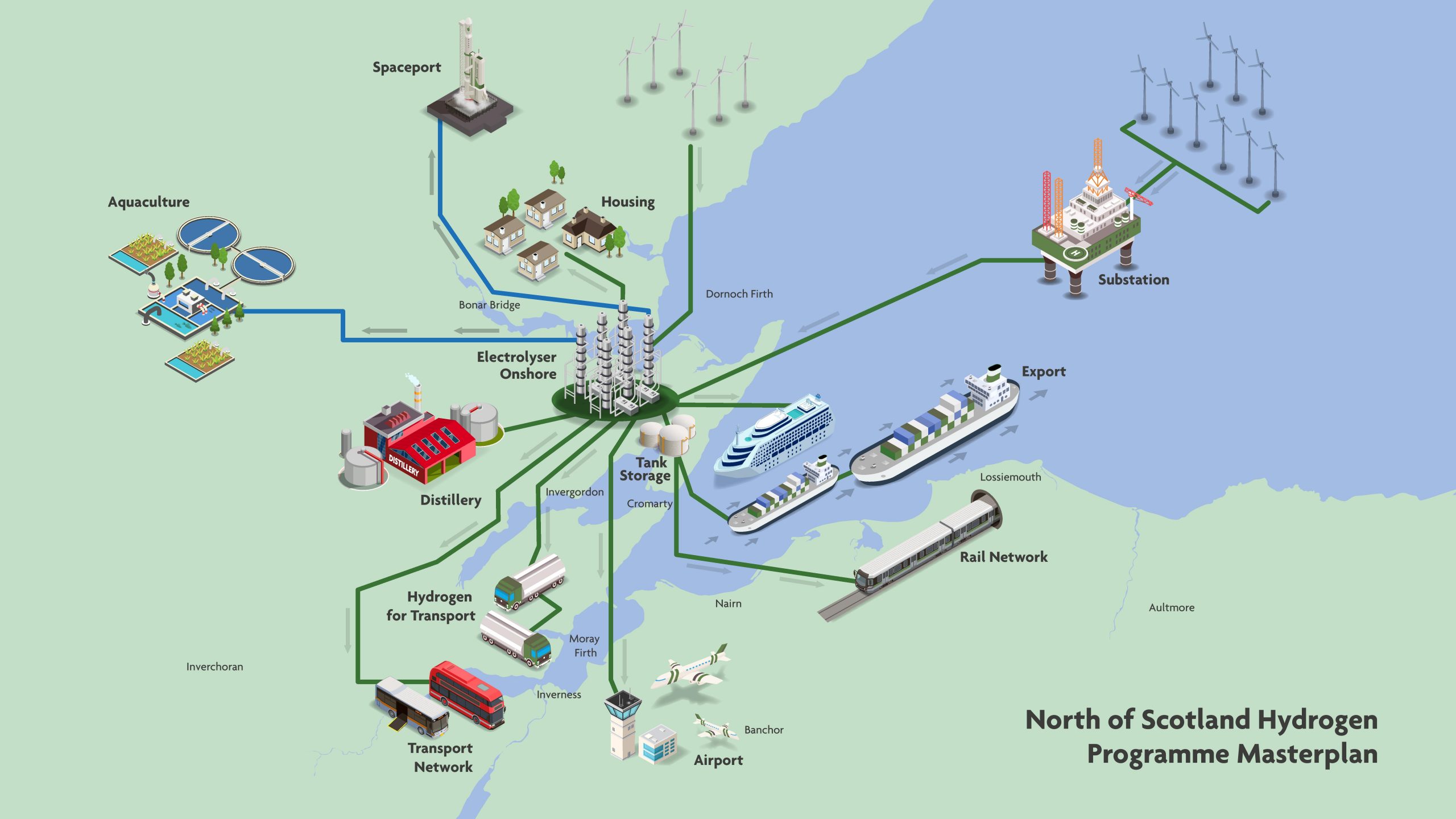
Note.
- Aquaculture is a use for the oxygen produced by the electrolyser.
- Everybody is promoting spaceports. Both hydrogen and oxygen can be used as rocket fuel.
- Hydrogen or electricity is shown powering all sorts of transport, including buses, a cruise ship, trains and trucks.
It certainly is a comprehensive plan.
Hydrogen At The Forth Green Freeport
Hydrogen is mentioned on the About page of the Forth Green Freeport web site in this general statement.
Investments will stimulate growth in trade, providing expanded logistics and trade capacity for existing and emerging industries including advanced modular systems, biofuels, hydrogen and carbon capture and storage, as well as support additional R&D capability and green incubator space to drive SME and start-up business growth.
But as INEOS are a partner, I would expect some hydrogen production from all that green offshore electricity.
Lithuanian Gas Pipeline Hit By Large Explosion
The title of this post, is the same as that of this article on the BBC.
This is the sub heading.
A large blast has hit a gas pipeline in the Pasvalys region of northern Lithuania, near the Latvian border.
This Google Map shows the location of the explosion.
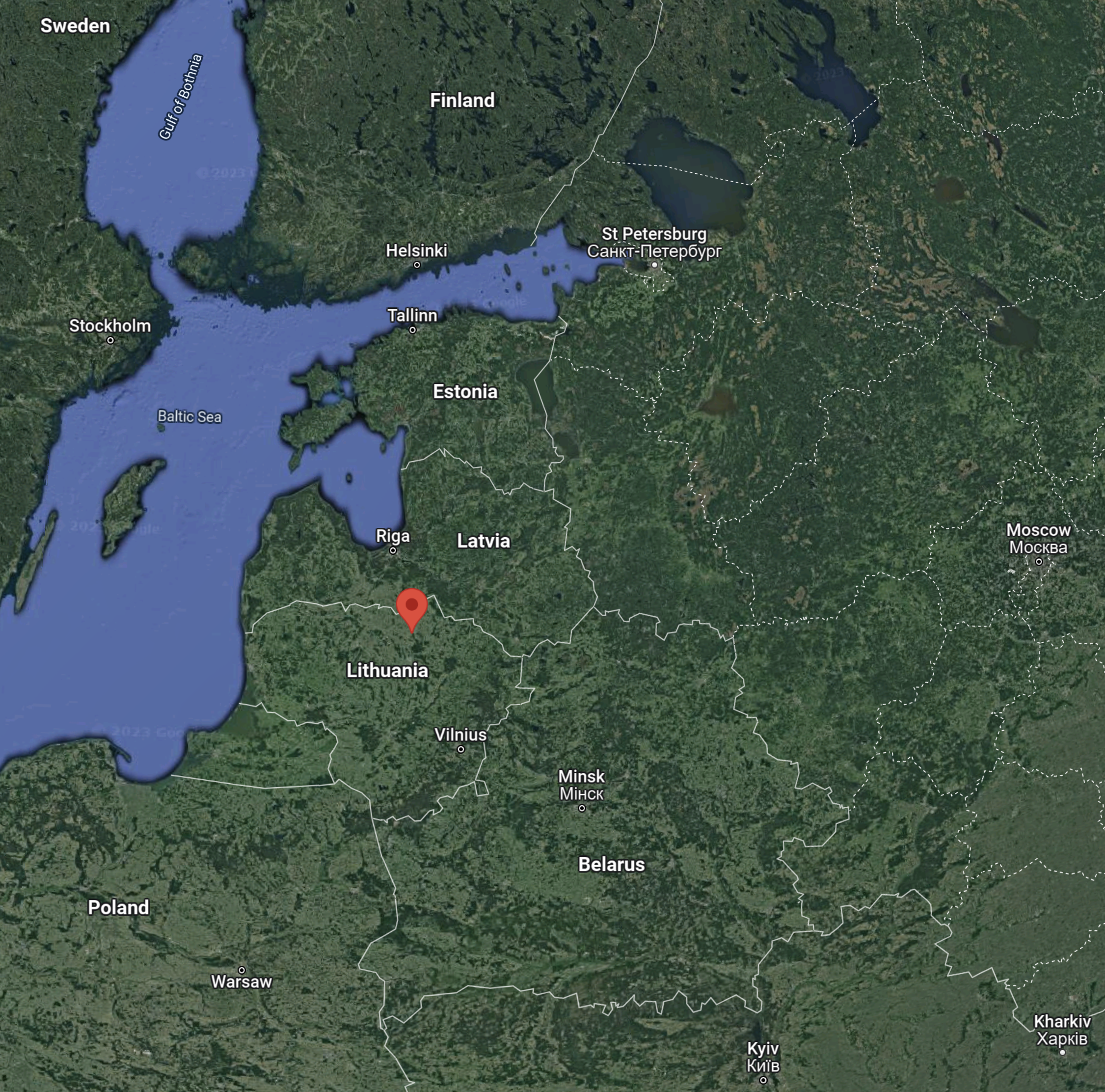
Note.
- Country borders are marked as white lines.
- The site of the explosion at Pasvalis Vienkiemii, is marked with a red arrow.
- Pasvalis Vienkiemii is about a hundred miles from Vilnius.
- About a hundred miles to the East of Pasvalis Vienkiemii, is the point, where Belarus, Latvia and Lithuania meet.
- Russian territory is about a hundred miles further to the East.
I have experience of the quality of borders in that area.
South-West of Lithuania and lying between that country and Poland, there is the small Russian enclave of Kaliningrad.
These pictures show the border between Poland and the Kaliningrad enclave of Russia.





If the borders between Belarus, Latvia and Lithuania are as secure as this, they are almost an open invitation to saboteurs to enter and do damage.
Cars In Central London Surged 60% After Khan Stopped Evening Congestion Charge
The title of this post, is the same as that of this article on the Standard.
These are the first two paragraphs.
Transport for London’s own data shows the dramatic impact of the Mayor’s decision to shorten the £15-a-day C-charge’s operating hours, ending it at 6pm rather than 10pm.
Last February, an average of 12,968 vehicles entered the zone between 6pm-10pm. But by October this had increased to 20,654 — a rise of 59 per cent.
To a Control Engineer like me, it is obvious that if you reduce the cost of the London Congestion Charge in the evenings between 18:00 and 22:00, you’re going to get more traffic.
Was that what was intended?
Or was the Mayor given bad advice?
I would have thought, the best course of action would have been to keep the charges as they were and use some the money to improve public transport in the central area.
First Offtake Deal Signed For 500MW/4,000MWh Advanced Compressed Air Energy Storage Project In California
The title of this post, is the same as that of this article on Energy Storage News.
These three paragraphs explain the deal.
Advanced compressed air energy storage (A-CAES) company Hydrostor has signed a power purchase agreement (PPA) for one of its flagship large-scale projects in California.
Central Coast Community Energy, one of California’s several dozen Community Choice Aggregator (CCA) non-profit energy suppliers, has signed a 200MW/1,600MWh energy storage PPA with a 25-year term with Toronto-headquartered Hydrostor for its Willow Rock Energy Storage Center.
That’s just under half of the output and capacity of the planned 8-hour, long-duration energy storage (LDES) facility, which is designed to be 500MW/4,000MWh. This is its first offtake deal, but the company is in discussion for others to take the rest of the plant’s available resource.
The article says that Hydrostor aim to have the plant online by 2028.
This segment describes their current projects.
It is currently working on large-scale projects with around 9GWh storage capacity in total across two sites in California as well as another in Australia.
Together with Willow Rock in Kern County, Hydrostor is developing the 400MW/3,200MWh Pechos Energy Storage Center in San Luis Obispo County, California, and the 200MW/1,500MWh Silver City Energy Storage Center in Broken Hill, New South Wales, Australia.
On its UK Projects page, Highview talks about a 200MW/2.5GWh facility in Yorkshire, which puts the two companies in similar markets, with Hydrostor appearing to have slightly larger systems under development.
Conclusion
It will be interesting to see how this technology progresses and which company does best in what is a very large energy storage market.
Zero-Carbon Lighting Of Large Spaces
In Cockfosters Train Depot – 12th January 2023, I took a series of pictures of Cockfosters Train Depot, of which these are a selection.








Note, the lamp clusters on top of tall poles to light the area.
You see lots of these lights to illuminate play areas, car parks, rail sidings and truck depots.
Could a SeaTwirl or another vertical wind turbine be placed as high as possible up the pole, that supports the lights?
- A battery would be needed for when the wind doesn’t blow.
- A control system would be used to use the lights, when they are needed.
- The poles would be able to be laid down, like many lights can be, for servicing from the ground.
Cockfosters would be an excellent location for a test, as the wind is always blowing and the site has an altitude of nearly a hundred metres.
 The Anonymous Widower