‘A Gift For Putin’: Czech E-shop Sells Tanks And Grenades To Support Ukrainian Army
The title of this post, is the same as that of this story on expats_cz.
This is the introductory paragraph.
The Czech Republic has been among the most active countries in supporting the Ukrainian military with donations and sales of weapons and ammunition, including shipments of Soviet-era tanks, multiple rocket launchers, howitzers, infantry fighting vehicles, and anti-aircraft weapons.
I hope the gift, will calm Vlad the Mad.
Full Story Of Hywind Scotland – World’s First Floating Wind Farm
The title of this post, is the same as that of a YouTube video.
I’m posting this, as I spent an enjoyable few months, doing simulations for a similar structure from a company called Balaena Structures, that had been founded by two engineering professors from Cambridge University.
Their structure was to be used as an oil or gas platform.
- It would have been built horizontally in a dock, where you might build supertankers.
- It would have been launched and then erected to a vertical position.
- Equipment would then have been craned on top.
- The professors also talked of it being held in place by means of the gumboot principle and the large weight.
- It was also designed to be reusable.
Sadly, they never sold an example.
I said more about my involvement with Balaena Structures in Are Floating Wind Farms The Future?.
Cerulean Winds Is A Different Type Of Wind Energy Company
I introduced Cerulean Winds in a post called What Is INTOG?, but I have decided it is too important a concept to be buried in another post.
Cerulean sounds like it could be a sea monster, but it is actually a shade of blue.
This article on offshoreWind.biz is entitled Cerulean Reveals 6 GW Floating Offshore Wind Bid Under INTOG Leasing Round.
These are the two introductory paragraphs.
Green energy infrastructure developer Cerulean Winds has revealed it will bid for four seabed lease sites with a combined capacity of 6 GW of floating wind to decarbonise the UK’s oil and gas sector under Crown Estate Scotland’s Innovation and Targeted Oil and Gas (INTOG) leasing round.
This scale will remove more emissions quickly, keep costs lower for platform operators and provide the anchor for large-scale North-South offshore transmission, Cerulean Winds said.
Note.
- It is privately-funded project, that needs no government subsidy and will cost £30 billion.
- It looks like each site will be a hundred turbines.
- If all the sites are the same, they could be 1.5 GW each, with the use of 15 MW turbines.
- Each site will need £7.5 billion of investment. So it looks like Cerulean have access to a similar magic money tree as Kwasi Kwarteng.
This paragraph describes their four hundred floating bases.
The steel floating bases would constitute hundreds of thousands of tonnes of steel, which unlike cement fixtures, can be floated out from shore which is said to be ideal for the UK.
Building those bases, is a very large project.
On their web site, Cerulean Winds have a page entitled Targeted Oil And Gas Decarbonisation.
This the page’s mission statement.
Cerulean Winds, a green energy & infrastructure developer, is leading a pioneering bid to reduce carbon emissions from oil and gas production through floating offshore wind.
These three paragraphs describe the scheme.
Cerulean Winds pioneering bid proposes an integrated floating wind and hydrogen development across four offshore floating wind farms located West and East of the Shetland Islands and in the North and the South of the Central North Sea (CNS). The objective of the project is to generate electricity from floating wind farms located far offshore on otherwise unallocated and uneconomic seabed areas in order to power oil and gas platforms with green energy.
Cerulean Winds’ dedicated power transmission network will offer both green electrons and green molecules to oil & gas production facilities across the UK Continental Shelf (UKCS) with surplus energy used in the production of green hydrogen. This dual approach allows the project to support all ages of oil and gas platforms with constant, reliable power and minimal brownfield modifications.
The optimised scale at which Cerulean Winds’ proposed scheme operates makes it the world’s largest decarbonisation project. It offers green energy to operators for asset power generation, delivered through an affordable Power Purchase Agreement (PPA). Another big advantage is the scheme does not require any public subsidies, but funded entirely through private investment.
That is sensational.
Effectively, they’re building four 1.5 GW power stations in the seas around us to power a large proportion of the oil and gas rigs.
I do have some thoughts.
Who Pays For This Massive Project?
This project overview on the Cerulean web site is entitled The Cerulean Winds INTOG Scheme and it gives many more details of the project.
I will refer to this page as the project overview in the subsequent text.
This is the first sentence of the first paragraph.
Our basin-wide scheme represents more than £30 billion of private investment in a single strategic infrastructure project.
Consider.
- The London Olympics in 2012 cost £9 billion.
- The Elizabeth Line will probably cost around £20 billion.
- The Channel Tunnel in 1994 cost £9 billion.
This project is a lot bigger than these.
Will your spare fifty pounds, still be in your mattress, when Cerulean Winds has put its £30 billion together?
I think so, as this is the last sentence on the page.
The scheme is ‘private wire’ and will not require Government subsidies… being funded entirely through private investment, with no cost to the tax payer.
There will of course, be tax rebates available, as they are for any business from the smallest to the largest.
Green Hydrogen Will Be Produced Offshore
The project overview says this about green hydrogen.
The scheme would use floating offshore wind to power oil and gas assets with surplus energy converted into green hydrogen. Cerulean Winds recognise each brownfield site has a different set of requirements and this would give operators the flexibility to electrify some Brownfield assets without the need to interrupt existing production or shutdown. It would also safeguard oil and gas jobs and create new green energy jobs within the floating wind and hydrogen sectors within the next five years.
The operator will have a choice of energy – electricity or hydrogen.
How Will The Project Earn An Income?
It appears that the project, will have a number of income streams.
The main stream, is described in this sentence from the project overview on the web site.
We have a deep understanding across the energy sector and will partner with the operator to agree the best way to achieve decarbonisation targets at the lowest possible cost. Our approach offers both green electrons and green molecules to the platforms through an affordable Power Purchase Agreement (PPA).
It looks like the oil and gas companies that own the rigs will be significant contributors to Cerulean’s cash flow.
Green electrons (electricity) and green molecules (hydrogen) will also be brought ashore and sold to various operators and the grid.
What Happens To The Gas That Is Currently Used To Power The Oil And Gas Rigs?
I do wonder, the gas, which will no longer be needed to power the rigs will give a boost to the supply to UK consumers.
They’ve thought of that one.
Under a heading of Reducing Gas Imports, this is said.
The project also aims to maximise recovery of energy from offshore platforms. With few exceptions, each platform have their own gas turbines for power generation, burning gas extracted from the reservoirs. Approximately 10% of the gas produced each year is used in offshore power generation. By replacing the need for gas power generation with a supply of clean, green energy, Cerulean Winds’ project frees important volumes of gas produced by platforms for consumption and reduces the UK’s import of gas from overseas.
This project, when it is fully implemented could increase UK gas production by up to ten per cent.
What’s In It For The Rig Operators?
They will have some benefits.
- They will cut their carbon dioxide emissions.
- They will sell about ten percent more of the gas they extract.
- Decarbonisation will not necessarily mean large capital expenditure on the rig.
- I also suspect, that some conveniently-placed rigs will be used to send excess hydrogen from Cerulean Winds’ electrolysers to the shore.
Some rig operators will make money from decarbonisation.
When Will The Project Be Complete?
This is the first paragraph on the project overview.
Our basin-wide scheme represents more than £30 billion of private investment in a single strategic infrastructure project. The locations will be West and East of the Shetland Islands and in the Central North Sea (CNS). They will become operational by 2028.
So we don’t have to wait for ever!
What Happens To Cerulean’s Project, When The Oil And Gas Runs Out Or We Stop Using Oil And Gas?
There would now be four 1.5 GW wind farms in the North Sea, that could be connected to the National Grid.
Conclusion
It looks like Cerulean Winds are a very different energy company.
Do All Wind Turbines Have To Be Similar?
I feel this is a reasonable question to ask.
But do all wind turbines have to look like those in this picture?

Wikipedia lists three main types.
- Horizontal Axis – Those in the picture are of this type, as are all the large wind turbines I’ve seen in operation.
- Vertical Axis – Wikipedia shows several examples.
- Unconventional Types
Recently, I have come across some which would be placed in the last group.
Hybrid Offshore Wind And Wave Energy Systems
This article on the Journal of Physics is entitled Review of Hybrid Offshore Wind and Wave Energy Systems, is a study from serious academics.
This is the abstract.
Hybrid wind wave systems combine offshore wind turbines with wave energy on a shared platform. These systems optimize power production at a single location by harnessing both the wind and the waves. Wave energy is currently at an earlier development stage than offshore wind. Research in this area is focused in wave energy converters being used for platform motion suppression of floating offshore wind turbines. Wave energy converters can passively shelter offshore wind turbines from waves and can also be actively controlled to reduce the system loads. Additionally, a small amount of supplemental power may be generated, which can be used for offshore wind turbine local power needs. There may be future benefits to these hybrid systems, but at this stage wave energy may increase the project cost and risk of offshore wind turbines. Hybrid wind wave system research and development is discussed, with a focus on floating offshore wind turbines. Additionally, two ocean demonstration scale hybrid wind and wave systems are discussed as case studies: the Poseidon Wave and Wind system and the W2Power system. Hybrid wind wave systems show potential to be part of the future of offshore wind energy.
Note.
- Wave energy development is at an earlier stage than offshore wind.
- Wave energy converters can passively shelter offshore wind turbines from waves and can also be actively controlled to reduce the system loads.
- There is more about Poseidon on this page on the Tethys web site.
- There is more about W2Power on the Pelagic Power web site.
The last sentence of the abstract is significant and I believe that hybrid offshore wind and wave energy will play a significant part in the future of offshore energy.
Wind Turbines With Added Storage
Critics and cynics of wind power always ask, what happens, when the wind doesn’t blow.
It is generally accepted, that the best thing to do is to pair a wind farm with some form of energy storage.
Technologies and solar and/or wind farms with energy storage are starting to be proposed and/or installed.
- In Cleve Hill Solar Park, I wrote about a solar farm, a wind farm and a battery sharing a grid connection.
- In First Ever Gravity Green Energy Storage System Set For North Yorkshire Town, I wrote about a battery being installed where two massive wind farms connect to the grid.
- In How To Store Excess Wind Power Underwater, I describe a Dutch system called an Ocean Battery.
- In UK Cleantech Consortium Awarded Funding For Energy Storage Technology Integrated With Floating Wind, I wrote about adding Marine Pumped Hydro to offshore wind farms.
More energy storage will be added in the future in or near to wind and solar farms.
Twin Turbines
This document from the Department of Business, Industry and Industrial Strategy lists all the Contracts for Difference Allocation Round 4 results for the supply of zero-carbon electricity.
One of the projects allocated a Contract for Difference, was the 32 MW TwinHub wind turbine, which I wrote about in Hexicon Wins UK’s First Ever CfD Auction For Floating Offshore Wind.
A full scale twin turbine hasn’t been built yet, but it does seem promising and the visualisations are impressive.
Scroll down on the TwinHub home page to see a video.
World Wide Wind
I’ll let the images on the World Wide Wind web site do the talking.
But who would have thought, that contrarotating wind turbines, set at an angle in the sea would work?
This is so unusual, it might just work very well.
Conclusion
There will be other unusual concepts in the future.
Ørsted Signs Two ‘Industry First’ Monopile Contracts For Hornsea 3 Foundations
The title of this post, is the same as that of this press release from Ørsted.
This is the introductory paragraph.
Ørsted, the world’s most sustainable energy company, has signed two ‘industry first’ contracts for the fabrication of XXL monopile foundations for the Hornsea 3 offshore wind farm.
I have a few thoughts about the press release.
XXL Monopile Foundations
These four paragraphs describe Hornsea 3’s XXL monopile foundations.
Subject to Ørsted taking a Final Investment Decision on Hornsea 3, the contracts have been finalised with Haizea Wind Group, through its subsidiary Haizea Bilbao, and SeAH Wind Limited, a UK-based subsidiary of SeAH Steel Holdings (SeAH).
Ørsted will be the first major customer at SeAH Wind’s new monopile facility in Teesside, and the agreement with Haizea marks the company’s first XXL monopile contract with Ørsted.
The deal with SeAH represents the single largest offshore wind foundations contract secured by any UK company. Haizea’s agreement is the largest single contract ever secured by Haizea Wind Group.
Each of the huge foundation structures for Hornsea 3 will weigh between 1,300 and 2,400 tonnes and measure in at between 83 and 111 metres in length. Monopile production is expected to start in 2024.
Note
- These are huge steel structures.
- But then the water depth appears to be between 36 and 73 metres.
- It looks like the orders are shared between Spanish and Korean companies
This article on offshoreWIND.biz, is entitled Beyond XXL – Slim Monopiles For Deep-Water Wind Farms.
These are some points from the article.
- XXL-Monopiles have been successfully used for water depths of up to 40 metres. Now wind farm developers need monopiles “beyond XXL”.
- The extension of the range is needed, mainly to enable the use of larger turbines, deeper water, and harsher environmental situations.
- These monopiles will allow turbines of up to 15 megawatts with rotor diameters of up to 230 metres.
- This monopile design automatically induces the idea of design and fabrication optimisation to ensure that monopiles continue to lead the ranking of most economical foundation systems.
In the 1970s, I was involved with a Cambridge University spin-out company called Balaena Structures, who were using similar much larger structures to support oil and gas production platforms.
I was just doing calculations, but I do wonder if these XXL monopile foundations, owe things in their design to work done by structural engineers, like those I met at Cambridge fifty years ago.
Are These Two Stories Related?
These are two stories recently published in Railway Gazette.
Deutsche Bahn Sells Arriva Businesses To Private Equity Holding Company, which starts with this paragraph.
Deutsche Bahn has reached agreement to sell its Arriva local transport activities in Denmark, Poland and Serbia to München-based private equity holding company Mutares SE & Co KGaA.
That is fairly clear and is probably related with the German government’s desire for DB to concentrate on its core business.seren
This article on Railway Gazette is entitled RENFE Looks At Entering UK Rail Market Through Open Access Partnership, which starts with this paragraph.
Open access passenger service developer Grand Union Trains is working with Spain’s national operator RENFE and private equity firm Serena Industrial Partners on a proposed service between London and Wales.
That also is fairly clear and would bring competition to services to and from South Wales.
It would also help in the financing of Grand Union Trains.
The article also says the following.
- RENFE seem to be expanding into partnerships to run services outside Spain.
- A parkway station at Felindre will be build to avoid the reverse at Swansea, that would save 20 mins.
- It will be a high quality service with new electro-diesel trains.
- Four trains will be needed.
- A 2025 start is envisaged.
Will this partnership with Grand Union Trains proceed with the development of Grand Union Trains’ London and Stirling service?
I have some thoughts and questions.
Will Deutsche Bahn Sell Other Arriva Businesses?
I think this is a reasonable question to ask, especially, as Deutsche Bahn owns two Open Access Operators in the UK; Chiltern Railways and Grand Central Trains.
- Both operators have a good reputation.
- Both operators need to decarbonise, either by updating their current stock or buying new trains.
- Both operators have solid niche markets, where they are often responsible for the stations.
- Both operators have expansion plans.
Would RENFE and Serena Industrial Partners be interested in taking over Arriva UK and developing the business?
The Talgo Factory At Longannet
I believe that there is reason to believe that one of Talgo’s reasons for a factory in Scotland, is that it could have been used to build Russian and dual-gauge trains for Eastern Europe. The trains would have been delivered by ferry from Rosyth.
There is also the not-small matter of the fleet for Rail Baltica, for which Talgo will surely be a bidder.
But Russia’s attack on Ukraine has scuppered that plan, or at least delayed it for a few years. But now, there could be a much larger market for trains in Eastern Europe and especially Ukraine.
If RENFE Acquire Open Access Operators In The UK, They Will Need New Trains
They will certainly need new trains for the South Wales operations, if they go ahead, but if they were to decarbonise Chiltern and Grand Central, the order could be substantial.
With one Spanish train factory in the UK and another a possibility, I would suspect any train order would go to a Spanish train-builder.
If the orders fell right, could we see Talgo’s factory at Longannet built after all?
Artemis Technologies Unveils World’s Most Advanced 100% Electric Passenger Ferry
The title of this post, is the same as that of this press release from Artemis Technologies.
These bullet points list the features of the EF-24 passenger ferry.
- With a top speed of 38 knots and a foiling range of 115 nautical miles at 25 knots, these vessels will transform the global passenger ferry market as it races to decarbonise
- Produces minimal wake, enabling high-speed operations in busy waterways
- Riding above the waves results in a comfortable ride, reducing effects of seasickness
- Efficiency of foils and electric drive system delivers significant OPEX savings including lower maintenance costs and up to 85% fuel savings
- Electric propulsion generates zero emissions in operation, removing air, water and noise pollution
- These 24 metre vessels designed and built by Artemis Technologies represent ground-breaking green innovations for commercial ferries, radically different from traditional ferries in operation
- First EF-24 Passenger ferry will be operated by Condor Ferries in 2024
- 100% electric, the vessels and systems developed by Artemis Technologies are designed to make the lowest possible impact on the environment
It certainly looks the part, but then it was designed using technology from racing yachts.
I have a few thoughts.
The Bangor And Belfast Trial Route
The press release says this about a trial route.
Artemis Technologies has partnered with Condor Ferries to operate a pilot scheme using the first EF-24 Passenger ferry. This will come into service in 2024, running between Belfast and Bangor in Northern Ireland.
This Google Map shows the location of the two cities.
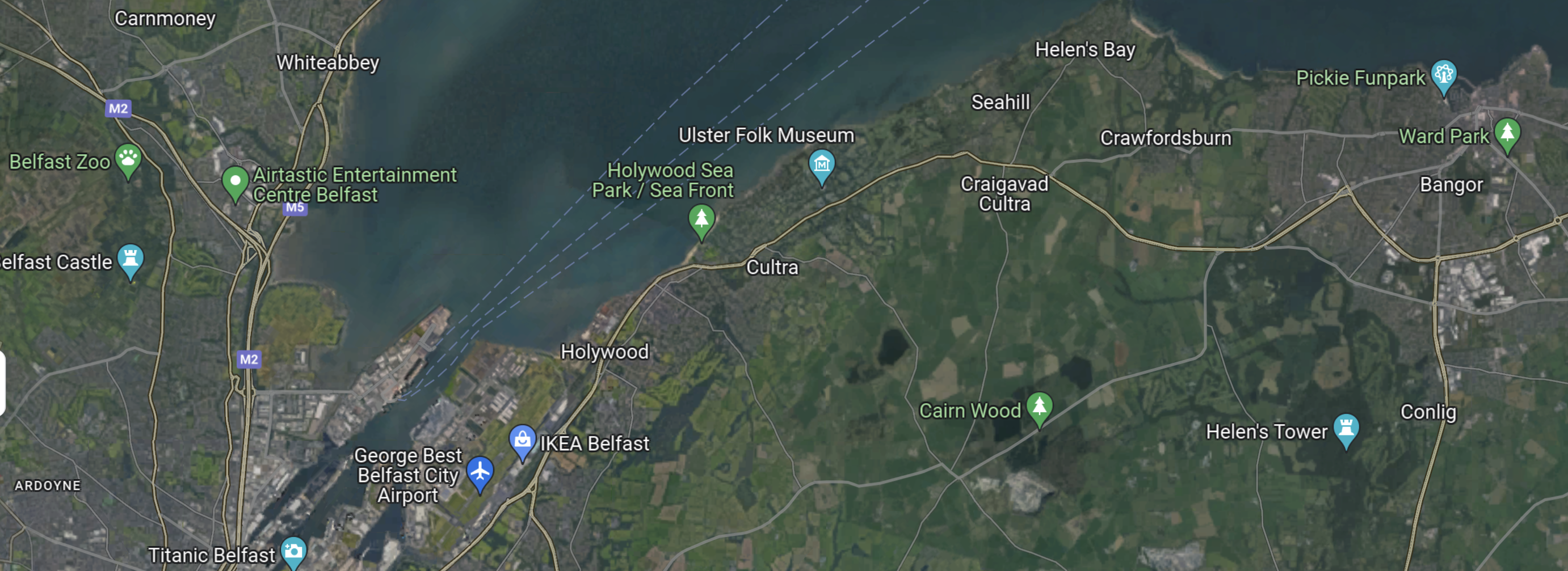
Note.
- Belfast is in the South-East corner of the map.
- The Titanic Quarter and George Best Airport are marked.
- I walked between the Airport and the Titanic Quarter, when I visited five years ago.
- Bangor is in the North-East corner of the map.
I have actually travelled between Belfast and Bangor on a train, which I wrote about in A Train Trip From Belfast To Bangor.
As the Thames Clipper in London competes well for commuters and other passengers in London, I would think that they will attract passengers.
I regularly go one way to Battersea Power Station on the Northern Line and come back on the Clipper to London Bridge, as it puts a bit of fresh air in my lungs.
Will the good burgers of Belfast do the same?
As the service will start at the Titanic Quarter, it could be a tourist attraction.
Other Routes
If you look at the Wikipedia entry for hydrofoil, there are a lot of route possibilities.
I have a few suggestions.
Thames Clippers
The Thames Clipper fleet is all diesel and typical boats have a 28 knot cruising speed and carry between 150-172 passengers.
So it would appear that EF-24 Ferries would have a similar performance.
Thames Clippers have promoted the possibility of a service from London to Gravesend, which is under thirty miles by road.
An EF-24 Ferry might be ideal for the longer route.
High-Speed Routes Between Great Britain And Ireland
In High-Speed Low-Carbon Transport Between Great Britain And Ireland, I laid out ideas to travel between the two islands.
I showed that by using high speed trains to Holyhead and then a high speed ferry, times of under five hours could be achieved to both Belfast and Dublin.
If a High Speed Two Classic-Compatible Train were to be used timings from Euston to Holyhead could be.
- Euston and Crewe – 56 minutes – High Speed 2 prediction
- Crewe and Holyhead – 1 hour 58 minutes – Current time.
The second leg would be faster, if the route were to be electrified.
Mersey Ferries
Like Merseyrail’s elderly Class 508 trains, the Mersey Ferries are long in the tooth and need replacing.
In my view, Artemis Technologies could build some very suitable electric ferries.
New routes might also be developed to appeal to tourists.
I am sure there are many more routes in the UK and around Europe and the wider world.
Ørsted Completes 50% Stake Sale In Hornsea 2 To French Team
The title of this post, is the same as that of this article on Renewables Now.
This sale was outlined in this press release from Ørsted in March, where this is the first paragraph.
Ørsted has signed an agreement to divest a 50 % ownership stake in its 1.3 GW Hornsea 2 Offshore Wind Farm in the UK to a consortium comprising AXA IM Alts, acting on behalf of clients, and Crédit Agricole Assurances.
Insurance companies must like wind power, as Aviva backed Hornsea 1 wind farm. I wrote about this in World’s Largest Wind Farm Attracts Huge Backing From Insurance Giant.
It looks like the French feel the same way as Aviva about Ørsted’s Hornsea wind farms.
There is no safer mattress in which to stash your cash.
Accelerating The Delivery Of Offshore Wind Farms
It is one of Kwasi Kwarteng’s ambitions to accelerate the delivery of offshore wind farms.
In The Growth Plan 2022, these groups of wind farms are mentioned.
- Remaining Round 3 Projects
- Round 4 Projects
- Extension Projects
- Scotwind Projects
- INTOG Projects
- Floating Wind Commercialisation Projects
- Celtic Sea Projects
My thinking in this post, will probably apply to all of these groups.
These are my thoughts.
Accelerating Delivery Of A Wind Farm
This will have these positive effects.
- Electricity will be delivered earlier.
- Customers will have a more secure supply of electricity.
- The wind farm owner will start to be paid for their electricity.
- The Crown Estate will start to be paid for their leases. Although, these might start at signing.
- National Grid will be paid for the transmission of the electricity.
- An energy storage company could be paid for storing surplus electricity.
- Construction teams and engineers can move on to the next project.
- Expensive construction hardware like ship-mounted cranes will no longer be needed.
- I also suspect that the government will raise some taxes from the various companies involved.
It looks like it’ll be winners all round.
How Will Delivery Be Accelerated?
These are some thoughts.
Overall Project Time
In How Long Does It Take To Build An Offshore Wind Farm?, I came to these conclusions.
- It will take six years or less from planning consent to commissioning.
- It will take two years or less from the start of construction to commissioning.
I suspect that as we have been building offshore wind farms for some years, that it will be very difficult to reduce these times significantly.
But as some wind farms take quite a few years to progress from the initial proposal to planning consent, I suspect that improvements to the planning process may speed up the overall construction time of a wind farm.
Project And Resource Management
Good project and resource management will always help.
Better Design And Construction Methods
I always remember in the early days of North Sea Oil, being told by a very experienced project manager that construction of production platforms was accelerated by the availability of larger and more powerful cranes.
Are we approaching the design of the ultimate wind farm? I doubt it, as in the last few months, I’ve seen two very radical new designs.
In Hexicon Wins UK’s First Ever CfD Auction For Floating Offshore Wind, I show this image of one of their TwinHub turbine installations being towed into place.
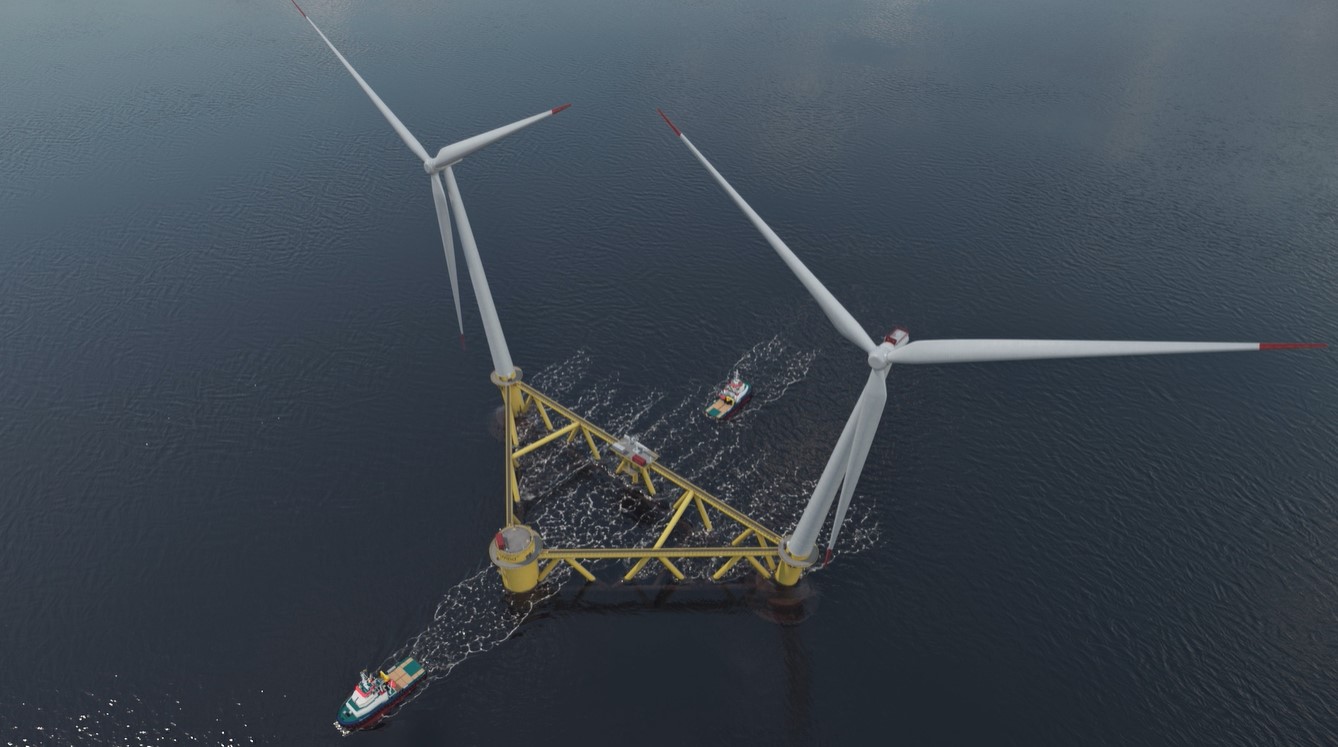
The TwinHub home page has a title of The First Floating Offshore Wind Project in The Celtic Sea.
This is the description on the page.
The TwinHub offshore wind demonstration project intends to prove how Hexicon’s innovative design with two turbines on one floating foundation can further reduce the Levelized Cost of Energy (also referred to as LCoE) before large scale commercialisation. The TwinHub project is a stepping stone to help kick-start floating wind in the Celtic Sea, an area identified as a hotspot for floating wind by the UK Government. It will pave the path for larger and larger projects to help support The Crown Estates’ ambitious target of 4GW of floating wind in the Celtic Sea.
Scroll the page down and there is a fascinating short video of a pair of wind turbines in operation.
- It appears that when there is no wind, it automatically goes into a safe parked mode.
- As the wind rises, one turbine starts up.
- The second turbine starts up and the float turns so they face the wind.
It appears to be a classic example of disruptive innovation.
I have a feeling that this type of installation might have generation, assembly and cost advantages over a single turbine mounted on a single float.
RCAM Technologies are also creating interesting designs for mounting turbines and energy storage using 3D-printed concrete.
What Ts The UK Government Doing To Accelerate Projects?
This article on offshoreWIND.biz, was published in late September 2022 and is entitled BREAKING: UK Puts Massive Amount Of New Offshore Wind Capacity On Fast Track and this is the first paragraph.
The UK will speed up planning and development consent processes for projects from the recently completed, currently ongoing, and upcoming (floating) offshore wind leasing rounds to bring new energy capacity online faster and facilitate economic growth and job creation.
The article is based on what Kwasi Kwateng said on the 23rd of September about speeding up projects in the 2022 Growth Plan.
A Quick Summary Of Our Wind Energy
The article has this paragraph, which summarises our wind energy.
For the UK, which currently has around 14 GW of offshore wind capacity in operation and 8 GW under construction, the projects from the listed auction rounds could bring well beyond the targeted capacity for 2030, which was recently raised to 50 GW.
I can see the target being raised again to at least 60 GW.
Great Western Railway Get Innovative
This article on Rail Advent, which is entitled Great Western Railway Trial New Long Weekender Ticket Between London Paddington, Bristol And South Wales, caught my eye.
This is the Long Weekender page on the Great Western Railway web site.
This seems to be the basic rule.
Leave on a Friday or Saturday, return on a Monday and save over 60% compared to an Anytime Return.
You can also apply your Railcard.
This sounds very useful to me.
As an example, I spent an enjoyable couple of days in Swansea, where I explored the area on the rail network. This could be made to fit in with one of these tickets, even if it meant buying a return from Cardiff.
I shall investigate further, as the website booking doesn’t seem to know about the Long Weekender ticket.
I visited Paddington this afternoon and asked one of those guys in a green uniform.
He told me that at the moment you have to buy them in the Booking Office and that they will be available on the web site.
He also thought they were a good idea.
There is also this post on Ian Visits, which is entitled GWR Launches “Long Weekend” Train Tickets.
Ian says this.
GWR added that if the trial of the Long Weekender proves successful, it will be extended to other parts of the network.
Does that mean GWR’s or the National network?
 The Anonymous Widower