Spain Launches App To Show If Men Shirk Housework
The title of this post is the same as that of this article in The Times.
This is the first paragraph.
Spain has announced plans to introduce an app that promises to address the gender imbalance of housework by getting users to log the hours they spend on chores.
At least it’s a free app!
How Sideshore Technology Can Optimise The Layout Of Your Offshore Wind Farm By Applying State-Of-The-Art Algorithms
The title of this post, is the same as that of this article on offshoreWIND.biz.
This is the sub-heading.
Smarter offshore wind farm layouts will accelerate the energy transition
These paragraphs outline the problem.
Wind farm layout optimisation is the art of defining the optimal locations of wind turbines, infield cables and substation structures. It presents a golden opportunity to increase project value.
The academic community has done extensive research into numerical wind farm layout optimization, however, in real projects, it is hardly ever applied. Wind farm layout optimisation is complex because it is multidisciplinary. A wind farm development is typically split into work packages (turbine, foundations, cables, substation). The location of each turbine influences the project cost across the various work packages. While wake effects are important, other aspects need to be considered as well. For example, water depth affects the foundation size. Turbulence levels need to be restricted. And cables, seabed preparation, and soil conditions are often neglected, while they too can have a substantial impact on costs. Fully optimising the turbine positions requires not only insight into wake interactions and the cost drivers across all work packages but also a way of linking everything together.
My project management software writing experience would take a system like this further and use the output pf their system to create the project network for a project management system.
The possibilities then are endless.
Tiny Data Centre Used To Heat Public Swimming Pool
The title of this post, is the same as that of this article on the BBC.
This is the sub-heading.
The heat generated by a washing-machine-sized data centre is being used to heat a Devon public swimming pool
These three paragraphs outline the story.
The computers inside the white box are surrounded by oil to capture the heat – enough to heat the pool to about 30C 60% of the time, saving Exmouth Leisure Centre thousands of pounds.
The data centre is provided to the council-run centre free of charge.
Start-up Deep Green charges clients to use its computing power for artificial intelligence and machine learning.
Note.
I find both of these interesting applications.
Green Hydrogen Powered, Off-Grid Data Center-As-A-Service Is A World First
The title of this post, is the same as that of this article on Hydrogen Fuel News.
This is the first paragraph.
ECL has announced the world’s first off-grid Datacenter-as-a-Service, fully powered by green hydrogen, with 99.999% uptime at a much lower cost compared to traditional colocation data centers.
This paragraph gives details of an installation.
It runs with zero emissions at very low noise levels. The data center’s modularity combined with having no need to depend on local utilities means that it can be designed and delivered far more rapidly than other companies’ data centers. Instead of typical construction cycles that take between 18 – 24 month, ECL’s data centers take between six and nine months.
The product looks like a promising development.
I think this is the company’s web site.
The Ultimate Bus Stop
London has very comprehensive bus stops as these pictures show.








Note.
- Most bus stops have a pole mounted roundel, that can be seen from a reasonable distance. In many cases, anybody with reasonable sight can see the roundel for the next stop.
- Where space permits, bus stops have a shelter with seats, maps and instructions on ticketing.
- Some stops have been extended into the road, so that it is a level step into and out of the bus.
- As shown in the pictures, so bus stops have displays showing the next ten buses, that will be arriving.
But I do think, they could be improved, with extra features.
Internet Connectivity
I feel strongly, that all bus stops should have good internet connectivity.
This could be 4G, 5G or just wi-fi, but I believe this could help with the safety of people on the street.
Comprehensive Lighting
To contribute to safety, I also feel that all bus stops should be well lit.
CCTV Issues
I also feel that all bus stops should have provision for CCTV, so if there was a need, it could be quickly fitted. But if the bus stop had good internet connectivity, then this shouldn’t be a problem.
Phone Charging
New buses have this feature, so why not at the stops?
Power Supply Issues
If we add all these features, we could be needed an uprated power supply.
- So could we see bus stops, with solar panels on the roof.
- Perhaps even a mini wind turbine?
- I think a vertical wind turbine, which was similar to a SeaTwirl, but smaller, could be ideal!
- Could it be called a StreeTwirl?
- A self-powered bus could be created with the addition of a battery.
Self-powered bus stops might be easier to install.
Conclusion
Bus stops will have more features in the future.
Looking For A Job
There’s probably a lot like me these days, what with Putin’s war having depressed the financial markets and put up the cost of everything.
I’m now 75 and seem to regularly get good news about my health, which probably means that my pension will have to stretch further.
Before Christmas, I did a couple of weeks as a volunteer receptionist in a research institute and I enjoyed it.
Perhaps, I’m just lonely and feel a job would liven up my life.
I have a large number of skills and a wide range of knowledge about technical subjects.
I have programmed in many languages with the most useful probably being VB6, which I used for perhaps twenty years, so I might be the guy to update a VB6 system, that is vital to your business.
I am very much an algorithm person because of my background and have done a lot of work in project management.
I also live a few miles North of the City of London.
So if you have any ideas let me know!
Second Life Energy Storage Firm Smartville Inc On Modules vs Packs, Ramp-Up Plans And Tesla’s Approach
The title of this post, is the same as that of this article on Energy Storage News.
I like the concept of taking the life-expired batteries out of electric vehicles and giving them a second life as grid batteries.
Smartville seem to have taken this simple and useful idea to a new level.
These are my thoughts.
The Internet Of Batteries
By the use of clever software, it appears, that they can control different types of battery packs, in a manner that could be called the Internet of Batteries.
They can also measure the state and performance and calculate the replacement date of each battery pack.
The Mother Of All Batteries
The implementation of this concept in their MOAB product allows the controlling software to manage a number of battery packs precisely to deliver a battery of the precise number of MWh, that the customer ordered.
- Provided an interface driver can be written, any type and make of battery pack can be incorporated.
- Nearly new, salvaged or elderly battery packs cab be used.
- The operating system can predict, when a battery pack must be replaced.
- Smartville are planning to install a 4MWh grid battery in central California that will be co-located with an existing power plant.
In some ways, the controlling software, is like the Chief Coach of a tug-of-war team, of mixed sexes, weights and strengths, that by asking for the right level of power from each member, gets the required performance.
Working With Tesla
The article talks about why, they don’t work with Tesla, where this is said.
Our experience in the US is that Tesla does not seem to be interested in working with outside partners. They’ve also publicly stated that they’re not focused on battery repurposing, not in their current business model at least, which I think might change over time. But that’s their public stance at the moment. We’re absolutely open to working directly with them but the opportunity hasn’t presented itself.
Does this indicate, that Tesla and Elon Musk are not the easiest people to deal with?
Conclusion
I shall be following Smartville.
I Can Now See Why A Big Pharma Company Liked My Software Daisy
Yesterday, I went to a seminar about medical research.
There was a presentation, where data in several dimensions was shown and the data was crying out for a Daisy Chart.
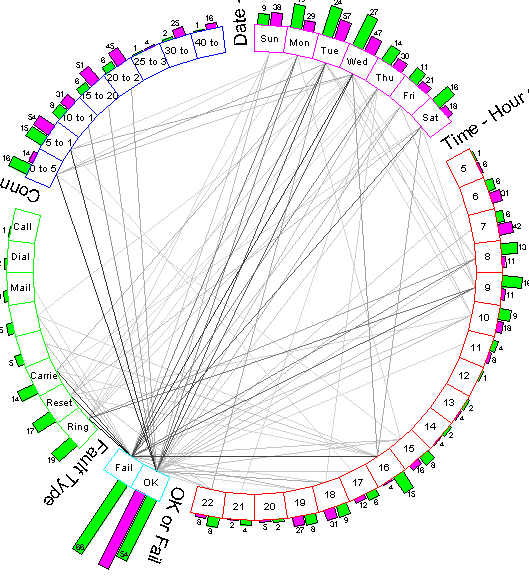
A Daisy Chart
This chart is a very simple presentation of telephone data, but I can imagine arcs showing factors like Dose, Blood Pressure, Sex, Patient Satisfaction etc.
Note.
- This chart is what I call a Day of the Week/Hour of the Day chart, which is a powerful way of looking at any time-based data, like faults or A & E arrivals.
- You can click on the nodes and links of the chart to access the data underneath. So if you wanted all female patients with high blood pressure in a separate Excel spreadsheet, this is possible with a couple of clicks.
- The charts can also be clipped from the screen and inserted into reports.
Daisy was used by one Big Pharma company twenty years ago and after yesterday’s presentation, I can understand, why they used it.
The seminar changed my mind about my attitude to Daisy and I got rather fired up about its possibilities.
Google Buys Scottish Offshore Wind Power
The title of this post, is the same as that of this article on offshoreWIND.biz.
This is the sub-heading and the first paragraph.
ENGIE and Google have entered into a 12-year, 100 MW corporate power purchase agreement (CPPA) supporting the Moray West offshore wind development in Scotland.
ENGIE will provide Google with more than 5 TWh of green power from the Moray West project, a nearly 900 MW offshore wind farm set to begin generating power from 2025.
Increasingly, it seems that large energy users are committing themselves to long-term energy deals.
One of Google’s senior people is quoted as saying.
People across the UK and Europe are increasingly worried about climate change and energy security. We share that concern and believe technology is an important part of the solution – both by reducing our own emissions, and by helping others to reduce their own.
I have a few thoughts.
How Much Of Moray West’s Output Is 5 TWh?
Consider.
- Moray West has an maximum output of 882 MW.
- This converts to 7.73 TWh.
If Google are buying all the electricity produced by the wind farm, that would mean that the capacity factor is around 64.7 %, which is quite reasonable, if a bit high for a fixed foundation wind farm.
If we are, it does surely reflect a desire for stability and security in a fast-changing world.
Are We Seeing More Corporate Power Purchase Agreements (CPPAs)?
Norwegian Company To Power Data Centres With Offshore Wind
The title of this post, is the same as that of this article on offshoreWIND.biz.
This is the sub-title.
Norwegian energy company Earth Wind & Power (EWP) is set to offtake up to 400MW of excess and pre-grid offshore wind power to supply electricity to data centre infrastructure in Northern Europe.
This sounds like a good idea.
Over the next few years, the UK will be ramping up our production of renewable energy.
Data centres could be an ideal way to make money from our excess energy.
 The Anonymous Widower