Xlinks Welcomes New Investor Octopus Energy In Providing Cheap Green Power To Over 7 Million Homes
The title of this post, is the same as that of this press release from Xlinks.
These are the first three paragraphs.
Xlinks is pleased to announce a financial and strategic partnership with energy tech pioneer Octopus Energy Group.
The Morocco – UK Power Project will speed up the UK’s transition to net zero by laying four 3,800km-long subsea cables to connect a huge renewable energy farm in the Moroccan desert with Devon in South West England. Morocco is setting its sights on becoming a world leader in solar energy, already boasting some of the world’s largest solar arrays, and meeting two-fifths of its electricity demand with renewables. There will be huge economic benefits to both countries involved, with Xlinks bringing green energy and engineering jobs to both the UK and Morocco.
The project will diversify UK supply routes and boost energy security through the supply of 3.6 GW of reliable, clean power to the UK for an average of 20 hours a day, enough green energy to power about 7 million homes.
Note.
- The cables will be nearly 2,400 miles
- It is scheduled to be operational in 2027.
- Xlinks is expected to deliver power at £48/MWh, which is comparable with offshore wind.
- Wikipedia talks of a Hinkley Point C strike price of £92.50/MWh (in 2012 prices).
- Greg Jackson, founder of Octopus Energy Group, is also a personal investor in the project.
- Greg Jackson is interviewed in this article in today’s Sunday Times.
I wrote more about this project in Moroccan Solar-Plus-Wind To Be Linked To GB In ‘Ground-Breaking’ Xlinks Project.
Conclusion
This mega-project could be approaching the point, where the starting gun is fired.
New Mobile Hydrogen Unit Unveiled By Logan Energy In Bid To Accelerate Greener Transport
The title of this post, is the same as that of this article on Fuel Cell Works.
This sums up the development, that has been unveiled by Logan Energy.
It is a compression trailer, that looks like it could be towed by any vehicle capable of towing a horse box.
- The compressor can transfer hydrogen between any two cylinders at all the usual pressures.
- It is aimed at both the bus and heavy goods vehicle market.
- The hydrogen capacity of the trailer is not stated.
I feel that this sort of development will help operators embrace hydrogen.
A bus company for instance could have an appropriate number of trailers, for their fleet of hydrogen buses.
- The bus company would need a suitable towing vehicle, like a light truck.
- Trailers would be filled at an electrolyser outside of the city.
- Each bus depot could have a space, where a trailer could be parked to fill the buses.
- A schedule would probably need to be developed for filling the trailers.
We will see more developments like this.
But they will have to compete with companies like ITM Power, who can supply on-site electrolysers.
Ofgem Enables National Grid To Make Early Payment Of Interconnector Revenues, Helping To Reduce Household Bills
The title of this post, is the same as that of this press release from National Grid.
These are the first three paragraphs.
National Grid has offered to pay £200m of interconnector revenues ahead of schedule rather than at the end of the standard five-year review period to play its part in reducing household energy bills.
Interconnectors, which are subsea electricity cables connecting the UK and Europe, enable the import of cheaper, cleaner energy from European neighbours, supporting security of supply and reducing carbon emissions.
It’s estimated that National Grid’s interconnector portfolio will help the UK avoid around 100 million tonnes of carbon emissions by 2030.
Ofgem has approved National Grid’s request to make early payments.
These are my thoughts.
What’s In It For Consumers?
National Grid is making a payment early, so they are not getting anything, they won’t eventually get.
But they are getting it early!
What’s In It For National Grid?
As National Grid is making a payment early, they are forgoing interest on the £200 million.
In New Electricity ‘Superhighways’ Needed To Cope With Surge In Wind Power, I talked about National Grid’s plan to build new North-South interconnectors, that would handle all the extra wind-power.
National Grid currently owns all or part of these operating or planned interconnectors.
- BritNed
- HVDC Cross-Channel
- IceLink
- IFA-2
- Isle of Man to England Interconnector
- NemoLink
- North Sea Link
- Viking Link
- Western HVDC Link
National Grid would appear to have a substantial interest in the UK’s interconnectors and is the £200 million payment to ensure they get the contract to build and operate any new UK interconnectors? I’m not saying it’s a bribe, but it’s just operating the interconnectors in a manner that is an advantage to the UK and its electricity customers.
Surely, if the ultimate customers are happy, there will be less calls for the break-up of National Grid.
What Is A Cap And Floor Regime?
The press release explains a cap and floor regime like this.
Ofgem’s cap and floor regime sets a yearly maximum (cap) and minimum (floor) level for the revenues that the interconnector licensees can earn over a 25-year period. Usually, revenues generated by the interconnector are compared against the cap and floor levels over five-year periods. Top-up payments are made to the interconnector licensee if revenues are lower than the floor; and similarly, the licensee pays revenues in excess of the cap to consumers.
Ofgem’s approval enables National Grid to make payments of above cap revenues significantly earlier than originally planned, which will contribute to reducing consumer energy costs over the next two years. National Grid is now working with Ofgem to explore how to ensure the early payments can have the most impact for consumers.
I wonder if Ofgem and National Grid feel that a cap and floor regime is not only good for them, but for electricity consumers as well.
Cap And Floor Regimes And Energy Storage
There has been talk that cap and floor regimes should be used for energy storage.
This article on Current News is entitled Cap And Floor Mechanism The ‘Standout Solution’ For Long Duration Storage, KPMG Finds.
These are the first two paragraphs.
A cap and floor regime would be the most beneficial solution for supporting long duration energy storage, a KPMG report has found.
Commissioned by Drax, the report detailed how there is currently no appropriate investment mechanism for long duration storage. Examining four investment mechanisms – the Contracts for Difference (CfD) scheme, Regulated Asset Value (RAV) model, cap and floor regime and a reformed Capacity Market – it identified cap and floor as the best solution.
I also suspect that if the operator does a National Grid with the revenues, a cap and floor regime, must be even better.
I would not be surprised to see schemes like Coire Glas pumped hydro operating under a cap and floor regime.
Effect On Other Energy Companies
Wind farms seem to be operated under the Contracts for Difference scheme in many cases, but will we see cap and floor regimes being used in this market?
I can certainly see a new regime emerging, that is better for investors, wind farm builders, consumers and the Treasury.
In some ways keeping a happy relationship between the investors, Government and consumers is most important. So as National Grid, the Government and consumers don’t seem to be jumping up and down about their cap-and-floor regime, it must be working reasonably well!
Conclusion
Get the right regime and quality investors could be flocking to the UK’s energy generation and supply industry.
National Grid by their actions in paying up early, have thoroughly endorsed the system.
Sustainable Marine Delivers Floating Tidal Power To Nova Scotia Grid
The title of this post, is the same as that of this article on Renewable Energy Magazine.
This is the first paragraph.
Ocean energy pioneer Sustainable Marine has successfully harnessed the enormous tidal currents in Canada’s Bay of Fundy, delivering the first floating in-stream tidal power to Nova Scotia’s grid.
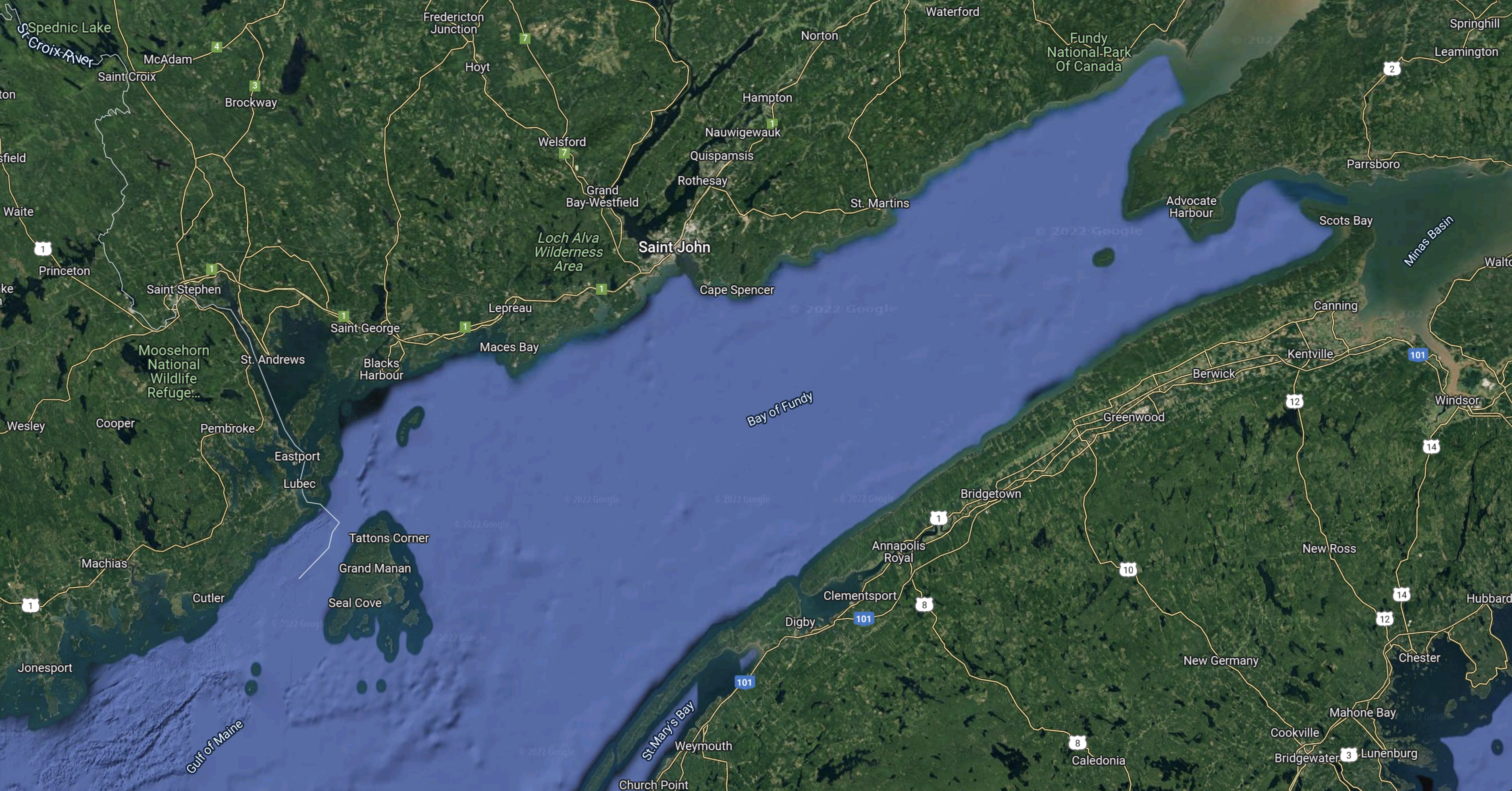
This Google Map shows the Bay Of Fundy.
Note.
- The hydrology of the Bay of Fundy has the highest tidal range in the world of sixteen metres, against a worldwide average of about a metre.
- According to the Renewable Energy Magazine article, Nova Scotia has allocated circa 30MW of capacity via demonstration permits.
- The article also indicates that up to 2.5 GW of clean and predictable energy for Canada could be generated.
- By comparison Hinckley Point C nuclear power station will generate 3.26 GW.
The Bay of Fundy would be the largest tidal power station in the world.
But this list in Wikipedia gives these proposed tidal power stations.
- Incheon Tidal Power Station – 1.32 GW
- Severn Barrage – 8.64 GW
- Penzhin Tidal Power Plant Project – 87 GW
There are another two Russian proposals and a South Korean one.
Note.
- There are some large numbers.
- There are also some huge ambitions and massive budgets.
But will we ever see large scale tidal power stations?
Are There Any Medical Application For Large Amounts Of Electricity?
I ask this question, as an eminent medical researcher has just thanked me by text for my energy posts.
It could be that he sees some benefit in having lots of energy available from wind.
I have a few thoughts.
Are Electricity Bills Getting To Be A Larger Proportion Of The Running Costs Of Hospitals Or Medical Research Establishments?
We are all suffering to some extent from higher electricity prices, but some of the latest medical equipment with large electromagnets and powerful X-rays must be expensive on electricity.
Proton Therapy
Does proton therapy use very large amounts of electricity and is this one of the reasons, that these seemingly-powerful machines are thin on the ground?
So if electricity is much more plentiful and hopefully more affordable, is this going to mean that proton therapy is used more often?
Synchrotrons
The Diamond Light Source is described like this in Wikipedia.
Diamond Light Source (or Diamond) is the UK’s national synchrotron light source science facility located at the Harwell Science and Innovation Campus in Oxfordshire. Its purpose is to produce intense beams of light whose special characteristics are useful in many areas of scientific research. In particular it can be used to investigate the structure and properties of a wide range of materials from proteins (to provide information for designing new and better drugs), and engineering components (such as a fan blade from an aero-engine) to conservation of archeological artifacts (for example Henry VIII’s flagship the Mary Rose).
There are more than 50 light sources across the world. With an energy of 3 GeV, Diamond is a medium energy synchrotron currently operating with 32 beamlines.
When the history of the pandemic is written, Diamond may well turn out to be one of the heroes.
This page on the Diamond web site, lists some of the applications of a particular analysis, that Diamond can perform.
Under Life Sciences and Bio-Medicine, this is said.
One of the remarkable exploits of SRIR microspectroscopy is probing single isolated cells and tissues at sub-cellular resolution, collecting broadband molecular information with excellent spectral quality via the diffraction limited microbeam. Studying individual cells is important because it reveals the cell-cell differences (e.g. due to cell cycle or biological variability) which are averaged together in conventional IR imaging or spectroscopy. This is important for identifying the subtle underlying spectral differences of interest in the research.
Applications include developing spectral biomarkers for disease diagnosis – particularly cancer research, location of stem cells within tissues, following effects of natural and synthetic chemicals on stem-cell differentiation and quantifying drug sensitivity.
A key development recently achieved is moving from fixed and dried samples to ex vivo, living conditions in the natural aqueous environment and time-dependent studies of biological processes. The combined requirements of high spatial resolution, rapid data acquisition and high photon flux (due to strong IR absorption by water) make synchrotron radiation an invaluable microanalysis tool.
In the THz part of the spectrum, very bright (coherent) synchrotron radiation (CSR) is useful in the study of low energy modes, especially in highly absorbing samples. The THz properties of biological materials is a rapidly growing field, from the organism level (imaging) down to fundamental spectroscopy at the biochemical level, where, for example, the solvation shell around proteins can be studied via changes in low energy hydrogen bonds.
That all sounds impressive.
As with NMR, which I used in the 1960s and as since been developed into MRi, I wonder if important hospitals and universities will have their own mini-Diamonds to do the analyses described above.
Again what will be the electricity bill?
Conclusion
I suspect that electricity may be a significant cost of the running some of these new machines and an abundance of wind power, which reduces the cost of electricity, may improve medical research and treatment.
Could Fortescue Future Industries’ Green Hydrogen Help Europe Ditch Russian Energy?
The title of this post, is the same as that of this article on Motley Fool Australia.
This is the first paragraph.
Green hydrogen may help interrupt the Kremlin’s ability to conduct “war games”, says Fortescue chief Andrew Forrest.
I very much think that Andrew ‘Twiggy’ Forrest is right.
My last three hydrogen articles were.
- Poland May Become A Green Hydrogen Tycoon.
- Will The Orkney Become A Major Green Hydrogen Production Centre?
- Wind And Solar Boom Will Bring Energy Surplus.
If the projects in these articles don’t blow the bottom out of the market for Russia’s bloodstained gas, with a little bit of help from Twiggy’s hydrogen kanganaut, then I’ll be very surprised. Especially, as countries like Argentina, Australia, Brazil, Canada, Chile, Denmark, Iceland, Ireland, Jordan, Japan, Kenya, Namibia, Morocco, Norway, Papua New Guinea, Portugal, South Korea, Spain, Sweden and the United States are all planning to produce green hydrogen in large quantities.
Poland May Become A Green Hydrogen Tycoon
The title of this post, is the same as that of this article on Hydrogen Central.
This is the first two paragraphs.
In 2050, Poland may become one of the most competitive producers of green hydrogen in the European Union. In addition, we could export it to other countries, using the already existing infrastructure – e.g. the Yamal gas pipeline.
According to analysts of the Polish Economic Institute (PIE), in the next three decades Poland could become a very competitive producer of green hydrogen. Particularly economically beneficial in Polish conditions would be the production of hydrogen based on energy from onshore wind energy.
Note.
- The Yamal pipeline comes all the way from Siberia.
- The Baltic pipeline will connect Norway and Poland.
- Poland currently has over 7 GW of wind power.
- Wikipedia says this “In 2019, wind was the second most important source of electricity produced in Poland, after coal, and accounted for about 10% of the electricity production.”
- I have been to quite a few parts of Poland and it seems that it can be flat and windy.
- 1.2 GW of offshore wind is under development near Slupsk.
I very much feel that the conclusion of the article could be right.
Will Orkney Become A Major Green Hydrogen Production Centre?
Two projects seem to be coming together to the West of and on Orkney.
The West Of Orkney Wind Farm
This map shows the awarded leases in the latest ScotWind round, which I analysed in ScotWind Offshore Wind Leasing Delivers Major Boost To Scotland’s Net Zero Aspirations.

Note the wind farm numbered 13 to the West of Orkney.
- It is now called the West of Orkney wind farm.
- It has its own web site.
This page on the web site describes the project.
The West of Orkney Windfarm is being developed around 30km off the west coast of Orkney and around 25km from the north Caithness coast. With an expected capacity of 2GW, and first power scheduled for 2029, the project will be capable of powering the equivalent of more than two million homes.
The West of Orkney Windfarm lies wholly within the “N1” Plan Option, which is one of 15 areas around Scotland which the Scottish Government considered suitable for the development of commercial scale offshore windfarms. The Scottish Government published the Sectoral Marine Plan for Offshore Wind Energy in October 2020 following over two years of extensive analysis, consideration and engagement with a wide range of stakeholders.
In January 2022 OWPL were successful in securing an Option Agreement from Crown Estate Scotland for the project in the ScotWind leasing process.
The West of Orkney Windfarm has a grid connection agreement with National Grid for a connection in Caithness. Additionally, the project partners are exploring an option to power the Flotta Hydrogen Hub. There is the potential for both power export options to be utilised.
The project is currently considering both fixed-bottom foundations and floating substructures for the wind turbines.
The West of Orkney wind farm will be one of the largest offshore wind farms in Scotland.
The Flotta Hydrogen Hub
The Flotta Hydrogen Hub is described on its web site.
This section describes the low carbon ambition of the Flotta Hydrogen Hub.
This potential £multi-billion project would utilise a repurposed area of the existing Flotta Terminal to create a green hydrogen hub powered by offshore wind projects in the seas to the west of Orkney.
If successful, this ambitious plan – which could be realised in the later years of this decade – would deliver a new wave of renewable employment alongside significant quantities of green hydrogen.
This hydrogen could be exported to Europe or other destinations, blended into the gas grid at St Fergus and drive forward an international maritime green hydrogen refueling hub.
If realised, the Flotta Hydrogen Hub would contribute significantly to the UK’s low carbon ambitions, sustain and create long-term skilled jobs and place Scotland at the front of the global hydrogen revolution.
The proposal is supported locally by EMEC Hydrogen which has spearheaded Orkney’s leading position in green hydrogen production.
It is certainly a comprehensive vision.
I have my thoughts.
Will The West Of Orkney Wind Farm Have Fixed Foundations Or Floating Substructures?
If you look on the map earlier in this post, you will notice a cluster of wind farms at the North of Scotland.
- 7 – DEME Concessions Wind – 200 km² – 1.0 GW – Floating
- 8 – Falck Renewables Wind – 256 km² – 1.0 GW – Floating
- 9 – Ocean Winds – 429 km² – 1.0 GW – Fixed
- 13 – Offshore Wind Power – 657 km² – 2.0 GW – Fixed or Floating
- 14 – Northland Power – 390 km² – 1.5 GW – Floating
- 15 – Magnora – 103 km² – 0.5 GW – Floating
Given that floating wind farms outnumber those on fixed foundations, I wouldn’t be surprised to see the West of Orkney wind farm, built as a floating wind farm.
Where Is Flotta?
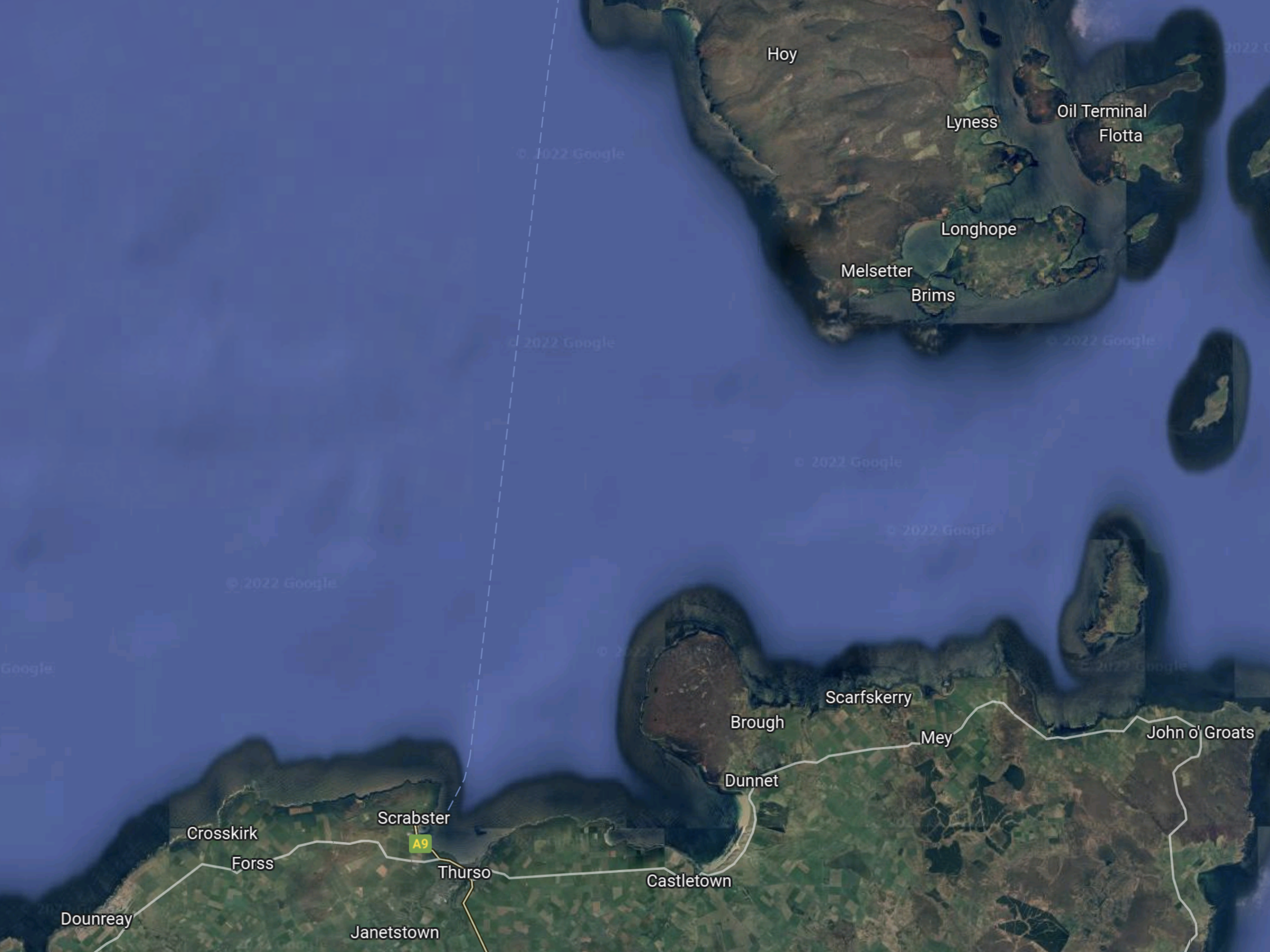
This Google Map shows the North of Scotland and the Southern part of Orkney.
Note.
- Flotta and its Oil Terminal in the North-East corner of the map.
- John o’Groats in the South-East corner of the map.
- The ferry between Scrabster and Orkney.
- Dounreay in the South-West corner of the map.
The West of Orkney Windfarm web site says that the wind farm is being developed around 30km off the west coast of Orkney and around 25km from the north Caithness coast.
This Google Map shows the island of Flotta.

Note.
- The oil terminal is clearly visible.
- Will it get tight for space on the island of Flotta, if they need a tank farm for all the hydrogen?
- I suspect that a pipeline to deliver hydrogen elsewhere, would have a high priority!
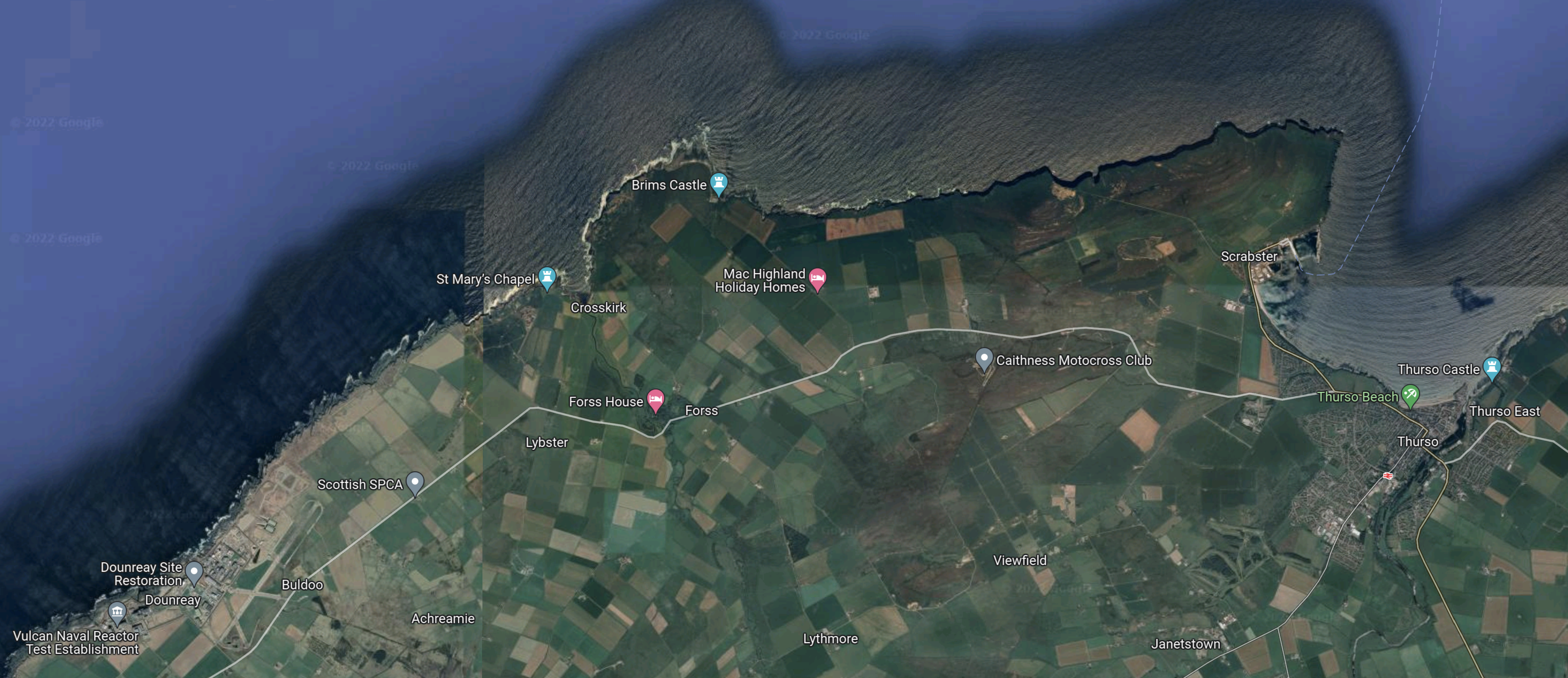
This Google Map shows the Caithness coast in more detail.
Note.
- Thurso and Scrabster are at the East of the map.
- The former nuclear research at Dounreay, is in the South-West corner of the map.
This article on the Stornaway Gazette is entitled SSE Plan To Bypass Isles Condemned and has this sub-title.
The Western Isles could be massively disadvantaged for decades to come if Scottish and Southern Energy are allowed to take power from offshore windfarms direct to a hub at Dounreay in Caithness.
This appears to indicate that West of Orkney wind farm and others in the area could be connected to the National Grid using a sub-station at Dounreay.
What Will Be The Capacity Of The Flotta Hydrogen Hub?
As I said previously, if the Flotta Hydrogen Hub is well-designed, possibly with a pipeline to take hydrogen out, that the Flotta Hydrogen Hub will have limitations on how much hydrogen it can produce due to the site size.
So the limitation of the capacity of the Flotta Hydrogen Hub will depend on the size of the electrolyser and how much electricity can be fed from the West of Orkney wind farm and possibly other wind farms to the site.
The West of Orkney wind farm has a capacity of 2 GW.
The other site that could possibly be connected would be Northland’s 1.5 GW wind farm in ScotWind N2.
Note that the combined area of these two wind-farms would be a 33 km square.
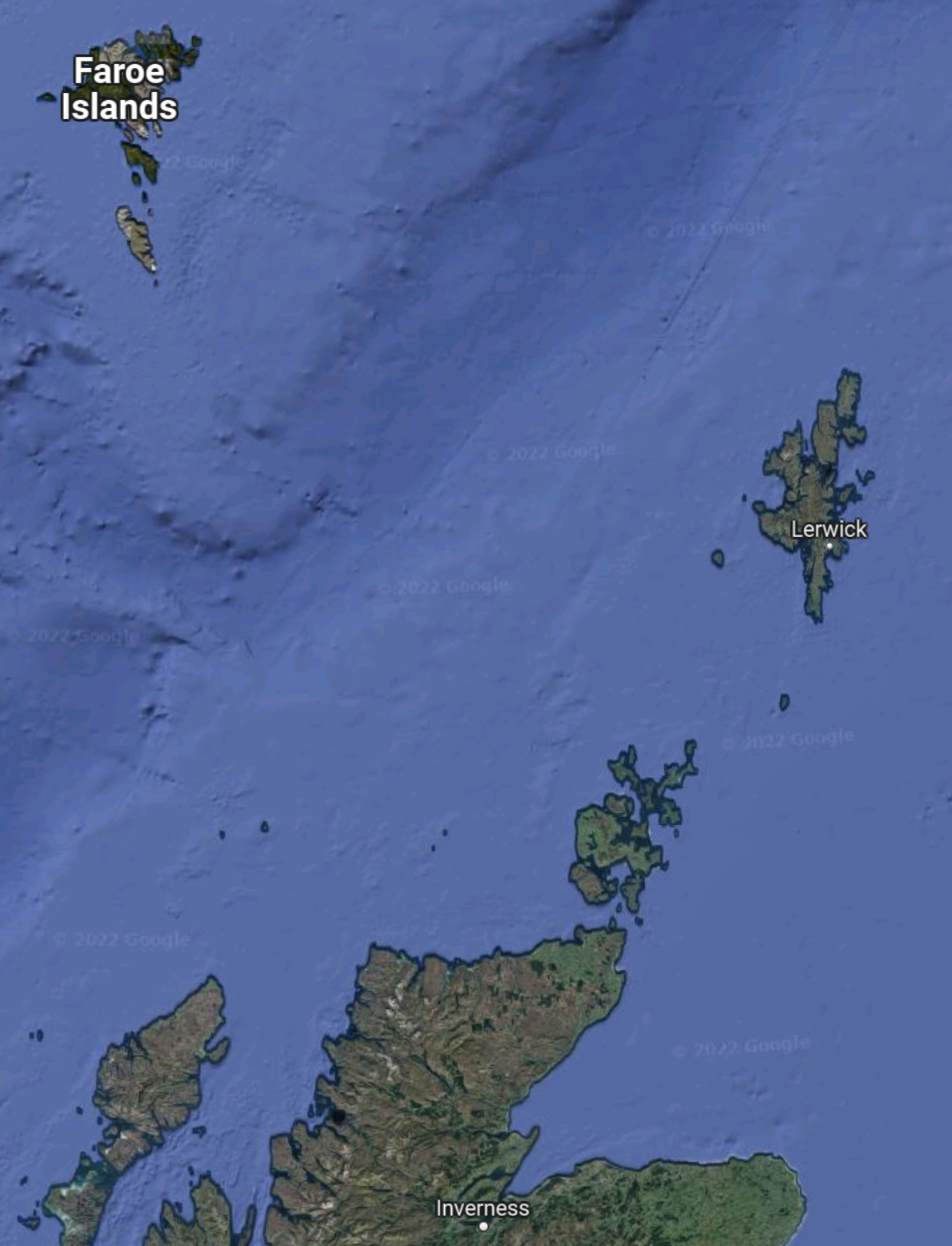
This Google Map shows the North of Scotland, Orkney, Shetland and the Faroe Islands.
Note.
- The distance between Cape Wrath and John o’Groats is just over 100 km.
- There is nothing to the West of Orkney, except a few rocky stacks, sea, fish and sea-birds.
- I could see the West of Orkney wind farm and the one Northland are building in the ScotWind N2 being extended further out.
A 100 km square would hold about 13.5 GW of floating turbines, so lets say that a round 10 GW could be cabled to Orkney.
Could The West of Orkney Wind Farm And ScotWind N2 Use Identical Technology?
I wouldn’t be surprised if this happened and a massive floating wind farm expanded to the North and West.
The capacity of the wind farm could be upwards of 10 GW.
How Much Hydrogen Could Be Produced In The Flotta Hydrogen Hub?
In Can The UK Have A Capacity To Create Five GW Of Green Hydrogen?, I said the following.
Ryze Hydrogen are building the Herne Bay electrolyser.
- It will consume 23 MW of solar and wind power.
- It will produce ten tonnes of hydrogen per day.
The electrolyser will consume 552 MWh to produce ten tonnes of hydrogen, so creating one tonne of hydrogen needs 55.2 MWh of electricity.
A GW of electricity for a year is 8760 GWh, which would produce over 150,000 tonnes of hydrogen.
Conclusion
This plan could generate huge amounts of green hydrogen on Orkney.
Wind And Solar Boom Will Bring Energy Surplus
The title of this post, is the same as that of this article on The Times.
Under the picture, is this sub-title.
The government has set a target of 50 gigawatts of offshore wind farms by 2030, up from about 10 gigawatts at present.
According to this Wikipedia list of offshore wind farms, the UK currently has 2180 offshore turbines with a capacity of 8113 MW.
These wind farms appear to be planned.
Hornsea
The Hornsea wind farm is currently supplying 1.2 GW to the grid, but it is planned to be expanded to 6 GW, which is another 4.8 GW.
East Anglia Array
The East Anglia Array is currently supplying 0.7 GW to the grid, but it is planned to be expanded to 7.2 GW, which is another 6.5 GW.
Sofia
The Sofia wind farm will supply 1.4 GW from 2026.
Moray East
The Moray East wind farm will supply 0.95 GW from 2022.
Neart Na Gaoithe
The Neart Na Gaoithe wind farm will supply 0.45 GW from 2023.
Triton Knoll
The Triton Knoll wind farm will supply 0.86 GW from 2022.
Seagreen
The Seagreen wind farm will supply 1.1 GW from 2023.
Dogger Bank
The Dogger Bank wind farm will supply 3.6 GW from 2025.
Moray West
The Moray West wind farm will supply 1.2 GW from 2025.
Rampion 2
The Rampion 2 wind farm will supply 1.2 GW before 2030.
Norfolk Boreas
The Norfolk Boreas wind farm will supply 1.8 GW before 2030
Norfolk Vanguard
The Norfolk Vanguard wind farm will supply 1.8 GW before 2030
These wind farms total up to 31.1 GW
Morgan And Mona
The Morgan and Mona wind farms will supply 3 GW from 2028.
ScotWind
This map shows the wind farms in the latest round of leasing in Scotland.
These wind farms should be providing 24.8 GW by 2030.
Celtic Sea
In Two More Floating Wind Projects In The Celtic Sea, I give details of six wind farms to be developed in the Celtic Sea, that will produce a total of 1.2 GW.
All should be delivered by 2030.
Northern Horizons
In Is This The World’s Most Ambitious Green Energy Solution?, I talk about Northern Horizons, which will produce 10 GW of wind energy from 2030.
An Armada Of Wind Farms
As many of these wind farms will be floating and wind-powered, the collective noun must surely be an armada.
These are some figures.
- The size is certainly spectacular at 70.1 GW.
- As the UK electricity consumption in 2020-2021 was 265.4 TWh, the average hourly production throughout the year is 30.3 GW.
- As I write this post, the UK is generating 30.1 GW.
As the best offshore wind farms have a capacity factor of around fifty percent, we should be able to power the UK with wind power alone.
So when The Times says this in the first two paragraphs of the article.
Britain will have excess electricity supplies for more than half of the year by 2030 as a huge expansion of wind and solar power transforms the energy system, a new analysis suggests.
Energy storage technologies, including batteries and electrolysers to make hydrogen, will need to be deployed at massive scale to prevent this surplus electricity going to waste, according to LCP, a consultancy.
The article would appear to correct.
The Need For Energy Storage
If we look at energy production at the current time, energy production is as follows.
- Biomass – 0.5 GW
- Gas – 17 GW
- Nuclear – 5 GW
- Onshore Wind – 12 GW with 20 % capacity factor – 2.4 GW
- Offshore Wind – 8.1 GW with 30 % capacity factor – 2.4 GW
- Interconnects – 0.4 GW
- Others – 0.5 GW
This totals up to 28.2 GW.
In 2030, energy production could be as follows.
- Biomass – 0.5 GW
- Nuclear – 5 GW
- Onshore Wind – 12 GW with 20 % capacity factor – 2.4 GW
- Offshore Wind – 30 GW with 30 % capacity factor – 9 GW
- Floating Offshore Wind – 40 GW with 50 % capacity factor – 20 GW
- Others – 0.5 GW
This totals up to 37.4 GW.
So if you take a typical day, where on average throughout the day we are producing around 7 GW more of electricity than we need, we will actually produce around 7 * 24 GWh = 168 GWh of excess electricity
Whichever was you look at it, we have got to do something concrete with a large amount of electricity.
- Store it in batteries of various types from lithium ion, through new types of batteries like those being developed by Highview Power and Gravitricity to pumped hydro storage.
- Store the energy in the batteries of electric cars, vans, buses, trucks, trains and ships.
- Store the energy in Norwegian pumped hydro storage.
- Convert it to hydrogen using an electrolyser and blend the hydrogen with the natural gas supply.
- Convert it to hydrogen using an electrolyser and use the hydrogen to make zero-carbon steel, concrete and chemicals.
- Convert it to hydrogen using an electrolyser and develop new zero-carbon industries.
- Convert it to hydrogen using an electrolyser and store the hydrogen in a depleted gas field.
- Sell it to Europe, either as electricity or hydrogen.
Note.
- We are going to have to build a lot of batteries and I suspect they will be distributed all round the country.
- We are going to have to build a lot of hydrogen electrolysers.
- We have world class battery and electrolyser companies.
We should also fund the following.
- Developments of technology, that makes better batteries, electrolysers, boilers and heat pumps.
- I would also do a lot of work to increase the capacity factor of wind farms.
I also believe that if we have masses of electricity and hydrogen, we might find as a country, it’s very beneficial in terms of jobs, exports and a healthier economy to invest in certain industries.
Conclusion
The future is rosy.
DP Energy And Offshore Wind Farms In Ireland
DP Energy are a company that are developing these offshore wind farms in Ireland.
Located off the West Coast of Ireland, the Clarus Offshore Wind Farm project will utilise Floating Offshore Wind (FOW) technology and upon completion, will have the potential capacity of up to 1 GW.
Located off the South Coast of Ireland, the Inis Ealga Marine Energy Park project will utilise Floating Offshore Wind (FOW) technology and upon completion, will have the potential capacity of up to 1 GW.
Latitude 52 Offshore Wind Farm
DP Energy has given the name Latitude 52 to the area it is exploring for a potential future offshore wind farm off the coast of Counties Wicklow and Wexford.
It appears to be another 1 GW project.
Located off the East Coast of Ireland, the Shelmalere Offshore Windfarm project will utilise fixed bottom wind turbines and upon completion, will have the potential capacity of up to 1 GW.
Note.
- These wind farms are being developed in a partnership with Spanish Energy company; Iberdrola.
- Each is a one GW offshore wind farm.
They are also developing the Gwynt Glas offshore wind farm in the UK sector of the Celtic Sea.
- In January 2022, EDF Renewables and DP Energy announced a Joint Venture partnership to combine their knowledge and
expertise, in order to participate in the leasing round to secure seabed rights to develop up to 1GW of FLOW in the Celtic Sea. - The wind farm is located between Pembroke and Cornwall.
The addition of Gwynt Glas will increase the total of floating offshore wind in the UK section of the Celtic Sea.
- Blue Gem Wind – Erebus – 100 MW Demonstration project – 27 miles offshore
- Blue Gem Wind – Valorus – 300 MW Early-Commercial project – 31 miles offshore
- Falck Renewables and BlueFloat Energy – Petroc – 300 MW project – 37 miles offshore
- Falck Renewables and BlueFloat Energy – Llywelyn – 300 MW project – 40 miles offshore
- Llŷr Wind – 100 MW Project – 25 miles offshore
- Llŷr Wind – 100 MW Project – 25 miles offshore
- Gwynt Glas – 1000 MW Project – 50 miles offshore
This makes a total of 2.2 GW, with investors from several countries.
It does seem that the Celtic Sea is becoming the next area of offshore wind around the British Isles to be developed.
Interconnectors
Interconnectors are to be built to connect Ireland, UK and France.
The Celtic Interconnector is being built between County Cork in Ireland and the North West Coast of France.
Greenlink is being built between County Wexford in Ireland and Pembroke in Wales.
Conclusion
Are the British, Irish and French governments, planning to build a large wind power resource in the Celtic Sea?
 The Anonymous Widower