Is Vlad The Bad Running Out Of Cash?
The BBC News Channel has just reported, that in a speech Vlad the Bad has said, that if you have too much money in your Russian Bank account, that can’t be supported by your salary, then he’ll seize it.
I suppose he needs to pay the gas bill on his little dacha in Sochi.
Longer Duration Energy Storage Demonstration Programme, Stream 1 Phase 1: Details Of Successful Projects
The title of this post, is the same as that of this document from the UK Government.
This is the introduction.
Stream 1 aims to accelerate commercialisation of innovative longer duration energy storage projects through to actual demonstrations. During Phase 1, projects will be expected to mobilise their proposed technologies to prepare for potential deployment on the UK energy system.
These are the projects.
Ballylumford Power-to-X
This is the description of this project in Northern Ireland.
B9 Energy Storage will receive £986,082 to mobilise a 20MW membrane free electrolyser green hydrogen project. Using otherwise curtailed wind power, hydrogen produced will be stored in local underground salt caverns for later use as a fuel in transport and electricity sectors, creating a full-cycle hydrogen economy (production, storage, distribution and usage) on site.
Note.
Ballylumford power station is a 600 MW gas-fired power station, that provides half of Northern Ireland’s electricity.
A 20 MW electrolyser will produce just under nine tonnes of hydrogen per day.
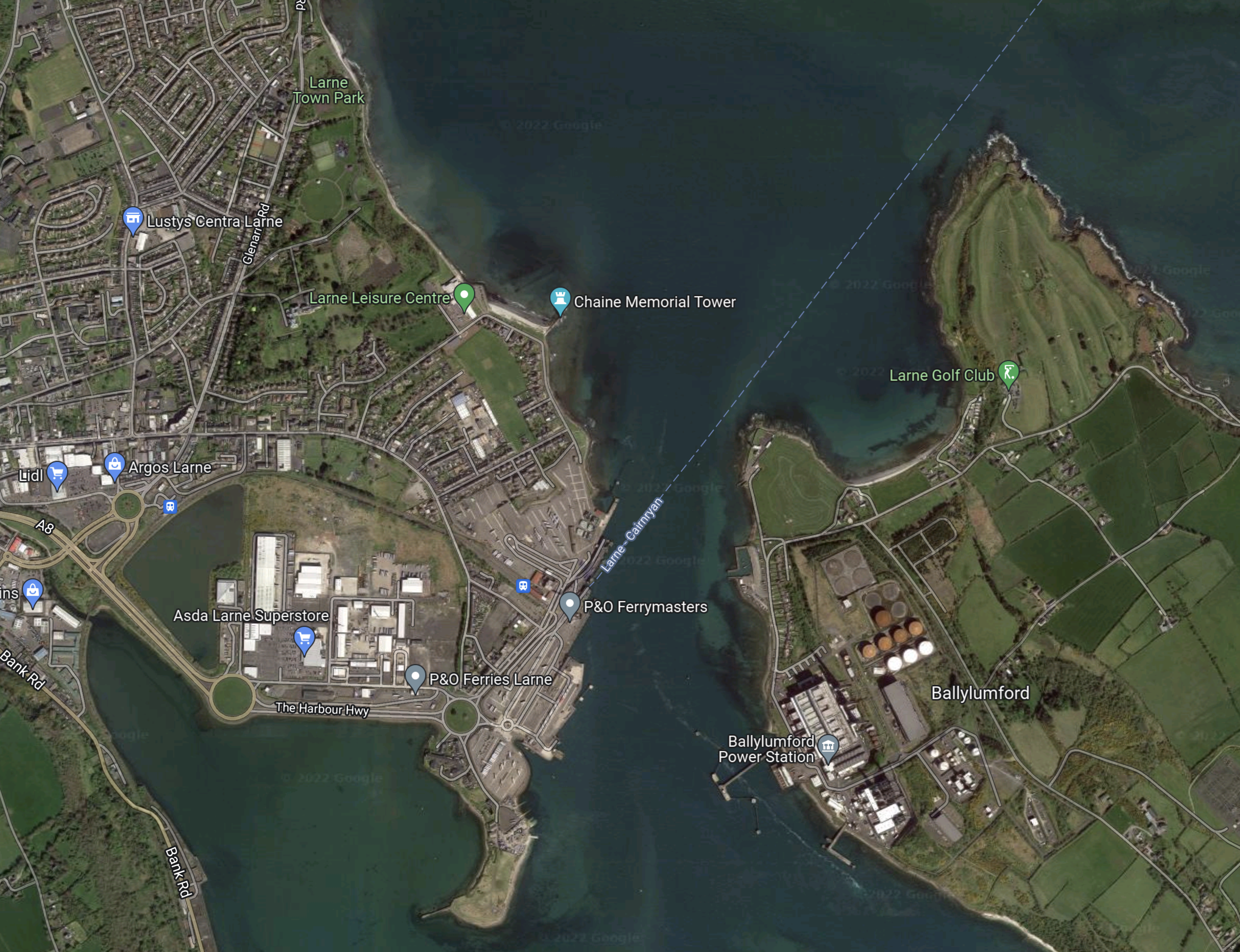
This Google Map shows the location of the power station opposite the port of Larne.
Note.
Ballylumford power station is clearly visible to the East of the channel towards the bottom of the map.
Ballylumford is also the Irish end of the HVDC Moyle interconnector from Scotland, which has a capacity of 500 MW.
Ballylumford would appear to have enough power for a large electrolyser.
Salt Beds In Northern Ireland
This document on the British Geological Survey web site is entitled Geological Storage In Northern Ireland.
The document discusses Irelands energy needs and gives a good description of using compressed air energy storage in salt caverns.
Then these two paragraphs describe the salt bed in Northern Ireland compare them to other deposits under Great Britain.
Thick halite deposits, found both onshore in Northern Ireland and immediately offshore in the North Channel, offer potential for salt cavern storage facilities. The salt deposits occur as bedded deposits with minor halokinesis (geological movement of salt) forming salt swells rather than pillows or domes so that the height of any cavern may be restricted by bed thickness. Pure salt beds tend to be thin (approximately 100-250 metres maximum thickness) compared to those used elsewhere and the presence of significant insoluble impurities and minor intrusive dolerite dykes or sills may reduce their suitability.
The Larne and Carrickfergus area of County Antrim is the only part of the whole island where thick salt beds occur. Elsewhere in the UK parts of Cheshire, Lancashire, Teesside, Humberside and Dorset have similar, or thicker, developments of salt beds and gas storage facilities are either in construction, or are already in operation.
It would appear that the thick salt beds in the Larne and Carrickfergus area could be suitable for gas storage.
Ballylumford might actually be on top of the salt beds, as Carrickfergus is a few miles to the South.
On a personal note, I used to work for ICI Mond Division and during that time and immediately afterwards, I met many people, who had been into the salt mines and worked with boreholes extracting the salt and the one thing everybody said about the salt mine, was that water must not get in.
Membrane-Free Electrolysis
I saw this in operation when I worked at ICI Mond. Most of their hydrogen and chlorine was produced using the main Castner-Kellner process at Castner-Kellner works in Runcorn. That is a nasty process that uses a lot of mercury, which got into the air and plant operators’ bodies.
But ICI also had a much smaller plant, where they used simple electrolysers, that had a metal cell, with a concrete top, with the anode and cathode going through the concrete into the brine. I seem to remember that its main purpose was to provide mercury-free hydrogen, chlorine and sodium hydroxide. I can remember seeing workers rebuilding the cells, as was done on a regular basis.
These were membrane free electrolysers and had been running successfully for many years.
Searching the Internet for “membrane free electrolyser” I found a company in Doncaster called CPH2.
The home page on their web site declares
Clean Power Hydrogen are the manufacturers of the unique Membrane-Free Electrolyser
Turning to the About page, this is said.
Being passionate about hydrogen as clean energy for the future, we wanted to find an alternative to PEM electrolysers as these had barriers to adoption. We realised that the cleanest way to produce hydrogen was by membrane-free water electrolysis, and in doing so, it would be a less expensive and more robust technology.
Dr. Nigel Williamson and Joe Scott established CPH2 (Ireland) in 2012 with the ambition to help clean up the environment for our children and future generations. Entering the green technology sector; a high growth and profitable market, they developed a Membrane-Free Electrolyser™ to produce hydrogen faster, more reliably, and more cost-effectively than other electrolysers.
They also have the ambition to be leading developer and manufacturer of green hydrogen technologies and an Irish connection.
My experience says that their technology will work. Especially, with the application of modern materials.
Have the Government backed the Ballylumford Power-to-X project, as they can back two promising technologies with one grant?
GraviSTORE
This is the description of this project.
Gravitricity Limited will receive £912,410.84 to design their multiweight energy store demonstrator project, which will store and discharge energy by lifting and lowering multiple weights in a vertical underground shaft.
Note.
- I like the Gravitricity concept and have invested through crowdfunding.
- The project will be based on a brownfield site in Northern England.
- Gravitricity’s current demonstrator in Edinburgh, which I wrote about in Gravitricity Celebrates Success Of 250kW Energy Storage Demonstrator, only uses a single weight, but this project talks about multiple weights.
According to other sources on the Internet, the demonstrator will have a storage capacity of 4 MWh and will be built on a brownfield site.
Will we see Gravitricity coming to a disused deep coal mine near you?
Long Duration Offshore Storage Bundle
This is the description of this project.
Subsea 7 Limited and FLASC B.V. will receive £471,760.00 to further develop the Long Duration Offshore Storage Bundle which will store energy as a combination of pressurised seawater and compressed air, using an innovative hydro-pneumatic technology.
Note.
- Subsea 7 Limited are a subsea engineering, construction and services company serving the offshore energy industry, domiciled in Luxembourg with headquarters in London.
- According to their web site, FLASC B.V. is a spin-off of the University of Malta, established in The Netherlands in 2019.
On the page on the FLASC web site, which is labelled The Technology, this is said.
FLASC is an energy storage device that can be integrated directly into a floating offshore platform. Energy is stored using a hydro-pneumatic liquid piston, driven by a reversible pump-turbine.
Charging Mode: electricity is used to pump water into a closed chamber containing pre-charged air.
Discharging Mode: the pressurised water is released through a hydraulic turbine to generate electricity.
FLASC leverages existing infrastructure and supply chains, along with the marine environment itself as a natural heatsink, resulting in a safe, reliable and cost-effective solution.
There is also this video.
The news page on the FLASC web site is a comforting read.
My knowledge of modelling vessel systems for chemical plants, tells my brain to like it.
Vanadium Flow Battery Longer Duration Energy Asset Demonstrator
This is the description of this project.
Invinity Energy Systems will receive £708,371 to demonstrate how a 40 MWh Vanadium Flow Battery could deliver long duration storage-enabled power on demand from UK-based solar generation.
Note.
- I wrote about Invinity Energy Systems in UK’s Pivot Power Sees First Battery On Line By 2021.
- Invinity Energy Systems was formed by a merger of RedT and Avalon Battery.
- The project appears to be located at Bathgate in Scotland.
This picture from EdF shows a large vanadian flow battery.
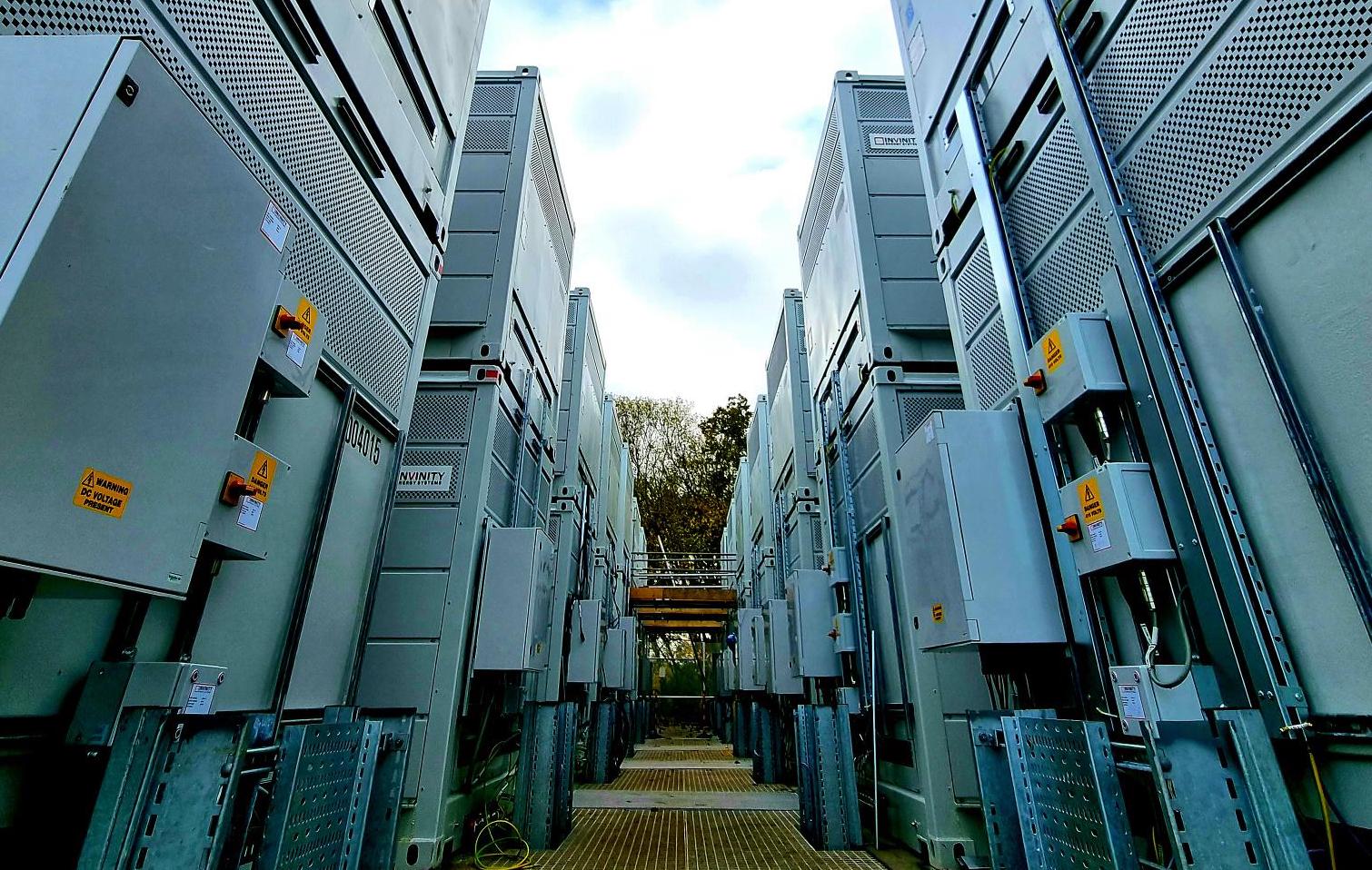
Invinity Energy Systems flow battery at Energy Superhub Oxford
If this project works out, vanadium flow batteries would be a good replacement for lithium-ion batteries.
Cheshire Energy Storage Centre
This is the description of this project.
io consulting will receive £1 million to enable its consortium to develop an electricity storage facility which could use mothballed EDF gas cavities in Cheshire utilising Hydrostor’s Advanced Compressed Air Energy Storage technology
Note.
- This is another project based on salt caverns.
- I wrote about Canadian company; Hydrostor in Gigawatt-Scale Compressed Air: World’s Largest Non-Hydro Energy-Storage Projects Announced.
- Hydrostor have received at least one large order for their system.
I have put Hydrostor on my list of tecnologies that should make it.
Conclusion
This is a well-balanced list of projects.
I would rate success as follows.
- Ballylumford Power-to-X – 60 %
- GraviSTORE – 80 %
- Long Duration Offshore Storage Bundle – 60 %
- Vanadium Flow Battery Longer Duration Energy Asset Demonstrator – 70 %
- Cheshire Energy Storage Centre – 80 %
But then all these projects are a bit of a gamble
ILI Group Announces New 1.5GW Pumped Storage Hydro Project
The title of this post is the same as that of this article on Insider.
This is the body of the article.
Intelligent Land Investments Group (ILI) has commenced the initial planning phase for its new 1.5 GigaWatt (GW) pumped storage hydro (PSH) project, Balliemeanoch, at Loch Awe in Argyll & Bute.
This is ILI’s third and largest PSH project. Its other PSH projects include ‘Red John’ at Loch Ness, which was awarded planning consent from Scottish Ministers in June Last year, and ‘Corrievarkie’ at Loch Ericht for which they aim to submit a Section 36 planning application in August.
The new project would be able to supply 1.5GW of power for up to 30 hours, enough to power 4.5 million homes.
The project will create a new head pond in the hills above Loch Awe capable of holding 58 million cubic metres of water when full and it is estimated the project will offset more than 200 million tonnes of CO2 emissions over its lifetime.
I would assume that this will be a privately-financed project and at 45 GWh it will be one of the largest pumped storage systems in the world.
But it must show that if it is privately-financed that the big boys in infrastructure finance, see pumped storage as a safe place to put insurance and pension funds to earn a worthwhile return.
- No-one’s going to steal one of these systems.
- They are a job-creating asset when built.
- Hydro-electric power seems very safe, when well-built.
- You don’t see media reports of schemes like Cruachan, Electric Mountain and Foyers breaking down.
In World’s Largest Wind Farm Attracts Huge Backing From Insurance Giant, I talked about Aviva’s funding for wind farms. If Aviva wukk fund those, surely they’ll fund schemes like this, as it could be argued that they make wind farms a better investment and more valuable, as they won’t have to shut down so often, when there’s too much power.
SSE Renewables Launches 1.5GW Coire Glas Construction Tender
The title of this post, is the same as that of this article on renews.biz.
These are the first two paragraphs.
Hydro construction companies have been invited to submit tenders for construction of SSE Renewables’ proposed 1500MW pumped hydro storage scheme at Coire Glas, in Scotland.
Coire Glas, on the shores of Loch Lochy near Invergarry, would be the first large-scale pumped hydro storage scheme to be built in the United Kingdom for more than 30 years.
There appears to be global interest and six shortlisted bidders.
- The ANDRITZ HYDRO and Voith Hydro partnership
- The Bechtel, Acciona Construcción and Webuild S.p.A consortium
- The BAM Nuttall, Eiffage Génie Civil and Marti Tunnel consortium
- The Dragados and BeMo Tunnelling UK consortium
- GE Hydro France
- STRABAG UK
Bidders like these probably wouldn’t bother to get involved unless they knew that funding of the project was in place and it was pretty certain that the project will be constructed.
In World’s Largest Wind Farm Attracts Huge Backing From Insurance Giant, I talk about how Aviva are funding the Hornsea wind farm.
I believe, that insurance and pension companies like abrdn, Aviva and L & G could find a way of financing a scheme like Coire Glas.
Conclusion
It looks to me, that it’s almost certain that Scotland will get a 1.5GW/30 GWh pumped-storage system at Coire Glas.
Coire Glas could supply slightly more power than Sizewell B nuclear power station for twenty hours.
Now that’s what I call backup!
Green Hydrogen Companies Are Going Public To The Delight Of Investors
The title of this post, is the same as that of this article on Hydrogen Fuel News.
The article discusses the IPO of the ThyssenKrupp subsidiary; Nucera.
There is more in this article on Reuters, which is entitled Betting On Hydrogen Hype, Thyssenkrupp Eyes $687 mln In IPO Cash.
I have a feeling, that this would not be an investment for widows and orphans, but this widower may know enough to have a small punt at the right price.
Aviva To Eject Company Directors If Climate Goals Are Not Met
The title of this post is the same as that of this article in The Sunday Times.
Increasingly, I am seeing company boards taking decisions, that will cut their company’s carbon footprint.
Only yesterday, I wrote Suppliers Sought For New Bi-Mode Locomotives For TransPennine Express And Great Western Railway, which was about First Group’s moves to decarbonise some of their locomotive-hauled trains.
I have also written about BHP, BP, Fortescue, Go-Ahead and Rio-Tinto taking action to decarbonise.
It does seem that some company boards are following Aviva’s guidance, but then it is in the directors own interest.
Many directors of large companies own shares and in a big public company, these are publicly traded.
I would suspect, that if a company board, do the right thing in terms of decarbonisation, that the share price will rise.
So by following the accepted climate science, they are actually helping themselves.
If they don’t believe that, then aggressive shareholders from Norwich will punish them.
Energy Storage Could Emerge As The Hottest Market Of 2022
The title of this post, is the same as that of this article on Nasdaq.
This is the introductory paragraph.
A few years ago, battery energy storage began drawing attention as what one industry executive at the time called the Holy Grail of renewable energy. In the years since, EVs have stolen the spotlight but now battery storage is back, larger than life and, quite likely, twice as expensive.
I would wholeheartedly agree.
Although, I do think, that some of the major players over the next few years will not be based on lithium-ion batteries.
I have invested in Gravitricity and Rheenergise and would have invested in Highview Power, if I had had the chance.
My stockbroker has also invested some of my pension in energy storage and battery funds.
Cap And Floor Mechanism The ‘Standout Solution’ For Long Duration Storage, KPMG Finds
The title of this post, is the same as that of this article on Current News.
These are the first two paragraphs.
A cap and floor regime would be the most beneficial solution for supporting long duration energy storage, a KPMG report has found.
Commissioned by Drax, the report detailed how there is currently no appropriate investment mechanism for long duration storage. Examining four investment mechanisms – the Contracts for Difference (CfD) scheme, Regulated Asset Value (RAV) model, cap and floor regime and a reformed Capacity Market – it identified cap and floor as the best solution.
Cap and floor has been used successfully in the financing of interconnectors, so perhaps to apply it to long duration energy storage, will lead to greater use of such storage.
Goldman Sachs Invests $250 million In Hydrostor To Advance Compressed Air Energy Storage Projects
The title of this post, is the same as that of this article on pv Magazine.
This is the introductory paragraph.
The investment is planned to support development and construction of Hydrostor’s 1.1GW, 8.7GWh of Advanced Compressed Air Energy Storage projects that are well underway in California and Australia, and help expand Hydrostor’s project development pipeline globally.
It certainly seems that the big beasts of finance are starting to back innovative energy storage.
Catalyst Capital Makes First Move In GBP 300m Battery Storage Strategy
The title of this post, is the same as that of this article on Renewables Now.
This is the first paragraph.
Fund manager Catalyst Capital has acquired a site to build a 100-MW battery in Yorkshire, northern England, in the first of a series of planned deals under a GBP-300-million (USD 406.1m/EUR 358.9m) strategy to develop diversified UK battery energy storage systems (BESS) facilities.
£300 million, says to me that the finance industry, now finds battery storage to be a worthwhile investment.
Skelton Grange Power Station
This Google Map shows the location of the Skelton Grange power station site, where the battery will be developed.

And this second Google Map shows the site in more detail.

Note that there is still a sub-station on the site.
The article states that planning permission was received in 2021 and they hope to have the facility on-line in the first quarter of this year.
That appears quick to me. Is it because the electrical connection already in situ?
It should also be noted, that the battery output of 100 MW is much less than that of the former coal-fired power station in the mid-1980s, which was at last 480 MW.
I also wonder, if the site could host a hydrogen fuelling station for buses.
- It is not far from the centre of Leeds.
- It has a good connection to the National Grid.
- An electrolyser like the one built by ITM Power at Tyseley Energy Park uses 3 MW of electricity to produce around 1.5 tonnes of hydrogen per day.
I also feel that the site could host a wind turbine up to about 10 MW.
Conclusion
Catalyst Capital seems to have made a big entry into the market. They won’t be the last to do this, as the returns are there and the battery storage is needed.
 The Anonymous Widower