An Interesting Comment From Lord Peter Hendy
This article on Modern Railways is entitled Chiltern FINALLY Signs Mk 5 Deal.
This extract from the article describes the deal.
An agreement for Chiltern Railways to lease the Mk 5A coaches previously operated by TransPennine Express and owned by Beacon Rail Leasing has been signed – and the trains are due to replace the current Mk 3 stock in phases from 2026. A 10-year lease has been agreed for the vehicles.
Chiltern will take on all 13 five-car sets as well as the spare Driving Trailer and the dedicated pool of 14 Class 68 locomotives.
The article also, has this excellent quote from Lord Peter Hendy, who is the Rail Minister at the end.
This government is putting passengers back at the heart of the 21st century railway by investing to make journeys easier, greener, and more comfortable.
“We are continuing to support Chiltern as they develop a plan to introduce additional services into their timetable, giving people more opportunities to work, live, and socialise.
I agree with much of what Lord Peter Hendy says, but could we see some actions to back up the words.
I have a few thoughts.
Lumo To Glasgow
I wrote about this new service in Lumo Will Extend Its King’s Cross And Edinburgh Service To Glasgow.
Given the opposition of the Transport Minister to open access services, I didn’t think this innovative service would be approved.
- But it does add an affordable passenger-friendly service to London and Glasgow routes.
- It will certainly be an easier route to London for some in Scotland.
- It also adds some much-needed direct services between Newcastle and Glasgow.
Did Lord Peter Hendy have words to help Lumo get its approval?
As I wrote in Could London And Central Scotland Air Passengers Be Persuaded To Use The Trains?, I also believe that this new Lumo service could persuade more air passengers to take the train to Scotland.
Lumo To Stirling
I wrote about this service in ORR: Open Access Services Given Green Light Between London And Stirling.
- First Group has taken over Grand Union Trains and the service will now be run by Lumo, who will use diesel Class 222 trains.
- But Lumo will have the option of running their electric Class 803 trains on the route, as it is fully electrified, when their fleet receives more trains.
This was another service, that I didn’t think would be approved, as no other services on the West Coast Main Line were approved, as Network Rail objected.
But it certainly meets the words in Lord Peter Hendy’s statement.
Like Lumo’s service to Glasgow, when the Stirling service gets electric trains, it will surely cut carbon emissions of travellers to Central Scotland.
Chiltern’s Replacement Trains
Chiltern Railways are replacing this fleet of locomotive hauled trains.
- 8 Class 68 locomotives
- 25 Mark 3 coaches
- 6 Driving Van Trailers
As services between London Marylebone and Birmingham Moor Street stations consist of one locomotive, five coaches and one driving van trailer, that means there are two spare locomotives, one spare coach and one spare driving van trailer, if there are five rakes of coaches in service.
The new fleet will be.
- 14 Class 68 locomotives
- 52 Mark 5A coaches
- 14 Driving Van Trailers
If services between London Marylebone and Birmingham Moor Street stations consist of one locomotive, four coaches and one driving van trailer, that means there are one spare locomotive and one spare driving van trailer, which gives a possible thirteen rakes of coaches in service.
There are certainly enough to expand Chiltern’s services. The obvious destination would surely be Oxford. These pictures show the two North-pacing platforms at Oxford station.








The platforms would be shared with East-West Rail, but they are around 160 metres in length.
The Modern Railways article quote Arriva Group Managing Director UK Trains Amanda Furlong as saying this.
Upgrading our fleet is a vital next step in Chiltern’s modernisation plans and an important part of Arriva’s wider ambition to support the transition to more sustainable rail travel across the UK and Europe.
We are proud to support this important milestone for Chiltern Railways, which is a great example of what can be achieved through strong collaboration with Government to deliver practical improvements for passengers. We look forward to seeing these upgraded trains improve journeys and lower emissions across the network.
She certainly would agree on some issues with Lord Peter Hendy.
So will Chiltern Railways do something to reduce the carbon footprint of their fourteen Class 68 locomotives?
- The Class 68 locomotives don’t have too many miles on the clock.
- Chiltern have already run some their Class 68 locomotives on HVO, so this must be a possibility.
- In total there are thirty-four Class 68 locomotives in service all of which have Caterpillar engines, so a conversion to zero-carbon power could be worthwhile.
I asked Google for an AI Overview on How many diesel locomotives have caterpillar engines worldwide? I got this answer.
While a precise worldwide count of diesel locomotives powered by Caterpillar (CAT) engines is difficult to pinpoint, it’s estimated that hundreds, if not thousands, of locomotives are equipped with CAT engines. Caterpillar has a long history of supplying engines to the rail industry, with engines like the 3500 series powering both mainline and switcher locomotives. Additionally, CAT engines are also used in generator sets for Head End Power (HEP) in passenger locomotives.
Note.
- It appears that, Caterpillar might have given up making truck engines because of emission issues.
- London Marylebone and Oxford is 66.8 miles
- London Marylebone and Birmingham Snow Hill is 112.3 miles.
Perhaps one of the consultants like Ricardo could convert these locomotives to run on hydrogen.
Council Invests £16m In Hydrogen Buses
The title of this post, is the same as that of this article on the BBC.
This is the sub-heading.
There are now 34 hydrogen buses on the streets of Surrey, the council has announced.
These two paragraphs add more details.
Surrey County Council (SCC) said it has invested £16m and partnered with Metrobus to provide greener commuting options.
The fleet is now made up of 23 single-deck buses and 11 double-deckers, the council said.
I wrote about a ride on one of these buses to Gatwick Airport in Sutton Station To Gatwick Airport By Hydrogen-Powered Bus.
From the comments in the article, by a Surrey County Council councillor, the council seems very pleased with their hydrogen buses.
Singapore’s First Hydrogen-Powered Data Center Launched By DayOne Using SOFC Technology
The title of this post, is the same as that of this article on Fuel Cell Works.
These two bullet points act as sub-headings.
- DayOne has broken ground on its first AI-ready hyperscale data center in Singapore, a 20MW facility set to be operational in 2026. The project integrates 100% renewable energy, SOFC-based hydrogen power generation, and cutting-edge hybrid cooling technologies.
- Strategic partnerships with Sembcorp and NUS will drive green energy adoption and R&D in sustainable tropical data center innovation, aligning with Singapore’s AI and digital infrastructure goals.
This data centre and the companies and the technologies behind it, are certainly ones to watch.
The R & D and innovation behind it could allow data centres to be built in more tropical places than is currently possible.
British Gas Owner Mulls Mini-Nuke Challenge To Rolls-Royce
The title of this post, is the same as that of this article in The Telegraph.
This is the sub-heading.
Centrica is looking to follow Rolls-Royce in developing small modular reactors
These are the first three paragraphs.
The owner of British Gas is considering investing in mini nuclear power plants in the UK as it seeks to cash in on burgeoning demand for the technology.
Centrica is in early talks with the Government about a potential future deal that could see the energy giant participate in the development of so-called small modular reactors (SMRs).
It comes after Ed Miliband, the Energy Secretary, last month announced billions of pounds in funding for SMRs, which will form part of a new “golden age” for atomic energy.
In Centrica Really Can’t Lose At Sizewell, I looked at Centrica’s involvement in Sizewell C and in particular the financing of the nuke and what Centrica would do with their share of the electricity, that the nuke will produce.
I listed these uses for hydrogen in the East of England.
- Transport – Buses, Coaches and Trucks
- Large Construction Projects
- Rail
- Ports
- Airports
- Agriculture And The Rural Economy
- Exports
I do wonder, if Centrica made the investment in Sizewell C, when they realised that there were a lot of uses for hydrogen and producing hydrogen using the electricity from a nuclear power station was a good way to generate hydrogen.
- Sizewell B is a 1.2 GW nuclear powerstation.
- Sizewell C is a 3.2 GW nuclear powerstation.
- Their investment in HiiROC surely gives them access to the technology to generate hydrogen.
- Centrica have a lot of experience of selling natural gas to customers, who need energy.
- There were also substantial government guarantees involved.
- Hydrogen made by a nuclear reaxtor is generally referred to as pink hydrogen.
- In Westinghouse And Bloom Energy To Team Up For Pink Hydrogen, I describe how two American companies have formed a partnership to make pink hydrogen.
Before they invested in Sizewell C, they would have done detailed financial and technical due diligence.
Did Centrica then scale the calculations to see if funding a Small Modular Reactor (SMR) to make hydrogen was a viable deal?
- SMRs are typically around 400-500 MW.
- The article mentions Rolls-Royce, but other companies are developing SMRs.
- Centrica use Rolls-Royce mtu generators for some of their installations.
- Some SMR/HiiROC systems could be built close to steelworks or other high energy users.
This is a very interesting development in taking the UK to net-zero.
Centrica Really Can’t Lose At Sizewell
The title of this post, is the same as that of this article in The Times.
This is the sub-heading.
Centrica’s £1.3 billion investment in Sizewell C guarantees substantial returns, even with cost overruns.
These two-and-a-half paragraphs explain the funding.
Now we know what Ed Miliband means by his “golden age of nuclear” — golden for the companies putting their money into Sizewell C. Yes, reactor projects have a habit of blowing up private investors. But maybe not this one. It looks more like an exercise in transferring risk to consumers and the taxpayer.
Sure, nobody builds a £38 billion nuke on a Suffolk flood plain without a frisson of danger. But the energy secretary and his Treasury chums have done their bit to make things as safe as possible for the companies putting in equity alongside the government’s 44.9 per cent stake: Canada’s La Caisse with 20 per cent, British Gas-owner Centrica (15 per cent), France’s EDF (12.5 per cent) and Amber Infrastructure (7.6 per cent).
For starters, nearly all the debt for the 3.2 gigawatt plant, three-quarters funded by loans, is coming from the state-backed National Wealth Fund. It’s bunging in up to £36.6 billion, with £5 billion more guaranteed by a French export credit agency.
It looks to me that between them the British and French governments are providing £41.5 billion of loans to build the £38 billion nuke.
These are my thoughts.
Hydrogen And Sizewell C
This page on the Sizewell C web site is entitled Hydrogen And Sizewell C.
Under a heading of Hydrogen Buses, this is said.
At Sizewell C, we are exploring how we can produce and use hydrogen in several ways. We are working with Wrightbus on a pilot scheme which, if successful, could see thousands of workers transported to and from site on hydrogen double decker buses. You can read more about the pilot scheme in our press release
Firstly, it could help lower emissions during construction of the power station. Secondly, once Sizewell C is operational, we hope to use some of the heat it generates (alongside electricity) to make hydrogen more efficiently.
This would appear to be a more general statement about hydrogen and that the following is planned.
- Hydrogen-powered buses will be used to bring workers to the site. A press release on the Sizewell C web site, talks about up to 150 buses. That would probably be enough buses for all of Suffolk.
- Hydrogen-powered construction equipment will be used in the building of the power station.
- It also talks about using the excess heat from the power station to make hydrogen more efficiently. I talk about this process in Westinghouse And Bloom Energy To Team Up For Pink Hydrogen.
This is a substantial investment in hydrogen.
Centrica And Electricity From Sizewell C
The article in The Times, also says this.
Even so, there’s a fair bit of protection for the likes of Centrica, which has also agreed a 20-year offtake deal for its share of Sizewell’s electricity. The price of that is not yet known.
Nothing is said in the article about the size of Centrica’s electricity offtake.
- If they get 15 % of Sizewell C, that would by 480 MW.
- If they get 15 % of Sizewell B + C, that would by 660 MW.
If they use their share to generate hydrogen, Suffolk would have a massive hydrogen hub.
To power the buses and construction of Sizewell C, Sizewell B could be used to provide electricity to create the hydrogen.
How Would The Hydrogen Be Produced?
Centrica, along with other companies, who include Hyundai and Kia, are backers of a company in Hull called HiiROC, who use a process called Thermal Plasma Electrolysis to generate hydrogen.
On their web site, they have this sub-heading.
A Transformational New Process For Affordable Clean Hydrogen
The web site also describes the process as scalable from small modular units up to industrial scale. It also says this about the costs of the system: As cheap as SMR without needing CCUS; a fraction of the energy/cost of water electrolysis.
If HiiROC have achieved their objective of scalability, then Centrica could grow their electrolyser to meet demand.
How Would The Hydrogen Be Distributed?
Consider.
- Currently, the Sizewell site has both road and rail access.
- I can still see in my mind from the 1960s, ICI’s specialist articulated Foden trucks lined up in the yard at Runcorn, taking on their cargoes of hydrogen for delivery all over the country.
- As that factory is still producing hydrogen and I can’t remember any accidents in the last sixty years, I am fairly sure that a range of suitable hydrogen trucks could be developed to deliver hydrogen by road.
- The road network to the Siewell site is being updated to ensure smooth delivery of workers and materials.
- The rail access to the Sizewell site is also being improved, for the delivery of bulk materials.
I believe there will be no problems delivering hydrogen from the Sizewell site.
I also believe that there could be scope for a special-purpose self-propelled hydrogen tanker train, which could both distribute and supply the hydrogen to the vehicles, locomotives and equipment that will be using it.
Where Will The Hydrogen Be Used?
I have lived a large part of my life in Suffolk and know the county well.
In my childhood, there was quite a lot of heavy industry, but now that has all gone and employment is based on agriculture, the Port of Felixstowe and service industries.
I can see hydrogen being used in the following industries.
Transport
Buses and heavy trucks would be powered by hydrogen.
The ports in the East of England support a large number of heavy trucks.
Large Construction Projects
Sizewell C is not the only large construction project in the East of England, that is aiming to use low-carbon construction involving hydrogen. In Gallagher Group Host Hydrogen Fuel Trial At Hermitage Quarry, I talked about a hydrogen fuel trial for the Lower Thames Crossing, that involved JCB and Ryse Hydrogen.
Hydrogen for the Lower Thames Crossing could be delivered from Sizewell by truck, down the A12.
Rail
We may not ever see hydrogen-powered passenger trains in this country, but I do believe that we could see hydrogen-powered freight locomotives.
Consider.
- The latest electro-diesel Class 99 locomotives from Stadler have a Cummins diesel engine.
- The diesel engine is used, when there is no electrification.
- Cummins have developed the technology, that allows them to convert their latest diesel engines to hydrogen or natural gas power, by changing the cylinder head and the fuel system.
- Access to the Port of Felixstowe and London Gateway needs a locomotive with a self-powered capability for the last few miles of the route.
A Class 99 locomotive converted to hydrogen would be able to run with out emitting any carbon dioxide from Felixstowe or London Gateway to Glasgow or Edinburgh.
Ports
Ports have three main uses for hydrogen.
- To power ground-handing equipment, to create a pollution-free atmosphere for port workers.
- To fuel ships of all sizes from the humblest work-boat to the largest container ships.
- There may need to be fuel for hydrogen-powered rail locomotives in the future.
There are seven ports with excellent road and/or rail connections to the Sizewell site; Felixstowe, Great Yarmouth, Harwich, Ipswich, London Gateway, Lowestoft and Tilbury.
The proposed Freeport East is also developing their own green hydrogen hub, which is described on this page on the Freeport East web site.
Airports
Airports have two main uses for hydrogen.
- To power ground-handing equipment, to create a pollution-free atmosphere for airport workers.
- In the future, there is likely to be hydrogen-powered aircraft.
There are three airports with excellent road and/or rail connections to the Sizewell site; Norwich, Southend and Stansted.
Agriculture And The Rural Economy
Agriculture and the rural economy would be difficult to decarbonise.
Consider.
- Currently, most farms would use diesel power for tractors and agricultural equipment, which is delivered by truck.
- Many rural properties are heated by propane or fuel oil, which is delivered by truck.
- Some high-energy rural businesses like blacksmiths rely on propane, which is delivered by truck.
- Electrification could be possible for some applications, but ploughing the heavy land of Suffolk, with the added weight of a battery on the tractor, would probably be a mathematical impossibility.
- JCB are developing hydrogen-powered construction equipment and already make tractors.
- Hydrogen could be delivered by truck to farms and rural properties.
- Many boilers can be converted from propoane to run on hydrogen.
I feel, that hydrogen could be the ideal fuel to decarbonise agriculture and the rural economy.
I cover this application in detail in Developing A Rural Hydrogen Network.
Exports
Consider.
- Sizewell B and Sizewell C nuclear powerstations have a combined output of 4.4 GW.
- A rough calculation shows that there is a total of 7.2 GW of wind farms planned off the Suffolk coast.
- The East Anglian Array wind farm alone is said in Wikipedia to be planned to expand to 7.2 GW.
- The Sizewell site has a high capacity connection to the National Grid.
Nuclear plus wind should keep the lights on in the East of England.
Any excess electricity could be converted into hydrogen.
This Google Map shows the location of Sizewell B in relation to Belgium, Germany and The Netherlands.
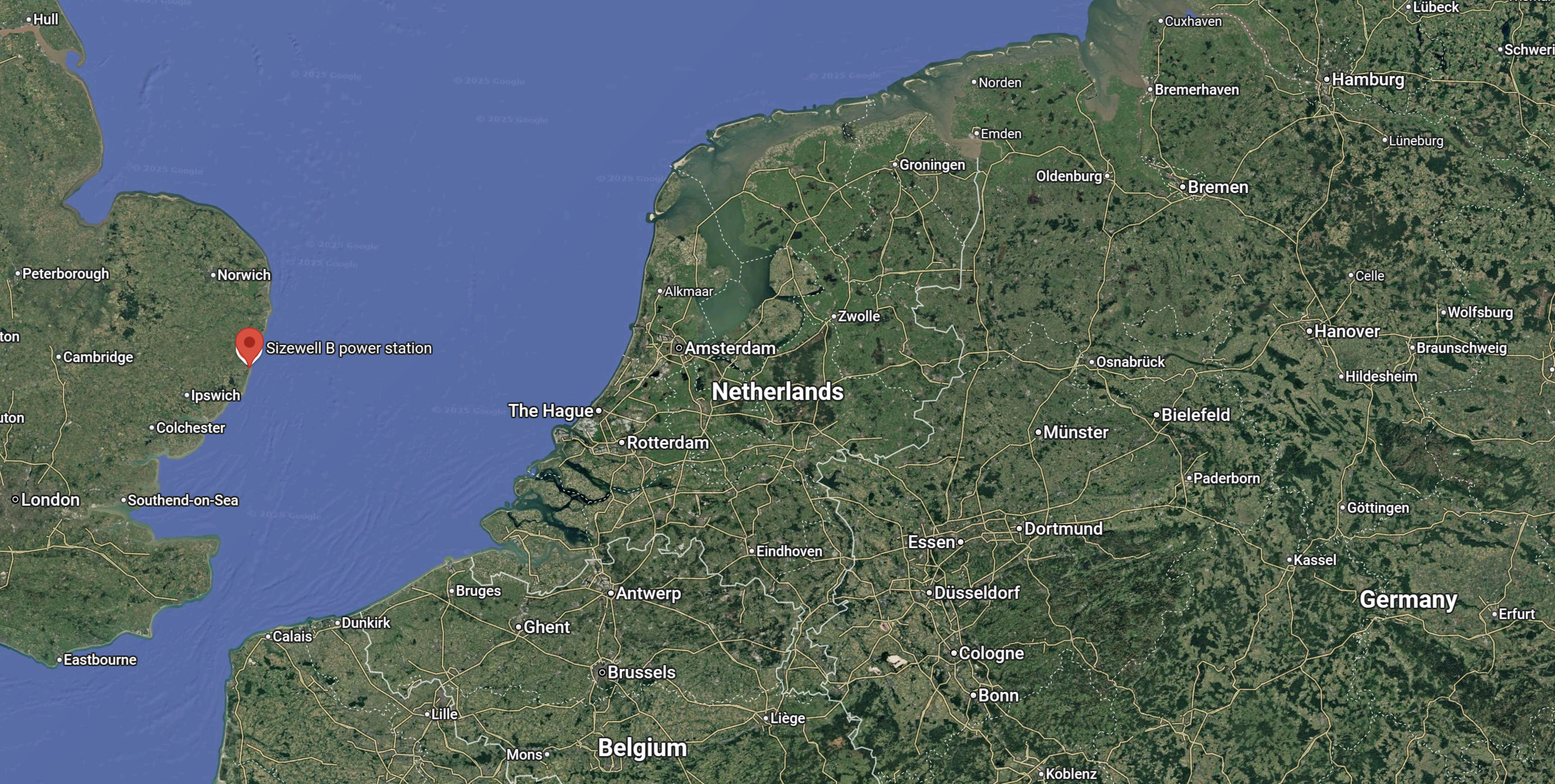
The Sizewell site is indicated by the red arrow.
The offshore oil and gas industry has used technology like single buoy moorings and coastal tankers to collect offshore natural gas for decades.
I don’t see why coastal hydrogen tankers couldn’t export excess hydrogen to places around the North Sea, who need the fuel.
It should be born in mind, that Centrica have a good reputation in doing natural gas trading. This expertise would surely be useful in hydrogen trading.
Conclusion
I believe that a hydrogen hub developed at Sizewell makes sense and I also believe that Centrica have the skills and technology to make it work.
One Of The Five Large Buses Sold In Korea This Year Is Hydrogen-Powered
The title of this post, is the same as that of this article in Pulse.
These are the first three paragraphs.
Nearly one in five large buses sold in South Korea in 2025 to date has been a hydrogen fuel cell electric vehicle (FCEV). In response, Hyundai Motor Co. is increasingly focusing on hydrogen-powered commercial transport amid sluggish demand for hydrogen-powered passenger cars.
According to data from the Korea Automobile & Mobility Association (KAMA) and Hyundai Motor, 380 hydrogen-powered buses were sold in the first five months of 2025, out of 1,923 large buses sold overall. The market share stood at 19.8 percent, indicating a significant increase from 6 percent in 2023 and 14.4 percent the previous year.
Analysts say hydrogen power is better suited for commercial vehicles than for passenger cars. While electric vehicles work well for lighter, smaller vehicles, hydrogen-powered systems offer key advantages for larger vehicles, including longer range, shorter refueling times, and greater payload capacity.
Korea and Germany certainly have more hydrogen-powered buses than the UK.
But then we are rather lagging behind other countries in the use of hydrogen. I am certainly writing fewer hydrogen stories since the change of government.
The Hindenberg has done a wonderful job, in convincing politicians that hydrogen is dangerous.
RWE, Masdar Move Forward With 3 GW Dogger Bank South Offshore Wind Farms
The title of this post, is the same as that of this article on offshoreWIND.biz.
This is the sub-heading.
The UK’s Planning Inspectorate has concluded its six-month Nationally Significant Infrastructure Project (NSIP) examination period for the Dogger Bank South (DBS) offshore wind farms, being developed by RWE and Abu Dhabi’s Masdar.
These two introductory paragraphs add more details.
Since the start of the examination this January, the Planning Inspectorate has assessed the environmental, socio-economic, and technical attributes of the DBS projects against the UK’s standards for sustainable infrastructure development.
The Inspectorate plans to prepare and submit a detailed report with recommendations to the Secretary of State for Energy Security and Net Zero within the next three months, and a consent decision is expected within the next six months.
The development of this wind farm moves on.
- The lease with the Crown Estate was signed in Jan 2023.
- In November 2023, Masdar took a 49 % stake as I reported in RWE Partners With Masdar For 3 GW Dogger Bank South Offshore Wind Projects.
But there is no completion date anywhere for the whole project, that I can find with Google.
If you type RWE offshore electrolysis into Google AI, you get this answer.
RWE is actively involved in several hydrogen projects utilizing offshore wind power for electrolysis, particularly in the Netherlands and Germany. These projects aim to produce green hydrogen, which is then used in various applications like industrial processes, transportation, and potentially for export. RWE is a major player in offshore wind and is leveraging this experience to advance hydrogen production.
Note.
- RWE are one of the largest, if not the largest electricity generator in the UK.
- In RWE Opens ‘Grimsby Hub’ For Offshore Wind Operations And Maintenance, I stated that RWE are developing almost 12 GW of offshore wind power around our shores.
So just as RWE are utilizing offshore wind power for electrolysis, particularly in the Netherlands and Germany, could they be also be planning to do the same in UK waters with the Dogger Bank South wind farm?
The hydrogen would be brought ashore in a pipeline.
There would be no need for any 3 GW overhead power lines marching across East Yorkshire and around the town of Beverley.
Two large hydrogen stores are being developed at Aldbrough and Rough in East Yorkshire.
H2ercules And AquaVentus
These are two massive German projects, that will end the country’s reliance on Russian gas and coal.
- H2ercules is a series of pipelines that will distribute the hydrogen in Southern Germany.
- AquaVentus will build a network of pipelines to bring 10.3 GW of green hydrogen from the North Sea to the German mainland for H2ercules to distribute.
Germany is embracing hydrogen in a big way.
- I introduce AquaVentus in AquaVentus, which I suggest you read.
- AquaVentus is being developed by RWE.
- AquaVentus connects to a German hydrogen network called H2ercules to actually distribute the hydrogen.
This video shows the structure of AquaVentus.
I clipped this map from the video.

Note.
- The thick white line running North-West/South-East is the spine of AquaVentus, that will deliver hydrogen to Germany.
- There is a link to Esbjerg in Denmark, that is marked DK.
- There appears to be an undeveloped link to Norway, which goes North,
- There appears to be an undeveloped link to Peterhead in Scotland, that is marked UK.
- There appears to be a link to just North of the Humber in England, that is marked UK.
- Just North of the Humber are the two massive gas storage sites of Aldbrough owned by SSE and Rough owned by Centrica.
- Aldbrough and Rough gas storage sites are being converted into two of the largest hydrogen storage sites in the world!
- There appear to be small ships sailing up and down the East Coast of the UK. Are these small coastal tankers, that are distributing the hydrogen to where it is needed?
When it is completed, AquaVentus will be a very comprehensive hydrogen network.
I believe that offshore electrolysers could be built in the area of the Hornsea 4, Dogger Bank South and other wind farms and the hydrogen generated would be taken by AquaVentus to either Germany or the UK.
- Both countries get the hydrogen they need.
- Excess hydrogen would be stored in Aldbrough and Rough.
- British Steel at Scunthorpe gets decarbonised.
- A 1.8 GW hydrogen-fired powerstation at Keadby gets the hydrogen it needs to backup the wind farms.
Germany and the UK get security in the supply of hydrogen.
Rolls-Royce And Duisport Launch CO2-Neutral, Self-Sufficient Energy System For New Port Terminal
The title of this port is the same as that of this press release from Rolls-Royce.
These two bullet points act as sub-headings.
- First mtu hydrogen CHP units, battery storage systems and fuel cell systems from Rolls-Royce in operation.
- Benchmark for sustainable energy supply in logistics centers worldwide.
These three paragraphs give more details of the project.
Rolls-Royce and Duisburger Hafen AG have opened a CO2-neutral and self-sufficient energy system for the new Duisburg Gateway Terminal, located in the Rhine-Ruhr industrial region of Germany. The core components are two mtu combined heat and power units designed for operation with 100 percent hydrogen, which are being used here for the first time worldwide. The system is supplemented by an mtu battery storage system, mtu fuel cell systems and a photovoltaic system integrated via an intelligent energy management system.
The Enerport II flagship project, funded by the German Federal Ministry for Economic Affairs and Energy, is setting new standards for sustainable energy supply in large logistics centers and is considered a model for other ports, infrastructure projects and industrial facilities. Project partners include the Fraunhofer Institute UMSICHT, Westenergie Netzservice GmbH, Netze Duisburg GmbH, Stadtwerke Duisburg AG, and Stadtwerke Duisburg Energiehandel GmbH.
“The launch of this carbon-neutral energy system at the Duisburg Gateway Terminal is a big step toward a more climate-friendly, resilient energy supply. Together with our partner duisport, we’re showing how scalable technologies from Rolls-Royce can really help transform critical infrastructure – and help make the energy transition happen,” said Dr. Jörg Stratmann, CEO of Rolls-Royce Power Systems.
Note.
- It is carbon-neutral.
- The system uses both hydrogen and solar power.
- What has been created at the Port of Duisburg is considered by the German Federal Ministry for Economic Affairs and Energy to be a model for other ports, infrastructure projects and industrial facilities.
- It surely must help sales, that the flagship project is up and running.
In November 2021, I wrote about this project in Rolls-Royce Makes Duisburg Container Terminal Climate Neutral With MTU Hydrogen Technology, which included this graphic.

It seems that Heathrow Airport could have a use for this technology.
I have one important thought.
Where Will The Port Of Duisburg Get The Hydrogen It Needs?
In the graphic an Electrolyser and H2 Storage are clearly shown, as are the two H2 Combined Heat and Power Units.
So it looks like the Port of Duisburg will be generating their own green hydrogen.
Alternatively in April 2021, I wrote Uniper To Make Wilhelmshaven German Hub For Green Hydrogen; Green Ammonia Import Terminal.
Uniper’s plans for the Wilhelmshaven hydrogen hub include a 410 MW hydrogen electrolyser.
The Germans are also developing a project called AquaVentus to bring green hydrogen to Germany from the North Sea.
I asked Google AI, where AquaVentus would make landfall in Germany and got this answer.
The AquaVentus project’s planned offshore hydrogen pipeline, AquaDuctus, is intended to make landfall in the greater Wilhelmshaven or Büsum area in Germany, according to the AquaDuctus website. This pipeline is part of a larger plan to transport green hydrogen produced from offshore wind farms in the North Sea to the German mainland for distribution and use.
Wilhelmshaven and Duisburg is 194 miles.
Hydrogen could be delivered onward from Ludwigshaven to Southern Germany by a pipeline network called H2ercules.
I asked Google AI if the H2ercules hydrogen pipeline will connect to Duisburg and got this answer.
Yes, the H2ercules hydrogen network will connect to Duisburg. Specifically, a new 40-kilometer pipeline will be constructed from Dorsten to Duisburg-Walsum, connecting to the steelworks there, as part of the GET H2 pipeline extension according to thyssenkrupp Steel. This connection is part of the larger H2ercules project, which aims to create a hydrogen infrastructure backbone for Germany and beyond. The pipeline is scheduled to be operational in 2027, with thyssenkrupp Steel being connected in 2028.
It would appear that at some date in the not too distant future that the Port of Duisburg could be powered by green hydrogen from the North Sea, imported into Germany at Wilhelmshaven.
The German plans for hydrogen are extensive and it appears that the Port of Duisburg could have two sources for the hydrogen it needs.
mtu Engines From Rolls-Royce Provide Emergency Power On Offshore Wind Platforms In The UK
The title of this post, is the same as that of this press release from Rolls-Royce.
These two bullet points act as sub-headings.
- Four engines from the mtu Series 4000 provide emergency power for two converter platforms
- Norfolk wind farm will generate electricity for demand from more than four million households
This opening paragraph adds more detail.
Rolls-Royce has received a second order from Eureka Pumps AS to supply mtu Series 4000 engines to power emergency power generators for the Norfolk Offshore Wind Farm on the east coast of the United Kingdom. Rolls-Royce will thus supply a total of four mtu engines for the first and second phases of the large wind farm, which is operated by energy supplier RWE. The engines will be installed on two converter platforms at sea and onshore, which are the heart of the offshore grid connection: they ensure that the electricity generated at sea can be fed into the power grid. With a total capacity of 4.2 GW, the wind farm is expected to generate electricity for more than four million households during the course of this decade. It is located 50 to 80 kilometers off the east coast of the UK.
In some ways I find it strange, that a diesel generator is used to provide the necessary emergency power.
But when I asked Google if mtu 4000 generators can operate on hydrogen. I got this answer.
Yes, mtu Series 4000 engines, specifically the gas variants, can be adapted to run on hydrogen fuel. Rolls-Royce has successfully tested a 12-cylinder mtu Series 4000 L64 engine with 100% hydrogen fuel and reported positive results. Furthermore, mtu gas engines are designed to be “H2-ready,” meaning they can be converted to operate with hydrogen, either as a blend or with 100% hydrogen fuel.
That seems very much to be a definite affirmative answer.
So will these mtu Series 4000 engines for the Norfolk wind farms be “H2 ready”? The hydrogen needed, could be generated on the platform, using some form of electrolyser and some megawatts of electricity from the wind farms.
Will The Norfolk Wind Farms Generate Hydrogen For Germany?
Consider.
- Germany needs to replace Russian gas and their own coal, with a zero-carbon fuel.
- Germany is developing H2ercules to distribute hydrogen to Southern Germany.
- Germany is developing AquaVentus to collect 10 GW of hydrogen from wind-powered offshore electrolysers in the North Sea.
- The AquaVentus web site shows connections in the UK to Humberside and Peterhead, both of which are areas, where large hydrogen electrolysers are bing built.
- In addition Humberside has two of the world’s largest hydrogen stores and is building a 1.8 GW hydrogen-fired powerstation.
- The Norfolk wind farms with a capacity of 4.2 GW, are not far from the border between British and German waters.
- To the North of the Norfolk wind farm, RWE are developing the 3 GW Dogger Bank South wind farm.
- 7.2 GW of British hydrogen would make a large proportion of the hydrogen Germany needs.
I clipped this map from a video about Aquaventus.
Note.
- The thick white line running North-West/South-East is the spine of AquaVentus, that will deliver hydrogen to Germany.
- There is a link to Esbjerg in Denmark, that is marked DK.
- There appears to be an undeveloped link to Norway, which goes North,
- There appears to be an undeveloped link to Peterhead in Scotland, that is marked UK.
- There appears to be a link to just North of the Humber in England, that is marked UK.
- Just North of the Humber are the two massive gas storage sites of Aldbrough owned by SSE and Brough owned by Centrica.
- Aldbrough and Rough gas storage sites are being converted into two of the largest hydrogen storage sites in the world!
- There appear to be small ships sailing up and down the East Coast of the UK. Are these small coastal tankers, that are distributing the hydrogen to where it is needed?
When it is completed, AquaVentus will be a very comprehensive hydrogen network.
It will also be a massive Magic Money Tree for the UK Treasury.
So why is this vast hydrogen system never mentioned?
It was negotiated by Clair Coutinho and Robert Habeck, back in the days, when Boris was Prime Minister.
Centrica And PTT Sign Heads Of Agreement For Long-Term LNG Supply
The title of this post, is the same as that as this press release from Centrica.
These two paragraphs add details to the deal.
Under the agreement, PTT will supply LNG to Centrica for a 10-year period across a range of destinations in Asia, with deliveries expected to begin in 2028.
This agreement marks a significant step forward in Centrica’s strategic efforts to grow its LNG portfolio. The agreement provides access to diverse markets in Asia, whilst deepening Centrica’s relationship with PTT, an important partner in Asia. For PTT, this deal represents its first, long-term, international LNG sale.
I wonder if this is a much wider deal than it first appears.
There are a lot of small nations in Asia and it looks as the press release talks about a range of destinations in Asia, that Centrica are setting themselves up as a major supplier of LNG to the smaller nations in Asia.
Centrica are also building up a portfolio of products, that they could offer to these small nations.
- LNG terminals from their own engineering resources.
- Domestic client management software.
- Hydrogen production from HiiROC, which they have backed.
- Carbon black for soil improvement from HiiROC.
- Liquid Air energy storage from Highview Power, which they have backed.
- Gas-fired power stations perhaps based on Rolls-Royce mtu diesel engines running on natural gas or hydrogen.
Countries could get these products and services from China, but at what price?
 The Anonymous Widower