The Construction Of The New Thanet Parkway Station Is Substantially Complete And It Will Open To Passengers On 31 July 2023
The title of this post, is the same as that of this page on the Network Rail web site.
The opening date is the most important information, but the rest of the page is worth a read, as it gives details of the work, that is still to do.
Much concerns sorting out the kevel crossings.
Cummins And Leclanché S.A. To Collaborate On Lower-Emissions Solutions For Use In Marine And Rail Applications
The title of this post, is the same as that of this press release from Cummins.
This is the introductory paragraph.
Today, global power and technology leader, Cummins Inc., and leading provider of energy storage solutions, Leclanché S.A, announced the signing of a Memorandum of Understanding (MOU). The collaboration represents a significant step forward in providing customers with a broader portfolio of integrated power solutions.
Effectively, this means that all customer requirements for integrated power solutions can be met by the two companies.
It appears to me, that if someone wanted Cummins to provide a system like the HybridFLEX train, I wrote about in Rolls-Royce And Porterbrook Launch First Hybrid Rail Project In The UK With MTU Hybrid PowerPacks, then Cummins and Leclanché have the technology between them to create a system.
In the UK, Cummins power these relatively-modern trains.
- Class 175 – 9 x two-car and 15 x three-car.
- Class 180 – 1 x four-car and 12 x five-car.
- Class 185 – 51 x three-car.
- Class 220 – 34 x four-car.
- Class 221 – 24 x four-car and 18 x five-car.
- Class 222 – 23 x five-car and 4 x seven-car.
Note.
- They are capable of 100 mph or 125 mph.
- Condition of the interiors is generally good.
- There are 9 x two-car, 66 x three-car, 59 x four-car, 53 five-car and 4 x seven-car.
- In Grand Central DMU To Be Used For Dual-Fuel Trial, I described innovative fuel trails in a Class 180 train.
- There could be other similar trains in Europe and around the world.
How many of these trains could be converted to hybrid operation, if Cummins and Leclanché were to create their version of the mtu Hybrid PowerPack?
Conclusion
Have Cummins and Leclanché decided that if a hybrid approach is good enough for Rolls-Royce mtu, then it’s good enough for them?
Hoerbiger And HD Hyundai Infracore Cooperate On Hydrogen-Powered Combustion Engine
The title of this post, is the same as that of this article on Hydrogen Central.
These two paragraphs outline the story.
This year’s ConExpo in Las Vegas was full of surprises and amazing news. Among the stars of the exhibition was the hydrogen-powered internal combustion engine (ICE) from HD Hyundai Infracore equipped with H2PFI injectors made by HOERBIGER.
This hydrogen-powered ICE can produce a power output of 300 kW (402 HP) and will see mass production in 2025. It will be installed on buses, trucks and construction equipment. While meeting Zero CO2 and Zero Impact Emission requirements it is also 25-30% more economical than battery packs or fuel cells when vehicle price and maintenance costs are considered. One fueling of 10 minutes allows the vehicle to drive for a distance of up to 500 km (310.6 miles).
The more of these stories I read about hydrogen internal combustion engines, the more they convince me, that this is the way to go.
These advantages keep repeating themselves.
- Large range.
- Quick refuelling times.
- Understandable technology.
- Suitable for heavy applications.
- Similar manufacturing to current diesel and petrol engines.
- Less exotic rare earths and metals.
- Lower environmental footprint.
- Can be converted from existing diesels.
The one thing they all need is different lean-burn fuel injection. Hence Hyundai’s tie-up with HOERBIGER.
The Ultimate Bi-Mode
This picture shows, what could be an experiment by Freightliner at Shenfield.
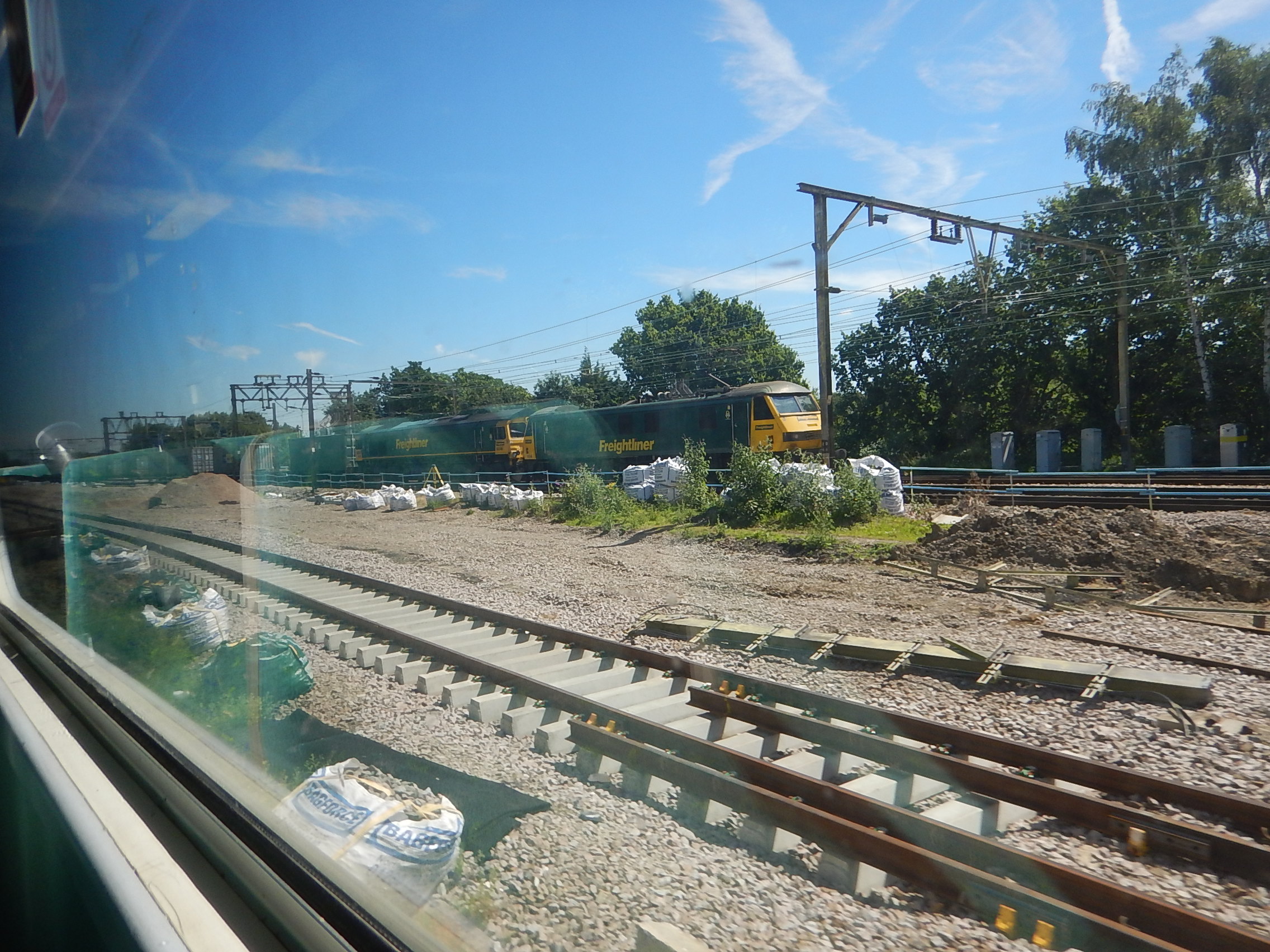
Unfortunately, I didn’t have a chance to ask the driver, if the Class 66 locomotive was running dead-in-train or helping the Class 90 locomotive with a very heavy load.
The picture shows, that the electric and diesel locomotives can work together, at the front of a train.
Note.
- The Class 66 locomotive has a power of 1,850 kW and the Class 90 locomotive has 3,730 kW.
- Did the Class 66 locomotive pull the train out of Felixstowe?
Since I took this picture, I’ve never seen a similar pairing again.
Could The Bombardier Voyagers Be Converted To Hydrogen Power?
Avanti West Coast, CrossCountry and East Midlands Trains all run versions of Bombardier Voyager trains.
- There are 103 sets in service.
- Lengths are four, five and seven cars.
- They are 125 mph trains.
- They are powered by one Cummins QSK19 diesel engine in each car.
Given Cummins’s enthusiasm for hydrogen could these diesel engines be converted to hydrogen power, so the trains could run long distance routes on zero-carbon power?
If there is no need for them in the UK, there are probably lots of places in the world that would like them!
Northern Unveils ‘Supersonic’ Leaf Busting Tech
The title of this post, is the same as that of this article on Rail Technology Magazine.
These two paragraphs outline the project.
A collaborative effort between Northern and The University of Sheffield has resulted in the development of an innovative piece of technology, small enough to be fitted onto passenger trains, that clears leaves from the line.
A recent demonstration at the Wensleydale Railway has highlighted the effectiveness of this tech, meaning that the disruptions from fallen leaves to rail operations could soon be a thing of the past.
The process is described in this paragraph.
The new cleaning system, developed by researchers from the University’s Department of Mechanical Engineering, works via firing dry ice pellets in a stream of air at supersonic speed at the railhead, resulting the freezing of the leaves stuck on the line, which are subsequently blasted away as the dry ice pellets turn back into a gas. The dry ice pellets themselves are provided from waste carbon dioxide from other industries.
I suppose the only problem, is that it releases carbon dioxide into the atmosphere.
More Details
This page on the Sheffield University web site, which is entitled End Of The Line For Rail Delays Caused By Autumn Leaf Fall, gives more derails.
NI Green Hydrogen Projects Win Government Grants
The title of this post, is the same as that of this article on the BBC.
This is the sub-heading.
Two green hydrogen projects in Northern Ireland have won government grants in the first round of the UK Net Zero Hydrogen Fund.
These three paragraphs outline the projects.
Green hydrogen is made by using renewable electricity to separate water into oxygen and hydrogen – a process called electrolysis.
The grants will be used to help fund the construction of electrolysers.
One will be at the Mannok cement plant in Fermanagh, the other at Wrightbus in Ballymena.
I talked about the Wrightbus project in Ballymena: Wrightbus To Develop Hydrogen Production Facility.
Cross Border Railway £10million Feasibility Study Due To Get ‘Underway Imminently’
Thw title of this post, is the same as that of this article on ITV.
These three paragraphs introduce the article.
A £10million feasibility study into expanding the Borders Railway to Carlisle is due to get “underway imminently”.
Penrith and the Border MP Dr Neil Hudson discussed the plans at Parliament with Scotland Minister, John Lamont.
There have been calls for the service to be extended past Tweedbank to Carlisle taking in towns and villages including Longtown, Hawick and St Boswells.
This finally looks like a serious move by the Government.
But then there’s an election coming!
ZeroAvia To Bring Zero-Emissions Flight To Sweden
The title of this post, is the same as that of this article on AviationSourceNews.
These three paragraphs outline the deal.
ZeroAvia has announced this week that it has struck a deal to bring zero-emissions flights to Sweden.
Such a deal has been struck to allow commercial routes from Skellefteå Airport using hydrogen-electric powertrains with Braathens Airlines.
Braathens Airlines operates a fleet of 14 ATR 72 aircraft, which will eventually have these powertrains utilized for flights across Sweden.
ZeroAvia are also targeting de Havilland Canada Dash 8 airliners for conversion to hydrogen.
Wales’ Inaugural Hybrid Train Service Launches On The Borderlands Line
The title of this post, is the same as that of this article on Rail Technology Magazine.
These are the first two paragraphs.
Today marks a historic day for the Welsh rail sector, seeing the introduction of the first battery-hybrid trains used in regular passenger service on the Borderlands Line between Wrexham and Bidston, as announced by Transport for Wales (TfW).
The inaugural service for the Class 230 trains left Wrexham Central at 07:31, following months of testing and crew training.
Unfortunately, it didn’t go very well, as some trains were late and there were several rail replacement buses and cancellations.
I’m afraid, Vivarail’s ambitious project is starting to look like a heroic failure.
Could Stadler Rescue The Borderlands Line?
Perhaps the solution for the Borderlands Line, which is only 27.5 miles each way, is to ask Stadler for an estimate to extend Merseyrail’s Class 777 trains to Wrexham Central station.
- Trains would use battery power between Bidston and Wrexham.
- Passengers would not need to change trains to go between Liverpool and Wrexham.
- Trains would go round the rail loop under Liverpool, where they would charge their batteries.
- There may need to be some form of charging in Wrexham.
I’m sure the good people Merseyside and North Wales wouldn’t object, but the politicians in Cardiff might!
The UK-Wide Need For Self-Powered Trains
Consider.
- The UK needs a substantial number of two-, three- and four-car self-powered trains.
- A proportion of these trains will run on partially-electrified routes.
- 100 mph trains would be preferable.
- Some routes would need trains capable of using third-rail electrification.
They are also needed urgently.
Will Mark 3’s Save The Day?
Consider.
- The only Mark 3 electric multiple units still running or in a state good enough to be converted are the thirty-four three-car Class 320 trains and perhaps fifty four-car Class 321 trains.
- Class 317 and Class 318 trains are probably too old to convert.
- A Class 319 train is a very inferior train from a passengers point of view to the Class 321 Renatus.
As some of these like the thirty Class 321 Renatus have been refurbished and given AC transmissions, it might be a good idea to build a few prototypes and try them out on various routes to assess their quality, reliability and performance.
But this route would only give about eighty three- and four-car trains.
It wouldn’t supply any two-car trains.
Sadly, the twenty-four two-car Class 456 trains, which could have been converted have all been recently scrapped.
Are There Any Other Trains That Can Be Converted?
There are several fleets of modern trains, that might be available.
- Four-car Class 350 trains
- Four-car Class 360 trains
- Four-car Class 379 trains
- Four-car Class 386 trains
There may also be some three- and four-car Bombardier Electrostars.
Again, there is a shortage of two-car trains, except for thirty-nine Class 466 trains.
- They are Networkers.
- They were built in the 1990s.
- They were refurbished ten years ago.
- They are third-rail trains.
- They are not in bad condition.
- Their operating speed is only 75 mph.
But they would probably be a hard train to convert and would only be a stopgap.
Conclusion
I am led to the conclusion, that there is a large gap in the UK rail network for a two-car train with this specification.
- Battery-electric operation.
- 100 mph operation
- Battery range of at least eighty miles.
- Quality interior.
- Ability to run on 25 KVAC overhead and/or 750 VDC third-rail electrification.
- Ability to add a third-car in the middle to create a three-car train.
Effectively, they would be a replacement for the Class 170 diesel trains.
 The Anonymous Widower