Renault Scenic Vision Concept Debuts As Hydrogen Fuel Cell Range Extender
The title of this post, is the same as that of this article on Inside EVs.
This is the subtitle to the article.
The French automaker is repurposing its Scenic nameplate for a very different vehicle.
The car looks fairly conventional, but the power system is not.
This paragraph describes it.
What’s perhaps more interesting than the styling is what powers this study. The 215-horsepower front-mounted electric motor is taken from the new Megane E-Tech, as is the 40 kWh battery pack (the smaller of the two available for the Megane EV). The battery pack is small because this vehicle also has an on-board power source, in the form of a 16 kW hydrogen fuel cell.
Note.
- 215 horse power is 160 kW.
- Is it significant that that motor is ten times as powerful as the fuel-cell?
The rest of the article, describes the construction of the car, which includes a lot of recycled plastic.
Another article on the car, indicates a range of 500 miles.
Incidentally, I never owned a French car, although my father did own a couple of Amilcars before World War 2. From one picture I saw, he might have had an Amilcar CGS. This car featured in Mousieur Hulot’s Holiday and I can remember a clip of the film appearing on television and my father remarking that the car was an Amilcar. I can also remember him telling the story of Isadora Duncan’s death, which involved an Amilcar.
My father had some surprising friends in the 1920s, 1930s and 1940s.
Call For Rail Sector To Mobilise To Get Ukrainian Agricultural Exports Moving
The title of this post, is the same as that of this article on Railway Gazette.
These are the first two paragraphs.
Rail has a central role in the European Commission’s plan to establish ‘Solidarity Lanes’ for the transport of Ukrainian agricultural exports which would normally use the Black Sea ports that are being blockaded by Russia.
Announcing its plan, the commission said the Russian blockade is threatening global food security, creating an urgent need for alternative transport routes. Ukraine is the largest exporter of sunflower oil (50% of world exports), the third largest of rapeseed (20%) and barley (18%), the fourth of maize (16%) and the fifth of wheat (12%).
It certainly is a big problem and not just for Ukraine, but for any country that habitually buys these agricultural products from Ukraine.
But it will probably require a lot of investment to solve.
These are points from the article.
- Trains handling 1,400 tonnes are possible.
- The average waiting time for wagons at the Ukrainian border is sixteen days.
- The capacity of existing freight corridors must be expanded and new ones must be created.
After reading the whole article, it does seem that an EU plan is being created.
I have my thoughts.
Gauge Change
Consider.
- There will be a gauge change between standard and Russian gauge.
- Spanish company; Talgo has developed the technology, so that trains can run on both gauges and even change between gauges at a slow speed.
- The technology is used on the Strizh train, which runs passenger services between Berlin and Moscow via Warsaw.
I feel it is likely, that Talgo could develop freight wagons to move the agricultural products between Ukraine and ports in Poland or Germany.
Talgo’s Plans
In A Spaniard In The Works!, I outlined Talgo’s plans, which included building a factory at Longannet in Scotland.
But their plans must have been disrupted, as the company did not secure the High Speed Two Classic-Compatible rolling stock contract.
On the other hand Longannet could be an ideal place to build trains for Eastern Europe. They could go on a ferry to Gdansk, Helsinki or other ports.
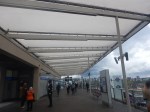
Diss Station – 19th May 2022
I went to Diss station for the first time today on a train, although I have caught a train from the station a couple of times.
These are my thoughts.
Long Platforms
Consider.
- The platforms are long enough to take two full-length twelve-car Class 745 trains, which are nearly 240 metres long.
- I suspect the platforms can also accept a pair of five-car Class 720 trains, which would be 244 metres long.
If this is true at all Inter-City stations, this must mean that Greater Anglia can still run a full service, if they are short of Class 745 trains.
Car Parking
This Google Map shows the extensive car parking at Diss station.
Note.
- There are two tracks and two platforms, with the London-bound platform on the Eastern side.
- There is parking on both sides of the tracks.
- According to the National Rail web site, there appears to be 316 parking bays on the London-bound side.
- A sign in the tenth picture shows a £2.50 All-Day parking deal on the Norwich-bound platform.
- The Internet shows a lot of competitively-priced parking around the station.
Commuters to London, Ipswich or Norwich will have to cross the line in the morning or evening and there are no lifts to make that easy.
A Step-Free Bridge At Diss
Network Rail had a competition a few years ago in conjunction with RIBA to design a stylish, affordable and easy-to-install footbridge and this was the winner.
This design is also under development.
I think one of these bridges could possibly be installed at Diss station at the Northern end of the station.
- Both bridges would appear to have small footprints.
- They are designed to clear 25 KVAC overhead electrification.
- Both bridges appear to be able to be built to a flexible width. I suspect this might allow one end of the bridge could be in a car park and the other on the opposite platform.
- Both are fully step-free.
- The composite bridge might be better because of a lower weight.
- The first bridge appears to be enclosed, so would work better in Manchester.
- I suspect that both could be installed after creating an appropriately-sized concrete base on either side of the tracks, by lifting in the bridge by means of a rail-mounted crane.
It is now over three years since the first design won the Network Rail/RIBA competition. That is just too long to get a prototype bridge built and installed.
Toilets
The toilets at the station were of an excellent standard. But this is getting increasingly common these days.
Cutting Emissions – Cleaner, Greener Turbostars
The title of this post, is the same as that of this article on Rail Engineer.
It is a detailed technical description about how one of Chiltern Trains’s Class 168 trains has been converted to hybrid power.
This extract from the article gives the results of the conversion.
In July 2021, to celebrate Chiltern Railways’ 25th anniversary, the prototype was used to carry a number of invited guests to Bicester for a celebration lunch. The unit achieved speeds of up to 100mph during this demonstration run and operated with emission free battery power into/out of Marylebone and Bicester. The converted train is expected to reduce CO2 by up to 25%, nitrous oxide by up to 70%, particulates by up to 90% and fuel consumption by up to 25%. There was also an expectation that engine noise level will be reduced by 75%.
The article finishes by discussing how all 450 cars of the combined Class 168/170 fleet could be converted.
The article also hopes that the new Chiltern contract could lead to a full conversion of the fleet to hybrid operation.
It is an article well-worth a read.
Bank Station – 16th May 2022
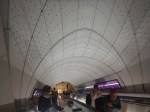
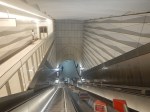
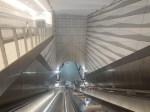
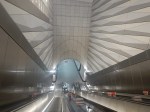
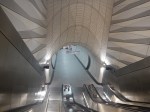
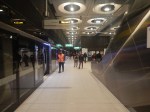
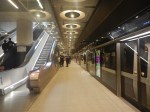
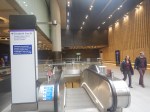
The new Northern Line platforms at Bank station are now open and I went this morning to have a quick look.
These are my thoughts.
The New Southbound Platform Is Wide
The new Southbound platform is wide and compares well with the wide platform at Angel station, that I wrote about in All Platforms Should Be Wide Like This.
This picture shows the Southbound platform at Angel., which dates from 1992.
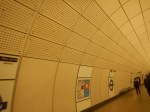
And this the new Southbound platform at Bank.
Two similar designs, but thirty years apart.
Simple Decor
The two pictures also illustrate the simple decor used in the rebuilt station.
The New Southbound Platform Is A Sprayed Concrete Tunnel
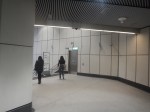
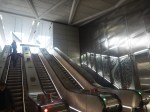
These pictures show the far wall of the new Southbound platform.
It looks from my untrained eye to be lined with sprayed concrete. I learned more about the use of sprayed concrete in tunnels, when I visited TUCA in Ilford, during Open House in 2012, which I wrote about in Open House – TUCA.
The Existing Northbound Platform Is Narrow
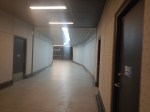
The Northbound platform is effectively as before, but with large and small holes in the wall to access a wide parallel pedestrian tunnel behind the wall.
There is a lot of circulation space.
The Parallel Pedestrian Tunnel
The old Southbound platform has been turned into a parallel pedestrian tunnel separated from the Northbound platform, by a wall that has four small and eight larger pedestrian-sized holes through it.
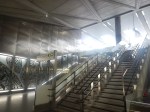
These pictures show a selections of the holes in the wall.
In addition.
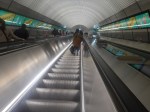
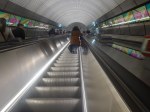
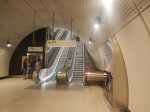
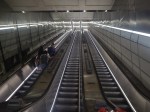
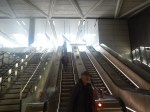
- The tunnel has escalators at the Southern end connecting to Monument station.
- The tunnel has stairs at the Northern end to the Central Line.
- Further connections will be added.
- It also has seats along its length. These will be mainly for Northbound passengers, waiting for trains, who can see the trains through the large holes.
It is an unusual layout and I’ve never seen anything like it before anywhere in London, the UK, Europe or the world.
Wot No More Marble?
The Northbound Northern Line used to have a platform with marble facings.
Some of marble is still there as these pictures show.
Note that the old rat-run to the DLR is still there between the platforms.
The Wide Cross Tunnels
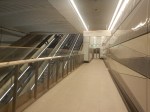
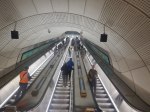
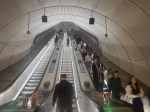
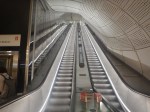
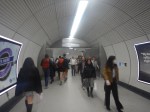
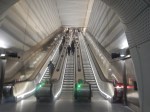
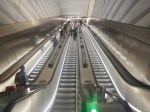
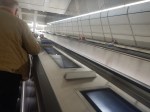
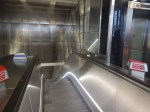
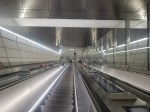
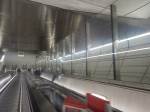
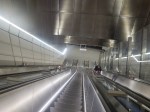
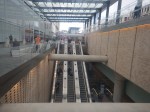
The wide cross tunnels link the two sides of the station together and to the escalators and moving walkways in the middle of the station.
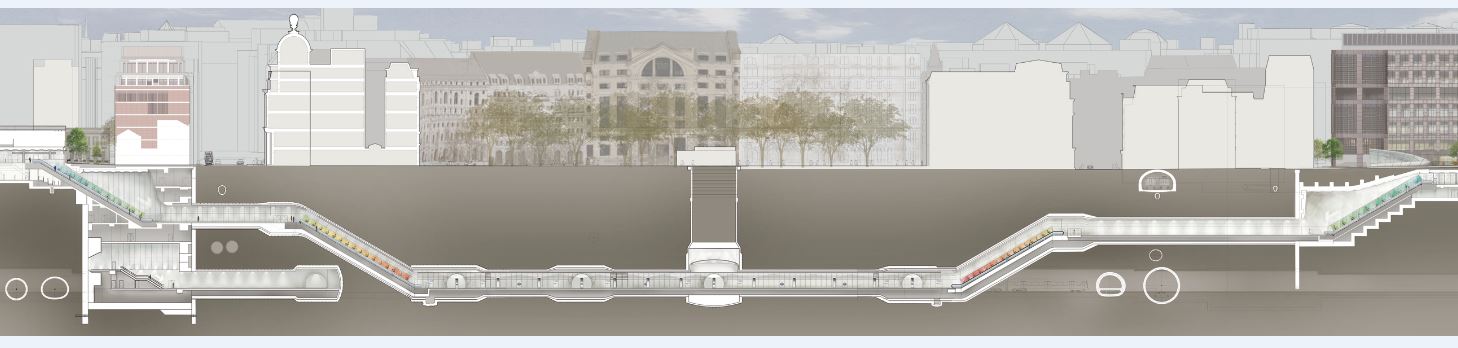
This visualisation shows the station.
Note.
- The only more-or-less completed bits are the two Northern Line tunnels and platforms and parallel pedestrian tunnel.
- The four cross tunnels can be picked out towards the far end of the station.
- Three of the cross tunnels can now be used by passengers.
- The moving walkway can be accessed from the two cross tunnels nearest to the Central Line.
- The escalators from the yet-to-open Cannon Street entrance appear to lead directly into a cross tunnel and a parallel tunnel to the moving walkway.
This station has definitely been designed for rabbits.
Level Access To The Trains
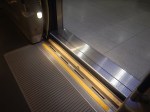
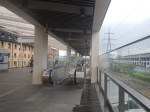
This picture shows the level access on the new Southbound platform.
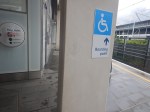
And this shows the step-up into the train on the old Northbound platform.
I wonder, if the platform can be raised to make the Northbound as good as the Southbound.
There Is Still A Lot To Do
At present the only sections of the project that are completed and visible to passengers are the following.
- The new wide Southbound platform.
- The refurbished Northbound platform, which is a similar width to before.
- The wide passenger tunnel behind the Northbound platform, that was converted from the old Southbound tunnel.
- The four new cross tunnels between the two platforms. Some still need finishing and there are spaces, where escalators will slot in.
It would appear that at least the following need to be done.
- Open up the new Cannon Street entrance
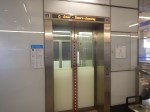
- Add the escalators and lifts.
- Put in the moving walkways between the Northern and Central Lines.
But it looks that everything left to do is small compared to the tunnel work that needed the closure from January.
This page on the TfL web site gives these dates.
- 16 May 2022: New southbound platform and concourse open
- Autumn 2022: DLR escalator and Central line link open
- Late 2022: Bank station capacity upgrade works due to be completed. New station with step-free access opens on Cannon Street.
It looks to me, that the project management has been done well and after hitting the first milestone, they appear to be on track.
Elizabeth Line To Open On 24 May 2022
The title of this post, is the same as that of this press release on Crossrail.
This is the sub-title.
Trains to run every five minutes 06:30 – 23:00 Monday to Saturday between Paddington and Abbey Wood.
And these are the first two paragraphs describe what will open.
Transport for London (TfL) has today confirmed that, subject to final safety approvals, the Elizabeth line will open on Tuesday 24 May 2022. The Elizabeth line will transform travel across London and the South East by dramatically improving transport links, cutting journey times, providing additional capacity, and transforming accessibility with spacious new stations and walk-through trains. The Elizabeth line will initially operate as three separate railways, with services from Reading, Heathrow and Shenfield connecting with the central tunnels from autumn this year.
In the coming weeks, Elizabeth line signage will continue to be uncovered across the network in preparation for the start of customer service. The updated Tube and Rail map will also be released later showing the new central section stations connected with the rest of the TfL network for the first time.
These are some points from the rest of the press release.
- Work will continue in engineering hours and on Sundays to allow a series of testing and software updates in preparation for more intensive services from the autumn.
- All services between Reading and Heathrow to Paddington and Shenfield to Liverpool Street, currently operating as TfL Rail, will be rebranded to the Elizabeth line.
- Passengers wanting to do longer journeys may need to change at Paddington or Liverpool Street stations.

- Services from Reading, Heathrow and Shenfield will connect with the central tunnels in autumn when frequencies will also be increased to 22 trains per hour in the peak between Paddington and Whitechapel.
- Paddington and Canary Wharf will have a journey time of only 17 minutes. It takes thirty minutes by the Underground.
- All Elizabeth line stations will be staffed from first to the last train, with a ‘turn up and go’ service offered to anyone needing assistance.
- Step-free access is in place from street to train across all Elizabeth line stations between Paddington and Woolwich.
- Work is ongoing at Bond Street Elizabeth line station, which means that it will not open with the other stations on 24 May. It will open later in the year.
- Changes will be made to 14 bus routes to improve links to Elizabeth line stations in east and south-east London, where many customers will use buses to get to and from stations.

- Full services across the entire route introduced by May 2023.
I have some thoughts.
My Routes To Crossrail
Like many in London, I will have multiple routes to and from Crossrail.
- I could take a 21 or a 141 bus from the bus stop round the corner to the Moorgate end of Liverpool Street station on Crossrail.
- I could take a 38 bus from another bus stop round the corner to Tottenham Court Road station on Crossrail.
- I could also take a 38 or 56 bus from this stop to Angel station and get a Northern Line train to Liverpool Street station on Crossrail.
- I could also take a 38 or 56 bus from this stop to Essex Road station and get a Northern City Line train to Liverpool Street station on Crossrail.
- I could also take a 30 bus from this stop to Highbury & Islington station and get a Northern City Line train to Liverpool Street station on Crossrail.
- I could take a 30, 38 or 56 from yet another stop round the corner to Dalston Junction station and get an Overground train to Whitechapel on Crossrail.
- I could even walk a few hundred metres to take a 76 bus from the stop in the centre of de Beauvoir Town to the Moorgate end of Liverpool Street station on Crossrail.
One of the reasons, I bought my house, was that it would have good connections to Crossrail.
But there is a cloud on the horizon.
My easiest route will probably be to use a 21 or 141 bus direct to Moorgate.
But our South London Mayor in his wisdom is hoping to retire the 21 bus leaving us with just the 141 direct to Moorgate.
I am by training a mathematical modeller and I have lived much of my life at various points on the transport corridor from Cockfosters to Moorgate formed by the Piccadilly Line and the 141 bus. I can even remember using the predecessor of the 141 bus, which was the 641 trolley-bus to come up to London with my grandmother in the 1950s.
I’m certain that when Crossrail opens, that if you live in say Wood Green, Southgate and Oakwood, if you want to use Crossrail to get to Heathrow or Canary Wharf, you will be highly likely to take the Piccadilly Line to Manor House and then take a 141 bus to Moorgate to pick up Crossrail.
The only alternative will be to change at Finsbury Park for the Moorgate Line, which even after the improvements at Finsbury Park, would not be an easy change with a heavy bag or a baby in a buggy.
I talked about this problem before in Does London Need High Capacity Bus Routes To Extend Crossrail?, where I said this.
I suspect that when Crossrail opens, the 141 bus will be heavily used by travellers going between the Northern reaches of the Piccadilly Line and Crossrail at Moorgate.
The 141 bus goes between London Bridge station and Palmers Green and it has a route length of about nine miles.
Currently, buses run every fifteen minutes or so, but I doubt it will be enough in future as Transport for London are rerouting the closely-related 21 bus.
I suspect any route seen as an extension of Crossrail needs to have the following characteristics.
- High frequency of perhaps a bus every ten minutes.
- Interior finish on a par with the Class 345 trains.
- Wi-fi and phone charging.
I would also hope the buses were carbon-free. Given that some of these routes could be quite long, I would suspect hydrogen with its longer range could be better.
It should be noted that the 43 bus, that passes Moorgate, is already carbon-free.
I will be interested to see what action is taken by Transport for London.
I believe their current plan is lacking and will make it difficult for those where I live to get to Crossrail at Moorgate.
Feeder Bus Routes To Crossrail
I believe that there could be considerable scope for more high-capacity high-quality feeder routes to and from Crossrail.
Currently, there are four bus routes that pass Moorgate station, that come into this category.
- 21 – Lewisham Shopping Centre and Newington Green
- 43 – London Bridge Station and Friern Barnet
- 76 – Waterloo Station and Stoke Newington
- 141 – London Bridge Station and Palmers Green
How many other routes are there, that stop outside a Crossrail station?
I suspect that for many Londoners and visitors, a bus to Crossrail will be their fastest way to their ultimate destination.
For instance, my fastest way to Bond Street, Canary Wharf, Ealing, Heathrow, Paddington and Reading will start with a bus to the Crossrail entrance at Moorgate station.
And it looks like Transport for London will be reducing my bus frequency to Moorgate, when it probably needs a slight increase.
Crossrail’s North-West Essex Extension
One of the elegant parts of Crossrail’s design is its interchange with the Central Line at Stratford station.
- The Eastbound Crossrail and Central Line platforms share an island platform.
- The Westbound Crossrail and Central Line platforms share an island platform.
This arrangement allows step-free cross-platform interchange between the two lines.
This map, which was clipped from Wikipedia, shows the North-Eastern end of the Central Line.
I am sure, that those who live to the North-East of Stratford station will be some of the residents of London, who benefit the most from Crossrail.
The following stations are step-free.
- Buckhurst Hill
- Debden
- Epping
- Hainault
- Newbury Park
- Roding Valley
- South Woodford
- Stratford
- Woodford
I suspect more stations will be made step-free.
Cross-Platform Interchanges
It was originally planned, that a similar cross-platform interchange would have been built at Walthamstow Central station, that would have allowed the Victoria Line to continue to Woodford.
As the Stratford interchange works so well, I’m surprised the track layout hasn’t been used at more places on London’s rail network.
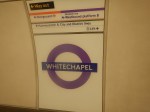
The Whitechapel Reverse
In Is Whitechapel Station Going To Be A Jewel In The East?, I discussed the importance of Whitechapel station.
Whitechapel station solves the round-the-corner problem for passengers, who want to go between say Romford and Woolwich stations.

Passengers just walk the few metres between the two platforms at Whitechapel station and take the first train to their destination.
I will be interested to see if Crossrail has an effect on traffic over the Dartfood Crossing and through the tunnels. How many will use Crossrail instead, when they are visiting their team, clients or family on the other side of the river?
I call stations like Whitechapel reversal stations, as they allow passengers to easily reverse direction. There is more about reversal stations in Reversal Stations.

The New Tube Map
These pictures show the new tube map.
Note.
- Crossrail is shown as a double purple line.
- Thameslink is also shown as a double pink line.
- There are certainly some drawing gymnastics to fit it all in.
But Harry Beck’s design survives.
Abbey Wood Station
The more I look at the design of Abbey Wood station and compare it to the Crossrail/Central interchange at Stratford, the more I think it is a substandard station.
Would it have been better, if one island platform had been designed for Westbound services and the other had been designed for Eastbound services? Crossrail services might be on the outside with North Kent services between the two island platforms.
This would have enabled a journey between say Rochester and Bond Street to have been done with a simple cross-platform change at Abbey Wood station.
No Victoria Line Interchange
I was surprised by these omissions.
This article on London Reconnections is entitled Horrible Holborn: When Postponement Is Not An Option.
It is well worth a read.
One section is entitled The interchange that isn’t, where this is said.
Whilst modelling showed that Bond St and Tottenham Court Road would be capable of managing the expected passengers once the Elizabeth line opens, it was clear that a combined Oxford Circus/Bond St (Crossrail) east entrance could not. If you have ever wondered why the Elizabeth line has no sub-surface interchange with the Victoria line at Oxford Circus despite the eastern ends of the Bond Street platforms being tantalisingly close, this is your answer. As the Victoria line at Oxford Circus is never likely to be able to handle the expected numbers of people that would board if there were direct access from the Bond St Crossrail platforms, it appears the two stations will never be linked with publicly accessible passages below ground.
In other words, you would solve the problem of the interchange between the Elizabeth and Victoria Lines and create severe overcrowding on the Victoria Line.
When I have supper with my son at the Angel, he comes from his home in Walthamstow, via a cross-platform change at Euston.
Routes like this allow those that live on the Victoria Line to access the Elizabeth Line.
No Piccadilly Line Interchange
The article says this about an Elizabeth Line station at Holborn.
It is pertinent to note that an early plan to have a Crossrail station at Holborn was abandoned. In reality, it would have been too close to Tottenham Court Road station to be really worthwhile. It would have restricted the alignment (bearing in mind that sub-surface Crossrail stations have to be straight and level). It would also have added considerable expense and may have put the entire project at risk. At the end of the day, it just wasn’t a good business case. Whilst a station on the scale of the Elizabeth line could not be justified, however, an improvement of the existing Holborn station could.
The article also says that upgrading Holborn station would not be easy, even without the connection to the Elizabeth Line.
New Mobile Hydrogen Unit Unveiled By Logan Energy In Bid To Accelerate Greener Transport
The title of this post, is the same as that of this article on Fuel Cell Works.
This sums up the development, that has been unveiled by Logan Energy.
It is a compression trailer, that looks like it could be towed by any vehicle capable of towing a horse box.
- The compressor can transfer hydrogen between any two cylinders at all the usual pressures.
- It is aimed at both the bus and heavy goods vehicle market.
- The hydrogen capacity of the trailer is not stated.
I feel that this sort of development will help operators embrace hydrogen.
A bus company for instance could have an appropriate number of trailers, for their fleet of hydrogen buses.
- The bus company would need a suitable towing vehicle, like a light truck.
- Trailers would be filled at an electrolyser outside of the city.
- Each bus depot could have a space, where a trailer could be parked to fill the buses.
- A schedule would probably need to be developed for filling the trailers.
We will see more developments like this.
But they will have to compete with companies like ITM Power, who can supply on-site electrolysers.
Work Begins In South Africa On Largest Fuel-Cell Vehicle In The World
The title of this post, is the same as that of this article on Hydrogen Fuel News.
This is an explanatory paragraph.
The Anglo American mining company in South Africa is seeking to lead the way in reducing its greenhouse gas emissions. It will be starting this effort with a 210 metric ton truck. The fuel-cell vehicle is the largest in the world and will operate at the Mogalakwena platinum mine.
These are some points from the article.
- The nuGen haul truck began as a Komatsu 930E with a diesel-electric powertrain.
- The haul truck’s traction motors are now powered by eight 100-kilowatt hydrogen fuel cell modules. The modules were provided by Ballard.
- They are complemented by a Williams Advanced Engineering lithium-ion battery pack capable of outputting 1.1MW.
- The components were integrated in Seattle by First Mode.
- The fuel-cell vehicle’s powertrain is 2MW (2,682 hp).
- That is adequate for the haul truck to keep up its rating of 300 metric tons.
- The truck and payload will reach 510 metric tons combined.
There are a lot of heavy numbers there.
There is this video from Anglo American.