Fortescue Future Industries And Airbus Join Forces To Help Decarbonise Aviation
The title of this post, is the same as that of this press release from Fortescue Future Industries.
These are the first two paragraphs.
Global green hydrogen company Fortescue Future Industries (FFI) and Airbus, a world leader in aeronautics, have joined forces to create a working alliance to help enable the aviation industry to decarbonise through zero-emissions green hydrogen.
Today’s announcement reflects FFI’s and Airbus’ shared ambition to leverage their respective expertise to support the entry-into-service of a green hydrogen-based aircraft by 2035. Green hydrogen, unlike other forms of hydrogen, is made from water using 100 per cent renewable electricity.
I think this is a smart move by Airbus.
It could be argued that hydrogen trucks, buses, cars, vans and other road vehicles have not taken off at a great rate due to the lack of hydrogen filling stations.
Hydrogen airliners travelling on typical routes will probably need refuelling at both ends of the route and possibly several times per day, so hydrogen refuelling would be an important part of any deal Airbus signs with an airline.
Fortescue Future Industries seem to be in prime position to be the first global hydrogen company, so they must be the ideal hydrogen fuelling partner.
I don’t think anybody predicted, when Airbus published the possible designs of their concepts for hydrogen-powered aircraft in September 2020, that I wrote about in ZEROe – Towards The World’s First Zero-Emission Commercial Aircraft, that an Australian company would be likely to provide the hydrogen fuel for these aircraft.
Will Rail Baltica Annoy Putin?
Rail Baltica is described like this in Wikipedia.
Rail Baltica (also known as Rail Baltic in Estonia) is an ongoing greenfield railway infrastructure project to link Finland (via ferry or an undersea tunnel), Estonia, Latvia, Lithuania with Poland and through this with the European standard gauge rail line network. Its purpose is to provide passenger and freight service between participating countries and improve rail connections between Central and Northern Europe, specifically the area in the Southeast of the Baltic sea. Furthermore, it is intended to be a catalyst for building the economic corridor in Northeastern Europe. The project envisages a continuous rail link from Tallinn (Estonia) to Warsaw (Poland). It consists of links via Riga (Latvia), Kaunas and Vilnius (Lithuania). Rail Baltica is one of the priority projects of the European Union.
These are a few more details.
- It will be a double-track railway or four tracks if it handles freight.
- Passenger trains will run at up to 250 kph (155 mph)
- Electrification will be either 25 KVAC or 3 KVDC overhead.
- It will be a standard gauge line.
- There will be no level crossings.
- It is planned to open around 2026.
The biggest problem could be that some of the route is shared with the Russian gauge line, that connect Kaliningrad to Vilnius and then from there to the main part of Russia.
This map from OpenRailwayMap shows the railways between Kaliningrad and Vilnius.
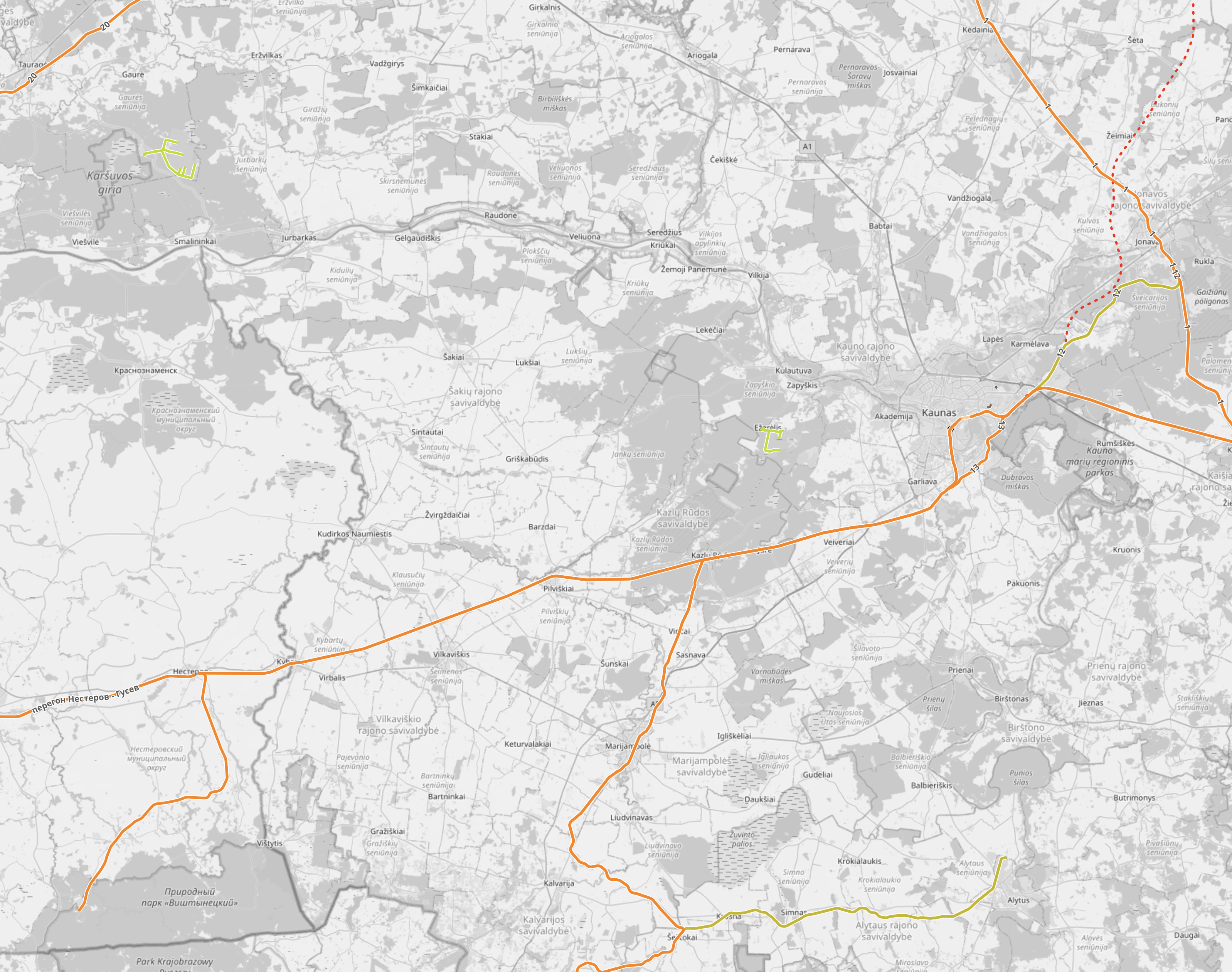
Note.
- The orange lines are main lines.
- The yellow lines are secondary lines.
- The orange line going West goes to Kaliningrad.
- The dark grey line crossing the railway is the border of the Kaliningrad enclave, which was annexed by the Soviet Union in 1945.
- The orange line going South goes to Bialystok, Warsaw and all places to the West.
- The loop in the line is at Kaunus, where there will be an interchange between the two lines.
- The orange lines going East go to Vilnius.
- The dotted red line in the North-East corner of the map, will be new track for Rail Baltica.
The new railway will effectively squeeze itself between Kaliningrad and Kaunus.
Railway Gauges In Poland and the Baltic States
Consider.
- Most, if not all of the railways in the Baltic States are Russian gauge.
- The line between Kaliningrad and Kaunus is Russian gauge.
- Most of the railway lines in Poland are standard gauge.
- The EU likes all new high speed lines like Rail Baltica to be built to standard gauge and have 25 KVAC overhead electrification.
- Kaunus is in Lithuania, so NATO control access to Kaliningrad in sensitive times.
I can’t believe that Vlad likes the current situation and would probably prefer Rail Baltica to be built to Russian gauge, as it would enable the Russian Army to easily move tanks into the Baltic States.
Conclusion
There’s a chance that Vlad will make trouble.
The Flying Scotswoman
I didn’t know there was a Flying Scotswoman, until I saw this InterCity 225 train, at King’s Cross station, this morning.
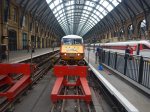
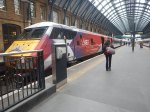
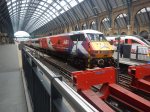
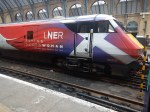
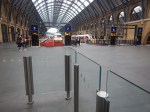
She was actually leaving for Leeds.
Polish Industry Calls For ’Full And Complete’ Sanctions On Russian And Belarusian Railways
The title of this post, is the same as that of this article on Railway Gazette.
This is the introductory paragraph.
Representatives of the Polish railway industry have issued a joint call for the European Commission to impose ‘full and complete’ sanctions on the Russian and Belarusian railways because of their logistical role in the invasion of Ukraine.
Sounds fine by me!
EMR Refine Its All Day Complimentary Food Menu For First Class Customers
The title of this post, is the same as that as this press release from East Midlands Railway.
This is the details.
East Midlands Railway (EMR) has refined it’s all day complimentary food menu for its First Class Intercity customers, offering a range of options – no matter what time they choose to travel.
The changes will mean, instead of a small number of services offering complimentary food in the morning, the company will now offer a range of free food and drink items on all its longer distance Intercity services, all day, Monday to Saturday, with plans to extend the offer to Sundays in the future.
Customers travelling First Class during the morning will now be able to choose a hot complimentary bacon or sausage ciabatta, porridge, or a vegan breakfast burrito. While in the afternoon, they will be offered a chilled sandwich, wrap or salad, or the choice of a gluten free meal or vegan option.
Next time, I go to Nottingham, I’ll go First.
106 Solaris Zero Emission Buses Headed To ÖBB Postbus’ Fleet In Austria
The title of this post, is the same as that as this article on Sustainable Bus.
This is the body of the story.
Up to 106 zero emission buses are headed to Austria, where ÖBB Postbus is going to deploy them starting from 2022 – 2025. Solaris has signed another framework agreement with the Austrian bus company Österreichische Postbus AG. It stipulates a possibility to deliver up to 106 battery-electric and hydrogen buses that would be deployed throughout Austria. The models offered include Urbino 9 LE electric and Urbino 12 hydrogen buses.
Solaris Bus and Coach is a Polish company, that is a subsidiary of CAF.
Mayor Announces Proposals For London-Wide Pollution Charge
The title of this post, is the same as that of this article on the BBC.
These paragraphs explain the changes.
The mayor of London has announced plans to extend the Ultra Low Emission Zone (ULEZ) across the whole of London.
Under the current scheme, drivers of older, more polluting vehicles are being charged to enter London’s north and south-circular orbital roads.
New proposals will see the scheme extend to the edges of London’s boroughs in 2023.
I believe in this, as in many things, that the carrot is more powerful than the stick.
So we need to encourage people to change to electric or hydrogen-powered vehicles.
- There are not enough electric charging points.
- There are not enough hydrogen filling stations.
- Installing and building more might encourage people to go zero-carbon.
But surely, the biggest drop in pollution would come from encouraging large London-based fleets of trucks to go zero-carbon. These would include.
- Refuse trucks.
- Cement trucks.
- Skip trucks.
- Large trucks used to transport aggregates and spoil from building sites.
It is unlikely, that many of these will ever be electric. The batteries would be just too heavy.
But many will go hydrogen or dual fuel, where they can use diesel and hydrogen.
I think there are various measures that would encourage the companies running these trucks to switch to hydrogen.
- Following Birmingham, which has bought a few hydrogen buses and installed an electrolyser to provide their hydrogen fuel, which will be available to all users.
- Once there is a good network of hydrogen stations, this might encourage owners of fleets of trucks to convert to hydrogen.
- Once owners of taxis and Chelsea tractors, see lots of trucks and buses running on hydrogen, would they switch?
If I was the Mayor, I would offer a Mayor’s Prize to the company or borough, that has done most to cut pollution and/or carbon emissions.
Some mayors would enjoy giving out that prize.
Greater Manchester Leaders Now Want Clean Air Zone Charges Scrapped On ALL Vehicles After Huge Backlash
The title of this post, is the same as that of this article on the Manchester Evening News.
This is the first two paragraphs.
No vehicles should be charged in the new Clean Air Zone (CAZ), Greater Manchester leaders have agreed, as the scheme remains under review.
In a letter to the Prime Minister, Greater Manchester mayor Andy Burnham has called for a ‘non-charging’ scheme which would help fund vehicle upgrades.
How can a non-charging scheme help to fund vehicle upgrades?
I suppose that Burnham wants the Government to pay for updating all the vehicles that Mancunians might drive in the Clean Air Zone.
Green Light For Last Of Six New Stations For Northumberland Line
The title of this post, is the same as that of this article on the Northumberland Gazette.
The title probably says it all and now final planning can be started, with construction due to start in the summer.
GB Railfreight Plans Order For Future-Proofed Bi-Mode Locomotives
The title of this post, is the same as that of this article on Railway Gazette.
This is the introductory paragraph.
GB Railfreight is planning to order a fleet of main line electro-diesel locomotives with a modular design which would facilitate future replacement of the diesel engine with a battery or hydrogen fuel cell module.
The rest of the article gives clues to the deal and the specification of the locomotives.
- Negotiations appear to have started with Stadler for locomotives to be built at their Valencia plant.
- Twenty locomotives could be ordered initially, with options for thirty.
- The locomotive will be Co-Co bi-modes.
- The diesel engine will be for heavy main line freight and not just last-mile operations.
- They would be capable of hauling freight trains between Ipswich and Felixstowe, within two minutes of the times of a Class 66 locomotive.
- They will be of a modular design, so that in the future, the diesel engine might be replaced by a battery or fuel cells as required and possible.
They have provisionally been called Class 99 locomotives.
These are my thoughts.
EuroDual or UKLight?
Stadler make two types of bi-mode locomotives.
But the two types are closely related and open up other possibilities.
This paragraph from the Eurolight wikipedia entry, explains the various versions.
The type has been intentionally developed to support use on secondary lines without limiting power or speed performances, making it suitable for mixed traffic operations. Specific versions of the Eurolight have been developed for the United Kingdom market, and a 6-axle Co’Co’ machine for narrow gauge Asian markets, named UKLight and AsiaLight respectively. Furthermore, an electro-diesel locomotive derivative of the UKLight that shares much of its design, referred to as the Stadler Euro Dual, has also been developed and introduced during the late 2010s.
It looks like the customer can get the locomotive they want.
GB Railfreight would probably need locomotives to this specification.
- Slightly narrower than a EuroDual, to fit the UK loading gauge.
- Three-axle bogies to handle the weight of the larger locomotive.
- A body bigger than the UK Light to be large enough for the diesel engine.
- It would probably help if the locomotive could go anywhere that a Class 92 locomotive could go, so it could handle their duties if required.
This leads me to the conclusion that GB Railfreight will get a slightly narrower EuroDual.
Weight Issues
The weights of various locomotives are as follows.
- Class 66 Locomotive – 129.6 tonnes
- Euro Dual – 126 tonnes
- Class 90 Locomotive – 84.5 tonnes
- Class 92 Locomotive – 126 tonnes
All locomotives have six axles, except for the Class 90 Locomotive which has four.
I don’t think there will be any weight issues.
Power On Electricity
These are the power of the locomotives on electricity.
- Class 66 Locomotive – Not Applicable
- Euro Dual – Up to 7 MW
- Class 90 Locomotive – 3.7 MW
- Class 92 Locomotive – 5 MW
GB Railfreight can probably have what power is best for their routes.
Operating Speed On Electricity
These are the power of the locomotives on electricity.
- Class 66 Locomotive – Not Applicable
- Euro Dual – 100 mph
- Class 90 Locomotive – 110 mph
- Class 92 Locomotive – 87 mph
GB Railfreight can probably have what power is best for their routes, but I suspect they’d want it to be as fast as a Class 90 locomotive.
Power On Diesel
These are the power of the locomotives on diesel.
- Class 66 Locomotive – 2.5 MW
- Euro Dual – Up to 2.8 MW
- Class 90 Locomotive – Not Applicable
- Class 92 Locomotive – Not Applicable
To be able to handle trains, that a Class 66 locomotive is able to, 2.5 MW would probably suffice.
Could The Locomotives Use The Channel Tunnel?
I suspect that diesel locomotives are not liked in the Channel Tunnel because of all that flammable diesel.
But in the future, when there is a battery-electric variant, I would suspect that would be allowed.
In UK To France Automotive Train Service Launched, I talked about Toyota’s new service between Toton in England and Valenciennes in France via the Channel Tunnel. A locomotive with sufficient battery range might be ideal for this service, if it could handle the Market Harborough and Toton section, which is likely to be without electrification for some years.
Will The Locomotives Have Third Rail Shoes?
If their power on electricity is such that they can stand in for Class 92 locomotives, then there may be a need to fit all or some of the locomotives with third rail shoes.
As an example, they might be useful in taking freight trains to and from Southampton or the Channel Tunnel.
Conclusion
I feel that, as the locomotive must fit current routes and schedules, so I wouldn’t be surprised to see the following specification.
- UK loading gauge.
- Co-Co
- Class 90 locomotive power and operating speed on electricity of 3.7 MW and 110 mph.
- Class 66 locomotive power and operating speed on diesel of 2.5 MW and 75 mph.
- Ability to change between electric and diesel power at speed.
- Ability to haul a heavy freight train out of Felixstowe.
- Ability to haul passenger trains.
Stadler will have one eye on the fact, that if they get this design right, this order for up to fifty locomotives could be just the start.
It certainly seems a locomotive designed for the UK’s railway system.
 The Anonymous Widower