Kawasaki’s Liquefied Hydrogen Carrier Departs To Pick Up First Cargo
The title of this post, is the same as that of this article on Green Car Congress.
This is the first paragraph.
Kawasaki Heavy Industries’ Suiso Frontier, the world’s first liquefied hydrogen carrier, has left Japan to pick up its first hydrogen cargo in Australia. A return to Japan is expected around late February.
As the cargo is only seventy-five tonnes of liquid hydrogen, I have my doubts about shipping hydrogen from Australia to Japan.
Late February is two months away, so this represents a production rate of 37.5 tonnes per month.
In Can The UK Have A Capacity To Create Five GW Of Green Hydrogen?, I said the following.
Ryze Hydrogen are building the Herne Bay electrolyser.
- It will consume 23 MW of solar and wind power.
- It will produce ten tonnes of hydrogen per day.
The electrolyser will consume 552 MWh to produce ten tonnes of hydrogen, so creating one tonne of hydrogen needs 55.2 MWh of electricity.
This would mean that if the Japanese built one Herne Bay-size electrolyser, then it would produce around three hundred tonnes of hydrogen in an average month.
The only possible use for this ship at the moment, is as a research project to identify the problems of the transportation of hydrogen over long distances by sea.
But we may need to use ships for the coastal transportation of hydrogen in the UK and to Europe.
Lumo Allows Passengers From London To Edinburgh To Pre-Order Meals
The title of this post, is the same as that of this article on Rail Advent.
I just tried it out and what I saw was a good start.
They even had gluten-free sandwiches and other items from Marks & Spencer.
You can access it here.
Road-Rail Services Inaugurated
The title of this post, is the same as that as this article on Railway Gazette.
This first paragraph tells all.
The start of regular road-rail services on the Asa Kaigan Tetsudo in southeast Shikoku was marked with a ceremony at Awa-Kainan-Bunkamura on December 25.
I have found this video of the vehicles.
I do wonder if there is a simpler way.
In Zwickau in Germany on the Vogtlandbahn, standard Stadler diesel multiple units, run through the streets from the main station to a tram-stop like station in the centre of the town.



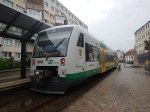
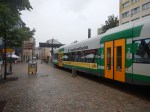
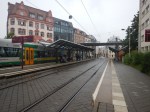
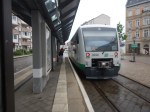

They are more of a train-tram, than a tram-train.
- The train is fitted with orange warning lights.
- The train shares the same corridor with a tram, that uses a different gauge, using three-rail track.
- Access between the train and platform is more-or-less level and as good as, if not better than most German trains.
- The platform at Zwickau Zentrum is an island platform, where the trams call at the other side.
- The concept would work with any independently-powered multiple unit.
I am sure, where there are places where this will work in the UK.
We almost do the same thing at some seaside stations like Saltburn, Sheringham and St. Ives.
‘New Era’ As German Coalition Prioritises Rail Spending Over Road
The title of this post, is the same as that of this article on Railway Gazette.
This is the first paragraph.
The so-called ‘traffic light coalition’ formed by the Social Democratic, Green and Free Democratic parties as the next federal government has committed to launching a ‘Rapid Capacity Expansion’ to enhance railway infrastructure as part of its wider transport strategy.
Other policies would include.
- A national regular interval timetable as a matter of priority.
- Increasing rail’s share of the freight transport market from the current 19% to 25% by 2030.
- Doubling passenger traffic by the end of the decade.
- Electrify 75 % of the network by 2030.
- Road tolls for trucks would be increased to reflect CO2 emissions.
- New commercial and industrial developments would be mandated to examine the potential for incorporating a rail connection.
- A pressure group, whose name translates as Alliance Pro Rail is in favour.
But will the average German voter in their Audi, BMW, Mercedes or Volkswagen cruising down the autobahn be in favour?
It certainly looks like it will be all change on German railways and roads.
The article is also linked to three in depth articles on the future of German railways published by Railway Gazette in the last few months.
- Comment: Climate Goals To Trump Profits
- German Associations Seek More Competition In Second Rail Reform
- Rail Reopenings To Support Climate-Friendly Transport
It certainly is all change.
Platform Construction Underway At Winslow On New East West Railway
The title of this post, is the same as that as this article on Rail Advent.
This picture from Network Rail shows the Winslow station construction site.
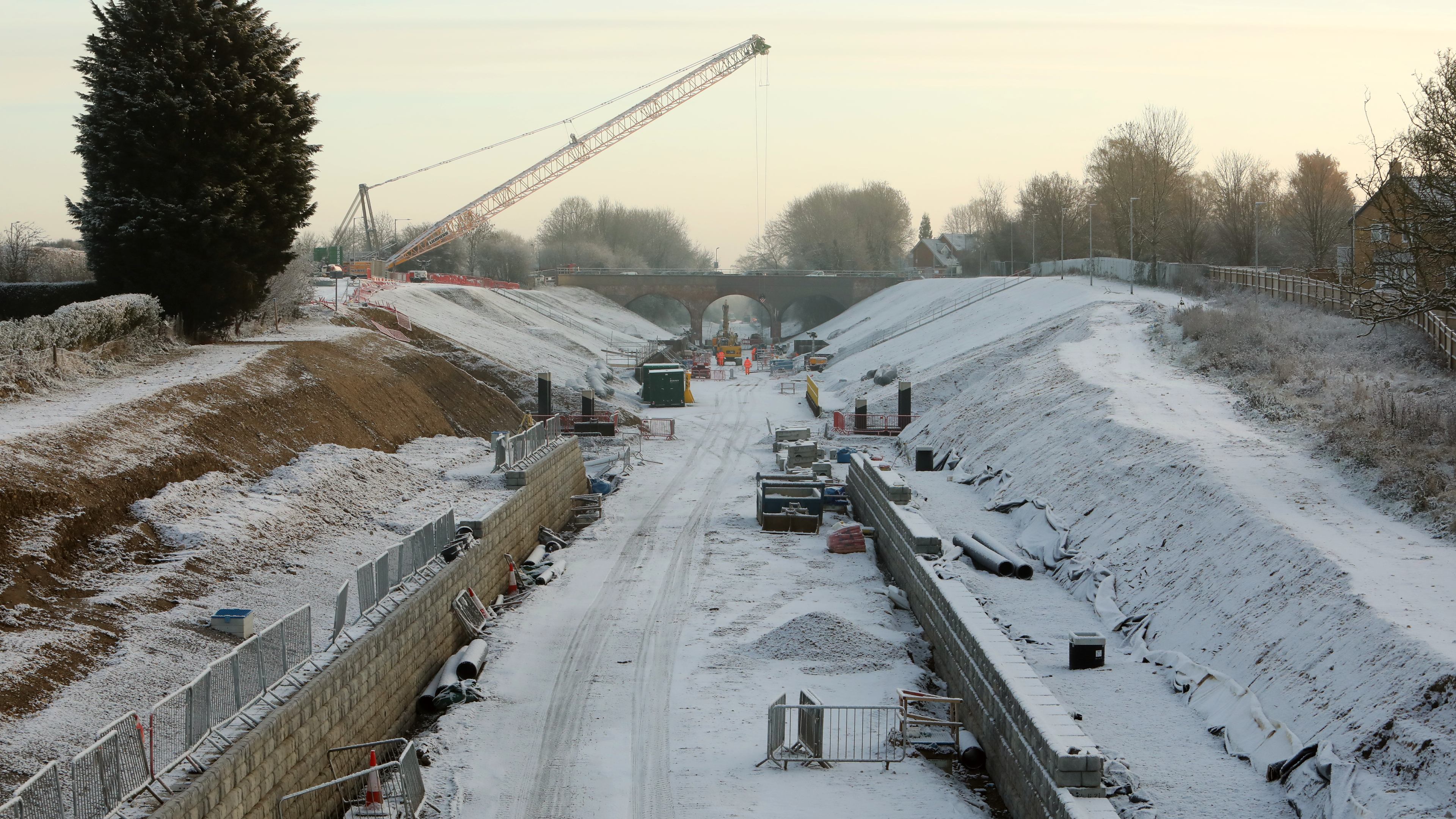
This paragraph from the Rail Advent article describes the operation.
A 250 tonne crawler crane is being used to lift over 500 pre-cast concrete platform units into position within new railway cutting. As there is limited space available on site, a smartphone app has been developed to allow the platform units to be called for delivery in the exact construction sequence. The crane’ ‘lattice boom’ is 62-metres long , which is taller than Nelson’s Column.
That all sounds like good project management to me.
More ICE Sprinters Offer Alternative To Flying
The title of this post, is the same as that of this article on Railway Gazette.
The first two paragraphs, give an overview of the changes being made.
Deutsche Bahn introduced more limited-stop Sprinter ICE services on long-distance inter-city routes with the timetable change on December 12.
Sprinter-branded ICE services now operate on eight domestic routes, while a daily Frankfurt am Main – Paris service calling at Mannheim and Karlsruhe also carries the branding. Intended to appeal to business travellers, many of the Sprinter services are timed to depart early in the morning with return trips in the evening. This ensures a full day at the destination and offers a viable alternative to domestic flights.
It would appears that these services now have trains that are under the acceptable four hours.
- Cologne and Berlin
- Cologne and Munich
- Hamburg and Frankfurt Airport
If Deutsche Bahn are serious about competing with the airlines, they must surely increase the frequency.
In 2018, I travelled between Berlin and Munich in under four hours and wrote about it in From Berlin To Munich In Four Hours By Train.
This is how I started that post.
The length of the East Coast Main Line between London Kings Cross and Edinburgh is 632 kilometres.
Deutsche Bahn have recently completed an upgraded High Speed Line between Berlin and Munich, which has a length of 623 kilometres.
Both lines are not the very fastest of High Speed Lines, but lines where a consistent two hundred kilometres per hour is possible.
The East Coast Main Line was built in Victorian times and services typically take around twenty minutes over four hours, with nine -car InterCity 225 trains running twice an hour.
The Berlin-Munich route was originally built over two centuries ago, but the Germans have spent twenty-five years and many billions of euros punching a new route between Berlin and Nuremberg, through the difficult countryside of Thuringen Forest.
The route may allow the Germans to travel from Berlin to Munich in three hours fifty-five minutes, but at present you can only do it three times a day in a six-car train.
I took the lunchtime train and sat in First Class for a hundred and fourteen euros.
Deutsche Bahn have increased the trains on this route to five trains per day, but compared to London and Edinburgh on LNER, it is too infrequent, expensive with questionable customer service and not enough seats to give the airlines a run for their money.
A quick look on Rail Europe indicates that these routes have fast services at an hourly frequency or better.
- Madrid and Barcelona
- Milan and Rome
- Paris and Bordeaux
- Paris and Cologne
- Paris and Marseilles
- Venice and Naples
German rail services might be getting better, but not fast enough to take on the airlines.
Will We See Class 43 Power Cars Converted To Hydrogen?
To say that the Class 43 power cars of the InterCity 125 trains are iconic is rather an understatement.


Note.
They were built by British Rail in the late 1970s and early 1980s.
- They have an operating speed of 125 mph.
- They are now powered by a modern MTU 16V4000 R41R diesel engine after being re-engined earlier this century.
- They have an electric transmission.
According to Wikipedia, there are over a hundred and twenty in service.
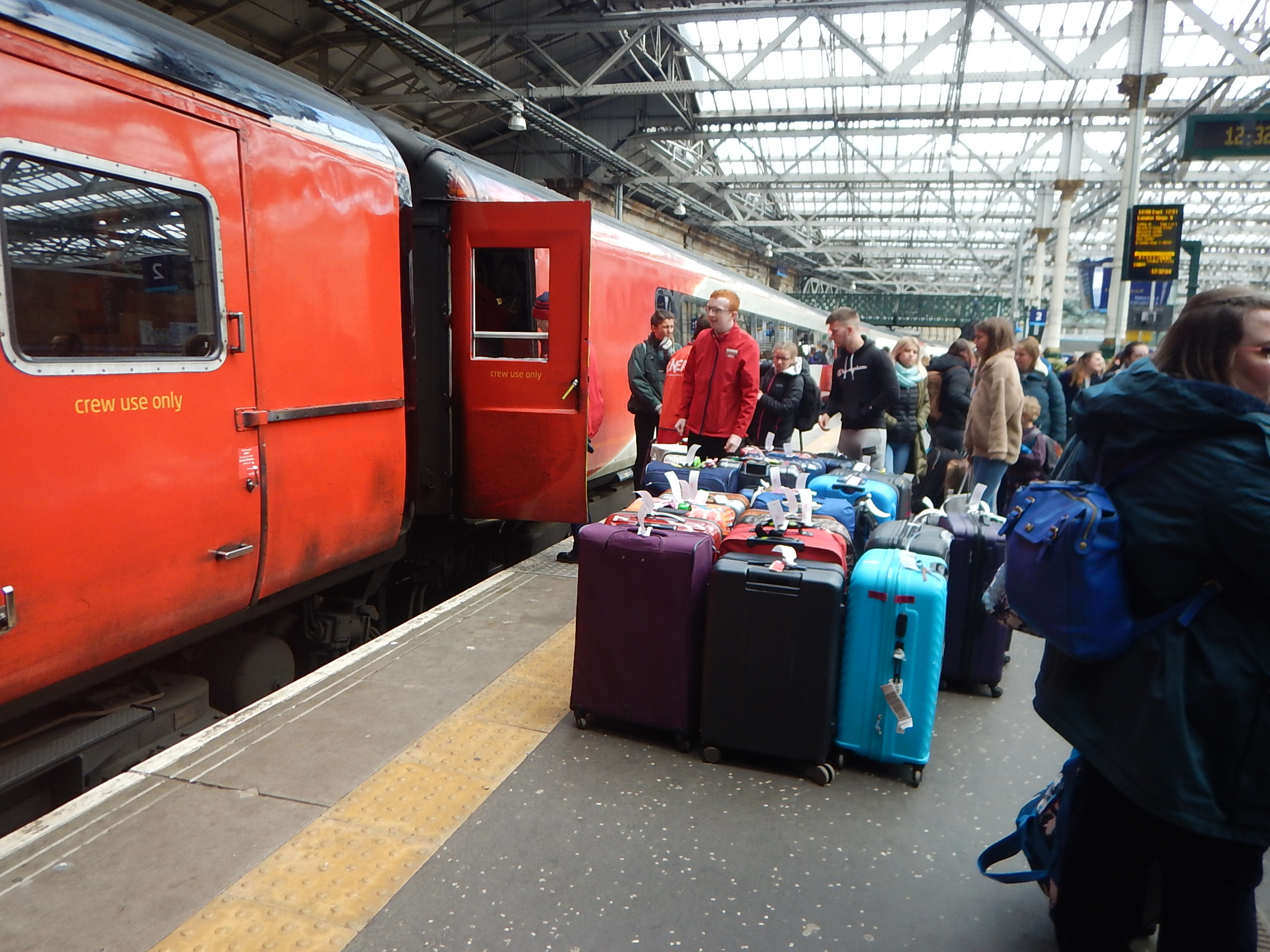
At the back of the power car there is a lot of space, as this picture shows.
This press release from Rolls-Royce is entitled Rolls-Royce Launches mtu Hydrogen Solutions For Power Generation.
These are the introductory bullet points to the press release.
- From 2022 mtu Series 500 and Series 4000 ready for 25% hydrogen
- From 2023 mtu engines and conversion kits available for 100% hydrogen
And what engine is there in a Class 43 power car? – It’s an MTU 16V4000 R41R diesel engine.
Is it an mtu Series 4000 engine?
If it is, there is space in the back of the power car for the hydrogen tank and the diesel engine can be converted to run on hydrogen, Rolls-Royce have everything they need break the speed record for hydrogen-powered trains. After all power cars; 43102 and 43159 hold the diesel-train speed record at 148 mph.
It would be the ultimate Roller.
Flirt Akku And Class 755 Train Compared
This article on Focus Transport is entitled 224-kilometre Battery Range For FLIRT Akku – Stadler Sets World Record For Guinness Book Of Records.
These facts about the record run are given.
- The route was from from Berlin to Warnemünde.
- It appears to have been independently verified.
- The distance was 224 kilometres or 139 miles.
- This distance is more than London to Great Yarmouth via Norwich.
- It is reported that the temperature was around zero, which is not very battery-friendly.
No mention was made in the article of the number of passengers on board or the average speed.
Various articles have stated that the Flirt Akku is a three-car train, but I was not sure, if it included a PowerPack car like the Class 755 train.
So I flew my virtual drone over the route and got this picture.

Compare the front end with this picture of a Class 755 train at Lowestoft.
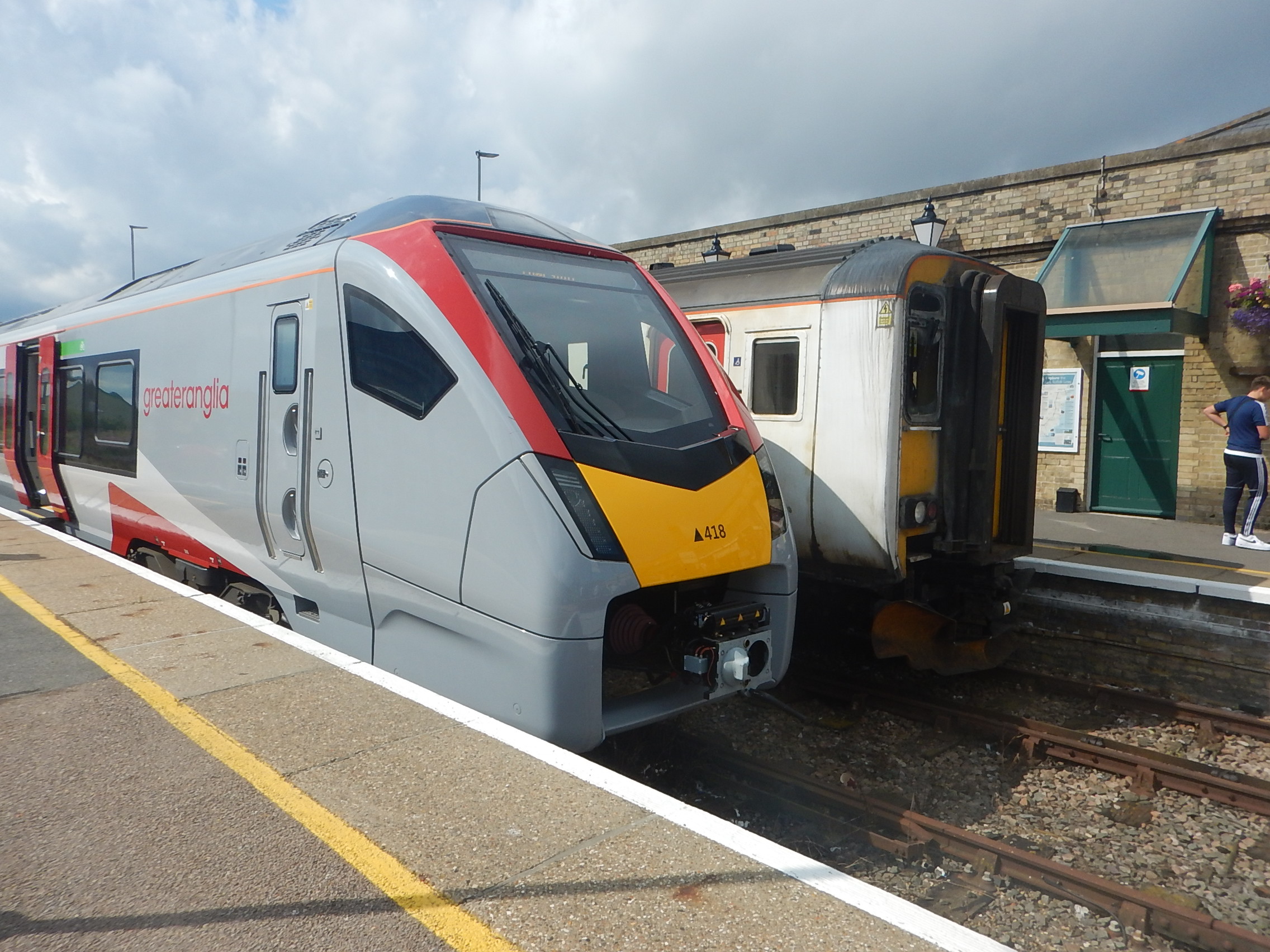
And the side view with this diagram of the trains, that I clipped from Wikipedia.
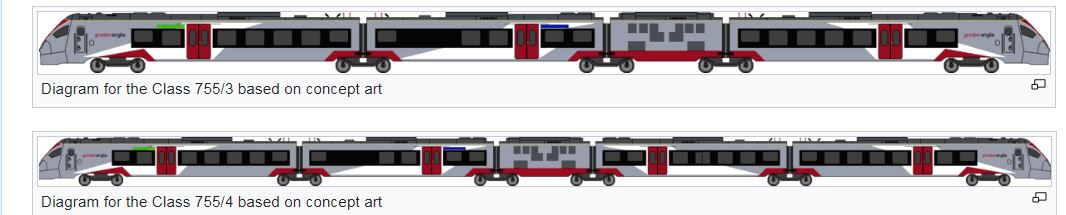
I can come to these conclusions.
- The two front ends are very different, although the basic layout of doors and windows appears the same.
- The Akku seems to have a flatter side.
- The Akku lacks the PowerPack of the British train.
It also looks like the Greater Anglia train has better step-free access between between train and platform. But then you never seem to find good step-free access on German trains.
Some extra information and thoughts .
Testing The Flirt Akku
This article on Railvolution is entitled FLIRT AKKU Research Project Completed.
The article comprehensively described the testing process and gave more details of the train.
- The train was running at 140 kph or 87 mph.
- This speed is available from the catenary or battery.
- Battery charging takes twenty minutes.
- The train seats 154 passengers in a 2 + 2 configuration.
The train appears to be roughly the same size and performance as a three-car Class 755 train.
Range On A Battery-Electric Class 755 Train
The battery range needed on various Greater Anglia routes are as follows.
Ipswich and Cambridge – 41.3 miles
- Ipswich and Felixstowe – 15.6 miles
- Ipswich and Lowestoft – 48.9 miles
- Ipswich and Peterborough – 71.2 miles
- Norwich and Great Yarmouth – 18.3 miles
- Norwich and Lowestoft – 23.5 miles
- Norwich and Sheringham – 30 miles
- Norwich and Stansted Airport – 53.7 miles
- Marks Tey and Sudbury – 11.8 miles
Note.
- Cambridge, Ely, Ipswich, Norwich and Peterborough are stations with full electrification.
- I suspect some services will need charging at the remote station.
It looks like to handle all routes will need a train with a range of around 80 miles or around 129 kilometres.
Conclusion
I don’t think that it would be impossible for Stadler to create a battery-electric Class 755 train with enough range.
What Will Happen To Northern’s Class 195 Trains?
Northern’s Class 195 trains could be a problem in the future.
- They are diesel multiple units.
- There are twenty-five two-car trains and thirty-three three-car trains.
- All cars have a Rolls-Royce MTU 6H1800R85L diesel engine, that drives the train through a ZF EcoLife 6-speed transmission.
- They are 100 mph trains, which is adequate for the routes they serve.
- According to Wikipedia, the trains are designed for a lifespan of thirty-five years, which takes the trains past the date, when it is intended that all trains should be zero-carbon.
It looks to me, that a plan will be needed to decarbonise these trains, as they are probably too new and costly to scrap.
These are possibilities to upgrade them to zero-carbon.
Rebuild as Class 331 Electric Trains
The design of the Class 195 trains is based on the same platform as that of the Class 331 trains.
I would expect that it could be possible to rebuild the Class 195 trains as Class 331 trains.
But it would be an expensive and disruptive process and would require a lot of electrification.
Some battery-electric versions could be created to cut the need for electrification.
Run The Trains On Net-Zero Hydrogenated Vegetable Oil Or Other Fuels
In Powered By HVO, I wrote about research going on into the use of Hydrogenated Vegetable Oil or HVO.
There is also ongoing research into other net-zero fuels that can be used in a diesel engine.
The process used by Velocys to create sustainable aviation fuel can also be used to produce diesel from various sources like disposable nappies, household waste and scrap wood.
Run The Trains On A Dual Fuel Basis With Hydrogen
In Grand Central DMU To Be Used For Dual-Fuel Trial, I talk about how Grand Central in collaboration with a company called G-volution are running experiments with dual-fuelling a Class 180 train. G-volution state that they could dual fuel with hydrogen using their technology.
The Class 180 trains have Cummins engines, but I suspect G-volution’s technology or something similar could be applied to the Rolls-Royce MTU engines in the Class 195 trains.
This could be a very promising route.
Convert The Diesel Engines To Run On Hydrogen
Cummins and JCB have developed internal combustion engines, that can run on hydrogen. I would be very surprised if Rolls-Royce MTU are not developing this technology.
Conclusion
There are options to convert the Class 195 trains into low or zero-carbon trains.
.
Anglo American And Aurizon Look To Hydrogen-Powered Trains
The title of this post, is the same as that of this article on World Coal.
This is the first paragraph.
Australia’s largest rail freight operator, Aurizon, and leading global mining company, Anglo American, have agreed to work together on a feasibility study to assess the introduction of hydrogen-powered trains for bulk freight in Queensland.
I find it interesting and very ironic, that this partnership has been formed, partly to transport the product, with the most polluting of end uses; coal.
The article also says this about Anglo American’s policy on decarbonisation of their mines.
As part of its commitment to carbon neutral mines by 2040, Anglo American has taken a global lead in the development of green hydrogen solutions for its ultra-class 290 t payload mine haul trucking fleet. Anglo American’s unique combination of powertrain technologies, designed to operate safely and effectively in real-world mine conditions, will displace the use of the majority of diesel at its mining operations, with an advanced trial of the prototype truck at its Mogalakwena platinum group metals mine in South Africa.
It does appear that the partnership are starting from a proven base of hydrogen technology.
Conclusion
This looks like a sound real-world project to produce a hydrogen-powered zero-carbon locomotive.
 The Anonymous Widower