Planning Permission Granted For The First New Railway Station On The Northumberland Line
The title of this post, is the same as that of this article on ITV.
This map from ITV shows the Northumberland Line.

Ashington station has been given planning permission.
Facilities include.
- A hundred metre platform and all the gubbins. The platform length would accommodate a five-car train.
- A 270 space car park with facilities for the disabled and electric cars.
It is due to open by 2024.
It looks like it’s just five new stations to go.
Is Lumo The Ryanair Of Rail?
Someone had to draw the comparison between Lumo and Ryanair and it was The Times, that used a headline of Lumo, The Ryanair Of Rail, Gets The Green Light On East Coast, for their article about the new London and Edinburgh rail service in their article today.
But how alike are the two business models?
Standard Planes And Trains
The Boeing 737 and the Airbus A 320, as used by Ryanair and easyJet are the two workhorses of short haul airlines.
It can also be said, that Hitachi’s AT-300 train is becoming the workhorse of long-distance rail services in the UK.
Customised Interiors
Ryanair and easyJet do customise the interiors of their aircraft to a certain extent and from pictures on the Internet Lumo appear to have done the same.
If you look at the widths of the planes and trains on Wikipedia, you find these values.
- Airbus A 320 – 3.95 metres
- Boeing 737 – 3.8 metres
- Class AT-300 train – 2.7 metres
Dividing by the number of seats across, which is six for the planes and four for the train gives these figures.
- Airbus A 320 – 0.66 metres
- Boeing 737 – 0.63 metres
- Class AT-300 train – 0.67 metres
I know there is an aisle down the middle, so let’s say that it is 0.60 metres. This gives these spaces for each seat.
- Airbus A 320 – 0.56 metres
- Boeing 737 – 0.53 metres
- Class AT-300 train – 0.53 metres
I think that is adequate space for a designer to do a good job.
This picture shows the interior of a Great Western Railway Class 802 train, which use a similar body shell to the trains used by Lumo.
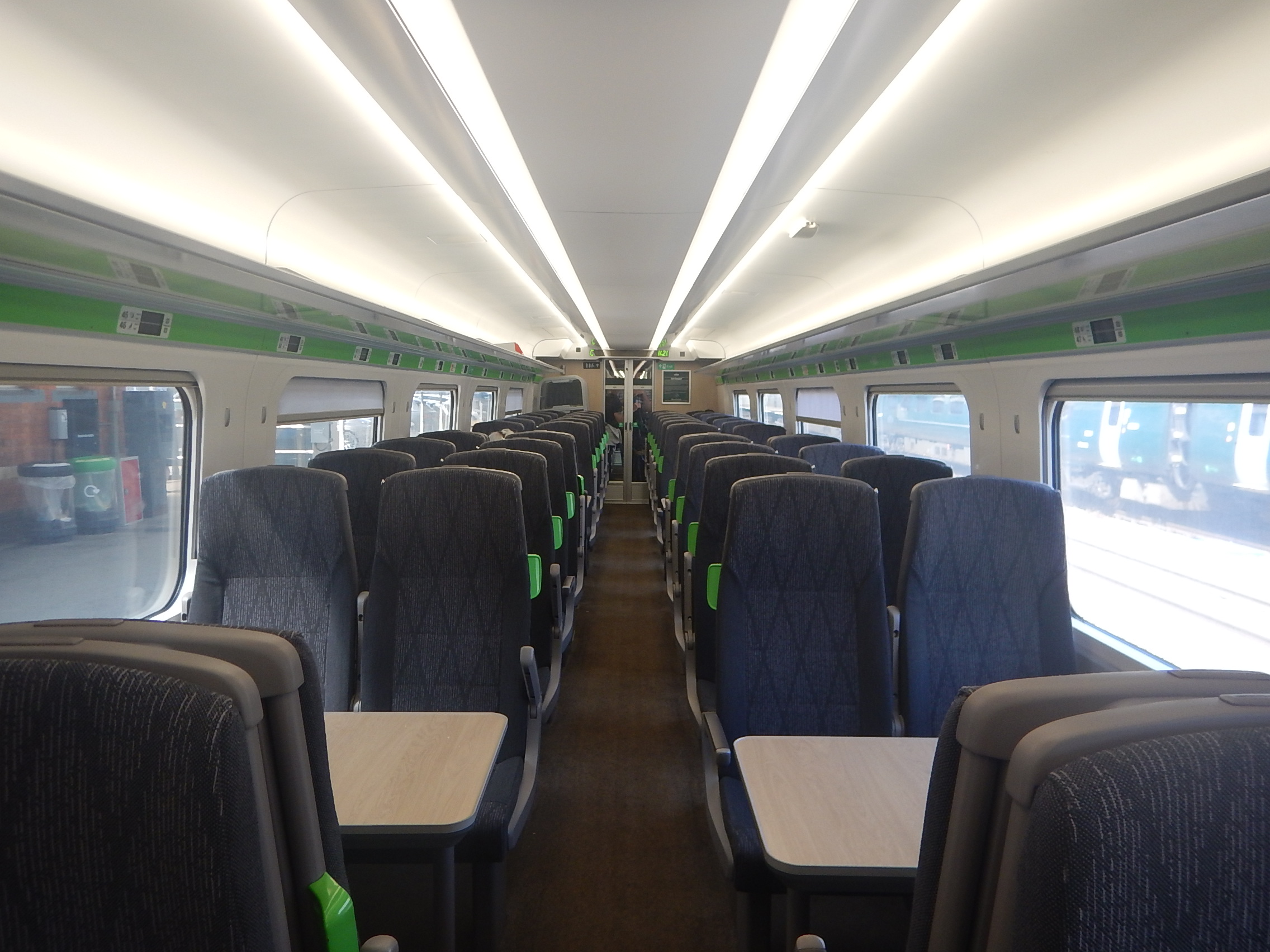
Note.
- The aisle looks to be similar in width to a seat.
- There is a bag shelf above the windows and lots of coat hooks.
As both Lumo and Great Western Railway are both First Group companies, is it likely that the interior dimensions are similar, so that standard trolleys could be used and training could be eased and shared between companies in the group.
This picture shows a trolley fitting in between the tables on a Great Western Railway service.

I suspect, if they design everything together, Lumo could make best use of a narrow aisle to give the seats a bit more width.
This last picture shows TransPennine Express Class 802 train at Willesden Junction station.
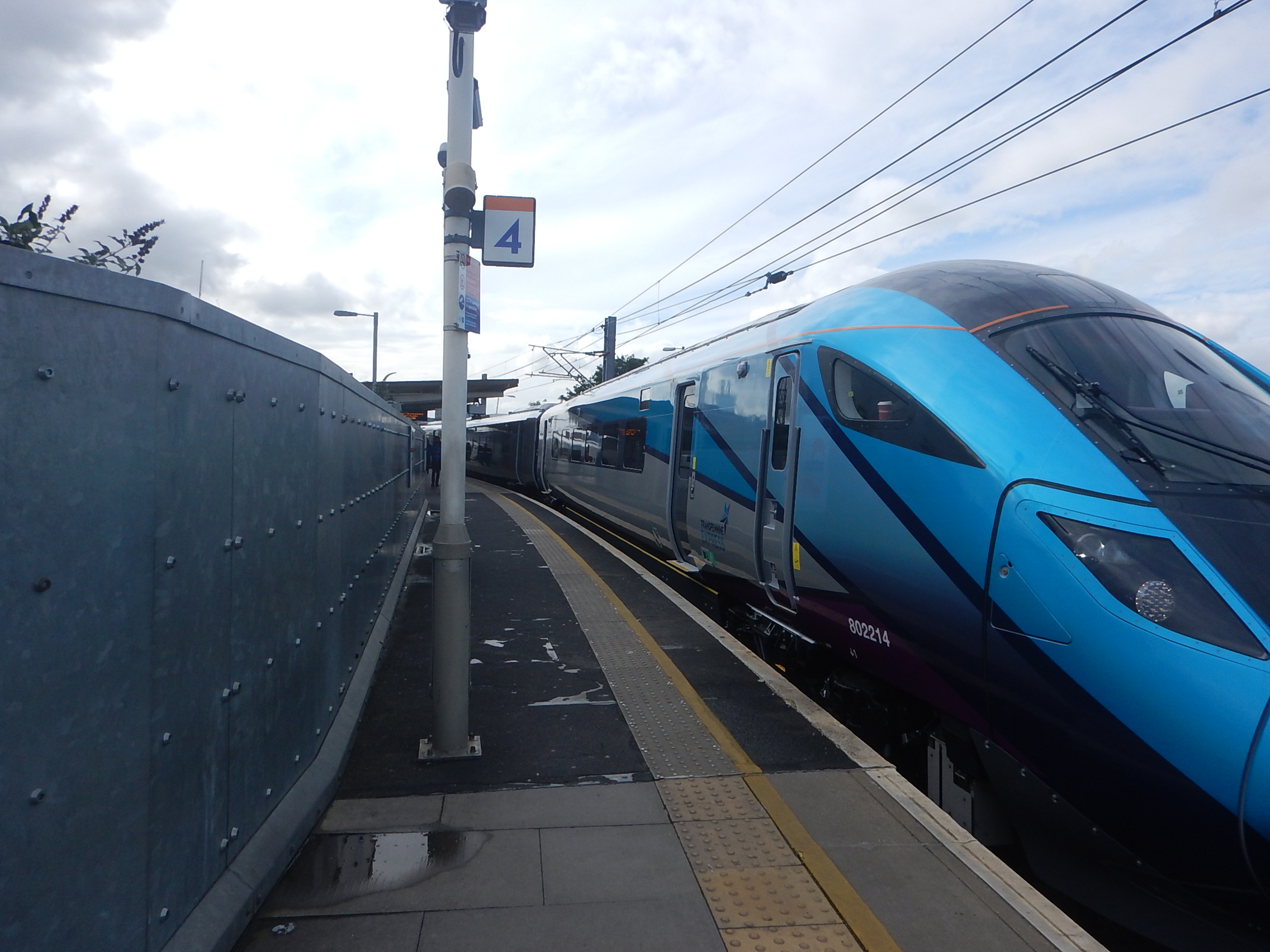
Note how the lower part of the side of the train is curved. Is this to get a bit more room for the seat squab?
Passengers Per Metre
This is only a rough calculation and shows typical passengers, fuselage or car length and passengers per metre.
- Airbus A 320 – 164 passengers – 37.57 metres – 4.4 px/metre
- Boeing 737 – 160 passengers – 37.0 metres – 4.3 px/metre
- Class AT-300 train – 96 passengers – 26 metres – 3.7 px/metre
Passenger density in the train is about fourteen percent less.
Toilets
In The Definitive Seating Layout Of Lumo’s Class 803 Trains, I said this.
This article on Economy Class and Beyond is entitled Enter Lumo – The New East Coast Railway Competitor.
It contains a drawing from Lumo, which shows the layouts of the seats on the train.
-
- Coach A – 44 Standard seats – 8 Priority seats – 2 Wheelchair spaces – 2 Tip up seats – Accessible toilet – 56 Total seats
- Coach B – 84 Standard seats – 12 Priority seats – Bike store – Toilet – 96 Total seats
- Coach C – 84 Standard seats – 12 Priority seats – 96 Total seats
- Coach D – 84 Standard seats – 12 Priority seats – Bike store – Toilet – 96 Total seats
- Coach E – 52 Standard seats – 8 Priority seats – 2 Tip up seats – Accessible toilet – 62 Total seats
Note.
-
- This is a total of 406 seats.
- Judging by the position of the tip-up seats they are for staff and perhaps emergency use, if say a coffee gets spilled on a seat.
- Each car has a pair of tables, where four can sit. As Lumo’s business model allows early booking, if you and your partner want to take the kids to see granny on her birthday, you should be able to get a table, by booking early.
- There are two bike stores in Coaches B and D.
These are some further thoughts.
Toilet Provision
I was on an LNER Class 800 train earlier this week and needed to go to the toilet.
-
- I wasn’t sure which way I needed to go, as I couldn’t see a sign pointing me to the toilet, but in the end I struck lucky.
- You don’t have that problem with Lumo’s trains, as there appears to be a toilet at both ends of the three middle coaches, either in your car or the next.
- If you’re in one of the driver cars, there is an accessible toilet at the blunt end.
I don’t think anybody will argue with the toilet provision on Lumo’s trains.
Typically a Boeing 737 or an Airbus A320 will have two toilets for about 160 passengers.
Lumo’s trains have two accessible toilets and two ordinary ones for 406 passengers.
Ease Of Boarding
If you want to catch a train at virtually any station in the UK, in most cases, you just turn up something like fifteen minutes before the departure time, present your ticket and get on the train.
Planes used to be like that in the UK, but they aren’t any more.
Catering
In the article in The Times, Matt Lee, who is Lumo’s customer experience director, said they have been free to develop their own systems. He says this about the catering.
Catering will be a Deliveroo-style service: passengers can order M&S or Pret sandwiches in advance and have them delivered to their seat. “We are a testbed for other FirstGroup train operators.
Will they do gluten-free?
Luggage
Lumo have a luggage courier service called LumoLuggage.
Service Expansion
Suppose an airline or a train operating company wants to run additional services to add capacity to a route.
With an airline, they will need to obtain additional take-off and landing slots to fly the route.
But Lumo are running five-car trains on a route, where all the stations can handle nine-car trains and possibly a pair of five-car trains.
So Lumo just add extra cars to the fleet, so that they match the number of cars running on the route to the demand.
The only costs to increase the capacity are those of the extra cars and a proportionate number of extra staff.
Conclusion
I can see this service model being copied by other train operators in other countries.
I’m looking forward to going North on Wednesday.
Railfreight Goes Back To Diesel As Electricity Costs Soar
The title of this post, is the same as that of this article on Railnews.
This is the first paragraph.
Some rail freight operators have abandoned electric traction, at least for now, because the price of electricity has been rising sharply. The electricity tariffs include a 40 per cent renewable energy tax, and following the latest rises diesel traction is now cheaper. The drivers’ union ASLEF is calling for the government to intervene, but Freightliner has already taken action.
This quote from the article is from ASLEF General Secretary; Mick Whelan.
Moving freight by rail rather than road is, inherently, a carbon-efficient mode of transport and an environmentally-friendly way of doing business. Electric-hauled freight services reduce emissions by 99 per cent; even moving goods by diesel traction reduces emissions by 76 per cent.
It looks to me, that a reputable and trusted environmental economist could come up with a compromise price and possibly a solution to improve the situation.
Possible solutions could include.
- Use of Biodiesel or Hydrotreated Vegetable Oil
- More energy storage.
Surely, though, the long term solution is hydrogen-powered locomotives. or dual-fuel locomotives, as I wrote about in Freightliner Secures Government Funding For Dual-Fuel Project.
The Final Crossrail Station Oversite Has Been Handed To The Developer
The title of this post, is the same as that of this article on Ian Visits.
This is the first paragraph.
The last of the Elizabeth line stations to have a building built above the station has been handed over to the developer, Grosvenor for an office development. The site, at 65 Davies Street will sit above the back of Bond Street station where a classic Edwardian style brick building occupied by the University of Arts had been based.
I went today and took these pictures.


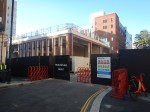

It doesn’t look it, but the building should be ready by the end of 2023.
I used to visit this area regularly from the age of about fourteen. My uncle; Dick had a newsagents shop at the back of Bond Street station at 2 Weighhouse Street and I used to come up to see him and his wife; Rene.
Report Finds London North Eastern Railway Can Aid UK’s Pandemic Recovery
The title of this post, is the same as that of this article on Rail Technology Magazine.
It is a must-read article, that discusses a report by respected consultants; Steer.
The main conclusion is that LNER services are worth £ 2 billion per year to the UK.
Could similar figures be attributed to other train operating companies?
Rolls-Royce Joins Boeing And World Energy For Successful 100% Sustainable Aviation Fuel Flight
The title of this post, is the same as that of this Press Release from Rolls-Royce.
These are the first two paragraphs.
Rolls-Royce, working with Boeing and World Energy, has carried out a successful test flight of its 747 Flying Testbed aircraft using 100% Sustainable Aviation Fuel (SAF) on a Trent 1000 engine.
The aircraft flew from Tucson airport in Arizona, passing over New Mexico and Texas, with a Trent 1000 engine running solely on 100% SAF while the remaining three RB211 engines ran on standard jet fuel, arriving back at the airport three hours and 54 minutes later. Initial indications confirm there were no engineering issues, providing further proof of the fuel’s suitability for commercial use.
Until new zero-carbon technology is developed, which possibly uses hydrogen as a fuel, I believe that Sustainable Aviation Fuel is the best route that the world can take to cut the carbon emissions from flying.
Wagons Roll For Freightliner UK
The title of this post, is the same as that of this article on railfreight.com.
This is the first paragraph.
UK operator Freightliner has taken delivery of the first batch of new FFA-G wagons for UK operations. The forty wagons have arrived in the UK from Poland, adding to the intermodal fleet of the operator. The entire order, for 230 wagons will be delivered by the end of November 2021.
The wagons have been designed for efficiency and being able to take a forty foot container anywhere on the UK’s network with a loading gauge of W10.
Battery Rather Than Hydrogen Trains Suggested In Sachsen Study
The title of this post, is the same as that of this article on the Railway Gazette.
This is the first paragraph.
The use of battery rather than hydrogen traction is recommended in a study into options for replacing diesel multiple-units on regional routes around Dresden where electrification is unlikely in the short to medium term.
They give the reason that battery power is a better short term option, where electrification is envisaged in the long-term.
I also think, that in the case of the German hydrogen trains, which are hydrogen-power only, this means that the trains will have to be replaced, as the electrification is installed. Whereas, with battery-electric trains, they just get more efficient as the wires go up and don’t need to be replaced. Although, their batteries might be removed to improve acceleration.
Dresden, Leipzig and that area of Germany also has a lot of electrification already, so charging will not be a problem.
But battery power would also get around the problem at Zwickau, where diesel multiple units run through the streets as trams to a station in the town centre.
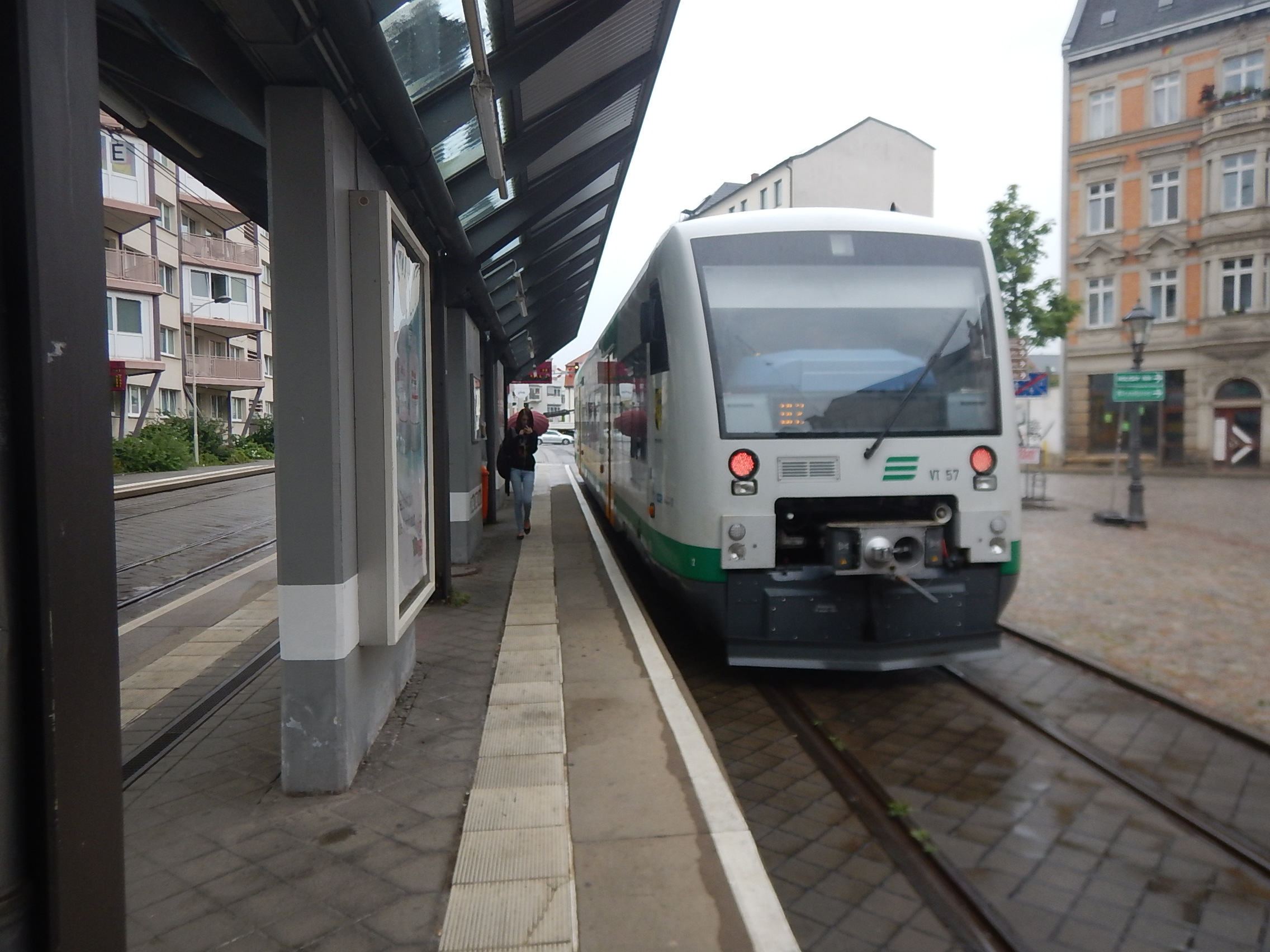
The picture shows a diesel multiple unit playing trams in Zwickau Zentrum station.
- Note the orange lights that flash on the train.
- Trams call at the other side of the platform.
- I wonder, if the Germans felt that battery-electric trains will be safer in Zwickau than hydrogen-powered trains.
It puzzles me, why this simple solution is not used more often to extend railways into town and city centres.
With battery-electric trains, there would be no need for any electrification.
Conclusion
The Germans seem to be going battery-electric train mad!
Perhaps, we should follow their example?
What Will Happen To The Eighty-Seven Class 350 Trains
At the current time, West Midlands Trains have a fleet of eighty-seven Class 350 trains.
- The trains are being replaced by new Class 730 trains.
- They are of different specifications.
- The interiors vary, but there are a lot of tables.
- All are four-car sets.
- They are 110 mph trains.
- Thirty of the trains are dual-voltage.
- Fifty are owned by Angel Trains.
- Thirty-seven are owned by Porterbrook, who have looked at converting the trains to battery-electric operation.
- They are a bit of a dog’s breakfast, although they are excellent trains.
- The future of the trains is rather uncertain and even Porterbrook’s plans have gone rather quiet.
So perhaps a big dog ought to round up all these trains and turn them into something more useful.
Consider.
- All the trains were built in this century by Siemens in Germany.
- Siemens service the Class 350 trains at Kings Heath Depot in Northampton.
- Siemens have recently opened a factory in Goole to make new trains for the London Underground.
- Siemens are developing the Mireo Plus B, which is a battery-electric multiple unit in Germany.
Siemens must have the knowledge and experience to turn these trains into a quality fleet of battery-electric trains.
- Thirty would be dual-voltage and fifty-seven would be 25 KVAC overhead only.
- All would be 110 mph trains.
- I doubt there would be many places on the UK rail network, where they couldn’t run.
All appear to be in excellent condition, as these pictures show.


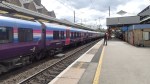
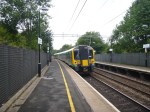
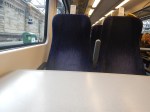
I very much feel, that these fleets could be converted into a quality fleet of very useful battery-electric trains.
Charging The Batteries
Most of the charging would be done from existing electrification, but as all trains have pantographs, they could use specially-erected short lengths of 25 KVAC overhead wires or charging systems like the Furrer + Frey Voltap system.
Possible Routes
I will start with the dual-voltage trains.
- Uckfield Branch, where a charger would be needed at Uckfield station.
- Marshlink Line
- Basingstoke and Exeter, where chargers would be needed at Salisbury and Exeter and possibly Yeovil Junction.
I feel with 25 KVAC overhead applications, we will soon run out of trains.
 The Anonymous Widower