Are Scotrail Going To Replace The Inter7City Trains With Hydrogen-Powered Trains?
This article in The Times is entitled The Caley Is Ready To Roll With New Venture Building Trains.
I feel that this is one of the most significant paragraphs in the article.
ScotRail has indicated that it wants to replace nearly two thirds of its fleet with new, low-carbon rolling stock between 2027 and 2035, comprising about 675 carriages in total, with an initial core order of 64 four and five-car units. A spokesman confirmed: “We are working on a business case that will go to the Scottish government for the procurement of a new suburban train fleet.”
The current Scotrail fleet includes.
- 25 Inter7City trains which comprise 52 Class 43 power cars and 120 Mark 3 carriages – Diesel – 120 cars – 1975
- 5 Class 153 trains – Diesel – 5 cars – 1987
- 42 Class 156 trains – Diesel – 84 cars – 1987
- 40 Class 158 trains – Diesel – 80 cars – 1987
- 30 Class 170 trains – Diesel – 90 cars – 1998
- 21 Class 318 trains – Electric – 63 cars – 1985
- 34 Class 320 trains – Electric – 66 cars – 1990
- 40 Class 334 trains – Electric – 120 cars – 1999
- 38 Class 380 trains – Electric – 140 cars – 2009
- 70 Class 385 trains – Electric – 234 cars – 2015
Note the last three fields are the traction type, total number of cars and the build year of the first train.
I will split these trains into four groups.
- Inter7City – Diesel – 25 trains – 120 cars
- BR Diesel – Diesel – 117 trains – 259 cars
- BR Electric – Electric – 55 trains – 129 cars
- Modern Electric – Electric – 148 trains – 494 cars
Note.
- This is a grand total of 345 trains and 1002 cars.
- Ignoring the modern electric trains and the total is 197 trains and 508 cars.
- The total for diesel trains is 142 trains and 359 cars.
- As Great Western Railway have withdrawn their similar GWR Castles, there must be reasons for Scotrail to do the same.
I will now look at replacement strategies, based on this statement from Scotrail.
ScotRail has indicated that it wants to replace nearly two thirds of its fleet with new, low-carbon rolling stock between 2027 and 2035, comprising about 675 carriages in total, with an initial core order of 64 four and five-car units.
I would expect 675 carriages would be about 232 trains, if the current average train length of just under three cars is carried over.
The Effect Of 675 New Carriages
Assuming that no modern electric trains were replaced, this would create a fleet size of at least 1169 carriages.
This would be a sixteen percent increase in carriages, which would be welcome news for some rail users.
The Initial Core Order Of 64 Four And Five-Car Units
All we know of this order, is the number of trains and that they will be new and low-carbon, according to indications from Scotrail.
Low-carbon would mean one of these traction options.
- Electric trains with full electrification.
- Battery-electric trains with partial-electrification.
- Hydrogen-powered trains.
Note.
- The heritage Taliban would object violently to full electrification of some historic routes.
- UNESCO would probably remove the World Heritable Site status to the Forth Bridge if it were to be electrified.
- Scotland is developing a hydrogen infrastructure.
- Hydrogen-powered trains have long ranges in the order of a thousand kilometres.
- Hydrogen-powered trains are essentially electric trains with a hydrogen fuel-cell to provide electricity as needed.
- Hydrogen-powered trains would need very little new infrastructure, except for a network of refuelling points across Scotland.
- Well-designed battery-electric and hydrogen-electric trains, should be very quiet and comfortable for passengers.
As an engineer, I would choose hydrogen-power for the initial core order.
Where would the initial core order be deployed?
Twenty-five would be used to replace the carbon-emitting elderly Inter7City trains.
These routes could probably handle the other forty.
- Aberdeen and Inverness
- Edinburgh/Glasgow and Aberdeen.
- Edinburgh/Glasgow and Inverness.
- Glasgow and South Western Line
- West Highland Line.
Note.
- A lot of diesel trains would be retired.
- Trains could be designed, for tourists with proper cycle spaces.
- The West Highland Line would get the five-car trains it needs.
This would be a good start.
Conclusion
It looks to me, that the Inter7City trains will be going and will be replaced by new trains.
But will Scotland take the great leap forward and power the new trains by Scottish hydrogen?
Blackwall Tunnel Southbound Route To Close For Four More Weekends
The title of this post, is the same as that of this article on the BBC.
This is the sub-heading.
Part of the Blackwall Tunnel will close this weekend as work continues on the Silvertown Tunnel.
These three paragraphs detail the closures.
The southbound route will be closed from 00:01 BST Saturday until 05:00 Monday and on three further weekends.
The 57-year-old crossing is also due to shut on 1-3 June, 8-10 June and 29 June-1 July, as resurfacing and landscaping work is undertaken.
The Silvertown Tunnel is due to open in 2025, after which drivers using both tunnels will pay to cross the Thames.
At least the works to create the Silvertown Tunnel, seem to be progressing as planned.
But then London’s tunnels have generally been completed on time.
Aura Power Secures £10 Million Funding From Novuna
The title of this post, is the same as that of this article on Solar Power Portal.
These two paragraphs introduce the deal.
Aura Power has announced the successful closing of a £10 million debt facility with Novuna Business Finance. Novuna is a part of Mitsubishi HC Capital UK PLC, designed to support projects from early development through to the operational phase.
Bristol-based Aura Power is developing an active pipeline of utility-scale solar PV and battery energy storage of about 12GW in the UK, Europe and North America. The funding will help progress global development for Aura, covering expenditures like grid payments, planning fees and legal land costs.
These two paragraphs describe some of Aura’s projects.
In December 2023, Aura was granted planning permission for a 100MW/400MWh battery energy storage (BESS) project in Capenhurst, Cheshire. It was the third UK project to receive planning permission last year, alongside Aura’s 49.9MW Horton Solar Farm located in East Devon and its 49.9MW Hawthorn Pit Solar Farm in Durham.
Aura has been active within the solar and battery industries, with a pipeline in development in excess of 20GW. Last week (2 May), following an appeal, the developer secured planning permission for an Essex solar farm that will have an export capacity of 30 MW.
Nearly, forty years ago, I started a finance company in Ipswich with a friend. Our financing was mainly directed towards truck leasing for companies moving containers to and from the Port of Felixstowe.
Before, I committed my money to that venture, I built a large mathematical model of the proposed business. I found, that there were some unique financial properties to leasing quality trucks, that meant losing large sums of money were difficult.
I wouldn’t be surprised that leasing battery energy storage (BESS) systems have a lot of things going for them, if you have the right contract.
This may explain, why there a large number of companies in the market of providing grid batteries.
- At the top end; Centrica, Rolls-Royce and SSE will supply you with one.
- Funds like Gore Street and Gresham House and others allow you to invest in batteries.
- At the other end of the market are companies like Aura Power.
I suspect, that as with truck-leasing company, the financial flows are very stable and investor-friendly, if you get the model right.
Northern Lights Stun UK In Spectacular Display
The title of this post, is the same as that of this article on the BBC.
This is the sub-heading.
The Northern Lights have made a rare appearance across the UK, delighting sky watchers up and down the country.
These three paragraphs add more detail.
Excited onlookers shared pictures of the lights, also known as aurora borealis, visible right across the country, including the south coast of England – and if you missed it you are likely to have a chance to see it again on Saturday night.
They could be seen after one of the strongest geomagnetic storms for years hit Earth, with the US National Oceanic and Atmospheric Administration (NOAA) issuing a rare solar storm warning.
Such storms increase people’s chances of seeing the lights.
But how did the weather effect me?
- Yesterday, my INR was 2.4.
- I then had a terrible night, as I tossed and turned.
- I even had to get up twice in the middle of the night to remake the bed.
- This is so unlike me.
- In the morning my INR was 2.2.
Was the reduction because low pressure sucked the water out of my body?
That is nnot in itself dangerous, but I do think, that there will have been a lot of strokes last night.
I wrote about this in Do Thunderstorms Cause Strokes?.
C-Capture Launches Innovative Carbon Capture Trial For Cement Industry
The title of this post, is the same as that of this news item from C-Capture.
This is the sub-heading.
C-Capture, developers of next generation technology for carbon dioxide removal, has launched a new carbon capture trial in the cement manufacturing sector in partnership with Heidelberg Materials.
This is the first paragraph.
The trial, which utilises C-Capture’s innovative solution for industrial decarbonisation, is taking place at Heidelberg Material’s cement manufacturing plant in Ketton. It forms part of C-Capture’s national project, ‘XLR8 CCS – Accelerating the Deployment of a Low-Cost Carbon Capture Solution for Hard-to-Abate Industries’. Working with project partners across the UK, C-Capture’s XLR8 CCS project will demonstrate that a low-cost carbon capture solution is a reality for difficult-to-decarbonise industries in the race to net zero.
I wrote about C-Capture’s technology in Could Drax Power Station Solve The Carbon Dioxide Shortage?
The technology appears to have been spun out of Leeds University.
BP and Drax are investors.
This page on the C-Capture web site is called Technology and has a very neat interactive guide to how the technology works.
Conclusion
I have high hopes for this company and its technology.
Gluten Sensitivity And Epilepsy: A Systematic Review
Yesterday, The Times published this article, which was entitled ‘Game-Changing’ NHS Laser Therapy To Prevent Epileptic Seizures.
One reader had made this comment.
Be ace too if they can tweak to help migraine.
I used to suffer from something like migraine about thirty years ago. But after being found to be coeliac and going gluten-free, what ever it was seemed to disappear from my life.
Type “Coeliac Disease and Migraine” into Dr. Google and there are lots of references.
This indicates to me that serious scientists and doctors, must believe there could be a link.
There certainly is with me and going gluten-free eased my migraine-like symptoms.
I then typed “Coeliac Disease and Epilepsy” into Dr. Google and found this paper, which was entitled Gluten Sensitivity And Epilepsy: A Systematic Review.
This information is from the Abstract of the paper
Objective
The aim of this systematic review was to establish the prevalence of epilepsy in patients with coeliac disease (CD) or gluten sensitivity (GS) and vice versa and to characterise the phenomenology of the epileptic syndromes that these patients present with.
Methodology
A systematic computer-based literature search was conducted on the PubMed database. Information regarding prevalence, demographics and epilepsy phenomenology was extracted.
Results
Epilepsy is 1.8 times more prevalent in patients with CD, compared to the general population. CD is over 2 times more prevalent in patients with epilepsy compared to the general population. Further studies are necessary to assess the prevalence of GS in epilepsy. The data indicate that the prevalence of CD or GS is higher amongst particular epileptic presentations including in childhood partial epilepsy with occipital paroxysms, in adult patients with fixation off sensitivity (FOS) and in those with temporal lobe epilepsy (TLE) with hippocampal sclerosis. A particularly interesting presentation of epilepsy in the context of gluten-related disorders is a syndrome of coeliac disease, epilepsy and cerebral calcification (CEC syndrome) which is frequently described in the literature. Gluten-free diet (GFD) is effective in the management of epilepsy in 53% of cases, either reducing seizure frequency, enabling reduced doses of antiepileptic drugs or even stopping antiepileptic drugs.
Conclusion
Patients with epilepsy of unknown aetiology should be investigated for serological markers of gluten sensitivity as such patients may benefit from a GFD.
My Thoughts
These are my thoughts.
Coeliacs Prior To 1960
Consider.
- Even if my excellent GP; Doctor Egerton White, felt I was coeliac, there was no test until 1960 for coeliac disease.
- And the test that was developed using endoscopy wasn’t anywhere near to the endoscopies of the present day.
- My late wife, who was a family barrister, likened the test to child abuse on a young child.
- I have heard some terrible horror stories of doctors looking for coeliac disease in young children in the 1950s.
- But there were some successes. A friend of mine, who is in her eighties, was successfully diagnosed by her parents using food elimination. But they were both GPs.
- Recently, I’ve met two elderly ladies, who only in the last couple of years have been diagnosed as coeliacs.
Luckily, I was never tested until 1997 and I was diagnosed in 48 hours, by gene testing.
Methodology
The methodology was based on a systematic computer-based literature search of the PubMed database.
This has these advantages.
- The rules for the search can be published and peer-reviewed.
- Its Wikipedia entry says PubMed is a free database including primarily the MEDLINE database of references and abstracts on life sciences and biomedical topics.
- The technique can surely be applied repeatedly, to see how results are changing with time.
- The search can be modified to analyse any topic, drug or condition, that appears in the PubMed database.
- The analysis could surely be applied to other databases.
As a writer of data analysis software, developing this sort of software, would be really enjoyable.
Excitement Brewing for Gateshead FC Away At Wembley
The title of this post, is the same as that of this news item on Lumo.
This is the sub-heading.
Lumo, the Open Access rail operator, has teamed up with local Gateshead brewery Black Storm to offer Gateshead FC fans a special commemorative beer onboard its trains.
These first two paragraphs add a few more details.
Hot on the heels of Tyneside based Lumo, the Open Access rail operator, announcing an extra train on Saturday 11th May to get Gateshead FC fans back from London as part of the club’s huge achievement of a second Wembley FA cup final in as many years, they’ve teamed up with local Gateshead brewery Black Storm to offer fans and travellers a special commemorative beer onboard its trains.
The appropriately named’ Whistle Stop’ is a 5% ABV Helles Lager featuring special commemorative Gateshead FC Wembley 2024 and Lumo branding on the can and will be available to purchase on the LumoEats at seat trolley service on all Lumo trains from this week, including on its specially named ‘Heed Army Express’ trains on Saturday 11th (running from Newcastle to London at 07:12 and 10:22, and returning at 20:26).
Surely, rail companies should do more deals like this to support local teams and suppliers.
Feadship Ushers In The Fuel-Cell Era With The Launch Of118.80-metre Project 821
The title of this post, is the same as this press release from Feadship.
This picture from Feadship shows project 821.

These are the first two paragraphs of the press release.
When the drydock doors slid open on 4 May at Feadship’s Amsterdam shipyard, the yachting
world was forever changed. Say hello to Project 821, the world’s first hydrogen fuel-cell
superyacht. Five years in the making, innovation-packed Feadship Project 821 is the answer to
a fundamental question: “How far can we push green technology on superyachts?”Designed by RWD and with owners representation by Edmiston, Feadship’s bold response was
a multi-faceted, zero-diesel approach designed to cruise between harbours or anchorages and
to operate the yacht’s hotel load and amenities with emission-free power from green hydrogen.
“The aim has been to develop a new, clean technology not just for this project, but for the
world,” said Jan-Bart Verkuyl, Feadship Director / CEO Royal Van Lent Shipyard. The size of
the proposed yacht – 100-metres-plus – made it a good candidate to explore pure green
hydrogen as the fuel-cell source. For those captivated by cutting-edge innovations, this yacht
presents an opportunity for potential acquisition as it showcases the pinnacle of modern
technological advancements.
As the superyacht is 118.8 metres long, I can see a lot of ships of this size being powered by hydrogen.
Klaipėda – Kyiv Rail Freight Plan
The title of this post, is the same as that of this article on Railway Gazette.
These two paragraphs give more details.
Lithuania’s national train operator LTG Group and Ukrainian Railways have signed a memorandum of understanding to develop an intermodal freight service from the Baltic port of Klaipėda to Kyiv via Poland.
Test runs are planned for this year, ahead of regular services.
I have some thoughts.
The Route
This Google Map shows the route.

Note.
- Russia is in the North-East corner of the map, with Moscow clearly marked.
- Lithuania is in the North-West corner of the map.
- Klaipėda is on the Lithuanian coast.
- South-West of Lithuania is the Kaliningrad enclave, which is part of Russia.
- South of the Kaliningrad enclave is Poland, where Gdansk, Warsaw and Krakow are clearly marked.
- Belarus is in the middle of the map, with Minsk clearly marked.
- Ukraine is South of Russia and Belarus and East of Poland.
- Dnipro, Kharkiv, Kyiv and Lyiv in Ukraine are clearly marked.
It looks to me, that a possible route would be along the Eastern Polish Border avoiding both Belarus and the Kaliningrad enclave.
The Gauges
This Google Map shows the gauges between Klaipėda and Kyiv.
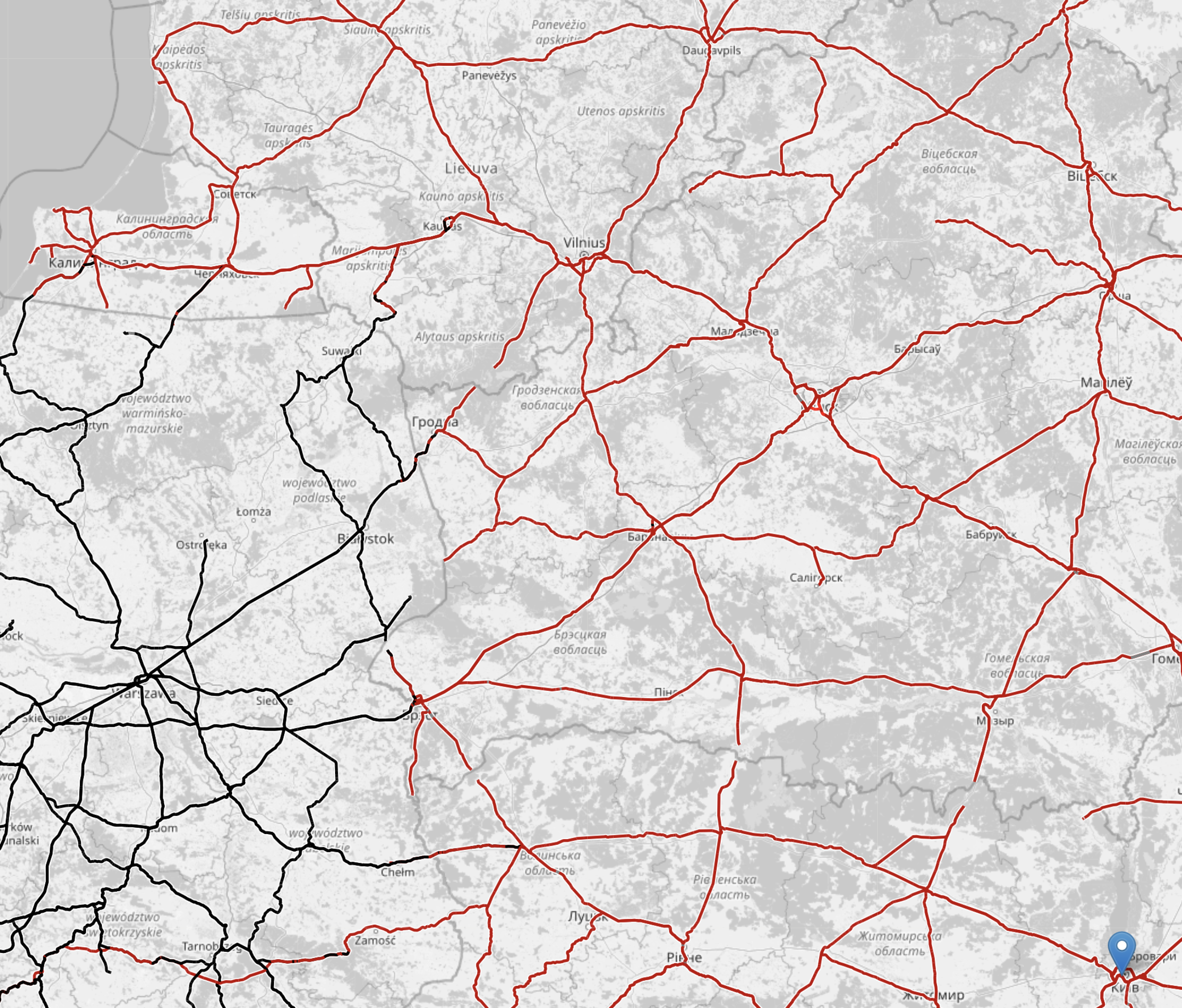
Note.
- Black tracks are Standard gauge of 1435 mm.
- Red tracks are Russian gauge of 1520 mm.
- Klaipėda is on the Lithuanian coast in the North-West corner of the map.
- Kviv is in the South-East corner of the map.
It looks to me, that although Lithuania and Ukraine are Russian gauge, the routes through Poland could be standard gauge.
So there may be a need for some rolling stock, that can run on both Russian and Polish gauges.
This article on Railway Gazette is entitled Ukrainian Railways Produces Cross-Border Grain Wagon.
These two paragraphs describe the wagons.
National railway Ukrzaliznytsia has used mostly domestic components to produce a grain hopper wagon which can operate on both the former USSR’s 1 520 mm broad gauge and the 1 435 mm standard gauge of neighbouring EU countries.
The Type 19-8005-U wagon has a capacity of 70 tonnes and 104 m3, with five loading and six unloading hatches. It is designed for operation at up to 120 km/h.
The wagon certainly looks professional in the pictures.
I don’t think that dual-gauge wagons for containers will be a serious engineering problem for the Ukrainians.
Rail Baltica
The Wikipedia entry for Rail Baltica has this introduction.
Rail Baltica is an under-construction rail infrastructure project that is intended to integrate the Baltic states in the European rail network. Its purpose is to provide passenger and freight service between participating countries and improve rail connections between Central and Northern Europe, specifically the area southeast of the Baltic Sea.
Note.
- As it is an EU-funded project, it is being built as standard gauge.
- It is being built with operating speeds of 145 mph for passengers and 75 mph for freight trains.
- There will be comprehensive connections to airports, freight terminals and major conurbations.
This page on the Rail Baltica web site has an interactive map of Rail Baltica.
It is thought that Putin is not pleased about Rail Baltica, as his extensive fleet of rail transporters for tanks and other military vehicles, are now built for the wrong gauge to invade the Baltic States.
Putin And Dual-Gauge Tracks And Wagons
As they could be used to bring war-related imports to Kyiv, I suspect Vlad the Genocider is against them.
How Will Ukraine Protect The Trains?
Consider.
- Being West of Kyiv will help.
- I suspect the UK have a few ideas for camouflage.
- Will a few brave Ukrainians ride the trains, with a sophisticated train protection missile?
- Drones probably won’t be as effective as ground attack aircraft at attacking trains.
I do suspect though that the Ukrainians have a plan.
Conclusion
This is going to be an interesting development.
 The Anonymous Widower