Sumitomo Mitsui Trust Bank Makes Substantial Investment In Australia’s MCi Carbon
The title of this post, is the same as that of this article on the Carbon Herald.
This is the introductory paragraph.
MCi Carbon, an Australian clean technology platform revolutionising the carbon recycling industry, proudly announces the addition of esteemed Japanese investor, Sumitomo Mitsui Trust Bank, to its investor roster. This significant investment from the Japanese giant, with assets under management totalling $617 billion marks a pivotal moment in MCi Carbon’s journey towards global leadership in carbon capture and utilisation and underscores the growing international recognition of Australia’s role in the transition to a zero-carbon world economy.
I believe that MCi Carbon, will be a very successful company.
I first wrote about this company in March 2021 in Energy Minister Angus Taylor Launches $50 million Fund For Carbon Capture Projects.
Could Open Access Operators Use High Speed Two?
In Mayors Propose New Staffordshire To Manchester Rail Line, I suggested the Grand Union Trains might like to run their service between London Euston and Stirling via High Speed Two.
But would this be a feasible idea?
These are my thoughts.
What Is An Open Access Operator?
The Wikipedia entry for Open-Access Operator, provide this answer.
In rail transport, an open-access operator is an operator that takes full commercial risk, running on infrastructure owned by a third party and buying paths on a chosen route and, in countries where rail services run under franchises, are not subject to franchising.
It then lists fifty-four operators in fifteen countries.
As the companies, who provide the services take full commercial risk and don’t get a subsidy from the taxpayer, I don’t see why, that providing, the operator can get the paths, they should be allowed to operate.
If they fail, then that’s the operator’s problem.
Are Any Paths Available On High Speed Two?
These are High Speed Two services as originally planned.
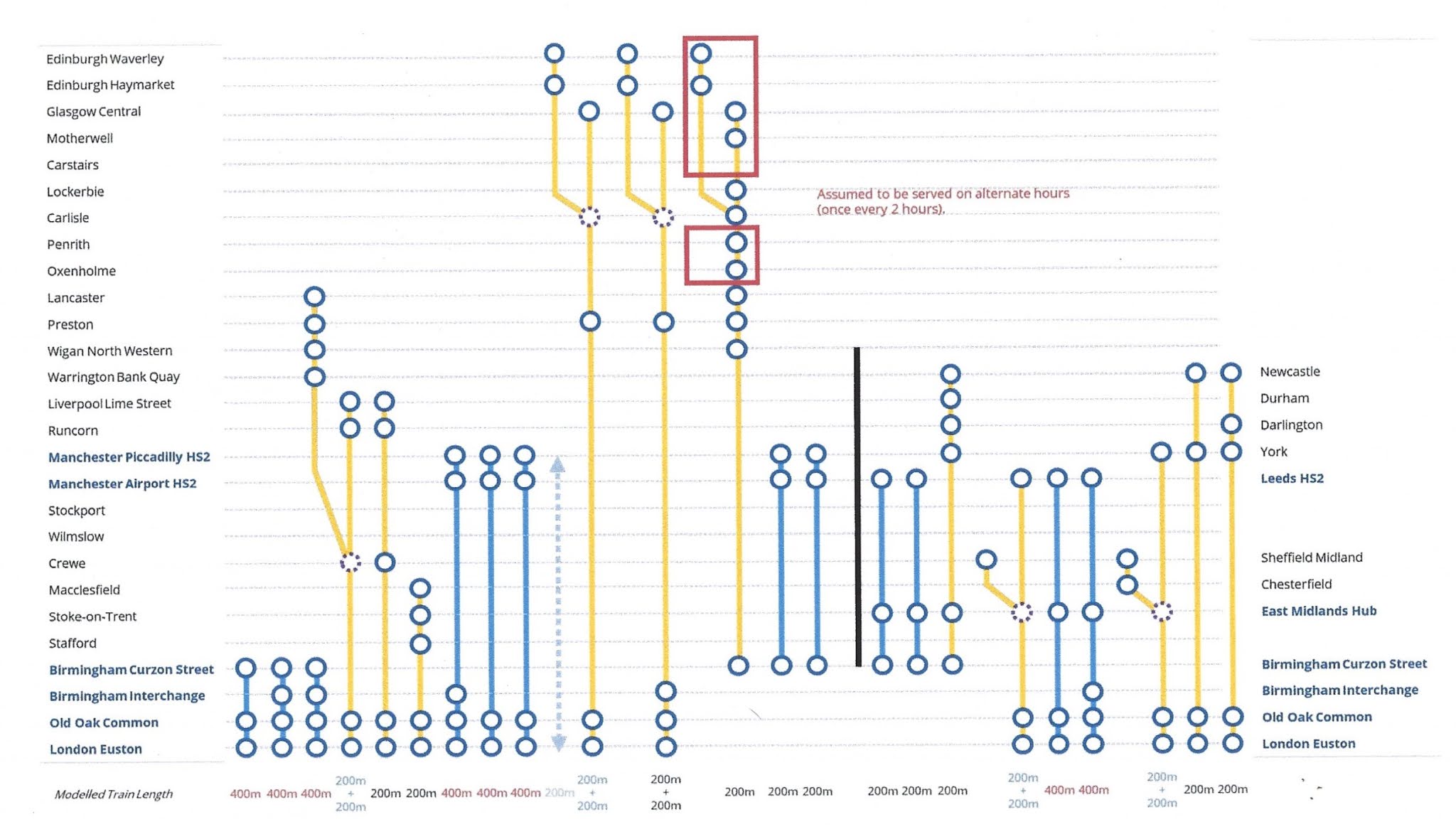
Since the Eastern Leg was cancelled, the following has happened.
- There are only eleven trains per hour (tph) between London Euston and Birmingham Interchange.
- There are only ten tph between Birmingham and Crewe.
- There is one tph between Birmingham and Macclesfield via Stafford and Stoke-on-Trent.
Note.
The Trent Valley Line section between Stafford and Crewe is 24.3 miles.
The Trent Valley Line between Handsacre Junction and Crewe is nearly all four tracks.
Currently, this section carries these fast trains.
- Avanti West Coast – 1 tph – London Euston to Blackpool North, Edinburgh or Glasgow via Birmingham New Street.
- Avanti West Coast – 1 tph – London Euston to North Wales
- Avanti West Coast – 1 tph – London Euston to Liverpool Lime Street
- Avanti West Coast – 2 tph – London Euston to Manchester Piccadilly
- Avanti West Coast – 1 tph – London Euston to Scotland
- West Midlands Trains – 1 tph – London Euston to Crewe.
- West Midlands Trains – 1 tph – Stafford to Crewe.
- West Midlands Trains – 1 tph – Birmingham New Street to Liverpool Lime Street.
This totals nine tph and will be 10 tph, when a second London Euston to Liverpool Lime Street is added.
When High Speed Two opens between London Euston and Birmingham Curzon and Handsacre Junction, trains between London Euston and Liverpool, Manchester, the North and Scotland will switch to the Trent Valley Line at Handsacre Junction.
The Trent Valley Line section between Stafford and Crewe will carry these fast trains.
- Avanti West Coast – 1 tph – London Euston to North Wales
- High Speed Two – 2 tph – London Euston to Liverpool Lime Street
- High Speed Two – 3 tph – London Euston to Manchester Piccadilly
- High Speed Two – 2 tph – London Euston to Scotland
- High Speed Two – 1 tph – Birmingham Curzon Street to Scotland
- High Speed Two – 2 tph – Birmingham Curzon Street to Manchester Piccadilly
- West Midlands Trains – 1 tph – London Euston to Crewe.
- West Midlands Trains – 1 tph – Stafford to Crewe.
- West Midlands Trains – 1 tph – Birmingham New Street to Liverpool Lime Street
Note.
- This totals to ten tph for High Speed Two, 1 tph for Avanti West Coast and the tph for West Midlands Trains.
- There is no service to Blackpool.
- It looks to me that the London Euston to North Wales should, as soon as the North Wales Coast Line is electrified become a High Speed Two service.
- Should the Birmingham New Street to Liverpool Lime Street service be replaced with a High Speed Two from Birmingham Curzon Street to Liverpool Lime Street?
There is plenty of paths South of Handsacre Junction on High Speed Two to accommodate a few services to Blackpool and an open access operator like Grand Union Trains, who have been given permission to run a service to Stirling.
Conclusion
My rough calculation says that open access services could be fitted in on the latest variant of High Speed Two.
In Mayors Propose New Staffordshire To Manchester Rail Line, the two Andies; Burnham and Street proposed that the Handsacre Junction and Manchester Airport section of High Speed Two should be built.
If this should happen, then it would open up several possibilities for open access services for the North.
Centrica And Moog Inc. Agree Major Solar Power Purchase Agreement
The title of this post is the same as that of this press release from Centrica.
This is the sub-heading.
Centrica Business Solutions has completed a long-term solar power purchase agreement (PPA) with aerospace defence designer and manufacturer, Moog Inc. The solar array will accelerate the decarbonisation of its aerospace manufacturing site in Wolverhampton and help the business achieve its net zero goals.
These three paragraphs introduce the project.
The agreement sees Centrica lease roof space from Moog Inc. to install a 2,200 solar panel array capable of generating circa 1MW. The energy company will finance the project and have agreed on a PPA with Moog Inc. for the renewable electricity generated on site.
Construction is set to complete in the spring and the panels will provide Moog Inc. with 800 MWh of renewable, reliable energy every year for the next 25 years – around 10 per cent of the site’s existing electricity requirements.
This gives Moog Inc. price certainty and access to green electricity without any upfront costs, and it will reduce operational CO2 emissions by 175 tonnes every year.
Note.
- The roof is one of Centrica’s biggest roof top solar arrays to date.
- It’s the first retrofit on an existing manufacturing plant of a solar array for Moog Inc. and wthe’re looking forward to doing more.
The Wikipedia entry for Moog Inc. starts with this paragraph.
Moog is an American-based designer and manufacturer of electric, electro-hydraulic and hydraulic motion, controls and systems for applications in aerospace, defense, industrial and medical devices. The company operates under four segments: aircraft controls, space and defense controls, industrial controls, and components. Moog is headquartered in Elma, New York and has sales, engineering, and manufacturing facilities in twenty-six countries.
Bill Moog, who founded the company, was a cousin of the guy who invented the Moog synthesizer.
Their products feature on the Airbus A 350, the Boeing 787, the Lockheed Martin F 35 and are used to operate the roofs on Centre Court and Court One at Wimbledon.
Conclusion
We will see a lot more solar installations like these.
I am not sure of the type of solar panels used on Moog’s Wolverhampton factory, but these roofs must be an ideal place to use BIPVco steel solar panels as Network Rail used at Denmark Hill station.
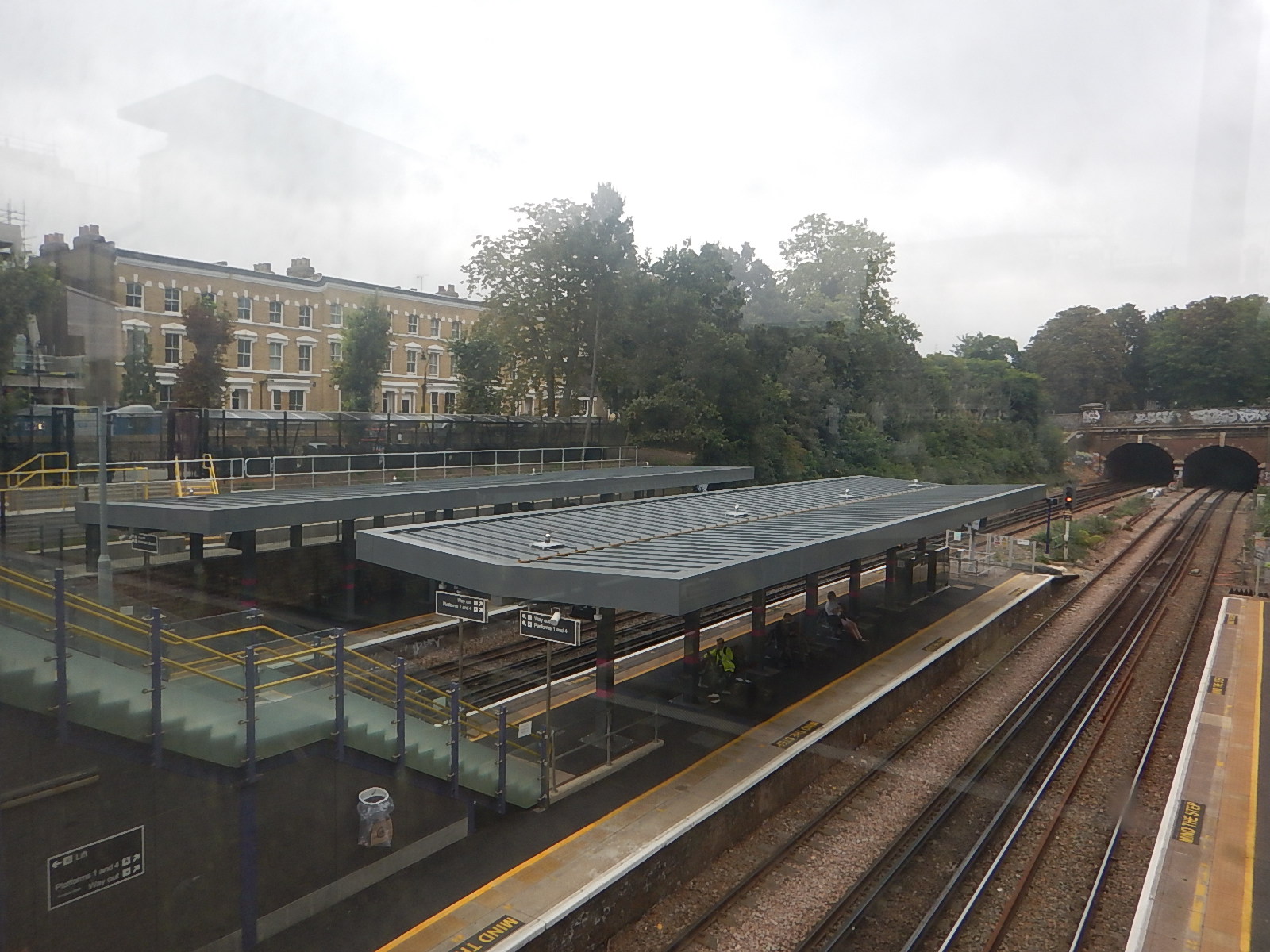
This roof became operational in 2021.
This picture shows a Ventum Dynamics turbine on Skegness Pier.
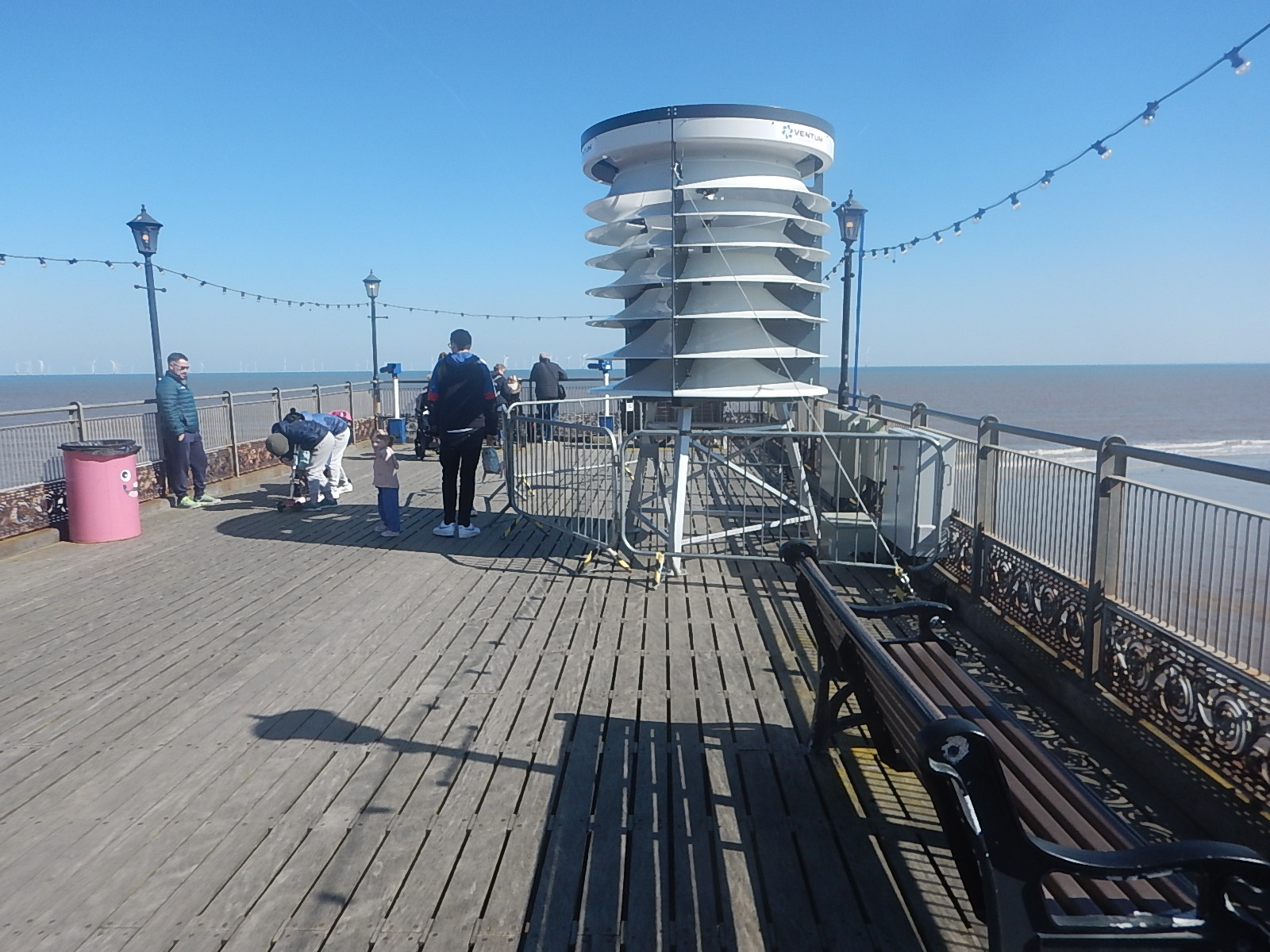
On the Ventum Dynamics web site, there are several pictures of buildings with flat roofs, that have several turbines on each.
I believe these turbines would fit neatly on some large industrial roofs with solar panels to form an efficient wind/solar application.
Network Rail To Rebuild Multi-Million-Pound Bridge Across M62 In Rochdale
The title of this post, is the same as that of this article on RAILUK.
These four paragraphs describe the work.
Network Rail is investing more than £20 million in rebuilding a major railway bridge that takes trains over the M62 in Castleton, near Rochdale.
Passengers and motorists are urged to check before they travel in September 2024 as rail and road closures are required to replace the 42-metre-long, 2,000 tonne bridge.
The work will ensure safe and reliable journeys for passengers and freight over this vital structure for years to come.
To complete the work, engineers need to dismantle the old bridge and take it away on the M62. The new bridge materials will be delivered by road and built on site.
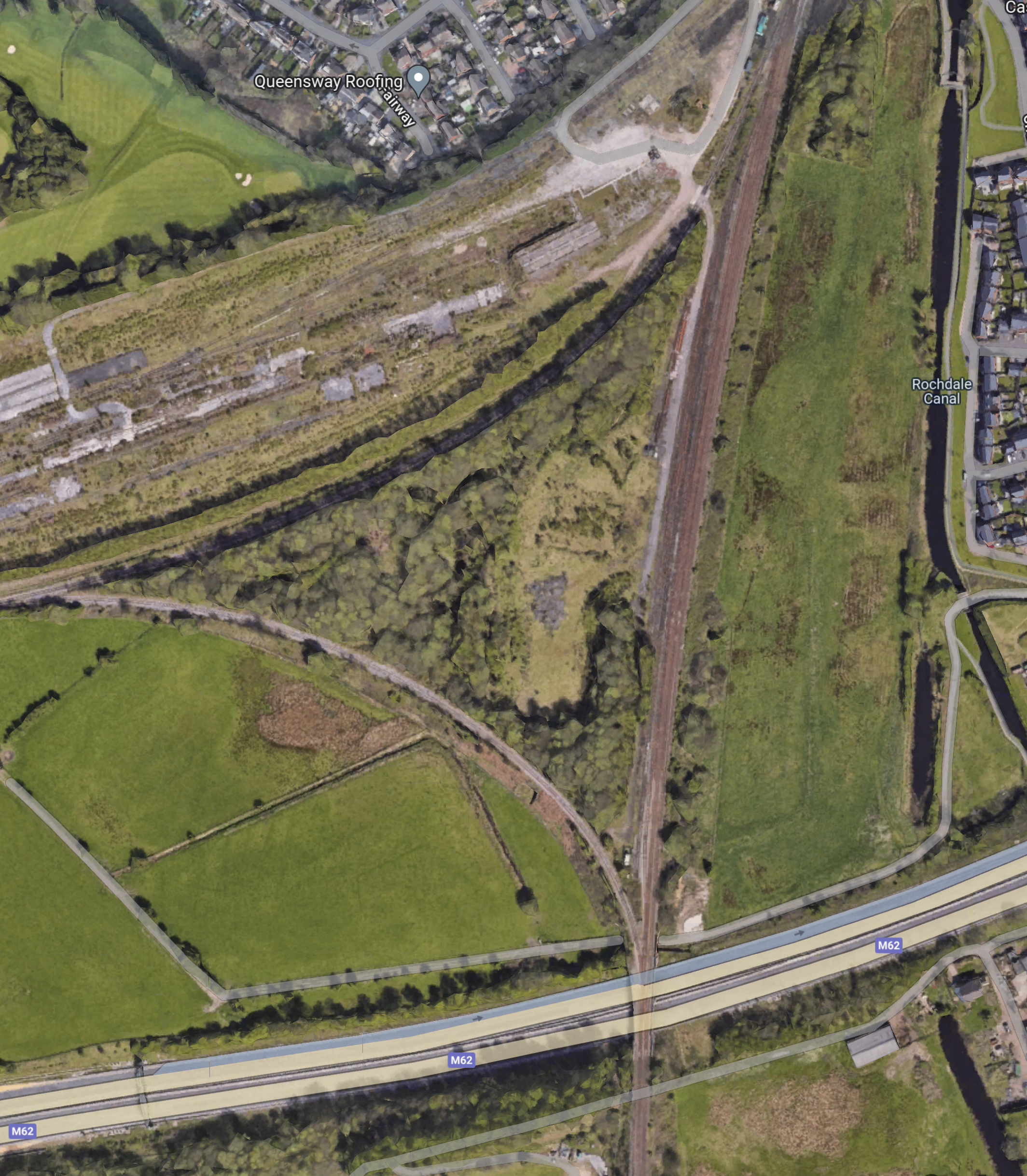
This Google Map shows the location of the bridge.
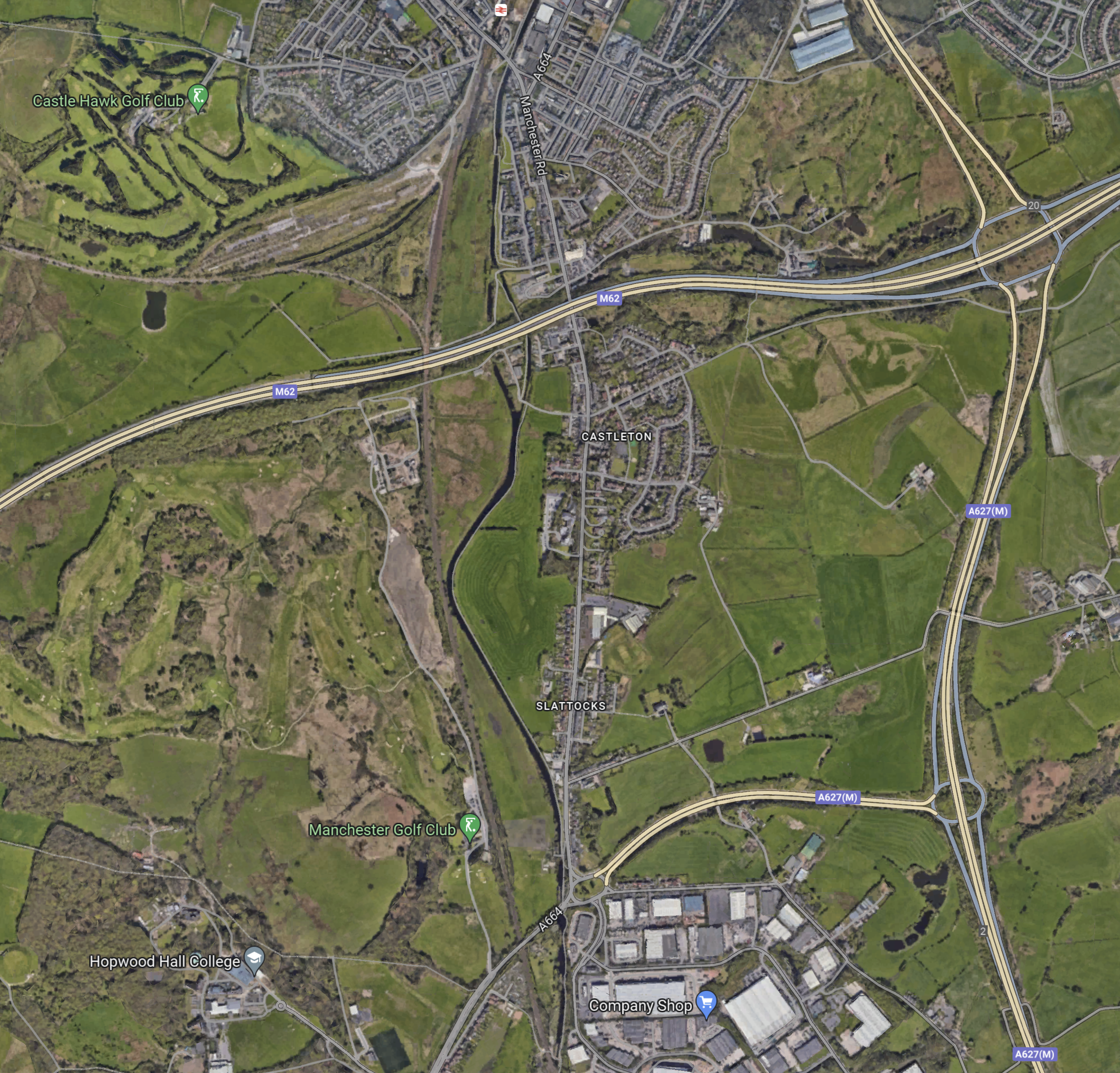
Note.
- Running East-West across the map is the M62, which is the TransPennine motorway with the big Junction 20 in the North-East corner.
- Junction 20 connects the M62 to the North-South A 627 (M).
- Meandering its way North-South up the middle of the map is the Rochdale Canal.
- Where the Canal leaves the map at its Northern edge, there is Castleton station on the Calder Valley Line, that is the picturesque route between Manchester in the West and Leeds and Bradford in the East.
- The Calder Valley Line runs North-South across the map to the West of the Rochdale Canal.
- The bridge to be replaced is where the Calder Valley Line passes over the motorway.
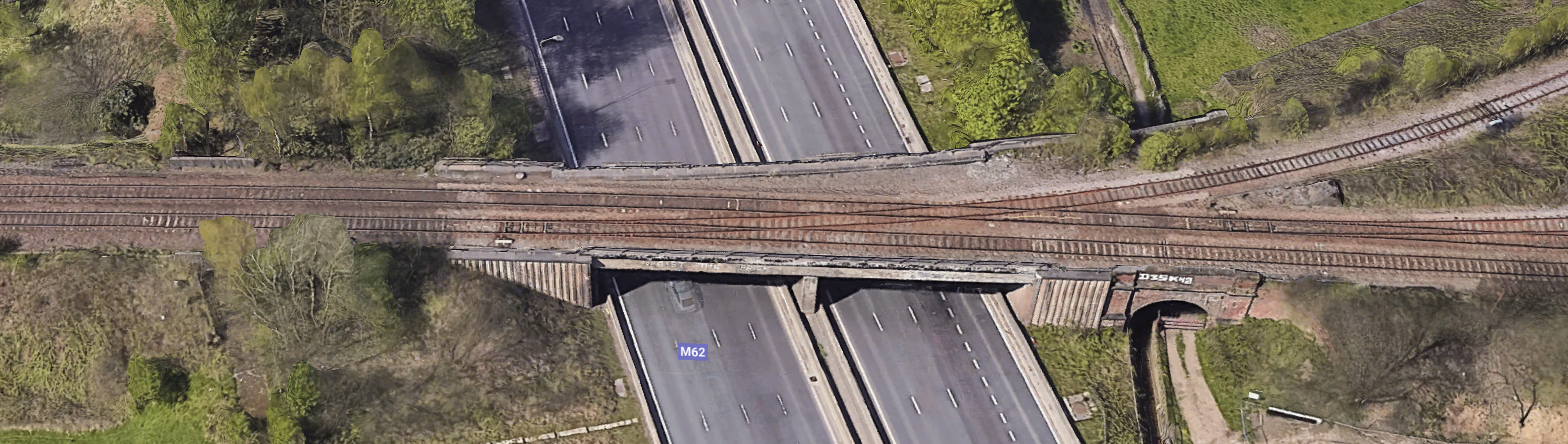
This Google Map shows a close up of the bridge.
Note.
- The Rochdale Canal running North-South at the Eastern edge of the map.
- The M62 running East-West across the bottom of the map.
- The Calder Valley Line runs North-South and passes over the motorway.
- To the North of the motorway, there is a large triangular junction, that connects the heritage East Lancashire Railway to the Calder Valley Line.
This Google Map shows a 3D image of the bridge from the East.
Ot looks to be a modern bridge, so when the M62 was built in the 1970s was some of these dodgy concretes used?
The RAILUK article does have these two paragraphs.
The bridge, known as Castleton bridge, carries 6% of the UK’s energy supply across the country, as freight trains carry material to and from Drax power station in Selby.
Olivia Boland, Network Rail sponsor, said: “The replacement of Castleton bridge is essential for the safe running of our railway, and crucial to the country’s economy as 6% of the UK’s energy supply relies on the bridge for transportation.
So is the £20 million being spent to in part make sure Drax keeps running?
Conclusion
This is going to cause traffic chaos.
Mystery LNER Train Found In Belgium
The title of this post, is the same as that of this article on RAILUK.
These four paragraphs detail what is known about the wagon.
More than 400 miles from LNER’s current home in York, an LNER train has been unearthed by archaeologists in Antwerp in Belgium.
The modern-day operator of trains on the East Coast Mainline has been in touch with the team who dug up the wagon to try and find out more about the curious discovery.
It appears that the find is a wooden removals truck, used to carry people’s belongings when they moved house. It’s thought to be almost a hundred years old.
It’s a mystery as to how the carriage came to be in Antwerp, and unfortunately there’s very little left of the relic as it disintegrated while being excavated.
It’s a story to go with London Bus Found On The Moon, that was published in the Daily Sport.
Mayors Propose New Staffordshire To Manchester Rail Line
The title of this post, is the same as that of this article on Greater Birmingham Chambers of Commerce.
These five paragraphs introduce the article.
The mayors of the West Midlands and Greater Manchester have set out proposals for a new railway line between Staffordshire and Manchester Airport in a bid to improve connections to the north.
Work commission by West Midlands mayor Andy Street and Greater Manchester mayor Andy Burnham has concluded the new line is the preferred option to tackle congestion on the West Coast Mainline, following the government’s decision to curtail HS2 beyond Birmingham.
A private sector group – chaired by infrastructure expert Sir David Higgins – had been looking at three potential options to improve connectivity between Birmingham and Manchester.
The options included undertaking significant engineering upgrades to the West Coast Main Line, building bypasses at the pinch points on the line and building a new railway between Handsacre and Manchester Airport.
The group, convened by the mayors, is led by global engineering firm Arup with input from over 60 partners from six other firms – Arcadis, Addleshaw Goddard, EY, Dragados, Mace and Skanska.
This paragraph gives the conclusion.
The group has provisionally concluded that a new line – running approximately 70 miles between HS2 at Handsacre and Northern Powerhouse Rail at High Legh – is likely to offer the best combination of costs and benefits.
It looks to me, that this professional approach has led to a sensible answer.
I will now look at the route.
This Open Railway Map shows the tracks to the South of Handsacre.
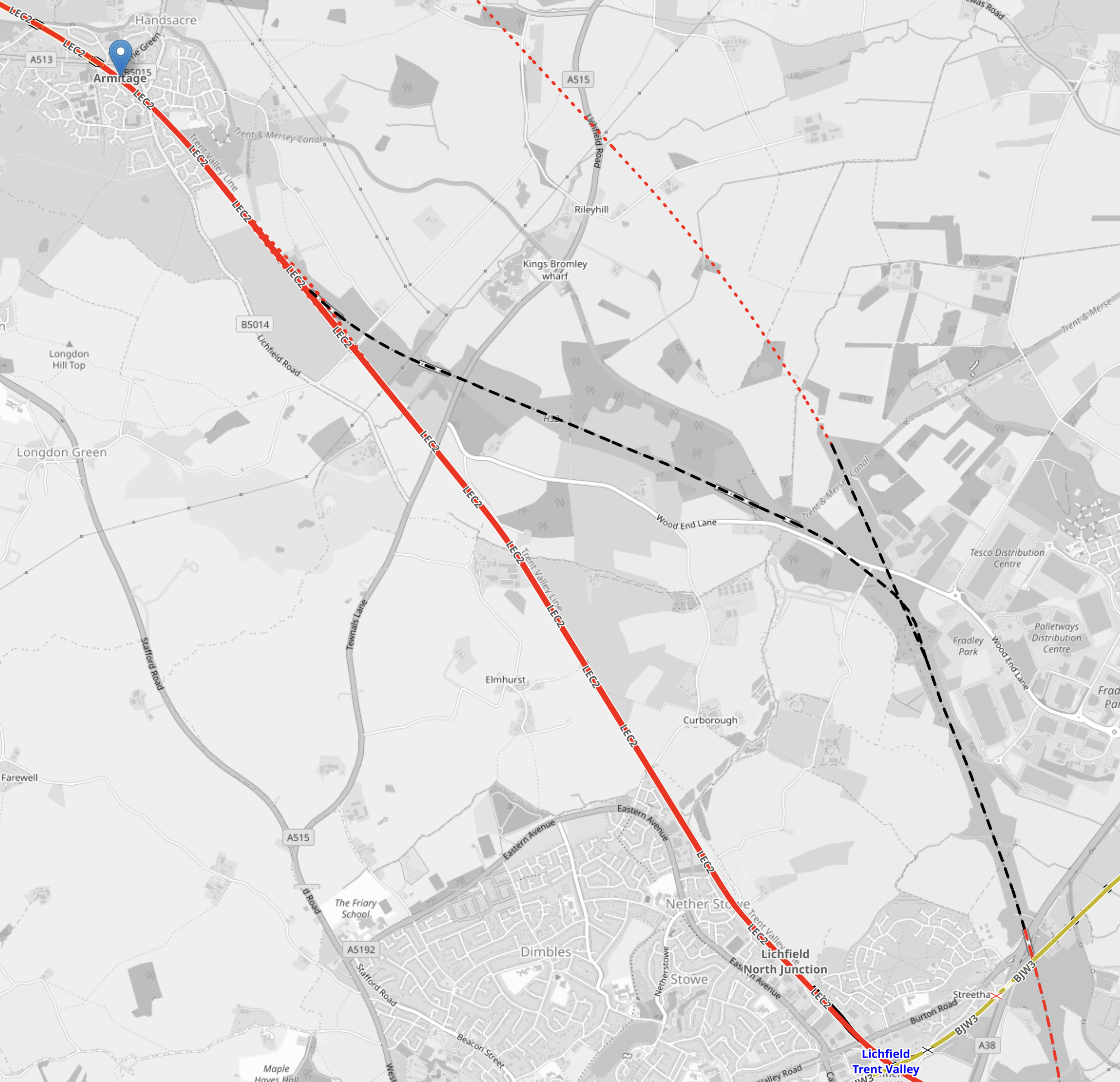
Note.
- The blue arrow in the North-West corner of the map, indicates the location of the former Armitage station, which had the village of Handsacre to its North-East.
- The red line through Armitage station is the Trent Valley Line.
- Lichfield Trent Valley station is at the bottom of the map.
- The line drawn with large dashes from the South-East corner of the map is the proposed line of High Speed Two. Red indicates under construction and black indicates proposed.
High Speed Two splits into two.
One branch goes North-West to join the Trent Valley Line, whilst the other just stops after about a kilometre.
- All trains for Liverpool, Manchester, North Wales, The North and Scotland will take the Trent Valley Line, when High Speed Two opens.
- Trains for Stoke-on-Trent, Macclesfield and some to Manchester will leave the Trent Valley Line at Colwich Junction.
- All other trains, will take the same route as now and proceed to Crewe via Stafford.
The red dotted line leading from the cancelled branch of High Speed Two shows where the original fast line to Crewe was planned to go.
This Open Railway Map shows the tracks around Crewe.
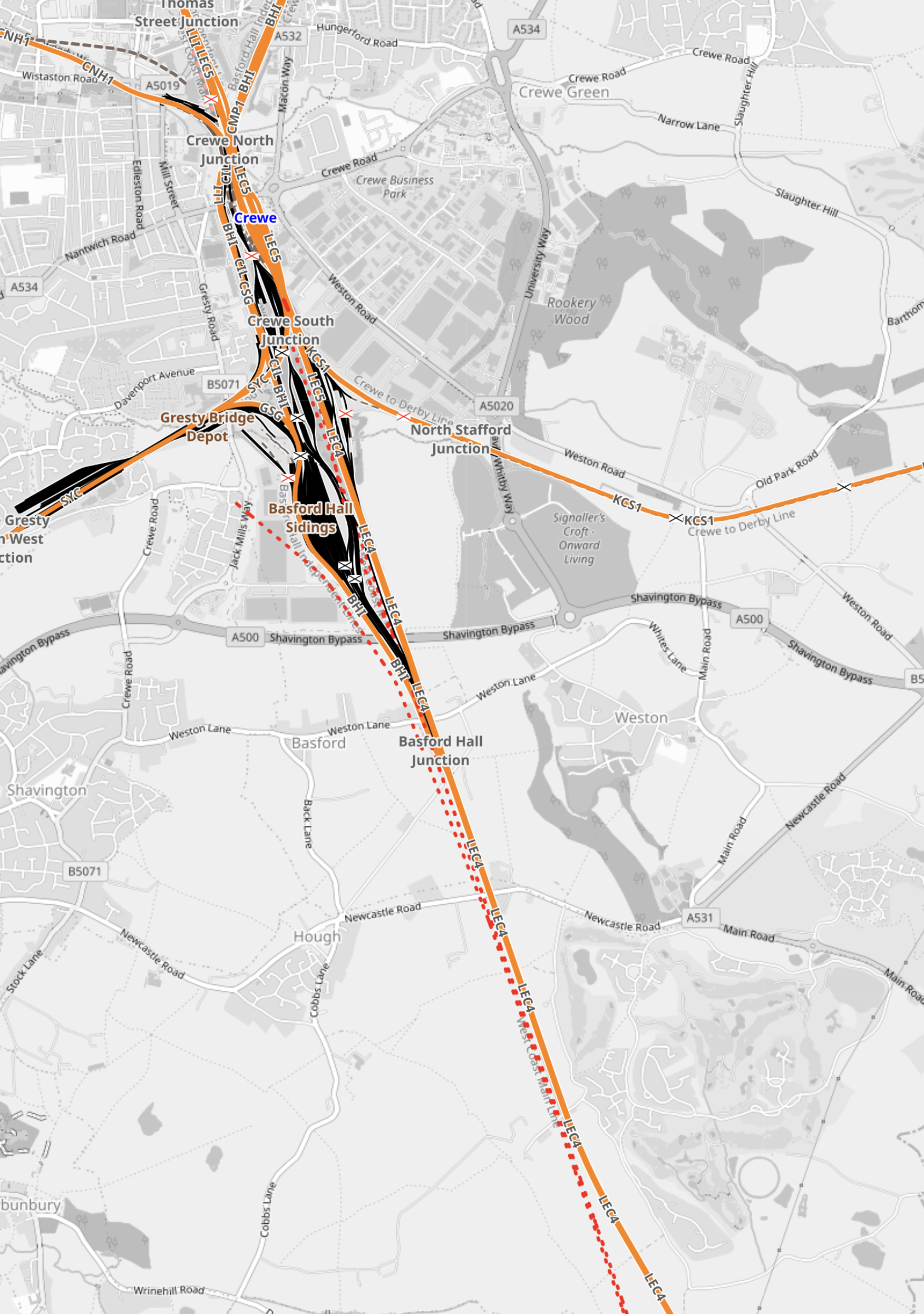
Note.
- Crewe is the important junction station towards the North-West corner of the map.
- The orange line going South is the West Coast Main Line to The South and London.
- The red dotted line running along the West side of the West Coast Main Line was the proposed route of High Speed Two from Birmingham, London and the South.
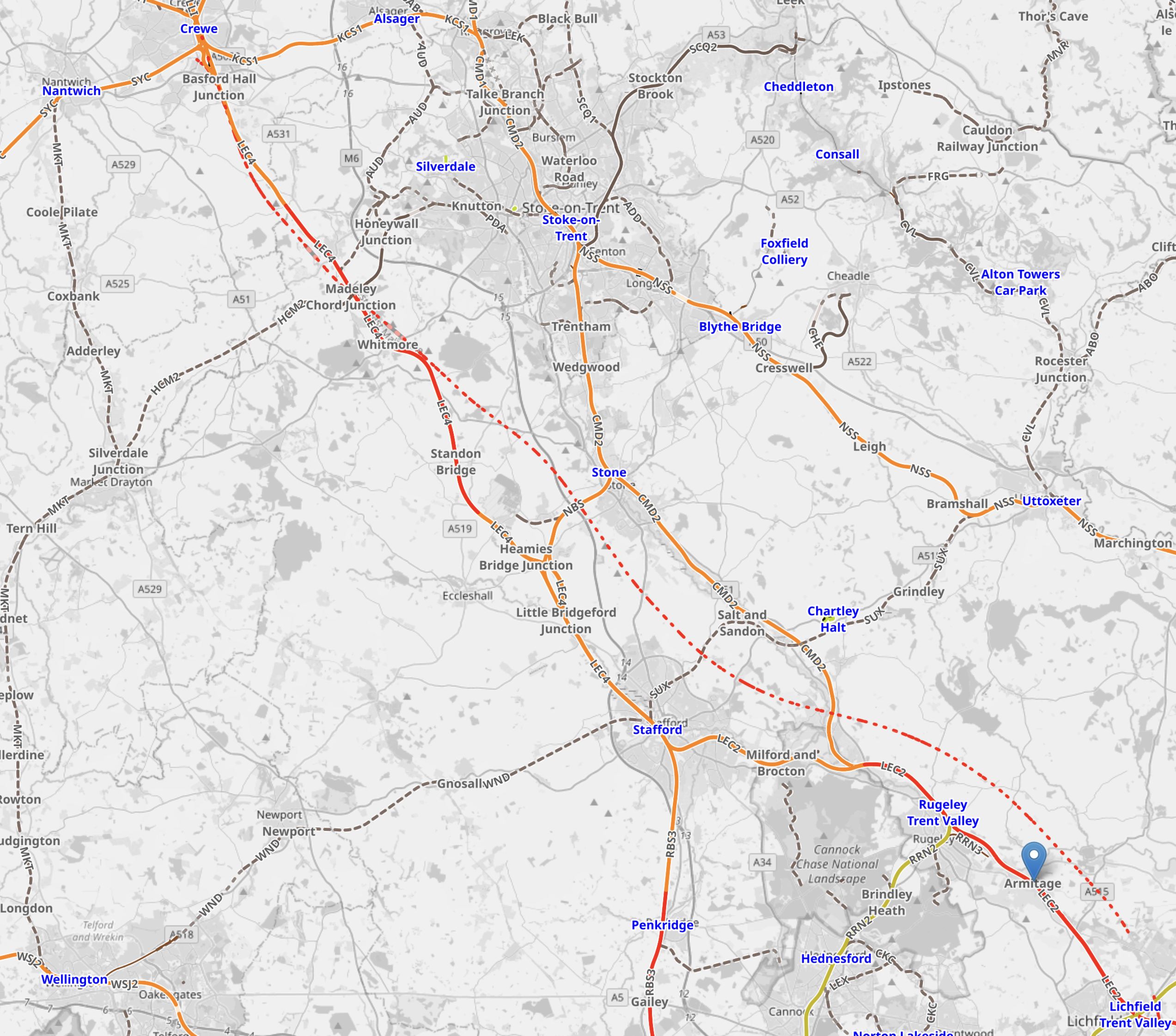
This Open Railway Map shows the originally proposed direct route of High Speed Two between Crewe and Handsacre.
Note.
- Crewe is in the North-West corner of the map.
- The blue arrow in the South-East corner of the map, indicates the location of the former Armitage station, which had the village of Handsacre to its North-East.
- The dotted red line was the originally proposed route of High Speed Two.
I feel that this route between Handsacre and Crewe has advantages if it were to be chosen as part of a route between Handsacre and Northern Powerhouse Rail, as recommended by the Mayors and their consultants.
- The route seems to stay well clear of large conurbations.
- A lot of the design work has been at least started and major problems will be known.
- Crewe is the only station on the route, which will need to be upgraded.
- Services to Liverpool, Manchester, North Wales, The North and Scotland will be speeded up.
- With Crewe, Liverpool and North Wales, times could be as High Speed Two promised in the first place.
I feel that building the Handsacre and Crewe section, as originally envisaged, will score high in a benefit/cost analysis
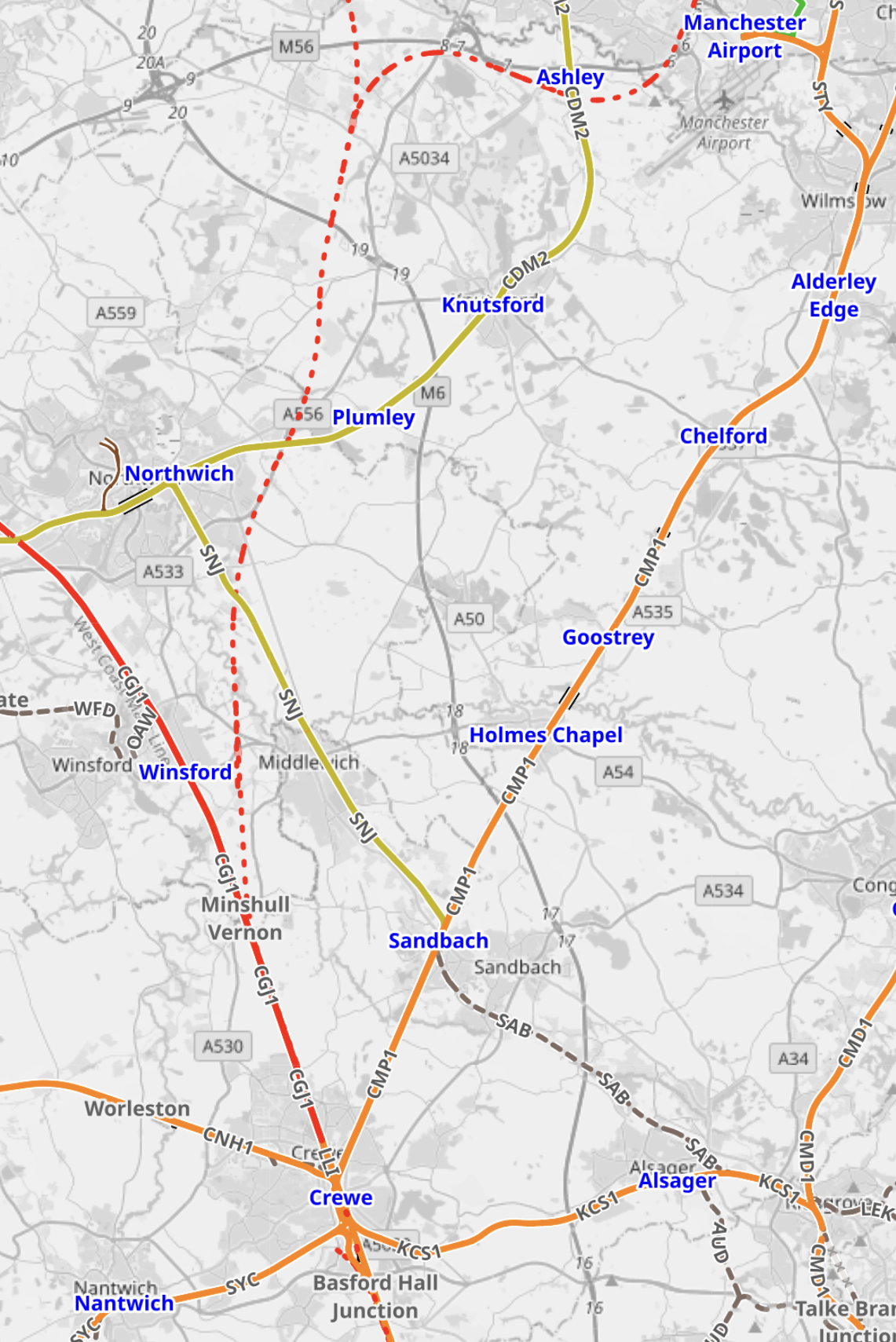
This OpenRailwayMap shows the originally proposed route of High Speed Two between Crewe and Manchester Airport.
Note.
- Crewe is towards the South-West corner of the map.
- Manchester Airport is in the North-East corner of the map.
- The red line going North from Crewe is the West Coast Main Line.
- The dotted red line was the originally proposed route of High Speed Two, between the West Coast Main Line and Manchester Airport.
Northern Powerhouse Rail will go West from Manchester Airport towards Warrington and Liverpool and will join with High Speed Two at a junction at High Legh.
Northern Powerhouse Rail is currently being planned, but surely, if High Speed Two and Northern Powerhouse Rail share a line from High Legh to Manchester Airport and Manchester Piccadilly, this will be a more affordable project.
Services To Crewe
In Could The High Speed Two Link Between Lichfield And Crewe Still Be Built?, which I wrote after much of High Speed Two was chopped in 2023, I said this.
Currently, Avanti West Coast trains take around one hour and thirty minutes between London and Crewe.
The Wikipedia entry for High Speed Two gives these times between London and Crewe.
- Fastest time before High Speed Two – one hour and thirty minutes.
- Time after Phase 2a of High Speed Two opens – fifty-six minutes.
Note.
- That is a time saving of thirty-four minutes.
- High Speed Two Trains will use the direct line between Lichfield and Crewe.
- High Speed Two will also add eighteen tph to the capacity between London and Crewe.
This would seem to mean that any trains going to or through Crewe will be thirty-four minutes faster, if they use High Speed Two between London and Crewe.
If the Handsacre and Crewe direct line is built, it looks like London and Crewe will be the full High Speed Two time of 56 minutes.
Services To Liverpool
Consider.
- Liverpool Lime Street was originally planned to get two trains per hour (tph) to and from London using High Speed Two.
- The approaches into Liverpool were improved a few years ago.
- No more improvements are planned between Crewe and Liverpool Lime Street stations.
- Between Crewe and Liverpool Lime Street stations currently takes 38 minutes.
- There could be time savings on the 16.3 miles between Crewe and Weaver Junction, which currently takes 21 minutes.
It looks like a time of one hour and 34 minutes could be possible, with under one hour and 30 minutes not being impossible.
Services To Manchester
Consider.
- Manchester was originally planned to get three tph to and from London using High Speed Two.
- No improvements are planned between Crewe and the Manchester stations.
- Between Crewe and Manchester Piccadilly stations currently takes 34 minutes.
It looks like a time of one hour and 30 minutes could be possible.
But there is still the option of building a new line between Crewe and Northern Powerhouse Rail at High Legh.
I showed this OpenRailwayMap earlier and it shows the originally proposed route of High Speed Two between Crewe and Manchester Airport.
Note.
- Crewe is towards the South-West corner of the map.
- Manchester Airport is in the North-East corner of the map.
- The red line going North from Crewe is the West Coast Main Line.
- The dotted red line was the originally proposed route of High Speed Two, between the West Coast Main Line and Manchester Airport.
Northern Powerhouse Rail is currently being planned. and will go West from Manchester Airport towards Warrington and Liverpool and will be built first.
A junction at High Legh will be built to link the West Coast Main Line to Northern Powerhouse Rail.
Services To North Wales
Why Not? With the cancellation of the Eastern Leg of High Speed Two, there must be a path available for North Wales.
Consider.
- The North Wales Main Line has been promised electrification.
- As Holyhead and Crewe is only 105.5 miles, it could even be in battery high speed train range in a few years.
- All times to and from Crewe are assumed to be as Avanti West Coast achieve now.
- As Crewe and Chester currently takes 23 minutes, London and Chester would take 1 hour and 19 minutes.
- As Crewe and Llandudno Junction currently takes 1 hour and 22 minutes, London and Llandudno Junction would take 2 hours and 18 minutes.
- As Crewe and Holyhead currently takes 2 hours and 7 minutes, London and Holyhead would take 3 hours and 3 minutes.
Could this open up a fast zero-carbon route between London and Dublin?
Services To Blackpool, Lancaster, Preston, Warrington And Wigan
Why Not, Blackpool? With the cancellation of the Eastern Leg of High Speed Two, there must be an extra path available, if it is needed.
Cpnsider.
- All routes are electrified.
- All times to and from Crewe are assumed to be as Avanti West Coast achieve now.
- As Crewe and Blackpool currently takes 1 hour and 20 minutes, London and Blackpool would take 2 hour and 16 minutes.
- As Crewe and Lancaster currently takes 60 minutes, London and Lancaster would take 1 hour and 56 minutes.
- As Crewe and Preston currently takes 40 minutes, London and Preston would take 1 hour and 36 minutes.
- As Crewe and Warrington Bank Quay currently takes 22 minutes, London and Warrington Bank Quay would take 1 hour and 18 minutes.
- As Crewe and Wigan North Western currently takes 33 minutes, London and Wigan North Western would take 1 hour and 29 minutes.
Note.
- Lancaster in under two hours will help the Eden Project Morecambe.
- For some areas of the North West, it might be more convenient to change at Crewe, Warrington Bank Quay, Wigan North Western or Preston.
Improvements to track and signalling could probably bring benefits.
Services To Carlisle And Central Scotland
Cpnsider.
- All routes are electrified.
- All times to and from Crewe are assumed to be as Avanti West Coast achieve now.
- As Crewe and Carlisle currently takes 1 hour and 55 minutes, London and Carlisle would take 2 hours and 51 minutes.
- As Crewe and Lockerbie currently takes 2 hours and 6 minutes, London and Lockerbie would take 3 hours and 1 minute.
- As Crewe and Motherwell currently takes 2 hours and 45 minutes, London and Motherwell would take 3 hours and 41 minutes.
- As Crewe and Edinburgh currently takes 3 hours and 9 minutes, London and Edinburgh would take 4 hours and 5 minutes.
- As Crewe and Glasgow Central currently takes 3 hours and 3 minutes, London and Glasgow Central would take 3 hours and 59 minutes.
Note.
- Just under four hours to Glasgow Central would please the Marketing Department.
- Selective splitting and joining could increase the number of destinations.
Improvements to track and signalling could probably bring benefits.
Services To Stirling
In ORR: Open Access Services Given Green Light Between London And Stirling, I wrote about Grand Union Trains’s new open access service to Stirling.
There has been good feedback on this service, so perhaps one of the spare paths on High Speed Two could be allocated to Open Access Operators, so that more of the country could have a high speed service to London Euston and Birmingham Curzon Street stations.
In the related post, I showed that London Euston and Stirling takes forty five minutes longer than a London Euston and Motherwell service.
This would mean that a London Euston and Stirling service via High Speed Two would take four hours and 26 minutes.
Services Between Birmingham Curzon Street and the North West
Under the plans for High Speed Two, the following services would have run North from Birmingham Curzon Street.
- One tph to Edinburgh or Motherwell and Glasgow via Wigan North Western, Preston, Lancaster, Oxenholme, Penrith, Carlisle, Lockerbie and Carstairs.
- Two tph to Manchester Airport and Manchester Piccadilly.
But there are now spare paths South of Crewe, so Could a one tph Birmingham Curzon Street and Liverpool Lime Street service be squeezed in?
Could The Line Be Privately Financed?
I suspect that building the section between Handsacre and Crewe could be financed in perhaps a similar way, to the Chiltern improvements or the M6 Toll Road were financed.
- The Handsacre and Crewe section is just a simple stretch of rail, with a number of trains passing along it.
- The number of trains passing through, is likely to increase.
- Every train passing through would pay a track charge, just as they do to Network Rail.
- Those with lots of money to lend, like simple projects like wind farms or road tunnels, but think very hard about anything complicated like nuclear power stations or High Speed Two’s station at Euston.
Certainly, my late and very good friend, David, who dealt with the finance of some of London’s largest projects and was on the top table of London’s bankers, would have found a way. It might though have been unorthodox.
But then David was a rogue. But a rogue on the side of the angels.
Conclusion
I have come to these conclusions.
- Building the direct route between Handsacre and Crewe could be good value as it improves all routes that will pass through Crewe.
- Combining High Speed Two and Northern Powerhouse Rail could substantially cut the costs of both routes to the centre of Manchester.
- London and Crewe times should be 56 minutes.
- London and Liverpool Lime Street times could be under one hour and thirty minutes.
- London and Manchester Piccadilly times could start at one hour and thirty minutes and reduce when Northern Powerhouse Rail is built and linked to the West Coast Main Line.
- London and Holyhead could be just over three hours and could open up a fast zero-carbon route between London and Dublin.
- London and Lancaster in under two hours could help the Eden Project Morecambe.
It’s certainly not a bad plan and it should be looked at in more detail.
How Germany Is Dominating Hydrogen Market
The title of this post, is the same as that of this article on Hydrogen Fuel News.
This is the sub heading.
With 3827 kilometers of pipeline across the country, Germany is blazing a trail through the continent in terms of hydrogen infrastructure growth.
These are the first two paragraphs.
Indeed, plans within the country are so far advanced that Germany is set to become the biggest importer of hydrogen in Europe and the third biggest in the world, behind global leaders China and Japan.
All this leaves the German transport sector in good stead, with a strong infrastructure supporting clean fuel adoption, while the country transitions towards net zero.
So where are the Germans going to get their hydrogen from?
One possibility is the UK.
- The UK has vast amounts of renewable energy.
- We’re only hundreds of kilometres, instead of thousands of kilometres away.
- RWE; the German energy giant has full or partial interests in about 12,3 GW of UK wind farms.
- RWE is building the Pembroke Net Zero Centre which will generate green and blue hydrogen.
Hydrogen could be exported from the UK to Germany by tanker.
Conclusion
Production and exporting of green hydrogen will become significant industry in the UK.
UK ESO Unveils GBP 58 Billion Grid Investment Plan To Reach 86 GW of Offshore Wind By 2035
The title of this post, is the same as that of this article on offshoreWIND.biz.
This is the sub-heading.
Great Britain’s electricity system operator (ESO) has proposed a GBP 58 billion (approximately EUR 68 billion) investment in the electricity grid. The proposal outlines a vision for incorporating an additional 21 GW of offshore wind into the grid by 2035, which would bring the country’s total offshore wind capacity to a potential 86 GW.
These three paragraphs add more details to what the investment in the grid means for offshore wind.
The ESO released on 19 March the first Beyond 2030 report. The plan sets up the necessary infrastructure to transfer power to and from future industries, as electricity demand is expected to rise by 64 per cent by 2035, according to the ESO.
The grid operator said that the plan connects a further 21 GW of offshore wind in development off the coast of Scotland to the grid in an efficient and coordinated way which would bring the country’s total offshore wind capacity to a potential 86 GW.
The proposals could assist the UK government in meeting the sixth Carbon Budget and allow for the connection of Crown Estate Scotland’s ScotWind leasing round.
These are my thoughts.
How Much Offshore Wind Is In The Pipeline?
This Wikipedia entry is a List Of Offshore Wind Farms In The United Kingdom.
It gives these figures for wind farms in various operational an development states.
- Operational – 14,703 MW
- Under Construction – 5,202 MW
- Pre-Construction – 6,522 MW
- Contracts for Difference – Round 3 – 12 MW
- Contracts for Difference – Round 4 – 1,428 MW
- Early Planning – England – 18,423 MW
- Early Planning – Wales – 700 MW
- Early Planning – Scotland – 30,326 MW
Note.
- These add up to a total of 77,316 MW.
- If all the wind farms in the Wikipedia entry are commissioned, the UK will be short of the 86,000 MW total by 8,664 MW.
- Some wind farms like Ossian could be increased in size by a few GW, as I reported in Ossian Floating Wind Farm Could Have Capacity Of 3.6 GW.
It looks like only another 7,164 MW of offshore wind needs to be proposed to meet the required total.
This article on offshoreWIND.biz is entitled The Crown Estate Opens 4.5 GW Celtic Sea Floating Wind Seabed Leasing Round, will add another 4,500 MW to the total, which will raise the total to 81,816 MW.
The article also finishes with this paragraph.
Round 5 is expected to be the first phase of development in the Celtic Sea. In November 2023, the UK Government confirmed its intention to unlock space for up to a further 12 GW of capacity in the Celtic Sea.
A further 12 GW of capacity will take the total to 93,816 MW.
In Three Shetland ScotWind Projects Announced, I talked about three extra Scotwind wind farms, that were to be developed to the East of Shetland.
These will add 2.8 GW, bringing the total to 96,616 MW.
I don’t think the UK has a problem with installing 86 GW of offshore wind by 2035, so we must create the electricity network to support it.
The Electricity Network In 2024
I clipped this map from this article in The Telegraph, which is entitled Britain’s Energy System Will Not Hit Net Zero Until 2035, National Grid Tells Labour.
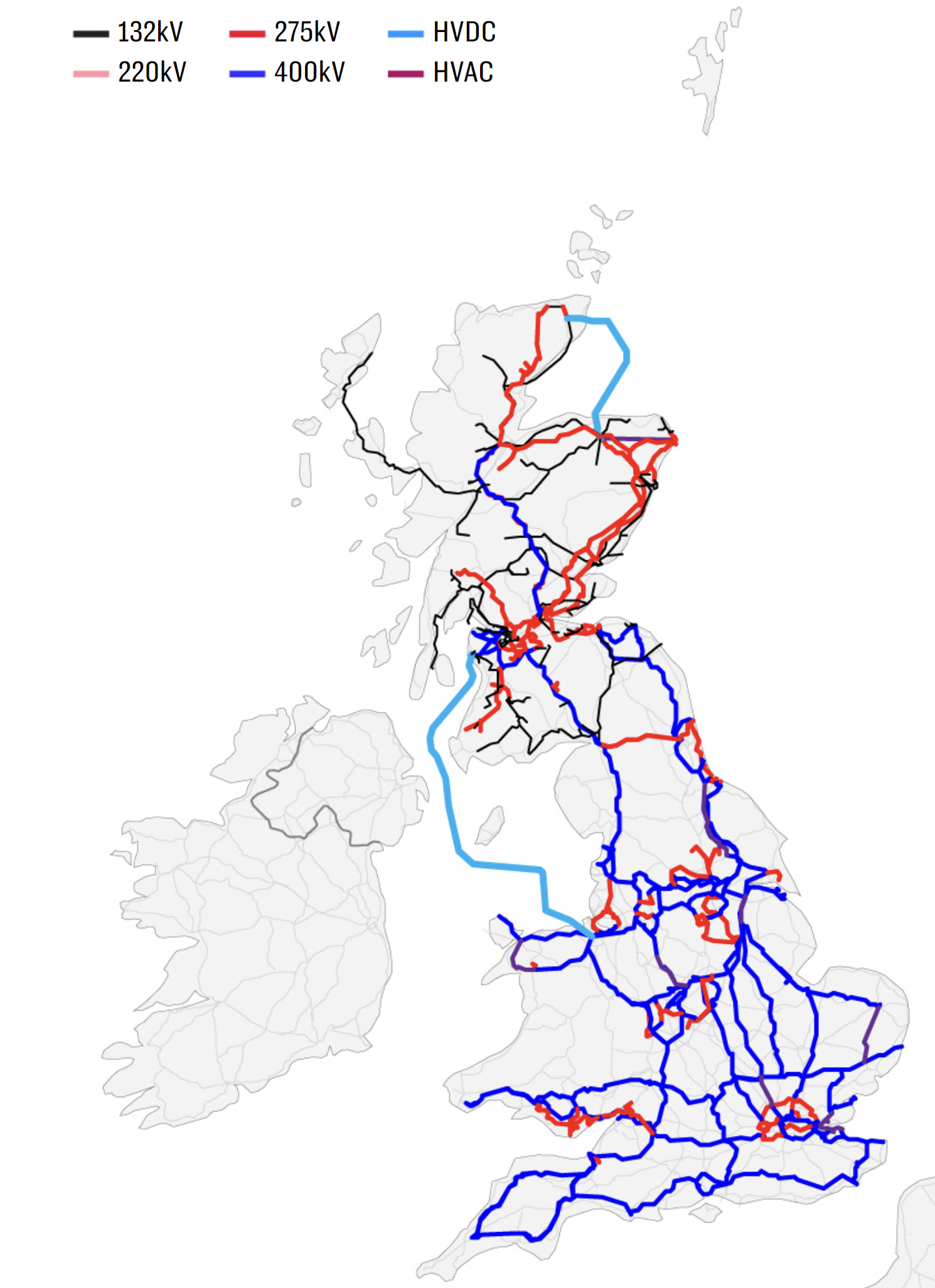
The dark blue lines are the 400 kV transmission lines.
- The one furthest East in East Anglia serves the Sizewell site, which hosts the Sizewell B nuclear power station and will be the home of Sizewell C nuclear power station, unless the Green or LibDem Parties are a member of a coalition government.
- Kent and Sussex seem to be encircled by 400 kV lines, with small spurs to the interconnectors to Europe.
- Two 400 kV lines appear to serve the South-West peninsular, with one going along the South Coast and the other further North. I suspect these two motorways for electricity explain, why the Morocco-UK Power Project terminates in Devon.
- London seems to have its own M25 for electricity.
- There also appears to be an East-West link to the North of London linking Sizewell in the East and Pembroke in the West. Both ends have large power stations.
- There also appear to be two 400 kV lines from Keadby by the Humber Estuary to North Wales with the pumped storage hydro power station at Dinorwig.
- Two more 400 kV lines link Yorkshire to the South of Scotland.
- A lonely Northern cable connects Edinburgh and the North of Scotland.
The red lines, like the one encircling central London are the 275 kV transmission lines.
- Think of these as the A roads of the electricity network.
- They encircle London often deep underground or under canal towpaths.
- They reinforce the electricity network in South Wales.
- Liverpool appears to have its own local network.
- They also seem to provide most of the capacity North of and between Edinburgh and Glasgow.
Newer cables are starting to appear on this map.
There are two light blue cables and these are HVDC cables that run underwater.
- The 1.2 GW Caithness – Moray Link does what it says in the name and it connects the far North of Scotland direct towards Aberdeen.
- The much larger 2.25 GW Western HVDC Link connects Hunterston near Glasgow to Flintshire Bridge near Liverpool. Note how it passes to the West of the Isle of Man.
Not shown on the map are the smaller 500 MW Moyle Interconnector and the recently-opened 600 MW Shetland HVDC Connection.
The Electricity Network In 2050
This second map shows how the network will look in 2050.

Note.
- The colours are the same, as the previous map.
- Although, I do think there are some errors in which have been used.
- There are a lot more cables.
There are several more light blue cables and these are HVDC cables that run underwater.
- Shetland is now linked to the North of Scotland by the Shetland HVDC Connection.
- There appears to be a cluster of HVDC interconnectors at Caithness HVDC switching station, near Wick, including a new one to Orkney, to go with the others to Moray and Shetland.
- The 2 GW Scotland England Green Link 1 will run from Torness in Southeast Scotland to Hawthorn Pit substation in Northeast England.
- The 2 GW Eastern Green Link 2 will run from Sandford Bay, at Peterhead in Scotland, to the Drax Power Station in Yorkshire, England.
- There also appear to be two or possibly three other offshore cables linking the East Coast of Scotland with the East Coast of England.
- If the Eastern cables are all 2 GW, that means there is a trunk route for at least 8 GW between Scotland’s wind farms in the North-East and Eastern England, which has the high capacity wind farms of Dogger Bank, Hornsea and around the Lincolnshire and East Angliam coasts.
- Turning to the Western side of Scotland, there appears to be a HVDC connection between the Scottish mainland and the Outer Hebrides.
- South-West of Glasgow, the Western HVDC Link appears to have been duplicated, with a second branch connecting Anglesey and North-West Wales to Scotland.
- The Moyle Interconnector must be in there somewhere.
- Finally, in the South a link is shown between Sizewell and Kent. It’s shown as 400 kV link but surely it would be a HVDC underwater cable.
There are also seven stubs reaching out into the sea, which are probably the power cables to the wind farms.
- The red one leading from South Wales could connect the wind farms of the Celtic Sea.
- The blue link North of Northern Ireland could link the MachairWind wind farm to the grid.
- The other two red links on the West Coast of Scotland could link to other ScotWind wind farms.
- The red link to the North of East Anglia could link RWE’s Norfolk wind farms to the grid.
- The other stubs in the East could either connect wind farms to the grid or be multi-purpose interconnectors linking to Germany and the Netherlands.
It looks to me, that National Grid ESO will be taking tight control of the grid and the connected wind farms, as an integrated entity.
As a Graduate Control Engineer, I can’t disagree with that philosophy.
Hydrogen Production
In How Germany Is Dominating Hydrogen Market, I talked about how Germany’s plans to use a lot of hydrogen, will create a large world-wide demand, that the UK because of geography and large amounts of renewable energy is in an ideal place to fulfil.
I can see several large electrolysers being built around the UK coastline and I would expect that National Grid ESO have made provision to ensure that the electrolysers have enough electricity.
Would I Do Anything Different?
Consider.
- If it is built the Morocco-UK Power Project will terminates in Devon.
- There could be more wind farms in the Celtic Sea.
- It is likely, that the wind farms in the Celtic Sea will connect to both Pembroke and Devon.
- Kent has interconnectors to the Continent.
Would a Southern HVDC link along the South Coast between Devon and Kent be a good idea?
Conclusion
Looking at the proposed list of wind farms, a total in excess of 96 GW could be possible, which is ten GW more than needed.
The network not only serves the UK in a comprehensive manner, but also tees up electricity for export to Europe.
Mersey Tidal Power Flythrough
Liverpool City Region Combined Authority have released a flythrough of the proposed tidal barrage across the Mersey.
Why Don’t Whales Get Cancer? Cracking One Of Medicine’s Greatest Mysteries
The title of this post, is the same as that of this article on The Guardian.
This is the sub-heading.
Understanding why some animals are more susceptible to the disease could lead to improved screening for humans
These are the first three paragraphs
Scientists are homing in on one of medicine’s most baffling mysteries: why some species avoid getting cancers while others are plagued by tumours that shorten their lives.
Whales tend to have low rates of cancer but it is the leading cause of death for dogs and cats. Foxes and leopards are susceptible while sheep and antelopes are not. Bats are also relatively well protected against cancer but not mice or rats. In humans, cancer is a leading cause of death that kills around 10 million people a year.
Even more puzzling is the fact that many huge creatures, including whales and elephants, generally avoid cancer when, instead, they should be at special risk because they possess vast numbers of cells, each of which could trigger a tumour.
The article is definitely a must-read.
 The Anonymous Widower