Is This The Way We’ll Drive Hydrogen-Powered Vehicles?
In Hydrogen Business Model / Net Zero Hydrogen Fund: Shortlisted Projects Allocation Round 2022, I listed all the hydrogen electrolyser projects on the shortlist for Government funding, if they pass the due diligence.
One project is from two companies H2 Energy and Trafigura, who are building a business model in West Wales, where you lease a hydrogen-powered truck for the same price as a diesel truck. You only pay for the miles you drive.
Their business model is explained in this must-watch Youtube video.
Consider.
- Hydrogen-powered vehicles have a long range.
- Fuelling time would be short compared to charging an electric truck.
- Are hydrogen-powered vehicles easy and low-cost to service?
- Cost of driver would be the same for operators.
- Would it be easier to recruit drivers for a hydrogen fuel-cell truck?
- Would cleaning costs be less for a hydrogen fuel-cell truck?
- Do the trucks come with sophisticated route planning software to cut mileage?
But as the video states, the upfront cost of the vehicle is higher.
I suspect the companies have driven the prices down, so that everybody gets an acceptable deal.
I wish the two companies all the best in their venture.
As I used to be half-owner of a vehicle leasing company, I feel that if the two companies can make a success of this hydrogen-powered truck leasing business, then I feel the model could be applied to the leasing of hydrogen-powered cars and other vehicles.
It could be a new way to buy your car.
Liverpool Lime Street And Newcastle By Battery-Electric Class 802 Train
After my visit to Morley station, which I wrote about in Morley Station – 17th August 2023, in this post, I look at how a battery-electric Class 802 train might run between Liverpool Lime Street And Newcastle stations.
These are the various sections of the route.
- Liverpool Lime Street and Manchester Victoria – 31.6 miles – 36 minutes – Electrified
- Manchester Victoria and Huddersfield – 25.7 miles – 30 minutes – Not Electrified
- Huddersfield and Dewsbury – 8 miles – 7 minutes – Currently Being Electrified
- Dewsbury and Leeds – 9.1 miles – 14 minutes – Not Electrified
- Leeds and York – 25.8 miles – 30 minutes – Currently Being Electrified
- York and Newcastle – 80.2 miles – 58 minutes – Electrified
Note.
- Liverpool Lime Street and Manchester Victoria, Leeds and York and York and Newcastle are all long enough to fully charge a battery-electric train.
- There is electrification of both ends of the route.
- Manchester Victoria and York is a distance of 68.6 miles.
- The total route length is a distance of 180.4 miles.
In the August 2023 Edition of Modern Railways, there is an article, which is entitled GWR Seeks Opportunities To Grow.
This is the sub-heading.
Managing Director Mark Hopwood tells Philip Sherratt there is plenty of potential to increase rail’s economic contribution.
This is a paragraph.
Meanwhile, GWR had announced plans with Eversholt Rail to trial the replacement of a diesel generator unit with batteries on a Class 802 IET. However, Mr. Hopwood says this would not be useful for GWR and so the trial is not proceeding; instead, a TransPennine Express Class 802 will be the subject of a battery trial.
Could the trial be conducted on TransPennine Express’s Liverpool Lime Street And Newcastle route?
- The total route length is a distance of 180.4 miles.
- The two electrified sections at the ends of the route; Liverpool Lime Street and Manchester Victoria and York and Newcastle are both long enough to fully charge a battery-electric train.
- The central section between Manchester Victoria and York is not overly long at 68.6 miles.
- The route is convenient for Hitachi’s headquarters at Newton Aycliffe.
It looks like, the Liverpool Lime Street And Newcastle route would make an ideal test route for battery-electric Class 802 trains.
Manchester Piccadilly And Newcastle By Battery-Electric Class 802 Train
This is a very similar route to the Liverpool Lime Street And Newcastle route with a different Western terminal.
These are the various sections of the route.
- Manchester Piccadilly and Huddersfield – 25.5 miles – 42 minutes – Not Electrified
- Huddersfield and Dewsbury – 8 miles – 10 minutes – Currently Being Electrified
- Dewsbury and Leeds – 9.1 miles – 14 minutes – Not Electrified
- Leeds and York – 25.8 miles – 30 minutes – Currently Being Electrified
- York and Newcastle – 80.2 miles – 58 minutes – Electrified
Note.
- Turnround time at Manchester Piccadilly and York and Newcastle are all long enough to fully charge a battery-electric train.
- There is electrification of both ends of the route.
- Manchester Piccadilly and York is a distance of 68.4 miles.
- The total route length is a distance of 148.5 miles.
Like the Liverpool Lime Street And Newcastle route, I believe the Manchester Piccadilly And Newcastle route would make an ideal test route for battery-electric Class 802 trains.
Morley Station – 17th August 2023
These pictures show Morley station, which is currently being upgraded.




























I was rather surprised at the lack of any sign of electrification.
There was no sign of any gantries for overhead electrification, either installed or ready to installed.
In Is There Going To Be Full Electrification Between Leeds And Huddersfield?, I said this.
I have now found this document on the Network Rail web site, which is entitled Huddersfield to Westtown (Dewsbury).
This statement is included under proposals.
Electrification of the railway from Huddersfield to Ravensthorpe – and right through to Leeds.
Because there is a dash in the words, has electrification to Leeds, been a recent addition?
I also showed this map, that I have copied from the Network Rail document
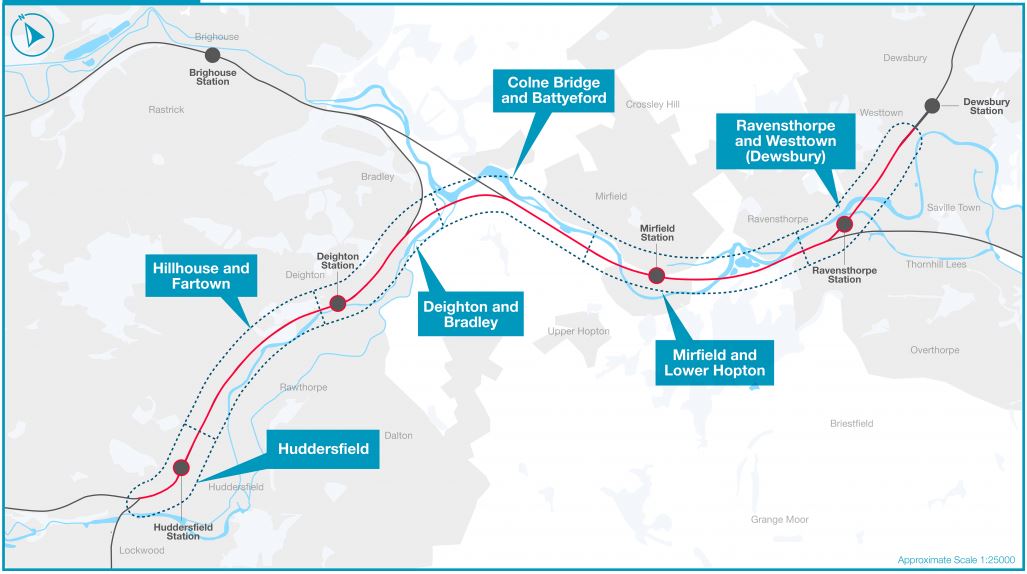
Note the railway lines shown in red. Are these the ones to be electrified? As they go from Huddersfield to Westtown, I think the answer is probably in the affirmative.
Surely, if there were going to be electrification through Morley, they’d have at least put the gantries up by now or installed the bases for them by now?
These are some distances from Real Time Trains.
- Leeds and Morley – 4.6 miles
- Morley and Dewsbury – 5,5 miles
- Dewsbury and Huddersfield 8 miles
Note.
- Leeds and Dewsbury are only 10.1 miles apart, which would be an easy journey for a battery-electric train.
- Trains typically take eighteen minutes between Dewsbury and Huddersfield, which would surely be more than enough time to charge the batteries on a train.
- It also appears that the only trains through Morley station are passenger services run by TransPennine Express or Northern Trains.
It certainly looks to me, that the section of the route between Dewsbury and Leeds though Morley station is to be run using battery-electric trains.
New Livery On An InterCity 225
I took these pictures of an InterCity 225 at Doncaster station.

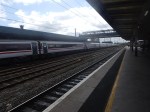

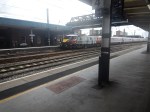

They scrub up well for a train that entered service in 1989.
The Lonely Wind Turbine – 17th August 2023
I took these pictures to the North of Newark on the way to Leeds.




You don’t often see an onshore single wind turbine as large as this one.
Old Street Station – 16th August 2023
I took these pictures this evening, as my bus passed Old Street roundabout.












It’s still progressing as slowly as ever.
Germany ‘A Laughing Stock’ After Minister’s Plane Grounded
The title of this post, is the same as that of this article in The Times.
This is the first paragraph.
Faulty wing flaps on an ageing Airbus have left officials red-faced after Germany’s foreign minister was forced to abandon the plane en route to Australasia.
Germany’s foreign minister is Annalena Baerbock, who is a Green Party politician.
A lot of the comments are asking, what was a Green Party politician doing flying all the way to Australia in a fuel-hungry four-engine Airbus A 340.
The article got me thinking.
Consider.
- Government ministers, diplomats and some business people, will always need to fly around the world for some important face-to-face meetings.
- Perhaps, this won’t happen as much as it did in the past with the development of better communications technology, but there will always be a need in some cases.
- There are over 20,000 business jets in service.
- Most business jets could be run on sustainable aviation fuel.
- Some business jets have a very long-rage.
I can see one of the manufacturers developing sustainable business aircraft to fit various segments.
Lightweight Zero-Carbon Business Aircraft
Aircraft like the Eviation Alice will dominate this field.
- The aircraft is battery-powered.
- It can carry nine passengers.
- It has a range of 440 nautical miles.
- It can operate as either a feeder airliner, business aircraft or small parcel carrier.
- It is planned to be in service in 2027.
The Alice already has a substantial order book.
There are several other aircraft in this segment under development.
Lightweight Hybrid-Electric Business Aircraft
Aircraft like the Faradair BEHA are under development.
- The aircraft is powered by a Honeywell turbo generator running on sustainable aviation fuel.
- It can carry eighteen passengers.
- It has a range of around a thousand miles.
- It is being developed at Duxford Airfield.
- The aircraft has a radical quick-change interior.
- Operational trials are planned to start in 2026.
Like the Alice the Faradair BEHA is different.
Lightweight Business Aircraft Running On Sustainable Aviation Fuel
I can see several of the smaller business aircraft being certified for sustainable aviation fuel.
Cessna sold 8,000 of their Citation jets in 2022 and have delivered around 7,500 according to Wikipedia.
Cessna won’t be giving up that market without a fight.
Certifying the aircraft to run on sustainable aviation fuel would be the interim solution until a hydrogen-powered business aircraft becomes available as it surely will.
The biggest problem will be to make enough sustainable aviation fuel.
Long-Range Business Aircraft Running On Sustainable Aviation Fuel
Long-range business jets like the Gulfstream G800 are true intercontinental transport.
- They can carry nineteen passengers and sleep ten.
- Range is 8,000 nautical miles.
- The jets are powered by Rolls-Royce Pearl 700 engines.
- This press release from Rolls-Royce is entitled Rolls-Royce Conducts First Tests Of 100% Sustainable Aviation Fuel For Use In Business Jets.
I think it is right to assume that long-range business jets like the Gulfstream G800 will be able to fly intercontinental routes on a net-zero basis.
An Airbus A321 XLR Running On Sustainable Aviation Fuel
Airbus and to a certain extent Boeing are the elephants in the room.
Airbus have launched an A321 XLR for long routes.
- The aircraft can carry over 200 passengers.
- It can fly up to 5,400 miles.
- It is selling well.
- Air Canada are thinking of using the plane on transatlantic routes.
The engines are from either CFM or Pratt & Whitney and I would be very surprised if the aircraft couldn’t run on sustainable aviation fuel.
Conclusion
I can see a new pattern of flying developing.
To return to the case of Germany’s foreign minister, I could see her going to Australia in a long-range business jet like the Gulfstream G800 running on sustainable aviation fuel.
- She might take a flight from Berlin or perhaps a more convenient airport with a rail connection.
- The plane would refuel in the Middle East and possibly Singapore.
It would be interesting to see how her green supporters reacted.
I can also see Airbus A321 XLRs running on sustainable aviation fuel across the Atlantic, being marketed as the net-zero way to the USA.
After all, Lumo market themselves as the net-zero way to Scotland against the airlines.
Mercia Power Response And RheEnergise Target 100MW Of High-Density Hydro Energy Storage
The title of this post, is the same as that of this article on the Institution of Mechanical Engineers.
This is the sub-heading.
Two new partners will explore installation of high-density hydro energy storage with 100MW capacity by 2030.
These two paragraphs outline the deal.
Mercia Power Response, a provider of flexible power response services to the UK grid, signed an agreement with RheEnergise to explore the potential deployment of its new form of long-duration hydro energy storage, known as High-Density Hydro (HD Hydro).
The companies will work together to identify suitable sites for HD Hydro storage projects, using Mercia PR’s existing grid connections.
Note.
I am certainly pleased that this simple idea for energy storage appears to be on its way.
 The Anonymous Widower