Hydrogen-Powered Vehicles And Trains In Tunnels
In writing about the Silvertown Tunnel, I started to wonder, if hydrogen vehicles will be allowed in the tunnel.
Consider.
- I don’t think diesel-powered trains are allowed in the Channel Tunnel and the tunnels of the link to London.
- Some tunnels don’t seem to allow hydrogen-powered vehicles.
- In a few years, hydrogen-powered buses, cars, locomotives, trains, trucks and vans will be more common, than they are today.
But help is at hand, with a co-operation between UK and EU agencies called HyTunnel-CS.
It is over fifty years now, since I worked as an instrument engineer in an ICI hydrogen factory at Runcorn. Truckloads of hydrogen were filled and despatched all over the UK. I may be wrong, but in all those intervening years, I can’t remember a hydrogen emergency on the UK’s roads.
I am confident, that we will achieve a safety regime, that allows hydrogen-powered vehicles and trains to be certified to pass through tunnels.
Silvertown Tunnel Bus Network Proposals
This web page is the Silvertown Tunnel Bus Network Proposals.
These proposals are made.
- A new high frequency, limited stop service between Grove Park and Canary Wharf referred to in this consultation as route X239
- To extend route 129 (Lewisham – North Greenwich) north across the river to Great Eastern Quay via the Royal Docks development zone
- A minor change to route 108 so that it uses the new Millennium Way slip road to exit the Blackwall Tunnel southbound
- We are also seeking your views on route options for three sections of routes 129 and X239.
It looks like route 108 will continue to use the current stop.
The proposals include this map.
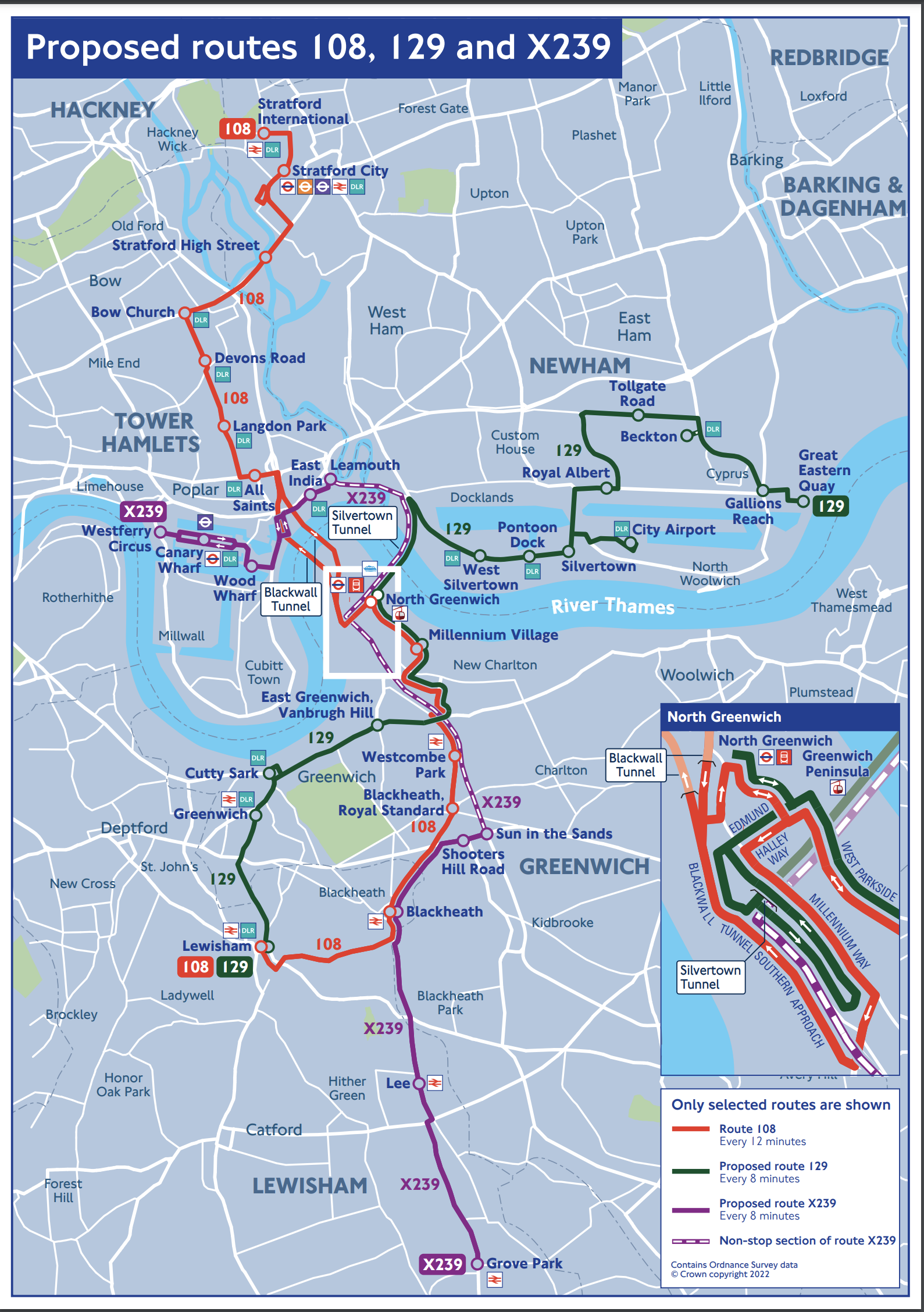
I copied this map from the TfL web site, as they don’t provide one for people who want or need to use it.
These are my observations.
The 108 Bus
The 108 seems to be more or less as now and will be continue to be run by a single-decker bus, as double-decker buses can’t use the Blackwall Tunnel.
North of the Thames, the 108 calls at these stations.
- Stratford International for DLR and National Rail.
- Stratford for DLR, Central, Elizabeth and Jubilee Lines, and National Rail.
- Bow Church for DLR
- Devons Road for DLR
- Langdon Park for the DLR
- Bazely Street (All Saints) for DLR
South of the Thames, the 108 calls at these stations.
- North Greenwich for the Jubilee Line.
- Westcombe Park for National Rail
- Blackheath for National Rail
- Lewisham for DLR and National Rail
Note.
- It is possible to go between Lewisham and Stratford on the DLR with a change at Canary Wharf.
- It is possible to go between North Greenwich and Stratford on the Jubilee Line.
- Westcombe Park station is on the Greenwich Line.
I would wonder, if many people use this bus route for long distances.
The 129 Bus
Note.
- The 129 appears to connect Lewisham and Greenwich to the City Airport and the Becton branch of the DLR.
- Many journeys on the 129 bus, might be easier using the DLR, with a change at Westferry or Poplar, which is probably what travellers do now.
- The 129 bus is shown on the map with a stop at Silvertown. Does that mean that it could connect with a Silvertown station on the Elizabeth Line?
- As the 129 bus will pass through the larger Silvertown Tunnel, it could be a double-decker route, instead of the current single-decker.
North of the Thames, the 129 calls at these stations.
- Gallions Reach for the DLR
- Beckton for the DLR
- Royal Albert for the DLR
- London City Airport for the DLR
- Silvertown
- Pontoon Dock for the DLR
- West Silvertown for the DLR
South of the Thames, the 129 calls at these stations.
- North Greenwich for the Jubilee Line.
- Cutty Sark for DLR
- Greenwich for DLR and National Rail
- Lewisham for DLR and National Rail
Would improvements and a frequency increase to the DLR and the building of Silvertown station, mean that changes to the 129 bus route, would not be so important?
The X329 Bus
Note.
- Canary Wharf must be served and starting at Westferry Circus is probably a good choice.
- But is Grove Park station, the ideal Southern terminal?
- Not stopping the X329 bus at North Greenwich is probably correct, as North Greenwich station is a large Jubilee Line and bus interchange close to the O2.
North of the Thames, the X329 calls at these stations.
- Canary Wharf for DLR and Elizabeth and Jubilee Lines
South of the Thames, the X329 calls at these stations.
- Blackheath for National Rail
- Lee for National Rail
- Grove Park for National Rail
Note.
- Blackheath station is on the Bexleyheath and North Kent Lines.
- Lee station is on the Dartford Loop Line.
- Grove Park station is on the South Eastern Man Line.
- Grove Park has a bus station, where there could be space for a battery charger for electric buses.
The X329 seems to have been partly designed on the premise, that an express bus should be run through the Silvertown Tunnel. But it does connect four of the rail lines going into London terminals to Canary Wharf.
Silvertown Station For London City Airport
Silvertown station would more than double the number of stations with easy routes to the London City Airport.
The Elizabeth Line would enable the direct connection that is needed to Canary Wharf, the City of London, Heathrow, Liverpool Street and Paddington stations and the West End.
- A single change at Abbey Wood, would give access to much of Kent.
- A single change at Farringdon, would give access to Thameslink services and Gatwick and Luton airports.
- Around 2030, a single change at Old Oak Common, would give access to High Speed Two services.
- A single change at Paddington, would give access to Wales and West services.
- A single change at Whitechapel, would give access to the great circle of the London Overground.
I believe the case for a Silvertown station with at least a good walking route to the London City Airport is strong, and the station would be a marvellous asset for Silvertown and the Airport.
The Northern End Of The Silvertown Tunnel From The DLR To Woolwich Arsenal – 6th January 2023
I took these pictures of the Northern end of the Silvertown Tunnel from DLR trains to and from Woolwich Arsenal.
















Note.
- The New London City Hall and the Cable Car in the background.
- All pictures were taken going to Woolwich.
The pictures are better than the earlier ones, which I may retire.
Is This The Worst Bus Stop In London?
This article on MyLondon is entitled The ‘Creepiest’ London Bus Stop Hidden At The Bottom Of A Dark, Grimy Staircase In East London.
I just had to go and take a look at the bus stop.




































Note.
- The bus stop is on the road leading to the modern Southbound tunnel.
- There were a surprising number of full-size articulated trucks.
- The traffic was moving fairly slowly.
- The pollution was bad, but I’ve been in worse.
The stairs were covered in graffiti, but they appeared to have been swept recently, as there was only a small amount of litter and that was mainly a few leaves.
This Google Map shows the junction and the position of the bus stop.
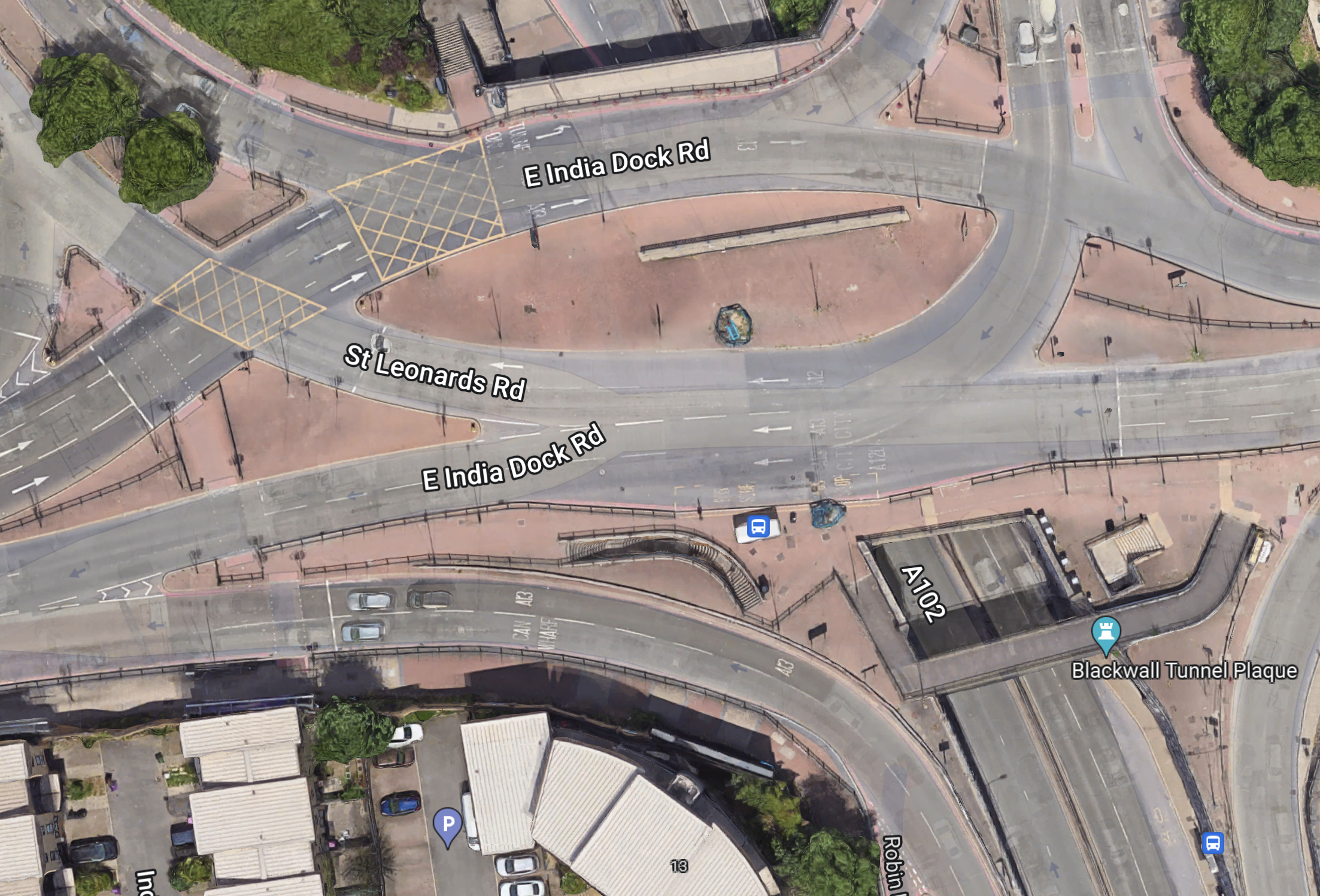
The bus stop is in the bottom-right corner of the map.
Bank Station Upgrade – 6th January 2023
I took these pictures this morning of the new Cannon Street entrance to Bank station.








There’s certainly space above the building for a substantial oversite development.
This article on Ian Visits is entitled TfL’s Office Development At Bank Tube Station Gets Taller.
These four paragraphs describes the scheme.
Transport for London (TfL) already had permission for a 7-storey building on the site but was structurally future-proofed for the possibility of an additional floor. They’ve now received permission to add the extra floor on top, and it’s further stepped back from the front of the building so that there’s space to create a large roof terrace as well.
Commercially, the previous top floor, the sixth floor lost about a third of the floorspace to plant room equipment, but will now be a full-width open plan office space, and while the new top floor still needs space for the plant equipment, but also has the new roof terrace and some additional office space. They’ve also flipped the plant room from the western side where it blocked the view of the church steeple and a lower-rise set of buildings, to the other side, which faces an office block, so the 6th-floor office users have a rather better view from the windows.
The revised scheme provides accommodation totalling 142,310 square feet across the ground and 7 upper floors plus over 7,600 square feet of terrace space over three floors.
The new scheme also changes the roof structure, which was to be covered in solar cells. However, that’s because the attic level above the offices was for traditional water boilers. The new scheme has removed the water boilers to replace them with a lower energy air source heating network, so the roof needs to be open to the air instead.
There’s also been a requirement from the City of London to reduce the number of vehicles allowed to make deliveries to the building from 54 per day to a maximum of 42, which considering that the building is also larger, is a meaningful change. Planning policy required at least 142 cycle racks, but another recent change to the building requested by the developer allowed them to put in space for 229 cycle spaces at the basement level, which is significantly higher than the minimum required.
The building certainly appears to have good environmental credentials.
Is Something Happening At Highview Power?
It seems to be impossible to connect to the Highview Power web site.
I get the message, that my security is not private.
There is also no news of the company in the last month.
The Next Generation Of Fixed Foundation Wind Farms
This article on offshoreWIND.biz, is entitled Offshore Wind Turbines In 2022: 15 MW Prototypes Starting To Spin In Europe, Chinese Rolling Out 16 MW Models, Windcatcher And VAWTs Secure Demo Projects.
The title itself, shows 15-16 MW wind turbines and the text lists three European 15 MW and two Chinese 16 MW wind turbines, that are being developed.
This paragraph also indicates that Siemens Gamesa are in the running for orders.
So far, the SG 14-236 DD wind turbine has been selected as a preferred option for the Norfolk Vanguard and Boreas wind farms offshore the UK, as well as for the MFW Bałtyk II and MFW Bałtyk III wind farms in the Polish Baltic Sea.
Large turbines with a capacity of 15 MW and upwards appear to be becoming the new normal.
Water depths for these large turbines are forecast to be deeper than the two Norfolk wind-farms, which are between 22 and 40 metres.
This means that foundations will get much larger and heavier.
This article on offshoreWIND.biz, is entitled New Monopile Installation Method Attracts Major Backer, describes a new generation of monopiles as 100-130 metres in length, 12-15 metres in outer diameter, and a weight of up to 5,000 tonnes.
Installing these long and heavy objects safely in deep waters, is not a job for the faint-hearted.
The article describes a new method of installation, which I feel is very elegant.
- The XXXL monopiles are built horizontally.
- They are moved on to the jack-up ship by self-propelled modular transporters (SPMT).
- It appears at least two or possibly up to four monopiles can be carried on the ship.
- They are lifted into the vertical position by a lifting beam.
Note.
- No cranes are involved in the process.
- The lifting beam method of erecting the 5,000 tonne XXXL monopile is simple and very efficient.
- Self-propelled modular transporters were used to install the 2000 tonne subway at Hackney Wick station.
- Rollers are fitted on the ship to ease handling of the monopiles.
I can certainly see this specialised jack-up ship speeding up the installation of these giant monopiles.
Consequences For Floating Wind
I do wonder, if this method of installing fixed foundation wind farms, will allow larger foundations and these may mean that there is less need for the more complex floating wind farms.
Gravitricity Makes Hydrogen Play With FlexiStore
The title of this post, is the same as that of this article on The Engineer.
This is the sub-heading.
Edinburgh-based energy storage firm Gravitricity is looking to green hydrogen, bringing a new underground storage solution to market.
The system is explained with a large graphic, showing an electrolyser, a FlexiStore and a hydrogen filling station, with this paragraph underneath.
Known as FlexiStore, the concept involves purpose-built, steel-lined shafts capable of holding up to 100 tonnes of compressed hydrogen at 220 bar – around 3.33GWh of energy, or enough to refuel over 1,000 HGVs, according to Gravitricity. Unlike naturally occurring underground storage like salt caverns, FlexiStores could be positioned anywhere, with the current plan to co-locate the storage as close as possible to renewable generation. Gravitricity says a single FlexiStore could serve a 460MW wind farm and that 1,000 units could meet the UK’s predicted hydrogen storage needs in 2050.
Note.
- The concept certainly solves the problem of storing hydrogen on a country-wide basis.
- I suspect, a machine could be designed and built to create the shafts.
- A 3.33 GWh store could supply 460 MW for nearly 33 hours. As a Control Engineer, that sounds a good balance for backing up a wind farm!
As ARUP has been involved in a feasibility study, I suspect there’s a fair chance that FlexiStores can be built.
Norway’s Answer To Wind Power Intermittency Lies Offshore – Study
The title of this post, is the same as that of this article on offshoreWIND.biz.
This is the first paragraph.
SINTEF has revealed in its recent study that there is no statistical covariation or systematic correlation in time between the occurrence of offshore wind conditions in southern and northern Norway, and adds that this knowledge will increase the commercial value of Norwegian offshore wind energy.
It does seem lucky for the Norwegians, that their wind farms appear to be able to supply a more constant amount of electricity, than many of those against wind farms would have you believe.
I hope that a reputable UK agency or university, is doing a similar analysis for UK wind farms.
World’s First Floating Offshore Wind Farm Celebrates Five Years Of Operation
The title of this post, is the same as that of this article on offshoreWIND.biz.
This is the sub-heading.
Hywind Scotland, the first floating offshore wind farm in the world, has passed five years in operation since its commissioning in 2017.
And this is the first paragraph.
According to Equinor, Hywind Scotland is the world’s best-performing offshore wind farm, achieving a capacity factor of 54 per cent over its five years of operations.
Note.
- Hywind Scotland is a 30 MW wind farm with five turbines.
- The capacity faction is much higher than a windfarm with fixed foundations.
- The water depth is between 95 and120 metres.
- The wind farm is 30 km. off Peterhead.
There is at least 15 GW of floating wind farms being planned in UK waters before 2030.
Conclusion
The wind farm has made a good start for the first floating wind farm.
 The Anonymous Widower