Plan To Build £150m Green Hydrogen Plant At Felixstowe Port
The title of this post, is the same as that of this article in The Times.
These two paragraphs introduce the project.
A £150 million green hydrogen plant is to be built at the UK’s busiest container port according to proposals by ScottishPower, it emerged yesterday.
The energy company has devised plans for a 100MW plant at the Port of Felixstowe which will provide fuel to power trains, trucks and ships.
There’s a lot more to this project than it would appear at first.
Where Will The Electrolyser Be Sited?
The Times article says this.
The site will be around the size of a football pitch, on brownfield land within the port.
I have flown my virtual helicopter over the port and there could be a couple of suitable football pitch-sized plots.
Where Will The Electricity Come From?
The East Anglia Array is a proposed massive series of offshore wind farms, which will be about thirty miles off the Suffolk coast.
Wikipedia says this about the size.
Up to six individual projects could be set up in the area with a maximum capacity of up to 7.2 GW.
But the main thing about the East Anglian Array is that it is being developed by a partnership of ScottishPower and Vattenfall.
Negotiations shouldn’t be difficult.
This Google Map shows the town of Felixstowe.
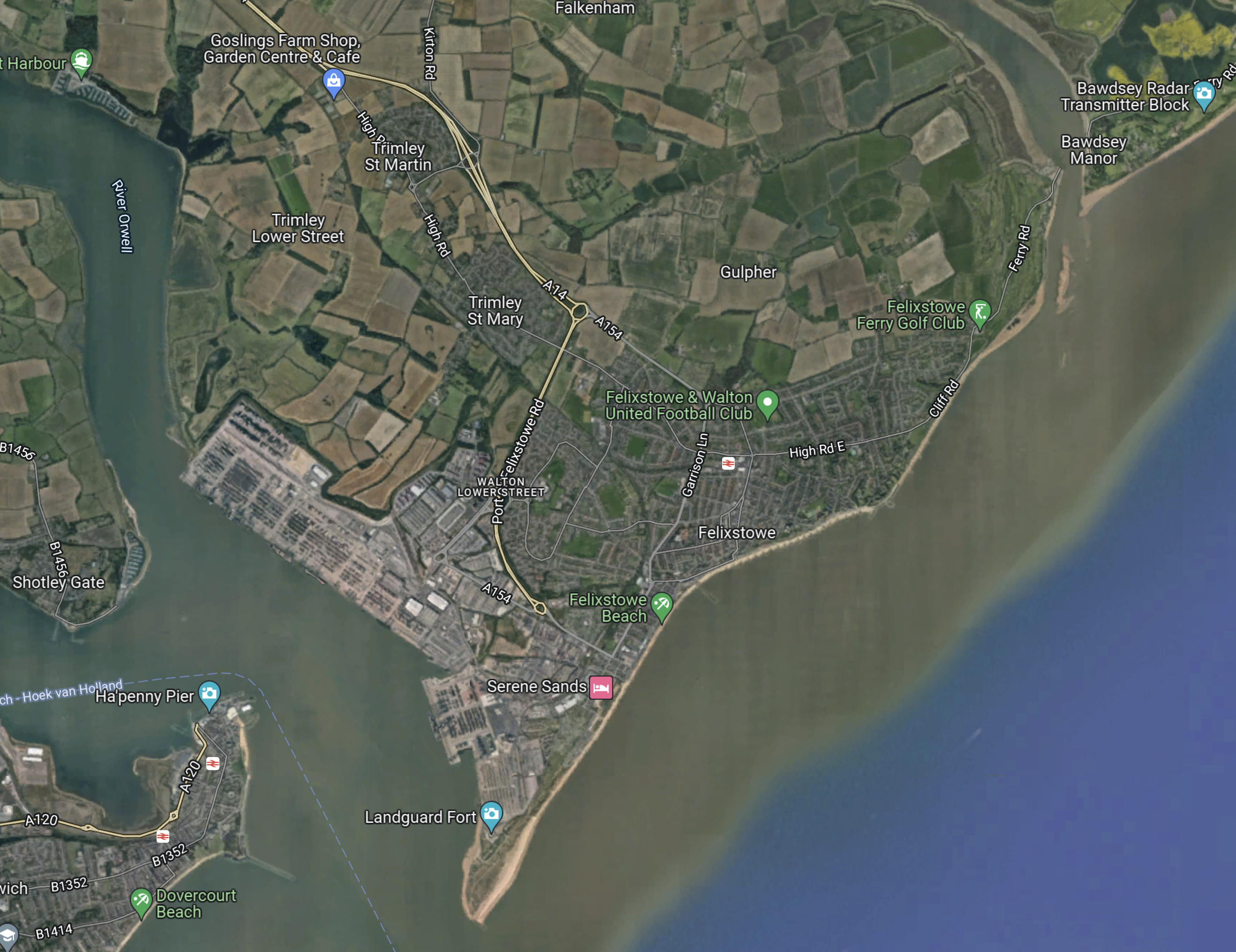
Note.
- The Ports of Felixstowe and Harwich are opposite each other on the two banks of the River Orwell.
- The power cable to the East Anglia Array comes ashore at Bawdsey in the North-East corner of the map.
- The Port of Felixstowe has two rail links, which are not electrified.
I suspect that the electric power to the electrolyser might well be routed underwater to the Port of Felixstowe either from Bawdsey or possibly direct from the wind farm.
A Meeting With A Crane Driver
I used to regularly go to Ipswich Town away matches and at one match, I met a senior crane operator from the Port of Felixstowe. We got talking about electrifying the rail link to the port and decarbonisation of the port in general.
He was adamant that electrification of the rail lines in the port, wouldn’t be a good idea as containers occasionally get dropped or crane drivers aren’t as accurate as they should be.
Hydrogen-Powered Freight Locomotives
When, I told him about the possibilities of hydrogen rail locomotives, he felt this was the way to go, as no rail electrification would be needed in the port.
Hydrogen-electric hybrid locomotives would also be able to take containers cross-country to the main electrified routes to the North and West, where they would raise their pantographs and use electric power.
How many trucks would be removed from the A14, A1 and M6?
Will Greater Anglia Convert Their Class 755 Trains to Hydrogen?
Class 755 trains have a short PowerPack in the middle and are designed for conversion to hydrogen-electric operation.

Note the PowerPack has four slots for diesel engines, batteries or hydrogen fuel-cells.
A Better Working Environment
But my fellow supporter felt the biggest gain in the port, would come with replacement or updating of all the vehicles and handling equipment, as if all these machines were hydrogen-powered, this would greatly improve the working conditions for the dock workers.
ScottishPower’s Vision
This press release on ScottishPower’s web site is entitled ScottishPower Vision For Green Hydrogen Fuels Hub At Port Of Felixstowe.
Conclusion
The Port of Felixstowe is doing the planning for this in the right way, as ensuring the hydrogen supply in the port first, is the logical way to transition to hydrogen power.
But then, I’ve watched the Port of Felixstowe grow since the 1960s and they usually get their decisions right.
The press release starts with these bullet points.
- ScottishPower explores green hydrogen at Port of Felixstowe to help decarbonise the UK’s busiest port.
- The project could help kick-start the low carbon transformation of the UK’s heavy transport sector.
- 100MW facility could deliver up to 40 tonnes of green hydrogen per day – enough to power 1300 hydrogen trucks.
- International export also being explored.
And these two paragraphs.
ScottishPower, with Hutchison Ports, is exploring the opportunity to develop, build and operate a multi-hundred MW green hydrogen production facility at the Port of Felixstowe – with the potential to decarbonise industry and transportation in the region.
Both companies have set out their vision to help create a greener port, which could provide clean fuel for customers at Britain’s busiest container port.Plans are being developed to use green hydrogen for onshore purposes, such as road, rail and industrial use, with the potential to create liquid forms, such as green ammonia or e-methanol. This could, in turn, provide clean fuels for shipping and aviation, and create opportunities for cost-effective export to international markets. The project aims to continue engineering and site development works to align with customer demand from 2025 onwards.
It is certainly a very extremely ambitious vision!
But then the county of my conception, has a tremendous determination to succeed. And often against all conventional logic!
Barking Riverside To Barking – 8th August 2022
This post and Woodgrange Park To Barking Riverside – 8th August 2022 are a pair and show the area on the date given. This is so I can show it as it develops in the next few years.
I took these pictures returning from Barking Riverside station.












Note, that this side of the line, is dominated by Barking substation, lots of overhead cables and views of the viaduct.
This 3D Google Map shows the viaduct from the West.

Are there any other viaducts, which comprise a whole branch line?
Woodgrange Park To Barking Riverside – 8th August 2022
This post and Barking Riverside To Barking – 8th August 2022 are a pair and show the area on the date given. This is so I can show it as it develops in the next few years.
I took these pictures going to Barking Riverside station.
































Note.
- The route passes the ventilation shaft for High Speed One.
- It goes through and over the concrete viaducts and bridges of Barking station.
- Renwick Road station could be built in the area to serve five thousand proposed houses.
- It then crosses over the Barking Freight Terminal, which is sure to be developed either as a larger freight terminal or housing.
- The houses of Barking Riverside have sheds in their gardens.
What are the circular structures in the penultimate picture for?
What A Stupid Place To Park A Bike!
These days my eyesight, has almost returned to normal after my stroke in 2011 and I rarely bump into things, that I did in the first couple of years after suffering from the stroke.
Today, though I came across this hire bicycle, that some twit had left where a light-controlled crossing meets the pavement.

The idiot deserves at least points on their driving licence or a suspended sentence for their stupid behaviour. Or perhaps, the bike hire company need a hundred pound fine?
It has been stated on The Times, ITV and other web sites, that the next Transport Bill will include a review of cycling law.
That should also include rules about how to park a bicycle.
The Plans For Giant Seaweed Farms In European Waters
The title of this post, is the same as that of this article on the BBC.
The article describes how the Dutch are developing the growing and harvesting of seaweed.
This is all fascinating stuff and reminds me of reading of a company called Alginate Industries in the Meccano Magazine in the 1950s.
I can’t find much about the company, except that they were taken over by Merck & Co in 1979.
The Wikipedia entry for alginic acid, gives this information on alginates.
Alginates are refined from brown seaweeds. Throughout the world, many of the Phaeophyceae class brown seaweeds are harvested to be processed and converted into sodium alginate. Sodium alginate is used in many industries including food, animal food, fertilisers, textile printing, and pharmaceuticals. Dental impression material uses alginate as its means of gelling. Food grade alginate is an approved ingredient in processed and manufactured foods.
I remember the Meccano Magazine saying that alginates were an important food additive and UK production came from the North of Scotland.
This page on the Secret Scotland wiki gives details of current alginate production in Scotland.
Has Wikipedia replaced the Meccano Magazine, as a source of information for scientifically-inquisitive children?
ZeroAvia Hydrogen Powered Jets For American Airlines?
The title of this post, is the same as that of this article on Aviation Source.
The article states that American Airlines will be investing an undisclosed amount into ZeroAvia and that it might use their regional hydrogen-powered aircraft in the United States.
Equinor Is Counting On Tax Breaks With Plans For North Sea Oilfield
The title of this post, is the same as that, of this article in The Times.
These paragraphs outline the project.
Norway’s state-owned oil company is pushing ahead with plans to develop Britain’s biggest untapped oilfield after confirming that it stands to benefit from “helpful” tax breaks introduced alongside the windfall levy.
Equinor could lower its windfall tax bill by as much as £800 million in the years to come thanks to investment relief if it develops the Rosebank field, according to Uplift, a campaign group.
Rosebank, to the west of Shetland, could cost £4.1 billion to develop and may account for about 8 per cent of British oil output in the second half of this decade, producing 300 million barrels of oil by 2050.
Equinor said yesterday that it hoped to take a final investment decision on the field by next year and to start production by 2026. It has applied for environmental approval from the government.
Needless to say Greenpeace are not amused.
We Have Both Long Term And Short Term Energy Problems
In the UK, energy is generally used as electricity or gas and to power industry and transport.
Electricity
In the long term, we need to decarbonise our electricity production, so that all our electricity is produced from zero-carbon sources like nuclear, solar, tidal, wave and wind.
- As I write this, our electricity production is around 26.8 GW of which 62 % is coming from renewable sources.
- Surprisingly around 45 % of the renewables is coming from solar. Who’d have ever thought that in an predominantly-grey UK?
- As we have committed to around 50 GW of wind power by 2030 and the 3.26 GW Hinckley Point C will be on stream by the end of the decade, the long term future of electricity production looks to be fairly secure.
- It would be even more secure, if we added around 600 GWh of storage, as proposed in Highview Power’s Plan To Add Energy Storage To The UK Power Network, which would be used as backup when the sun doesn’t shine and the wind doesn’t blow.
It looks to me, that our long term electricity problem is capable of being solved.
For the next few years, we will need to rely on our existing gas-fired power stations until the renewables come on stream.
Gas
Gas could be more of a problem.
- I wouldn’t be surprised to see a lot of resistance to the replacement of natural gas for heating, cooking and industrial processes.
- Natural gas is becoming increasingly difficult to source.
- As I said in the previous section, we will still need some gas for electricity generation, until the massive wind farms are completed.
On the other hand, there is HyDeploy.
I like the HyDeploy concept, where up to 20 % of hydrogen is blended with natural gas.
- Using a blend of hydrogen and natural gas doesn’t require any changes to boilers, appliances or industrial processes.
- The hydrogen blend would make the most of our existing world class gas network.
- Customers do not require disruptive and expensive changes in their homes.
- Enormous environmental benefits can be realised through blending low carbon hydrogen with fossil gas.
- The hydrogen blending could happen, where the natural gas enters the network at terminals which receive gas from the UK continental shelf or where liquified natural gas is imported.
- Alternatively, it may be possible to surround a gas production platform with an offshore wind farm. This could enable hydrogen production and blending to be performed offshore.
The amount of gas we need would drop by twenty percent.
In The Mathematics Of Blending Twenty Percent Of Hydrogen Into The UK Gas Grid, I calculated that 148.2 tonnes per hour of hydrogen would be needed, to blend twenty per cent of hydrogen into UK natural gas supplies.
I also said this about the electricity needed.
To create 148.2 tonnes per hour of hydrogen would need 8,180.64 MW of electricity or just under 8.2 GW.
I also calculated the effect of the hydrogen on carbon dioxide emissions.
As twenty percent will be replaced by hydrogen, carbon dioxide emission savings will be 24,120,569.99 tonnes.
I believe that generating the 8.2 GW of electricity and delivering the 148.2 tonnes per hour of hydrogen is feasible.
I also believe that HyDeploy could be a valuable way to reduce our demand for natural gas by twenty per cent.
Transport
Not every vehicle, ship, aircraft and train can be powered by electricity, although batteries will help.
Hydrogen will help, but we must also develop our capability for sustainable fuels made from rubbish diverted from landfill and biologically-derived ingredients like used cooking oil.
Summing Up Our Long Term And Short Term Energy Problems
We obviously have got the problem of creating enough renewable energy for the future, but there is also the problem of how we keep everything going in the interim.
We will need gas, diesel, petrol and other fossil fuel derived products for the next few years.
Is Rosebank Our Short Term Solution?
This page on the Equinor web site is entitled Rosebank Oil And Gas Field.
This introductory paragraph described the field.
Rosebank is an oil and gas field 130 kilometres off the coast of the Shetland Islands. Equinor acquired the operatorship in 2019 and has since then been working to optimise and mature a development solution for the field together with our partners.
Could the field with its resources of oil and gas, be just the sort of field to tide us over in the next few difficult years.
But given the position, it will surely not be an easy field to develop.
These two paragraphs set out Equinor’s strategy in developing the field.
Equinor believes the field can be developed as part of the UK Government North Sea Transition deal, bringing much needed energy security and investment in the UK while supporting the UKs net zero target. According to a socioeconomic study (see link below) based on data and analysis by Wood Mackenzie and Voar Energy, if sanctioned Rosebank is estimated to create GBP 8.1 billion of direct investment, of which GBP 6.3 billion is likely to be invested in UK-based businesses. Over the lifetime of the project, Rosebank will generate a total of GBP 24.1 billion of gross value add (GVA), comprised of direct, indirect and induced economic impacts.
Equinor together with our partners are working with the supply chain to ensure that a substantial part of investment comes to Scotland and the UK. A supplier day was held in Aberdeen in partnership with EIC in order to increase the number of local suppliers to tender.
Note.
- The sums that could accrue to the UK economy are worthwhile.
- The Government North Sea Transition Deal is worth a read.
- A lot of the deal is about converting oil and gas skills to those of a renewable energy economy.
Planned properly, we should get all the oil and gas we need to get through difficult years.
I particularly like these two paragraphs, which are towards the end of the Government North Sea Transition Deal.
Through the Deal, the UK’s oil and gas sector and the government will work together to deliver
the skills, innovation and new infrastructure required to decarbonise North Sea oil and gas
production as well as other carbon intensive industries. Not only will it transform the sector in
preparation for a net zero future, but it will also catalyse growth throughout the UK economy.
Delivering large-scale decarbonisation solutions will strengthen the position of the existing UK
energy sector supply chain in a net zero world, securing new high-value jobs in the UK,
supporting the development of regional economies and competing in clean energy export
markets.
By creating the North Sea Transition Deal, the government and the UK’s oil and gas sector are
ambitiously seeking to tackle the challenges of reaching net zero, while repositioning the UK’s
capabilities to serve the global energy industry. The Deal will take the UKCS through to
maturity and help the sector pivot towards new opportunities to keep the UK at the forefront of
the changing 21st century energy landscape.
I believe that developing Rosebank could enable the following.
- The oil and gas we need in the next few years would be obtained.
- The economic situation of the UK would be improved.
- The skills and techniques we need to decarbonise the UK would be delivered.
- Net-zero would be reached in the required time.
- Jobs will be created.
- The export of surplus oil and gas.
I strongly believe that developing the Rosebank field would be worthwhile to the UK.
I have some other thoughts.
Electrification Of Platforms
This page on the Equinor web site is entitled Electrification Of Platforms.
This paragraph explains what that means.
Electrification means replacing a fossil-based power supply with renewable energy, enabling a reduction in greenhouse gas emissions. Equinor is fully committed to reducing emissions from our offshore oil & gas production.
Note.
- Typically, platforms use gas turbine engines running on natural gas to provide the electricity needed on the platform.
- Platforms in the future will get their electricity from renewable sources like wind and will have an electricity cable to the shore.
- Rosebank will be powered in this way.
This document on the Equinor web site is entitled Rosebank: Investing In Energy Security And Powering A Just Transition, which has a section called How Is Rosebank Different?, where this is said.
The key difference of Rosebank compared to other oil fields is that it
aims to draw on new technology applications to help reduce carbon
emissions from its production, through FPSO electrification.Building offshore installations that can be powered by electricity reduces
reliance on gas powered generators which are the biggest source
of production emissions. The electrification of UKCS assets is vital to
meeting the North Sea Transition Deal’s target of reducing production
emissions by 50% by 2030, with a view to being net zero by 2050.Electrification of Rosebank is a long-term investment that will drastically
cut the carbon emissions caused by using the FPSO’s gas turbines for
power. Using electricity as a power source on Rosebank results in a
reduction in emissions equivalent to taking over 650,000 cars off the
road for a year compared with importing 300 million barrels of oil from
international sources.
Note.
- An FPSO is a Floating Production Storage And Offloading Unit, which is the method of production, that Equinor have chosen for the Rosebank field.
- If we are going to extract fossil fuels then we must extract them in a manner, that doesn’t add to the problem by emitting extra carbon dioxide.
- We will probably extract fossil fuels for some years yet, as they are the easiest route to some important chemicals.
- I also believe that we will increasingly find uses for any carbon dioxide captured in combustion and chemical processes.
I already know of a farmer, who heats greenhouses using a gas-powered combined heat and power unit, who pipes the carbon dioxide to the tomatoes in the greenhouses.
Despite what Greenpeace and others say, carbon dioxide is not all bad.
Energy Security
The last page of this document on the Equinor web site is entitled Rosebank: Investing In Energy Security And Powering A Just Transition, is entitled Energy Security.
Look at the numbers.
- £8.1 billion – Total field investment with 78% of this being spent in the UK
- 1600 – Estimated peak number of direct FTE jobs
- £24.1 billion – Estimated gross value add
- 8 % – Of UK oil production from Rosebank to 2030
- 39 million cubic feet per day – Average daily gas production over the first 10 years of field life, equivalent to almost twice Aberdeen’s daily gas consumption
- 250kt CO2 – Carbon avoided by reusing existing FPSO
And if you have time read it fully.
Could The Rosebank FPSO Be Powered By Floating Offshore Wind?
Floating wind turbines are now being installed around the world.
- They can use the largest turbines.
- Some designs perform in the roughest of seas.
- They have a high capacity factor.
- They are generally brought into a suitable port for servicing and updating.
- Floating wind farms can be connected to floating substations
There is at least 20 GW of floating wind turbines planned for UK waters.
So could an appropriately-sized floating wind farm be placed near the Rosebank FPSO to provide it with electricity?
I don’t see why not, if there were some energy storage in the system, for when the wind wasn’t blowing.
Floating Offshore Wind Close To The Rosebank FPSO Would Be Challenging
Rosebank is an oil and gas field 130 kilometres off the West coast of the Shetland Islands.
That would be a challenging location for floating wind turbines.
But solving the installation problems would set precedents for floating wind farms all over the world.
Could The Rosebank FPSO Handle Hydrogen From Floating Offshore Wind?
It would surely be possible to put an electrolyser in the system somewhere, so that hydrogen was also stored in the tanks of the FPSO.
I also don’t think it unfeasible, that twenty percent of hydrogen could be blended into the natural gas to create the low-carbon natural gas, that has been proposed by the HyDeploy project.
Long Duration Energy Storage Would Reduce The UK’d Gas Usage By 10 Megatonnes By 2035
The title of this post, is the same as that of this press release on the Highview Power web site.
The press release gives these three bullet points.
- UK has wasted over 1,300 GWh of wind since the start of the energy crisis in September 2021 due to an inability to store excess generation – enough to power 500,000 homes a day.
- A new survey from YouGov, commissioned by Highview Power, reveals that 43% of UK adults think the UK imports too much gas, rising to 54% among Conservative voters at the 2019 General Election.
- Long-duration energy storage (LDES) would reduce UK’s gas usage by 10 megatonnes in 2035 and save the grid around £2 billion a year, passing on savings of up to £50 a year.
In Highview Power’s Plan To Add Energy Storage To The UK Power Network, I talked about Highview Power’s possible 30 GWh CRYOBattery.
This project has not been fully revealed and I expect something will be announced before the end of this year.
Rio Tinto’s Big Energy Project Attracts Multiple Bidders
The title of this post, is the same as that of this article on Mining Technology.
The article has this subtitle.
The company seeks to offset its power consumption with a massive renewable plant.
These two paragraphs introduce the project.
British and Australian mining giant Rio Tinto has attracted multiple bids for a massive renewable power infrastructure project.
The company currently seeks suppliers to build up to 4GW of renewable generation for its alumina and aluminium operations in Queensland, Australia. Speaking to the Melbourne Mining Club, the company’s CEO of Australia, Kellie Parker, said that it had received proposals for “a lot more than 4GW”. Parker also said that construction of the project “would not be easy” due to the cost of construction for Australian projects.
In the UK, we may talk of wind farms like Hornsea, which could produce 6 GW, but the Aussies can produce similar amounts of energy from the sun.
This will be the fourth major renewable power development in Australia to be announced in the last few months.
- The Asian Renewable Energy Hub could generate up to 26 GW in Western Australia.
- I wrote about Andrew Forrest’s ambitions in Andrew Forrest Snaps Up Pilbara And Gascoyne Cattle Stations For Green Energy Production.
- The Australia-Asia Power Link will export solar power from Australia to Singapore.
Australia is certainly looking to power the world.
Energy Storage
Rio Tinto are also talking about energy storage, as other systems of this type and size do. Could this be one of a number of Australian projects mentioned on the Highview Power web site?
High Speed Two Works Between Denham And West Ruislip Stations – 5th August 2022
I took these pictures as my Chiltern Train returned from Birmingham Moor Street station tonight.













Note that the pictures were taken looking to the North of the Chiltern Main Line.
 The Anonymous Widower