The 38 Bus And The Lizzie Line
London’s 38 bus is very convenient for me.
- It is a frequent route, running most times every few minutes.
- The stops are about a hundred metres from my house just round the corner.
- To the East it goes through Hackney to the romantic Clapton Pond.
- To the West it goes to Angel and across Central London to Victoria station.
- The route connects to the new entrance at Hackney Central station, which makes it easy coming home from the East with heavy shopping.
Yesterday, I used the 38 bus to go to and from the Lizzie Line for a trip to Paddington station.
The Outrun
These pictures show the change to the Lizzie Line at Tottenham Court Road station.
















Note.
- It was a walk of about a hundred metres.
- I took pictures of the entrance to the new @sohoplace theatre, which is still behind barriers.
- The walk could improve, once the works around Centre Point are finished.
It’s certainly a viable route from where I live and the Angel to the Lizzie Line, if you’re going West.
The Return
I took these pictures on my return.





Note.
- It was a walk of about a hundred metres.
- The two stops for the 38 bus are opposite each other.
- The walk could improve, once the works around Centre Point are finished.
It would certainly be a viable route to get from the Lizzie Line to the Angel, if you’re coming from the West.
It would also be a viable route for me to get to my house.
Although taking a 21 or 141 bus from Moorgate is a better route, as I suspect it is quicker.
Unfortunately, that route won’t be viable if Transport for London have their way and execute The Great Bus Robbery.
Which Route Does Transport for London’s Journey Planner Recommend?
Whoever wrote the current version of this is not a Londoner, as it recommends a route with three changes and doesn’t use the Lizzie Line.
If I type in my home address, it does recommend going via Dalston Junction and Whitechapel, which is better, but the walk is too much for me on some days.
I Wouldn’t Be Surprised To See Improvements To The Positions Of Bus Stops
They are not best placed at the moment, but the construction in the area is still going on.
So after construction finishes, I wouldn’t be surprised to see some stops moved to better places.
BP To Charge Up Vehicle Battery Research
The title of this post is the same as that of this article in The Times.
This is the title on a stock picture at the top of the page.
BP, whose profits benefited from soaring oil and gas prices, plans to invest heavily in research to develop solutions to help to decarbonise the transport sector.
I’m unsure about the picture, but it could be a number of buses or trucks connected to a large battery.
This press release on the BP web site, is the original source for The Times article and it is entitled BP To Invest Up To £50 million In New Global Battery Research And Development Centre In Britain.
The press release starts with these bullet points.
- bp continuing to invest in the UK, with new investment of up to £50 million for new electric vehicle battery testing centre and analytical laboratory in Pangbourne.
- Aims to advance development of engineering, battery technology and fluid technology and engineering into new applications such as electric vehicles, charging and data centres.
- New facilities at its Castrol headquarters and technology centre expected to open in 2024, supporting the technology, engineering and science jobs housed there today.
I find these sentences interesting.
new applications such as electric vehicles, charging and data centres
This sentence is a bit of a mess as electric vehicles are not new, charging is well established and what have data centres got to do with batteries.
I have a friend, who runs a large fleet of electric buses and charging is a problem, as getting the required number of MWhs to the garage can be a problem in a crowded city.
But could it be, that BP are thinking of a battery-based solution, that trickle-charges when electricity is affordable and then charges buses or other vehicles as required, throughout the day?
I believe that a battery based on process engineering like Highview Power’s CRYOBattery could be ideal in this situation.
- Effectively, the bus garage or transport parking would have its own high capacity battery-powered charging network.
- The storage capacity of the battery would be geared to the daily charge load of the vehicles.
- It would reduce the cost of electricity to the operator.
Such a battery might also be ideal to power a battery charging station.
I don’t know much about data centres, except that they need a lot of electricity.
Would driving data centres from a battery, that was trickle-charged overnight mean that the cost of electricity was reduced?
bp today unveiled plans to invest up to £50 million (around $60 million) in a new, state-of-the-art electric vehicle (EV) battery testing centre and analytical laboratory in the UK
There are a lot of battery ideas in the pipeline, so will one of the tasks be to find the best batteries for BP’s needs?
The site already undertakes research and development of fuels, lubricants and EV fluids and aims to become a leading hub for fluid technologies and engineering in the UK
You don’t think of lubricants being associated with electric vehicles, but obviously BP thinks it’s a serious enough topic to do some research.
The new facilities will help advance the development of leading fluid technologies and engineering for hybrid and fully battery electric vehicles, aiming to bring the industry closer to achieving the key tipping points for mainstream electric vehicle (EV) adoption.
This is self-explanatory.
Castrol ON advanced e-fluids manage temperatures within the battery which enables ultra-fast charging and improves efficiency, which help EVs to go further on a single charge and extend the life of the drivetrain system
Lubrication helps the world go round.
In addition, the advanced e-fluid technologies and engineering can be applied to other industries such as thermal management fluids for data centres where demand is rising exponentially
This is an interesting application and it will become increasingly important.
The growth of EV fluids is a huge opportunity, and we aim to be the market leader in this sector
I didn’t realise that EV fluids were so important.
The press release says this about the current status.
Two thirds of the world’s major car manufacturers use Castrol ON EV fluids as a part of their factory fill and we also supply Castrol ON EV fluids to the Jaguar TCS Racing Formula E team.
This press release on the Castrol web site is entitled CASTROL ON: Range Of Advanced E-Fluids For Mobility On Land, Sea And In Space.
This is the Castrol ON E-Fluids home page.
Where Will BP Need Batteries?
I can see the following applications are in BP’s sight from this press release.
- Charging fleets of buses and trucks at their garage.
- Powering battery-charging stations at filling stations.
- Providing uninterruptable electricity feeds.
- Powering data centres.
I will give a simple example.
Suppose a bus company wants to electrify the buses in a town.
- They will have thirty double-deck buses each with a 500 kWh battery.
- Wrightbus electric buses charge at 150 kW.
- Charging all buses at the same time would need 4.5 MW
- Each bus will need to be charged overnight and once during the day.
- This means the bus company will need 30 MWh of power per day.
- The largest wind turbines today are around 12 MW and have a capacity factor of 30 %.
- A single turbine could be expected to generate 86 MWh per day.
It looks to me, that a battery in the garage which could provide an output of 5 MW and had a capacity of 100 MWh would link everything together and support the following.
- A fleet of thirty buses.
- All buses charged overnight and at one other time.
- A 12 MW wind turbine.
- Power for the offices and other facilities.
- The battery would provide backup, when there is no wind.
- There would also be a mains connection to the battery for use, when the wind turbine failed.
The size of the battery and the turbine would depend on the number of vehicles and how often, they were to be charged.
BP could replace diesel sales to the bus or transport company, with leasing of a zero-carbon charging system.
Simple systems based on one or two wind turbines, solar panels and a battery would have several applications.
- Charging fleets of buses and trucks at their garage.
- Powering battery-charging stations at filling stations.
- Providing uninterruptable electricity feeds.
- Powering data centres
- Powering farms
- Powering new housing estates
- Powering factories
I can see this becoming a big market, that big energy companies will target.
Are BP planning to develop systems like this, as many of those, who might buy a system, are already their customers?
Choosing the best batteries and designing the system architecture would appear to be within the remit of the new Research Centre at Pangbourne.
Supporting Wind Farms
BP could certainly use a 2.5 GW/30 GWh battery at each of the three large wind farms; Mona, Morgan and Morven, that they are developing in the Irish Sea and off Aberdeen. These wind farms total 5.9 GW and a battery at each one, perhaps co-located with the offshore sub-station could mean that 5.9 GW was much more continuous.
The wind farms would be like virtual nuclear power stations, without any nuclear fuel or waste.
It would also mean that if the wind farm wasn’t needed and was told to switch off, the electricity generated could be stored in BP’s battery.
How many of BP’s other developments around the world could be improved with a co-located battery?
Process Technology
I am very keen on Highview Power’s CRYOBattery, but I do think that some parts of the design could benifit from the sort of technology that BP has used offshore and in the oil industry.
So will BP’s new battery research include offering advice to promising start-ups?
Could A Highview Power CRYOBattery Use A LNG Tank For Liquid Air Storage?
This Google Map shows a 3D image of liquified natural gas (LNG) tanks at South Hook LNG Terminal near Milford Haven.
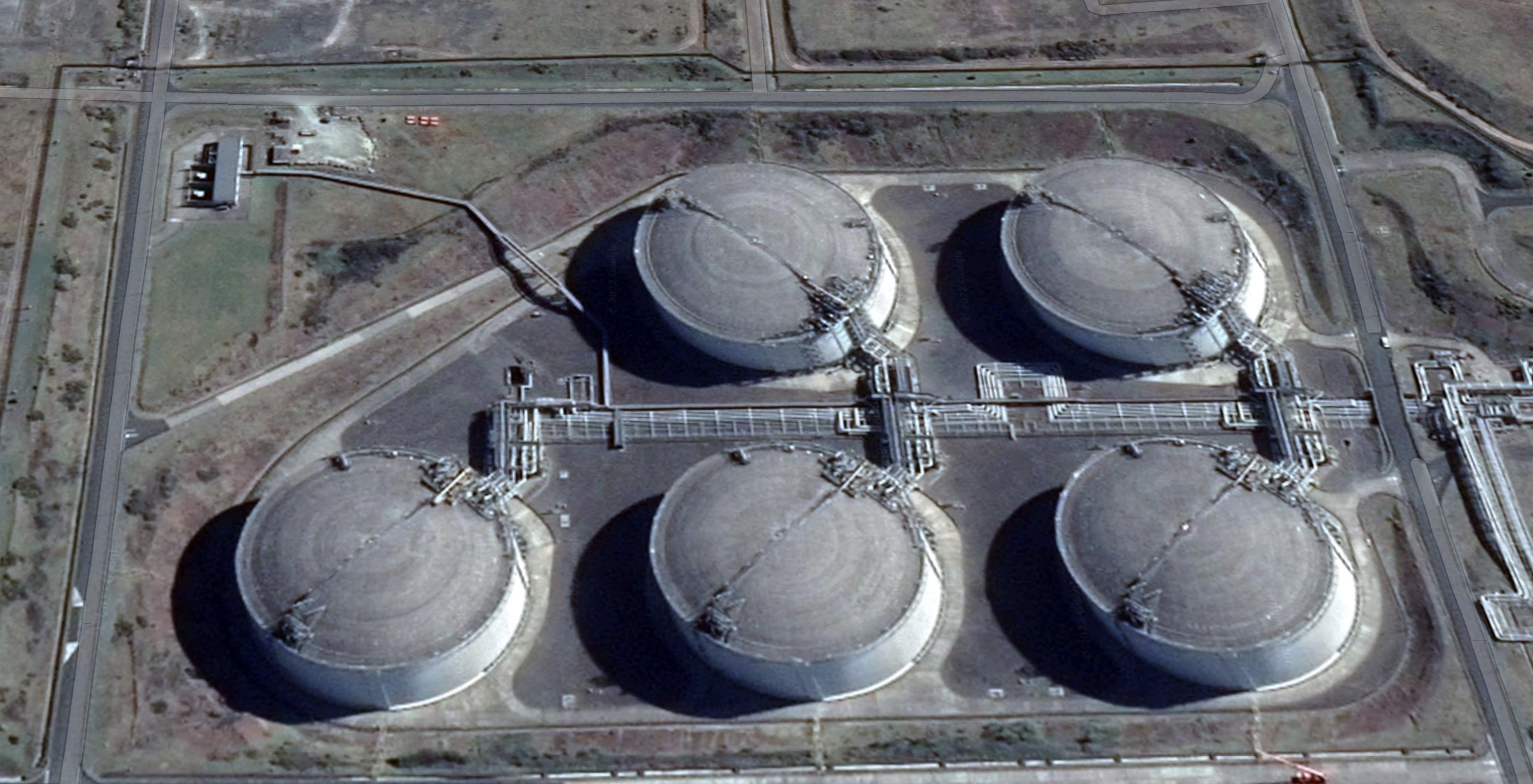
Note that images of these tanks under construction on the Internet, show that there is an underground portion of the tanks.
This page on the CIMC-ENRIC web site is entitled Successful Delivery Of 5,000M3 LNG Single Containment Tank Project. The page shows the design of the LNG tank.
As the density of liquid air is 870 kg/m3, a 5,000 cubic metre tank would contain 4,350 tonnes of liquid air at −194.35 °C and atmospheric pressure.
How much energy would be needed to create 4,350 tonnes of liquid air?
In this document, this is said about compressing natural gas with an electric drive.
It is the most-energy efficient technology with 230 kWh per ton of LNG.
As air and natural gas have molecules of similar weight, would 230 kWh per tonne be applicable to liquid air.
If it is, then around a GWh of electricity will be needed to create the liquid air.
This Wikipedia entry is entitled Cryogenic Energy Storage and describes Highview Power’s CRYOBattery.
This section describes the operation of the CRYOBattery.
When it is cheaper (usually at night), electricity is used to cool air from the atmosphere to -195 °C using the Claude Cycle to the point where it liquefies. The liquid air, which takes up one-thousandth of the volume of the gas, can be kept for a long time in a large vacuum flask at atmospheric pressure. At times of high demand for electricity, the liquid air is pumped at high pressure into a heat exchanger, which acts as a boiler. Air from the atmosphere at ambient temperature, or hot water from an industrial heat source, is used to heat the liquid and turn it back into a gas. The massive increase in volume and pressure from this is used to drive a turbine to generate electricity.
Note.
- The Claude cycle is described in this Wikipedia entry.
- The liquid air takes up one-thousandth of the volume of the gas.
- Wikipedia suggests that Highview claim the process has a round trip efficiency of 70 %.
Having done calculations in the past with chemical reactions in a series of large vessels, the dynamics can be strange and I wouldn’t be surprised that as Highview learn more about the process and add more and better ways of recycling heat and coolth, efficiencies will improve.
Certainly, in the process I mathematically-modelled in the 1970s, when I worked for ICI, I remember that one large reaction vessel performed better than four or five smaller ones with the same total volume.
Hence my thought that perhaps one large containment tank could be the most efficient design.
I also think, that the design of LNG tanks must have improved significantly over the last few years, as the transport of LNG has increased in importance.
A German View Of The Euro 2022 Final
This article on DW.COM is German View of the match.
New Proton Ceramic Reactor Stack For Highly Efficient Hydrogen Production And Carbon Capture In A Single Step
The title of this post, is the same as that of this article on Green Car Congress.
This is the opening paragraph.
A team of researchers from CoorsTek Membrane Sciences and SINTEF in Norway, and Universitat Politècnica de València in Spain, has demonstrated a 36-cell well-balanced proton ceramic reactor stack enabled by a new interconnect that achieves complete conversion of methane with more than 99% recovery to pressurized hydrogen, leaving a concentrated stream of carbon dioxide. The team has also demonstrated that the process can be scaled up for commercial application.
A paper has been published in the journal; Science.
I find this concept interesting for a number of reasons.
- I’ve believed for some time, that applications, that need a good supply of pure carbon dioxide will be developed. One obvious use is feeding it to plants in large greenhouses, so we can have our CO2 and eat it!
- 99 % is a very high efficiency.
- Ammonia, natural gas or biogas can be used as a feedstock.
Coors were an Artemis user for project management and I had an enjoyable few days Golden, Colorado and at the Coors brewery, sometime in the 1980s.
- It was then that I first heard of CoorsTek, who used to make ceramics for the US defence industry.
- In those days, the beer was made to German brewing rules and was unpasteurised.
- The beer had to be delivered to customers within a certain time, so long distance deliveries used trains.
- Coors Brewing Company has since merged with Molson, but CoorsTek appears to be still owned by the Coors family.
- I had taken a few small bottles of Adnams Broadside with me and one of their managers analysed one before drinking the rest of the bottle. He informed me that it was a felony to be in possession of such a strong beer in Colorado.
Coors were and probably still are in some ways not your average brewing company.
Coors News Item On Proton Ceramic Membranes For Hydrogen Production
This page on the CoorsTek web site, which is entitled Proton Ceramic Membranes For Hydrogen Production Published In ‘Science’, gives more details.
Conclusion
This technology could be massive.
Form Energy And The UK
This article on the Telegraph, which is entitled Britain Will Soon Have A Glut Of Cheap Power, And World-Leading Batteries To Store It, is proving to be a mine of information about the development of the UK Power Network.
Reliable information about US startup; Form Energy has been hard to find.
But the Telegraph article has these three paragraphs on Form Energy.
Form Energy in Boston – backed by Jeff Bezos and Bill Gates – is working on an iron-air “rust” battery based on the reversible oxidation of iron pellets. It does not require rare and polluting minerals such as vanadium, and will have a 100-hour range.
“The modules will produce electricity for one-tenth the cost of any technology available today for grid storage,” the company told Recharge.
Form Energy has been working with National Grid to map out the economics of UK renewables with storage, and how to cope with future curtailment. And it too praises the UK as a global trailblazer, though its pilot project next year will be in Minnesota.
Note.
- Iron certainly, isn’t an exotic material.
- A hundred hour range is claimed.
- If National Grid have been working with Form Energy, is it reasonable to assume, that they have been working with Highview Power?
- Good to see that Form Energy praises the UK as a global trailblazer. I have noted several times, that the Department for Business, Energy and Industrial Strategy seems to be well-advised.
Will National Grid put in one of Form Energy’s batteries? It would be a prudent thing to do, to make sure you get the best.
Highview Power’s Second Commercial System In Yorkshire
This is all that Highview Power say about their proposed system in Yorkshire, on their web site.
Highview Power’s second commercial renewable energy power station in the UK is a 200MW/2.5GWh facility in Yorkshire. This is the first of 18 sites for UK wide deployment strategically located to benefit from the existing transmission infrastructure.
I have a few thoughts.
How Does The Size Of This System Fit With Other Systems?
According to the Highview Power web site the Manchester system is a 50MW/300MWh facility, but Wikipedia has this system as a 50MW/250MWh.
In this article on the Telegraph, which is entitled Britain Will Soon Have A Glut Of Cheap Power, And World-Leading Batteries To Store It, it is stated that they are planning a battery with this specification, location and timeline.
- 2.5 GW output
- 30 GWh of storage
- Located on Humberside
- Delivery in late 2024.
This CRYOBattery is an absolute monster.
Will The Humberside CRYOBattery Be Built At Creyke Beck Substation?
In Highview Power’s Plan To Add Energy Storage To The UK Power Network, I came to the conclusion, that the Humberside CRYOBattery will most likely be built near Creyke Beck substation, which is close to Cottingham.
- Dogger Bank A, Dogger Bank B and Hornsea 4 offshore wind farms will all be connected to the Creyke Beck substation.
- These wind farms have a total capacity of 3.4 GW.
- The Humberside CRYOBattery, now looks to have a maximum output of 2.5 GW.
- It looks like the Humberside CRYOBattery would be a well-matched backup to the three planned wind farms and perhaps even a few more turbines.
Building the Humberside CRYOBattery at Creyke Beck substation would appear to be a sensible decision.
Is Cottingham In Humberside, Yorkshire Or Both?
The Wikipedia entry for the village is named Cottingham, East Riding of Yorkshire, says this.
A golf course and leisure club on Wood Hill Way, and a major (400/275 kV AC) electricity substation “Creyke Beck”, lie just outside the formal boundaries of the parish, within Skidby civil parish.
Skidby is definitely in Yorkshire.
Where Are The Other Seventeen Sites?
The Yorkshire facility is indicated to be one of 18 sites on the Highview Power web site. Where are the other seventeen?
All we know is that they will be strategically located to benefit from the existing transmission infrastructure.
This is said in the Wikipedia entry, which is entitled High-Voltage Substations In The United Kingdom.
In 2020 there were 179 400 kV substations and 137 275 kV substations.
He who pays the money, makes the choice!
Has The Company Changed Direction?
I wrote Highview Power Names Rupert Pearce Chief Executive Officer on April 12th, 2022.
- Since then, the Vermont and Chile projects have disappeared from the web site and projects in Yorkshire and Australia have been added.
- The web site has also been improved.
- As new CEOs often do, is Rupert Pearce refocussing the company?
Are they also looking in detail at current projects?
Has The Yorkshire Project Grown Substantially?
Consider.
- National Grid are a company that has improved its image and engineering in recent years.
- It has shown it can obtain finance for infrastructure from the City of London and respected financial institutions.
- National Grid probably have extensive computer models of their electricity network.
- National Grid knows it must add energy storage to their electricity network.
- National Grid pays almost a billion pounds a year to wind farm operators to shut them down.
Eventually saving up to a billion pounds would be a good reason to have a small bet on promising technology.
Did Rupert Pearce ask his engineers to design the largest CRYOBattery they can?
Did National Grid have a count up sand find that twenty CRYOBatteries would cover all the strategic points on their transmission infrastructure?
According to the figures on the Highview Power web site (200 MW/2.5 GWh), eighteen systems like the one proposed for Yorkshire would have.
- A total output of 3.6 GW
- A total storage capacity of 45 GWh
The figures given in the article in the Telegraph (2.5 GW/30 GWh) for the very large system, would mean that twenty systems would have.
- A total output of 50 GW
- A total storage capacity of 600 GWh
These figures are between thirteen and fourteen times larger than those originally proposed.
Building The System
The Highview Power web site, says this about the deployment of eighteen systems.
UK wide deployment strategically located to benefit from the existing transmission infrastructure.
This Google Map shows the Creyke Beck substation.
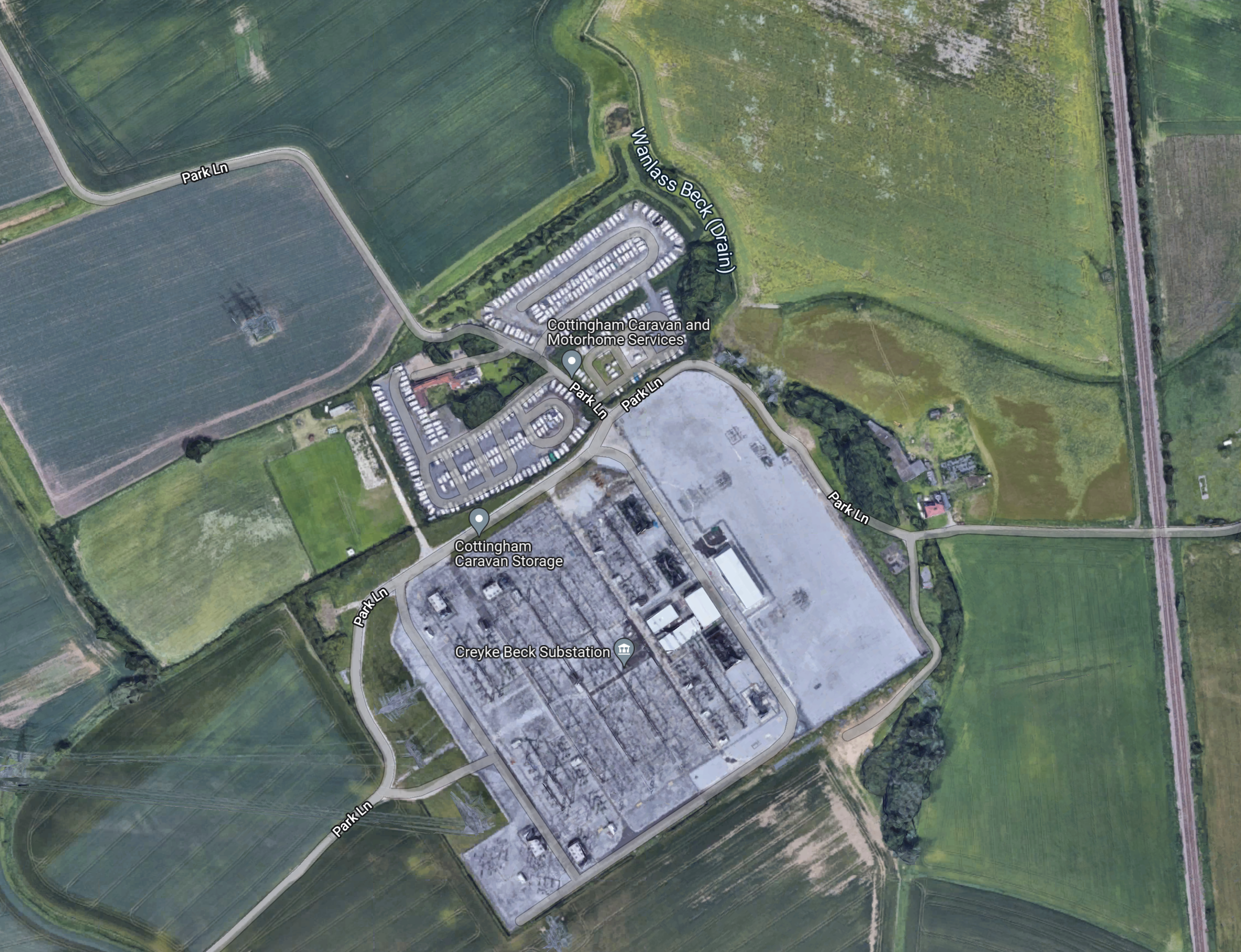
Could 30 GWh of liquid-air storage be accommodated on the site?
I can see a large insulated sphere, partly buried in the ground being used.
Designing, building and testing the first system will probably be the most difficult part of the project.
- But once the first system is successfully working reliably, the roll-out of other systems can be started.
- The biggest problem will probably be planning permissions, so the systems must be designed to be sympathetic to the local environment.
I can certainly see, twenty of these systems in the UK, but how many others will we see worldwide?
I
Highview Power’s Plan To Add Energy Storage To The UK Power Network
The plan was disclosed in this article on the Telegraph, which is entitled Britain Will Soon Have A Glut Of Cheap Power, And World-Leading Batteries To Store It, by Rupert Pearce, who is Highview’s chief executive.
His plan is to build twenty of Highview Power’s CRYOBatteries around the country.
- Each CRYOBattery will be able to store 30 GWh.
- Each CRYOBattery will be one of the largest batteries in the world.
- They will have three times the storage of the pumped storage hydroelectric power station at Dinorwig.
- They will be able to supply 2.5 GW for twelve hours, which is more output than Sizewell B nuclear power station.
The first 30 GWh CRYOBattery is planned to be operational by late 2024.
- It will be built on Humberside.
- Humberside is or will be closely connected to the Dogger Bank, Hornsea and Sofia wind farms.
- When fully developed, I believe these wind farms could be producing upwards of 8 GW.
The Telegraph quotes Rupert Pearce as saying this.
We can take power when the grid can’t handle it, and fill our tanks with wasted wind (curtailment). At the moment the grid has to pay companies £1bn a year not to produce, which is grotesque.
I certainly agree with what he says about it being a grotesque practice.
It sounds to me, that Rupert’s plan would see Highview Power in the waste electricity management business.
- The wasted wind would just be switched to the Humberside CRYOBattery, if there was too much power in the area.
- The CRYOBattery might be conveniently located, where the wind farm cables join the grid.
- Dogger Bank A and B wind farms are connected to Creyke Beck substation, which is North of the Humber.
- Hornsea 1 and Hornsea 2 wind farm are connected to Killingholme substation, which is South of the Humber.
- Hornsea 3 wind farm will be connected to Norfolk.
- Hornsea 4 wind farms will be connected to Creyke Beck substation
- It looks like the combined capacity of Dogger Bank A, Dogger Bank B and Hornsea 4 could be around 3.4 GW.
- Sofia wind farm will be connected to Lazenby substation near Redcar.
- As the CRYOBattery is buying, selling and storing electricity, I would assume that there’s money to be made.
This Google Map shows Creyke Beck substation.
Note.
- It is a large site.
- Creyke Beck Storage have built a 49.99 MW lithium-ion storage battery on the site.
- The Northern part of the site is used to store caravans.
- It looks like the combined capacity of Dogger Bank A, Dogger Bank B and Hornsea 4 could be around 3.4 GW.
It looks like a 30 GWh CRYOBattery with a maximum output of 2.5 GW would be an ideal companion for the three wind farms connected to Creyke Back substation.
The combination could probably supply upwards of 2.5 GW to the grid at all times to provide a strong baseload for Humberside.
Conclusion
Will the income from the Humberside CRYOBattery be used to fund the next CRYOBattery?
I very much think so as it’s very sensible financial management!
Renewable Power’s Effect On The Tory Leadership Election
I wouldn’t normally comment on the Tory Leadership Election, as I don’t have a vote and my preference has already been eliminated.
But after reading this article on the Telegraph, which is entitled Britain Will Soon Have A Glut Of Cheap Power, And World-Leading Batteries To Store It, I feel I have to comment both about this election and the General Election, that will follow in a few years.
These two paragraphs from the article illustrate the future growth of offshore wind power.
It is a point about the mathematical implications of the UK’s gargantuan push for renewables. Offshore wind capacity is going to increase from 11 to 50 gigawatts (GW) by 2030 under the Government’s latest fast-track plans.
RenewableUK says this country currently has a total of 86GW in the project pipeline. This the most ambitious rollout of offshore wind in the world, ahead of China at 78GW, and the US at 48GW.
If we assume that there is eight years left of this decade, that means that we should install about 4.9 GW of offshore wind every year until 2030. If we add in planned solar and onshore wind developments, we must be looking at at least 5 GW of renewable energy being added every year.
We have also got the 3.26 GW Hinckley Point C coming on stream.
I think we can say, that when it comes to electricity generation, we will not be worried, so Liz and Rishi can leave that one to the engineers.
If we have an electricity problem, it is about distribution and storage.
- We need more interconnectors between where the wind farms are being built and where the electricity will be used.
- National Grid and the Government have published plans for two interconnectors between Scotland and England, which I wrote about in New Electricity ‘Superhighways’ Needed To Cope With Surge In Wind Power.
- We need energy storage to back up the wind and solar power, when the wind isn’t blowing and the sun isn’t shining.
I think it is reasonable to assume, that we will get the interconnectors we need and the Telegraph article puts forward a very feasible and affordable solution to the energy storage problem, which is described in these two paragraphs from the article.
That is now in sight, and one of the world leaders is a British start-up. Highview Power has refined a beautifully simple technology using liquid air stored in insulated steel towers at low pressure.
This cryogenic process cools air to minus 196 degrees using the standard kit for LNG. It compresses the volume 700-fold. The liquid re-expands with a blast of force when heated and drives a turbine, providing dispatchable power with the help of a flywheel.
The article also talks of twenty energy storage systems, spread around the UK.
- They will have a total output of 6 GW.
- In total they will be able to store 600 GWh of electricity.
The first one for Humberside is currently being planned.
Surely, building these wind and solar farms, interconnectors and energy storage systems will cost billions of pounds.
Consider.
- Wind and solar farms get paid for the electricity they generate.
- , Interconnectors get paid for the electricity they transfer.
- Energy storage systems make a profit by buying energy when it’s cheap and selling it, when the price is better.
- In World’s Largest Wind Farm Attracts Huge Backing From Insurance Giant, I talked about how Aviva were funding the world’s largest wind farm at Hornsea.
- National Grid has a history of funding interconnectors like the North Sea Link from large financial institutions.
I believe that the islands of Great Britain and Ireland and the waters around our combined shores will become the largest zero-carbon power station in the world.
This will attract engineering companies and financial institutions from all over the world and we will see a repeat of the rush for energy that we saw for oil and gas in the last century.
If we get the financial regime right, I can see a lot of tax money flowing towards the Exchequer.
The big question will be what do we do with all this energy.
- Some will be converted into hydrogen for transport, the making of zero-carbon steel and cement and for use as a chemical feedstock.
- Industries that use a lot of electricity may move to the UK.
- A large supply of electricity and hydrogen will make it easy to decarbonise housing, offices and factories.
The Telegraph article also says this.
Much can be exported to the Continent through interconnectors for a fat revenue stream, helping to plug the UK’s trade deficit, and helping to rescue Germany from the double folly of nuclear closures and the Putin pact. But there are limits since weather patterns in Britain and Northwest Europe overlap – partially.
I suspect that more energy will be exported to Germany than most economists think, as it will be needed and it will be a nice little earner for the UK.
Given the substantial amount of German investment in our wind industry, I do wonder, if Boris and Olaf did a deal to encourage more German investment, when they met in April this year.
- BP have been backed with their wind farms by a German utility company.
- RWE are developing the Sofia wind farm.
- Only last week, the deal for the NeuConnect interconnector between the Isle of Grain and Wilhelmshaven was signed.
- Siemens have a lot of investments in the UK.
I wouldn’t be surprised to see more German investments in the next few months.
The Golden Hello
Has there ever been a Prime Minister, who will receive such a golden hello, as the one Liz or Rishi will receive in September?
The Tory Leadership Election
Some of the candidates said they would reduce taxes , if they won and Liz Truss is still saying that.
I wonder why Rishi isn’t saying that he would reduce taxes, as he must know the cash flow that is coming. It may be he’s just a more cautious soul.
Can Highview Power’s CRYOBattery Compete With Pumped Storage Hydroelectricity?
In this article on the Telegraph, Rupert Pearce, who is Highview’s chief executive and ex-head of the satellite company Inmarsat, discloses this.
Highview is well beyond the pilot phase and is developing its first large UK plant in Humberside, today Britain’s top hub for North Sea wind. It will offer 2.5GW for over 12 hours, or 0.5GW for over 60 hours, and so forth, and should be up and running by late 2024.
The Humberside plant is new to me, as it has not been previously announced by Highview Power.
- If it is built it will be megahuge with a storage capacity of 30 GWh and a maximum output of 2.5 GW.
- Humberside with its connections to North Sea Wind, will be an ideal location for a huge CRYOBattery.
- The world’s largest pumped storage hydroelectric power station is Fengning Pumped Storage Power Station in China and it is 40 GWh.
Pumped storage hydroelectric power stations are the gold standard of energy storage.
In the UK we have four pumped storage hydroelectric power stations.
- Cruachan Power Station – 7.1 GWh
- Dinorwig Power Station (Electric Mountain) – 9.1 GWh
- Falls of Foyers – 10 GWh
- Ffestiniog Power Station 1 GWh
With two more under construction.
- Coire Glas Power Station – 30 GWh
- Red John Power Station – 2.8 GWh
As energy is agnostic, 30 GWh of pumped storage hydroelectric power at Coire Glas is the equivalent of 30 GWh in Highview Power’s proposed Humberside CRYOBattery.
Advantages Of CRYOBatteries Over Pumped Storage Hydroelectric Power
I can think of these advantages.
- Cost
- Could be build on the flat lands of East Anglia or Lincolnshire
- Factory-built
- NIMBYs won’t have much to argue about
- No dams
- No flooding of valleys
- No massive construction sites.
- No mountains required
- No tunnels
- Small footprint
I suspect that a large CRYOBattery could be built well within a year of starting construction.
Rupert Pearce’s Dream
The Telegraph article says this and I suspect it’s a quote from Rupert Pearce.
Further projects will be built at a breakneck speed of two to three a year during the 2020s, with a target of 20 sites able to provide almost 6GW of back-up electricity for four days at a time, or whatever time/power mix is optimal.
6 GW for four days is 576 GWh, which if it were spread around twenty sites is 28.8 GWh per site, which is just under the 30 GWh of the proposed Humberside CRYOBattery.
Conclusion
You can just imagine the headlines in The Sun!
Man In Bishop’s Stortford Shed Saves The World!
This story on the BBC, which is entitled Meet The British Inventor Who Came Up With A Green Way Of Generating Electricity From Air – In His Shed, explains my suggested headline.
Now that’s what I call success!
 The Anonymous Widower