Aberdeen Unveils UK’s First Green Hydrogen Waste Truck
The title of this post, is the same as that of this article on renews.biz.
These are the first three paragraphs.
The UK’s first green hydrogen-fuelled waste collection vehicle has been unveiled in Aberdeen.
While typical waste trucks are powered by diesel and petrol, the new vehicle will use green hydrogen from existing refuelling infrastructure in Aberdeen.
The truck will start collecting waste and recycling around the city from early March and will be the first hydrogen-powered waste truck to become operational in the UK.
I feel, that this is one of the obvious applications for hydrogen trucks.
- They return to the same depot at the end of the day and if the hydrogen refuelling station is nearby or at the depot, refuelling would be no more hassle than with diesel.
- The trucks are probably too large for battery power.
- They tend to work a lot in areas, where there are a lot of people about, like residential streets and shopping centres.
- Workers will be exposed to less pollution, as they bring bins to the trucks.
Aberdeen Council have provided this video.
I can see lots of Councils at least thinking of following Aberdeen’s example, when they renew their refuse trucks.
Incidentally, I may be only 74, but I can still remember the horse-drawn waste carts that Wood Green Council used to use in the 1950s. They were used around Wood Green town centre, where trailers were parked to receive rubbish from shops and businesses. Horses were used to move them about and to the depot. In the end they horses were replaced by Scammel Mechanical Horses.
Onshore And Offshore Wind Energy Capacity Predicted To Increase By 230% By 2030
The title of this post, is the same as that of this article on insider.
The report was commissioned by Scottish Renewables to assess the effects on the supply chain in Scotland.
But it does show that Scotland is on the way to be able to supply a lot of its electricity from wind farms, which would be backed up by some of another of pumped storage schemes under development.
Up To 24GW Of Long Duration Storage Needed For 2035 Net Zero Electricity System – Aurora
The title of this post, is the same as that of this article on Current News.
This the first three paragraphs.
Deploying large quantities of long duration electricity storage (LDES) could reduce system costs and reliance on gas, but greater policy support is needed to enable this, Aurora Energy Research has found.
In a new report, Aurora detailed how up to 24GW of LDES – defined as that with a duration of four hours or above – could be needed to effectively manage the intermittency of renewable generation in line with goals of operating a net zero electricity system by 2035. This is equivalent to eight times the current installed capacity.
Additionally, introducing large quantities of LDES in the UK could reduce system costs by £1.13 billion a year in 2035, cutting household bills by £26 – a hot topic with energy bills on the rise as a result of high wholesale power prices.
The report also says that long duration storage could cut carbon emissions by ten million tonnes of carbon dioxide per year.
I feel strongly, that this is a target we will achieve, given that there are at least four schemes under development or proposed in Scotland.
- Balliemeanoch – 45 GWh
- Coire Glas – 30 GWh
- Corrievarkie – 14.5 GWh
- Loch Sloy – 14 GWh
- Red John – 2.8 GWh
It certainly looks like the Scots will be OK, especially as there are other sites that could be developed according to SSE and Strathclyde University.
We probably need more interconnectors as I wrote about in New Electricity ‘Superhighways’ Needed To Cope With Surge In Wind Power.
There are also smaller long duration storage systems under development, that will help the situation in the generally flatter lands of England.
One of them; ReEnergise, even managed to sneak their advert into the article.

Their high density hydro could be a good way to store 100 MWh or so in the hills of England. As they could be designed to fit into and under the landscape, I doubt their schemes would cause the controversy of other schemes.
Conclusion
I think we’ll meet the energy storage target by a wide margin.
Norfolk Wind Farms Offer ‘Significant Benefit’ For Local Economy
The title of this post, is the same as that of this article on the BBC.
This is a comprehensive article, which looks at the benefits of the huge Norfolk Boreas and Norfolk Vanguard wind farms will have to the economy of Norfolk.
The last section is devoted to Norfolk Nimby; Raymond Pearce.
This is the section.
Following the re-approval of the decision by the government, Mr Pearce says he is considering a new appeal over what he calls “a very poor decision”.
He is also sceptical of claims the two new wind farms will bring the economic gains promised by Vattenfall.
“It’s renewable energy at any cost and the cost here is to the environment in Norfolk,” he says.
“I don’t blame them for being positive about it, it’s their industry but they’re not looking at it holistically.”
He says he is not against renewable energy but thinks a better plan is needed to connect the offshore windfarms and minimise the number of cables and substations onshore.
It’s his money if he appeals, but we do need more wind, solar and other zero-carbon energy to combat global warming and its effects like the encroachment of the sea around Norfolk.
I believe, that building wind farms off the coast of Essex, Suffolk and Norfolk is a good move, as in the future, if we have spare electricity, it will be easy to export energy to Europe, through existing interconnectors.
But I do agree with him, that a better plan is needed to connect the offshore windfarms and minimise the number of cables and substations onshore.
A Norfolk Powerhouse
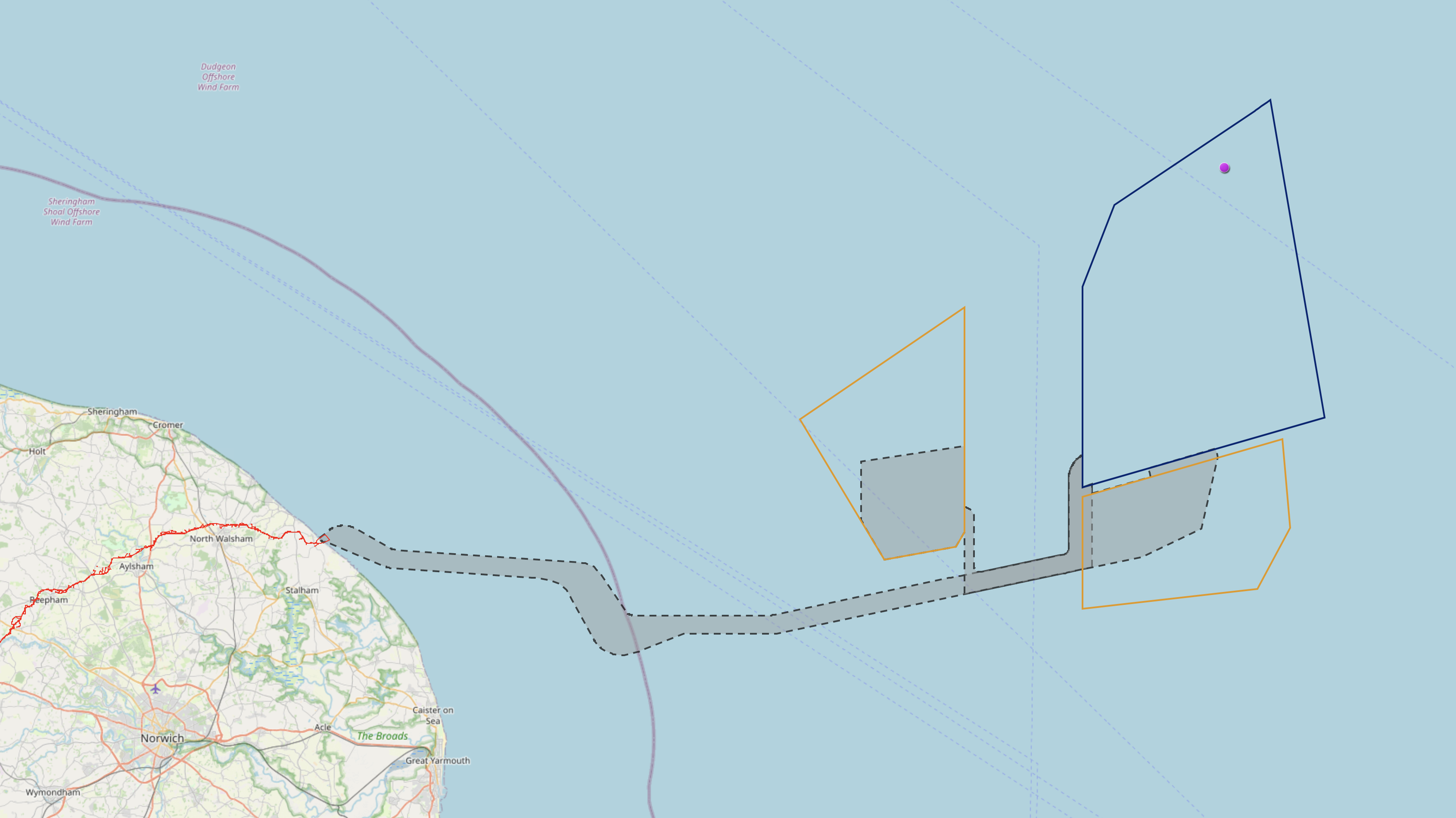
This map from Vattenfall, the developer of the two wind farms, shows the position of the farms and the route of the cable to the shore.
Note.
- The purple line appears to be the UK’s ten mile limit.
- Norfolk Boreas is outlined in blue.
- Norfolk Vanguard is outlined in orange.
- Cables will be run in the grey areas.
- Both wind farms are planned to have a capacity of 1.8 GW
Landfall will be just a few miles to the South of the Bacton gas terminal.
Bacton Gas Terminal
Bacton gas terminal is much more than a simple gas terminal.
- It is a complex of six gas terminals on four sites.
- There is a National Grid terminal, that odourises and blends the gas before distributing it into the National Transmission System via five outgoing 36-inch feeders to much of Southern England.
- There is a gas interconnector to Belgium.
- There is a gas interconnector to The Netherlands.
- There is coastal erosion in the area.
With the need to decarbonise, I can’t help feeling that the Bacton gas terminal is very much on the decline and the site will need to be repurposed in the next few years.
Blending Hydrogen With Natural Gas
If you blend a proportion of hydrogen into natural gas, this has two beneficial effects.
- Gas used in domestic and industrial situations will emit less carbon dioxide.
- In the near future we will be replacing imported natural gas with hydrogen.
The hydrogen could be produced by a giant electrolyser at Bacton powered by the electricity from the two Norfolk wind farms.
At the present time, a research project call HyDeploy is underway, which is investigating the blending of hydrogen into the natural gas supply.
- Partners include Cadent, Northern Gas Networks, the Health and Safety Executive, Keele University and ITM Power and Progessive Energy.
- A first trial at Keele University has been hailed as a success.
- It showed up to twenty percent of hydrogen by volume can be added to the gas network without the need to change any appliances or boilers.
Larger trials are now underway.
A Giant Electrolyser At Bacton
If hydrogen were to be produced at Bacton by a giant electrolyser, it could be used or distributed in one of the following ways.
- Blended with natural gas for gas customers in Southern England.
- Stored in a depleted gas field off the coast at Bacton. Both Baird and Deborah gas fields have been or are being converted to gas storage facilities, connected to Bacton.
- Distributed by truck to hydrogen filling stations and bus and truck garages.
- Greater Anglia might like a hydrogen feed to convert their Class 755 trains to hydrogen power.
- Sent by a short pipeline to the Port of Great Yarmouth and possibly the Port of Lowestoft.
- Exported to Europe, through one of the interconnectors.
Note.
- If the electrolyser were to be able to handle the 3.6 GW of the two wind farms, it would be the largest in the world.
- The size of the electrolyser could be increased over a few years to match the output of the wind farms as more turbines are installed offshore.
- There is no reason, why the electrical connection between Bacton and the landfall of the wind farm cable couldn’t be offshore.
If ITM Power were to supply the electrolyser, it would be built in the largest electrolyser factory in the World, which is in Sheffield in Yorkshire.
A Rail Connection To The Bacton Gas Terminal
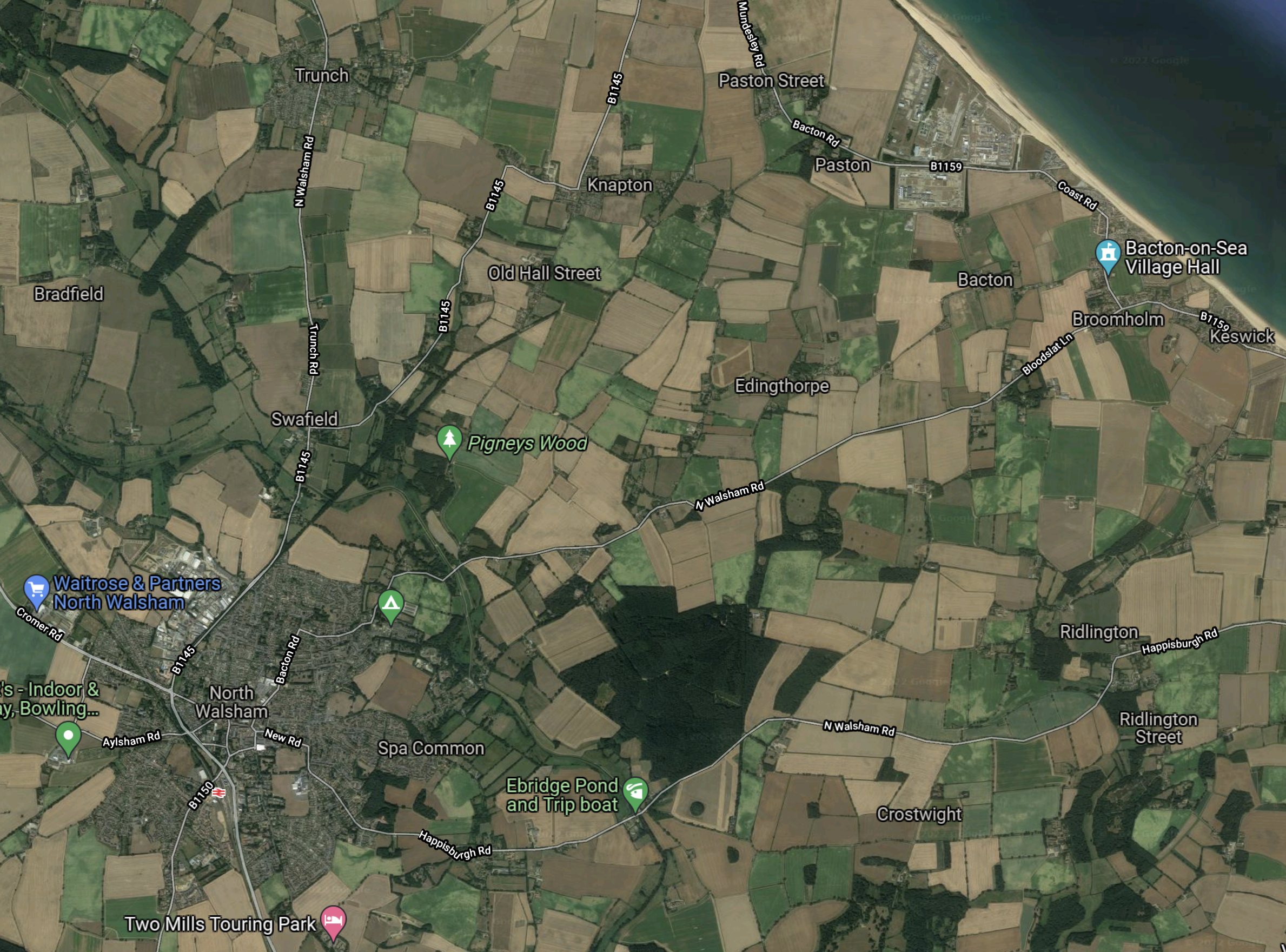
This Google Map shows the area between North Walsham and the coast.
Note.
- North Walsham is in the South-Western corner of the map.
- North Walsham station on the Bittern Line is indicated by the red icon.
- The Bacton gas terminal is the trapezoidal-shaped area on the coast, at the top of the map.
I believe it would be possible to build a small rail terminal in the area with a short pipeline connection to Bacton, so that hydrogen could be distributed by train.
How Much Hydrogen Could Be Created By The Norfolk Wind Farms?
In The Mathematics Of Blending Twenty Percent Of Hydrogen Into The UK Gas Grid, I said the following.
Ryze Hydrogen are building the Herne Bay electrolyser.
- It will consume 23 MW of solar and wind power.
- It will produce ten tonnes of hydrogen per day.
The electrolyser will consume 552 MWh to produce ten tonnes of hydrogen, so creating one tonne of hydrogen needs 55.2 MWh of electricity.
Each of the Norfolk wind farms, if they were working flat out would produce 43.2 GWh of electricity in a day.
Dividing the two figures gives a daily production rate of 782.6 tonnes of hydrogen per day.
But what happens if the wind doesn’t blow?
This is where the gas storage in the Baird, Deborah and other depleted gas fields comes in.In times of maximum wind, hydrogen is stored for use when the wind doesn’t blow.
Conclusion
I believe a plan like this, would be much better for Norfolk, the UK and the whole planet.
Using the existing gas network to carry the energy away from Norfolk, could mean that the electricity connection across Norfolk could be scaled back.
Battery Train And Fast Charger To Be Tested In London
The title of this post is the same as that of this article on Railway Gazette.
This is the first paragraph.
Great Western Railway has signed an agreement to test Vivarail’s Class 230 battery multiple-unit and fast charging technology under real-world conditions on the 4 km non-electrified branch between West Ealing and Greenford in West London.
As an engineer, who started designing control systems for rolling mills in the mid-1960s and went on to get a Degree in Control and Electrical Engineering from Liverpool University, before working for ICI applying computers to a variety of problems, I can’t look at a railway line like the Greenford Branch without wanting to automate it.
I had one amateurish attempt in An Automated Shuttle Train On The Greenford Branch Line. I was trying to get four trains per hour (tph) on the branch and I don’t think that is possible, with the Class 230 trains.
Now we know the train we are dealing with, I could plan an automated system, that would drive the train.
- Each journey on the branch takes around 11-12 minutes.
- Two tph would take between 44 and 48 minutes shuttling between the two stations in an hour.
- The article states that recharging takes ten minutes.
- If the train charged the batteries once per hour, that would leave between two and six minutes for the other three stops.
- Any freight train using the branch seems to take about six minutes, so they could sneak through, when the shuttle is having a fast charge.
- I would also use a similar system to that originally used on the Victoria Line. After the driver has closed the doors and ascertained that there were no problems, they would press a button to move the train to the next station and then automatically open the doors.
From this rough calculation to run a two tph service, I suspect that the train needs to be able to go between West Ealing and Greenford stations in ten minutes. Assuming one ten minute Fast Charge per hour, this would give three minutes and twenty seconds to turn the train, at the three terminal station stops.
I certainly feel, that an automatic shuttle would be possible.
A Lower-Cost Pumped Hydro Storage System
Whilst writing some of the posts recently about pumped storage I came across the Loch Sloy Hydro-Electric Scheme.
This is the introductory sentence in Wikipedia.
The Sloy/Awe Hydro-Electric Scheme is a hydro-electric facility situated between Loch Sloy and Inveruglas on the west bank of Loch Lomond in Scotland.
This page on the Greenage web site gives comprehensive details of the power station and is well worth a read.
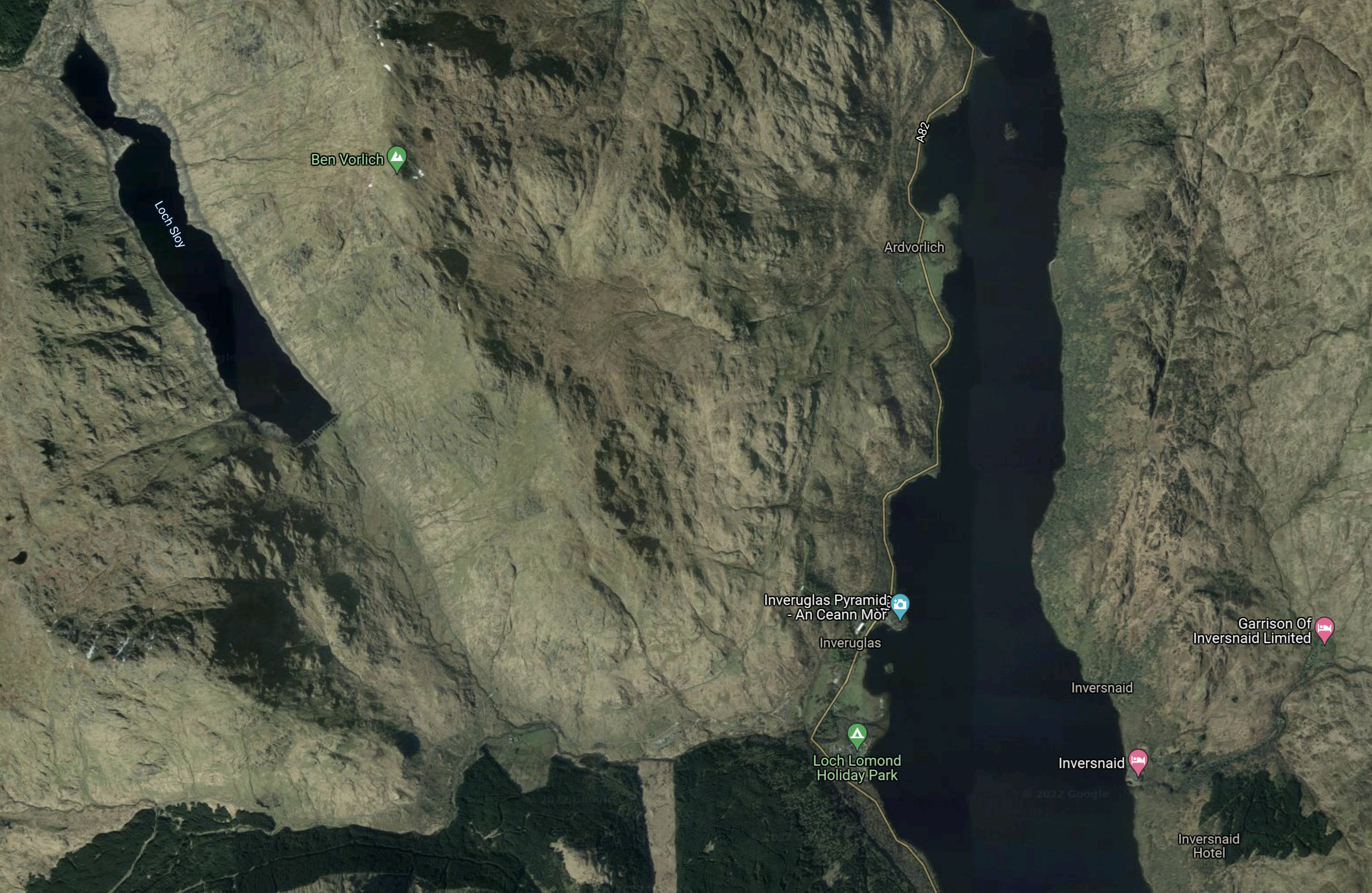
This Google Map shows the Lochs Sloy and Lomond.
Note.
- Loch Sloy is in the North-West corner of the map.
- The page on Greenage says that Loch Sloy can store 14 GWh of electricity
- Loch Lomond is the body of water towards the Eastern side of the map.
- Inverglas is on the West bank of Loch Lomond to the North of the Loch Lomond Holiday Park, which is indicated by the green arrow with a tent.
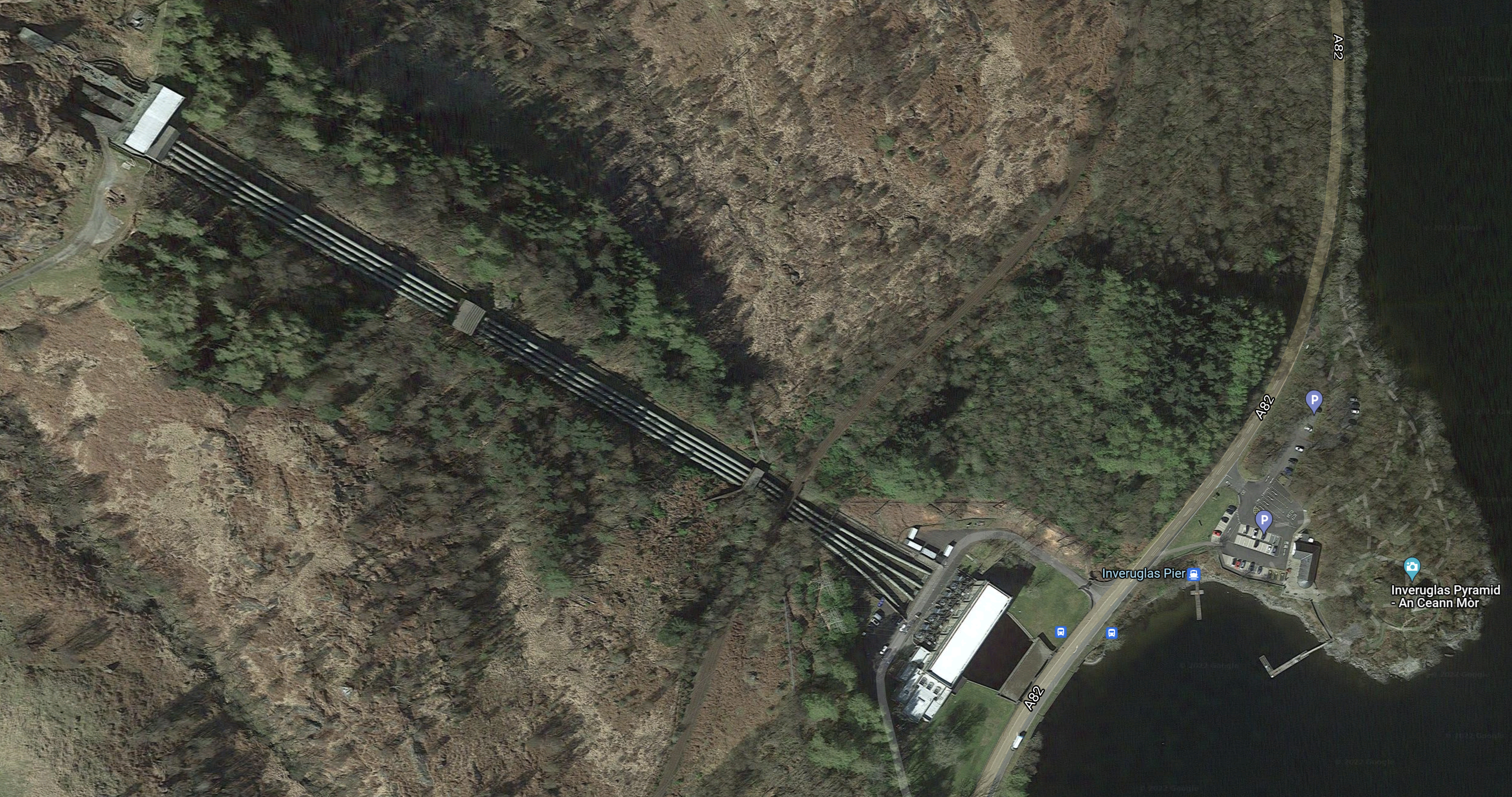
This second Google Map shows the power station and Inverglas.
Note.
- It is a classic layout for a hydro-electric power station.
- In the North West corner of the map is the valve house, which is connected to Loch Sloy by a three kilometre tunnel.
- The valve house controls the water flows to the power station by Loch Lomond.
- There are four two-metre pipes running down the hill, one for each of the four turbines.
- According to the page on Greenage, the power station has three 40 MW turbines and one 32 MW turbine, which gives a total output of 152 MW.
- The water discharges into Loch Lomond after doing its work in the power station.
Loch Sloy is the largest conventional hydroelectric power plant in the UK.
Extending The Loch Sloy Hydro-Electric Scheme
This page on Hydro Review, which is dated the 10th of November 2010, is entitled SSE Gets Government Consent For Sloy Pumped-Storage Hydropower Project.
These are the first paragraph.
SSE Generation Ltd., the wholly owned generation business of Scottish and Southern Energy, has received consent from the Scottish Government to develop a 60-MW pumped-storage hydro project at its existing Sloy hydropower station at Loch Lomond, SSE reported.
Note.
- Two 30 MW pumps will be added to the power station to pump water up the hill from Loch Lomond to Loch Sloy.
- According to the page on Greenage, if the two pumps worked together for six hours, they would transfer 432,000 m3 of water. Note that a cubic metre of water weighs a tonne.
- Water would be transferred, when there was a surplus of energy being generated over the demand.
It would appear to be a simple scheme, as it is just adding two pumps to pump the water up the hill.
- As pumps rather than pump/turbines as at Foyers are used, there is no corresponding increase in generating capacity.
- Water also appears to be pumped up to the valve house in the existing pipes.
- Loch Sloy and Loch Lomond would not need major works to enable the scheme..
The page on Greenage gives the cost at just £40 million.
Originally, the project was supposed to have started in 2012, but as there are environmental problems with the fish, the work has not started.
These problems are detailed on the page on Greenage.
Conclusion
For £40 million, 14 GWh of pumped storage can be created at Sloy.
- But it could be bigger than 14 GWh, as this page on the Strathclyde University web site, says 20.4 GWh is possible.
- This would surely, be a project that could be first in the queue, once the environmental problems are solved.
20 GWh of pumped storage would be nice to have reasonably quickly.
Does London Need High Capacity Bus Routes To Extend Crossrail?
If Crossrail has a major problem, it is that some areas of the capital will find it difficult to access the new line.
Up to the age of sixteen, I used to live half-way between Oakwood and Cockfosters stations on the Piccadilly Line.
There are a large number of people who live along the Northern reaches of the Piccadilly Line, who might want to use Crossrail to perhaps go to Heathrow or places in East London.
But the journey will need a double change as there is no interchange between the Piccadilly Line and Crossrail.
I suspect that many will link to Crossrail by taking the Piccadilly Line to Wood Green, Turnpike Lane or Manor House and then get a 141 bus to Moorgate. It is a route, I use if I want to go to Southgate or Cockfosters from my house, which has a 141 stop opposite.
But then as a child to go to Harringay, where my father had an uncle, my mother would use a 641 trolley bus from Wood Green or Turnpike Lane.
Do people follow the public transport habits of their parents?
I know I do!
My father never went on a deep tube. As he several times mentioned the terrible Bank station bombing in the Blitz, which killed 56 people, I always thought that was his problem. But now living as I do along the Northern and Northern City Lines, I suspect it was more to do with air quality, as we were or are both bad breathers.
I suspect that when Crossrail opens, the 141 bus will be heavily used by travellers going between the Northern reaches of the Piccadilly Line and Crossrail at Moorgate.
The 141 bus goes between London Bridge station and Palmers Green and it has a route length of about nine miles.
Currently, buses run every fifteen minutes or so, but I doubt it will be enough in future as Transport for London are rerouting the closely-related 21 bus.
I suspect any route seen as an extension of Crossrail needs to have the following characteristics.
- High frequency of perhaps a bus every ten minutes.
- Interior finish on a par with the Class 345 trains.
- Wi-fi and phone charging.
I would also hope the buses were carbon-free. Given that some of these routes could be quite long, I would suspect hydrogen with its longer range could be better.
Other Routes
According to me, the 141 bus route needs improvement!
But how many other routes could need similar improvement?
ILI Group Announces New 1.5GW Pumped Storage Hydro Project
The title of this post is the same as that of this article on Insider.
This is the body of the article.
Intelligent Land Investments Group (ILI) has commenced the initial planning phase for its new 1.5 GigaWatt (GW) pumped storage hydro (PSH) project, Balliemeanoch, at Loch Awe in Argyll & Bute.
This is ILI’s third and largest PSH project. Its other PSH projects include ‘Red John’ at Loch Ness, which was awarded planning consent from Scottish Ministers in June Last year, and ‘Corrievarkie’ at Loch Ericht for which they aim to submit a Section 36 planning application in August.
The new project would be able to supply 1.5GW of power for up to 30 hours, enough to power 4.5 million homes.
The project will create a new head pond in the hills above Loch Awe capable of holding 58 million cubic metres of water when full and it is estimated the project will offset more than 200 million tonnes of CO2 emissions over its lifetime.
I would assume that this will be a privately-financed project and at 45 GWh it will be one of the largest pumped storage systems in the world.
But it must show that if it is privately-financed that the big boys in infrastructure finance, see pumped storage as a safe place to put insurance and pension funds to earn a worthwhile return.
- No-one’s going to steal one of these systems.
- They are a job-creating asset when built.
- Hydro-electric power seems very safe, when well-built.
- You don’t see media reports of schemes like Cruachan, Electric Mountain and Foyers breaking down.
In World’s Largest Wind Farm Attracts Huge Backing From Insurance Giant, I talked about Aviva’s funding for wind farms. If Aviva wukk fund those, surely they’ll fund schemes like this, as it could be argued that they make wind farms a better investment and more valuable, as they won’t have to shut down so often, when there’s too much power.
The Development Of The Foyers Pumped Storage Scheme
This leaflet from SSE Renewables probably gives as good a record as any others about the development of the Foyers Pumped Storage Scheme.
This is the introduction.
The Foyers Scheme is a 300 Megawatt (MW) combined conventional hydro and pumped storage scheme. 1896 saw the British Aluminium Company commission Foyers for the smelting of aluminium. The plant was in continuous operation for 70 years until it’s closure in 1967. The scheme was promoted by NOSHEB in February 1968 and after receiving statutory approval in April 1969 work started that autumn and was commissioned in 1975 . The high level reservoir is Loch Mhor which was formed under the original development by enlarging and joining Loch Garth and Loch Farraline.
The full catchment area of Loch Mhòr today is now 207 sq km.
Note that NOSHEB stands for North of Scotland Hydro Electric Board.
This Google Map shows Loch Mhòr.
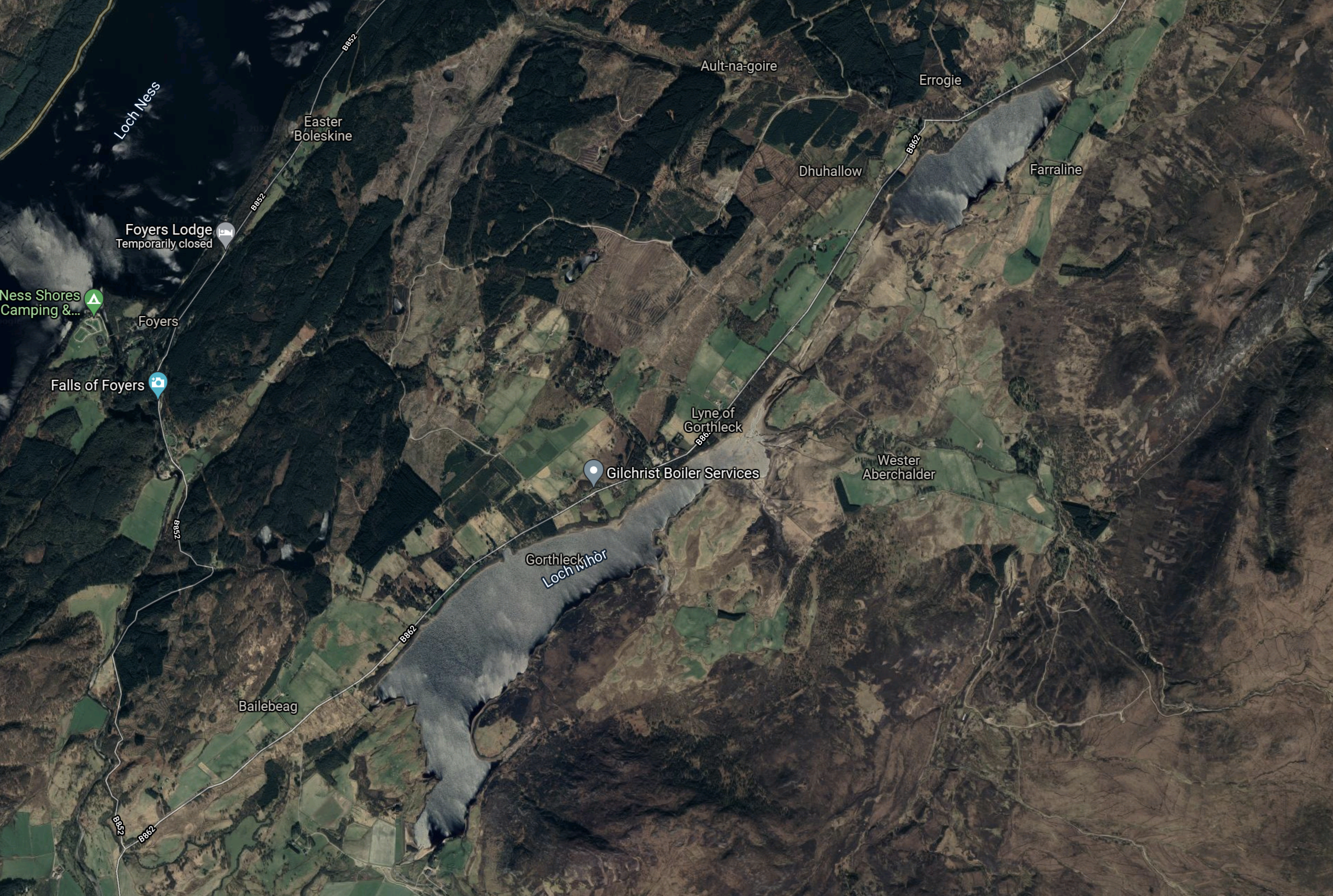
Note.
- Loch Ness is in the North West corner of the map.
- Loch Mhòr is the loch running diagonally across the map.
- Loch Mhòr was originally two separate lochs; Loch Garth in the South-West and Loch Farraline in the North-East.
- The power station is on the shores of Loch Ness.
I have found a document on the Internet, that says that the current storage capacity of Loch Mhòr is 10 GWh. That figure, if it is correct, would make the Foyers pumped storage scheme a small amount bigger than Electric Mountain.
The Original Scheme
The original scheme appears to have been a straight hydro-electric scheme with the water running from Loch Mhòr into Loch Ness through turbines. I don’t know how big it was and if anybody does, the figure needs to be inserted in this post. So if you know it, please tell me!
This gazetteer gives the figure at 3750 kW and also this history.
The British Aluminum Company development at Foyers was the first large-scale use of hydropower in Scotland. The scheme was highly influential, proving not only the viability of the technology to produce electricity with water driven turbines, but also that the power could be successfully applied to industrial processes. The British Aluminum Company went on to develop two large smelters in Scotland at Kinlochleven and Lochaber.
The original scheme generated electricity for seventy years.
The Current Scheme
There are effectively two parts of the current scheme, which was created in the early 1970s.
- The original 3.7 MW turbines have been replaced by a 5 MW turbine in the old power station.
- A new separate pumped storage power station has been built with two 150 MW pump/turbines.
This paragraph from the leaflet from SSE Renewables, gives brief details of the engineering.
When the station is generating, water flows from Loch Mhor through 2 miles of tunnels and shafts to the power station. When pumping, energy is drawn from the main transmission system at times of low load to drive the two 150 megawatt machines in the reverse direction and pump water from Loch Ness up to Loch Mhor. The existing gravity dam at the outlet of Loch Mhor (231.7m long and 9.14m high) was retained by NOSHEB . Remedial work was carried out on subsidiary earth embankment dams. The waters of the River Fechlin are diverted into Loch Mhor by a tunnel and the channel of the river.
From the complete description in the leaflet, it looks to be sound engineering.
Did Modern Project Management Enable This Scheme?
As someone, who was involved in writing project management software from about 1972, I do wonder if the arrival of ,odern project management around the mid-1960s was one of factors that prompted NOSHEB to carry out this scheme.
Other factors would have been.
- The original turbines were on their last legs after seventy years of generating electricity.
- There was a need for more pumped storage.
- This scheme was feasible.
I would very much like to meet one of the engineers and talk the scheme through.
Conclusion
This power station and its rebuilding as a pumped storage scheme has been carried out to an excellent standard and I wonder if similar techniques can be used to create new pumped storage systems around the world.
A Plea From Michael Portillo
In the latest episode of his Great British Coastal Railways – Helensburgh to Connel, Michael Portillo made a plea to train makers.
Travelling along the scenic West Highland Line, he asked train manufacturers to build a train with a glass roof.
 The Anonymous Widower