Could The Standedge Tunnels Be Part Of A High Speed Line?
This article on Rail Technology Magazine is entitled Warrington Borough Council React To Integrated Rail Plan, where this is said about improvements between Liverpool and Manchester via Warrington.
One such promise is the delivery of a new high-speed line between Warrington, Manchester and Marsden as part of NPR.
The IRP will also introduce a fully electrified upgraded line between Liverpool and Warrington as part of NPR.
Note NPR is Northern Powerhouse Rail.
Where Is Marsden?
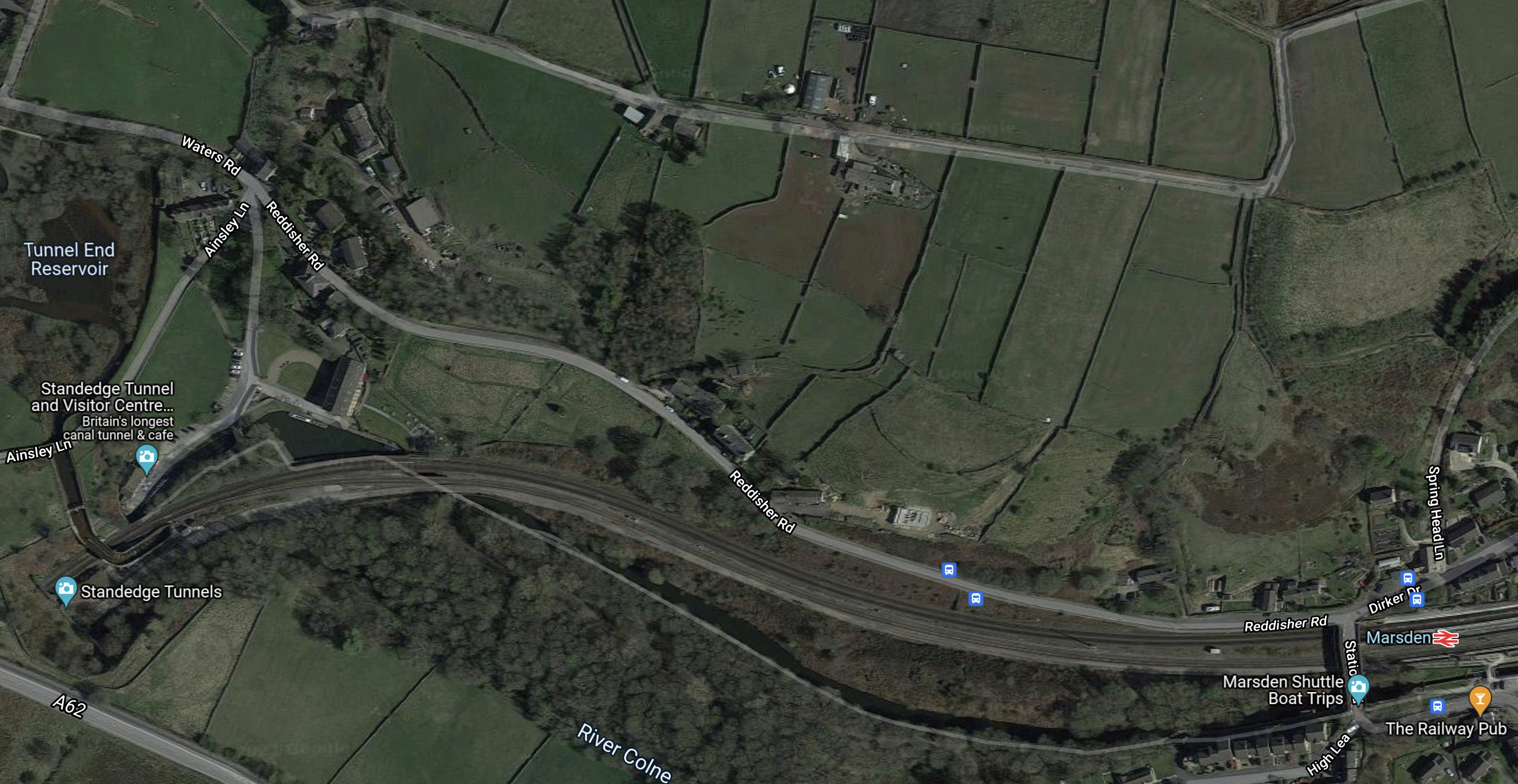
This Google Map shows the rail line between the Standedge Tunnels and Marsden station.
Note.
- Standedge Tunnels and the Visitor Centre in the West.
- Marsden station in the South-East corner of the map.
- The railway between them is the Huddersfield Line.
- The distance between Marsden station and the Eastern Portals of the Standedge Tunnels is about a mile.
Huddersfield station is seven miles to the East of Marsden station.
The Eastern End Of The Standedge Tunnels
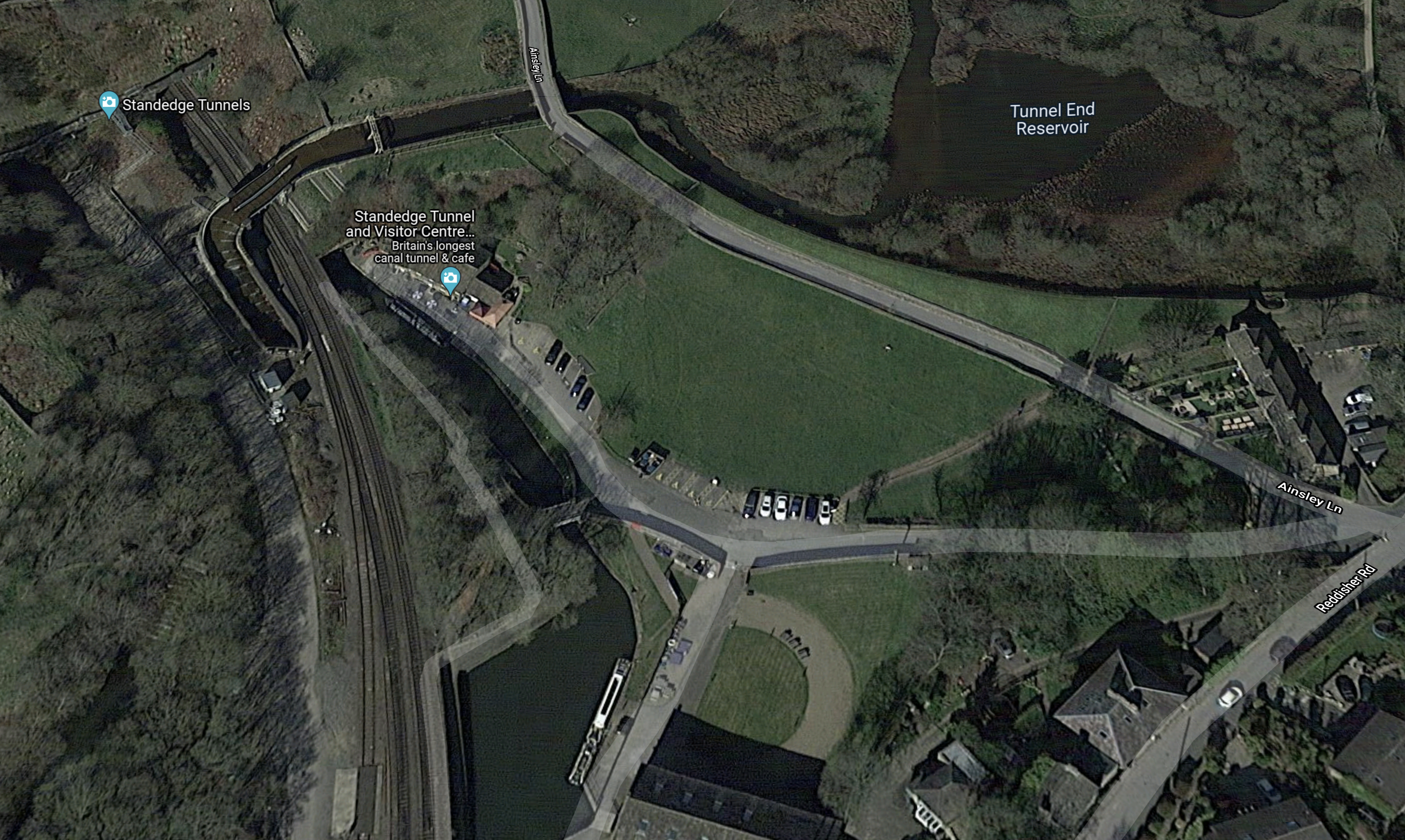
This Google Map shows the Eastern end of the Standedge tunnels.
Note.
- This is a 3D image tilted to give a possibly better view.
- Only a double-track railway and a canal tunnel are in daily use.
- There are two other disused but intact single-track rail tunnels.
- I suspect that the Tunnel End Reservoir keeps the canal water at the right level.
It looks to me that the Standedge Tunnels will be part of the proposed high speed route.
Greenfield Station
Greenfield station is to the West of the Western portal of the Standedge tunnels.
The distance between Greenfield and Marsden stations is six miles.
The Standedge Tunnels
Wikipedia has a very comprehensive description of the canal tunnel and the three rail tunnels that form the Standedge tunnels complex.
These are points from the entry.
- The canal tunnel is the oldest and was opened in 1811.
- The two single-track rail tunnels were opened in 1848 and 1871
- The double-track rail tunnel opened in 1894.
- The rail tunnels were all built using the canal tunnel for access.
- All the tunnels are parallel to each other.
- The tunnels are level.
- All tunnels appear to be connected together with cross passages.
- For safety reasons some diesel-powered boats are towed through the canal tunnel using electric tugs.
- The railway tunnels were the only level section of the route and were fitted with water troughs for steam engines.
- Drainage of the rail tunnels appears to be good, with water draining into the canal.
- Only the 1894 tunnel is in use by trains, but all three rail tunnels are maintained.
- The 1848 tunnel can be used for emergency access and is accessible to fire engines and ambulances.
The complex appears to be a masterpiece of nineteenth century engineering.
There are several factors that could enable the conversion of the rail tunnels into a high-capacity modern railway with speeds up to at least 100 mph.
- The tunnels are level.
- The tunnels are well-drained.
- The access to the tunnels is good.
- Slab track, which allows higher speeds could be installed in the tunnels, as it was in the Bowshank Tunnel on the Borders Railway.
But the biggest factor could be the possibility of using battery-electric trains to avoid electrification of the main lines, which as now would probably be in the double-track tunnel.
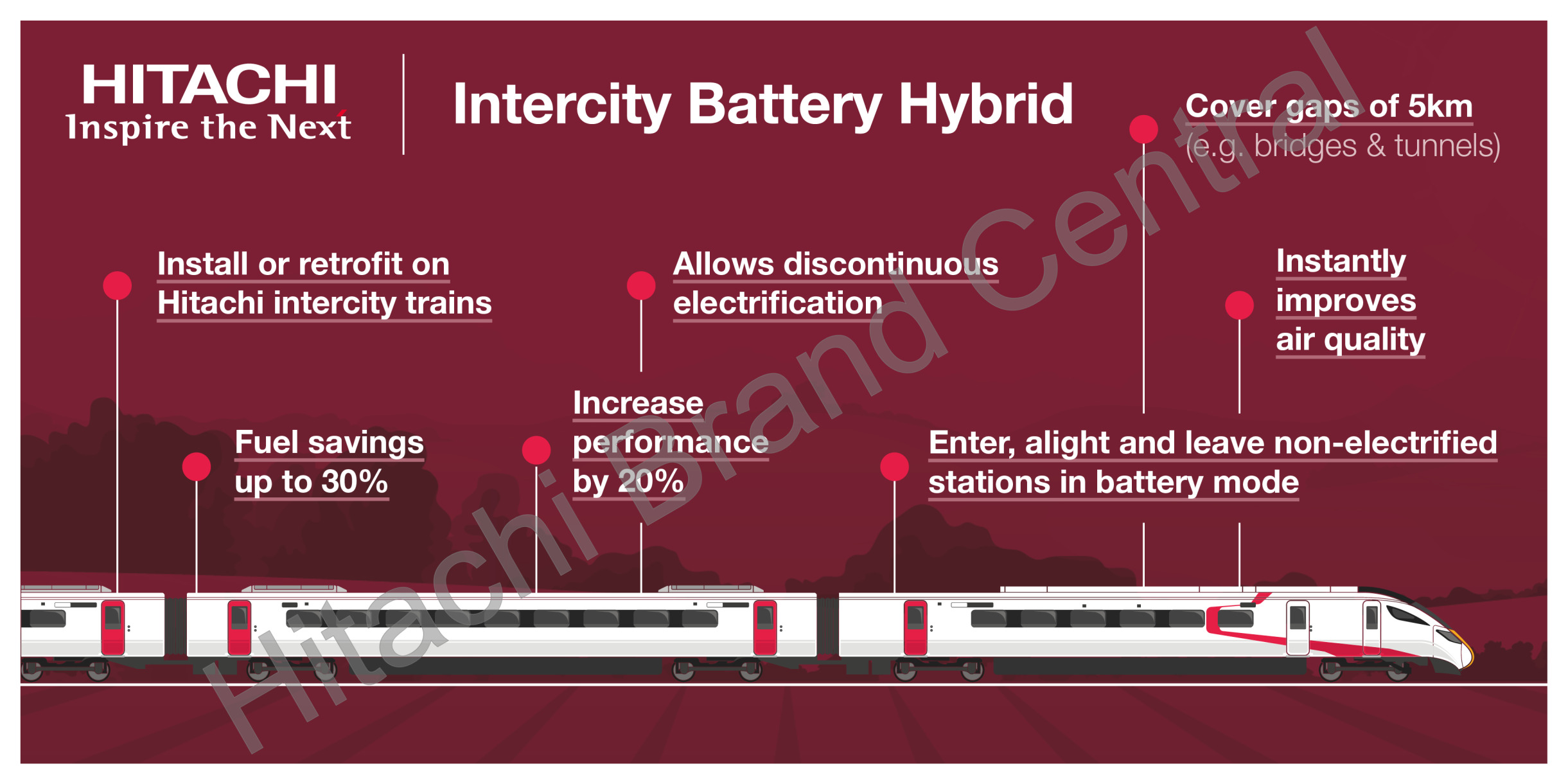
This Hitachi infographic describes their Intercity Battery Hybrid Train, which is based on a Class 802 train and they are developing in partnership with TransPennine Express.
Note.
- Greenfield and Marsden stations are only six miles apart.
- The tunnels are only a few metres longer than 5000 metres.
- The train may only be able to cover 5 km now, but I believe this could be increased.
I also wonder, if the electrification on either side could get as close to the tunnel as possible.
This would enable trains to drop pantograph at speed and switch to battery power a few metres from the tunnel and get to the other side using a mix of battery-power and kinetic energy. Once under the wires at the other side of the tunnel and they had slowed to a safe speed at which they could raise the pantograph, it would be raised and trains would continue using the electrification.
The operating speed would probably be determined by any curves at the ends of the straight and level tunnel.
This method of operation may be OK for expresses, but what about other passenger and freight trains?
I wonder, if it would be possible to put a third track in one of the other rail tunnels.
- Slab-track would probably be installed.
- This third track could be electrified.
- It would be signalled to allow bi-directional running.
This by-pass tunnel could keep the main lines free for the expresses.
Conclusion
I am fairly sure that the Standedge Tunnels could be incorporated in a high speed line.
The Great Bus Robbery
Transport for London (TfL) obviously don’t like people where I live in the Northern part of De Beauvoir Town in the London Borough of Hackney.
When I moved here, ten years ago there were six bus routes that passed through the traffic lights where the Balls Pond Road (It is not a made-up-name from Round The Horne) and Southgate Road/Mildmay Park meet.
- 21 – Newington Green and Lewisham Shopping Centre
- 30 – Marble Arch and Hackney Wick (From the sublime to the ridiculous?)
- 38 – Victoria station and the romantic Clapton Pond
- 56 – Bart’s Hospital and Whipps Cross (You’d be cross, if you’d been whipped!)
- 141 – London Bridge Station and Palmers Green North Circular Road (Surely, another romantic destination!)
- 277 – Highbury & Islington Station and Crossharbour
Note.
- We had two bus routes to and from Highbury & Islington station for Dear Old Vicky!
- We had two bus routes to and from Moorgate, Bank and the City of London.
- We had four bus routes to and from Dalston Junction station and the cultural attractions of Hackney Central.
- We had a direct bus to Canary Wharf.
TfL looked at the name of the district and thought the posh French name, meant we were all had expensive vehicles or Hackney carriages and said we had too many buses.
So in June 2018, the 277 bus was cut back to Dalston Junction station and TfL promised that the frequency of the 30 bus would be increased. We’re still waiting for extra services.
Now, if you want to go to Highbury & Islington station, according to TfL’s Journey Planner, it’s often quicker to take a 38 or 56 bus to Essex Road station and take a train.
To make matters worse the 30 bus route now has cheap and nasty Egyptian-built buses with more steps than Russia. All buses should have flat floors like the New Routemasters.
What is TfL’s latest crime?
The 21 and 271 buses are going to be combined into a new route between Lewisham and Highgate, which will go nowhere near the Balls Pond Road.
So we’ll just have the one bus route to the City of London.
On past form, if TfL say they will increase the frequency, I wouldn’t believe them.
I think that TfL have ignored some problems.
The Elderly And Disabled
Between Newington Green and Englefield Road, a higher proportion of the passengers getting on the 21 and 141 buses seem to be in these groups.
- As it’s a nice place to live, I suspect many elderly people have just stayed on.
- I believe that North of the Balls Pond Road, there are some care homes and sheltered housing.
Have TfL analysed their passengers?
Not Everybody Has Cars
There are several blocks of social housing on the Newington Green and Englefield Road stretch and you see a lot of passengers who don’t look like car owners.
The lack of parking and the Low Traffic Neighbourhoods don’t help.
Access To Waterloo
My quickest way to Waterloo, which is London’s busiest rail terminal, is to take a bus to Bank and then get the Drain.
A halved service to Bank station will probably force me to take longer routes.
Tradition
When I was a child in the 1950s, the 141 was the 641 trolley bus, which ran between Winchmore Hill and Moorgate.
People, who live in Wood Green, Turnpike Lane and Manor House still commute to the City by bus, as people have done for over a hundred years.
I suspect a lot of commuters change from the Piccadilly Line to the 141 bus at Manor House station. I certainly use that route if I’m going to Southgate or Cockfosters.
The 21 bus starts at Newington Green, which means if you want to go from Balls Pond Road to Bank, you’ll usually get on a 21 bus, as the 141 buses are full with passengers from further North.
So it looks like to get to Moorgate, we’ll need to get a bus to Angel and then get the Northern Line, after the rerouting of the 21 bus.
Crossrail
This will have a big effect.
Suppose you live in Wood Green and want to get to Crossrail.
There is no obvious connection, but tradition will mean your preferred route will be to take a 141 bus between Manor House and Moorgate.
There will also be a quick route between Moorgate and Liverpool Street station, that I wrote about in London’s First Underground Roller Coaster.
Conclusion
We will need the 21 bus to provide us with a route to Crossrail, as the 141 buses will be full.
The 21 bus is needed where it is and mustn’t be stolen.
Lumo: Why The Latest Edinburgh-London Train Service Could Wean Us Off Planes And Roads
The title of this post, is the same as that of this article on The Conversation.
It is an interesting read and it appears that Lumo’s message is getting through.
With Southwest Airlines Deal, Velocys Presells 100% Of The Output From Its US Biobased Jet Fuel Project
The title of this post, is the same as that of this article on the American Chemical Society.
This is the first paragraph.
The biofuel maker Velocys has signed jet fuel purchase agreements with Southwest Airlines and International Airlines Group. Velocys says it now has agreements for the entire output of the facility it plans to open in Mississippi in 2026. The plant, known as Bayou Fuels, will use gasification and Fischer-Tropsch chemistry to make the fuel from wood waste. It will be fitted with carbon-capture equipment from Oxy Low Carbon Ventures, making its fuel net-negative in CO2 emissions. The two airlines have also agreed to buy the resulting greenhouse gas.
Note that the technology is net-negative in carbon dioxide emissions.
This must be a short-term route to decarbonise existing aviation.
Would A Lumo-Style Service Work Between King’s Cross And Norfolk?
This is a bit of a fantasy and you’ll never know the real reason why I have written it!
With the upgrade of the East Coast Main Line to full digital signalling, there will be a problem South of Hitchin with 140 mph Azumas and Hitachi Class 802 trains and similar from Grand Central , Hull Trains and Lumo hogging the fast lines to and from King’s Cross. I first wrote about it in Call For ETCS On King’s Lynn Route.
One solution would be to replace the current Class 387 trains with a 140 mph train , such as a Hitachi Class 802 variant. This would enable these fast King’s Lynn and Cambridge trains to join the 140 mph trains on a fast run to and from King’s Cross.
The Future Of Cambridge
Cambridge is one of the UK’s four world cities, with its heritage and lately its high position in any technology league table.
The Current Rail Service Between London And Cambridge
Currently, it has a good service into King’s Cross, Liverpool Street and St. Pancras.
- Great Northern – two tph to King’s Cross – A stopping train using Class 700 or Class 387 trains.
- Great Northern – one tph between Ely and King’s Cross – A fast train using Class 387 trains.
- Great Northern – one tph between King’s Lynn and King’s Cross – A fast train using Class 387 trains.
- Thameslink – two tph to Brighton – A semi-fast train using Class 700 trains.
- Greater Anglia – two tph to Liverpool Street – A semi-fast train using Class 720 or Class 379 trains.
Note.
- tph means trains per hour.
- The similar Class 387 and Class 379 trains are both late-model Bombardier Electrostars with sensible seats and a large number of tables. Both train types can or could be modified to run at 110 mph.
- The Class 700 trains are unsuitable for the route, as they have ironing-board seats and no tables. These are only 100 mph trains.
- The Queen’s bottom doesn’t like the Class 700 trains.
A large proportion of the passengers and commuters between to and from Cambridge work in high-tech or information-rich businesses and I believe if the trains were more geared to this market they would attract passengers away from the roads.
The Cambridge Employment Problem
Fast-growing Cambridge is taking over the region and it is always looking for towns and villages to develop as places for dormitories and to build premises for the hundreds of high-tech businesses.
This is one of the reasons why Greater Anglia acquired new Stadler Class 755 trains to run services from Cambridge to Bury St. Edmunds, Ipswich, Norwich, Peterborough and Stansted Airport.
If you’re going to lure Cambridge’s well-paid high-tech commuters out of their cars, you must give them an equivalent seat to their car. The Class 379, 387 and 755 trains do this.
Living In Norfolk And Suffolk And Working In Cambridge
This has always been the choice of many who work in Cambridge, but using rail into Cambridge didn’t really take-off seriously until modern three-car Class 170 trains replaced the single-car Class 153 trains.
Greater Anglia have followed the upward trend in passenger numbers, by running hourly four-car Class 755 trains from Cambridge to both Ipswich and Norwich.
Before the pandemic, it was starting to look like Norwich and Cambridge would soon need a second service, especially with the planned opening of the new Cambridge South station in 2025.
Addenbrooke’s Hospital And The Cambridge Biomedical Campus
Cambridge South station is being built to serve Addenbrooke’s Hospital and Cambridge Biomedical Campus, which intend to be create the foremost medical research cluster in the world.
Staycations And Holiday Homes In East Anglia
Life is changing because of the covids and more people are taking staycations or buying holiday homes.
And many are following the example of the Queen and going to Norfolk for their relaxation.
The Undoubted Need To Improve Rail Services Between London King’s Cross And Norfolk Via Cambridge
These factors convince me that there is a need for a new or repurposed rail service between London King’s Cross and Norfolk via Cambridge.
- The need to provide a high-class commuter service between London and Cambridge.
- The need to bring workers into Cambridge from Norfolk.
- The need to provide a fast high-class rail link to Cambridge South station with all its medical research.
- The need to provide a comprehensive working environment on the trains.
- The need to cater for all those people relaxing in Norfolk after a hard week in London.
It is my view, that a radical design of train is needed for this route.
- It would need to have a high-class interior.
- It would need at least a 125 mph capability, so that it can use the fast lines between Hitchin and King’s Cross.
- The train may need the ability to split and join.
- It would need an independent power capability for running on the Breckland Line between Ely and Norwich.
- Because of Cambridge and because East Anglia is easy country for cycling, it would need a sensible capacity for cycles.
I also believe that because of the need to decarbonise, the train should be zero-carbon.
These are my thoughts.
Operating Speed
Because of running on the fast lines between Hitchin and King’s Cross with the 140 mph trains from the North, I suspect that an operating speed of at least 125 mph is needed. But if the Hitachi trains of LNER, Hull Trains, Lumo and in the future possibly other operators like Grand Central, will be capable of 140 mph, this speed could be desirable.
Speed limits once the trains have left the East Coast Main Line at Hitchin North junction are as follows.
- Hitchin and Cambridge – 90 mph
- Cambridge and King’s Lynn – 90 mph
- Ely and Norwich – 75-90 mph
I can see Network Rail using their expertise to raise the speed limit on sections of these lines.
Flighting Of Trains On The East Coast Main Line
To increase capacity on the East Coast Main Line, I believe that at some point in the not too distant future that trains will be flighted. This will involve two or more trains leaving King’s Cross in a sequence and proceeding with all trains at a safe distance from each other.
I can envisage a flight like this from King’s Cross.
- An Edinburgh train with York as the first stop – Leaves at XX.00
- A Leeds train with Doncaster as the first stop – Leaves at XX.03
- A Lincoln train with Peterborough as the first stop – Leaves at XX.06
- A Cambridge train with Stevenage as the first stop – Leaves at XX.09
Note.
- The Edinburgh train would set the speed.
- Trains would maintain their time behind the lead train.
- Everything could be controlled by the digital signalling.
- Gaps between the trains would be sufficient for a safe stop.
- No train in the flight would make a station stop unless it was the last train in the flight.
- The last train in the flight would drop off and go to their destination.
As there are at least two tph to Edinburgh, Leeds and Cambridge, there would be two main flights per hour leaving King’s Cross, with the second flight perhaps incorporating a service to Hull.
Digital signalling and precise driving would enable the flights to be built in the opposite direction into King’s Cross.
The big advantage would be that instead of needing eight paths per hour on the East Coast Main Line, only two would be needed.
All trains would need to have similar performance, so this is another reason why the Cambridge trains need to be at least 125 mph trains.
Train Interiors
Lumo has broken new ground in train interiors.
- It is one class.
- Everybody gets a decent seat.
- Everybody gets good legroom.
- Everybody gets some form of table.
- There are decent-sized overhead racks for hand-baggage and coats.
- There is space for bicycles and heavy luggage appropriate to the route.
This can be built on to provide a good working and playing environment suited to the passengers who would use a fast King’s Cross and Norfolk service via Cambridge.
- Lots of tables for four, as in the high-class Electrostars.
- Better bicycle storage.
- Better alignment of seats with windows.
Hitachi could obviously produce a train to this specification.
But what about other manufacturers.
Stadler’s Class 755 trains are surely a possibility.
- A senior driver from Greater Anglia told me that the design speed for a Class 755 train is 200 kph or 125 mph.
- They have good seats.
- They have flat floors.
- They have large windows.
- They have step-free access between train and platform.
- Like the Hitachi trains, they are in service.
I believe the closely-related Class 745 trains are probably the best commuter trains in the UK and are the only alternative to the Hitachi trains on a125 mph fully-electrified route.
Bridging The Electrification Gap Between Ely And Norwich
Between Norwich and Ely stations is 53.8 miles and this section is not electrified, although both stations have full electrification.
The line is not heavily used with typically only two passenger trains and the occasional freight trains in each direction in an hour.
This Hitachi infographic describes the Hitachi Regional Battery Train.

A 90 km. range could be sufficient to cover the gap between Norwich and Ely.
Could Hitachi build a Class 802 train or similar with a battery range of 90 km or 56 miles?
Certainly, a speed of 100 mph would probably be sufficient to bridge the gap in a decent time.
Improving The Breckland Line
The Breckland Line is the route between Cambridge and Norwich.
- Cambridge and Norwich is 68.5 miles
- Only the sixteen miles between Cambridge and Ely North junction is electrified.
- There are thirteen stops between the two cities.
- A typical time is 79 minutes
- This is an average speed of just 52 mph.
- The operating speed is 75-90 mph.
I am sure that Network Rail can squeeze a few minutes here and there to get the operating speed up to the 100 mph of the Great Eastern Main Line.
But the big problem at Norwich is the Trowse swing bridge.
It is only single track and it is likely that this bridge will be replaced soon.
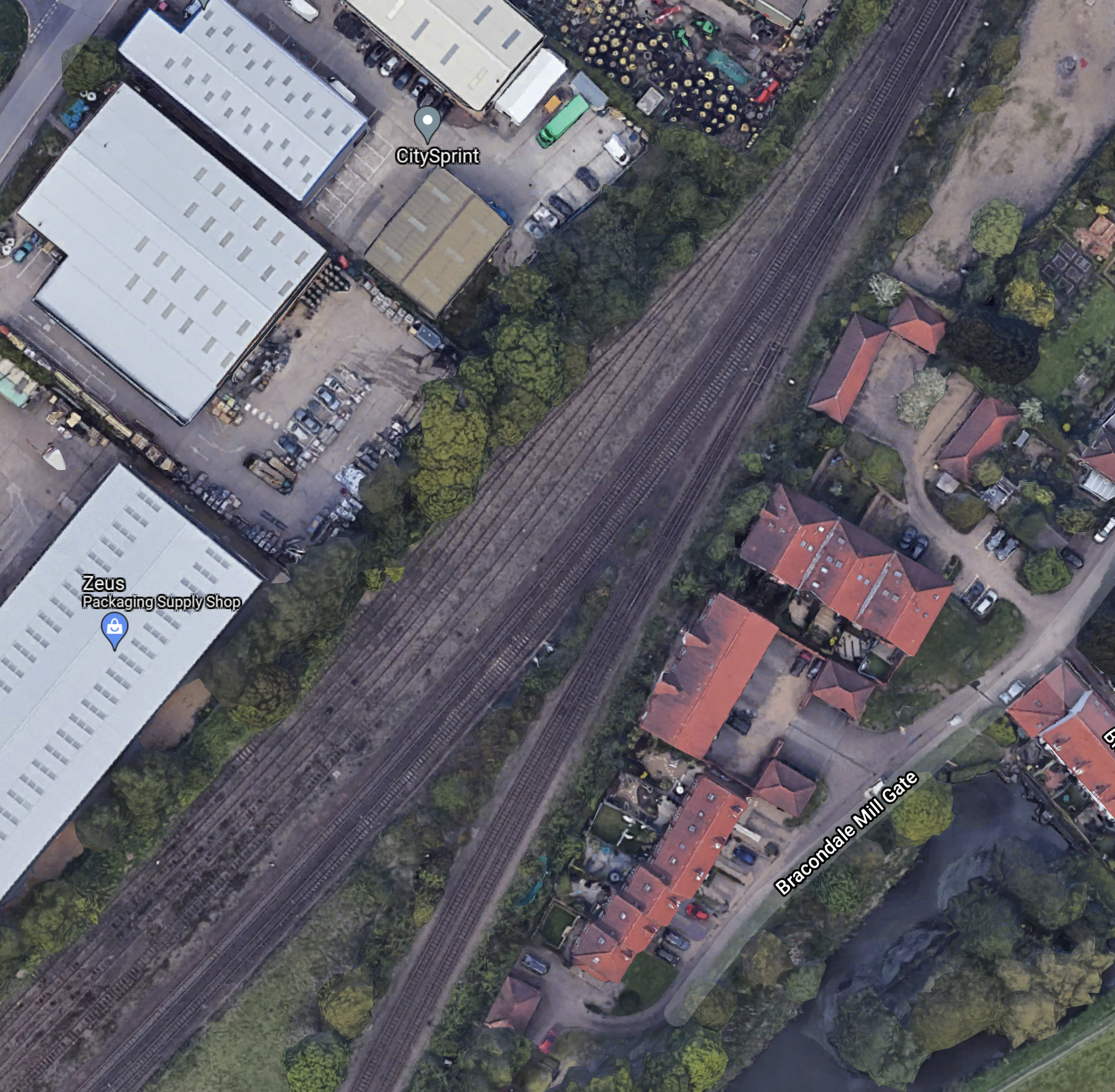
This Google Map shows Trowse junction, a short distance South of the swing bridge.
Note.
- The electrified double-track of the Great Eastern Main Line goes across the map from North East to South West.
- The double-track railway to the East of the main line is the unelectrified Breckland Line to Cambridge, which turns West and goes under the main line.
- On the West of the main lines are the Victoria sidings that I wrote about in Greater Anglia Completes Directly-Managed Norwich Victoria Sidings Project.
As the replacement of the swing bridge will require some work to be done to the electrification, I wonder if at the same time Network Rail would electrify the Norwich end of the Breckland Line.
There must be a balance point adding electrification or batteries to the trains.
As the Breckland Line has few freight trains, electrification is not needed for freight.
Ticketing
A high-speed high-capacity service as I’m proposing must be easy to use.
It is a classic route, where nothing short of London-style contactless ticketing will do, as I’m certain this encourages people to use the trains.
As East Anglia is self-contained and has few services that don’t terminate in the area or in London, I am certain that this could be achieved.
If you remove First Class as Greater Anglia has done on many services, you actually simplify the ticketing, so a Lumo-style mid-class is ideal.
High Speed Train Services
Currently Great Northern run two tph from King’s Cross to Ely via Cambridge.
- One service is extended to King’s Lynn.
- I could see the second service extended to Norwich.
Both services would need to be run by 125 mph trains because of the speed of other trains on the East Coast Main Line.
Conclusion
I think duch a system would be possible.
Hydrogen Train Refuelling Standard To Be Developed
The title of this post, is the same as that of this article on Railway Gazette.
This is the first paragraph.
A agreement to optimise hydrogen refuelling equipment for passenger trains and define an international standard has been signed by Alstom and the Hynamics hydrogen subsidiary of French energy group EDF.
This can only be a good thing.
Is The Okehampton Effect Starting?
This article on the Tavistock Times Gazette is entitled Hop Aboard The 118 For Town And Village Connection To Rail.
These are the first three paragraphs.
County council chiefs have confirmed they have launched a new bus service to link residents in Tavistock to Okehampton’s restored railway line.
From Saturday, Service 118 will link Tavistock to Okehampton, via Mary Tavy and Lydford, to provide an integrated connection to the rail services between Okehampton and Exeter during the day. The service is part of a bigger project to improve public transport in Devon.
The move comes as Devon County Council pushes ahead with plans to get trains rolling again in Tavistock — but in the opposite direction.
Note.
- Tavistock has almost twice the population of Okehampton.
- Okehampton and Tavistock are about sixteen miles apart.
- Buses will take about forty minutes.
- The railway from Tavistock could eventually go to Plymouth via the existing Bere Alston station and the Tamar Valley Line.
This bus route will complete a circular route between Exeter and Plymouth around Dartmoor.
Devon does seem to be getting itself ready for the next phase of rail development in the county.
But does Devon as the birthplace of those great mariners, Chichester, Drake, Gilbert, Grenville and Raleigh, follow in their footsteps and plan things well and get it done?
My maternal grandmother was born in Dalston of two Devonian parents.
Just before the Second World War my mother asked her if she was prepared for the inevitable war.
My grandmother’s reply was as follows.
I got caught out in the First War, so I’ve got a hundredweight of sugar and a hundredweight of jam in the cellar.
Was that her Devonian genes shining through?
Devon is certainly planning for the future at Okehampton.
- There are plans for an Okehampton Parkway station, where the railway crosses the A30, which I wrote about in Work Begins On Okehampton Parkway Station.
- There is this new bus route.
- Will there be more housing in Okehampton?
- There will be developments linked to tourism.
I believe the Okehampton Effect is starting.
The Dartmoor Line Is Back: ‘I Can’t Imagine Why Anyone Would Want To Arrive On The Moor Any Other Way’
The title of this post, is the same as that of this article in The Times.
The article is in the travel section and describes what you might do if you took a train to Okehampton.
I wondered how many of the other Saturday papers and web sites have got articles about Okehampton and the railway.
So I searched and found these.
- The Guardian talks of Devon joy and a financial boost for the town.
- ITV says it will boost tourism and give access to education and work for local people.
- Devon Live also talks of joy and a feat of engineering.
- The Tavistock Times Gazette talks of a new bus service between Tavistock and the railway at Okehampton.
It’s a much more optimistic situation compared to that portrayed in this article in The Times from 2011, which was entitled Okehampton Workers Living On Food Parcels After Business Closures.
Trains Restart On Dartmoor Rail Line After 49 Years
The title of this post, is the same as that of this article on the BBC.
This shows what Network Rail can do, if they pull out all the stops.
I have said this before in Railway Restored: Regular Trains To Run On Dartmoor Line For First Time In 50 Years.
Network Rail have set themselves a good precedent to open the line in nine months and £10 million under budget.
But it could turn out to be one of the most significant days in the development of the railways of the UK.
Well done! Network Rail!
Here’s to the next reopening!
A Simple Solution To The Tricky Problem Of Eye Drops
Since the cataract in my left eye has been removed, I have supposed to be putting drops in my eyes seven times a day. It’s four of one and three of another.
But it has all changed since the District Nurse brought me a pair of these shields.

The bottle with the drops is poked through the bottom of the shield and the cut goes over the eye. To get one drop, you squeeze the bottle gently.
I find the best place to be drop the drops, is lying on my back on my Chinese carpet, with my head on a cushion that C embroidered.

My father would have liked this device.
In his printing business he specialised in creating special cards and forms for the office systems of the 1950s and 1960s. So he would create guides and spacers out of wood in his workshop, so that his staff could perform complex operations quickly and efficiently.
It has certainly made putting the drops in my eye a lot easier.
Conclusion
The hospital should have given me a shield with the drops. The wholesale price can’t be that expensive.
 The Anonymous Widower