Manchester To London Train To Run Without Passengers
The title of this post, is the same as that of this article on the BBC.
This is the sub-heading.
A train service taking commuters from Manchester to London is to run empty for around five months following a decision by the rail regulator.
These three paragraphs add more detail.
A decision by the Office of Rail and Road (ORR), means the 07:00 GMT service operated by Avanti West Coast from Manchester Piccadilly to London will still run but will only be used to carry staff from mid-December.
An Avanti West Coast spokesperson said they were “disappointed” with the decision, which would “clearly impact those customers who already use these services”.
An ORR spokesperson said the decision was made on “robust evidence” from Network Rail to guard against possible service disruption on the West Coast Main Line.
It is a long article on the BBC and I suspect, it is one of those, that should be fully-read before commenting.
I looked up last Friday’s service and found this.
- It was an eleven-coach Class 390 train.
- The train goes via Macclesfield, Stoke-on-Trent and Stafford, but only stops to pick up passengers at Stockport.
- It left on time at 07:00.
- It arrived in London at 09:20, which was twenty-one minutes late.
I think, I’ll see this train arrive on Monday.
Could Avanti West Coast Be Planning A Fast Service From Both Liverpool and Manchester?
Consider.
- Manchester Piccadilly has a 07:00 train to Euston, that takes two hours via Stoke-on-Trent.
- The train also stops at Stockport.
- The Manchester Piccadilly train is an eleven-car Class 390 train, that is 265.3 metres long.
- Liverpool Lime Street has a 06:43 train to Euston, that takes two hours and 11 minutes via Crewe, that stops at Runcorn.
- The Liverpool Lime Street train is a seven-car Class 807 train, that is 182 metres long.
Note.
- I wonder, if at some time in the future, these two services could both be run by seven-car Class 807 trains, that joined at Crewe.
- This might not have been possible with Class 390 trains, as the pair of trains would have been very long.
- Class 390 trains may not be able to split and join.
- I don’t think any extra paths would be needed.
This would give Crewe, Liverpool, Manchester, Runcorn and Stockport, a fast early train to Euston.
EDF Developing Offshore Wind-Powered Hydrogen Production Project In French EEZ
The title of this post, is the same as that of this article on offshoreWIND.biz.
This is the sub-heading.
EDF Power Solutions has invited applications for a tender for Environmental Impact Assessment (EIA) services and hazard studies as part of a project to develop an offshore hydrogen production station in France’s Exclusive Economic Zone (EEZ).
This is the first paragraph.
The project, dubbed HYODE (HYdrogen Offshore DunkerquE), will produce green hydrogen by coupling offshore wind farms with an offshore electrolyser near Dunkirk, France, and is planned to also include storage and transport by ship to port, forming what EDF describes as an “innovative solution” to help scale green hydrogen production.
I asked Google AI, if there are any operational offshore hydrogen electrolysers and received this answer.
Yes, there are operational offshore electrolyser projects, though large-scale, dedicated offshore hydrogen platforms are still in development. The first operational offshore production on an existing gas platform is planned for late 2024 with the PosHYdon project. Additionally, a pilot project in the UK is testing the full integration of a hydrogen electrolyser onto an existing offshore wind turbine, with another project in the Netherlands installing an offshore hydrogen production and storage platform.
But, I did get this page on page on the Ramboll web site, which is entitled The Rise Of Offshore Hydrogen Production At Scale, which has this introductory paragraph.
The stage is set for producing green hydrogen from offshore wind and desalinated seawater. Building on existing and proven technology, offshore wind farms have the potential to become future production hubs for green hydrogen production at scale to meet increasing demand.
That sounds very promising, especially, if proven technology is borrowed from the offshore oil and gas industry.
It’s
Island’s Birds Thriving Decade After Railway Project
The title of this post, is the same as that of this article on the BBC.
This is the sub-heading.
An island transformed into a nature haven thanks to excavations from a major engineering project is thriving with record numbers of birds.
These two paragraphs add detail to the story.
RSPB Wallasea Island, a 740-hectare reserve at Rochford in Essex, was created using more than three million tonnes of earth, brought by boat from the tunnels and shafts created by the Crossrail scheme.
Before work began more than a decade ago there were just a small number of birds present – but almost 40,000 arrived last winter.
This Google Map shows the location of Wallasea Island.
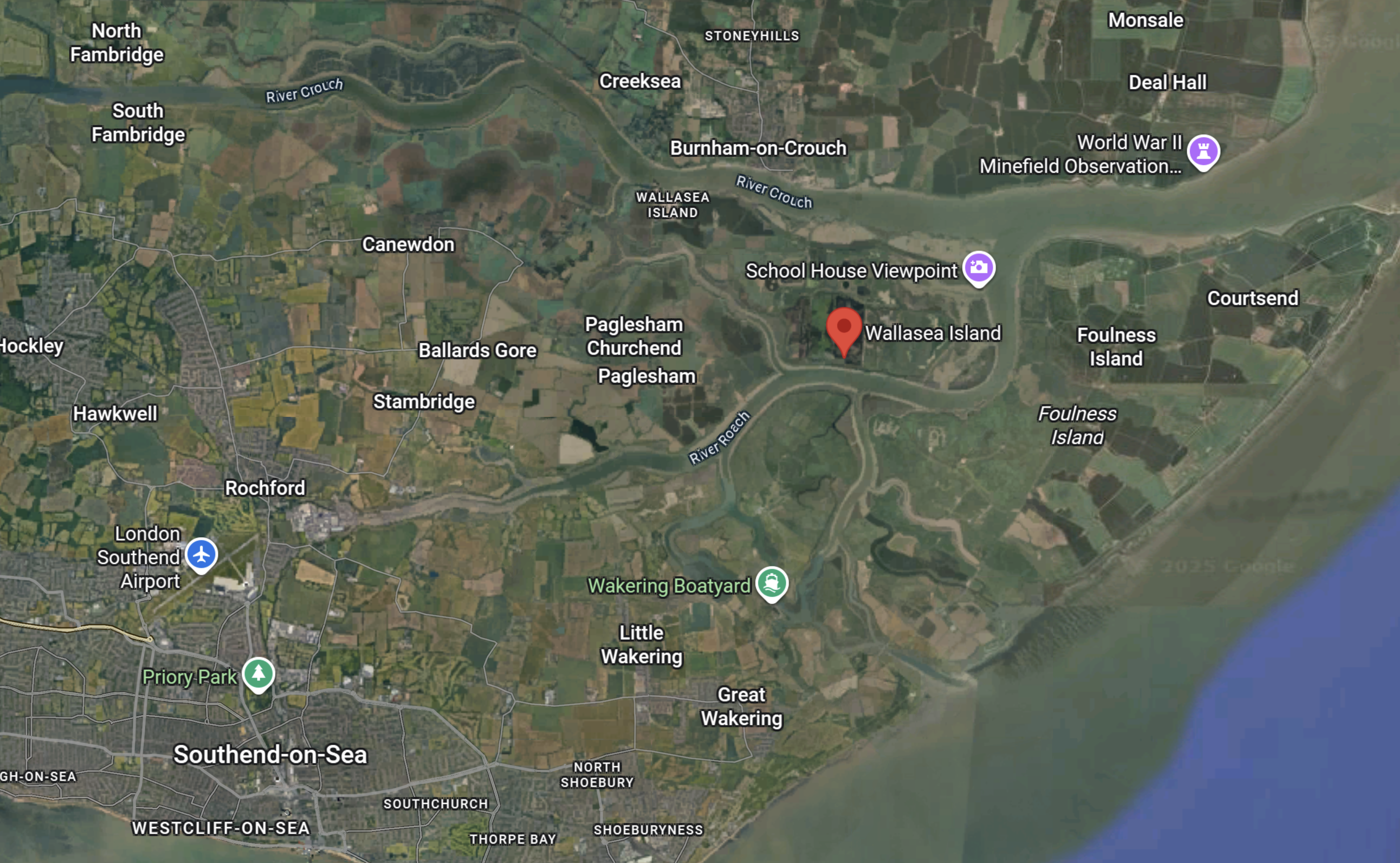
Note.
- Wallasea Island is indicated by the red arrow.
- Southend-on-Sea is in the South-West corner of the map.
- To the East of Wallasea Island is Foulness Island, which at one time was to be the location for London’s third airport.
- In the Summer, there is a ferry to Wallasea Island from Burnham-on-Crouch, where there is a railway station.
- The distance between the quay and the station loooks to be about five hundred metres.
I will make a trip.
Centrica Energy And Exodus Sign Landmark LNG Agreement
The title of this post, is the same as that of this press release from Centrica.
This is the sub-heading.
Centrica Energy has announced the signing of a long-term Sale and Purchase Agreement (SPA) to supply liquefied natural gas (LNG) to Exodus for Honduras, marking a new milestone in the country’s energy development.
These two paragraphs add more details.
Under the terms of the agreement, Centrica will deliver approximately six LNG cargoes per year to Exodus through a ship-to-ship operation into the Floating Storage Unit (FSU) Bilbao Knutsen, located in Puerto Cortes. The 15-year contract is expected to commence in 2026.
“This agreement reflects Centrica Energy’s commitment to expanding global LNG access through strategic partnerships,” said Arturo Gallego, Global Head of LNG at Centrica Energy. “By leveraging our global reach and operational expertise, we’re proud to support Exodus and Honduras in its journey toward a more sustainable and resilient energy future.”
It looks a good deal for Centrica, that has been snatched from under the American’s noses.
I also asked Google AI, if Honduras produced any natural gas and received this reply.
No, Honduras does not produce natural gas, but it is importing it through a new liquefied natural gas (LNG) agreement that begins in 2026. The country relies on imports to meet its energy needs, and this new deal aims to diversify its energy mix and provide cleaner energy for power generation.
That’s clear and it’s interesting that Honduras are looking to provide cleaner energy.
These two paragraphs from Centrica’s press release add details on power generation in Honduras.
The LNG will be transported to the Brassavola Combined Cycle Power Plant, an operating 150 MW thermal facility with its combined cycle under construction and set to reach 240 MW of power capacity, marking the first-ever import of natural gas for power generation in Honduras. This initiative represents a significant step toward diversifying the nation’s energy mix and reducing its reliance on less environmentally friendly fossil fuels.
Once operational, the FSU will serve as the backbone of LNG storage at a new terminal currently under construction on Honduras’ Caribbean coast. The project is designed to enhance energy security, improve generation efficiency, and support industrial growth.
This article on Riviera is entitled Honduras Turns To LNG To Meet Energy Needs and provides these points.
- Honduras is grappling with a 250 MW power shortage.
- Genesis Energías is spearheading efforts to introduce a reliable and cost-effective energy source by importing liquefied natural gas (LNG).
- Hyundai, who are one of Centrica’s partners in HiiROC, are converting the Bilbao Knutsen for its new role as a Floating Storage Unit (FSU).
It would certainly help Honduras’s economy, if they had more power generation.
I asked Google AI, if Honduras was developing offshore wind power and received this reply.
While Honduras has been actively developing onshore wind power for over a decade, there is currently no information to suggest it is developing offshore wind power projects. The country’s wind energy development has focused exclusively on land-based projects, with a number of operational farms and more in the pipeline.
I also asked Google AI if Honduras was developing solar power and received this reply.
Yes, Honduras is actively and significantly developing its solar power capacity as a cornerstone of its national energy strategy. The country has been a regional leader in solar energy penetration and continues to invest heavily in new projects to reduce its dependence on fossil fuels.
But, whether its offshore wind, onshore wind or solar power, these renewals will need backup and the 240 MW Brassavola Combined Cycle Power Plant, will be a good start.
I have some further thoughts.
Does HiiROC Have A Part To Play?
If would be good, if the 240 MW Brassavola Combined Cycle Power Plant could be zero-carbon, so that Honduras could be more zero-carbon.
Consider.
- Centrica own part of HiiROC, who can generate turquoise hydrogen efficiently from natural gas.
- Honduras will from 2026, have plenty of natural gas.
- In Hydrogen Milestone: UK’s First Hydrogen-to-Power Trial At Brigg Energy Park, I talked about how Centrica powered Brigg power station with a hydrogen blend.
- If the Brassavola Combined Cycle Power Plant was reasonably-modern like Brigg, I suspect it could be run on hydrogen or a hydrogen-blend.
- A reliable supply of hydrogen in Honduras would have its uses.
I wouldn’t be surprised to see a HiiROC plant in Honduras to help decarbonise the country.
HiiROC Creates A Lot Of Carbon Black
When a HiiROC system produces turquoise hydrogen, it produces carbon black as a by-product.
I asked Google AI, if Honduras has a use for carbon black, and received this reply.
Honduras likely has a use for carbon black because the material is a vital component in the production of many common industrial and consumer goods that are used globally. The primary applications are universal across most countries, including those in Central America.
But carbon black can also be used to improve poor agricultural land.
So I asked, Google AI, if Honduras has a lot of land to improve and received this reply.
Yes, Honduras has significant land to improve, but this is complicated by issues like deforestation, land degradation, and a lack of clear land rights for many communities. There is a need to balance economic activities like coffee plantations with conservation, improve sustainable agriculture practices, and address illegal land occupation.
It seems to me, that a sensible hollistic approach could use some of the carbon black.
I also believe, that there are many universities, who could advise Honduras on land restoration.
Does Highview Power Have A Part To Play?
Consider.
- Centrica are one of the backers of Highview Power, who are building their first two environmentally-friendly liquid air batteries in the UK.
- Their flagship battery is a 300 MW/3.2 GWh monster that can incorporate a stability island, that controls the grid.
- Highview Power’s batteries are zero-carbon, with a 40-50 year life.
As a Control Engineer, I believe that one of these batteries would be superb backup for the Brassavola Combined Cycle Power Plant and all those renewables.
Where Will Centrica Get Their LNG For Honduras?
I have already reported on two deals, where Centrica is purchasing LNG.
- Centrica Enters Into Long Term Natural Gas Sale & Purchase Agreement
- Centrica And PTT Sign Heads Of Agreement For Long-Term LNG Supply
I can expect more deals like this around the world.
Also, as the Grain LNG Terminal has the ability to export LNG could we be seeing UK natural gas being exported by Centrica to Honduras and the other countries hinted at in the PTT purchase?
Are Centrica Proposing A Comprehensive Solution To A Nation’s Power Problem?
It certainly looks like they are.
And Honduras would be getting a zero-carbon energy system.
This could be repeated all around the world.
Conclusion
This certainly looks like a good deal for Centrica, that can be repeated in other places.
DeepForm
On Wednesday I went to the TDAP Wave 8 Demo Day, which was organised by the Advanced Propulsion Centre.
One of the cohort of companies there was DeepForm, who were described like this.
DeepForm is transforming sheet metal pressing with its patented cold-shear press design, which reduces blank sizes by up to 45 % and trimming waste by up to 85%. This drop-in technology lowers material costs and embodied CO2 in existing press lines without compromising performance, quality or speed. Spun out of the University of Cambridge in 2022, DeepForm enables OEMs and Tier 1 suppliers to adopt the breakthrough through IP licensing, simulation and design support.
The company have an impressive web site, which deserves a very full read.
In their presentation, they showed two products, that could benefit from their innovation; a large steel component for Jaguar Land Rover and a humble aluminium drink can.
As I walked home ntoday, I saw this advert displayed on a bus stop.
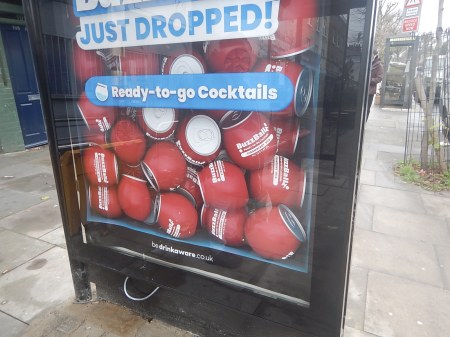
The cans for BuzzBallz are also shown on the company’s web site.
But these products are are only the start.
For instance, I can see lots of small plastic items and components, that can’t be recycled, could be made from aluminium, which is easy to be recycle.
I also think companies like IKEA will love the design freedom, the technology will give.
A Smorgasbord Of Misery
This phrase of Kemi Badenoch’s in her reply to Rachel Reeve’s budget speech will do her no harm.
Offshore Wind Developer Gets DNV Concept Certification for Floating Foundation Design
The title of this post, is the same as that of this article on offshoreWIND.biz.
This is the sub-heading.
BayWa r.e. has received concept certification from DNV for its BayFloat floating wind semi-submersible concrete substructure and mooring system design. The design was validated using the 22 MW generic reference turbine “IEA-22-280-RWT”
These three introductory paragraphs give a few more details.
The certification process was conducted in accordance with DNV-SE-0422:2021-09 “Certification of floating wind turbines” scheme, including DNV-ST-0119:2021-06 “Floating wind turbine structures” as the governing standard, BayWa r.e. says.
The assessment concluded that the BayFloat concrete floating substructure, including the mooring system design, is feasible for further development and qualifies for DNV concept-level certification.
BayWa r.e. collaborated with the engineering company Ramboll on the design and certification process, with Ramboll providing design services, expert insights and engineering advice.
Note.
- Certification must be a good thing.
- If you are unfamiliar with DNV, then their Wikipedia entry, is a good place to start.
- As I was doing the calculations for a floating oil platform in the 1970s, I don’t see why floating wind turbines won’t work!
- Especially, as floating wind turbines, seem to have a higher capacity factor than fixed.
- Concrete also worked for oil and gas platforms, so why won’t it work for wind?
In fact I quite like this design.
These are some other thoughts and information.
The Buchan Wind Farm
Baywa r.e. are also developing the 960MW Buchan floating wind farm about 75 km North-East of Fraserburgh.
The Buchan Wind Farm web site says this about the technology to be used.
The project has identified BW Ideol’s patented Damping Pool® floating substructure as its preferred foundation option, with BW Ideol working actively to establish a manufacturing centre at the Ardersier Energy Transition Facility being developed at the former oil and gas fabrication yard on the Moray Firth.
Perhaps, Baywa r.e. are seeing if they can do better.
The Original Article
The original article also links to several designs of floating wind float design, so it is well worth a full read.
But then, each have their advantages in materials used, ease of construction, methods of assembly, ease of tow-out and erection and most importantly; cost!
East West Rail Unveils Next Phase For Oxford-Cambridge Growth
The title of this post, is the same as that of this press release from the UK Government.
These three bullet points act as sub-headings.
- more frequent trains on the horizon for millions of passengers between Oxford and Cambridge as multibillion pound East West Rail project confirms next steps
- new rail station set to help serve upcoming Universal theme park in Bedford, as well as improvements planned for several existing stations
- new route delivers on the government’s Plan for Change, unlocking £6.7 billion of regional economic growth and delivering up to 100,000 new homes
These two introductory paragraphs make a few general points about the overall project, housing and jobs.
Millions of people across the Oxford to Cambridge corridor are set to benefit from more frequent trains as the East West Railway Company (EWR Co) has revealed the next steps for the second phase of the project today (19 November 2025).
As one of Britain’s largest transport projects, East West Rail forms a cornerstone of the government’s Plan for Change, unlocking £6.7 billion of regional economic growth by 2050, enabling up to 100,000 new homes and supporting tens of thousands of new jobs along the route.
These sections make some more detailed points.
How Many Permanent Staff Will Be Employed At Universal Studios Bedford?
As many will want to live locally, this will surely encourage many to use the trains on the East-West Rail to travel to work, so this will be an important factor.
I asked Google AI, the question in the title of this section and received this answer.
Universal Studios plans to employ 8,000 permanent staff at its new resort in Bedford. This number is part of an overall total of approximately 28,000 jobs, which includes 20,000 jobs during the construction phase.
My project management knowledge is telling me that the station should be built before the theme park.
How Many Daily Visitors Are Expected At Universal Studios Bedford?
I asked Google AI, the question in the title of this section and received this answer.
The Universal Studios theme park in Bedford is expected to have 55,000 visitors on peak days from its launch, based on its plan to handle 8.5 million annual visitors. The project, planned to open in 2031, is expected to attract 8.5 million annual visitors in its first year, with numbers rising to 12 million within 20 years.
I would expect a large number of visitors and staff will probably be encouraged to come by train, just as they are at some Premier League football stadiums.
Will Universal Studios Bedford Be Marketed As A Low Carbon Theme Park?
I’m asking this question, as it seems, the railway is being upgraded make this easier.
I asked Google AI, the question in the title of this section and received this answer.
Yes, it appears Universal Studios Bedford will be marketed as having a low-carbon focus, as evidenced by its planning applications that highlight sustainability efforts. The project outlines include goals for water conservation, energy reduction and clean energy use, waste minimization, and the use of low-carbon materials, all of which will likely be part of the marketing narrative for the theme park, according to LinkedIn.
How Many Car Parking Spaces Will Be Provided At Universal Studios Bedford?
I asked Google AI, the question in the title of this section and received this answer.
The Universal Studios resort planned for Bedford will include a minimum of 7,106 parking spaces and 100 coach bays. The resort is also expected to have 250 cycle spaces and enough room for over 7,100 cars
That is a lot of car parking spaces. Hopefully, there will be a lot of car charging points.
Increased Train Frequency And Capacity
These two paragraphs from the press release, talk about increased train frequency and capacity.
Following extensive consultation with local communities, the multi-billion-pound project has confirmed it is exploring a series of transformative plans including increasing the proposed frequency of trains from 3 or 4 to up to 5 per hour.
These enhancements could provide up to 70% more seating across the route, easing overcrowding and speeding up boarding, as well as cutting average waiting times, improving service resilience and creating a smoother, more reliable passenger experience.
When you consider that London Overground, Merseytravel, the South Wales Metro, West Midlands Trains and other local lines in the UK consider than four trains per hour to be a minimum service, then five trains per hour is to be welcomed.
Station Improvements And New Stations
These two paragraphs from the press release, talk about station improvements and new stations..
Several other improvements across the route have also been confirmed, including new station entrances at Bletchley, Cambridge and Bedford, as well as four brand-new stations along the Marston Vale Line – the first significant investment since the 1960s.
With the current stations on the Marston Vale Line seeing some of the lowest usage in the country, the new stations will better serve local communities by providing faster, more frequent services, as well as helping to serve the upcoming Universal theme park.
I thought Bletchley, Cambridge and Bedford stations had already been substantially improved in recent years.
A New Station At Stewartby
Are the station improvements to upgrade public transport access to the Universal theme park at Stewartby station?
- An East-West Rail service between Oxford and Stansted Airport via Bletchley, Milton Keynes Central, Stewartby, Bedford and Cambridge would give the Universal theme park all-important airport access.
- Would an upgraded Bletchley station improve interchange between the West Coast Main Line and East-West Rail give better access to the theme park from London, the West Midlands and North-West for visitors?
- Would an upgraded Bedford station improve interchange between the Midland Main Line and East-West Rail give better access to the theme park from London, the East Midlands and North-East for visitors?
- An upgraded Bedford station could also be marketed as a zero-carbon route between the theme park and the Continent via St. Pancras International and Eurostar.
- Would an upgraded Cambridge station give better access to the theme park from the East of England?
In addition four new stations on the Marston Vale Line would improve access for visitors and staff, who live locally.
Will Battery-Electric Trains Be Used On The East-West Rail?
As five major East-West Rail stations; Bedford, Bletchley, Cambridge, Milton Keynes and Reading are substantially served by main line electric trains, and it is likely that more stations will be in future, I believe that East-West Rail must either be electrified or services should be run by battery-electric trains, which would enable zero-carbon rail routes to and from London and all the city’s airports, Birmingham, Liverpool, Manchester and an increasing number of cities in the North and Midlands of England, and Scotland and Wales.
I asked Google AI, the question in the title of this section and received this answer.
Yes, the East West Rail (EWR) project plans to use battery-electric trains as part of a discontinuous electrification strategy. This means trains will run on overhead electric power in sections where they are installed, and on onboard batteries in other sections of the route.
It does appear that discontinuous electrification and battery-electric trains will be used.
Electrification At Bedford Station
This OpenRailwayMap shows The East side of Bedford station.
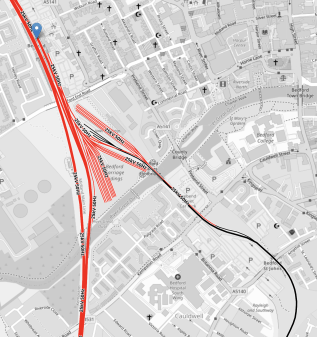
Note.
- The red tracks are electrified and black tracks are not.
- The black track looping into the station from the East is the Marston Vale Line, which will connect the East-West Rail to Bedford station.
- At the Easternmost part of the curve is Bedford St. Johns station, which serves Bedford hospital.
- The Marston Vale Line services normally connect to Platform 1A at Bedford station.
- But it also appears trains can also use Platforms 1 and 2 at Bedford station.
- It also appears that that Platforms 1A, 1 and 2 are all electrified.
This picture confirms electrification in Platforms 1A and 1.
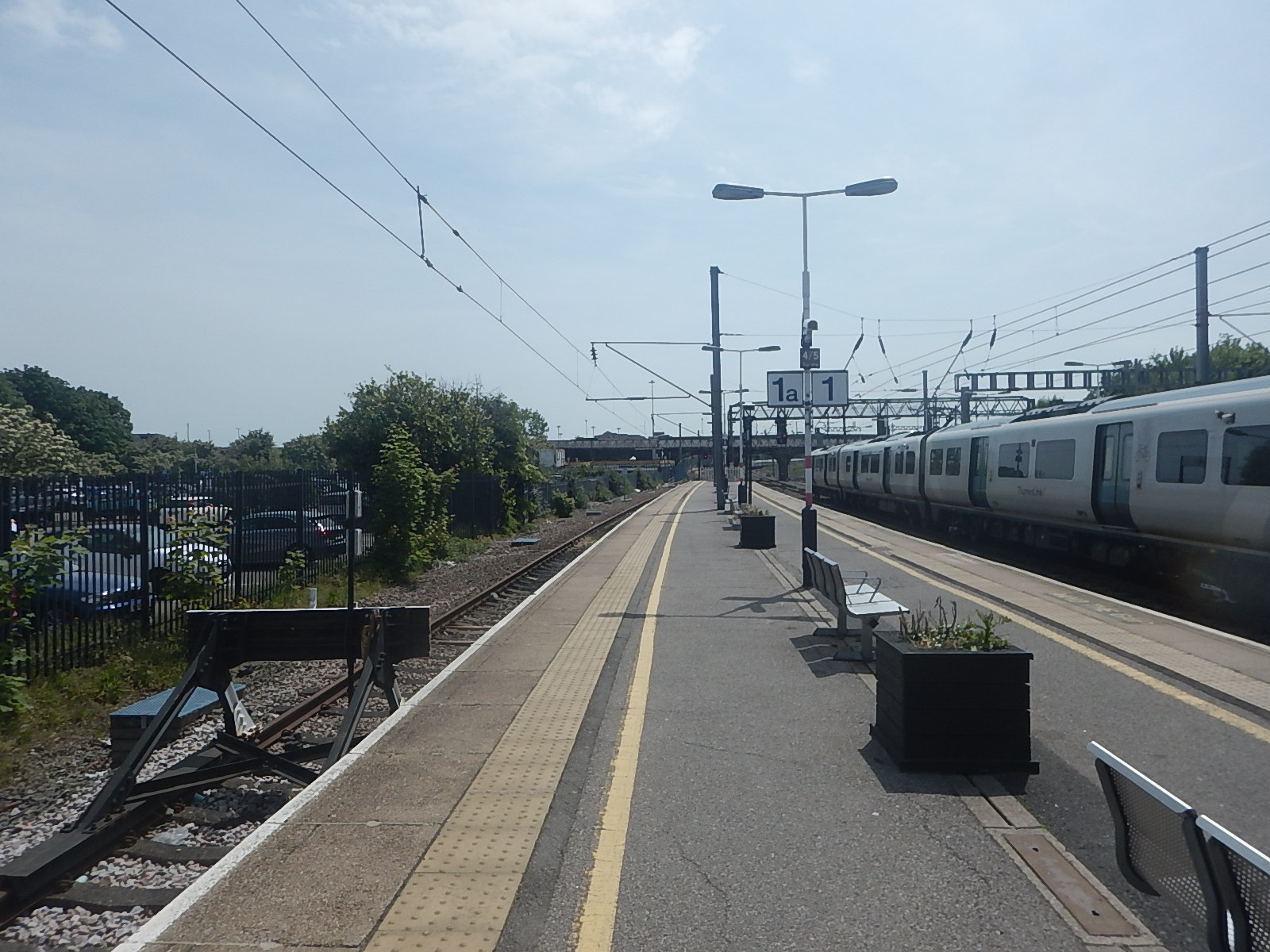
Note.
- Platform 1A is on the left.
- Platform 1 is on the right.
- The Thameslink train on the right is in Platform 2.
- Platforms 1A, 1 and 2 are all clearly electrified.
- Platform 1A is 81 metres long, so could accept a typical four-coach train.
Battery-electric trains with pantographs could certainly by charged in either of these two platforms at Bedford station.
Electrification At Milton Keynes Central Station
It would appear that East-West Rail services will use Platform 2A at Milton Keynes Central station.
This OpenRailwayMap shows Platform 2A at Milton Keynes Central station.
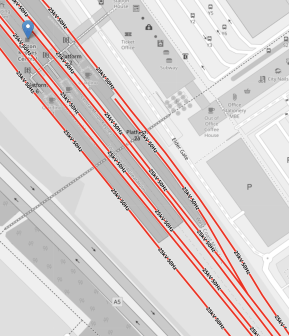
Note.
- The red tracks are electrified and black tracks are not.
- Platform 1 is the through platform on the North-East side of the station.
- Platform 2A is the bay platform tucked underneath Platform 1.
- Platform 2A is clearly electrified.
- Platform 2A is 124 metres long, so could accept a typical five or six-coach train.
These pictures show Platforms 1 and 2A at Milton Keynes Central station.

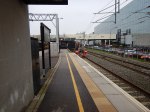


Battery-electric trains with pantographs could certainly by charged in Platform 2A at Milton Keynes Central station.
Electrification At Oxford Station
It would appear that terminating East-West Rail services will use Platform 1 or 2 at Oxford station.
This OpenRailwayMap shows the platforms at Oxford station.
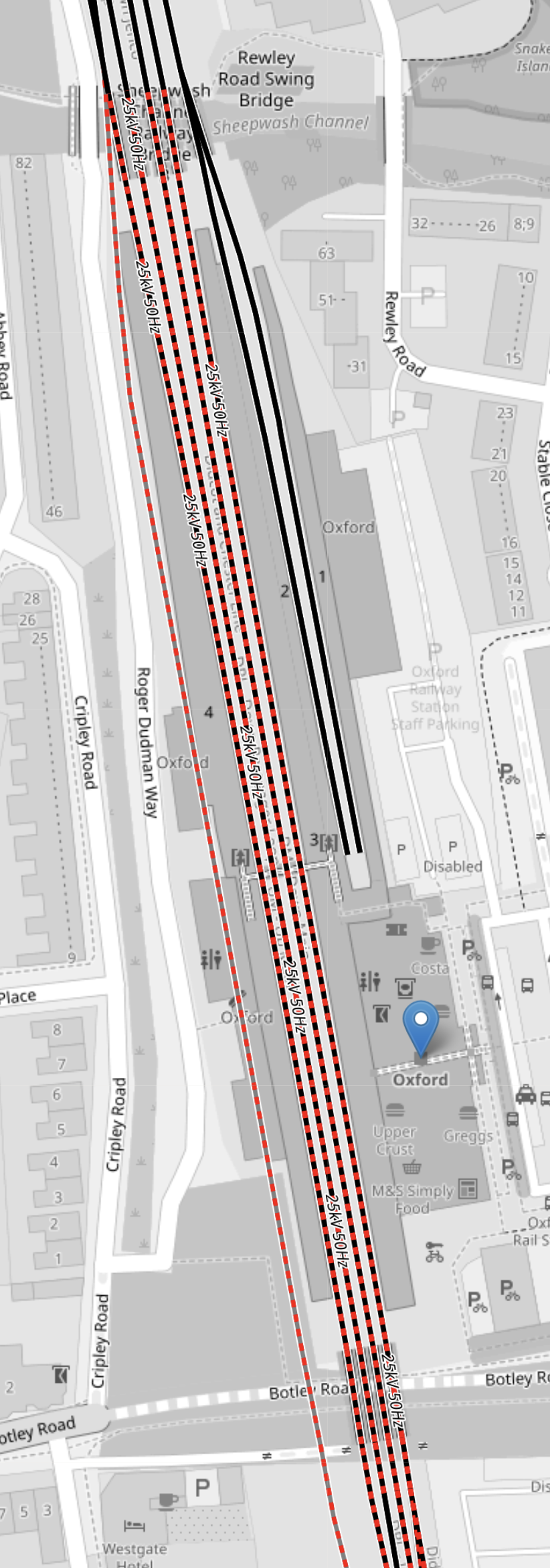
Note.
- The red and black tracks are to be electrified and black tracks are not.
- Platforms 1 and 2 are shown in black and are likely to be used by terminating East-West Rail trains.
- Platforms 1 and 2 would need to be electrified to be able to charge trains.
- Platforms 1 and 2 would also be used by Chiltern’s London services.
- Platform 1 and 2 are respectively 157 and 160 metres long, so could accept a typical five or six-coach train.
- As Oxford and Reading is to be electrified, through East-West Rail trains could use that electrification to travel to and from Reading.
These pictures show Platforms 1 and 2 at Oxford station.








Battery-electric trains with pantographs could certainly by charged in Platform 1 and 2 at Oxford station, if the platforms were electrified.
Electrification At Reading Station
The West-facing platforms at Reading station are all electrified and longer than 120 metres, so could accept a typical four or five-coach train.
What Trains Should Be Used?
Consider.
- There is only one battery-electric train, that has been tested on the UK rail network – The Hitachi Class 802 train or similar.
- There is only one battery-electric train, that has been ordered – The Hitachi Class 802 train or similar.
- The longest distance on battery, between Reading and Bedford, is probably about thirty miles.
The Government could do a lot worse than order some more Class 802 trains, that were tailored for East-West Rail.
The Hitachi Class 802 train has five-cars, which are 26 metres long.
- It has a 125 mph operating speed.
- It has a range of 45 miles on battery power.
- The trains have been proven in service.
- The trains are made in the UK.
- The trains could handle extended routes like Birmingham and Stansted Airport or Cardiff and Cambridge.
A four-car variant of the train with a 100 mph operating speed could be an alternative.
What Will Be The Initial East-West Rail Service?
I asked Google AI, the question in the title of this section and received this answer.
The initial East West Rail service will be between Oxford and Milton Keynes/Bletchley, with passenger services delayed until at least 2026 due to a dispute over train crew roles. Freight services began in June 2025, and temporary diesel services will run until the line is electrified. The full project aims to connect Oxford and Cambridge.
Note.
- Stewartby station for Universal Studios Bedford will not be served by East-West Rail initially.
- But I suspect, that the current Marston Vale Line service will continue, with a change if needed at Bletchley or Bedford to get to Stewartby.
- Earlier I showed that Google AI is predicting 20,000 construction jobs at Universal Studios Bedford, which I am sure will need some form of high-capacity rail transport, if grid-lock is to be avoided in much of Bedfordshire.
Perhaps an initial fleet of four- or five-car Class 802 diesel-electric trains could be ordered and they would run the full route between Oxford and Bedford stations, with a reverse in Platform 2A at Milton Keynes station.
- The trains would run initially on diesel.
- By using stepping-up in Platform 2A at Milton Keynes station, I believe a two trains per hour (tph) service could surely be run.
- Hitachi could probably deliver the trains quickly, as they have not long been out of production.
- Those living locally would get a much improved train service from their local station to and from Bedford, Milton Keynes or Oxford.
- A large portion of the onward connectivity of the East-West Rail would be delivered early to the benefit of locals and visitors.
- If extra services are needed, semi-fast services could be added between Bedford and Reading with stops at Stewartby, Bletchley, Bicester Village, Oxford Parkway and Oxford stations.
When Platforms 1 and 2 at Oxford station are electrified and the trains are converted to battery-electric operation, the route could be converted to zero-carbon operation.
Virtually Nothing Is Said About The Route Of The East-West Rail Between Bedford and Cambridge South Stations Via Tempsford Station
This quote from David Hughes, CEO, East West Railway Company, is the only time, that Tempsford is mentioned in the press release.
“From a new station at Cambridge East to better access in Oxford and clear alignment through Tempsford, East West Rail is shaping the modern, sustainable transport link this region needs to thrive.”
I asked Google AI, if the proposed route of the East-West Rail between Bedford and Cambridge South stations through Tempsford is controversial and I received this reply.
Yes, the proposed route of East West Rail between Bedford and Cambridge is controversial, with opposition from some local residents and political figures who have expressed concerns about the southern alignment through Tempsford and surrounding villages. However, East West Rail Co has selected the route north of the Black Cat roundabout as the preferred alignment, citing reasons like cost-effectiveness and fewer disruptions, while also updating designs to include a southern station entrance to connect with planned growth areas around Tempsford.
Does Government or Artificial Intelligence have precedence?
Cambridge East Station Gets A First Mention
This quote from David Hughes, CEO, East West Railway Company, is the first time, that I’ve seen Cambridge East station mentioned.
“From a new station at Cambridge East to better access in Oxford and clear alignment through Tempsford, East West Rail is shaping the modern, sustainable transport link this region needs to thrive.”
In this document on the East-West Rail Consortium web site, there is extensive talk of an A14 Parkway station.
- The document dates from 2018.
- Google AI can’t find any trace of the A14 Parkway station referred to in the document.
- This article on the BBC, which was written five days ago and is entitled Additional City station Proposed By East West Rail, is the only reference on the Internet, that references Cambridge East station.
- The BBC article also says that other proposals after consultation include a new eastern entrance for Cambridge station, locating Cambourne station closer to the town and a mined tunnel for Bourn Airfield.
- I also have to assume that A14 Parkway has also morphed into Cambridge East station.
- To access all my posts, that relate to A14 Parkway, click this link.
But it does seem that consultation appears to have produced an acceptable compromise.
Between Kempston Hardwick and Tempsford Stations Through Bedford
I’ve now found that OpenRailwayMap has been updated between Bedford and Cambridge.
This first section shows the route between Kempston Hardwick and Tempsford stations through Bedford.
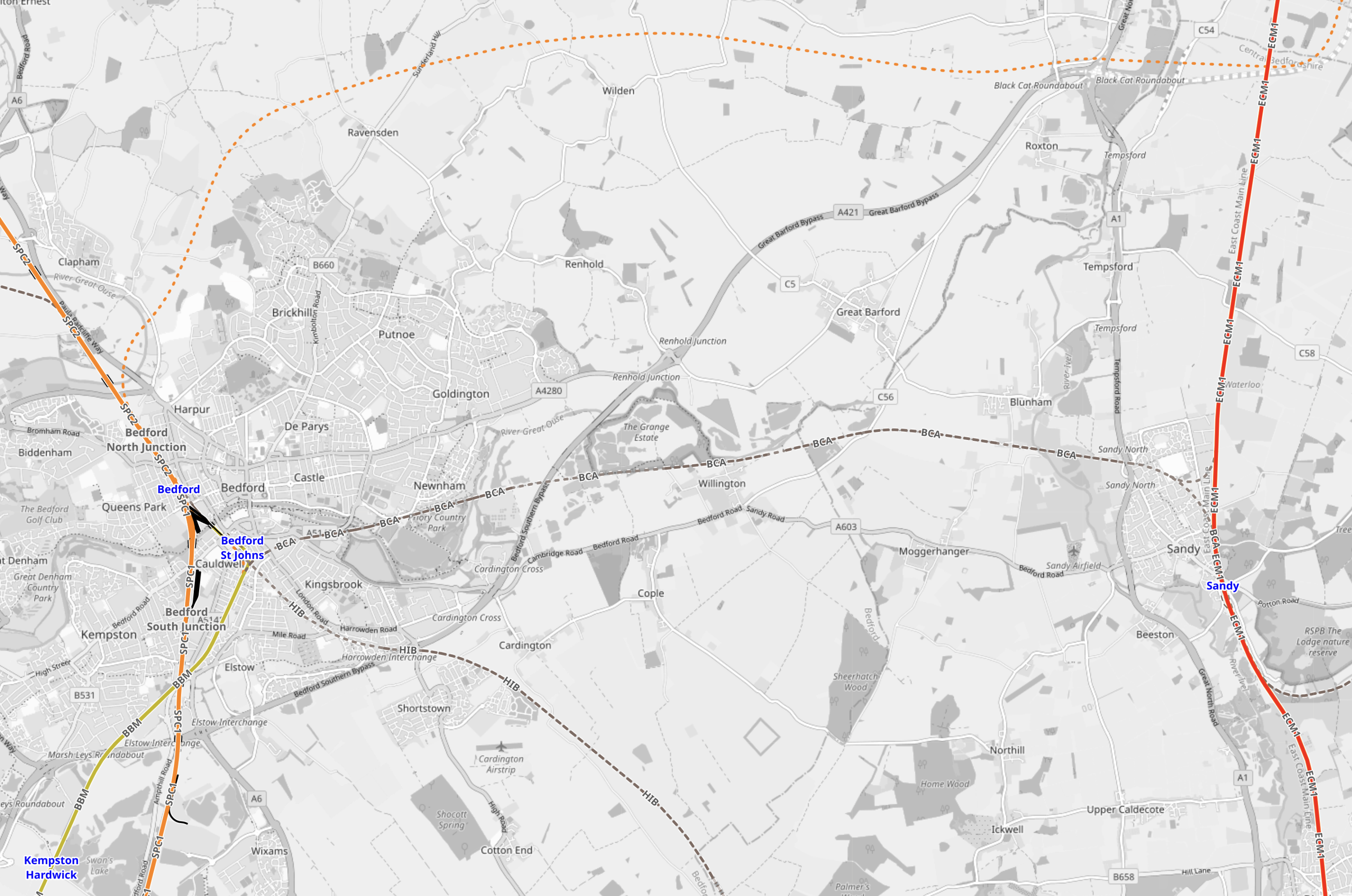
Note.
- Kempston Hardwick station is in the South-West corner of the map.
- The yellow track is the Marston Vale Line, which goes through Bedford St. Johns and Bedford stations.
- The red track on the West side of the map is the Midland Main Line.
- The red track on the East side of the map is the East Coast Main Line.
- The dotted red line across the top of the map will be the route of the East-West Rail.
- Tempsford station will be to the South-West of where the East Coast Main Line and East-West Rail cross in the North-East cornet of the map.
I hope the good people of Bedford are happier now!
Between Tempsford and Cambourne
I’ve now found that OpenRailwayMap has been updated between Bedford and Cambridge.
This second section shows the route between Tempsford and Cambourne stations.
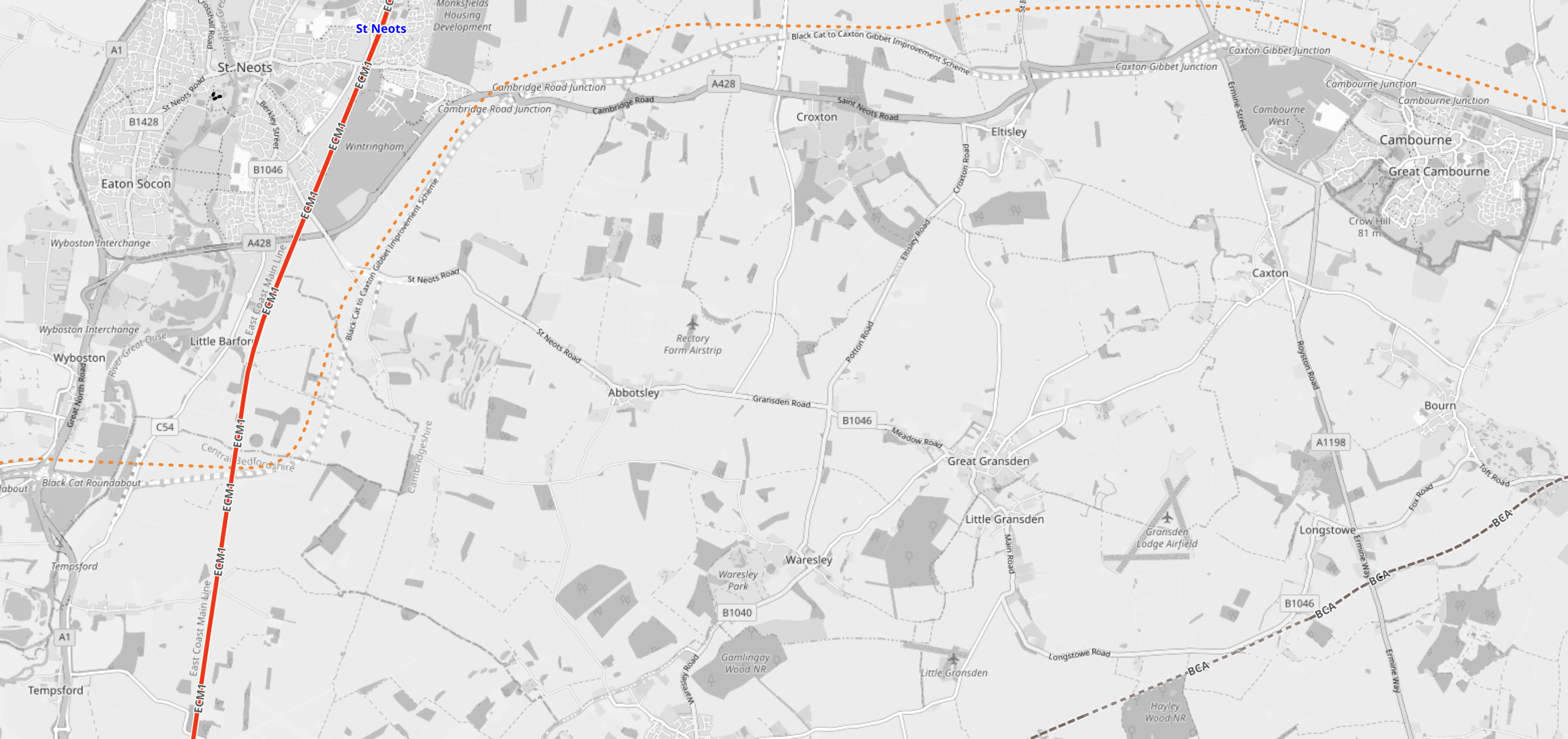
Note.
- The dotted red line across the top of the map will be the route of the East-West Rail.
- Tempsford station is in the South-West corner of the map on the route of the East-West Rail.
- The red track on the West side of the map is the East Coast Main Line.
- Cambourne is the village in the North-East corner of the map.
The Diesel-Hybrid 141 Buses Always Seem To Get Through
Today, I had an all-too-typical bus-rid back from Moorgate after breakfast and a bit of shopping.
My direct bus is a 141, which is a second-rate, Chinese BYD bus, which has a number of problems as I pointed out in My 78-Year-Old Legs Are More Reliable Than The New Chinese Buses On London’s 141 Bus Route.
- I just missed a 141, so I caught the next bus that was going my way.
- It was a New Routemaster on the 76 route, so I took a chance, that it might pass the previous 141 bus, as they often do.
- As we passed Moorfield’s Eye Hospital, we passed the 141, but it was stopped at the side of the road, with all its lights flashing.
- I decided to change two stops from home and left two stops from home, from where I could walk.
- I waited perhaps five minutes before an elderly Wrightbus diesel-hybrid arrived to take me home,
After today’s experience, I can’t help but remember the old joke!
- Question: What’s red and lies in the gutter?
- Answer: A dead bus!
Other colours are available.
East West Rail Train Door Row May See Launch Delayed
The title of this post, is the same as that of this article on the BBC.
This is the sub-heading.
The launch of a new £7bn railway faces being delayed because of a row over who will control the opening and closing of carriage doors.
These three paragraphs add more details.
The BBC understands train operator Chiltern Railways is in a standoff with the Rail, Maritime and Transport (RMT) union, which represents train guards, over how East West Rail services between Oxford and Milton Keynes will run.
The RMT said the operator wants train drivers to open and close the doors at stations, with no guards required.
Passenger trains were scheduled to start running between Oxford and Milton Keynes for the first time in nearly 60 years by the end of December.
I suspect that the unions won’t be satisfied until all trains in the UK have a crew of two.

