Proposals Submitted To Create Darlington To Dales Rail Link
The title of this post, is the same as that of this article on the Durham County Council web site.
These paragraphs outline the proposals.
The proposals will focus on development of the Darlington-Dales corridor, improving the connectivity of towns and villages along the Weardale line. It will also review the possibility of providing a link to Crook.
This new rail link would support economic development along the Darlington-Dales corridor, helping to attract visitors and boost spend in these areas by connecting tourism sites including Hamsterley Forest, Bishop Auckland town centre, the Durham Dales, and the Weardale Railway.
The enhanced rail connectivity would also enable residents to access wider education and job opportunities, while reducing the environmental impact of the county’s transport system by providing an alternative to cars.
It looks at first glance to be practical proposals, that could be easily achieved without spending a fortune.
As Teesside has a plentiful supply of hydrogen and is even planning a depot for hydrogen trains, what would new Alstom Aventra hydrogen trains between Weardale and Saltburn via Darlington, do for tourism in the area?
BP Plans To Turn Teesside Into First Green Hydrogen Hub
The title of this post, is the same as that of this article in The Times.
This is the first paragraph.
BP plans to build Britain’s biggest “green hydrogen” facility on Teesside to produce the clean fuel for use in new hydrogen-powered lorries and other transport.
Note.
The plans appear to be ambitious starting with a £100 million investment to build a 60 MW electrolyser by 2025, which would rise to as much as 500 MW by 2030.
The electrolyser will be paired with an upwards of a billion pound one gigawatt facility called H2Teesside, that will produce blue hydrogen.
I think there could be more to this than meets the eye.
Using The Carbon Dioxide Rather than Storing It!
I followed the carbon dioxide pipe from the CF fertiliser plant on Teesside using Google maps after seeing a film about it on the BBC. It goes to the Quorn factory and a massive greenhouse. I do wonder, if BP is talking to other companies, who also have a need for large quantities of good quality carbon dioxide.
One could be an Australian company, called Mineral Carbonation International, who have developed a process to convert carbon dioxide into building products like blocks and plasterboard. MCI won a prize at COP26, so could BP be looking at integrating one of these plants into their complex on Teesside?
The Electrolysers
Will BP be purchasing their electrolysers for green hydrogen from ITM Power in Sheffield?
This press release from ITM Power is entitled 12MW Electrolyser Sale.
The customer is not named, but could this be a starter kit for BP?
Alstom’s Hydrogen Aventras
In Alstom And Eversholt Rail Sign An Agreement For The UK’s First Ever Brand-New Hydrogen Train Fleet, I came to this conclusion.
This modern hydrogen train from Alstom is what is needed.
I also felt there could be three similar trains; electric, battery-electric and hydrogen, which would help operators hedge their bets on what type of traction to use.
Teesside must be one of the more likelier places where the Hydrogen Aventras will be carrying passengers.
I wrote about this possibility in Alstom Hydrogen Aventras And Teesside.
A deal between BP and Alstom would surely be in the interest of both companies.
- Alstom would get a local hydrogen supply.
- BP would get a first sale.
- BP would get excellent publicity and a local demonstration of the possibilities of hydrogen.
It might even be possible to supply the hydrogen by pipeline.
More On Alston’s Hydrogen Aventra and Porterbrook’s HydroFLEX
The December 2021 Edition of Modern Railways has a small article, which is entitled Alstom To Build Hydrogen Aventras.
This is an extract.
Fuel cells will be roof-mounted, and the trains will be powered by hydrogen in conjunction with batteries, without any additional power sources such as overhead electric or diesel. They could be in service in 2025.
I am surprised that the trains can’t use electrification, as surely this would be a great advantage.
Especially, as according to another article, which is entitled New HydroFlex Debuts At Cop, which describes Porterbrook’s converted ‘319’ says this.
The original HydroFlex unit, which like the latest version has been converted from a Class 319 EMU, made its main line debut in September 2020. Porterbrook has invested £8 million in HydroFlex with the new version built over the last 10 months.
Porterbrook says its ability to operate under hydrogen, electric and battery power makes it the world’s first ‘tri-mode’ train. One carriage within the train is given over to the ‘HydroChamber’.
The contents of the ‘HydroChamber’ are given as.
- Storage for 277 Kg. of hydrogen in thirty-six high pressure tanks.
- A 400 kW fuel cell system.
- A 400 kW lithium-ion battery, which can be charged by the fuel cells in 15 minutes.
Does this mean that the battery is a 100 kWh battery that can supply energy at a rate of 400 kW?
This sentence from the article describes the train’s performance.
Porterbrook says the train carries sufficient hydrogen to offer a range of 300 miles and a top speed of up to 100 mph.
A few years ago, I had a chat with a Northern driver about the Class 319 train, which he described as a fast train with good acceleration and superb brakes.
Have Porterbrook and the University of Birmingham just added the ‘HydroChamber’ as an on-board electricity source or have they gone for a full integrated system with new traction motors and regenerative braking to the battery?
The original Class 319 trains worked well without regenerative braking, so I suspect that the simple approach has been used.
But this would make the train ideal for branch lines and extensions without electrification from electrified lines. The following routes come to mind.
- Blackpool South and Colne via Preston
- Manchester Airport and Windermere
- Ipswich and Felixstowe.
- The Borders Railway in Scotland.
The Alstom Hydrogen Aventra might be better on lines without any electrification at all.
Conclusion
My feeling is that both these trains have their good points and limitations and I suspect both will find their niche markets.
Is The Alstom Hydrogen Train Powered By A Fuel Cell?
In Alstom And Eversholt Rail Sign An Agreement For The UK’s First Ever Brand-New Hydrogen Train Fleet, I mentioned that Alstom’s Hydrogen Aventra could be powered by either a small gas turbine or a fuel cell or cells, but I didn’t plump for one or the other. I said this.
If you look at the proportions of the Alstom hydrogen train and the pictures of Class 710 trains, I feel that the Alstom train could have the longer twenty-four metre cars.
It may be a tight fit compared to creating the Alstom Coradia iLint hydrogen train, but I would feel it is possible to install a fuel cell or cells, the required cooling and the hydrogen tanks, having seen cutaway drawings of hydrogen-powered double-deck buses on the Wrightbus web site.
Interestingly, the Alstom press release doesn’t mention fuel cells, so could the train be powered by a small gas turbine?
I think it is unlikely, but it is technically feasible.
I had forgotten one important factor. Both the Aventra factory and Rolls-Royce are in Derby and I know from talking to a retired British Rail engineer, that there is a lot of contact between the two companies at an informal level.
Rolls-Royce have published this picture of their beer keg-sized generator.
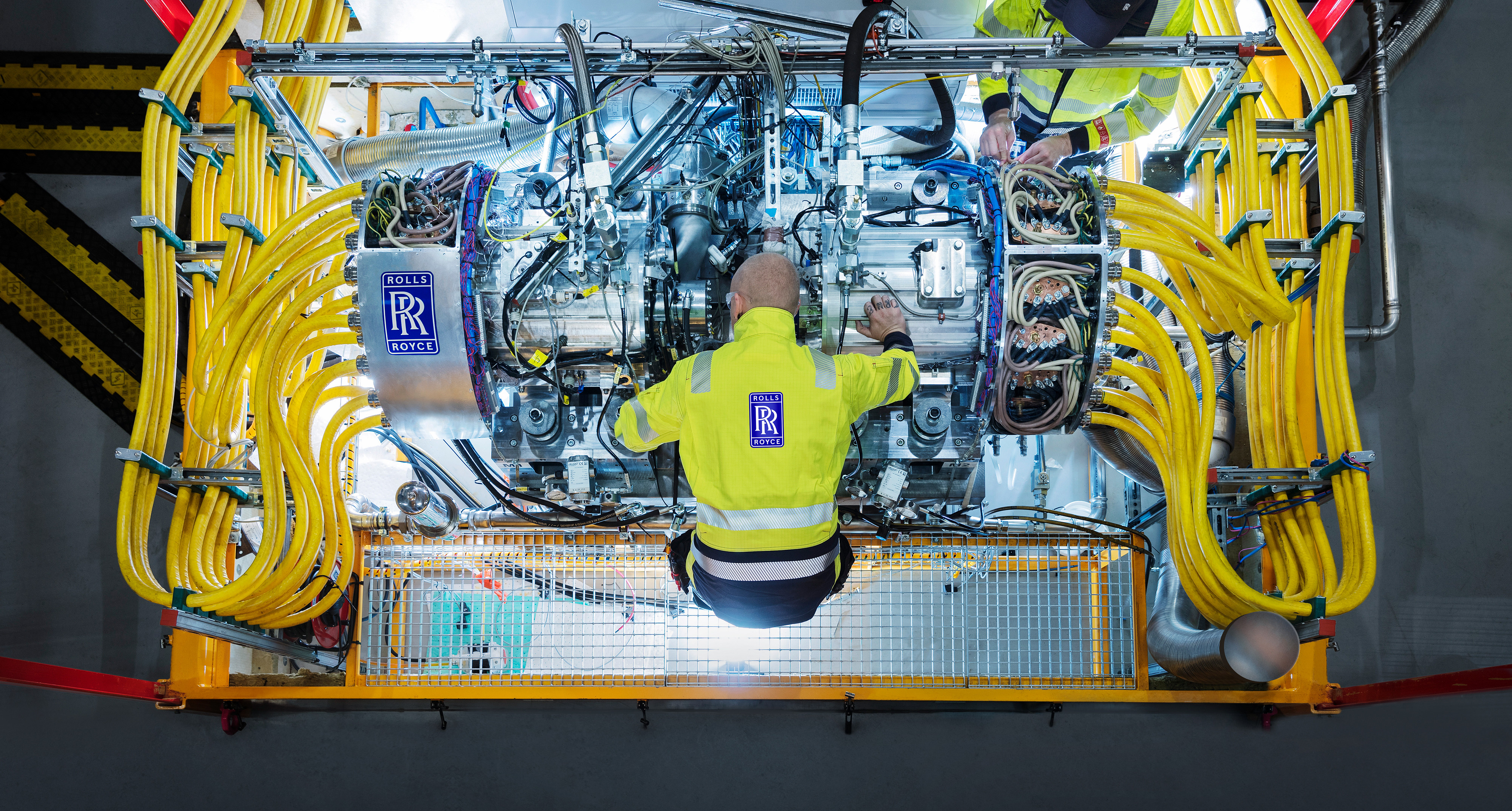
Would it need the cooling system, which appears to be needed with a fuel-cell?
The Rolls-Royce Advantage
There would surely be advantages in using a Rolls-Royce gas turbine to power the train.
- Having a Rolls-Royce power unit must help sales of your plane or train.
- There is the Derby connection.
- Alstom already deal with Rolls-Royce subsidiary; MTU for diesel engines for freight locomotives.
Could we be seeing a hydrogen multiple unit powered by a gas turbine?
Alstom Hydrogen Aventras And Teesside
In Alstom And Eversholt Rail Sign An Agreement For The UK’s First Ever Brand-New Hydrogen Train Fleet, I give my thoughts on Alstom’s new hydrogen train, which I have called the Alstom Hydrogen Aventra.
Would this train be suitable for the local railways around Teesside?
Fuelling The Change On Teesside Rails is a post based on an interview with Tees Valley Mayor; Ben Houchen in Rail Magazine.
Teesside is getting ready for hydrogen.
- They have identified a site for a specialist depot for hydrogen-powered trains.
- There is plenty of hydrogen available from chemical works in the area.
All they need is some trains and I think the Alston Hydrogen Aventras would fill the need admirably.
I also believe that with its history of heavy industry, steel and chemicals, the residents of Teesside and the Tees Valley would take to hydrogen trains.
I wrote Fuelling The Change On Teesside Rails in January 2020 and since then the Department of Transport has funded a study to examine the extension of the Tees Valley Line past Bishop Auckland, which I wrote about in Reopening The Darlington – Weardale Line To Passenger Services.
On the subject of rolling stock for the Weardale Line, I said this in the Weardale Line post.
There is no point in extending the line in these days of global warming without providing zero-carbon trains.
The Tees Valley Combined Authority is keen on hydrogen and there are good reasons.
-
- There is hydrogen available from chemical plants on Teesside.
- Hydrogen will give the trains a long range.
- The trains would probably only need refuelling once a day.
- In addition, Alstom are looking for an order for their Class 600 train, which is a conversion of a Class 321 train.
But I have my doubts about Alstom’s trains and Hitachi have doubts about hydrogen.
Consider.
-
- Do you really want to run hydrogen trains on a line where steam trains run?
- Darlington station is fully-electrified and it is also to be remodelled for more capacity and High Speed Two.
- Bishop Auckland and Darlington is just twelve miles.
- Darlington and Saltburn is just thirty miles.
With charging systems at Bishop Auckland, Saltburn and Stanhope, I am fairly sure Hitachi could develop an electric train for Teesside’s railways.
When I wrote the Weardale Line post, I was veering towards the Hitachi battery-electric trains, but the launch of the Alstom Hydrogen Aventra may have changed that.
Conclusion
The new trains for Teesside could become a fight between Hitachi with their battery-electric trains and Alstom with their Hydrogen Aventras.
If there is a fight of the technologies, who wins on Teesside could be important in deciding the future of world-wide rail transport.
Is it slightly ironic, that this battle could be happening close to the birthplace of railways?
Alstom Hydrogen Aventras And The Reopened Northumberland Line
In Alstom And Eversholt Rail Sign An Agreement For The UK’s First Ever Brand-New Hydrogen Train Fleet, I give my thoughts on Alstom’s new hydrogen train, which I have called the Alstom Hydrogen Aventra.
Would this train be suitable for the Northumberland Line?
This is a caption to a picture in this article on the BBC, which is entitled Northumberland Line: Railway ‘Could Create Economic Powerhouse’.
The Northumberland Line could connect Blyth and Newcastle with half hourly services and journey times of under 25 minutes.
This timetable would mean that between two and four trains would be needed to provide the service.
In my posts on the Northumberland Line, I show a strong preference for battery-electric trains and in particular those proposed by Hitachi, which would be built in their factory at Newton Aycliffe, which is a dozen miles to the South. These trains would have batteries produced by Hyperdrive Innovation in Sunderland.
I dismissed hydrogen trains, as until this week no viable new hydrogen train for the UK rail network had been proposed.
But this week, Alstom announced their hydrogen-powered Aventra.
I suspect a small fleet of these trains could work the Northumberland Line.
My only reservation would be that their operating speed was in line with the speed needed on the short sections of the East Coast Main Line used by the Northumberland Line service.
Alstom Hydrogen Aventras And Extension Of The Birmingham Cross-City Line
In Alstom And Eversholt Rail Sign An Agreement For The UK’s First Ever Brand-New Hydrogen Train Fleet, I give my thoughts on Alstom’s new hydrogen train, which I have called the Alstom Hydrogen Aventra.
In that post, decide that the proposed Alstom Hydrogen Aventras are based on the three-car Class 730/0 trains that have been ordered by West Midlands Trains for Birmingham’s electrified Cross-City Line.
I then go on to say.
There are plans to expand the line in the future and I do wonder if the proposed Alstom Hydrogen Aventras could be the ideal trains for extending the network.
Expansion plans are detailed a section called Future, in the Wikipedia entry for the Cross-City Line, where these plans are indicated.
- Reintroduction of local trains on the Camp Hill Line.
- Extension of electrification and services to Burton-on-Trent via a reopened Alrewas station, which would serve the National Memorial Arboretum.
In addition, the Walsall and Wolverhampton Line is being reopened to passenger trains.
These new and possibly other services will need no new tracks, but more electrification and extra new trains.
In 2015, I wrote Electrification May Be In Trouble Elsewhere, But The Brummies Keep Marching On, which looked at electrification progress in the UK and the Birmingham in particular, where the electrification of the Chase Line seemed to be going well. So unlike in some places, where electrification seems to be accident-prone, Birmingham seems to avoid the sort of problems, that happened in the Preston and Blackpool and GOBlin electrifications.
But the Alstom Hydrogen Aventra gives Birmingham and the West Midlands a unique advantage compared to say Leeds or Manchester.
Birmingham can obtain a unified fleet, which to the passengers and the drivers looks the same, but in fact are two separate classes of three-car trains; the Class 730/0 electric train and the Alstom Hydrogen Aventra.
- Where electrification exists, the Class 730/0 trains will be used and where there is no electrification, the Alstom Hydrogen Aventra will work the route on hydrogen.
- All that is needed is to provide good tracks and signalling and the Alstom Hydrogen Aventras will take you where you want to go.
- Through the centre of Birmingham, these trains will use the existing electrification.
- It would be a network, that would be simple to expand.
The only other English city to use a similar technique will be Liverpool, where Merseyrail’s new Class 777 trains will use battery power outside of the electrified core.
Conclusion
If Birmingham uses their disused but still existing railway lines and adds new trains as required, they can create a world-class suburban network, with the Cross-City Line at its centre
Alstom Hydrogen Aventras And Great Western Branch Lines Between Paddington And Oxford
In Alstom And Eversholt Rail Sign An Agreement For The UK’s First Ever Brand-New Hydrogen Train Fleet, I give my thoughts on Alstom’s new hydrogen train, which I have called the Alstom Hydrogen Aventra.
One reader suggested these lines in a comment, as they are all run by diesel Class 165 trains.
These are the lines, that could be converted to Hydrogen operation.
Greenford Branch
The branch runs between West Ealing and Greenford via Drayton Green, Castle Bar Park and South Greenford.
- It has a frequency of two trains per hour (tph).
- The branch is 2.5 miles long.
- Services take eleven minutes.
- It needs a single train to run the service.
Note.
- In GWR To Test Battery Train On Branch Line, I wrote about Great Western Railway’s plans to test battery-eclectic trains on this line.
- The platform at Greenford station may need lengthening to accommodate the Alstom Hydrogen Aventra.
- It is my view that the branch needs four tph.
- It might also be possible to run Peak hour services to and from Paddington.
I do think that if the train length issue is solved that a single Alstom Hydrogen Aventra could work this branch.
A two-car Class 230 train would certainly fit.
Windsor Branch
The branch runs between Slough and Windsor & Eton Central.
- It has a frequency of three tph
- The branch is 2.8 miles long.
- Services take six minutes.
- It needs a single train to run the service.
Note.
- The extra capacity of the Alstom Hydrogen Aventra could be welcome.
- Prince Charles would like it.
I do think that a single Alstom Hydrogen Aventra could work this branch.
Marlow Branch
The branch runs between Maidenhead and Marlow via Furze Platt, Cookham and Bourne End.
- It has a frequency of one tph
- The branch is 7.1 miles long.
- Services take twenty-three minutes.
- The service reverses at Bourne End.
- It needs a single train to run the service.
Note that the three-car Alstom Hydrogen Aventra may be too long to execute the reverse at Bourne End.
I do think that if the Bourne End problem can be solved that a single Alstom Hydrogen Aventra could work this branch.
The two-car Class 165 train, that currently works the branch is 46 metres long, so a two-car battery-electric train may be needed for this branch. A two-car Class 230 train would certainly fit.
Regatta Line
The branch runs between Twyford and Henley-on-Thames via Wargrave and Shiplake.
- It has a frequency of two tph
- The branch is 4.6 miles long.
- Services take twelve minutes.
- It needs a single train to run the service.
Note.
- If this line needed more capacity trains could be doubled up, as there are no length issues.
- It might also be possible to run Peak hour services to and from Paddington.
I do think that a single Alstom Hydrogen Aventra could work this branch.
North Downs Line
The line runs between Reading and Gatwick Airport via Wokingham, Crowthorne, Sandhurst, Blackwater, Farnborough North, North Camp, Ash, Guildford, Shalford, Chilworth, Gomshall, Dorking West, Dorking Deepdene, Betchworth, Reigate and Redhill
- It has a frequency of two tph
- The route is 53.1 miles long.
- The route is partially-electrified with 750 VDC third-rail electrification.
- The route has been planned for 100 mph trains.
- Services take eighty-two minutes.
- It needs six trains to run the service.
Note.
- The route is proposed to be run by four-car Class 769 bi-mode trains.
- Would a three-car train be sufficient for this route?
- The Alstom Hydrogen Aventras are only 90 mph trains and would they be fast enough?
I do think that Alstom Hydrogen Aventras could work this route, but given the number of trains and possible capacity and speed issues, a four-car battery-electric train could be better suited to the route.
Reading And Basingstoke Line
This line runs between Reading and Basingstoke via Reading West, Mortimer and Bramley
- It has a frequency of two tph
- The route is 15.4 miles long.
- There is 25 KVAC overhead electrification at Reading.
- There is 750 VDC third-rail electrification at Basingstoke, but the platform used by the service is unelectrified.
- The route has been planned for 100 mph trains.
- Services take twenty-eight minutes.
- It needs two trains to run the service.
Note.
- For a battery-electric train to work this route, it might need a charging system at Basingstoke.
- The Alstom Hydrogen Aventras are only 90 mph trains and would they be fast enough?
I do think that a pair of Alstom Hydrogen Aventras could work this service.
Oxford Canal Line
This route runs between Didcot Psrkway and Banbury via Appleford, Culham, Radley, Oxford, Tackley, Heyford and Kings Sutton.
- It is effectively two routes with a combined frequency of two tph between Didcot Junction and Oxford and half that between Oxford and Banbury.
- The full route is 33 miles long.
- There is 25 KVAC overhead electrification at Didcot Parkway.
- Services take forty-one minutes.
- It probably needs four trains to run the service.
I do think that a small fleet of Alstom Hydrogen Aventras could work this service.
Some General Thoughts
These are a few general points.
Stabling And Hydrogen Fuelling
Reading Train Care Facility is a large depot to the west of Reading.
- It is ideally placed for all the lines, that I’ve mentioned.
- It is connected to all the lines by electrified lines.
I am sure that it would be possible to build a hydrogen fuelling facility at the depot.
Two-Car Battery-Electric Trains
It looks like the Greenford and Marlow Branches might need to be served by two-car battery-electric trains.
Four-Car Trains
Some of the services might be run by four-car trains, as these would be more suitable for the number of passengers.
Total Number Of Trains
My rough estimates of numbers of trains are as follows.
- Greenford Branch – 1 train
- Windsor Branch – 1 train
- Marlow Line – 1 train
- Regatta Line – 1 train
- North Downs Line – 6 trains
- Reading And Basingstoke Line – 2 trains
- Oxford Canal Line – 4 trains
This would be a total of sixteen trains or ten, if the Class 769 trains were used on the North Downs Line.
Additional Routes
There may be other routes, where the trains could be used, that are handy for Reading Train Care Facility.
Hydrogen or battery power may give advantages in opening new routes.
Would Hydrogen Trains Attract Passengers And Tourists?
I think they could, as if nothing there is a curiosity value.
Conclusion
This collection of routes surround Reading Train Care Facility and would be a nice package to run with hydrogen or battery-electric trains.
Alstom Hydrogen Aventras And The Uckfield Branch
In Alstom And Eversholt Rail Sign An Agreement For The UK’s First Ever Brand-New Hydrogen Train Fleet, I give my thoughts on Alstom’s new hydrogen train, which I have called the Alstom Hydrogen Aventra.
One possible route for the trains could be the Uckfield Branch, which has an hourly service from London Bridge via East Croydon and Oxted stations?
- The route is forty-six miles long, with the Northernmost twenty-one miles electrified with 750 VDC third-rail electrification.
- On each trip, the train would need to run for fifty miles without electrification.
- There are seven stops on the route.
- The platforms on the Uckfield Branch can handle a 240 metre train.
- Trains take around three hours for the round trip.
- Each train probably does around five round trips per day.
So would Alstom Hydrogen Aventras be able to work the route?
- The length of a three-car Alstom Hydrogen Aventra is probably around 72 metres.
- Three Alstom Hydrogen Aventras working together would be 216 metres.
- Aventras can be configured to work on 750 VDC third rail electrification.
- The capacity of a nine-car formation of Alstom Hydrogen Aventra would be similar to that of a ten-car Electrostar, which has shorter cars.
Three Alstom Hydrogen Aventra trains working together could seem to be a possible solution for the route.
These are my thoughts.
The Required Range
If each train has to do five round trips, with each needing fifty miles on hydrogen, the trains would need a range in excess of 250 miles, whilst running on hydrogen.
Refuelling With Hydrogen
This would probably be done at a depot setup to service the hydrogen trains, where they would be stabled at night.
I doubt that London Bridge or Uckfield stations would be suitable places to refuel
The Number Of Trains
In Battery Electrostars And The Uckfield Branch, I estimated that three ten- or twelve-car trains would be needed to run an hourly service. Running half-hourly would need six trains.
As each nine-car train would need three Alstom Hydrogen Aventras, an hourly service would need a total of nine and a half-hourly service would need eighteen individual trains.
I suspect that this would not be a cost effective way of using the trains, as a lot of trains would need to refuelled every day.
Conclusion
I am not saying that Alstom Hydrogen Aventras couldn’t work the Uckfield Branch, but I’m sure there are are better ways to decarbonise the route.

