First Hydrogen Train Arrives In The Netherlands
The title of this post is the same as that on this article of Railway News.
This is the introductory paragraph.
On 26 February the first hydrogen train arrived in the Netherlands. The Dutch rail infrastructure manager ProRail led the train into the country from Germany via Oldenzaal and then ran it on track to its provisional parking facility in Leeuwarden.
The article also says this.
The public will also have the chance to view the hydrogen train on 7 March, when it will be at Groningen Station between noon and 4pm.
I won’t be going, as I’ve ridden the train in Germany as I reported in My First Ride In An Alstom Coradia iLint.

These trains are technology demonstrators at best and greenwash at worst.
Hydrogen power needs a radical new design of train and not a quick rehash of an existing design.
The problem is that the Coradia iLint is based on a diesel mechanical train and it has a lot of transmission noise.
You get less noise and vibration in the average British-Rail era diesel multiple unit like a Class 156 train. But then these are diesel hydraulic, have steel-bodies and built thirty years ago.
When I first saw the iLint, I looked for the pantograph, as these trains run on partially-electrified lines and hydrogen-powered trains are effectively electric trains with a different source of electricity.
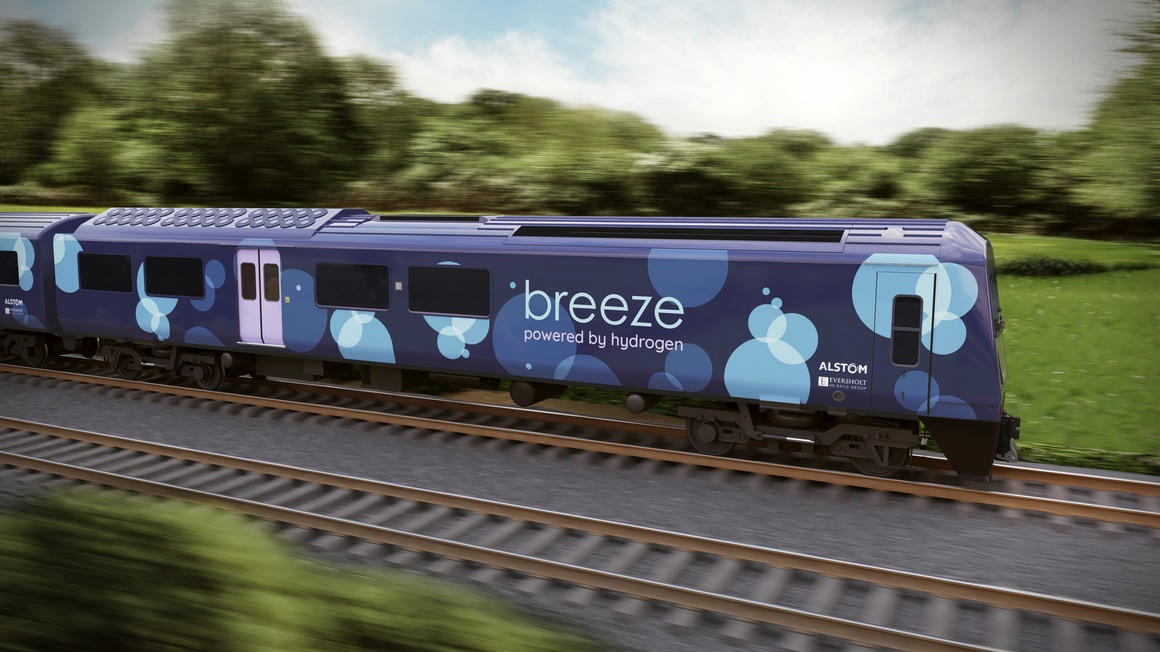
To be fair to Alstom, their development of the hydrogen-powered Class 321 Breeze, will also be able to use a pantograph, but as this visualisation shows, the hydrogen tanks take up a lot of space.
Hydrogen might find itself a place on the railways, but I suspect that battery-electric will always be better for passenger trains.
- Battery technology will improve faster than hydrogen technology.
- Innovators will find better ways of fast-charging trains.
- A battery-electric train will match the daily range of a hydrogen-powered train, using innovative dynamic charging.
- Many modern electric trains can be converted into battery-electric ones.
- As the Class 379 BEMU trial, this conversion can be relatively easy, quick and successful.
I suspect though, the mathematics will be different for freight locomotives.
Akiem Acquires Macquarie European Rail Fleet
The title of this post is the same as that of this article on Railway Gazette.
This is the introductory paragraph.
Leasing company Akiem Group has signed a definitive agreement to acquire Macquarie European Rail’s rolling stock leasing business, subject to regulatory approval.
Included in the deal are thirty Class 379 trains, currently used on the Stansted Express and soon to be replaced by new Class 745 trains.
Because of the lack of any published plans about where the Class 379 trains will be cascaded, I have been wondering if there is something wrong with the trains or perhaps their owner.
As the latter looks now to be changing from Macquarie to Akiem, perhaps we’ll hear some news on what is happening to the Class 379 trains.
I still feel the Class 379 trains would make excellent battery-electric trains, possibly for an airport service.
But which train operating company would need a fleet of thirty four-car electric trains?
Most have now sorted their fleet requirements and when Bombardier get their production working smoothly, perhaps with Alstom’s backing, there will be more trains being delivered to train operating companies.
But there is one fleet replacement, where battery-electric Class 379 trains may be ideal; the replacement of South Western Railway (SWR)‘s fleet of Class 158 and Class 159 trains.
Consider.
- 10 x two-car Class 158 trains and 30 x three-car Class 159 trains could be replaced by 30 x four-car Class 379 trains, which would be a near ten percent increase in carriages.
- 90 mph diesel trains, that were built in the 1990s, will be replaced by 100 mph battery-electric trains, that are not yet ten years old.
- The Class 379 trains are Electrostars and fitting third-rail shoes, will be straight out of Bombardier’s parts bins.
- Waterloo station will become another diesel-free London terminus.
- Fellow French company; Alstom could step in to the picture with their battery knowledge from other products like the iLint hydrogen train and convert the trains at Widnes or one of their other maintenance depots.
- South Western Railway and Akiem would need to procure a charging system and could probably do worse than see what Vivarail or Furrer + Frey can supply!
How would the Class 379 battery-electric trains handle various services?
London Waterloo To Salisbury And Exeter St. Davids
The most difficult service to run, would be the London Waterloo and Exeter St. Davids service via Salisbury.
Note that when SWR bid for the franchise, they promised to knock ten minutes off the time to Exeter and they will need 100 mph trains for that!
With climate change in the news, only a hardline climate-change denier would buy 100 mph diesel trains.
In Are Hitachi Designing the Ultimate Battery Train?, I suggested how Waterloo and Exeter could be run with a battery-electric train, with a range of around sixty miles on battery power.
- Use existing electrification, as far as Basingstoke – 48 miles
- Use battery power to Salisbury – 83 miles
- Trains can take several minutes at Salisbury as they often split and join and change train crew, so the train could be fast-charged, at the same time.
- Use battery power to the Tisbury/Gillingham/Yeovil/Crewkerne area, where trains would be charged – 130 miles
- Use battery power to Exeter- 172 miles
Note.
- The miles are the distance from London.
- The charging at Salisbury could be based on Vivarail’s Fast-Charging or traditional third-rail technology.
- The charging around Yeovil could be based on perhaps twenty miles of third-rail electrification, that would only be switched on, when a train is present.
- Charging would also be needed at Exeter for the return journey.
I estimate that there could be time savings of up to fifteen minutes on the route.
London Waterloo To Salisbury And Bristol Temple Meads
This service in run in conjunction with the Exeter St. Davids service, with the two trains joining and splitting at Salisbury.
As Salisbury and Bristol Temple Meads is 53 miles, it looks like this service is possible, providing the following conditions are met.
- The Class 379 train has a sixty mile range on battery power.
- The train can charge at Bristol Temple Meads, perhaps by using the 25 KVAC overhead electrification.
- The Class 379 trains can join and split with the with amount of alacrity.
Note that there may be other places, where a tri-mode capability might be useful.
Exeter And Axminster
This shorter trip is thirty miles and if the battery range is sufficient, it could probably be run by a Class 379 train, charged at Exeter.
If necessary, a method of charging could be provided at Axminster.
Romsey And Salisbury Via Southampton Central
This route is partially electrified and it looks like a battery-electric train with a sixty mile range could run the service without any extra infrastructure.
If Salisbury, gets a charging system, then this service might be used to ensure a reliable or extended service.
Portsmouth Harbour And Basingstoke And Portsmouth Harbour and Southampton Central
These two services could be run by Class 379 trains running using the electrification.
London Or Wareham and Corfe Castle
This Summer Saturday-only service is an ideal one for a battery-electric train.
New Services
There are also other branches that could be reopened, like those to Ringwood and Hythe, that could be worked by battery-electric trains.
Conclusion
It will be very interesting to see where the Class 379 trains end up.
But my money’s on them replacing South Western Railways, diesel trains, after conversion to battery-electric trains.
- Only limited infrastructure works will need to be done.
- South Western Railway will have more capacity.
- Passengers will get a faster service in a modern train.
- Waterloo will become a diesel-free station.
But most importantly, South Western Railway will have an all-electric fleet.
Fuelling The Change On Teesside Rails
The title of this post, is the same as that of an article in Edition 895 of RAIL Magazine.
The article is based on an interview with Ben Houchen, who is the Tees Valley Mayor.
Various topics are covered.
Hydrogen-Powered Local Trains
According to the article, the Tees Valley produces fifty percent of UK hydrogen and the area is already secured investment for fuelling road vehicles with hydrogen.
So the Tees Valley Combined Authority (TVCA) is planning to convert some routes to hydrogen.
The Trains
Ten hydrogen-powered trains will be purchased or more likely leased, as the trains will probably be converted from redundant electrical multiple units, owned by leasing companies like Eversholt Rail and Porterbrook.
- Eversholt Rail and Alstom are developing the Breeze from Class 321 trains.
- Porterbrook and Birmingham University are developing the HydroFLEX from Class 319 trains.
The RAIL article says that the first train could be under test in 2021 and service could be started in 2022.
That would certainly fit the development timetables for the trains.
Lackenby Depot
A depot Will Be Created At Lackenby.
- The site is between Middlesbrough and Redcar.
- It already has rail and hydrogen connections.
This Google Map shows the area.
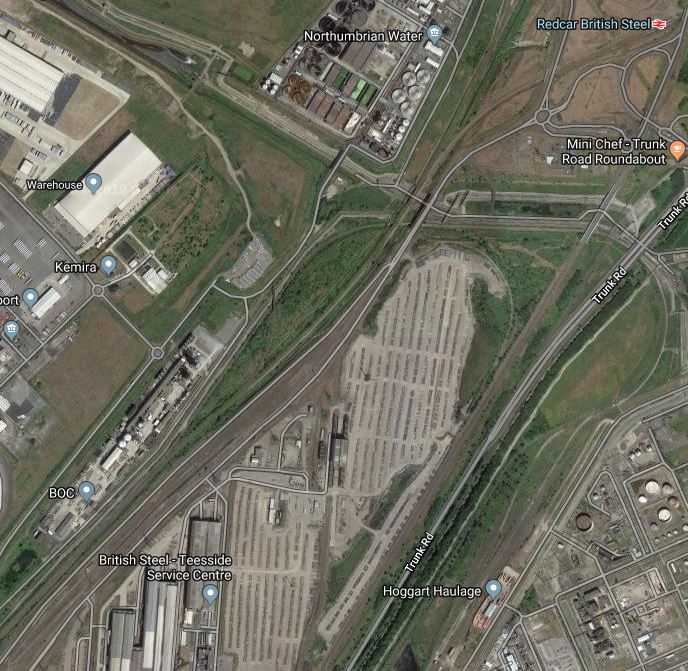
Note the disused Redcar British Steel station, which is still shown on the map.
I remember the area from the around 1970, when I used to catch the train at the now-closed Grangetown station, after visits to ICI’s Wilton site. It was all fire, smoke, smells and pollution.
Darlington Station
Darlington station will also be remodelled to allow more services to operate without conflicting with the East Coast Main Line.
Wikipedia says this under Future for Darlington station.
As part of the Tees Valley Metro, two new platforms were to be built on the eastern edge of the main station. There were to be a total of four trains per hour, to Middlesbrough and Saltburn via the Tees Valley Line, and trains would not have to cross the East Coast Main Line when the new platforms would have been built. The Tees Valley Metro project was, however, cancelled.
It does sound from reading the RAIL article, that this plan is being reinstated.
Would services between Bishop Auckland and Saltburn, use these new platforms?
Saltburn And Bishops Auckland Via Middlesbrough and Darlington
Currently, the service is two trains per hour (tph) between Saltburn and Darlington, with one tph extending to Bishop Auckland.
- I estimate that the current service needs five trains.
- If a two tph service were to be run on the whole route, an extra train would be needed.
- I suspect, the limitations at Darlington station, stop more trains being run all the way to Bishops Auckland.
I could also see extra stations being added to this route.
The Mayor is talking of running a service as frequent as six or eight tph.
These numbers of trains, will be needed for services of different frequencies between Saltburn and Darlington.
- 2 tph – 6 trains
- 4 tph – 12 trains
- 6 tph – 18 trains
- 8 tph – 24 trains
As the London Overground, Merseyrail and Birmingham’s Cross-City Line, find four tph a more than adequate service, I suspect that should be provided.
After updating, Darlington station, should be able to handle the following.
- Up to six tph terminating in one of the new Eastern platforms, without having to cross the East Coast Main Line.
- Two tph between Saltburn and Bishops Auckland could use the other platform in both directions.
I would suspect that the design would see the two platforms sharing an island platform.
Alternatively, trains could continue as now.
- Terminating trains could continue to use Platform 2!
- Two tph between Saltburn and Bishops Auckland stopping in Platforms 1 (Eastbound) and 4 (Westbound)
This would avoid any infrastructure changes at Darlington station, but terminating trains at Darlington would still have to cross the Southbound East Coast Main Line.
If the frequencies were as follows.
- 4 tph – Saltburn and Darlington
- 2 tph – Saltburn and Bishop Auckland
This would require fourteen trains and give a six tph service between Saltburn and Darlington.
Ten trains would allow a two tph service on both routes.
There would be other services using parts of the same route, which would increase the frequency.
Hartlepool And The Esk Valley Line Via Middlesbrough
This is the other route through the area and was part of the cancelled Tees Valley Metro.
- Service is basically one tph, with six trains per day (tpd) extending to Whitby.
- A second platform is needed at Hartlepool station.
- There is a proposal to add a Park-and-Ride station between Nunthorpe and Great Ayton stations.
- One proposal from Modern Railways commentator; Alan Williams, was to simplify the track at Battersby station to avoid the reverse.
- Currently, trains between Whitby and Middlesbrough are timetabled for around 80-100 minutes.
- Hartlepool and Middlesbrough takes around twenty minutes.
Substantial track improvements are probably needed to increase the number of trains and reduce the journey times between Middlesbrough and Whitby.
But I believe that an hourly service between Hartlepool and Whitby, that would take under two hours or four hours for a round trip, could be possible.
This would mean that the hourly Hartlepool and Whitby service would need four trains.
Providing the track between Nunthorpe and |Whitby could be improved to handle the traffic, this would appear to be a very feasible proposition.
Nunthorpe And Hexham Via Newcastle
There is also an hourly service between Nunthorpe and Hexham, via Middlesbrough, Stockton, Hartlepool, Sunderland and Newcastle, there would be two tph.
- It takes around two hours and twenty minutes.
- I estimate that five trains would be needed for the service.
- I travelled once between Newcastle and James Cook Hospital in the Peak and the service was busy.
- A new station is being built at Horden, which is eight minutes North of Hartlepool.
- The service could easily access the proposed fuelling station at Lackenby.
- It would reduce carbon emissions in Newcastle and Sunderland stations..
Surely, if hydrogen power is good enough for the other routes, then it is good enough for this route.
Hartlepool Station
Hartlepool Station could become a problem, as although it is on a double track railway, it only has one through platform, as these pictures from 2011 show.
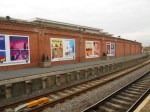
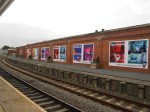
Consider.
- There is no footbridge, although Grand Central could pay for one
- There is a rarely-used bay platform to turn trains from Middlesbrough, Nunthorpe and Whitby.
This Google Map shows the cramped site.
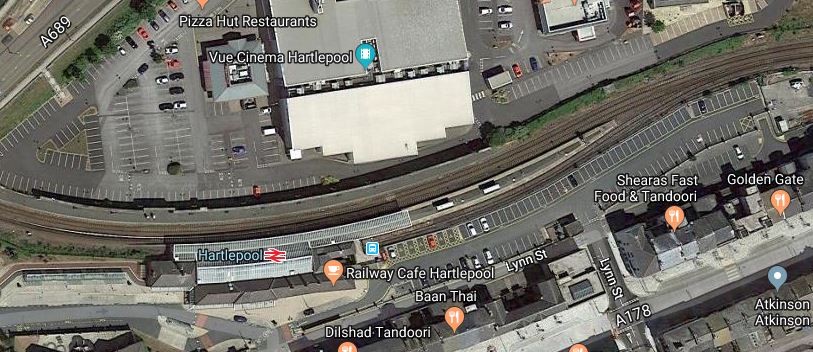
The final solution could mean a new station.
Nunthorpe Park-And-Ride
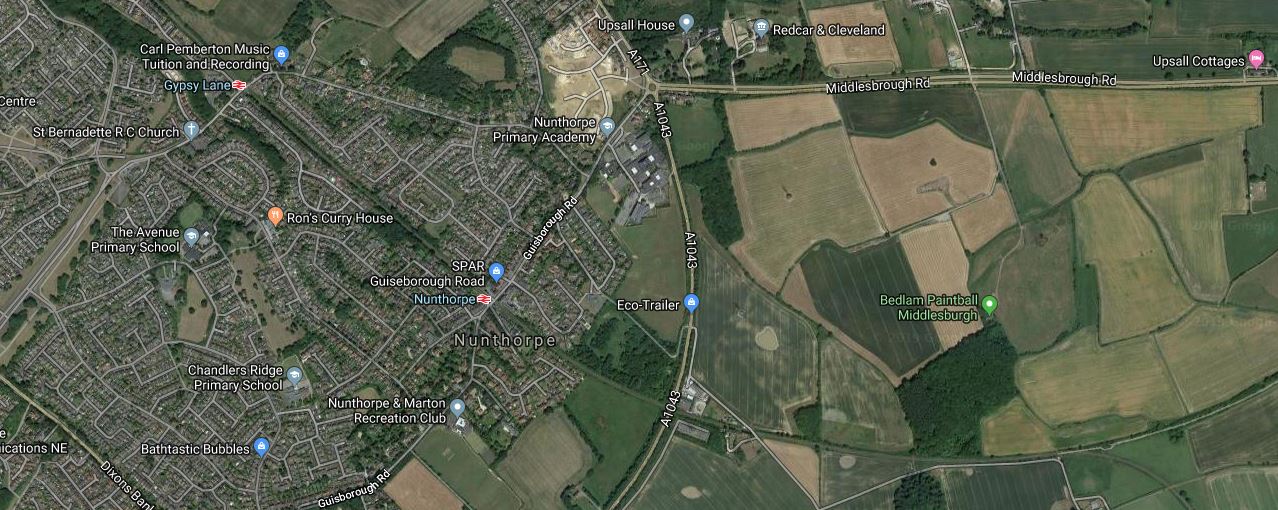
This Google Map shows Nunthorpe with thje bEsk Valley Line running through it.
Note.
- Gypsy Lane and Nunthorpe stations.
- The dual-carriageway A171 Guisborough by-pass running East-West, that connects in the East to Whitby and Scarborough.
- The A1043 Nunthorpe by-pass that connects to roads to the South.
Would where the A1043 crosses the Esk Valley Line be the place for the Park-and-Ride station?
The new station could have a passing loop, that could also be used to turn back trains.
Battersby Station
Alan Williams, who is Chairman of the Esk Valley Railway Development Company, is quoted in the RAIL article as saying.
If you’re going to spend that sort of money we’d much rather you spent it on building a curve at Battersby to cut out the reversal there.
Williams gives further reasons.
- Battersby is the least used station on the line.
- It’s in the middle of nowhere.
- The curve would save five minutes on the overall journey.
This Google Map shows Battersby station and the current track layout.

Note.
- The line to Middlesbrough goes through the North-West corner of the map.
- The line to Whitby goes through the North-East corner of the map.
There would appear to be plenty of space for a curve that would cut out the station.
LNER To Teesside
LNER, the Government and the TVCA are aiming to meet a target date of the Second Quarter of 2021 for a direct London and Middlesbrough service.
Middlesbrough Station
Middlesbrough Station will need to be updated and according to the RAIL article, the following work will be done.
- A new Northern entrance with a glass frontage.
- A third platform.
- Lengthening of existing platforms to take LNER’s Class 800 trains.
This Google Map shows the current layout of the station.
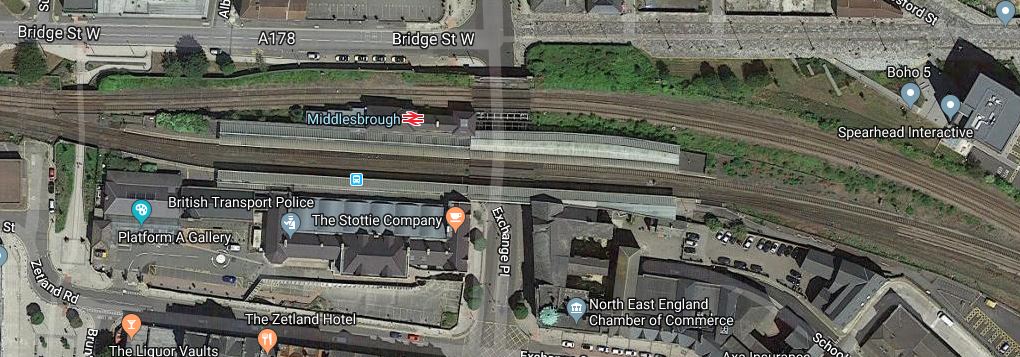
From this map it doesn’t look to be the most difficult of stations, on which to fit in the extra platform and the extensions.



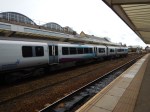
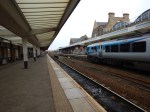
It should also be noted that the station is Grade II Listed, was in good condition on my last visit and has a step-free subway between the two sides of the station.
Journey Times
I estimate that a Kings Cross and Middlesbrough time via Northallerton would take aroud two hours and fifty minutes.
This compares with other journey times in the area to London.
- LNER – Kings Cross and Darlington – two hours and twenty-two minutes
- Grand Central – Kings Cross and Eaglescliffe – two hours and thirty-seven minutes.
I also estimate that timings to Redcar and Saltburn would be another 14 and 28 minutes respectively.
Frequencies
Currently, LNER run between three and four tph between Kings Cross and Darlington, with the competing Grand Central service between Kings Cross and Eaglescliffe having a frequency of five trains per day (tpd).
LNER have also started serving secondary destinations in the last month or so.
- Harrogate, which has a population of 75.000, is served with a frequency of six tpd.
- Lincoln, which has a population of 130,000 is now served with a frequency of six tpd.
Note that the RAIL article, states that the Tees Valley has a population of 750,000.
I feel that Middlesbrough will be served by a frequency of at least five tpd and probably six to match LNER’s new Harrogate and Lincoln services.
Will LNER’s Kings Cross and York Service Be Extended To Middlesbrough?
Cirrently , trains that leave Kings Cross at six minutes past the hour end up in Lincoln or York
- 0806 – Lincoln
- 0906 – York
- 1006 – Lincoln
- 1106 – York
- 1206 -Lincoln
- 1306 – York
- 1406 – Lincoln
- 1506 – York
- 1606 – Lincoln
- 1906 -Lincoln
It looks to me that a pattern is being developed.
- Could it be that the York services will be extended to Middlesbrough in 2021?
- Could six Middlesbrough trains leave Kings Cross at 0706, 0906, 1106, 1306, 1506 and 1706 or 1806?
- York would still have the same number of trains as it does now!
LNER certainly seem to be putting together a comprehensive timetable.
Could Middlesbrough Trains Split At Doncaster Or York?
I was in Kings Cross station, this afternoon and saw the 1506 service to York, go on its way.
The train was formed of two five-car trains, running as a ten-car train.
If LNER employ spitting and joining,, as some of their staff believe, there are surely, places, where this can be done to serve more destinations, without requiring more paths on the East Coast Main Line.
- Splitting at Doncaster could serve Hull, Middlesborough and York.
- Splitting at York could serve Scarborough, Middlesborough and Sunderland.
Scarborough might be a viable destination, as the town has a population of over 100,000.
Onward To Redcar And Saltburn
One of the changes in the December 2019 timetable change, was the extension of TransPennine Express’s Manchester Airport and Middlesbrough service to Redcar Central station.
The RAIL article quotes the Mayor as being pleased with this, although he would have preferred the service to have gone as far as Saltburn, which is a regional growth point for housing and employment.
But the extra six miles would have meant the purchase of another train.
Redcar Central Station
This Google Map shows Redcar Central station and its position in the town.
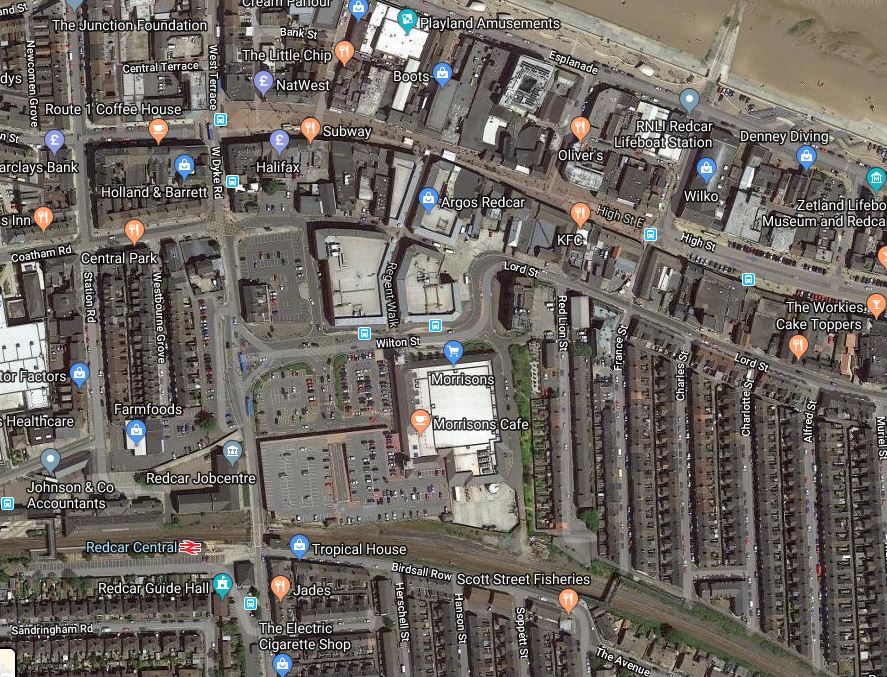
It is close to the sea front and the High Street and there appears to be space for the stabling of long-distance trains to Manchester Airport and perhaps, London.
TransPennine seem to be using their rakes of Mark 5A coaches on Redcar services, rather than their Class 802 trains, which are similar to LNER’s Azumas.
Surely, there will be operational advantages, if both train operating companies ran similar trains to Teesside.
Saltburn Station
Saltburn station is the end of the line.
This Google Map shows its position in the town.
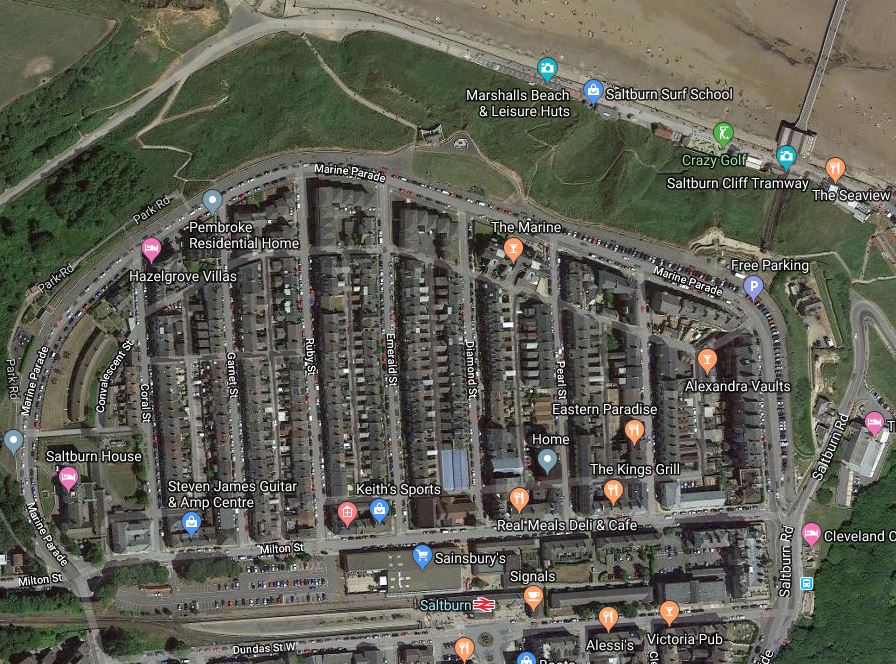
Unlike Redcar Central station, there appears to be very little space along the railway and turning back trains might be difficult.
There may be good economic reasons to use Saltburn as a terminal, but operationally, it could be difficult.
Will Redcar And Saltburn See Services To and From London?
Given that both towns will likely see much improved services to Middlesbrough, with at least a service of four tph, I think it will be unlikely.
But we might see the following.
- LNER using Redcar as a terminus, as TransPennine Express do, as it might ease operations.
- An early morning train to London and an evening train back from the capital, which is stabled overnight at Redcar.
- TransPennine Express using Class 802 trains on their Redcar service for operational efficiency, as these trains are similar to LNER’s Azumas.
It would all depend on the passenger numbers.
A High-Frequency Service Between York And Teesside
After all the changes the service between York and Teesside will be as follows.
- LNER will be offering a train virtually every two hours between York and Middlesbrough.
- Grand Central will be offering a train virtually every two hours between York and Eaglescliffe, which is six miles from Middlesbrough.
- TransPennine Express will have an hourly service between York and Redcar via Middlesbrough.
- There will be between three and four tph between York and Darlington.
All services would connect to the hydrogen-powdered local services to take you all over Teesside.
Could this open up tourism without cars in the area?
Expansion Of The Hydrogen-Powered Train Network
Could some form of Hydrogen Hub be developed at Lackenby.
Alstom are talking of the hydrogen-powered Breeze trains having a range of over six hundred miles and possibly an operating speed of 100 mph, when using overhead electrification, where it is available.
In Breeze Hydrogen Multiple-Unit Order Expected Soon, I put together information from various articles and said this.
I am fairly certain, that Alstom can create a five-car Class 321 Breeze with the following characteristics.
- A capacity of about three hundred seats.
- A smaller three-car train would have 140 seats.
- A near-100 mph top speed on hydrogen-power.
- A 100 mph top speed on electrification.
- A 1000 km range on hydrogen.
- Regenerative braking to an on-board battery.
- The ability to use 25 KVAC overhead and/or 750 VDC third rail electrification.
The trains could have the ability to run as pairs to increase capacity.
The distance without electrification to a selection of main stations in the North East from Lackenby is as follows.
- Newcastle via Middlesbrough and Darlington – 21 miles
- Newcastle via Middlesbrough and Durham Coast Line – 53 miles.
- York via Northallerton – 27 miles
- Doncaster via Northallerton and York – 27 miles
- Leeds via Northallerton and York – 52 miles
- Sheffield via Northallerton, York and Doncaster – 45 miles
I am assuming that the trains can use the electrification on the East Coast Main Line.
From these figures it would appear that hydrogen-powered trains stabled and refuelled at Lackenby could travel to Doncaster, Newcastle, Leeds, Sheffield or York before putting in a days work and still have enough hydrogen in the tank to return to Lackenby.
Several things would help.
- As hydrogen-powered trains have a battery, with a battery range of thirty miles all these main stations could be reached on battery power, charging on the East Coast Main Line and at Lackenby.
- Electrification between Darlington and Lackenby.
- Electrification between Northallerton and Eaglescliffe.
I am fairly certain that a large proportion of the intensive network of diesel services in the North East of |England from Doncaster and Sheffield in the South to Newcastle in the North, can be replaced with hydrogen-powered trains.
- Trains could go as far West as Blackpool North, Carlisle, Manchester Victoria, Preston and Southport.
- Refueling could be all at Lackenby, although other refuelling points could increase the coverage and efficieny of the trains.
- Green hydrogen could be produced by electrolysis from the massive offshore wind farms off the Lincolnshire Coast.
- Hydrogen-powered trains would be ideal for re-opened routes like the proposed services from Newcastle to Blyth and Ashington.
The hydrogen-powered trains on Teesside could be the start of a large zero-carbon railway network.
The Alstom Breeze And The HydroFlex Would Only Be The Start
As I said earlier, the initial trains would be conversions of redundant British Rail-era electrical multiple units.
Thirty-year-old British Rail designs like the Class 319 and Class 321 trains based on the legendary Mark 3 carriages with its structural integrity and superb ride, may have been state-of-the-art in their day, but engineers can do better now.
- Traction and regenerative braking systems are much more energy efficient.
- Train aerodynamics and rolling resistance have improved, which means less energy is needed to maintain a speed.
- Interior design and walk-through trains have increased capacity.
- Crashworthiness has been improved.
Current Bombardier Aventras, Stadler Flirts or Siemens Desiros and CAF Civities are far removed from 1980s designs.
I can see a design for a hydrogen-powered train based on a modern design, tailored to the needs of operators being developed.
A place to start could be an electric CAF Class 331 train. or any one of a number of Aventras.
- From the visualisation that Alstom have released of their Breeze conversion of a Class 321 train, I feel that to store enough hydrogen, a large tank will be needed and perhaps the easiest thing to do at the present time would be to add an extra car containing the hydrogen tank, the fuel cells and the batteries.
- Alstom have stated they’re putting the fuel cells on the roof and the batteries underneath the train.
Although, it is not a hydrogen train, Stadler have developed the Class 755 train, with a power car in the middle of the train.
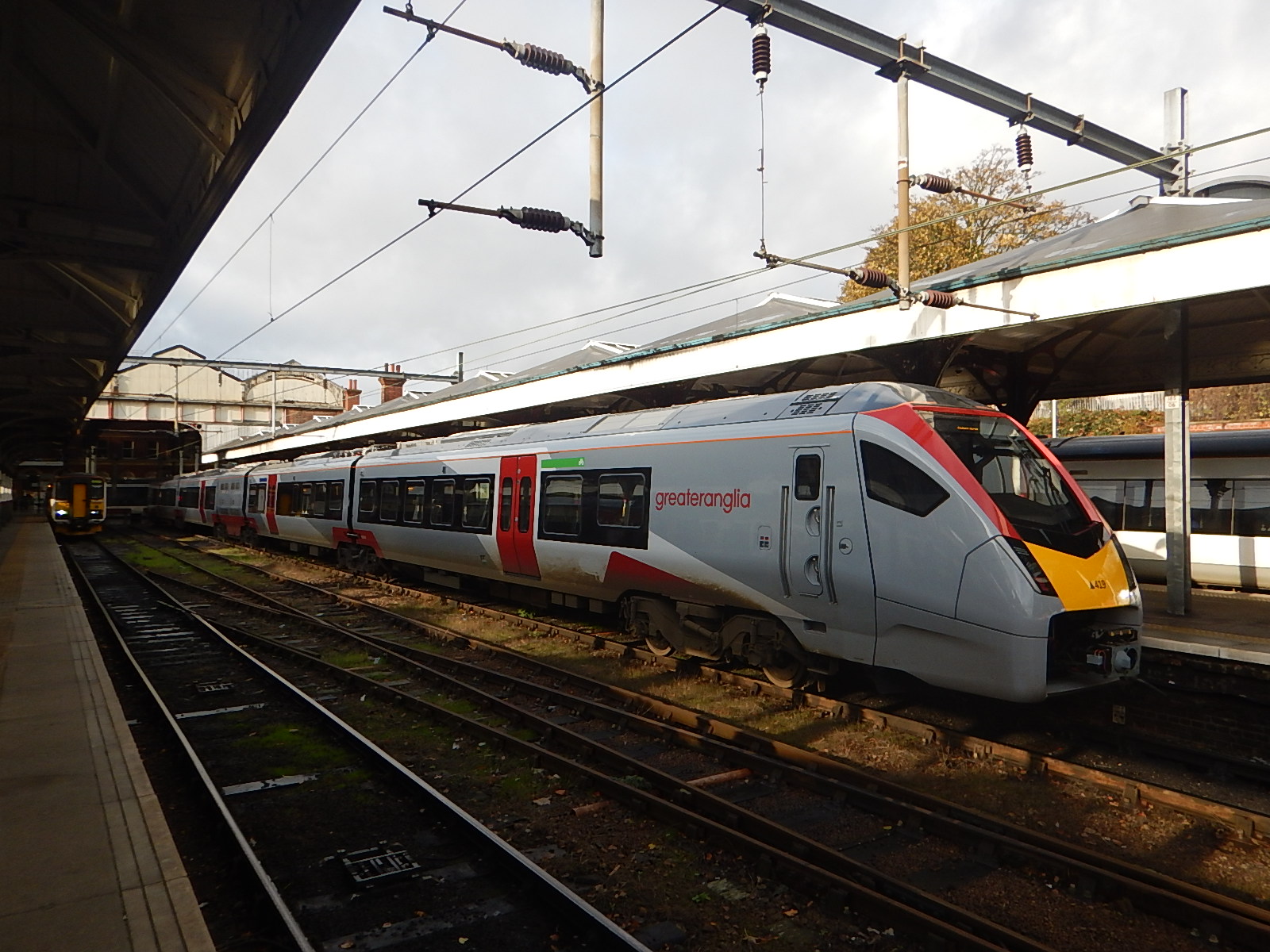
Stadler’s approach of a power car, must be working as they have received an order for a hydrogen-powered version of their popular Flirts, which I wrote about in MSU Research Leads To North America’s First Commercial Hydrogen-Powered Train.
I think we can be certain, that because of the UK loading gauge, that a hydrogen-powered train will be longer by about a car, than the equivalent electric train.
I can see a certain amount of platform lengthening being required. But this is probably easier and less costly than electrification to achieve zero-carbon on a route.
Batteries can be distributed under all cars of the train, anywhere there is space., But I would suspect that fuel cells must be in the same car as the hydrogen tank, as I doubt having hydrogen pipes between cars would be a good idea.
Alstom have resorted to putting hydrogen tanks and fuel cells in both driving cars and they must have sound reasons for this.
Perhaps, it is the only way, they can get the required power and range.
As I understand it, the Alstom Breeze draws power from three sources.
- The electrification if the route is electrified.
- The electricity generated by regenerative braking.
- The hydrogen system produces electricity on demand, at the required level.
Energy is stored in the batteries, which power the train’s traction motors and internal systems.
The electrical components needed for the train are getting smaller and lighter and I feel that it should be possible to put all the power generation and collection into a power car, that is somewhere near the middle of the train. Stadler’s power car is short at under seven metres, but there is probably no reason, why it couldn’t be the twenty metres, that are typical of UK trains.
Suppose you took a four-car version of CAF’s Class 331 train, which has two driver cars either side of a pantograph car and a trailer car.
This has 284 seats and by comparison with the three-car version the trailer car has eighty. As the pantograph car is also a trailer, I’ll assume that has eighty seats too! Until I know better!
Replacing the pantograph car with a hydrogen car, which would be unlikely to have seats, would cut the seats to 204 seats, but a second trailer would bring it back up to 284 seats.
I actually, think the concept of a hydrogen car in the middle of a four-car electric train could work.
- The five-car hydrogen train would have the same capacity as the four-car electric version.
- The train would need an updated software system and some rewiring. Bombardier achieved this quickly and easily with the train for the Class 379 BEMU trial.
- There are several types of four-car electrical multiple units, that could possibly be converted to five-car hydrogen-powered multiple units.
- Some five-car electrical multiple units might also be possible to be converted.
Obviously, if an existing train can be adapted for hydrogen, this will be a more cost effective approach.
Conclusion
Overall, the plans for rail improvements on Teesside seem to be good ones.
I’m looking forward to riding LNER to Teesside and then using the network of hydrogen-powered trains to explore the area in 2022.
My only worry, is that, if the network is successful, the many tourists visiting York will surely increase the numbers of day visitors to Whitby.
This is a paragraph from the RAIL article.
Alan Williams says that the EVRDC’s long-term objective is to see the Esk Valley served at intervals of roughly every two hours, equating to eight return trains per day, but with Northern and NYMR services sharing the single line between Grosmont and Whitby, introducing further Middlesbrough trains during the middle of the day, brings the conversation back to infrastructure.
He goes on to detail what is needed.
Alstom Digital Train Control System Enters Service On Wuppertal Suspension Railway
The title of thiis post is the same as that of this article on Railways Africa.
It describes how Alstom have fitted digital signalling with ETCS to Wuppertal’s Schwebebahn.
Surely, if you can fit digital signalling to the city’s weird and wonderful railway, it can be applied to any other railway.
Battery Answer To Schleswig-Holstein’s Diesel Replacement Question
The title of this post, is the same as that of this article on Railway Gazette International.
It is a good explanation of why there is so much interest in battery-powered trains.
This paragraph from the article, describes how the trains will operate in Schleswig-Holstein.
They will have range of 150 km under optimal conditions, although the longest non-electrified route they will operate on is around 80 km. The batteries will be recharged from the existing 15 kV 16·7 Hz overhead electrification at Kiel, Neumünster, Flensburg, Lübeck and Lüneburg stations and on the Osterrönfeld – Jübek line. Charging facilities will also be provided in other locations, and there will be some extensions to the existing overhead power supply.
Consider.
- These trains can run on routes of up to eighty kilometres or around fifty miles.
- Greater Anglia and Transport for Wales will be running the UK versions of the Stadler Flirts, that will be used in Schleswig-Holstein.
- Transport for Wales will also be running a tri-mode Flirt with electric, diesel and battery power.
- The Continental loading gauge, probably allows more batteries than the smaller UK loading gauge.
I think it could be reasonable to assume, that a UK-sized battery-electric Stadler Flirt could have a range of forty miles on batteries.
These could be possible routes for Greater Anglia.
- Norwich and Sheringham – 30 miles
- Norwich and Lowestoft – 23.5 miles
- Norwich and Great Yarmouth – 18 miles
- Ipswich and Felixstowe – 16 miles
- Colchester Town and Sudbury – 20 miles
In addition some partially-electrified routes have gaps less than forty miles. Think Cambridge and Ipswich!
I would not be surprised to see battery trains, quietly gliding around East Anglia.
Would they attract passengers and tourists?
Perhaps Germany and Stadler will give us the Schleswig-Holstein Answer, which will be much more interesting than the Schleswig-Holstein Question.
Economics Of Battery Trains
The article also has this quote from the CEO of Stadler Germany about the economics of battery trains.
It makes us very proud that with the battery-powered Flirt we have not only managed to find an ecological and innovative solution, but have also enabled a clear economic improvement. If we consider the average life of a rail vehicle of around 30 years, battery-operated vehicles are more cost-effective than diesel’.
I think it can also be said, that battery technology will improve continuously in the next thirty years and we should see a corresponding improvement in range and performance.
You don’t get that with diesel.
Hydrogen Or Battery Power?
I would think that Alstom are not happy about this order for battery-powered trains.
- Only a hundred kilometres or so to the West, they are supplying Alstom Coradia iLint trains for a similar network.
- These trains are working well.
- They have teamed up with Linde to supply the hydrogen.
I wouldn’t have been surprised if Schleswig-Holstein had chosen hydrogen trains.
So why did Schleswig-Holstein, choose battery rather than hydrogen trains?
- Provided, the driver or a computer, raises and lowers the pantograph appropriately, there is no difference between an electric train and its battery-electric sibling.
- Systems to charge battery trains can be installed anywhere, there is an electricity supply.
- The electricity supply could be local wind or solar.
- Charging battery trains could be automatic and require no more action from the driver, than checking everything is as it should be and perhaps pushing a button or two. On a bleak miserable day, the driver would remain in the warm and comfortable cab.
- Hydrogen would need to be loaded on the train at a depot or another place with the necessary safety clearance.
- The iLint seats 160 and the Flirt Akku seats 124, so I suspect capacity isn’t much of a problem.
- The Flirt Akku is a train designed for battery-electric operation, whereas the iLint is a modified diesel train, with a noisy and harsh mechanical transmission. It’s like comparing Class 710 trains, with their predecessors on the Gospel Oak to Barking Line; the Class 172 trains.
- I suspect most Germans have talked to a relative or older person, who remembers the Hindenburg.
There is probably little to choose between the two trains, but I believe that the operation of the hydrogen-powered train will be more complicated.
I also don’t know the cost of each train.
As I said earlier, Stadler claim long-term ownership of battery-powered trains is more economic than diesel. Does the same apply to battery against hydrogen power.
Conclusion
I believe we’ll see lots more battery trains.
Is There Nothing A Class 319 Train Can’t Do?
If a train every goes into orbit round the world, it will be highly-likely that it will be a Class 319 train!
Electric Trains In North-West England
The fleet of eighty-six trains entered service in 1987 on Thameslink and now twenty-seven are plying their trade on the electrified routes around the North-West of England.
- You don’t hear many complaints about them being called London’s cast-offs.
- Passengers fill them up in Blackpool, Liverpool, Manchester and Preston.
- They still do 100 mph where possible.
- They seem to be reliable.
- They are not the most attractive of trains.
But handsome is as handsome does!
Drivers have told me, that although the suspension may be a bit soft for the bumpy route across Chat Moss, the trains do have superb brakes.
Bi-Mode Class 769 Trains
Nearly thirty of the trains are being converted into bi-mode Class 769 trains for working partially-electrifired routes and although these are running late, they should be in service this year.
Rail Operations Group
Two Class 769 trains have been ordered to be fast logistics trains by Rail Operations Group.
Wikipedia says the trains will be used to transport mail.
But if you read the history of the Rail Operations Group, they make the assets sweat and I’ve read the trains will still have seats, so they might do some other rail operations.
The Hydrogen-Powered Class 799 Train
And now comes the Class 799 train!
This is a demonstrator to prove the concept of conversion to hydrogen power.
The fact that the train now has it’s own number must be of some significance.
Alstom are converting Class 321 trains into Class 321 Breeze trains.
- The conversion will reduce passenger capacity, due to the large hydrogen tank
- It will have a 1,000 km range.
- It will have regenerative breaking.
- It will have a new AC traction package
- It will probably have the interior of a Class 321 Renatus train.
The conversion will obviously build on Alstom’s experience with the Alstom Coradia iLint train and Eversholt’s experience with the Renatus.
When it comes to the Class 799 train, the following will apply.
- Porterbrook have all the experience of creating the bi-mode and dual-voltage Class 769 train.
- Birmingham University’s Birmingham Centre For Railway Research And Education (BCRRE) are providing the expertise to design and convert the Class 319 train to hydrogen power.
- I also wouldn’t be surprised to find out, that the BCRRE has applied some very extensive mathematical modelling to find out the performance of a hydrogen-powered Class 319 train or HydroFLEX train.
- The conversion could be based closely on Class 769 experience and sub-systems,
Could the main purpose be to demonstrate the technology and ascertain the views of train operators and passengers on hydrogen power?
The most important question, is whether the Class 799 train, will have the same passenger capacity as the original Class 319 train?
If it does, then BCRRE must have found a way to store the hydrogen in the roof or under the floor.
It should be noted, that it was only in September 2018, that the contract to develop the Class 799 train was signed and yet less than a year later BCRRE and Porterbrook will be demonstrating the train at a trade show.
This short development time, must mean that there is not enough time to modify the structure of the train to fit a large hydrphen tank inside, as Alstom are proposing.
A smaller hydrogen tank could be placed in one of three places.
- Underneath the train.
- On the roof.
- Inside the train, if it is small enough to fit through the train’s doors.
Note.
- I doubt that anybody would put the tank inside the train for perceived safety reasons from passengers.
- On the roof, would require substantial structural modifications. Is there enough time?
So how do you reduce the size of the hydrogen tank and still store enough hydrogen in it to give the train a useful range?
In Better Storage Might Give Hydrogen The Edge As Renewable Car Fuel, I indicated technology from Lancaster University, that could store four times as much hydrogen in a given size of tank.
This reduced tank size would make the following possible.
- The hydrogen tank, the fuel cell and the batteries could be located underneath the four-cars of the Class 319 train.
- The seating capacity of the Class 799 train could be the same as that of a Class 319 train.
Clever electronics would link everything together.
If BCRRE succeed in their development and produce a working hydrogen-powered Class 799 train, how would the technology be used?
Personally, I don’t think we’ll see too many hydrogen-powered Class 799 trains, running passengers on the UK network.
- The trains are based on a thirty-year-old train.
- The interiors are rather utilitarian and would need a lot of improvement, to satisfy what passengers expect.
- Their market can probably be filled in the short-term by more Class 769 trains.
But I do believe that the technology could be applied to more modern trains.
A Hydrogen-Powered Electrostar
Porterbrook own at least twenty four-car Electrostar trains, which have been built in recent years.
Six Class 387 trains, currently used by c2c, may come off lease in the next few years.
Could these trains be converted into a train with the following specification?
- Modern train interior, with lots of tables and everything passengers want.
- No reduction in passenger capacity.
- 110 mph operating speed using electrification.
- Useful speed and range on hydrogen power.
- ERTMS capability, which Porterbrook are fitting to the Class 387 trains to be used by Heathrow Express.
It should be born in mind, that a closely-related Class 379 train proved the concept of a UK battery train.
- The train was converted by Bombardier.
- It ran successfully for three months between Manningtree and Harwich.
- The interior of the train was untouched.
But what was impressive was that the train was converted to battery operation and back to normal operation in a very short time.
This leads me to think, that adding new power sources to an Electrostar, is not a complicated rebuild of the train’s electrical system.
If the smaller hydrogen tank, fuel cell and batteries can be fitted under a Class 319 train, I suspect that fitting them under an Electrostar will be no more difficult.
I believe that once the technology is proven with the Class 799 train, then there is no reason, why later Electrostars couldn’t be converted to hydrogen power.
- Class 387 trains from c2c, Great Northern and Great Western Railway.
- Class 379 trains, that will be released from Greater Anglia by new Class 745 trains.
- Class 377 trains from Southeastern could be released by the new franchise holder.
In addition, some Class 378 trains on the London Overground could be converted for service on the proposed West London Orbital Railway.
A Hydrogen-Powered Aventra
If the Electrostar can be converted, I don’t see why an Aventra couldn’t be fitted with a similar system.
Conclusion
A smaller hydrogen tank, holding hydrogen at a high-density would enable trains to be converted without major structural modifications or reducing the passenger capacity.
The development of a more efficient method of hydrogen storage, would open up the possibilities for the conversion of trains to electric-hydrogen hybrid trains.
Hydrogen Trains Ready To Steam Ahead
The title of this post is the same as that of an article in today’s copy of The Times.
This is the first two paragraphs.
Hydrogen trains will be introduced in as little as two years under ambitious plans to phase out dirty diesel engines.
The trains, which are almost silent and have zero emissions, will operate at speeds of up to 90 mph and release steam only as a by-product. The new trains, which will be called “Breeze” will be employed on commuter and suburban lines by early 2021.
From the article and other published sources like Wikipedia, I can say the following.
Train Formation
The formation of some of the current Class 321 trains is as follows.
DTSO(A)+TSO+MSO+DTSO(B)
Note.
- The two DTSO cars are identical and are Driving Trailer Standard Open cars.
- The TSO car is a Trailer Standard Open car.
- The MSO car is a Motor Standard Open, which contains the four traction motors, the pantograph and all the electrical gubbins.
The refurbished Class 321 Renatus train has a new AC traction system.
In the past, the Trailer car has been removed from some of these trains, to make a three-car Class 320 train, which has this formation.
DTSO(A)+MSO+DTSO(B)
The Times says this about the formation of the hydrogen trains.
New images released by Alstom show that the existing four-carriage 321s will be reduced to three as part of the conversion process, which will be carried out at the company’s plant in Widnes, Cheshire. The front and rear third of the train will be used to house hydrogen gas storage tanks.
It would appear to me that Alstom have decided to go down a route based on the proven Class 320 train.
The TSO car will be removed and the existing or re-tractioned MSO car will be sandwiched between two rebuilt DTSO cars containing large hydrogen tanks and the hydrogen fuel cells to generate the electricity to power the train.
Although, Alstom’s pictures show a three-car train, I can’t see any reason, why a four-car train would not be possible, with the addition of a TSO car.
The train would obviously need to have enough power.
But then a standard Class 321 train is no wimp with a 100 mph operating speed and one MW of power, which is a power level not far short of the 1.68 MW of a modern four-car Class 387 train.
The MSO Car
You could almost consider that a Class 321 train is an MSO car, with a Driving Trailer car on either side and an extra Trailer car to make a four-car train.
In an original Class 321 train, the MSO car has the following.
- Two motored bogies, each with two traction motors.
- A pantograph on the roof to pick up the 25 KVAC overhead power.
- A transformer and the other electrical gubbins.
This picture shows the side view of an MSO car in an unmodified Class 321 train.
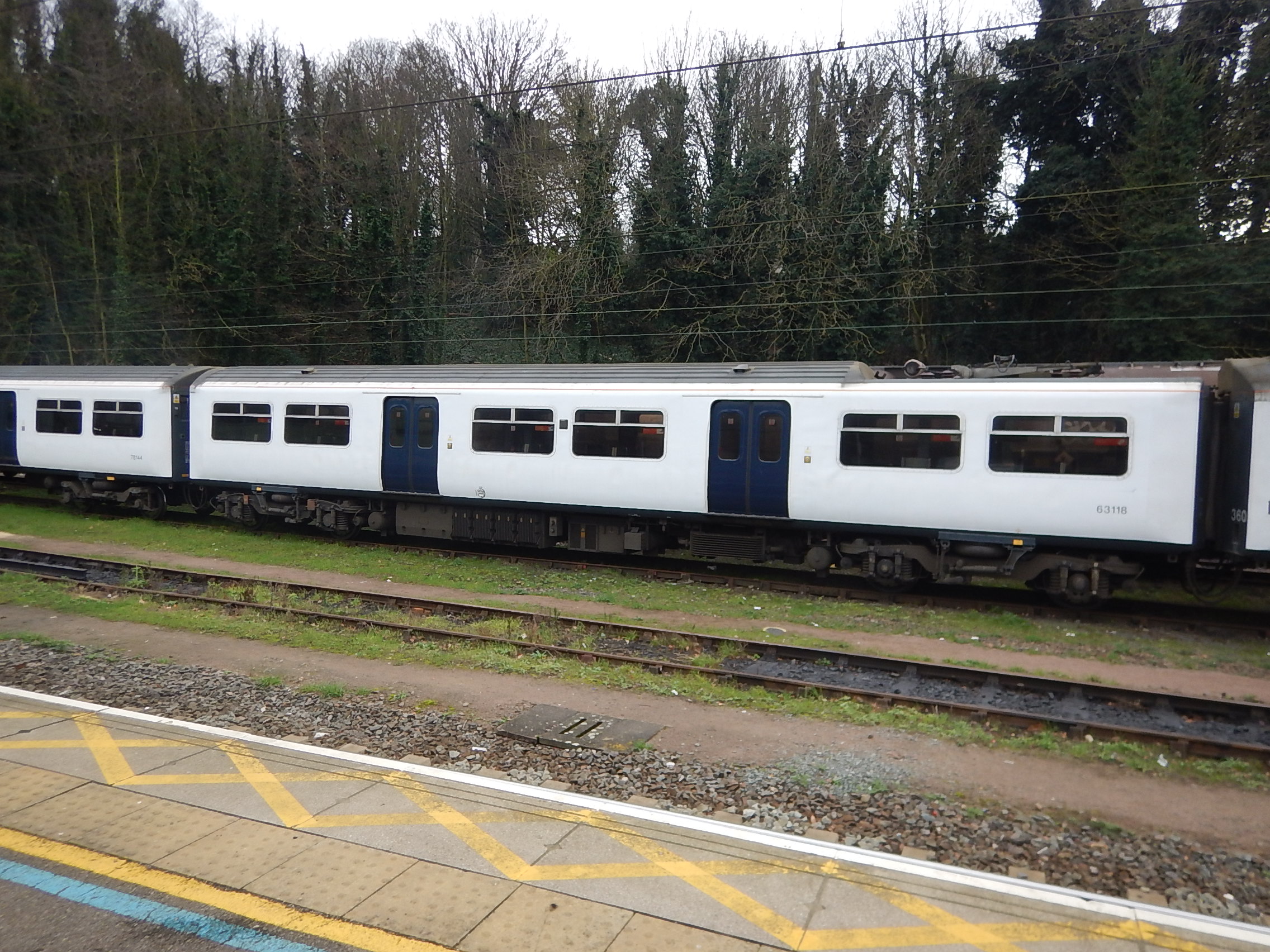
It does appear to be rather full under the MSO car, but I suspect, that modern AC equipment will take up less space. Although, the air-conditioning will have to be squeezed in.
Some if not all cars are labelled as PMSO, to indicate they have the train’s pantograph.
British Rail designed a lot of Mark 3 coach-based Electric Multiple Units like this, with a power car in the middle and trailer cars on either side. For instance, the legendary Class 442 train, is of five cars, with all the traction motors and electrical gear in the middle car. It still holds the speed record for third-rail-powered trains. British Rail certainly got the dynamics right.
The upgraded Class 321 Renatus trains have a new AC traction system.
- This will be state-of-the-art, more efficient and probably more reliable.
- New traction motors handle regenerative braking.
But is it more powerful than the original system?
If it was, it would give better acceleration.
This modern traction system will probably be a starting point for the electrical system of a hydrogen-powered Class 321 train.
It would have to be able to accept electrical power from the following sources.
- The pantograph, when connected to the 25 KVAC overhead electrification.
- The two Driving Trailer Standard Open cars with their hydrogen tanks and fuel-cells..
The voltages will probably be different, but this should not be a problem for a modern well-designed electrical system.
Batteries And Regenerative Braking
The Times has a graphic, which shows a part-cutaway of the train.
There is an arrow and explanation labelled Traction System, where this is said.
Ensures appropriate energy is transmitted between fuel cell and battery. Drives wheels and collects energy during braking.
I would suspect that a single battery would be placed in the MSO car, so that the battery could be close to the traction motors under the car.
Battery Size Calculation
The battery should be big enough to handle the energy generated when braking from the train’s maximum speed.
Obviously, Alstom have not disclosed the weight of the train, but a three-car Class 320 train, which is a Class 321 train without the trailer car, weighs 114.5 tonnes and has 213 seats. So I suspect that because of the hydrogen tanks, there will be about 140 seats in the hydrogen-powered train. So could it hold 300 passengers with the addition of standees?
I don’t know how much a hydrogen tank weighs, but I suspect it is more bulky than heavy.
Fuel cells of the required size, seem to weigh in the order of hundreds of kilograms rather than tonnes.
So I think I will assume the following for my kinetic energy calculation.
- A 200 tonne train
- 300 passengers at 90 Kg each with baggage, bikes and buggies.
- A speed of 87 mph.
This gives a 227 tonne train, when fully loaded.
Omni’s Kinetic Energy Calculator gives a kinetic energy of just under 50 kWh.
So this amount of energy will be needed to accelerate the train to the operating speed and could be substantially recovered at a station stop from the operating speed.
As the train will also need hotel power for doors, air-conditioning and other train systems, a battery of perhaps around 100 kWh would give enough power.
Obviously, Alstom will have done a complete computer simulation, they will have much better and more accurate figures.
As 50 kWh traction batteries are of the size of a large suitcase, I doubt there would be a problem putting enough battery capacity in the MSO car.
Obviously, these are very rough calculations, but it does appear that with modern lightweight tanks, hydrogen trains are feasible, with readily-available components.
But then Alstom have already converted a Coradia Lint to hydrogen power.
Will The Train Be A Series Hybrid?
In a series hybrid, like a New Routemaster bus, the vehicle is driven by an electric motor, powered by a battery, which in the case of the bus is charged by a small diesel engine. Braking energy is also recycled to the battery.
In Alstom’s Breeze train, the traction motors in the MSO car would be connected to the battery.
When the power in the battery is low, the train’s computer will top up the battery from the overhead electrification, if it is available or use the hydrogen fuel cells.
I suspect the computer would always leave enough spare capacity in the battery to accommodate the energy generated during braking.
Passenger Capacity and Range
I have estimated that the passenger capacity of the train is around three hundred.
This picture from Alstom, shows a side view of one DTSO car of the train.
The windows, probably denote the size of the passenger compartment. So instead of having the capacity of a three-car train, it probably only carries that of a two-car train.
Compare this visualisation with a picture of an unmodified DTSO car.

There’s certainly a lot of space under the DTSO car, which I’m sure Alstom will use creatively. Can the fuel cells fit underneath?
From the cutaway view of the proposed train in The Times, it would appear that the section behind the driving compartment is occupied by the hydrogen tank.
The hydrogen fuel cells or at least their vents are on the roof at the back end of the car.
The Times gives the range of the train as in excess of 625 miles.
To put this into context, the Tyne Valley Line has a length of sixty miles, so a train could do at least five round trips between Newcastle and Carlisle without refuelling.
It’s certainly no short-range trundler!
I deduce from the extreme range quoted by The Times, that Alstom’s Breeze is an extremely efficient train and probably a series hybrid.
If the train is very efficient, that could mean, that there is the possibility to use smaller tanks to increase the train’s passenger capacity to fit a particular route better.
Use Of The Pantograph
All the articles published today don’t say anything about the pantograph.
But I can’t see any reason, why when 25 KVAC overhead electrification exists, it couldn’t be used.
Being able to use available electrification is also a great help in positioning trains before and after, trains perform their daily schedule.
750 VDC Operation
British Rail did get a lot of things right and one was that nearly all of their electrical multiple units could work or be modified to work on both forms of electrification in the UK; 25 KVAC overhead and 750 VDC third-rail.
So I believe that a 750 VDC version of Alstom’s Breeze will be possible.
A Replacement For A Two-Car Diesel Multiple Unit
There are large numbers of two-car diesel multiple units in the UK.
- Class 150 trains – 137
- Class 156 trains – 114
- Class 165 trains – 48
- Class 170 trains – 44
All would appear to have a similar passenger capacity to Alstom’s Breeze.
Some though will be converted into more efficient diesel-battery hybrids.
But there will still be a sizeable number of replacements, where the Breeze will be suitable.
The Breeze will have a major advantage, if as I expect, it has the ability to run using 25 KVAC or 750 VDC electrification.
It will be able to work routes that are partially electrified.
Possible Routes
The Times says this about possible routes.
Although the company refused to be drawn on the destination of the new trains, it is believed that they could be used on unelectrified lines in the north-west or north-east.
It is worth looking at the location of Alstom’s factory in Widnes, where the Class 321 trains will be converted. This Google Map shows the area.
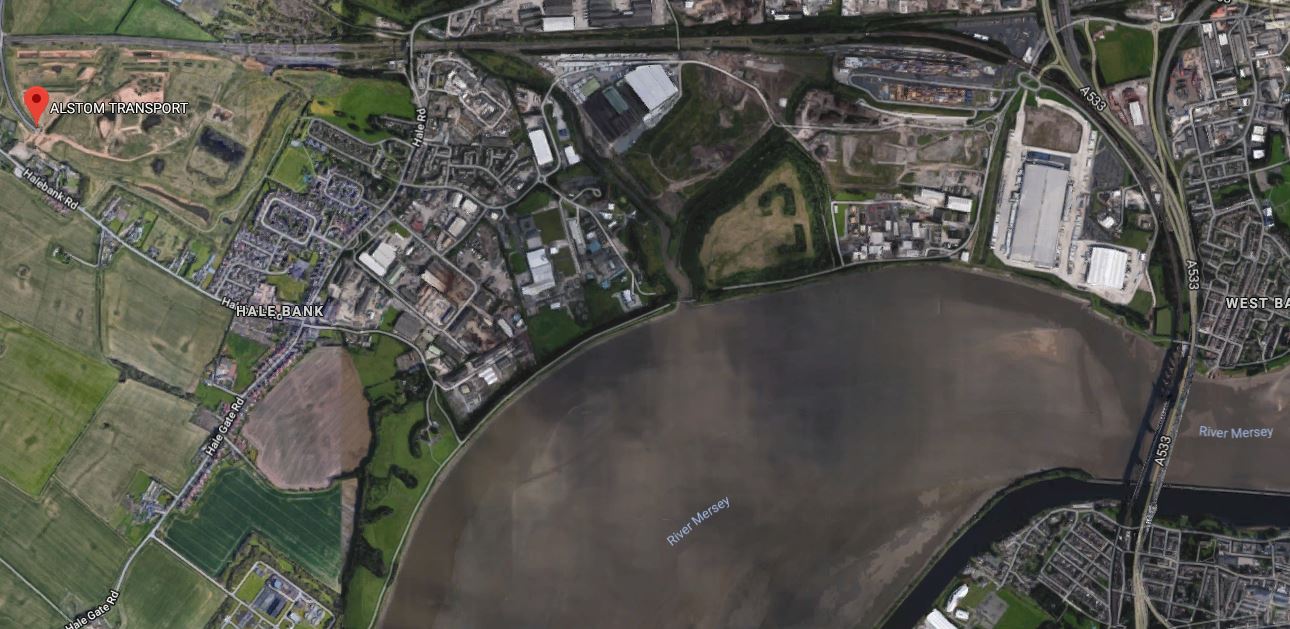
Note.
- The main railway between Liverpool and Crewe running across the top of the map and then crossing the River Mersey to go South.
- The Alstom factory is shown by a red arrow in the North-West corner of the map.
Not shown on the map, as it is just to the South on the South Bank of the Mersey, is INEOS’s massive Castner-Kellner works, which is a major producer of hydrogen, as it was when I worked there in the late 1960s.
I doubt that Alstom will be short of hydrogen to test the new trains.
Alstom and INEOS could even build a pipeline across the Mersey.
The Liverpool and Crewe Line is electrified and recently, the Halton Curve has been upgraded to form a new route between Liverpool and Chester via Runcorn, Frodsham and Helsby.
The Wikipedia entry for the Halton Curve has a section called Hydrogen Fuel Cell Train Trials, where this is said.
The Chester to Liverpool line via the Halton Curve is proposed for a trial by Alstom of their zero emissions hydrogen fuel cell trains. The line was chosen as Alstom’s new technology facility is at Halebank on the Liverpool border adjacent to the line, with hydrogen supplied via the nearby Stanlow refinery.
I should say, that I personally prefer the INEOS route for hydrogen, where it is a by-product of the electrolysis of brine, which is mainly to produce chlorine. Even in the 1960s, ICI performed a lot of production at night to take advantage of more affordable electricity.
The other route that goes close to Alstom’s factory is the Liverpool Lime Street to Manchester route via Warrington.
Increasing Capacity
I believe that effectively two-car trains with a capacity of 300 passengers,running between say the cities of Liverpool and Chester would not be large enough.
The current Class 321 trains are four-car trains and the conversion to Alstom’s Breeze trains, will result in the removal of the Trailer car, which contains the toilet.
The power of the MSO car in the current Class 321 trains is 1,000 kW.
During the conversion for use in Alstom’s Breeze trains, the power system will be updated.
- Four new AC traction motors will be fitted.
- A battery to store electricity and handle regenerative braking will be fitted. I estimated earlier, that this could be at least 100 kWh.
- The ability to connect to the hydrogen fuel cells in the two updated Driving Trailer Standard Open cars will be fitted.
I also suspect a well-designed computer control system will be added.
As a time-expired Control Engineer, I believe that the updated MSO car can be designed to deliver any amount of power between say 1,000 kW and 1,600 kW.
Alstom will obviously know, how much power will be needed to accelerate their proposed three-car train to the operating speed of 87 mph.
Four-Car Alstom Breeze Trains
Suppose though that the trailer car was also updated and added to the train.
- The weight would rise to 223 tonnes.
- Passenger capacity would rise to 450.
- Maximum kinetic energy at 87 mph, would rise to 55 kWh.
Provided the MSO car is powerful enough, a four-car Alstom Breeze would appear to be feasible.
Five-Car Alstom Breeze Trains
What would the sums look like for a five-car Alstom Breeze.
- Two trailer cars would be added.
- The weight would rise to 246 tonnes.
- Passenger capacity would rise to 600.
- Maximum kinetic energy at 87 mph, would rise to 63 kWh.
With the priviso of the power of the MSO car, it certainly looks like a five-car Alstom Breeze could be feasible.
It looks like at least three different sizes of train are possible.
- Three-car – 300 passengers
- Four-car – 450 passengers
- Five-car – 600 passengers
Only three different types of car will be needed.
- Driving Trailer Standard Open – DTSO – With hydrogen tanks and hydrogen fuel cells and less seating than in the current trains.
- Motor Standard Open – MSO – With new AC power system and a battery.
- Trailer Standard Open – TSO – With seats and possibly a Universal Access Toilet, bike racks or a buffet.
Note.
- All DTSO would be more-or-less identical, but some might have larger tanks and more fuel-cells.
- All MSO cars would be identical.
- TSO cars would be specified by the customer and could be tailored to a particular route.
The train’s computer, would automatically determine what train had been assembled and adjust power settings and displays accordingly.
Suppose four Class 321 trains were to be converted to Alstom Breezes.
You could end up with.
- Four three-car trains.
- Four spare Trailer Standard Open cars.
Or.
- Four four-car trains.
Or.
- Two three-car trains.
- Two five-car trains
The permutations are endless.
It is an infinitely flexible system, which can produce trains of a variety of lengths.
I would suspect that Eversholt will want customers to take complete trains, to maximise their returns and not end up with too many orphaned trailer cars.
Are There Any Spare Trailer Cars?
I ask this question, as in the last few years, twelve four-car Class 321 trains, have been converted to three-car Class 320 trains. As part of this process the trailer car is removed.
I would assume the twelve trailer cars have been put into store.
Could they be used to create five-car Alstom Breeze trains?
Will Alstom Breeze Trains Work In Multiple?
Class 321 trains can do this and I suspect that the Alstom Breezes will have the capability.
But it will probably be mainly for train recovery, than general operation.
Although, running two shorter trains as a longer one, is always useful, when there is a large sporting or other event happening.
Manufacturing
Alstom’s design eases the conversion.
Each type of car has its own manufacturing process,
Driving Trailer Standard Open
This would need to be done to all DTSO cars.
- The car is checked, cleaned and externally refurbished.
- The seats and most of the interior is removed.
- The driving compartment is updated.
- The hydrogen tank is added behind the driving compartment.
- The hydrogen fuel cells are added, with vents on the roof.
- The new interior with seats is fitted behind the hydrogen tank and fuel cells.
- No work would need to be done to the bogies, except that needed for maintenance.
- Finally, the new livery would be applied.
All DTSO cars would be treated in the same manner, although some might have smaller hydrogen tanks and detailed differences due to customer preferences and route needs.
Motor Standard Open
This would need to be done to all MSO cars.
- The car is checked, cleaned and externally refurbished.
- The seats and most of the interior is removed.
- The electrical equipment is replaced with the new AC system with a battery.
- The bogies would be fitted with the new AC traction motors.
- The new interior is fitted.
- Finally, the new livery would be applied.
All MSO cars would probably be treated in the same manner.
Trailer Standard Open
This would need to be done to all TSO cars.
- The car is checked, cleaned and externally refurbished.
- The seats and most of the interior is removed.
- The new interior is fitted.
- Finally, the new livery would be applied.
All TSO cars would probably be treated in a similar manner, but the interior fitment would depend on the customer’s requirements.
This picture shows a side view of an unmodified TSO car.
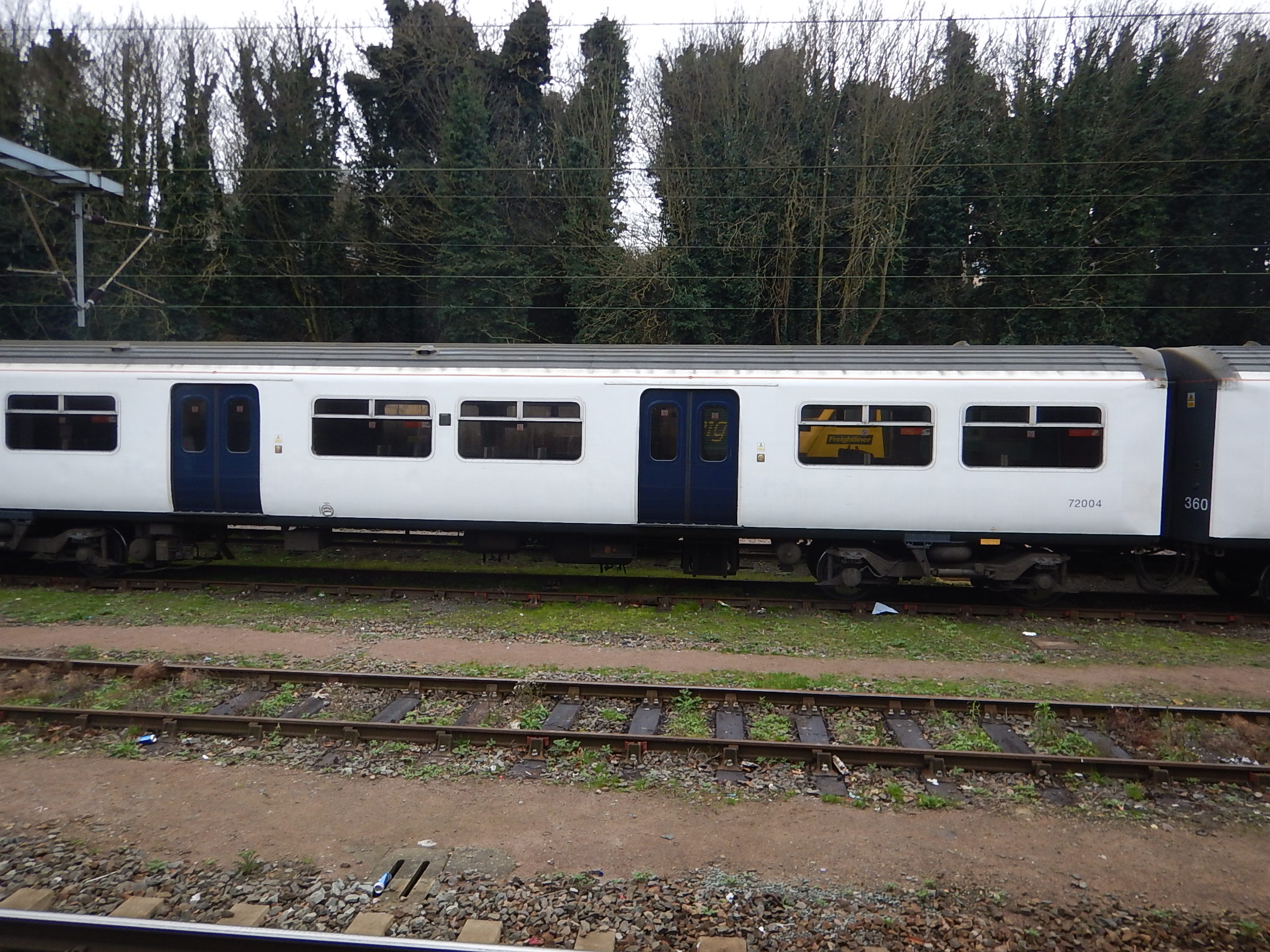
There is certainly a lot of space underneath the car.
I wonder if Alstom have any plans for using this space?
Summing Up Manufacturing
The process for the three types of cars is very similar and is very typical of the work regularly done to give mid-life updates to trains in the UK.
Alstom’s Widnes factory has already performed a major upgrade to Virgin Trains’ Pendelinos and I doubt that the work will hold many terrors for the factory, if the design phase is good.
Train Testing
So many train projects have been let down recently, by the lack of suitable test facilities and poorly-planned testing.
The Halton Curve route between Liverpool and Chester would appear to be an ideal route to test the trains.
- Liverpool Lime Street station has recently been upgraded in size.
- Chester station is not busy.
- The route is about forty miles long.
- I estimate that trains will take about forty minutes
- The route passes Alstom’s factory in Widnes.
- The route is about half-electrified, between Liverpool Lime Street and Runcorn.
- Access is good to the North Wales Main Line for long range testing.
Running on both electrification and hydrogen can be tested with a changeover at Runcorn station.
A Liverpool to Chester service would go through the following sequence.
- Arrive at Runcorn station, after running from Liverpool using existing 25 KVAC electrification.
- Drop the pantograph.
- Continue towards Chester on hydrogen power.
The sequence would be reversed in the opposite direction.
I don’t believe Alstom could want for a better test route.
I can only see one major problem.
Liverpudlians are a curious breed and I predict they will turn up in droves at a new attraction in their midst.
Conclusion
I very much feel that by using hydrogen tanks in the two driving cars Alstom have created a pragmatic flexible design, that will prove if hydrogen trains are a viable proposition for the UK.
Things that I particularly like.
- The first trains being two-car DMU-sized.
- The ability to use electrified lines.
- The extraordinary range.
- The performance.
- Trains of different length and capacity can be created from three different car types.
- The testing process.
But I have my doubts that the initial train has enough capacity.
Although I suspect that it could be increased by adding one or more trailer cars.
Hybrid Regional Train To Be Tested
The title of this post is the same as that of this article on Railway Gazette.
This is the first two paragraphs.
Plans to convert a TER regional multiple-unit into a prototype overhead electric, battery and diesel hybrid unit were announced by SNCF and Alstom on September 17.
The Grand Est, Nouvelle-Aquitaine and Occitanie regions and Alstom are to spend €16.6m converting and testing the Régiolis unit, which will be taken from the Occitanie region’s fleet. Two of the four diesel engines will be replaced with high-capacity lithium-ion batteries able to store regenerated braking energy.
It looks to me, that each Régiolis train has four slots in which to put a diesel engine. So are they doing what Stadler are doing with the tri-mode Flirts for the South Wales Metro and allowing operators to fill each slot with a diesel engine and generator or a lithium-ion battery.
Hopefully, the modules are designed, so they are just Plug-and Play.
The train’s computer would decide what power is best and swap between electric/diesel and battery power automatically or under the control of the driver.
The concept is simple and it could have some interesting outcomes.
- The ability to use regenerative braking on an electrified line, that can’t handle the reverse currents.
- Extending routes efficiently on non-electrified lines, where noise and pollution could be a problem.
- As battery technology gets better and can hold more energy, all diesel engines might be replaced with batteries.
It does seem that Alstom are taking battery trains seriously.
It also appears that the number of existing trains, that are being improved by the addition of batteries is growing.
Hydrogen Trains Have Arrived
According to this page on the Internet, Alstom launched the Coradia iLint today.
These are some of the pictures.
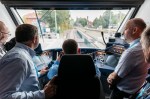
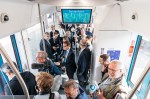
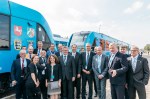
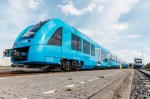
I shall go for a ride.
The web page says this about the test route.
On behalf of LNVG, the Coradia iLint trains will be operated on nearly 100km of line running between Cuxhaven, Bremerhaven, Bremervörde and Buxtehude, replacing EVB’s existing diesel fleet.
As Buxtehude is close to Hamburg, the easiest way to experience the trains would be to fly to Hamburg.

