FirstGroup Applies To Run Rail Services Between Hereford And London via Cwmbran
The title of this post, is the same as that of this news item from FirstGroup.
These first two paragraphs, add more detail to the title.
FirstGroup plc has submitted the first phase of an application for a new open access rail service between Hereford and London to the Office of Rail and Road (ORR).
FirstGroup plans to expand its open access rail operations as part of its successful Lumo business, building on Lumo’s existing service which has transformed long-distance connectivity between London and Edinburgh. This has helped materially grow rail demand on the East Coast Mainline in recent years, through a new and enhanced choice for customers and providing more trains to more destinations.
These are some more points from the press release.
Route and Frequency
The news item says this about route and frequency.
FirstGroup’s proposal is for two return journeys a day (one on Sundays) between London Paddington and Hereford, calling at Bristol Parkway and Severn Tunnel Junction as well as providing direct London services at Cwmbran, Pontypool & New Inn and Abergavenny.
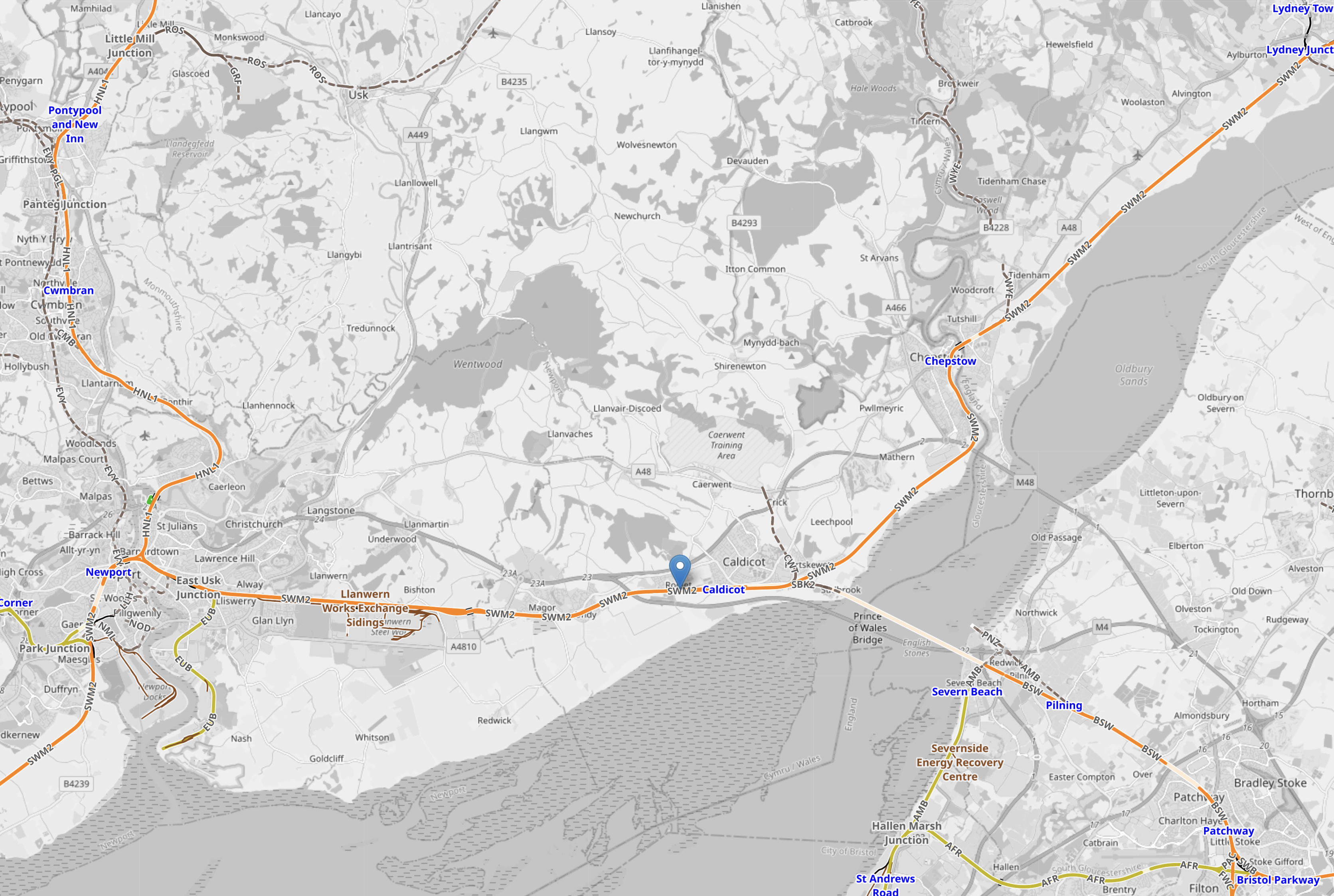
This OpenRailwayMap shows the route between Bristol Parkway and Pontypool & New Inn stations.
Note.
- Bristol Parkway station is in the South-East corner of the map.
- Severn Tunnel Junction station is marked by the blue arrow in the middle of the map.
- The electrified South Wales Main Line connects Bristol Parkway and Severn Tunnel Junction stations.
- From Bristol Parkway, the electrified Great Western Main Line goes to London Paddington via Swindon and Reading.
- From Severn Tunnel Junction station the South Wales Main Line goes West to Newport, which is on this map and then to Cardiff, Swansea and West Wales.
- Pontypool & New Inn station is in the North-West corner of the map on the Welsh Marches Line between Newport and Crewe stations.
- Welsh Marches Line is connected to the South Wales Main Line at Maindee triangular junction, which is a few miles East of Newport station.
- Cwmbran station is on the Welsh Marches Line between Newport and Pontypool & New Inn stations.
After a quick look on Wikipedia and Real Time Trains, it appears that few if any trains run in either direction between Cwmbran and Severn Tunnel Junction stations using the North-East side of Maindee junction.
Lumo’s trains would use this route to go between Bristol Park and Pontypool & New Inn stations via Severn Tunnel Junction, and Cwmbran.
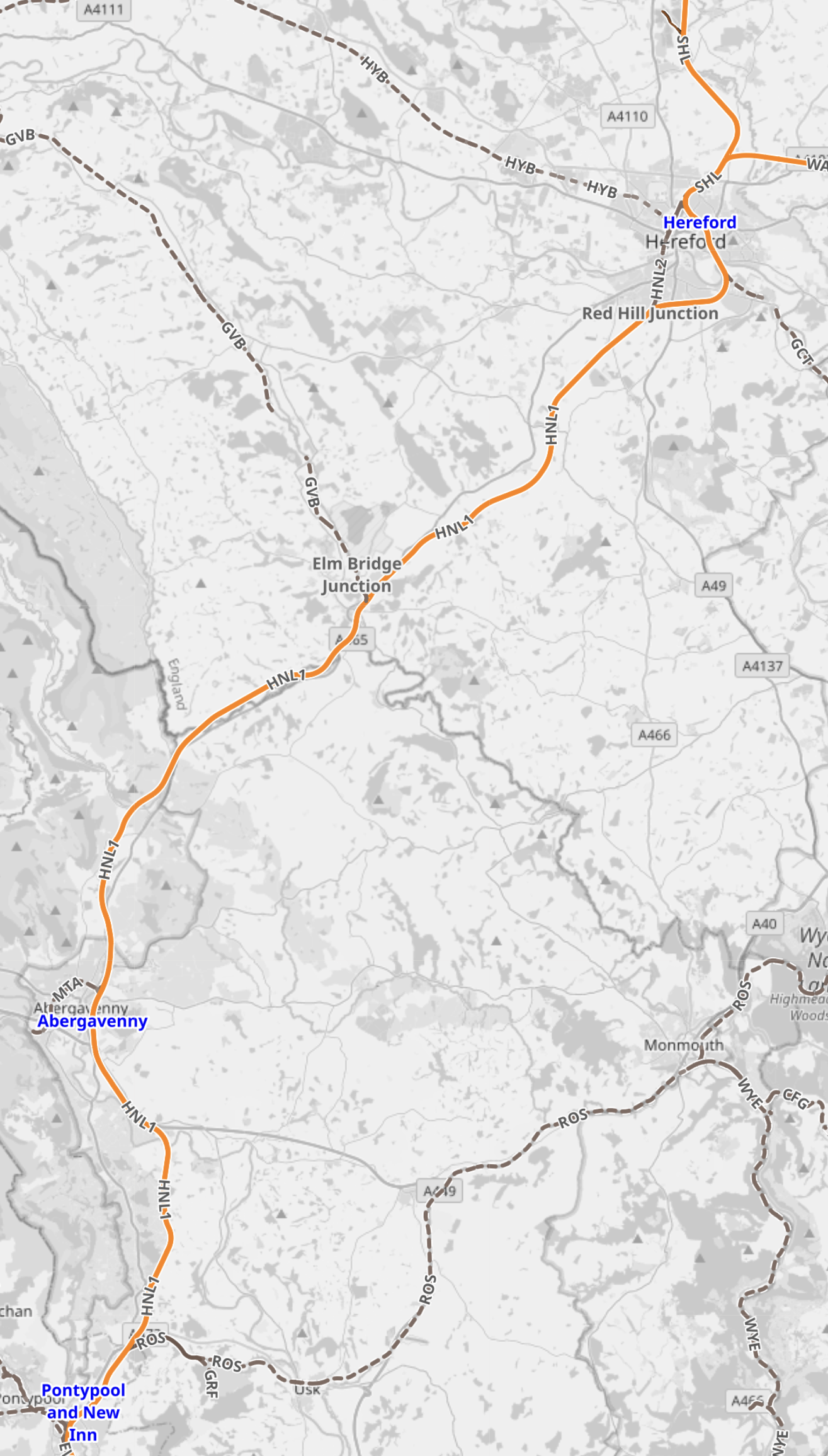
This second OpenRailwayMap shows the Northern part of the route between Pontypool & New Inn and Hereford stations.
Note.
- The orange track is the Welsh Marshes Line between Newport and Crewe.
- Pontypool & New Inn station is in the South-West corner of the map.
- Abergavenny station is on the West side of the map.
- Hereford station is in the North-East corner of the map.
Looking at the route as a whole, it is a very simple route.
- Trains go as fast as traffic allows, non-stop to Bristol Parkway station.
- Trains then take the South Wales Main Line with a single stop at Severn Tunnel Junction station to Maindee Junction, just to the East of Newport.
- Trains then take the Welsh Marches Line to Hereford stopping at Cwmbran, Pontypool & New Inn and Abergavenny stations.
It is an innovative route, that has these advantages.
- It uses a little-used leg of Maindee Junction.
- London Paddington and Maindee Junction is electrified.
- The fastest Hitachi trains seem to take about one hour and forty minutes between London Paddington and Maindee Junction.
As direct trains between Newport and Hereford take around fifty minutes, a time of two-and-a-half hours between London Paddington and Hereford could be possible.
This would compare with current Great Western Railway services, which take upwards of two hour and forty-five minutes, which often have a change of train.
Lumo Trains Should Be Faster Between London Paddington And Bristol Parkway
This may seem surprising, but most if not all current services stop between London Paddington and Bristol Parkway, stop at Swindon and Reading.
Cutting out a stop saves a few minutes on the journey.
New Trains
The news item says this about new trains.
The new Hereford service would support further investment in new trains. In December 2024 FirstGroup placed a £500m order for 14 trains from Hitachi Rail in County Durham. The Group has an option for a potential second order of similar size and the Hereford fleet would form part of this option.
Yesterday, I went to North Wales and used Avanti West Coast from Euston. The trains both ways were new Class 805 trains, which are bi-mode versions of Lumo’s Class 803 trains. These Class 805 trains travel all the way between Crewe and Holyhead on their diesel engines, so the much shorter leg between Maindee Junction and Hereford will definitely be in range.
But Hitachi are developing battery-electric versions of these trains and as there-and-back between Maindee Junction and Hereford is only 88 miles, I wouldn’t be surprised in a couple of years that Cwmbran, Pontypool & New Inn, Abergavenny and Hereford stations have a direct electric service from London.
Services At Hereford
The news item says this about services at Hereford station.
For Hereford, the two direct London paths each weekday would increase services on this flow from four today, to six. The new services would help mitigate the current large gaps in the timetable with additional daytime and evening arrivals into London, giving Hereford more regular connectivity. The new services would also provide the stations on the route with new direct journey opportunities to Bristol Parkway.
I also believe it would be a faster, fully electric service.
Services At Abergavenny
The Wikipedia entry for Abergavenny station says this about services at the station.
With a few exceptions, the weekday daytime service pattern typically sees one train per hour in each direction between Manchester Piccadilly and Cardiff Central, with most trains continuing beyond Cardiff to Swansea and West Wales. There is also a two-hourly service between Cardiff and the North Wales Coast Line to Holyhead via Wrexham General. These services are all operated by Transport for Wales. The northbound Premier service from Cardiff to Holyhead calls here on Monday to Fridays but the southbound service does not call here.
Note.
- The station has partial step-free access
- The station has 74 parking spaces.
Two trains in each direction would improve the services at Abergavenny station.
Services At Pontypool & New Inn
The Wikipedia entry for Pontypool & New Inn station says this about services at the station.
On weekdays and Saturdays, there is generally a two hourly service between Holyhead and Cardiff in the middle of the day, with additional peak time services southbound in the mornings and northbound in the evenings for commuters to Newport and Cardiff. These include services between Manchester Piccadilly and West Wales via Crewe and Swansea. From December 2013 the evening northbound Arriva “Premier” service train began to call at Pontypool for the first time. The southbound service in the morning does not call here. On Sundays, an irregular service operates, with 8 trains calling southbound and 10 northbound. These mainly run between Manchester and Cardiff.
Note.
- The station is step-free with lifts.
- The station has 150 parking spaces.
Two trains in each direction would improve the services at Pontypool and New Inn station.
Services At Cwmbran
The Wikipedia entry for Cwmbran station says this about services at the station.
Services that stop at Cwmbran in both directions are all operated by Transport for Wales and include the hourly service between Manchester Piccadilly, Cardiff Central and West Wales and the two hourly service between Holyhead and Cardiff Central. Most Sunday services only run on the former route (there are only two services each way to/from Holyhead).
Note.
- The station is being made step-free with lifts.
- The station has 76 parking spaces.
Two trains in each direction would improve the services at Pontypool and New Inn station.
The Heads Of The Valleys Road
The A465 or Heads of the Valleys Road could be considered the South Wlaes equivalent of the North of England’s M62 Motorway.
This description is from the first paragraph of the Wikipedia entry.
Approximately following the southern boundary of the Bannau Brycheiniog National Park, the Ordnance Survey Pathfinder guide describes it as the unofficial border between rural and industrial South Wales. The A465 provides an alternative route between England and the counties in South West Wales and to the ferries to Ireland.
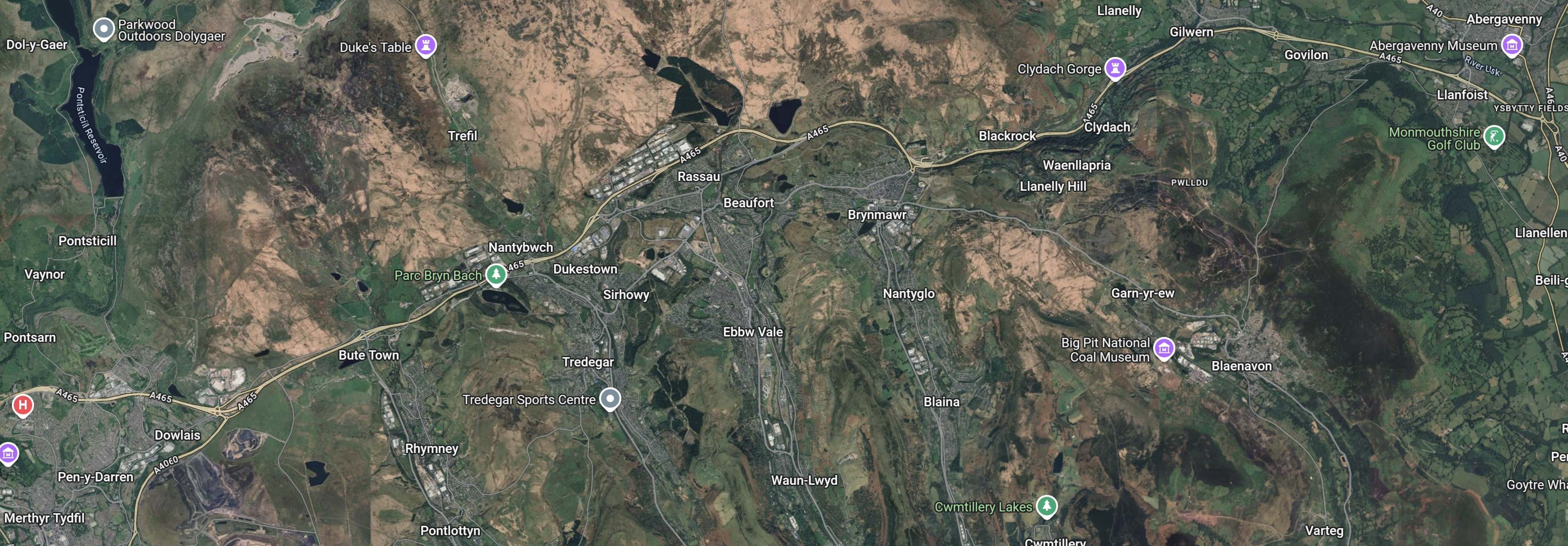
This Google Map shows its route between Merthyr Tydfil and Abergavenny.
Note.
- Merthyr Tydfil is in the South-West corner of the map.
- Abergavenny is in the North-East corner of the map.
- The full length of the road is just under seventy miles.
- The Heads of the Valleys Road connects to all the towns, that are the Northern termini of the South Wales Metro.
- At it’s Western end, the A 465 connects to the M4 near Swansea.
The news item says this about the tourism benefits of the service.
The new service is expected to have positive economic and social benefits for the communities it serves. Both of FirstGroup’s open access services Lumo and Hull Trains are on track to deliver more than £1.4bn in economic benefits along their routes and FirstGroup hopes to have a similar positive effect for the South Wales and Herefordshire communities.
The service should also provide a convenient link for visitors travelling to the Brecon Beacons/ Bannau Brycheiniog National Park; Blaenavon World Heritage Site and cathedral city of Hereford, driving growth and supporting jobs in the area’s tourism sector.
I do wonder if other tourism related services will be developed at Pontypool & New Inn, Abergavenny and Hereford?
Monmouthshire
This paragraph from the Wikipedia entry for Monmouthshire gives a flavour of the Welsh county.
The county is rural, although adjacent to the city of Newport and the urbanised South Wales Valleys; it has an area of 330 square miles (850 km2) and a population of 93,000. After Abergavenny (population, 12,515), the largest towns are Chepstow (12,350), Monmouth (10,508), and Caldicot (9,813).
I was surprised that the population of the county, was as high as 93,000.
This second paragraph, lists the railway stations.
Monmouthshire is served by four railway stations: in the south are the Severn Tunnel Junction railway station at Rogiet on the South Wales Main Line, which connects South Wales to London; and Chepstow railway station and Caldicot railway station on the Gloucester–Newport line; and in the north, Abergavenny railway station on the Welsh Marches line.
Severn Tunnel Junction and Abergavenny stations will be served by Lumo’s new service.
From my experience of using parkway stations in East Anglia with connections to London, I suspect residents of several towns outside of Monmouthshire will use these two stations for trips to the capital.
Are plans in place for extra parking and bus services?
Travelling To And From Heathrow Airport
I wouldn’t be surprised if Lumo picks up quite a few passengers, who are going to and from Heathrow.
Consider.
- I suspect Severn Tunnel Junction to London Paddington will take about one hour and forty minutes, with just the single stop at Bristol Parkway.
- The Elizabeth Line to the Airport will take 28 minutes and cost £13.90, according to Transport for London.
- The Elizabeth Line is an easy step-free change from National Rail at Paddington.
- Elizabeth Line trains between Paddington and Heathrow are every six minutes.
- It’s not a very long walk at Heathrow between the Elizabeth Line and the terminals.
- Driving from say Monmouth to Heathrow will take about two-and-a-quarter hours and cost you to cross the Severn Bridge and for parking.
If your local Great Western Main Line station is between say Chippenham and Cardiff, you might be surprised at how fast and affordable it can be to go to and from Heathrow by Great Western Railway and Elizabeth Line.
When Lumo starts running to Heathrow, I am sure it will be faster, as the trains will not stop East of Bristol Parkway station.
Running In Conjunction With Services Between London Paddington And Carmarthen
The news item says this about running services in conjunction with Lumo’s services to Carmarthen.
The service would operate in conjunction with the planned service from London to Carmarthen which is due to launch in December 2027, and it is anticipated it could begin at the same time.
Consider.
- Both routes are identical between London Paddington and Maindee Junction.
- Both routes could share depots.
- Hitachi’s trains can split and join with alacrity.
- Class 800, 801, 802 and 803 trains have twenty-six metre cars, which mean a five-car train is 130 metres long.
- Bristol Parkway station has 280 metre long platforms. Pairs of trains could split and join here.
- Seven Tunnel Junction has three 171 metre long platforms. Pairs of trains could not use this station, unless the platforms were lengthened.
- Newport station has three platforms longer than 278 metres. Pairs of trains could split and join here, if the Hereford trains reversed direction.
I suspect if trains split and joined, it would be at Bristol Parkway station.
Note that Bristol Parkway station has 1,800 car park spaces, so Lumo could target passengers wanting to park and take the train to London, Cardiff, Newport and other Welsh destinations.
Co-operation With Great Western Railway
In Does Innovation Get Mr. Ed Miliband Better Prices To Doncaster?, I talked about the ticketing on the East Coast Main Line.
It appears to me, that if you put more seats on a popular route, like King’s Cross and Doncaster, then the availability drives down prices.
I also believe that if the tickets are all available through a common walk-up system, then this fills the seats.
The system has now been applied to the West Coast Main Line and I believe that if Great Western Railway and Lumo collaborated on ticketing, this would improve competition between London Paddington, Bristol Parkway and Cardiff.
There is also the issue of train rescue.
Supposing a pair of five-car Hitachi trains broke down with a fault, that allowed the train to be towed to the nearest station, so that passengers could be disembarked.
Hitachi trains are designed, so that up to twenty-four trains can be joined together in rescue mode.
That would certainly be an impressive sight.
Direct Rail Service Plan Supported By PM
The title of this post, is the same as that of this article on the BBC.
This is the sub-heading.
Plans for a new passenger rail service running direct trains between north Wales, the West Midlands and London have received support from the prime minister.
These three paragraphs add detail to the story.
A new open-access rail operator, external, called the Wrexham, Shropshire and Midlands Railway (WSMR), has been formed, offering passengers in Wrexham, as well as Gobowen, Shrewsbury, Walsall and Coleshill, a direct link with the capital.
Speaking in the Commons, Shrewsbury’s Labour MP Julia Buckley asked Sir Keir Starmer if he would support the provider’s application.
The prime minister responded, saying he would be “delighted to make sure the MP and other interested MPs meet with the rail minister to put their case forward”.
He didn’t actually say he supported the application, but then lawyers are careful with words, as every syllable costs money.
I have a few thoughts on this service.
The North Wales Metro
The North Wales Metro was announced today and I wrote about it in £2.1bn North Wales Rail Overhaul Plans Unveiled.
The Wrexham, Shropshire and Midlands Railway connects the North Wales Metro to Gobowen, Shrewsbury, Wolverhampton, Coleshill and London Euston.
Will The Trains Be Hydrogen Powered
In Alstom And Eversholt Rail Sign An Agreement For The UK’s First Ever Brand-New Hydrogen Train Fleet, I reported how Alstom could be going to build a fleet of hydrogen trains in Derby.
I just wonder, if Alstom are going to create a hydrogen train with this specification.
- Five cars
- 125 mph top speed
- Ability to use electrification, where it exists.
- Sufficient range on hydrogen to cover the non-electrified section of the route between Wrexham General and Wolverhampton.
- Wrexham General and Wolverhampton is just under sixty miles and takes an hour and six minutes.
As the fastest trains between London Euston and Walverhampton take one hour and forty-nine minutes, trains would take just under three hours between London Euston and Wrexham General.
I rode an Alstom hydrogen-powered train in Germany in March 2019 and wrote My First Ride In An Alstom Coradia iLint.
I took this picture at the time.

Alstom certainly have all the technology to build a 125 mph hydrogen-powered train, that can use electrification.
Where Would A Hydrogen Train Be Refuelled?
I suspect, that as the train would probably have a range of around a thousand kilometres, it could fill up overnight at Wrexham.
The hydrogen could be sourced from Runcorn or it might even be generated at the depot.
Would A Hydrogen Train Attract Passengers?
If the hydrogen-powered train were to be mouse-quiet like Wrightbus’s hydrogen buses, I believe it would.
The UK’s Worst Airport For Flight Delays Revealed
The title of this post, is the same as that, as this article in The Times.
This is the sub-heading.
The shortage of air traffic controllers is a European problem but some in the industry have blamed early retirement during the pandemic
These are the first two paragraphs.
Gatwick was the country’s worst airport for delays last year as it struggled with air traffic issues and capacity.
Departures were an average of more than 23 minutes late, according to analysis of Civil Aviation Authority (CAA) data. It is the second year in a row it has topped the late league table.
It does look that the first paragraph is saying they need more air traffic controllers and that second runway.
Ironically, one of the adverts in my copy of the article was for Avanti West Coast.
Times Of Avanti West Coast Trains Between London Euston And Crewe
This table shows the first few Avanti West Coast trains between London Euston and Crewe on the 17th March 2025.
- 390119 – IS37 – Glasgow – 11 cars – 05:31 – 07:29 – 2 stops – 118 mins – 80.3 mph.
- 390155 – IH61 – Manchester Piccadilly – 11 cars – 06:29 – 08:08 – 2 stops – 99 mins – 95.7 mph.
- 807007 – IF11 – Liverpool Lime Street – 7 cars – 06:36 – 08:23 – 2 stops – 107 mins – 88.6 mph.
- 390104 – IS42 – Glasgow – 11 cars – 07:29 – 08:59 – 0 stops – 90 mins – 105.3 mph
- 390010 – IH62 – Manchester Piccadilly – 9 cars – 07:33 – 09:10 – 1 stop – 97 mins – 97.7 mph.
- 390044 – IF12 – Liverpool Lime Street – 9 cars – 07:43 – 09:18 – 2 stops – 95 mins – 99.7 mph.
- 390118 – IS45 – Glasgow – 11 cars – 08:30 – 10:01 – 0 stops – 91 mins – 104.2 mph
- 390040 – IH63 – Manchester Piccadilly – 11 cars – 08:33 – 10:19 – 1 stop – 106 mins – 89.4 mph.
- 807001 – IF14 – Liverpool Lime Street – 7 cars – 08:43 – 10:28 – 1 stop – 95 mins – 99.7 mph.
- 805001/805011 – ID83 – Holyhead – 10 cars – 09:02 – 10:51 – 1 stop – 109 mins – 86.9 mph.
- 390136 – IS48 – Glasgow – 11 cars – 09:30 – 11:02 – 0 stops – 92 mins – 103.0 mph
- 390040 – IH64 – Manchester Piccadilly – 9 cars – 09:33 – 11:08 – 1 stop – 95 mins – 99.7 mph.
- 390154 – IF16 – Liverpool Lime Street – 11 cars – 09:43 – 11:31 – 1 stop – 108 mins – 87.7 mph.
- 805012/805003 – ID84 – Chester – 10 cars – 10:10 – 11:53 – 1 stop – 103 mins – 92.0 mph.
- 390130 – IS52 – Glasgow – 11 cars – 10:30 – 12:00 – 0 stops – 90 mins – 105.3 mph
- 390151 – IH65 – Manchester Piccadilly – 11 cars – 10:35 – 12:09 – 1 stop – 94 mins – 100.8 mph.
- 807008 – IF18 – Liverpool Lime Street – 7 cars – 10:43 – 12:30 – 1 stop – 107 mins – 88.6 mph.
- 805009 – ID85 – Chester – 5 cars – 11:00 – 11:46 – 1 stop – 106 mins – 89.4 mph.
Note.
- All trains shown, go through Crewe.
- Some trains were delayed, hence their slow average speed.
- The Glasgow trains, which run non-stop from Euston to Warrington Bank Quay were the fastest, with four trains over 100 mph.
I have a few other thoughts.
The Class 805 Trains Are Crying Out For Batteries
In The Data Sheet For Hitachi Battery Electric Trains, I said this on how the Hitachi Class 80x trains will perform on batteries.
These are my conclusions about Hitachi’s battery packs for Class 80x trains.
- The battery pack has a capacity of 750 kWh.
- A five-car train needs three battery-packs to travel 100 miles.
- A nine-car train needs five battery-packs to travel 100 miles.
- The maximum range of a five-car train with three batteries is 117 miles.
- The maximum range of a nine-car train with five batteries is 121 miles.
Holyhead and Crewe is only 105.5 miles.
As battery technology gets better, these distances will increase.
The Fast Glasgow Train Appears To Be Leading A Convoy
The non-stop to Warrington Bank Quay Glasgow trains, also appear to be leading one Manchester Piccadilly, a Liverpool Lime Street and a Chester/North Wales train in a convoy, through Milton Keynes Central and the Trent Valley.
This convoy could grow as other services are added to the West Coast Main Line.
The Open Access Services Might Have Their Own Convoy
It would seem to me, that it might be possible to run a second convoy every hour, out of phase with the current one following the Glasgow service.
It also might be more virtual than real and under the control of the digital signalling, that will be installed on the line.
Avanti West Coast Increases Liverpool – London Services With Launch Of Electric Evero Trains
The title of this post, is the same as that of this article on Railway Gazette.
This is the sub-heading.
Avanti West Coast officially launched the Class 807 electric only-version of its Hitachi-built Evero trainsets into service on November 11. This enables the operator to offer an additional weekday return service between Liverpool Lime Street and London Euston.
On the 14th of November 2024, these services were run by new Class 807 trains.
- 3F79 – 807001 – 2100 – Northampton to Liverpool Lime Street
- 3F80 – 807001 – 0023 – Liverpool Lime Street to Edge Hill Depot
- 5A99 – 807001 – 0836 – Edge Hill Depot to Liverpool Lime Street
- 1A99 – 807001 – 0901 – Liverpool Lime Street to London Euston – 02:40
- 1F12 – 807003 – 0743 – London Euston to Liverpool Lime Street – 03:07
- 1A28 – 807003 – 1043 – Liverpool Lime Street to London Euston – 02:20
Note,
- I have shown all Class 807 movements that happened. Some possibly didn’t!
- There appear to be extra services, which I’ve marked with their times.
- Time seems to be available to go to Edge Hill Depot if needed.
- I suspect an open return ticket can be used on any train, that’s running.
Services seem to be slow, but they can be booked.
Avanti Are Ramping Up The Service
I suspect that as they add more trains, times will come down and a stop at Liverpool South Parkway will be added.
The Class 390 trains currently used on the Liverpool route are too long for Liverpool South Parkway station.
But seven-car Class 807 trains would fit easily.
The shorter and lighter seven-car Class 807 trains may well have faster acceleration and deceleration than the nine- or eleven-car Class 390 trains with their heavy tilting mechanism.
Could this extra performance mean that the Class 807 trains could still meet the timetable with extra stops?
In Is Liverpool Going To Get High Speed One-Point-Five?, I discussed various options for the London and Liverpool service.
I believe that a practical timetable like this could work.
- Eleven-car Class 390 train – one tph – Non-stop or perhaps a single stop in the Midlands – Under two hours
- Seven-car Class 807 train – one tph – Stopping at Nuneaton, Stafford, Crewe, Runcorn and Liverpool South Parkway – Current time or better
Note.
- An hourly service between London and Liverpool in under two hours would surely be a passenger magnet.
- Two tph would be a 43 % hourly increase in the number of seats between London and Liverpool.
- There would be better connections between Liverpool Lime Street and the East Midlands.
The Railway Gazette article also says this.
From the December timetable change AWC will supplement the current hourly Liverpool – London service with an extra two trains each way every weekday and a third service on Saturdays.
In the short term, AWC will not be delivering the long-standing plan for a half-hourly service on the route, but further services are to be introduced over the next year.
One constraint relates to the power supply. Network Rail has identified two locations where additional electric services cannot currently be accommodated, and discussions over a resolution are ongoing.
A fast service could also be applied to one of the London and Manchester services.
It should be noted, that the two hours and eight minutes record between Manchester and London Euston was set by an InterCity 225 in 1992, so perhaps a seven-car Class 807 could do better than a Class 390 train.
Could A Pair Of Class 807 Trains Leave Euston For Liverpool And Manchester, And Split At Crewe?
Train lengths are as follows.
- Seven-car Class 807 train – 182 metres.
- Fourteen-car Class 807 train – 364 metres.
- Nine-car Class 390 train – 217.5 metres.
- Eleven-car Class 390 train – 365.3 metres.
- Caledonian Sleeper – 374 metres.
I suspect with perhaps a small amount of platform lengthening, a pair of Class 807 could be fitted into all stations, where they would need to call.
This might be a way of adding extra capacity and faster services to Manchester, without needing an extra path on the West Coast Main Line.
Could A Single Class 807 Train Call At Manchester Airport Station?
The platforms at Manchester Airport station are 192 metres long, so a single Class 807 train should fit.
This would allow an hourly service from Manchester Airport to the South, without a change at Manchester Piccadilly or Crewe.
To save paths, it could split and join with the second Liverpool service at Crewe.
Conclusion
The new Class 807 trains could increase performance to between London Euston and both Liverpool Lime Street and Manchester Piccadilly.
3rd October 2024 – A Day In Liverpool
A Three-Leg Journey North
This is the second time, I’ve bought one of there journeys North and they are a pain, unless you want to guarantee seats.
I suppose, I should buy my tickets earlier, but if I can buy my rickets on the day on other train companies, I would prefer to do it on Avanti West Coast.
Avanti West Coast’s problem is that they haven’t got their new Class 807 trains into service yet, which will double the services to Liverpool.
T arrived at Warrington Bank Quay on time and the transfer to Newton-le-Willows went smoothly, but then, I waited thirty minutes for my train to Liverpool Lime Street.
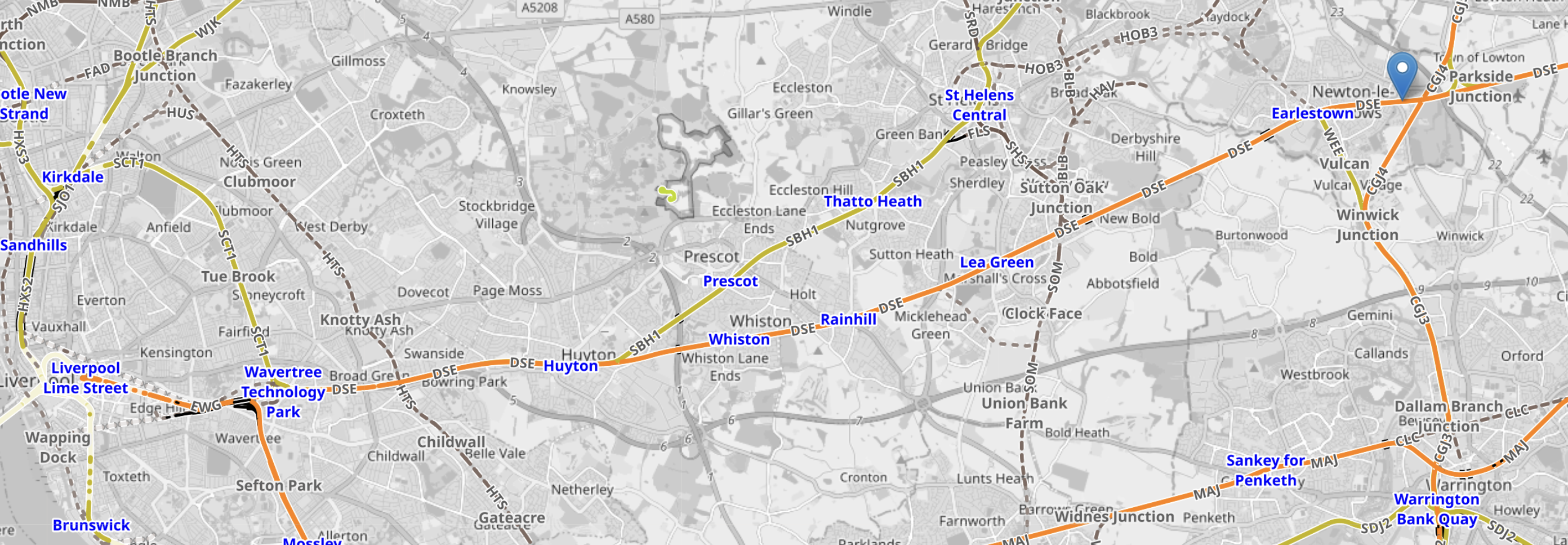
This OpenRailwayMap shows the route I took.
Note.
- Liverpool Lime Street station is at the Western side of the map.
- Newton-le-Willows station is marked by the blue arrow in the top right corner of the map.
- Warrington Bank Quay station is in the bottom right corner of the map.
It does seem a round about route, But I got there. Although, I was late.
Hopefully, in a couple of years, you’ll be able to take a local train between Liverpool Lime Street and Newton-le-Willows stations to link up with FirstGroup’s low-cost Lumo Open Access service between Euston and Rochdale.
A Single Journey Home
I was booked home on the 18:43 train from Lime Street, but as you can often do, I asked and was allowed to board the 17:43.
A Crowded And Crazy Euston
I arrived back at Euston at 20:00, but it was crowded, as the station is very much a building site for High Speed Two.
I felt I would treat myself to a taxi, but I couldn’t find any.
So I took a 205 bus along Euston Road to King’s Cross, where I jumped on the the Circle Line for Moorgate.
From there I took my usual 141 bus home.
A friendly station guy at Moorgate, indicated, there might not be any taxis at Euston.
I’d also found earlier, that there were no escalators to the Underground.
Perhaps more than ever, care should be taken at Euston, when getting to and from the station.
It Looks To Me That High Speed Two Has Got Their Planning Wrong At Euston
The big problem at Euston is getting to and from the National Rail station from East or West,
Compare Euston in this respect with Liverpool Street, King’s Cross, St. Pancras or Paddington.
In The New Step-Free Entrance At Euston Square Station, I show the plans for step-free access to the sub-surface lines.
This new entrance to Euston station, should be built first.
All the dithering about High Speed Two seems to have delayed it!
Destination Manchester
The title of this post is the same as the title of this page on the London North Western Railway web site.
The page introduces, the operator’s proposed new service to Manchester.
As a progressive rail operator we’re always looking to develop our services and timetables to provide a better travelling experience for our customers. We are ambitious and our team seek innovative solutions to create new journey opportunities.
That’s why we have developed proposals for our trains to begin serving Manchester for the first time. Under the plans, our existing hourly service between Crewe and London Euston would be extended to Manchester city centre from summer 2026.
Following the cancellation of the northern leg of HS2, these proposals will provide much-needed connectivity between Manchester, the West Midlands and London, with thousands of extra seats every day.
In more detail, the extended London Euston and Crewe service to Manchester Victoria station, will create the following.
- Additional capacity and comfortable, affordable journeys to and from Manchester city centre
- A great alternative to car and coach travel, with fares up to 50% cheaper than the main intercity train operator
- New regular direct services to Warrington for passengers at Milton Keynes, Rugby and Lichfield
- New regular direct services to Manchester for passengers at Rugeley, Lichfield, Tamworth and Atherstone
Note.
- The service will pass through Warrington Bank Quay, Stockport, Earlestown, Newton-le-Willows, Eccles and Salford Central to reach Manchester Victoria, so could be a comprehensive service to the Northern and Western parts of Manchester City Centre. It would just depend on the stopping pattern in the City Centre.
- There would be good connections to Manchester Metrolink at Eccles and Manchester Victoria.
- All stations on the Manchester Metrolink can be reached either direct or with a single change from Manchester Victoria.
- Manchester Metrolink is touch-in and out with a credit card.
- Manchester Victoria is very well connected by rail to cities and important destinations across the North including Blackburn, Blackpool, Bradford, Burnley, Halifax, Hebden Bridge, Huddersfield, Leeds, Liverpool, Preston, Wigan and York.
- The page talks of a London Euston and Manchester Victoria time of three hours and ten minutes.
- Manchester Stations is a group of the four stations; Manchester Piccadilly, Manchester Oxford Road, Manchester Victoria and Deansgate. Often a ticket to Manchester Stations is a few pounds cheaper and more convenient, if you are visiting several places in the City Centre.
The London Euston and Manchester Victoria service looks to me to be a well-thought out proposal.
A New Connection To Manchester Airport
Under a title of Anything Else on the page on the London North Western Railway web site, this is said.
As well as the proposal to extend our London Euston-Crewe services to Manchester Victoria, we are also proposing to begin running trains to Manchester Airport. This will involve extending our existing service between Stafford and Crewe, providing direct connectivity to the airport from Stoke-on-Trent and Staffordshire. More details on this proposal will be announced in due course.
Note.
- The extended Stafford and Manchester Airport service could call at Stone, Stoke-on-Trent, Longport, Kidsgrove, Alsager, Crewe, and possibly Wilmslow and Styal.
- Stafford, Stone, Stoke-on-Trent, Longport, Kidsgrove and Alsager would gain direct services to and from Manchester Airport.
- It would appear that the current Stafford and Crewe service waits in Stafford station for at least fifteen minutes.
- The current Stafford and Crewe service appears to always use platform 6 at Stafford.
- The current Euston and Crewe service appears to always use platform 3 at Stafford.
- The current Crewe and Euston service appears to always use platform 1 at Stafford.
- The current Birmingham and Liverpool service appears to always use platform 5 at Stafford.
- The current Liverpool and Birmingham service appears to always use platform 4 at Stafford.
I suspect that trains can be timetabled, so that the following is possible.
- An hourly London Euston and Manchester Airport service with a quick step-free change at Stafford between the London Euston and Manchester Victoria service and the Stafford and Manchester Airport service.
- An hourly Manchester Airport and London Euston service with a quick step-free change at Stafford between the Manchester Airport and Stafford service and the Manchester Victoria and London Euston service.
- An hourly Birmingham New Street and Manchester Airport service with a quick cross-platform change at Stafford between the Birmingham New Street and Liverpool Lime Street service and the Stafford and Manchester Airport service.
- An hourly Manchester Airport and Birmingham New Street service with a quick step-free change at Stafford between the Manchester Airport and Stafford service and the Liverpool Lime Street and Birmingham New Street service.
Note.
- I suspect more changes at Stafford could be cross-platform.
- I also suspect that it is possible to arrange that all services to the same destination, leave from the same platform, at the same time or times each hour.
- It would appear too, that if you want a cheap ticket price to Liverpool Lime Street, Manchester Victoria or Stoke-on-Trent, then you may have to change at Stafford.
It appears all more affordable London Northwestern Railway trains will go via Stafford.
I have some further thoughts.
Stafford And Manchester Airport Timings
With all the stops, it looks like Stafford and Manchester Airport will take about 78 minutes, but if they used the West Coast Main Line and didn’t stop the time could be reduced to just under an hour.
The Class 730 Trains
The services will be run by 110 mph Class 730 trains.
In 2018, there was talk of a bi-mode 125 mph Aventra, which I wrote about in Bombardier Bi-Mode Aventra To Feature Battery Power.
Currently, the Class 730 trains are 110 mph trains.
Would it help timetabling and capacity if these trains could be stretched to 125 mph?
Avanti West Coast
Several Avanti West Coast services stop at Stafford.
Their services could be half-an-hour quicker to Stafford, but they wouldn’t have the same stopping patterns.
In response to the competition, Avanti West Coast might run a few Manchester Airport Expresses using their new Class 805 trains.
A Second Service Between Stoke And Manchester Airport
I feel this might be needed and perhaps it could be faster, by using the direct route between Stafford and Crewe.
Avanti West Coast could use it to create a one-change fast service between London Euston and Manchester Airport, if they felt such a service were to be needed.
Conclusion
I like this proposal.
But there is a lot of fine tuning to do!
FirstGroup’s Lumo Seeks To Launch Rochdale – London Open Access Service
The title of this post, is the same as that of this article on Railway Gazette.
These two paragraphs outline the service.
FirstGroup has applied to operate Rochdale – London open access passenger trains, more than 20 years after a short-lived through service ran between the two destinations.
On May 17 FirstGroup said that it had applied to the Office of Rail & Road to launch six Lumo-branded return journeys per day linking London Euston and Rochdale via the West Coast Main Line. The trains would call at Warrington Bank Quay, Newton-le-Willows, Eccles and Manchester Victoria.
These are my thoughts.
The Route Isn’t Fully-Electrified
The route is electrified between London Euston and Manchester Victoria stations, but the 10.4 miles between Manchester Victoria and Rochdale is not electrified.
In Extra Luggage Racks For Lumo, I also talk about the possibility of fitting traction batteries to Lumo’s Class 803 trains, so they could handle the 88.5 mile diversion on the East Coast Main Line via Lincoln.
Trains with a traction battery, with an 88.5 mile range, would be able to travel between Manchester Victoria and Rochdale and return.
How Long Would London Euston And Rochdale Take?
Consider.
- The fastest London Euston and Warrington Bank Quay services take 1 hour and 44 minutes
- The fastest Warrington Bank Quay and London Euston services take 1 hour and 47 minutes
- Northern’s Class 195 trains take between 44-51 minutes Rochdale and Warrington Bank Quay with three stops.
- Northern’s Class 195 trains take between 29-32 minutes Manchester Victoria and Warrington Bank Quay with two stops.
- I will add two minutes for the extra stop.
These are my estimates for overall journey times.
- London Euston and Manchester Victoria – 2 hours and 15 minutes
- London Euston and Rochdale – 2 hours and 29 minutes
- Manchester Victoria and London Euston – 2 hours and 21 minutes
- Rochdale and London Euston – 2 hours and 40 minutes
The fastest direct Avanti West Coast services between London Euston and Manchester Piccadilly take 2 hours and 6 minutes.
Could The Service Be Extended To Leeds?
For my timings between Rochdale and Warrington Bank Quay, I used Northern’s Leeds and Chester service.
This service goes between Manchester Victoria and Leeds calling at Rochdale, Todmorden, Hebden Bridge, Halifax, Bradford Interchange, New Pudsey and Bramley.
I estimate it would take about 3 hours 32 minutes.
When Bradford has a new through station, I wouldn’t be surprised if a train operator looked at this route between London Euston and Leeds.
As Leeds and Manchester Victoria is only 49.8 miles, Lumo’s battery electric trains, with 88.5 mile batteries sized for the Lincoln diversion on the East Coast Main Line, would have no difficulty serving Leeds, where they would charge before return.
Could Lumo Run Pairs Of Five-Car Trains Between London Euston and Manchester Victoria?
As I said in Ten-Car Hull Trains, Lumo’s sister company; Hull Trains, runs the occasional ten-car service.
Perhaps for a big football match or other event, Lumo might like to run ten-car trains between Manchester Victoria and London Euston.
I suspect they could do it if the platforms were long enough, but they wouldn’t be able to run a 260 metre ten-car train to Rochdale, as that station only has a 135 metre long platform.
Warrington Bank Quay Station Will Get Six Extra Non-Stop Trains To And From London
This would provide real competition to Avanti West Coast over this route.
Newton-le-Willows Station Is Only A Few Miles From The Town Of St. Helen’s
Newton-le-Willows station has 400 parking spaces and 32 disabled parking spaces.
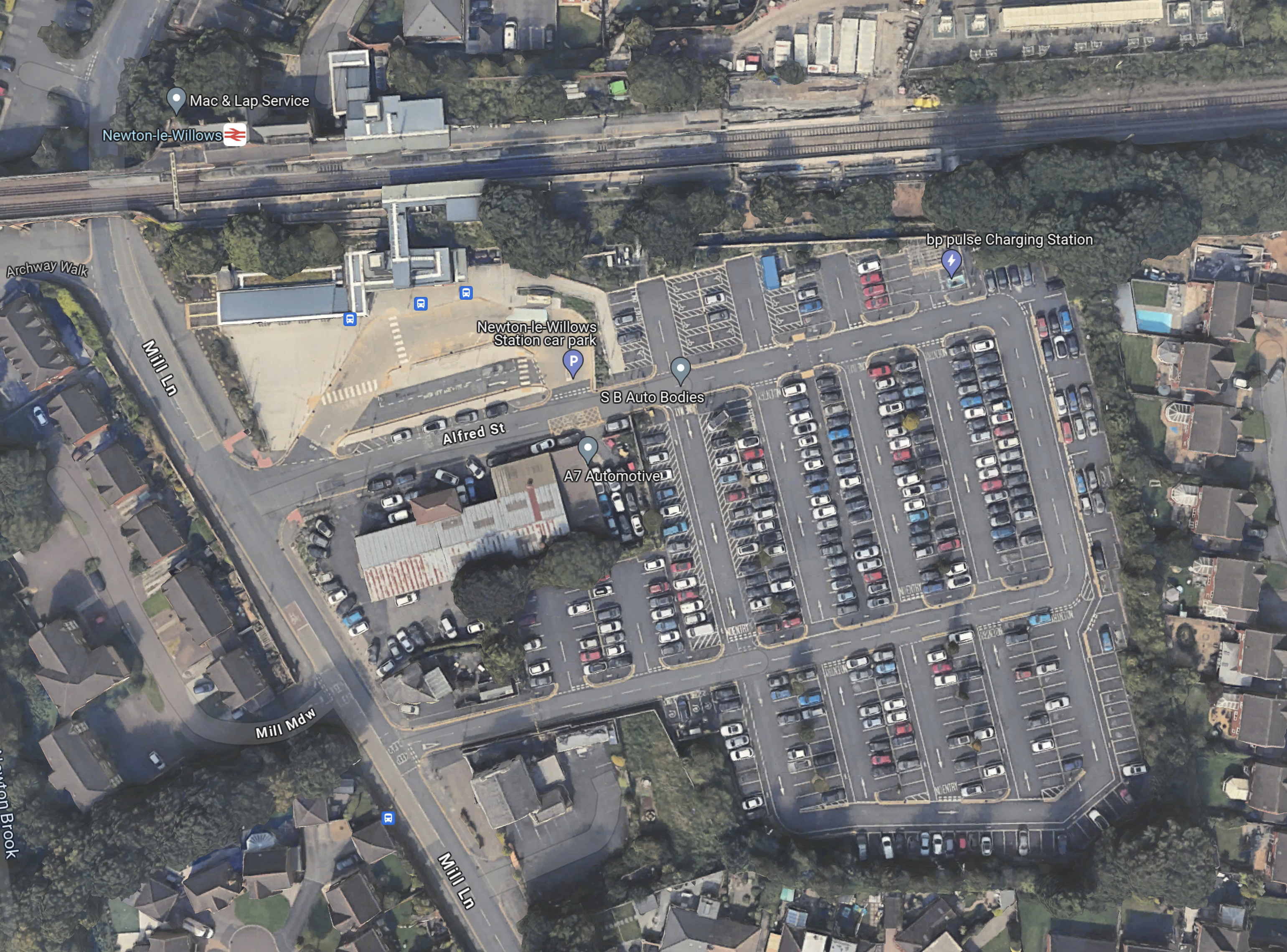
Note.
- The parking is all free!
- There are regular local trains to Chester, Leeds, Liverpool Lime Street, Manchester Airport and Wigan North Western.
A six trains-per-day service to and from London, will help fill up the parking spaces.
Eccles Station Is Within Walking Distance Of Eccles Interchange
This OpenRailwayMap shows Eccles station and Eccles Interchange.
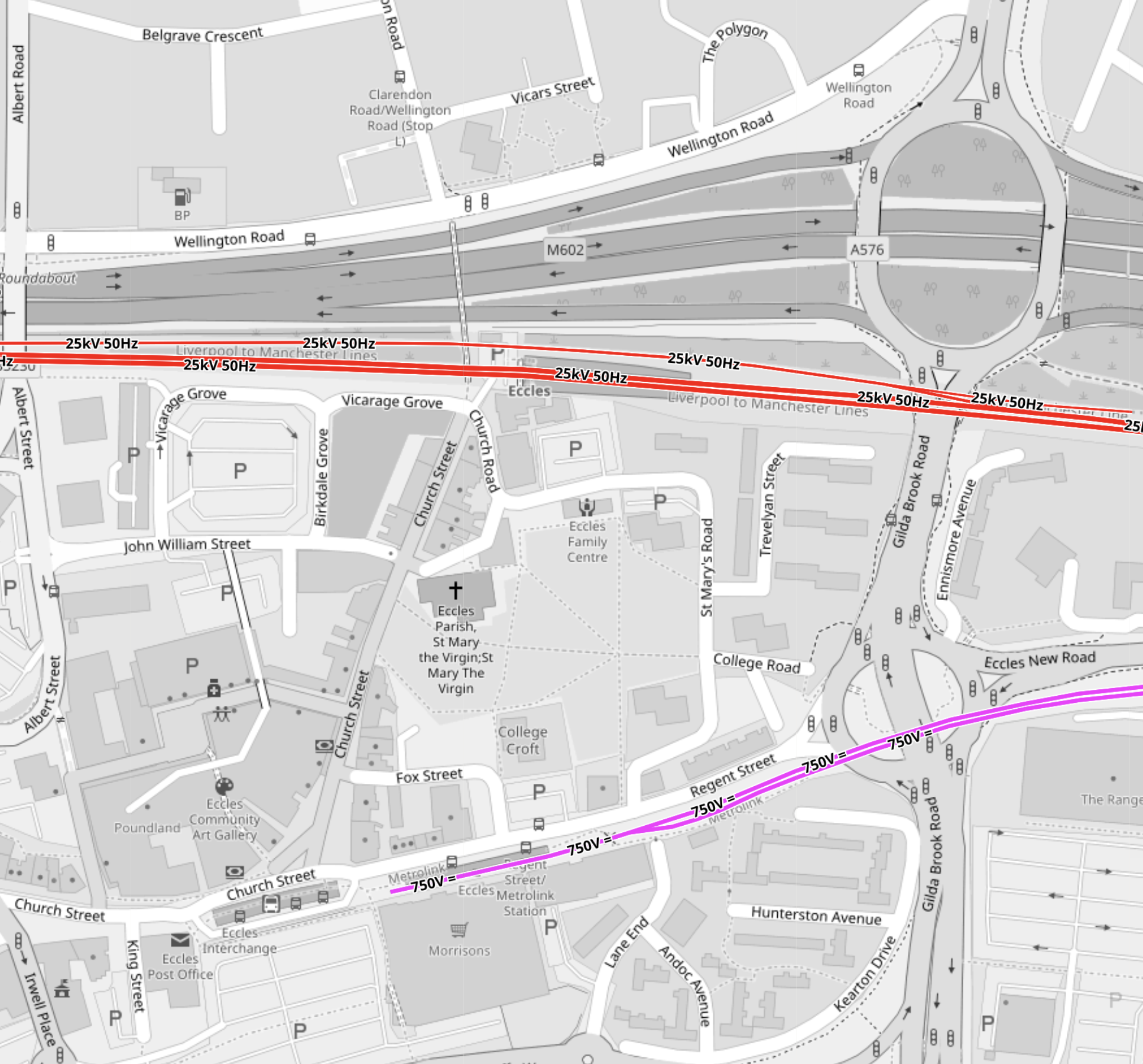
Note.
- The mauve tracks are the Manchester Metrolink.
- They terminate in the South-West at Eccles Interchange.
- The red tracks are the Liverpool-Manchester lines.
- Eccles station is a Northerly walk from Eccles Interchange.
This connection must be useful to more than a few.
I suspect if you’re going between London and Media City UK, Salford Quays or Piccadilly Gardens, you may be better to change to the Metrolink at Eccles.
Will Lumo’s Rochdale Service Run As A Flight With Avanti’s Glasgow Service?
Flighting is where two or more trains going on the same route run a few minutes apart.
- Every hour, on the half hour, an Avanti West Coast service for leaves London Euston for Glasgow Central.
- As with Lumo’s Rochdale service, the first stop is Warrington Bank Quay station.
- The Lumo service would leave London Euston a few minutes after Avanti’s Glasgow service.
- The distance between the two trains would be such, that if the first train stopped, the second train could stop safely.
- Digital signalling as is being installed on UK rail lines would make it easier to ensure safe separation.
But the benefit would be that both trains ran fast to Warrington Bank Quay station.
A Day-Trip To Manchester
If I’m right about the 2 hours and 15-21 minutes between London Euston and Manchester Victoria, then a day-trip would certainly be feasible.
Last Trains
This is a table of the last train times for Lumo between Newcastle and London.
- Weekdays – 20:27 21:35
- Saturdays – 18:27 19:22
- Sundays – 19:24 20:21
Note.
- The first time is the last Northbound departure.
- The second time is the last Southbound departure.
- Are these late enough for football matches?
I shall be interested to see the proposed last train times for the Manchester route.
- Will they be timed so you can get a tram from the Etihad or Old Trafford stadium after an evening match, that allowed you to get the last train back to London from Manchester Victoria?
- Taylor Swift gave the Manchester Arena a lot of favours with her concerts. Would you have been able to see her concert and get the last train back to London?
A few extra full trains wouldn’t hurt Lumo’s finances.
Conclusion
It looks like, this could be a very worthwhile service.
250,000 Seats A Day On The WCML?
The title of this post, is the same as that of this article on Rail Engineer.
These are the first three paragraphs.
In the Parliamentary debate on the cancellation of HS2 phase 2, Transport Minister Mark Harper claimed that what remains of HS2 will deliver “a massive increase in capacity to the West Coast Main Line (WCML)” by providing 250,000 seats a day. This figure was subsequently repeated by the Prime Minister and Rail Minister who advised that it applies “across the primary long-distance operator on the West Coast.”
Yet without HS2 phase 2a, there is to be no WCML capacity increase north of Lichfield. Furthermore, with no HS2 station in Manchester it will not be possible to run the planned two-unit 400-metre HS2 trains to the city. Instead, there can only be single 200-metre unit HS2 trains which are shorter than the current 265-metre Pendolino trains.
Furthermore, 250,000 seats a day is equivalent to running 17 x 605-seat Pendolinos an hour, 24 hours a day. This is clearly not credible.
Note.
- The writer’s assumptions about Manchester are correct.
- Liverpool Lime Street is already is already HS2-ready for trains between Crewe and London, after the recent upgrade.
- Liverpool Lime Street will certainly be able to take two London trains per hour (tph), which can only be single 200-metre unit HS2 trains.
- Liverpool Lime Street may be able to take a third London train per hour.
These are my thoughts.
Current Services
Current services include.
- Avanti West Coast – London Euston and Blackpool North via Birmingham New Street – 2 trains per day (tpd)
- Avanti West Coast – London Euston and Glasgow Central via Birmingham New Street – 5 tpd
- Avanti West Coast – London Euston and Edinburgh Waverley via Birmingham New Street – 7 tpd
- Avanti West Coast – London Euston and Birmingham New Street – 1 tph
- Avanti West Coast – London Euston and Holyhead – 10 tpd
- Avanti West Coast – London Euston and Liverpool Lime Street – 1 tph – Increasing to 2 tph.
- Avanti West Coast – London Euston and Manchester Piccadilly via Stoke-on-Trent, Macclesfield and Stockport – 1 tph
- Avanti West Coast – London Euston and Manchester Piccadilly via Stoke-on-Trent and Stockport – 1 tph
- Avanti West Coast – London Euston and Manchester Piccadilly via Crewe, Wilmslow and Stockport – 1 tph
- Avanti West Coast – London Euston and Glasgow Central – 1 tph.
- West Midlands Trains – London and Birmingham New Street – 2 tph
- West Midlands Trains – London and Crewe – 1 tph
- West Midlands Trains – Birmingham New Street and Liverpool Lime Street – 1 tph
It looks like there are eight Avanti West Coast tph and two West Midlands Trains tph between Stafford and Crewe.
High Speed Two Services
This diagram shows High Speed Two services, as they were originally envisaged before Phase 2 was discontinued.
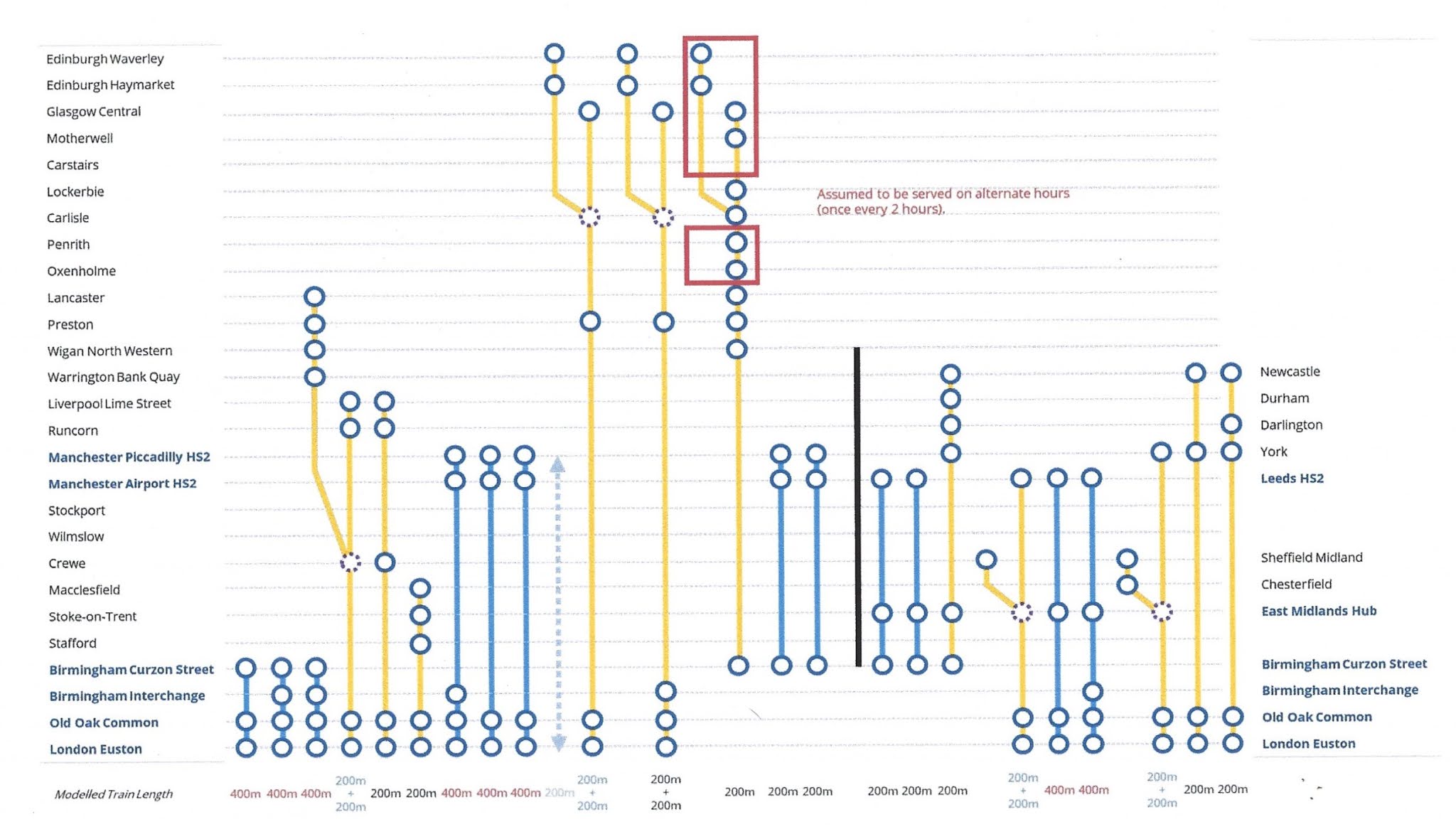
Note.
- Trains to the left of the vertical black line are Phase 1 and those to the right are Phase 2.
- Full-Size trains are shown in blue.
- Classic-Compatible trains are shown in yellow.
- The dotted circles are where trains split and join.
- In the red boxes routes alternate every hour.
- Was Lancaster chosen as it’s close to the new Eden Project Morecambe?
Click on the diagram to enlarge it.
The Author’s Assumption
The author has made these assumptions.
- Current West Coast Main Line capacity North of Lichfield; Avanti West Coast – 8 tph, West Midlands – 1 tph and freight trains – 4 tph
- HS2 offers no extra capacity North of Lichfield.
- Max capacity ; Old Oak Common – 8 tph and London Euston – 10 tph.
- 400-metre long trains North of Birmingham ; Min – 1 tph to Edinburgh/Glasgow
- 400-metre long trains North of Birmingham ; Max – plus 3 tph to Liverpool/Manchester
- Trains operate a maximum of 14 hours per day.
I would add.
- All pairs of 200-metre long trains split and join at Crewe.
- Birmingham Curzon Street has seven platforms.
- Lancaster and Macclesfield have long bay platforms, that can handle 200-metre trains
- Liverpool Lime Street and Manchester Piccadilly have two platforms, that can handle 200-metre trains.
- I suspect
- Liverpool Lime Street and Manchester Piccadilly could both handle four 200-metre trains tph hour – Three for London and one for Birmingham.
There is a surprising amount of capacity in the North.
The Author’s Minimum Plan For HS1 – Phase 1
I think his minimum plan is as follows.
- Old Oak Common and Birmingham Curzon Street – 400-metre long trains – 3 tph
- Old Oak Common and Liverpool Lime Street/Lancaster – 400-metre long trains – 1 tph – Splits at Crewe.
- Old Oak Common and Liverpool Lime Street – 200-metre long trains – 1 tph
- Old Oak Common and Macclesfield via Stafford and Stoke-on-Trent – 200-metre long trains – 1 tph
- Old Oak Common and Manchester Piccadilly – 200-metre long trains – 2 tph
- Old Oak Common and Edinburgh Waverley/Glasgow Central – 400-metre long trains – 1 tph – Splits at Crewe.
Note.
- 400-metre long trains are a pair of 200-metre long trains, that can split and join.
- This fulfils all the requirements of the original HS2 timetable for Phase 1.
- The total is nine tph and Old Oak Common can only handle 8 tph.
- Perhaps, the Liverpool Lime Street service could be a Liverpool Lime Street/Manchester Piccadilly service, that splits at Crewe?
I think it could work with London having the following services.
- Birmingham Curzon Street – 400-metre long trains – 3 tph
- Birmingham International – 400-metre long trains – 4 tph
- Carlisle – 200-metre long trains – 1 tph
- Crewe – 400-metre long trains – 3 tph
- Edinburgh Waverley – 200-metre long trains – 1 tph
- Glasgow Central – 200-metre long trains – 1 tph
- Lancaster – 200 metre long trains – 1 tph
- Liverpool Lime Street – 200-metre long trains – 2 tph
- Macclesfield – 200-metre long trains – 1 tph
- Manchester Piccadilly – 200-metre long trains – 2/3 tph
- Preston – 200-metre long trains – 2 tph
- Stafford – 200-metre long trains – 1 tph
- Stoke-on-Trent – 200-metre long trains – 1 tph
- Warrington Bank Quay – 200-metre long trains – 1 tph
- Wigan North Western – 200-metre long trains – 1 tph
Services care as good or better than the current services.
The Author’s Maximum Plan For HS1 – Phase 1
I think his maximum plan is as follows.
- London Euston and Birmingham Curzon Street – 400-metre long trains – 3 tph
- London Euston and Liverpool Lime Street/Lancaster – 400-metre long trains – 1 tph – Splits at Crewe.
- London Euston and Liverpool Lime Street/Manchester Piccadilly – 400-metre long trains – 1 tph – Splits at Crewe.
- London Euston and Macclesfield via Stafford and Stoke-on-Trent – 200-metre long trains – 1 tph
- London Euston and Manchester Piccadilly – 200-metre long trains – 2 tph
- London Euston and Edinburgh Waverley/Glasgow Central – 400-metre long trains – 1 tph – Splits at Crewe.
Note.
- 400-metre long trains are a pair of 200-metre long trains, that can split and join.
- This fulfils all the requirements of the original HS2 timetable for Phase 1.
- That is nine tph and London Euston can handle 10 tph.
- Perhaps, a tenth train could serve Edinburgh Waverley/Glasgow Central with a split at Crewe.
It should work.
Could High Speed Birmingham Curzon Street and Liverpool Lime Street And Manchester Piccadilly Services Be Provided With A Reverse At Birmingham Curzon Street?
A train would take this route.
- A 400 metre long train would leave London and go to Birmingham Curzon Street.
- At Birmingham Curzon Street the train would reverse and travel to Crewe.
- At Crewe the train would split with separate trains going to Liverpool Lime Street and Manchester Piccadilly.
Note.
- Automation could be used extensively to do the joining and splitting.
- The train would have an onboard team of drivers, so all joins, reverses and splits are performed as fast as possible.
- A local service could be paired with each train, so that intermediate stations on the Liverpool and Manchester branches had excellent connections to Birmingham and the South.
Suppose the maximum plan is now as follows.
- London Euston and Liverpool Lime Street/Manchester Piccadilly via Birmingham Curzon Street – 400 metre long trains – 3 tph – Reverses at Birmingham Curzon Street – Splits at Crewe.
- London Euston and Birmingham Curzon Street – 400 metre long trains – 1 tph
- London Euston and Lancaster – 200 metre long trains – 1 tph
- London Euston and Liverpool Lime Street – 200 metre long trains – 1 tph
- London Euston and Macclesfield via Stafford and Stoke-on-Trent – 200 metre long trains – 1 tph
- London Euston and Manchester Piccadilly – 200 metre long trains – 1 tph
- London Euston and Edinburgh Waverley/Glasgow Central – 400 metre long trains – 2 tph – Splits at Crewe.
Note.
- Birmingham Curzon Street, Liverpool Lime Street and Manchester Piccadilly would all get four tph to and from London.
- Birmingham Curzon Street, Liverpool Lime Street and Manchester Piccadilly would all get one tph to and from London, that could be non-stop and didn’t join, reverse or split.
- Birmingham Curzon Street and Liverpool Lime Street would have a three tph service.
- Birmingham Curzon Street and Manchester Piccadilly would have a three tph service.
- Lancaster, Edinburgh Waverley, Glasgow Central and other stations would get the originally-promised service to and from London.
- That is ten tph to and from London Euston and the station can handle that number of trains.
It should work.
Could High Speed Birmingham Curzon Street and Edinburgh Waverley and Glasgow Central Services Be Provided With A Reverse At Birmingham Curzon Street?
In the previous section, I showed how, three tph between London Euston and Liverpool Lime Street/Manchester Piccadilly could be provided with a reverse at Birmingham Curzon Street.
So could the fourth train between London and Birmingham Curzon Street take this route?
- A 400 metre long train would leave London and go to Birmingham Curzon Street.
- At Birmingham Curzon Street the train would reverse and travel to Crewe, or another station, where the split can be performed.
- The train would split with separate trains going to Edinburgh Waverley and Glasgow Central.
Note.
- They would use the current paths used by Avanti West Coast Birmingham and Scotland services along the West Coast Main Line.
- This would give a third train to both Edinburgh Waverley and Glasgow Central.
It certainly appears that by using a reverse at Birmingham Curzon Street, more capacity can be created on the West Coast Main Line/HS2 route.
Could High Speed Two Serve North Wales?
It finally looks like the North Wales Coast Lines will finally be electrified.
- Would this allow a 200 metre long train to run all the way to Holyhead for the boats to Ireland?
- There could be a join and split at Crewe with another train.
- Chester would also be served by HS2.
It would create a zero-carbon route to Ireland.
What Would Be The Daily Number Of Passengers Carried?
The maximum plan could now be as follows.
- London Euston and Liverpool Lime Street/Manchester Piccadilly via Birmingham Curzon Street – 400 metre long trains – 3 tph – Splits at Crewe.
- London Euston and Edinburgh Waverley/Glasgow Central via Birmingham Curzon Street – 400 metre long trains – 1 tph – Splits at Crewe.
- London Euston and Liverpool Lime Street/Lancaster – 400 metre long trains – 1 tph – Splits at Crewe.
- London Euston and Macclesfield via Stafford and Stoke-on-Trent – 200 metre long trains – 1 tph
- London Euston and Manchester Piccadilly/Holyhead – 400 metre long trains – 1 tph – Splits at Crewe.
- London Euston and Edinburgh Waverley/Glasgow Central – 400 metre long trains – 2 tph – Splits at Crewe.
Note.
- There are eight 400 metre long trains and one 200 metre long trains in both directions.
- A 200 metre long train hold 550 passengers.
- There are seventeen 200 metre long tph in both directions.
- Trains operate a maximum of 14 hours per day.
The number of passengers per day is 261,800.
Could Open Access Operators Use High Speed Two?
In Mayors Propose New Staffordshire To Manchester Rail Line, I suggested the Grand Union Trains might like to run their service between London Euston and Stirling via High Speed Two.
But would this be a feasible idea?
These are my thoughts.
What Is An Open Access Operator?
The Wikipedia entry for Open-Access Operator, provide this answer.
In rail transport, an open-access operator is an operator that takes full commercial risk, running on infrastructure owned by a third party and buying paths on a chosen route and, in countries where rail services run under franchises, are not subject to franchising.
It then lists fifty-four operators in fifteen countries.
As the companies, who provide the services take full commercial risk and don’t get a subsidy from the taxpayer, I don’t see why, that providing, the operator can get the paths, they should be allowed to operate.
If they fail, then that’s the operator’s problem.
Are Any Paths Available On High Speed Two?
These are High Speed Two services as originally planned.
Since the Eastern Leg was cancelled, the following has happened.
- There are only eleven trains per hour (tph) between London Euston and Birmingham Interchange.
- There are only ten tph between Birmingham and Crewe.
- There is one tph between Birmingham and Macclesfield via Stafford and Stoke-on-Trent.
Note.
The Trent Valley Line section between Stafford and Crewe is 24.3 miles.
The Trent Valley Line between Handsacre Junction and Crewe is nearly all four tracks.
Currently, this section carries these fast trains.
- Avanti West Coast – 1 tph – London Euston to Blackpool North, Edinburgh or Glasgow via Birmingham New Street.
- Avanti West Coast – 1 tph – London Euston to North Wales
- Avanti West Coast – 1 tph – London Euston to Liverpool Lime Street
- Avanti West Coast – 2 tph – London Euston to Manchester Piccadilly
- Avanti West Coast – 1 tph – London Euston to Scotland
- West Midlands Trains – 1 tph – London Euston to Crewe.
- West Midlands Trains – 1 tph – Stafford to Crewe.
- West Midlands Trains – 1 tph – Birmingham New Street to Liverpool Lime Street.
This totals nine tph and will be 10 tph, when a second London Euston to Liverpool Lime Street is added.
When High Speed Two opens between London Euston and Birmingham Curzon and Handsacre Junction, trains between London Euston and Liverpool, Manchester, the North and Scotland will switch to the Trent Valley Line at Handsacre Junction.
The Trent Valley Line section between Stafford and Crewe will carry these fast trains.
- Avanti West Coast – 1 tph – London Euston to North Wales
- High Speed Two – 2 tph – London Euston to Liverpool Lime Street
- High Speed Two – 3 tph – London Euston to Manchester Piccadilly
- High Speed Two – 2 tph – London Euston to Scotland
- High Speed Two – 1 tph – Birmingham Curzon Street to Scotland
- High Speed Two – 2 tph – Birmingham Curzon Street to Manchester Piccadilly
- West Midlands Trains – 1 tph – London Euston to Crewe.
- West Midlands Trains – 1 tph – Stafford to Crewe.
- West Midlands Trains – 1 tph – Birmingham New Street to Liverpool Lime Street
Note.
- This totals to ten tph for High Speed Two, 1 tph for Avanti West Coast and the tph for West Midlands Trains.
- There is no service to Blackpool.
- It looks to me that the London Euston to North Wales should, as soon as the North Wales Coast Line is electrified become a High Speed Two service.
- Should the Birmingham New Street to Liverpool Lime Street service be replaced with a High Speed Two from Birmingham Curzon Street to Liverpool Lime Street?
There is plenty of paths South of Handsacre Junction on High Speed Two to accommodate a few services to Blackpool and an open access operator like Grand Union Trains, who have been given permission to run a service to Stirling.
Conclusion
My rough calculation says that open access services could be fitted in on the latest variant of High Speed Two.
In Mayors Propose New Staffordshire To Manchester Rail Line, the two Andies; Burnham and Street proposed that the Handsacre Junction and Manchester Airport section of High Speed Two should be built.
If this should happen, then it would open up several possibilities for open access services for the North.

