Network Rail And Vivarail Bring The Next-Generation Battery Train To COP26
The title of this post, is the same as that of this article on Network Rail.
These are the first two paragraphs.
Network Rail and Vivarail today announced that Vivarail’s next-generation battery train will be launched at COP26 and will run daily services throughout the international climate change conference.
This zero-emission train uses new batteries, developed by Vivarail, to combine maximum range with the ability to recharge quickly. The result is a train that can travel for up to 80 miles on battery power and recharge in only 10 minutes using Vivarail’s patented Fast Charge system.
That is an excellent range coupled with a fast turnround time.
How will other companies like CAF, Hitachi and Stadler respond?
If all battery-electric trains can reach this range, I don’t think we’ll need hydrogen for multiple units, but we will probably need it for freight and other locomotives.
LNER’s Middlesbrough And London Service Starts On December 13th
Tucked at the bottom of the article entitled LNER Tickets For Christmas Getaway in Edition 939 of Rail Magazine, there is this paragraph separated from the article by a sole bullet point.
LNER has confirmed that from December 13 it will run a new weekday service between London King’s Cross and Middlesbrough.
It has already made an appearance on Real Time Trains and I can find the following details.
- There will be one train per day (tpd)
- Intermediate stops will be at Thornaby and York.
- The Middlesbrough and London service will leave Middlesbrough from Platform 1 at 07:08 and arrive in King’s Cross at 10:22.
- The London and Middlesbrough service will leave King’s Cross at 15:25 and arrive in Middlesbrough in Platform 2 at 18:18.
These are my thoughts.
Trains Per Day
One train per day, is obviously an introductory service and like services to Harrogate and Lincoln, the number of services will ramp up to perhaps four or five tpd, if the demand is there and the paths and trains are available.
Journey Times
Consider
- The Southbound journey takes three hours and fourteen minutes with a time of two hours and nine minutes between York and King’s Cross
- The Northbound journey takes two hours and fifty-three minutes with a time of one hour and fifty-six minutes between King’s Cross and York.
- Some services between King’s Cross and York are as fast as one hour and forty-eight minutes.
- Middlesbrough and York seems to take around 52-58 minutes.
- These Middlesbrough and York timings are consistent with TransPennine Express.
- Digital signalling could offer savings in journey time between York and London.
I think it is very likely as the timetable improves, that timings between Middlesbrough and London could be around two hours and forty minutes.
Electrification
The route is fully electrified except for between Middlesbrough and Longlands Junction, where it joins the electrification of the East Coast Main Line, which is a distance of twenty-two miles.
Hitachi are developing a battery-train, which they call the Hitachi Intercity Tri-Mode Battery Train, which is described in this Hitachi infographic.

Note.
- LNER’s current Class 800 trains will probably be able to be converted to this train.
- A range on battery power of upwards of forty miles would be expected.
If the range on battery-power can be stretched to perhaps sixty miles, this train should be capable of serving Middlesbrough without the need for any extra charging at the terminus.
I am sure Hitachi would like to see their battery-electric trains running between King’s Cross and Middlesbrough, as it would be an ideal route on which to show the trains to prospective customers, given that their factory is at Newton Aycliffe.
Conclusion
This could be good demonstration battery-electric service for Hitachi and LNER.
Lumo: Why Won’t The New Train Service Stop At Yorkshire Stations?
The title of this post, is the same as that of this article on the Yorkshire Post.
This is the first article, I’ve found about Lumo, that has a negative headline.
The reason is probably very simple, in that most Lumo services are planned to stop at only at Newcastle and Morpeth, with two services having an extra stop Stevenage.
They are intending to run the service in as short a time as possible between London King’s Cross and Edinburgh.
As each stop has a time penalty, not stopping in Yorkshire will give potential to go cut the journey time.
But the positive message that comes from the writer of the Yorkshire Post article is that Yorkshire likes the concept.
This paragraph is their take on the service.
The goal is to encourage a more environmentally friendly mode of transportation and affordable travel. Lumo will provide low-carbon emissions, affordable long-distance travel for more than one million passengers every year.
Perhaps they would like their own Yorkshire flyer.
The obvious way for this to happen would be for the Open Access operator; Grand Central to convert themselves into a train operator like Lumo.
- The ten diesel Class 180 trains would be replaced by new electric trains.
- The trains would need a 140 mph capability under digital signalling to fit in with the plans of Network Rail, LNER and Lumo to create a top-class high-speed high-capacity East Coast Main Line.
- The trains would need a battery capability as Grand Central’s routes are not fully electrified.
- They could copy Lumo’s green marketing philosophy, ticketing and catering offering.
As to the trains, I’m sure that Hitachi could offer a version of their Intercity Tri-Mode Battery Train, the specification of which is shown in this Hitachi infographic.
The trains would need a range of fifty miles on battery-power.
Charging facilities wold be needed at Bradford Interchange and Sunderland stations, as neither has suitable 25 KVAC overhead electrification.
Conclusion
The conversion of Grand Central to work on the Lumo model is possible and as the trains will need to be changed to zero-carbon ones soon to meet decarbonisation objectives, I would suspect that at least that will happen.
Battery-Electric Trains And The TransPennine Upgrade
In Is There Going To Be Full Electrification Between Leeds And Huddersfield?, I showed this map of the TransPennine Upgrade between Huddersfield and Westtown near Dewsbury.
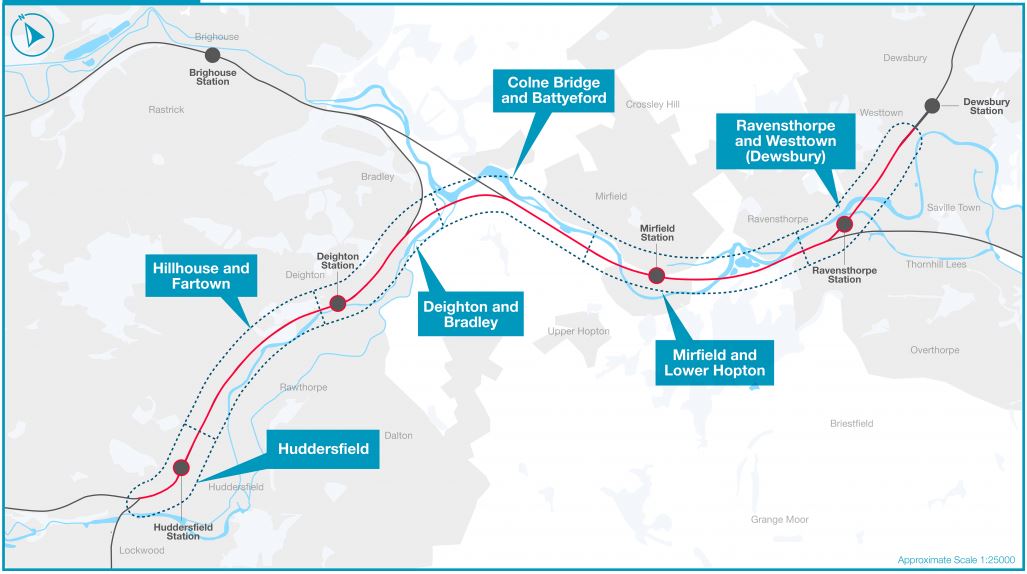
Note.
- There will be electrification between Dewsbury and Huddersfield.
- Tracks will be doubled from two to four.
- Ravensthorpe, Mirfield, Deighton and Huddersfield stations will be electrified and probably upgraded.
- Dewsbury and Huddersfield stations are eight miles apart.
This page on the Network Rail website gives more information.
Click on Huddersfield and Westtown (Dewsbury) and you get this information.
On 31 March 2021, we submitted a Transport and Works Act Order (TWAO) application to the Secretary of State for Transport for the Huddersfield to Westtown (Dewsbury) scheme.
Throughout this eight-mile section of the route, we’re proposing to double the number of tracks from two-to-four, electrify from Huddersfield to Dewsbury and make big improvements to the four stations in this section – Huddersfield, Deighton, Mirfield and Ravensthorpe; where we also need to separate the lines going to/from Leeds from the lines going to/from Wakefield, with either a bridge or a tunnel.
It is a much larger scheme than the one between Bolton and Wigan, which I wrote about in Bolton-Wigan £78m Rail Electrification Project Announced.
- Huddersfield-Westtown is eight miles, whereas Bolton-Wigan is 6.5 miles.
- Both involve upgrading four stations.
- Both involve full electrification.
- Huddersfield-Westtown involves doubling the number of tracks, whereas Bolton-Wigan needs little work to the track.
- Huddersfield-Westtown will need a bridge or a tunnel, whereas Bolton-Wigan might need minor work to a couple of flat junctions.
- Huddersfield station is Grade 1 Listed, whereas Wigan Wallgate station has some good features.
- The Huddersfield-Westtown scheme is costed at £2.9 billion, whereas Bolton-Wigan is just £78 million.
The Huddersfield-Westtown scheme is thirty-seven times larger in terms of money.
What Passenger Services Use The Route Between Huddersfield And Dewsbury?
These services use the route, all or in part.
- Northern Trains – Wigan Wallgate and Leeds via Manchester Victoria, Hebden Bridge, Brighouse, Mirfield, Ravensthorpe and Dewsbury – 1 tph
- Northern Trains – Huddersfield and Castleford via Deighton, Mirfield and Wakefield Kirkgate – 1 tph
- TransPennine Express – Liverpool Lime Street and Scarborough via Manchester Victoria, Stalybridge, Huddersfield and Leeds – 1 tph
- TransPennine Express – Manchester Airport and Redcar Central via Manchester Victoria, Stalybridge, Huddersfield, Dewsbury and Leeds – 1 tph
- TransPennine Express – Liverpool Lime Street and Edinburgh via Manchester Victoria, Huddersfield and Leeds – 1 tph
- TransPennine Express – Manchester Airport and Newcastle via Manchester Victoria, Huddersfield, Dewsbury and Leeds – 1 tph
- TransPennine Express – Manchester Piccadilly and Hull via Stalybridge, Huddersfield and Leeds – 1 tph
- TransPennine Express – Huddersfield and Leeds via Deighton, Mirfield, Ravensthorpe and Dewsbury – 1 tph
Note.
- All trains are one train per hour (tph)
- Three tph run non-stop between Huddersfield and Leeds.
- Two tph stop at Deighton station, Mirfield and Ravensthorpe.
After completion of the Huddersfield and Westtown upgrade, there will be electrification at the following places.
- West of Manchester Victoria station
- Between Huddersfield and Westtown
- Between Leeds and York – Currently being electrified between York and Church Fenton.
And these routes will not be electrified.
- Dewsbury and Leeds – 9.2 miles
- Leeds and Hull – 51.5 miles
- Mirfield and Castleford – 16 miles
- Manchester Piccadilly and Stalybridge – Could be electrified – 7.5 miles
- Manchester Victoria and Heaton Lodge Junction via Hebden Bridge – 47.4 miles
- Manchester Victoria and Stalybridge – Could be electrified – 7.7 miles
- Redcar Central and Northallerton – 28.1 miles
- Stalybridge and Huddersfield – 18 miles
- York and Scarborough – 42.1 miles
Note that all routes except Mirfield and Castleford and Leeds and Hull have electrification at both ends.
Which Routes Between Huddersfield And Westtown Could Be Handled By Battery-Electric Trains?
I will assume that operators will have a battery-electric train capable of running 56 miles on batter ypower. This distance comes from Hitachi’s specification for the Hitachi Regional Battery Train, which is shown in this Hitachi infographic.

These are the routes and my answers.
Northern Trains – Wigan Wallgate and Leeds
The longest section without electrification is Manchester Victoria and Heaton Lodge Junction via Hebden Bridge, which is 47.4 miles.
I am sure this route is possible with battery-electric trains.
Northern Trains – Huddersfield and Castleford
The longest section without electrification is Mirfield and Castleford, which is 16 miles.
But it must be handled on both an out and back basis. So the train will cover 32 miles on battery power.
I am sure this route is possible with battery-electric trains.
TransPennine Express – Liverpool Lime Street and Scarborough
The longest section without electrification to the West of Leeds, is Manchester Victoria and Huddersfield, which is 25.7 miles.
At the Eastern end, as York and Scarborough is 42.1 miles without electrification, there would need to be some electrification or a charging system at Scarborough station.
I am sure this route is possible with battery-electric trains.
TransPennine Express – Manchester Airport and Redcar Central
The longest section without electrification to the West of Leeds,is Manchester Victoria and Huddersfield, which is 25.7 miles.
At the Eastern end, as Northallerton and Redcar Central is 28.1 miles without electrification, there may need to be some electrification or a charging system at Redcar Central station.
I am sure this route is possible with battery-electric trains.
TransPennine Express – Liverpool Lime Street and Edinburgh
The longest section without electrification is Manchester Victoria and Huddersfield, which is 25.7 miles.
Leeds and Edinburgh is fully electrified.
I am sure this route is possible with battery-electric trains.
TransPennine Express – Manchester Airport and Newcastle
The longest section without electrification is Manchester Victoria and Huddersfield, which is 25.7 miles.
Leeds and Newcastle is fully electrified.
I am sure this route is possible with battery-electric trains.
TransPennine Express – Manchester Piccadilly and Hull
The longest section without electrification to the West of Leeds, is Manchester Victoria and Huddersfield, which is 25.5 miles.
At the Eastern end, as Leeds and Hull is 51.5 miles, there would need to be some electrification or a charging system at Hull station.
I am sure this route is possible with battery-electric trains.
TransPennine Express – Huddersfield and Leeds
The longest section without electrification is Dewsbury and Leeds, which is 9.2 miles.
I am sure this route is possible with battery-electric trains.
Handling The Eastern Ends
At Hull, Redcar Central and Scarborough stations, there will need to be some means to recharge the trains, so they can get back to the electrification on the East Coast Main Line.
There could either be a short length of 25 KVAC overhead electrification or a special-purpose charging station.
There would need to be an allowance in the turnback, of perhaps 10-15 minutes to make sure trains started back with full batteries.
Will Huddersfield And Westtown Be Long Enough To Charge A Battery-Electric Train?
I have looked at train times between Huddersfield And Westtown and typically trains take around 11-12 minutes to go between Huddersfield and Dewsbury stations.
That should probably be enough, especially, as the trains will probably be using regenerative braking to batteries at any station stops.
Conclusion
I am absolutely certain that by completing the TransPennine Upgrade with full electrification between Huddersfield and Westtown, that all passenger services through the section could be run by battery-electric trains with a range of ninety kilometres or fifty-six miles.
There would probably need to be some electrification or a charging system at Hull, Redcar Central and Scarborough stations.
A Thought On Short Sections Of Electrification
As with the Bolton-Wigan scheme to the West of the Pennines, a length of electrified track that is less than ten miles, allows several services to be run by battery-electric trains and decarbonised.
How many other sections of less than ten miles of electrification can transform train services and reduce the use of diesel around the UK, by the introduction of fleets of battery-electric trains?
Thoughts On CAF’s Battery-Electric Class 331 Trains
I first wrote about CAF’s battery-electric trains in Northern’s Battery Plans, where I describe how CAF and Northern are planning to convert a number of three-car Class 331 trains into four-car battery-electric trains.
- The fourth car would contain batteries.
- Batteries would also be added to the PTS (pantograph) car.
I suspect that the battery range could be arranged so that all Northern’s routes suitable for battery-electric operation could be handled.
These are my thoughts.
How Much Would The Conversion Cost?
I will first make rough estimate of what the extra car would cost.
Northern placed a £500 million order for the following trains.
- 31 x three-car Class 331 trains
- 12 x four-car Class 331 trains
- 25 x two-car Class 195 trains
- 33 x three-car Class 195 trains
This is a total of 290 trains.
So on a rough estimate, each car will cost around £1.72 million.
As batteries would also be added to the pantograph car, the cost of updating a three-car train to a four-car battery-electric train would probably be around two million.
Why Are CAF Proposing A Four-Car Train With Two Battery Cars?
When I first read about CAF’s and Northern’s plans, I wondered, why CAF were also putting batteries in the pantograph car, as surely, with their extensive experience with battery-powered trains, CAF could fit enough batteries into one battery-car for a reasonable range, as Bombardier did seven years ago.
Having done all the calculations around Wigan and Bolton in Bolton-Wigan £78m Rail Electrification Project Announced, I suspect that CAF and Northern want a trans-Pennine range, so they can compete with TransPennine Express.
Two cars with batteries is probably needed for that.
Could The Three-Car Trains Be Converted To Three-Car Battery-Electric Trains?
But there is a collateral benefit of putting batteries in the pantograph car.
I suspect that in a four-car Class 331 trains have a trans-Pennine range, which between Manchester Victoria and Leeds stations is 50.2 miles and between Carlisle and Newcastle stations is 61.5 miles. So let’s say that the four-car Class 331 train with two battery packs has a range of 70 miles.
So what would be the range of a three-car train with one battery pack.
One battery pack would only take a four-car train 35 miles, so a single battery pack would contain 140 car-miles of electricity.
If a single-battery were to be fitted to the pantograph car of a three-car train, 140 car-miles would give a range of 46.7 miles.
My conclusion about the Bolton and Wigan electrification in Bolton-Wigan £78m Rail Electrification Project Announced, was as follows.
This electrification of just 6.5 miles of double-track between Lostock junction and Wigan Wallgate station seems to be one of the smaller electrification projects.
But on closer examination, when linked to a fleet of battery-electric trains with a range of perhaps forty miles, the electrification enables battery-electric trains to run these services.
- Southport And Alderley Edge
- Southport And Stalybridge
- Kirkby And Manchester Victoria
With a charging station in Blackburn station, then the Wigan Wallgate And Blackburn service can be added.
All these four services could be run by three-car battery-electric Class 331 trains. And if the services are to be run by six-car trains, a pair can be coupled up.
What Would Be The Range Of A Four-Car Battery-Electric Train With Only One Battery?
If I’m right that a four-car battery-electric Class with two batteries has a range of seventy miles across the Pennines, then a train with one battery should be able to manage 35 miles.
Conclusion
It sounds like the Spanish might have come up with a cunning plan, that might be able to convert both three- and four-car Class 331 trains to battery-electric operation.
By adding a battery to the pantograph car, this enables a four-car battery-electric train with a trans-Pennine range.
Summing up the various options gives the following ranges.
- Three-car battery-electric train with one battery pack – 46.7 miles
- Four-car battery-electric train with one battery pack – 35 miles
- Four-car battery-electric train with two battery packs – 70 miles
I’m impressed.
Stadler FLIRT Akku Battery Train Demonstrates 185km Range
The title of this post, is the same as that of this article on Railway-News.
This is the first paragraph.
Stadler’s offering in the battery-powered rolling stock market, the FLIRT Akku has demonstrated a guaranteed range of 185km, even in energy-intensive conditions, it has been found following a three-year research period.
The range is very good and is over twice what Hitachi are claiming with the Hitachi Regional Battery Train.
I can’t find out many details of the size of a Flirt Akku train, but this article on the International Railway Journal has these details.
- A picture shows a three-car train.
- The trains have a 100 mph operating speed.
- Fifty-five two-car trains are on order for Schleswig-Holstein.
Stadler can also fit batteries into trains like Greater Anglia’s Class 755 trains.
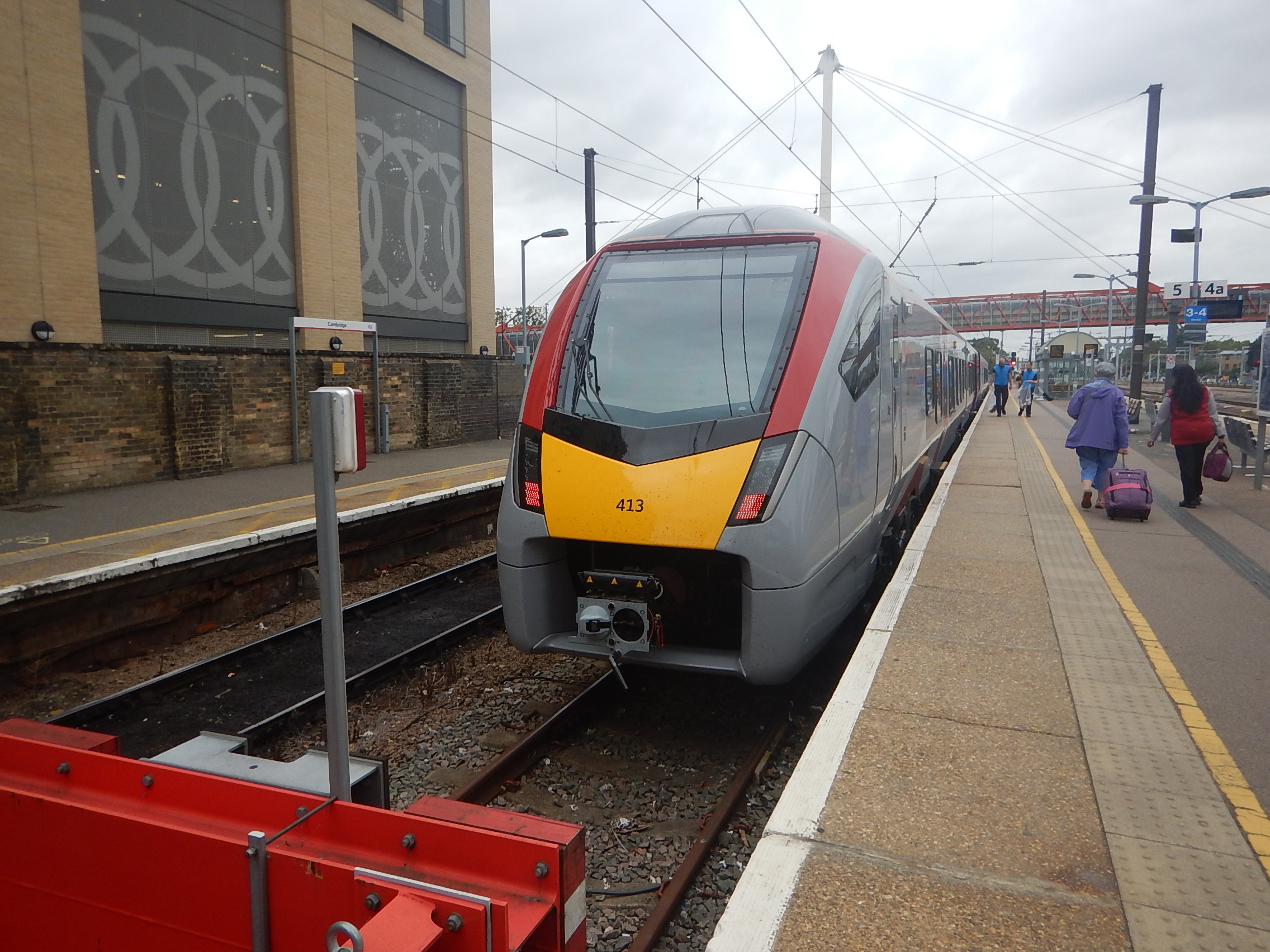
There have been reports of these trains being fitted with batteries in a couple of years to reduce carbon emissions.
CAF Selected For Major Battery Train Order
The title of this post, is the same as that of this article on Railway Gazette International.
This is the first paragraph.
CAF has been named as preferred bidder for what it says is the largest order to date for battery trains. This covers the supply and maintenance of more than 60 electric multiple-units which will be able to operate on non-electrified sections of the Niederrhein-Münsterland network.
On reading the rest of the article, it sounds like the trains are to a high standard, with all the features one could expect.
As in Bolton-Wigan £78m Rail Electrification Project Announced, I predicted that CAF could sell a number of battery-electric trains to Northern in the UK, it looks like CAF could be building a substantial number of battery-electric trains.
There could even be the possibility of some of the German trains being assembled in the CAF factory in Newport, as the logistics might be easier.
Bolton-Wigan £78m Rail Electrification Project Announced
The title of this post, is the same as that of this article on the BBC.
This is a small electrification project compared to many, but it still includes.
- 13 miles of electrification.
- 450 new overhead line equipment stanchions.
- Modifications to 17 bridges and two level crossings.
- Platform extensions at Westhoughton, Hindley and Ince stations, so that they can handle six-car trains.
Completion is expected to be 2025.
The numbers indicate it could be be a small project with quite a bit of work.
I have a few specific thoughts.
How Far Will The Electrification Go?
This document on the Government web site is entitled Green Light Given For Wigan To Bolton Electrification.
These are two paragraphs.
The track between Wigan North Western station and Lostock Junction near Bolton will receive a £78 million upgrade, targeted to complete in 2024/2025.
Through electrifying almost 13 miles of infrastructure and lengthening platforms, this investment will ensure that CO2 emitting diesel trains are replaced by electric rolling stock. As longer trains with additional capacity, these will provide passengers with greener, more comfortable and more reliable journeys.
Note.
- Lostock junction is on the Manchester and Preston Line which was electrified in 2019.
- As is typical, the electrification continues for a short distance from Lostock junction towards the Wigan stations.
- Wigan North Western station is a fully-electrified station on the West Coast Main Line.
- Wigan Wallgate station is not electrified.
- The distance between Lostock junction and Wigan Wallgate station is 6.9 miles.
- Lostock junction and Wigan Wallgate station is double-track all the way.
- My Track Atlas shows crossovers that allow trains to and from Lostock junction to access some platforms at Wigan North Western.
These facts lead me to these conclusions.
- As thirteen files of electrification would be 6.5 miles of double-track electrification, the new electrification would create a fully-electrified line between Lostock junction and Wigan Wallgate station.
- By electrifying the crossovers at Wigan Station junction, electric trains would to able to access both Wigan stations.
But this does mean, that electric trains can’t run past Wigan Wallgate station, as the wires seem to stop there.
Electrification At Wigan Wallgate Station
Mark Clayton has made this comment to this post.
Yes there is a single track connecting from the track through Hindley to the WCML and vice versa, however at Wallgate there are buildings straddling the line and the station itself. Maybe the track could be lowered, but it could well be a major engineering project to get the wires under Wallgate.
The best picture, that I can get of the tracks under Wallgate is this 3D image from Google Maps.
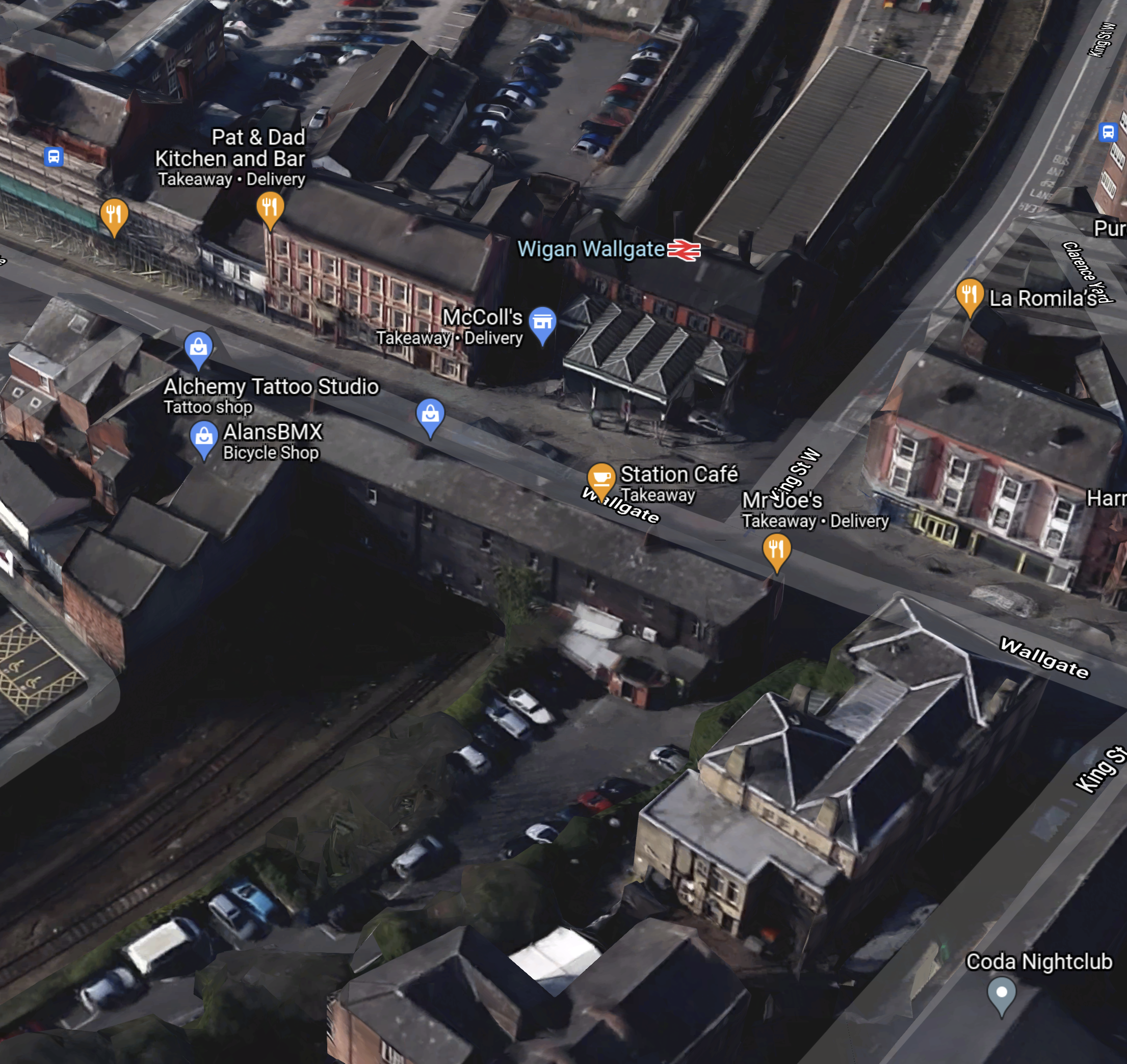
It does seem a bit tight in terms of height.
I have also looked at several videos of trains going trough the station and I suspect that the tracks may need lowering to get the wires through.
Or they could use some of the discontinuous tricks being used on the South Wales Metro.
It could be difficult, but I don’t think it will be impossible.
I do suspect though for operational reasons, Network Rail and the train operators would want the wires to extend to the station.
- Train operators probably prefer to raise and lower the pantograph in a station, in case anything goes wrong.
- If battery-electric trains should be used on the line, then if necessary, they could wait in the station to charge the batteries.
- If the station is wired, then the West-facing bay-platform can also be wired, so that it could be used for a battery-electric shuttle train to Kirkby or Southport.
It looks to me, that for lots of reasons, the engineers will have to find a way of getting the wires under the low bridge under Wallgate.
Services That Use All Or Part Of The Route Between Lostock Junction And Wigan
These services use all or part of the route.
- 1 tph – Southport and Alderley Edge via Ince (irregular), Hindley, Westhoughton and Bolton
- 1 tph – Southport and Stalybridge via Hindley, Westhoughton and Bolton
- 1 tph – Kirkby and Manchester Victoria via Ince (irregular), Hindley, Daisy Hill, Hag Fold, Atherton, Walkden, Moorside, Swinton and Salford Crescent.
- 1 tph – Wigan Wallgate and Blackburn via Hindley, Daisy Hill, Atherton, Walkden, Swinton and Salford Crescent.
- 1 tph – Wigan Wallgate and Leeds via Daisy Hill, Atherton, Walkden and Salford Crescent.
Note.
- tph is trains per hour.
- The two services that terminate at Wigan Wallgate sometimes terminate in Wigan North Western station.
- Wigan Wallgate station would appear to get up to five tph to Manchester, via a variety of routes.
I wonder how many of these services could be run by a battery-electric train, with a performance like the Hitachi Regional Battery Train, which is described in this Hitachi infographic.
Note 90 kilometres is 56 miles.
I will look at each route in detail.
Southport And Alderley Edge
The only section without electrification will be between Wigan Wallgate and Southport stations, which is a distance of 17.4 miles.
With a battery range of 56 miles, a battery-electric train should be able to run a return trip between Wigan Wallgate and Southport stations on battery power and have time for a leisurely turnround in Southport.
The batteries would be charged on the fully electrified section of the line between Wigan Wallgate and Alderley Edge stations.
Southport And Stalybridge
There are two sections without electrification.
- Wigan Wallgate and Southport stations – 17.4 miles
- Manchester Victoria and Stalybridge stations – 7.6 miles
With a battery range of 56 miles, a battery-electric train should be able to run a return trip on both sections without electrification.
The batteries would be charged on the fully electrified section of the line between Wigan Wallgate and Manchester Victoria stations.
Kirkby And Manchester Victoria
There are two sections without electrification.
- Wigan Wallgate and Kirkby stations – 12.1 miles
- Hindley and Salford Crescent stations – 13.4 miles
With a battery range of 56 miles, a battery-electric train should be able to run services on both sections without electrification.
The batteries would be charged on the two fully electrified sections of the line between Wigan Wallgate and Manchester Victoria stations.
Wigan Wallgate And Blackburn
There are two sections without electrification.
- Hindley and Salford Crescent stations – 13.4 miles
- Manchester Victoria and Blackburn stations – 39.4 miles
The first section could be easily run by a battery electric train, but the second section would need a charger at Blackburn station to return to Manchester Victoria station.
The batteries would be charged on the two fully electrified sections of the line between Wigan Wallgate and Manchester Victoria stations.
Wigan Wallgate And Leeds
There are two sections without electrification.
- Hindley and Salford Crescent stations – 13.4 miles
- Manchester Victoria and Leeds stations – 50.2 miles
The first section could be easily run by a battery electric train.
But the second section would be very much touch-and-go with a battery-electric train with a range of 56 miles, despite the fact that both Manchester Victoria and Leeds stations are electrified.
It should also be noted that Network Rail has plans in the TransPennine Upgrade to electrify the route between Leeds and Heaton Lodge junction between Mirfield and Brighouse stations. This would reduce the second section without electrification to a more manageable 37.1 miles.
I suspect that by the time the TransPennine Upgrade is complete, battery range would have improved to allow Manchester Victoria and Leeds stations to handle the route.
Battery-Electric Trains That Could Run The Services Through Wigan Wallgate Station
I have used the Hitachi Regional Battery Train as an example of a train that might run the services through Wigan Wallgate station.
- It has an operating speed of 100 mph.
- It could be based on a Class 385 train, which have three or four cars.
- It would have a battery range of 56 miles.
I suspect a demonstration train will run by 2025, which is the expected date of completion of the Lostock and Wigan electrification project.
But other manufacturers and rolling stock companies could also supply trains, with this specification.
- Alstom could create a battery-electric train based on an Electrostar, like a Class 379 or Class 387 train.
- CAF are developing a battery-electric train based on a Class 331 train.
- Porterbrook are developing a battery-electric train, based on a Class 350 train.
- Stadler could probably deliver a battery-electric Flirt based on a Class 755 train.
Competition would hopefully result in an excellent train, that would be suitable for many routes in the UK.
Northern’s Battery Plans And CAF
I suspect though that CAF could be the front runner as Northern already have forty-three Class 331 trains in service.
In Northern’s Battery Plans, I describe how CAF and Northern are planning to convert a number of three-car Class 331 trains into four-car battery-electric trains.
- The fourth car would contain batteries.
- Batteries would also be added to the PTS (pantograph) car.
I suspect that the battery range could be arranged so that all routes suitable for battery-electric operation could be handled.
In this article on Rail Magazine, which is entitled Northern Plans More New Trains After CAF Milestone, this is a paragraph.
A CAF source confirmed that a lot of work was ongoing with Northern, including the continued development of a battery EMU that is planned to be tested on the Oxenholme-Windermere route.
As the article dates from January 2021, things should be progressing.
Possible routes for battery-electric operation could be.
- Northumberland Line – Under construction
- Csrlisle and Newcastle – 61.5 miles between electrification at both ends
- Wigan Wallgate and Leeds via Dewsbury – 50.2 miles between electrification at both ends
- Manchester Victoria and Leeds via Hebden Bridge – 49.8 miles between electrification at both ends
- Leeds And Carlisle via Settle – 86.8 miles between electrification at both ends.
- Leeds and Morecambe – 37.8 miles between electrification.
- Manchester Airport and Barrow-in-Furness – 28.7 miles from electrification
- Manchester Airport and Windermere – 10.9 miles from electrification
Note.
- The distance is the longest section without electrification.
- Some routes have electrification at both ends.
- Some need an out-and-back journey at one end of the route.
I was surprised that the Settle and Carlisle Line could be included and as battery technology improves it certainly will be possible.
What a tourist attraction that line would be if worked by battery-electric trains.
Conclusion
This electrification of just 6.5 miles of double-track between Lostock junction and Wigan Wallgate station seems to be one of the smaller electrification projects.
But on closer examination, when linked to a fleet of battery-electric trains with a range of perhaps forty miles, the electrification enables battery-electric trains to run these services.
- Southport And Alderley Edge
- Southport And Stalybridge
- Kirkby And Manchester Victoria
With a charging station in Blackburn station, then the Wigan Wallgate And Blackburn service can be added.
It also looks that with the completion of the TransPennine Upgrade between Huddersfield and Leeds, that it might even be possible to run Wigan Wallgate and Leeds using battery-electric trains.
There will be a long list of stations, previously served by diesel trains, that will now only be served by electric or battery-electric trains.
- Appley Bridge
- Atherton
- Bescar Lane
- Burscough Bridge
- Daisy Hill
- Gathurst
- Hag Fold
- Hindley
- Hoscar
- Ince
- Kirkby
- Meols Cop
- Moorside
- New Lane
- Orrell
- Parbold
- Pemberton
- Rainford
- Southport
- Swinton
- Upholland
- Walkden
- Wigan Wallgate
- Westhoughton
That is a total of twenty-four stations.
Never in the field of railway engineering, has one small section of electrification delivered electric trains to so many stations.
Could High Speed Two Serve Holyhead?
Why?
It could be a way to create a zero- or low-carbon route between the islands of Great Britain and Ireland.
Battery-Electric Trains Could Be The Solution
In Will High Speed Two’s Classic-Compatible Trains Have Battery Operation?, I suggested that it might be feasible for High Speed Two’s Classic-Compatible trains to have batteries.
I said this at the start of that post.
I believe it is very likely, that High Speed Two’s new classic-compatible trains will have battery capabilities.
-
- Batteries would handle energy generated by regenerative braking.
- Batteries would give a train recovery capability in case of overhead catenary failure.
- Batteries would be used for depot movements.
- Batteries would probably improve the energy efficiency of the trains.
Effectively, the batteries would power the train and would be topped-up by the electrification and the regenerative braking.
Since I wrote that post in February 2020, Hitachi have launched two battery-electric trains, one of which is the Hitachi Intercity Tri-Mode Battery Train, which is described in this Hitachi infographic.
As diesel (or should I say Stuart) engines are so nineteenth-century. any high speed independently-powered train would probably use batteries, have no diesel engines and be a battery-electric train.
So could Hitachi or any other bidder for the High Speed Two Classic-Compatible trains produce a train, that would be capable of handling the long-distance routes from London, that would be difficult or expensive to electrify, by the use of batteries?
- Batteries will improve dramatically in the next few years.
- Batteries will also become more affordable.
- Engineers will also learn how to package them in better and more innovative ways.
I think it is very likely, that a High Speed Two Classic-Compatible train could be produced with a reliable range of over eighty miles on batteries.
Holyhead And Crewe By Battery-Electric Classic-Compatible High Speed Train
These are the distances between stops on the route between Holyhead and Crewe
- Holyhead and Bangor – 25 miles.
- Bangor and Llandudno Junction – 16 miles
- Llandudno Junction and Colwyn Bay – 4 miles
- Colwyn Bay and Rhyl – 10 miles
- Rhyl and Prestatyn – 4 miles
- Prestatyn and Flint – 14 miles
- Flint and Chester – 13 miles
- Chester and Crewe – 21 miles
Note.
- It is a route of only 105 miles.
- There is no 25 KVAC electrification, except at Crewe.
- It is nearly all double-track.
- The operating speed is 90 mph
- The route is also generally flat and mainly along the coast.
Suppose the following were to be done.
- Erect traditional electrification between Chester and Crewe.
- Hitachi ABB Power Grids build a section of their discontinuous electrification around Llandudno Junction.
- Install a battery charging system at Holyhead.
An alternative might be to put another section of discontinuous electrification through Bangor, if installing the charging station at Holyhead proved to be difficult.
I believe it would be possible to run a High Speed Two Classic-Compatible train equipped with batteries between London Euston and Holyhead.
What Time Would Be Possible?
Consider.
- High Speed Two are predicting 56 minutes between London Euston and Crewe.
- Avanti West Coast are showing journey times of one hour and 57 minutes between Crewe and Holyhead.
- Avanti West Coast are using 125 mph Class 221 trains, but are restricted to a lot less than this speed.
- The HSC Dublin Swift can sail between Dublin and Holyhead in several minutes under two hours.
I believe that a High Speed Two Classic-Compatible train equipped with batteries could go between London Euston and Holyhead in under three hours.
If this were to be linked to the latest hydrogen-powered fast ferry between Holyhead and Dublin, would London Euston and Dublin be fast enough to attract passengers from the airlines?
- The journey time could be under five hours.
- It would be zero-carbon.
- By cutting stops to the West of Chester and track improvements train times could be reduced.
- It would be the sort of adventure, that some families like!
I think that Avanti West Coast and the ferry company could have a rail and ferry service, that would appeal to many travellers.
Would There Be A Path To Euston For Another High Speed Service?
In How Many Trains Are Needed To Run A Full Service On High Speed Two?, I listed the trains that would use the Western leg of High Speed Two.
- Train 1 – London Euston and Birmingham Curzon Street – 400 metre Full-Size
- Train 2 – London Euston and Birmingham Curzon Street – 400 metre Full-Size
- Train 3 – London Euston and Birmingham Curzon Street – 400 metre Full-Size
- Train 4 – London Euston and Lancaster – Classic Compatible
- Train 4 – London Euston and Liverpool – Classic Compatible
- Train 5 – London Euston and Liverpool – Classic Compatible
- Train 6 – London Euston and Macclesfield – Classic Compatible
- Train 7 – London Euston and Manchester – 400 metre Full-Size
- Train 8 – London Euston and Manchester – 400 metre Full-Size
- Train 9 – London Euston and Manchester – 400 metre Full-Size
- Train 10 – London Euston and Edinburgh – Classic Compatible
- Train 10 – London Euston and Glasgow – Classic Compatible
- Train 11 – London Euston and Edinburgh – Classic Compatible
- Train 11 – London Euston and Glasgow – Classic Compatible
- Train 12 – Birmingham Curzon Street and Edinburgh or Glasgow – Classic Compatible
- Train 13 – Birmingham Curzon Street and Manchester – 200 metre Full-Size
- Train 14 – Birmingham Curzon Street and Manchester – 200 metre Full-Size
Note.
- A lot of the paths into London Euston would appear to be allocated.
- Train 4 is a pair of 200 metre long Classic-Compatible trains, that will split and join at Crewe, with one train going to Liverpool and the other going to Lancaster.
- Train 5 is only a single 200 metre long Classic-Compatible train.
I suspect it would be possible to make Train 5 a pair of 200 metre long Classic-Compatible trains, that will split and join at Crewe, with one train going to Liverpool and the other going to Chester and Holyhead.
It does appear that the proposed timetable for High Speed Two has been designed so extra trains can be added if the demand is there.
What Times Would Be Possible Between Holyhead And Crewe?
Consider.
- I have looked at the route from my virtual helicopter and suspect that much of the route can be upgraded to 100 mph running.
- The current average speed between Holyhead and Crewe is 54 mph.
- London Liverpool Street and Norwich is 114.5 miles and is regularly achieved in ninety minutes on a 100 mph line, which is an average speed of 76 mph.
- The number of stops could be reduced.
I can build a table of times for faster average speeds.
- 60 mph – One hour and 45 minutes – Two hours and 41 minutes
- 70 mph – One hour and 30 minutes – Two hours and 26 minutes
- 80 mph – One hour and 19 minutes – Two hours and 15 minutes
- 90 mph – One hour and 10 minutes – Two hours and 6 minutes
- 100 mph – One hour and 3 minutes – One hour and 59 minutes
Note.
- The first time is Holyhead and Crewe.
- The second time is London and Holyhead.
I am fairly certain, that a substantial time improvement is possible.
Why Not Electrify All The Way Between Holyhead And Crewe?
I am seventy-four and can remember several incidents of serious storms and flooding along the North Wales Coast Line.
There was a warning earlier this year according to this article on the BBC.
Perhaps it would be better to spend the money on improving the resilience and operating speed of the track?
Conclusion
London Euston and Holyhead could be a serious proposition.
With some development and a new fast ferry, it could also open up a practical zero-carbon route between Great Britain and Ireland.
Times of four and a half hours between London Euston and Dublin could be possible.
Where Are All The Battery-Electric Trains?
Consider these dates and notes
February 10th, 2015
, I wrote Is The Battery Electric Multiple Unit (BEMU) A Big Innovation In Train Design?, after an excellent first ride in Bombadier’s experimental battery-electric multiple unit or BEMU based on a Class 379 train.
October 10th, 2018
I wrote Battery Class 230 Train Demonstration At Bo’ness And Kinneil Railway, after a ride on Vivarail’s Class 230 train in Scotland.
October 15th, 2018
This article on Railway Gazette, which was entitled BatteryFLEX Desiro EMU Conversion Proposed, announced Porterbrook’s plan to convert their Class 350/2 trains to battery-electric operation.
September 30th, 2019
I wrote Battery Electrostars And The Uckfield Branch.
I indicated that according to Modern Railways, battery Electrostars were on their way to replace Class 171 trains, that need to be cascaded to East Midlands Railway by September 2021.
February 28th, 2020
I wrote Northern’s Battery Plans.
This described a plan by Northern Trains and CAF to convert three-car Class 331 trains into four-car battery electric trains, by adding a battery car.
July 6th, 2020
I wrote Hyperdrive Innovation And Hitachi Rail To Develop Battery Tech For Trains, which announced Hitachi’s Regional Battery Train, which is shown in this Hitachi infographic.
Hitachi are now testing Class 803 trains, which have batteries, but only for hotel purposes and not traction.
Although, I do suspect that the batteries in Class 803 trains will be very similar to those in other Hitachi trains.
It’s just not good engineering to do the same job twice and all Hitachi trains are members of the same A-train family.
August 12, 2020
In Converting Class 456 Trains Into Two-Car Battery Electric Trains, I mused on some remarks made by Mark Hopwood, who then was the interim Managing Director of South Western Railway.
December 15th, 2020
Hitachi released a press release which was entitled Hitachi And Eversholt Rail To Develop GWR Intercity Battery Hybrid Train – Offering Fuel Savings Of More Than 20%.
This is the Hitachi Intercity Tri-Mode Battery Train, which is described in this Hitachi infographic.
Details given in the press release include.
- A five-car train will be used as the prototype.
- The objective is fuel savings of 20 %.
- Battery power will be used in stations.
I have read elsewhere that testing will start in 2022, with trains entering service a year later.
In addition, I have written many posts on this blog about the possible deployment of battery-electric trains.
There are certainly a lot of ideas and aspirations for the development and use of battery trains, but except for the Class 803 trains, which only use batteries for emergency hotel power and are now under test, no battery-electric trains have been seen on the UK rail network.
I have a few thoughts.
Existing Trains That Could Be Converted To Battery-Electric Trains
The following trains would appear to be candidates for conversion to battery-electric operation for passenger operations.
- Class 350 trains – 87 trains of four cars – 110 mph – Will be replaced by Class 730 trains.
- Class 360 trains – 21 trains of four cars – 110 mph – In service with East Midlands Railway between St. Pancras and Corby, but with batteries could extend the route to Oakham and Melton Mowbray.
- Class 379 trains – 30 trains of four cars – 100 mph – Have been replaced by Class 745 trains and now filling in for late delivery of new Class 720 trains.
- Class 385 trains – 24 trains of four cars – 100 mph – In service with Scotrail and could be upgraded to Regional Battery Trains.
- Class 385 trains – 46 trains of three cars – 100 mph – In service with Scotrail and could be upgraded to Regional Battery Trains.
- Class 387 trains – 107 trains of four cars – 110 mph – Some are being replaced with new trains and it appears that some may be available for conversion. There must also be question marks over Heathrow and Gatwick Express services.
Note.
- All trains have an operating speed of 100 or 110 mph.
- I suspect most of the 100 mph trains could be upgraded to 110 mph trains.
- There is a total of nearly three hundred four-car trains.
In addition, there are other trains like Class 377 trains, Class 444 trains, Class 450 trains and Class 707 trains. that could be converted to battery-electric operation should it be necessary or the trains were withdrawn from service due to being replaced with new trains.
We could have access to over five hundred battery-electric trains, if all were to be converted.
Does that mean that until fleets start to wear out, we will not need to buy any new electric multiple units for the standard gauge UK rail network?
A Comparison Between A Hitachi Regional Battery Train And An Existing Electric Multiple Unit With Added Batteries
If you compare an Hitachi Regional Battery train based on a four-car Class 385 train with a four-car Class 350 train you get the following with Hitachi figures first.
- Cars – 4 – 4
- Operating Speed – 100 mph – 110 mph
- Seats – 273 – 270
- Length – 92 metres – 82 metres
- Dual-voltage – Probably possible – Yes
The two trains could share a route and few passengers would complain or even notice the difference.
Will Battery-Electric Trains Have Collateral Benefits?
All these trains, that are available to conversion to battery-electric trains are modern 100 mph four-car units that meet all the regulations.
They will offer a better standard of service than say a Class 156 diesel train, but most importantly, their size will mean that most services in the UK would be run by a four-car train, which would help to ease overcrowding in a lot of places.
Where Are The Battery Electric Trains?
Could it be that someone has added up the number of trains we already have and has decided that with decarbonisation to the fore, that by using a mix of battery-electric trains and discontinuous electrification, we can create a unified electric train network in England, Scotland and Wales, without ordering large fleets of new trains.
The specification for the UK’s standard battery-electric local train may need to emerge first, but I suspect that train manufacturers and upgraders like Wabtec, want to make sure they create a battery-electric train to these standards.
- Very reliable.
- A range as long as feasibly possible.
- Long-lasting
So with this technology change from pure-electric, bi-mode and diesel trains to pure-electric and battery-electric, is everybody making sure, that it ends up as a success, rather than a disaster?
Over the last few years, there have been a lot of late train deliveries for various reasons and releasing battery-electric trains too early might not be prudent.
 The Anonymous Widower