Vauxhall-Maker Says UK Needs To Change Its Brexit Deal
The title of this post, is the same as that of this article on the BBC.
This is the sub-heading.
One of the world’s biggest carmakers has called on the government to renegotiate part of the Brexit deal or risk losing parts of its car industry
These four paragraphs explain the problem.
Stellantis, which makes Vauxhall, Peugeot, Citroen and Fiat had committed to making electric vehicles in the UK.
But it has now said it is no longer able to meet Brexit trade rules on where parts are sourced.
The government is “determined” that the UK will remain competitive in car manufacturing, a spokesperson said.
Stellantis called on the government to come to an agreement with the EU to keep rules as they are until 2027.
Because, there is not enough battery capacity in the UK and possibly the EU, everything has gone pear-shaped.
I think there are three possible solutions.
- Build more battery factories.
- Change the regulations.
- Develop hydrogen internal combustion engines.
Note.
- Could a battery factory be built fast enough? I doubt it!
- Could the regulations be changed? Possibly!
- Could hydrogen internal combustion engines be developed quickly enough? Ask Cummins, JCB, Ricardo and Toyota.
It is highly likely that there will be much higher demand for batteries, than anybody expects, as innovators develop more applications.
Electric Cars Are A Dead End!
When you introduce any product to the general population, you must think of all the consequences.
I found these statistics on the RAC Foundation web site.
There were 33.2 million cars (81.3 per cent), 4.63 million LGVs (11.3 per cent), 0.54 million HGVs (1.3 per cent), 1.46 million motorcycles (3.6 per cent), 0.15 million buses & coaches (0.4 per cent) and 0.84 million other vehicles (2 per cent) licensed at the end of September 2022.
Could anybody please tell me how the average guy or gal, who owns one of those 33.2 million cars is going to be able to afford to replace it, find a convenient place to park and charge it and go and visit their mum in say Scunthorpe from Plymouth?
We are going down a massive dead end!
The only sensible alternative is internal combustion engines running on hydrogen, many of which could be converted from existing diesel engines.
But only a few councils have a hydrogen policy, with the biggest disgrace being London, where the Mayor’s hydrogen policy, is to ignore it and hope it will go away.London has an air quality problem, which is not helped by large numbers of HGVs in the centre.
The technology exists to convert HGVs to hydrogen and it would be possible to insist that all vehicles over a certain weight were zero-carbon. But as London has no plans for hydrogen, it can’t happen.
Vote Hydrogen for Mayor in May 2024, to improve London’s air quality.
Notes.
- To replace 33.2 million cars with electric ones would cost 1660 billion pounds, assuming each electric car costs fifty grand.
- As most electric cars are not made in the UK, what would happen to our balance of payments?
- On average an electric car needs 63 kilos of lithium for its battery, so 33.2 million will need over two million tonnes of lithium.
Hyperbat In Multimillion-Pound Deal To Supply Battery Packs For Lotus Supercar
The title of this post, is the same as that of this article on The Times.
Lotus or supercars for that matter, will not be a big market for battery packs, but they will be a high-profile one. The article in The Times may well flush out a few good sales leads from companies who want to decarbonise their products.
Many years ago, I did a consultancy job for Cummins, where my software was used to look for faults in their engine testing system. One of their engineers explained to me that they had a sales and production philosophy that could handle all markets from the large down to small niche ones. He said that we can’t tell which niche markets are going to be successful.
In the last couple of years Cummins have embraced hydrogen very strongly and it looks like they are adopting a similar philosophy.
So in the Cummins engine business model, it looks like the niche market is important.
I suspect that what goes for the diesel engine market will also go for the electric transmission market, with niche markets being nicely profitable and an important part of sales.
It looks to me that Hyperbat are going for that market, backed up by the engineering and battery experience of Williams Advanced Engineering and the manufacturing knowledge and logistics of Unipart.
Note that Williams Advanced Engineering is now owned by Australian billionaire; Andrew Forrest, through his company; Fortescue Future Industries. I wrote about this purchase in Fortescue Buys Williams Engineering In Major Push Into High Performance Batteries.
On the Hyperbat web site, this is said about their manufacturing facility.
The facility is about to double in size to meet current needs, with plans to double again in the next 2 years.
The factory is based on the site of a former exhaust plant and reintroduces manufacturing to the area, with an environmentally sustainable future.
Capacity of the factory is approximately 10,000 packs per year.
I;m sure the company, has enough backing for a very successful future.
The Third Route To Zero-Carbon Transport
The two most common routes to zero-carbon transport are.
- Battery-electric vehicles
- Hydrogen fuel-cell vehicles
Note that most hydrogen-fuel cell vehicles also have a battery.
But I believe there’s a third route and that is the use of hydrogen in an internal combustion engine.
Earlier today, I wrote Rolls-Royce And AVK Provide Over 3.5 Gigawatts Of Emergency Power Capacity In The UK, which is based on a Rolls-Royce press release, with the same title.
This is an extract.
And this is said about the use of hydrogen.
Rolls-Royce is also currently developing its mtu gas engine portfolio for power generation so that the engines can run on hydrogen fuel in future, enabling a Net Zero energy supply. The company is also launching complete mtu hydrogen fuel cell solutions, that emit nothing but water vapor from 2025. This will enable CO2-free generation of emergency power for data centers and many other critical applications.
I certainly think, that they are going in the right direction.
Rolls-Royce mtu have a lot to lose, if their diesel engines that power trains, heavy equipment, ships and emergency power generators are replaced by other companies zero-carbon solutions.
- Large investments will need to be made in hydrogen electrolyser and fuel cell production.
- Some traditional factories making diesel engines will be closed and could this mean redundancies?
- A lot of retraining of staff at both manufacturer and customer will need to be made.
But a traditional internal combustion engine, that runs on hydrogen or even both hydrogen and diesel makes the transition to hydrogen a lot less painful.
Other companies going this route include Cummins, Deutz and JCB.
Conversion Of Existing Diesel Engines To Hydrogen
Surely, if an equivalence hydrogen engine exists for all of their diesel engines, a company like Cummins or Rolls-Royce mtu can produce a sound engineering route to decarbonise some of their existing applications.
A classic application would be converting London’s Routemaster buses to hydrogen, which I wrote about in Could London’s New Routemaster Buses Be Converted To Hydrogen Power?
This was my conclusion in that post.
I believe from my knowledge of Cummins and the way they work, that they will come up with a hydrogen-based solution, that will replace the Cummins diesel in these buses with a zero-carbon engine.
If Cummins don’t then someone else will.
Whoever solves the problem of converting London’s new Routemasters to hydrogen will have one of the best adverts for their product, there has ever been.
After converting London’s thousand Routemasters, the engineers could move on to anything powered by a Cummins engine.
As this is a world-wide problem, I believe that the manufacturers of cars, buses, trucks and many other vehicles will offer zero-carbon solutions for their products, as it will be necessary for survival.
If you have just bought a new diesel BMW and your government says that in two years time, diesel will no longer be available, you’re up the creek without a paddle. But if BMW can convert it to hydrogen for a small fraction of the cost of a new electric equivalent, you have a more available way out.
BP To Charge Up Vehicle Battery Research
The title of this post is the same as that of this article in The Times.
This is the title on a stock picture at the top of the page.
BP, whose profits benefited from soaring oil and gas prices, plans to invest heavily in research to develop solutions to help to decarbonise the transport sector.
I’m unsure about the picture, but it could be a number of buses or trucks connected to a large battery.
This press release on the BP web site, is the original source for The Times article and it is entitled BP To Invest Up To £50 million In New Global Battery Research And Development Centre In Britain.
The press release starts with these bullet points.
- bp continuing to invest in the UK, with new investment of up to £50 million for new electric vehicle battery testing centre and analytical laboratory in Pangbourne.
- Aims to advance development of engineering, battery technology and fluid technology and engineering into new applications such as electric vehicles, charging and data centres.
- New facilities at its Castrol headquarters and technology centre expected to open in 2024, supporting the technology, engineering and science jobs housed there today.
I find these sentences interesting.
new applications such as electric vehicles, charging and data centres
This sentence is a bit of a mess as electric vehicles are not new, charging is well established and what have data centres got to do with batteries.
I have a friend, who runs a large fleet of electric buses and charging is a problem, as getting the required number of MWhs to the garage can be a problem in a crowded city.
But could it be, that BP are thinking of a battery-based solution, that trickle-charges when electricity is affordable and then charges buses or other vehicles as required, throughout the day?
I believe that a battery based on process engineering like Highview Power’s CRYOBattery could be ideal in this situation.
- Effectively, the bus garage or transport parking would have its own high capacity battery-powered charging network.
- The storage capacity of the battery would be geared to the daily charge load of the vehicles.
- It would reduce the cost of electricity to the operator.
Such a battery might also be ideal to power a battery charging station.
I don’t know much about data centres, except that they need a lot of electricity.
Would driving data centres from a battery, that was trickle-charged overnight mean that the cost of electricity was reduced?
bp today unveiled plans to invest up to £50 million (around $60 million) in a new, state-of-the-art electric vehicle (EV) battery testing centre and analytical laboratory in the UK
There are a lot of battery ideas in the pipeline, so will one of the tasks be to find the best batteries for BP’s needs?
The site already undertakes research and development of fuels, lubricants and EV fluids and aims to become a leading hub for fluid technologies and engineering in the UK
You don’t think of lubricants being associated with electric vehicles, but obviously BP thinks it’s a serious enough topic to do some research.
The new facilities will help advance the development of leading fluid technologies and engineering for hybrid and fully battery electric vehicles, aiming to bring the industry closer to achieving the key tipping points for mainstream electric vehicle (EV) adoption.
This is self-explanatory.
Castrol ON advanced e-fluids manage temperatures within the battery which enables ultra-fast charging and improves efficiency, which help EVs to go further on a single charge and extend the life of the drivetrain system
Lubrication helps the world go round.
In addition, the advanced e-fluid technologies and engineering can be applied to other industries such as thermal management fluids for data centres where demand is rising exponentially
This is an interesting application and it will become increasingly important.
The growth of EV fluids is a huge opportunity, and we aim to be the market leader in this sector
I didn’t realise that EV fluids were so important.
The press release says this about the current status.
Two thirds of the world’s major car manufacturers use Castrol ON EV fluids as a part of their factory fill and we also supply Castrol ON EV fluids to the Jaguar TCS Racing Formula E team.
This press release on the Castrol web site is entitled CASTROL ON: Range Of Advanced E-Fluids For Mobility On Land, Sea And In Space.
This is the Castrol ON E-Fluids home page.
Where Will BP Need Batteries?
I can see the following applications are in BP’s sight from this press release.
- Charging fleets of buses and trucks at their garage.
- Powering battery-charging stations at filling stations.
- Providing uninterruptable electricity feeds.
- Powering data centres.
I will give a simple example.
Suppose a bus company wants to electrify the buses in a town.
- They will have thirty double-deck buses each with a 500 kWh battery.
- Wrightbus electric buses charge at 150 kW.
- Charging all buses at the same time would need 4.5 MW
- Each bus will need to be charged overnight and once during the day.
- This means the bus company will need 30 MWh of power per day.
- The largest wind turbines today are around 12 MW and have a capacity factor of 30 %.
- A single turbine could be expected to generate 86 MWh per day.
It looks to me, that a battery in the garage which could provide an output of 5 MW and had a capacity of 100 MWh would link everything together and support the following.
- A fleet of thirty buses.
- All buses charged overnight and at one other time.
- A 12 MW wind turbine.
- Power for the offices and other facilities.
- The battery would provide backup, when there is no wind.
- There would also be a mains connection to the battery for use, when the wind turbine failed.
The size of the battery and the turbine would depend on the number of vehicles and how often, they were to be charged.
BP could replace diesel sales to the bus or transport company, with leasing of a zero-carbon charging system.
Simple systems based on one or two wind turbines, solar panels and a battery would have several applications.
- Charging fleets of buses and trucks at their garage.
- Powering battery-charging stations at filling stations.
- Providing uninterruptable electricity feeds.
- Powering data centres
- Powering farms
- Powering new housing estates
- Powering factories
I can see this becoming a big market, that big energy companies will target.
Are BP planning to develop systems like this, as many of those, who might buy a system, are already their customers?
Choosing the best batteries and designing the system architecture would appear to be within the remit of the new Research Centre at Pangbourne.
Supporting Wind Farms
BP could certainly use a 2.5 GW/30 GWh battery at each of the three large wind farms; Mona, Morgan and Morven, that they are developing in the Irish Sea and off Aberdeen. These wind farms total 5.9 GW and a battery at each one, perhaps co-located with the offshore sub-station could mean that 5.9 GW was much more continuous.
The wind farms would be like virtual nuclear power stations, without any nuclear fuel or waste.
It would also mean that if the wind farm wasn’t needed and was told to switch off, the electricity generated could be stored in BP’s battery.
How many of BP’s other developments around the world could be improved with a co-located battery?
Process Technology
I am very keen on Highview Power’s CRYOBattery, but I do think that some parts of the design could benifit from the sort of technology that BP has used offshore and in the oil industry.
So will BP’s new battery research include offering advice to promising start-ups?
Gelion Claims Zinc-Bromine Gel Batteries Will Replace Lithium-Ion
The title of this post, is the same as that as this article on RideApart.
These are the first two paragraphs.
Battery technologies are evolving at a rapid pace—and for good reasons. With the automotive world moving toward electrification, companies need to find solutions for producing electric vehicles on a massive scale. While lithium-ion battery technology rules the roost today, that isn’t stopping firms from developing the next big leap forward.
From solid-state power units to structural batteries to sci-fi-worthy quantum batteries, there’s no shortage of ideas and concepts. However, the Australian company Gelion Technologies believes it found a more affordable and durable approach with its zinc-bromine gel battery. Unlike lithium-ion units, the material found in Gelion’s design isn’t rare, expensive, or potentially flammable.
It’s yet another development coming out of Australia.
The Big Beast In Your Electric Bus
This article on electrive.com is entitled BAE Systems Takes Orders For 340 Hybrid Drive Systems.
This is the first paragraph.
The Southeastern Pennsylvania Transportation Authority (SEPTA) has selected BAE Systems to supply up to 340 hybrid electric drive systems for its new fleet of low emission transit buses. BAE Systems will provide 220 electric drive systems to New Flyer of America, with an option for 120 additional systems, over the next three years.
The article also reveals that the company is working with AlexanderDennis.
The system appears to be hybrid, with a lot of intelligent choosing of when to use a polluting engine.
National Grid Bets On Surge Pricing And Electric Cars To Avoid Another Energy Crisis
The title of this post is the same as that of this article on the Telegraph.
These are the first few paragraphs.
With wind supplies forecast to be low and other energy sources offline, a power crunch was looming by teatime the next day.
A call for help went out on a Tuesday afternoon and at 4.30pm on the Wednesday, electric car drivers plugged in special chargers to export power from their car batteries back to the grid, as part of a trial run by Ovo Energy.
Their efforts in November 2020 may have amounted to only a tiny portion of the power needed on that day, but it was a taste of things to come.
Cars and other devices will be both a source of electricity demand and a helpful tool to keep the lights on as the UK tries to build a much greener energy system at the least expense.
It is as the article says the shape of things to come.
I also believe that long-term car parking at places like airports will become storage batteries in the future. You will tell your car, when you will be returning and it will be fully charged to drive home, when you arrive. If you are running late, you would probably use an app to tell your car the new arrival time.
These developments will all be part of the Internet of Power.
Glencore & Strategic Partner Britishvolt Strengthen Relationship And Agree To Build Battery Recycling Ecosystem In The UK
The title of this post is the same as that of this press release from Glencore.
These are the first two paragraphs.
Glencore is proud to have entered an industry-leading battery recycling joint venture with strategic partner and battery pioneer Britishvolt, the UK’s foremost investor in battery cell technologies and R&D.
The joint venture will develop a world-leading ecosystem for battery recycling in the UK. This ecosystem will be anchored at a new recycling plant located at the Britannia Refined Metals operation (BRM-located in Northfleet), a Glencore company. BRM will continue with its current production and trading operations.
These appear to be some of Glencore’s objectives for the project.
- They intend to recycle a minimum of 10,000 tonnes of lithium-ion batteries per year, including but not limited to valuable battery manufacturing scrap, portable electronics batteries and full EV packs.
- They intend to recycle Britishvolt’s scrap.
- They intend to be up and running by mid-2023.
- They intend to be 100 % powered by renewable energy in the longer term.
It all seems admirable.
These are my thoughts.
Britannia Refined Metals
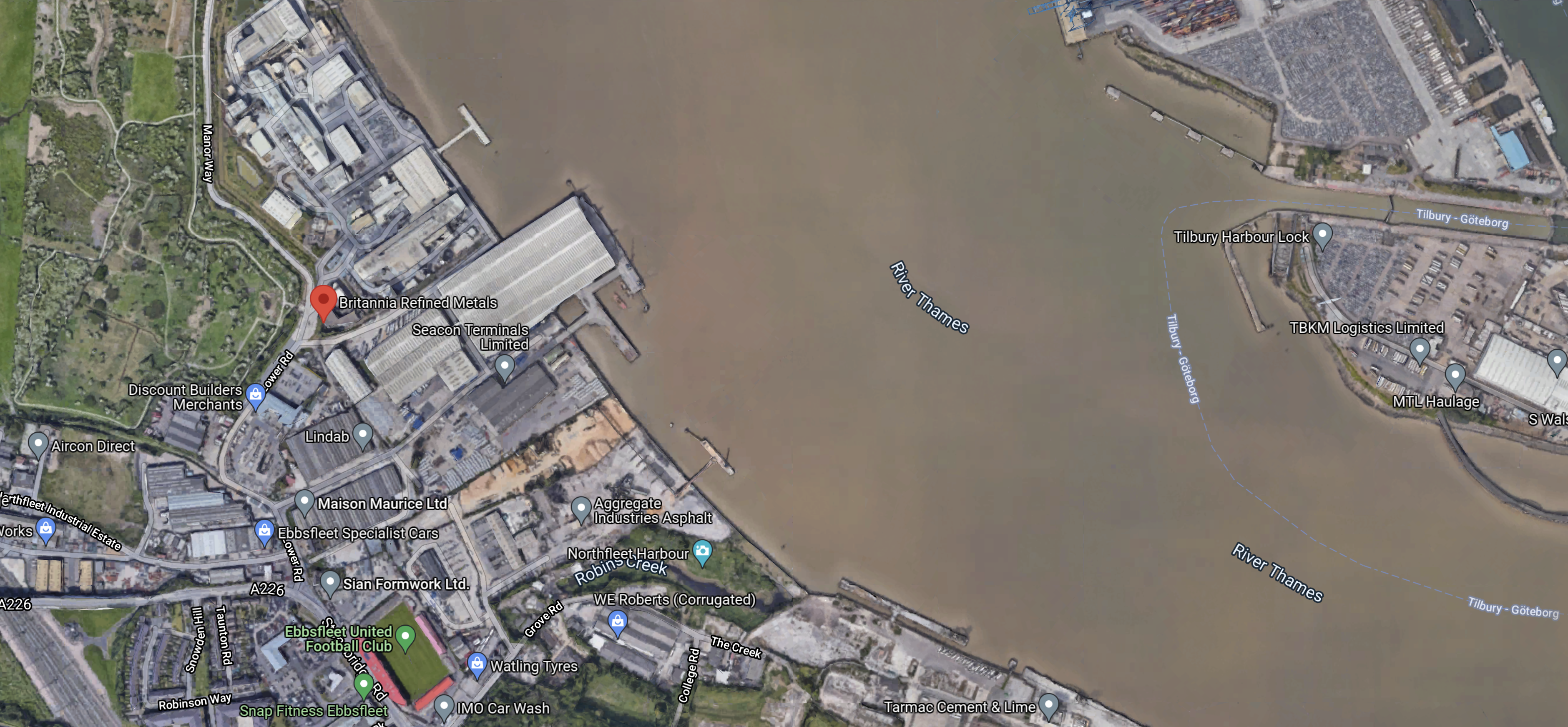
This Google Map shows the Britannia Refined Metals site at Northfleet.
Note.
- Britannia Refined Metals is indicated by the red arrow.
- The Port of Tilbury is on the other side of the Thames.
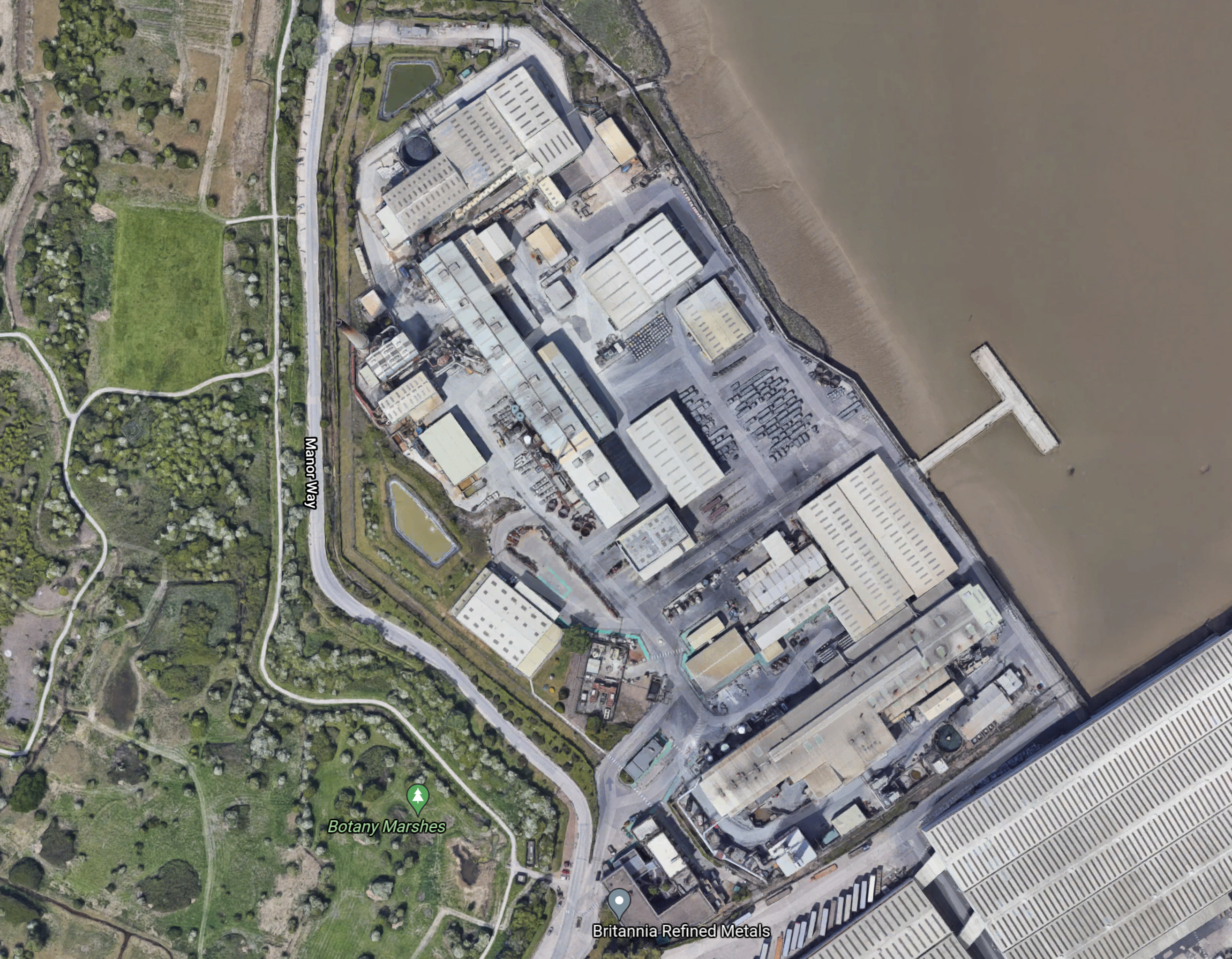
This second Google Map shows the site in more detail.
Note.
- It is not a very large site.
- There doesn’t appear to be much space for expansion.
- They appear to have a wharf on the river.
I’ve found this company video from the 1980s on the Internet.
They do seem to have developed a sophisticated process for recycling lead-acid batteries.
Renewable Energy
There are these offshore wind farms in the Thames Estuary.
- Gunfleet Sands – 172 MW
- Kentish Flats – 140 MW
- London Array – 630 MW
- Thanet – 300 MW
Two of these could be extended.
I am sure that there could be more space in the Thames Estuary for more wind power.
Recycling Batteries
I have found this article on the BBC, which is entitled As The World looks To Electrify Vehicles And Store Renewable Power, One Giant Challenge Looms: What Will Happen To All The Old Lithium Batteries?.
This is the third paragraph.
While this may sound like the ideal path to sustainable power and road travel, there’s one big problem. Currently, lithium (Li) ion batteries are those typically used in EVs and the megabatteries used to store energy from renewables, and Li batteries are hard to recycle.
The article talks about possible solutions.
- Don’t treat the batteries as disposable.
- Increasing the number of batteries recycled from the measly five percent.
- Automate the recycling process, which currently is labour intensive.
- Give the cathode, anode and other parts a second life in new batteries, by refurbishment.
- Batteries that degrade on command.
But the idea, I like is described in this paragraph from the article.
The next step for scientists pushing direct recycling of Li batteries forward is working with battery manufacturers and recycling plants to streamline the process from build to breakdown.
In context with the tie-up between Glencore and Britishvolt, you can imagine engineers from both companies, getting together to improve the design of the battery, so that manufacturing and recycling of batteries are two mutually efficient and complimentary processes.
I can also see some very sophisticated logistics systems being developed to return batteries to an approved recycler, who may be in another country.
But then we are dealing with something that could have a substantial value.
Deals Between Battery Manufacturers And Recyclers
I can see more deals like this between battery manufacturers and recyclers.
- It could reduce the cost of batteries.
- It could impress governments seeking to reduce the about of batteries going into landfill.
- It would reduce the amount of new metals to be mined.
It may even help, in the protection of intellectual property rights, that are concerned with battery manufacture and recycling.
A Second Similar Glencore Deal
There is also a second deal about battery recycling mentioned in a press release on the Glencore web site, which is entitled Glencore & Managem Set Up Partnership For Moroccan Production Of Cobalt From Recycled Battery Materials.
- The press release was issued only a few days before the one announcing the deal with Britishvolt.
- It is for 12,000 tonnes of recycling.
- The press release mentions renewable power.
I do wonder, if Glencore or one of their companies has developed a new process.
Shell’s New Filling Station For Electric Cars
I took these pictures of Shell’s new filling station for electric cars in Fulham, yesterday.










It’s got eleven chargers, a Little Waitrose and a Costa Coffee. What more couple Fulham want?
I’m surprised the Council allowed a Costa!
 The Anonymous Widower