RWE Plans Hydrogen-Ready Combined-Cycle Gas Turbine At Gersteinwerk In Werne
The title of this post, is the same as that of this press release from RWE.
These two bullet points act as sub-headings.
- Italian-Spanish consortium commissioned to plan 800-megawatt plant
- Investment decision to be made once H2 grid connection and regulatory framework are in place and economic viability has been established
These two paragraphs introduce the project.
RWE is planning to build hydrogen-ready gas-fired power plants at the company’s power plant sites in Germany to contribute to a successful coal phase-out by 2030. Following Weisweiler in the Rhenish mining area, the company is now pressing ahead with plans for such a plant at a possible second site in Werne in the southern Münsterland region. An H2-ready combined-cycle gas turbine (CCGT) power plant with a nominal capacity of around 800 megawatts may be built at the Gersteinwerk power plant.
Following intensive technical soundings, RWE has commissioned an Italian-Spanish consortium to plan the project. Work on the planning approval process is already underway.
These are my thoughts.
The current coal-fired power station at Gersteinwerk has a capacity of 2127 MW and was built in 1984.
This is a visualisation of the two power stations.
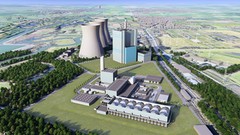
Note.
- The new gas/hydrogen-fired power station is in the foreground.
- The coal-fired power station, with its three cooling towers is behind.
This Google Map shows the site.
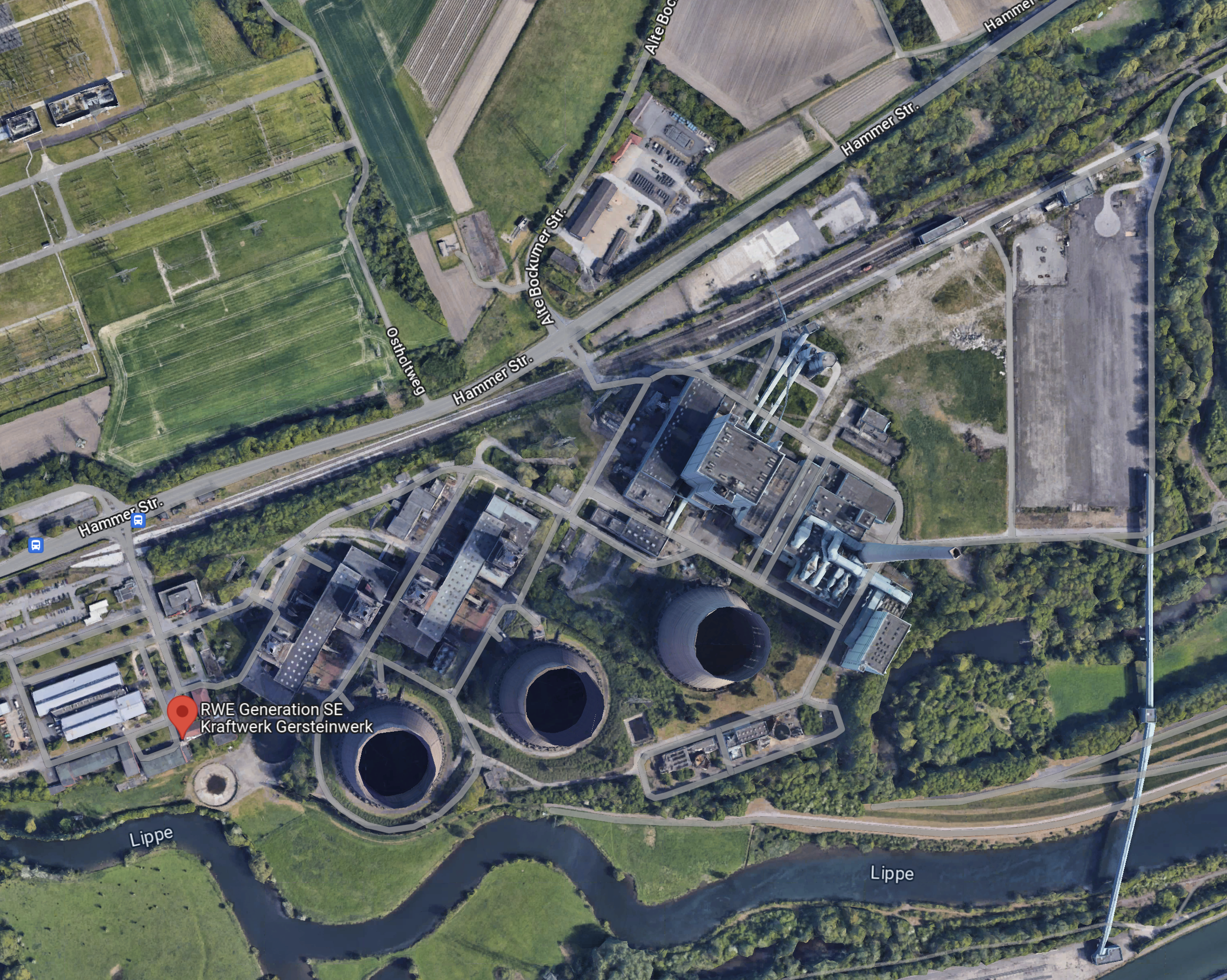
I suspect that due to the size of the original coal-fired power station, more than one hydrogen-fired power station will be needed.
Project Timeline
These paragraphs lay out the project timeline and the route to 100 % hydrogen operation.
Work on the planning process is already underway. This is the prerequisite for RWE to be able to start implementing the project as soon as an investment decision has been made.
According to current planning, the plant in Werne could start producing electricity by 2030.
At the time of commissioning, the plant should be able to use a fuel mix with at least 50 per cent hydrogen content, and it is intended to run it entirely on hydrogen at a later stage.
Germany is aiming for a coal phase-out by 2030.
The Scale Of German Power Decarbonisation
This article on Power Technology is entitled Germany To Invest €16bn In Hydrogen-Ready Gas-Fired Power Plants.
These are the first two paragraphs.
Germany’s Ministry for Economic Affairs and Climate Action (BMWK) has agreed to provide subsidies of €16bn for the construction of 10GW of hydrogen-ready gas-fired power plants.
The subsidy scheme has been significantly reduced since August 2023 when the proposal was first unveiled. A maximum of 23.8GW was anticipated at that time.
These power stations will need a lot of green hydrogen and I believe the most convenient place to source some of the hydrogen, will come from the windy waters of the UK’s North Sea.
RWE already have leases to build 7.2 GW of wind farms in UK waters.
Copenhagen Infrastructure Partners Takes FID On 1,000 MWh Battery Energy Storage Project
The title of this post, is the same as that of this press release from Copenhagen Infrastructure Partners.
This is the sub-heading.
The battery energy storage system Coalburn 1 will be one of the largest battery storage projects in Europe. Construction has commenced in November 2023 and the project will be 500 MW / 1,000 MWh once complete.
These two paragraphs outline the project.
Copenhagen Infrastructure Partners (CIP) through its Flagship Funds has taken final investment decision and commenced construction on a 500 MW / 1,000 MWh energy storage system in Coalburn, Scotland, which will be one of the largest of its kind in Europe.
The facility is the first project to be developed from the partnership between CIP and Alcemi to deploy 4 GW of energy storage assets across the UK. CIP aims to take final investment decision on two other projects next year with a combined capacity above 1 GW. The portfolio will provide vital support to the UK’s energy network, accelerating the integration of renewable energy and the transition to net zero by 2050.
Note.
- FID means final investment decision.
- 500 MW / 1,000 MWh could become a common size as it is two hours of power and easy for politicians to add up.
- CIP and Alcemi seem to be planning a total amount of energy storage, eight times bigger than Coalburn 1.
This battery could be the largest in the UK, when it is commissioned.
Who Are Copenhagen Infrastructure Partners (CIP)?
Their About CIP web page gives a lot of details.
Who Are Alcemi?
Their Who We Are web page gives a lot of details.
Environmental Considerations
The press release says this about environmental considerations.
The Coalburn 1 facility has been developed with extensive landscaping and ecological mitigation measures, including the maintenance of peat reserves, tree and wildflower planting, and new habitats, promoting biodiversity across the site.
I’ll agree with that, but add that I hope that they look after the hares. It will be interesting to see how big batteries and big bunnies co-exist. As co-exist they will!
Operation
The press release says this about operation.
The scheme will reduce the need for fossil fuel power generation during periods of peak demand leading to a decrease in CO2 emissions but also provide balancing services to help lower the costs for end consumers to manage the UK Power system.
As a Control Engineer, I suspect, it will act in a little-and-large mode with Scotland’s pumped storage.
Location
This page on the SP Energy Networks web site is entitled Coalburn Connection – South Lanarkshire.
There is this introductory paragraph.
SP Energy Networks own and maintain the electricity network in central and southern Scotland. As part of our infrastructure, Coalburn Grid Substation is a key installation in the transmission network situated to the south of Lesmahagow in South Lanarkshire.
Underneath is this map.
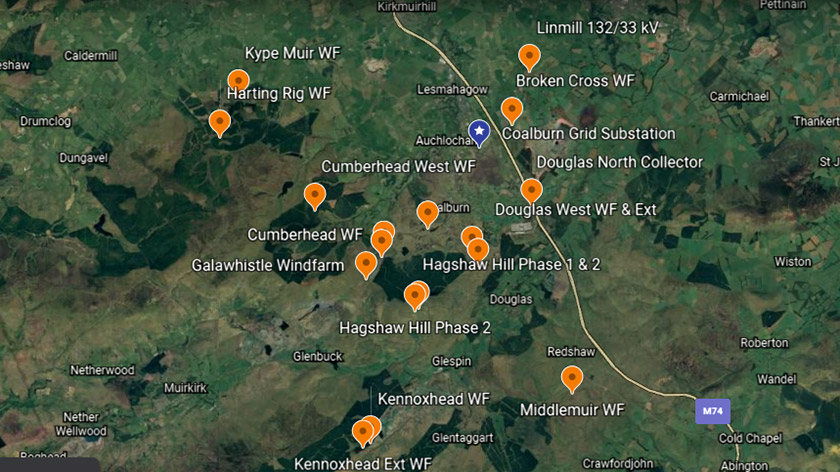
Note.
- The orange arrows are wind farms and there appear to be around a dozen of them.
- The blue arrow is Coalburn Grid Substation.
- Running through the area is the M74 between Glasgow and Carlisle.
- There are some remains of opencast coal-mines in the area, which have been restored and turned into wind farms.
- I have found the capacity of fourteen of the existing wind farms and it totals 946 MW, which is an average capacity for each wind farm of 67 MW.
- During my search for capacity, I found a couple of wind farms that were being upgraded with larger turbines.
- The SP Energy Networks page gives a date of Q3 2025 for connection of the Coalburn battery to the sub-station.
With the 500 MW/1000 MWh Coalburn 1 battery, I wouldn’t be surprised that this massive onshore wind farm complex has been designed to provide a guaranteed 1000 MW to the grid.
Australia Climate Protest: Rising Tide Activists Shovel Coal Off Train
The title of this post, is the same as that of this article on the BBC.
This is the sub-heading.
About 50 climate activists have been arrested in the Australian state of New South Wales after protesters climbed on a train carrying coal and began shovelling its cargo out of the wagons.
At least with coal, the mess won’t do too much damage.
Coal Sales Could Lose Tens Of Millions For Consumers
The title of this post, is the same as that of this article on The Times.
These two paragraphs outline the story.
A huge stockpile of coal bought for emergency use in power stations this winter is due to be resold at a loss of tens of millions of pounds to consumers.
National Grid funded the procurement of hundreds of thousands of tonnes of coal as part of a deal to keep open five coal-fired units this winter. The estimated £368 million cost of the “winter contingency contracts”, which includes an undisclosed sum for the coal purchases, is being recouped via energy bills.
Note.
- None of the coal has been burned, as the weather was warmer than expected,
- It is now sitting in various places around the country.
- It will probably sell at a loss and there will be transport costs.
I will look at the mathematics of disposal.
Burning Fossil Fuels
On the Internet, I have found these figures.
- If you burn a kilogram of natural gas you create 15.5 KWh of electricity and 2.75 kilograms of carbon dioxide.
- If you burn a kilogram of coal you create 2.46 KWh of electricity and 2.38 kilograms of carbon dioxide.
This means that natural gas and coal create 0.18 and 0.97 kilograms of carbon dioxide respectively for every KWh generated.
I believe these figures say, that if we have to use a fossil fuel, gas will be much better than coal for climate change reasons.
The Size Of The Problem
We are talking about 130,000 tonnes of coal for EDF and 400,000 for Drax. Uniper’s figure is not stated. Let’s say they make the coal pile up to 600,000 tonnes.
Burning this pile will generate 1,476,000 KWh or 1.476 GWh of electricity and create 1428,000 tonnes of carbon dioxide.
Effect On Total UK Carbon Dioxide Emissions
According to government figures on the Internet in 2021 we emitted 107.5 million tonnes of carbon dioxide.
Burning all that coal in a year, would add less than 1.5 % to our carbon dioxide emissions. Perhaps we should burn it strategically over a number of years, when there are energy supply problems, as it is after all a crude form of energy storage.
What Would I Do With The Savings?
The money saved on the transport and making loss-making sales could be spent on other ways to save carbon emissions, like converting surplus wind energy into hydrogen and blending it with the gas.
I discussed the mathematics of hydrogen blending in UK – Hydrogen To Be Added To Britain’s Gas Supply By 2025.
If we put 2 % hydrogen in our natural gas, this would save nearly 2.5 million tonnes of carbon dioxide emissions in a year. This figure is much bigger than the 1428,000 tonnes of carbon dioxide, that would be created by burning all the coal.
At a level of 2 %, most appliances, boilers and industrial processes would work without change. But a good service would help.
Containerised Coal Overcomes The Break-Of-Gauge
The title of this post, is the same as that of this article on the Railway Gazette.
Innofreight containers are being transferred from broad to standard gauge trains as part of a through journey for the first time.
Russia’s attack on Ukraine has forced Poland to seek alternatives to Russian coal, but Polish ports have limited capacity to handle the required volumes.
As a result, coal is being imported via the Lithuanian port of Klaipėda. LTG Cargo’s 1 520 mm gauge trains are loaded with 60 Innofreight MonTainer XXL bulk goods containers of coal for transport to Kaunas or Šeštokai, where the containers are transferred to 15 standard gauge InnoWagons for onward transport to Braniewo in Poland.
It sounds like a simple solution, with advantages.
Innofreight says that this is faster than discharging the coal from one train and reloading it onto another, and also avoids creating dust.
On their home page, Innofreight describe themselves like this.
The focus of our corporate activity is the development of innovative wagons, containers and unloading systems for and in cooperation with our customers.
Certainly after the war in Ukraine is finished, there should be a large market for dual-gauge systems like that being used to get coal to Poland.
US Utility Xcel To Put Form Energy’s 100-hour Iron-Air Battery At Retiring Coal Power Plant Sites
The title of this post is the same as that of this article on Energy Storage News.
This is the first two paragraphs.
‘Multi-day’ battery storage startup Form Energy’s proprietary iron-air battery is set to be deployed at the sites of two US coal power plants due for retirement.
Form Energy said yesterday that definitive agreements have been signed with Minnesota-headquartered utility company Xcel Energy for the two projects, one in Minnesota and the other in Colorado.
On their Technology page, they say this about their battery storage technology.
Our first commercial product is an iron-air battery capable of storing electricity for 100 hours at system costs competitive with legacy power plants. Made from iron, one of the most abundant minerals on Earth, this front-of-the-meter battery will enable a cost-effective, renewable energy grid year-round.
They also seem to be very much into grid-modelling technology. As I’ve build mathematical models for sixty years, I like that!
It does seem Form Energy is on its way.
Lützerath: German Coal Mine Stand Off Amid Ukraine War Energy Crunch
The title of this post, is the same as that on this article on the BBC.
This is the sub-heading.
From her tiny wooden treehouse, which sways precariously in the winter wind, a young woman watches an enormous mechanical digger tear into the earth below, its jaws edging ever closer to the village which she’s determined to save.
And these two paragraphs outline the protest.
Lützerath, in western Germany, is on the verge – literally – of being swallowed up by the massive coal mine on its doorstep.
Around 200 climate change activists, who are now all that stand in the way of the diggers expanding the Garzweiler opencast mine, have been warned that if they don’t leave by Tuesday they’ll be forcibly evicted.
But this is not about coal or bituminous coal, as we know it in the UK, this mine will produce lignite or brown coal.
Read both Wikipedia entries linked to the previous sentence and you find some choice phrases.
For bituminous coal.
- Within the coal mining industry, this type of coal is known for releasing the largest amounts of firedamp, a dangerous mixture of gases that can cause underground explosions.
- Extraction of bituminous coal demands the highest safety procedures involving attentive gas monitoring, good ventilation and vigilant site management.
- The leading producer is China, with India and the United States a distant second and third.
For lignite.
- It has a carbon content around 25–35%. and is considered the lowest rank of coal due to its relatively low heat content.
- When removed from the ground, it contains a very high amount of moisture which partially explains its low carbon content.
- The combustion of lignite produces less heat for the amount of carbon dioxide and sulfur released than other ranks of coal. As a result, environmental advocates have characterized lignite as the most harmful coal to human health.
- Depending on the source, various toxic heavy metals, including naturally occurring radioactive materials may be present in lignite which are left over in the coal fly ash produced from its combustion, further increasing health risks.
- Lignite’s high moisture content and susceptibility to spontaneous combustion can cause problems in transportation and storage.
I don’t think, that we’ve ever burned lignite in the UK for electricity, as it is just too filthy.
This map shows the mine.

Note.
- The autobahn at the West of the map, is a six-land highway, so gives an idea of the scale.
- The village of Lützerath is towards the bottom of the map in the middle.
- What has been left after the mining, is going to take a lot of restoration.
It almost appears that some of the scenes of devastation, we are seeing in the Ukraine are also happening in Germany due to the frantic search for energy.
A 1960s-Educated Engineer’s Attitude To Coal
I was one of about four-hundred engineers in my year at Liverpool University in the 1960s.
- Quite a few of those engineers were from coal-mining areas and some were children of miners.
- I remember the graduate recruitment fair at the University in 1968, where the representative from the National Coal Board sat there alone, as if he’d got the 1960s version of Covid-19.
- Some went and talked to him, as they felt sorry for him.
- As far as I know, not one of us, went to work for the National Coal Board.
Engineers and other graduates of the 1960s, didn’t feel that coal was the future.
Had Aberfan and the other pit disasters of the era killed coal as a career, amongst my generation of the UK population?
What Should The Germans Do?
It is my view that whatever the Germans do, burning brown coal, should not be on the list. It’s just too polluting.
This article on euronews is entitled Germany And Poland Have A Dirty Big Secret – An Addiction To Brown Coal.
A few years ago, I was in Katowice on Poland and I have never seen such pollution in Europe, since the smogs of the 1950s.
The euronews article says this.
In eastern Germany some members of a little-known group claim they are being ethnically cleansed, not by militia groups, but by the coal mining industry.
Bulldozers have so far destroyed over 130 Sorb villages to make way for the mining of Europe’s dirtiest kind of fossil fuel – brown coal, or lignite as it is also known.
Brown coal mines are open cast and devour vast tracts of land. As well as whole villages farming and wildlife are destroyed.
The Penk family live in the village of Rohne. They feel their whole culture is also being destroyed.
Note that the Sorbs have a Wikipedia entry, which says there are 60,000 Sorbs in Germany.
One thing the Germans are doing is investing in the UK renewable energy industry.
- RWE own or part-own over 7 GW of offshore wind farms in the UK, some of which are under development.
- enBW and BP are developing 3 GW of offshore wind farms in the UK.
- Over twenty offshore wind farms use Siemens Gamesa turbines.
- The NeuConnect interconnector is being built between the Isle of Grain and Wilhelmshaven.
Would it not be better for the physical and mental health of German citizens, if they abandoned their dirty love of brown coal and spent the money in the North Sea?
Green Groups Furious As New Coalmine In Cumbria Is Approved
The title of this post, is the same as that of this article on The Times.
These two paragraphs outline the story.
Michael Gove has approved the first deep coalmine in 30 years, despite calls from environmental activists and Labour to turn down the project.
The levelling-up secretary’s planning approval for the mine in Cumbria comes after two years of opposition. Critics said that it would increase emissions and 85 per cent of the coking coal would be exported to produce steel.cumbria
In March 2019, I wrote Whitehaven Deep Coal Mine Plan Moves Step Closer, when local councillors unanimously backed the plan.
In that post, I speculated about the possibility of using the coal from Cumbria with the HIsarna ironmaking process and wrote this.
In Wikipedia, there is an entry for the HIsarna ironmaking process.
This process is being developed by the Ultra-Low Carbon Dioxide Steelmaking (ULCOS) consortium, which includes Tata Steel and the Rio Tinto Group. Reduction in carbon-dioxide produced by the process compared to traditional steel-making are claimed to be as high as fifty percent.
This figure does not include carbon-capture to reduce the carbon-dioxide still further.
However, looking at descriptions of the process, I feel that applying carbon-capture to the HIsarna steelmaking process might be a lot easier, than with traditional steelmaking.
If you are producing high quality steel by a process like HIsarna, you want to make sure that you don’t add any impurities from the coal, so you have a premium product.
So is Cumbrian metallurgical coal important to the HIsarna process?
I originally heard that the coal from Whitehaven was very pure carbon and I felt as the HIsarna process uses powdered coal, there might be a connection between the two projects. Reading today in The Times article, it seems that the Cumbrian coal has some sulphur. So either the HIsarna project is dead or the Dutch have found a way to deal with the sulphur.
The HIsarna process is a continuous rather than a batch process and because of that, it should be easier to capture the carbon dioxide for use elsewhere or storage in a depleted gas field.
There’s more to come out on the reason for the approval of the project.
I shall be digging hard to see what I can find. But I do believe a steel-making process, that uses a much smaller amount of coal, not coke, could lead to a more economic way of making zero-carbon steel than using hydrogen created by electrolysis.
Carbon capture would need to be used to deal with carbon dioxide produced, but progress is being made with this technology.
 The Anonymous Widower