BHP To Trial Battery Locos On Pilbara Iron Ore Network
The title of this post, is the same as that of this article on Railway Gazette.
The article summarised all the battery-electric locomotives ordered to bring the iron ore to the coast by mining companies; BHP, Fortescue, Rio Tinto and Roy Hill.
The article indicates some of the innovative operations that will be tried. This is a sentence from the article.
A key element will be to assess the potential for capturing regenerated braking energy on the loaded downhill runs, and storing it to power empty trains back uphill to the mines.
I would hope that the South Wales Metro, the Buxton branch and the East Kilbride branch will use similar energy conservation techniques.
Are First Group Moving Towards Zero-Carbon?
My post, which was entitled Suppliers Sought For New Bi-Mode Locomotives For TransPennine Express And Great Western Railway, prompted me to ask the question in the title of this post.
This factsheet for First Bus says that all their buses will be zero-carbon by 2035.
This factsheet for First Rail says this about Decarbonising Rail Travel.
FirstGroup’s ambition is to be the partner of choice for low or zero emission transport. We recently became the first UK rail and bus operator to formally commit to setting an ambitious science-based target for reaching net zero emissions by 2050 or earlier.
First Rail leads the sector in decarbonisation, including the introduction of bi-mode diesel and electric powered trains which allow us to make best use of electrified networks. We have signed up to the Government’s challenge to take all diesel-only trains out of service by 2040.
GWR has recently taken delivery of the UK’s first tri-mode train which can use overhead wires, third rail or diesel power. Sustainability is at the heart of the NRCs and both SWR and TPE will develop a decarbonisation policy and roadmap towards net zero emissions in accordance with this goal. New all-electric and bi-mode trains will be introduced by Avanti to replace diesel only trains in the current fleet.
Both these factsheets appear to have been written in 2021.
The zero-carbon status of each of First Group’s rail companies is as follows.
Avanti West Coast
The mainstay of Avanti West Coast are fifty-six Class 390 electric trains.
Twenty Class 221 diesel trains are being replaced by ten new Class 807 electric trains and thirteen new Class 805 bi-mode trains.
Great Western Railway
The mainstay of Great Western Railway are a mixture of ninety-three Class 800 and Class 802 bi-mode trains.
They also have thirty-three Class 387 electric trains working London commuter routes.
There are a large assortment of ninety-four diesel trains of various classes working rural routes and local services in Bristol, Exeter, Oxford and Plymouth. There are a lot of these trains in the UK and I suspect that a nationwide solution will be developed.
There are thirty-five Class 43 diesel locomotives, that power the shortened InterCity 125 trains in the South-West. I wrote about converting these to hydrogen in Will We See Class 43 Power Cars Converted To Hydrogen?
Four Class 57 diesel locomotives that haul the Night Riviera are covered by the request for suppliers, that prompted me to write this post.
South Western Railway
The mainstay of South Western Railway are a mixture of around three hundred electric trains.
There are also ten Class 158 diesel trains and thirty Class 159 diesel trains. There are a lot of these trains in the UK and I suspect that a nationwide solution will be developed.
TransPennine Express
The mainstay of TransPennine Express are nineteen Class 802 bi-mode trains and twelve Class 397 electric trains.
There are also fifty-one Class 185 diesel trains.
Fourteen Class 68 diesel locomotives that haul coaches are covered by the request for suppliers, that prompted me to write this post.
Hull Trains
Hull Trains have a fleet of five Class 802 bi-mode trains.
Lumo
Lumo have a fleet of five Class 803 electric trains.
The service is also sold on the basis of its low-carbon footprint.
Conclusion
First Group would appear top have a fair way to go towards full decarbonisation.
- They have around a hundred-and-thirty Hitachi bi-mode trains. Research is ongoing to replace some diesel engines with batteries.
- They have a lot of diesel trains and locomotives, that are still in front-line service.
- They have the tricky problem of the Class 43 locomotives, which I suspect will result in a nationwide solution.
But at least they have started by requesting proposals to replace the other diesel locomotives.
Aviva To Eject Company Directors If Climate Goals Are Not Met
The title of this post is the same as that of this article in The Sunday Times.
Increasingly, I am seeing company boards taking decisions, that will cut their company’s carbon footprint.
Only yesterday, I wrote Suppliers Sought For New Bi-Mode Locomotives For TransPennine Express And Great Western Railway, which was about First Group’s moves to decarbonise some of their locomotive-hauled trains.
I have also written about BHP, BP, Fortescue, Go-Ahead and Rio-Tinto taking action to decarbonise.
It does seem that some company boards are following Aviva’s guidance, but then it is in the directors own interest.
Many directors of large companies own shares and in a big public company, these are publicly traded.
I would suspect, that if a company board, do the right thing in terms of decarbonisation, that the share price will rise.
So by following the accepted climate science, they are actually helping themselves.
If they don’t believe that, then aggressive shareholders from Norwich will punish them.
The Future Of The Class 68 Locomotives
This post has been brought on by the comments to two posts I have written today.
- Direct Rail Services Disposes Of Heritage Locomotives
- Suppliers Sought For New Bi-Mode Locomotives For TransPennine Express And Great Western Railway
Both Direct Rail Services and TransPennine Express are major users of Class 68 locomotives, with each having a fleet of fourteen locomotives.
In addition, Chiltern Railways has a smaller fleet of six locomotives.
- Direct Rail Services use their locomotives for various passenger and freight duties, including the important one of moving nuclear material around the country.
- TransPennine Express use their locomotives on their passenger services across the North of England.
- Chiltern Railways use their locomotives on their passenger services between London and Birmingham and sometimes Oxford.
The design was a bespoke one by Stadler for Direct Rail Services and the first one entered service in 2014.
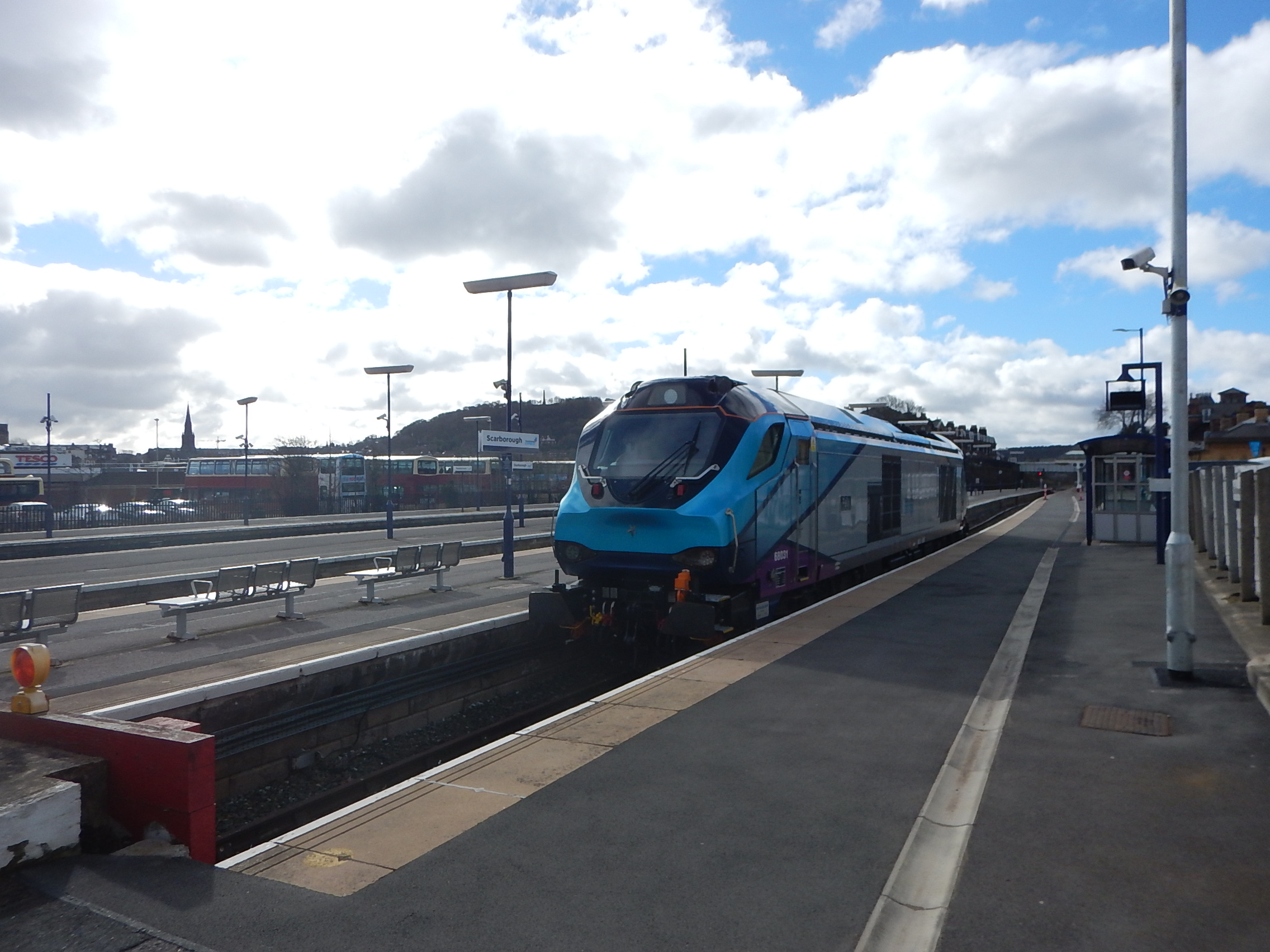
The picture shows one of TransPennine’s Class 68 locomotives at Scarborough. As the picture shows, they are a smart and purposeful-looking locomotive, that wouldn’t look out of place in the right livery on the front of the Royal Train.
It has some good features.
- It is a 100 mph locomotive.
- It seems to be well-liked by operators.
- It can haul both passenger and freight trains.
- It can act as a Thunderbird or rescue locomotive.
But they have three problems; emissions, noise and diesel.
This is from Wikipedia.
The locomotive’s propulsion system is compliant with Stage III A of the European emission standards, but not the more stringent Stage III B requirements.
But noise is a another problem and this has caused council action in Scarborough.
More important than emissions or noise, is the fact, that the locomotive is diesel-powered, so the fleet will probably have to be retired from the railway, at a time, when there is still useful life left in the locomotives.
The Class 68 locomotive is a member of the Stadler Eurolight family, of which there are three versions.
All follow similar design principles, differing mainly in dimensions, with Spain, Taiwan and the UK ordering upwards of twenty-thirty locomotives.
The UKLight branch of the family has two other members.
The Class 88 locomotive is an electro-diesel version of the Class 68 locomotive and the development of the design is described in this extract from the Class 88 locomotive’s Wikipedia entry.
Amid the fulfillment of DRS’ order for the Class 68, Stadler’s team proposed the development of a dual-mode locomotive that could be alternatively powered by an onboard diesel engine or via electricity supplied from overhead lines (OHLE). Having been impressed by the concept, DRS opted to place an order for ten Class 88s during September 2013. Having been developed alongside the Class 68, considerable similarities are shared between the two locomotives, amounting to roughly 70 percent of all components being shared.
According to Wikipedia, the type had a smooth entry into service.
The Class 93 locomotive will be the next development of the UKLight branch of the family, when it is delivered in 2023.
It will be a tri-mode locomotive, that will be capable of being powered by 25 KVAC overhead electrification, an onboard diesel engine and batteries.
It will be a 110 mph locomotive.
It can haul both passenger and freight trains.
Rail Operations Group have ordered 30 locomotives.
This is the first paragraph of the section in Wikipedia called Specification.
The Class 93 locomotive has been developed to satisfy a requirement for a fast freight locomotive that uses electric power while under the wires, but is also capable of self-powered operations. Accordingly, it is capable of running on diesel engines, from overhead wires, or from its onboard batteries. These batteries, which occupy the space used for the braking resistors in the Class 88, are charged via the onboard transformer or regenerative braking; when the batteries are fully charged, the locomotive only has its friction brakes available. The diesel engine is a six-cylinder Caterpillar C32 turbocharged power unit, rated at 900 kW, conforming with the EU97/68 stage V emission standard. The batteries units are made of Lithium Titanate Oxide and use a liquid cooling solution, enabling rapid charge and discharge.
It is a truly agnostic locomotive, that can take its power from anywhere.
The last paragraph of the specification compares the locomotive to the Class 66 locomotive.
In comparison with the Class 66, the Class 93 can outperform it in various metrics. In addition to a higher top speed, the locomotive possesses greater acceleration and far lower operating costs, consuming only a third of the fuel of a Class 66 along with lower track access charges due to its lower weight. ROG has postulated that it presents a superior business case, particularly for intermodal rail freight operations, while also being better suited for mixed-traffic operations as well. Each locomotive has a reported rough cost of £4 million.
It is no ordinary locomotive and it will change rail freight operations in the UK.
I have a feeling that the Class 93 locomotive could be a lower-carbon replacement for the Class 68 locomotive.
But I also believe that what Stadler have learned in the development of the Class 93 locomotive can be applied to the Class 68 locomotive to convert them into zero-carbon locomotives.
It may be just a matter of throwing out the diesel engine and the related gubbins and replacing them with a large battery. This process seems to have worked with Wabtec’s conversion of diesel locomotives to FLXdrive battery-electric locomotives.
Suppliers Sought For New Bi-Mode Locomotives For TransPennine Express And Great Western Railway
The title of this post, is the same as that of this article on Rail Advent.
These three paragraphs give a summary of the proposed fleet of locomotives required by First Group for their two operations.
TransPennine Express is looking for expressions of interest from suppliers for a fleet of at least 15 bi-mode locomotives for use on with its Mk5 carriages.
The provision released by First Group is for up to 30 bi-mode locomotives, with an additional 5 for use on Great Western Railway’s Sleeper Service.
The operators say that the new locomotives must have the capability to be powered by overhead wires as well as being able to operate with an alternate traction mode, IE Diesel or Battery, where routes are not yet electrified or for use as a contingency.
I have also read the detailed proposal, which can be downloaded from this page of the First Group web site.
- The locomotives must be capable of hauling a train at 100 mph.
- First Group are putting a high emphasis on environmental impact of the locomotives.
- The locomotives must be compatible with the latest emission regulations.
- The locomotives must be low-noise.
- The locomotives must be capable of hauling seven coaches, including a driving van trailer.
Nothing in the request for proposals would appear to be too challenging.
I have some thoughts.
The Number Of Locomotives For TransPennine Express
Currently, TransPennine Express has a fleet of fourteen Class 68 locomotives and enough coaches and driving van trailers to create thirteen rakes of Mark 5A coaches.
So why do TransPennine Express talk of up to thirty locomotives?
- Fifteen locomotives would handle the current services, so thirty could cover new services or more services on the current locomotive-hauled routes.
- Manchester Airport and Cleethorpes and Manchester Piccadilly and Hull are run by Class 185 diesel trains, which will need replacing at some future time.
- First Group probably know the costs of running Class 802 trains and locomotives with rakes of coaches better than anyone , so are they thinking about swapping some Class 802 trains for locomotives with rakes of coaches?
The last point would be one for the accountants.
But I am led to the conclusion, that TransPennine Express could be expanding and also decarbonising the long routes still operated by Class 185 trains.
The Number Of Locomotives For Great Western Railway
Currently, Great Western Railway has a fleet of four Class 57 locomotives to haul the Night Riviera.
Five replacement locomotives would probably be enough.
Could A Battery-Electric Locomotive Handle The TransPennine Express Requirement?
Currently, there are gaps in the electrification of the TransPennine network.
- Manchester Victoria and Stalybridge – 7.7 miles – Electrification in progress
- Stalybridge and Huddersfield – 18 miles
- Huddersfield and Dewsbury – 8 miles – Electrification in progress
- Dewsbury and Leeds – 9.1 miles
- Leeds and York – 25.6 – Electrification in progress
- Northallerton and Redcar – 28.8 miles
- Manchester Piccadilly and Stalybridge – 7.5 miles
- Leeds and Hull – 51.8 miles
- Doncaster and Cleethorpes – 72.1 miles
- Scarborough and York – 42 miles
- Doncaster and Sheffield – 18.7 miles
- Sheffield and Stockport – 36.8 miles – Rumoured to be electrified
Note.
- Many gaps are quite small.
- The longest gaps are on easy routes.
- Sheffield will be electrified for the Midland Main Line.
- A length of electrification at Scunthorpe could ease Doncaster and Cleethorpes.
I feel that a battery-electric locomotive with a range of a hundred miles hauling seven coaches, would be able to handle all the TransPennine routes.
If the train could run the routes with an electricity consumption of 4 kWh per vehicle-mile, seven coaches would need 4 * 8 * 100 = 3.2 MWh of battery storage.
Note.
- A 3.2 MWh battery would weigh around 3.2 tonnes, which would be less than the diesel engine in a Class 68 locomotive.
- Regenerative braking to batteries could be used to improve range.
- In How Much Power Is Needed To Run A Train At 125 Or 100 mph?, I calculated that an InterCity 125 needs 1.81 kWh per vehicle mile to maintain 100 mph.
I am fairly certain, that a well-designed efficient battery-electric locomotive would be able to handle all of the routes for TransPennine Express.
Could A Battery-Electric Locomotive Handle The Night Riviera?
I have just looked up the Southbound Night Riviera on Real Time Trains.
- It leaves Paddington at 23:50.
- It is typically eight coaches and a Class 57 locomotive.
- The train is planned to run at 75 mph.
- The first 53 miles between Paddington and Newbury are electrified.
- There is a stop of one hour and 39 minutes at Exeter.
- Newbury and Exeter is 120.4 miles
- Exeter and Penzance is 130.8 miles
The Northbound Night Riviera only has a five minute stop at Exeter and two minutes stops at Totnes, Newton Abbott and Taunton.
A battery-electric locomotive would need a range of 140 miles hauling eight coaches.
- Some stops like Plymouth may need to be lengthened by a few minutes to charge the batteries.
- Extra stops of perhaps five minutes could be added to top-up the batteries.
- The train would be limited to 75 mph, which would improve efficiency.
- It might even be prudent to electrify the uphill track of some of the steeper parts of the route.
But think of the marketing advantages of a zero-carbon sleeper train!
Conclusion
When I saw First Group’s proposals, I thought that they were over ambitious.
But after doing a few simple calculations, I think they can decarbonise some, but not all of the TransPennine Express services and the Night Riviera.
What is Mineral Carbonation And How Could It Transform The Building Industry?
The title of this post, is the same as that of this article on AZO CleanTech.
This is the introductory paragraph.
Natural carbonates have been prime building materials for centuries, but synthetic carbonates are a modern, robust building material, created via mineral carbonation.
The article is a must-read introduction to this fascinating Australian technology, which could be very important in combating climate change.
There is also an explanatory video, which is worth a watch.
Sunrise On Ravenstruther Rail Freight Terminal In Scotland
The title of this post, is the same as that of this article on Railfreight.com.
This is the opening paragraph.
The long awaited rebirth of Cloburn Quarry has been celebrated onsite. The former coal handling depot in South Lanarkshire has been inaugurated as a new aggregates terminal, serving the continued growth of the UK infrastructure and construction industry. The onsite quarry will supply materials, with the facility to handle both outbound and inbound loads.
It is a fascinating article, which explains how Cloburn Quarry has opened a rail terminal to supply its customers by rail.
This Google Map shows the Ravenstruther Rail Freight Terminal.
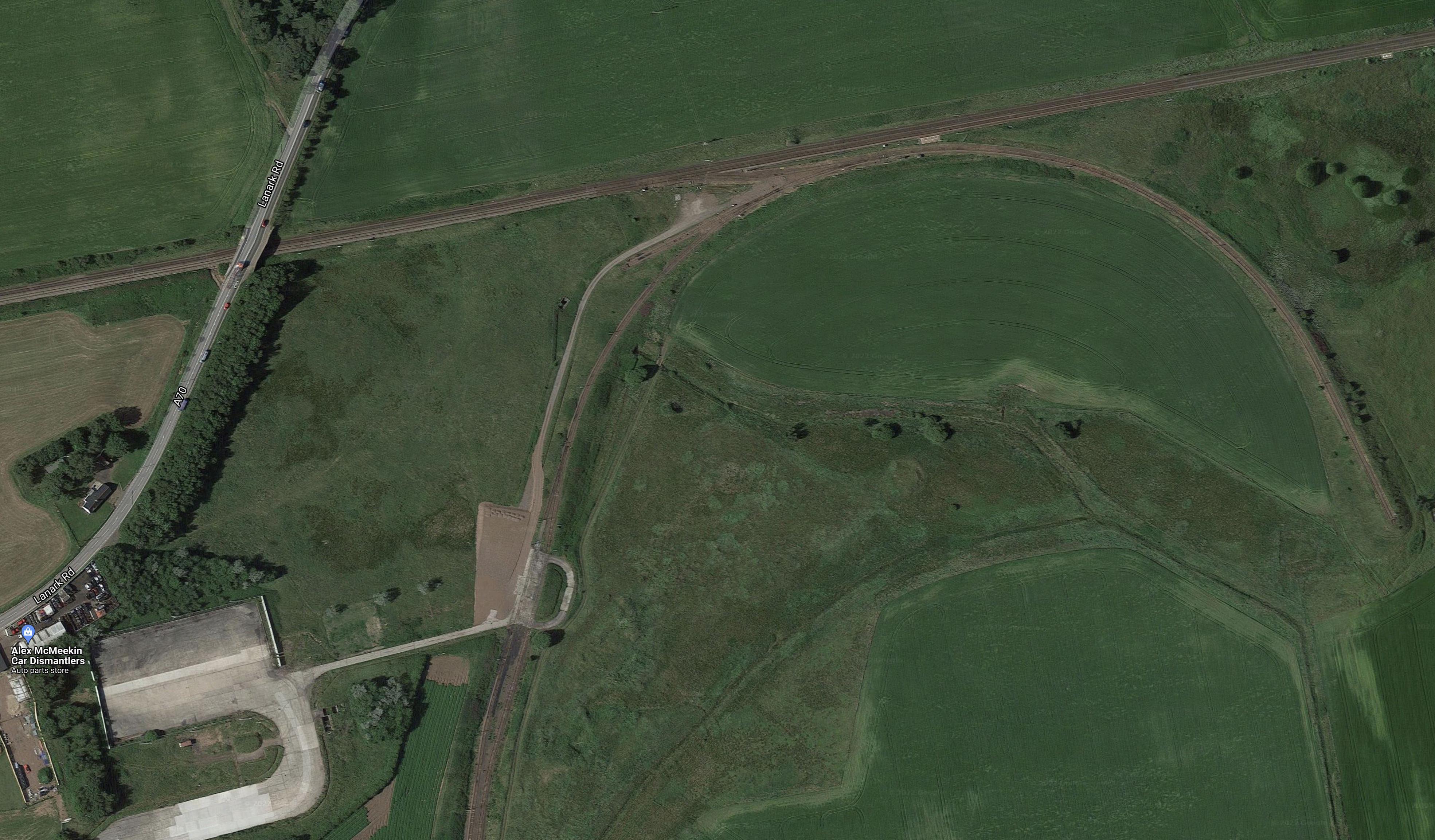
It is very simple being a horseshoe shaped double-track with a connection to the West Coast Main Line.
- Trains would appear to be loaded and unloaded on the Western limb.
- The railway line across the top of the map is the West Coast Main Line..
- Glasgow is to the West with Carstairs station a few miles to the East.
- Glasgow Central and Carstairs stations are 28.7 miles apart.
If the business grows there would appear to be plenty of space to expand.
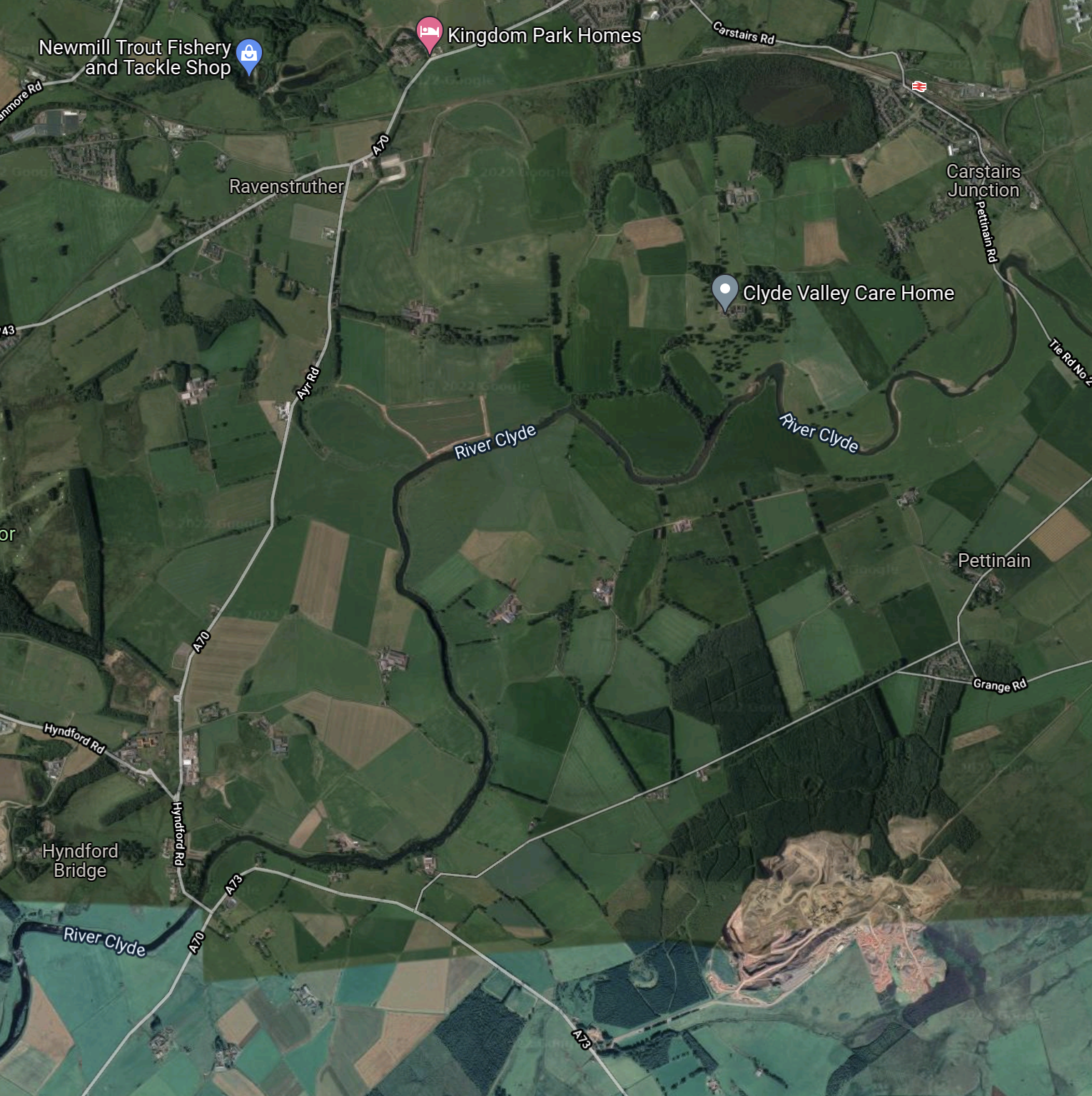
This second Google Map shows the relationship of the Ravenstruther Rail Freight Terminal and Cloburn Quarry.
Note.
- In the top right corner of the map, the red symbol marks Carstairs station.
- It is possible to pick out the rail freight terminal to the South of the pink arrow making Kingdom Park Homes.
- Cloburn Quarry is the large brown-red scar in the bottom-right corner of the map.
It would appear that the quarry and the rail freight terminal must use heavy trucks along the A70 and A73 to move the aggregate between the two sites.
Operation Of The Quarry
According to the article, the quarry is a source of red granite, which can be used for dressing roads and rail ballast, which is distributed all over the UK and even to Europe.
Having a rail terminal on the West Coast Main Line, must be a big advantage.
As with the rail terminal at Penmaenmawr, which I wrote about in Penmaenmawr Quarry Rail Terminal Opens, this terminal will benefit with locomotive developments that should happen in future.
Both battery-electric and hydrogen-electric capable of using the electrification of the West Coast Main Line, would bring this freight terminal up a level in terms of zero-carbon operation.
It is also likely, that within a few years, there will be heavy eight-wheeler trucks and loading shovels powered by hydrogen to transport and load the aggregates.
Penmaenmawr Quarry Rail Terminal Opens
The title of this post, is the same as that of this article on Railway Gazette.
These are the first two paragraphs.
Hanson has reopened its Penmaenmawr railhead in north Wales, as part of its strategy to reduce vehicle movements and associated CO2 emissions.
The quarrying company has spent £300 000 refurbishing the facility, including upgrades to the railhead conveyor which was last used in 2012. The first trial service was operated by GB Railfreight and transported stone to the Tuebrook depot near Liverpool to test the equipment and uncover any operational issues within the quarry and at the railhead.
The aim is to one one train per week between North Wales and North West England.
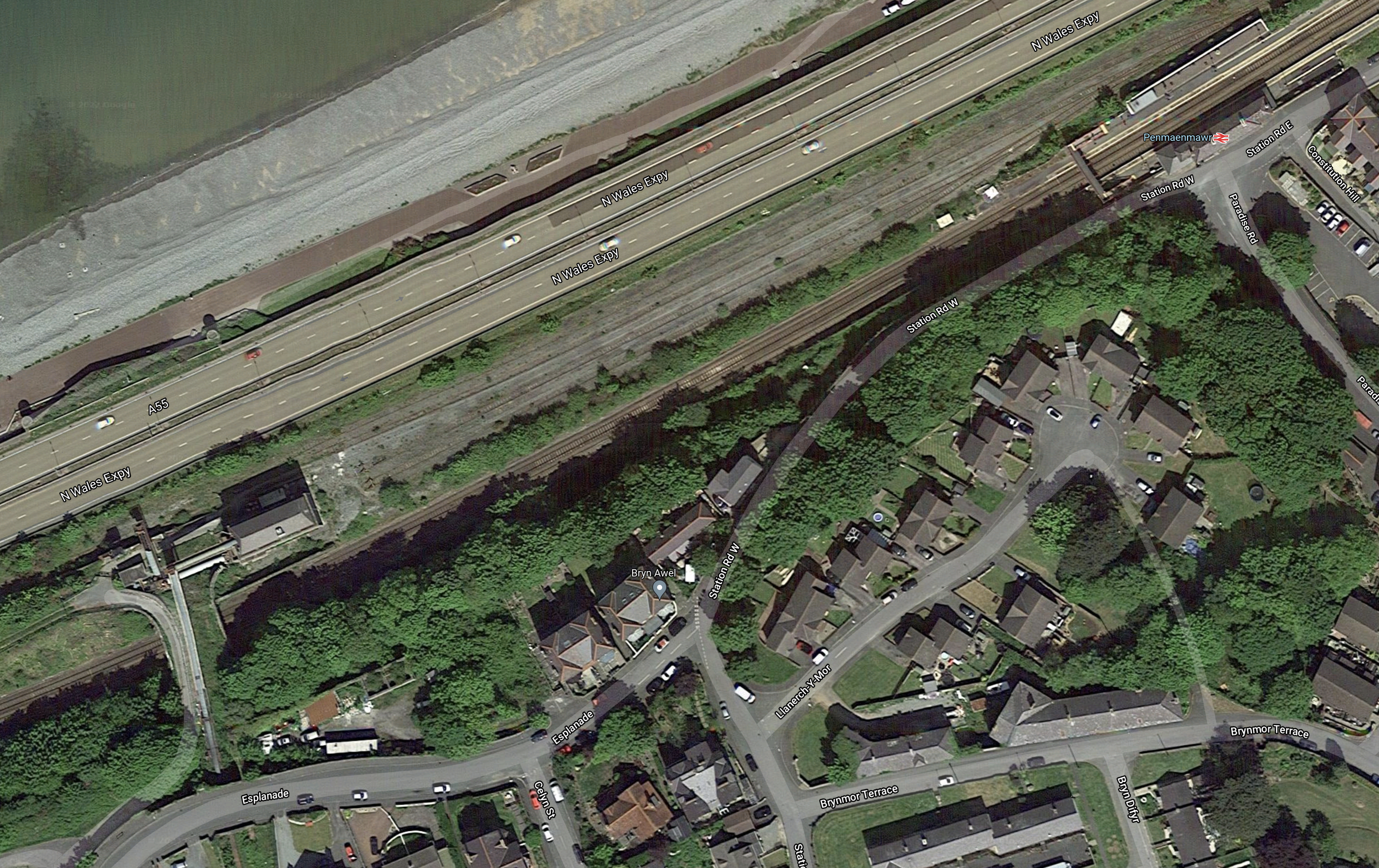
This Google Map shows the Penmaenmawr railhead.
Note.
- Penmaenmawr station is in the top right corner of the map.
- The railhead is in the bottom-left corner of the map.
- The North Wales Expressway is between the railway and the beach.
There is a conveyor leading to the South and this second Google Map shows the vast quarry complex.
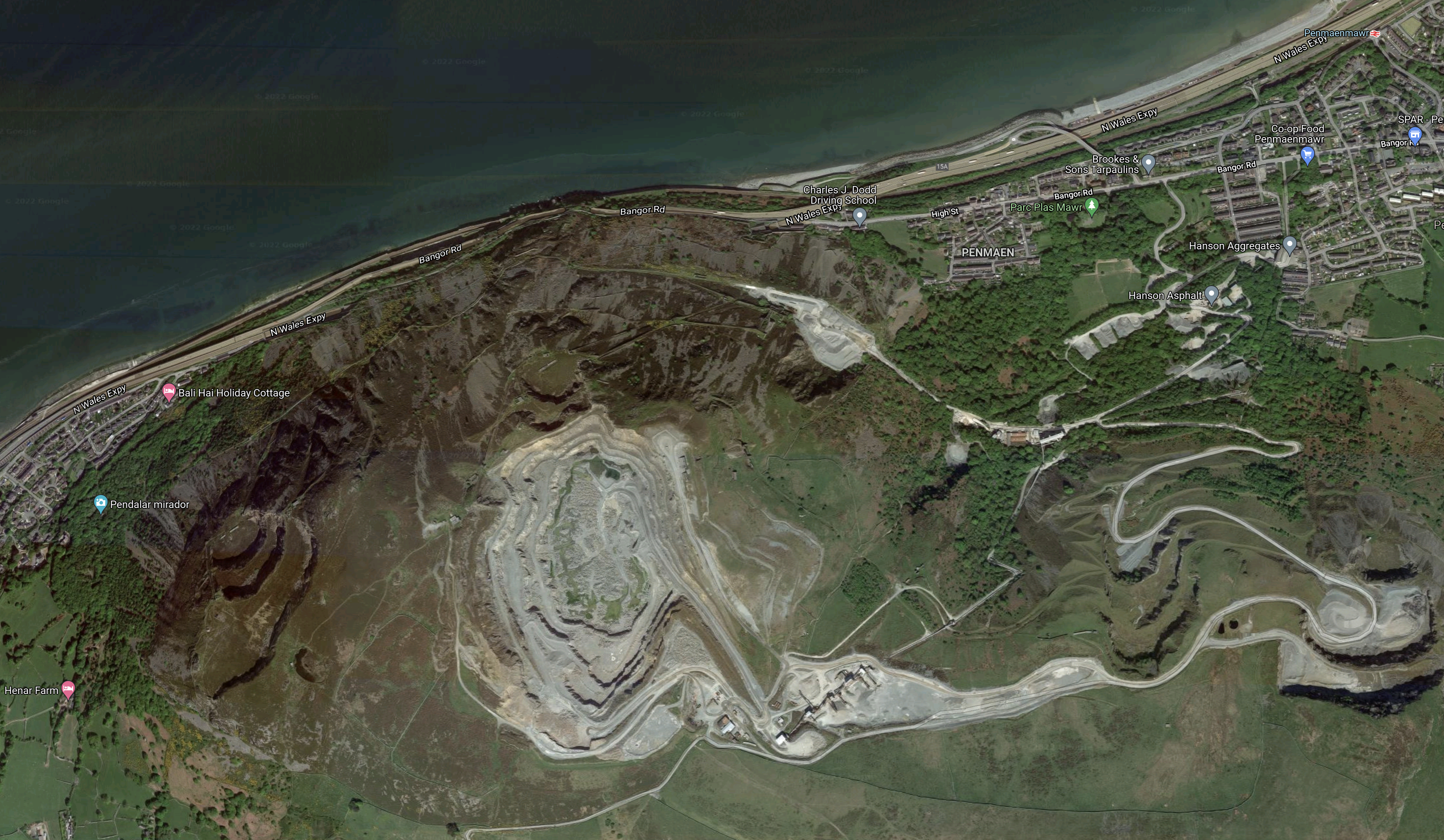
Penmaenmawr station is in the top right corner of the map.
It does appear to me, that this is a good move by Hanson.
- If the quarry can be worked economically, it is surely worthwhile exploiting.
- Opening new quarries, is generally not an easy process.
- Even using diesel locomotives on the aggregate trains, probably saves carbon compared to trucks.
- Closing the quarry would probably not be good for the area.
- They only want to run one train per week.
- I wonder, if the train goes through the Halton Curve that opened a couple of years ago.
- Penmaenmawr and Tuebrook Sidings are a route of about eighty miles.
But I think in the future it could be a very good move, as at least one of three things will happen.
- The North Wales Coast Line will be electrified.
- Someone will develop a hydrogen-electric freight locomotive.
- Wabtec will develop their battery-electric locomotive for the UK with a UK-sized FLXdrive battery.
All possibilities will help Hanson lower the carbon footprint of the route.
Given too, that Hanson will probably decarbonise their quarrying operations by using hydrogen-powered equipment, it should be possible to arrange a hydrogen supply at Penmaenmawr.
Wabtec’s 100% Electric Locomotive Trickle Suddenly Becomes International Flood
The title of this post, is the same as that of this article on Clean Technica.
This is the introductory paragraph.
Whelp, that was fast. The locomotive manufacturer Wabtec lit up the Intertubes last November when it debuted the new FLXdrive 100% electric locomotive in Pennsylvania, but that was just the beginning. The company has nailed down two clients in Australia for its carbon-free choo-choo while also locking in a spot on the new Europe’s Rail Joint Undertaking, which aims to green up railway systems throughout Europe.
It certainly has been quick.
Usually, only in times of war, do things go that fast.
But you could argue that climate change is as big a threat to the world than China, Iran, North Korea or Russia.
Goldman Sachs Invests $250 million In Hydrostor To Advance Compressed Air Energy Storage Projects
The title of this post, is the same as that of this article on pv Magazine.
This is the introductory paragraph.
The investment is planned to support development and construction of Hydrostor’s 1.1GW, 8.7GWh of Advanced Compressed Air Energy Storage projects that are well underway in California and Australia, and help expand Hydrostor’s project development pipeline globally.
It certainly seems that the big beasts of finance are starting to back innovative energy storage.
 The Anonymous Widower