2.7M Tonnes Of Co2 Could Be Saved Per Year If UK Domestic Flights Went Electric
The title of this post is the same as that of this article on Simple Flying.
This is the introductory paragraph.
Analysing over 100 domestic routes within the UK, researchers have uncovered some significant Co2 reductions upon the inevitable switch to electric.
It is an excellent summary of the state and potential of electric airliners in the UK.
The article gives this example of the sort of carbon savings, that can be achieved.
One of the shortest domestic flights in the United Kingdom, a 38-minute hop between Belfast International and the Isle of Man, uses around 36kg of carbon dioxide per passenger. In 2019, the route served approximately 20,000 passengers – with a switch to electric aviation, 752 tonnes of carbon dioxide could be cut on the 76-mile flight.
The article says this about one of the more developed electric aircraft; the ES-19 from Heart Aerospace.
One manufacturer, in particular, is seeing a significant surge in interest; Swedish electric aircraft startup, Heart Aviation. Currently holding letters of interest from United Airlines and Finnair, Heart’s 19-seat ES-19 is set to be the first all-electric regional aircraft, boasting a 400km range with a full-charge time of just 40 minutes. The first flight is planned for 2024, with an anticipated 2026 start date.
Airports within a 400 km range from London would include.
- Anglesey
- Blackpool
- Exeter
- Guernsey
- Jersey
- Leeds/Bradford
- Liverpool
- Manchester
- Newquay
- Norwich
- Paris
- Schipol
Dublin, Isle of Man and Newcastle are just over 400 km.
Note.
I also suspect that Dublin, Edinburgh, Leeds and Liverpool would make excellent hubs for electric aircraft.
I used Free Map Tools to get the distances.
Clean Air Power Adds Hydrogen To Class 66 Fuel Mix
The title of this post, is the same as that of this article on the International Rail Journal.
This is the first two paragraphs.
Fuel injection technology developed by Clean Air Power that enables a class 66 locomotive to run on a combination of diesel, biogas and hydrogen has successfully completed nine months of trials with British freight operator Freightliner.
This is the first time that the injection technology has been tested by the rail freight sector and, according to Clean Air Power, paves the way for reducing the emissions of other class 66 locomotives.
Note.
- There are 450 Class 66 locomotives in service in the UK, with more in service in Europe.
- Freightliner was Clean Air Power’s main project partner.
- Nothing was disclosed about carbon savings.
- The trial was backed by £400,000 of Government money.
- The locomotive has completed a nine month trial.
This would appear to be a good professional start to decarbonisation of rail freight.
It’s also rather ironic, that this successful trial of a diesel-saving locomotive was announced on the day of Vlad the Mad’s big parade.
Royal Mail Rolling Back The Years To Put More Post On Trains
The title of this post, is the same as that of this article on The Daily Telegraph.
This is the sub-title.
Post transported by train will treble under plan to ditch planes and lorries.
These are some points from the article.
- They are in discussion with Network Rail.
- Roughly 4pc to 5pc of Britain’s mail is transported on the railways.
- Keith Williams is executive Chairman of Royal Mail and also was the independent chair of the recent Government-supported Rail Review.
- One of the aims of the strategy is to rescue the share price.
- Royal Mail are building some fully-automated parcel-hubs, with the first two at Warrington and Northampton.
I have some further thoughts.
The Warrington Parcel Hub
This appears to be at the Omega Business Park on the closed RAF Burtonwood airfield.
This Google Map shows Warrington.
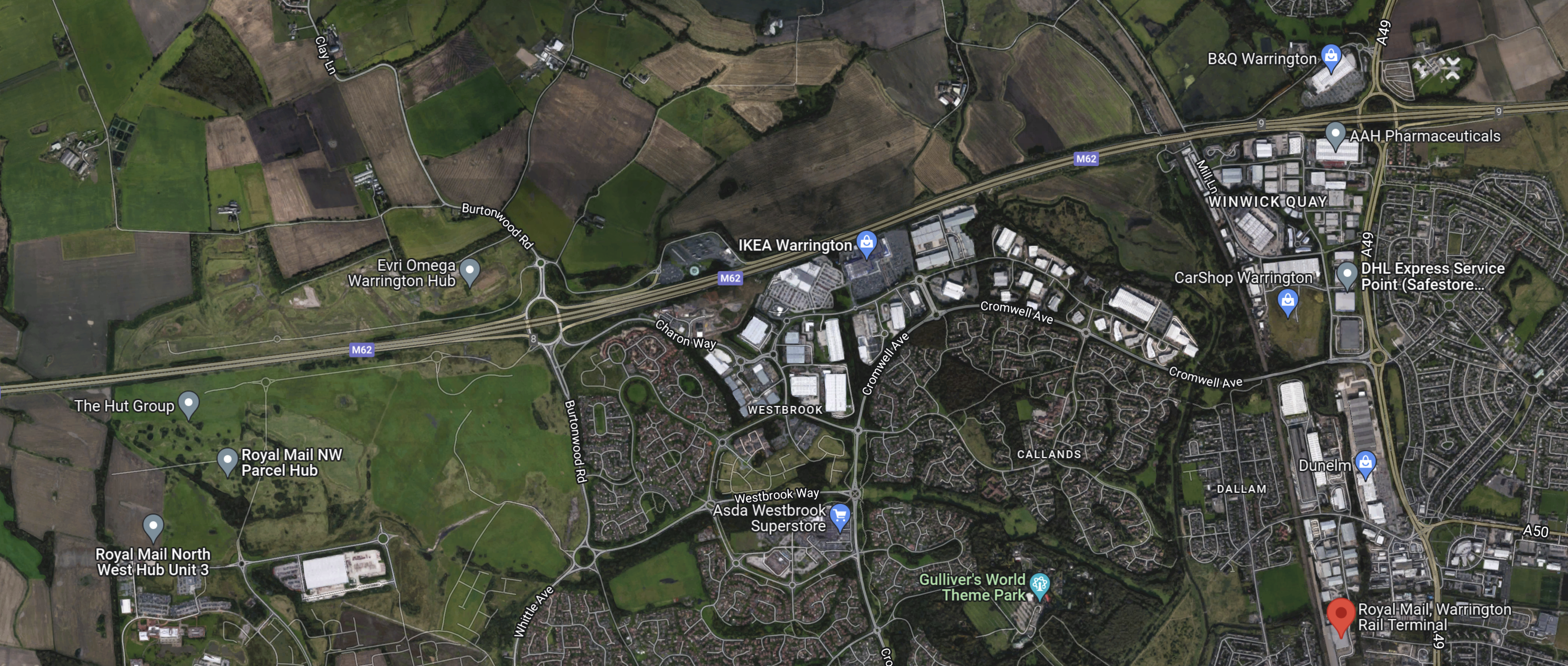
Note.
- The M62 running across the map in an East-West direction.
- The two junctions on the M62 are 8 and 9, with junction 8 to the West and junction 9 to the East.
- The Omega Business Park is on both sides of the M62 to the West of Junction 8.
- Royal Mail appear to have three sheds to the South of the motorway.
- Amazon, Asda, Hermes, The Hut Group and others have sheds in the Omega Business Park.
- The red arrow indicates the location of Royal Mail’s Warrington Rail Terminal, where mail services between London and Scotland call.
This second Google Map shows Royal Mail’s Warrington Rail Terminal in more detail.
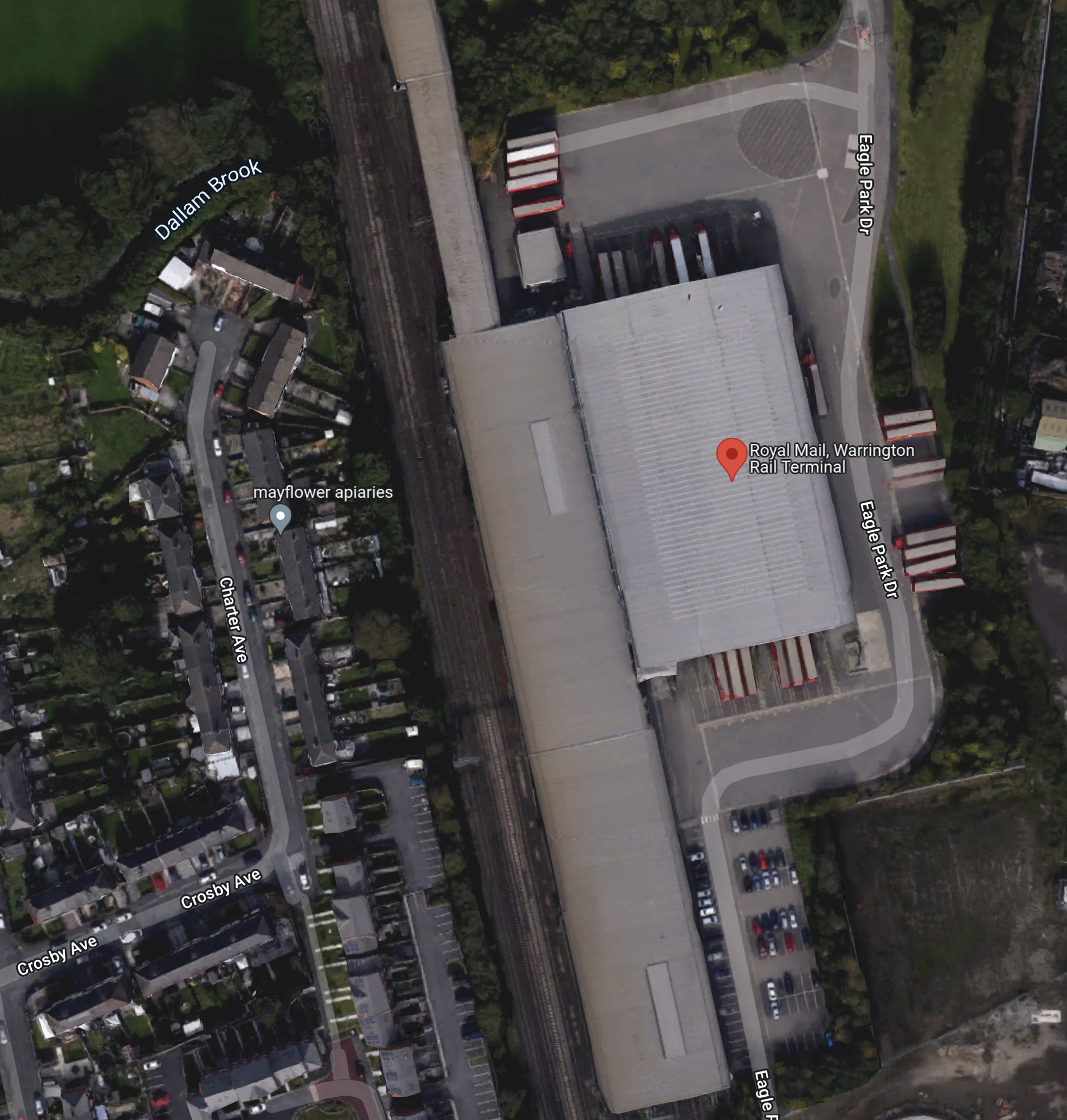
Note.
- The West Coast Main Line runs North-South to the West of the terminal.
- It looks to be a cramped site.
- I doubt that Royal Mail would want to transfer parcels between the rail terminal and the parcel hub, because of the number of trucks involved and the carbon they will generate.
- They could use Hydrogen or battery trucks, but that would be a considerable expense.
Perhaps the best thing to do, would be to bore a tunnel.
- It’s about six kilometres.
- Electric shuttles would be zero-carbon.
- Everything could be highly-automated.
- No drivers would be needed.
It would probably cost less to run.
Royal Mail At Northampton
Where the Northampton Loop Line meets the West Coast Main Line between Rugby and Northampton, there is a massive logistics park, which is shown in this Google Map.
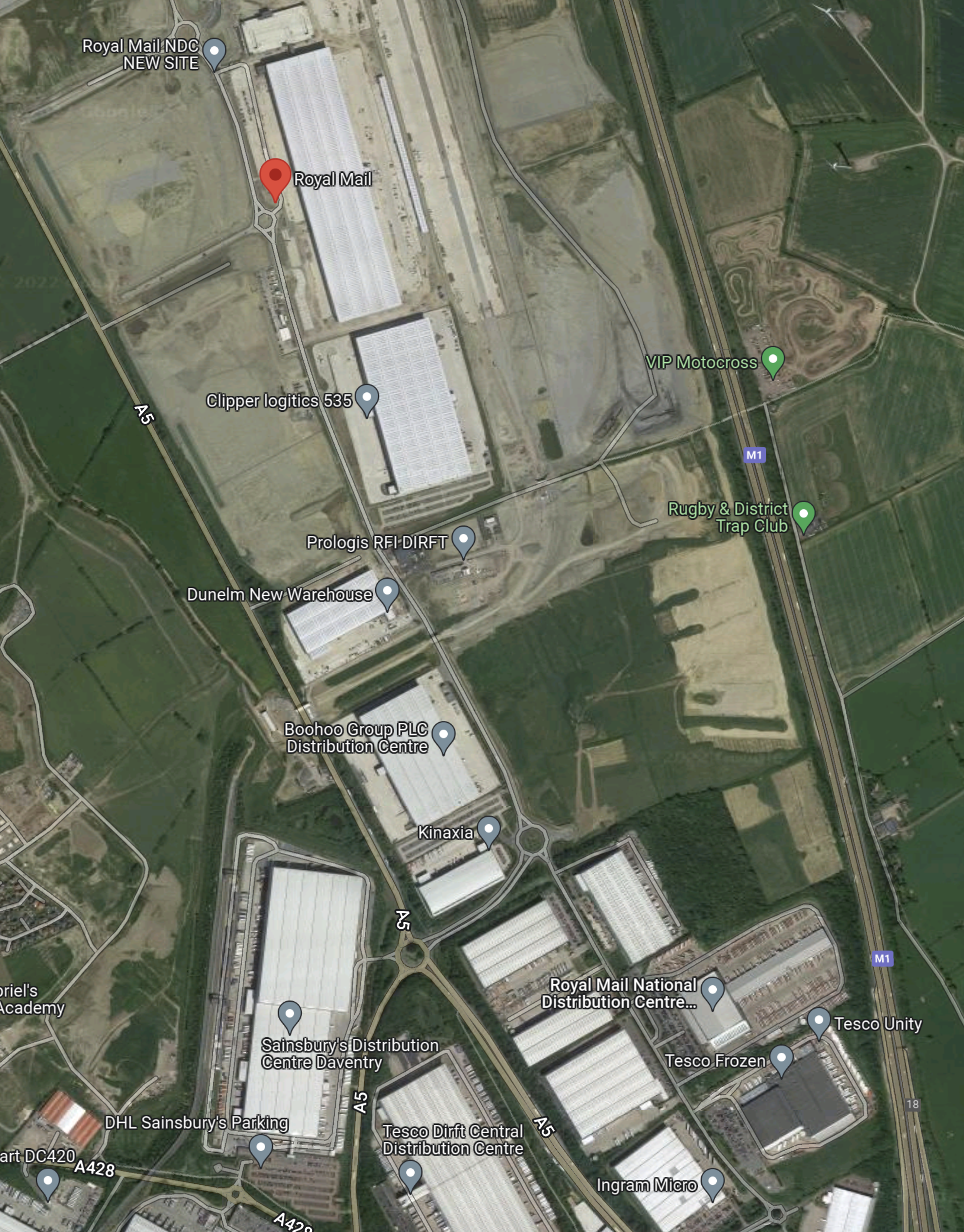
Note.
- There are at least three Royal Mail sites here.
- One at the top of the map is labelled Royal Mail NDC NEW SITE.
- One at the bottom of the map is labelled Royal Mail National Distribution Centre.
- There is a rail connection.
This must be a very large investment for Royal Mail.
Further Parcel Hubs
No further hubs are mentioned in the article. But I’m sure, that the systems at Warrington and Northampton could be replicated.
The East Coast, Great Western And Midland Main Lines
I suspect, when these lines are fully electrified, they could be brought into the system.
A Hub At Calais
Why not?
Conclusion
It looks a good plan and one that can be realised.
Siemens Mobility and Deutsche Bahn Present New Hydrogen Train
The title of this post, is the same as that of this article on Global Railway Review.
This is the sub-title.
Deutsche Bahn and Siemens Mobility have presented the newly developed Mireo Plus H and a newly designed mobile hydrogen storage trailer.
It seems that Deutsche Bahn and Siemens Mobility have put together a well-thought out plan to use hydrogen on a lot of unelectrified lines.
The Germans have given the project, the catchy name of H2goesRail.
How does that translate into German?
A Massive Task For Ukraine?
After the Russians are thrown out of Ukraine, it will be a massive task to rebuild Ukraine.
But one of Ukraine’s traditional industries can also be used to transform the world.
The Transformation Of Energy Production To Floating Offshore Wind
I believe that over the next few years, we will see an enormous transformation of zero-carbon energy to floating offshore wind.
- The floating offshore wind industry is planning to use the next-generation of larger wind turbines of up to 20 MW.
- These turbines are too large and intrusive to install onshore.
- Floating wind turbines generally have a higher capacity factor of over 50 %, than onshore turbines.
- Each wind turbine will be mounted on a substantial semi-submersible float, which is built out of large-diameter steel tubes
- The wind turbines are of the same design, as those installed onshore.
- There are several designs for the floats and they are usually based on designs that have worked in the oil and gas industry.
The world will need millions of floating turbines and an equivalent number of floats to fully decarbonise.
Could The Ukrainians Build The Floats?
Consider.
- The Russians have destroyed Mariupol, whilst the Ukrainians have defended the city in the steelworks.
- Mariupol used to have a large shipbuilding industry.
- Ukraine is in the world’s top ten of iron ore producers.
- There is a lot of scrap steel available in the Ukraine, that the Russians have left behind.
- The Ukrainians probably have a lot of workers, who have the skills to build the floats.
I’m sure something could be arranged for the benefit of everybody.
Will Twiggy Save The World?
This article on the Sydney Morning Herald is entitled ‘No One’s Married To Coal’: How Forrest Is Taking On The World To Save The Climate.
The article is the story of Andrew ‘Twiggy’ Forrest’s Damascene conversion to hydrogen.
These three paragraphs sums up Andrew Forrest‘s vision and ambitions.
Forrest’s companies, including its mining arm, Fortescue, and its green energy arm, Fortescue Future Industries, would be net zero by 2030. This would necessitate inventing and then developing hydrogen-powered trucks, trains and ships. This way the mining operation would avoid burning up to a billion litres in diesel a year.
The project would include the construction of vast solar and wind power stations in the Pilbara that would create green hydrogen to first fuel the trains, trucks and ships of the iron ore empire and then for export to a clean-energy starved world. The electrolysers needed to make the hydrogen for the early phases of the plan would be built by a vast new factory in Queensland, that itself would double the global supply of the machines.
Hydrogen would soon become the world’s largest shipborne trade. The Fortescue revolution would occur at a blistering pace set by the demands of addressing global warming, and it would be done for profit, to remove the excuses of governments and businesses that objected to ambitious climate action.
Note.
- How many other companies are intending to be net-zero by 2030?
- Certainly not many Chinese, German or Russian companies.
- And how many companies have planned to achieve net-zero at a profit?
If Forrest achieves his ambitions, the world will be a much better place.
The ZEROe Demonstrator Has Arrived
The title of this post, is the same as that of this press release from Airbus.
This is the introductory paragraph.
2022 marks a new and exciting phase for ZEROe – Airbus’ ambition to develop the world’s first zero-emission commercial aircraft by 2035. The multi-year demonstrator programme has officially been launched with the objective to test a variety of hydrogen technologies both on the ground and in the air.
The ZEROe demonstrator will be the first Airbus A 380 aircraft and it is shown in this Airbus visualisation.

Note.
- The four hydrogen tanks in the fuselage.
- The fifth engine mounted in a pod on the fuselage.
- There’s certainly lots of space inside the fuselage for more hydrogen tanks and test and monitoring equipment.
I have a few thoughts.
This Aircraft Will Be A Superb Demonstrator
The press release says this about the use of an A 380 as a demonstrator.
The A380 is the world’s largest and most spacious passenger jet ever built – a size that makes it ideally suited to the role of test platform.
Today, the A380 MSN1 test aircraft is earmarked for a new role: to take the lead on testing the technologies that will be vital to bringing the world’s first zero-emission aircraft to market by 2035.
“The A380 MSN1 is an excellent flight laboratory platform for new hydrogen technologies,” says Mathias Andriamisaina, Airbus ZEROe Demonstrator Leader. “It’s a safe and reliable platform that is highly versatile to test a wide range of zero-emission technologies. In addition, the platform can comfortably accommodate the large flight test instrumentation that will be needed to analyse the performance of the hydrogen in the hydrogen-propulsion system.”
Initially, I suspect the aircraft will fly as a four-engined turbofan aircraft running on standard or sustainable aviation fuel.
The performance of the hydrogen engine will be tested in all phases of operation and at different altitudes.
What Size Is The Fifth Engine?
This layout is clever.
If Airbus want to test a smaller hydrogen engine for say an Airbus A 320-sized hydrogen aircraft like the ZEROe Turbofan shown in this Airbus visualisation, they fit it to the fifth pylon.

Note.
- The fifth pylon on the ZEROe Demonstrator could be the proposed pylon for the ZEROe Turbofan.
- The ZEROe Demonstrator could probably carry a lot of hydrogen to test out the hydrogen engine over a long duration.
- The hydrogen engine could be tested out over the full flight envelop of an Airbus A 380.
I would suspect that the tests on the hydrogen engine would be some of the most comprehensive ever carried out on a new engine.
If Airbus want to test a larger hydrogen engine for say an Airbus A 350-sized hydrogen aircraft, they would probably replace one of the four main engines with the hydrogen engine.
It looks like Airbus will be able to test hydrogen engines for all sizes of plane in their current range.
What Will Happen To Current A 380s?
Consider.
- The production of the A 380 has been stopped.
- There are 251 aircraft in service.
- They appear to be a reliable and safe aircraft.
- The aircraft can run on sustainable aviation fuel.
- The oldest aircraft are only thirteen years old.
- They are still reasonably modern aircraft, that if they needed to be updated to the latest standards could probably be easily done so.
- The aircraft have a lot of volume, which can hold over 500 passengers in a typical configuration.
- The flying characteristics and structure of the aircraft is well known.
I suspect there are a lot of aircraft leasing companies, who feel these aircraft are too good to scrap, just because they are not zero-carbon.
Could Hydrogen Be Stored In The Wing Of An A 380?
Hydrogen storage will get more capable in the next few years and we will see hydrogen stored in strange places in vehicles and aircraft using the gas as a fuel.
The A 380 may well have an advantage in that its wing is relatively thick compared to that of other airliners.
- The A 380 has a wing aspect ratio of 7.53.
- The Boeing 787 has a wing aspect ratio of 11.
- Gliders have wing aspect ratios as upwards of 30.
High aspect ratios are generally more economical on fuel.
But this relatively thick wing, may make it possible to store hydrogen in the wing of an A 380.
Could There Be A Hydrogen-Powered A 380?
I suspect part of the Airbus ZEROe progam will be to investigate the possibility of converting existing A 380 aircraft into a capable hydrogen-powered aircraft.
In Could An A320 neo Be Rebuilt As A ZEROe Turbofan?, I looked at the possibility of turning an existing Airbus A 320 neo into a ZEROe Turbofan running on hydrogen.
This was my conclusion.
I very much feel that there will be a route to convert some or all of the A 320 neo aircraft to hydrogen power.
So what will a ZEROe A 380 look like if it follows the same design route as an A 320 neo to a ZEROe Turbofan?
- There would be a large hydrogen tank in the rear fuselage.
- As I explained earlier, there may be a possibility for some hydrogen to be stored in the wing.
- Both passenger decks would be shortened and perhaps be able to hold the 350-410 passengers of the Airbus A350-1000.
- The cockpit, front part of the fuselage, wings, tailplane and landing gear would be unchanged.
- The aircraft would fit existing jetways at any airport, that can handle an existing A 380.
I believe that converting an existing Airbus A380 to a hydrogen-powered aircraft is possible and the conversion falls within Barnes Wallis‘s rule of problem solving.
There is no greater thrill in life, that proving something is impossible and then showing how it can be done.
The quote comes from a BBC program, where he was interviewed by Chris Brasher, who was another for whom impossible was just a minor hurdle in the way of meeting objectives.
Could There Be A Hydrogen-Powered A 380 Freighter?
Consider.
- I think it is likely, that companies like Amazon will come under pressure over their carbon footprint, as they transport increasing numbers of packages around the world.
- In DHL Express Shapes Future For Sustainable Aviation With First Order Of All-Electric Cargo Planes From Eviation, I talk about how DHL Express have ordered twelve Eviation Alice aircraft to create a zero-carbon service. DHL must feel this would be good for their image. So would they like an intercontinental zero-carbon freighter?
- Some people worry about the air-miles on their food!
There could be a worthwhile niche market for a high capacity intercontinental zero-carbon freighter.
Because it has such a large internal volume, an Airbus A 380 might make an ideal aircraft to convert.
Conclusion
Airbus will learn a lot from the ZEROe Demonstrator.
They may even learn how to develop, a long-range hydrogen-powered zero-carbon A 380 variant that could carry four hundred passengers between Europe and Australia.
Hydrogen Fuel Cell Trucks And H2 Infrastructure Could Benefit From New Legislation
The title of this post, is the same as that of this article on Hydrogen Fuel News.
Politicians from both main parties in the United States are promoting a Hydrogen for Trucks Act, to support the conversion of domestic trucking from diesel to hydrogen.
These are the three main parts of the Act
- Provide incentives for adopting hydrogen fuel cell trucks by covering the difference in cost between them and conventional diesel-powered vehicles.
- Encourage tandem fueling station and vehicle deployment, to ensure that one doesn’t need to exist before the other is in place, solidifying the overall fueling infrastructure.
- Collect data and establish benchmarks for various forms of fleet operation, helping to accelerate deployment by incentivizing private investment.
We could do with an Act like this in the UK.
But whereas the United States would start with hydrogen for trucks, we would probably start with hydrogen for buses.
Shell And ScottishPower Win Bids To Develop 5 GW Of Floating Wind Power In The UK
The title of this post, is the same as that of this press release from Shell.
This is three paragraphs from the press release.
Shell and ScottishPower have secured joint offers for seabed rights to develop large-scale floating wind farms as part of Crown Estate Scotland’s ScotWind leasing. The partners have won two sites representing a total of 5 gigawatts (GW) off the east and north-east coast of Scotland.
The new wind farms will be delivered through two joint ventures called MarramWind and CampionWind. They bring together ScottishPower’s and Shell’s decades of experience working offshore and significant presence in Scotland, as well as their strong innovation capabilities for delivering world-class offshore energy projects.
The development, construction and operation of ScotWind projects is set to bring new skilled jobs and manufacturing opportunities and boost local supply chains.
ScottishPower are actually involved in three large ScotWind projects; one by themselves and two in partnership with Shell.
MacHairWind
MachairWind is a project that Scottish Power is developing alone.
- It has its own page on the ScottishPower Renewables web site.
- It will be a 2 GW wind farm to the North-West of Islay.
- The turbines will be on fixed foundations.
I wrote about this project in MacHairWind Wind Farm.
MarramWind And CampionWind
These two wind farms are being developed in partnership with Shell.
They both have their own web sites.
MarramWind’s web site has this introduction.
ScottishPower and Shell have joined forces to develop the MarramWind offshore windfarm following success in the recent ScotWind auction process by Crown Estate Scotland.
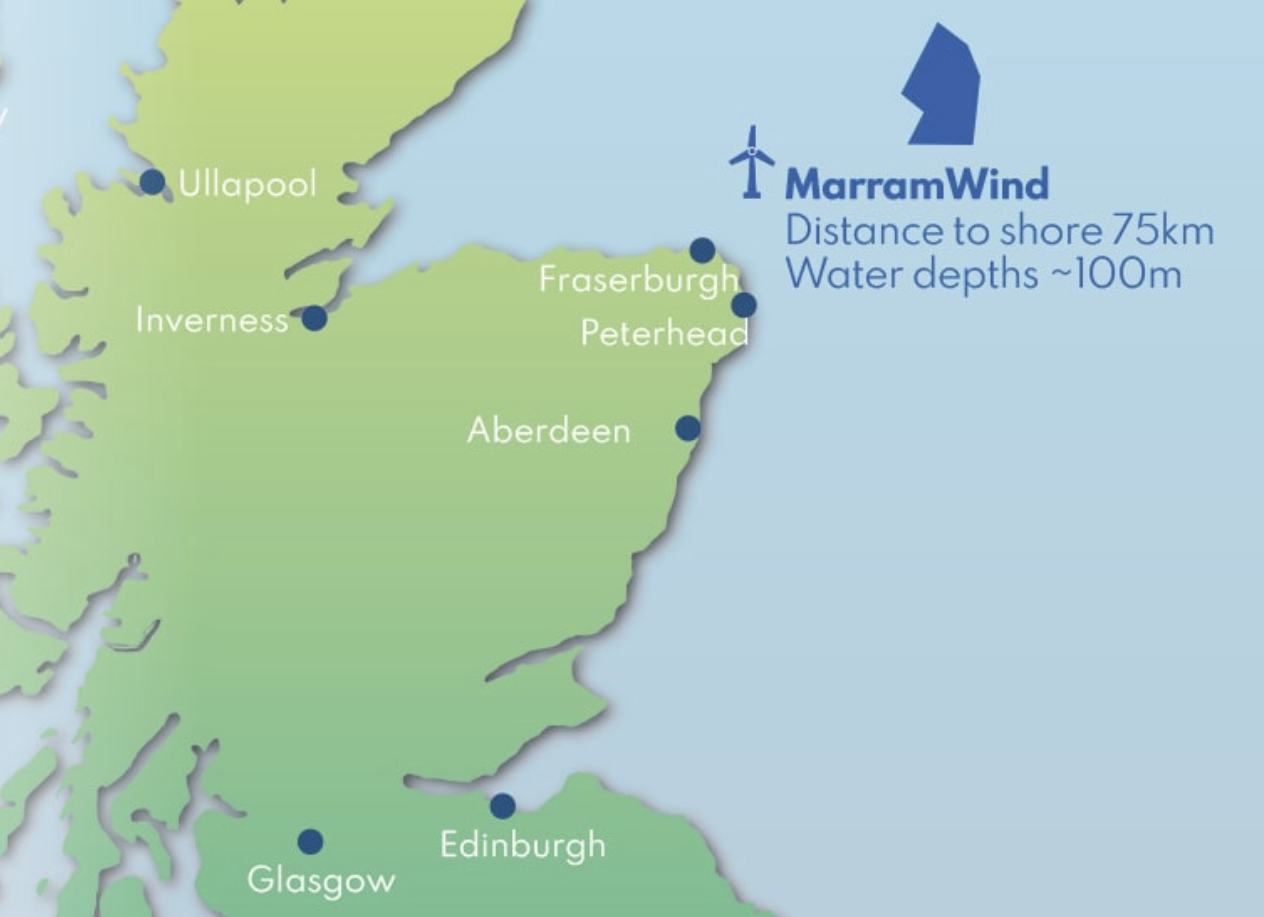
Located 75 kilometres off the North East coast of Scotland in water depths averaging 100 metres, the proposed MarramWind floating offshore windfarm could deliver up to 3 gigawatts (GW) of cleaner renewable energy.
This map clipped from the MarramWind web site, shows the location of the wind farm.
CampionWind’s web site has this introduction.
ScottishPower and Shell have joined forces to develop the CampionWind offshore windfarm following success in the recent ScotWind auction process by Crown Estate Scotland.
Located 100 kilometres from the east coast of Scotland, in water depths averaging 77 metres, the proposed CampionWind floating offshore windfarm could deliver up to 2 gigawatts (GW) of cleaner renewable energy.
This map clipped from the CampionWind web site, shows the location of the wind farm.
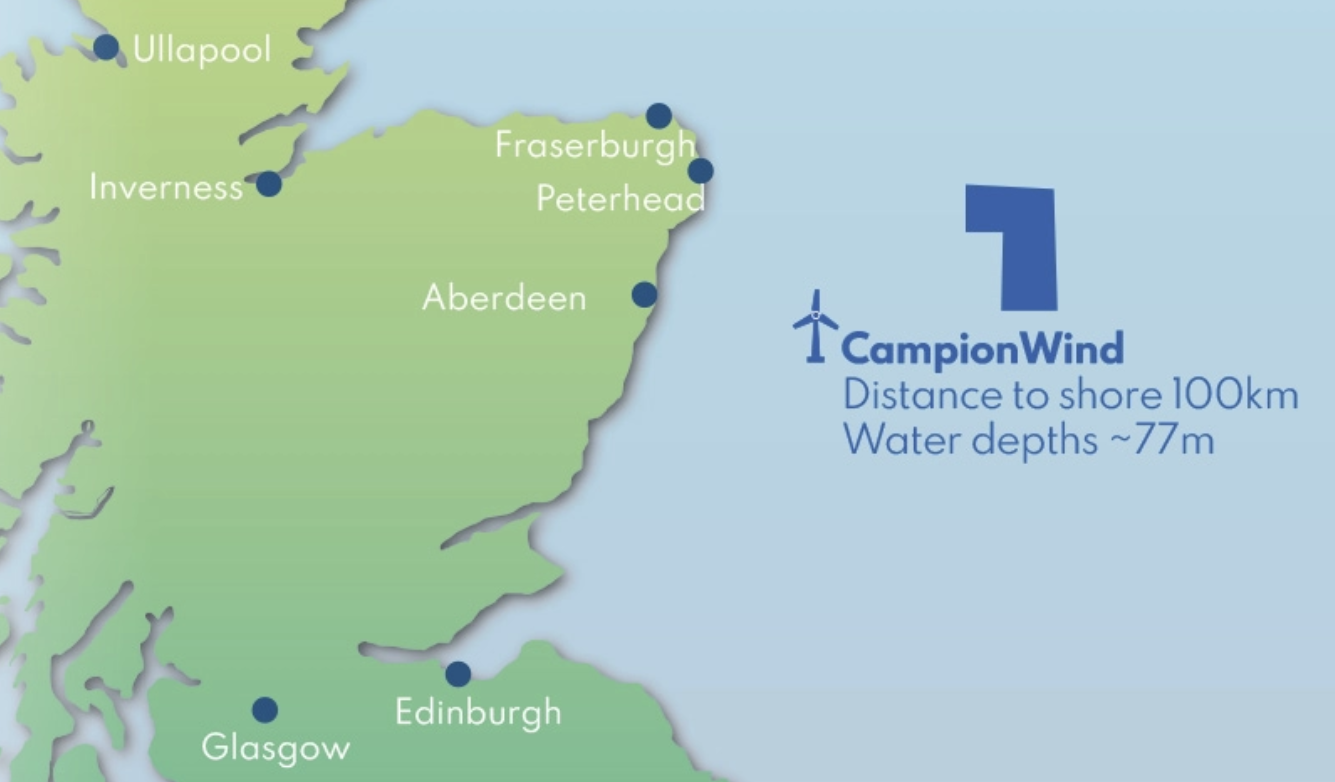
Note.
- The two wind farms will be within a few miles of each other.
- Both wind farms will use floating wind turbines.
- The water is a bit deeper at MarramWind, but this surely doesn’t bother a floating turbine.
- MarramWind and CampionWind will have a total capacity of 5 GW.
- Hywind Scotland is the world’s first commercial wind farm using floating wind turbines, situated 29 kilometres off Peterhead. This wind farm is only 30 MW, but in its first years of operation has achieved a capacity factor of over 50 %.
- The proposed turbines at Northern Horizons‘ 10 GW wind farm, which is 130 kilometres to the North-East of Shetland will be 20 MW giants and nearly as tall as The Shard in London.
So will Scottish Power and Shell design and build a combined field, similar in concept to Northern Horizons’ wind farm, using an armada of 250 floating wind turbines?
- The wind turbines might be moored around a fixed or floating mother platform or structure, that will collect the electricity and deliver it to the shore.
- Turbines could be serviced in situ or moved into port, as needed.
- Extending the wind farm could just be a matter of mooring the extra turbines in position and then connecting them to the mother platform.
- Is there a convenient disused oil or gas platform, that could be repurposed as the mother platform?
It certainly would appear to be a way of building large offshore fields in deep waters.
Where Would The Combined MarramWind And CampionWind Rank In Terms of UK Wind Farms?
Consider.
- MarramWind and CampionWind will have a total capacity of 5 GW.
- Phase one of the Hornsea Wind Farm is the largest offshore wind farm in the world, with a capacity of just over 1.2 GW and when complete it will have a capacity of 6 GW.
- Northern Horizons is planned to be 10 GW.
- The East Anglian Array could be as large as 7.2 GW.
- The Dogger Bank Wind Farm is planned to be as large as 4.8 MW.
- Norfolk Vanguard and Norfolk Boreas are a pair of 1.8 GW wind farms.
- MacHairWind will be a 2 GW wind farm.
Note.
- This is not a complete list of large wind farms in the development pipeline.
- BP have obtained leases, but have not published their plans.
- Most farms under development are at least one GW.
- These farms are a total of 38.6 GW.
The Combined MarramWind and CampionWind would be one of several large wind farms around 5 GW.
There Is A Desperate Need For Energy Storage
If we are generating upwards of 40 GW of wind and solar energy in the UK, there will be a desperate need for energy storage to cover for the times, when the wind doesn’t blow and the sun doesn’t shine.
Scotland should be OK, as there are various energy storage projects in development.
- The 1.5 GW/ 30 GWh Coire Glas project is according to SSE shovel-ready and has planning permission.
- The 450 MW/2.8 GWh Red John project is being constructed.
- Drax, ILI Group and SSE have several other projects under development.
So what would happen in the South?
The government appears to be on the case as I wrote in Ministerial Roundtable Seeks To Unlock Investment In UK Energy Storage.
But there is also the possibility of using hydrogen.
- Hydrogen could be created by a series of giant electrolysers.
- It could be blended with natural gas to eke out our natural gas and save carbon. According to HyDeploy, it appears that up to 20 % can be added, without needing to change boilers and appliances.
- It can be stored in depleted offshore gas fields.
- It can be used to power heavy transport like buses, trucks, trains and ships.
- It can be burned in gas-fired power stations to generate electricity.
Hydrogen can also be used as a feedstock or green energy source for the making of chemicals, concrete and steel.
Conclusion
We are approaching the end of the first phase of the development of renewable energy in the UK.
Massive floating wind farms using armadas of floating wind farms, a large expansion of pumped storage hydro and a huge expansion of the use of hydrogen will see us through to a carbon-free future.

