Rolls-Royce And Duisport Launch CO2-Neutral, Self-Sufficient Energy System For New Port Terminal
The title of this port is the same as that of this press release from Rolls-Royce.
These two bullet points act as sub-headings.
- First mtu hydrogen CHP units, battery storage systems and fuel cell systems from Rolls-Royce in operation.
- Benchmark for sustainable energy supply in logistics centers worldwide.
These three paragraphs give more details of the project.
Rolls-Royce and Duisburger Hafen AG have opened a CO2-neutral and self-sufficient energy system for the new Duisburg Gateway Terminal, located in the Rhine-Ruhr industrial region of Germany. The core components are two mtu combined heat and power units designed for operation with 100 percent hydrogen, which are being used here for the first time worldwide. The system is supplemented by an mtu battery storage system, mtu fuel cell systems and a photovoltaic system integrated via an intelligent energy management system.
The Enerport II flagship project, funded by the German Federal Ministry for Economic Affairs and Energy, is setting new standards for sustainable energy supply in large logistics centers and is considered a model for other ports, infrastructure projects and industrial facilities. Project partners include the Fraunhofer Institute UMSICHT, Westenergie Netzservice GmbH, Netze Duisburg GmbH, Stadtwerke Duisburg AG, and Stadtwerke Duisburg Energiehandel GmbH.
“The launch of this carbon-neutral energy system at the Duisburg Gateway Terminal is a big step toward a more climate-friendly, resilient energy supply. Together with our partner duisport, we’re showing how scalable technologies from Rolls-Royce can really help transform critical infrastructure – and help make the energy transition happen,” said Dr. Jörg Stratmann, CEO of Rolls-Royce Power Systems.
Note.
- It is carbon-neutral.
- The system uses both hydrogen and solar power.
- What has been created at the Port of Duisburg is considered by the German Federal Ministry for Economic Affairs and Energy to be a model for other ports, infrastructure projects and industrial facilities.
- It surely must help sales, that the flagship project is up and running.
In November 2021, I wrote about this project in Rolls-Royce Makes Duisburg Container Terminal Climate Neutral With MTU Hydrogen Technology, which included this graphic.

It seems that Heathrow Airport could have a use for this technology.
I have one important thought.
Where Will The Port Of Duisburg Get The Hydrogen It Needs?
In the graphic an Electrolyser and H2 Storage are clearly shown, as are the two H2 Combined Heat and Power Units.
So it looks like the Port of Duisburg will be generating their own green hydrogen.
Alternatively in April 2021, I wrote Uniper To Make Wilhelmshaven German Hub For Green Hydrogen; Green Ammonia Import Terminal.
Uniper’s plans for the Wilhelmshaven hydrogen hub include a 410 MW hydrogen electrolyser.
The Germans are also developing a project called AquaVentus to bring green hydrogen to Germany from the North Sea.
I asked Google AI, where AquaVentus would make landfall in Germany and got this answer.
The AquaVentus project’s planned offshore hydrogen pipeline, AquaDuctus, is intended to make landfall in the greater Wilhelmshaven or Büsum area in Germany, according to the AquaDuctus website. This pipeline is part of a larger plan to transport green hydrogen produced from offshore wind farms in the North Sea to the German mainland for distribution and use.
Wilhelmshaven and Duisburg is 194 miles.
Hydrogen could be delivered onward from Ludwigshaven to Southern Germany by a pipeline network called H2ercules.
I asked Google AI if the H2ercules hydrogen pipeline will connect to Duisburg and got this answer.
Yes, the H2ercules hydrogen network will connect to Duisburg. Specifically, a new 40-kilometer pipeline will be constructed from Dorsten to Duisburg-Walsum, connecting to the steelworks there, as part of the GET H2 pipeline extension according to thyssenkrupp Steel. This connection is part of the larger H2ercules project, which aims to create a hydrogen infrastructure backbone for Germany and beyond. The pipeline is scheduled to be operational in 2027, with thyssenkrupp Steel being connected in 2028.
It would appear that at some date in the not too distant future that the Port of Duisburg could be powered by green hydrogen from the North Sea, imported into Germany at Wilhelmshaven.
The German plans for hydrogen are extensive and it appears that the Port of Duisburg could have two sources for the hydrogen it needs.
National Grid Pioneers UK-First Trial Of 3D Printed Technology For Low-Carbon Substations
The title of this post, is the same as that of this press release from National Grid.
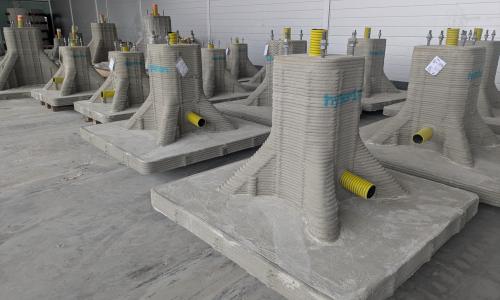
These three bullet points act as sub-headings.
- Collaboration with Hyperion Robotics and the University of Sheffield will trial low-carbon 3D-printed concrete foundations including at National Grid’s Deeside Centre for Innovation in North Wales
- Innovation could reduce waste, carbon emissions and costs to consumers of network construction
- If rolled out across National Grid substations the technology could save up to 705 tons of concrete and 323 tons of CO2 and deliver £1.7 million in consumer savings versus traditional methods over a 10-year period
These two paragraphs give more details.
National Grid is working with Hyperion Robotics and the University of Sheffield on a UK-first trial to manufacture, install and test 3D-printed substation foundations, which have the potential to reduce construction-driven carbon emissions and reduce costs to consumers of network construction. This is part of National Grid’s commitment to leverage innovation to future-proof the network.
If the project is successful and the technology is rolled out across all National Grid substations, it is estimated it could save up to 705 tons of concrete and 323 tons of CO2 over a 10-year period, and deliver £1.7 million in consumer savings versus traditional methods.
The foundation design will deliver significant savings across the entire value chain.
- 70% reduction in concrete usage
- 80% less soil displacement
- 65% decrease in embodied carbon emissions
- 70% weight reduction compared to typical foundations
- 50% reduction in site operative hours, streamlining production
The foundations will be designed and produced in Finland by Hyperion Robotics, and tested at full-scale by the University of Sheffield. Further field testing will then be carried out at National Grid’s state-of-the-art testing facility, the Deeside Centre for Innovation in North Wales, later in 2025.
Conclusion
I like this technology and I suspect there are many other applications of 3D Concrete Printing.
Trump’s Tax Bill To Cost 830,000 Jobs And Drive Up Bills And Pollution Emissions, Experts Warn
The title of this post, is the same as that of this article on The Guardian.
This is the sub-heading.
Bill will unleash millions more tonnes of planet-heating pollution and couldn’t come at a worse time, say experts
This first paragraph adds a bit more detail.
A Republican push to dismantle clean energy incentives threatens to reverberate across the US by costing more than 830,000 jobs, raising energy bills for US households and threatening to unleash millions more tonnes of the planet-heating pollution that is causing the climate crisis, experts have warned.
After that the news gets worse for the planet and the sooner Tamworth retires or is retired, the better!
New Routemasters As Advertising Hoardings
Increasingly, New Routemasters are appearing as advertising hoardings.








































































Note.
- I am unsure if some of the products should be advertised so prominently.
- The last picture is of a naked bus to fill the space.
- I shall be adding to this gallery.
In Could London’s New Routemaster Buses Be Converted To Hydrogen Power?, I came to this conclusion.
I believe from my knowledge of Cummins and the way they work, that they will come up with a hydrogen-based solution, that will replace the Cummins diesel in these buses with a zero-carbon engine.
If Cummins don’t then someone else will.
Whoever solves the problem of converting London’s new Routemasters to hydrogen will have one of the best adverts for their product, there has ever been.
After converting London’s thousand Routemasters, the engineers could move on to anything powered by a Cummins engine.
It would be a quick, easy and affordable way to create a thousand zero-carbon buses.
Berkeley Scientists Finally Solve 10-Year Puzzle Enabling Efficient CO2-to-Fuel Conversion With Major Climate Impact Potential
The title of this post, is the same as that of this article on Sustainability Times.
This is the sub-heading.
In a groundbreaking advancement, scientists at Lawrence Berkeley National Laboratory and SLAC National Accelerator Laboratory have unveiled the critical mechanisms behind the degradation of copper catalysts, a revelation that promises to revolutionize the production of sustainable fuels by enhancing the efficiency and stability of CO2 conversion processes.
This paragraph gives more details.
Scientists from the Lawrence Berkeley National Laboratory and SLAC National Accelerator Laboratory have made a groundbreaking discovery in the field of artificial photosynthesis. By utilizing advanced X-ray techniques, they have uncovered the critical factors that limit the performance of copper catalysts in converting carbon dioxide and water into useful fuels. This revolutionary insight could significantly enhance the stability and efficiency of catalysts in CO2 conversion processes, potentially accelerating the production of ethanol and ethylene. The research, which tackles a decades-old puzzle, offers promising avenues for the development of more durable catalyst systems, paving the way for future advancements in sustainable energy solutions.
I first came across catalysts in my working life, when I was working at ICI. I was modelling a chemical process called sulphonation for a guy who was trying to find an efficient way to create the monomer of building block for a new engineering plastic.
Some feel that all plastics are bad for the environment, but I think that, if the plastic is designed to replace another material in a long-lasting application, then plastic is good for the environment.
This picture shows my wonderful Sheba cutlery.

Note.
- C and I bought it in the 1960s, when we got married.
- Some have been used every day for over fifty years.
- The important bits are Sheffield stainless steel, with the handles formed of black Delrin plastic.
- Some of the handles have been in the dishwasher too many times and have faded.
- From what I have seen on the Internet, the average worth of pieces could be as much as a tenner.
Perhaps, when I pass on, all the pieces should be divided between my grandchildren.
I have digressed and I will return to my modelling project with one of ICI’s catalyst experts.
I remember him telling me, that if you could improve the way catalysts worked, you would open up whole new areas of chemistry.
It looks to me, that the scientists at Berkeley may have opened up a route to turn carbon dioxide into fuel.
Whether that is a good route to decarbonisation is another long discussion.
Mineral Carbonation International Changed Its Name To MCi Carbon In Early 2023
This post is to retrospectively sort out that Mineral Carbonation International changed its name to MCi Carbon in Early 2023.
Google AI gives this summary.
Mineral Carbonation International (MCi) changed its name to MCi Carbon in early 2023. The company’s rebranding emphasized its focus on commercializing and scaling its technology for carbon capture and utilization. The name change reflected a broader shift in the company’s strategy and market positioning.
They now have a web site at www.mcicarbon.com.
The old web site was at www.mineralcarbonation.com and the address now redirects to the new web site.
As I missed the name change, my last post on the company was Sumitomo Mitsui Trust Bank Makes Substantial Investment In Australia’s MCi Carbon.
I should probably have covered these stories earlier this year.
The world’s first CCU plant in the refractory industry
Japan’s MUCC Invests $5M In MCi Carbon To Advance Cement Decarbonization
MCi Carbon seems to be moving on.
Centrica Business Solutions Powers Gressingham Foods Into A Sustainable Future
The title of this post, is the same as this press release from Centrica Business Systems.
This is the sub-heading.
Centrica Business Solutions has partnered with luxury poultry supplier, Gressingham Foods, to decarbonise its operation and unlock significant energy savings, with the installation of a 3.27MW solar array
These four paragraphs detail the project, its operation and the thinking it.
The energy solutions company will deliver a 5,100 solar panel array to Gressingham Foods’ main food processing site in Redgrave, Suffolk capable of providing more than a quarter of its total energy requirements – enough energy to power 111 homes.
The project will break ground in March and is expected to be fully operational by September 2025.
Once live, the solar project will accelerate the decarbonisation plans of the famous Gressingham Duck producer, by reducing more than 670 tonnes of carbon in the first year alone. The chosen site for the project is part of the original Gressingham duck farmland on the property – with low agricultural land grading, solar represents a great solution to make sustainable use of the space.
The solar project is part of a flexible Power Purchase Agreement (PPA) that will see Gressingham Foods purchase the energy generated by the solar installation from Centrica Business Solutions over the next 12 years, with no upfront capital cost to Gressingham Foods. During this period, Centrica Business Solutions will own and maintain the solar site, guaranteeing its optimal performance.
I have posted this, as I feel the project is a good example of how this type of business can be partially decarbonised.
Certainly, with my rooftop solar installation, I now have the knowledge to have managed the energy on the stud farm, I owned with my wife, in a more efficient manner.
A Bespoke Tram-Train For The UK
Trams, tram-trains, trains and anything that runs on rails is generally very expensive.
Does this partly explain, why the UK has relatively few urban tramways and railways?
In Stadler Presents Mock-Up Of Tram-Trains For German And Austrian Operators, I discussed how five German and Austrian operators had got together to create a common tram-train design, that would be suitable for all the operators.
The mayor of one of the cities involved in the joint order, said savings of the order of a million euros per vehicle may have resulted from the common design.
I would also feel that savings in operational costs, design of infrastructure, spares inventory and other costs would also result.
Identical tram-trains would make through running between networks easier.
Where Could Tram-Trains Be Used In The UK?
Consider.
- Currently, tram-trains are running in Sheffield and a battery-electric version of the same Stadler Citylink tram-train will soon be running in Cardiff.
- Cardiff, is developing a Cardiff Crossrail on tram-train principles across the city.
- Sheffield have said that they will be replacing their trams and I believe they could use developments of their excellent Stadler tram-trains.
- Sheffield is likely to extend their tram system and might include tram-trains to Doncaster.
- Cities that have talked about adding tram-trains to their tram networks include Birmingham, Blackpool, Manchester and Nottingham.
- Leeds is developing a metro system, which could be developed using tram-train principles.
- Glasgow has talked about a tram-train to Glasgow Airport for some time.
- The East-West Rail Link is proposing a tram-train link between Ipswich and Felixstowe to allow more freight trains into the Port of Felixstowe.
There could be quite a number of tram-trains being used in the UK, especially if they are used as at Felixstowe, to increase freight capacity into ports.
These are a few of my thoughts.
Battery-Electric Tram-Trains
I would envisage, that a lot of the new tram-trains would operate using batteries. Especially, as battery-electric trains are showing quite long ranges of upwards of thirty miles.
Already trams in Birmingham and trains on Merseyside, are operating using batteries and it avoids the expense of putting up catenary, if enough exists to charge the trams.
Replacement of Diesel Multiple Units By Battery-Electric Tram-Trains
There are some branch lines, where diesel multiple units run off a branch of an electrified main line.These services could be decarbonised by changing the rolling stock.
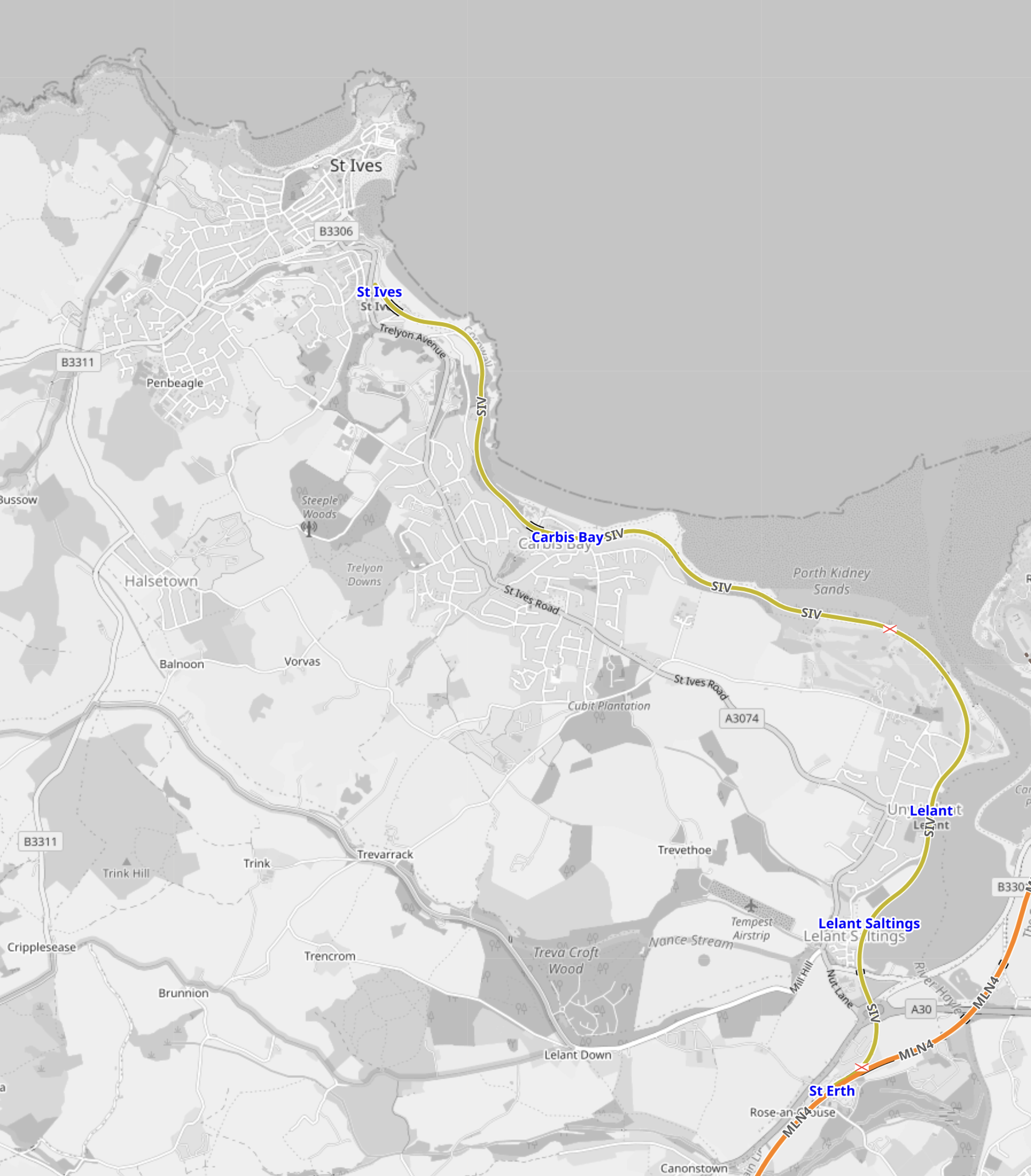
This OpenRailwayMap shows the St. I’ves Bay Line in Cornwall.
Note.
- The St. Ives Bay Line is shown in yellow.
- The Southern terminal is St. Erth station, where it connects to the Cornish Main Line, which is shown in orange.
- The Northern terminal is St. Ives station, which is towards the top of the map.
- The St. Ives Bay Line is 4.25 miles long.
- No tracks are electrified.
- There are three intermediate stations.
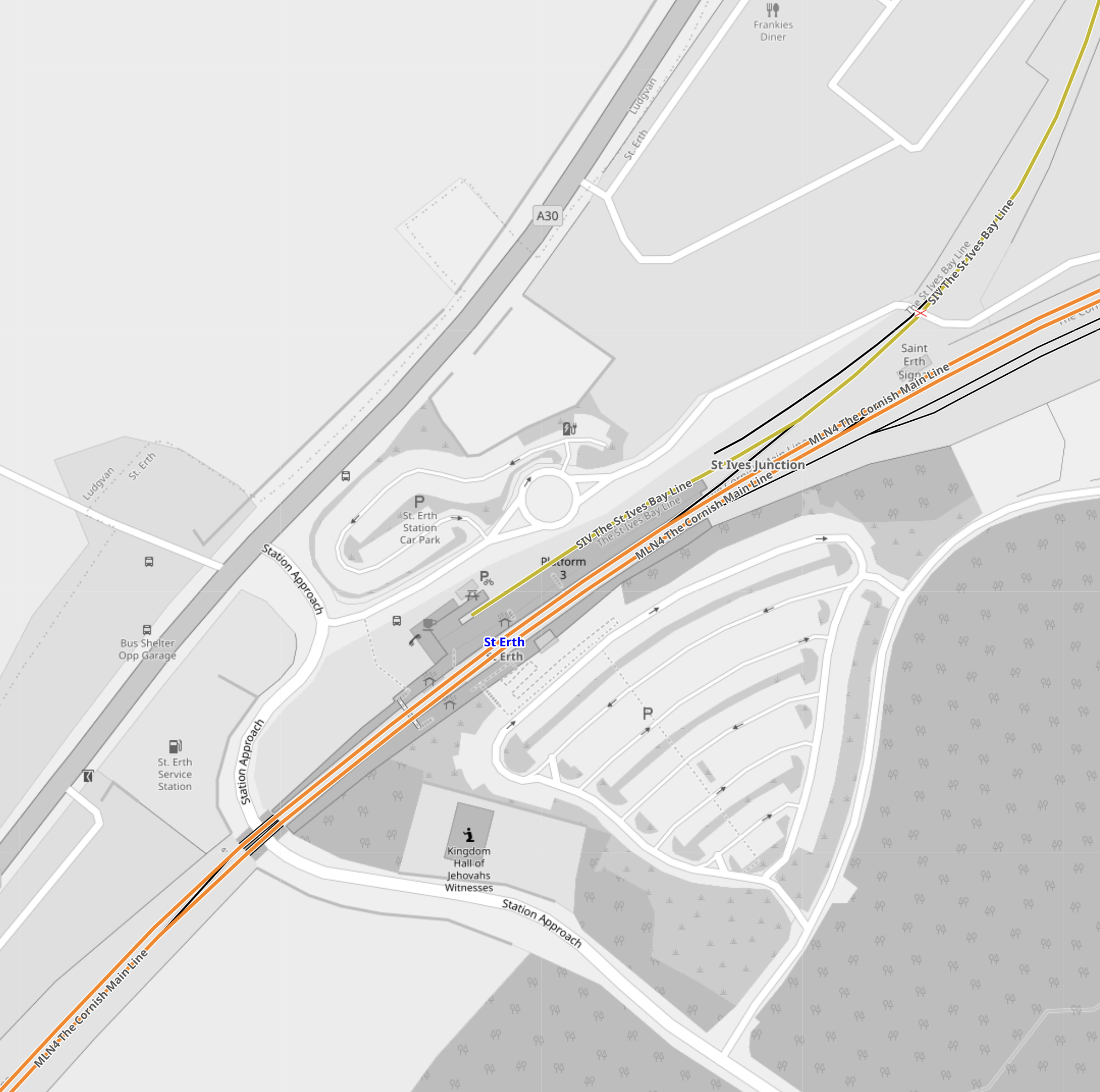
This second OpenRailwayMap shows St. Erth station in more detail.
Note.
- The St. Ives Bay Line has its own platform at the side of the station.
- I am fairly certain, that some form of charging could be installed in this platform.
- At the other side of the Cornish Main Line are two sidings, which could be used for cleaning and maintenance.
A neat zero-carbon branch line could easily be created.
New Branch Lines To New Developments
In Sheffield Region Transport Plan 2019 – A New Tram-Train Route To A New Station At Waverley, I gave my view on a tram-train loop from the Sheffield-Lincoln Line to serve the Advanced Manufacturing Centre and new housing at Waverley.
The tram-train would run as a train to the branch line for the development and then run as a battery-electric tram, through the development.
As the Midland Main Line to Sheffield will be electrified, the tram-trains could be charged on the electrification in Sheffield station.
Build Them In Doncaster
Wabtec are closing Doncaster works.
Surely this would be the site to assemble the scores of tram-trains that could be needed in the UK.
Conclusion
Tram-trains could do a lot to improve the railways of the UK.
They would also help to decarbonise the existing system.
Scotch Whisky Is In A Unique Position
Scotland has so much zero-carbon energy now, let alone in a few years, that Scotch whisky would not be the most difficult of industries to make completely zero-carbon, which could marketing-wise completely trump any tariffs, that Trummkopf might impose.
- Already some small distilleries are using hydrogen to distill the whisky.
- Some glass bottles are already made using hydrogen instead of natural gas to make zero-carbon malt whiskies.
- I’m sure Cummins in Darlington, JCB in Rocester and Ricardo in Sussex will be pleased to help make farm machinery, mechanical handling and road transport zero carbon.
- Soft fruit like raspberries are already used to absorb the carbon dioxide from the distillation process in some areas of Scotland. I’m sure dealing with more quality raspberries would not be a problem.
- A large electrolyser is planned for Kintore in the North of Scotland. Think of the good publicity for say Centrica or SSE, if they built the world’s largest hydrogen plant to help make zero-carbon whisky.
These are some more thoughts.
Taste Is Everything
As only the method of providing heat and electricity will have been changed, I can’t see there will be any change to the taste.
It’s Already Happening
This page on the Annandale Distillery web site is entitled Annandale Distillery Pioneers Zero-Carbon Whisky Production with EXERGY 3 Project.
The Kintore Electrolyser
These figures summarise the Kintore Electrolyser.
- Total Electrolyser Capacity – 3 GW
- First Phase – 500 MW
- Hydrogen – 200 kTonnes per year
Explore the Kintore Hydrogen web site.
Marketing Advantage
Scotland, is probably, the only country, where the main ingredients for whisky come together in abundance ; barley, energy, tradition and water.
It also is all produced in a single country in many different brands and types, which could all be produced in a zero-carbon manner.
Conclusion
Let’s give Trump a beating and the planet a kiss.
Are Rolls-Royce Converting The World To Sussainable Fuels?
Rolls-Royce are certainly up to something.
- Versions of all their diesel and aero engines appear to be able to or will be able to run on hydrogen, SAF, HVO and other exotic zero or low-carbon fuels.
- They are replacing the engines on the USAF B 52s with new American-built Rolls-Royce engines, that can run on hydrogen.
- They are working with easyJet on zero-carbon engines.
- They are developing the UltraFan, which promises to be the most frugal turbofan engine ever. Will all long-distance wide-bodies end up Rolls-Royce powered?
- They have developed a frugal engine for business jets that can run on any fuel.
- Rolls-Royce have also developed a 2.5 MW electric generator based on the engine of a Super Hercules. This level of power is what you need for a railway locomotive.
- Are they building a retrofit for all the diesel-electric railway locomotives of the world, which runs on hydrogen?
Some of these developments could be moving from diesel, jet-fuel and SAF to hydrogen. Others will just reduce the amount of fuel needed.
I just can’t get the image of an iconic B 52, with RR on the side of the engines out of my mind.
But all of these developments seem to have one aim in mind. – To reduce the amount of aircraft and other large vehicles that have to run on standard jet fuel, diesel, SAF or HVO.
This will mean that long-distance air travel, which will be the most difficult to decarbonise will be able to use SAF and other exotic fuels made from renewable sources.
 The Anonymous Widower