Britain Will Soon Have A Glut Of Cheap Power, And World-Leading Batteries To Store It
The title of this post, is the same as that of this article on the Telegraph.
This is the first four paragraphs.
Today’s electricity price shock is the last crisis of the old order. Britain will soon have far more power at times of peak production than it can absorb. The logistical headache will be abundance.
Wind and solar provided almost 60pc of the UK’s power for substantial stretches last weekend, briefly peaking at 66pc. This is not to make a propaganda point about green energy, although this home-made power is self-evidently displacing liquefied natural gas (LNG) imported right now at nosebleed prices.
It is a point about the mathematical implications of the UK’s gargantuan push for renewables. Offshore wind capacity is going to increase from 11 to 50 gigawatts (GW) by 2030 under the Government’s latest fast-track plans.
RenewableUK says this country currently has a total of 86GW in the project pipeline. This the most ambitious rollout of offshore wind in the world, ahead of China at 78GW, and the US at 48GW.
The article goes on to give a comprehensive account of where we are with renewables, where we are going and how we will handle things, when the wind doesn’t blow.
Dogger Bank
The article says this about the Dogger Bank wind farm, which is being developed by SSE.
The giant hi-tech turbines to be erected on the Dogger Bank, where wind conditions are superb, bear no resemblance to the low-tech, low-yield dwarves of yesteryear. The “capacity factor” is approaching 60pc, which entirely changes the energy equation.
A capacity factor of 60 % seems a bit high to me and is what can be expected with the latest floating turbines. But these are fixed to the sea floor.
The Wikipedia entry for the Dogger Bank wind farm, says this about the building of the the first two sections of the massive wind farm.
On 21 September 2020, it was announced that Dogger Bank A and B will use 190 GE Haliade-X 13 MW offshore wind turbines over both sites, meaning that 95 turbines will be used on each site.[19] The availability of upgraded Haliade-X turbines rated at 13 MW rather than 12 MW means that each site will be capable of generating up to 1.235 GW, for a total of 2.47 GW. Turbines will be pre-assembled at Able Seaton Port in Hartlepool, an activity that will lead to the creation of 120 skilled jobs at the port during construction. Turbine installation is expected to commence in 2023 at Dogger Bank A.[20] Power Purchase Agreements (PPA) for 15 years were signed in November 2020. Offshore cable laying started in April 2022. Installation of the turbine foundations was started in July 2022.
This GE data sheet about the Haliade-X offshore wind turbine, says this about capacity factor.
it also features a 60-64% capacity factor above industry standard. Capacity factor compares how much energy was generated against the maximum that could have been produced at continuous full power operation during a specific period of time.
A 60-64% capacity factor is exceptional.
Current plans for Dogger Bank indicate that 3.6 GW will be installed and operational by 2024/25.
Could that mean that Dogger Bank will be able to deliver 2.16 GW almost continuously, on GE’s figures? Sizewell B is only 1.25 GW.
Sofia Wind Farm
There was going to be a fourth section to Dogger Bank, but this is now the separate Sofia wind farm.
- It is being developed by RWE.
- The first phase of three has a capacity of 1.4 MW. Does that mean Sofia will eventually be a 4.2 GW wind farm?
- RWE seem to be putting in a very large offshore substation. Could this support a lot more turbines?
- The wind farm seems to be using high-specification SiemensGamesa 14MW SG 14-222 DD wind turbines, which have a Power Boost facility to deliver up to 15 MW.
- I can’t find anything about capacity factor.
Wikipedia gives a delivery date of 2023 for the first phase of Sofia.
Storing Electricity
The article says this about storing electricity.
Much of the power will have to be stored for days or weeks at a time. Lithium batteries cannot do the job: their sweet spot is two hours, and they are expensive. You need “long duration” storage at a cost that must ultimately fall below $100 (£82) per megawatt hour (MWh), the global benchmark of commercial viability.
That is now in sight, and one of the world leaders is a British start-up. Highview Power has refined a beautifully simple technology using liquid air stored in insulated steel towers at low pressure.
I have had Highview Power on my radar for some time.
Highview Power
What is there not to like about Highview Power?
- The original idea was developed in a shed in Bishop’s Stortford, by a lone inventor.
- Sumitomo are one of their backers.
- They are also backed by English Universities and the UK Government.
- They have run a successful pilot plant in Bury.
- They are now building their first full-size 50 MW/250 MWh commercial plant at Carrington near Manchester.
- Much of the equipment they use to build their batteries is standard equipment from world-class companies like MAN.
- There are no exotic and expensive materials used.
The writer of the article has obviously had a long chat with Rupert Pearce, who is Highview’s chief executive and ex-head of the satellite company Inmarsat.
Pearce happily discloses this monster.
Highview is well beyond the pilot phase and is developing its first large UK plant in Humberside, today Britain’s top hub for North Sea wind. It will offer 2.5GW for over 12 hours, or 0.5GW for over 60 hours, and so forth, and should be up and running by late 2024.
Note.
- The world’s largest battery is at Ouarzazate Solar Power Station in Morocco and it is 3 GWh.
- Highview’s Humberside battery is megahuge at 30 GWh.
- The world’s largest pumped storage power station is Fengning Pumped Storage Power Station in China and it is 40 GWh.
- My experience of doing the calculations for large reaction vessels and other structures, tells me, that Highview should be able to construct huge systems.
I suspect that it will be easier and more affordable to build the Humberside battery.
This is another pair of paragraphs.
Mr Pearce said Highview’s levelised cost of energy (LCOE) would start at $140-$150, below lithium, and then slide on a “glide path” to $100 with over time. The company has parallel projects in Spain and Australia but Britain is the showroom.
“The UK is a fantastic place to do this. It has one of the most innovative grids in the world and an open, fair, liquid, market mechanism with absolute visibility,” he said.
It looks to me, that Rupert Pearce has taken Highview Power to a different level, in his short tenure at the company.
The world will soon be very familiar with the name of Highview Power.
Will We Run Out Of Power This Winter?
Someone asked me if we will run out of power, if Vlad the Mad cuts all the gas to Western Europe.
This was my reply.
It appears that this year, 3.2 GW of new offshore wind farms could start producing electricity, followed by similar amounts in both 2023 and 2024.
One of those to come on stream about now is the 1.4 GW Hornsea 2 wind farm!
The follow-up 2.9 GW Hornsea 3, signed a contract last week for delivery in 2026/27.
Moray East in Scotland and Triton Knoll off Lincolnshire, are also scheduled to come on stream this year and they’re around 900 MW each.
As someone, who used to write project management software, I hope the companies building these fields have enough resources, in terms of people, boats, cranes and money. But as the companies are all the Shells of the wind industry, I would hope they have got their sums right.
What About The Contracts for Difference Awarded In Allocation Round 4?
We are currently fighting two wars at the moment.
- The main war in Ukraine, where we are giving that unfortunate country all the help we can.
- The secondary war in the UK against energy prices.
Would it help our cause in both wars, if we produced more energy?
- More renewable energy would reduce our dependence on imported gas.
- The gas saved could go to Europe.
- Europe would not be buying Vlad the Mad’s bloodstained gas.
- Replacing gas with solar and wind power might reduce energy prices.
If I put myself in the position of a struggling farmer with a contract for difference to build a solar farm on a poor field, I would want that farm to be earning money as soon as possible.
- Now that I have the contract can I start assembling that solar farm?
- Similar arguments can probably be used for onshore wind, which must be easier to assemble, than offshore wind.
- I don’t think that the hard-pressed energy suppliers would bother, if they received some quality cheap electricity earlier than they expected.
- Obviously, all the cables and the substations would need to be in place.
So I think that it is reasonable to assume, that energy might ramp up quicker than expected.
It could even be more front-loaded, if all the installers got a shift on.
Every little helps!
New Renewable Energy In 2023?
These wind farms are scheduled for commissioning in 2023.
- Neart Na Gaoithe – 450 MW
- Sofia Offshore Wind Farm – 1400 MW
- Seagreen Phase 1 – 1075 MW
We could see 2925 MW of offshore wind power commissioned in 2023.
New Renewable Energy In 2024?
These renewable energy sources are scheduled for commissioning in 2024.
- Dogger Bank A – 1200 MW
- Round 4 Solar – 125.7 MW
- Dogger Bank B – 1200 MW
- Dogger Bank C – 1200 MW
Note, where a windfarm is given a commissioning date of 2023/24 in Wikipedia , I will put it in 2024.
We could see 3726 MW of renewable energy commissioned in 2024.
New Renewable Energy In 2025?
These renewable energy sources are scheduled for commissioning in 2025.
- Moray West – 1200 MW
- Round 4 Solar – 1958 MW
- Round 4 Onshore Wind – 888 MW
- Round 4 Energy from Waste – 30 MW
- Vanguard Boreas Phase 1 – 1400 GW
We could see 6476 MW of renewable energy commissioned in 2025.
New Renewable Energy In 2026?
These renewable energy sources are scheduled for commissioning in 2026.
- East Anglia 1 North – 800 MW
- East Anglia 2 – 900 MW
- Round 4 Tidal Stream – 5.62 MW
We could see 1705 MW of renewable energy commissioned in 2026.
New Renewable Energy In 2027?
These renewable energy sources are scheduled for commissioning in 2027.
- Round 4 Tidal Stream – 35.2 MW
- Round 4 Floating Offshore Wind – 32 MW
- Round 4 Offshore Wind – 5594 MW
- Hornsea 3 Offshore Wind – 2852 MW
- Hinckley Point C Nuclear – 3,260 MW
We could see 13173 MW of renewable energy commissioned in 2027.
Too Much Electricity!
Summarising the figures for new capacity gives.
- 2022 – 3200 MW
- 2023 – 2925 MW
- 3024 – 3726 MW
- 2025 – 6476 MW
- 2026 – 1705 MW
- 2027 – 11773 MW
This totals to 28554 MW.
One problem we may have is too much electricity and as we are not blessed with much storage in the UK, where will be able to put it?
In a strange way, Vlad the Mad may solve the problem, by cutting off Europe’s gas.
We have a few interconnectors, where we can export the electricity to allow the Belgians, Dutch, French and the Germans to have a shower.
- BritNed – 1 GW – Isle of Grain and Rotterdam
- ElecLink – 1 GW – England and France through the Channel Tunnel.
- HVDC Cross-Channel – 2 GW – England and France
- IFA-2 – 1 GW – England and France
- Nemo Link – 1 GW – Richborough and Zeebrugge
- North Sea Link – 1.4 GW – Blyth and Norway
- Viking Link – 1.4 GW – Lincolnshire and Denmark
It looks like construction may be starting soon for another interconnector. NeuConnect will have a capacity of 1.4 GW between the Isle of Grain and Wilhelmshaven.
Conclusion
If I was the German Chancellor, I’d do everything in my power to accelerate the construction of NeuConnect!
SSE Thermal And Equinor To Acquire Triton Power In Acceleration Of Low-Carbon Ambitions
The title of this post, is the same as that as this press release from SSE.
These are the first three paragraphs.
SSE Thermal and Equinor have entered into an agreement to acquire Triton Power Holdings Ltd from Energy Capital Partners for a total consideration of £341m shared equally between the partners.
The transaction represents another step forward for the two companies’ existing collaboration, supporting the long-term decarbonisation of the UK’s power system whilst contributing to security of supply and grid stability through flexible power generation in the shorter term.
Triton Power operates Saltend Power Station which is 1.2GW CCGT (Combined Cycle Gas Turbine) and CHP (Combined Heat & Power) power station located on the north of the Humber Estuary in East Yorkshire.
This deal is more complicated than it looks and these are my thoughts.
What About The Triton Power Workers?
The press release says this.
The 82 existing employees will continue to be employed by Triton Power. In line with just transition principles, the joint venture is committed to transitioning the assets for the net zero world through responsible ownership and operation, and in consultation with the local workforce and representatives.
It does sound that they are following the right principles.
Saltend Power Station
Saltend power station is no tired ancient asset and is described like this in Wikipedia.
The station is run on gas using single shaft 3 × Mitsubishi 701F gas Turbines machines with Alstom 400 MWe generators. The station has a total output of 1,200 MW; of that 100 MW is allocated to supply BP Chemicals. Each gas turbine has a Babcock Borsig Power (BBP) heat recovery steam generator, which all lead to one steam turbine per unit (single shaft machine means Gas turbine and Steam Turbine are on the same shaft). The waste product of electricity generation is steam at the rate of about 120 tonnes/h which is sold to BP Chemicals to use in their process. This makes Salt End one of the most efficient[clarification needed] power stations in the UK. The plant is scheduled to use hydrogen from steam reformed natural gas for 30% of its power.
Note.
- It was commissioned in 2000.
- It appears there are seven CCGT power stations in England that are larger than Saltend.
- The power station seems to have had at least four owners.
The press release says this about SSE and Equinor’s plans for Saltend power station.
The transaction underscores SSE Thermal and Equinor’s shared ambition to decarbonise the Humber, which is the UK’s most carbon-intensive industrial region, as well as the UK more widely. Initial steps to decarbonise Saltend Power Station are already underway, targeting partial abatement by 2027 through blending up to 30% of low-carbon hydrogen. In addition, carbon capture provides an additional valuable option for the site. SSE Thermal and Equinor will continue to work towards 100% abatement.
Note.
- It appears that initially, Saltend power station will move to running on a mixture of 30 % hydrogen and 70 % natural gas.
- Carbon capture will also be applied.
- It looks like that in the future all carbon-dioxide emitted by the power station will be captured and either stored or used.
The press release says this about the source of the hydrogen.
Saltend Power Station is a potential primary offtaker to Equinor’s H2H Saltend hydrogen production project. H2H Saltend is expected to kick-start the wider decarbonisation of the Humber region as part of the East Coast Cluster, one of the UK’s first carbon capture, usage and storage clusters.
H2H Saltend is described in this page on the Equinor web site, which has a title of The First Step To A Zero Carbon Humber, where this is said.
This project represents a bold but practical first step towards delivering the world’s first net zero industrial cluster by 2040. This unparalleled project can play a leading role in the UK’s journey to net zero by 2050, renew the UK’s largest industrial cluster, and unlock technology that will put the UK at the forefront of a global hydrogen economy.
There is also a video.
SSE Thermal And Equinor Low-Carbon Thermal Partnership
This is a section in the press release, where after giving their policy about the workers, it says this about the acquisition of Triton Power.
This acquisition strengthens SSE Thermal and Equinor’s portfolio of joint projects, which bring together expertise in power, natural gas, hydrogen and carbon capture and storage. This portfolio includes three development projects within the Humber region:
- Keadby 3 Carbon Capture Power Station, which could be the UK’s first flexible power station equipped with carbon capture.
- Keadby Hydrogen Power Station, which could be one of the world’s first 100% hydrogen-fuelled power stations.
- Aldbrough Hydrogen Storage, located in East Yorkshire, which could be one of the world’s largest hydrogen storage facilities.
The two companies are also developing Peterhead Carbon Capture Power Station, situated on the Aberdeenshire coast in Scotland and there are further opportunities for hydrogen blending across SSE’s generation portfolio, including at Keadby 2.
Note.
- There is no mention of the three Dogger Bank Wind Farms, each of which will be 1200 MW, that are owned by SSE Renewables and Equinor.
- I wrote about Aldbrough Gas Storage in The Massive Hydrogen Project, That Appears To Be Under The Radar.
- According to this press release from Equinor, which is entitled SSE Thermal And Equinor Join Forces On Plans For First-Of-A-Kind Hydrogen And Carbon Capture Projects In The Humber, Keadby Hydrogen power station will have a capacity of 1800 MW.
The Complete System
The system has the following power sources.
- Dogger Bank A – 1200 MW – Expected commissioning in 2023/24
- Dogger Bank B – 1200 MW – Expected commissioning in 2024/25
- Dogger Bank C – 1200 MW – Expected commissioning in 2024/25
- Keadby power station – 735 MW
- Keadby 2 power station – 893 MW – Could be Part-Hydrogen
- Keadby 3 power station – 910 MW – Carbon Capture
- Keadby Hydrogen power station – 1800 MW – Hydrogen
- Saltend power station – 1200 MW – Part-Hydrogen
That totals up to 9138 MW.
Fuel will come from three sources.
- The God of the winds.
- Natural gas
- Hydrogen
Hydrogen will be sourced from.
- Blue hydrogen from H2H Saltend
- Green Hydrogen could come from electrolysers driven by wind power.
Hydrogen would be stored in Aldbrough Gas Storage.
I am by training a Control Engineer and controlling these power sources is either a wonderful dream or your most entwined and complicated nightmare.
Conclusion
I suspect on an average day, this cluster of power stations and sources could reliably supply as much zero-carbon power as two large nuclear stations.
Wind And Solar Boom Will Bring Energy Surplus
The title of this post, is the same as that of this article on The Times.
Under the picture, is this sub-title.
The government has set a target of 50 gigawatts of offshore wind farms by 2030, up from about 10 gigawatts at present.
According to this Wikipedia list of offshore wind farms, the UK currently has 2180 offshore turbines with a capacity of 8113 MW.
These wind farms appear to be planned.
Hornsea
The Hornsea wind farm is currently supplying 1.2 GW to the grid, but it is planned to be expanded to 6 GW, which is another 4.8 GW.
East Anglia Array
The East Anglia Array is currently supplying 0.7 GW to the grid, but it is planned to be expanded to 7.2 GW, which is another 6.5 GW.
Sofia
The Sofia wind farm will supply 1.4 GW from 2026.
Moray East
The Moray East wind farm will supply 0.95 GW from 2022.
Neart Na Gaoithe
The Neart Na Gaoithe wind farm will supply 0.45 GW from 2023.
Triton Knoll
The Triton Knoll wind farm will supply 0.86 GW from 2022.
Seagreen
The Seagreen wind farm will supply 1.1 GW from 2023.
Dogger Bank
The Dogger Bank wind farm will supply 3.6 GW from 2025.
Moray West
The Moray West wind farm will supply 1.2 GW from 2025.
Rampion 2
The Rampion 2 wind farm will supply 1.2 GW before 2030.
Norfolk Boreas
The Norfolk Boreas wind farm will supply 1.8 GW before 2030
Norfolk Vanguard
The Norfolk Vanguard wind farm will supply 1.8 GW before 2030
These wind farms total up to 31.1 GW
Morgan And Mona
The Morgan and Mona wind farms will supply 3 GW from 2028.
ScotWind
This map shows the wind farms in the latest round of leasing in Scotland.

These wind farms should be providing 24.8 GW by 2030.
Celtic Sea
In Two More Floating Wind Projects In The Celtic Sea, I give details of six wind farms to be developed in the Celtic Sea, that will produce a total of 1.2 GW.
All should be delivered by 2030.
Northern Horizons
In Is This The World’s Most Ambitious Green Energy Solution?, I talk about Northern Horizons, which will produce 10 GW of wind energy from 2030.
An Armada Of Wind Farms
As many of these wind farms will be floating and wind-powered, the collective noun must surely be an armada.
These are some figures.
- The size is certainly spectacular at 70.1 GW.
- As the UK electricity consumption in 2020-2021 was 265.4 TWh, the average hourly production throughout the year is 30.3 GW.
- As I write this post, the UK is generating 30.1 GW.
As the best offshore wind farms have a capacity factor of around fifty percent, we should be able to power the UK with wind power alone.
So when The Times says this in the first two paragraphs of the article.
Britain will have excess electricity supplies for more than half of the year by 2030 as a huge expansion of wind and solar power transforms the energy system, a new analysis suggests.
Energy storage technologies, including batteries and electrolysers to make hydrogen, will need to be deployed at massive scale to prevent this surplus electricity going to waste, according to LCP, a consultancy.
The article would appear to correct.
The Need For Energy Storage
If we look at energy production at the current time, energy production is as follows.
- Biomass – 0.5 GW
- Gas – 17 GW
- Nuclear – 5 GW
- Onshore Wind – 12 GW with 20 % capacity factor – 2.4 GW
- Offshore Wind – 8.1 GW with 30 % capacity factor – 2.4 GW
- Interconnects – 0.4 GW
- Others – 0.5 GW
This totals up to 28.2 GW.
In 2030, energy production could be as follows.
- Biomass – 0.5 GW
- Nuclear – 5 GW
- Onshore Wind – 12 GW with 20 % capacity factor – 2.4 GW
- Offshore Wind – 30 GW with 30 % capacity factor – 9 GW
- Floating Offshore Wind – 40 GW with 50 % capacity factor – 20 GW
- Others – 0.5 GW
This totals up to 37.4 GW.
So if you take a typical day, where on average throughout the day we are producing around 7 GW more of electricity than we need, we will actually produce around 7 * 24 GWh = 168 GWh of excess electricity
Whichever was you look at it, we have got to do something concrete with a large amount of electricity.
- Store it in batteries of various types from lithium ion, through new types of batteries like those being developed by Highview Power and Gravitricity to pumped hydro storage.
- Store the energy in the batteries of electric cars, vans, buses, trucks, trains and ships.
- Store the energy in Norwegian pumped hydro storage.
- Convert it to hydrogen using an electrolyser and blend the hydrogen with the natural gas supply.
- Convert it to hydrogen using an electrolyser and use the hydrogen to make zero-carbon steel, concrete and chemicals.
- Convert it to hydrogen using an electrolyser and develop new zero-carbon industries.
- Convert it to hydrogen using an electrolyser and store the hydrogen in a depleted gas field.
- Sell it to Europe, either as electricity or hydrogen.
Note.
- We are going to have to build a lot of batteries and I suspect they will be distributed all round the country.
- We are going to have to build a lot of hydrogen electrolysers.
- We have world class battery and electrolyser companies.
We should also fund the following.
- Developments of technology, that makes better batteries, electrolysers, boilers and heat pumps.
- I would also do a lot of work to increase the capacity factor of wind farms.
I also believe that if we have masses of electricity and hydrogen, we might find as a country, it’s very beneficial in terms of jobs, exports and a healthier economy to invest in certain industries.
Conclusion
The future is rosy.
Dogger Bank C In UK Offshore Wind First To Provide Reactive Power Capability
The title of this post, is the same as that of this press release from the Dogger Bank wind farm.
This paragraph gives an explanation.
Dogger Bank Wind Farm has secured a UK power first by becoming the first offshore wind farm project to win a tender from National Grid ESO to provide reactive power capability. The sector-first contract will help deliver a greener grid, maintain a stable voltage power supply, and help drive down UK consumer costs by millions of pounds.
Note that the three Dogger Bank wind farms; A, B and C will each have a capacity of 1.2 GW and that Hartlepool nuclear power station has a capacity of 1.32 GW. The latter is due to be decommissioned in 2024.
So the wind farms will effectively replace the nuclear power station.
This paragraph describes the contract.
Under new £22.5m Pennines Voltage Pathfinder contracts announced today, National Grid ESO has awarded a 10-year power contract to Dogger Bank C that will see its onshore converter station at Lazenby in the North-East of England provide 200 MVAr* of reactive power capability between 2024 and 2034. This marks the first time that an offshore wind transmission asset has been awarded a contract through a reactive power tender by National Grid ESO.
I suspect that there will need to be some form of energy storage added to the system somewhere, either at Lazenby or could we see a system like one of Highview Power’s CRYOBattery installed offshore?
It should be noted that CRYOBatteries are no more complicated, than some of the equipment installed on offshore gas and oil platforms.
The Lackenby Substation
It does seem that there has been a mix-up between the two nearby villages of Lazenby and Lackenby.
I can’t find a Lazenby substation, but I can find one at Lackenby.
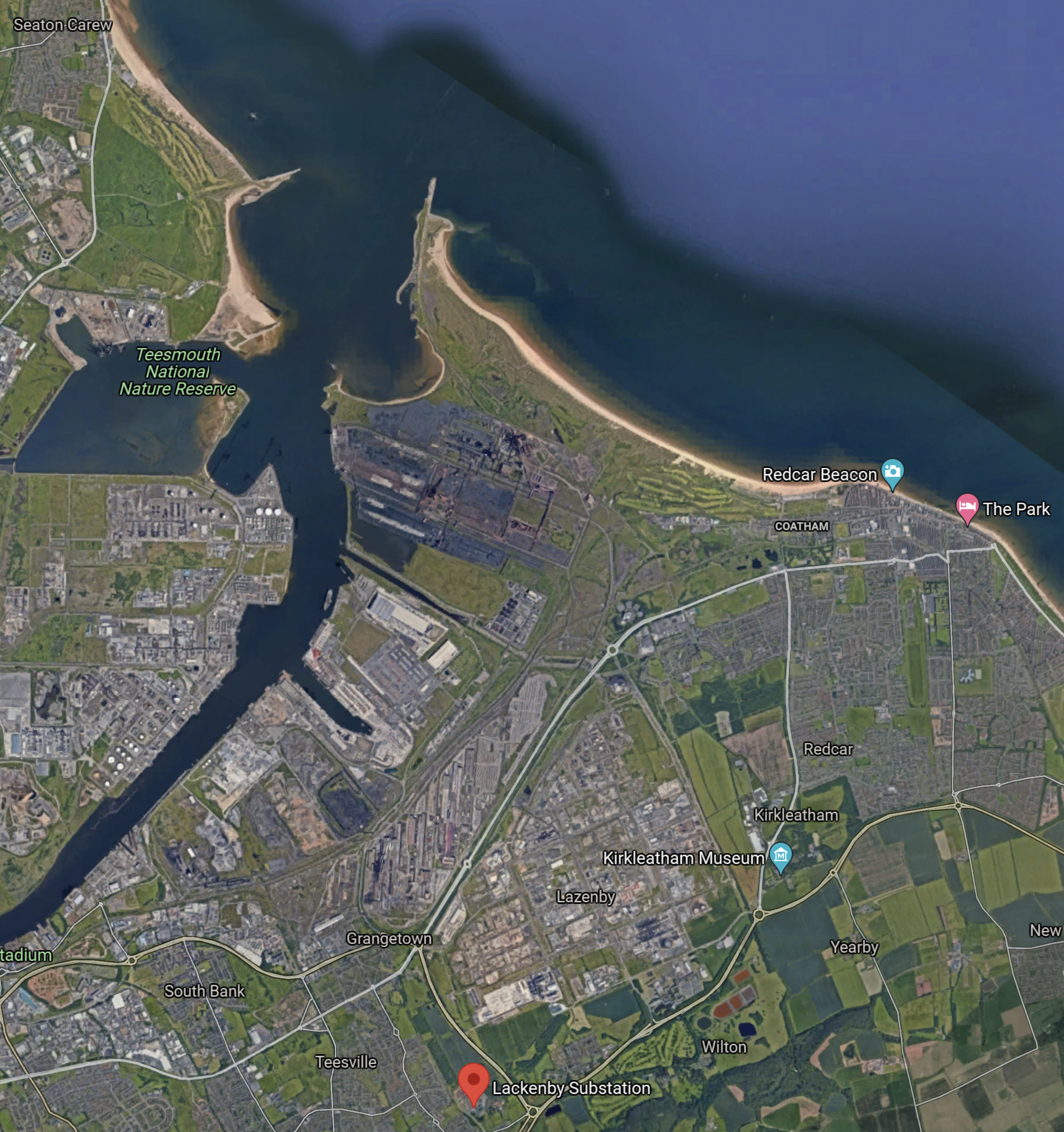
This Google Map shows that the location of the Lackenby substation.
This second map shows the substation in more detail.
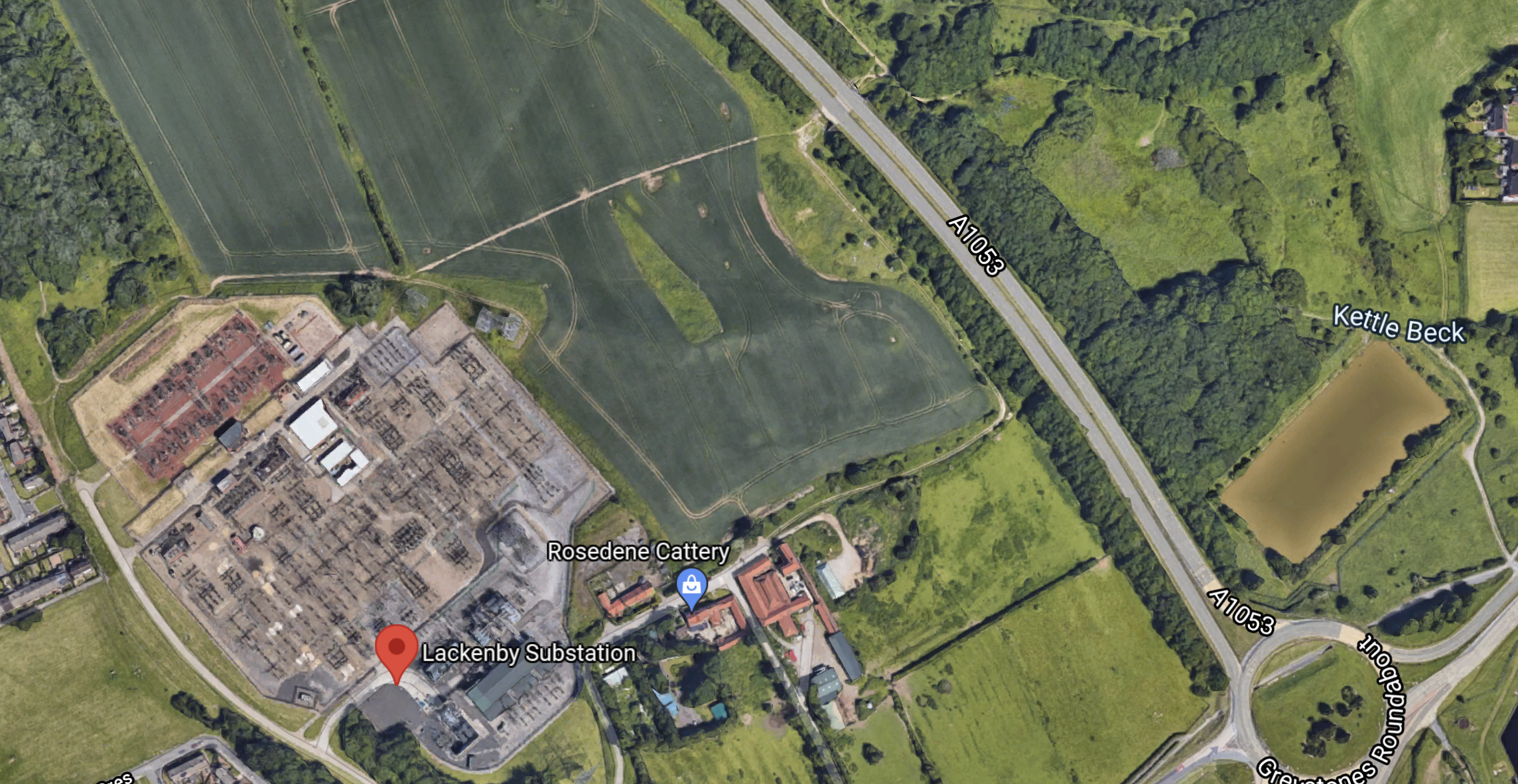
Note.
- There are a lot of large chemical works on both banks of the Tees.
- I can find nothing on the route of the cable from Dogger Bank C to Lackenby substation.
- Perhaps, it’s planned to go up the River Tees or it could come ashore South of the mouth of the River Tees.
Plans must be published soon, so that the substation can be updated before the wind farm is commissioned.
Future Offshore Wind Power Capacity In The UK
I am building this table, so that I can get a feel for the electricity needs of the UK.
According to Wikipedia, on February 2020, there were thirty six offshore wind farms consisting of 2180 turbines with a combined capacity of 8113 megawatts or 8.113 gigawatts.
Currently, these offshore wind farms are under construction, proposed or are in an exploratory phase.
- Triton Knoll – 857 MW – 2021 – Under Construction
- Hornsea Two – 1386 MW – 2022 – Under Construction
- Moray East – 960 MW – 2022 – Under Construction
- Neart Na Gaoithe – 450 MW – 2023 – Under Construction
- Seagreen Phase 1 – 1075 MW – 2023 – Under Construction
- Dogger Bank A – 1200 MW – 2023/24 – Proposed
- Dogger Bank B – 1200 MW – 2024/25 – Proposed
- Dogger Bank C – 1200 MW – 2024/25 – Proposed
- Moray West – 1200 MW – 2024/25 – Exploratory
- Hornsea Three – 2400 MW – 2025 – Proposed
- East Anglia One North 800 MW – 2026 – Exploratory
- East Anglia Two – 900 MW – 2026 – Exploratory
- East Anglia Three – 1400 MW – 2026 – Exploratory
- Sofia Offshore Wind Farm Phase 1 – 1400 MW – 2023/2026 – Under Construction
- Hornsea Four – 1000 MW (?) – 2027 – Exploratory
- Rampion Two Extension – 1200 MW – Exploratory
- Norfolk Vanguard – 1800 MW – Exploratory
- Norfolk Boreas – 1800 MW – Exploratory
Note.
- The date is the possible final commissioning date.
- I have no commissioning dates for the last three wind farms.
- Wikipedia says that the Hornsea Four capacity is unknown by Ørsted due to the ever increasing size of available wind turbines for the project.
I can total up these wind farms by commissioning date.
- 2021 – 857 MW
- 2022 – 2346 MW
- 2023 – 1525 MW
- 2024 – 1200 MW
- 2025 – 6000 MW
- 2026 – 4500 MW
- Others – 5800 MW
I can draw these conclusions.
- Total wind farm capacity commissioned each year is increasing.
- It looks like there will be a capacity to install up to 5000 or 6000 MW every year from about 2025.
- If we add my figures for 2021-2026 to the 8113 MW currently installed we get 24541 MW.
- Adding in 6000 MW for each of the four years from 2027-2030 gives a total of 48541 MW or 48.5 GW.
As I write this on a Sunday afternoon, wind power (onshore and offshore) is supplying 13 GW or forty-four percent of our electricity needs.
I have further thoughts.
Parallels With North Sea Oil And Gas
I was very much involved in the development of North Sea oil and gas, as my software was used on a large number of the projects. I had many discussions with those managing these projects and what was crucial in shortening project times was the increasing availability of bigger rigs, platforms and equipment.
Big certainly was better.
I believe that as we get more experienced, we’ll see bigger and better equipment speeding the building of offshore wind farms.
Reuse of Redundant North Sea Oil And Gas Platforms
Don’t underestimate the ability of engineers to repurpose redundant oil and gas platforms for use with windfarms.
Electrolysers on the platforms can convert the electricity into hydrogen and use redundant gas pipes to bring it ashore.
Some processes like steelmaking could use a lot of hydrogen.
Platforms can be used as sub-stations to collect electricity from windfarms and distribute it to the various countries around the North Sea.
Hydrogen
Some processes like steelmaking could use a lot of hydrogen. And I don’t think steelmakers would be happy, if the supply was intermittent.
So why not produce it with giant electrolysers on redundant oil and gas platforms and store it in redundant gas fields under the sea?
A large store of hydrogen under the sea could have the following uses.
- Steelmaking.
- Feedstock for chemical manufacture.
- Transport
- Power generation in a gas-fired power station, that can run on hydrogen.
It would just need a large enough hydrogen store.
Energy Storage
This large amount of wind power will need a large amount of energy storage to cover for when the wind doesn’t blow.
Some of this storage may even be provided by using hydrogen, as I indicated previously.
But ideas for energy storage are coming thick and fast.
The North Sea Link To Norway
The North Sea Link is much more important than an interconnector between Blyth in Northumberland and Norway.
- At the Norwegian end the link is connected to a vast pumped storage energy system in the mountains of Norway.
- This pumped storage system is filled in two ways; Norwegian rain and snow and UK wind power through the interconnector.
- In times of need, we can draw electricity through the interconnector from Norway.
- It has a capacity of 1.4 GW.
- It was delivered on time for a cost of around €2 billion.
It can almost be thought of as an international bank of electricity and is probably one of the most significant pieces of European infrastructure built in recent years.
There are also plans to build NorthConnect, that would connect Peterhead in Scotland to Norway.
Conclusion
It looks like we’ll be able to reap the wind. And possibly 50 GW of it!
UK National Grid In Talks To Build An Energy Island In The North Sea
The title of this post, is the same as that of this article on the New Scientist.
This is the first paragraph.
UK company National Grid has revealed it is in talks with two other parties about building an “energy island” in the North Sea that would use wind farms to supply clean electricity to millions of homes in north-west Europe.
These are my thoughts.
An Artificial Island on the Dogger Bank
The idea of the North Sea Wind Power Hub in the area of the Dogger Bank has been around for a few years and has a comprehensive Wikipedia entry.
Wikipedia says that it would be an artificial island on the Dutch section of the Dogger Bank and the surrounding sea could eventually host up to 110 GW of wind turbines.
North Sea Wind Power Hub Programme
The Dutch and the Danes seems to have moved on and there is now a web site for the North Sea Wind Power Hub Programme.
The home page is split into two, with the upper half entitled Beyond The Waves and saying.
The incredible story of how the Netherlands went beyond technical engineering as it had ever been seen before. Beyond water management. To secure the lives of millions of inhabitants.
I have met Dutch engineers, who designed and built the Delta Works after the North Sea Floods of 1953 and I have seen the works all over the country and it is an impressive legacy.
And the lower half of the home page is entitled North Sea Wind Power Hub and saying.
Today, climate policy is largely national, decoupled and incremental. We need a new approach to effectively realise the potential of the North Sea and reach the goals of the Paris Agreement. We take a different perspective: harnessing the power of the North Sea requires a transnational and cross-sector approach to take the step-change we need.
Behind each half are two videos, which explain the concept of the programme.
It is a strange web site in a way.
- It is written totally in English with English not American spelling.
- The project is backed by Energinet, Gasunie and TenneT, who are Danish and Dutch companies, that are responsible for gas and electricity distribution networks in Denmark, Ger,many and The Netherlands.
- There are four sections to the web site; Netherlands, Germany, Denmark and North Sea.
It is almost as if the web site has been designed for a British company to join the party.
Hubs And Spokes In North Sea Wind Power Hub Programme
If you watch the videos on the site, they will explain their concept of hubs and spokes, where not one but several energy islands or hubs will be connected by spokes or electricity cables and/or hydrogen pipelines to each other and the shore.
Many electrical networks on land are designed in a similar way, including in the UK, where we have clusters of power stations connected by the electricity grid.
The Dogger Bank
The Dogger Bank is a large sandbank in a shallow area of the North Sea about 100 kilometres off the east coast of England.
Wikipedia says this about the geography of the Dogger Bank.
The bank extends over about 17,600 square kilometres (6,800 sq mi), and is about 260 by 100 kilometres (160 by 60 mi) in extent. The water depth ranges from 15 to 36 metres (50 to 120 ft), about 20 metres (65 ft) shallower than the surrounding sea.
As there are Gunfleet Sands Wind Farm and Scroby Sands Wind Farm and others, on sandbanks in the North Sea, it would appear that the engineering of building wind farms on sandbanks in the North Sea is well understood.
The Dogger Bank Wind Farm
We are already developing the four section Dogger Bank Wind Farm in our portion of the Dogger Bank and these could generate up to 4.8 GW by 2025.
The Dogger Bank Wind Farm has its own web site, which greets you with this statement.
Building the World’s Largest Offshore Wind Farm
At 4.8 GW, it will be 45 % larger than Hinckley Point C nuclear power station, which is only 3.3 GW. So it is not small.
The three wind farms; Dogger Bank A, B and C will occupy 1670 square kilometres and generate a total of 3.6 GW or 0.0021 GW per square kilometre.
If this density of wind turbines could be erected all over the Dogger Bank, we could be looking at nearly 40 GW of capacity in the middle of the North Sea.
Interconnectors Across The North Sea
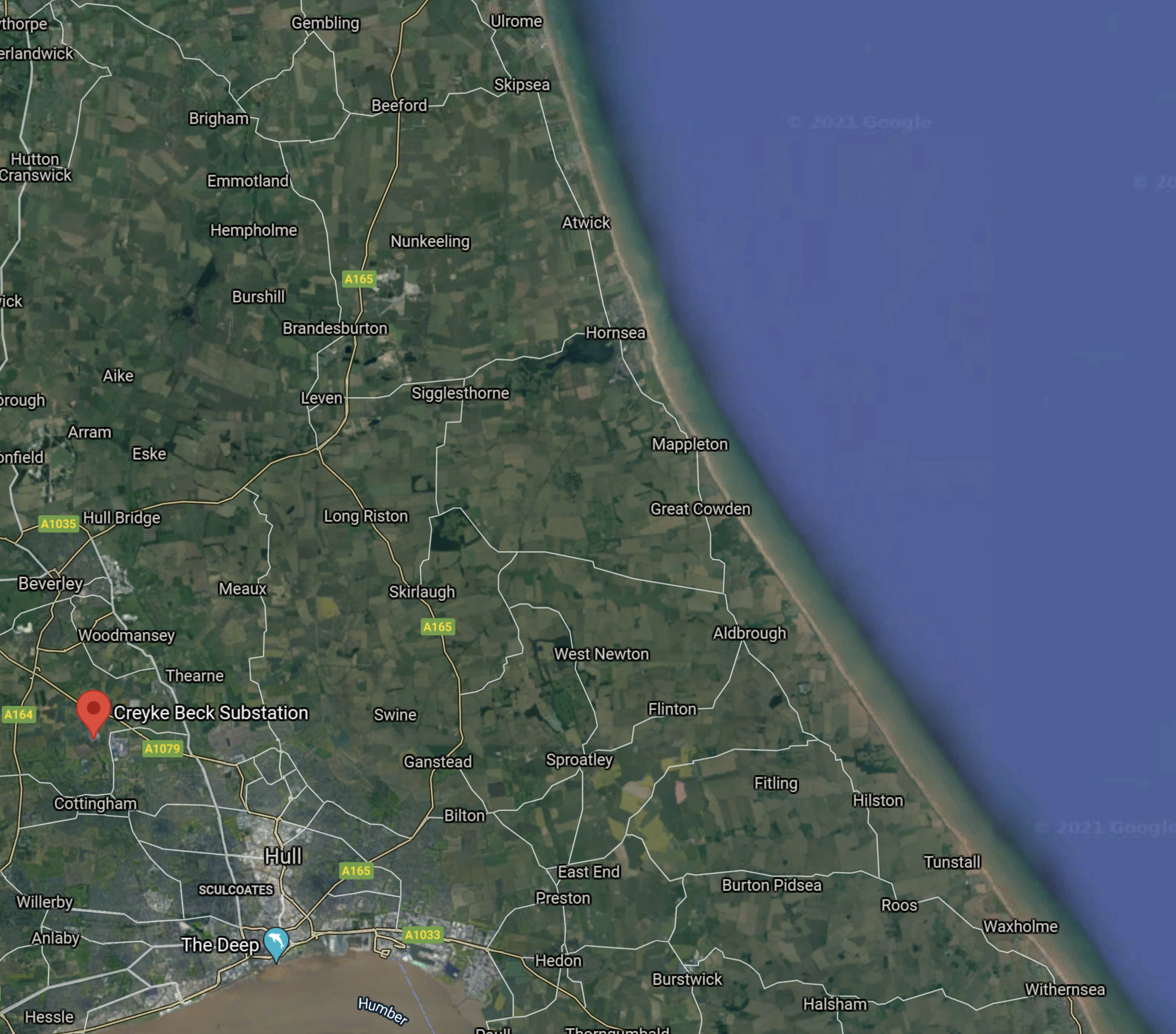
This Google Map shows the onshore route of the cable from the Dogger Bank Wind Farm.
Note.
- Hull and the River Humber at the bottom of the map.
- The red arrow which marks Creyke Beck sub station, where the cable from the Dogger Bank Wind Farm connects to the UK electricity grid.
- At the top of the map on the coast is the village of Ulrome, where the cable comes ashore.
The sub station is also close to the Hull and Scarborough Line, so would be ideal to feed any electrification erected.
I would assume that cables from the Dogger Bank Wind Farm could also link the Wind Farm to the proposed Dutch/Danish North Sea Wind Power Hub.
Given that the cables between the wind farms and Creyke Beck could in future handle at least 4.8 GW and the cables from the North Sea Wind Power Hub to mainland Europe would probably be larger, it looks like there could be a very high capacity interconnector between Yorkshire and Denmark, Germany and The Netherlands.
It almost makes the recently-opened North Sea Link to Norway, which is rated at 1.4 GW seem a bit small.
The North Sea Link
The North Sea Link is a joint project between Statnett and National Grid, which cost €2 billion and appears to have been delivered as planned, when it started operating in October 2021.
So it would appear that National Grid have shown themselves capable of delivering their end of a complex interconnector project.
Project Orion And The Shetlands
In Do BP And The Germans Have A Cunning Plan For European Energy Domination?, I introduced Project Orion, which is an electrification and hydrogen hub and clean energy project in the Shetland Islands.
The project’s scope is described in this graphic.
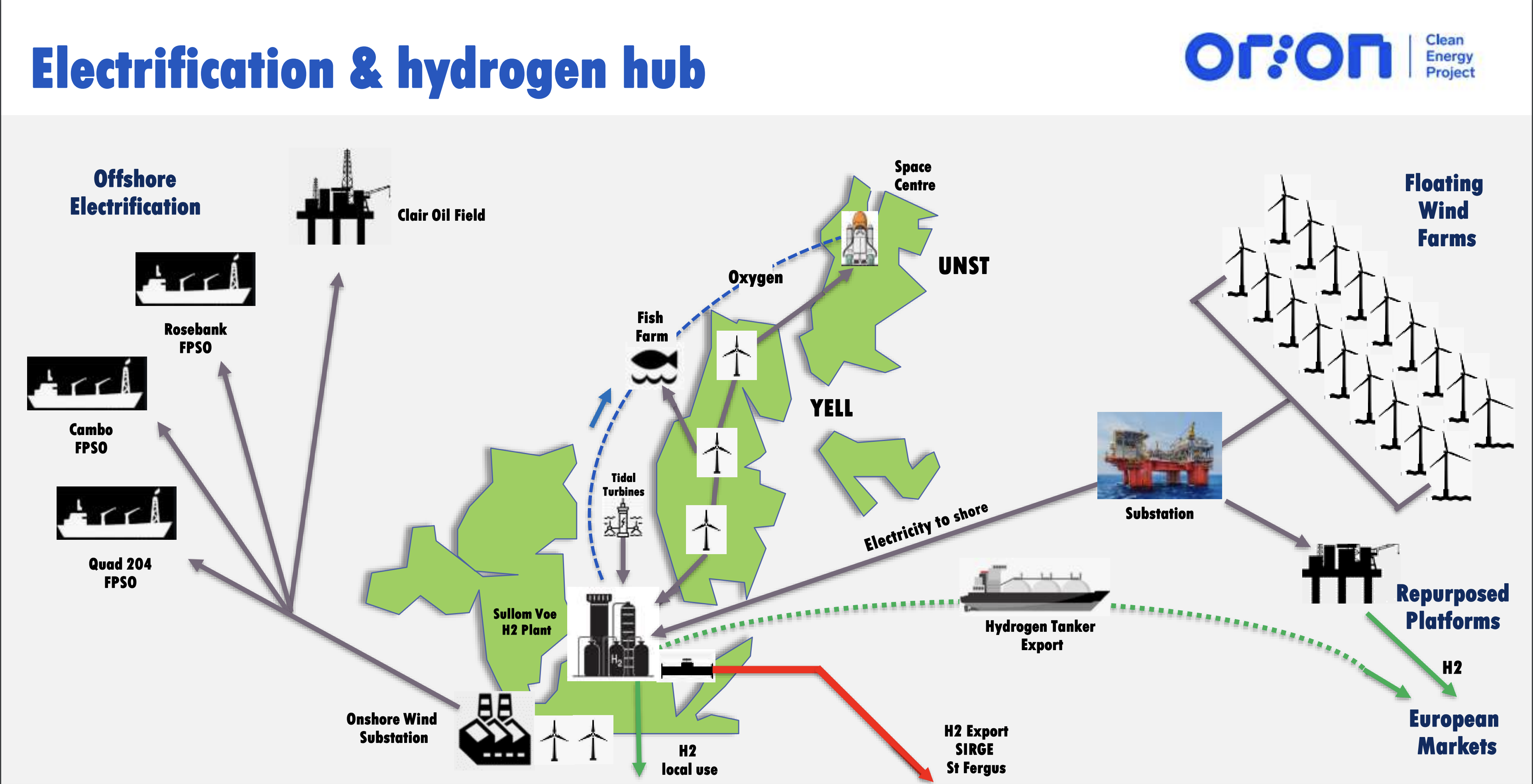
Note that Project Orion now has its own web site.
- Could the Shetlands become an onshore hub for the North Sea Power Hub Programme?
- Could Icelink, which is an interconnector to Iceland be incorporated?
With all this renewable energy and hydrogen, I believe that the Shetlands could become one of the most prosperous areas in Europe.
Funding The Wind Farms And Other Infrastructure In The North Sea
In World’s Largest Wind Farm Attracts Huge Backing From Insurance Giant, I described how Aviva were funding the Hornsea wind farm.
I very much believe that City of London financial institutions will be able to finance a lot of the developments in the North Sea.
After all National Grid managed to find a billion euros in a sock drawer to fund their half of the North Sea Link.
Electrifying The North Sea: A Gamechanger For Wind Power Production?
The title of this section, is the same as that of this article on Engineering and Technology Magazine.
This article in the magazine of the IET is a serious read and puts forward some useful facts and interesting ideas.
- The EU is targeting offshore wind at 60 GW by 2030 and 300 GW by 2050.
- The UK is targeting offshore wind at 40 GW by 2030.
- The article explains why HVDC electricity links should be used.
- The major players in European offshore wind are the UK, Belgium, the Netherlands, Germany, and Denmark.
- The foundations for a North Sea grid, which could also support the wider ambitions for a European super-grid, are already forming.
- A North Sea grid needs co-operation between governments and technology vendors. as well as technological innovation.
- National Grid are thinking hard about HVDC electrical networks.
- By combining HVDC links it can be possible to save a lot of development capital.
- The Danes are already building artificial islands eighty kilometres offshore.
- Electrical sub-stations could be built on the sea-bed.
I can see that by 2050, the North Sea, South of a line between Hull and Esbjerg in Denmark will be full of wind turbines, which could generate around 300 GW.
Further Reading
There are various articles and web pages that cover the possibility of a grid in the North Sea.
- National Grid – Interconnectors
- The Guardian – National Grid In Talks Over Plan For Energy Island In North Sea
- The Times – National Grid Planning ‘Energy Island’ In North Sea
I shall add to these as required.
Conclusion
I am coming to the conclusion that National Grid will be joining the North Sea Wind Power Hub Programme.
- They certainly have the expertise and access to funding to build long cable links.
- The Dogger Bank wind farm would even be one of the hubs in the planned hub and spoke network covering the North Sea.
- Only a short connection would be needed to connect the Dogger Bank wind farm, to where the Dutch and Danes originally planned to build the first energy island.
- There may be other possibilities for wind farm hubs in the UK section of the North Sea. Hornsea Wind Farm, which could be well upwards of 5 GW is surely a possibility.
- Would it also give access to the massive amounts of energy storage in the Norwegian mountains, through the North Sea Link or Nord.Link between Norway and Germany.
Without doubt, I know as a Control Engineer, that the more hubs and spokes in a network, the more stable it will be.
So is National Grid’s main reason to join is to stabilise the UK electricity grid? And in turn, this will stabilise the Danish and Dutch grids.
Equinor and SSE Renewables’ Dogger Bank Wind Farm Reaches Financial Close
The title of this post, is the same as that of this article on Energy Global.
It is a very matter of fact article to record the fact that SSE and Equinor have raised three billion pounds for the first two sections of their 3.6 GW wind farm on the Dogger Bank, in the middle of the North Sea.
Wikipedia indicates, they will be operational around 2023-2025.
All very boring! But we’ll see a lot more deals like this.
 The Anonymous Widower