Birmingham Plays The Green Card
This article in The Times today is entitled Birmingham Airport Set For Hydrogen Take-Off.
These two paragraphs introduce the article.
Birmingham Airport aims to become the first in Britain to operate commercial zero-emission hydrogen-fuelled flights — and by as early as 2025.
The ambitious goal follows the signing of a partnership with the British start-up ZeroAvia whose first trial flight of a 19-seater passenger aircraft powered by hydrogen fuel cells took place last month.
Other points from the article include.
- ZeroAvia is also working with Rotterdam Airport.
- Initially, it is likely that the hydrogen-powered aircraft will be used for cargo.
- The government wants all UK domestic flights to be zero-carbon by 2040.
- Birmingham wants to be zero-carbon by 2033.
- ZeroAvia has received upwards of £20 million of matched-taxpayer funding.
- It has some big backers and well-known airlines, who have placed orders.
These are my thoughts.
ZeroAvia’s Airliners
This paragraph from The Times article describes their first two aircraft.
ZeroAvia is retrofitting turboprops, 19-seater Dornier and in future 80-seater De Havilland Canada Dash 8-400s, with tanks of hydrogen which is converted by fuel cell stacks to energy taken to electric motors that power the propellers. The only emission is water. It is talking to potential new-entrant airframe makers to build all-new hydrogen aircraft of the future.
Note.
- The Dornier 228 is a 19-seater airliner of which over three hundred have been built.
- The de Havilland Canada Dash 8-400 is an 80-seater airliner of which over six hundred have been ordered and over 1200 of all marques of Dash 8s have been built.
Both are workhorses of the smaller airlines all over the world.
As the paragraph from The Times indicates the power system is not conventional, but then most of this new breed of small electric/hydrogen/hybrid airliners have electric propulsion. I suspect that there’s been a marked improvement in the design and efficiency of electric motors.
Electric propulsion should have a substantial noise advantage over turboprops.
ZeroAvia are also retrofitting their two chosen airliners.
This offers advantages in the certifying of the airliners. Providing the changes made to the airframe are not significant, the various certifying authorities in the UK, US and EU will allow previous certification to be carried over.
This means that ZeroAvia only have to thoroughly test and certify the powerplant and its integration into the aircraft.
One of their competitors, the Eviation Alice is a completely new airframe with battery-electric power, so I suspect this aircraft will take longer to certify.
I think ZeroAvia have used this shorter certification time to aim to get their airliners in service first.
Those that don’t win, don’t get the same fame.
Hydrogen At Birmingham Airport
Hydrogen will be needed at Birmingham Airport to refuel ZeroAvia’s airliners.
But will hydrogen also be used on the airside to power some of the heavy vehicles you see on airports.
Look at this page on the Hawaii Technology Development Corporation, which shows a Hydrogen Fuel Cell U-30 Aircraft Tow Tractor. The specification indicates, that it can tow a C-17 or a Boeing 747.
I wouldn’t be surprised to see Birmingham Airport build their own electrolyser nearby both to supply hydrogen-powered aircraft and decarbonise the airside.
To And From Birmingham Airport
Consider.
- Birmingham Airport is connected to Birmingham International station by a free AirRail Link.
- Birmingham International station has an impressive number of services, many of which are electric.
- There will be a people mover to connect to Birmingham Interchange for High Speed Two.
- Birmingham Interchange will have five trains per hour (tph) to and from London, taking under forty minutes.
- There are plans to extend the West Midlands Metro to the airport, with journeys taking thirty minutes from the City Centre.
- Birmingham Airport is at the centre of the UK’s motorway network.
Most public transport to Birmingham Airport will be zero-carbon and the percentage that is will increase.
A Green Air Bridge To Ireland
Currently the fastest services between London and Birmingham International station take a few minutes over the hour.
But after High Speed Two opens, the service will improve.
- High Speed Two will take under forty minutes.
- There will be five tph.
- High Speed Two will connect to the Elizabeth Line and the London Overground at Old Oak Common station.
- Euston station will have better connectivity to the Underground.
This diagram shows High Speed Two services.
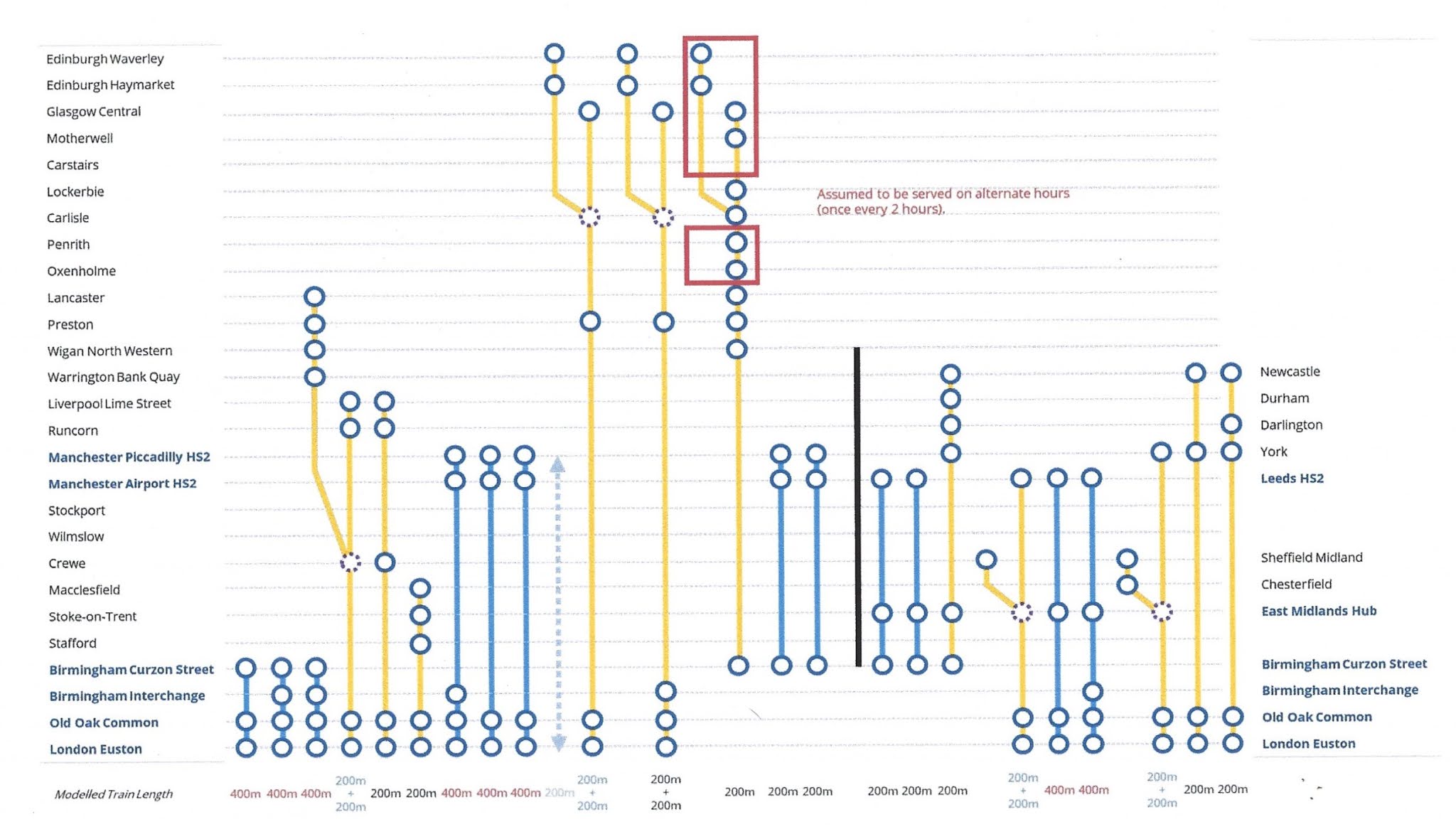
Consider.
- Birmingham Interchange has good connections in the North.
- I can see that Birmingham Airport could start to attract lots of passengers going between the islands of Great Britain and Ireland.
- And don’t forget Cardiff, Swansea, Exeter, Isle of Man and New Quay.
- Could Birmingham-Dublin and Birmingham-Belfast be run as frequent shuttles?
- Will there be AirRail tickets between Euston and Belfast and Dublin?
I also wonder if zero-carbon travel will attract passengers?
Zero-Carbon Air Cargo At Birmingham Airport
This article on Railway Gazette is entitled Varamis Rail Launches Regular Express Light Freight Service.
These three paragraphs outline the service from Varamis Rail.
Varamis Rail has launched a 160 km/h express freight service between Glasgow and Birmingham International using a converted electric multiple-unit.
The service is targeted at express parcels and third-party delivery companies seeking next day delivery of consumer goods.
Consignments arriving at the Glasgow hub by 17.30 from Monday to Friday can reach Birmingham at 23.00, with northbound freight arriving at the Birmingham site by 23.00 reaching Glasgow at 05.30 the next morning.
I think this service would interface well with cargo planes operating overnight from Birmingham Airport.
It seems to me, that Spokes at Speke could be reborn at Birmingham.
Conclusion
Birmingham Airport seems to be positioning itself to take advantage of aviation’s new breed of planes.
Ballymena: Wrightbus To Develop Hydrogen Production Facility
The title of this post, is the same as that of this article on the BBC.
This is the sub-heading.
Wrightbus is planning to develop a green hydrogen production facility at its factory in Ballymena.
And these first three paragraphs outline the project.
The proposal is being made in partnership with a sister company, Hygen Energy.
Part of the Wrightbus business is the manufacturing of hydrogen-powered buses, some of which are operated by Translink.
The new facility would help create a reliable source of fuel for those buses and other hydrogen-powered vehicles.
It seems a well-designed project and it appears Hygen are building a similar facility in Bradford.
Some months ago, I had a drink in my house, with three senior London bus company executives.
One has had problems with electric buses, as getting the required power to charge a fleet in some Central London garages is not easy.
I showed them these figures, from the Wrightbus web site.
- A Wrightbus electric double-decker takes 2.5 hours to charge for a 200 mile range.
- A hydrogen double-decker takes 8 minutes to refuel with up to a 280 miles range.
They were impressed. Especially, as a typical duty for a bus in London is almost 200 miles. A hydrogen bus seemed to make a lot more sense.
So why isn’t London preparing for scores of hydrogen buses?
Ask the Mayor!
Researchers Use Sea Water To Produce Green Hydrogen At Almost 100% Efficiency
The title of this post, is the same as that of this article on Hydrogen Fuel News.
This paragraph gives more details.
“We have split natural seawater into oxygen and hydrogen with nearly 100 percent efficiency, to produce green hydrogen by electrolysis, using a non-precious and cheap catalyst in a commercial electrolyser,” explained Professor Shi-Zhang Qiao, project leader at the School of Chemical Engineering at the University of Adelaide.
They use what is called a Lewis acid catalyst.
In the late 1960s, I worked for ICI in Runcorn.
Most of the hydrogen they needed was produced from brine by the large Castner-Kellner process, which may have been green, but was filthy, as it used a lot of mercury.
ICI also had an older and cruder process, which produced hydrogen and oxygen, by electrolysing brine, in a simple cell.
- These cells had a metal tub, with a concrete lid.
- Two electrodes passed through the lid.
- The lids quickly degraded and cells were rebuild regularly.
- But it did produce medical grade sodium hydroxide.
Legend also had it, that the salt that collected around the lid was pure enough to use in the canteen.
In Torvex Energy, I describe a company in Stockton which is also going the sea water electrolysis route.
Having seen, its Victorian ancestor in operation, I believe that sea water electrolysis has possibilities to make hydrogen efficiently.
ITM Signs 200MW Electrolyser Deal
The title of this post, is the same as that of this article on renews.biz.
This is the sub-heading.
Agreements with Linde Engineering will be for installation at RWE’s GET H2 Nukleus project in Germany
These paragraphs outline the deal.
ITM Power has signed two contracts for electrolysers, totalling 200MW, which will be installed in green hydrogen plants in Germany that will be supplied by North Sea offshore wind.
The contracts, both with Linde Engineering, are each for 100MW of PEM electrolysers.
The machines will be installed at two plants operated by RWE in Lingen, Germany.
Note.
- Linde Engineering and ITM Power were preselected by RWE for these orders.
- ITM Power seem to be going through scale-up problems.
But the comments in the article and the orders, surely show that ITM Power is now more likely to recover.
Cromarty Firth And Forth To Host First Green Freeports
The title of this post, is the same as that, of this article on the BBC.
This is the sub-heading.
Sites at Cromarty Firth and the Forth have been selected to host Scotland’s first green freeports.
These three paragraphs outline the deal.
The winning bids were revealed in a joint announcement by the UK and Scottish governments.
The special economic zones north of the border are being created under a scheme agreed by the two governments.
The successful applicants will be able to offer tax incentives and lower tariffs in the zones.
At least it seems that Westminster and Holyrood are in agreement.
What Is A Green Freeport?
This article on the BBC, is entitled Freeports: What Are They And Will They Help The Economy?.
It is a good summary of freeports in the UK.
This press release from the UK Government is entitled Joint Cooperation To Deliver Two New Green Freeports In Firth Of Forth And Inverness And Cromarty Firth, contains this statement from Deputy Scottish First Minister; John Swinney.
This is a milestone achievement in the process to deliver Green Freeports for Scotland. Inverness and Cromarty Firth Green Freeport and Forth Green Freeport will support businesses to create high-quality, well-paid new jobs, promote growth and regeneration, and make a significant contribution to achieving our net zero ambitions.
A rigorous joint selection process has been followed. The successful applicants showed a strong determination to embed fair work practices, including payment of the Real Living Wage, and to enshrine net zero initiatives in their work.
We look forward to working closely with them to ensure they deliver maximum positive impact and become operational as soon as possible. We will also work with the unsuccessful bidders to consider how they can build on the plans set out in their bids to deliver jobs and growth in their regions outside the Green Freeports programme.
Scotland has a rich history of innovation, trade and manufacturing and as we look to seize the many opportunities achieving net zero offers, the creation of these internationally competitive clusters of excellence will help us to create new green jobs, deliver a just transition and support our economic transformation.
This statement may be a lot more about aspiration, than hard directions, but having in my lifetime seen Scotland rally round their newborn oil and gas industry, I am very hopeful that the concept of a green freeport will be successful.
Unless anyone can correct me, I do feel that Scotland’s two green freeports are a world first.
Forth Green Freeport
This is the home page of the Forth Green Freeport.
- It talks about being Central to Scotland’s green ambitions.
- Places shown on a map of the freeport are Burntisland, Edinburgh Airport, Grangemouth, Leith and Rosyth.
- The freeport has a long list of partners.
It appears to be a well-backed ambitious plan.
Cromarty Green Freeport
Opportunity Cromarty Firth are leading the development of the Cromarty Green Freeport and they have this web site.
This is the sub-heading on the home page.
Opportunity Cromarty Firth (OCF), is a consortium leading a bid in the current competition for Green Freeport status, which could “revolutionise” the Highland economy and stimulate major new manufacturing activity locally and elsewhere in Scotland and the UK.
It is following by these two paragraphs.
The consortium is backed by port owners Port of Cromarty Firth, Global Energy Group, Port of Inverness and The Highland Council alongside a dozen regional businesses, public sector organisations and academic bodies.
OCF believes the creation of such a zone on the Firth would maximise local and Scotland-wide benefits from a pipeline of renewable energy projects placing the Highlands at the heart of the drive towards net-zero and create tens of thousands of jobs.
There would appear to be a lot of aspiration and a good list of partners, but the plans for the freeport don’t seem to be as advanced as those for the Forth Green Freeport.
No Shortage Of Electricity
One thing, that will not be a problem for either freeport, is going to be a poor electricity supply, as both the Forth Estuary and Cromarty Form will be the home to several gigawatts of offshore wind.
In addition, it is likely that the wind farms in the Cromarty Firth will be backed by large amounts of pumped storage hydroelectricity in the Great Glen.
Wind Farms Close To The Cromarty Firth Green Freeport
These wind farms are currently close to the Cromarty Firth Green Freeport.
- Beatrice – 10 MW – Operational
- Beatrice Extension – 588 MW – Operational
- Moray East – 950 MW – Operational
- Moray West – 862 MW – Operational in 2025
- Caldeonia – 2000 MW – Operational in 2030
This is a grand total of 4410 MW. Hinckley Point C will be 3260 MW.
Wind Farms Close To The Forth Green Freeport
These wind farms are currently close to the Forth Green Freeport.
- Seagreen – 862 MW – Operational in 2023
- Inch Cape – 1080 MW – Operational in 2026/27
- Neart Na Gaoithe – 450 MW – Operational in 2024
- Forthwind – 12 MW – Operational in 2023/24
- Berwick Bank 4100 MW – Operational in 2030
This is a grand total of 6504 MW.
North of Scotland Hydrogen Programme
One plan that seems to be being developed by OCF is the North of Scotland Hydrogen Programme, which has this web page on the OCF web site.
These paragraphs outline the plan.
The North of Scotland Hydrogen Programme was established through Opportunity Cromarty Firth and brings together key partners who share ambitions for the region’s renewable, low carbon future. The programme aims to develop a state-of-the-art hub in the Cromarty Firth to produce, store and distribute green hydrogen at scale to the region, Scotland, other parts of the UK and Europe.
The Highlands will be at the centre of future large-scale production of green hydrogen if the Cromarty Firth wins Green Freeport status.
ScottishPower and Storegga have expressed their support for the Green Freeport bid by Opportunity Cromarty Firth (OCF), which could attract more than £1 billion investment to the area and create thousands of jobs and local supply chain opportunities during construction.The joint developers recently announced plans to develop one of the UK’s largest green hydrogen electrolyser plants on the Cromarty Firth. The project’s initial phase would see the facility produce up to 30 megawatts (MW) of green hydrogen to be used in heating processes in nearby whisky distilleries.
Achieving Green Freeport status would have the potential to bring forward significant investment in a larger-scale plant by up to 10 years and would place the Highlands firmly at the centre of future large-scale production of green hydrogen, because of the region’s enormous growth potential of offshore wind, which is critical to the industry’s development.
Note.
- The hydrogen from the first phase of the electrolyser will be used in the whisky industry.
- Gradually, hydrogen use will widen throughout the region.
- I suspect that as hydrogen production grows, it will be exported from the freeport.
This map from the web site shows all the energy flows.
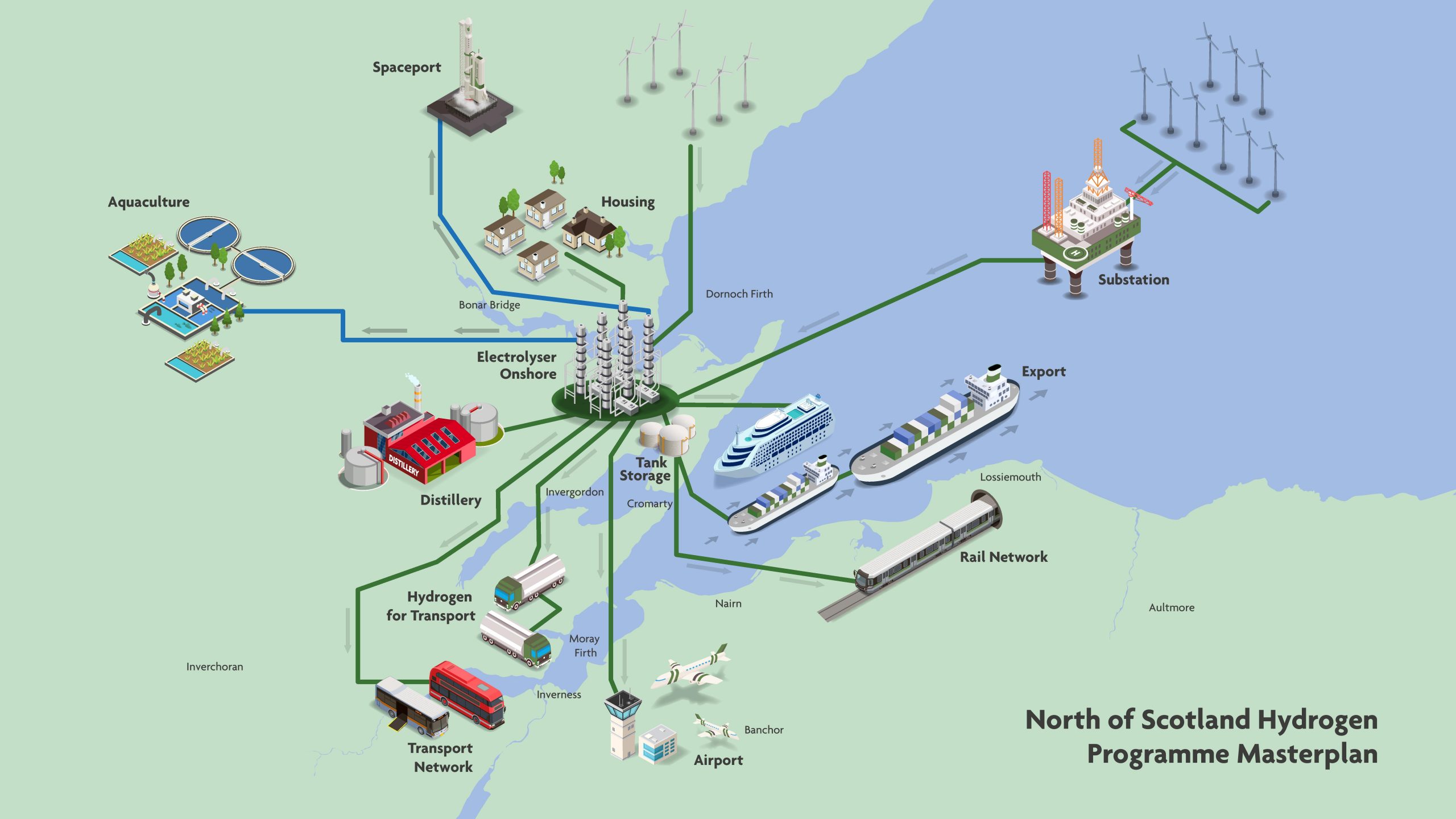
Note.
- Aquaculture is a use for the oxygen produced by the electrolyser.
- Everybody is promoting spaceports. Both hydrogen and oxygen can be used as rocket fuel.
- Hydrogen or electricity is shown powering all sorts of transport, including buses, a cruise ship, trains and trucks.
It certainly is a comprehensive plan.
Hydrogen At The Forth Green Freeport
Hydrogen is mentioned on the About page of the Forth Green Freeport web site in this general statement.
Investments will stimulate growth in trade, providing expanded logistics and trade capacity for existing and emerging industries including advanced modular systems, biofuels, hydrogen and carbon capture and storage, as well as support additional R&D capability and green incubator space to drive SME and start-up business growth.
But as INEOS are a partner, I would expect some hydrogen production from all that green offshore electricity.
Good Vibrations Turbo Charge Green Hydrogen Production
The title of this post, is the same as this news item from RMIT University in Australia.
This is the sub-heading.
Engineers in Melbourne have used sound waves to boost production of green hydrogen by 14 times, through electrolysis to split water.
And these are the first two paragraphs.
They say their invention offers a promising way to tap into a plentiful supply of cheap hydrogen fuel for transportation and other sectors, which could radically reduce carbon emissions and help fight climate change.
By using high-frequency vibrations to “divide and conquer” individual water molecules during electrolysis, the team managed to split the water molecules to release 14 times more hydrogen compared with standard electrolysis techniques
I could understand a two or three times increase, but fourteen times is sensational.
Again, Australia seems to have found the gold through innovative green technology.
Other Benefits
Read the last sections of the news item.
- The process allows the use of cheaper silver electrodes instead of platinum and iridium.
- The engineers also feel that their technique could help in this and other process where bubbles are a problem.
Sound waves have been used for decades for various processes and I am surprised that this appears to be the first time, they’ve applied to electrolysis.
Conclusion
I worked in a hydrogen factory around 1970 and have watched developments over the years.
I am now convinced that an individual or a company will come up with an affordable way to make green hydrogen.
Promising technologies in addition to this one include.
- High Temperature Electrolysis. See Nuclear-Enabled Hydrogen – How It Helps To Reach Net Zero.
- HiiROC See Centrica Partners With Hull-Based HiiRoc For Hydrogen Fuel Switch Trial At Humber Power Plant.
- Electrolysis of sea water. See Torvex Energy.
I can see a combination of a couple of methods.
SSE Thermal Charts Path To Green Hydrogen Future With First-Of-A-Kind Project
The title of this post, is the same as that of this press release from SSE Thermal.
This is the sub-heading.
SSE Thermal is developing a first-of-a-kind project in the Humber which would unite hydrogen production, storage and power generation in one location by the middle of this decade.
These paragraphs explain the project.
The Aldbrough Hydrogen Pathfinder project will support the evidence base for wider deployment of flexible hydrogen power in the UK’s net zero journey and is a major enabler of SSE Thermal’s wider Humber ambitions.
Located at SSE Thermal and Equinor’s existing Aldbrough Gas Storage site on the East Yorkshire coast, the project is designed to demonstrate the interactions between hydrogen electrolysis, hydrogen cavern storage and 100% hydrogen dispatchable power.
The concept would see green power sourced from grid through Renewable PPAs, in compliance with the Low Carbon Hydrogen Standard. Hydrogen would then be produced via a 35MW electrolyser before being stored in a converted salt cavern and then used in a 100% hydrogen-fired turbine, exporting flexible green power back to grid at times of system need. In future, hydrogen storage will also benefit offtakers in other sectors, for example in industry, heat or transport.
Note.
- The Aldbrough Gas Storage site currently can store the equivalent of 320 GWh of electricity, It is currently being expanded to be one of the largest hydrogen stores in the world according to this page on the SSE web site.
- SSE Thermal are proposing to build a hydrogen-powered power station at Keadby to the South of the Humber. The press release says this power station could have a peak demand of 1,800MW of hydrogen.
- Aldbrough at its current size could keep the Keadby hydrogen-powered power station going for a week. But Aldbrough will be a lot bigger than the current 320 GWh.
- The Hornsea and Dogger Bank wind farms off the coast of East Yorkshire will have a capacity of at least 13.5 GW.
- A 35 MW electrolyser will produce 15.2 tonnes of hydrogen per day.
SSE and Equinor hope to be storing hydrogen by 2025.
Conclusion
It is an enormous project and it will surely grow with more electrolysers and hydrogen-powered power stations.
Electrolyser System To Linde For Green Hydrogen Production In Niagara Falls, New York
The title of this post, is the same as that of this press release from Cummins.
This is the first paragraph.
Cummins Inc. will supply a 35-megawatt (MW) proton exchange membrane (PEM) electrolyzer system for Linde’s new hydrogen production plant in Niagara Falls, New York. Once commissioned, Cummins’ electrolyzer system will power Linde’s largest green hydrogen plant in the U.S., marking significant progress in moving the green hydrogen economy forward.
Note.
- The electrolyser will be powered by hydroelectricity.
- Linde have a strategic investment in iTM Power, who are a British manufacturer of electrolysers.
- ITM Linde Electrolysis is a joint venture between iTM Power and Linde.
Why did Linde choose Cummins over iTM Power?
Is it down to cost, delivery, politics or quality?
Gasunie Investigates Hydrogen Network In North Sea
The title of this post, is the same as that of this news article on the Gasunie web site.
Hydrogen-Powered Turbines May Help Clean And Improve Electrical Grid Reliability
The title of this post, is the same as that of this article on Hydrogen Fuel News.
This is the first paragraph.
In less than three years, one or more hydrogen-powered turbines are expected to be up and running at or near New Jersey’s Bayonne Energy Center power plant, which feeds power to New York City.
Note.
- The Bayonne Energy Center is a peaker plant with ten gas turbines, with a total capacity of 640 MW.
- Peaker plants automatically cut in, when power demand is high, but power generation is low.
- The Bayonne Energy Centre transfers power to New York, through an underwater cable.
- The electrolyzers will be made by Ohmium International Inc and I suspect they will be powered by offshore wind.
- The hydrogen that is created will be stored. As Bayonne has a history of chemical manufacturing, there may be salt caverns that can be used or the hydrogen could be stored as a compressed gas or liquid in tanks.
I can see hydrogen being used in peaker plants elsewhere in the world, where there is lots of renewable energy and suitable hydrogen storage.
The hydrogen can also be used to decarbonise local industries and transportation.
The Potential For Wind Power In New Jersey
Wikipedia says this about the potential of wind power in the state.
New Jersey has the potential to generate 373 GWh/year from 132 MW of 80 m high wind turbines or 997 GWh/year from 349 MW of 100 m high wind turbines located onshore as well as 430,000 GWh/year from 102,000 MW of offshore wind turbines.
Note.
- New Jersey used 76,759 GWh in 2011
- It appears that most of these turbines would be located along the coast.
There is also a worry about hurricanes. But solving that is an engineering problem.
From my experience of modelling floating structures, I believe they may stand up to high winds better. But I’m not sure!
 The Anonymous Widower