Hysata – Electrolyser Breaks Efficiency Records, Enabling World-Beating Green Hydrogen Cost
The title of this post, is the same as that of this article on Hydrogen Central.
These three paragraphs explain what Hysata have achieved.
Hysata – electrolyser breaks efficiency records, enabling world-beating green hydrogen cost.
Hysata’s world-leading hydrogen electrolyser technology has been recognised on the global stage with ground-breaking research published in top tier peer-reviewed scientific journal Nature Communications.
The research confirms Hysata’s ‘capillary-fed electrolysis cell’ can produce green hydrogen from water at 98% cell energy efficiency, well above International Renewable Energy Agency’s (IRENA) 2050 target and significantly better than existing electrolyser technologies, enabling a hydrogen production cost well below A$2/kg (US$1.50/kg).
Note.
- Hysata are an Australian company.
- The research and its results have have met the gold standard of pier review in a respected journal.
Their efficiency levels would appear to be breathtaking.
I have some more information and a couple of thoughts.
The Technology
This article on New Atlas is entitled Record-Breaking Hydrogen Electrolyzer Claims 95% Efficiency, gives a full overview of the technology.
It does appear that Hysata have shown tremendous attention to detail to raise the efficiency.
The Efficiency
In Can The UK Have A Capacity To Create Five GW Of Green Hydrogen?, I said the following.
Ryze Hydrogen are building the Herne Bay electrolyser.
- It will consume 23 MW of solar and wind power.
- It will produce ten tonnes of hydrogen per day.
The electrolyser will consume 552 MWh to produce ten tonnes of hydrogen, so creating one tonne of hydrogen needs 55.2 MWh of electricity.
55.2 MWh/tonne is 55.2 kWh/kg.
Hysata are claiming on their web site, that their electrolysers have 95% efficiency, which is 41.5 kWh/kg.
- A megawatt of electricity at Herne Bay will produce 18.1 Kg of hydrogen.
- A megawatt of electricity in a Hysata electrolyser will produce 24.1 Kg of hydrogen.
That is 33 % more.
Fortescue Starts Building Hydrogen Electrolyser Plant That Will Double Global Production
The title of this post, is the same as that of this article on RenewEconomy.
These are the first two paragraphs.
Fortescue Future Industries has begun construction of what it says will be the world’s largest electrolyser manufacturing facility in Gladstone, Queensland, the first stage of a massive plant that could also make wind turbines, solar panels, batteries and cables.
Fortescue Future Industries, the newly created green energy part of Andrew Forrest’s iron ore empire Fortescue Metals, and a key component of his massive and highly ambitious green hydrogen plans, says the firsts electrolysers will roll off the factory floor in 2023.
Production is to be at a level of 2 GW per year.
Is There A Need For A Norfolk-Suffolk Interconnector?
The coast of East Anglia from the Wash to the Haven Ports of Felixstowe, Harwich and Ipswich is becoming the Energy Coast of England.
Starting at the Wash and going East and then South, the following energy-related sites or large energy users are passed.
Bicker Fen Substation
Bicker may only be a small hamlet in Lincolnshire, but it is becoming increasingly important in supplying energy to the UK.
Nearby is Bicker Fen substation, which connects or will connect the following to the National Grid.
- The 26 MW Bicker Fen onshore windfarm.
- The 1,400 MW interconnector from Denmark called Viking Link.
- The proposed 857 MW offshore wind farm Triton Knoll.
This Google Map shows the location of Bicker Fen with respect to The Wash.
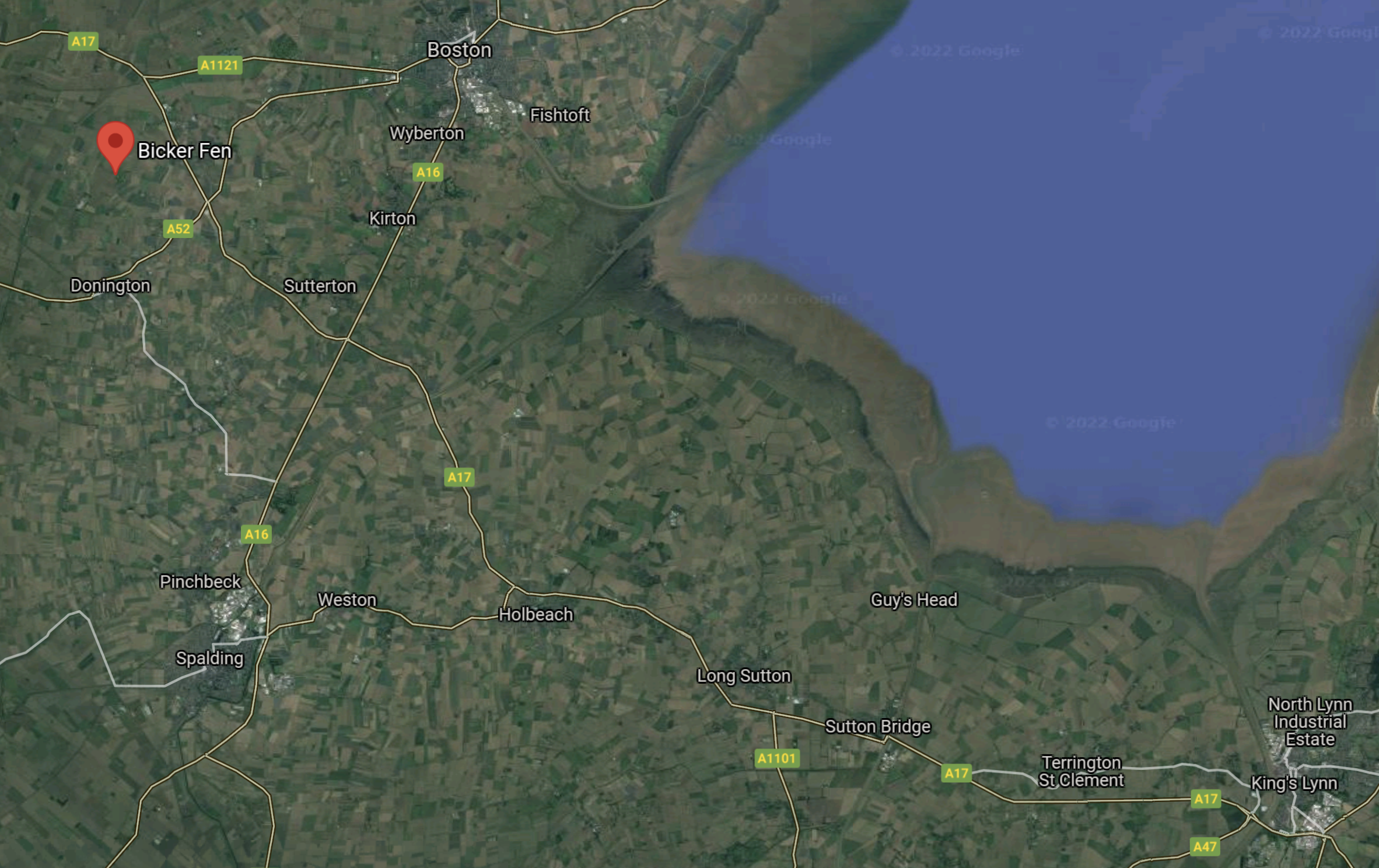
Bicker Fen is marked by the red arrow.
The Google Map shows the substation.
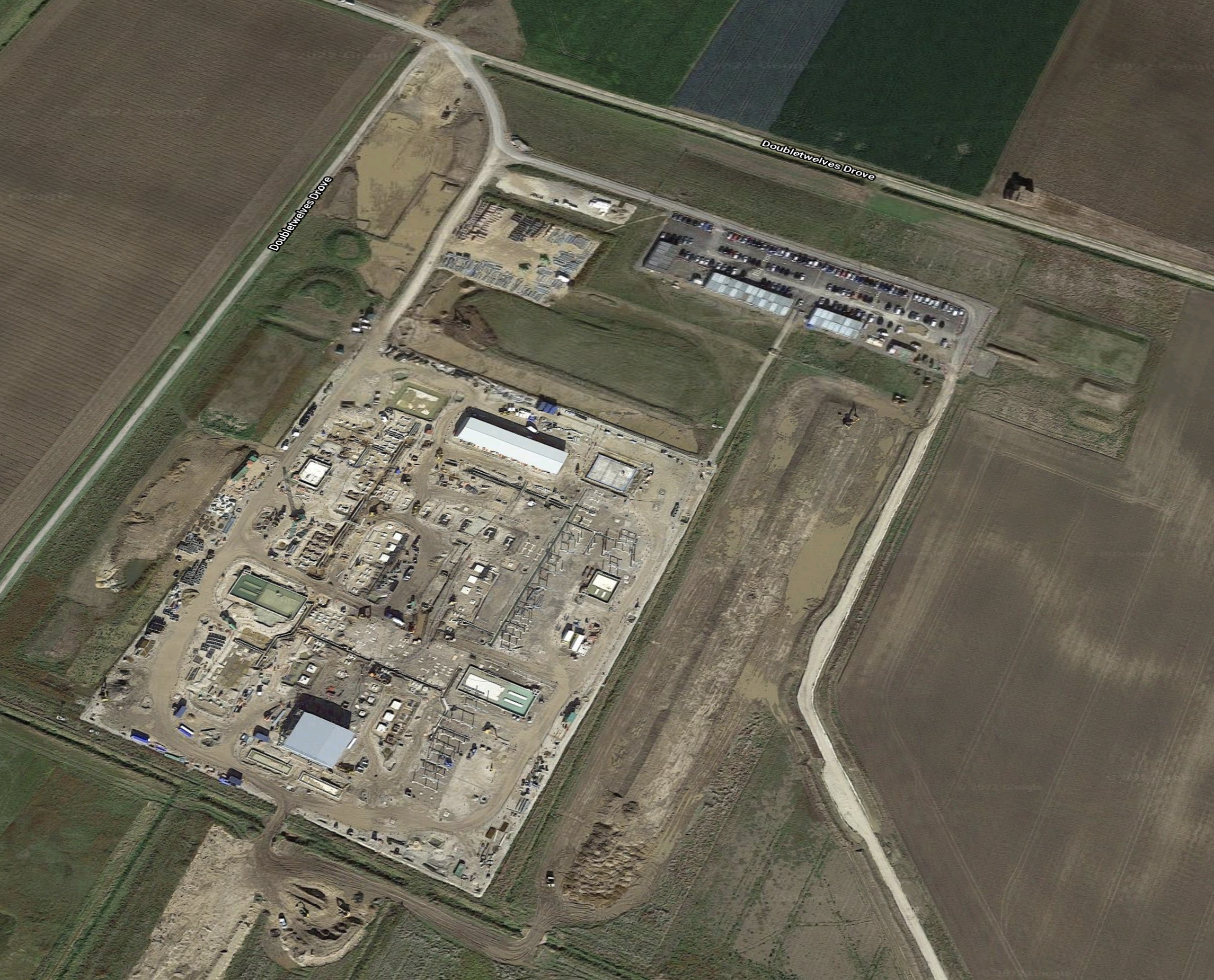
It must be sized to handle over 2 GW, but is it large enough?
Dudgeon Offshore Wind Farm
The Dudgeon offshore wind farm is a 402 MW wind farm, which is twenty miles off the North Norfolk coast.
- It has 67 turbines and an offshore substation.
- It is connected to the shore at Weybourne on the coast from where an underground cable is connected to the National Grid at Necton.
- It became operational in Oct 2017.
- Equinor and Statkraft are part owners of the windfarm and this is the home page of the wind farm’s web site.
- Equinor is the operator of the wind farm.
This Google Map shows the location of Weybourne on the coast.
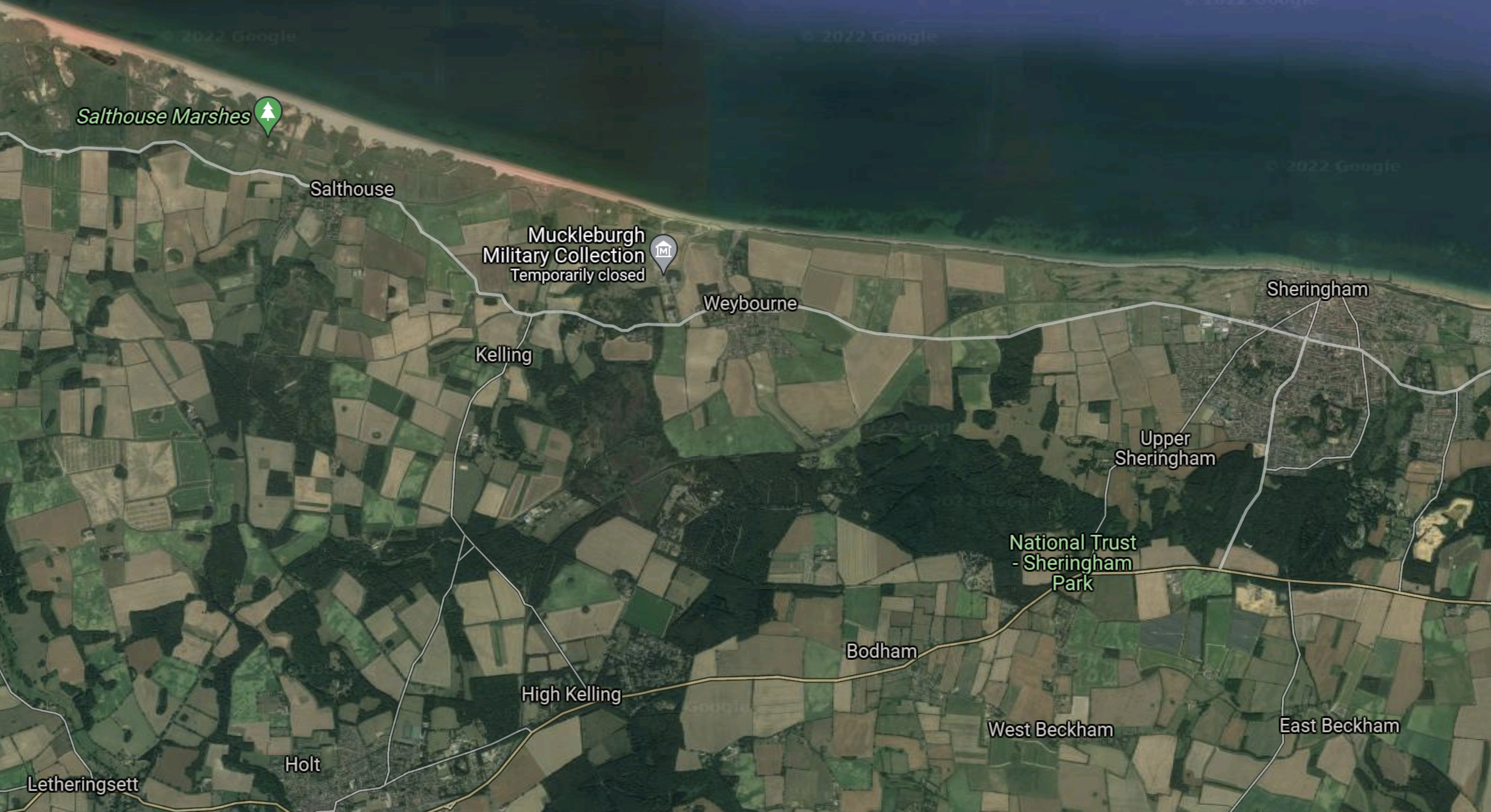
Note.
- Weybourne is in the middle on the coast.
- Sheringham is on the coast in the East.
- Holt is on the Southern edge of the map almost South of Weybourne.
This second map shows the location of the onshore substation at Necton, with respect to the coast.
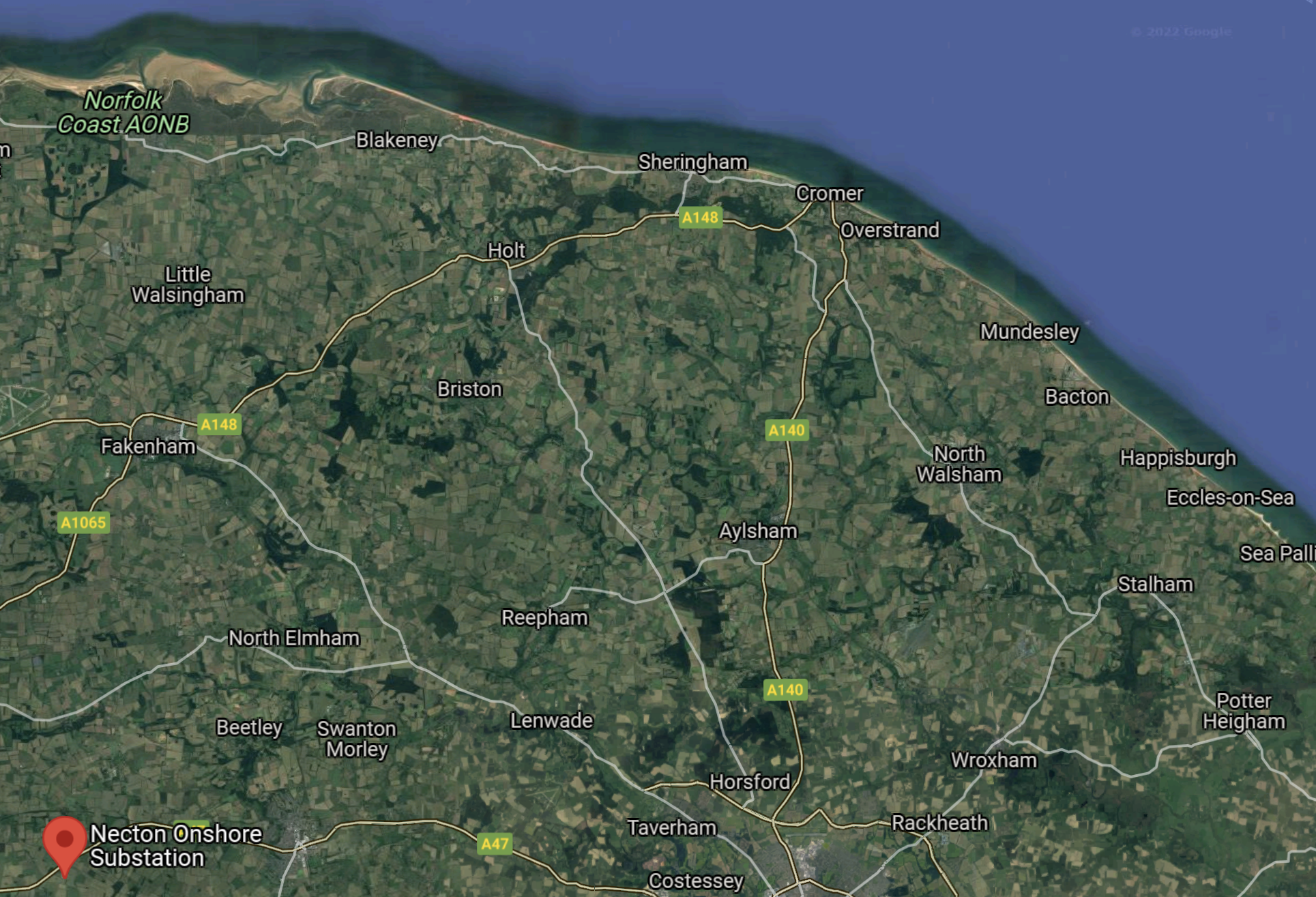
Note.
- The Necton substation is marked by a red arrow.
- Holt and Sheringham can be picked out by the coast in the middle.
- Weybourne is to the West of Sheringham.
- Necton and Weybourne are 35 miles apart.
Digging in the underground cable between Necton and Weybourne might have caused some disruption.
Looking at Weybourne in detail, I can’t find anything that looks like a substation. So is the Necton substation connected directly to Dudgeon’s offshore substation?
Sheringham Shoal Offshore Wind Farm
The Sheringham Shoal offshore wind farm is a 316.8 MW wind farm, which is eleven miles off the North Norfolk coast.
- It has 88 turbines and two offshore substations.
- As with Dudgeon, it is connected to the shore at Weybourne on the coast.
- But the underground cable is connected to an onshore substation at Salle and that is connected to the National Grid at Norwich.
- It became operational in Sept 2012.
- Equinor and Statkraft are part owners of the windfarm and this is the home page of the wind farm’s web site.
- Equinor is the operator of the wind farm.
This second map shows the location of the onshore substation at Salle, with respect to the coast.

Note.
- The Salle substation is marked by a red arrow.
- Holt, Weybourne and Sheringham can be picked out by the coast in the middle.
- Weybourne is to the West of Sheringham.
- Salle and Weybourne are 13.5 miles apart.
Could the following two statements be true?
- As the Sheringham Shoal wind farm was built first, that wind farm was able to use the shorter route.
- It wasn’t built large enough to be able to handle the Dudgeon wind farm.
The statements would certainly explain, why Dudgeon used a second cable.
Extending The Dudgeon And Sheringham Shoal Wind Farms
Both the Dudgeon And Sheringham Shoal web sites have details of the proposed join extension of both wind farms.
This is the main statement on the Overview page.
Equinor has been awarded an Agreement for Lease by the Crown Estate, the intention being to seek consents to increase the generating capacity of both the Sheringham Shoal Offshore Wind Farm and the Dudgeon Offshore Wind Farm.
They then make three points about the development.
- Equinor is proposing a joint development of the two projects with a common transmission infrastructure.
- As part of the common DCO application, the Extension Projects have a shared point of connection at the National Grid Norwich Main substation.
- These extension projects will have a combined generating capacity of 719MW which will make an important contribution to the UK’s target of 30GW of electricity generated by offshore wind by 2030.
This statement on the Offshore Location page, describes the layout of the wind farms.
The Sheringham Shoal Offshore Wind Farm extension is to the north and the east of the existing wind farm, while its Dudgeon counterpart is to the north and south east of the existing Dudgeon Offshore Wind Farm site. The proposed extension areas share the boundaries with its existing wind farm site.
They then make these two important points about the development.
- Equinor is seeking to develop the extension project with a joint transmission infrastructure. A common offshore substation infrastructure is planned to be located in the Sheringham Shoal wind farm site.
- The seabed export cable which will transmit the power generated by both wind farm extensions will make landfall at Weybourne.
There is also this map.

Note.
- The purple line appears to be the UK’s ten mile limit.
- The Sheringham Shoal Extension is outlined in red.
- The Dudgeon Extension is outlined in blue.
- The black lines appear to be the power cables.
I suspect the dotted blue lines are shipping routes sneaking their way through the turbines.
This statement on the Onshore Location page, describes the layout of the offshore and onshore cables.
A new seabed export cable will bring the electricity generated by both the Sheringham Shoal and Dudgeon Offshore Wind Farm extensions to shore at Weybourne, on the coast of Norfolk.
They then make these two important points about the development.
- From there a new underground cable will be installed to transmit that power to a new purpose built onshore substation, which will be located within a 3km radius of the existing Norwich main substation, south of Norwich. This will be the National Grid network connection point for the electricity from both wind farm extensions.
- The power will be transmitted from landfall to the substation using an HVAC system which eliminates the need for any relay stations along the onshore cable route.
There is also this map.
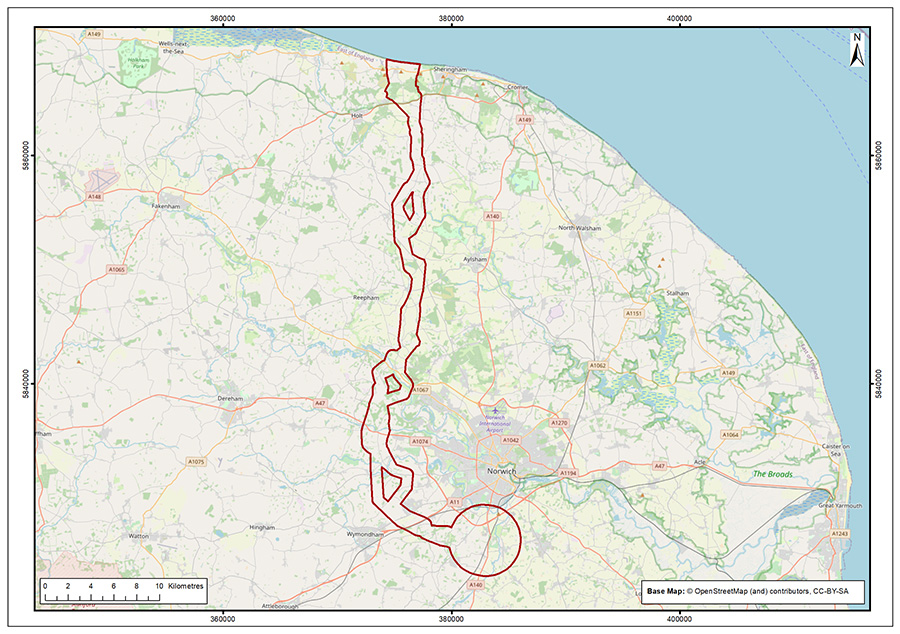
It will be a substantial undertaking to build the underground cable between Weybourne and South of Norwich.
Bacton Gas Terminal
The Bacton gas terminal is a complex of six gas terminals about ten miles East of Cromer.
- It lands and processes gas from a number of fields in the North Sea.
- It hosts the UK end of the BBL pipeline to The Netherlands.
- It hosts the UK end of the Interconnector to Zeebrugge in Belgium.
- The Baird and Deborah fields, which have been developed as gas storage, are connected to the gas terminal. They are both mothballed.
This Google Map shows the location of the terminal.
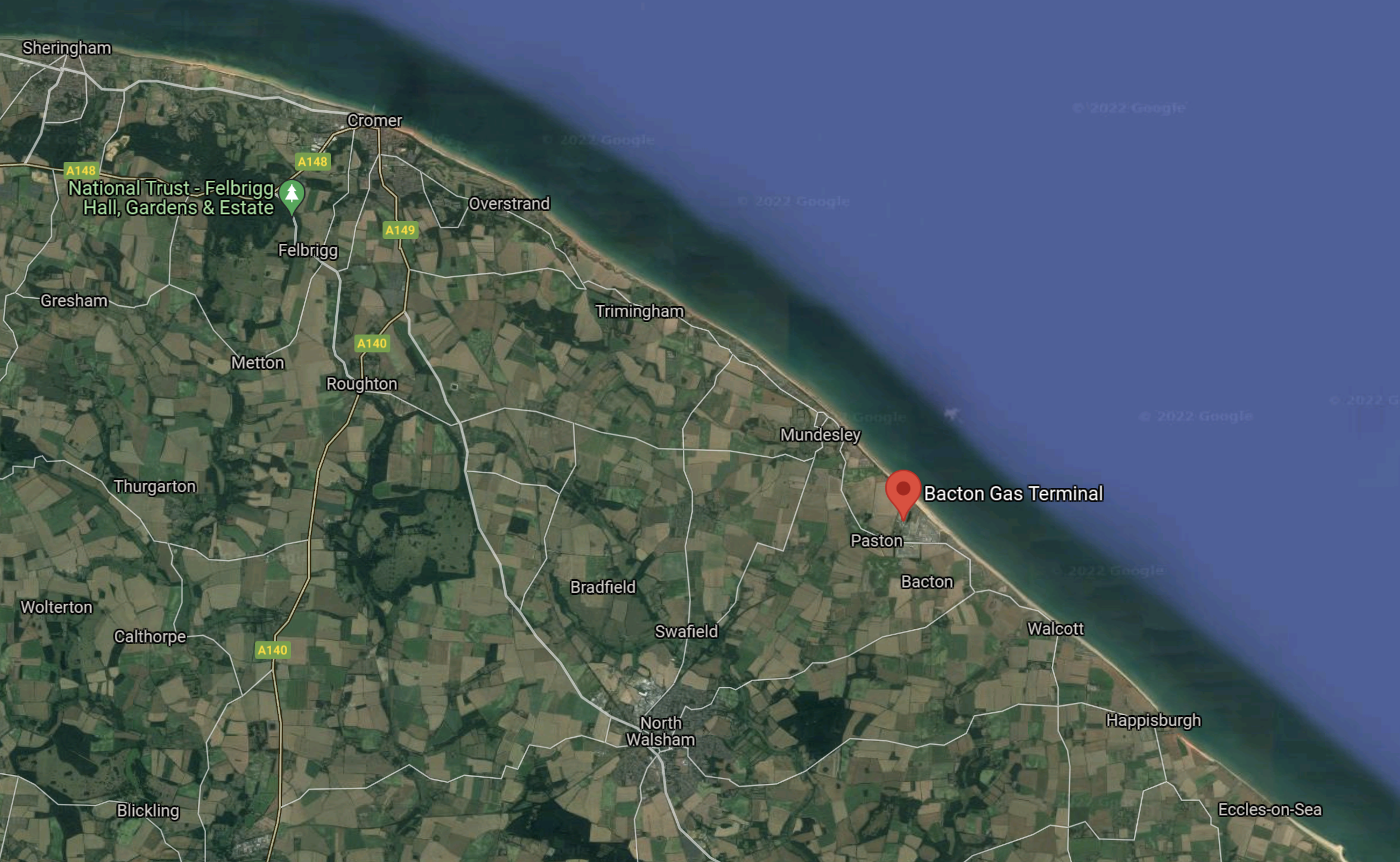
Note.
- The Bacton gas terminal is marked by a red arrow.
- Sheringham is in the North West corner of the map.
- Cromer, Overstrand, Trimingham and Mundesley are resort towns and villages along the coast North of Bacton.
This second map shows the Bacton gas terminal in more detail.
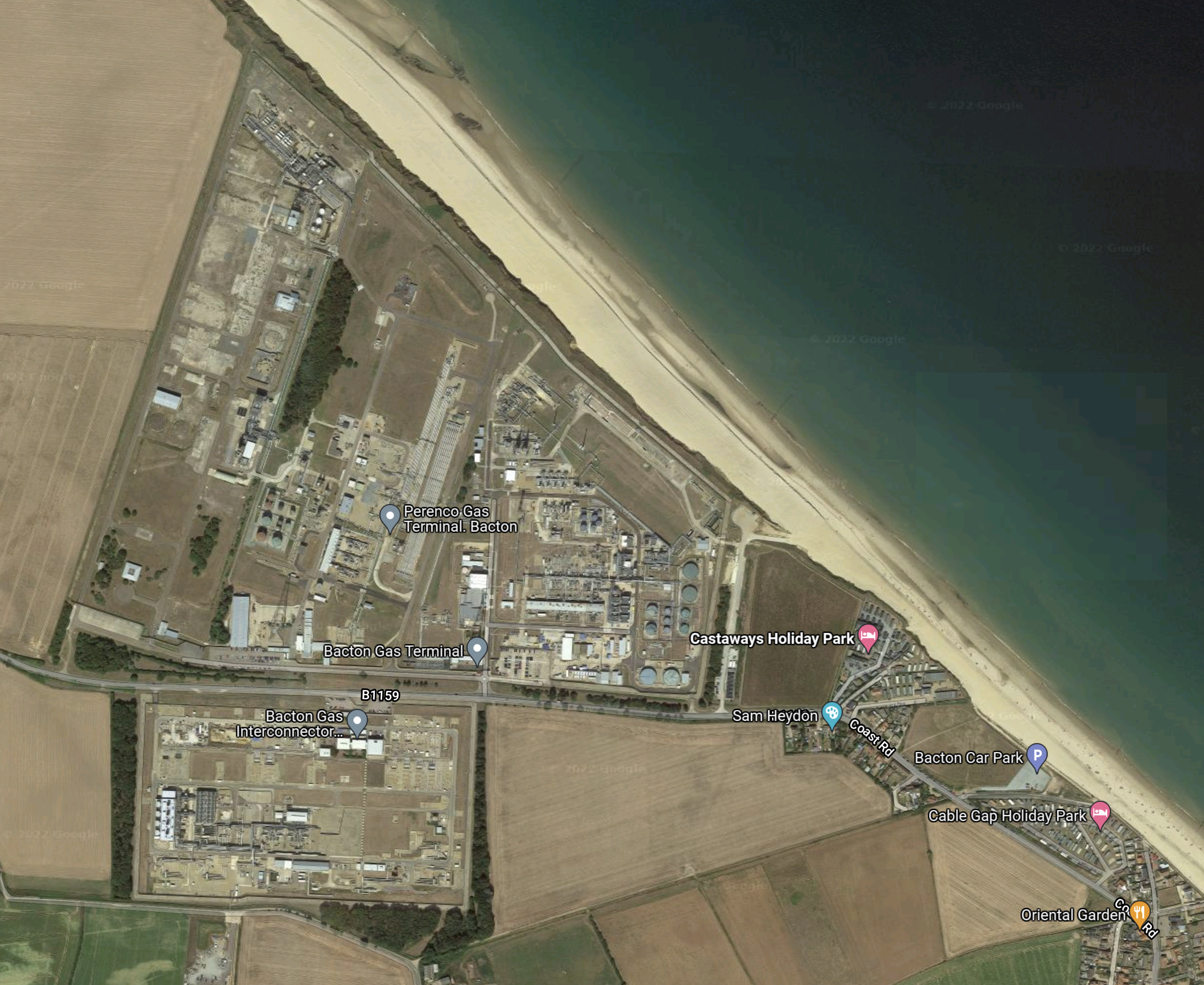
Would you want to have a seaside holiday, by a gas terminal?
Norfolk Boreas And Norfolk Vanguard
Norfolk Boreas and Norfolk Vanguard are two wind farms under development by Vattenfall.
- Norfolk Boreas is a proposed 1.8 GW wind farm, that will be 45 miles offshore.
- Norfolk Vanguard is a proposed 1.8 GW wind farm, that will be 29 miles offshore.
This map shows the two fields in relation to the coast.
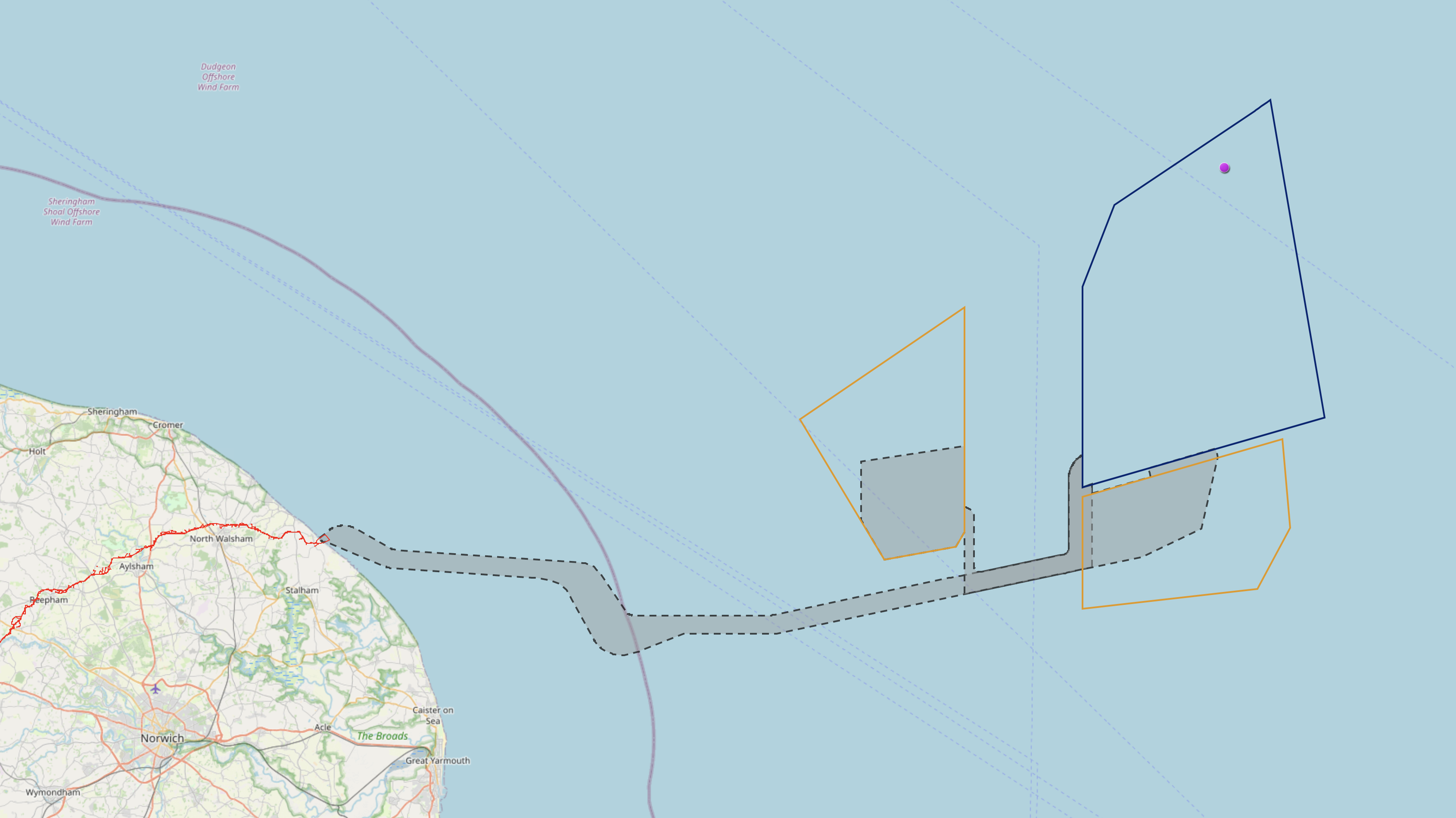
Note.
- The purple line appears to be the UK’s ten mile limit.
- Norfolk Boreas is outlined in blue.
- Norfolk Vsnguard is outlined in orange.
- Cables will be run in the grey areas.
This second map shows the onshore cable.
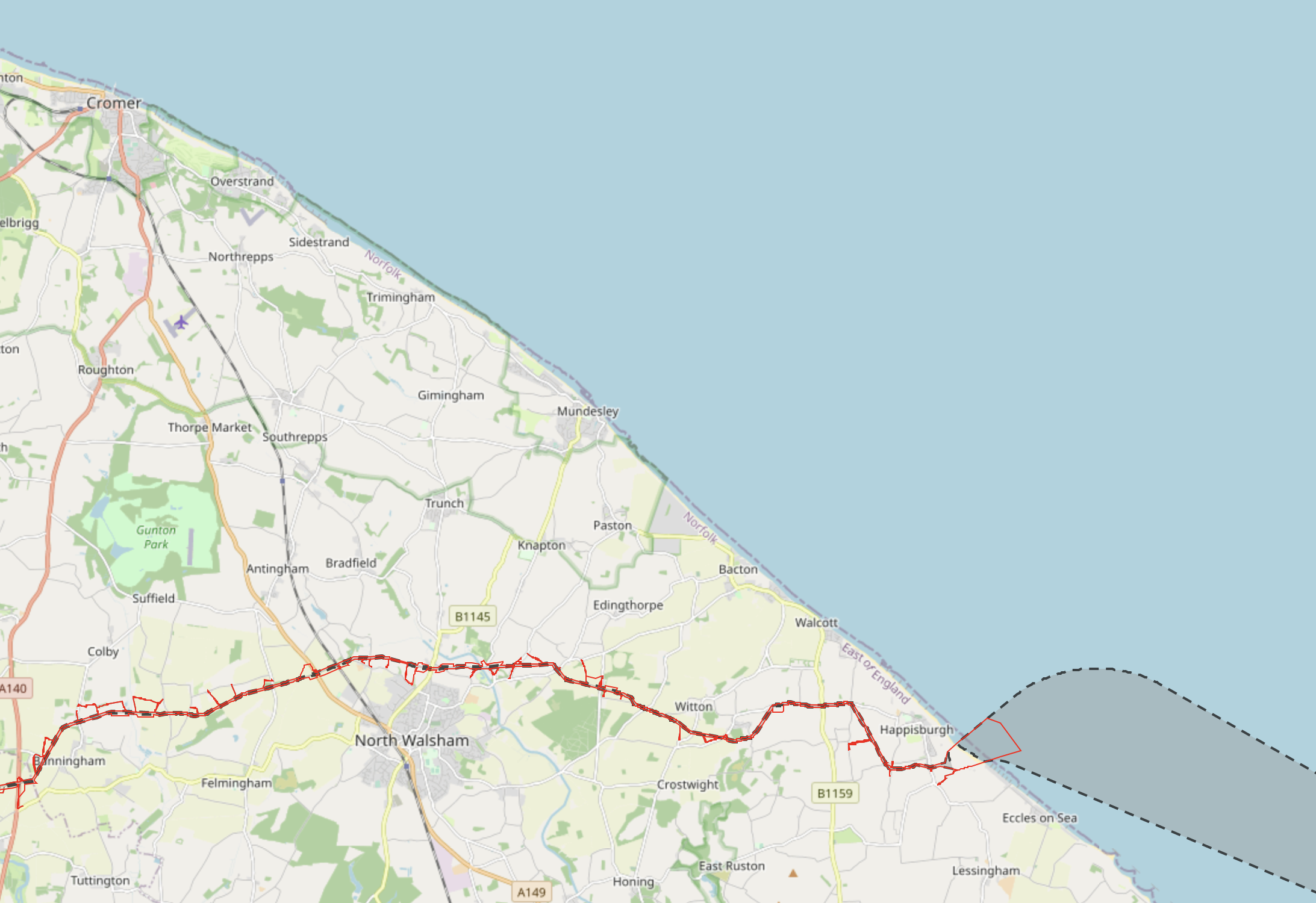
Note.
- The cables are planned to come ashore between Happisburgh and Eccles-on-Sea.
- Bacton gas terminal is only a short distance up the coast.
- The onshore cable is planned to go from here across Norfolk to the Necton substation.
But all of this has been overturned by a legal ruling.
This article on the BBC is entitled Norfolk Vanguard: Ministers Wrong Over Wind Farm Go-Ahead, Says Judge.
These are the first four paragraphs.
A High Court judge has quashed permission for one of the world’s largest offshore wind farms to be built off the east coast of England.
The Norfolk Vanguard Offshore Wind Farm was granted development consent in July by the Secretary of State for Business, Energy and Industrial Strategy (BEIS).
But Mr Justice Holgate overturned the decision following legal action from a man living near a planned cable route.
A Department for BEIS spokeswoman said it was “disappointed by the outcome”.
I bet the spokeswoman was disappointed.
Vattenfall and the BEIS will go back to the drawing board.
But seriously, is it a good idea to dig an underground cable all the way across Norfolk or in these times build a massive overhead cable either?
Perhaps the solution is to connect the Norfolk Boreas And Norfolk Vanguard wind farms to a giant electrolyser at Bacton, which creates hydrogen.
- The underground electricity cable across Norfolk would not be needed.
- Bacton gas terminal is only a few miles up the coast from the cable’s landfall.
- The UK gets another supply of gas.
- The hydrogen is blended with natural gas for consumption in the UK or Europe.
- A pure hydrogen feed can be used to supply hydrogen buses, trucks and other vehicles, either by tanker or pipeline.
- Excess hydrogen could be stored in depleted gas fields.
The main benefit though, would be that it would transform Bacton gas terminal from a declining asset into Norfolk’s Hydrogen Powerhouse.
Great Yarmouth And Lowestoft
Great Yarmouth Outer Harbour and the Port of Lowestoft have not been the most successful of ports in recent years, but with the building of large numbers of wind farms, they are both likely to receive collateral benefits.
I wouldn’t be surprised to see the support ships for the wind farms switching to zero-carbon power, which would require good electrical connections to the ports to either charge batteries or power electrolysers to generate hydrogen.
Sizewell
Sizewell has only one nuclear power station at present; Sizewell B, but it could be joined by Sizewell C or a fleet of Small Modular Reactors (SMR).
The Sizewell Overhead Transmission Line
Sizewell also has a very high capacity overhead power line to Ipswich and the West.





I doubt, it would be possible to build an overhead transmission line like this today.
Sizewell And Hydrogen
EdF, who own the site are involved with Freeport East and may choose to build a large electrolyser in the area to create hydrogen for the Freeport.
East Anglia Array
The East Anglia Array will be an enormous wind farm., comprising up to six separate projects.
It will be thirty miles offshore.
It could generate up to 7.2 GW.
The first project East Anglia One is in operation and delivers 714 MW to a substation in the Deben Estuary, which connects to the Sizewell high-capacity overhead power line.
Most projects will be in operation by 2026.
Freeport East
As the Freeport develops, it will surely be a massive user of both electricity and hydrogen.
Problems With The Current Electricity Network
I don’t believe that the current electricity network, that serves the wind farms and the large energy users has been designed with the number of wind farms we are seeing in the North Sea in mind.
Every new windfarm seems to need a new connection across Norfolk or Suffolk and in Norfolk, where no high-capacity cables exist, this is stirring up the locals.
There is also no energy storage in the current electricity network, so at times, the network must be less than efficient and wind turbines have to be shut down.
Objections To The Current Policies
It is not difficult to find stories on the Internet about objections to the current policies of building large numbers of wind farms and the Sizewell C nuclear power station.
This article on the East Anglia Daily Times, which is entitled Campaigners Unite In Calling For A Pause Before ‘Onslaught’ Of Energy Projects ‘Devastates’ Region is typical.
This is the first paragraph.
Campaigners and politicians have called on the Government to pause the expansion of the energy industry in Suffolk, which they fear will turn the countryside into an “industrial wasteland” and hit tourism.
The group also appear to be against the construction of Sizewell C.
I feel they have a point about too much development onshore, but I feel that if the UK is to thrive in the future we need an independent zero carbon energy source.
I also believe that thousands of wind farms in the seas around the UK and Ireland are the best way to obtain that energy.
Blending Hydrogen With Natural Gas
Blending green hydrogen produced in an electrolyser with natural gas is an interesting possibility.
- HyDeploy is a project to investigate blending up to 20 % of green hydrogen in the natural gas supply to industrial and domestic users.
- Partners include Cadent, ITM Power, Keele University and the Health and Safety Executive.
- Natural gas naturally contains a small amount of hydrogen anyway.
- The hydrogen gas would be distributed to users in the existing gas delivery network.
I wrote about HyDeploy in a post called HyDeploy.
Thje only loser, if hydrogen were to be blended with natural gas would be Vlad the Poisoner, as he’d sell less of his tainted gas.
An Interconnector Between Bicker Fen And Freeport East
I believe that an electricity interconnector between at least Bicker Fen and Freeport East could solve some of the problems.
My objectives would be.
- Avoid as much disruption on the land as possible.
- Create the capacity to deliver all the energy generated to customers, either as electricity or hydrogen.
- Create an expandable framework, that would support all the wind farms that could be built in the future.
The interconnector would be a few miles offshore and run along the sea-bed.
- This method of construction is well proven.
- It was used for the Western HVDC Link between Hunterston in Scotland and Connah’s Quay in Wales.
- Most wind farms seem to have existing substations and these would be upgraded to host the interconnector.
Connections en route would include.
Dudgeon Offshore Wind Farm
The interconnector would connect to the existing offshore substation.
Sheringham Shoal Wind Farm
The interconnector would connect to the existing offshore substation.
Dudgeon and Sheringham Shoal Extension Offshore Wind Farms
These two wind farms could be connected directly to the interconnector, if as planned, they shared an offshore substation in the Sheringham Shoal Extension offshore wind farm.
Bacton Gas Terminal
I would connect to the Bacton Gas Terminal, so that a large electrolyser could be installed at the terminal.
The hydrogen produced could be.
- Stored in depleted gas fields connected to the terminal.
- Blended with natural gas.
- Exported to Europe through an interconnector.
- Supplied to local users by truck or pipeline.
After all, the terminal has been handling gas for over fifty years, so they have a lot of experience of safe gas handling.
Norfolk Boreas And Norfolk Vanguard
These two wind farms could be connected directly to the interconnector, if they shared an offshore substation.
It would also help to appease and silence the objectors, if there was no need to dig up half of Norfolk.
Great Yarmouth And Lowestoft
It might be better, if these ports were supplied from the interconnector.
- Either port could have its own electrolyser to generate hydrogen, which could be.
- Used to power ships, trucks and port equipment.
- Liquefied and exported in tankers.
- Used to supply local gas users.
- Hydrogen could be supplied to a converted Great Yarmouth power station.
Both Great Yarmouth and Lowestoft could become hydrogen hub towns.
Sizewell
This site has a high-capacity connection to the National Grid. This connection is a big eyesore, but it needs to run at full capacity to take electricity from the Energy Coast to the interior of England.
That electricity can come from Sizewell B and/or Sizewell C nuclear power stations or the offshore wind farms.
East Anglia Array
There would probably need to be a joint offshore substation to control the massive amounts of electricity generated by the array.
Currently, the only wind farm in operation of this group is East Anglia One, which uses an underground cable connection to the Sizewell high-capacity connection to the Bullen Lane substation at Bramford.
Freeport East, Ipswich And Bullen Lane Substation
This Google Map shows the area between Ipswich and the coast.
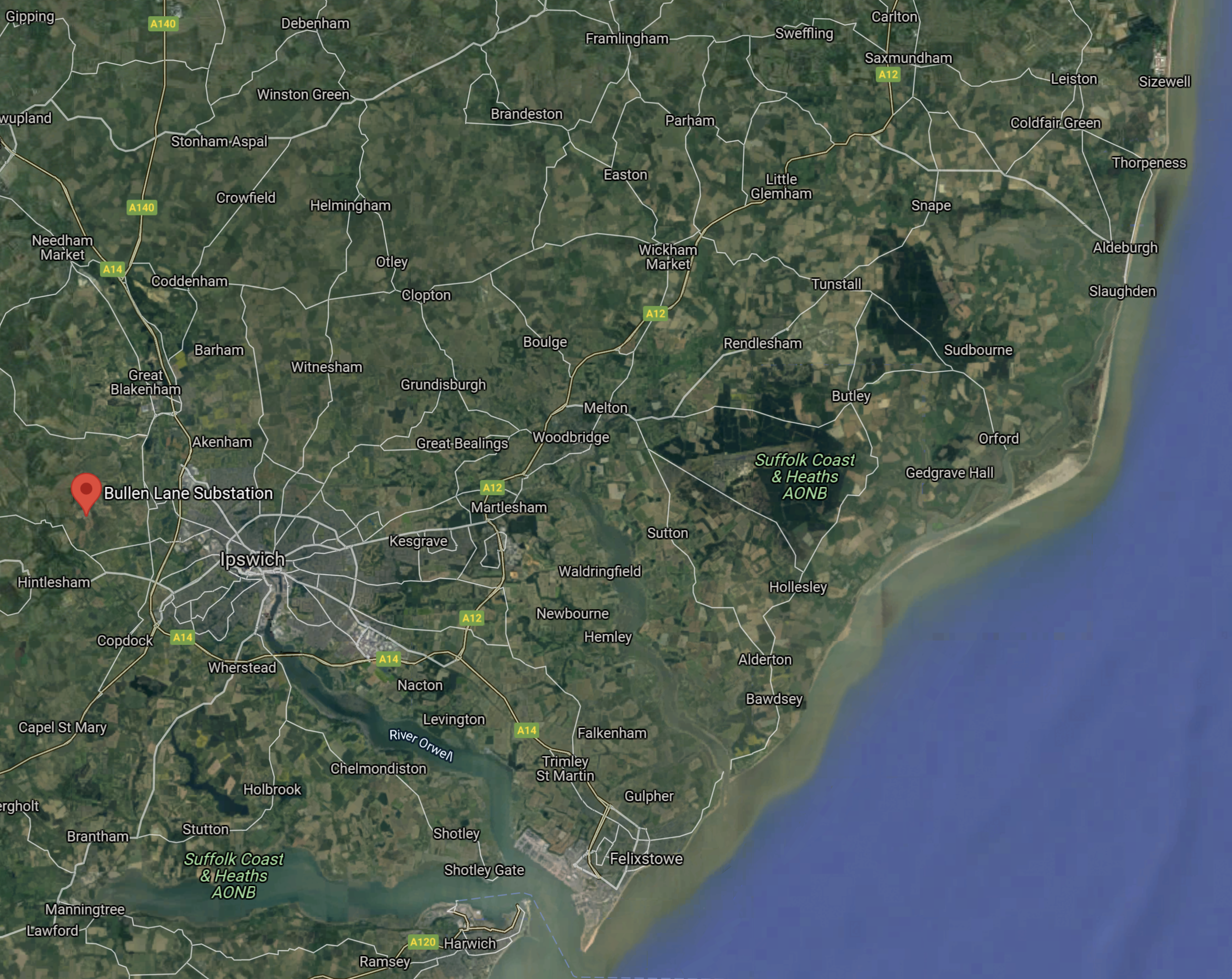
Note.
- Sizewell is in the North-East corner of the map.
- Felixstowe, Harwich and Freeport East are at the mouth of the rivers Orwell and Stour.
- The Bullen Lane substation is to the West of Ipswich and shown by the red arrow.
I would certainly investigate the possibility of running an underwater cable up the River Orwell to connect the Southern end of the interconnector Between Bicker Fen And Freeport East.
This Google Map shows the Bullen Lane Substation.
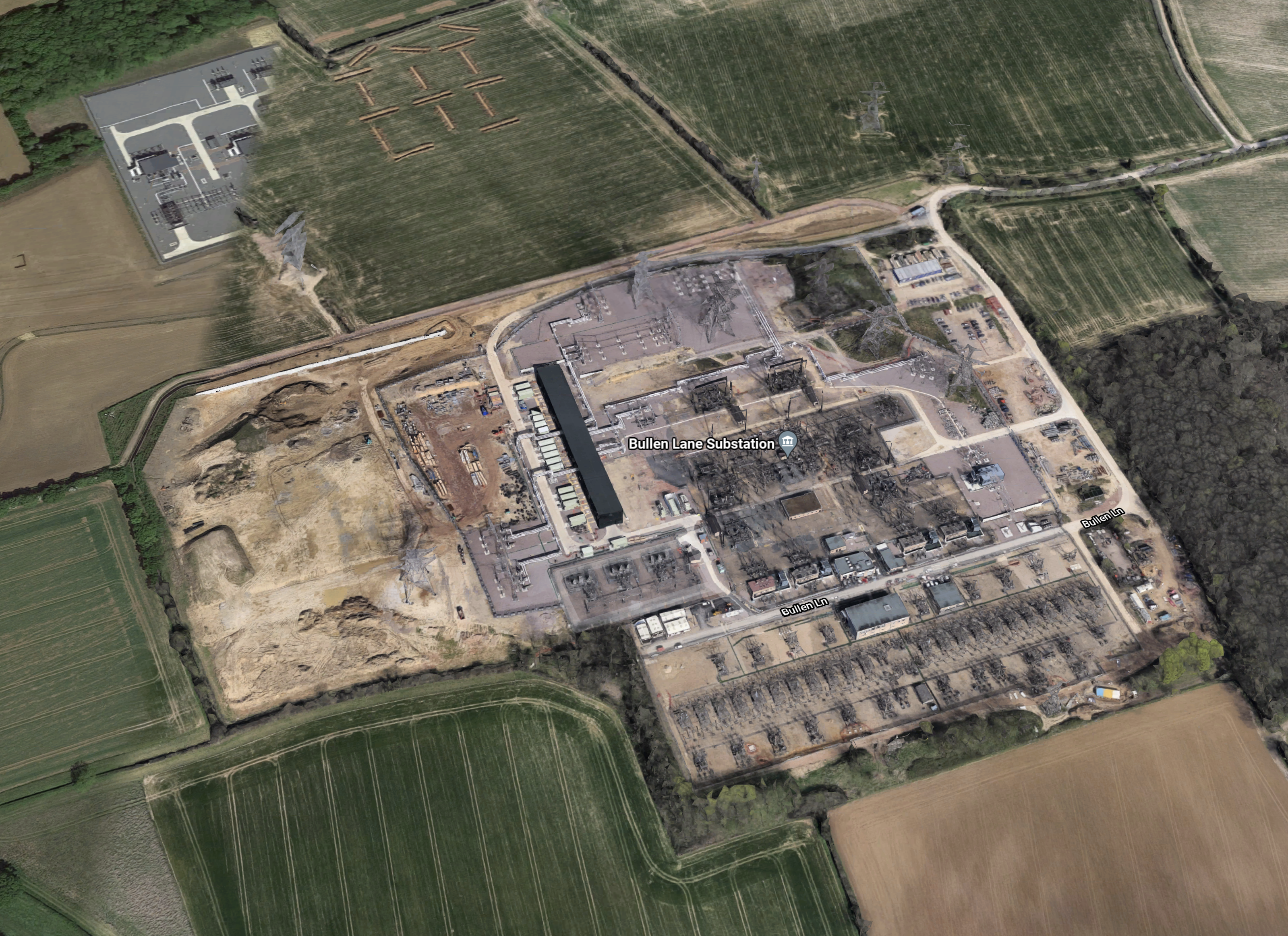
It looks impressive, but is it big enough to handle all the electricity coming ashore from the offshore wind farms to the East of Suffolk and the electricity from the power stations at Sizewell?
Conclusion
I believe there are a lot of possibilities, that would meet the threeobjectives, I stated earlier.
- Avoid as much disruption on the land as possible.
- Create the capacity to deliver all the energy generated to customers, either as electricity or hydrogen.
- Create an expandable framework, that would support all the wind farms that could be built in the future.
In addition, simple mathematics says to me, that either there will need to be extra capacity at both Bicker Fen and Bullen Lane substations and onward to the rest of the country, or a large electrolyser to convert several gigawatts of electricity into hydrogen for distribution, through the gas network.
Catalyst Capital Makes First Move In GBP 300m Battery Storage Strategy
The title of this post, is the same as that of this article on Renewables Now.
This is the first paragraph.
Fund manager Catalyst Capital has acquired a site to build a 100-MW battery in Yorkshire, northern England, in the first of a series of planned deals under a GBP-300-million (USD 406.1m/EUR 358.9m) strategy to develop diversified UK battery energy storage systems (BESS) facilities.
£300 million, says to me that the finance industry, now finds battery storage to be a worthwhile investment.
Skelton Grange Power Station
This Google Map shows the location of the Skelton Grange power station site, where the battery will be developed.
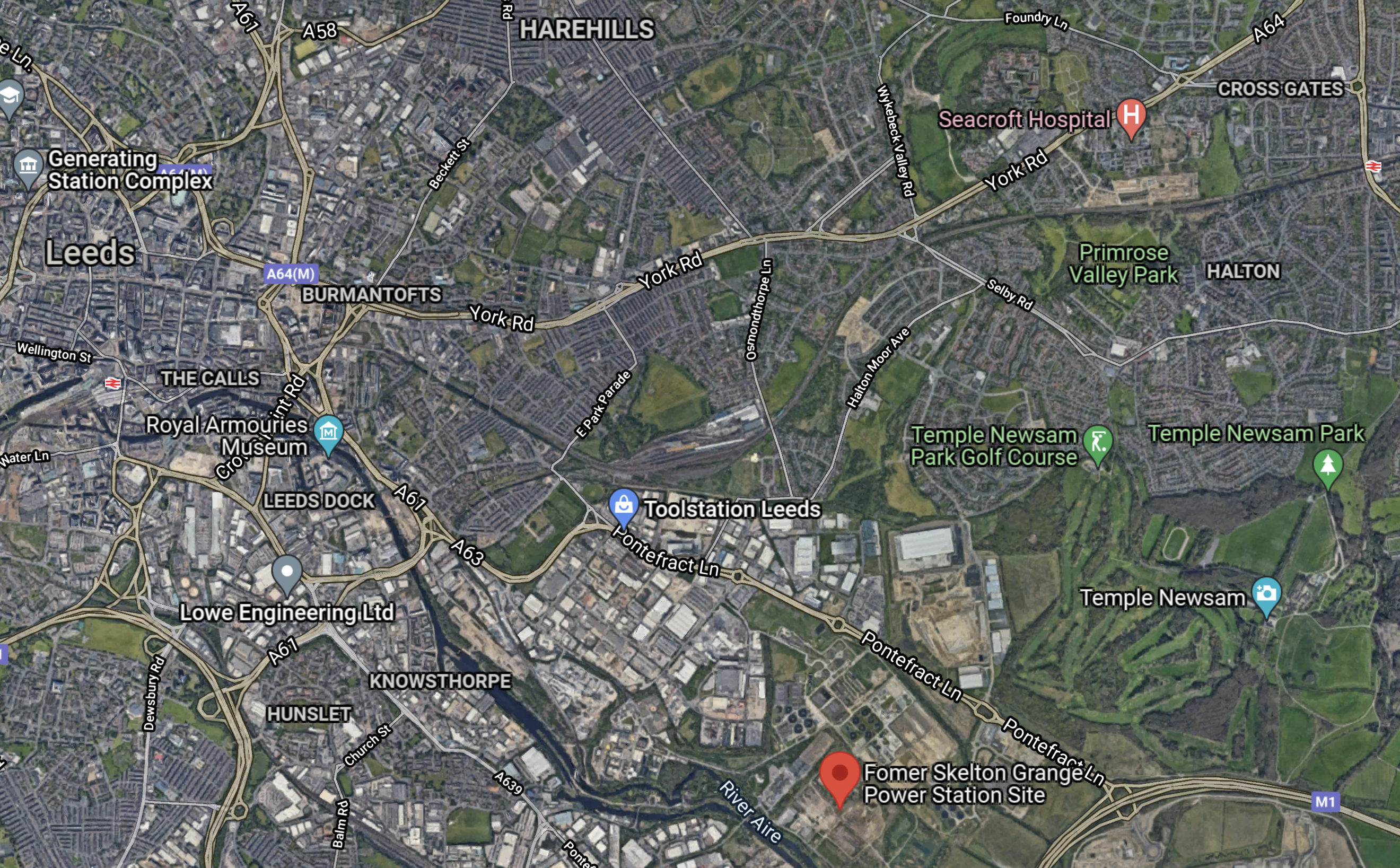
And this second Google Map shows the site in more detail.

Note that there is still a sub-station on the site.
The article states that planning permission was received in 2021 and they hope to have the facility on-line in the first quarter of this year.
That appears quick to me. Is it because the electrical connection already in situ?
It should also be noted, that the battery output of 100 MW is much less than that of the former coal-fired power station in the mid-1980s, which was at last 480 MW.
I also wonder, if the site could host a hydrogen fuelling station for buses.
- It is not far from the centre of Leeds.
- It has a good connection to the National Grid.
- An electrolyser like the one built by ITM Power at Tyseley Energy Park uses 3 MW of electricity to produce around 1.5 tonnes of hydrogen per day.
I also feel that the site could host a wind turbine up to about 10 MW.
Conclusion
Catalyst Capital seems to have made a big entry into the market. They won’t be the last to do this, as the returns are there and the battery storage is needed.
Why Use A Hydrogen Pipeline Rather Than A Electricity Cable To Bring Electricity Ashore From A Windfarm?
A comment to the post entitled Siemens Gamesa Partners On Offshore Wind-to-Hydrogen, was as follows.
Trying to get my head around this concept. Build an electrolysis plant in the North Sea and run a hydrogen pipeline to shore, rather than generating electricity and transferring the power by undersea cable to a shore based electrolysis plant. Can it really be better technically and economically? Someone convince me.
The reasons probably all come down to saving money and hassle.
Reusing Existing Infrastructure
Supposing, you have an offshore gas field, which is on the point of being worked out.
- It has a well-maintained platform on top.
- It has a pipe to an onshore terminal that handles the natural gas and distributes it to end-users.
Supposing the following are possible.
- Building a large wind farm in the vicinity of the platform.
- Using the gas field for hydrogen storage.
- Converting the gas terminal from natural gas to hydrogen.
- The end-users can convert to hydrogen.
In some cases the end-users might even prefer hydrogen to natural gas, to help their own decarbonisation.
I would suspect that there will be a sound economic case to use hydrogen, where wind farms are developed, in the same areas as worked-out gas fields.
- Platform demolition costs are deferred.
- No HVDC link is needed, with an expensive converter station at the shore end.
- The new system comes with energy storage.
The only extra cost might be that an offshore electrolyser is more expensive than an onshore one.
Engineering Resources
The engineering resources needed for a gas pipeline are different to those needed for an electrical system.
But because gas pipelines are a declining industry, they will be readily available.
Less Planning Hassle
There have been some objections to the development of wind farm terminals by Nimbies.
If a terminal is converted from natural gas to hydrogen, I suspect there will be fewer objections.
Better Control Of Wind Farms
There have been stories of wind farms having to be switched off because there is no-one to buy the electricity.
If some form of offshore hydrogen storage is possible, then the electricity can be used to generate hydrogen, which can be piped ashore, when it is needed.
It Won’t Be One Type Fits All
I suspect we’ll see some hybrid systems and other innovative engineering.
Conclusion
I believe that in a drive to cut costs, we’ll see a lot of energy brought ashore as hydrogen gas.
I
Riding Birmingham’s New Hydrogen-Powered Buses
I went to Birmingham today and took one of their new hydrogen buses on route 51 to Perry Barr and another one back.












































Note.
- As the pictures show Perry Barr is a bit of traffic bottleneck because of the reconstruction of Perry Barr station an other developments in the area, because of the Commonwealth Games, which are going to e held in Birmingham in 2022.
- The route goes past the High Speed Two site.
- Birmingham is a city of highways, flyovers, underpasses and roundabouts.
- The buses have wi-fi and charging points for phones.
I very much feel that the buses are the best hydrogen-powered vehicles, that I’ve travelled in, as they are smooth, comfortable, quiet and seem to have excellent performance.
Birmingham Buses Have Their Own Hydrogen Electrolyser
London bring their hydrogen in by truck from Runcorn, where it is created by electrolysis, for their hydrogen-powered buses.
On the other hand, Birmingham Buses have their own electrolyser at the Tyseley Energy Park.
This Google Map shows Tyseley Energy Park.

Note.
- The Birmingham Bus Refueler hadn’t opened, when this map was last updated.
- Tyseley Energy Park is only a few miles from the City Centre and route 51.
- I estimate that the Tyseley Energy Park occupies around four hectares.
This page on the Tyseley Energy Park web site described the refuelling options that are available.
- Fuels available include hydrogen, biomethane, compressed natural gas, diesel, gas oil and AdBlue.
- There are a range of charging options for electric vehicles.
The 3 MW electrolyser was built by ITM Power of Sheffield, which I estimate will produce nearly 1.5 tonnes of hydrogen per day.
According to this page on the Wrightbus website, a hydrogen-powered double-deck bus needs 27 Kg of hydrogen to give it a range of 250 miles. The refuelling of each bus takes eight minutes.
So the current fleet of twenty buses will need 540 Kg of hydrogen per day and this will give them a combined range of 5000 miles.
It would appear that the capacity of the electrolyser can more than handle Birmingham’s current fleet of twenty buses and leave plenty of hydrogen for other vehicles.
Could Other Towns And Cities Build Similar Energy Parks?
I don’t see why not and it looks like ITM Power are involved in a proposal to build an electrolyser at Barking.
Some would feel that London ought to follow Birmingham and create its own hydrogen.
.
Rolls-Royce Makes Duisburg Container Terminal Climate Neutral With MTU Hydrogen Technology
The title of this post, is the same as this press release from Rolls-Royce.
This is the first sentence.
Rolls-Royce will ensure a climate-neutral energy supply at the container terminal currently under construction at the Port of Duisburg, Germany.
There is also this Rolls-Royce graphic, which shows the energy sources.

It would appear batteries, combined heat and power (CHP), grid electricity, hydrogen electrolyser, hydrogen storage and renewable electricity are being brought together to create a climate-neutral energy system.
- As the graphic was named hydrogen technology for ports, I would assume that this is a Rolls-Royce mtu system that will be deployed at more than one port around the world.
- Note the H2 CHPs in the graphic. Could these be applications for Rolls-Royce’s beer keg-sized 2.5 MW electrical generator based on a Super Hercules engine?
- One of Rolls-Royce’s small modular nuclear reactors could be ideal for a large port outside Germany.
This is the last paragraph of the press release.
“Hydrogen technology is no longer a dream of the future, but hydrogen technology will prove itself in everyday use in Duisburg. The parallel use of fuel cell solutions and hydrogen engines shows that we have taken the right path with our technology-open approach to the development of new solutions for the energy supply of the future,” says Andreas Schell, CEO of Rolls-Royce Power Systems.
Rolls-Royce mtu appear to be very serious about the possibilities of hydrogen.
Ineos In Runcorn Is Key To UK Move To Hydrogen Energy
The title of this post, is the same as that of this article on Runcorn and Widnes World.
These are the first two paragraphs.
Thousands of buses and HGVs in the UK could soon be running on hydrogen – made in Runcorn.
The town, which already produces enough clean hydrogen to fuel 1,000 buses or 2,000 HGVs every day, is ramping up production to help reduce the amount of harmful CO₂ emissions on Britain’s roads.
The INOVYN site used to be owned by ICI in the 1960s and I used to work on the Castner-Kellner plant that electrolysed brine to produce sodium hydroxide, chlorine and hydrogen.
ITM Power Raises £250 million
The title of this post, is the same as that of this media release from ITM Power.
There is a also a sub-title.
Manufacturing Expanded To 5GW Per Annum By 2024
ITM Power are certainly going large.
Given the number of plans for electrolysers published around the world, a 5GW annual production is by no means over ambitious.
Fraunhofer Targets Hydrogen Adoption With Improved Electrolysis System Efficiency
The title of this post, is the same as that of this article on Hydrogen Fuel News.
This is the first paragraph.
The Fraunhofer Heinrich Hertz Institute (HHI) has announced that it is taking part in a new research project meant to accelerate hydrogen adoption. Its main focus is to examine water electrolysis in order to achieve improve efficiency.
The research project is called InnoEly, and this appears to be the project’s aim, as stated on the web site.
Modeling and characterization tools for the development of water electrolysers – from materials to system integration
This could be a project, that brings about a big improvement in the efficiency of electrolysers.
 The Anonymous Widower