One Of The Jobs I Did, That I’m Most Proud Of
In the early 1970s, I developed and attempted to market a simultaneous differential equation solving program called SPEED, which stood for Simple Program for the Efficient Evaluations of Differentials or something like that.
It wasn’t very successful, but two companies asked me to write some for them.
- For Time Sharing, I put the central algorithm into their simultaneous differential equation solver to move the program up to the next level.
- WS Atkins, asked me to install it on their computer.
SPEED had a few advantages over typical simultaneous differential equation solvers of the time like IBM/CSMP.
- IBM/CSMP needed at least an IBM 360/50 computer, which I ran it on at ICI in Welwyn Garden City, where I was a general mathematical dogsbody. But SPEED could run on a dial-up line to a time-shared computer like a PDP-10.
- The time-shared computers as used by Time Sharing and WS Atkins, gave the big advantage, that as the size of the computer increased, the size of the problem, that could be tackled in proportion.
- IBM/CSMP and SPEED both had a simple column-oriented report writer, which unsurprisingly ended up in Artemis, which I wrote a few years later.
- I can’t remember, who at ICI gave me the tip, but I used a sophisticated version of the Runga-Kutta algorithm, that everybody used and some probably still do today. The version, I used was called Runga-Kutta-England, where like me England, was a graduate of Liverpool University.
This summary by Google AI described the algorithm.
The England version of the Runge-Kutta method (developed by R. England) is a highly efficient 4th/5th order embedded numerical integration formula. By reusing intermediate slopes across two methods of differing orders, it provides a highly reliable built-in error estimate for adaptive step-size control.
Does anybody still use Runga-Kutta methods? I suspect not!
A breakthrough of sorts came, when WS Atkins asked me to produce a larger system of the SPEED software, that could handle several tens of thousands of equations.
- Atkin’s client was the Water Resources Board and they were modelling the water distribution system for a large part of the UK.
- Prominent in the project was a Dr. David A, Dimeloe and we became friends and had dinner with our wives a couple of times.
- But I never received a copy of the report, that was written or heard any more since about 1975.
- But judging by the fact, that we seem to have adequate supply of water in the UK and problems seem to be all about sewage, politics, management and finance, I feel that David and his team, must have done a good job.
- I was also never asked to fix any bugs in the software.
I did have some trouble getting the money I was owed from the intermediary in the deal, but I eventually retrieved it through the County Court without a solicitor.
SSE Energy Solutions Powers Ascot’s Shift To Electrification With One Of UK Sport’s Largest Rooftop Solar Projects
The title of this post, is the same as that of this press release from SSE.
The press release starts with these three bullet points.
- System expected to generate approx. 569,000 kWh of renewable electricity annually, reducing reliance on fossil fuel power
- Installation to supply around 9% of Ascot’s annual electricity needs
- Helps improve energy resilience and cost predictability through on-site generation
These first two paragraphs add more details.
Ascot Racecourse has taken a major step in electrifying its operations with the completion of a large rooftop solar installation, delivered in partnership with SSE Energy Solutions and Ortus Energy. The system, installed across the 480-metre Grandstand roof, includes more than 1,200 solar panels and has a total capacity of 608.04 kWp.
Once fully energised, the project is expected to generate approximately 569,000 kWh of renewable electricity each year. The electricity will be used on site to help power race days, including Royal Ascot, as well as more than 180 non-racing events hosted at the venue annually. By generating electricity at source, Ascot can reduce its reliance on grid electricity generated from fossil fuels and strengthen the resilience of its operations.
The installation will meet around 9% of Ascot’s total annual electricity demand.
I have a few thoughts.
The Scheme Is Delivered Via A Long-Term Power Purchase Agreement
This is the last paragraph of the press release.
Delivered via a long-term power purchase agreement (PPA), the project requires no upfront capital investment from Ascot. SSE Energy Solutions funds the installation, while Ortus Energy designs, installs and operates the system — enabling Ascot to access renewable electricity with long-term price visibility and reduced exposure to volatile fossil fuel markets.
It looks like King Charles III, who owns Ascot racecourse, hasn’t had to put any cash up front.
What Is The Capacity Of Ascot Racecourse?
Google AI said this.
Ascot Racecourse has a maximum race-day capacity of 70,000 guests, which was reduced from 80,000 to manage crowd density and improve the overall customer experience. The venue is divided into several enclosures, each with its own limit to maintain a comfortable environment during premier events like Royal Ascot.
It may be only the third largest horse racing venue in the UK, but it is probably larger than most sports stadiums.
Which Other Stadiums Have Or Plan To Have Solar Panels In The UK?
A quick use of Google AI found these.
- Hampshire Cricket Stadium
- London Stadium
- Principality Stadium
- Queen’s
I suspect this list could grow fairly quickly.
Could SSE Be Using Ascot Racecourse To Sell Solar Roofs?
Consider.
- Ascot racecourse is one of the most prestigious venues in the UK.
- Ascot racecourse has its own dedicated railway station.
- There are twenty-six race days per year.
- Both codes of horse-racing are featured.
- Some meetings are followed by live music.
- I suspect flying drones about the stands to show off the solar panels could be arranged.
- Catering should be top notch.
- Everything for a high-class sales-presentation should be available.
Ascot racecourse could be an ideal venue to sell large solar roofs to owners of sports stadia or other large buildings.
TerraLithium, BHE Renewables Announce Key Milestones For Geothermal Lithium Project In California
The title of this post, is the same as that of this article on ThinkGeoEnergy.
This is the sub-heading.
TerraLithium and BHE Renewables have announced key milestones towards advancing technology for lithium extraction from geothermal brines in Imperial Valley, California.
This is the important paragraph in the article.
The business model of coupling lithium and critical minerals extraction with geothermal energy production is gaining increasing attention, both in the United States and in countries like Germany, France, and the UK. As demonstrated in the United Downs geothermal power project in Cornwall, lithium extraction provides additional revenue generation that can significantly improve the economics of deep geothermal projects.
So here we have little Cornwall showing Big California how to get power and lithium out of hot rocks.
In Cornish Plant Produces Geothermal Power, I described the progress at the Cornish plant in March.
Has Andy Burnham Ever Said Anything On Geothermal Energy?
Given that there is an election or coronation under way, I just had to ask Google AI, the question in the title of this section.
This is the answer I received.
Yes, Andy Burnham has occasionally engaged with topics involving geothermal energy, particularly in the context of tapping natural underground heat and mine water for green energy
His notable references to the technology include:
Supporting Manchester’s Geothermal Potential: He has voiced support for localized renewable heat projects, such as exploratory borehole plans in Manchester city centre intended to tap into thermal springs for community heating.
I think we can put that down as a favourable view.
This excellent article on the BBC is entitled Plan To Heat Manchester Homes With A Geothermal Spring, is worth a full read.
Calls Grow For Direct Trains To New Universal Park
The title of this post, is the same as that of this article on the BBC.
This is the sub-heading
There are growing calls for more train services to run directly to Universal’s planned UK theme park.
These two paragraphs add more details.
West Northamptonshire Council said it had written to the secretary of state for transport to ask that Northampton be included in passenger service plans for East West Rail.
It comes after Northampton South’s Labour MP Mike Reader raised the issue in the House of Commons, warning the current plans meant the town could “miss out on the opportunities” the park brings.
How Will Universal United Kingdom Resort Connect To The Rail System?
I asked Google AI the question above and received this answer.
The proposed Universal United Kingdom Resort near Bedford will connect to the rail system via two primary railway stations:
Wixams Station (Midland Main Line): A two-platform station currently under construction to the east of the site. Universal plans to expand this to four platforms to accommodate high visitor volume, connecting passengers directly to Thameslink services in about 45 minutes from Central London. A dedicated fleet of resort shuttle buses will run between Wixams and the park entrance.
East West Rail Station (Stewartby): A dedicated, purpose-built station is planned directly adjacent to the resort on the western side of the park. This will replace the older Kempston Hardwick station, providing high-capacity, five-carriage trains running between Oxford and Cambridge.
Together, these stations and surrounding road networks—such as the upcoming dedicated slip roads off the A421—will form the East and West Gateway Zones for the resort.
This OpenRailwayMap shows the railways in the are of the Universal United Kingdom Resort.
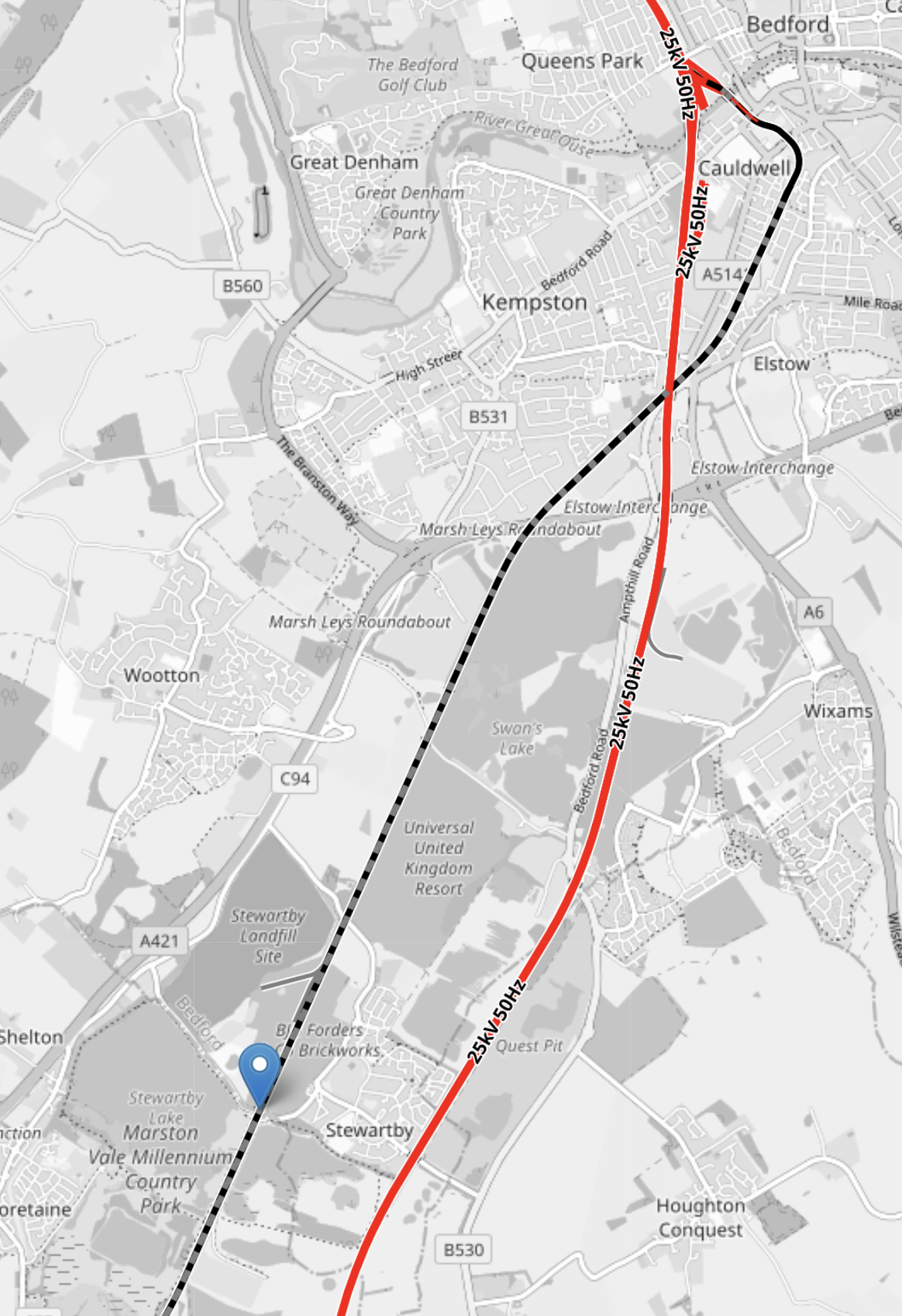
Note.
- The red track is the Midland Main Line between St. Pancras and Leicester, Derby, Nottingham and Sheffield.
- The black track is the East-West Rail between Bedford and Oxford when it opens.
- This section of the East-West Rail is shown dashed as it is not finalised yet
- The East-West Rail should eventually connect Oxford and Cambridge.
- The blue arrow indicates Stewartby station.
- The village of Wixams is at the right edge of the map.
If you read the Wikipedia entry for the new Wixams station, you get the impression, that a lot of groups and organisations don’t agree on lots of things about the railway, the theme park and Wixams station.
This second OpenRailwayMap shows the railways between Northampton and Bedford.
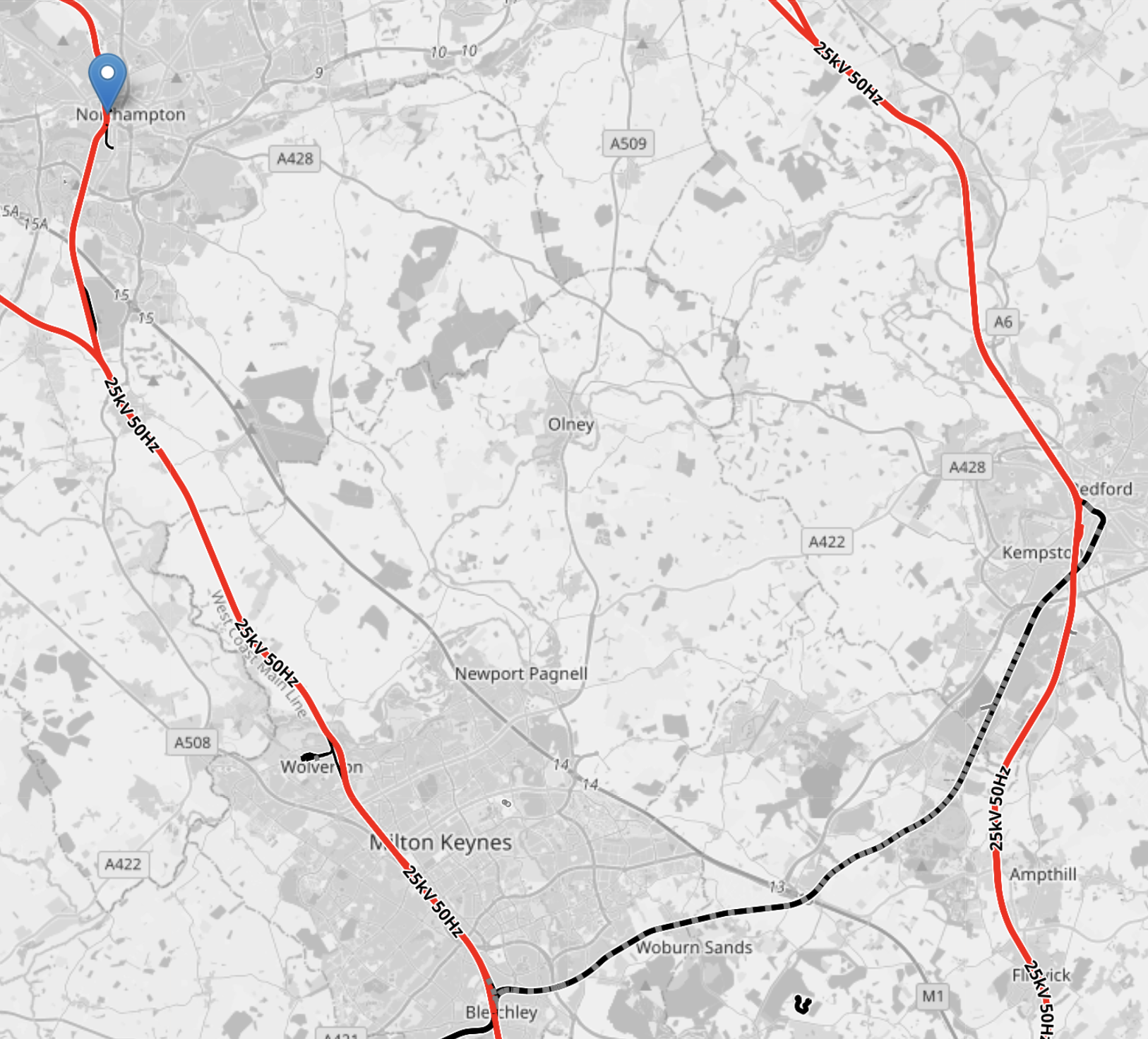
Note.
- The red tracks at the left are the West Coast Main Line between Euston and the North.
- The blue arrow indicates Northampton station.
- The red tracks at the right are the Midland Main Line between St. Pancras and the Midlands
- The black tracks connecting the two main lines are East-West Rail.
- The Western end of this section is at Bletchley, where the East-West Rail crosses the West Coast Main Line and also connects to it.
- The Eastern end of this section is at Bedford, where the East-West Rail joins the Midland Main Line through Bedford.
- Milton Keynes station is on the West Coast Main Line, just a few miles North of Bletchley station.
It looks to me, that a train could run between Northampton and Bedford stations, which could stop at Stewartby.
Are Universal United Kingdom Resort Going To Encourage Visitors To Use Rail?
I asked Google AI the question above and received this answer.
Yes, the Universal United Kingdom resort is making extensive plans to encourage and accommodate visitor travel by rail. The upcoming destination near Bedford is heavily integrating public transit into its infrastructure to manage the expected 8.5 million annual visitors.
The resort’s focus on railway accessibility includes several key features:
Dedicated Resort Station: Land has been explicitly reserved for a dedicated railway station directly at the resort on the East West Rail line, which connects Oxford and Cambridge.
Increased Train Frequency: To ensure seamless transportation, the East West Rail service plans to run up to five trains per hour during peak times specifically to cater to theme park visitors once it is fully operational.
Wixams Station Upgrades: A significant portion of a £1.3 billion government investment package is being utilized to construct and expand the nearby Wixams Railway Station, creating robust links along the Midland Mainline.
Initial Bus & Marston Vale Services: For the opening window of the park, Universal is setting up dedicated bus connections (such as from Milton Keynes) alongside existing local Marston Vale line options as full East West Rail expansions are completed.
Note how this question got slightly different answers to my original question, but they don’t conflict with each other.
I do find though with AI, that the more questions you ask and the more you refine those questions, the better answers you obtain.
But surely that is to be expected. Or at least hoped for!
Will Universal United Kingdom Resort Be Attracting Overseas Visitors?
I asked Google AI the question above and received this answer.
Yes, the Universal United Kingdom Resort will be a major draw for international tourists. Projections estimate that the park will attract well over one million overseas visitors annually, serving as a catalyst to boost Britain’s global visitor economy.
The resort’s target demographic is explicitly designed to tap into international travel markets:
International Forecasts: Tourism officials and developers project that up to one-third (30%) of all visitors in its opening year will be from overseas, with projections shifting toward a 40% to 50% international mix as the resort matures.
Global Location: As the only Universal-branded theme park in Europe, it will be highly accessible to travelers arriving through London’s major international airports and rail hubs.
Economic Boost: Because of this anticipated influx, the UK Government is backing the Universal United Kingdom Resort with £1.3 billion for strategic road and rail upgrades. This includes enhancing connectivity on the A421 and at Wixams train station to seamlessly transport international visitors directly to the Bedfordshire site.
Will Universal United Kingdom Resort Be Attracting Visitors From Scotland?
I asked Google AI the question above and received this answer.
Yes, the Universal United Kingdom Resort in Bedfordshire is expected to be a major draw for visitors from Scotland. As the first Universal-branded theme park in Europe, it is designed as a destination resort meant to attract millions of tourists annually from across the UK and the wider continent.
The projected 8.5 million annual visitors will be drawn from all over, driven by several key factors:
High-Speed Connectivity: Situated in Kempston, Bedfordshire, the resort is roughly 50 miles north of London. Scottish travelers can easily access it by taking direct train routes (e.g., LNER or Avanti West Coast) from Edinburgh and Glasgow to London Kings Cross or St Pancras, then catching connecting trains to Bedford in under an hour. Alternatively, direct flights into London Luton Airport place visitors within a very short distance of the park.
National Draw: Because it is the only destination of its kind in the UK, it is being positioned as a “must-visit” national tourist attraction, capturing a large domestic market extending well beyond the southeast of England.
I believe that travelling between Universal United Kingdom Resort and Scotland by rail could be improved significantly, if the following were to be done.
- Fit batteries to the Class 810 trains run by East Midlands Railway, so they could run between St. Pancras and Sheffield stations without using diesel. This in itself, would probably attract more passengers.
- I believe that little or no electrification would need to be added, so that Sheffield could be an all electric and probably faster, trip from London or Universal United Kingdom Resort.
- The battery-electric trains would need to be charged at Sheffield, but why not do this at Doncaster station, which is a station with copious electrification.
- Extending the Sheffield services to Doncaster would also allow LNER passengers between Aberdeen, Edinburgh or Newcastle and Derby or Universal United Kingdom Resort, to do the trip with a single cross-platform change at Doncaster between two almost identical Hitachi trains.
- Sadly, the Midland Main Line has suffered a tragic accident this week. Were passengers going between Scotland and say Luton Airport inconvenienced? I believe that linking the two London services together at Doncaster, would have advantages for passengers, operators and Network Rail. Especially, when engineering works are scheduled!
I talk about using battery-electric trains to fully electrify the Midland Main Line in Could Electric Trains Run Between St. Pancras International and Sheffield Stations With No More Electrification?
Has Andy Burnham Made Any Comments About The Picc-Vic Tunnel?
This is the introductory paragraph for the Wikipedia entry for the Picc-Vic Tunnel.
Picc-Vic was a proposed, and later cancelled, underground railway designed in the early 1970s with the purpose of connecting two major mainline railway termini in Manchester city centre, England. The name Picc-Vic was a contraction of the two key station names, Manchester Piccadilly and Manchester Victoria. The proposal envisaged the construction of an underground rail tunnel across Manchester city centre. The scheme was abandoned in 1977 during its proposal stages. The view was that the scheme still retained two large and expensive-to-maintain terminal stations in Manchester while other similarly sized cities had reduced their terminals to one.
Note.
- British Rail had a plan to improve the rail system in the North of England, by building rail tunnels under Liverpool, Manchester and Newcastle.
- Liverpool’s and Newcastle’s tunnels were built and are used by Merseyrail and the Newcastle Metro.
- Harold Wilson cancelled the Picc-Vic Tunnel, the TSR2, the Channel Tunnel and Maplin Airport, as he’d run out of taxpayer’s money.
I asked Google-AI, the question in the title of this post, and received this answer.
Greater Manchester Mayor Andy Burnham has made extensive comments about the Picc-Vic tunnel, effectively resurrecting the concept of an underground railway for the city.
Key details of his statements include:
The Vision: Burnham has tasked Transport for Greater Manchester (TfGM) with designing a conceptual underground system—which has been likened to a “Crossrail for Manchester”. He envisions two lines (North-South and East-West) intersecting at a new subterranean station at Manchester Piccadilly.
Rebranding the Concept: Acknowledging the original 1970s Picc-Vic plan that was ultimately shelved, Burnham views the new tunnel as an absolute necessity to cope with the city’s growth, stating “it is essential to the future economic prosperity of the city-region”.
Piccadilly Station: He is adamant that Manchester Piccadilly Station should be the “Kings Cross of the North”. He has pushed heavily against “cut-price” infrastructure, demanding an entirely underground railway option rather than sprawling over-ground train lines.
Next Steps: He has instructed officials to prepare detailed plans and cost estimates for the multi-billion pound project, with initial discussions on funding mechanisms already underway with the government.
You can read more about his 10-year strategy announcement on the BBC News report or follow local discourse on the Reddit Manchester threads.
Conclusion
If Andy Burnham is going to do all this for his beloved Manchester, can the rest of the country, afford him to be Prime Minister?
Encomara’s Floating Wind Installation Technology Gets ABS Design Approval
The title of this post, is the same as that of this article on offshoreWIND.biz.
This is the sub-heading.
Encomara’s floating wind installation technology, Squid, has received Product Design Assessment (PDA) certification from the American Bureau of Shipping (ABS)
These three paragraphs add more details.
The PDA follows an Approval in Principle (AiP) granted by ABS in November 2025 and moves the system a step closer to commercial deployment, according to Encomara, as it advances the technology along its qualification pathway towards Technology Readiness Level assessment and market adoption.
The technology is developed by Encomara and manufactured by Aurora Energy Services (AES), which acquired the Aberdeen-based company in 2025.
Squid integrates pre-installed mooring lines and electrical connections into a single subsea unit, enabling floating wind turbines to be connected using a “plug-and-play” approach.
In some ways the project reminds me of a floating oil and gas production platform, on which I did the calculations.
But the Balaena Structures design never sold a platform and the company, which was based in Cambridge, folded.
Encomara have a web site, which is well worth a visit.
Does Floating Wind Power Have A Higher Capacity Factor Than Fixed Foundation Wind Power?
I asked Google AI the question in the above sub-title and received this answer.
Yes. Floating wind power typically achieves higher capacity factors than fixed-foundation wind power.
The main reasons for this performance edge include:
Stronger, More Consistent Winds: Floating platforms allow turbines to be placed much further offshore, where wind speeds are higher, steadier, and less turbulent.
Access to Deeper Waters: Over 80% of deep-water offshore wind resources exist in waters too deep for fixed-bottom structures.
Performance Comparisons: Fixed offshore wind turbines typically see capacity factors ranging between 45% and 60% (depending on the location), whereas floating installations can push past 60%. For instance, the Hywind floating wind farm in Scotland achieved a capacity factor exceeding 65% in its first months of operation.
Despite this higher generation yield, floating wind technology is generally more complex and features higher installation and capital costs than fixed-bottom turbines.
I also believe that some of the floating wind technology, lends itself to advanced production and installation methods.
Toyota Hydrogen Cars At Le Mans
I gave the title of this post to Google AI and this is what I received.
Toyota is aggressively pushing hydrogen technology at the 24 Hours of Le Mans, moving beyond concepts to on-track public demonstrations of the TR LH2 Racing Prototype. Powered by a liquid-hydrogen combustion engine, the vehicle aims to showcase the viability of hydrogen as a near-zero emission fuel in endurance racing.
The TR LH2 Racing Prototype
The Vehicle: Built on the same chassis as Toyota’s TR010 HYBRID. It acts as a dedicated technology development platform to test hydrogen performance under extreme endurance conditions.
On-Track Debut: The prototype officially took to the track for demonstration laps at the 13.626km Circuit de la Sarthe during the 94th Le Mans 24 Hours.
The Drivers: The vehicle was driven in special dynamic sessions by former Le Mans winner Kazuki Nakajima.
The Competition: Toyota’s demos also featured other pioneering hydrogen machines, including the Alpine Alpenglow and the Ligier Bosch JS2 RH2.
Long-Term Vision & Infrastructure
Timeline: The ACO (Automobile Club de l’Ouest) is targeting the introduction of an official hydrogen class at Le Mans, with race entries potentially slated for upcoming endurance racing seasons.
Hydrogen Village: During the race week, Toyota highlighted the full hydrogen ecosystem.
Fans could explore the Hydrogen Village, which featured a functional TotalEnergies 700-bar liquid hydrogen refueling station.
Fuel Cell Support: Toyota’s commitment expanded to race operations, with official team staff and drivers utilizing hydrogen fuel cell buses and Toyota Hilux Fuel Cell prototypes during the event week.
Toyota seem serious about hydrogen.
Is The UK Developing Sea-Drones To Protect Wind Farms?
I asked Google AI the question in the title of this post and received this answer.
Yes, the UK is actively developing and utilizing sea-drones (and autonomous boats) for its offshore wind farms. This technology is being used to protect the farms by patrolling subsea infrastructure, inspecting underwater turbine foundations, and delivering heavy equipment to mitigate human risk.
Here is a look at how sea drones and autonomous systems are being developed and used for the UK’s offshore energy sector:
Subsea Security and Patrolling: The UK and NATO are highly focused on protecting critical subsea cables and wind networks from adversarial interference. Firms like Aberdeen-based Honuworx have been contracted to develop autonomous underwater vehicles capable of prolonged remote operation for defense and infrastructure surveillance.
Underwater Structure Inspection: Projects like the UNITE program (led by Heriot-Watt University and supported by the National Robotarium) are testing AI-controlled underwater robots to operate in turbulent seas and maintain offshore wind infrastructure. Meanwhile, Beam (an offshore wind services company) successfully deployed the world’s first AI-driven autonomous underwater drone at Scotland’s Seagreen wind farm, cutting inspection times in half.
Sailing Drones & Remote Operations: Energy companies like Vattenfall are controlling uncrewed surface vessels (USVs) and sailing drones from remote operation centers in Aberdeen to patrol and keep North Sea wind farms safe and efficient.
Heavy-Lift Cargo Drones: Beyond sea drones, energy giant Ørsted has utilized giant autonomous drones to deliver heavy equipment—like 70kg boxes of safety gear—directly to the tops of offshore wind turbines in the UK, removing the need for ships and cranes in rough seas
We should fight fire with innovation.
Can A ‘Secret Sauce’ Help Store Renewable Energy?
The title of this post, is the same as that as this article on the BBC.
This is the sub-heading.
The US-Israel war with Iran has led to higher electricity bills and put the issue of energy security back in the spotlight.
These two paragraphs add more detail to the story.
Now a pilot project inspired by a 100-year-old idea aims to store renewable energy.
Those behind the high density hydro demonstrator scheme near Plymouth say the technology can “turn small hills into giant batteries”, as part of the transition away from fossil fuels.
This is one of those stories, that could only emerge in the UK.
If you have the time, click on the link to the BBC article and read it in full.
I have a feeling, that the world will be hearing a lot about RheEnergise.
I asked Google AI, “How Much Energy Can A RheEnergise Battery Store”, and received this reply.
A RheEnergise system acts like pumped-storage hydro, using a dense fluid instead of water to store energy.
Planned commercial facilities are designed to store 2 to 16 hours of energy capacity, offering between 10 MW and 50 MW of power generation.
The exact energy storage figures for their deployments scale depending on the site requirements.
The breakdown of how these installations store and yield energy includes:
Commercial-Scale Capacity: A standard commercial site ranging from 10 MW to 50 MW will yield between 20 MWh and 800 MWh of total energy output (based on operating at full capacity for 2 to 16 hours).
The “Secret Sauce”: The system uses a proprietary fluid called R-19, which is 2.5 times denser than water.
This density allows the system to generate 2.5× more power and energy from the same physical footprint and vertical drop compared to traditional water-based facilities.
Real-World Pilot: The company operates a 500 kW demonstrator project at Cornwood near Plymouth, UK. This smaller test-bed, if run continually, generates energy equivalent to powering about 400 homes for an entire year.
Zero Seasonal Losses: Unlike chemical batteries (like lithium-ion) that degrade and lose charge over time, pumped hydro setups suffer virtually zero energy loss while the fluid sits idle.
Sizewell B Nuclear Plant To Get Life Extension
The title of this post, is the same as that of this article on Energy Live News.
This is the sub-heading.
Power station was slated to close in 2035 but could have its life extended by two decades
These two paragraphs add detail to the story.
EDF and Centrica are preparing to invest around £800 million to keep Sizewell B generating for another 20 years, according to reports.
The Suffolk nuclear plant is currently due to close in 2035 but the companies are in talks with the UK Government over a deal that could extend operations to 2055.
These are also some facts from Wikipedia and other sources.
- Sizewell B was commissioned in 1995.
- It has a capacity of 1.2 GW.
- It provides three percent of the UK’s power.
- According to Google AI, Sizewell B has had an excellent safety record.
- Sizewell A is the only UK nuclear power plant that I have visited and I was very impressed how they managed the annual shutdowns.
Incidentally, according to Google AI, Sizewell A generated electricity for forty years and only had one alarming problem during decommissioning.
How Many Similar Nuclear Plants Are There In The World Like Sizewell B?
I have to ask this question, as when you are running old machines of any type, the more operational examples you have the better.
I asked Google AI and received this answer.
Sizewell B is the UK’s only commercial Pressurized Water Reactor (PWR). Its nuclear core is based on the Westinghouse 4-loop SNUPPS (Standardized Nuclear Unit Power Plant System). While hundreds of PWRs operate worldwide, only two exact global clones share this foundational design, alongside heavily adapted reactors.
The Exact SNUPPS Clones (2 in the world)
Sizewell B’s “nuclear island” is fundamentally based on the SNUPPS model developed in the 1970s.
Only two other plants share this exact base design:
Callaway Nuclear Generating Station (Missouri, USA)
Wolf Creek Generating Station (Kansas, USA)
Note: While Sizewell B utilizes this base architecture, it features significant UK-specific modifications, such as heavily diversified safety systems and an Emergency Boration System.
Similar 4-Loop Westinghouse PWRs
If you are looking at the broader Westinghouse 4-loop PWR family—the wider technological class that Sizewell B belongs to—there are dozens of similar reactors spread across the globe.
These operate in countries like the United States, France, South Korea, and China.
I have been over four PWRs of various makes in the United States and only one gave me any cause for concern.
My training at ICI taught me, that if you have a complicated and possibly dangerous plant or factory, you must keep it tidy, as that lowers the risk of accidents.
This nuclear power plant was the most untidy industrial plant I’d ever seen. Since I visited in the 1980s, it has been decommissioned and demolished.
Would I Be Happy To See Sizewell B Carry On Generating?
Obviously, I’d be guided by the various authorities and information from around the world.
But Sizewell has the Leiston factor. Leiston is the nearest town to the Sizewell site.
This is a paragraph from Leiston’s Wikipedia entry.
Leiston thrived in the late 19th and early 20th centuries as a manufacturing town, dominated by Richard Garrett & Sons, owners of Leiston Works, which boasted the world’s first flow assembly line, for the manufacture of portable steam engines. The firm also made steam tractors and a huge variety of cast and machined metal products, including munitions during both world wars. The works closed in 1981 and the site was reused as a mixture of housing, flats and industrial sites. The Long Shop Museum, showing the history, vehicles and products of the works, remains as a heritage tourist attraction.
Did the engineering heritage of the area contribute to the good safety records of the first two Sizewell nuclear power stations?
I also lived near the nuclear site at Sizewell for thirty years and the feeling of Suffolk people about the power stations is more one of pride, rather than fear.

