Is The Testing Of All Babies In Italy For Coeliac Disease And Type 1 Diabetes Having Any Effects?
I asked Google AI, the question in the title of this post and received this reply.
Italy’s law (Law 130/2023) targets children aged 1 to 17 rather than newborns. Pilot screening programs (like D1Ce Screen) show major positive effects: they successfully catch hidden cases early—finding coeliac antibodies in nearly 3% of children and type 1 diabetes markers in 0.8%—which dramatically cuts down dangerous emergency complications like severe diabetic ketoacidosis at diagnosis.
Key Findings and Effects
Early Detection: Finds silent or pre-symptomatic cases that standard symptom-based testing misses.
Reduced Complications: Lowers severe diabetic ketoacidosis rates by up to 50% when type 1 diabetes is caught early.
High Prevalence Insights: Pilot data show coeliac markers reach nearly 2.8–2.9% in children, higher than previous global estimates.
Healthcare Feasibility: Proves that capillary blood collection through primary care pediatricians is organized and practical on a national scale.
The testing appears to be successful in Italy.
On The Bonnie, Bonnie Banks o’ Loch Lomon’
I couldn’t resist using the first line of one of the most famous Scottish traditional songs, as the title of this post.
But a very significant power station project, is to be undertaken in the area.
These are the opening few sentences of the Wikipedia entry for the Loch Sloy Hydro-Electric Scheme.
The Loch Sloy Hydro-Electric Scheme is a hydro-electric facility situated between Loch Sloy and Inveruglas on the west bank of Loch Lomond in Scotland. It is also within the Arrochar Alps. The site was originally suggested as the location of a huge pumped-storage scheme in 1936 by Edward MacColl, but this was rejected as being uneconomic. After the North of Scotland Hydro-Electric Board was created in 1943, it became the first of their proposed schemes.
This Google Map shows Loch Lomond and Loch Sloy.
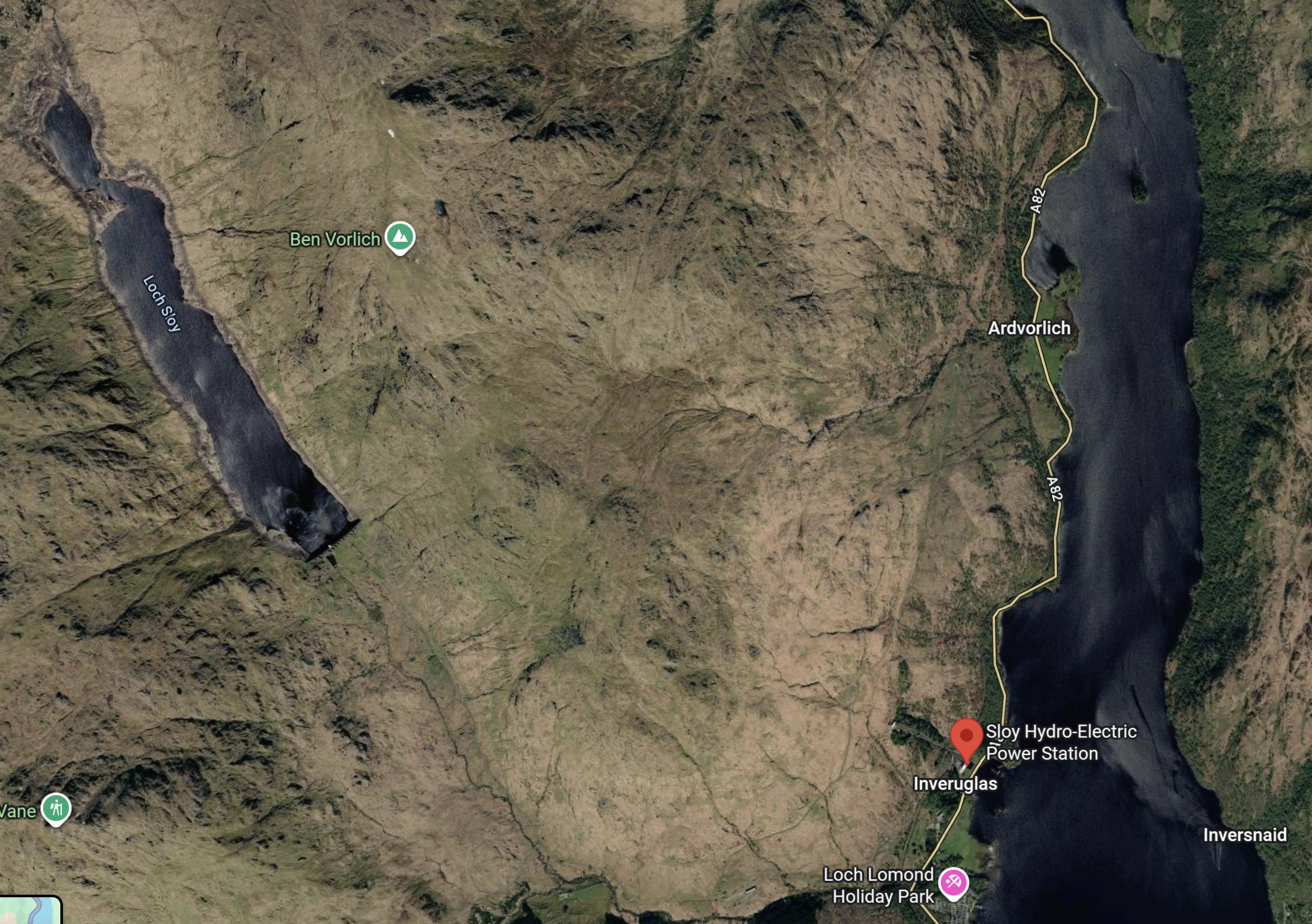
Note.
- Loch Sloy is in the North-West corner of the map.
- Loch Lomond is on the Eastern side of the map.
- The red arrow indicates the main buildings of the LochSloy Hydro-Electric Power Station.
- Loch Sloy is eight-hundred feet above Loch Lomond.
- The total generating capacity of the power station is 152.5 MW.
The facility is operated by Scottish and Southern Energy, and is normally in standby mode, ready to generate electricity to meet sudden peaks in demand. It can reach full capacity within 5 minutes from a standing start.
This second Google Map shows the power station to a larger scale.
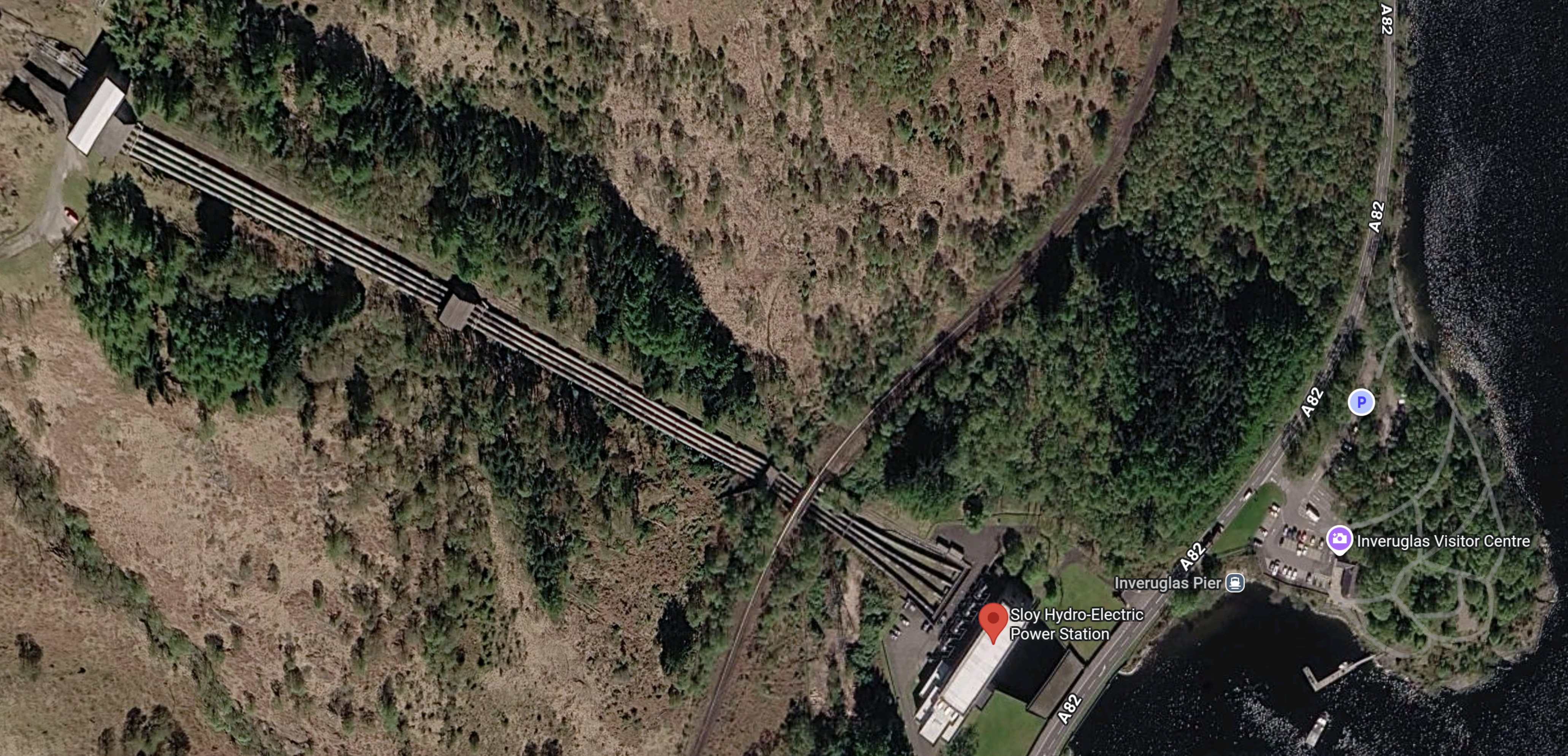
Note.
- Loch Sloy is to the North-West of the North-West corner of the map.
- Loch Lomond is on the Eastern side of the map.
- The red arrow indicates the main buildings of the Loch Sloy Hydro-Electric Power Station.
- The four pipes carry water from Loch Sloy to the actual power station.
- The single-track West Highland Line crosses over the four pipes at their South-Eastern end.
The design of Loch Sloy Hydro-Electric Power Station is typical of many hydro-electric stations all over the world.
This third map is an OpenRailwayMap of the area.
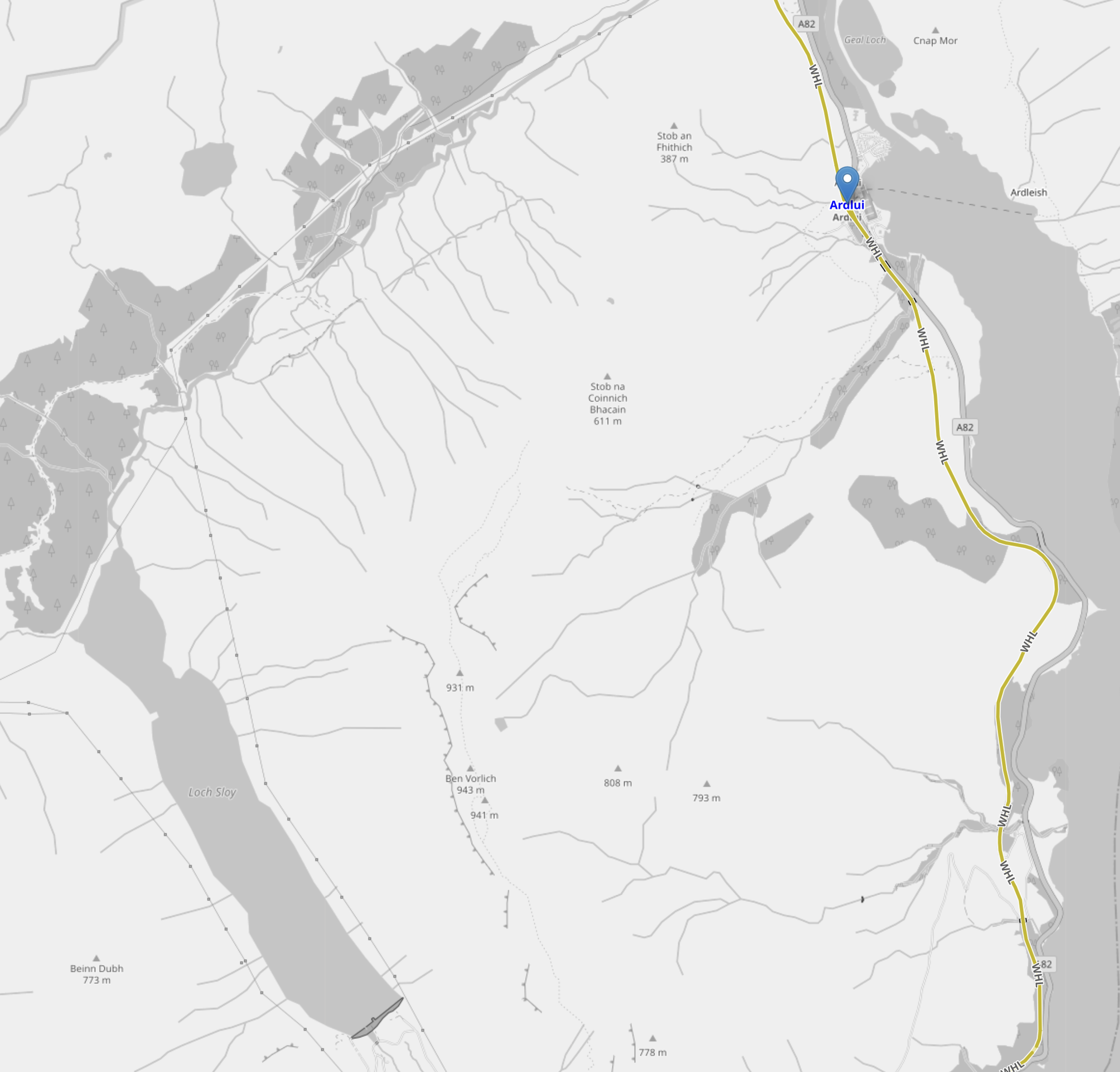
Note.
- Loch Sloy is on the Western side of the map.
- Loch Lomond is on the Eastern side of the map.
- The yellow track is the single-track West Highland Line between Glasgow and Mallaig via Fort William
- The blue arrow indicates Ardlui station.
The railway goes close to the power station.
A Platinum Celebration for Sloy Power Station!
The title of this section is the same as this must-read web page on the SSE web site, which dates from 2020.
Sloy Power Station Development Plans
This second must read web page on the SSE web site is entitled Sloy Power Station.
This is the sub-heading.
We’re Proposing To Convert Our Iconic 1950s Hydro Station To Pumped Storage Hydro
This is the introduction to the development.
In April 2025, we submitted a planning application to the Scottish Government to convert the iconic Sloy Power Station into a pumped storage hydro scheme.
Our proposals would bolster energy security and help provide the large-scale and flexible renewable energy back-up needed in a future UK net zero power system, helping meet the UK Government’s ambition of Clean Power by 2030.
If approved for delivery, the converted Sloy scheme would be capable of delivering up to 16GWh of long-duration electricity storage capacity.
It could provide firm, flexible renewable energy for up to 100 hours non-stop.
It appears that the upgraded power station will effectively become a 160 MW/16 GWh long duration energy store.
Currently, the UK’s largest pumped storage power station is the 1727 MW/9.1 GWh Electric Mountain in North Wales.
The updated Sloy power station will have less output, but more storage capacity, than Electric Mountain.
Should There Be A Railway Station At Loch Sloy Power Station?
Google AI gives this answer in reply to “Loch Sloy Railway Station”.
There was never a permanent public railway station called Loch Sloy, but temporary private platforms like Inveruglas railway station and Faslane Platform railway station served the area. These stops were built in 1945 by the London and North Eastern Railway (LNER) to haul materials and workers—including prisoners of war—for the construction of the Loch Sloy Hydro-Electric Scheme.
Note.
- Surely, similar reasons to those in 1945 could apply to the development of the power station. Materials and workers could be brought in by rail.
- Given, the power station’s historic significance, I believe that it could become a tourist attraction and/or education centre.It could be a stop for the Caledonian Sleeper.
I believe that as time passes, the power station’s historic significance will increase.
Are There Any Other Hydro Power Stations, That Can Be Upgraded To Pumped Storage Hydro?
Google AI can’t find anything at present.
UK’s Largest Onshore Wind Farm To Be Rebuilt With Fewer, Larger Turbines
The title of this post is the same as that of this article on the BBC.
This is the sub-heading.
One of Europe’s biggest onshore wind farms is to be flattened and rebuilt with fewer, taller turbines, its owner has announced.
These three paragraphs add more detail to the story.
Whitelee Windfarm has been producing electricity for about 20 years on a stretch of moorland near Eaglesham, south of Glasgow, but is reaching the end of its life.
Scottish Power Renewables says the existing 215 turbines will be replaced in three phases with around 124, each of which will be about 110m (361ft) taller.
The £1.5 billion “repowering” project will take 10 years to complete and will double the electricity output from 539 megawatts to 1 gigawatt, which is enough to power about 650,000 homes.
I asked Google AI,”Will there be any objectors to the repowering of Whitelee Wind Farm” and received this reply.
While there are no formal objectors on record yet, opposition to the repowering of Whitelee Wind Farm is highly anticipated. The developer, ScottishPower Renewables, officially filed their proposal with the Scottish Government in July 2026, but the formal planning application is not expected to be submitted until December 2027.
Anticipated objectors and their concerns typically include:
Campaign Groups & Environmentalists: Organisations like Scotland Against Spin generally challenge large-scale onshore wind projects over landscape dominance, ecological impacts, and the sheer scale of the new turbines.
Visual and Height Concerns: The repowering plan proposes replacing the existing 215 turbines with roughly 124 much larger machines. Each new turbine will stand roughly 110m taller than the current ones, which is expected to draw objections from those concerned about the visual alteration of the moorland.
Aviation and Radar Issues: Taller turbines and longer blades frequently raise fresh concerns and potential clearance objections from civil aviation and military radar stakeholders.
The BBC article finishes with this paragraph.
The work at Whitelee is expected to generate about £330m for the Scottish economy.
How many Scottish jobs will a third of a billion pounds sustain?
Welsh Manufacturing Boost As Sizewell C Awards Contract To Boccard UK
The title of this post, is the same as that of this news item from Sizewell C.
These two bullet-points act as sub-headings.
- Boccard UK will deliver Pools, Tanks, and Sumps (PTS) scope elements for Sizewell C
- Tanks will be manufactured at fully-digitised Deeside facility in North Wales, which supports over 200 jobs
These two paragraphs add some more details.
Sizewell C has awarded a major contract to Boccard UK to deliver its critical Pools, Tanks, and Sumps (PTS) scope elements – with manufacturing to take place in its Deeside facility in North Wales.
Over the four-year programme, Boccard UK will be responsible for the fabrication and pre-assembly of high-integrity stainless steel tanks. These components will be embedded within key reinforced concrete structures across Sizewell C’s Nuclear Island and will play an essential role in the power station’s long-term operation.
Note.
- Boccard UK is a subsidiary of long-established family-owned Boccard.
- Bruno Boccard and Patrick Boccard serve as the Chief Executive Officers (CEOs).
- Where will the stainless steel come from?
- Will finished products be delivered to Sizewell C by rail?
This Google Map shows Deesside Industrial Park.
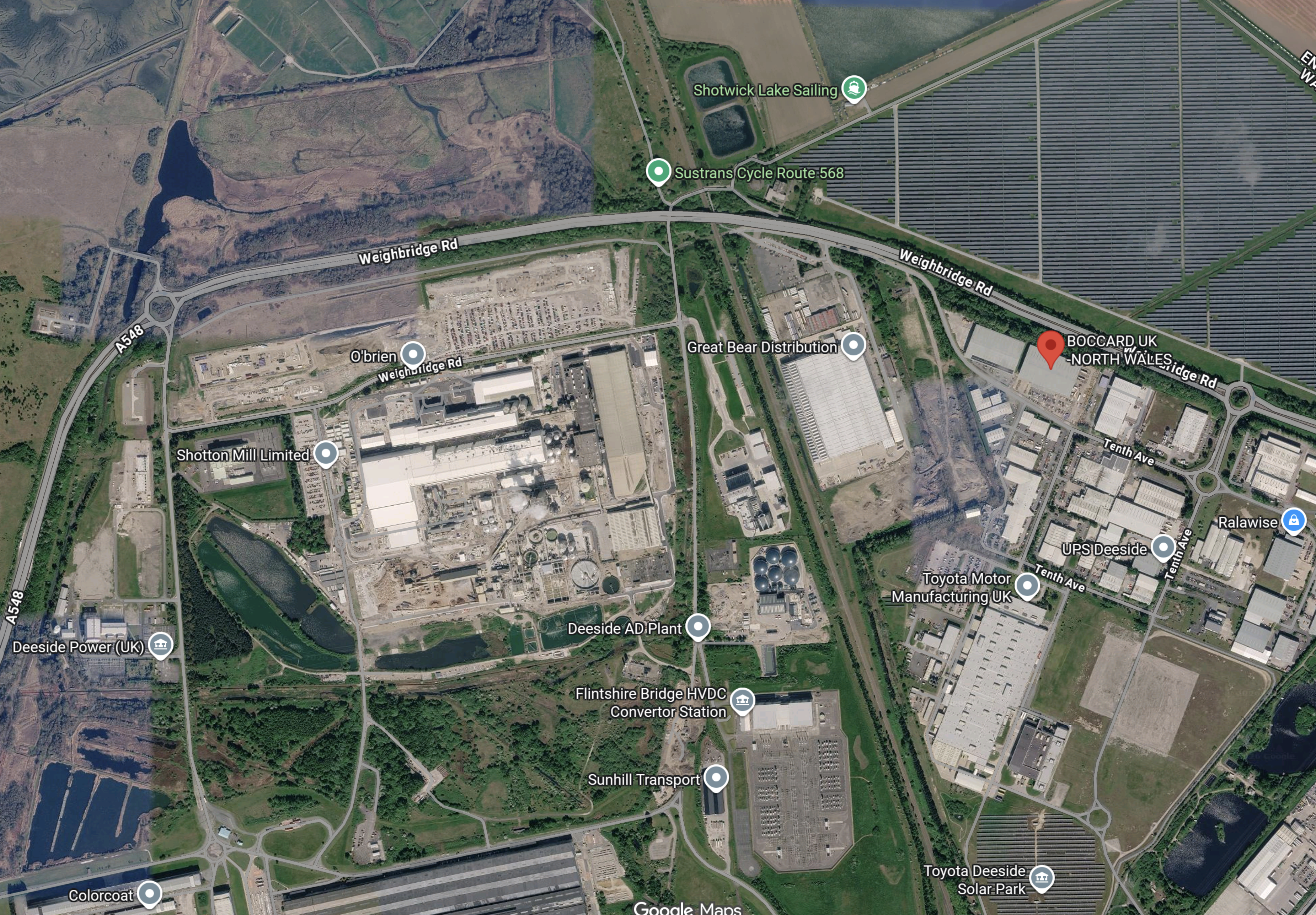
Note.
- The Boccard UK site is indicated by the red arrow.
- The Borderlands Line between Liverpool and Wrexham runs more or less North-South across the middle of the map.
- There is certainly a lot of solar power in the area.
- Deesside Parkway station will be built where Weighbridge Road crosses the railway.
- The station will be ideally placed for Sustrans Cycle Route 568, which goes from the Wirral to Chester via Hawarden Bridge.
I have added Deesside Parkway station to my list of stations to visit, when hopefully it opens at the end of 2027.
Does Deeside Industrial Park Have a Rail Freight Connection?
I asked Google AI, the question in the title of this section and received this answer.
Deeside Industrial Park does not have a general-use rail freight terminal. While parts of the adjacent Borderlands Line are used by industrial rail traffic—such as the Dee Marsh Reception Sidings and the Tata Steel site at Shotton—general businesses primarily rely on road freight. For broader rail freight connections, companies typically use facilities at the Port of Liverpool or the Euro Freight Line terminal in Crewe.
Despite that answer, if one of the tenants of the Deeside Industrial Park wanted a rail connection, I’m sure it could be arranged.
This Google Map shows the Dee Marsh Sidings and the adjacent businesses.
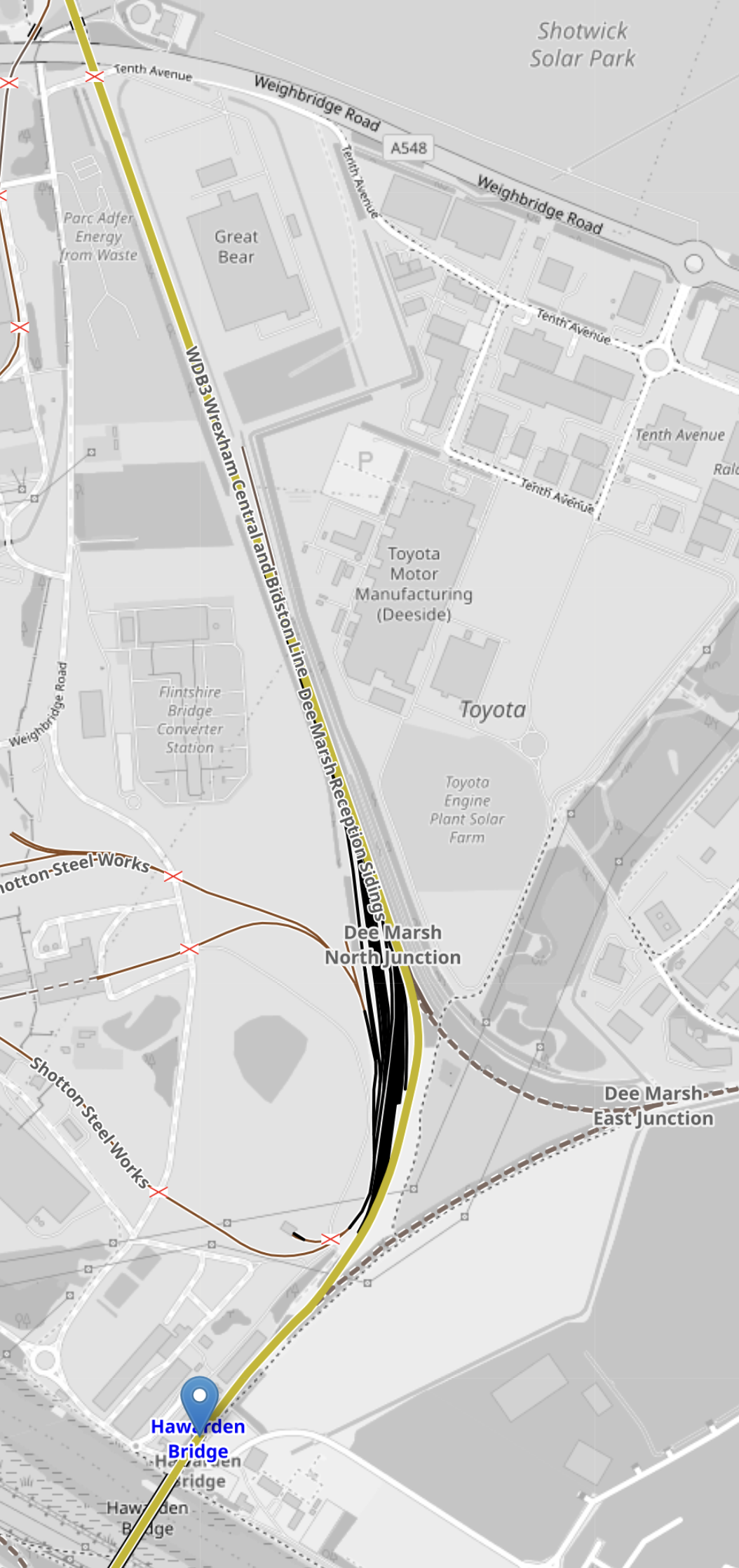
Note.
- The Borderlands Line between Liverpool and Wrexham runs more or less North-South across the middle of the map.
- Hawarden Bridge and Hawarden Bridge Station are in the South-West corner of the map.
- The Dee Marsh sidings are tucked inside the bend of the Borderlands Line.
- Rail lines seem to fan out to all corners of the Shotton steel works.
- The Boccard UK site is in the North-East corner of the map. Their site is the middle one of the five lined up on Weighbridge Road.
- Toyota’s engine plant fills in much of the space to the North-East of Dee Marsh Sidings.
I believe that if one of the tenants of the Deeside Industrial Park wanted a rail connection, I’m sure it could be designed and built.
Will Andy Burnham Take The Highview Road To Lower Energy Bills?
Has Andy Burnham Ever Said He’d Like Energy Bills To Come Down?
I asked Google AI, the question in the title of this section of this post, and received this reply.
Yes, Andy Burnham has explicitly stated he wants to bring energy bills down, making it a central priority upon becoming UK Prime Minister in July 2026. He has pledged to give voters “breathing room” on the cost of living and is considering radical market overhauls to reduce household costs.
But has he looked at radical engineering solutions, that would also help to push energy bills down.
This morning, I wrote Molten Salt And Human Sweat: The Weird Batteries That Could Store Renewable Energy, which is based on a must-read article in today’s Guardian.
The Guardian article shows Andy Burnham with Highview Power’s engineers and managers at the ground breaking ceremony of Highview Power’s 50MW/300 MWh liquid-air grid battery at Carrington in Andy Burham’s feifdom of Greater Manchester, where he was mayor for nine years.
In Andy Burnham and Highview Power, I asked Google AI about their relationship and Andy Burnham came over as an enthusiastic supporter of Highview Power.
In UK Wind Risks ‘Exponentially Rising’ Curtailment Without Energy Storage, I discuss using Highview’s batteries to avoid shutting wind turbines down, when we have too much electricity.
I believe that if Andy Burnham, were to experdite up to 20 of Highview’s largest 300 MW/3.2 GWh batteries around the UK, this would have the right effect on energy bills.
I would hope that Andy Burnham is watching the progress of the Carrington battery closely.
North-East-Based Turntide Receives Initial Battery Production Order From Hitachi Rail For Arriva’s Grand Central Intercity UK Battery Trains
The title of this post, is the same as that of this news item from Turntide Technologies.
This is the sub-heading.
New batteries to enable greener train operations to remove over 600 engines on existing trains, offering lower cost of operations, more range, and path to zero-emissions travel.
These are the initial three paragraphs, that add more detail.
Turntide Technologies (Turntide), a global leader in electrification and hybridisation solutions and a long-standing North East manufacturer, received its first order from Hitachi Rail to begin production of its next-generation modular battery system for the first U.K.-manufactured battery trains for Arriva’s Grand Central.
First announced on July 2, 2025, this partnership involved an R&D component and has officially moved into production with the potential to support either new battery trains or retrofitting over 600 engines on existing Hitachi Rail U.K. fleets.
This new battery system will allow for lower cost of operations, extended range, and a path to zero-emission travel, while reducing reliance on fossil fuels and improving air quality and noise pollution. Turntide’s bespoke batteries are designed to deliver even greater power density in the same footprint of a diesel engine. This battery production is an advanced manufacturing milestone for Arriva’s Grand Central new fleet, which is being built in Newton Aycliffe, County Durham by Hitachi Rail.
In Are Hitachi’s Tri-Mode Trains Exceeding Expectations?, I said this.
I asked Google AI, the question in the title of this post and received this answer.
Yes, Hitachi’s tri-mode (battery-hybrid) trains are exceeding expectations, particularly following successful trials in the UK in late 2024. Trials of the battery-equipped Class 802/2 demonstrated superior performance to initial forecasts, leading to a £300 million order for a new fleet to be delivered in 2028.
Key findings from trials and operational expectations:
Performance Exceeded: The trial, conducted with TransPennine Express and Angel Trains, showed fuel cost savings of 35%–50%, surpassing initial predictions of up to 30%.
Operational Capability: The battery technology enabled trains to reach speeds greater than 75 mph and provided enough range for zero-emission, silent running in and out of stations, significantly reducing noise and improving air quality.
Energy Efficiency: The battery matched the weight of a diesel engine, meaning no extra track degradation.
Future Impact: The success of the trial led to an order from Arriva Group for a new fleet for Grand Central services, which will increase seating capacity by 20% and are expected to significantly reduce carbon emissions.
These trains, designed to run on electric, battery, or diesel power, are part of a push to modernize rail services, with the technology allowing for the gradual elimination of diesel-only operation on certain routes.
In The Data Sheet For Hitachi Battery Electric Trains, I came to these conclusions.
- The battery pack has a capacity of 750 kWh.
- A five-car train needs three battery-packs to travel 100 miles.
- A nine-car train needs five battery-packs to travel 100 miles.
- The maximum range of a five-car train with three batteries is 117 miles.
- The maximum range of a nine-car train with five batteries is 121 miles.
Hitachi have seen my figures and told me they’re not far out.
As battery technology gets better, these distances will increase
What Battery Range Do Arriva Grand Central Trains Need?
Arriva Grand Central Trains currently run services to Bradford Interchange and Sunderland and hope of adding services to Cleethorpes.
All services would go between Doncaster and Kings Cross, with some stopping additionally at Peterborough.
The lengths of unelectrified track on each route is as follows.
- Bradford Interchange – Shaftholme junction and Bradford Interchange is not electrified – 47.8 miles
- Cleethorpes – Doncaster and Cleethorpes is not electrified – 52.1 miles
- Sunderland – Northallerton and Sunderland is not electrified – 47.4 miles
Note.
- Bradford Interchange station is on a tightly hemmed-in site and putting charging infrastructure in the station might be difficult.
- All Bradford Interchange services will soon be passing electrification at Mirfield station, so there may be scope for a quick charge and continue.
- Cleethorpes station is an open-air station with four platforms.
- I believe it is likely, that Cleethorpes station will also be a destination station for other battery-electric trains from LNER, Northern Trains and TransPennine, so I would suspect that charging facilities will be installed.
- Cleethorpes station could be an ideal location for one of Siemens’ Rail Charging Converters.
- Sunderland station is underground and has a unique layout where both platforms are electrified for the Metro. It is all explained in the Wikipedia entry for the station.
- The Wikipedia entry shows an open-air siding without electrification. One possibility would be for the Class 820 trains to park there and use their on-board diesel to top-up the batteries, so they could reach Northallerton.
- It appears that Grand Central visit Ryhope Grange Sidings between arriving and leaving for King’s Cross. The trains could have their batteries topped up there if needed.
It does look like a five-car train with a battery range of at least 105 miles would be able to handle these three routes.
The Arriva Grand Central Trains Fleet Are Now Class 820 trains
They have a Wikipedia entry.
The order was for nine trains of five cars.
- Wikipedia describes them as tri-mode trains.
- I believe they will have three battery packs and one diesel generator.
- Three battery packs should give a range of 117 miles.
- Google AI says that on one diesel generator, these trains can limp home at 60 miles per hour.
- Google AI says that the diesel generator will be able to charge the batteries at the destination station?
- From comments on the Internet, it appears that Hitachi have a very clever train control system, that ekes out the available power.
It looks to me that Hitachi have designed a train that can handle an unelectrified branch line of up to 60 miles or 120 miles if there are charging facilities at the destination station.
Did LNER And TransPennine Express Not Want To Be First With Battery-Electric Intercity Trains?
Consider.
- TransPennine and LNER are under government control.
- TransPennine provided the train for the testing, so they must know all the results and their drivers, who were probably involved certainly do.
- LNER must have the best initial route in King’s Cross and Lincoln, where only the last 16.6 miles, between Newark and Lincoln is not electrified.
- Surely, both companies should have been given at least one of the first batteries, so they could start training staff in how to use and service the batteries.
I have also totalled how many existing diesel power-packs are in existing Hitachi trains and it is 759.
This figure surprised me, as the sub-heading in the Turntide news item said the number of engines in existing trains was over 600. But then East Midlands Railway are still introducing their fleet of 33 x Class 810 trains, which have a total of 132 engines, and 627 could be described as over 600 engines.
How Much Would A Turntide Battery-Pack Cost?
Consider.
- This is a bespoke product for Hitachi.
- Hitachi have stated that the weight is the same as a diesel-pack, so that track-access rules and charges won’t change.
- As a Control Engineer, I wouldn’t be surprised, that the battery-pack is designed to tell the train control system, that it is a diesel power pack. So it acts just like one!
- In the 1960s, I was designing, building and installing transisterised control systems to replace electronic valve and relay equipment in a rolling mills. The two generations of control systems were interchangeable. Are diesel-packs and battery-packs the same?
- Why did Hitachi choose a small supplier in Gateshead, rather than one of a number of capable companies in Japan? You don’t go halfway around the world, if the quality is available locally.
- Deployment of these trains, will avoid the cost of scores of miles of overhead electrification.
- A lot of routes won’t even need chargers at the remote destination, as the range will be sufficient for an out and back journey from the current electrification.
- Fuel cost savings of 35%–50% were achieved in development testing.
- I have ridden in three battery-electric trains. All were mouse quiet. Will that increase ridership?
I believe these batteries are no ordinary batteries. So they won’t come cheap!
I wouldn’t be surprised that the cost of each battery-pack between a half-a-million pounds and a million pounds, with support.
Will These Trains Create Growth In The Economy?
I have ridden in all current variants of the Hitachi Intercity Express Trains, with the possible exception of the Class 805 train and as each version has been introduced, they are no worse, but often better than previous versions.
I have had two or maybe three return trips to Nottingham and Sheffield in the latest variant, which is East Midlands Railway’s Class 810 train.
This is without doubt the pick of the bunch.
I therefor believe that if this continuous improvement carries on, that the new Class 820 train, that has been ordered by Grand Central will be even better.
- My experience of battery-electric trains, says it will be quieter.
- The environment of stations will be improved.
- Train fuel costs will be reduced.
- I believe that ridership will be increased, as people will be intrigued by a 125 mph train running on batteries.
- The trains will have the ability to divert via Lincoln using the GNGE Diversion on the East Coast Main Line during engineering works.
- Because of their regenerative braking, the trains should be able to do very quick extra stops at intermediate stations.
- New routes will be developed.
- Less ugly electrification will be erected on scenic routes like Settle and Carlisle, and across the Highlands of Scotland.
I believe strongly, that at the end of the day, that battery-electric trains will increase the profits of operators and Network Rail, and reduce the cost to the taxpayers of the railways.
Grand Central’s New Trains Will Improve Services
All these stations will be served by the new Class 820 trains.
- Barnetby
- Bradford Interchange
- Brighouse
- Cleethorpes
- Doncaster
- Eaglescliffe
- Grimsby
- Habrough
- Halifax
- Hartlepool
- Low Moor
- Mirfield
- Northallerton
- Peterborough
- Pontefract Monkhill
- Scunthorpe
- Seaham
- Sunderland
- Thirsk
- Wakefield Kirkgate
- York
Passengers should notice the following from the new Grand Central trains.
- A quieter ride.
- Less vibration.
- Slightly faster services due to faster stops at stations.
- No diesel smoke and much less noise from trains in stations.
Note.
- Cross Country, Hull Trains, LNER, Lumo, TransPennine Express and other operators will come under pressure to follow suit.
- Batteries, will not have the power for freight trains, so will we see a new generation of hydrogen freight locomotives?
But will the improved services bring that exclusive growth to the economy?
Only time will tell!
Private And Public Operators
In the UK, we have.
- Private open access operators like Grand Central, Hull Trains and Lumo, who can buy trains on a loan from a leasing company.
- Public operators like LNER and TransPennine Express, who probably have to get sign off from the Treasury.
- Several companies like Great Western Railways and East Midlands Railway, who are soon to be taken over by Great British Railways, who are stuck in a sort of limbo.
My late friend ; David, who rose to the highest level in banking in the UK, would have come up with a solution.
He would probably have said, that there’s is very little difference between the groups of operators.
- The train services they offer vary only on destinations and prices.
- The ticketing system is now unified, so if you turn up at the last minute and want to go to Newcastle and Lumo and LNER both have tickets, you are offered a choice and you can pick the one that’s best for you.
- All services will soon be running similar battery-electric trains, fprobably from the same Hitachi factory in Newton Aycliffe.
- Food and beverage service is not competitive and could be improved.
- Staff are probably on similar employment agreements.
So why shouldn’t Great British Railways be able to lease trains and even battery packs from companies like Angel Trains, who are funding the trains for Grand Central?
It might get more battery trains running on tracks all over Great Britain sooner than it appears they will now!
Poland Receives Its First Electricity from Offshore Wind As Baltic Power Starts Delivering
The title of this post, is the same as that of this article on offshoreWIND.biz.
This is the sub-heading.
Electricity generated by the Baltic Power offshore wind farm has entered Poland’s national power grid, marking the first time the electricity generated by offshore wind turbines is added to the country’s energy mix.
This first paragraph gives more details of the project.
54 of 76 turbines have already been installed at Poland’s first offshore wind farm, with the first now generating electricity. Construction is scheduled for completion this autumn, ORLEN and Northland Power, the owners of the project, said.
When complete, the Baltic Power wind farm will generate up to 1.2 GW.
How Much Offshore Wind Does Poland Have Planned?
I asked Google AI, the question in the title of this section and received this reply.
Poland has massive offshore wind plans in the Baltic Sea.
The country targets 5.9 GW by 2030 and 18 GW by 2040. To meet these goals, the government is pursuing two primary development phases to transition the national grid away from coal.
A breakdown of Poland’s offshore wind rollout includes:
Phase I (Advanced Projects): Includes 5.9 GW of capacity.
Baltic Power: Poland’s first offshore wind farm (1.2 GW), developed by Orlen and Northland Power, officially connected to the national grid in July 2026.
Bałtyk 2 & 3: Equinor and Polenergia have finalized financing for an additional 1.4 GW, slated for commercial operation around 2028.
Phase II (Auction-Backed): Poland recently allocated over 3.4 GW in new capacity through competitive offshore wind auctions, pushing development well into the next decade.
Long-Term Outlook: Industry groups estimate the total technical potential in Poland’s portion of the Baltic Sea could reach up to 33 GW.
Will Poland Be Welcoming Any Invading Germany Wind Farms?
In New Study Shows How North Sea Offshore Wind Can Yield More While Costing Less, I talked about how Germany doesn’t have enough sea in which to place the wind farms it needs to generate the green electricity and hydrogen it needs.
This map from Wikipedia shows Exclusive Economic Zones in the North Sea, but it also shows who has control of the sea in the Baltic.
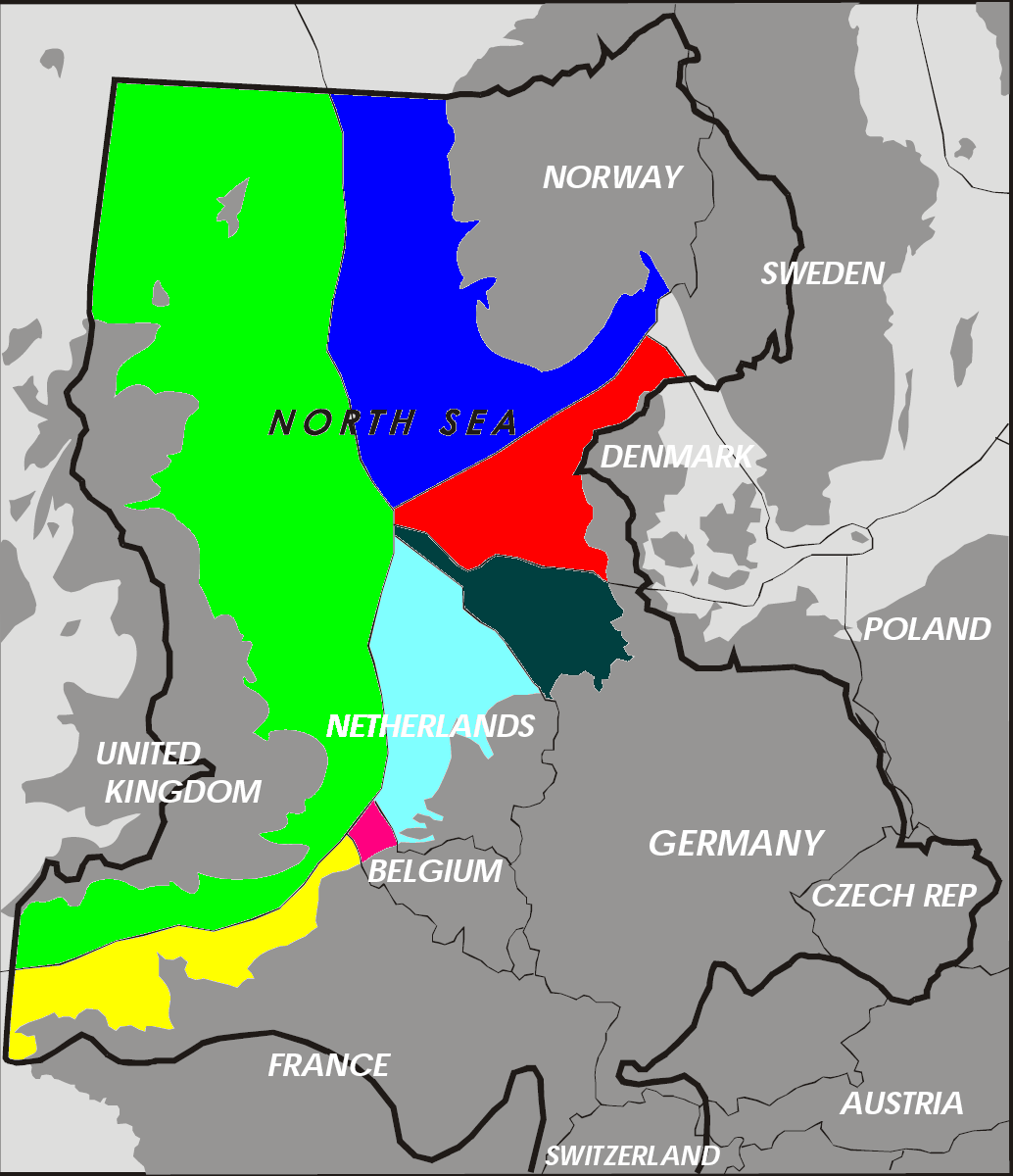
Note.
- Yellow is France.
- Mauve is Belgium, who drew the short straw.
- Light Blue is The Netherlands.
- Black is Germany, who despite their large land area, don’t have as much sea as the UK.
- Red is Denmark.
- Dark Blue is Norway.
- Green is The UK.
- Germany and Poland seen to share the Southern Baltic.
I wouldn’t be surprised to see Germany and Poland co-operating to maximize the wind power capacity of the Southern Baltic.
A Visit To Poland’s Coal Capital
On one of my trips to Poland, I went to Katowice, which is in Poland’s coal-mining region. I wrote about it in An Excursion In Katowice.
Google AI produced this snapshot of Katowice.
Katowice is historically known as the “Polish Coal Capital” and served as the absolute backbone of the region’s heavy industry. First transforming into an industrial powerhouse in the mid-19th century due to rich local coal and metal reserves, the city’s economy and rapid growth were entirely reliant on coal mining and steel.
While coal and heavy industry historically anchored its identity, the city of Katowice has aggressively transformed into a modern cultural, technological, and business hub. The wider Silesia region remains heavily tied to coal mining, but the municipality itself has shifted its focus to avoid reliance on it.
My visit to Katowice was an excellent pit-stop on a train ride between Krakow and Prague, when I did my Home Run From Krakow.
If you like your food and like me, you’re coeliac, I would certainly recommend Poland for a few days away.
Strangely, the language is not a problem, as if you get three Poles together, one will speak English better than what you do.
Will A Large Green German Elephant Get Involved In The Clacton By-Election?
Before I start I’ll ask a question.
What Does Farage Think Of Offshore Wind Farms?
Google AI gave me this reply.
Nigel Farage opposes offshore wind farms, viewing them as an unreliable energy source and arguing that they cause industrial decline and impose “intolerable costs” on households.
His specific stances include:
Taxation & Subsidies: He has pledged that his Reform UK party would eliminate subsidies for wind projects and impose a windfall levy on existing wind farms that have received subsidies.
Energy Alternatives: Farage advocates for abandoning “net zero dogma” and pushes instead for increased oil and gas drilling in the North Sea, along with the expansion of nuclear energy.
Environmental Impact: He has criticized both onshore and offshore wind infrastructure for “despoiling our landscapes and seascapes”. His opposition aligns with previously documented discussions with US President Donald Trump, who has lobbied him against wind turbines.
RWE Development In The Clacton Constituency
RWE or RWE-led consortia are developing three wind farms in the waters off the constiuency.
- 1.1 GW – Five Estuaries
- 504 MW – North Falls
- 353 MW – Galloper
Note:
- In total they are around 2 GW.
- The wind farms are around 30 km. offshore.
- RWE are a respected German company, who are one of our largest electricity generators.
I believe that RWE and their partners could receive a lot of opposition to an overhead power line across Essex to connect these wind farms to the National Grid, and 2 GW would not be a small set of pylons.
But although RWE are German, they may have a Plan B.
RWE have been building a big offshore electrolyser in The Netherlands called H2OpZee and I believe that similar technology could be used at Clacton.
- The electrolyser would be about 30 km from the shore and look like a typical wind farm substation.
- There would be connections to both the UK and Germany, and green hydrogen would be able to be sent either way.
- As Germany is decarbonising industry using hydrogen, I suspect that most green hydrogen would initially be exported.
- But it could attract businesses that needed a lot of green energy to the Clacton area.
- And Clacton certainly needs jobs.
How would Farage deal with something that would bring prosperity to his constituency, but was against his principles?
Has The Clacton Constituency Anything To Do With The Offshore Wind Industry?
I ask this question as Nigel Farage, who is the sitting MP has called a by-election.
Before I answer, the question in the title, I will ask Google AI if he supports wind farms.
I received this reply.
Nigel Farage does not support offshore wind farms. As the leader of Reform UK, he opposes them and has pledged to eliminate renewable energy subsidies, impose a windfall tax on wind developers, scrap net-zero targets, and prioritize the expansion of North Sea oil and gas extraction.
Put this alongside the answer to the question I put in the title of this post.
Yes, the Clacton constituency is directly connected to the offshore wind industry through both established infrastructure and future energy projects off its coastline.The constituency’s specific ties to the wind sector include:
Gunfleet Sands Offshore Wind Farm: Located just 7 kilometers (about 4 miles) off the coast of Clacton and Holland-on-Sea, this wind farm has been operating since 2010. It features 48 turbines and can be seen directly from the town’s beachfront.
Electrical Connection Points: The Gunfleet Sands Offshore Transmission Owner (OFTO) system connects this wind farm to the UK’s national grid via cables and onshore substations based in the local area.
Five Estuaries Offshore Wind Farm: The Clacton coastline falls within the proposed zone for this massive £1.5 billion project. Jointly developed by SSE Renewables and RWE, the project is projected to power over 400,000 homes, with onshore grid infrastructure and cabling proposed for the North Essex area.
If the right independent candidate stood againt Farage, this could be an interesting contest.
Meet The 6×6 Toyota Hilux Built To Tackle Electric Car Fires
The title of this post, is the same as that as this article on Select Car Leasing.
This is the sub-heading.
A car fire is never a good thing, and if the car is electric, the results could be even worse. If it all goes up in flames while the vehicle is in a multi-storey car park, then the consequences could be dire, with limited space available for fire services to control the situation.
This introductory paragraph adds some more details.
Such incidents happen — more than 1,000 cars were destroyed in a fire in Liverpool, while a multi-storey collapsed in Stavanger — so a UK company has converted a Toyota Hilux pickup into a six-wheel EV fire-fighting machine to keep us all safe.
A lot more details are given on the vehicle’s web site, which is called the 6 x 6 HILOAD.
I was alerted to the need for such a vehicle by this article in The Times, which is entitled How Scotland’s New £30k Fire Engines Left Crews Walking To Wildfires.
The pictures on the 6 x 6 HILOAD web site, show a vehicle with a Czechnia registration.
So, I typed “6 x 6 HILOAD Czechnia” into Google AI and received this answer.
The 6×6 Hiload (developed by Prospeed Motorsport) is a custom, six-wheeled conversion of the Toyota Hilux designed specifically for emergency response, particularly targeting electric vehicle (EV) battery fires.In Czechia, the 6×6 Hiload is undergoing trials with Czech Fire & Rescue Services (Hasiči) to test its capabilities in fast-response and confined environments. Key features of the vehicle in action include:
EV Firefighting: It utilizes specialized equipment like the Coldcut Cobra system, which pierces EV battery casings to extinguish fires directly with a minimal amount of water, reducing the risk of thermal runaway.
Low Profile: Standing at less than 1.9 metres tall, it can easily navigate low-clearance urban underground and multi-storey car parks that traditional, larger fire engines cannot access.
High Payload: The custom six-wheel chassis stretches the Hilux and increases its payload capacity to roughly 3,000kg, allowing it to carry heavy fire and rescue equipment without sacrificing off-road mobility.
This chassis will have more uses than a Swiss army knife.
I suspect the Ukrainians could find several uses.

