SSE Thermal Charts Path To Green Hydrogen Future With First-Of-A-Kind Project
The title of this post, is the same as that of this press release from SSE Thermal.
This is the sub-heading.
SSE Thermal is developing a first-of-a-kind project in the Humber which would unite hydrogen production, storage and power generation in one location by the middle of this decade.
These paragraphs explain the project.
The Aldbrough Hydrogen Pathfinder project will support the evidence base for wider deployment of flexible hydrogen power in the UK’s net zero journey and is a major enabler of SSE Thermal’s wider Humber ambitions.
Located at SSE Thermal and Equinor’s existing Aldbrough Gas Storage site on the East Yorkshire coast, the project is designed to demonstrate the interactions between hydrogen electrolysis, hydrogen cavern storage and 100% hydrogen dispatchable power.
The concept would see green power sourced from grid through Renewable PPAs, in compliance with the Low Carbon Hydrogen Standard. Hydrogen would then be produced via a 35MW electrolyser before being stored in a converted salt cavern and then used in a 100% hydrogen-fired turbine, exporting flexible green power back to grid at times of system need. In future, hydrogen storage will also benefit offtakers in other sectors, for example in industry, heat or transport.
Note.
- The Aldbrough Gas Storage site currently can store the equivalent of 320 GWh of electricity, It is currently being expanded to be one of the largest hydrogen stores in the world according to this page on the SSE web site.
- SSE Thermal are proposing to build a hydrogen-powered power station at Keadby to the South of the Humber. The press release says this power station could have a peak demand of 1,800MW of hydrogen.
- Aldbrough at its current size could keep the Keadby hydrogen-powered power station going for a week. But Aldbrough will be a lot bigger than the current 320 GWh.
- The Hornsea and Dogger Bank wind farms off the coast of East Yorkshire will have a capacity of at least 13.5 GW.
- A 35 MW electrolyser will produce 15.2 tonnes of hydrogen per day.
SSE and Equinor hope to be storing hydrogen by 2025.
Conclusion
It is an enormous project and it will surely grow with more electrolysers and hydrogen-powered power stations.
Ramboll To Develop Offshore Wind-To-Hydrogen Concept
The title of this post, is the same as that of this article on offshoreWIND.biz.
This is the sub-heading.
Ramboll has been selected to investigate the feasibility of producing hydrogen offshore at a multi-gigawatt scale with NortH2 in the Dutch part of the North Sea.
Note.
- NortH2 has a web site.
- There is a very rich About NortH2 page.
- NortH2 is a consortium made up of Equinor, Eneco, Gasunie, Groningen Seaports, RWE and Shell Netherlands.
- The consortium aims to use 4 GW to produce hydrogen by 2030 and 10 GW by 2040.
The world needs more ambitious projects like this.
Gasunie Investigates Hydrogen Network In North Sea
The title of this post, is the same as that of this news article on the Gasunie web site.
Rolls-Royce And easyJet Set New World First
The title of this post, is the same as that of this press release from Rolls-Royce.
These three paragraphs explain what the two companies have done and are planning to do.
Rolls-Royce and easyJet today confirmed they have set a new aviation milestone with the world’s first run of a modern aero engine on hydrogen.
The ground test was conducted on an early concept demonstrator using green hydrogen created by wind and tidal power. It marks a major step towards proving that hydrogen could be a zero carbon aviation fuel of the future and is a key proof point in the decarbonisation strategies of both Rolls-Royce and easyJet.
Both companies have set out to prove that hydrogen can safely and efficiently deliver power for civil aero engines and are already planning a second set of tests, with a longer-term ambition to carry out flight tests.
The test today was carried out at Boscombe Down and are shown in this picture from Rolls-Royce.
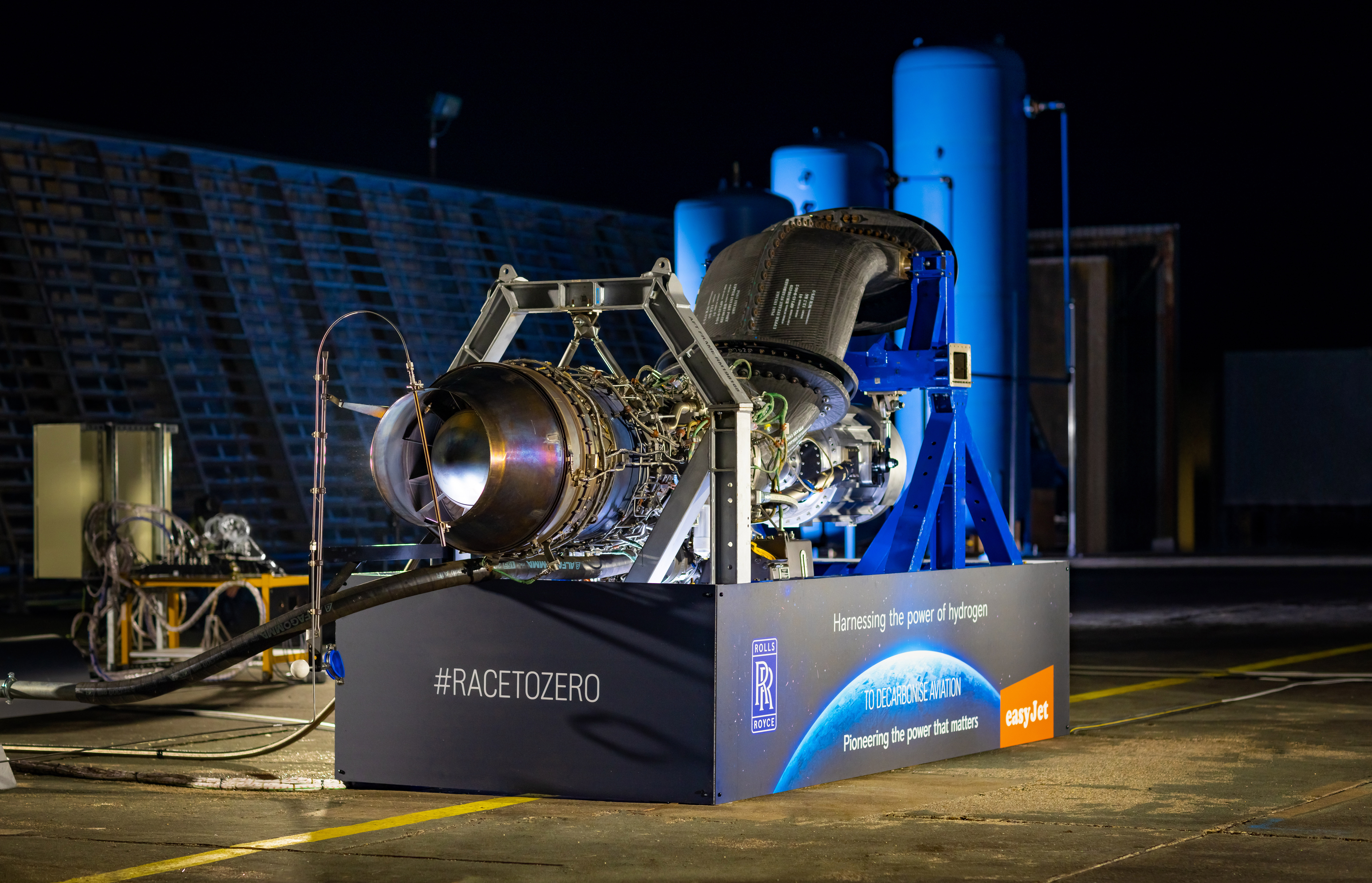
Rolls-Royce AE2100 Hydrogen Demonstrator engine preparing for test at RAF Boscombe Down
Note that the green hydrogen produced using Orcadian winds and tides.
We live in desperate times and I predict that a hydrogen-fuelled and Rolls-Royce-powered easyJet plane, will fly sooner than anybody thinks.
As with athletes, engineers love to be first!
How Is The XLinks Project Progressing?
The Wikipedia entry for the XLinks project has this introductory paragraph.
The Xlinks Morocco-UK Power Project is a proposal to create 10.5 GW of renewable generation, 20 GWh of battery storage and a 3.6 GW high-voltage direct current interconnector to carry solar and wind-generated electricity from Morocco to the United Kingdom. Morocco has far more consistent weather, and so should provide consistent solar power even in midwinter.
I ask the question in the title of this post, as there are two articles about the XLinks project in The Times today.
This article is optimistic and is entitled Xlinks Morocco Project Could Throw Britain A Renewable Energy Lifeline.
On the other hand this article is more pessimistic and is entitled Britain ‘Risks Losing Out’ On Green Energy From The Sahara.
This is the first paragraph of the second article.
Sir Dave Lewis has complained of “frustratingly slow” talks with the government over an £18 billion plan to generate power in the Sahara and cable it to Britain. The former Tesco chief executive has warned that the energy could be routed elsewhere unless ministers commit to the scheme.
It appears there have been little agreement on the price.
I have some thoughts.
Will XLinks Get Funding?
Xlinks is going to be privately funded, but I have doubts about whether the funding will be made available.
As an engineer, who was involved in many of the major offshore projects of the last forty years of the last century, I believe that the XLinks project is feasible, but it is only 3.6 GW.
These wind farm projects are also likely to be privately funded.
- SSE’s Berwick Bank project opposite Berwick is 4.1 GW
- Aker’s Northern Horizon off Shetland is 10 GW.
- The Scotwind Leasing Round is 25 GW.
- There is talk of 10 GW being possible off East Anglia.
- 50 GW may be being possible in the Celtic Sea.
- BP is planning 3 GW in Morecambe Bay.
Many of these enormous wind power projects are looking for completion on or before 2030, which is the date given for the Morocco cable.
I do wonder, if those financing these energy projects will find these and other projects better value than a link to Morocco.
Is the Project Bold Enough?
Consider.
- Spain has high levels of solar, wind and hydro power.
- France is developing wind to go with their nuclear.
- Both countries and Portugal, also have mountains for sensibly-sized pumped-storage hydroelectric power stations.
- France, Spain, Portugal and Ireland also have the Atlantic for wind, tidal and wave power.
Perhaps, the solution, is an Atlantic interconnector linking the UK, Ireland, France, Spain, Portugal and Gibraltar to West Africa.
Any excess power would be stored in the pumped-storage hydroelectric power stations and withdrawn as required.
In the UK, the National Grid are already using the huge 7800 GWh Ulla-Førre pumped-storage hydroelectric power station to store excess wind-generated energy using the North Sea Link from Blyth.
To my mind XLinks is just a UK-Morocco project.
BP’s Project In Mauretania
In bp And Mauritania To Explore Green Hydrogen At Scale, I discussed BP’s deal to create green hydrogen in Mauretania.
Is this a better plan, as hydrogen can be taken by tanker to where it is needed And for the best price.
Conclusion
I wouldn’t be surprised to see the XLinks project change direction.
bp And Mauritania To Explore Green Hydrogen At Scale
The title of this post, is the same as that of this press release from BP.
I’m fairly certain, that this post is the first on this blog about Mauretania.
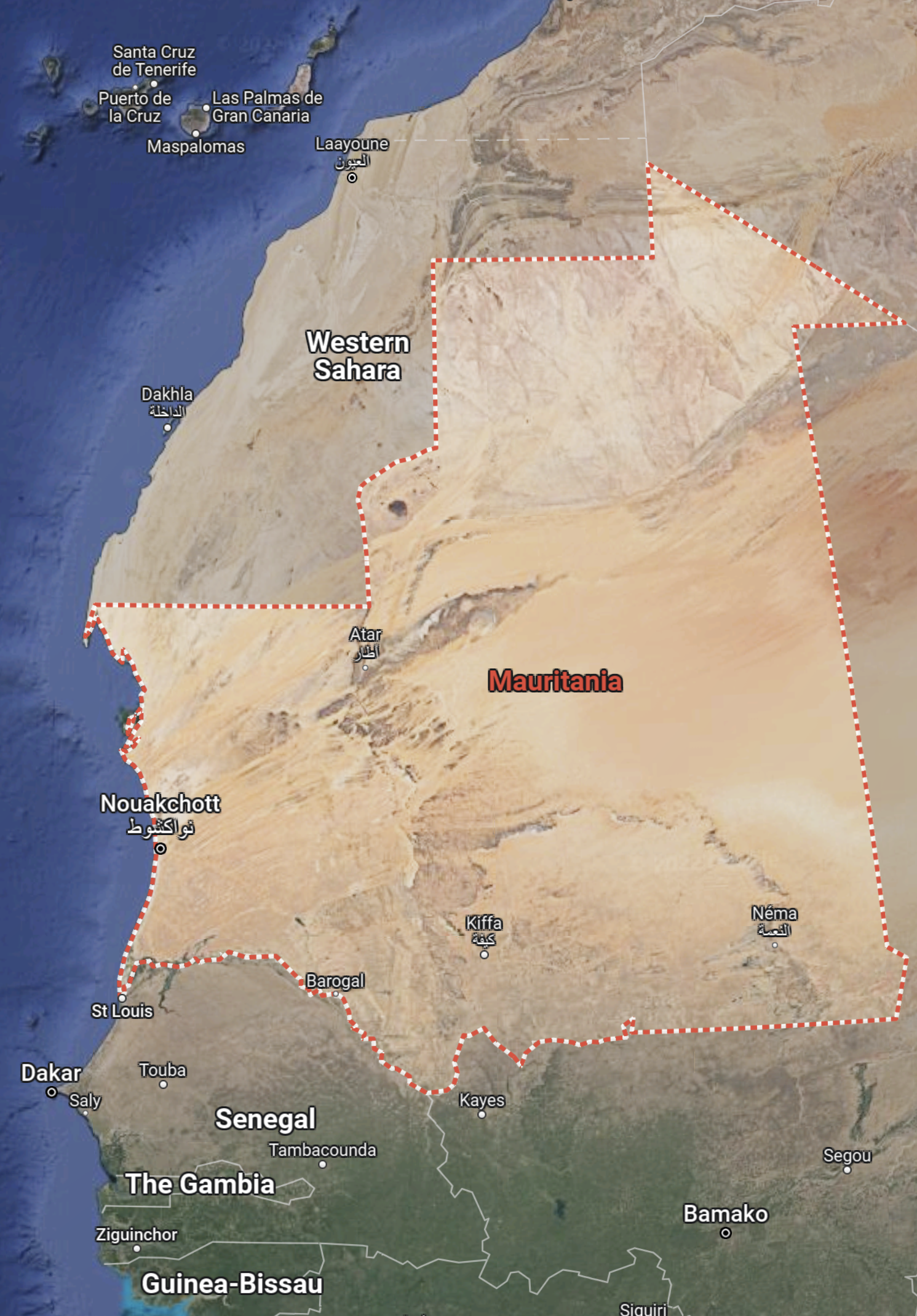
This Google Map shows the country’s position in West Africa.
Note.
- The population is about ten percent more than Wales.
- But the land area is fifty times as large.
- Most people live in the South-West of Mauretania.
The weather appears very different in the two countries.
This is the first paragraph of the press release.
bp today signed a Memorandum of Understanding (MoU) with the Government of Mauritania under which it will deliver an innovative programme exploring the potential for large-scale production of green hydrogen in the country. Building on bp’s existing strong relationships with the country, the agreement could be an important step towards the development of significant green hydrogen production in Mauritania.
There’s certainly a large area to explore.
The MoU was signed today in a meeting alongside COP27.
This paragraph outlines what will be done.
Under the agreement, bp will carry out a number of studies to evaluate the technical and commercial feasibility of producing green hydrogen in Mauritania. Green hydrogen is produced by the electrolysis of water, powered by renewable energy.
Given the area of Mauretania, there could be a substantial tonnage of green hydrogen produced.
BP And Mauritania
This paragraph details the current relationship between BP and Mauretania.
bp and Mauritania already have a long-standing relationship. bp and partners, including Mauritania’s Société Mauritanienne Des Hydrocarbures (SMH), are now working toward the completion of the Greater Tortue Ahmeyim (GTA) Phase 1 liquefied natural gas project. The development of this innovative offshore project on the border of Mauritania and Senegal was approved in 2018. It is set to produce around 2.3 million tonnes of LNG per year, with sufficient resources to support production for over 20 years. Earlier this year, bp also announced the signature of an Exploration and Production Sharing Contract for the BirAllah gas resource in Mauritania.
There could be scope to move Mauretania towards net-zero.
Electrolysis Of Salt Water
Typically electrolysis for hydrogen uses pure water, but companies like Torvex Energy, which I covered in a post called Torvex Energy can electrolyse salt water.
Surely, in a country like Mauretania, where water is much more precious than the UK, salt water electrolysis should be used.
I wouldn’t be surprised to see a major gas company like BP or Shell form a very strong relationship with Torvex Energy.
Transport Enterprise Leasing To Integrate Cummins X15H Hydrogen Engine Into Heavy Duty Trucks
The title of this post, is the same as that of this article on Fleet Equipment.
This is the first paragraph.
Transport Enterprise Leasing and Cummins Inc. announced recently that TEL has signed a letter of intent planning to purchase Cummins’ 15-liter hydrogen internal combustion engines when available. TEL will integrate the Cummins’ X15H hydrogen engines into their fleet of heavy-duty trucks.
This second paragraph is very significant.
Hydrogen engines can use zero-carbon green hydrogen fuel, produced by Cummins-manufactured electrolyzers. The projected investment in renewable hydrogen production globally will provide a growing opportunity for the deployment of hydrogen-powered fleets utilizing either Cummins fuel cell or engine power.
Cummins would appear to be aiming to be a one-stop shop to decarbonise your fleet of heavy trucks or anything that is powered by a Cummins diesel engine.
I did a small amount of work for Cummins about twenty years ago and one of the companies objectives was to be able to provide a diesel engine to fit anybody’s application.
So if someone wanted a diesel engine with a particular power, that fitted in an unusually-shaped or confined space, they would rearrange the layout of the engine to make it fit.
I suspect that London’s New Routemaster buses have a special version of Cummins B Series engine, designed for its unusual location halfway up the back stairs.
Will Cummins produce a hydrogen internal combustion engine for the New Routemaster?
- The buses could become zero-carbon, at less cost than new buses.
- Passengers would notice no difference in ride comfort and experience.
- Drivers would just need to use the hydrogen systems.
- Maintenance staff would only need to be trained n handling the hydrogen system, as much of the buses would be unchanged.
- Cummins could sell an electrolyser to each garage.
- London would get some good publicity for tourism.
London’s iconic bus would look the same.
Hydrogen Fuel Pioneer Wins £247k Funding For Carbon Capture Tech
The title of this post, is the same as that of this article on gasworld.
This is the introductory paragraph.
UK-based waste-to-hydrogen specialist Compact Syngas Solutions (CSS) has won £246,568 from the Hydrogen BECCS (bioenergy with carbon capture and storage) Innovation Programme.
I first wrote about Compact Syngas Solutions, in Welsh Firm Wins £300K BEIS Grant To Advance Hydrogen Fuel Tech.
Compact Syngas Solutions appear to be developing a process to turn waste, that would otherwise go to landfill, into green hydrogen.
- The first stage turns the waste into syngas using gasification.
- This process produces carbon dioxide, which must be captured.
- Compact Syngas Solutions seem to have found a chemical mechanism, that uses water to capture this carbon dioxide instead of ammonia-derived amines.
The last two paragraphs of the article state Compact Syngas Solutions’s plans.
Intended to be portable, CSS plans to develop ten Micro H2 hubs complete with four gasifiers.
Capable of producing 60kg of hydrogen and capturing 3.1kg of CO2 per day, the technology could contribute to full-scale Waste-to-Syngas-Liquid-Fuel facilities, leading to a 50,100 tonne CO2 capture capacity in the UK.
I feel, that if this technology can be made to work at scale, then Compact Syngas Solutions will have a viable way to make green hydrogen.
Bord na Mona Planning Offaly Hydrogen Project As New Wind Farm Is Switched On
The title of this post, is the same as that of this article on OffalyLive.
The policy of the Bord na Mona is described in detail in the article.
This paragraph describes the green hydrogen development.
The development will be two megawatts and will comprise a hydrogen electrolysis plant containing an electrolyser, three high pressure hydrogen storage units, a generator, a substation and an underground cable connecting to a wind turbine 600 metres away.
Surely, this hydrogen will have the right to be marketed as genuine Irish green hydrogen!
For those of you, who are confused by the various colours of hydrogen, this page on the National Grid web site, which is entitled The Hydrogen Colour Spectrum gives a useful guide.
Note that there is no orange hydrogen defined as yet, but there is a yellow hydrogen defined like this.
Yellow hydrogen is a relatively new phrase for hydrogen made through electrolysis using solar power.
So it does look, that yellow hydrogen, which could be called orange hydrogen at a pinch, is as environmentally-friendly as green hydrogen.
The Australian Tycoon With Designs On U.S. Coal Mines
The title of this post, is the same as that as this article on Politico.
The article is a must-read, as it is an interview with Andrew Forrest about his very strong views on the future of the coal industry in the United States.
This is a typical question from the interview and Forrest’s forthright answer.
Biden put jobs at the center of his climate messaging. Does the messenger actually need to be someone with a track record of creating jobs?
It’s a bloody good point. I think I can deliver that message much stronger, because I’m not a politician. I’m not looking for votes, this is the hardcore reality.

