An Express Service On The Overground
On Thursday, last week, I was travelling between Highbury & Islington and Willesden Junction stations on the North London Line of the London Overground. From Willesden Junction I intended to get the Bakerloo Line to Paddington for my trip to Okehampton.
There had been a problem and the train was rather full.
The surprise was that after Camden Road station it went non-stop to Willesden Junction.
It got me thinking.
- The Class 378 train sped along, as does the occasional Class 800 train, that is going to and from Hitachi’s North Pole Depot.
- It has been proposed to turn back some trains at Camden Road to increase frequencies through East London, which I wrote about in Will Camden Road Station Get A Third Platform?.
- There is a spare rarely-used bay platform at Willesden Junction station with short-distance step-free access to the two platforms that serve the Watford DC and Bakerloo Lines.
- I seem to remember that original plans for the North London Line including extending some services to Willesden Junction.
Could an express service be run between Stratford and Willesden Junction stations?
- It would stop at all stations to the East of Camden Road.
- It would terminate bay platform at Willesden Junction.
- It would improve the interchange at Willesden Junction station for many travellers.
I suspect though, it would need improved signalling, which is probably the reason it has never been implemented.
Digital Signalling Work Outlined By Network Rail For Northern City Line
The title of this post, is the same as that of this article on Rail Business Daily.
This is the first paragraph.
Network Rail has detailed work due to be delivered on the Northern City Line to Moorgate.
I use this line regularly and I believe that with digital signalling the Northern City Line could see a large increase in frequency.
Currently, the service from Moorgate is as follows.
- 4 tph to Welwyn Garden City via Potters Bar
- 4 tph to Hertford North of which 2 tph extending to Watton-at-Stone and 1tph of those continuing to Stevenage.
Note.
- tph is trains per hour.
- Although the service is reduced from that shown, because of the pandemic and lower passenger demand.
But eight tph means a train every seven minutes and thirty seconds.
If you look at London’s high frequency lines, they have or will have passenger frequencies as follows.
- Crossrail – 24 tph on dedicated tracks with digital signalling.
- East London Line – 16 tph on dedicated tracks.
- North London Line – 8 tph on tracks shared with freight trains.
- Thameslink – 24 tph on dedicated tracks with digital signalling.
Note.
- The East London Line is planned to go to 20 tph with two extra tph to Clapham Junction and Crystal Palace.
- 20 tph means a headway between trains of three minutes.
- 24 tph means a headway between trains of two minutes and thirty seconds.
It should also be noted that the Victoria Line runs upwards of thirty tph on a fully digitally-signalled line.
What Level Of Service Would Be Possible?
These are my thoughts on various aspects of the Northern City Line.
How Many Trains Could Be Handled Between Finsbury Park And Moorgate?
This section of track is a simple double-track with a diamond crossing to the North of the two platforms at Moorgate, so that trains can use either platform.
This layout is used at Brixton and Walthamstow Central on the Victoria Line and Battersea Power Station on the Northern Line to name just three of many.
So I suspect that the track layout at the terminus at Moorgate can handle well-upwards of twenty tph.
The new Class 717 trains that run into Moorgate have an operating speed of 85 mph, which is faster than the previous Class 313 trains, which appear to have run at 30 mph South of Drayton Park.
I suspect that eventually twenty or even twenty-four tph will be possible on a digitally-signalled route between Finsbury Park and Moorgate.
But in the interim, sixteen tph would be a good compromise.
How Many Trains Could Be Handled On The Current Routes?
Currently, four tph use the both the Welwyn Garden City and the Hertford East/Stevenage routes.
I am fairly sure that both routes could handle eight tph, with the only proviso, that there is enough terminal capacity to turn the trains.
Looking at the layout of Welwyn Garden City station, I am certain that it could be modified to be able to handle eight tph.
I would hope that the new platform at Stevenage station, built to handle trains to and from Moorgate, can cater for four tph. As there are turnback platforms at Gordon Hill and Hertford North stations, I’m sure the other four tph could be handled.
The Piccadilly Line And The City of London
It has always been difficult to get between the Northern section of the Piccadilly Line and the City of London.
In the 1960s, I used to use my bicycle. By public transport, you generally had to use the bus or the 641 trolley bus to Moorgate.
With the improvement of the Northern City Line and Finsbury Park station, the fastest route to Moorgate is probably to change between the Piccadilly and Northern City Lines at Finsbury Park station.
Increasing the frequency of Northern City Line services between Finsbury Park and Moorgate would create a high-capacity route to the City for those commuting from the Northern section of the Piccadilly Line.
The Piccadilly Line And Crossrail
There is no connection between the Piccadilly Line and Crossrail.
A trip between Oakwood and Canary Wharf would be difficult.
As with getting to the City of London, the improvement of the Northern City Line and Finsbury Park station offers a route to Crossrail.
Oakwood and Canary Wharf would probably be done with changes at Finsbury Park and Moorgate.
The Victoria Line And The City of London
There is a cross-platform interchange at Highbury & Islington station between the Victoria and Northern City Lines.
With an increased frequency of Northern City Line services between Finsbury Park and Moorgate, I would expect that more people would use this route.
The Victoria Line And Crossrail
There is no connection between the Victoria Line and Crossrail.
The easiest route will be to take the route in the previous section and join Crossrail at Moorgate.
Conclusion
It does look that with the current routes sixteen tph to and from Moorgate could be a practical limit.
But that would still be a train every three minutes and forty-five seconds between Finsbury Park and Moorgate.
This increased frequency could be needed to create a high capacity link between the Northern sections of the Piccadilly and Victoria Lines and the City of London and Crossrail.
The Great Bus Robbery
Transport for London (TfL) obviously don’t like people where I live in the Northern part of De Beauvoir Town in the London Borough of Hackney.
When I moved here, ten years ago there were six bus routes that passed through the traffic lights where the Balls Pond Road (It is not a made-up-name from Round The Horne) and Southgate Road/Mildmay Park meet.
- 21 – Newington Green and Lewisham Shopping Centre
- 30 – Marble Arch and Hackney Wick (From the sublime to the ridiculous?)
- 38 – Victoria station and the romantic Clapton Pond
- 56 – Bart’s Hospital and Whipps Cross (You’d be cross, if you’d been whipped!)
- 141 – London Bridge Station and Palmers Green North Circular Road (Surely, another romantic destination!)
- 277 – Highbury & Islington Station and Crossharbour
Note.
- We had two bus routes to and from Highbury & Islington station for Dear Old Vicky!
- We had two bus routes to and from Moorgate, Bank and the City of London.
- We had four bus routes to and from Dalston Junction station and the cultural attractions of Hackney Central.
- We had a direct bus to Canary Wharf.
TfL looked at the name of the district and thought the posh French name, meant we were all had expensive vehicles or Hackney carriages and said we had too many buses.
So in June 2018, the 277 bus was cut back to Dalston Junction station and TfL promised that the frequency of the 30 bus would be increased. We’re still waiting for extra services.
Now, if you want to go to Highbury & Islington station, according to TfL’s Journey Planner, it’s often quicker to take a 38 or 56 bus to Essex Road station and take a train.
To make matters worse the 30 bus route now has cheap and nasty Egyptian-built buses with more steps than Russia. All buses should have flat floors like the New Routemasters.
What is TfL’s latest crime?
The 21 and 271 buses are going to be combined into a new route between Lewisham and Highgate, which will go nowhere near the Balls Pond Road.
So we’ll just have the one bus route to the City of London.
On past form, if TfL say they will increase the frequency, I wouldn’t believe them.
I think that TfL have ignored some problems.
The Elderly And Disabled
Between Newington Green and Englefield Road, a higher proportion of the passengers getting on the 21 and 141 buses seem to be in these groups.
- As it’s a nice place to live, I suspect many elderly people have just stayed on.
- I believe that North of the Balls Pond Road, there are some care homes and sheltered housing.
Have TfL analysed their passengers?
Not Everybody Has Cars
There are several blocks of social housing on the Newington Green and Englefield Road stretch and you see a lot of passengers who don’t look like car owners.
The lack of parking and the Low Traffic Neighbourhoods don’t help.
Access To Waterloo
My quickest way to Waterloo, which is London’s busiest rail terminal, is to take a bus to Bank and then get the Drain.
A halved service to Bank station will probably force me to take longer routes.
Tradition
When I was a child in the 1950s, the 141 was the 641 trolley bus, which ran between Winchmore Hill and Moorgate.
People, who live in Wood Green, Turnpike Lane and Manor House still commute to the City by bus, as people have done for over a hundred years.
I suspect a lot of commuters change from the Piccadilly Line to the 141 bus at Manor House station. I certainly use that route if I’m going to Southgate or Cockfosters.
The 21 bus starts at Newington Green, which means if you want to go from Balls Pond Road to Bank, you’ll usually get on a 21 bus, as the 141 buses are full with passengers from further North.
So it looks like to get to Moorgate, we’ll need to get a bus to Angel and then get the Northern Line, after the rerouting of the 21 bus.
Crossrail
This will have a big effect.
Suppose you live in Wood Green and want to get to Crossrail.
There is no obvious connection, but tradition will mean your preferred route will be to take a 141 bus between Manor House and Moorgate.
There will also be a quick route between Moorgate and Liverpool Street station, that I wrote about in London’s First Underground Roller Coaster.
Conclusion
We will need the 21 bus to provide us with a route to Crossrail, as the 141 buses will be full.
The 21 bus is needed where it is and mustn’t be stolen.
Will Camden Road Station Get A Third Platform?
London has a rail capacity problem, for both freight and passenger trains.
This report from Network Rail is entitled The London Rail Freight Strategy (LRFS).
One of the recommendations of the report is to build a third platform at Camden Road station. It says this about the third platform.
Reinstatement of a third track and platform on the northern side of Camden Road station, utilising part of
the former 4-track formation through the station.
Camden Road station used to have four platforms, but now it just have two.
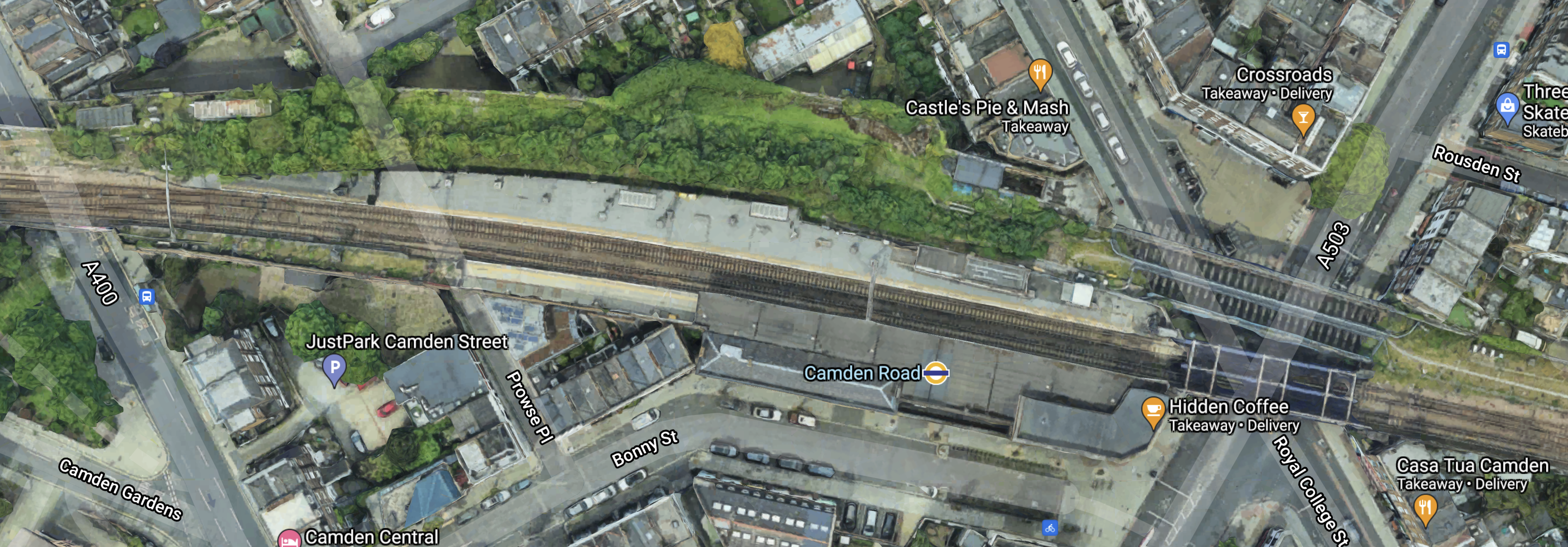
This Google Map shows the station as it is today.
Note.
- Platform 1 is on the South side of the tracks with the London Overground roundel conveniently shown on the roof.
- Platform 2 is on the North side of the tracks.
- Regular users of the station can probably pick out the lift at the Eastern end of Platform 2.
- There is a bridge to the East of the station which takes the tracks over the junction of Royal College Street and Camden Road.
To the North of this bridge, two further bridges can be seen, that used to take the former third and fourth tracks over the roads and into two additional platforms to the North of the current two.
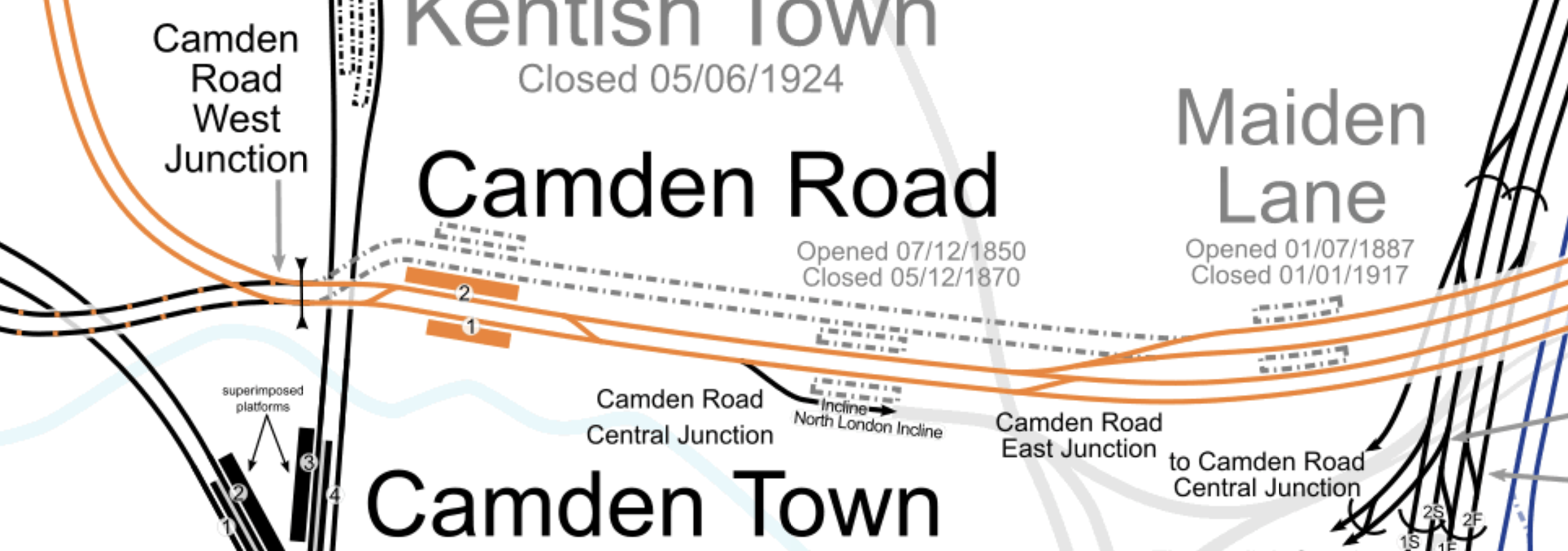
This map from cartometro.com shows the track layout through Camden Road station.
Note.
- The tracks shown in orange are the route of the North London Line of the London Overground.
- The two orange platforms labelled 1 and 2 at Camden Road station.
- The two former lines passing behind Platform 2, used to rejoin the North London Line to the West of the station.
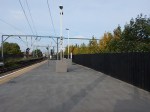
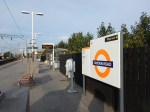
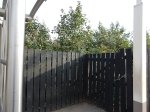
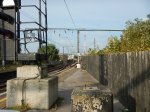
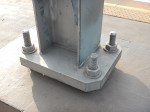
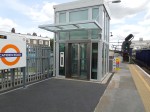
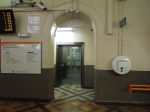
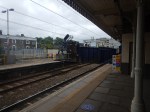
These pictures were taken on the current Platform 2.
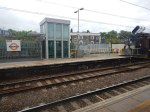
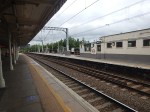
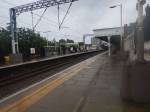
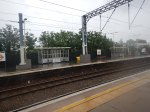
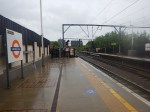
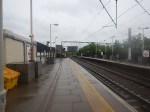
And these are some pictures of the bridge, what is behind the fence and other bridges.
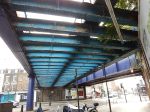
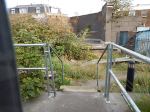
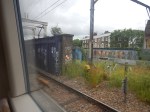
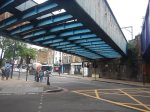
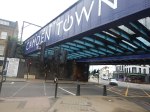
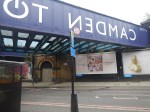
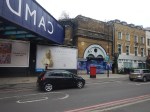
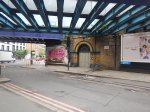
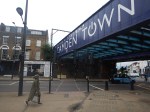
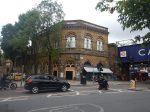
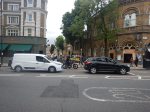
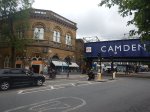
Note.
- Most of the pictures of Platform 2, were taken from Platform 1.
- Behind the fence on Platform 2, there appears to be a substantial urban forest.
- Renewing the bridges and updating the railway arches could improve the area significantly.
- Camden Road station is a Grade II Listed building.
I don’t think, that any of the construction would be too challenging.
How Would The Third Platform Be Used?
This is said in the Network Rail document about the third platform at Camden Road station.
This proposal would reinstate a third track and platform on the northern side of Camden Road station, utilising part of the former 4-track formation through the station.
The additional capacity provided would facilitate much greater flexibility in pathing options for trains on this busy central section of the NLL, opening up new options for future service provision and bolstering performance resilience.
Reinstatement of a third platform would enable platform 2 to be used as a central turnback, with platform 3 becoming the eastbound line for through London Overground services and the majority of freight.
Transport for London modelling suggests that the eastern end of the NLL, from Canonbury to Stratford, will see some of the strongest long-term demand growth on the Overground network.
A turnback platform will allow this to be addressed with peak capacity boosting services between Stratford and Camden Road and there would also be the option to operate these through the off-peak, which could offer a means of providing additional passenger capacity where it is most needed.
The availability of an additional platform would also aid performance recovery during perturbation on
the orbital routes.
That all looks fairly sensible and wouldn’t require much work to the current station.
Note.
- Platform 2 is currently a fully-accessible platform with a lift and will become a spacious fully-accessible island platform with two faces 2 and 3, both serving London Overground services going East.
- There must surely be space on the island platform to build a substantial shelter, where passengers can sit, when long freight trains are passing through.
- There could even be space for a coffee kiosk.
The former Platform 3 appeared to be a Westbound platform, but the proposed new one appears to be an Eastbound one.
The Track Layout Immediately To The East Of Camden Road Station
These are my thoughts on the track layout to the East of Camden Road station.
This map from cartometro.com shows the track layout between Camden Road and Highbury & Islington stations.
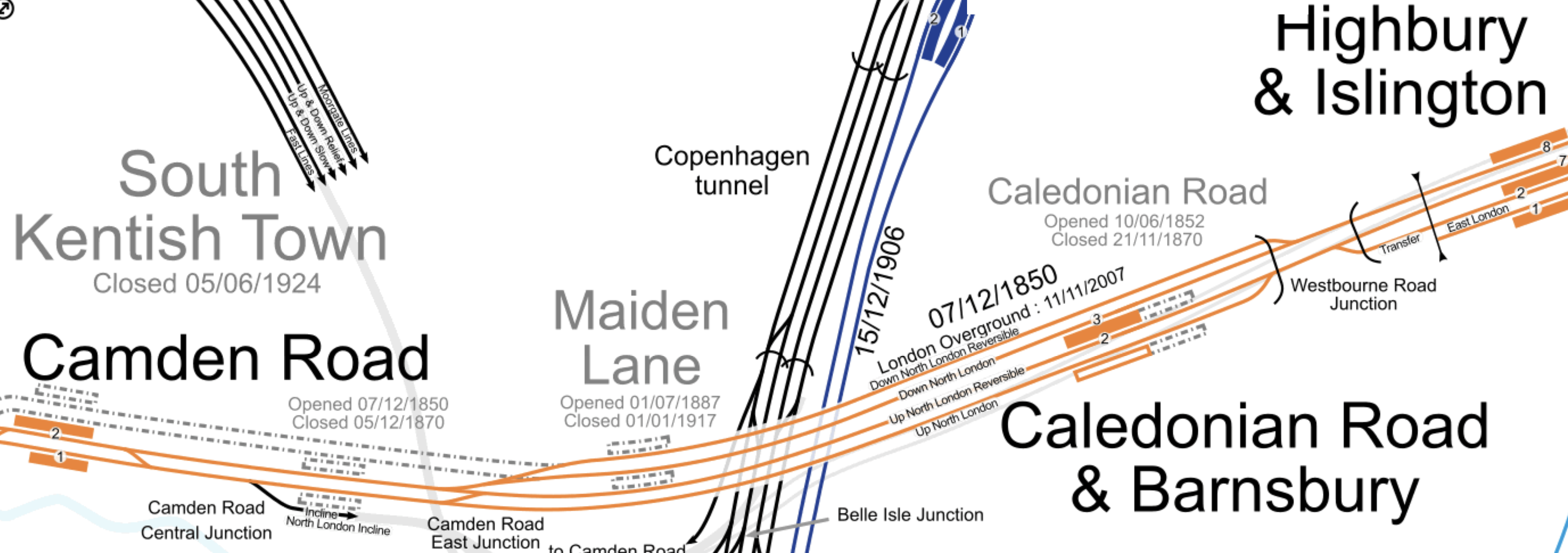
Much of the route through Caledonian Road and Barnsbury station is four tracks. These tracks are named from North to South as follows.
- Down North London Reversible
- Down North London
- Up North London Reversible
- Up North London
Note.
- Eastbound London Overground services use the Down North London track.
- Eastbound freight services use the Down North London Reversible track.
- Eastbound freight services are sometimes held by signallers on the Down North London Reversible track.
- Westbound London Overground services use the Up North London Reversible track, before crossing over to the Up North London track at Camden Road East Junction.
- London Overground services only use the central island platform at Caledonian Road and Barnsbury station.
- Westbound freight services use both of the Up North London tracks.
- The London Borough of Camden have stated that they would like to see the reopening of Maiden Lane station.
These pictures show the former trackbed between the former Maiden Lane station and Camden Road station.
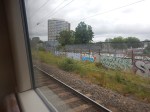
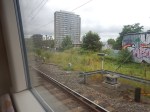
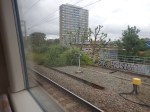
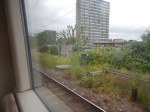
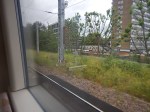
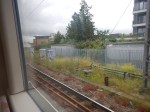
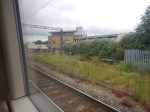
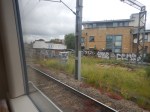
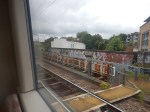
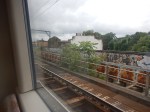
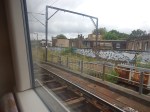
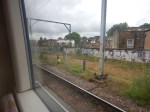
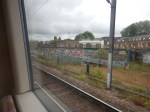
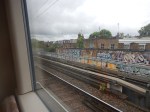
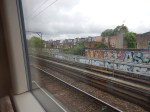
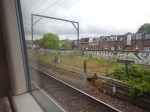
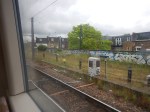
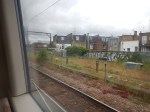
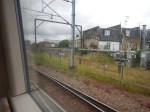
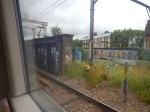
Looking at these pictures, I can deduce the following.
- There is very little constructuction of the former trackbed.
- There would be some signalling equipment to move.
- Some of the steel bridges would have to be replaced.
I feel, that a single track could definitely be created between the new Platform 3 at Camden Road station to connect with both Down North London tracks before the site of the former Maiden Line station.
It may even be possible to squeeze in two tracks.
A new track or tracks would enable the following.
- Eastbound London Overground services to go from Platform 3 at Camden Road station to Platform 3 at Caledonian Road and Barnsbury station.
- Eastbound freight services to go from Platform 3 at Camden Road station to either the Down North London Reversible or the Down North London tracks through Caledonian Road and Barnsbury station.
Note.
- Westbound services going through Camden Road station would be unaffected.
- Westbound London Overground services terminating in Platform 2 at Camden Road station would cross over to the current Up North London Reversible at the current Camden Road Central junction.
- Eastbound London Overground services starting in Platform 2 at Camden Road station would cross over to the new track or tracks to proceed to the East.
These are my answers to a few questions.
Will There Be One Or Two Extra Tracks?
Consider.
- It could probably be organised that the extra track or tracks start perhaps fifty metres or so to the East of Camden Road station.
- The distance between this point and Westbourne Road Junction is around a mile.
- Network Rail allows freight trains up to a length of 775 metres.
I am drawn to the conclusion, that if two tracks were to be built, then signallers would be able to hold the longest freight trains on the extended Down North London Reversible track, without interrupting London Overground passenger services.
How Will The Extra Tracks Affect The Camden Highline?
If two new tracks are built, I would expect that it will be impossible to build the Camden Highline.
But if only one is built, I suspect that a narrower Camden Highline might be able to be squeezed in.
Could Provision Be Made So A New Maiden Lane Station Could Be Built?
This map from cartometro.com shows the track layout around the former Maiden Lane station.
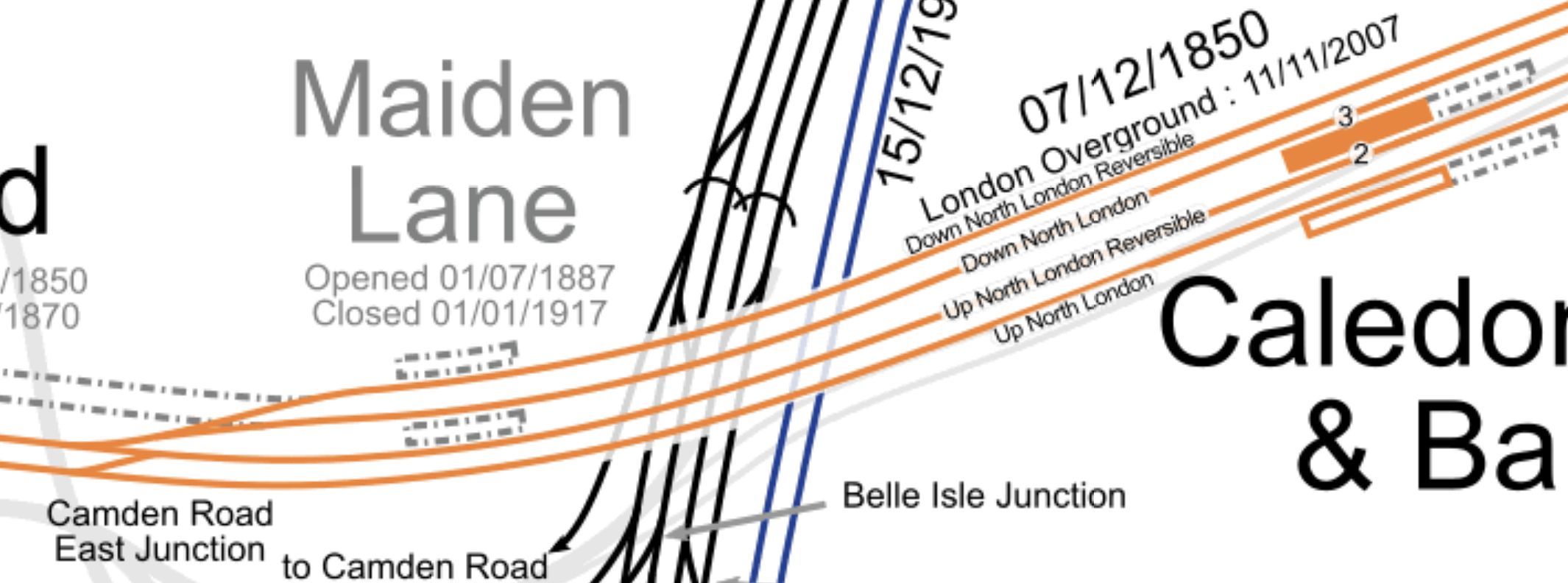
Consider.
- Eastbound London Overground services use the Down North London track and call in Platform 3 at Caledonian Road and Barnsbury station.
- Westbound London Overground services use the Up North London Reversible track and call in Platform 2 at Caledonian Road and Barnsbury station.
- To connect Platform 3 at Camden Road station to the Down North London Reversible and Down North London tracks, I suspect that Camden Road East junction will have to be remodelled.
I wonder if by the application of Network Rail’s latest track layout software, space could found for an island platform between the Up North London Reversible and Down North London tracks.
In Is Caledonian Road And Barnsbury An Ideal Four-Track Station?, I discuss the design of Caledonian Road and Barnsbury station,
I think it is a distinct possibility, that provision could be made for a future Maiden Lane station.
Will There Be Changes At Camden Road West Junction?
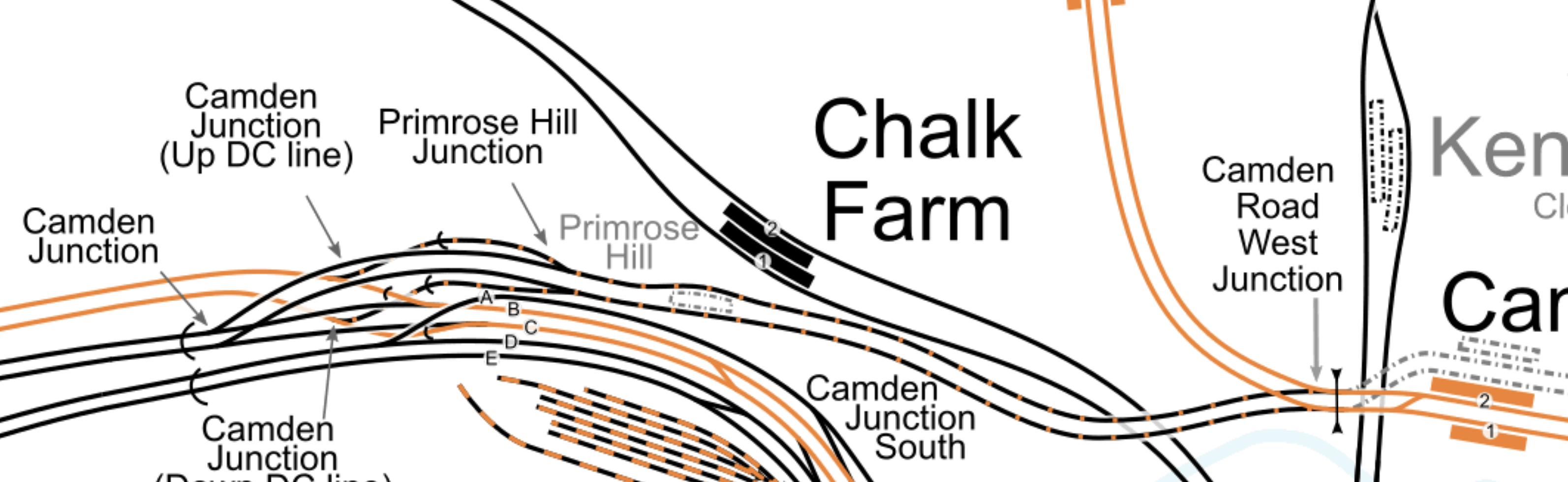
This map from cartometro.com shows the track layout to the West of Camden Road station.
Note.
- Platforms 1 and 2 of Camden Road station at the Eastern end of the map.
- Camden Road West junction to the West of the platforms.
- The dotted lines of old tracks leading to the former Platform 3 and 4 at Camden Road station.
Two double tracks lead away to the West from Camden Road West junction.
- The orange tracks are the North London Line to Willesden Junction and Acton.
- The black and orange tracks are an extension of the Watford DC Line, that links Camden Road station to the West Coast Main Line via Primrose Hill station.
Will both pairs of tracks be connected to the North London Line at Camden Road West junction, as they are now?
- Currently, a few freight trains per day, use the Primrose Hill route.
- There have been plans in the past, for the London Overground to use this route.
- They have also been known to run a Rail Replacement Train between Willesden Junction and Camden Road stations during engineering works, as I wrote about in The Future Of The Watford DC Line.
So I suspect Network Rail will design a comprehensive junction, that is all things to all operators and trains.
Through Running Between The East London Line and Willesden Junction Station
This was originally talked about in the original plans for the London Overground.
If you travel on the Overground to Barking, Blackhorse Road, Canada Water, Highbury & Islington, West Brompton, Hampstead, Whitechapel or Willesden Junction in the Peak, the interchanges are very busy, as passengers are transferring to the Underground.
Was this why through running was originally proposed between the East and North London Lines at Highbury & Islington station, as it would allow direct connection to extra Underground lines?
But one of the aims of the Overground was to enable journeys around London without going via Central London.
Platform 3 at Camden Road station, seems to increase the capacity on the North London Line, so perhaps this upgrade would give extra paths to allow some services to terminate to the West of Highbury & Islington.
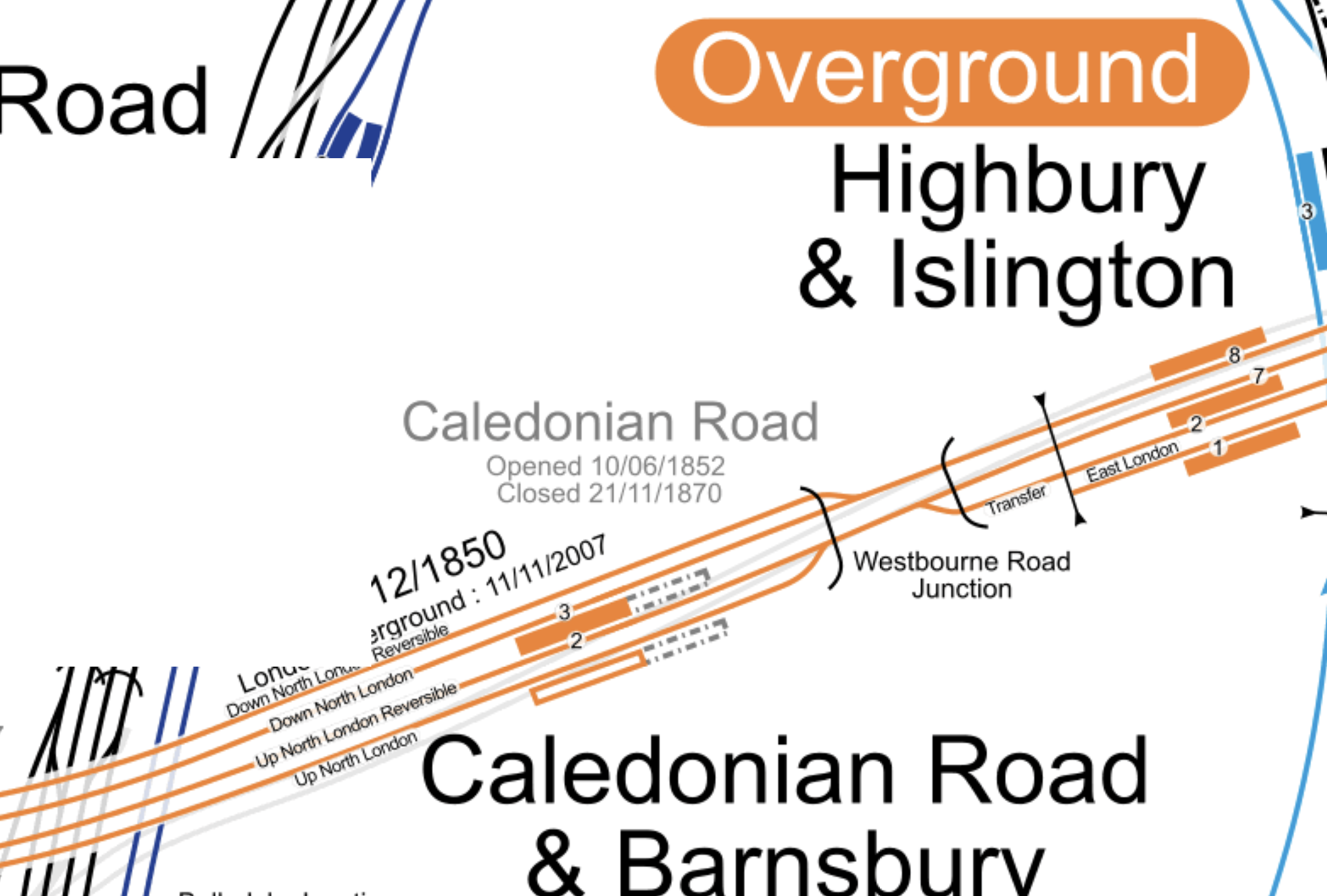
This map from cartometro.com shows the track layout to the West of Highbury & Islington station.
I’m sure if Network Rail’s engineers can sort out King’s Cross, then they can come up with a track and signalling system that can handle this,
Could Platform 2 At Camden Road Be Used As An Alternative Terminus For Watford DC Line Services?
Euston station is being rebuilt and Network Rail might like to kick Watford DC Line services out of the station either temporarily or even permanently.
There are two routes that the Watford DC Line could take to get between Harlesden and Camden Road stations.
- They can use the route, I took one Sunday, when the London Overground was running a Rail Replacement Train, via Willesden Junction Low Level, Kensal Green, Queens Park, Kilburn High Road and South Hampstead.
- They might also be able to join the North London Line an improved Kensal Green junction.
The first route works and the second may need some extra work at Harlesden junction.
I estimate that Platform 2 at Camden Road station is presently as long as 120 metres.
I also estimate that it could be lengthened at both ends, during the building of a new platform 3 alongside.
Could a platform be built long enough to be able to handle two trains simultaneously?
- A four-car Class 710 train at the Western end.
- A five-car Class 378 train at the Eastern end.
A 200 metre long platform would probably suffice!
I think the concept has possibilities.
- Willesden Junction station has connections to the Bakerloo Line.
- West Hampstead station has connections to Thameslink and the Jubilee and further connections could be developed,
- Camden Road station could be connected to Camden Town station, which is on both branches of the Northern Line.
- A reopened Primrose Hill station could be connected to Chalk Farm station on the Northern Line.
- The Northern Line connects to Crossrail at Moorgate and Tottenham Court Road stations.
I suspect, if Camden Town station were to be expanded and rebuilt, that the connection between the two Camden stations would be more likely.
Either route could be taken between Willesden Junction and Camden Road stations.
But I feel, it might be less costly to take the North London Line route, especially, as this connects to West Hampstead station.
Could The Track Layout Be Further Simplified?
I’m no track expert, but it strikes me that a four-track layout could be built between just East of Camden Road station and Westbourne Road junction. From North to South these tracks would be.
- Eastbound Freight line – Connecting at the Western end to Platform 3 at Camden Road station and following the existing Down North London Reversible track to Westbourne Road junction.
- Eastbound Overground line – Connecting at the Western end to Platforms 2 and 3 at Camden Road station and following the existing Down North London track through Caledonian Road and Barnsbury station to Westbourne Road junction.
- Westbound Overground line – Connecting at the Western end to Platforms 1 and 2 at Camden Road station and following the existing Up North London Reversible track through Caledonian Road and Barnsbury station to Westbourne Road junction.
- Westbound Freight line – Connecting at the Western end to Platform 1 at Camden Road station and following the existing Up North London track to Westbourne Road junction.
Note.
- Both freight lines would be long enough for signallers to hold freight trains, so that other services could overtake.
- East of Caledonian Road and Barnsbury station, Overground and freight service would share the two tracks, as they do now!
- West of Camden Road station, Overground and freight service would share the two tracks, as they do now!
It strikes me that by good design, the capacity and speed through this section of the busy North London Line can be increased.
Related Posts
These are related posts about the London Rail Freight Strategy (LRFS).
Decarbonisation Of London’s Freight Routes
East Coast Main Line South Bi-Directional Capability
Gauge Improvements Across London
Headway Reductions On The Gospel Oak To Barking, North London and West London Lines
Heavy Axle Weight Restrictions
Kensal Green Junction Improvement
Longhedge Junction Speed Increases
Moving The West London Line AC/DC Switchover To Kensington Olympia
Moving The West London Line AC/DC Switchover To Shepherd’s Bush
Stratford Regulating Point Extension
Will Clapham Junction Station Get A Platform 0?
The One Station I Never Use Coming Home Is Highbury & Islington
I am typing this post in Highbury & Islington station as my Overground train, skipped all stations North of Whitechapel, diue to congestion.
I always avoid this station, as getting between my house and the station is difficult as there is only one crowded 30 bus, every fifteen minutes. There used to be twice as many buses, as the 277 bus used to serve the route as well. But nearly a year ago, it was cut back to Dalston Junction making it as useful for me, as a chocolate tea pot.
So now after a ten minute wait, I’m taking the two stops back to Dalston Junction to get a bus home. That is only three routes now, due to the cutback of the 277.
I find it interesting, that North East London appears to have got more bus cuts, than Sadiq Khan’s patch of South London. And it was all to pay the bribe of the fare freeze, that got him elected.
So in the next Mayoral election, I shall be voting more a Mayor, who lives in the North.
We certainly, did better under Boris, who lived a mile towards the City of London.
Could Highbury & Islington And Canada Water Stations Be Connected By A Twelve Trains Per Hour Service?
This article on IanVisits, is entitled More Frequent Trains And A New Station For The London Overground.
This is said.
In a statement, the government agreed to requests for £80.8 million from the GLA to support transport upgrades so that 14,000 homes can be built along the East London Line.
Upgrades include
- New Bermondsey station, which was originally to be called Surrey Canal Road, will be built.
- A second entrance will be built at Surrey Quays station.
- Frequency between Dalston Junction and Clapham Junction stations will be increased from four trains per hour (tph) to six tph.
- Frequency between Highbury & Islington and Crystal Palace stations will be increased from four tph to six tph.
The frequency upgrades will mean twenty tph between Dalston Junction and Surrey Quays stations, or a tyrain every three minutes as opposed to the current three minutes and forty-five seconds.
Consider the section of the East London Line that I use most between Highbury & Islington and Canada Water stations via Whitechapel station.
- Highbury & Islington station has good connections to the Victoria Line, the Northern City Line and the North London Line.
- Highbury & Islington station is the thirteenth busiest station in the UK.
- Whitechapel station has good connections to the District and Hammersmith & City Lines, which have recently been increased in Frequency.
- Whitechapel station will be on Crossrail, when it opens.
- Canada Water station has a good step-free connection to the Jubilee Line.
- Canada Water station is the seventeenth busiest station in the UK.
- Currently, the frequency between Highbury & Islington and Canada Water station is eight tph and after the improvements it will be ten tph.
The frequency increase is to be welcomed but I wonder if it could be better.
Would it be possible that in addition to the proposed changes, the West Croydon and Clapham Junction services should swap Northern terminals, as they do on Sundays.
This would not affect any services South of Dalston Junction, but it would increase the number of services between Dalston Junction and Highbury & Islington via Canonbury to twelve tph.
This would give several benefits.
- Passengers changing from the North London Line to go South, would have an easier change at the less-crowded Canonbury station, rather than Highbury & Islington. Canonbury has only one Southbound platform, simpler passenger flows, is fully step-free and as the trains on the East London Line, will be at a higher frequency, the waiting time would be less and a maximum of just five minutes.
- Passengers could avoid the cramped Dalston Kingsland, which is not step-free, on many journeys.
- Half the trains going North through Dalston Junction would have a cross-platform interchange with the Westbound North London Line at Highbury & Islington.
- Passengers going South from Dalston Junction wouldn’t dither about at the bottom of the stairs, trying to ascertain, which train is going first. As there would be sixteen trains per hour leaving on the left island Platform 3/4, only passengers going to New Cross would go right.
- Dalston Kingsland and Highbury & Islington is one of the busiest Peak Hour services in the UK. Twelve trains per hour on the alternative route might ease the congestion.
- The increased frequency might help, when Arsenal are playing at home.
- In some ways, maximising the service between Dalston Junction and Highbury & Islington, compensates for the annoying cut-back of the 277 bus service.
I do feel that swapping the two services so that both six train per hour services terminate at Highbury & Islington could be beneficial.
Hopefully, TfL have got there first! Unless of course, there’s an operational reason, why the swap can’t be done!
Landscaping Outside Highbury & Islington Station Is Nearing Completion
I took these pictures outside Highbury & Islington station, this afternoon.



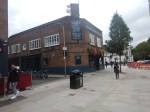


It does appear that this long project is nearing completion.
At least there’s now a large space in front of the station, that leads up towards Upper Street.
Highbury Corner Is Finally Getting There!
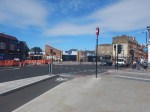
I had almost stopped using Highbury & Islington station, due to the construction works at Highbury Corner, which have been going on for several years.
I posted Changes At Highbury Corner in February 2016.
These pictures show it a few days ago!



This map from the linked post shows the intended road layout.
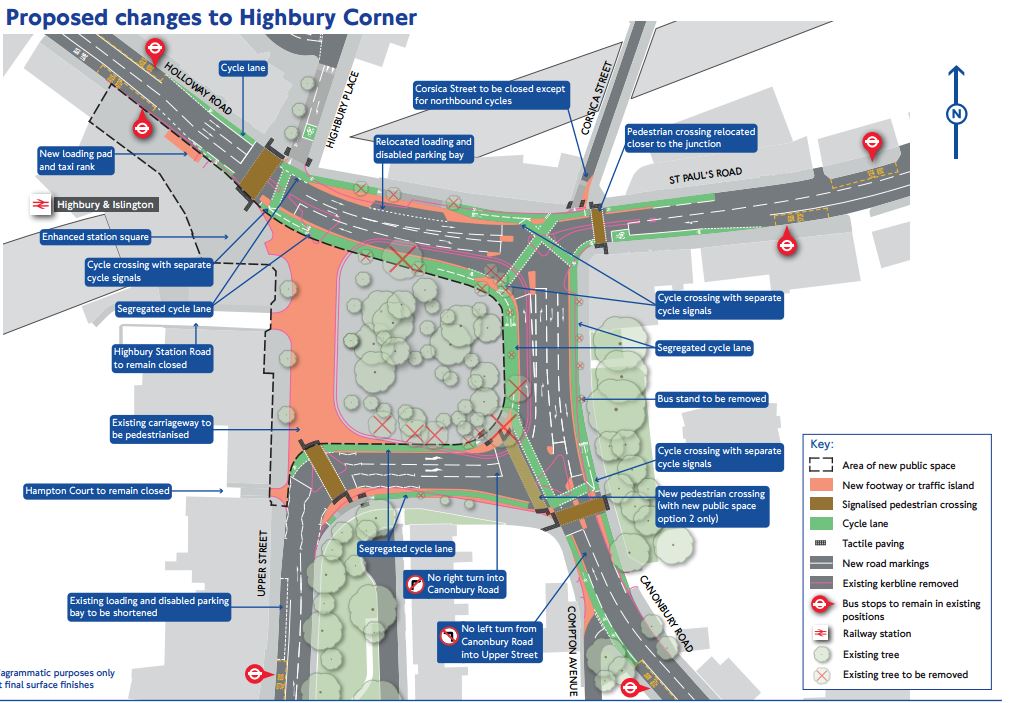
Highbury Corner Changes
The map is a good summary of the proposed changes.
It certainly means that my walk from the bus-top to the station isn’t an obstacle course.
Funding Secured For New Entrance At Stratford Tube Station
The title of this post is the same as that of this article on IanVisits.
The new entrance will give those coming from the Carpenters Estate direct access to Stratford station.
This Google Map shows the South East section of the station.
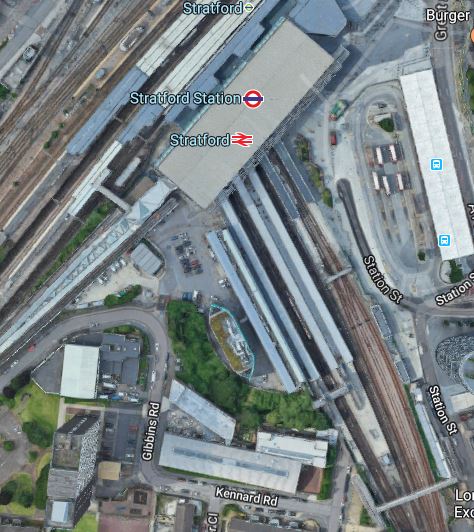
The main station building has the two station symbols on the top and the Jubilee Line platforms run Southwards from the building.
It would appear that the new entrance will be close to the Southernmost corner of the station building in a staff car park.
Knowing the station well, I suspect it will be a very useful new entrance for both residents and visitors to the Olympic Park.
It will make it easier to avoid the clutches of Eastfield.
The only details on the cost of the scheme is this sentence from Ian’s article.
Newham council has agreed to contribute £1 million to the scheme, which is being funded from its Community Infrastructure Levy.
As it incorporates some extra lifts in the station, the scheme is probably going to be more than a million pound one, but the London Legacy Development Corporation (LLDC) is involved, I suspect that everything is securely funded.
Should There Be Other Small Schemes Like This?
At Shepherd’s Bush station on the Overground, in 2015, a new entrance was built to give better access to Westfield. It is not very busy during the day, but I suspect that workers at Westfield use it more than shopper. Wikipedia says it cost £1.35 million, so I should think that the Stratford scheme wouldn’t cost a great deal more.
I believe there are other places, where extra entrances could be built.
Simple Ungated Entrances
Entrances don’t have to be grand, as I showed in An Ungated Entrance Used To Create Step-Free Access At Crofton Park Station.
These two entrances are just a hole in the station fence, Oyster readers and a bit of tarmac. There must be other places, where these entrances can be installed.
An Entrance At Hackney Central Station Into Graham Road
In It Looks Like The Hackney Downs/Central Link Is Ready To Open, I also talk in detail about adding a Southern entrance to Hackney Central station, that would lead directly into Graham Road. Eith a pedestrian crossing and changes to the bus stops, it would be a very useful step-free entrance for those living between the centres of Hackney and Dalston.
A Second Entrance At Highbury & Islington Station
In Could We Create A Second Entrance To The Overground At Highbury And Islington Station?, I investigated creating a West-facing entrance at Highbury & Islington station, that would improve access for those going to football.
Conclusion
I believe that a lot of stations can be improved, by adding extra entrances in convenient places.
It is probably easier to do in London’s Oyster/contactless card area, as a couple of readers can sort out ticketing.
 The Anonymous Widower