Completing Northern Powerhouse Rail
The Northern Powerhouse Rail/High Speed Two Connection To Manchester Airport Station
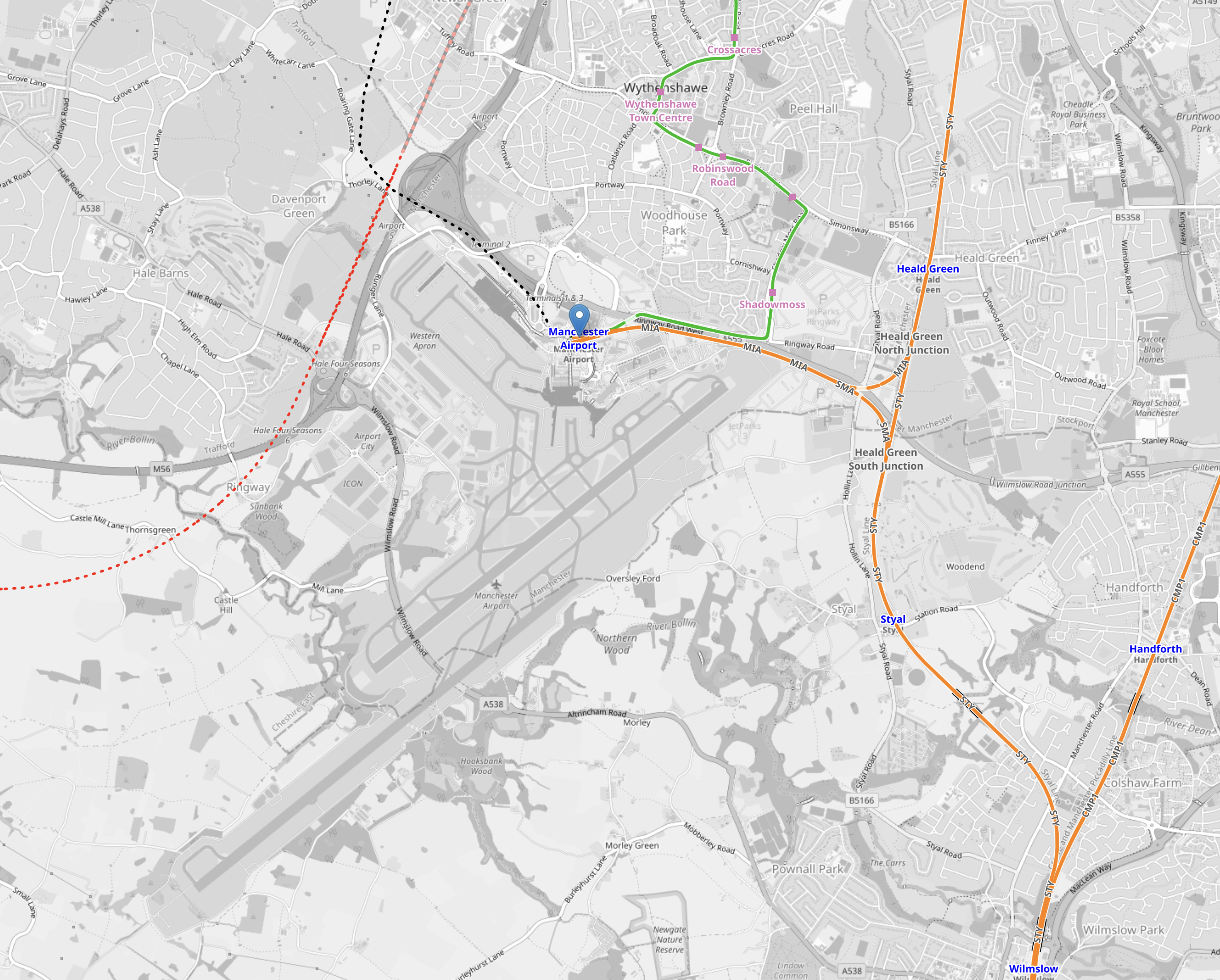
This OpenRailwayMap shows the rail connections that terminate at Manchester Airport station.
Note.
- The two runways are clearly shown.
- Manchester Airport station is indicated by the blue arrow near the top of the map.
- The orange tracks are rail lines.
- The green lines are Manchester Metrolink tracks.
- Rail and tram services approach the airport station from the East.
- The red dotted line is the current proposed path of Northern Powerhouse Rail/High Speed Two
- The black dotted line appears to be an extension of the tram line to the airport.
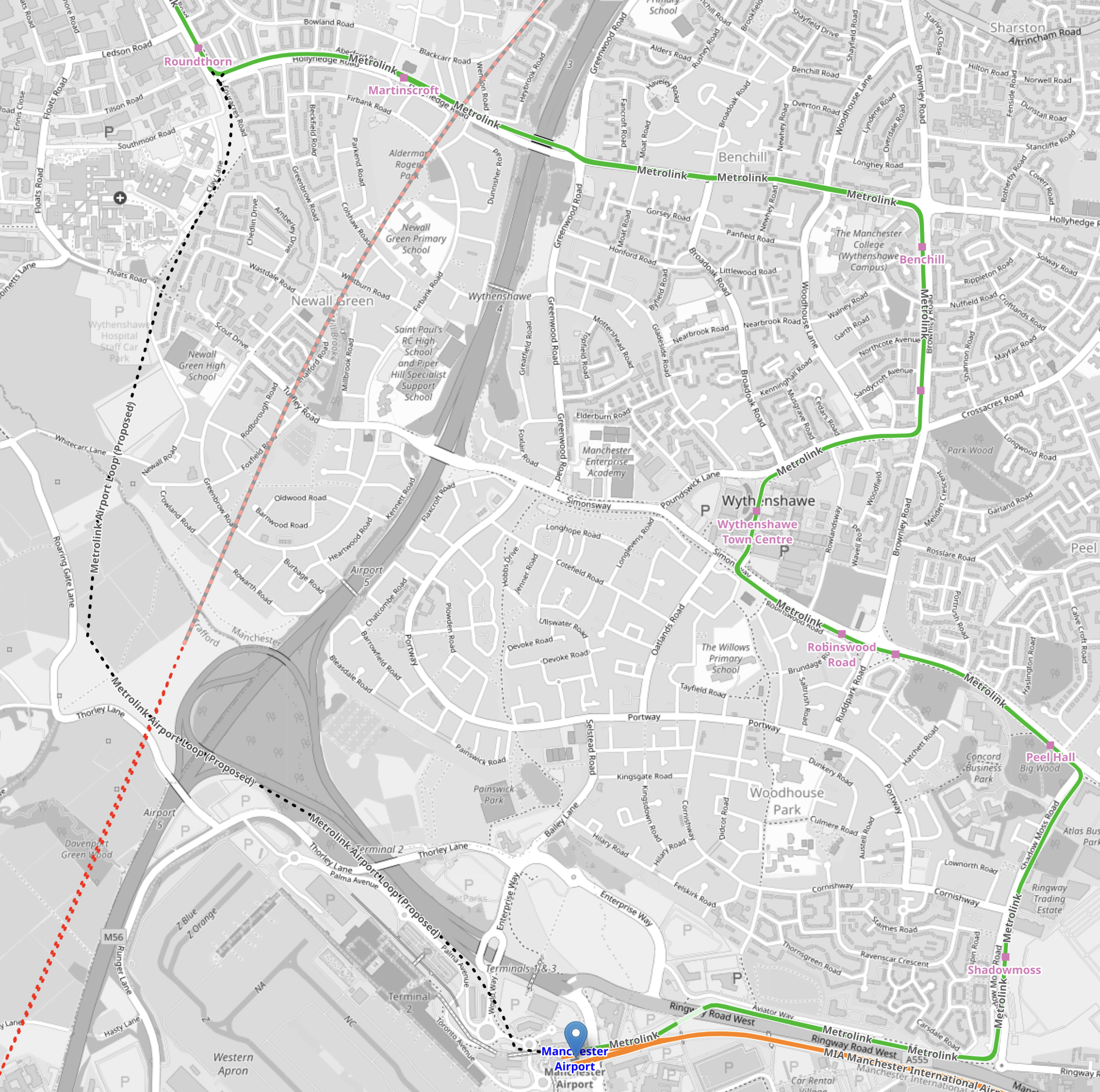
This second OpenRailwayMap shows the lines around the airport station to a larger scale.
Note.
- Manchester Airport station is indicated by the blue arrow at the bottom of the map.
- The orange tracks are rail lines.
- The green lines are Manchester Metrolink tracks.
- The red dotted line is the current proposed path of Northern Powerhouse Rail/High Speed Two.
- The Manchester Metrolink now makes a loop around the Airport.
I think the following will happen.
- A large proportion of passengers and staff travelling between Manchester Airport and Manchester City Centre will use Northern Powerhouse Rail/High Speed Two.
- Passengers and staff, who live locally will use the Manchester Metro loop.
- Northern Powerhouse Rail/High Speed Two will replace some of the current train services.
- Some services on the Castlefield Corridor will migrate to Northern Powerhouse Rail/High Speed Two.
There could be as many as twelve trains per hour (tph) between Manchester Airport and Manchester City Centre on Northern Powerhouse Rail/High Speed Two. But a new urban line like that, which was mostly in a tunnel could probably handle 20 tph.
Manchester Airport And Crewe
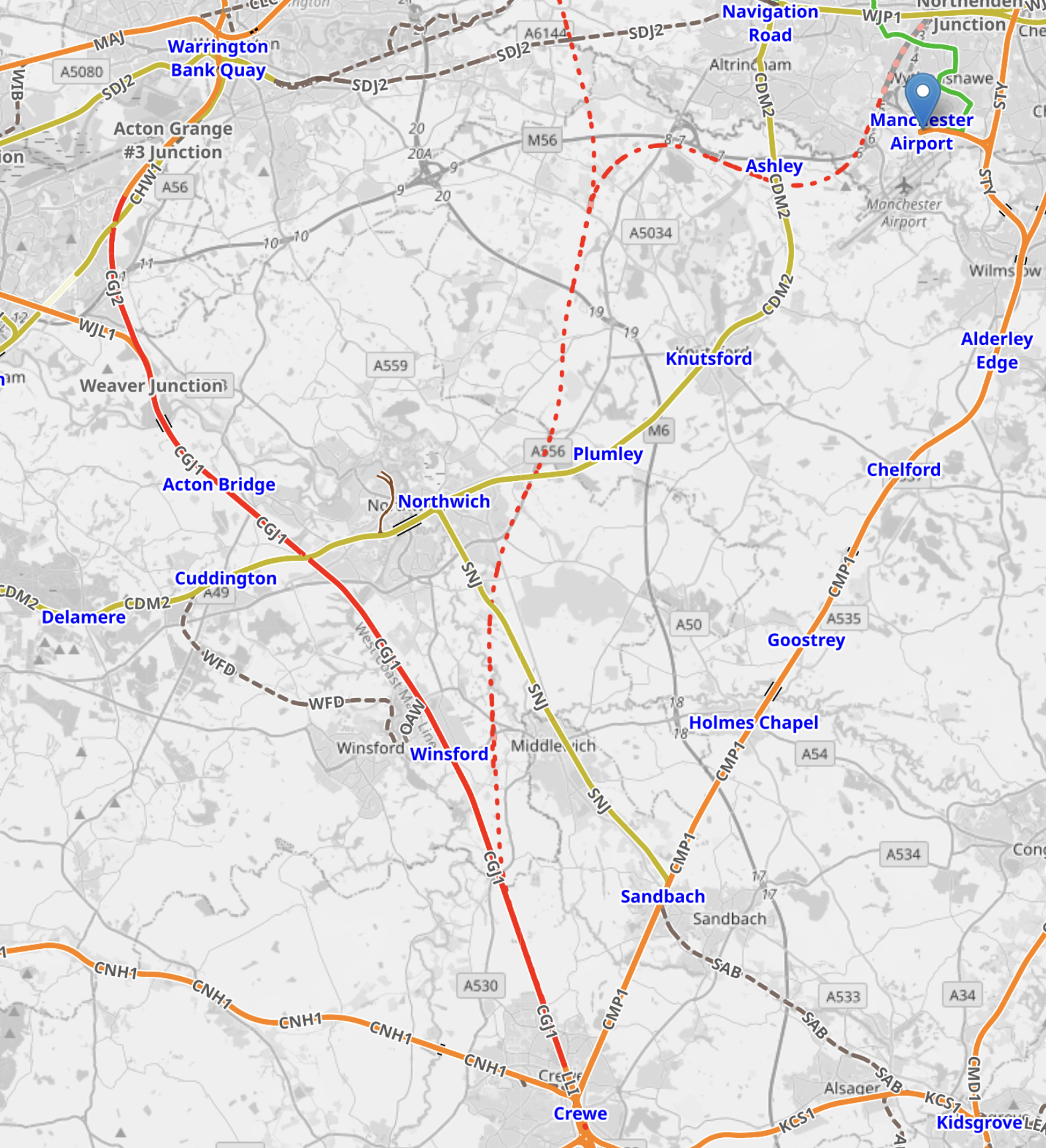
This OpenRailwayMap shows the railways between Manchester Airport and Crewe stations.
Note.
- Manchester Airport station is indicated by the blue arrow at the top of the map.
- The orange tracks are rail lines.
- The red track going down the left hand side of the map is the West Coast Main Line.
- The green lines are Manchester Metrolink tracks.
- The red dotted line is the current proposed path of Northern Powerhouse Rail/High Speed Two.
- Crewe station is at the bottom of the map in the middle.
There could be as many as 12 tph between Manchester Airport and Crewe.
Manchester Airport And Manchester Piccadilly
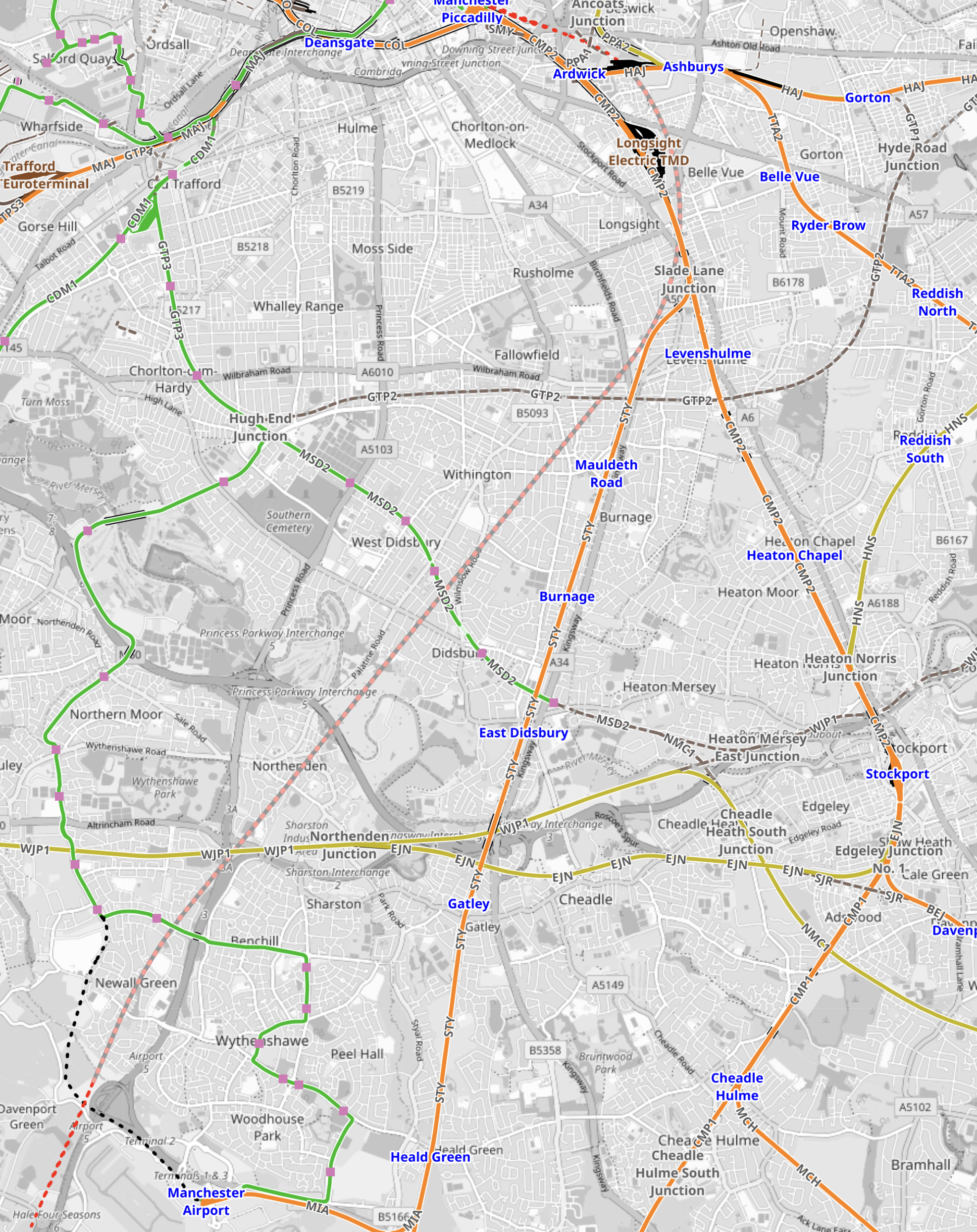
This OpenRailwayMap shows the railways between Manchester Airport and Manchester Piccadilly stations.
Note.
- Manchester Airport station is in the South-West corner of the map.
- The orange tracks are existing rail lines.
- The green lines are Manchester Metrolink tracks.
- The red dotted line going up the middle of the map is the current proposed path of Northern Powerhouse Rail/High Speed Two.
- Manchester Piccadilly station is at the Northern end of Northern Powerhouse Rail/High Speed Two.
This OpenRailwayMap shows the City Centre between Manchester Piccadilly and Manchester Victoria stations.
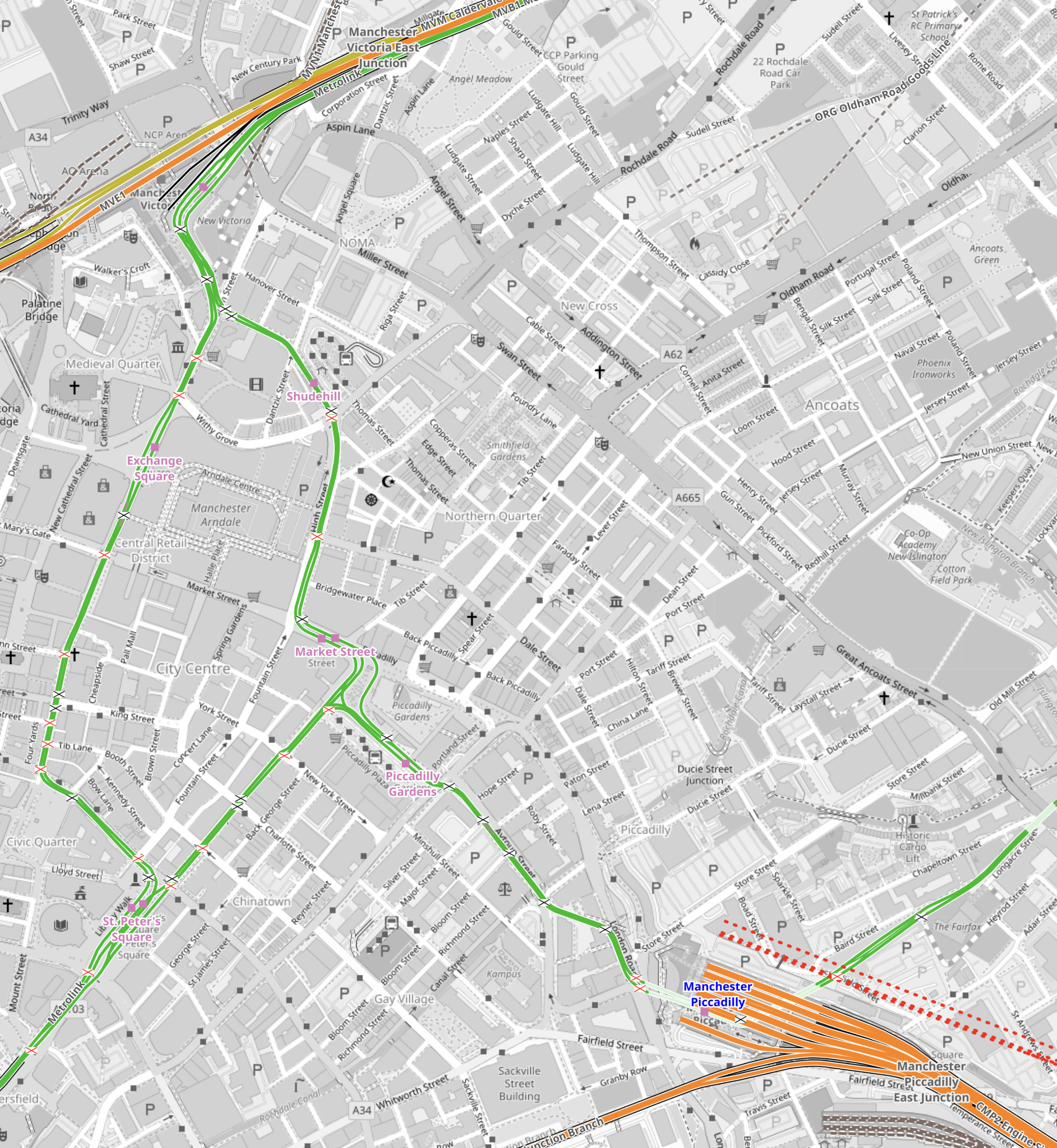
Note.
- Manchester Piccadilly station is in the South-East corner of the map.
- The red dotted lines creeping into the map is the current proposed path of Northern Powerhouse Rail/High Speed Two.
- All the platforms in Manchester Piccadilly station can be picked out, with the Castlefield Corridor breaking away to the West.
- The current plans will need demolition of buildings to the North of Manchester Piccadilly station.
- Manchester Victoria station is in the North-West corner of the map.
- The green line of the Manchester Metrolink route picks out the walking route between Manchester’s two main stations.
- About halfway between Manchester Piccadilly and Manchester Victoria stations is the open space of Piccadilly Gardens.
This Google Map shows Piccadilly Gardens.
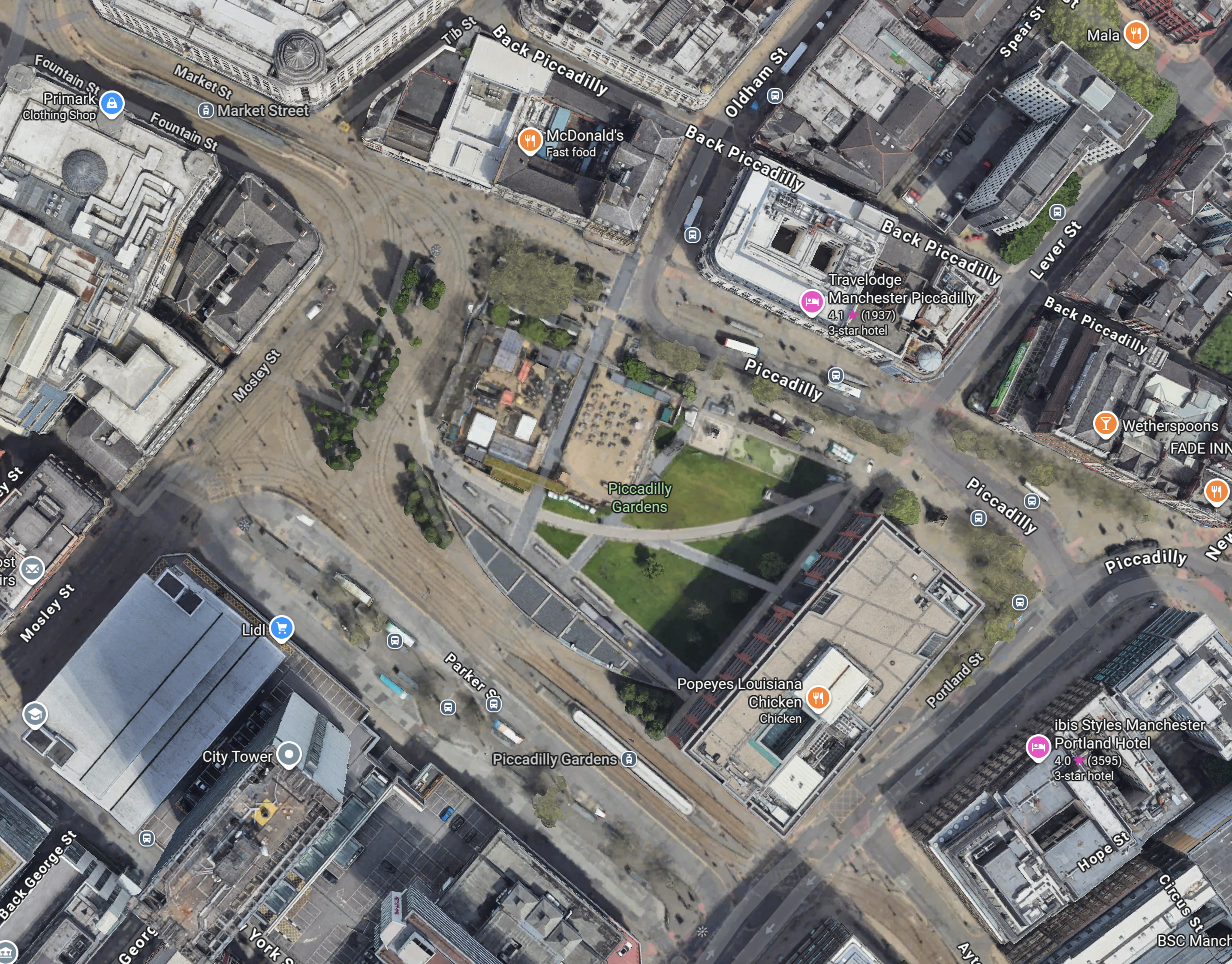
Note.
- The Manchester Metrolink running through.
- There are two Metrolink stops ; Market Street and Piccadilly Gardens, in the area.
- It appears any stop on the Manchester Metrolink can be reached with no more than a single change from one of these two stops.
Looking at the map showing Victoria and Piccadilly stations, I wonder, if a Lizzie Line of the North could be built under Manchester City Centre.
- There would be underground platforms at Piccadilly station, with two through platforms and two to terminate trains from the South.
- Local services from Piccadilly station could continue as now, although services to Manchester Airport could be simplified.
- There would be an underground station at Piccadilly Gardens with two through platforms , to connect with an expanded Manchester Metrolink, buses and walking routes.
- There would be underground platforms at Victoria station, with two through platforms and two to terminate trains from the East.
- Local services from Victoria could continue as now.
- There could be as many as 12 tph between Manchester Victoria, Piccadilly Gardens, Manchester Piccadilly and Manchester Airport.
Just as the Lizzie Line was slotted into London, with the minimum of disruption, I am fairly certain, a similar but smaller construction process could be carried out in Manchester City Centre.
- Manchester doesn’t have an Underground to avoid.
- The stations could be very similar to each other and like Custom House station on the Lizzie Line, they could be built with giant concrete Lego.
- There would only be four stations to create.
- The tunnel would be about fifteen miles at most.
- The tunnel would not need to be electrified as the trains could run on batteries.
As a Manchester Rail Tunnel has been talked about for decades, I suspect there is a big knowledge base of ground conditions, which would help with the design and construction.
Between Manchester Victoria And Leeds
Consider.
- The electrification between Manchester Victoria and Stalybridge stations has recently been switched on.
- Part of the electrification between Leeds and York stations has been switched on.
- Full electrification is being installed between Leeds and Manchester Victoria stations.
This OpenRailwayMap shows the Huddersfield Line between Manchester Victoria station and a few miles short of Huddersfield station.
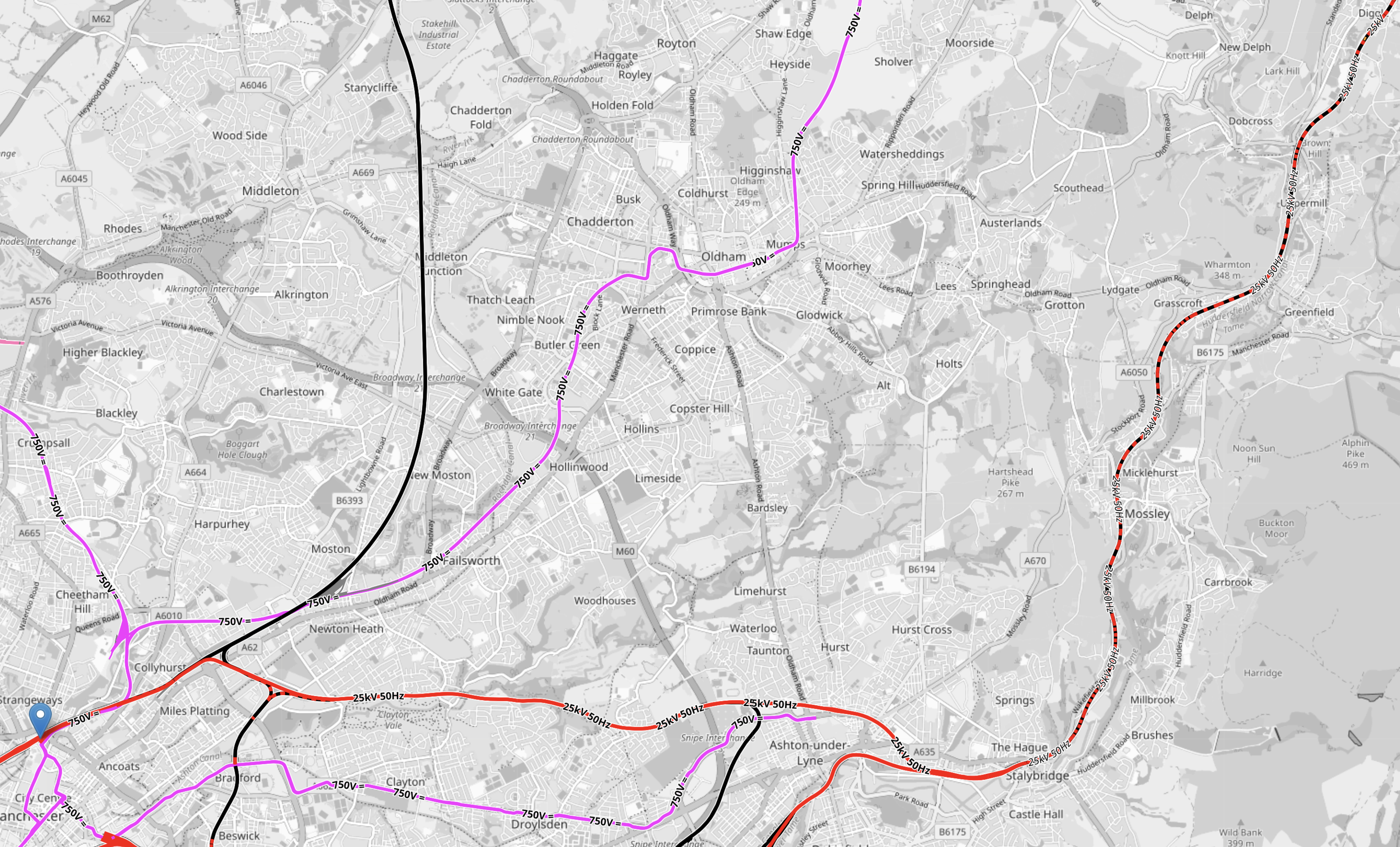
Note.
- Manchester Victoria station is indicated by the blue arrow in the South-West corner of the map.
- Huddersfield station is just off the map in the North-East corner.
- Manchester Victoria and Stalybridge stations is fully electrified and shown in red.
- Stalybridge and Huddersfield stations is being electrified and is shown as black and red dotted.
- Electrification between Huddersfield and Leeds is underway under the TransPennine Upgrade.
This section will be completed, when the Manchester City Centre Rail Tunnel is connected to the Huddersfield Line.
Connecting The Manchester City Centre Rail Tunnel To The Huddersfield Line
This Google Map shows where the Huddersfield Line crosses the M60 Motorway to the West of Ashton-under-Lyme.
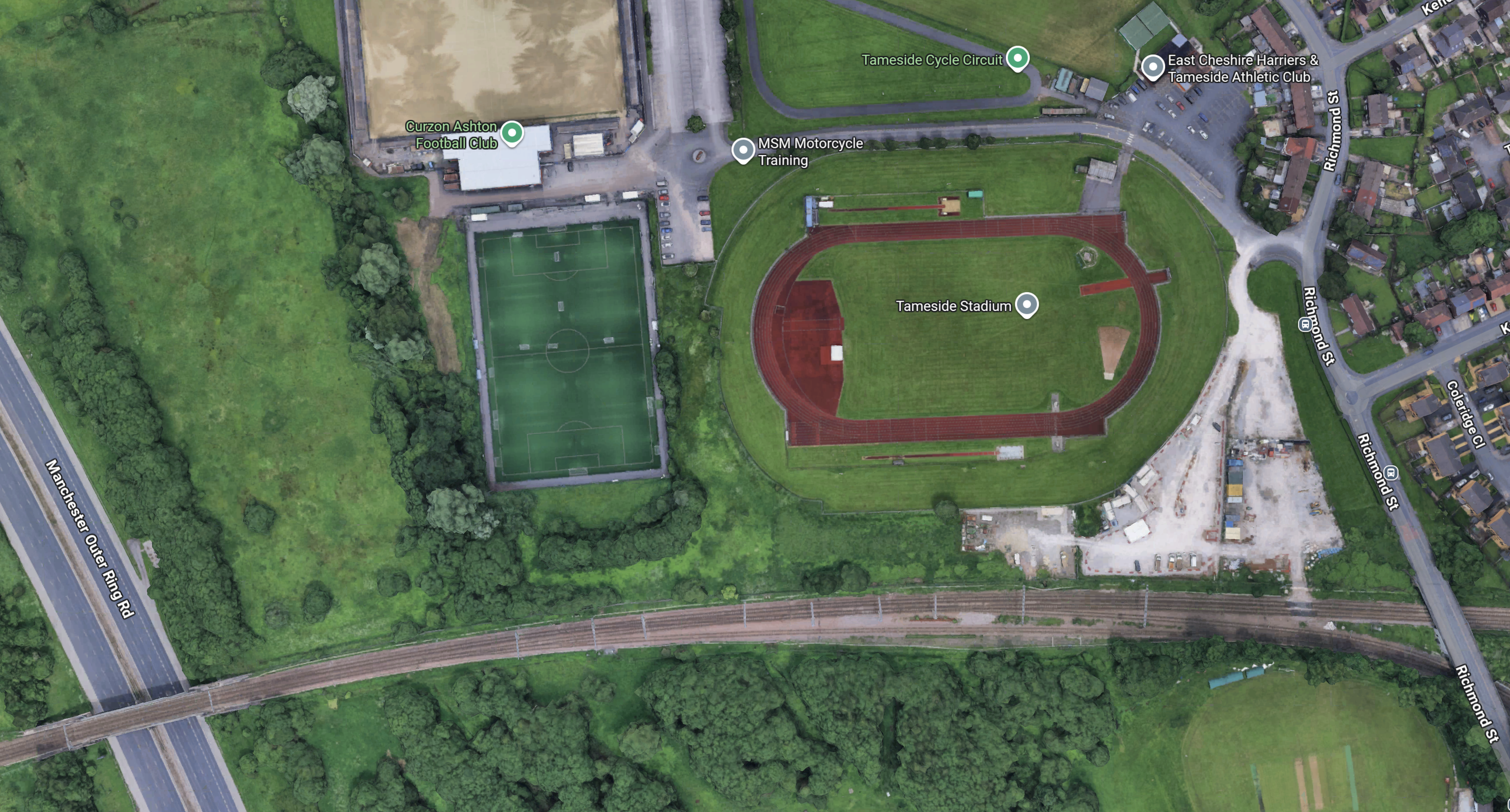
Note.
- The newly-electrified Huddersfield Line runs across the map.
- The M60 Motorway is on the left.
- There are facilities for athletics, cricket and football.
I wouldn’t be surprised if the Eastern portal of the Manchester City Centre Rail Tunnel was in this area.
But looking at Google Maps between this site and Manchester Victoria, there are other sites.
Conclusion
I now feel that it is possible to create a Northern Powerhouse Rail/High Speed Two route using a tunnel under Manchester.
Obviously, there is more work to be done.
Stalybridge Station – 16th December 2021
In my meandering along the TransPennine Route brought me to Stalybridge station.
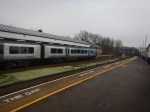
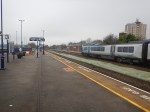
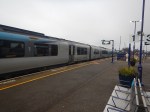
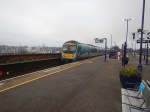
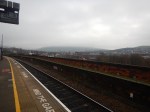
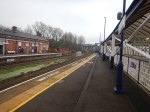
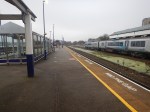
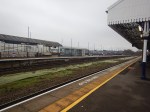
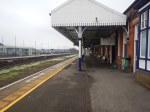
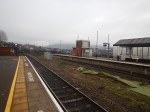
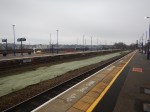
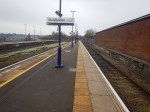
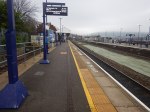
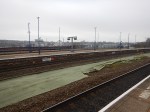
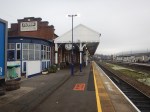
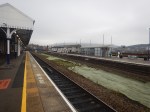
This Google Map shows the station.
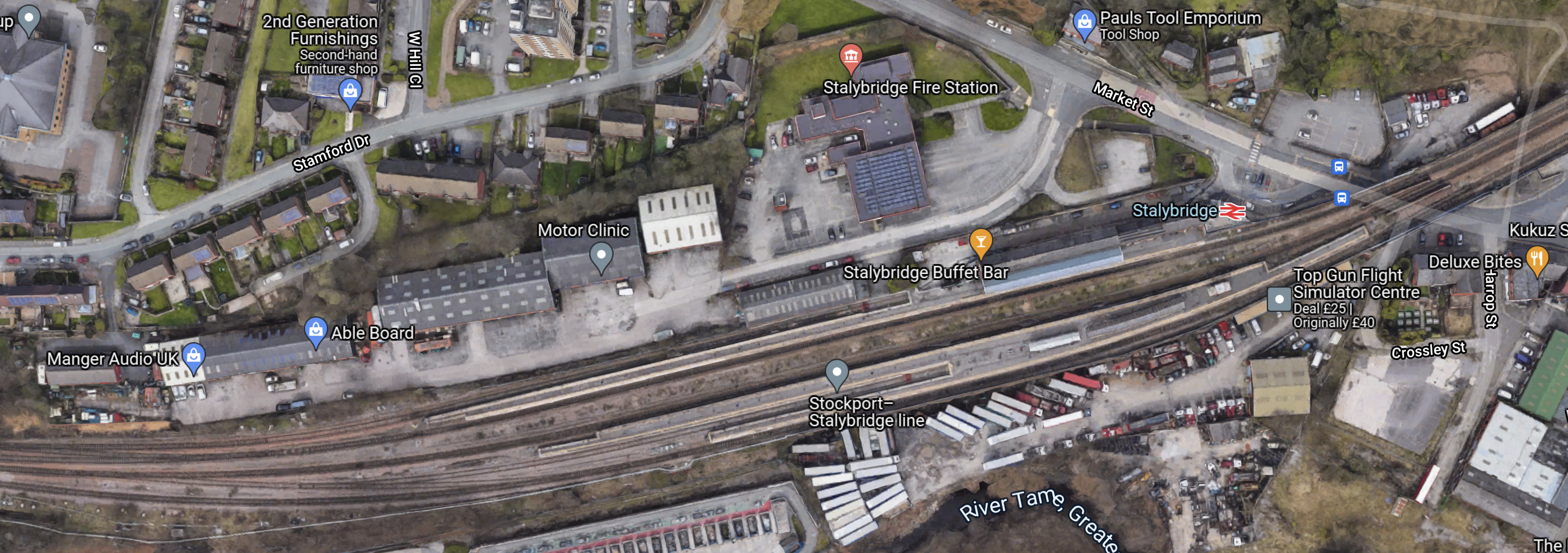
As the pictures and the maps show, there is space at Stalybridge station.
Timings Between Manchester Victoria And Huddersfield
There are these trains between Manchester Victoria and Huddersfield.
- Liverpool Lime Street and Scarborough – stops at Stalybridge
- Manchester Airport and Redcar Central
- Liverpool Lime Street and Edinburgh
- Manchester Airport and Newcastle.
That is four trains per hour (tph) between Manchester Victoria and Huddersfield.
- They take around 9-14 minutes between Manchester Victoria and Stalybridge.
- They take around 31-32 minutes between Manchester Victoria and Huddersfield.
- As Manchester Victoria and Stalybridge is 7.7 miles, the average speed on this section is 33-51 mph
- As Manchester Victoria and Huddersfield is 25.7 miles, the average speed on this section is 48-50 mph
In this Transport for the North report , which is entitled At A Glance – Northern Powerhouse Rail, an objective of twenty-five minutes is given for Manchester and Leeds.
One possible way to achieve this time stated in the report is stated as.
Diggle upgrades akin to a new line.
Diggle is between Greenfield station and the Standedge tunnels.
Assuming a constant average speed between Manchester Victoria and Leeds, the twenty-minutes objective for this route means a timing of fifteen minutes between Manchester Victoria and Huddersfield.
I estimate that this would need an average speed of well over 100 mph to get anywhere near the required fifteen minutes.
But by rebuilding the line between Manchester Victoria and Huddersfield to High Speed Two construction standards, it appears to be possible.
Timings Between Manchester Piccadilly And Huddersfield
There are these trains between Manchester Piccadilly and Huddersfield.
- Manchester Piccadilly and Huddersfield – stops at Stalybridge, Mossley, Greenfield, Marsden and Slaithwaite.
- Manchester Piccadilly and Hull – stops at Stalybridge
That is two tph between Manchester Piccadilly and Huddersfield.
The direct train is a few minutes slower, but the stopping train is nearly ten minutes slower.
I feel some time improvements will be possible, but the Manchester Victoria services will probably be faster.
Conclusion
It is possible, there could be a unique high speed line between Manchester Victoria and Huddersfield through the Victorian tunnels at Standedge.
- One possibility, I can see is to have two fast tracks for the main TransPennine expresses and a third bi-directional third-track to accommodate the stopping services.
- The double track express route could probably handle six tph, as the only stops between Manchester Victoria and Huddersfield is two tph that stop at Stalybridge.
- Operating speeds on the fast tracks could be up to perhaps 160 mph on slab track.
- All trains stop at Huddersfield.
- A single bi-directional track between Stalybridge and Huddersfield could easily handle two tph.
There would be engineering challenges, but I feel it would be possible.
Greenfield Station – 16th December 2021
Greenfield station is the nearest station to the West of the Standedge tunnels. In my meanderings between Middlesbrough and Mirfield, I went to have a look.
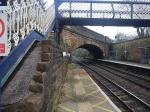
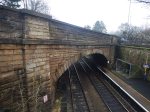
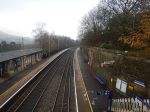
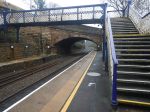
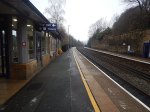
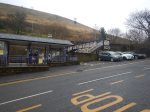
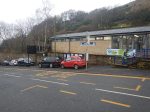
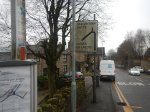
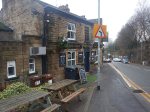
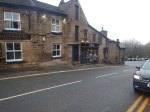
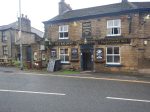
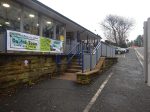
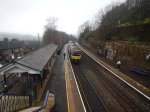
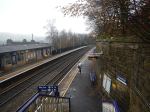
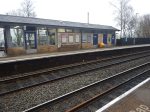
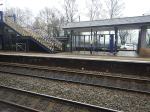
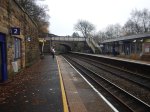
As the pictures show, this is a modern station with its own pub and an excellent cafe on the other side of the road.
But the access to the Huddersfield-bound platform is not step-free.
This Google Map shows the station.
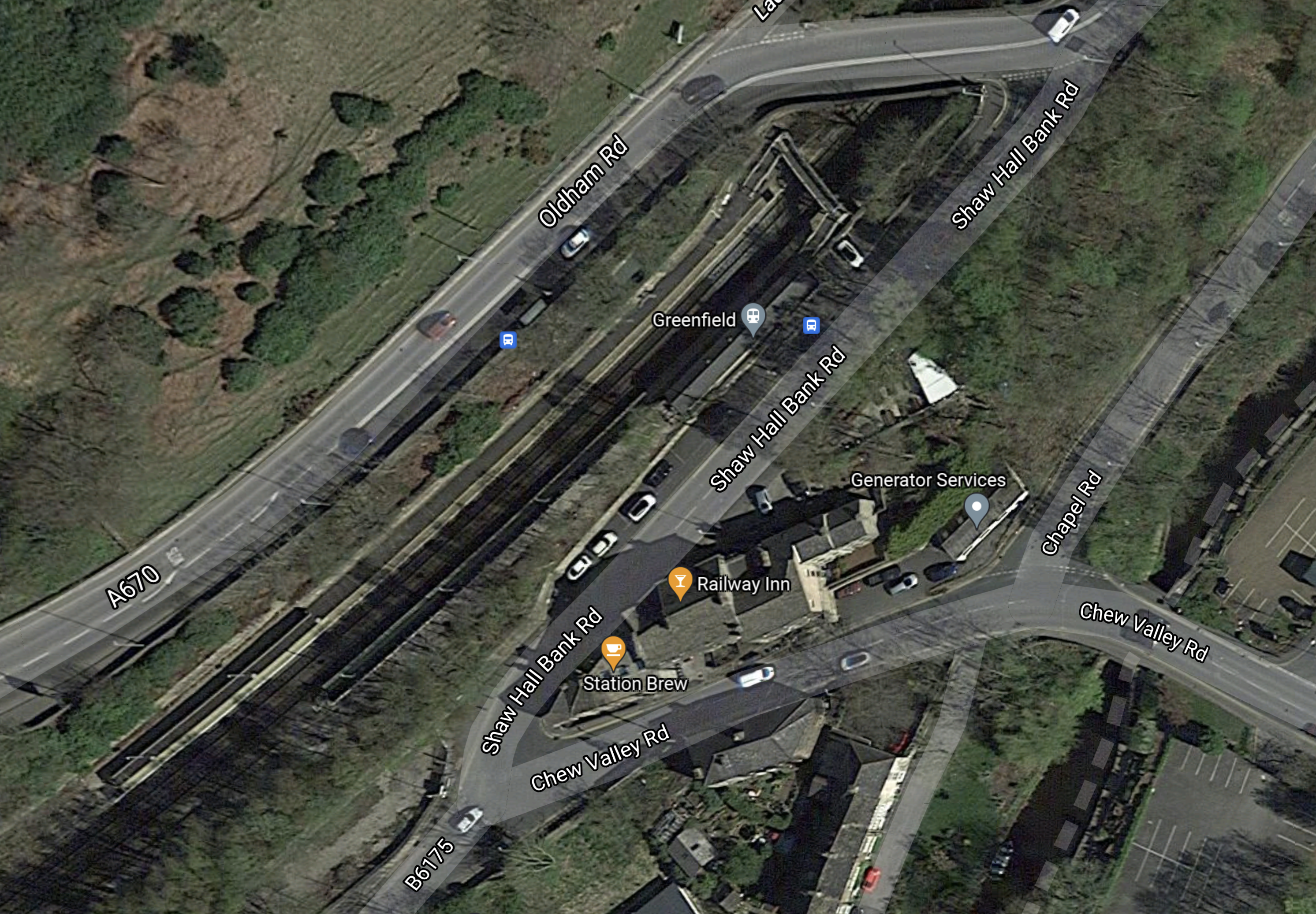
It is a cramped site, but the road didn’t appear to be very busy.
Could A High Speed Line Go Through Greenfield Station?
As I said it is a cramped site, but if the platform by the road were to be made bi-directional, the station would be converted into a two train per hour (tph) step-free station.
This is possible as has been shown on the Borders Railway at Galashiels station.
Look at this picture taken from the bridge.
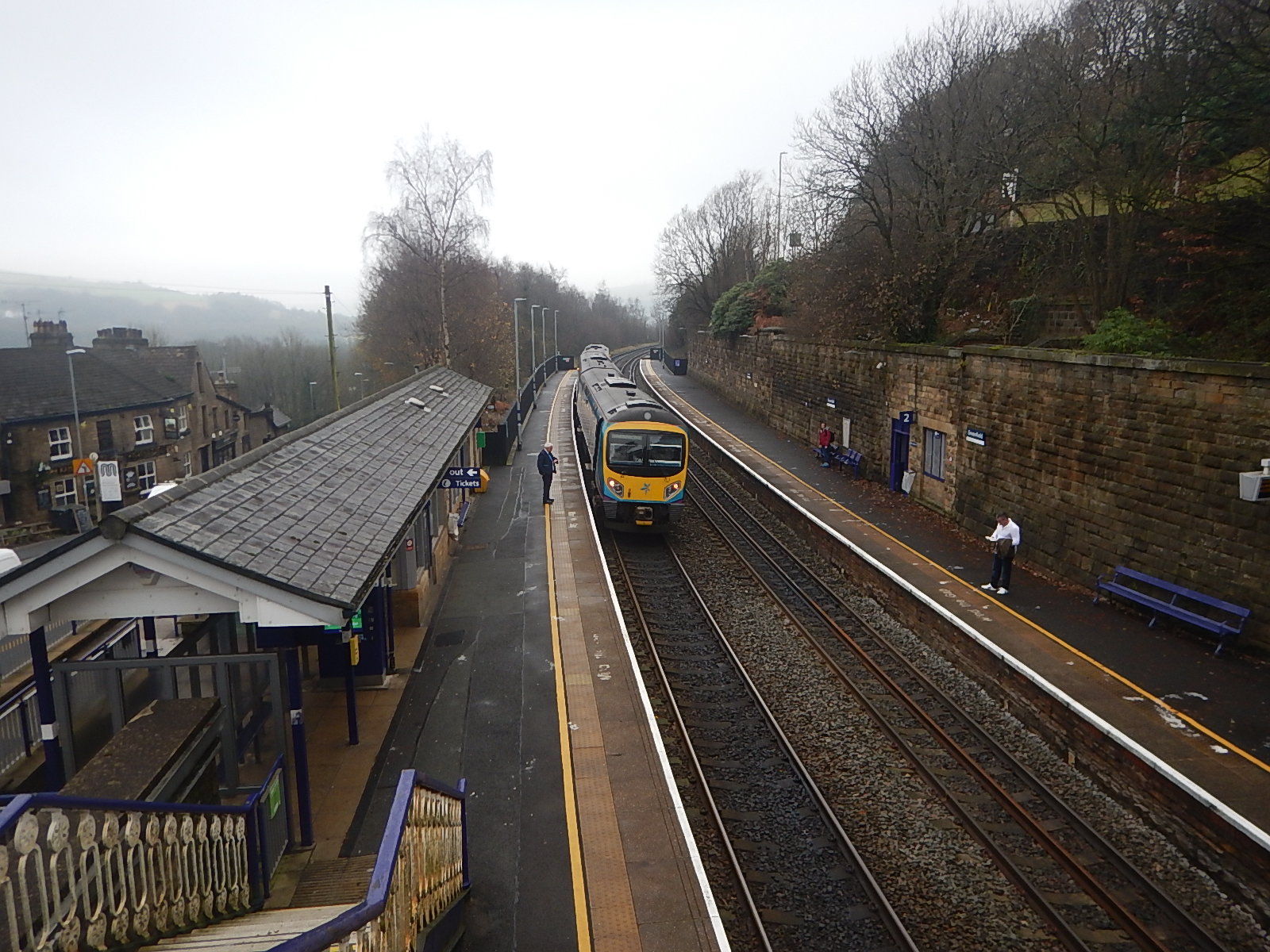
I feel that by removing the second platform and rebuilding the retaining wall and the road bridge, that two 125 mph tracks could be squeezed through.
Step-Free Access
If after two high speed lines through, will it be possible to have full step-free access?
It will certainly be the same for both directions, but what will the access be like between platform and train?
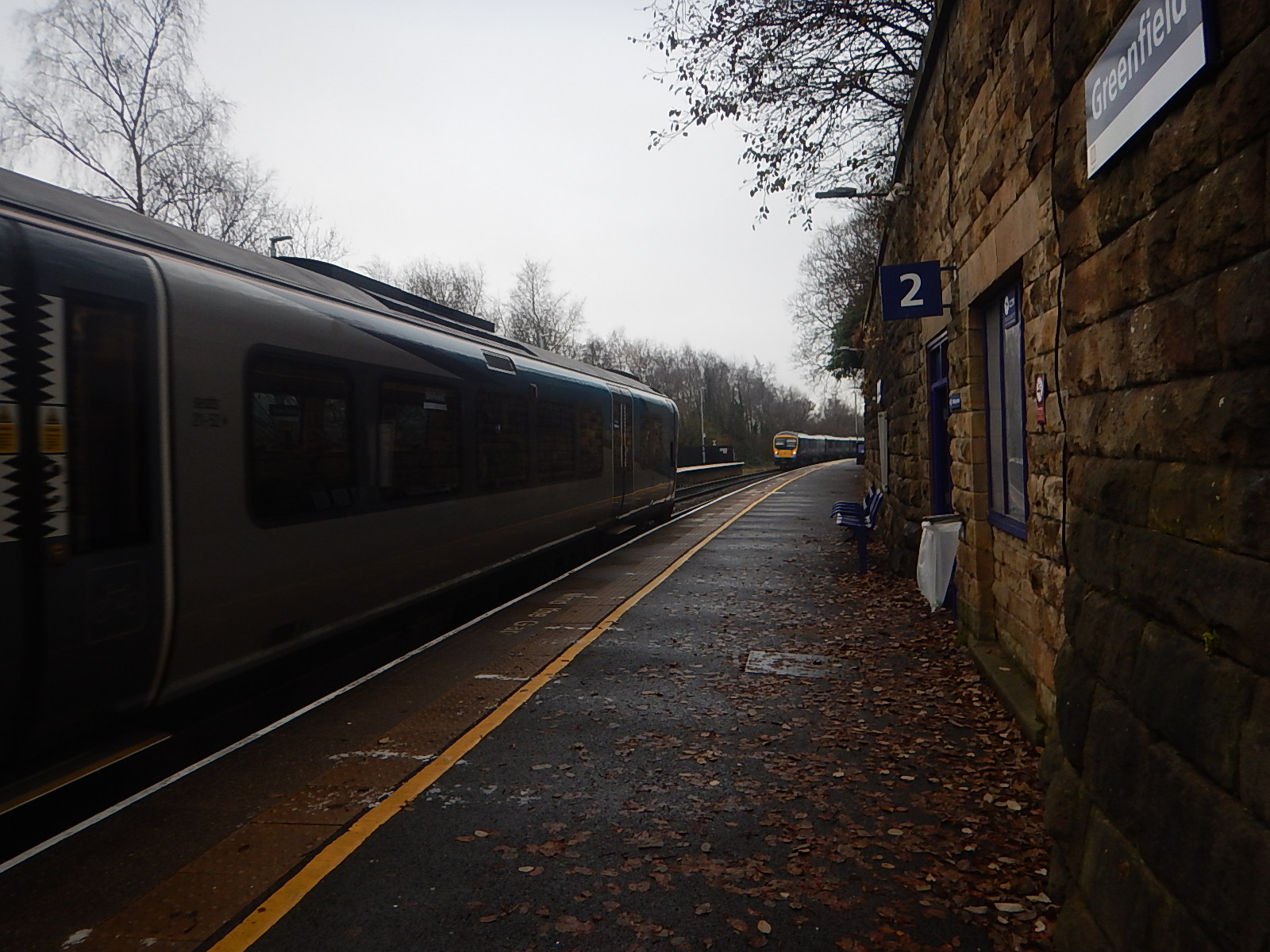
The picture shows a train in the current Huddersfield-bound platform.
It is not bad, but it could be better, as has been demonstrated at the recently-opened Soham station.
But with only one class of train calling in the station it could be a lot better.
The Station Brew Cafe
I had a late breakfast at the Station Brew Cafe opposite the station.
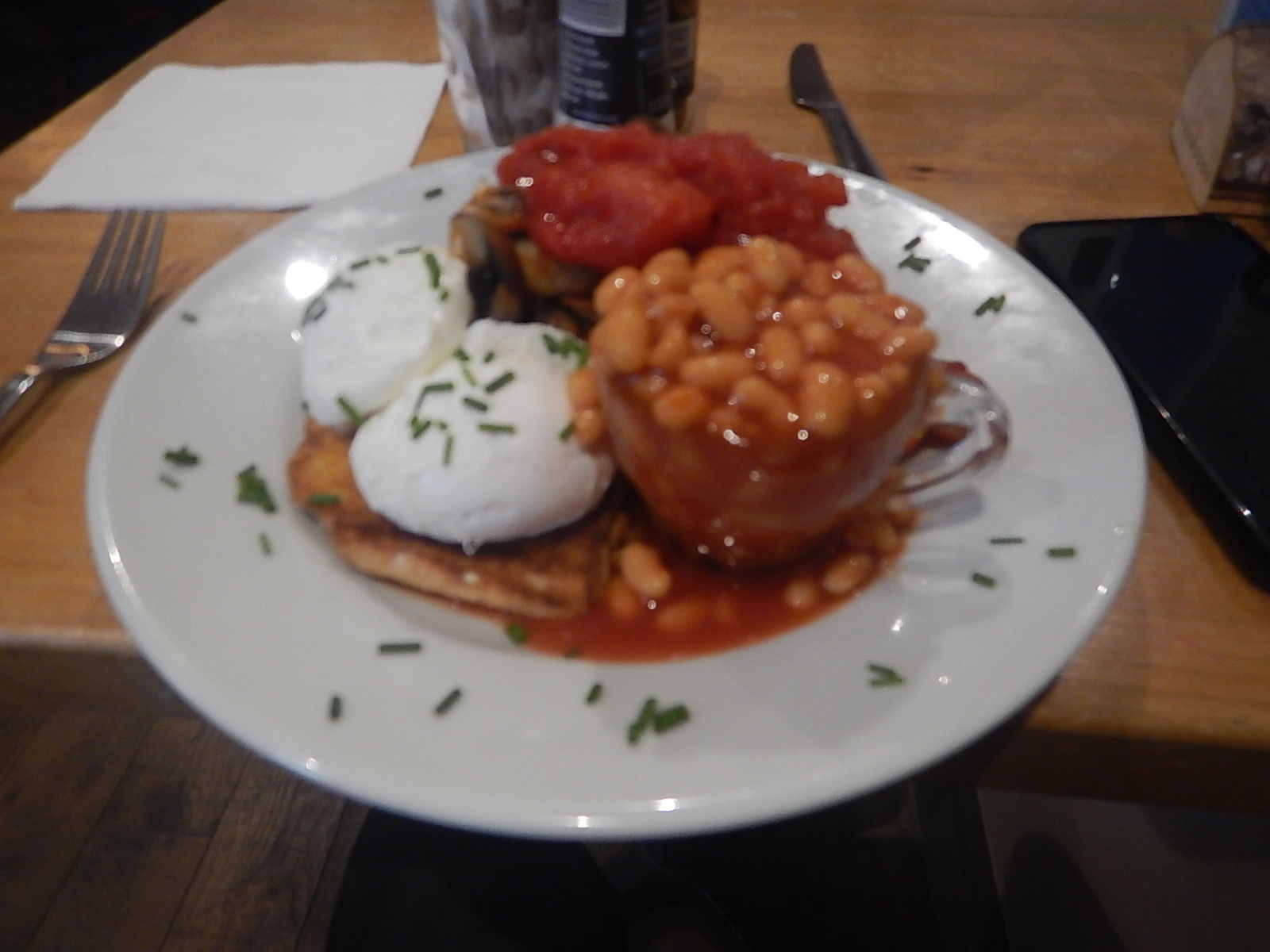
Excellent! And gluten-free too!
Note the small cup, which I assumed they used to microwave the beans.
Conclusion
It would be difficult but not impossible engineering to squeeze a high speed line through Greenfield station.
Marsden Station – 16th December 2021
On my meanderings yesterday I visited Marsden station, which has been suggested that it could be the Eastern end of a high speed route to Manchester and Liverpool.
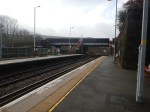
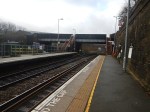
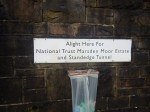

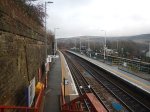

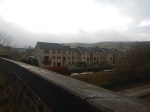
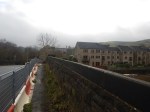
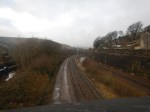
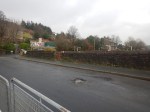
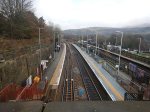
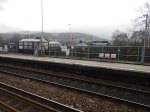
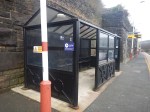

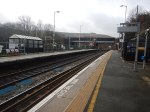
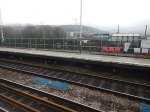
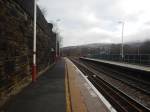
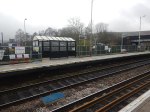
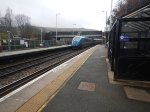
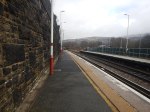
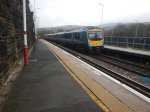
This Google Map shows the station.
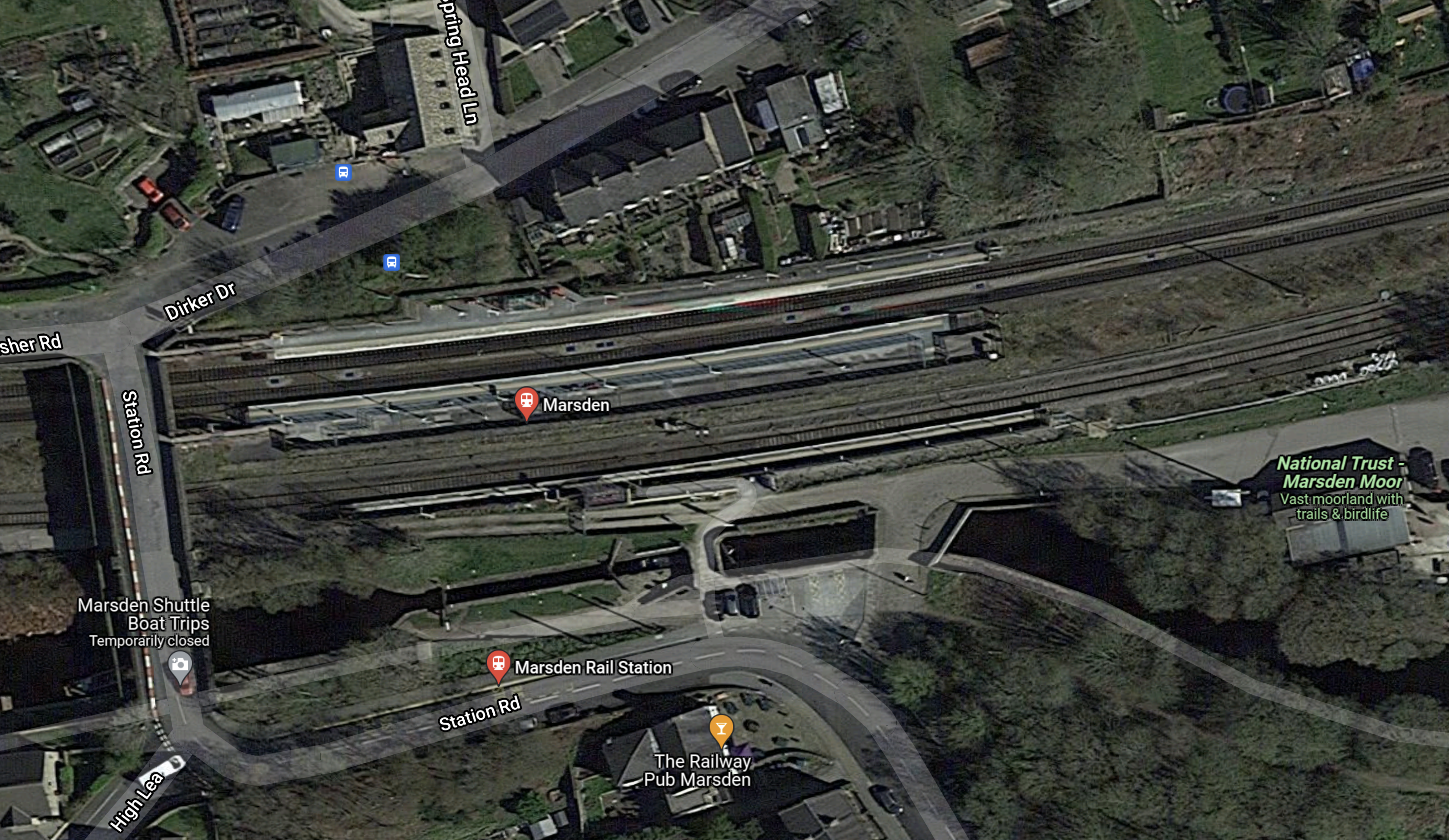
Note.
- The station has three platforms. but trains seem to only use the two Northern platform.
- Access to the platforms is up and down dreadful iron stairs.
- There is a new housing development by the station.
The station needs improvement.
Could A High Speed Line Go Through Marsden Station?
Having looked at the station, I wouldn’t be surprised if Network Rail have a plan to put two fast and one or possibly two slow tracks through this station.
My preference would be to run 125 mph or faster trains on the current pair of Northern lines and create a new station on a single bi-directional line or a pair of lines to the South.
- Trains on the fast line wouldn’t stop.
- There would be a capacity of two trains per hour (tph) in both directions through the station.
It might even be possible to extend high speed running to Slaithwaite station. I didn’t visit that station, but from the Wikipedia entry, I didn’t seem to miss much.
This Google Map shows Slaithwaite station.

After the station, the tracks would merge into two tracks to go the 4.5 miles to Huddersfield, where all trains appear to stop.
Step-Free Access
If after two high speed lines through, will it be possible to have full step-free access?
It will certainly be the same for both directions, but what will the access be like between platform and train?
The picture shows a train in the current Huddersfield-bound platform.
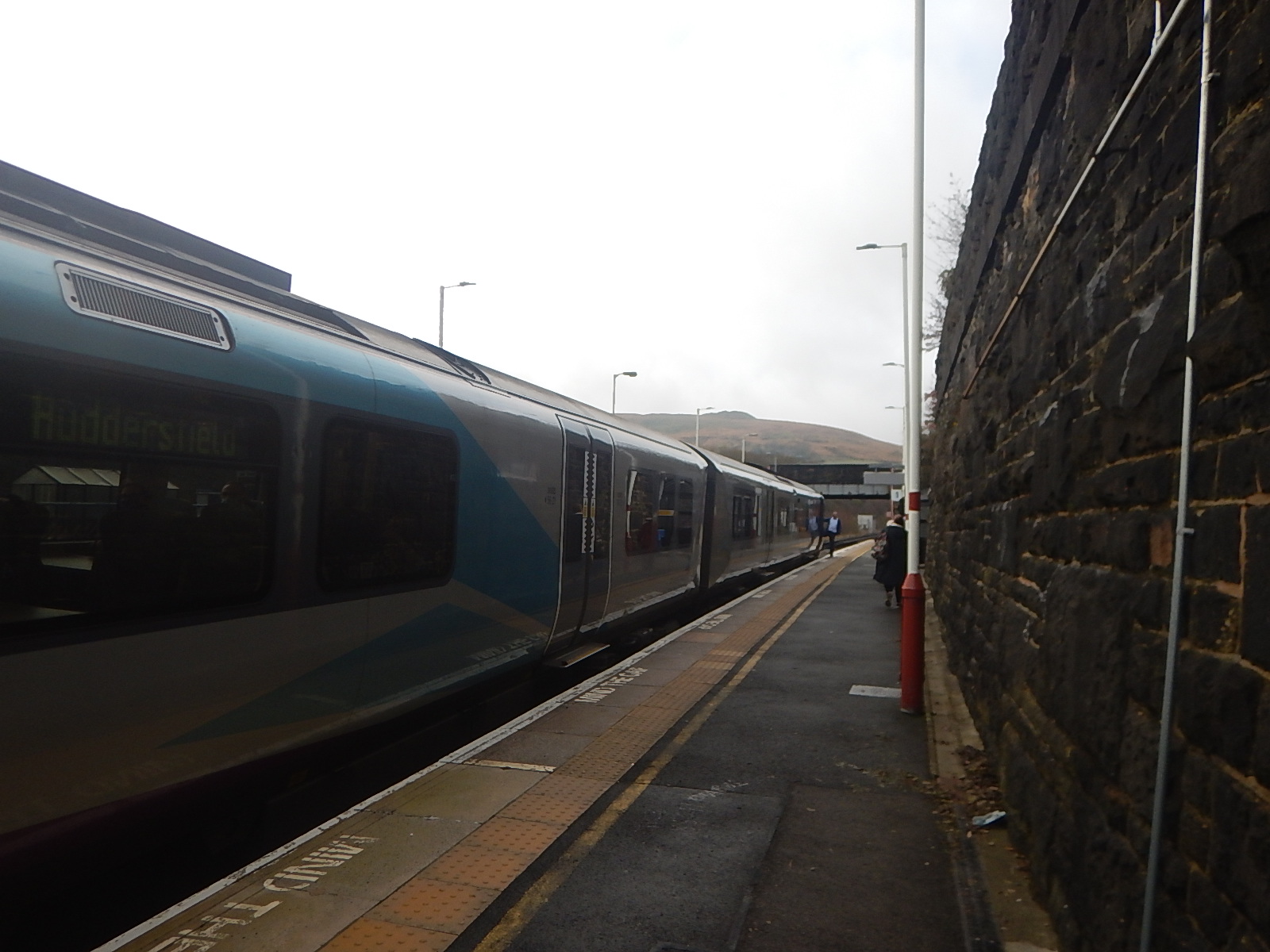
It is not bad, but it could be better, as has been demonstrated at the recently-opened Soham station.
But with only one class of train calling in the station it could be a lot better.
Conclusion
I believe two high speed tracks can be built through Marsden station.
Could The Standedge Tunnels Be Part Of A High Speed Line?
This article on Rail Technology Magazine is entitled Warrington Borough Council React To Integrated Rail Plan, where this is said about improvements between Liverpool and Manchester via Warrington.
One such promise is the delivery of a new high-speed line between Warrington, Manchester and Marsden as part of NPR.
The IRP will also introduce a fully electrified upgraded line between Liverpool and Warrington as part of NPR.
Note NPR is Northern Powerhouse Rail.
Where Is Marsden?
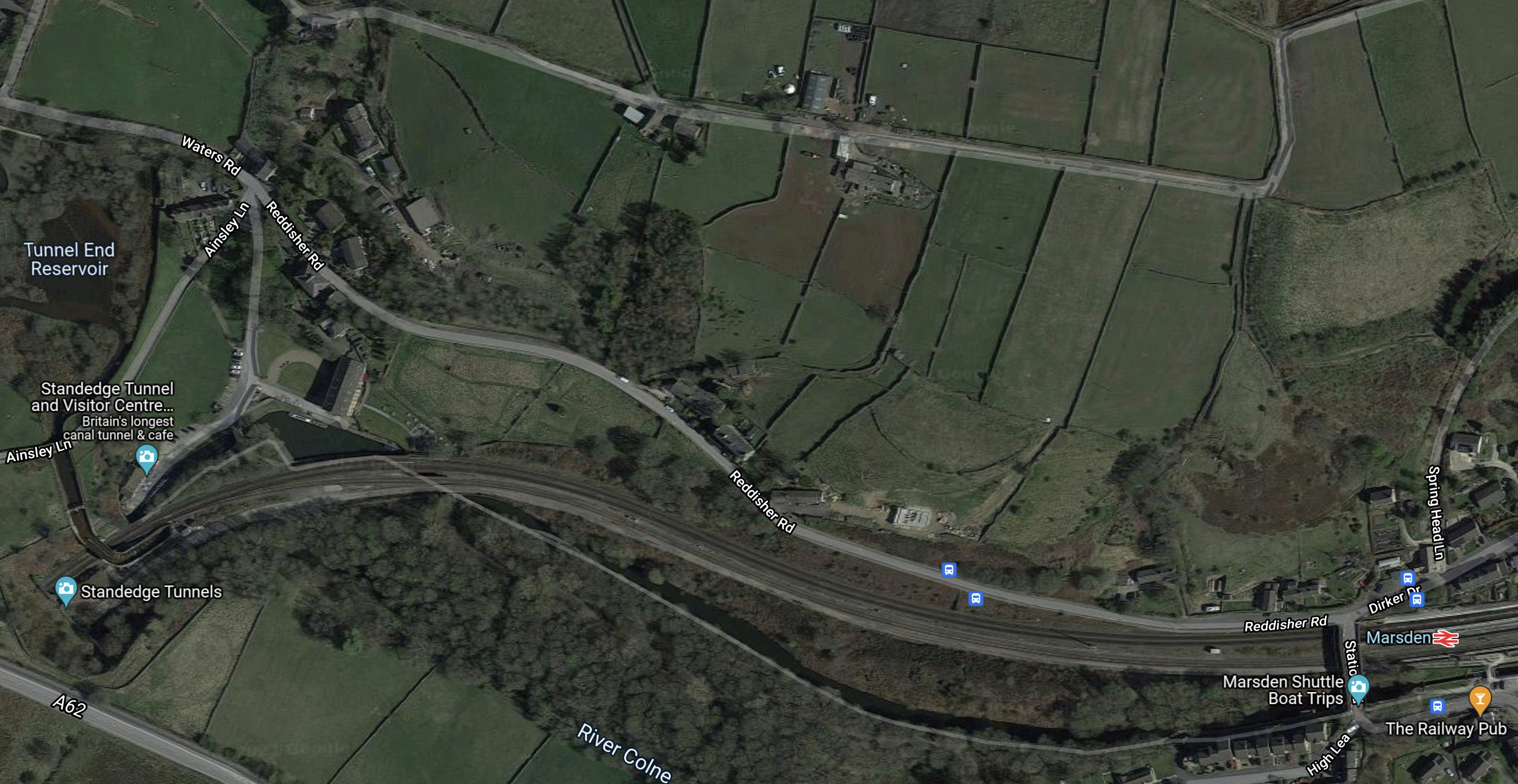
This Google Map shows the rail line between the Standedge Tunnels and Marsden station.
Note.
- Standedge Tunnels and the Visitor Centre in the West.
- Marsden station in the South-East corner of the map.
- The railway between them is the Huddersfield Line.
- The distance between Marsden station and the Eastern Portals of the Standedge Tunnels is about a mile.
Huddersfield station is seven miles to the East of Marsden station.
The Eastern End Of The Standedge Tunnels
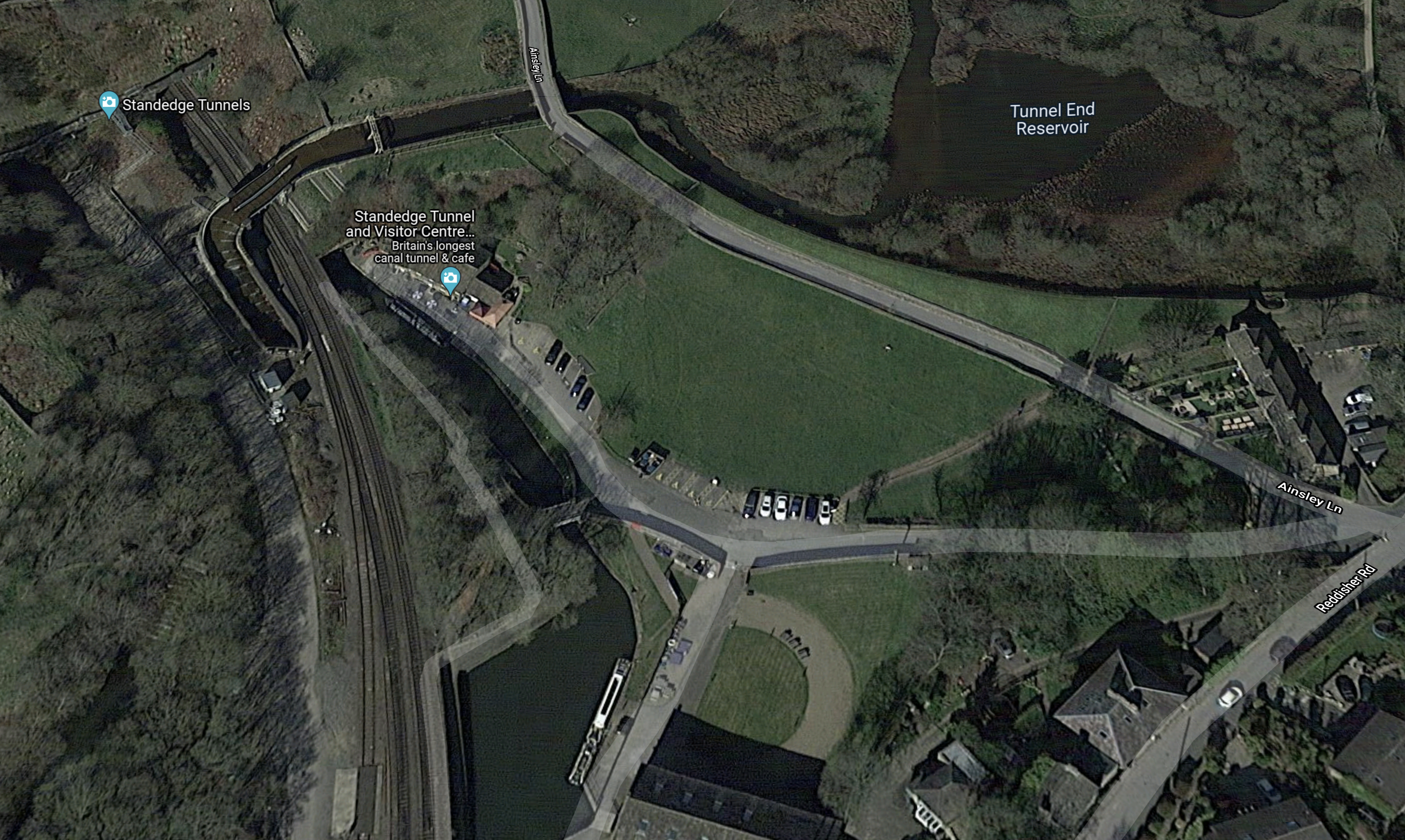
This Google Map shows the Eastern end of the Standedge tunnels.
Note.
- This is a 3D image tilted to give a possibly better view.
- Only a double-track railway and a canal tunnel are in daily use.
- There are two other disused but intact single-track rail tunnels.
- I suspect that the Tunnel End Reservoir keeps the canal water at the right level.
It looks to me that the Standedge Tunnels will be part of the proposed high speed route.
Greenfield Station
Greenfield station is to the West of the Western portal of the Standedge tunnels.
The distance between Greenfield and Marsden stations is six miles.
The Standedge Tunnels
Wikipedia has a very comprehensive description of the canal tunnel and the three rail tunnels that form the Standedge tunnels complex.
These are points from the entry.
- The canal tunnel is the oldest and was opened in 1811.
- The two single-track rail tunnels were opened in 1848 and 1871
- The double-track rail tunnel opened in 1894.
- The rail tunnels were all built using the canal tunnel for access.
- All the tunnels are parallel to each other.
- The tunnels are level.
- All tunnels appear to be connected together with cross passages.
- For safety reasons some diesel-powered boats are towed through the canal tunnel using electric tugs.
- The railway tunnels were the only level section of the route and were fitted with water troughs for steam engines.
- Drainage of the rail tunnels appears to be good, with water draining into the canal.
- Only the 1894 tunnel is in use by trains, but all three rail tunnels are maintained.
- The 1848 tunnel can be used for emergency access and is accessible to fire engines and ambulances.
The complex appears to be a masterpiece of nineteenth century engineering.
There are several factors that could enable the conversion of the rail tunnels into a high-capacity modern railway with speeds up to at least 100 mph.
- The tunnels are level.
- The tunnels are well-drained.
- The access to the tunnels is good.
- Slab track, which allows higher speeds could be installed in the tunnels, as it was in the Bowshank Tunnel on the Borders Railway.
But the biggest factor could be the possibility of using battery-electric trains to avoid electrification of the main lines, which as now would probably be in the double-track tunnel.
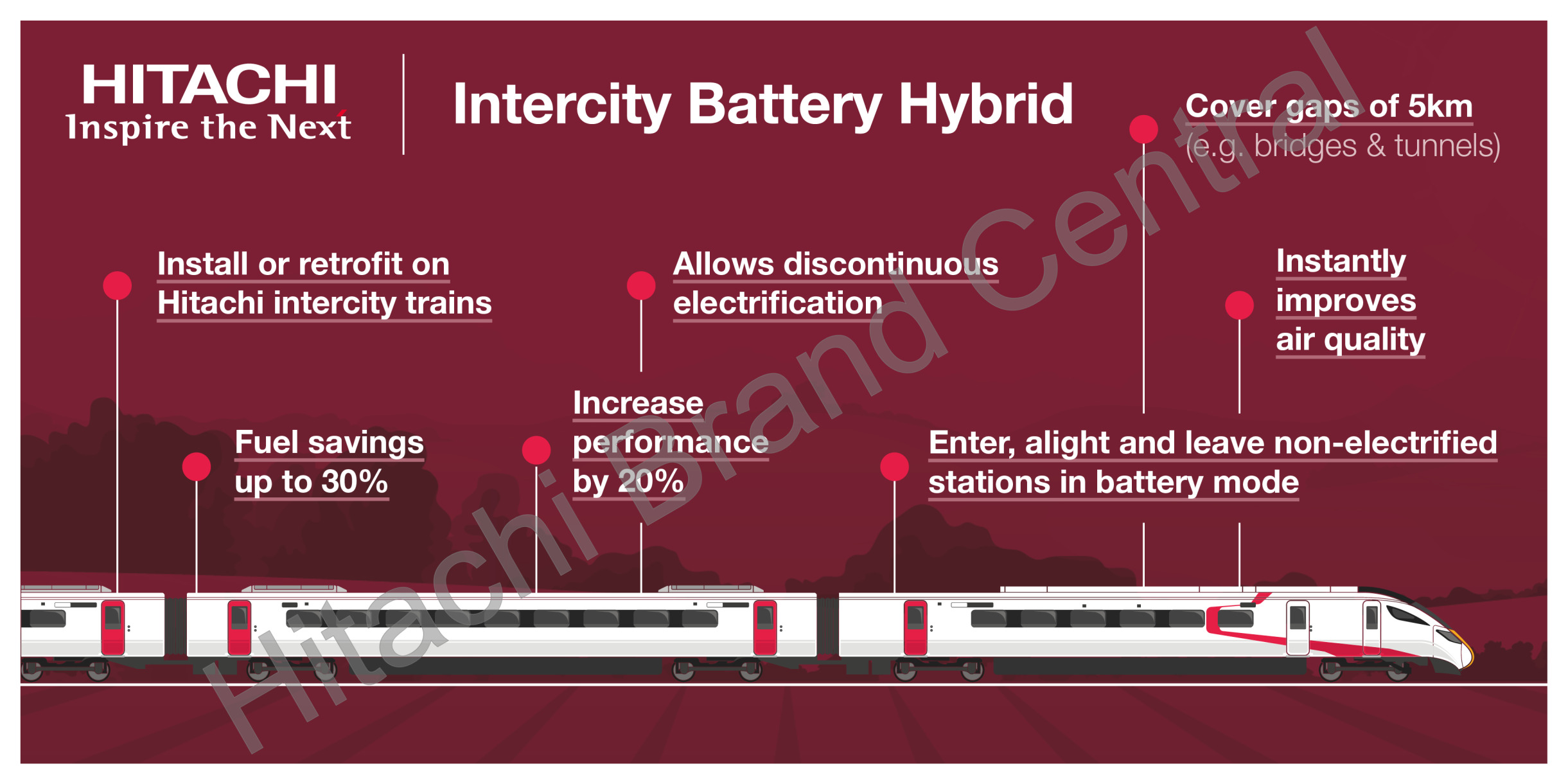
This Hitachi infographic describes their Intercity Battery Hybrid Train, which is based on a Class 802 train and they are developing in partnership with TransPennine Express.
Note.
- Greenfield and Marsden stations are only six miles apart.
- The tunnels are only a few metres longer than 5000 metres.
- The train may only be able to cover 5 km now, but I believe this could be increased.
I also wonder, if the electrification on either side could get as close to the tunnel as possible.
This would enable trains to drop pantograph at speed and switch to battery power a few metres from the tunnel and get to the other side using a mix of battery-power and kinetic energy. Once under the wires at the other side of the tunnel and they had slowed to a safe speed at which they could raise the pantograph, it would be raised and trains would continue using the electrification.
The operating speed would probably be determined by any curves at the ends of the straight and level tunnel.
This method of operation may be OK for expresses, but what about other passenger and freight trains?
I wonder, if it would be possible to put a third track in one of the other rail tunnels.
- Slab-track would probably be installed.
- This third track could be electrified.
- It would be signalled to allow bi-directional running.
This by-pass tunnel could keep the main lines free for the expresses.
Conclusion
I am fairly sure that the Standedge Tunnels could be incorporated in a high speed line.
Hitachi Rail And Angel Trains To Create Intercity Battery Hybrid Train On TransPennine Express
The title of this post, is the same as that of this Press Release from Hitachi Rail.
The press release starts with these three points.
- Hitachi Rail, Angel Trains and TransPeninne Express (TPE) agree to trial retrofitting battery on intercity train
- Trial, starting next year, can cut fuel usage by at least 20% and reduce emissions on Transpennine network from 2022 onwards
- Tri-mode service can cut noise pollution in urban areas and improve air quality.
Hitachi also point to this infographic.
This very much looks to be a step forward from the Intercity Tri-Mode Battery Train that was announced in December 2020 in this press release from Hitachi which is entitled Hitachi And Eversholt Rail To Develop GWR Intercity Battery Hybrid Train – Offering Fuel Savings Of More Than 20%.
The Intercity Tri-Mode Battery Train is described in this Hitachi infographic.

The specifications are very similar, except for the following.
- The battery range is given as five kilometres.
- Fuel savings are up to 30% instead of at least 20%.
- A performance increase of 30 % is claimed.
- The upgrade appears to be able to be fitted to Hitachi intercity trains, as opposed to a straight replacement of one engine by batteries.
It looks to me, that Hitachi have been working hard to improve their design.
I think this paragraph of the press release is key.
The trial will see a diesel engine replaced by batteries to help power a five-carriage train, along with the two remaining engines. The power provided by the batteries will help to reduce the amount of fuel required to operate the train.
Hitachi don’t say, but I suspect the trains and their batteries have a lot of energy saving features.
- Regenerative braking is already used to power some services like lighting and air-conditioning on the trains.
- But I suspect regenerative braking will also be used to recharge the batteries.
- A sophisticated computer system will drive the train in the most optimal manner.
- Hopefully, diesel will only be used as a last resort.
Features like these and others will enable the trains to jump gaps in the electrification. As more and more tricks are added and batteries hold more charge, the gaps the trains will be able to cross will get larger.
Five kilometres might not sound much, but I think it could be surprisingly useful.
I will use an example from the Midland Main Line to illustrate how the trains and discontinuous electrification might work.
In Discontinuous Electrification Through Leicester Station, I described the problems at Leicester station and how discontinuous electrification could solve the problem.
The following is a modified extract from that post.
This Google Map shows the bridge and the Southern end of the station.
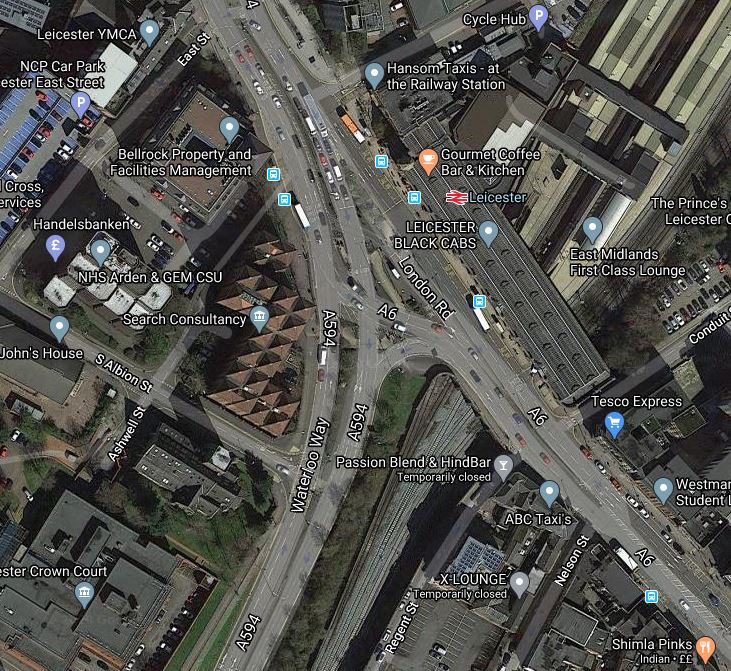
It looks to me, that Leicester station and the road, would have to be closed to traffic for some time, if the bridge were to be rebuilt, to allow the erection of electrification through the area. Leicester and all train passengers would love that!
A solution could be discontinuous electrification.
- The electrification from the South, would finish on the South side of bridge.
- The electrification from the North, would finish at a convenient point in Leicester station or just to the North.
- Electric trains would cover the gap of up to five kilometres on battery power.
Note.
Pantographs could be raised and lowered, where the wires exist.
Trains would probably use a stopping profile in Leicester station, that ensured they stopped with full batteries.
This would mean they had enough electricity to get back up to speed and reconnect to the electrification on the other side of the station.
To get an idea at how long five kilometres is in the Centre of Leicester, this Google Map shows the Leicester station.

Note that the platforms are around three hundred metres long.
In other words the electrification can be kept well away from the station and its troublesome bridge.
How much money would be saved and disruption avoided?
Application To The TransPennine Express Routes
These are the various routes, where Class 802 trains could be used.
Liverpool Lime Street And Edinburgh, Newcastle, Scarborough Or York
Sections are as follows.
- Liverpool Lime Street and Manchester Victoria – 31.7 miles – Electrified
- Manchester Victoria and Stalybridge – 8 miles – Electrified probably by 2024
- Stalybridge and Huddersfield – 18 miles – Diesel
- Huddersfield and Dewsbury – 8 miles – Electrified probably by 2024
- Dewsbury and Leeds – 9.2 miles – Diesel
- Leeds and York – 25.6 miles – Electrified probably by 2024
- York and Newcastle – 80.2 miles – Electrified
Note.
- All services take a common route between Liverpool Lime Street and York.
- A surprising amount is electrified.
- A further 42 miles are being electrified.
- The 3 km Morley Tunnel between Dewsbury and Leeds might not be electrified.
- The 5 km Standedge Tunnel between Huddersfield and Stalybridge might not be electrified.
It looks to me that the 5 km battery range will avoid electrification of two long Victorian tunnels.
Manchester Airport And Newcastle Or Redcar Central
Sections are as follows.
- Manchester Airport and Manchester Victoria – 13.2 miles – Electrified
- Manchester Victoria and Stalybridge – 8 miles – Electrified probably by 2024
- Stalybridge and Huddersfield – 18 miles – Diesel
- Huddersfield and Dewsbury – 8 miles – Electrified probably by 2024
- Dewsbury and Leeds – 9.2 miles – Diesel
- Leeds and York – 25.6 miles – Electrified probably by 2024
- York and Newcastle – 80.2 miles – Electrified
- Northallerton and Redcar Central – 29 miles – Diesel
The route goes through the Morley and Standedge tunnels.
Manchester Piccadilly And Hull
Sections are as follows.
- Manchester Piccadilly and Stalybridge – 7.5 miles – Electrified probably by 2024
- Stalybridge and Huddersfield – 18 miles – Diesel
- Huddersfield and Dewsbury – 8 miles – Electrified probably by 2024
- Dewsbury and Leeds – 9.2 miles – Diesel
- Leeds and Selby – 21 miles – Diesel
- Selby and Hull – 31miles – Diesel
The route goes through the Morley and Standedge tunnels.
Manchester Piccadilly And Huddersfield
The route goes through the Standedge tunnel.
Huddersfield And Leeds
The route goes through the Morley tunnel.
Manchester Airport And Cleethorpes
The Hope Valley Line which is part of this route has three tunnels.
Perhaps they will use a bit of diesel to get through Totley.
The Future
This paragraph sums up what Hitachi and Angel Trains could see as a possible future direction.
Once complete, the trial provides a pathway for Hitachi Rail, the train builder and maintainer, and Angel Trains, the train’s owner to develop plans to retrofit batteries to the wider fleet.
These plans will probably go in the directions like decarbonisation, more efficient operation and better standards for passengers.
Conclusion
This looks like a solution that has been helped by real ale in an appropriate hostelry.
- The battery range has been chosen so Network Rail don’t necessarily have to electrify the tunnels.
- Full electrification can be used either side of the tunnels.
- Will any stations not be electrified. After all if the trains are using battery power in stations do they need electrification?
- It might be useful to have some more bi-mode freight locomotives, that could traverse the tunnels on diesel or batteries.
Hitachi and Network Rail certainly seem to be cooking up a solution.
WYCA To Discuss Latest Plans For £24.2m White Rose Rail Station
The title of this post, is the same as that of this article on Rail Technology Magazine.
I briefly commented on this proposed station in Is There Going To Be Full Electrification Between Leeds And Huddersfield?, where I said this.
White Rose Station
There are plans to build a new White Rose station in the next couple of years at the White Rose Centre..
This would be between Morley and Cottingley stations.
This station will surely increase the passenger numbers on the Huddersfield Line.
This Google Map shows the White Rose Centre.
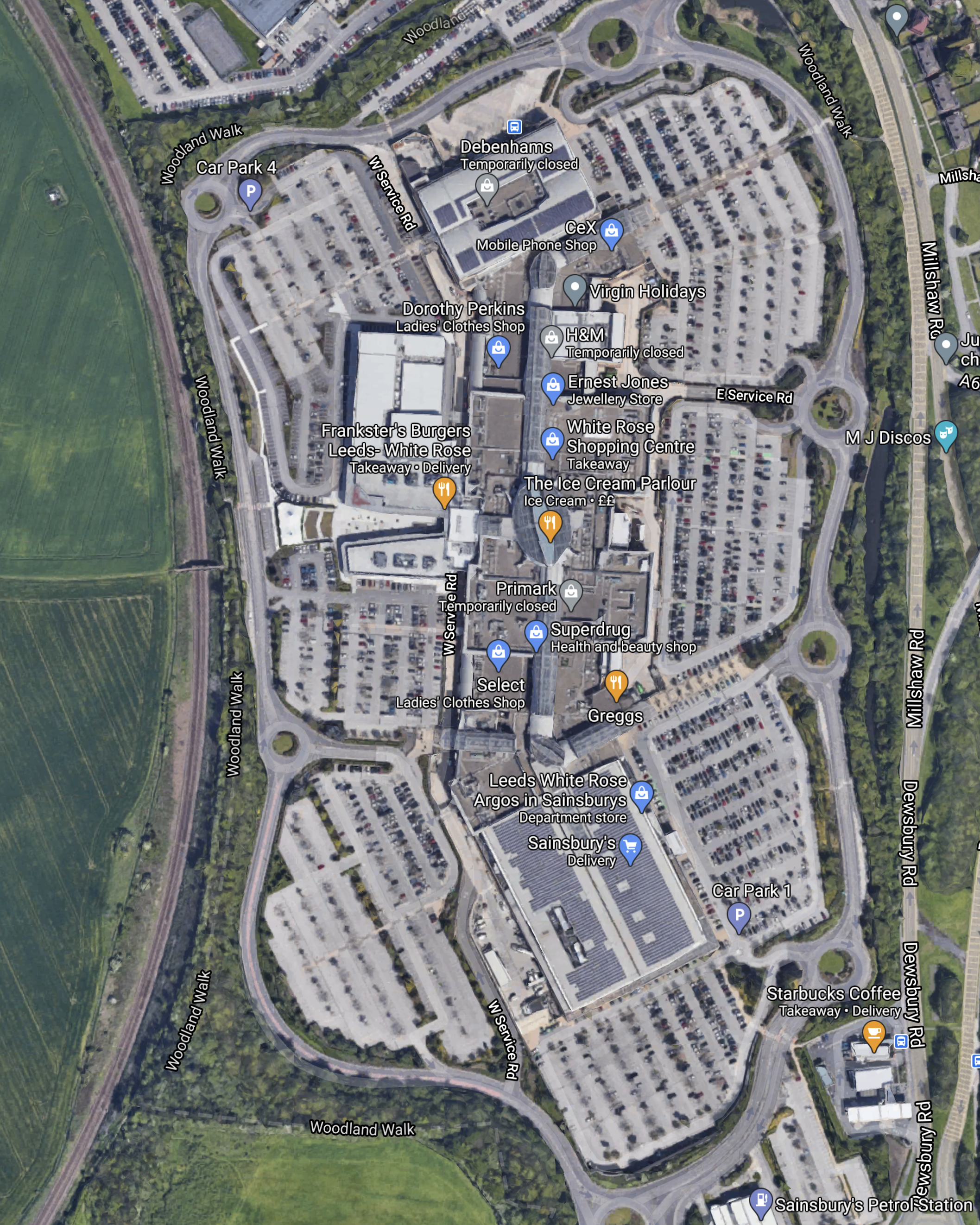
The Huddersfield Line runs North-South alongside the Centre and there must be plenty of space for a new White Rose station.
From Wikipedia and other sources, the following seems to be on the agenda for the station.
- Two platforms.
- Ability to take six-car trains, with a possibility to extend to eight-cars.
- Two trains per hour (tph) in both directions.
- Up to 340,000 passengers per year.
These are my thoughts.
Will White Rose Station Be Electrified?
The Rail Technology Magazine article has a visualisation of the new White Road station and very swish it looks too!
But it doesn’t show any electrification through the station.
This document on the Network Rail web site is entitled Overhead Line Electrification – Huddersfield to Westtown (Dewsbury).
This is the first paragraph.
We’re proposing to electrify the railway between Huddersfield and Westtown (Dewsbury) – and right through to Leeds.
This will enable train operators to use electric – or bi-mode (hybrid) trains – along this section of the route.
I am pretty certain, this paragraph can be interpreted, as saying that Leeds and Huddersfield will be connected by a fully-electrified railway.
This Google Map shows the current Ravensthorpe station, where the line to and from Wakefield joins the Huddersfield and Leeds Line.
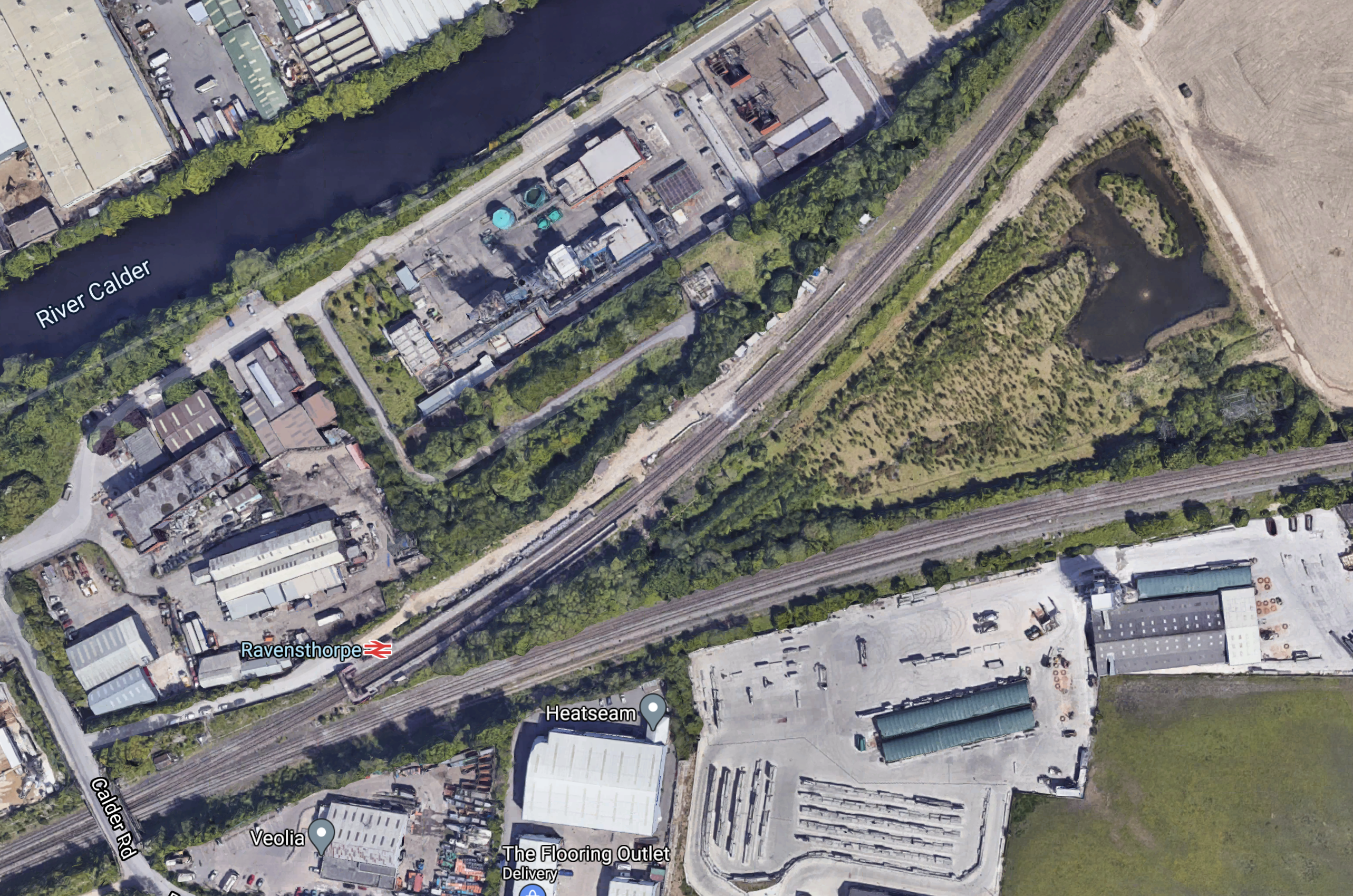
This document on the Network Rail web site is entitled Scheme Proposals – Huddersfield to Westtown (Dewsbury).
It indicates that the triangle of land between the two lines will be used for a sub-station to provide power for the electrification.
It says this.
We propose to build an electricity substation within the Ravensthorpe and Westtown area, to provide power for the electrification of the railway (known as traction power). To facilitate this work, a temporary construction compound which will provide essential welfare facilities for staff will be established in an area of land occupying the current landfill site to the east of Ravensthorpe Station. Access to the facilities will be made via Forge Lane or the existing Thornhill Power Station access road. In addition, Northern Powergrid will be undertaking extensive works to their overhead network within the Ravensthorpe area.
This looks like a convenient place to build a sub-station.
- Northern Powergrid would be able to combine one of their projects, with one for Network Rail.
- It looks like the location of the sub-station gives both good road and rail access.
It would also be ideal to provide power to the line to Wakefield Kirkgate station, which is only ten miles away.
Services At White Rose Station
Currently, the following services would appear to go through the site of White Rose station.
- Northern Trains – Wigan Wallgate and Leeds
- TransPennine Express – Huddersfield and Leeds
- TransPennine Express – Liverpool Lime Street and Edinburgh
- TransPennine Express – Liverpool Lime Street and Scarborough
- TransPennine Express – Manchester Airport and Newcastle
- TransPennine Express – Manchester Airport and Redcar Central
- TransPennine Express – Manchester Piccadilly and Hull
Note.
- All services are one tph.
- The first two services are stopping services, that stop at the two stations, that will be either side of White Rose station; Cottingley and Morley.
- Dewsbury station, which will be three stations away, has a service of three tph.
There may also be an LNER service between London and Huddersfield via Leeds, which might go through White Rose station.
When sources like Wikipedia, say the station will get two tph, they are probably basing this on the two stopping services.
Does White Rose Station Need A Direct Manchester Airport Service?
I think if the station becomes important, it will certainly need a direct service to Manchester Airport.
If one of TransPennine’s Manchester Airport services stopped at White Rose station it would give a direct fast hourly service to Manchester Airport.
- It would take about eighty minutes on current timings.
- In addition the service would call at Manchester Piccadilly, Leeds and York.
In my view it would be a very useful service.
Does White Rose Station Need A Direct London Service?
The reasoning for Manchester Airport, would probably apply to London.
Consider.
- Leeds currently has a two tph LNER service to London.
- I believe that LNER’s Leeds and London service could be uprated to three tph.
- Huddersfield should be getting a daily service or perhaps better to London.
- White Rose station is only planned to have a two tph service to Leeds.
I think there is scope to improve the service between White Rose and London.
- Stopping services between Leeds and Huddersfield should connect conveniently with the London trains at Leeds.
- If a third tph between Leeds and Huddersfield stopped at White Rose, that might help.
- Perhaps, some or all services between Huddersfield and London, should stop at White Rose.
It would all depend on the needs of passengers, once the station opened.
White Rose Station And Elland Road Stadium
This Google Map shows the distance between the White Rose Centre and Elland Road stadium.

Note.
- Elland Road stadium is in the North-East of the map
- The White Rose Shopping Centre is towards the South of the map.
- The Huddersfield Line runs down the Western side of the White Rose shopping centre.
- Cottingley station in North-West corner of the map is the nearest station to Elland Road stadium.
- I estimate it is about a mile-and-a-half walk, which is typical for many football grounds.
Would it be sensible on match days to run longer trains to White Rose station?
I also feel, that thought be given to the walking route between White Rose Station and Elland Road Stadium.
Would it also be better, if the new station was towards the North of the shopping centre?
Platform Length At White Rose Station
Platform length at White Rose station is stated that it will initially take six-car trains, with a possibility to extend to eight-cars.
Consider the lengths of trains likely to call at White Rose station.
- Three-car Class 185 trains are 71.3 metres.
- Three-car Class 195 trains are 71.4 metres.
- Three-car Class 331 trains are 71.4 metres.
- Four-car Class 331 trains are 94.5 metres.
- Five-car Class 802 trains are 130 metres.
- A Class 68 locomotive and five Mark 5 coaches are 131 metres
To handle pairs of three-car Class 185, Class 195 and Class 331 trains, it looks like 150 metre long platforms will be needed.
But to handle pairs of four-car Class 195 and Class 331 trains, it looks like 200 metre long platforms will be needed.
I suspect that because of the proximity of Elland Road and there is a lot of shopping in the build up to Christmas, that a thorough analysis of platform length should be done, before White Rose station is built.
Will A Cross-Leeds Service Serve White Rose Station?
If you look at Birmingham, Cardiff, Glasgow, Liverpool, London, Manchester and Newcastle, suburban lines fan out all around the city.
If you look at Leeds, you find the following routes.
- Bradford – West – Electrified
- Harrogate -North – No Electrification
- Dewsbury and Huddersfield – South-West – Electrification planned
- Ilkley – North – Electrified
- Skipton – North-West – Electrified
- Wakefield – South-East – Electrified
- York and Selby – North-East and East – No Electrification
It appears to me, that the suburban routes are better on the Western side of the City, with more electrification in operation or planned.
The planned electrification between Leeds and Huddersfield via White Rose station can only make matters more uneven.
The Rail Technology Magazine article also says this.
The Investment Committee will also consider plans for a new £31.9m parkway rail station at Thorpe Park on the Leeds to York section of the Transpennine route.
Wikipedia says that proposed Thorpe Park station, will be built on the Selby Line to the East of Leeds, in the Thorpe Park are of the city. Wikipedia also says this about the operation of the station.
It would be served by trains from the west of Leeds which would normally terminate at Leeds station; by continuing eastwards to this station, it is hoped that extra capacity for through trains would be created at Leeds. The station would also form the first phase of electrifying the railway line to the east of Leeds. As a parkway station (an early name was East Leeds Parkway), the intention would be to allow for a park-and-ride service and the plans include parking for 500 cars.
This Google Map shows the area where the station could be built.

Note.
- The Selby Line curving across the Northern side of the map.
- Cross Gates station is the next station to the West.
- Going East on the Selby Line, you pass through Garforth, East Garforth and Micklefield stations before the line divides for York to the North and Selby and Hull to the East.
- The M1 Motorway passing to the East of Leeds.
Other features of the proposed station and the area include.
- Wikipedia says that the station will have two island platforms and the ability to handle inter-city trains.
- The route through the station would be electrified.
- High Speed Two could be routed to go close to the station.
Currently, the following services would appear to go through the site of Thorpe Park station.
- CrossCountry – Plymouth and Edinburgh/Glasgow
- LNER – Leeds and Edinburgh
- Northern Trains – Blackpool North and York
- Northern Trains – Halifax and Hull
- Northern Trains – Leeds and York
- TransPennine Express – Liverpool Lime Street and Edinburgh
- TransPennine Express – Liverpool Lime Street and Scarborough
- TransPennine Express – Manchester Airport and Newcastle
- TransPennine Express – Manchester Airport and Redcar Central
- TransPennine Express – Manchester Piccadilly and Hull
Note.
- Most of these trains are one tph.
- I believe that LNER, when they get extra paths on the East Coast Main Line, could run a London, Leeds and Edinburgh service to increase frequency to the two Northern destinations to three tph.
- All the TransPennine Express services will pass through White Rose, Leeds and Thorpe Park stations.
I can see a high-capacity Leeds Crossrail service emerging.
These could be some example frequencies.
- Leeds and York – 6 tph
- Leeds and Thorpe Park – 10 tph
- Leeds and Hull – 2 tph
- Leeds and Huddersfield – 6 tph
- Leeds and Manchester Victoria/Piccadilly – 6 tph
- Leeds and Manchester Airport – 2 tph
- Leeds and White Rose – 4 tph
A four-track electrified route could be developed through Leeds station.
Are Two Platforms Enough At White Rose Station?
Superficially White Rose and Thorpe Park stations seem aimed at similar purposes in different parts of Leeds.
But White Rose station will only have two platforms and it appears that Thorpe Park could have four.
So does White Rose station need more platforms?
Conclusion
White Rose and Thorpe Park stations could be the start of something very big in Leeds.
Is There Going To Be Full Electrification Between Leeds And Huddersfield?
This article on Rail Technology Magazine is dated 23/08/19 and is entitled Network Rail Reveals Detailed £2.9bn Upgrade Plans For TransPennine Route and it prompted me to write this post of the same name.
The Rail Technology Magazine article talks about a comprehensive upgrade to the Huddersfield Line is planned that includes.
- Improvement between Huddersfield and Westtown
- Grade separation or a tunnel at Ravensthorpe
- Rebuilding and electrification of eight miles of track.
- Possible doubling the number of tracks from two to four.
- Improved stations at Huddersfield, Deighton, Mirfield and Ravensthorpe.
I have now found this document on the Network Rail web site, which is entitled Huddersfield to Westtown (Dewsbury).
This statement is included under proposals.
Electrification of the railway from Huddersfield to Ravensthorpe – and right through to Leeds.
Because there is a dash in the words, has electrification to Leeds, been a recent addition?
It certainly doesn’t fit with the Rail Technology Magazine article.
It also doesn’t fit with this article on the BBC, which is dated 20/08/19 and is entitled Detailed TransPennine £2.9bn Rail Upgrade Plans Unveiled.
Electrification is mentioned in the second paragraph.
Network Rail has also announced it intends to electrify the line between Huddersfield and Dewsbury and double the number of tracks from two to four.
And in the sixth paragraph.
Network Rail said the proposed major overhaul and electrification work would be carried out on an 8-mile (13km) section of the route, with the “first round” of consultations starting with those living closest to the railway.
The two news sites seem to have used the same source.
The BBC also uses this map, that I have copied from the Network Rail document
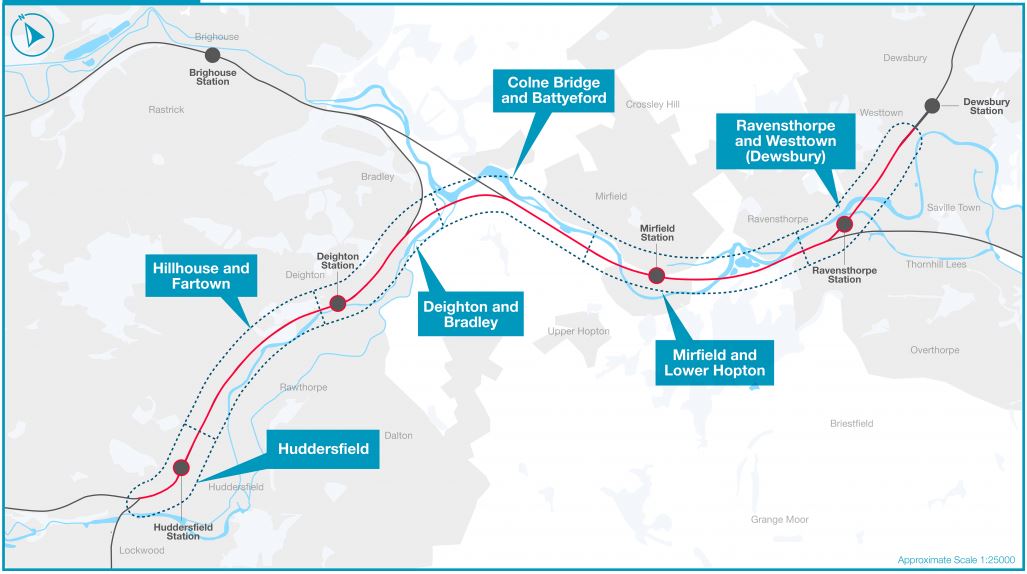
Note the railway lines shown in red. Are these the ones to be electrified? As they go from Huddersfield to Westtown, I think the answer is probably in the affirmative.
I seems to me, that Rail Technology Magazine and the BBC are using a common source and could it be an earlier version of the Network Rail document.
But the map, I have shown, shows the electrification only going as far as Westtown, despite coming from a document, that states twice that the electrification is going as far as Leeds.
It is certainly sloppy documentation.
Track Layouts
This document on the Digital Railway web site is dated 16/08/18 and is entitled Transpennine Route Upgrade SDO1 ETCS – Analysis.
Significantly, it is written by the Digital Railway – Joint Development Group (JDG), which consists of representatives of Siemens, Hitachi, ARUP and Network Rail.
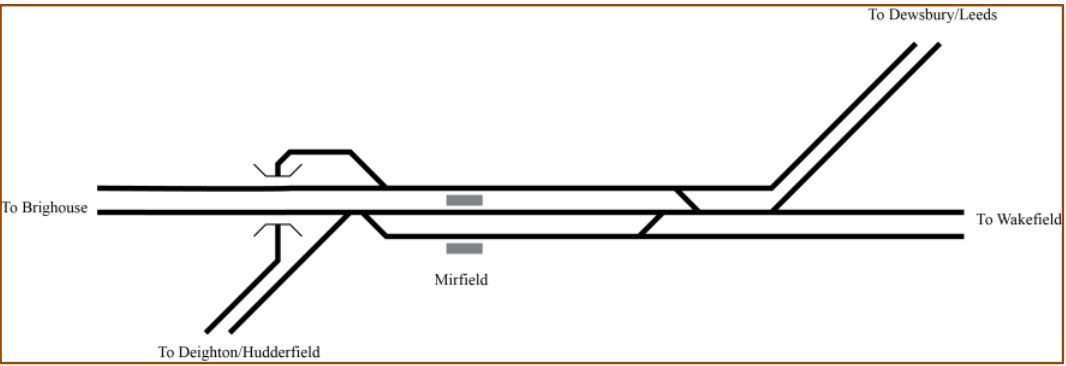
It is mainly about using digital signalling called ETCS on the Transpennine Route, but it does give these track layouts between Huddersfield and Dewsbury.
This is the current layout.
There is also this full four-track layout, which I assume was the original plan.
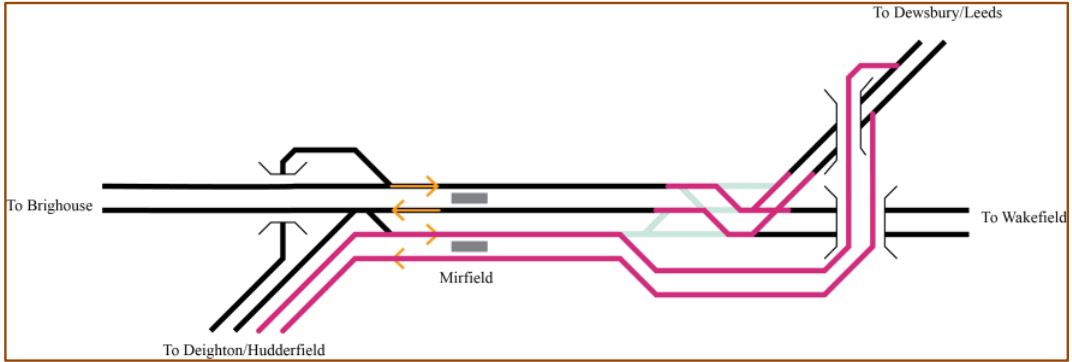
It is more complicated and involved the building of bridges in the area of Ravensthorpe station.
There is also a reduced four-track layout, which I assume was developed as the track analysis progressed.
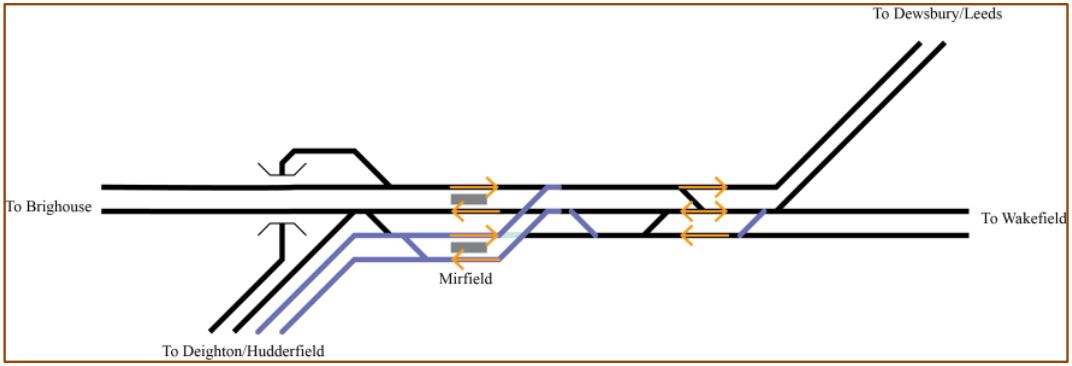
It is not a massive upgrade from the current layout.
As I see it, if the reduced layout can handle the required number of services, it has major advantages over the full scheme.
- There are no changes to track layout between Ravensthorpe and Dewsbury stations.
- Rebuilding Ravensthorpe station should be a smaller project.
- The current and reduced layout have three tracks between Mirfield and Ravensthorpe stations.
- There are no expensive new bridges to be built.
To make the scheme work there is a small amount of bi-directional running on the centre track, which is made possible by using digital signalling on the route.
Track Usage
By using bi-directional running on the centre track between Ravensthorpe and Mirfield stations, which is controlled by ETCS, the track layout is simplified, with three tracks instead of four.
- Slow trains from Huddersfield to Dewsbury will dive under the Brighouse lines and call in/pass Platform 1 at Mirfield station before going straight on to Ravensthorpe and Dewsbury. This is as trains do now.
- Slow trains from Dewsbury to Huddersfield will use the centre track from East to West and call in/pass Platform 2 at Mirfield station before turning South-West on to Huddersfield. This is as trains do now.
- Fast trains from Huddersfield to Dewsbury will call in/pass Platform 3 at Mirfield station and then cross over to the top track and go straight on to Ravensthorpe and Dewsbury.
- Fast trains from Dewsbury to Huddersfield will use the centre track from East to West and call in/pass Platform 4 at Mirfield station before turning South-West on to Huddersfield.
- Trains from Brighouse to Wakefield will call in/pass Platform 1 at Mirfield station and then cross to the centre track and go straight on to Wakefield. This is as trains do now.
- Trains from Wakefield to Brighouse will use the centre track from East to West and call in/pass Platform 2 at Mirfield station and go straight on to Brighouse.
Note.
- Platforms at Mirfield station are numbered 1 to 4 from the North
- The slow lines between Mirfield and Huddersfield are shown in black.
- The fast lines between Mirfield and Huddersfield are shown in blue.
- Passengers can use Platforms 1/2 as a cross-platform interchange between slow Huddersfield-Leeds and Brighouse-Wakefield services.
I also think it likely, that the proposed layout will improve the timetable.
Does The Reduced Layout Produce A Cost Saving?
In one of the first jobs I did at ICI Plastics Division, I simulated a chemical process on an analogue computer. My mathematics showed they could use much smaller vessels, which meant the height of the plant could be reduced by a few metres. I remember the engineer in charge of the project being very pleased, when he told me, that height costs money.
- The reduced layout removes three bridges, which must mean a cost saving.
- There is probably less track to lay
The negative is that digital signalling with ETCS must be installed through the area. This is going to be installed on the UK network, so it probably needs little more than shuffling the installation order.
On balance, when all things are considered, I suspect if the reduced layout can be used, there will be substantial cost savings on the project.
Problems At Morley Station
Morley station is two stations after Dewsbury station on the route towards Leeds.
Unusually for Wikipedia, the entry for Morley station has a large section entitled Current Problems.
This is the first two paragraphs.
The increase in demand, combined with growth elsewhere on the line, means that overcrowding in the morning peak, particularly for commuters heading towards Leeds, is becoming more of an issue.
Despite this commuter growth little has been done to bring this station into the 21st century. For example, only one platform is accessible for disabled passengers, there is insufficient parking, access routes to and from the station are often overgrown with weeds, and there are frequent drainage problems which all combine to make the station not as pleasant as other stations in West Yorkshire. In 2012 a “Friends of Morley station” group was formed, and is addressing some of these issues. Work to improve the car park and drainage commenced in February 2013.
To make matters worse, the station is 10-15 minutes walk from the centre of Morley with poor bus and taxi connections.
Would the following help the Friends of Morley Station?
- Longer trains.
- More frequent trains.
- Faster trains to Leeds
- Better bus services.
Electric trains would help solve the first three.
White Rose Station
There are plans to build a new White Rose station in the next couple of years at the White Rose Centre..
This would be between Morley and Cottingley stations.
This station will surely increase the passenger numbers on the Huddersfield Line.
Have Network Rail Designed The Electrification Between Dewsbury And Leeds?
This electrification has been off and on more times, than the lights in an average kitchen, so I suspect there is a workable plan dating from the last century amongst many others.
Would Extending Electrification To Leeds Provide The Power?
Electrification needs a good connection to the National Grid to provide the power needed to run the trains.
The short eight-mile electrification, as originally proposed could probably have been fed from one end; Huddersfield or Dewsbury.
Both locations would need new sub-stations, with Huddersfield possibly needed in the future to power the wires all the way to Manchester.
Leeds is already fully-electrified with electric expresses to Doncaster and London and several electric local services.
So is the easiest and most affordable way to power the eight-mile electrification between Huddersfield and Westtown to run an extension cable between Leeds and Dewsbury?
Network Rail had a similar problem on the Midland Main Line, which I wrote about in Welcome For Extension Of Midland Electrification.
National Grid had provided a power connection near Market Harborough for the Midland Main Line electrification, which was then cancelled North of Kettering North Junction, leaving the electrification to Corby without a power supply.
The problem is being solved, by extending the electrification to Market Harborough and connecting the wires to the power there.
I do wonder, that the most affordable way to power the Huddersfield and Westtown electrified line is to electrify all the way to Leeds and connect to the power there.
Conclusion
Improving services on the Huddersfield Line between Huddersfield and Leeds is going to be very necessary in the next few years, as passenger numbers will surely grow, due to new housing, increased commuting and the opening of White Rose station.
- New or refurbished four-car electric trains would provide more capacity, increased frequencies and faster services,
- Digital signalling with ETCS would allow more trains to run smoothly.
It appears to me, that to electrify all of the Huddersfield Line between Huddersfield and Leeds would be a good idea, if the money can be found.
Has that money been found by developing a more affordable track layout for the proposed TransPennine Upgrade between Huddersfield and Westtown?
But also using the power at Leeds and electrifying all the way between Huddersfield and Leeds, seems to be a bloody great tail, that is wagging the dog of electrification.
Further Electrification
Providing a fully-electrified route between Huddersfield and Leeds, would leave just two sections of the main TransPennine route without electrification.
- Stalybridge and Huddersfield over Saddleworth Moor and through the Standedge Tunnels.
- Leeds and the Northbound East Coast Main Line.
I don’t know about the planning and difficulty of the first route, but from my helicopter the engineering shouldn’t be too difficult, with the exception of the elecxtrification of the Standedge Tunnels, although Wikipedia seems optimistic about the electrifying the main twin-bore tunnel.
During the 2000s, Network Rail proposed reinstating rail traffic through the 1848 and 1871 tunnels to increase capacity on the Leeds-Manchester trans-Pennine route, but after a re-appraisal after the decision to electrify the trans-Pennine line, it was reported in 2012 that reinstatement was unnecessary.
In addition, could it be, that Manchester with lots of electric trains can provide enough power at Stalybridge, where an updated power connection has been recently installed, to power electric trains between Manchester and Huddersfield?
, The second has been planned for years and has a string of advantages.
- Speed up services between Leeds and Newcastle and Scotland.
- Allow LNER to run electric trains between London and Scotland via Leeds.
- Create an electrified route between Neville Hill Depot and York.
- Create an electrified diversion through Leeds for the East Coast Main Line
This section should be electrified for operational reasons on the East Coast Main Line.
A Final Conclusion
Network Rail’s plans seem to have evolved under analysis to be as follows.
- Limited four-tracking and updated track between Huddersfield and Westtown.
- Digital signalling with ETCS between Huddersfield and Leeds.
- Full electrification between Huddersfield and Leeds
- Power for the electrification from Leeds.
Could it even cost less than the allocated £2.9billion?
Upgrading Ravensthorpe Station
Ravensthorpe station is due to be upgraded as part of Network Rail’s £2.9billion project to upgrade the Huddersfield Line between Huddersfield and Dewsbury stations, that I wrote about in Network Rail Reveals Detailed £2.9bn Upgrade Plans For TransPennine Route.
This Google Map shows the station and the surrounding land.
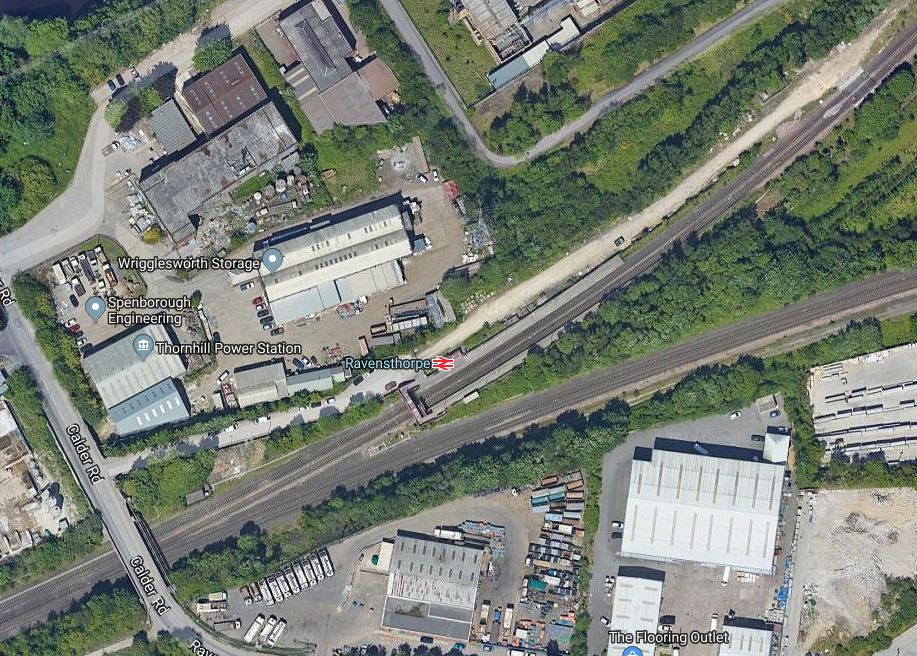
Note.
- The lines through the station go between Huddersfield in the East and Dewsbury in the North-East.
- The line going East goes to Wakefield.
These pictures show the station.
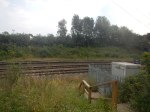

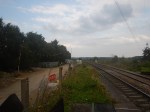
I did try to get a picture of the bridges over the River Calder, but I was unable to find the route and the weather was about to deteriorate.
The station is currently just two platforms on the lines between Huddersfield and Dewsbury, with a terrible overbridge, a poor shelter and a couple of seats.
The Wikipedia entry for Ravensthorpe station says this.
Ravensthorpe station is adjacent to Thornhill LNW (London North Western) Junction, where a line branches to Wakefield Kirkgate. There are plans to extend the station by building new platforms on this line, which was built by the former Manchester and Leeds Railway.
This document on the Digital Railway web site is entitled Transpennine Route Upgrade SDO1 ETCS – Analysis.
It is mainly about using digital signalling called ETCS on the Transpennine Route, but it does give these track layouts between Huddersfield and Dewsbury.
This is the current layout.
This is a reduced four-track layout.
In Proposed Track Layouts Between Huddersfield And Dewsbury, I came to the conclusion, that the reduced four-track layout or something better could handle the current trains through the area.
If the reduced four-track layout is used, the requirements for a new Ravensthorpe station can now be stated.
- Two platforms on the tracks to and from Dewsbury.
- Two platforms on the tracks to and from Wakefield.
- Some better shelters than at present.
- Step-free footbridges.
In Winner Announced In The Network Rail Footbridge Design Ideas Competition, I wrote how the competition was won by this bridge.
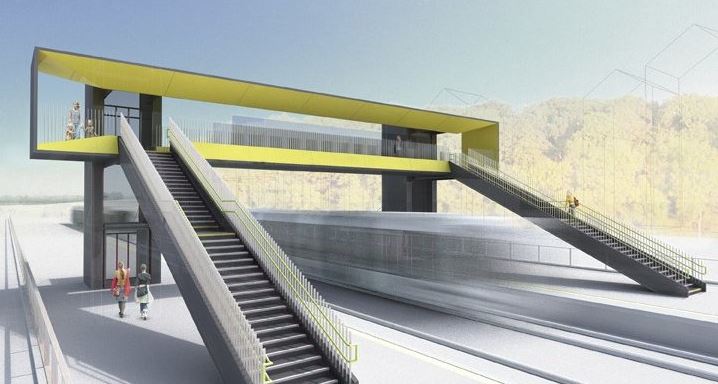
So could a factory-built bridge like this be installed at Ravensthorpe station?
- The platforms from Dewsbury and to Wakefield, could probably be arranged as a walk-across interchange.
- This would mean that the flexible nature of the bridge design would enable a single bridge with three lifts and three sets of stairs to be erected to join all the platforms together.
- The bridge would have the correct clearance for the electrification.
I doubt it would be the most complicated of stations.
Proposed Track Layouts Between Huddersfield And Dewsbury
Tracks between Huddersfield and Dewsbury stations are due to be upgraded as part of Network Rail’s £2.9billion project to upgrade the Huddersfield Line between the two stations, that I wrote about in Network Rail Reveals Detailed £2.9bn Upgrade Plans For TransPennine Route.
This document on the Digital Railway web site is entitled Transpennine Route Upgrade SDO1 ETCS – Analysis.
It is mainly about using digital signalling called ETCS on the Transpennine Route, but it does give these track layouts between Huddersfield and Dewsbury.
This is the current layout.
This is a full four-track layout.
This is a reduced four-track layout.
As I see it, if the reduced layout can handle the required number of services, it has major advantages over the full scheme.
- There are no changes to track layout between Ravensthorpe and Dewsbury stations.
- Rebuilding Ravensthotpe station should be a smaller project.
- The current and reduced layout have three tracks between Mirfield and Ravensthorpe stations.
- There are no expensive new bridges to be built.
By using bi-directional running on the centre track between Ravensthorpe and Mirfield stations, which is controlled by ETCS, the track layout is simplified, with three tracks instead of four.
- Slow trains from Huddersfield to Dewsbury will dive under the Brighouse lines and call in/pass Platform 1 at Mirfield station before going straight on to Ravensthorpe and Dewsbury. This is as trains do now.
- Slow trains from Dewsbury to Huddersfield will use the centre track from East to West and call in/pass Platform 2 at Mirfield station before turning South-West on to Huddersfield. This is as trains do now.
- Fast trains from Huddersfield to Dewsbury will call in/pass Platform 3 at Mirfield station and then cross over to the top track and go straight on to Ravensthorpe and Dewsbury.
- Fast trains from Dewsbury to Huddersfield will use the centre track from East to West and call in/pass Platform 4 at Mirfield station before turning South-West on to Huddersfield.
- Trains from Brighouse to Wakefield will call in/pass Platform 1 at Mirfield station and then cross to the centre track and go straight on to Wakefield. This is as trains do now.
- Trains from Wakefield to Brighouse will use the centre track from East to West and call in/pass Platform 2 at Mirfield station and go straight on to Brighouse.
Note.
- Platforms at Mirfield station are numbered 1 to 4 from the North
- The slow lines between Mirfield and Huddersfield are shown in black.
- The fast lines between Mirfield and Huddersfield are shown in blue.
- Passengers can use Platforms 1/2 as a cross-platform interchange between slow Huddersfield-Leeds and Brighouse-Wakefield services.
I also think it likely, that the proposed layout will improve the timetable.
Conclusion
I think it is highly likely that the reduced four-track layout will be used.
Unless of course something better is devised.
 The Anonymous Widower