West Midlands To Run ‘Largest Hydrogen Bus Fleet’ Due To New Funding
The title of this post, is the same as that of this article on the BBC.
These are a few points from the article.
- The region is set to get 124 new hydrogen vehicles.
- The West Midlands is set to run the UK’s largest hydrogen bus fleet after securing new funding.
- The region will get 124 new buses after it won £30m from the Department for Transport to fund a switchover.
- Twenty four of the new vehicles will be articulated tram-style buses set to run on a new bus priority route between Walsall, Birmingham and Solihull.
Does the last statement mean, that they will buying a hundred double-decker hydrogen buses?
A few thoughts.
Riding Birmingham’s New Hydrogen-Powered Buses
These are a few pictures from Riding Birmingham’s New Hydrogen-Powered Buses.
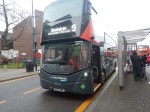

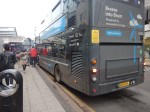


They were excellent buses from Wrightbus.
The Tram Style Buses
The Belgian firm; Van Hool have a product called Exquicity. This video shows them working in Pau in France.
These tram buses run on rubber types and are powered by hydrogen.
Similar buses running in Belfast are diesel-electric.
Could these be what the article refers to as tram-style buses?
It should be noted, that the West Midlands and Pau have bought their hydrogen filling stations from ITM Power in Sheffield.
So has there has been a spot of the Entente Cordiale between Pau and the West Midlands?
Will The West Midlands Buy The Other Hundred Buses From Wrightbus?
There doesn’t seem to be any problems on the web about the initial fleet, so I suspect they will.
It should also be noted that Wrightbus make the following types of zero-emission buses.
- StreetDeck – Hydroliner FCEV – Double-deck hydrogen bus
- StreetDeck – Electroliner BEV – Double-deck battery bus
- GB Kite – Hydroliner FCEV – Single-deck hydrogen bus
- GB Kite – Electroliner BEV – Single-deck battery bus
These would surely enable the West Midlands to mic-and-match according to their needs.
UK On Track To Reach 4,000 Zero Emission Bus Pledge With £200 Million Boost
The title of this post, is the same as that of this press release from the Government.
These are the main points of the press release.
- Nearly 1,000 more zero-emission buses to be funded in towns and cities across the country, bringing the total funded in England to 2000 so far under this government.
- A further 600 zero-emission buses have been funded in Scotland, Wales and Northern Ireland.
- Comes as consultation launched on ending sale of all new non-zero emission buses from 2025 to 2032.
- Government continues taking unprecedented action to hit net zero and level up transport across the country.
Areas to get the new buses include.
- Blackpool
- Greater Manchester
- Hertfordshire
- Norfolk
- North Yorkshire
- Nottingham
- Oxfordshire
- Portsmouth
- South Yorkshire
- West Midlands
- West Yorkshire
- York
I would also like to see the government fund trials for the conversion of suitable buses to zero carbon. I certainly believe that London’s New Routemaster buses could be converted to hydrogen.
Hydrogen Fuel Cell Trucks And H2 Infrastructure Could Benefit From New Legislation
The title of this post, is the same as that of this article on Hydrogen Fuel News.
Politicians from both main parties in the United States are promoting a Hydrogen for Trucks Act, to support the conversion of domestic trucking from diesel to hydrogen.
These are the three main parts of the Act
- Provide incentives for adopting hydrogen fuel cell trucks by covering the difference in cost between them and conventional diesel-powered vehicles.
- Encourage tandem fueling station and vehicle deployment, to ensure that one doesn’t need to exist before the other is in place, solidifying the overall fueling infrastructure.
- Collect data and establish benchmarks for various forms of fleet operation, helping to accelerate deployment by incentivizing private investment.
We could do with an Act like this in the UK.
But whereas the United States would start with hydrogen for trucks, we would probably start with hydrogen for buses.
Aberdeen City Council And BP Sign Joint Venture Agreement To Develop City Hydrogen Hub
The title of this post, is the same as this article on Renewable Energy Magazine.
The title is a good description of the project and these are a few details.
- Production will start in 2024.
- The hub will produce 800 kilograms of green hydrogen per day.
- That will be enough for 25 buses and 25 other vehicles.
- Further investment would provide hydrogen for rail, freight and marine uses.
I don’t think this is a small project, as they are talking about potentially exporting the hydrogen.
These are a few thoughts.
Electricity Supply
In Can The UK Have A Capacity To Create Five GW Of Green Hydrogen?, I said the following.
Ryze Hydrogen are building the Herne Bay electrolyser.
- It will consume 23 MW of solar and wind power.
- It will produce ten tonnes of hydrogen per day.
The electrolyser will consume 552 MWh to produce ten tonnes of hydrogen, so creating one tonne of hydrogen needs 55.2 MWh of electricity.
Scaling those figures mean that to create 800 kilograms of hydrogen will need 44.16 MWh of electricity or if it is a 24/7 operation, the electrolyser will need a feed of 1.84 MW.
Currently, there are two offshore wind farms close to Aberdeen.
- European Offshore Wind Development Centre – 93 MW
- Hywind Scotland – 30 MW
That would provide enough electricity to provide a starter of under 2 MW.
I can see a lot more wind farms off the coasts around Aberdeen, as on all my visits to the city it has been windy and there is a lot of empty sea.
I don’t think providing enough renewable electricity for a very large electrolyser in Aberdeen will be a problem.
Hydrogen Exports
I would expect, that the hydrogen would go to Germany, as the Germans are backing BP in their wind farm ambitions and they are building a large hydrogen import terminal at Wilhelmshaven on the North-West German coast. The distance for a ship is under 500 miles.
BP’s Future Hydrogen Plans
This is a quote from Louise Kingham CBE, BP’s UK head of country and senior vice president for Europe.
Partnering with cities and corporates as they shape their paths to net zero is a core part of BP’s strategy. BP expects to partner with 10-15 cities globally by 2030 to provide innovative, integrated, and decarbonized energy solutions at scale to help them achieve their goals of net zero emissions. BP also aims to capture 10% of the low carbon hydrogen market in key geographies by 2030.
BP is investing across all the energy transition growth areas in the UK. In fact, we have committed to spend £2 in the UK for every £1 generated here out to the middle of this decade.
“Today’s announcement is evidence of that commitment in action and is supported by other ambitious plans to produce clean energy from UK offshore wind, develop carbon capture in Teesside and grow the country’s electric vehicle charging network.
BP would be in part using their expertise in providing oil and gas to the production and delivery of hydrogen to end users, be they large or small.
I can also see BP repurposing a few gas and oil production platforms into offshore hydrogen production hubs, as this could be a better financial route, rather than demolishing the platforms.
Conclusion
Birmingham is building a hydrogen hub at Tyseley Energy Park to fuel hydrogen buses and other vehicles.
Where is the plan for London’s hydrogen hubs?
106 Solaris Zero Emission Buses Headed To ÖBB Postbus’ Fleet In Austria
The title of this post, is the same as that as this article on Sustainable Bus.
This is the body of the story.
Up to 106 zero emission buses are headed to Austria, where ÖBB Postbus is going to deploy them starting from 2022 – 2025. Solaris has signed another framework agreement with the Austrian bus company Österreichische Postbus AG. It stipulates a possibility to deliver up to 106 battery-electric and hydrogen buses that would be deployed throughout Austria. The models offered include Urbino 9 LE electric and Urbino 12 hydrogen buses.
Solaris Bus and Coach is a Polish company, that is a subsidiary of CAF.
Norfolk Wind Farms Offer ‘Significant Benefit’ For Local Economy
The title of this post, is the same as that of this article on the BBC.
This is a comprehensive article, which looks at the benefits of the huge Norfolk Boreas and Norfolk Vanguard wind farms will have to the economy of Norfolk.
The last section is devoted to Norfolk Nimby; Raymond Pearce.
This is the section.
Following the re-approval of the decision by the government, Mr Pearce says he is considering a new appeal over what he calls “a very poor decision”.
He is also sceptical of claims the two new wind farms will bring the economic gains promised by Vattenfall.
“It’s renewable energy at any cost and the cost here is to the environment in Norfolk,” he says.
“I don’t blame them for being positive about it, it’s their industry but they’re not looking at it holistically.”
He says he is not against renewable energy but thinks a better plan is needed to connect the offshore windfarms and minimise the number of cables and substations onshore.
It’s his money if he appeals, but we do need more wind, solar and other zero-carbon energy to combat global warming and its effects like the encroachment of the sea around Norfolk.
I believe, that building wind farms off the coast of Essex, Suffolk and Norfolk is a good move, as in the future, if we have spare electricity, it will be easy to export energy to Europe, through existing interconnectors.
But I do agree with him, that a better plan is needed to connect the offshore windfarms and minimise the number of cables and substations onshore.
A Norfolk Powerhouse
This map from Vattenfall, the developer of the two wind farms, shows the position of the farms and the route of the cable to the shore.
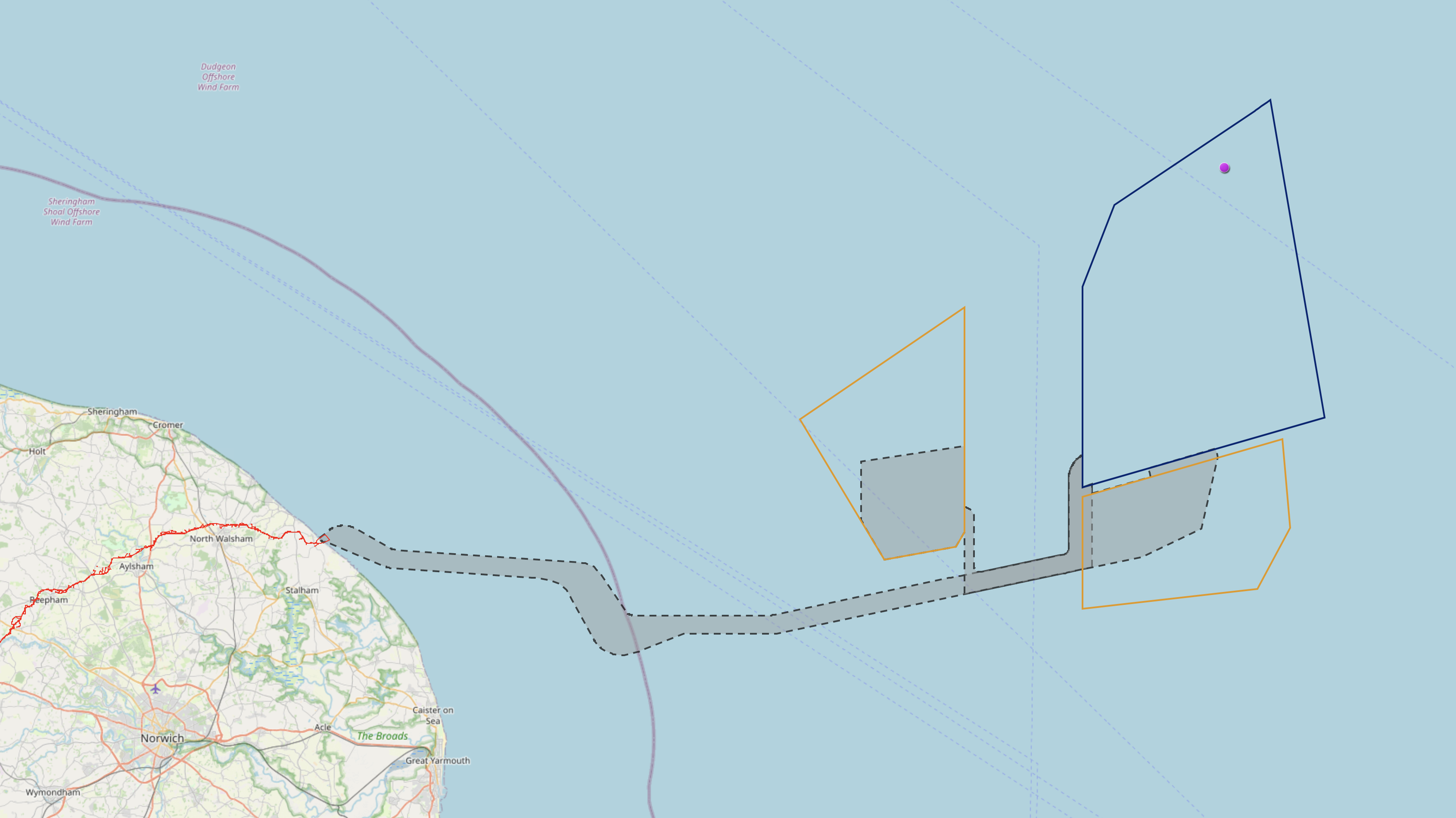
Note.
- The purple line appears to be the UK’s ten mile limit.
- Norfolk Boreas is outlined in blue.
- Norfolk Vanguard is outlined in orange.
- Cables will be run in the grey areas.
- Both wind farms are planned to have a capacity of 1.8 GW
Landfall will be just a few miles to the South of the Bacton gas terminal.
Bacton Gas Terminal
Bacton gas terminal is much more than a simple gas terminal.
- It is a complex of six gas terminals on four sites.
- There is a National Grid terminal, that odourises and blends the gas before distributing it into the National Transmission System via five outgoing 36-inch feeders to much of Southern England.
- There is a gas interconnector to Belgium.
- There is a gas interconnector to The Netherlands.
- There is coastal erosion in the area.
With the need to decarbonise, I can’t help feeling that the Bacton gas terminal is very much on the decline and the site will need to be repurposed in the next few years.
Blending Hydrogen With Natural Gas
If you blend a proportion of hydrogen into natural gas, this has two beneficial effects.
- Gas used in domestic and industrial situations will emit less carbon dioxide.
- In the near future we will be replacing imported natural gas with hydrogen.
The hydrogen could be produced by a giant electrolyser at Bacton powered by the electricity from the two Norfolk wind farms.
At the present time, a research project call HyDeploy is underway, which is investigating the blending of hydrogen into the natural gas supply.
- Partners include Cadent, Northern Gas Networks, the Health and Safety Executive, Keele University and ITM Power and Progessive Energy.
- A first trial at Keele University has been hailed as a success.
- It showed up to twenty percent of hydrogen by volume can be added to the gas network without the need to change any appliances or boilers.
Larger trials are now underway.
A Giant Electrolyser At Bacton
If hydrogen were to be produced at Bacton by a giant electrolyser, it could be used or distributed in one of the following ways.
- Blended with natural gas for gas customers in Southern England.
- Stored in a depleted gas field off the coast at Bacton. Both Baird and Deborah gas fields have been or are being converted to gas storage facilities, connected to Bacton.
- Distributed by truck to hydrogen filling stations and bus and truck garages.
- Greater Anglia might like a hydrogen feed to convert their Class 755 trains to hydrogen power.
- Sent by a short pipeline to the Port of Great Yarmouth and possibly the Port of Lowestoft.
- Exported to Europe, through one of the interconnectors.
Note.
- If the electrolyser were to be able to handle the 3.6 GW of the two wind farms, it would be the largest in the world.
- The size of the electrolyser could be increased over a few years to match the output of the wind farms as more turbines are installed offshore.
- There is no reason, why the electrical connection between Bacton and the landfall of the wind farm cable couldn’t be offshore.
If ITM Power were to supply the electrolyser, it would be built in the largest electrolyser factory in the World, which is in Sheffield in Yorkshire.
A Rail Connection To The Bacton Gas Terminal
This Google Map shows the area between North Walsham and the coast.
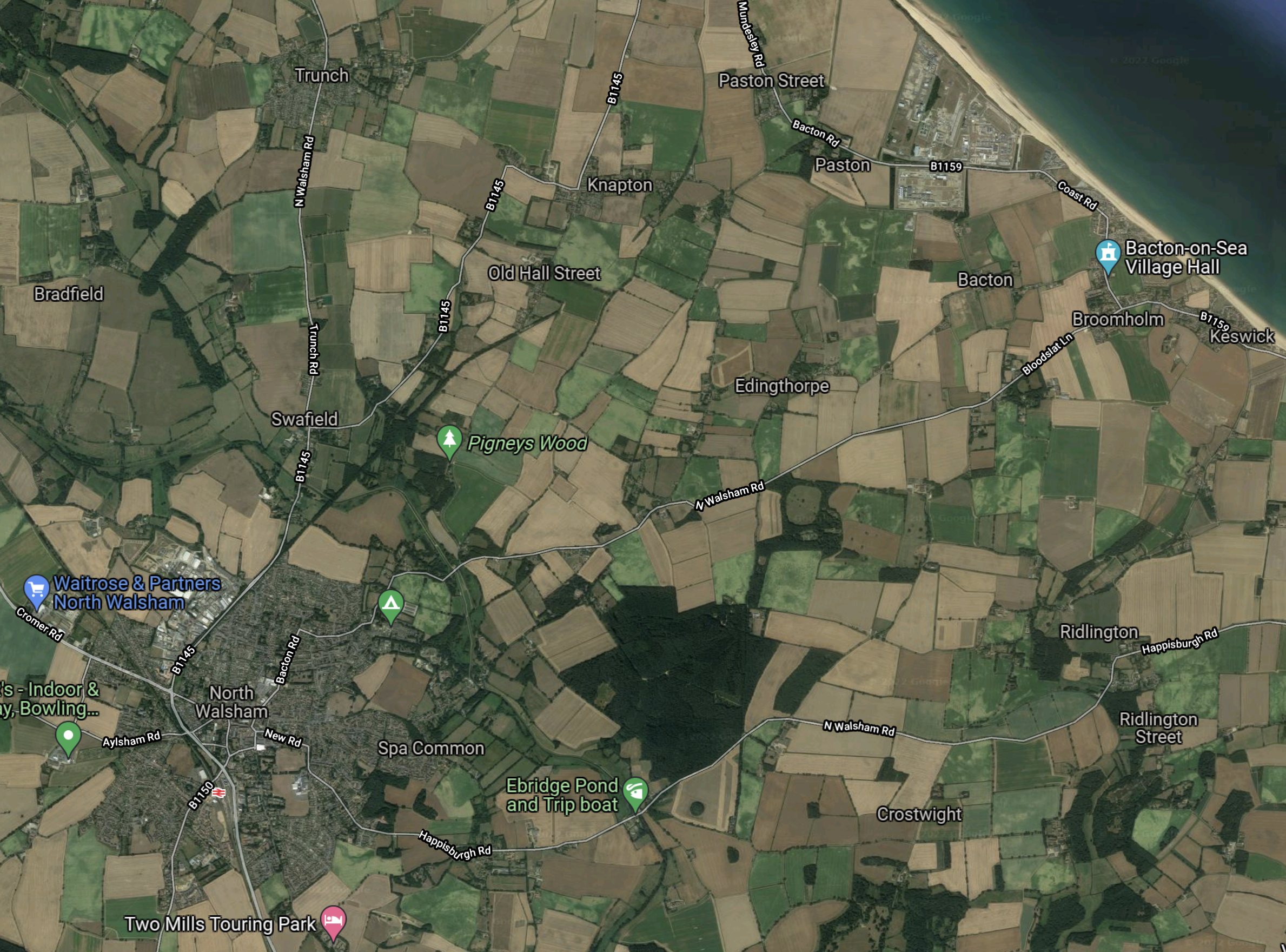
Note.
- North Walsham is in the South-Western corner of the map.
- North Walsham station on the Bittern Line is indicated by the red icon.
- The Bacton gas terminal is the trapezoidal-shaped area on the coast, at the top of the map.
I believe it would be possible to build a small rail terminal in the area with a short pipeline connection to Bacton, so that hydrogen could be distributed by train.
How Much Hydrogen Could Be Created By The Norfolk Wind Farms?
In The Mathematics Of Blending Twenty Percent Of Hydrogen Into The UK Gas Grid, I said the following.
Ryze Hydrogen are building the Herne Bay electrolyser.
- It will consume 23 MW of solar and wind power.
- It will produce ten tonnes of hydrogen per day.
The electrolyser will consume 552 MWh to produce ten tonnes of hydrogen, so creating one tonne of hydrogen needs 55.2 MWh of electricity.
Each of the Norfolk wind farms, if they were working flat out would produce 43.2 GWh of electricity in a day.
Dividing the two figures gives a daily production rate of 782.6 tonnes of hydrogen per day.
But what happens if the wind doesn’t blow?
This is where the gas storage in the Baird, Deborah and other depleted gas fields comes in.In times of maximum wind, hydrogen is stored for use when the wind doesn’t blow.
Conclusion
I believe a plan like this, would be much better for Norfolk, the UK and the whole planet.
Using the existing gas network to carry the energy away from Norfolk, could mean that the electricity connection across Norfolk could be scaled back.
Does London Need High Capacity Bus Routes To Extend Crossrail?
If Crossrail has a major problem, it is that some areas of the capital will find it difficult to access the new line.
Up to the age of sixteen, I used to live half-way between Oakwood and Cockfosters stations on the Piccadilly Line.
There are a large number of people who live along the Northern reaches of the Piccadilly Line, who might want to use Crossrail to perhaps go to Heathrow or places in East London.
But the journey will need a double change as there is no interchange between the Piccadilly Line and Crossrail.
I suspect that many will link to Crossrail by taking the Piccadilly Line to Wood Green, Turnpike Lane or Manor House and then get a 141 bus to Moorgate. It is a route, I use if I want to go to Southgate or Cockfosters from my house, which has a 141 stop opposite.
But then as a child to go to Harringay, where my father had an uncle, my mother would use a 641 trolley bus from Wood Green or Turnpike Lane.
Do people follow the public transport habits of their parents?
I know I do!
My father never went on a deep tube. As he several times mentioned the terrible Bank station bombing in the Blitz, which killed 56 people, I always thought that was his problem. But now living as I do along the Northern and Northern City Lines, I suspect it was more to do with air quality, as we were or are both bad breathers.
I suspect that when Crossrail opens, the 141 bus will be heavily used by travellers going between the Northern reaches of the Piccadilly Line and Crossrail at Moorgate.
The 141 bus goes between London Bridge station and Palmers Green and it has a route length of about nine miles.
Currently, buses run every fifteen minutes or so, but I doubt it will be enough in future as Transport for London are rerouting the closely-related 21 bus.
I suspect any route seen as an extension of Crossrail needs to have the following characteristics.
- High frequency of perhaps a bus every ten minutes.
- Interior finish on a par with the Class 345 trains.
- Wi-fi and phone charging.
I would also hope the buses were carbon-free. Given that some of these routes could be quite long, I would suspect hydrogen with its longer range could be better.
Other Routes
According to me, the 141 bus route needs improvement!
But how many other routes could need similar improvement?
Aberdeen’s Hydrogen Buses Taken Off The Road Due To Technical Issue
The title of this post, is the same as that of this article on the BBC.
This is the introductory paragraph.
Aberdeen’s fleet of hydrogen buses has been taken off the road due to a “technical issue”.
The technical issue appears not to be hydrogen-related, but with a mounting bracket.
Strange coming after CAF had bracket trouble with their trams and Hitachi had a similar problem with their trains.
Wrightbus, CAF and Hitachi haven’t been using the save dodgy Chinese supplier called El Cheapo Brackets have they?
French City Cancels Purchase Of 51 Hydrogen Buses After Realising Electric Ones Would Be Six Times Cheaper To Run
The title of this post, is the same as that as this article on Recharge Magazine.
The city is Montpelier and it’s their decision, but I do find it strange, that the French city of Pau have chosen the hydrogen version of the the Van Hool ExquiCity bus.
But Pau have chosen a British hydrogen system from ITM Power, rather than a French one.
Catalyst Capital Makes First Move In GBP 300m Battery Storage Strategy
The title of this post, is the same as that of this article on Renewables Now.
This is the first paragraph.
Fund manager Catalyst Capital has acquired a site to build a 100-MW battery in Yorkshire, northern England, in the first of a series of planned deals under a GBP-300-million (USD 406.1m/EUR 358.9m) strategy to develop diversified UK battery energy storage systems (BESS) facilities.
£300 million, says to me that the finance industry, now finds battery storage to be a worthwhile investment.
Skelton Grange Power Station
This Google Map shows the location of the Skelton Grange power station site, where the battery will be developed.
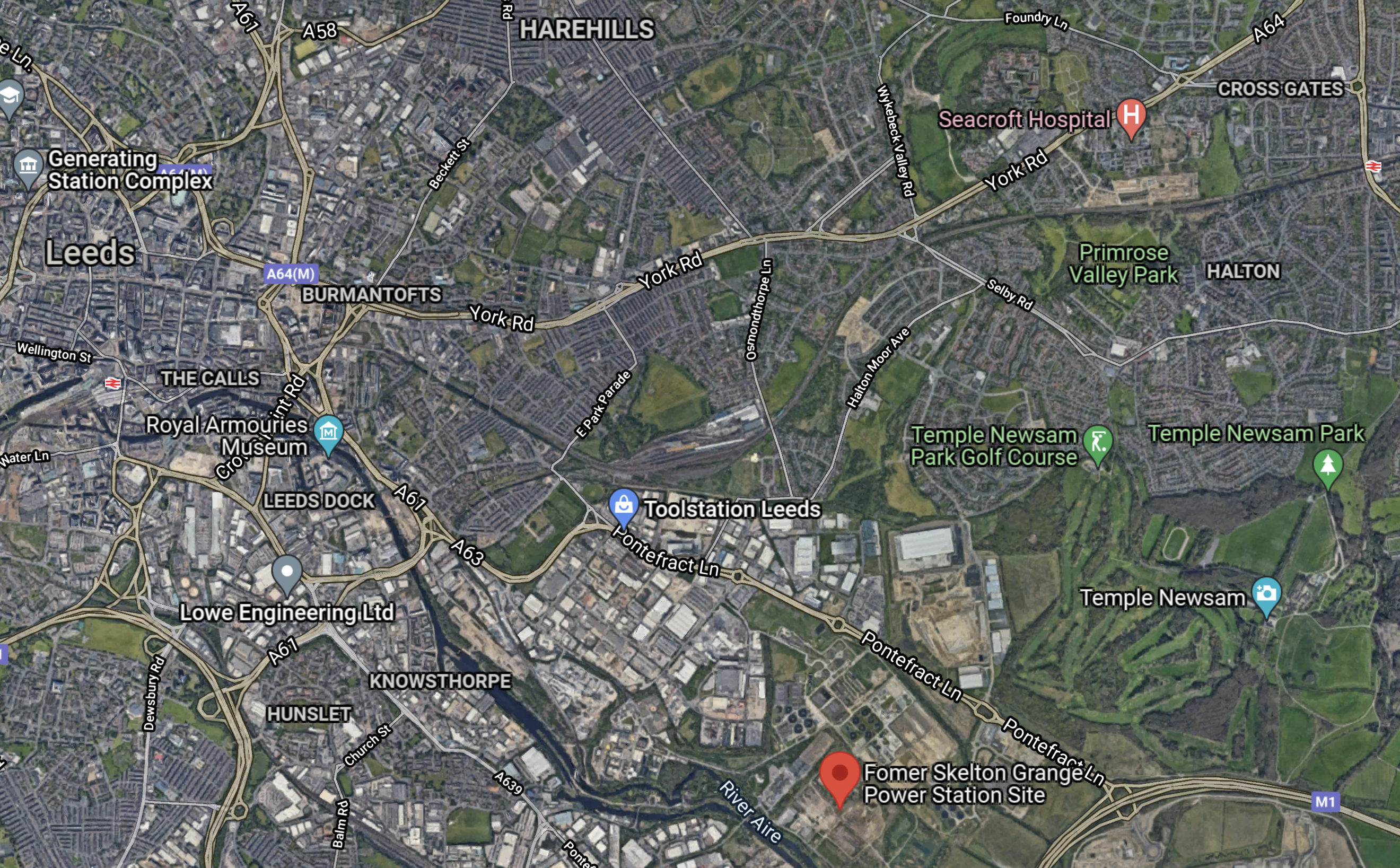
And this second Google Map shows the site in more detail.

Note that there is still a sub-station on the site.
The article states that planning permission was received in 2021 and they hope to have the facility on-line in the first quarter of this year.
That appears quick to me. Is it because the electrical connection already in situ?
It should also be noted, that the battery output of 100 MW is much less than that of the former coal-fired power station in the mid-1980s, which was at last 480 MW.
I also wonder, if the site could host a hydrogen fuelling station for buses.
- It is not far from the centre of Leeds.
- It has a good connection to the National Grid.
- An electrolyser like the one built by ITM Power at Tyseley Energy Park uses 3 MW of electricity to produce around 1.5 tonnes of hydrogen per day.
I also feel that the site could host a wind turbine up to about 10 MW.
Conclusion
Catalyst Capital seems to have made a big entry into the market. They won’t be the last to do this, as the returns are there and the battery storage is needed.
 The Anonymous Widower