Was The Price Of Fuel A Factor In The Ahmedabad Plane Crash?
I am asking this question, as I know that a prudent airline, is careful where it buys the fuel for its aircraft.
I asked Google, if jet fuel is more expensive at Gatwick or in India and got this reply.
Jet fuel (Jet A-1/AVTUR) is more expensive at Gatwick Airport compared to India. At Gatwick, the price is 906.8 GBP/1000L. While in India, the price varies by location, for example, ₹97,975.72/kl in Delhi. This indicates that Jet A-1/AVTUR costs more at Gatwick than in India.
I suspect, if they can that Air India would prefer to fill up their planes in India.
Consider.
- The flight that crashed was AI 171.
- The aircraft was a Boeing 787-8.
- The Air India flight that crashed was flying direct to Gatwick Airport, which is a great circle distance of 4254.3 miles.
- Afterwards, it would fly from Gatwick Airport to Goa, which is a great circle distance of 4703.7 miles.
- Wikipedia gives the range of a Boeing 787-8 as 8410 miles.
As a former private pilot, who did many long flights, if I were Air India, I might use a strategy like this.
- Fill the plane with as much fuel, as it can carry at Ahmedabad.
- Fly to Gatwick on an efficient great circle route.
- Top up the plane, with enough fuel to fly safely to Goa, at Gatwick.
The cost of fuel would be minimised, but it would mean a heavy take-off at Ahmedabad.
The temperature at Ahmedabad yesterday was around the low thirties and as the altitude is only 53 metres, I don’t think it would have been a hot-and-high take-off.
The Odd Sugary Snack May Be Good For You (But Lay Off Sugary Drinks)
The title of this post, is the same as that of this article in The Tunes.
I shall be discussing this research with my cardiologist. My relationship with him is as doctor/patient, researcher/lab-rat and just friends. I am also coeliac and very much feel that I need to take the odd sugary snack to keep my energy levels up. I also had a serious stroke at 64, thirteen years ago, due to atrial fibrillation.
Sweden and coeliac disease could be another complicating factor here, as Sweden went the wrong way to try to eliminate coeliac disease after WW2 and just created a lot more.
I found about this Swedish research in a peer-reviewed paper entitled Coeliac Disease: Can We Avert The Impending Epidemic In India? in the Indian Journal of Research Medicine.
A History Of Sugary Snacks And Drinks And Me
Growing up in London, after World War 2, I didn’t get much sugar, as it was rationed.
But I did put it in tea and coffee.
I never ate many cakes, except for some chocolate ones.
My habit of not eating cakes and proper puddings really annoyed my mother-in-law.
I was a sickly child and I didn’t really get better until I was found to be coeliac at 50.
I am fairly certain, that my consumption of sugary snacks has got more, as I’ve got older.
But because American drinks, sweets and snacks could use sugar made from wheat, I don’t touch any American sweetened products.
But I haven’t put on any weight, since I was fifty.
Thanks to the likes of Leon, Marks and Spencer and the cafe at Worksop station for excellent sugary gluten-free snacks to keep me going!
The Incredible £7m Hydrogen Train To Be introduced In ‘Fastest Growing’ Country
The title of this post, is the same as that of this article in the Express.
This is the sub-heading.
Each hydrogen train is priced at £7 million and can run up to 621 miles (1,000km) on a single tank, reaching speeds of 87mph (140 km/h).
These two paragraphs add more details.
India is the fastest-growing economy among G20 nations and is set to launch its first hydrogen-powered train this December.
The groundbreaking train will debut on the Jind-Sonipat route in Haryana and will mark a massive step toward eco-friendly rail travel.
If you look at the article, there is an impressive looking picture, but it may be a visualisation.
This page on etnow.in has an interesting paragraph.
- In this context, the launch of Hydrogen trains deserves special mention. The national transporter has envisaged running 35 Hydrogen trains under “Hydrogen for Heritage” on various heritage and hill routes.
Does that mean that Indian Railways are using hydrogen-powered trains to avoid spoiling the scenery with overhead wires?
Hydrogen-powered trains in India could be a story to watch.
ECoR Launches Special Drive Against Carrying Diwali Crackers On Trains
The title of this post, is the same as that of this article on Pragativadi.
These two paragraphs tell the story.
With the Diwali festival approaching, the East Coast Railway (ECoR) has intensified its efforts to ensure the safety of passengers by launching a special drive against the illegal transportation of firecrackers and other inflammable items on trains.
ECoR has reiterated that carrying dangerous goods like crackers, gas cylinders, acid, petrol, kerosene and similar materials in passenger-carrying trains is a punishable offence under the Railways Act, 1989, which can result in imprisonment of up to three years.
The punishment is probably a bit heavier than you get for this offence in Liverpool Lime Street.
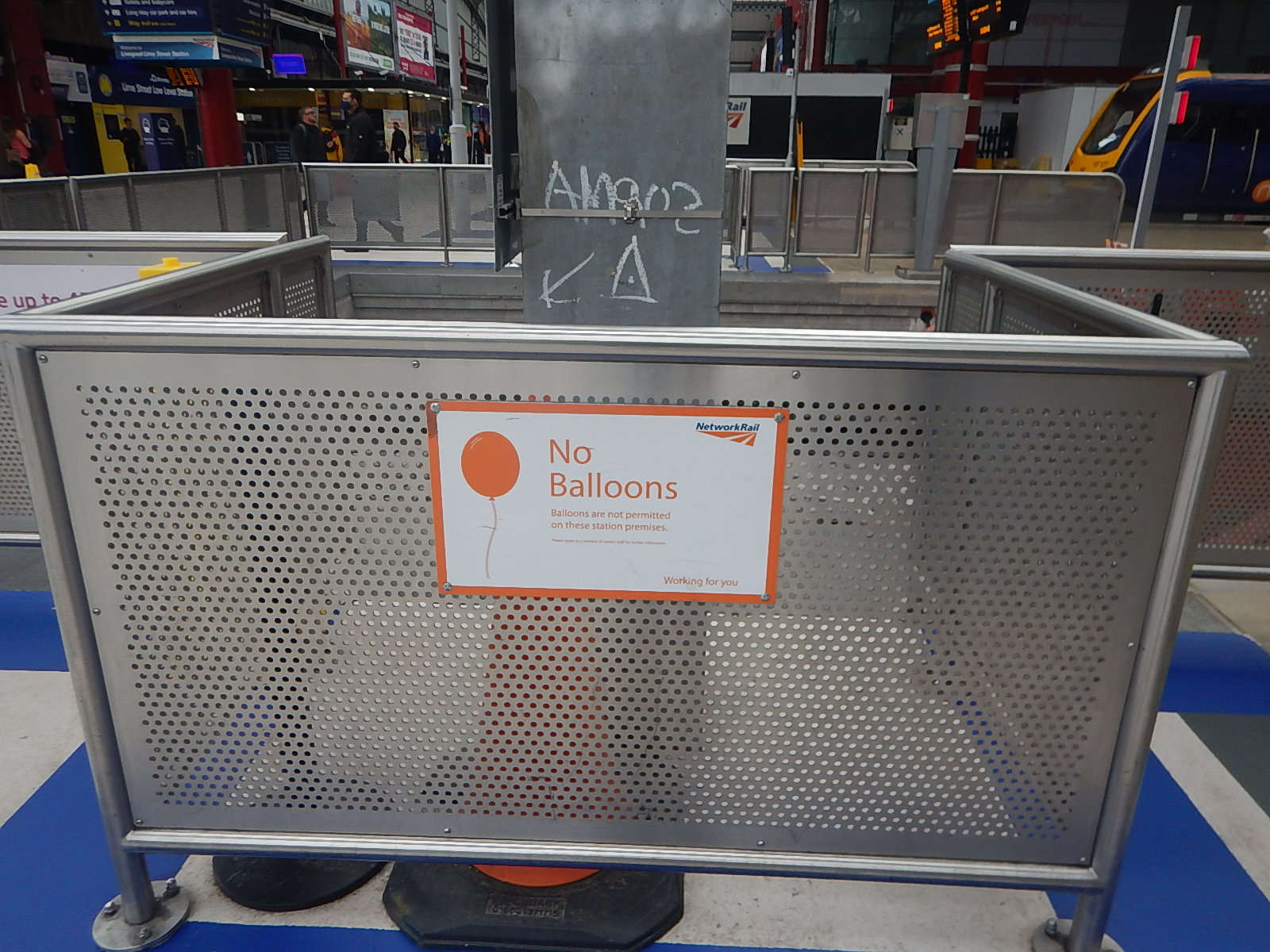
I suspect a Diwali cracker makes a bigger bang, than a typical balloon.
Indian Minister’s Health aAdvice: Lie In A Cowshed To Cure Cancer
The title of this post, is the same. as that of this article in The Times.
This is the sub-heading.
Senior politician in Narendra Modi’s party says he drinks cow urine every morning to kill bacteria and eliminate negativity
These are the first three paragraphs.
The humble cow has long been venerated in India. Revered by Hindus, pictured with the prime minister, Narendra Modi, and long used by his Bharatiya Janata Party to promote the leader’s own politically charged brand of nationalism, the animal plays a central part in Indian life.
That adoration could grow further after a senior politician claimed that cows could cure cancer.
Sanjay Singh Gangwar, 48, a BJP minister for sugarcane in the northern state of Uttar Pradesh, said patients could eradicate their symptoms simply by cleaning and lying down in a cowshed. They would be cured by the “positive aura and energy” of cows, the minister said.
When I found a peer-reviewed paper entitled Coeliac Disease: Can We Avert The Impending Epidemic In India?, I discussed it with my GP at the time, who was of part-Indian extraction, and I got a rant about Narendra Modi.
I now take anything Narendra Modi says with a very large dose of salt.
Gangwar’s advice doesn’t stop there.
These two paragraphs give more pearls of wisdom.
The health benefits of a cow do not end there, added Gangwar. He advocated drinking “filtered” cow urine — which he said he did every morning — and use cow dung as flooring in village homes. And anyone suffering from high blood pressure should simply stroke a cow — once in the morning and again in the evening.
“If a cancer patient starts cleaning a cowshed and lying there, even cancer can be cured,” he insisted as he inaugurated a cow shelter in the city of Pilibhit. “If you burn cow dung cakes, you get relief from mosquitoes. Everything that a cow produces is useful in some way.”
So to Gangwar, the global-warming methane, that cows emit is useful, but in what way?
Is Gangwar, Donald Trump’s long-lost Indian son from a dalliance in the country?
It’s All Happening In Jamshedpur!
When I read this article on Hydrogen Fuel News, which is entitled Cummins And Tata Motors Ignite Change With H2 Internal Combustion Engines, I couldn’t resist using the jokey headline, which was inspired by the sub-heading.
The manufacturing has started in Jamshedpur, India at a new state-of-the-art facility
These two paragraphs give some more details.
The hydrogen internal combustion engines continuing to be produced at the facility are being integrated into Tata Motors trucks. This technology is being viewed as a promising zero- or low-carbon alternative to diesel power because of its powerful performance and substantial operating range.
Cummins’ B6.7H engines have notable similarities to current natural gas and diesel engines, particularly in terms of the components they contain. Moreover, they can fit in standard engine vehicles and require similar refueling times.
I first wrote about the Cummins B 6.7H engines in Cummins Shows Hydrogen Internal Combustion-Engined Concept Truck At IAA Transportation Exhibition, which I posted in September 2022.
I have these further thoughts.
Cummins B Series Engine
The Wikipedia entry for the Cummins B Series Engine, starts with these two paragraphs.
The Cummins B Series is a family of diesel engines produced by American manufacturer Cummins. In production since 1984, the B series engine family is intended for multiple applications on and off-highway, light-duty, and medium-duty. In the automotive industry, it is best known for its use in school buses, public service buses (most commonly the Dennis Dart and the Alexander Dennis Enviro400) in the United Kingdom, and Dodge/Ram pickup trucks.
Since its introduction, three generations of the B series engine have been produced, offered in both inline-four and inline-six configurations in multiple displacements.
Note.
- Cummins B Series is used in a wide variety of vehicles.
- It is available in both four and six cylinder versions.
But what Wikipedia doesn’t say, is that any Cummins’ customer will get the engine he wants for his application, even if it means creating a special version of the engine. Thirty years ago, I did a small data analysis job for Cummins in Darlington and on a tour of the works, I was given full details on how they treated customers. Cummins are not your average US company.
London’s Routemaster Buses

These buses are powered by a small four-cylinder version of the B-series engine, called a 4.5L ISB, which is described like this in Wikipedia.
The 4.5L ISB is essentially a four-cylinder, two-thirds version of the 6.7L ISB rated at 185 hp (138 kW), used in the New Routemaster, a series hybrid diesel-electric double-decker bus in London.
Note.
- Some diesel Range-Rovers, have more power, than these buses, but then they’re not hybrids.
- The engine also needs to be smaller, as it’s mounted under the back stairs.
Did Cummins’ special engine. allow the unique design of London’s Routemaster Buses?
Could London’s Routemaster Buses Be Converted To Hydrogen?
As an engineer and with my knowledge of Cummins’ design and manufacturing methods, I am fairly certain, if Cummins can manufacture six-cylinder versions of the B-Series engines, then four-cylinder hydrogen-powered engines are not far behind.
If London were to convert the thousand New Routemaster buses to hydrogen, there would be winners all round.
- Cummins would love the publicity and would probably benefit from increased sales of their hydrogen engines in vehicles like refuse trucks and small buses.
- It would surely give a route to convert older vehicles to hydrogen.
- The air in cities will improve.
But London has a problem, It is one of the few large cities in the world without readily-available hydrogen.
As this post illustrates and my Google searches show, India has a more advanced and scientifically-correct view on the usefulness of hydrogen.
Will Jaguar Land Rover Switch To Cummins’ Hydrogen Engines?
If Tata Motors make a success of hydrogen in India, it must make them think about adding hydrogen engines to Jaguar Land Rover products, specially as other manufacturers are getting serious about hydrogen.
Conclusion
Cummins will change the world for the better.
Building Inside Mountains: Global Demand For Pumped Hydroelectric Storage Soars
The title of this post, is the same as that of this article on Construction-Europe.
This is the sub-heading.
Pumped hydroelectric storage plants around the world have been secretly storing electricity in remote mountain lakes for the last century. But the switch to renewable energy sources is prompting a surge in new construction.
These two paragraphs introduce the article.
Looking out over the ragged beauty of the Scottish Highlands, Coire Glas, a horseshoe-shaped valley holding a clear mountain lake above the shores of Loch Lochy, seems like an unlikely spot to build a megaproject.
In this remote location, surrounded by clumps of pine trees, a team of construction workers from contractor Strabag are tunnelling their way through the rock which they hope will form part of a vast new power storage facility.
The article is a must-read that talks about pumped storage hydroelectricity in general and SSE Renewables’s 1500MW/30 GWh Coire Glas power station in particular.
The Future Of Pumped Hydroelectric Storage
These two paragraphs from the article give a glimpse into the future.
According to the International Energy Agency, global pumped storage capacity is set to expand by 56% to reach more than 270 GW by 2026, with the biggest growth in India and China.
Current pumped storage megaprojects currently in construction include the Kannagawa Hydropower Plant near Minamiaki in Japan which when fully completed in 2032 is expected to have a total installed capacity of 2,820MW; and Snowy Hydro 2.0 in New South Wales, Australia, which is currently expected to complete in 2028.
Note.
- I can count two Indian and ninety Chinese systems under construction. All have a capacity of upwards of one GW.
- The Kannagawa Hydropower Plant appears to be the largest with a capacity of 2.82 GW. The Japanese are keeping quiet about the storage capacity.
- The Snowy Hydro 2.0 has a capacity of 2 GW and a storage capacity of 350 GWh.
- The Wikipedia entry for Snowy Hydro 2.0 states that it is the largest renewable energy project under construction in Australia.
Against this onslaught of massive systems, SSE Renewables are pitching the 1500MW/30 GWh Coire Glas and the 252MW/25 GWh Loch Sloy systems.
Pumped hydroelectric storage will have a big part to play in decarbonising the world. Even in little old and relatively flat UK.
Rahul Gandhi Disqualified As MP After Conviction In Defamation Case
The title of this post, is the same as that of this article on the BBC.
This is the sub-heading.
India’s parliament has disqualified senior opposition leader Rahul Gandhi, a day after he was sentenced to two years in prison in a defamation case.
The next two paragraphs outline the case.
A parliament notice said that Mr Gandhi “stands disqualified from the membership of Lok Sabha”, alluding to the lower house of parliament.
He was convicted by the court for 2019 comments about PM Narendra Modi’s surname at a election rally.
Recently, I made a comment to a doctor with part Indian genes about Modi and I got a very unflattering reply.
The Power Of Solar With A Large Battery
This post is based on this press release from Highview Power, which is entitled Highview Enlasa Developing 50MW/500MWh Liquid Air Energy Storage Facility In The Atacama Region Of Chile.
This is the first paragraph.
Highview Enlasa, the 50/50 joint venture between Highview Power, a global leader in long duration energy storage solutions, and Energía Latina S.A.-Enlasa, the largest backup power generation provider in Chile, is pleased to announce that it is developing the first liquid air long duration energy storage project in Chile. This 50MW/500MWh (10 hours) CRYOBattery™, which represents an estimated investment of USD $150 million, will be located in Diego de Almagro in the Atacama Region.
Ican deduce these points from this paragraph.
The power output of 50 MW appears to be standard for all of Highview Power’s CRYOBatteries, which is not surprising as the centre of each system appears to be a standard turbomachinery solution from MAN Energy Solutions, as I wrote about in MAN Energy Partners With Highview Power On Liquid-Air Energy-Storage Project.
But whereas the first system at Carrington, near Manchester, can only store 250 MWh, this plant in Chile is twice the size and can provide 50 MW of electricity for ten hours. The Chile plant will just have twice the number of storage tanks for liquid air.
I can no reason, why if Carrington needed to store more electricity, that more tanks couldn’t be added.
This Google Map shows the area around the city of Diego de Almagro.
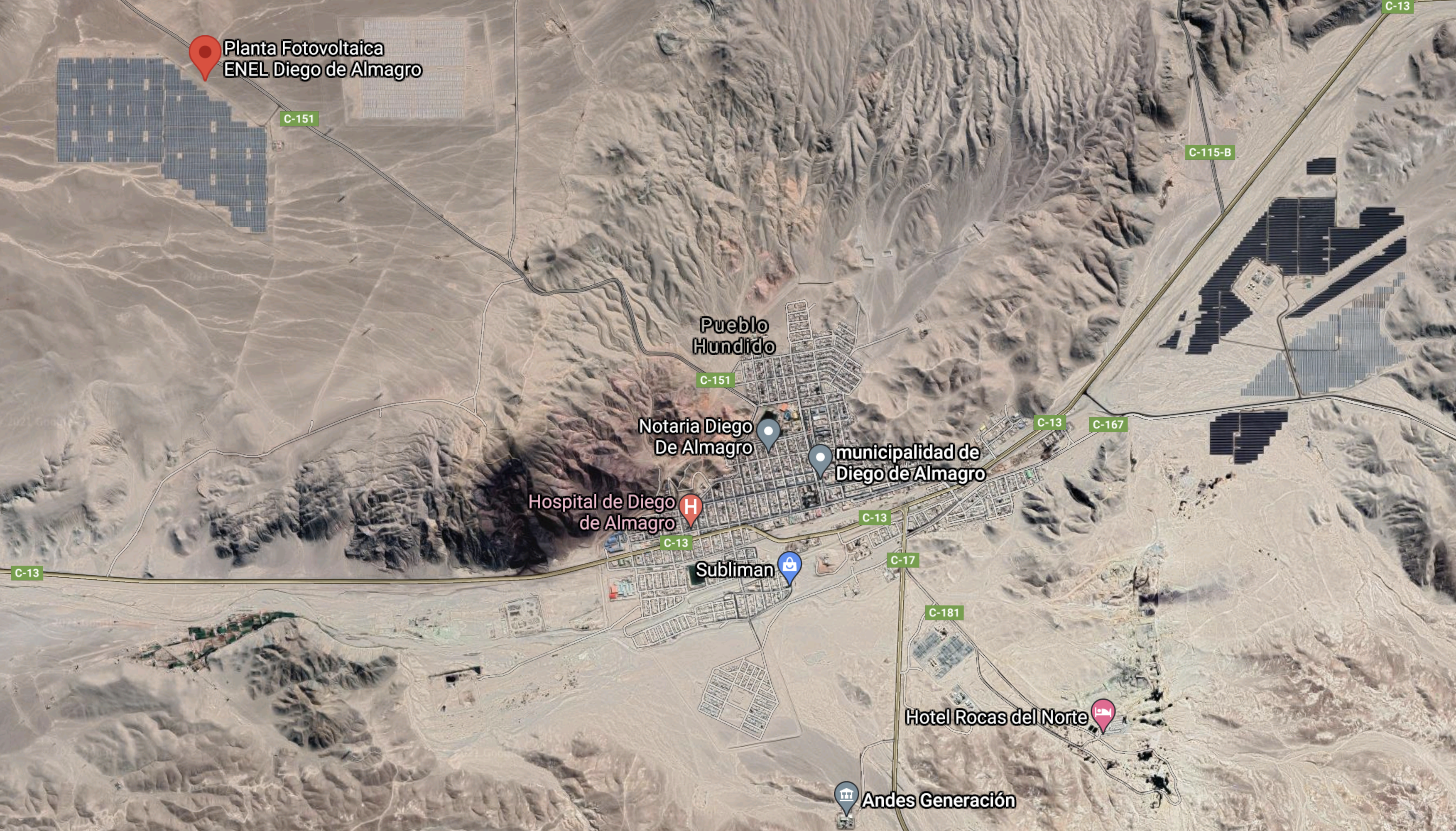
Note.
- The city of Diego de Almagro is in the centre of the map.
- In the North-Western corner is the Planta Fotovoltaica ENEL Diego de Almagro, which even my rudimentary Spanish, identifies as a solar power plant.
- In the North-Eastern corner of the map, is appears that a second solar power plant is under construction.
The city is surrounded by the large Atacama Desert.
This second Google Map shows the location of Diego de Almagro, with respect to the Chilean Coast.
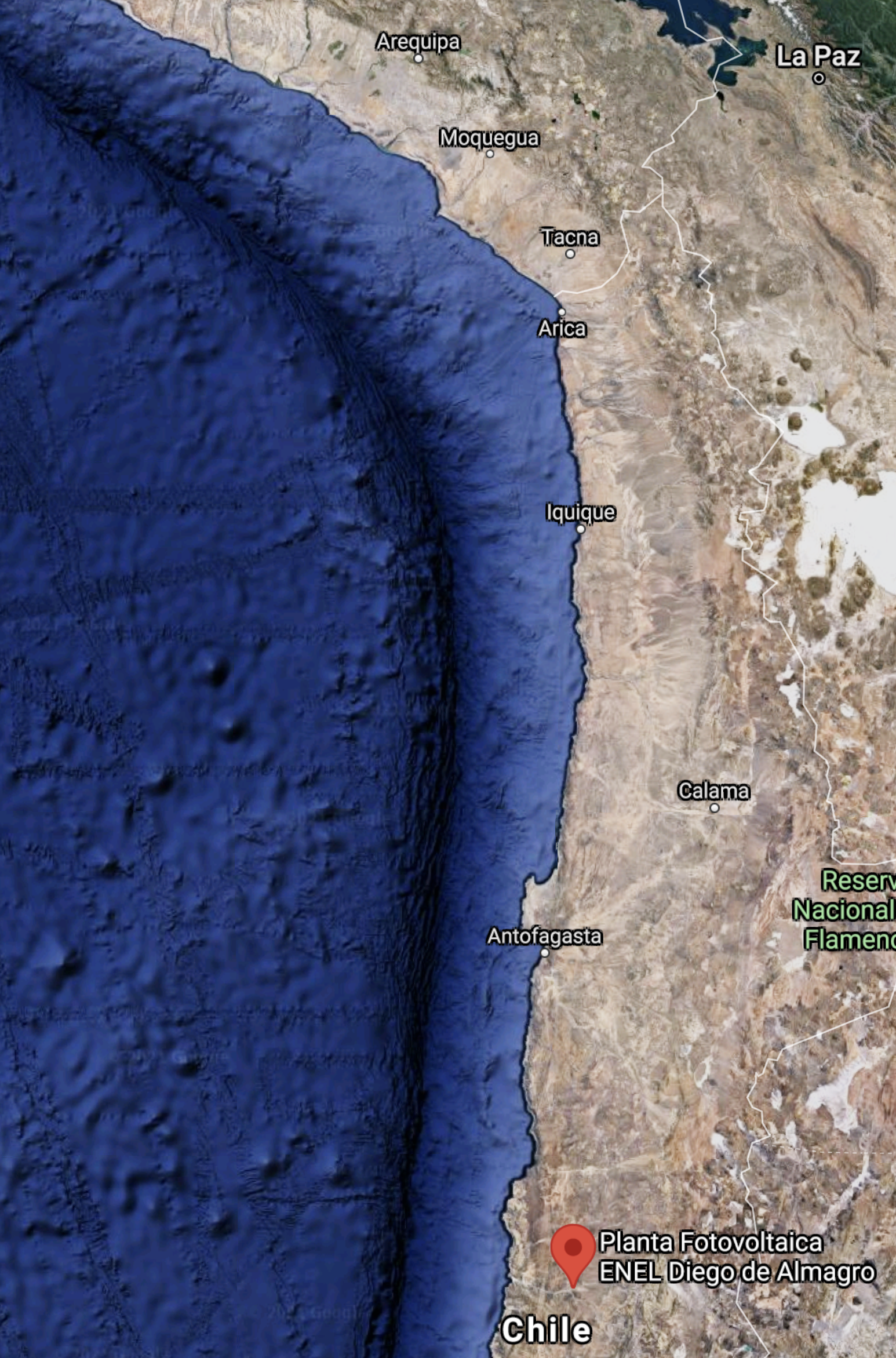
Note.
- The red arrow indicates the solar powerplant at Diego de Almagro.
- La Paz in Bolivia is in the North-East corner of the map.
- The sandy-beige colour indicates the Atacama Desert.
The area would appear not to lack sun.
This extract is from the press release.
With one of the highest solar irradiations in the world, the Atacama Region has the potential to generate all the country’s electricity. By pairing solar with cryogenic energy storage, Chile can benefit from 24/7, 100% renewable energy.
The Wiukipedia entry for Solar Power In Chile, is not as optimistic as the press release, but does show the rapid growth in the amount of solar power.
Conclusion
Solar power installed with large batteries, will transform the electricity supply in countries like Australia, Chile and India and those in Africa and other places, where there are large hot deserts.
In Europe, Spain is investing heavily in solar power and is a big innovator in solar technology.
Solar Canals Already Competitive With Ground-Mounted PV
The title of this post, is the same as that of this article on PV Magazine.
This is the introductory paragraph.
U.S. researchers have assessed the technical and economic feasibility of solar canals in California and have found that their LCOE is already close to that of ground-mounted solar plants. Three different project configurations were analyzed for eight different sites across the California network of canals.
It is a fascinating concept and is already been tried in India.
But apparently, California has the world’s largest network of canals.
Unlike the French system of Floatovoltaics, which I wrote about in Understanding Floatovoltaics, they don’t float the panels on the water, but suspend them with cables or trusses.
But like the French system, they do cut down evaporation.
 The Anonymous Widower