Hydrogen Trains Planned For Apennine Route
The title of this post, is the same as that of this article on Railway Gazette.
The trains appear to be part of a project to bring a sustainable economic recovery to an area that has been affected by three earthquakes in recent years and suffered badly from depopulation.
There would appear to be four projects.
Refurbishment Of The Sansepolcro And Sulmona Railway
This 300 km railway will also switch from diesel to hydrogen trains.
- Sansepolcros is a town in the Eastern part of Tuscany, to the South-East of Florence.
- Sulmona is a city that is roughly East of Rome.
- The Northern section of the route is covered in Wikipedia by the entry for the Terni – Perugia – Sansepolcro Railway.
- The Southern section of the route is covered in Wikipedia by the entry for the Terni and Sulmona Ralway.
- There are connections to Rome at Terni and Sulmona.
This railway looks like it could be an interesting route for a railway tourist. In my past experience, Todi and Perugia were certainly worth a visit.
Two Seas Railway
The Railway Gazette article says this about the Two Seas Railway.
This would cross Italy from west to east, connecting Roma’s Fiumicino airport with San Benedetto del Tronto via Rieti, Amatrice and Ascoli Picen.
It has been proposed for a long time and could use hydrogen traction.
Building Back Sustainably
The Railway Gazette article says this about the third and fourth projects.
A third project will assess the potential for diffused green hydrogen manufacturing activity in the region, and a fourth will look at ways to apply new energy and environmental technologies in post-earthquake reconstruction.
It looks to me, that hydrogen will play a large part in restoring this region of Italy.
Conclusion
It sounds a bit like, the Italians are rebuilding their railways like the UK and several other countries are doing.
Rolls-Royce’s All-Electric ‘Spirit of Innovation’ Takes To The Skies For The First Time
The title of this post, is the same as that of this press release from Rolls-Royce.
This is the first paragraph.
We are pleased to announce the completion of the first flight of our all-electric ‘Spirit of Innovation’ aircraft. At 14:56 (BST) the plane took to the skies propelled by its powerful 400kW (500+hp) electric powertrain with the most power-dense battery pack ever assembled for an aircraft. This is another step towards the plane’s world-record attempt and another milestone on the aviation industry’s journey towards decarbonisation.
Rolls-Royce also published an album of photographs, of which this is one.
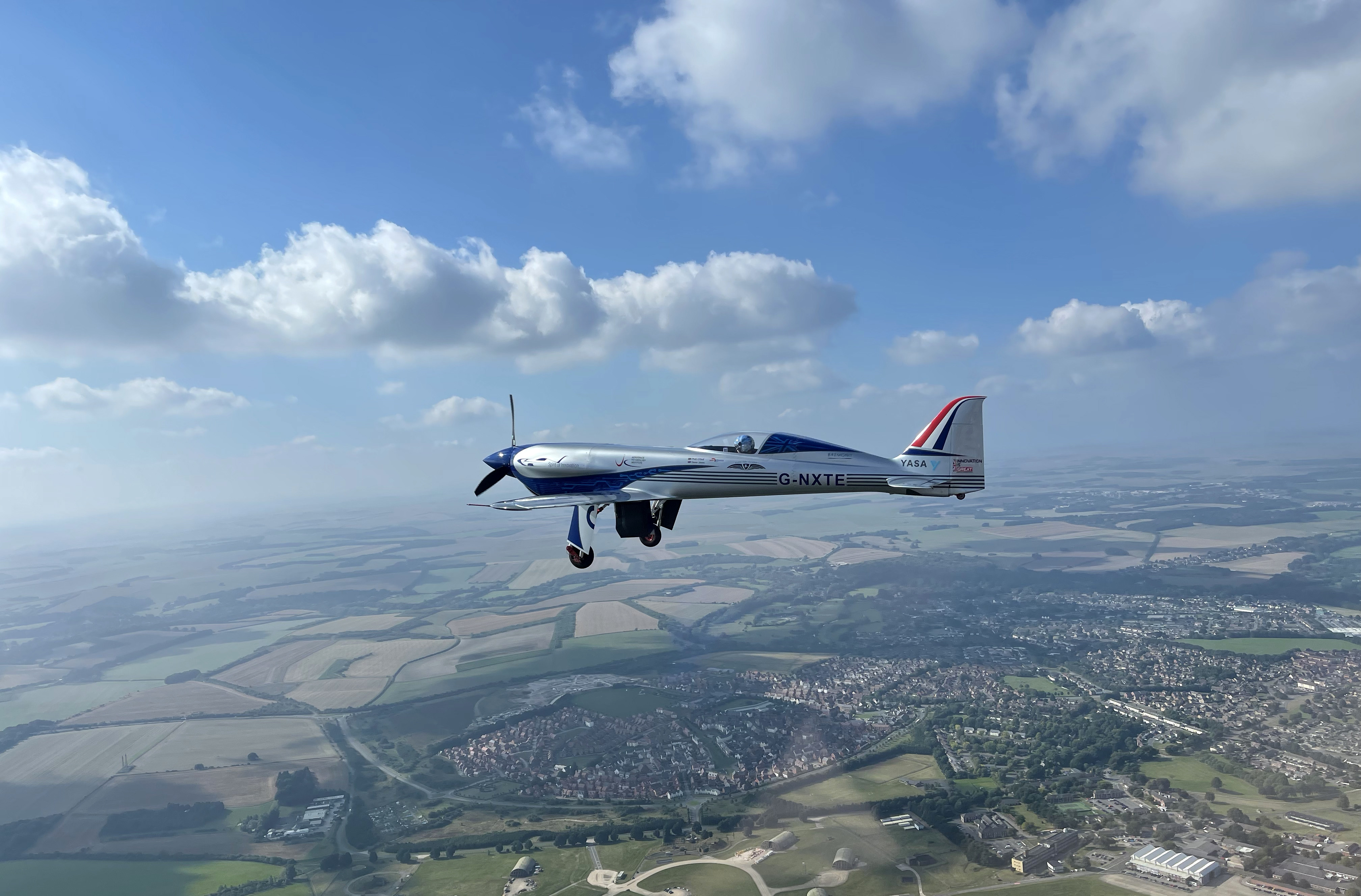
Note that the motor was designed and made by Yasa.
Caterpillar, Cummins Move On Hydrogen For Trains
The title of this post, is the same as that of this article on Construction Equipment.
This is the first paragraph.
Caterpillar and Cummins are working separately to put hydrogen to work in locomotives.
They have a lot to lose with the extinction of their diesel businesses, so why not join the party.
Let The Diving Under Begin!
The page on the Network Rail web site is entitled Network Rail Completes Major Signalling Work Near Peterborough Ready For Freight Trains To Begin Diving Under East Coast Main Line This Winter.
The Network Rail web page gives details of the innovative techniques used to build and insert the dive-under.
This Network Rail picture shows the dive-under going under the East Coast Main Line from the North East.
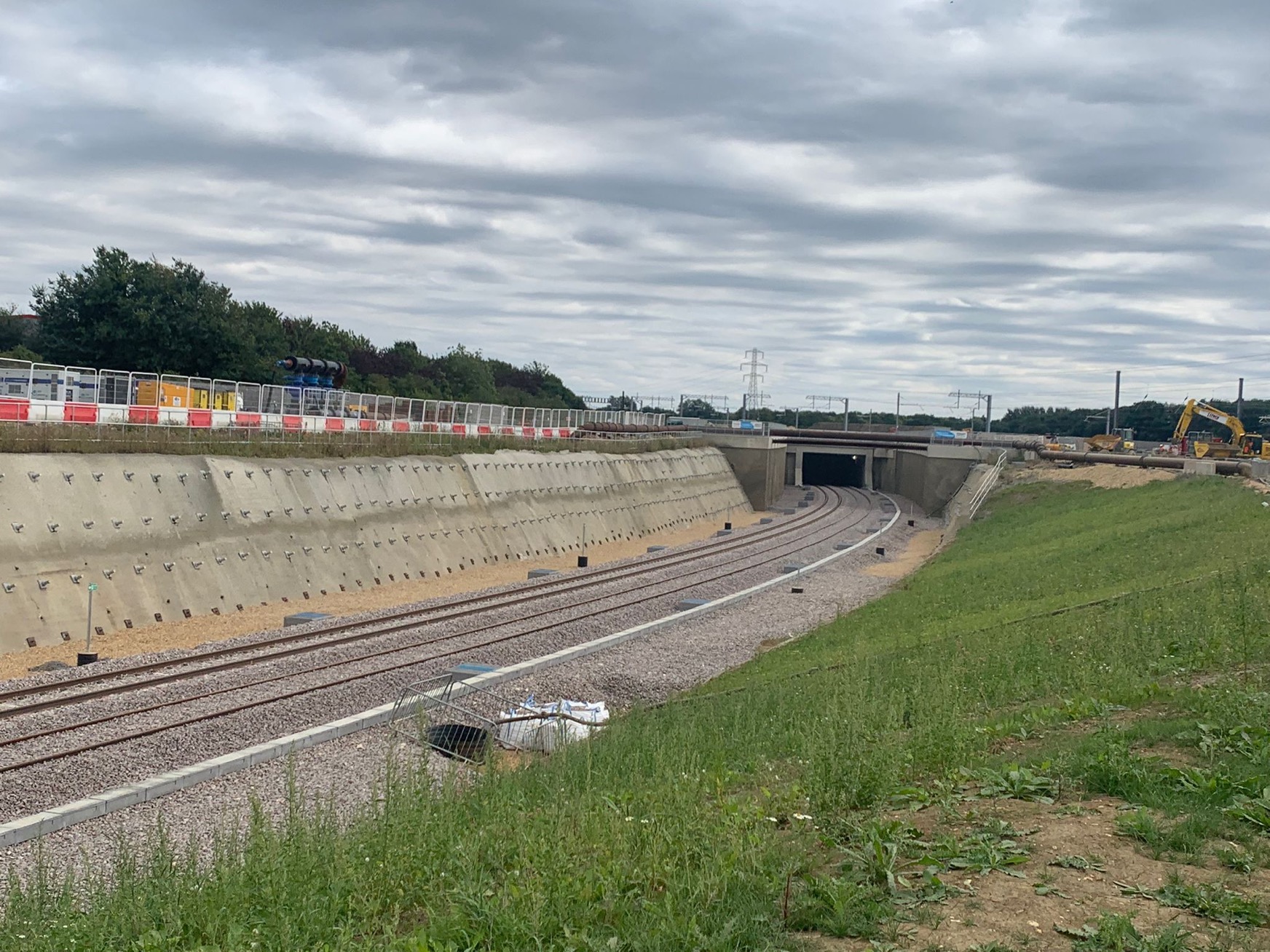
It certainly looks to be strongly constructed.
Freight Trains Through The Werrington Dive-Under
I have just counted the number of freight trains that would have used the route had it been open last Friday between 0600 and 2400.
It was twenty-seven trains or almost one train per hour (tph) in each direction.
- How long will it be before the residents of Lincoln and the other towns and cities on the route start protesting about the noisy, smelly and polluting Class 66 locomotives, that haul most of these freight trains?
- The long trains will also annoy drivers and residents at the many level crossings on the route.
Operators may not be able to do much about the train length, but they can start looking for some more environmentally-friendly locomotives, which could be hydrogen-powered.
At least there is funding for a lower-emission dual-dual-fuel locomotive, that I wrote about in Freightliner Secures Government Funding For Dual-Fuel Project.
Denmark Hill Station – 4th September 2021
The article on Rail Technology Magazine is entitled Denmark Hill Station First To Use Innovative Solar Technology In Europe.
The first two paragraphs describe the technology.
Denmark Hill station has become the first train station in Europe to have BIPVco’s Flextron thin film technology installed, on top of other upgrades, following a £7.5m extension.
The sophisticated and flexible solar panels are different from traditional ‘glass like’ panels, requiring no additional weight support, and will be used across other stations going forward.
Note.
- In the application of the technology at Denmark Hill station, a surplus of electricity is returned to the grid.
- BIPVco is a company based in South Wales, that evolved from research by Tata Steel and Swansea University, with the backing of the Welsh Government.
- The panels are lightweight, flexible, durable and self-cleaning.
Many years ago, I put up a barn based on timber beams, which had a sheet steel roof. These panels would be ideal for many agricultural buildings, like the one I commissioned.
These are pictures I took at Denmark Hill station, this morning.


Note.
- The original station was designed by Charles Henry Driver.
- The new entrance displays a high degree of craftsmanship, especially in the brickwork.
- The coffee and gluten-free cake I had in FCB Coffee were excellent.
- The station has its own pub; The Phoenix.
According to Network Rail, it has already been nominated for two architectural awards.
Thoughts On CAF’s Battery-Electric Class 331 Trains
I first wrote about CAF’s battery-electric trains in Northern’s Battery Plans, where I describe how CAF and Northern are planning to convert a number of three-car Class 331 trains into four-car battery-electric trains.
- The fourth car would contain batteries.
- Batteries would also be added to the PTS (pantograph) car.
I suspect that the battery range could be arranged so that all Northern’s routes suitable for battery-electric operation could be handled.
These are my thoughts.
How Much Would The Conversion Cost?
I will first make rough estimate of what the extra car would cost.
Northern placed a £500 million order for the following trains.
- 31 x three-car Class 331 trains
- 12 x four-car Class 331 trains
- 25 x two-car Class 195 trains
- 33 x three-car Class 195 trains
This is a total of 290 trains.
So on a rough estimate, each car will cost around £1.72 million.
As batteries would also be added to the pantograph car, the cost of updating a three-car train to a four-car battery-electric train would probably be around two million.
Why Are CAF Proposing A Four-Car Train With Two Battery Cars?
When I first read about CAF’s and Northern’s plans, I wondered, why CAF were also putting batteries in the pantograph car, as surely, with their extensive experience with battery-powered trains, CAF could fit enough batteries into one battery-car for a reasonable range, as Bombardier did seven years ago.
Having done all the calculations around Wigan and Bolton in Bolton-Wigan £78m Rail Electrification Project Announced, I suspect that CAF and Northern want a trans-Pennine range, so they can compete with TransPennine Express.
Two cars with batteries is probably needed for that.
Could The Three-Car Trains Be Converted To Three-Car Battery-Electric Trains?
But there is a collateral benefit of putting batteries in the pantograph car.
I suspect that in a four-car Class 331 trains have a trans-Pennine range, which between Manchester Victoria and Leeds stations is 50.2 miles and between Carlisle and Newcastle stations is 61.5 miles. So let’s say that the four-car Class 331 train with two battery packs has a range of 70 miles.
So what would be the range of a three-car train with one battery pack.
One battery pack would only take a four-car train 35 miles, so a single battery pack would contain 140 car-miles of electricity.
If a single-battery were to be fitted to the pantograph car of a three-car train, 140 car-miles would give a range of 46.7 miles.
My conclusion about the Bolton and Wigan electrification in Bolton-Wigan £78m Rail Electrification Project Announced, was as follows.
This electrification of just 6.5 miles of double-track between Lostock junction and Wigan Wallgate station seems to be one of the smaller electrification projects.
But on closer examination, when linked to a fleet of battery-electric trains with a range of perhaps forty miles, the electrification enables battery-electric trains to run these services.
- Southport And Alderley Edge
- Southport And Stalybridge
- Kirkby And Manchester Victoria
With a charging station in Blackburn station, then the Wigan Wallgate And Blackburn service can be added.
All these four services could be run by three-car battery-electric Class 331 trains. And if the services are to be run by six-car trains, a pair can be coupled up.
What Would Be The Range Of A Four-Car Battery-Electric Train With Only One Battery?
If I’m right that a four-car battery-electric Class with two batteries has a range of seventy miles across the Pennines, then a train with one battery should be able to manage 35 miles.
Conclusion
It sounds like the Spanish might have come up with a cunning plan, that might be able to convert both three- and four-car Class 331 trains to battery-electric operation.
By adding a battery to the pantograph car, this enables a four-car battery-electric train with a trans-Pennine range.
Summing up the various options gives the following ranges.
- Three-car battery-electric train with one battery pack – 46.7 miles
- Four-car battery-electric train with one battery pack – 35 miles
- Four-car battery-electric train with two battery packs – 70 miles
I’m impressed.
Langthwaite Reservoir
This site is the second application for United Utilities of floatovoltaics, where solar panels are floated on a reservoir.
This page on the Seaflex web site gives details of the project. This paragraph describes the application of the solar panels.
The 1 MW plant features approximately 3,700 pontoon modules and 3,520 solar panels, and the power generated will be used to run the neighbouring Lancaster water treatment works, which supplies water to 152,000 people across Lancaster, Morecambe and Heysham.
There are links to other floatovoltaic projects on this page.
One project at Alto Rabagao in Portugal tested the design in extreme environmental conditions.
Seaflex appear to be a Swedish company started by an inventor of a rubber mooring system.
Innovation Funding Awarded
The title of this post, is the same as that of a short article in the August 2021 Edition of Modern Railways.
This is the first paragraph.
Developments in passenger information, cutting carbon emissions and electrification are amongst the 30 winners of the latest round of the Department for Transport/Innovate UK’s First Of A Kind (FOaK) competition.
I particularly liked the first innovation mentioned.
Furrer+Frey is proposing a movable overhead conductor rail system for freight terminals which allows electric locomotives to enter them while providing obstruction-free loading and unloading of freight. It says this will remove the current barrier of end-to-end rail freight electrification and end the reliance on diesel traction.
Some years ago, I sat next to a crane driver from the Port of Felixstowe at a football match. At half-time we talked for a few minutes about the problems of overhead wires in ports and freight terminals. As he said “Accidents do happen!”
Furrer+Frey’s idea might be just what is needed to help decarbonise ports and freight terminals.
There is a good description of the project in this article on Rail Business UK, which is entitled Movable Overhead Electrification Aims To Eliminate The Need For Diesel Shunting Locomotives.
This link shows a picture of a similar Furrer + Frey system in a workshop or train shed.
It appears to be based on proven technology and will be tested at a Tarmac depot in Dunbar.
Furrer+Frey also got a second funding award.
It has also won funding for its innovative composite Mast for Greener Electrification, which could reduce the mass of overhead line electrification masts, as well as the size of foundations, depth of piling and lifting capability of installation machinery.
That sounds like a classic application of Buckminster Fuller’s More With Less Syndrome.
I shall add other awards later.
Viritech Issues A Call To Action For Hydrogen In The United Kingdom
The title of this post, is the same as that of this article on Daily Research Reporting.
This is the first paragraph.
According to Viritech, adopting clean hydrogen innovation to power road, air, and marine transportation offers the UK a major potential to retake a global engineering pioneering role, create an economic premium, and secure a key environmental dividend. The firm makes the case in its Call to Action for accelerated public and private sector commitment to groundbreaking technology with the potential to restore the UK’s leadership role in the automotive industry while also making a strong dedication to decarbonizing the difficult-to-reduce heavy freight segments of the transportation mix.
I’ll go along with what Viritech says.
Three things caught my eye in the article.
The first is the picture of a car, which I assume is hydrogen-powered.
I also liked this paragraph, which gives a prediction about how batteries and hydrogen will play out their competition.
“Hydrogen is a critical component of the zero-emissions puzzle,” said Jay Nagley, a seasoned automotive pundit from Viritech. “Batteries cannot do everything, and there are many use cases, particularly in heavy freight applications like heavy cargo vehicles, where batteries solely are not the answer to replacing fossil fuels. A dual-track method combining hydrogen and batteries, on the other hand, offers a full range of possibilities for achieving this goal. While batteries will be the primary source of growth in the early 2020s, the hydrogen powertrains will become the primary source of growth in the late 2020s.”
I agree with Jay Nagley.
The last point is only a few words.
Structural graphene pressure vessels.
That sounds to be just the ticket to reduce the size of hydrogen tanks.
Conclusion
Viritech could be one to watch.
New Company Established To Help Transition Bus Fleets To Hydrogen
The title of this post, is the same as that of this article on H2 View.
These first two paragraphs describe the company.
A new asset financed company has been launched to help design, deliver, and finance the seamless transition to a zero-emissions bus fleet with hydrogen included.
Launched by Wrightbus owner Jo Bamford today (August 9), FUZE will support the energy transition to cleaner variants by offering packages that enable the transition to hydrogen or electric fleets of buses.
If Jo Bamford gets this right, it could certainly smooth the transition to hydrogen and electric buses, where bus companies will be introducing new technology.
The words asset-based make me think, that buses, fuelling systems and chargers could all be hired on a bus-by-the-hour basis in much the same way train manufacturing companies like Hitachi and Stadler supply trains to the train operating companies.
The manufacturers are contracted to supply so many trains each day and if there are reliability or availability problems, then they must compensate the operators. That model would surely work with buses.
- I also suspect the model would allow flexibility, as to the choice of either an electric or hydrogen bus.
- I also think, that the model would be able to provide short-term deals for large events and Rail Replacement services.
- Buses no longer needed could also be returned, repainted and hired by another operator.
- FUZE could also have a standby fleet, so any bus operator wanting to try hydrogen buses for a month, could enter into a short-term deal.
I also think that this new generation of buses can open up innovative ideas for bus use. In Three Hydrogen Double Decker Buses Set For Dublin, I describe how Dublin will use just three hydrogen buses to create a fast commuter route.
Conclusion
I like it!
Short Term Hire Of Buses
I have a feeling that if say you wanted to hire a small fleet of buses for say a festival like Glastonbury, that hydrogen buses could be the better bet.
Suppose you wanted to run a fleet of five buses to and from the car park at the nearest rail station.
- Feeding the chargers for five buses will need a substantial electricity feed.
- Hydrogen buses can be refuelled from a mobile fuelling station.
- Hydrogen buses can probably run all day on one refuelling.
The ease of refuelling would appear to favour the hydrogen bus.
 The Anonymous Widower