Covid: Merck’s Antiviral Pill Molnupiravir Slashes Chances Of Illness And Death
The title of this post, is the same as that of this article on The Times.
The title almost sounds to go to be true, but on reading the article, that seems to be even better.
- Halves the chance of going to hospital.
- Slashes chance of death.
Xi Jinping was said to be unavailable for comment.
Moroccan Solar-Plus-Wind To Be Linked To GB In ‘Ground-Breaking’ Xlinks Project
The title of this post, is the same as that of this article on Current News.
This is the first paragraph.
New solar and wind under development in Morocco is to be linked with Britain, with developer Xlinks also seeking to develop a cable manufacturing industry.
It looks to be a very challenging project.
- The HVDC cable will be 3,800 km long.
- The plan envisages 10.5 GW of electricity being generated.
- There will be a 5GW/20GWh battery in Morocco.
- They will export 3.6 GW of electricity to the UK for at least twenty hours per day.
- The electricity will be exported to the UK by a cable that skirts to the West of Spain, Portugal and France.
- The UK end of the cable will be at Alverdiscott in Devon.
All except the last are pushing current technology to the limit.
There is more information on the Morocco-UK Power Project page on the Xlinks web site.
- The company claims, that it can supply renewable energy, that acts like baseload power.
- When complete, it could supply eight percent of the UK’s energy needs.
These are my thoughts.
The 3,800 km. HVDC Link
This paragraph on the project web page describes the HVDC link.
Four cables, each 3,800km long form the twin 1.8GW HVDC subsea cable systems that will follow the shallow water route from the Moroccan site to a grid location in Great Britain, passing Spain, Portugal, and France.
It appears that would be 15200 kilometres of cable.
The longest HVDC link in the world is 2375 km. It’s overland and it’s in Brazil.
I can’t think otherwise, than that this will be a very challenging part of the project.
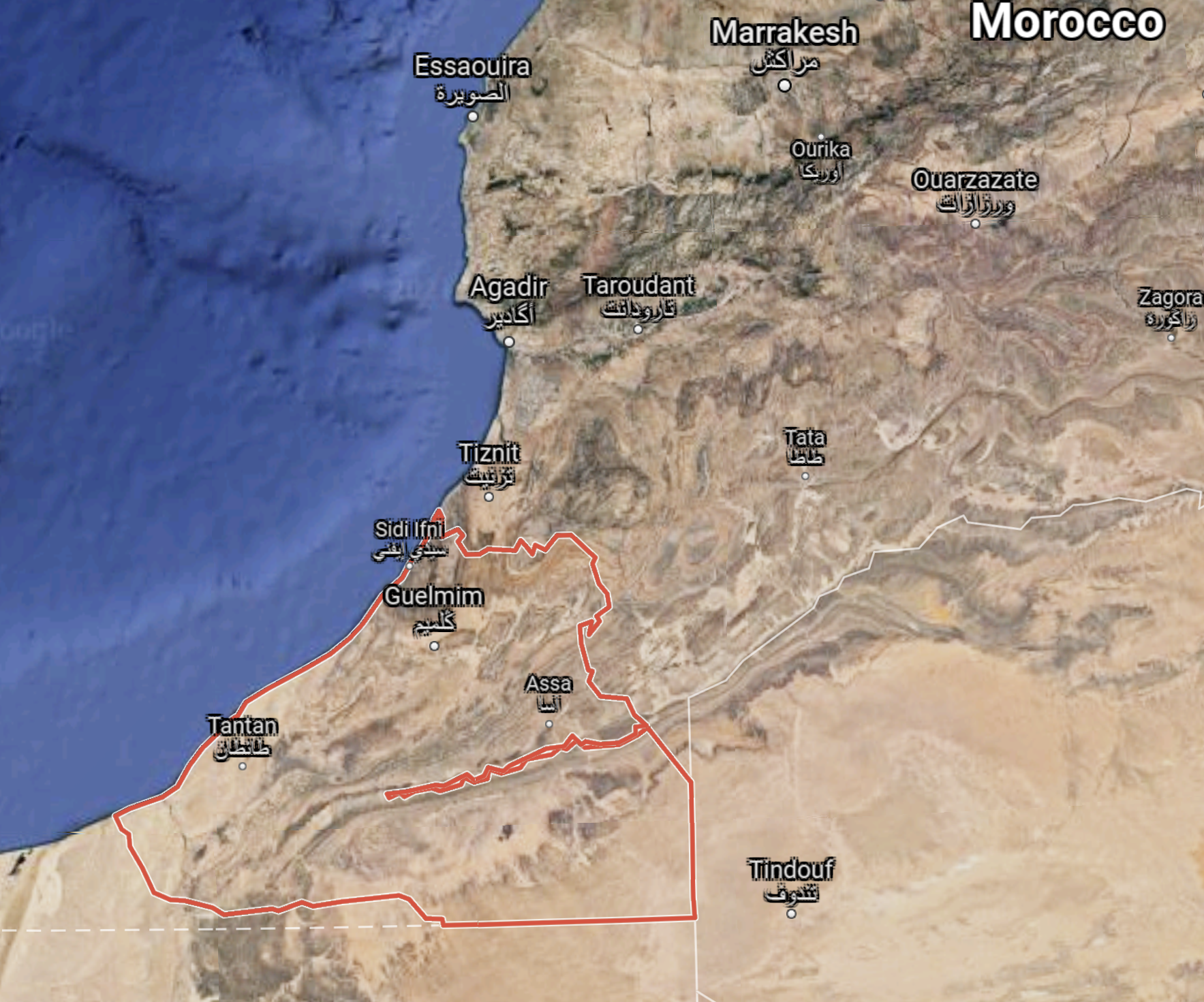
This Google map shows the area of Morocco, where the energy will be generated.
Note.
- Guelmim Oued Noun is outlined in red.
- The Canary Islands are just off the map to the West.
At least the project will be able to have convenient access to the sea.
This second Google Map shows the <Moroccan, Portuguese and Spanish coasts from Guelmim Oued Noun to the Bay of Biscay.

Note.
- The light blue of the Continental Shelf
- The darker blue of deeper water.
- Guelmim Oued Noun is outlined in red.
- The Canary Islands in the Atlantic Ocean to the West of Guelmim Oued Noun.
- Could the cable bring power to Gibraltar?
- There are other large cities on the route in Morocco, Portugal and Spain.
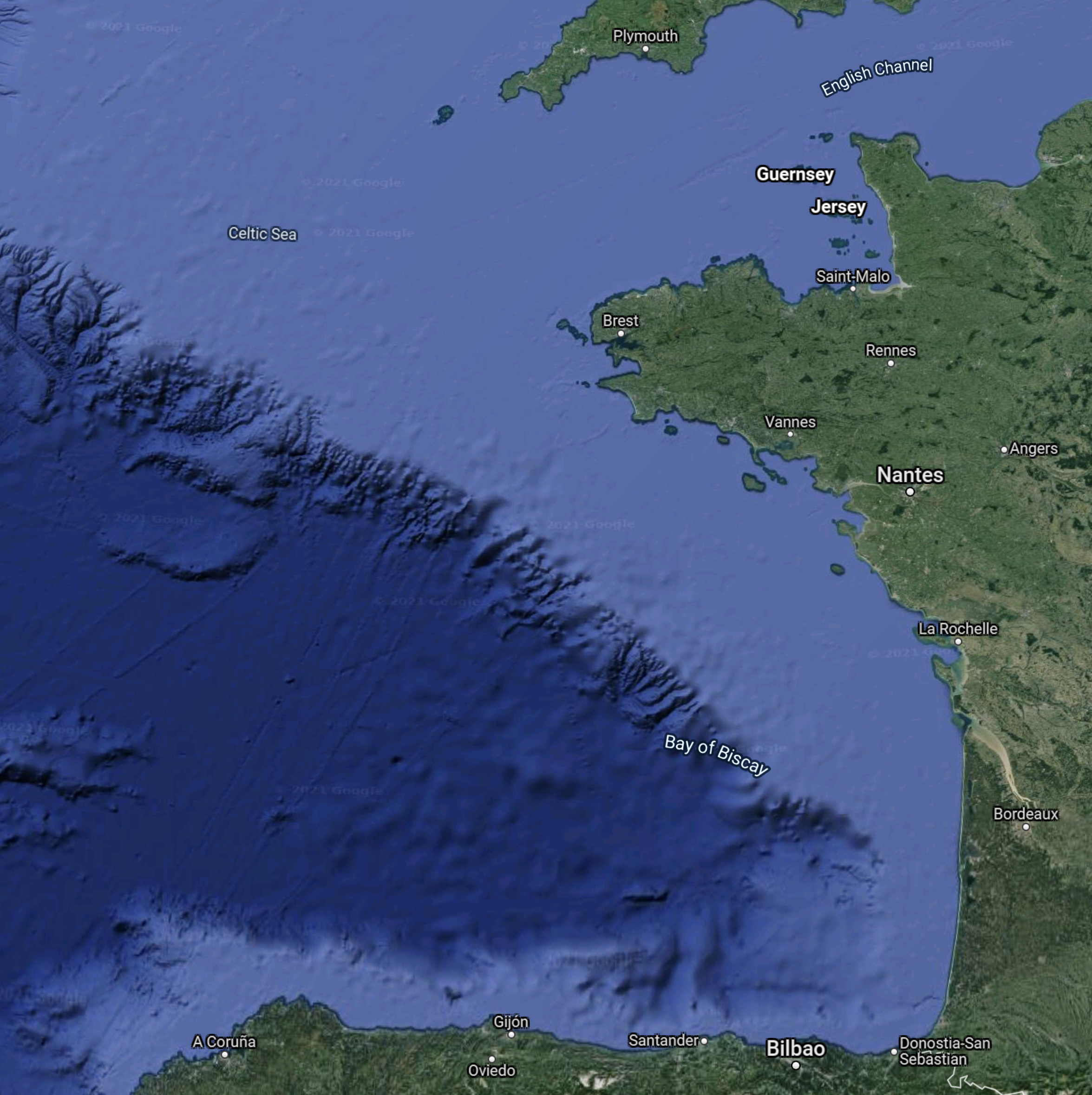
This third Google Map shows the Bay of Biscay.
Note.
- The light blue of the Continental Shelf
- The darker blue of deeper water.
- There are a series of islands off the Spanish and French coasts.
- Could these islands be used as stepping stones for the cable?
This fourth Google Map shows the Western Approaches to the UK.
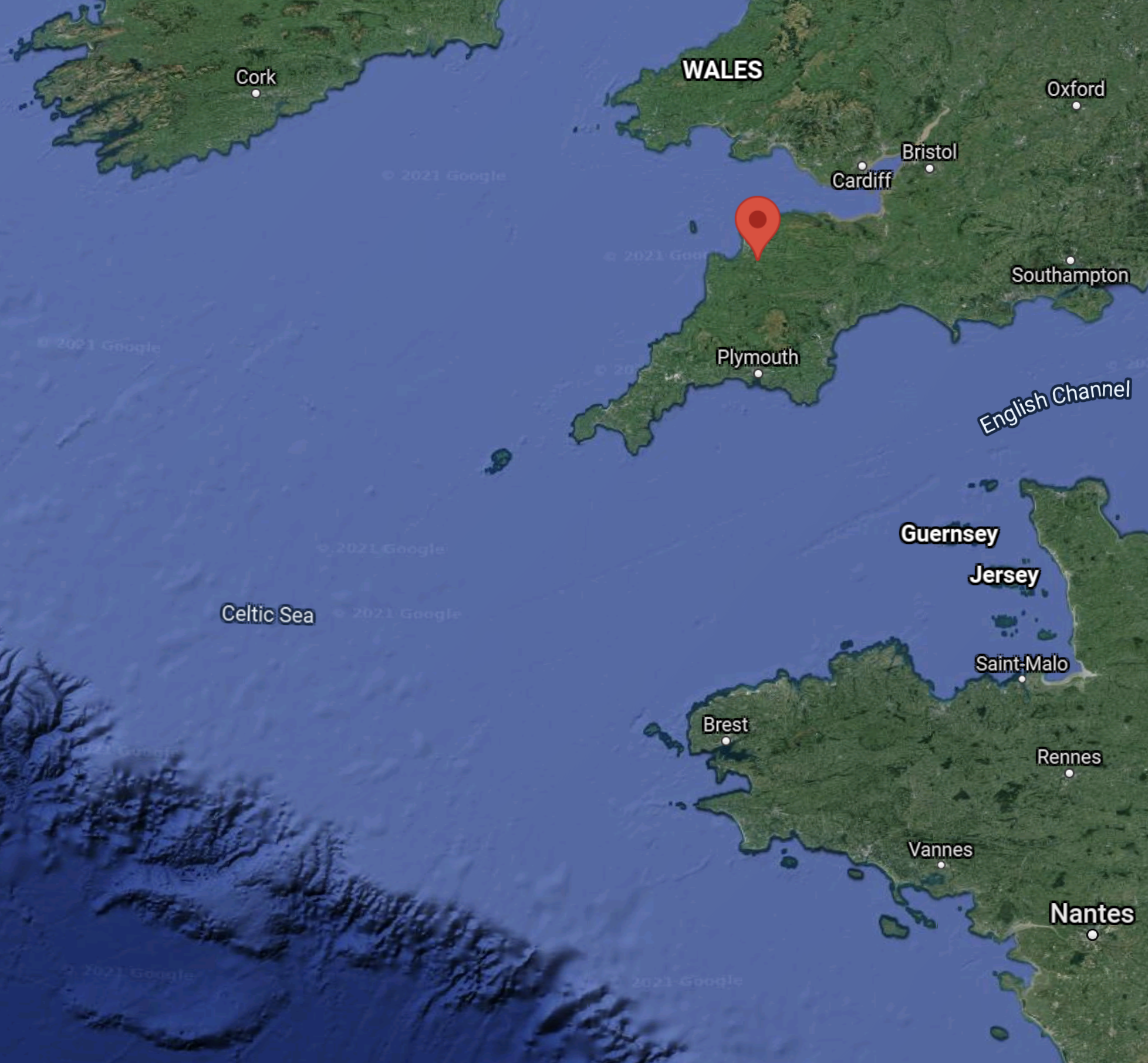
Note that the prominent red arrow indicates Alverdiscott, where cable connects to the UK National Grid.
This fifth Google Map shows Alverdiscott to Lundy Island.
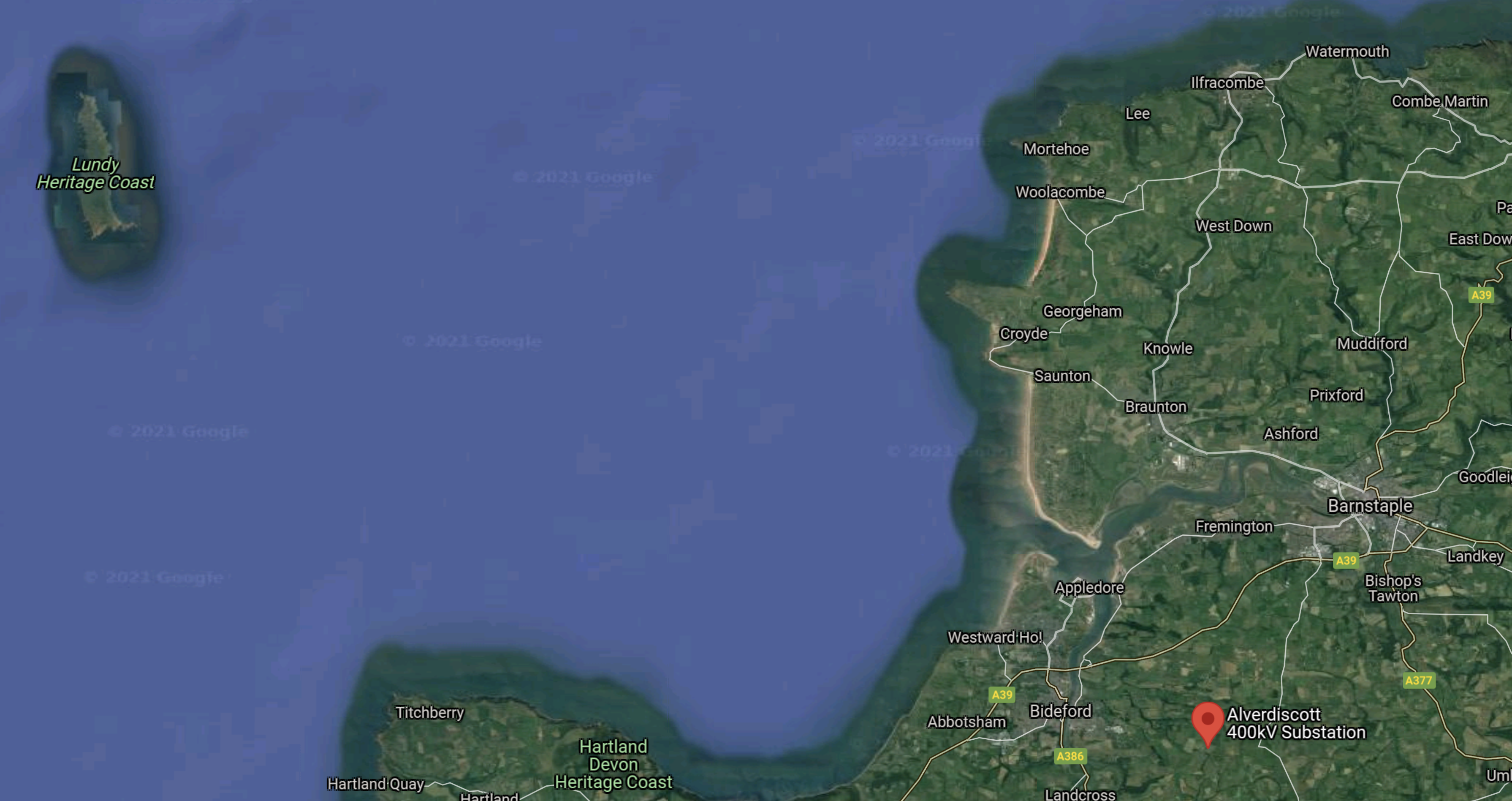
Alverdiscott substation is indicated by the red arrow.
This sixth Google Map shows the Alverdiscott substation in relation to the town of Bideford.
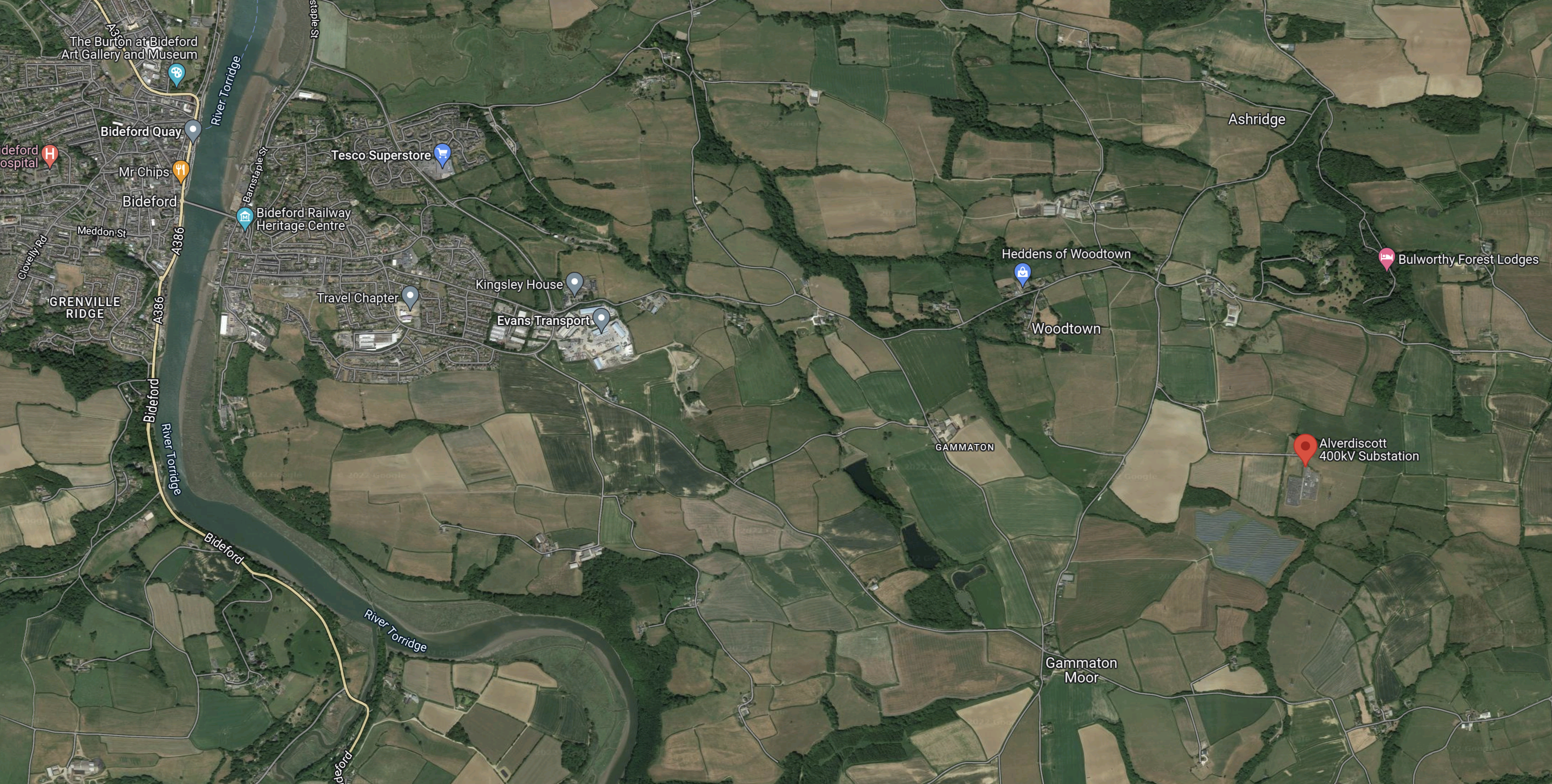
Note.
- Bideford is in the North-West corner of the map.
- The red arrow indicates the Alverdiscott substation.
- The River Torridge runs through the town of Bideford.
Could the river be used to bring the cables from Morocco to the substation?
This seventh Google Map shows the Alverdiscott substation
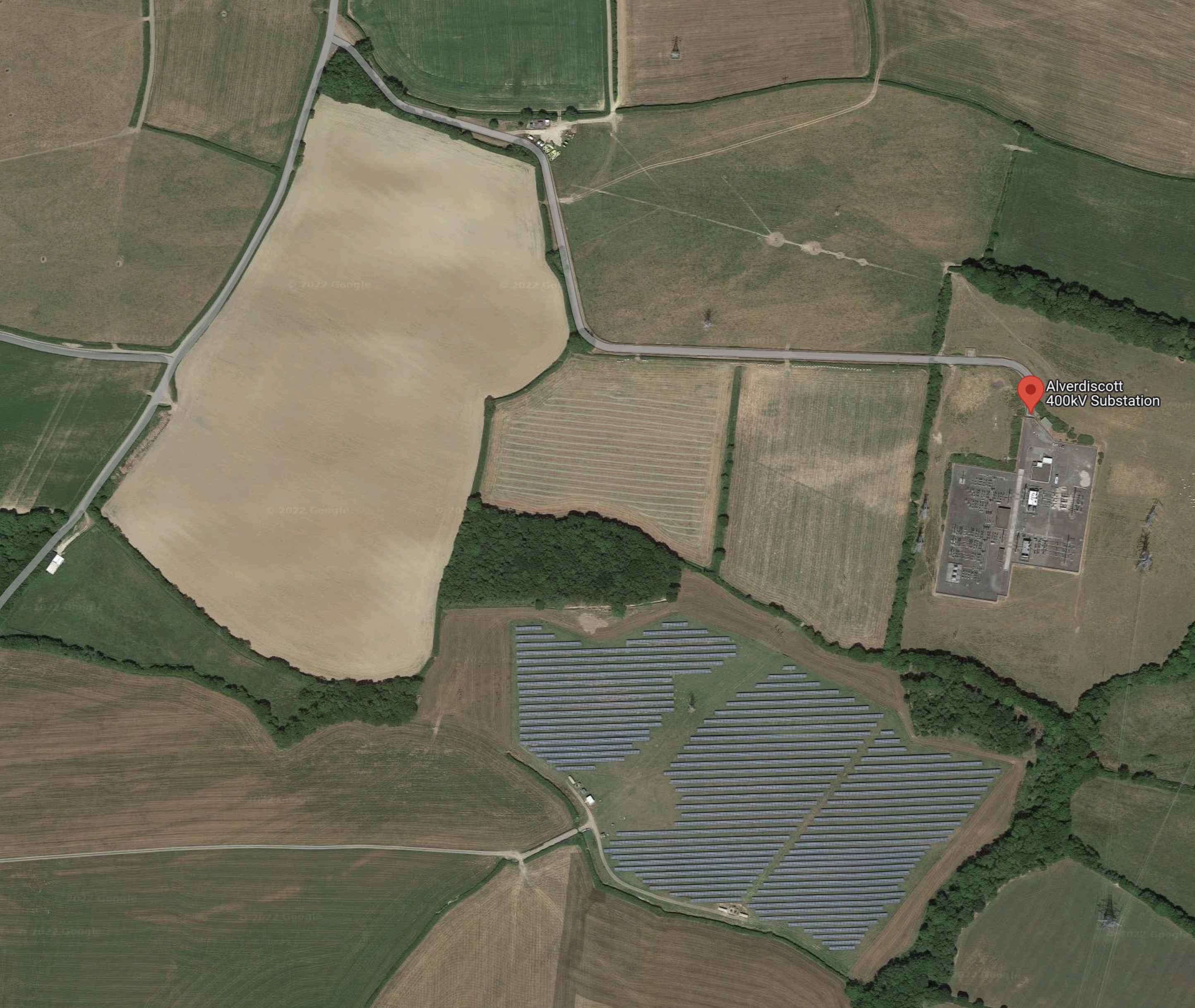
Note the solar farm to the South of the substation.
HVDC Cable
The article also says that they may be building their own cable-manufacturing facility. Does this indicate that there is a shortage of HVDC cable?
Judging by the number of proposed interconnectors proposed for UK waters, it might be a prudent move to improve cable-manufacturing capacity.
10.5 GW Of Zero-Carbon Electricity
This sentence on the project web page describes the power generation.
This “first of a kind” project will generate 10.5GW of zero carbon electricity from the sun and wind to deliver 3.6GW of reliable energy for an average of 20+ hours a day.
It appears that they will be providing a baseload of 3.6 GW to the UK for over twenty hours per day.
Consider.
- Hinckley Point C has an output of 3.2 GW.
- As I write this around midnight, the UK is generating 22.2 GW of electricity.
This paragraph from their web site describes the advantages of Morocco.
Most importantly, Morocco benefits from ideal solar and wind resources, required to develop renewable projects that could guarantee suitable power production throughout the year. It has the third highest Global Horizontal Irradiance (GHI) in North Africa, which is 20% greater than Spain’s GHI and over twice that of the UK. Furthermore, the shortest winter day still offers more than 10 hours of sunlight. This helps in providing production profiles that address the needs of the UK power market, especially during periods of low offshore wind production.
It is not a small power station in the wrong place.
The 5GW/20GWh Battery
That is a massive battery.
The world’s largest lithium-ion battery is Gateway Energy Storage in California. It has a capacity of 250 megawatts for one hour.
The proposed battery in Morocco is eighty times as large.
If I was choosing a battery for this application, I believe the only one that has been demonstrated and might work is Highview Power’s CRYOBattery.
I wrote about Highview’s similar type of application to Morocco in Chile in The Power Of Solar With A Large Battery.
But that installation only will only have storage of half a GWh.
But I believe Highview and their partner; MAN Energy Solutions can do it.
Conclusion
I wish the company well, but I have a feeling that there’s a chance, that this will join the large pile of dead mega-projects.
But I do feel that the solar and wind power station in Morocco will be developed.
And like the project in Chile it will have a large Highview CRYOBattery.
Hydrogen Trains Planned For Apennine Route
The title of this post, is the same as that of this article on Railway Gazette.
The trains appear to be part of a project to bring a sustainable economic recovery to an area that has been affected by three earthquakes in recent years and suffered badly from depopulation.
There would appear to be four projects.
Refurbishment Of The Sansepolcro And Sulmona Railway
This 300 km railway will also switch from diesel to hydrogen trains.
- Sansepolcros is a town in the Eastern part of Tuscany, to the South-East of Florence.
- Sulmona is a city that is roughly East of Rome.
- The Northern section of the route is covered in Wikipedia by the entry for the Terni – Perugia – Sansepolcro Railway.
- The Southern section of the route is covered in Wikipedia by the entry for the Terni and Sulmona Ralway.
- There are connections to Rome at Terni and Sulmona.
This railway looks like it could be an interesting route for a railway tourist. In my past experience, Todi and Perugia were certainly worth a visit.
Two Seas Railway
The Railway Gazette article says this about the Two Seas Railway.
This would cross Italy from west to east, connecting Roma’s Fiumicino airport with San Benedetto del Tronto via Rieti, Amatrice and Ascoli Picen.
It has been proposed for a long time and could use hydrogen traction.
Building Back Sustainably
The Railway Gazette article says this about the third and fourth projects.
A third project will assess the potential for diffused green hydrogen manufacturing activity in the region, and a fourth will look at ways to apply new energy and environmental technologies in post-earthquake reconstruction.
It looks to me, that hydrogen will play a large part in restoring this region of Italy.
Conclusion
It sounds a bit like, the Italians are rebuilding their railways like the UK and several other countries are doing.
Rolls-Royce’s All-Electric ‘Spirit of Innovation’ Takes To The Skies For The First Time
The title of this post, is the same as that of this press release from Rolls-Royce.
This is the first paragraph.
We are pleased to announce the completion of the first flight of our all-electric ‘Spirit of Innovation’ aircraft. At 14:56 (BST) the plane took to the skies propelled by its powerful 400kW (500+hp) electric powertrain with the most power-dense battery pack ever assembled for an aircraft. This is another step towards the plane’s world-record attempt and another milestone on the aviation industry’s journey towards decarbonisation.
Rolls-Royce also published an album of photographs, of which this is one.
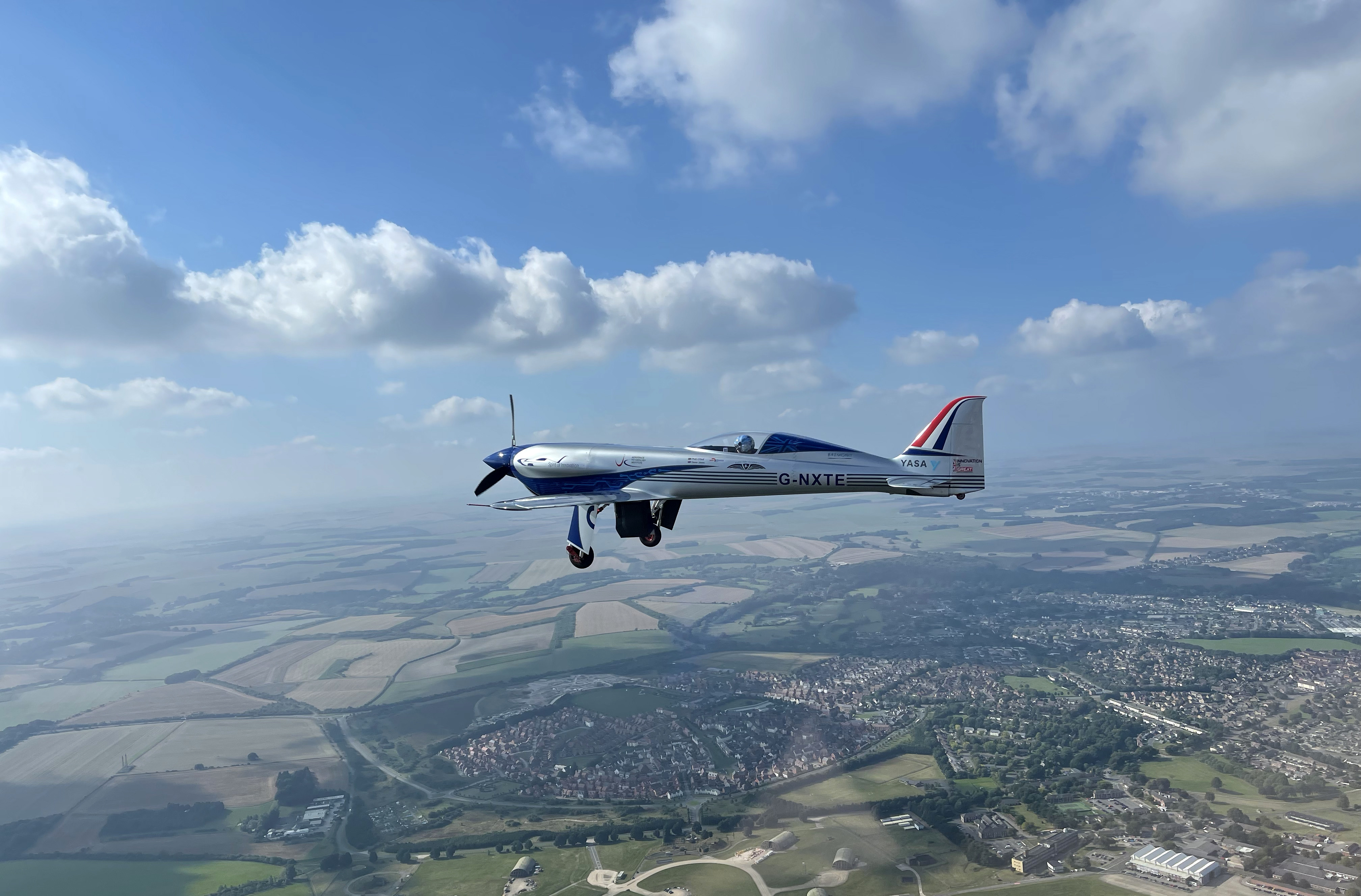
Note that the motor was designed and made by Yasa.
Caterpillar, Cummins Move On Hydrogen For Trains
The title of this post, is the same as that of this article on Construction Equipment.
This is the first paragraph.
Caterpillar and Cummins are working separately to put hydrogen to work in locomotives.
They have a lot to lose with the extinction of their diesel businesses, so why not join the party.
Let The Diving Under Begin!
The page on the Network Rail web site is entitled Network Rail Completes Major Signalling Work Near Peterborough Ready For Freight Trains To Begin Diving Under East Coast Main Line This Winter.
The Network Rail web page gives details of the innovative techniques used to build and insert the dive-under.
This Network Rail picture shows the dive-under going under the East Coast Main Line from the North East.
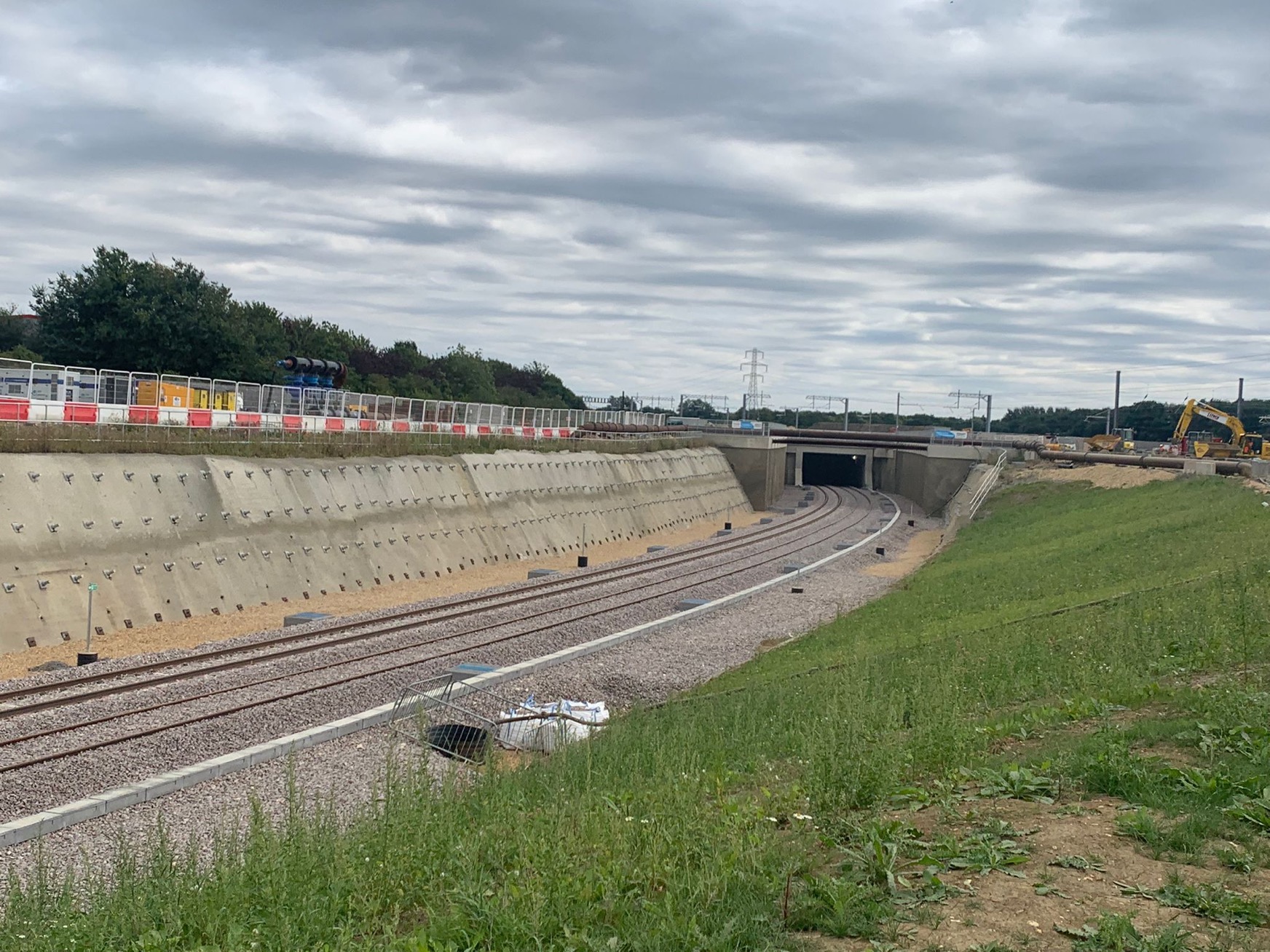
It certainly looks to be strongly constructed.
Freight Trains Through The Werrington Dive-Under
I have just counted the number of freight trains that would have used the route had it been open last Friday between 0600 and 2400.
It was twenty-seven trains or almost one train per hour (tph) in each direction.
- How long will it be before the residents of Lincoln and the other towns and cities on the route start protesting about the noisy, smelly and polluting Class 66 locomotives, that haul most of these freight trains?
- The long trains will also annoy drivers and residents at the many level crossings on the route.
Operators may not be able to do much about the train length, but they can start looking for some more environmentally-friendly locomotives, which could be hydrogen-powered.
At least there is funding for a lower-emission dual-dual-fuel locomotive, that I wrote about in Freightliner Secures Government Funding For Dual-Fuel Project.
Denmark Hill Station – 4th September 2021
The article on Rail Technology Magazine is entitled Denmark Hill Station First To Use Innovative Solar Technology In Europe.
The first two paragraphs describe the technology.
Denmark Hill station has become the first train station in Europe to have BIPVco’s Flextron thin film technology installed, on top of other upgrades, following a £7.5m extension.
The sophisticated and flexible solar panels are different from traditional ‘glass like’ panels, requiring no additional weight support, and will be used across other stations going forward.
Note.
- In the application of the technology at Denmark Hill station, a surplus of electricity is returned to the grid.
- BIPVco is a company based in South Wales, that evolved from research by Tata Steel and Swansea University, with the backing of the Welsh Government.
- The panels are lightweight, flexible, durable and self-cleaning.
Many years ago, I put up a barn based on timber beams, which had a sheet steel roof. These panels would be ideal for many agricultural buildings, like the one I commissioned.
These are pictures I took at Denmark Hill station, this morning.


Note.
- The original station was designed by Charles Henry Driver.
- The new entrance displays a high degree of craftsmanship, especially in the brickwork.
- The coffee and gluten-free cake I had in FCB Coffee were excellent.
- The station has its own pub; The Phoenix.
According to Network Rail, it has already been nominated for two architectural awards.
Thoughts On CAF’s Battery-Electric Class 331 Trains
I first wrote about CAF’s battery-electric trains in Northern’s Battery Plans, where I describe how CAF and Northern are planning to convert a number of three-car Class 331 trains into four-car battery-electric trains.
- The fourth car would contain batteries.
- Batteries would also be added to the PTS (pantograph) car.
I suspect that the battery range could be arranged so that all Northern’s routes suitable for battery-electric operation could be handled.
These are my thoughts.
How Much Would The Conversion Cost?
I will first make rough estimate of what the extra car would cost.
Northern placed a £500 million order for the following trains.
- 31 x three-car Class 331 trains
- 12 x four-car Class 331 trains
- 25 x two-car Class 195 trains
- 33 x three-car Class 195 trains
This is a total of 290 trains.
So on a rough estimate, each car will cost around £1.72 million.
As batteries would also be added to the pantograph car, the cost of updating a three-car train to a four-car battery-electric train would probably be around two million.
Why Are CAF Proposing A Four-Car Train With Two Battery Cars?
When I first read about CAF’s and Northern’s plans, I wondered, why CAF were also putting batteries in the pantograph car, as surely, with their extensive experience with battery-powered trains, CAF could fit enough batteries into one battery-car for a reasonable range, as Bombardier did seven years ago.
Having done all the calculations around Wigan and Bolton in Bolton-Wigan £78m Rail Electrification Project Announced, I suspect that CAF and Northern want a trans-Pennine range, so they can compete with TransPennine Express.
Two cars with batteries is probably needed for that.
Could The Three-Car Trains Be Converted To Three-Car Battery-Electric Trains?
But there is a collateral benefit of putting batteries in the pantograph car.
I suspect that in a four-car Class 331 trains have a trans-Pennine range, which between Manchester Victoria and Leeds stations is 50.2 miles and between Carlisle and Newcastle stations is 61.5 miles. So let’s say that the four-car Class 331 train with two battery packs has a range of 70 miles.
So what would be the range of a three-car train with one battery pack.
One battery pack would only take a four-car train 35 miles, so a single battery pack would contain 140 car-miles of electricity.
If a single-battery were to be fitted to the pantograph car of a three-car train, 140 car-miles would give a range of 46.7 miles.
My conclusion about the Bolton and Wigan electrification in Bolton-Wigan £78m Rail Electrification Project Announced, was as follows.
This electrification of just 6.5 miles of double-track between Lostock junction and Wigan Wallgate station seems to be one of the smaller electrification projects.
But on closer examination, when linked to a fleet of battery-electric trains with a range of perhaps forty miles, the electrification enables battery-electric trains to run these services.
- Southport And Alderley Edge
- Southport And Stalybridge
- Kirkby And Manchester Victoria
With a charging station in Blackburn station, then the Wigan Wallgate And Blackburn service can be added.
All these four services could be run by three-car battery-electric Class 331 trains. And if the services are to be run by six-car trains, a pair can be coupled up.
What Would Be The Range Of A Four-Car Battery-Electric Train With Only One Battery?
If I’m right that a four-car battery-electric Class with two batteries has a range of seventy miles across the Pennines, then a train with one battery should be able to manage 35 miles.
Conclusion
It sounds like the Spanish might have come up with a cunning plan, that might be able to convert both three- and four-car Class 331 trains to battery-electric operation.
By adding a battery to the pantograph car, this enables a four-car battery-electric train with a trans-Pennine range.
Summing up the various options gives the following ranges.
- Three-car battery-electric train with one battery pack – 46.7 miles
- Four-car battery-electric train with one battery pack – 35 miles
- Four-car battery-electric train with two battery packs – 70 miles
I’m impressed.
Langthwaite Reservoir
This site is the second application for United Utilities of floatovoltaics, where solar panels are floated on a reservoir.
This page on the Seaflex web site gives details of the project. This paragraph describes the application of the solar panels.
The 1 MW plant features approximately 3,700 pontoon modules and 3,520 solar panels, and the power generated will be used to run the neighbouring Lancaster water treatment works, which supplies water to 152,000 people across Lancaster, Morecambe and Heysham.
There are links to other floatovoltaic projects on this page.
One project at Alto Rabagao in Portugal tested the design in extreme environmental conditions.
Seaflex appear to be a Swedish company started by an inventor of a rubber mooring system.
Innovation Funding Awarded
The title of this post, is the same as that of a short article in the August 2021 Edition of Modern Railways.
This is the first paragraph.
Developments in passenger information, cutting carbon emissions and electrification are amongst the 30 winners of the latest round of the Department for Transport/Innovate UK’s First Of A Kind (FOaK) competition.
I particularly liked the first innovation mentioned.
Furrer+Frey is proposing a movable overhead conductor rail system for freight terminals which allows electric locomotives to enter them while providing obstruction-free loading and unloading of freight. It says this will remove the current barrier of end-to-end rail freight electrification and end the reliance on diesel traction.
Some years ago, I sat next to a crane driver from the Port of Felixstowe at a football match. At half-time we talked for a few minutes about the problems of overhead wires in ports and freight terminals. As he said “Accidents do happen!”
Furrer+Frey’s idea might be just what is needed to help decarbonise ports and freight terminals.
There is a good description of the project in this article on Rail Business UK, which is entitled Movable Overhead Electrification Aims To Eliminate The Need For Diesel Shunting Locomotives.
This link shows a picture of a similar Furrer + Frey system in a workshop or train shed.
It appears to be based on proven technology and will be tested at a Tarmac depot in Dunbar.
Furrer+Frey also got a second funding award.
It has also won funding for its innovative composite Mast for Greener Electrification, which could reduce the mass of overhead line electrification masts, as well as the size of foundations, depth of piling and lifting capability of installation machinery.
That sounds like a classic application of Buckminster Fuller’s More With Less Syndrome.
I shall add other awards later.
 The Anonymous Widower