Fracking Hell…Is It The End?
The title of this post, is the same as that of this article in yesterday’s Sunday Times.
The article is an interesting read.
These two paragraphs are key.
Activism by Extinction Rebellion and growing public concern about climate change have weakened the chances of an industry once expected to create 64,500 jobs ever getting off the ground.
Cuadrilla Resources, the fracking company most active in Britain, has in recent days been removing equipment from its sole operating site in Lancashire. Petrochemicals tycoon Sir Jim Ratcliffe has vowed to pursue shale gas exploration overseas because of “archaic” and “unworkable” regulations at home.
But I think it’s more complicated than that!
I sometimes go to lectures at the Geological Society of London and two stand were about fracking.
Two were about fracking.
Fracked or fiction: so what are the risks associated with shale gas exploitation?- Click for more.
This is a video of the lecture.
What Coal Mining Hydrogeology Tells us about the Real Risks of Fracking – Click for more.
This is a video of the lecture.
This is a must-watch video from a good speaker.
I have also written several posts about fracking, with some of the earliest being in 2012-2013.
I have just re-read all of my posts.
- In the posts I have tried to give information and at times, I have said we should start fracking.
- But we should only start if we know what we’re doing.
- In several places I ask for more research.
However, there are some interesting facts and inconvenient truths about fracking and natural gas in general.
- Russia earns about €300billion a year or twenty percent of its GDP from gas exports to Europe. See Should We Nuke Russia?.
- Putin backs the anti-fracking movement. See Russia ‘secretly working with environmentalists to oppose fracking’.
- Fracking techniques is used in the Scottish Highlands to obtain clean water from deep underground. See the second Geological Society of London video.
- About forty per cent of gas usage is to heat housing. See the second video.
- The eighteen percent of the UK population, who don’t have a gas supply are more likely to be in fuel poverty. See the second video.
- Scotland has more need for energy to provide heat. See the second video.
- Natural gas with carbon capture and storage has a similar carbon footprint to solar power. See the second video.
- Cowboy fracking, as practised in the United States, would not be allowed in the UK or the EU. See the second video.
- We have no historic earthquake database of the UK, which would help in regulation and research of fracking. See the second video.
- Fracking has brought down the price of gas in North America.
- In the United States fracked gas is cutting the need to burn coal, which produces more pollution and carbon dioxide to generate the same amount of energy. See A Benefit Of Fracking.
The article in the Sunday Times says pressure against fracking has started the shutdown of the industry in the UK.
But there is another big pressure at work.replacement of natural gas with hydrogen.
- This would reduce carbon emissions.
- It can be used as a chemical feedstock.
- It could be delivered using the existing gas network.
- The gas network could be changed from natural gas to hydrogen on a phased basis, just as the change from town to natural gas was organised around fifty years ago.
But it would mean that all gas users would need to change their boilers and other equipment.
Put yourself in the position of Jim Ratcliffe; the major owner and driving force behind INEOS.
INEOS needs feedstocks for chemical plants all over the world and affordable natural gas is one that is very suitable, as it contains two of the major elements needed in hydrocarbons and many useful chemicals; carbon and hydrogen.
If local sources are not available, then liquefied natural gas can be shipped in.
The Hydrogen Economy
It is possible to replace natural gas in many applications and processes with hydrogen.
- It can be used for heating and cooking.
- Important chemicals like ammonia can be made from hydrogen.
- It can be transported in existing natural gas etworks.
- Hydrogen can also replace diesel in heating and transport applications.
There is also a possibility of measures like carbon taxes being introduced, which using hydrogen would reduce.
There’s more in the Wikipedia entry for Hydrogen economy.
Have Jim Ratcliffe and others done their predicting and decided that the demand for locally sourced natural gas will decline and that the hydrogen economy will take over?
But there will need to be a readily available source of large amounts of hydrogen.
I used to work in a hydrogen factory at Runcorn, which was part of ICI, that created hydrogen and chlorine, by the electrolysis of brine. In some ways, the hydrogen was an unwanted by-product, back in the late 1960s, but similar and more efficient processes can be used to convert electricity into hydrogen.
The latest idea, is to cluster offshore wind farms around gas rigs in the seas around the UK. The electricity produced would be used to electrolyse water to extract the hydrogen, which would then be piped to the shore using existing gas pipelines.
It would be a way of reusing infrastructure associated with gas fields, that have no gas left to extract.
There would be no need to build an expensive electricity cable to the shore.
The Dutch, Danes and the Germans are proposing to build the North Sea Wind Power Hub, which is described like this in Wikipedia.
North Sea Wind Power Hub is a proposed energy island complex to be built in the middle of the North Sea as part of a European system for sustainable electricity. One or more “Power Link” artificial islands will be created at the northeast end of the Dogger Bank, a relatively shallow area in the North Sea, just outside the continental shelf of the United Kingdom and near the point where the borders between the territorial waters of Netherlands, Germany, and Denmark come together. Dutch, German, and Danish electrical grid operators are cooperating in this project to help develop a cluster of offshore wind parks with a capacity of several gigawatts, with interconnections to the North Sea countries. Undersea cables will make international trade in electricity possible.
Later, Wikipedia says that ultimately 110 GW of electricity capacity could be developed.
So could these planned developments create enough hydrogen to replace a sizeable amount of the natural gas used in Western Europe?
I suspect a lot of engineers, company bosses and financiers are working on it.
Conclusion
I have come to the following conclusions.
- Fracking for hydrocarbons is a technique that could be past its sell-by date.
- The use of natural gas will decline.
- INEOS could see hydrogen as a way of reducing their carbon footprint.
- The heating on all new buildings should be zero carbon, which could include using hydrogen from a zero-carbon source.
There are reasons to think, that electricity from wind-farms creating hydrogen by electrolysis could replace some of our natural gas usage.
Energy Vault Receives $110 Million From SoftBank For Gravity-Assisted Power Storage
The title of this post is the same as that of this article on Forbes.
Energy Vault is a company, that is developing gravity-assisted power storage.
You don’t invest £110million in a company, even if you are as rich as Softbank, unless you are certain, that you’ll get a return!
So I suspect Energy Vault may have a working system for storing energy
Read the article and see what your think! It also links to a video.
This is an interesting quote from the company.
We knew we needed to be around three to four cents levelized cost per kWh ($30 – $40 per MWh) to add to PV or wind in order to be competitive below fossil. This took a lot of innovation.
I shall be following the company.
From Green Gin To Sustainable Steel, Government Fires Up £140m Hydrogen Push
The title of this post, is the same as that of this article on Business Green.
The projects are wide ranging.
Green Gin
This is said about gin production by Orkney Distilling Ltd.
The successful projects feature a number of eye-catching initiatives, including the HySpirits project which has been awarded just under £200,000 to explore how the European Marine Energy Centre could work with local gin producer Orkney Distilling Ltd to convert its distillery from using liquid petroleum gas to hydrogen produced using renewable power.
I have been told that making whisky produces carbon dioxide. Does gin?
My source, also said carbon dioxide frpm Scotch whisky production has been used in the growing of soft fruit.
I found this article on The Courier, which is entitled Time To Cut Back On Whisky’s CO2 Emissions and this article on Scottish Capture and Storage, which is entitled Carbon Capture In The Heart Of The City.
Both are worth reading.
This is a paragraph from the second article.
The carbon capture process at this site is relatively simple, because the off gas from fermentation is already very pure in CO2. The process is not about enhancing CO2 concentration, but more about removing impurities. That involves a number of washing stages to remove water and impurities from the gas given off during fermentation, before it is compressed, stored, and eventually transported by road.
The article also says that the distillery produces four tonnes of carbon dioxide per day, which compared to the emissions of Chinese, Indian and United States coal-fired power stations is small beer, but it does show how in some industrial processes capturing the carbon dioxide can be relatively easy in some industrial processes and of a high quality for perhaps using in food and medical products.
But I can’t find a article connecting carbon dioxide from whisky to food production.
The Dolphyn Project
This is said about the Dolphyn Project.
A further £427,000 has been awarded to the Dolphyn project, which plans to mount electrolysers onto floating wind turbine platforms to produce hydrogen. One wind turbine alone has the potential to produce enough low carbon hydrogen to heat around 2,500 homes, fuel over 120-240 buses, or run eight to 12 trains,” the government said
I can’t find much on the Internet about this project, except this extract from this document on the Institution of Engineering and Technology web site, which is called Transitioning To Hydrogen.
The Deepwater Offshore Local Production of Hydrogen
(Dolphyn) project will consider large-scale retrofit
hydrogen production from offshore floating wind
turbines in deep water locations (Figure 19).This is a partnership project led by ERM with Engie,
Tractebel Engie and ODE. The project looks to
utilise the vast UK offshore wind potential to power
electrolysers to produce hydrogen from the water the
turbines float on. Large 10MW turbines consisting of
desalinisation technology and PEM electrolysers will
feed hydrogen at pressure via a single flexible riser to
a sub-sea manifold with other turbines’ lines. The gas
is then exported back to shore via a single trunkline.
A 20-by-20 array array would have a 4GW capacity,
producing sufficient hydrogen to heat more then 1.5
million homes.This project may include the offshore wind supply
of hydrogen supported with hydrogen from steam
methane reformation with carbon capture technology.
This project is well aligned to work the ACORN75
project at St Fergus.
Note that the project is talking about gigawatts of energy and providing enough hydrogen to heat millions of homes.
I think that the Dolphyn Project is badly named, as Google thinks you’re looking for projects about aquatic animals.
Gigastack
This is said about Gigastack.
Meanwhile, a consortium featuring Ørsted, ITM Power, and Element Energy is celebrating after securing just shy of £500,000 to help move forward with its Gigastack feasibility study, a six-month project to investigate the potential for delivering bulk, low-cost, and zero-carbon hydrogen.
There’s more here on this page on the ITM Power web site, where this is the first paragraph.
Project to demonstrate delivery of bulk, low-cost and zero-carbon hydrogen through gigawatt scale PEM electrolysis, manufactured in the UK.
As you’d expect from the name, they are looking at creating gigawatts of hydrogen.
Steel
This is said about steel.
The funding awards came as the government also launched a new call for evidence seeking views on how the government should structure and manage a planned £250m Clean Steel Fund. The government said the proposed fund would help the industry embrace clean technologies and move on to “a pathway that is consistent with the UK Climate Change Act” and its new net zero emission goal.
So what has hydrogen got to do with steel?
Search for hydrogen steelmaking on Google and you get lots of articles including this article from the Stockholm Environmental Institute, which is entitled Hydrogen Steelmaking For A Low-Carbon Economy.
This is a paragraph.
In the spring of 2016, three Swedish companies – LKAB (iron ore mining), SSAB (steel manufacturer) and Vattenfall (power utility) – announced their ambition to develop and implement a novel process for fossil-free steel production in Sweden. This process would use hydrogen (instead of coal) for the direct reduction of iron oxide/ore (H-DR), combined with an electric arc furnace (EAF). It would be almost completely fossil-free when the hydrogen is produced from electrolysis of water by use of renewable electricity. The concept is called Hydrogen Breakthrough Ironmaking Technology, or HYBRIT for short.
My knowledge of process engineering, tells me, that even if the Swedes don’t succeed, someone will and here in the UK, we’re ideally placed to take advantage, as we have the wind power to produce the hydrogen.
Conclusion
The future’s bright, the future’s green hydrogen!
, The North Sea can provide us with more than enough hydrogen, so long as the wind blows and there’s water to electrolyse..
World’s First Solar-Powered Trains Are Coming To England
The title of this post, is the same as that on this article on Lonely Planet.
This is the first paragraph
The first ever solar unit to directly supply a railway line with electricity has been put in place in England, paving the way for the world’s first solar-powered trains
I am not sure yet about this technology., powering large sections of the UK’s railways.
But the technology does have applications, if it is combined with energy storage.
Boosting Power With Third-Rail Electrification
Third-rail electrification has a problem, in that it needs to be fed with power every few miles. Inevitably, as timetables get busier, there are areas, where there is not enough power to supply the trains.
These systems can provide that fill-in power.
Note that 25 KVAC overhead electrification doesn’t have the problem, as the wires themselves distribute the electricity.
This means that the Great Western Main Line electrification is only supplied with power from the electricity grid at three places; the two ends and one in the middle.
Electrification In Visually-Sensitive Places
Look at this picture of Brunel’s magnificent Wharncliffe Viaduct.

It has been recently electrified and some groups object to the electrification of Grade I Listed structures like this.
Most modern electric trains can be dual-voltage and can work on both electrification systems used in the UK; 25 KVAC overhead and 750 VDC third rail. They can also change between electrification systems at maximum speed
So could we see selective use of solar-powered third-rail electrification in visually-sensitive areas?
Possibly! But battery/electric trains may be a better alternative!
Charging Battery-Electric Trains
There are some branch lines, that will be served by battery-electric trains in the future.
These solar-powered systems could be used to provide the energy to charge the batteries for the return journey.
Powering Remote Stations
Stations are increasingly needing better electricity supplies with more lighting and various ticket and parking machines, and charging for electric cars will become more important.
Solar power systems and batteries could be used.
Conclusion
Solar power will be increasingly used on the railways, with a large number of stations like Blackfriars and the recently-opened White Hart Lane.
But that will happen, irrespective of the result of the Aldershot trial, as many stations are easy places to install solar panels, either on the roof or redundant spaces.
This Google Map shows one of my local stations; Haggerston.

It was rebuilt and reopened in April 2010, so solar panels were probably not thought about for the station.
From my helicopter, it appears that the stations at Dalston Junction, Hoxton and Shoreditch High Street, which were all built at the same time, don’t have solar rooves either.
Perhaps Transport for London and/or Network Rail should rent their roof areas to companies, who run solar farms?
I’m sure there’s a mutually beneficial deal in there somewhere!
As to powering trains, I’m sure they that Riding Sunbeams has a place on third-rail networks, where power needs boosting.
However, electric trains with batteries might be a better option in other applications.
Dialysis-At-Home Developer Quanta Raises £38m
The title of this post is the same as that of this article in today’s Sunday Times
Strangely, in my almost seventy-two years, I’ve never met anybody, who is undergoing dialysis, although one of my friends did give one of his kidneys to his brother.
But reading this article in The Sunday Times, I feel that for those undergoing dialysis, things may be improving.
- The £38m will launch Quanta’s machine with the NHS.
- More people will be able to have dialysis-at-home.
- The company hopes the machine will be launched in the US this year.
It is very much a good news article.
To me though, it shows how technology is increasingly being developed to improve healthcare.
Surprisingly, the machine uses the same technology as that used to mix soft drinks in bars.
Solar Panel Pilot For Aldershot
The title of this post is the same as that of an article in the August 2019 Edition of Modern Railways.
This is the two paragraphs.
Solar panels are to be installed on derelict land near Aldershot station as part of an experiment into whether renewable energy can be used to power trains.
A total of 135 discrete solar panels are being installed and are expected to go live in August. The Riding Subnbeams ‘First Light’ demonstrator project is a collaboration between climate change charity 10:10, Community Energy South and Network Rail, alongside a consortium of specialist consultants and university departments.
I wrote about the company and its ideas in Solar Power Could Make Up “Significant Share” Of Railway’s Energy Demand, which I posted in December 2017.
I won’t repeat myself, but I will say that since I wrote the original article, a compatible development has happened.
In Vivarail Unveils Fast Charging System For Class 230 Battery Trains, I wrote about Vivarail’s charging system for battery trains, which uses battery-to-battery power transfer to charge batteries on trains, through standard third-rail technology.
I do feel that the 10:10 and Vivarail ought to be talking, as I feel that between them, they could come up with some good joint ideas.
Will We See A Phase Out Of Diesel-Mechanical And Diesel-Hydraulic Multiple Units?
After writing My First Ride In A Class 195 Train, I started to think about the future of diesel multiple units.
The Class 195 trains are powered by one MTU diesel engine, with a rating of 390 kW in each car, that drives the wheels through a ZF Ecolife transmission.
It is all very Twentieth Century!
- Power comes from one diesel engine per car.
- There is pollution and carbon-dioxide generated outside the train.
- Noise is generated outside and inside the train.
- Braking energy is not captured and used to power the train, or stored for reuse.
We can do so much better than this.
The MTU Hybrid PowerPack
MTU have now developed the MTU Hybrid PowerPack.
This page on the MTU web site, is a document, which describes the PowerPack.
It describes the PowerPack as the next generation of railcar drive.
It lists these benefits.
- Saving fuel through braking energy recovery
- Significantly reduced emissions through load point optimization
- Optimizing travel times with the Boost Mode
- Significant noise reduction
- Flexible vehicle deployment and simple retrofitting
In some ways the last point is the most significant.
This is said in the document about deployment and retrofitting.
Naturally, rail vehicles with hybrid drive can also be powered
exclusively by the diesel engine. This also means great flexibility
for the operator: The trains can be deployed on both electrified
and non-electrified rail routes. In addition, upgrading to a trimodal*
power system – with an additional pantograph – is easy because
the system is already equipped with an electric motor. This gives
the operator considerable freedom with regard to deployment of
the vehicles – it‘s a big plus when they can respond flexibly in the
future to every route requirement or tender invitation.
It sounds like MTU have really done their thinking.
If you want to read more, there is this document on the Rolls-Royce web-site, which is entitled Hybrid Train Trials.
Note that Rolls-Royce are MTU’s parent company.
A Simple Trimodal Example
I will give one simple example of where the trimodal technology pf the MTU Hybrid PowerPack, could be used, to great advantage.
Southern have two routes, where they have to use diesel Class 171 trains
- Eastbourne and Ashford International (42% electrified)
- London Bridge and Uckfield (45% electrified)
Porterbrook are planning to fit MTU Hybrid PowerPacks to Class 170 trains, as I wrote about in Rolls-Royce And Porterbrook Launch First Hybrid Rail Project In The UK With MTU Hybrid PowerPacks.
As the Class 171 train is very similar to the Class 170 train, I would suspect that Class 171 trains can be converted to diesel hybrids using MTU Hybrid PowerPacks.
It would be very useful, if they could be converted into tri-mode trains, by the addition of third-rail shoe gear.
This would mean, that the two routes run by the Class 171 trains, could be run on electricity for st least 40-45 percent of the route.
I would also think, that adding third-rail shoe gear to a diesel multiple unit, like a Class 171 train, could be easier than adding a pantograph.
When you consider that Southern have twenty Class 171 trains, with a total of fifty-six cars and conversion would therefore need fifty-six MTU Hybrid PowerPacks, this would not be a trivial order for MTU, that could bring substantial benefit to Southern.
I suspect new bi-mode or battery/electric trains would be less good value, than converting trains with MTU Hybrid PowerPacks, in many applications.
Other Technologies
Already other companies and research organisations are getting involved in developing affordable solutions to convert redundant diesel multiple units into more environmentally-friendly and energy efficient trains.
We have also seen train operating companies in a wider sense, buying trains that can easily be updated to zero-carbon trains.
Benefits Of Conversion To Diesel-Hybrid
I believe that conversion to diesel hybrid trains, using MTU Hybrid PowerPacks or similar technologies, could be advantageous in other ways, in addition to the obvious ones of less noise and pollution.
- Train operating companies would not need to greatly change their support infrastructure.
- Driver retraining would probably be a short conversion course.
- More partially-electrified routes would be possible with efficient modern trains.
I also feel, that if we can convert diesel-mechanical and diesel-hydraulic trains into trains with the ability to use either 25 KVAC overhead or 750 VDC third-rail electrification, this will open up possibilities to create new partially-electrified routes in places, where electrification is either too difficult, too expensive or is opposed by protests.
Trains That Could Be Converted
These trains are ones that can possibly be converted to diesel hybrid trains.
Turbostars
As I said earlier Porterbrook are already planning to convert some of their numerous Class 170 trains to diesel hybrid operation using MTU Hybrid PowerPacks.
Turbostars are a class of diesel trains.
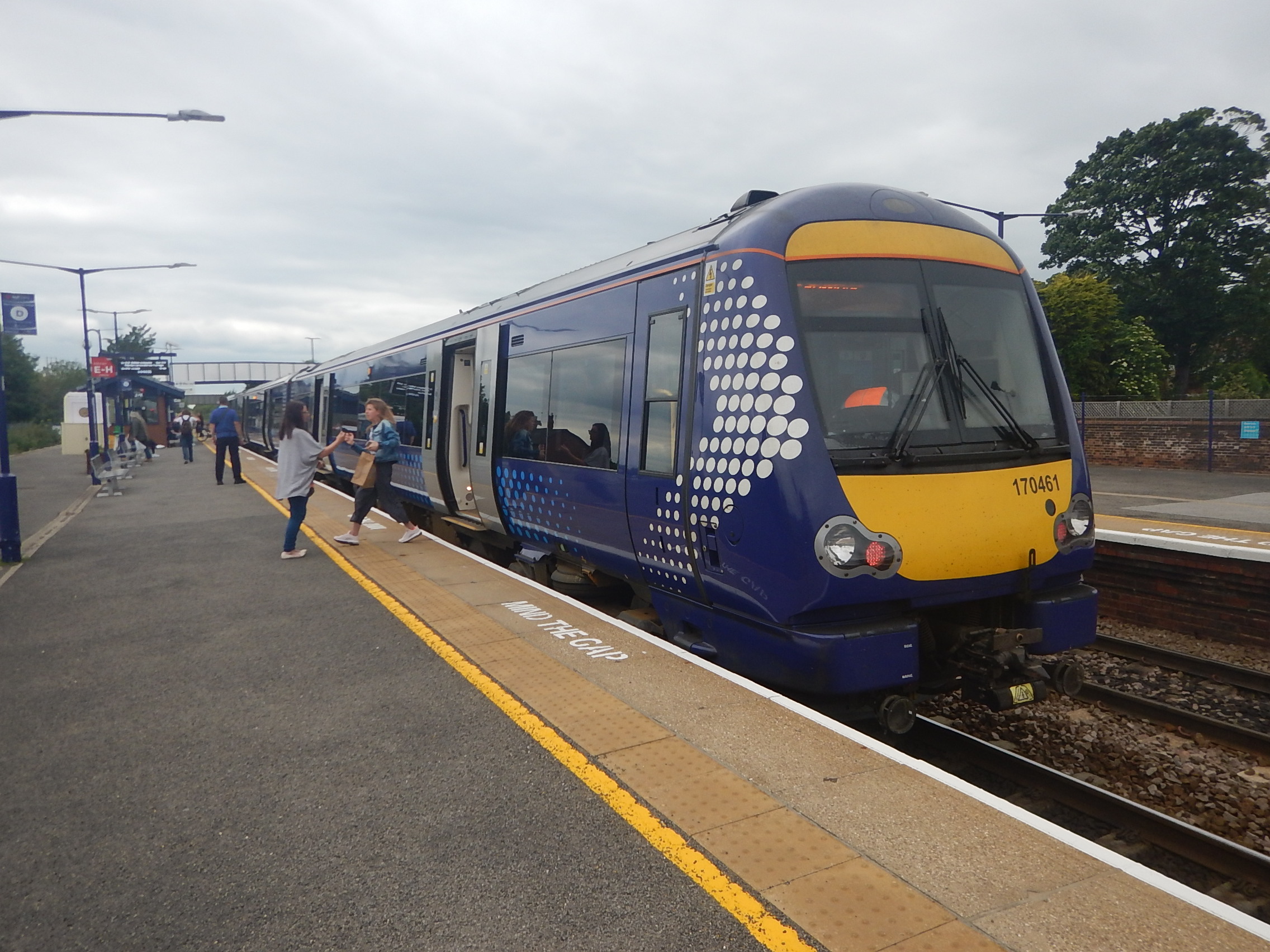
The picture shows a Class 170 train in ScotRail livery, at Brough station, working a service for Northern.
- They have a 100 mph top speed.
- They come in two, three or four car sets.
- They were built between 1996 and 2011.
- They have a comfortable interior and passengers only complain, when say a Class 170 train is replaced by a Class 156 or even older train.
- There are a total of 196 Turbostars in various classes.
This description from Wikip[edia, details their drive system.
Much of the design is derived from the Networker Turbo Class 165 and Class 166 trains built by British Rail Engineering Limited’s Holgate Road carriage works. Notable features shared are the aluminium alloy frame and two-speed Voith T211r hydrodynamic transmission system. The diesel engine has changed to an MTU 6R 183TD. A cardan shaft links the output of the gearbox to ZF final drives on the inner bogie of each vehicle. The engine and transmission are situated under the body; one bogie per car is powered, the other bogie unpowered.
It is simple system and well suited to replacement with the MTU Hybrid PowerPack.
As I said earlier, some Turbostars run over partially-electrified routes.
I also said that two of Southern’s routes are partially-electrified with the 750 VDC third-rail system, so could we see some examples making use of this to create a trimodal version.
On the other hand fitting a pantograph for 25 KVAC overhead electrification could be difficult. Although, all British Rail designs and their derivatives were usually designed, so they could work with every type of K electrification.
Class 165 And Class 166 Trains
The Class 165 and Class 166 trains are the predecessors of the Turbostars, and the later trains share a lot of their features.
As with all British Rail train designs, they have Japanese Knotweed in their DNA and engineers continuously find profitable ways of not sending them to the scrapyard. So they’ll be around for a few years yet!
The owner of these trains; Angel Trains has started a development project to create the Class 165 Hydrive train, which I wrote about in Class 165 Trains To Go Hybrid.
Will we see another hundred or so diesel hydraulic trains in good condition converted to more environmentally-friendly diesel hybrid trains?
Class 195 And Class 196 Trains
The Class 195 and Class 196 trains are still in the process of being built and judging by my first experience of Northern’s Class 195 train, that I wrote about in My First Ride In A Class 195 Train, they would benefit from the fitting of a quieter hybrid drive, like an MTU Hybrid PowerPack.
I suspect that any follow on orders for CAF’s diesel trains could well be built as diesel hybrids.
- The MTU Hybrid PowerPack could be used to replace the MTU engine and ZF Ecolife transmission.
- A battery-electric transmission, perhaps even using bogies and traction motors from the Class 331 train, could be developed.
Consider.
- Building the train around a hybrid transmission, will be probably no more difficult, than building one with a mechanical transmission.
- The train would create less noise and pollution.
- Hybrid trains would probably be more marketable to prospective purchasers. See Hybrid Selling.
As CAF are the only manufacturer of new diesel trains in the UK, I don’t think, they will be bothered.
Class 175 Trains
Transport for Wales have a fleet of eleven two-car and sixteen three-car Class 175 trains and they are scheduled to be replaced by a series of new trains starting in 2021.
I suspect the conversion to diesel hybrid will be possible, but even with a full interior refurbishment, will anybody have need for them, as there are already a lot of new 100 mph diesel trains on order, many of which could be delivered as diesel hybrids.
Class 180 Trains
There are fourteen five-car Class 180 trains.
They are 125 mph trains.
- Ten trains are used by Grand Central, who seem to have no announced plan to replace them.
- Four trains are used by Hull Trains and they will be replaced this year by new Class 802 trains.
The fact that Hull Trains are replacing their Class 180 trains with new Class 802 trains, probably says a lot about the limitations of Class 180 trains.
Conclusion
We will be seeing a lot of hybrid trains, made by updating diesel-mechanichal and diesel-hydraulic trains.
The Mathematics Of Fast-Charging Battery Trains Using Third-Rail Electrification
In Vivarail Unveils Fast Charging System For Class 230 Battery Trains, I talked about how Vivarail are proposing to fast-charge their Class 230 trains.
- The trains are fitted with special high-capacity third rail shoes.
- Third-rail electrification is laid in stations.
- The third rail is powered by a bank of bstteries, that are trickle-charged from the mains or perhaps even solar power.
- When the train connects to the rail, the rail is made live and a fast transfer takes place between third-rail and train.
So how much electricity could be passed to a train during a stop?
The most powerful locomotive in the UK, that can use 750 VDC third-rail electrification is a Class 92 locomotive.
According to Wikipedia, it can produce a power output of 4 MW or 4,000 kW, when working on third-rail electrification.
This means, that in an hour, four thousand kWh will be transferred to the train using conventional third-rail electrification.
Or in a minute 66.7 kWh can be transferred.
In Vivarail’s system, because they are transferring energy between batteries, enormous currents can be passed.
To illustrate how batteries can can deliver enormous currents here’s a video of a guy using two car batteries to weld things together.
These currents are possible because batteries have a low impedance and when the battery on the train is connected to the battery bank on the station, the two batteries will equalise their power.
If we take the example of the Class 92 locomotive and conventional electrification, this would be able to transfer 200 kWh in three minutes or 400 kWh in six minutes.
But I believe that battery-to-battery transfers could be at a much higher current
Thus in a typical one or two minute stop in a station, upwards of 200 kWh could be transferred to the train.
On this page of their web-site, Vivarail say this.
Due to the high currents required for the train Vivarail uses a carbon ceramic shoe able to withstand the heat generated in the process – without this shoe the charge time would make operational running unfeasible.
The devil is always in the details! From what I’ve seen and heard about the company, that would fit!
Class 710 Train Roofs At Blackhorse Road Station
I took these pictures at Blackhorse Road station.






I couldn’t spot any resistor banks on the roofs, that could be used to burn off excess energy, that is generated by regenerative braking.
Consider.
- The roofs do have a rather clean aerodynamic look.
- I’ve never seen resistor banks placed anywhere other than on the roof of a train.
- Regenerative braking must either return the energy through the electrification or store in in some form of onboard energy storage.
It looks to me, that Bombardier have designed a very efficient train.
 The Anonymous Widower