UK Wind Risks ‘Exponentially Rising’ Curtailment Without Energy Storage
The title of this post, is the same as that of this article on Recharge.
This is the sub-heading.
UK liquid battery pioneer Highview Power is working with renewable energy giant Orsted on plan to store excess power from its Hornsea offshore wind projects
This is the introductory paragraph.
The UK wind sector faces “exponentially” increasing curtailment of assets without a rapid rollout of energy storage, says the chief of liquid battery pioneer Highview Power, which is working with Orsted on a project to store excess offshore wind power.
The article also states that according to Octopus Energy, this cost could have been as high as a billion pounds last year.
In Grid Powers Up With One Of Europe’s Biggest Battery Storage Sites, I described how Ørsted were planning to build a large BESS near the Swardeston substation in Norfolk, where the Hornsea 3 wind farm will connect to the grid.
Have Ørsted decided to put a Highview Power battery on the Swardeston site, as it can be a bigger battery, as Highview Power talk about 200MW/2.5GWh capacity batteries on the projects page of the web site?
Highview also say this about co-operation with Ørsted on that page.
Highview Power and Ørsted’s joint study shows that the co-location of LAES with Ørsted’s offshore wind offers a step forward in reducing wind curtailment, and helping to move to a more flexible, resilient zero carbon grid.
The words are accompanied by pictures of a smart gas storage site, which shows four of the largest tanks, that might be used to store LNG.
In Could A Highview Power CRYOBattery Use A LNG Tank For Liquid Air Storage?, I estimated that one of the largest LNG tanks could hold about a GWh of energy.
So Highview Power’s visualisation on their project page would be a 4 GWh battery.
.
Centrica And Coterra Energy Announce Natural Gas Sale And Purchase Agreements
The title of this post, is the same as that of this news item from Centrica.
These three bullet points, act as sub-headings.
- Coterra will supply 100,000 MMbtu/d of natural gas for a period of 10 years, commencing in 2028.
- Volume supplied sufficient to heat 400,000 homes per year.
- Agreement expands Centrica’s growing LNG business.
These three paragraphs say more about the deal and add more on its context.
Centrica LNG and Coterra today announced the execution of two natural gas sale and purchase agreements. Under the contracts, Coterra will supply 100,000 MMbtu/d of natural gas linked to European gas prices such as TTF and NBP, for a period of 10 years, commencing in 2028.
This major gas deal will reduce the market risk in Centrica’s LNG portfolio by purchasing US gas on the same price indices under which the LNG is subsequently sold, and help underpin customer energy supplies for a decade. The volume supplied is sufficient to heat 400,000 homes per year, further cementing Centrica’s global role supporting energy security.
The deal follows similar agreements over recent years, demonstrating Centrica Energy’s innovative partnership approach, one of the key pillars of its successful and growing LNG business.
It certainly looks like Centrica are doing their best for UK energy security.
It also looks to me, that it is a low risk deal.
It should also help to keep us all warm in the UK, until renewable electricity and hydrogen come fully on stream.
Energy Security Boost After Centrica And Repsol Agree LNG Supply Deal
The title of this post, is the same as that of this press release from Centrica.
This is the sub-heading.
Centrica Energy and Repsol today announced the signing of a deal that will improve the UK’s energy security in the coming years.
These two paragraphs give more details of the deal.
The deal will see Centrica purchase 1 million tonnes of Liquified Natural Gas (LNG) shipments between 2025 and 2027. All of these cargoes are expected to be delivered to the Grain LNG import terminal in Kent.
The deal marks an additional move by Centrica to build further resilience in the UK’s energy security. It follows a 15 year, $8bn deal with Delfin Midstream in July 2023, a three-year supply agreement with Equinor that will heat 4.5m UK homes through to 2024 and the reopening and expansion of the Rough gas storage facility in October 2022 and June 2023 respectively. Rough now provides half of the UK’s total gas storage capacity with the potential to store over 50 billion cubic feet (bcf) of gas, enough to heat almost 10% of UK homes throughout winter.
Centrica do seem to be keeping us supplied with gas.
Two days ago, National Grid published this press release, which is entitled Grain LNG Signs New Deal With Venture Global Further Strengthening The Security Of Supply Of LNG To The United Kingdom.
This is the sub-heading.
Today (5 February), Grain LNG and Venture Global have announced the execution of a binding long-term terminal use agreement (TUA) enabling the regasification and sale of LNG from all of Venture Global’s LNG terminals in Louisiana, including CP2 LNG, subject to obtaining necessary federal permits.
These two paragraphs give more details of the deal.
Under the agreement, Venture Global will have the ability to access 3 million tonnes per annum (3MTPA) of LNG storage and regasification capacity at the Isle of Grain LNG receiving terminal for sixteen years beginning in 2029, equivalent of up to 5% of average UK gas demand.
This is the second agreement from Grain LNG’s competitive auction process which was launched in September 2023. The successful outcome of the auction further secures the future of Europe’s largest LNG import terminal into the mid 2040s.
Two big deals in the same week is not to be sneezed at and must be good for the UK’s energy security.
Grain LNG
The Grain LNG web site, greets you with this message.
Welcome To Europe’s Largest Liquified Natural Gas Terminal, Grain LNG
Grain LNG is the gateway connecting worldwide LNG to the European energy market, making a genuine difference to people’s lives. Find out all about our cutting-edge operations – showcasing our leadership in powering the future – and why Grain LNG is at the forefront of energy as we move towards net zero.
There is also a video.
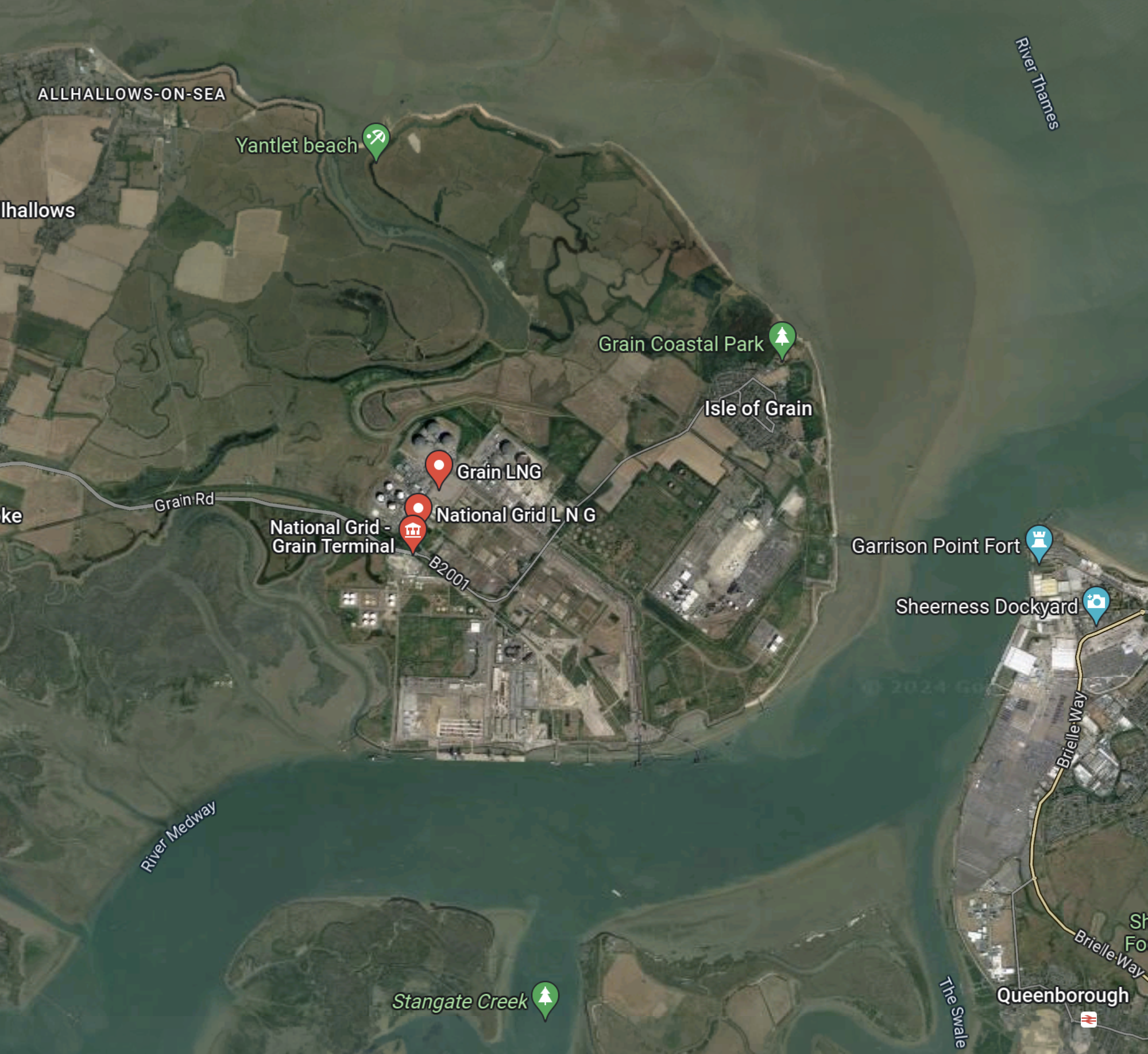
This Google Map shows the location of Grain LNG on the Isle of Grain.
Note.
- The River Medway flows into the River Thames between the Isle of Grain on the left and the Isle of Sheppey on the right.
- From South to North, the red arrows indicate, the National Grid – Grain Terminal, National Grid L N G and Grain LNG.
There would appear to be space for expansion.
Fresh Air Fuels Global
Because of its history, South Africa has developed technology to create biofuels, as alternatives to diesel.
If you read the Wikipedia entry for South African chemical company; SASOL, you’ll see the things that South African chemists did, to get round the sanctions imposed because of apartheid.
SASOL has advanced the Fischer–Tropsch process and uses it to produce diesel and other fossil fuels.
Note that Velocys have also developed this process to make sustainable aviation fuel in the UK.
Fresh Air Fuels Global have a page on the G-volution web site.
The page is dominated by an infographic, which shows organic waste (animals and plants) going into an anaerobic digester, which produces.
- Biogas, which is used to create heat, electricity, CO2, biomethane, fuel and gas for the grid.
- Digestate, which is used for fertiliser and livestock bedding.
It almost sounds too good to be true.
This is the mission statement below the graphic.
Our mission: To be the most reliable producer of energy secure low carbon fuels.
There is then these paragraphs, which explain the relationship between G-volution and Fresh Air Fuels Global.
Global energy security concerns and climate targets necessitate countries and businesses to transition away from high-cost fossil fuels towards low-carbon alternatives.
Over more than a decade, Cape Advance Engineering South Africa (CAE) have been developing an incredibly cost-effective Anaerobic Digestion (AD) technology, which has proven to generate renewable energy from organic waste in the form of gas, heat and electricity that is cost competitive with fossil fuels.
G-Volution has partnered with CAE to form Fresh Air Fuels Global (FAFG), with aim of introducing the CAE technology to international markets that the G-Volution already have a foothold, constructing AD plants and creating carbon neutral biofuel from waste that can be used in dual fuel engines.
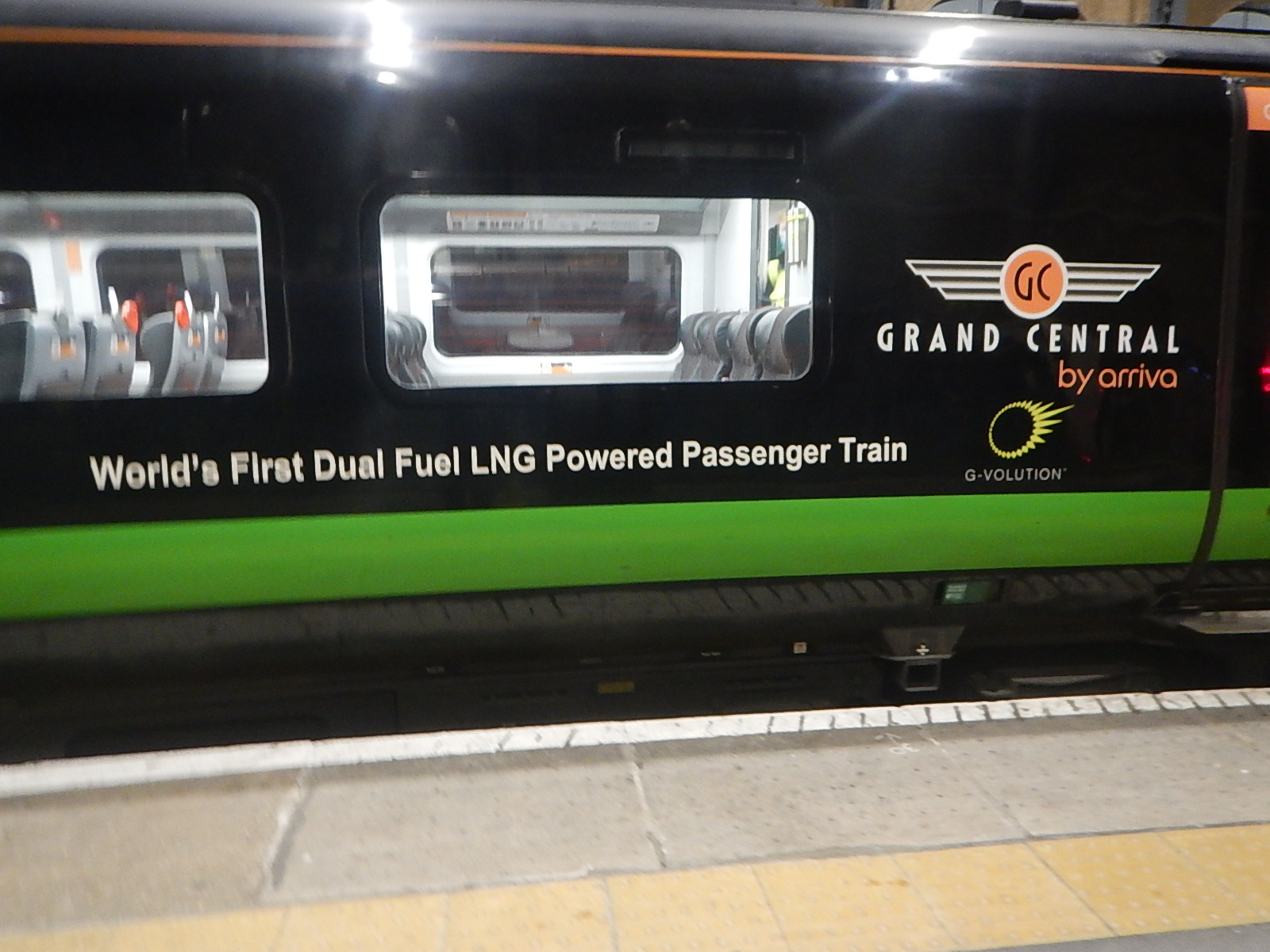
In Grand Central DMU To Be Used For Dual-Fuel Trial, I describe how G-volution’s dual fuel technology has been applied to one of Grand Central’s Class 180 train.
This picture I took after travelling in a Grand Central Class 180 train, shows that G-volution don’t hide their light under a bushel.
Note.
- This train appears to run on diesel and liquified natural gas.
- This G-volution video gives more details.
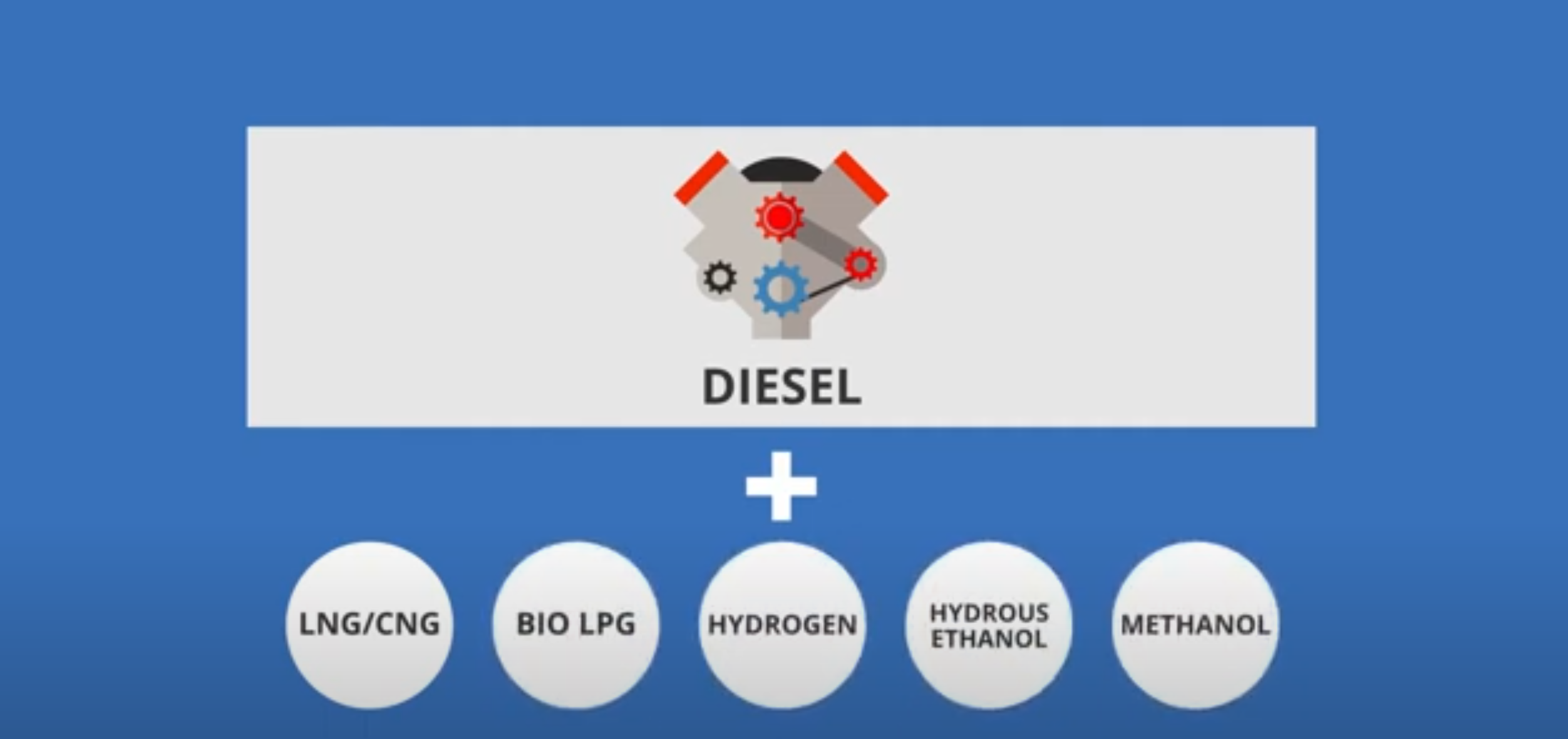
This clip from the video, shows the possible fuels.
Note.
- Can the dual fuel engine use biodiesel or HVO instead of diesel?
- It looks like the Fresh Air Fuels Global process can produce biomethane, which could be liquified as LNG.
- Hydrogen is the only true zero-carbon secondary fuel.
- There is a Wikipedia entry for ethanol fuel.
- Hydrous ethanol is about 95% ethanol and 5% water and is used as a fuel in Brazil in petrol cars.
- There is a Wikipedia entry for the use of methanol as fuel.
Have G-volution got access to the technology to both reduce the fuel consumption of diesel engines and run them on zero-carbon fuel?
UK Trains That Have Cummins QSK-19 R Diesel Engines
Grand Central’s Class 180 trains have a Cummins QSK-19 R diesel engine.
All these trains have the same engine.
- 14 – Class 180 trains
- 51 – Class 185 trains
- 34 – Class 220 trains
- 44 – Class 221 trains
- 27 – Class 222 trains
In addition, Class 175 trains have a different engine made by Cummins.
Conclusion
If G-volution’s technology can be made to work successfully, it could play a large part in the decarbonisation of UK passenger trains.
Grain LNG Launches Market Consultation For Existing Capacity
The title of this post is the same as that of this press release from National Grid.
This is the sub-heading.
Grain LNG, the largest liquefied natural gas (LNG) terminal in Europe, is pleased to announce the launch of a market consultation for the auction of 375 Gwh/d (approx. 9 mtpa) of existing capacity. The initial consultation phase for the Auction of Existing Capacity will commence on 14 June and run until 26 July.
These paragraphs detail what Grain LNG, which is a subsidiary of National Grid are offering.
GLNG has used the positive feedback received from the recent ‘Expression of Interest’ exercise and subsequent market engagement to offer three lots of capacity:
- Each lot will be entitled to 42 berthing slots, 200,000 m3 of storage and 125GWh/d (approx. 3 mtpa) of regasification capacity from as early as January 2029.
- This product is specifically designed for parties who wish to acquire a substantial stake in a major terminal in Northwest Europe, at a reduced cost and with shorter contract lengths when compared to new-build projects.
- As the terminal’s capacity already exists, parties involved will not be subjected to the FID approvals or potential delays that can arise from construction issues commonly associated with new build terminals.
Simon Culkin, Importation Terminal Manager at Grain LNG, said: “We are really pleased with the high level of interest shown by the market at a time of significant geo-political influence on our energy markets. It has allowed us to engage with potential customers and shape our offering to best meet their needs, whilst optimising access to this strategic asset. “
Reading the Wikipedia entry for the Grain LNG Terminal, it looks like it gets used as a handy store for natural gas.
About Phase 1 (2002–05), Wikipedia says this.
The new facilities enabled the Grain terminal to become a base supply to the NTS, with the ability to deliver gas continuously when required. The cost of the Phase 1 project was £130m. A 20-year contract with BP / Sonatrach enabled Grain LNG to import LNG on a long-term basis from July 2005.
About Phase 2 (2005–08), Wikipedia says this.
The development provided an additional five million tonnes of capacity per annum. All this capacity was contracted out from December 2010. Customers included BP, Iberdrola, Sonatrach, Centrica, E.ON and GDF Suez.
Under Current Facilities, Wikipedia says this.
Grain LNG Ltd does not own the LNG or the gas that it handles but charges for gasifying it. Current (2016) users include BP, Centrica (British Gas Trading), Iberdrola (Spain), Sonatrach (Algeria), Engie (France), and Uniper (Germany).
National Grid must be pleased that some customers seem loyal.
I feel that National Grid’s basic plan is to carry on with more of the same.
But will they develop more storage and other facilities on the site.
There are certainly other projects and interconnectors, that make the Isle of Grain and energy hub connecting the UK, Netherlands and Germany.
- In Did I See The UK’s Hydrogen-Powered Future In Hull Today?, I mentioned, that I thought that the Isle of Grain could be a location for an electrolyser and a hydrogen store.
- In EuroLink, Nautilus And Sea Link, I talk about new interconnectors, if which Nautilus might come to the Isle of Grain.
- In UK-German Energy Link Reaches Financial Close, I talk about NeuConnect, which will be an interconnector between the Isle of Grain ans Wilhelmshaven in Germany.
- The Isle of Grain is the landing point for the BritNed undersea power cable between The Netherlands and the UK.
I could also see National Grid building an East Coast interconnector to bring power from the wind farms off the East Coast of England to the Isle of Grain for distribution.
These are major wind farms South of the Humber.
- Dudgeon – 402 MW
- East Anglia 1 – 714 MW
- East Anglia 1 North – 800 MW
- East Anglia 2 – 900 MW
- Galloper – 504 MW – RWE
- Greater Gabbard – 504 MW
- Gunfleet Sands – 174 MW
- Hornsea 1 – 1218 MW
- Hornsea 2 – 1386 MW
- Hornsea 3 – 2852 MW
- Humber Gateway – 219 MW
- Lincs – 270 MW
- London Array – 630 MW
- Lynn and Inner Dowsing – 194 MW
- Race Bank – 580 MW
- Scroby Sands – 60 MW
- Sheringham Shoal – 317 MW
- Triton Knoll – 857 MW – RWE
- Dogger Bank A – 1235 MW
- Dogger Bank B – 1235 MW
- Dogger Bank C – 1218 MW
- Dogger Bank D – 1320 MW
- Dogger Bank South – 3000 MW RWE
- East Anglia 3 – 1372 MW
- Norfolk Boreas – 1396 MW
- Norfolk Vanguard – 1800 MW
- Outer Dowsing – 1500 MW
- North Falls – 504 MW – RWE
- Sheringham Shoal and Dudgeon Extensions – 719 MW
- Five Estuaries – 353 MW – RWE
Note.
- These figures give a total capacity of 28,333 MW.
- Five wind farms marked RWE are owned by that company.
- These five wind farms have a total capacity of 5618 MW.
- Will RWE export, their electricity to Germany through NeuConnect?
I can certainly see National Grid building one of the world’s largest electrolysers and some energy storage on the Isle of Grain, if an East Coast Interconnector is built.
Wabtec Signs $600M MoU With Kazakhstan Railway Company
The title of this post, is the same as that of this article on Seeking Alpha.
This is the introductory paragraph.
Wabtec announced Tuesday signing of a $600M memorandum of understanding with Kazakhstan Temir Zholy for 150 FLXdriveTM battery-electric shunters and modernization work to transform the mainline fleet into NextFuelTM liquid natural gas-powered (LNG) locomotives.
Note.
- It is for 150 shunting locomotives, which is not a small number.
- A lot of the work will be done in Kazakhstan.
- Wabtec certainly seem to be getting their FLXdrive technology about.
- Obviously LNG locomotives must be a good route to reduce carbon emissions for diesel locomotives.
- The Kazahks seem pleased with the deal for economic and decarbonisation reasons.
But what surprises me about this deal, is that it has not gone to Russia. Does this say something about Putin’s lack of friends.
Have We Enough LNG Carriers To Distribute The Natural Gas We Need?
I recently, asked this question of myself, as liquefied natural gas (LNG), now seems to be being moved all over the world.
Note, that the we in the title of this post, is a global we!
I stated by reading the Wikipedia entry for LNG Carrier.
This paragraph outlines the history of LNG carriers.
The first LNG carrier Methane Pioneer (5,034 DWT), classed by Bureau Veritas, left the Calcasieu River on the Louisiana Gulf coast on 25 January 1959. Carrying the world’s first ocean cargo of LNG, it sailed to the UK where the cargo was delivered. Subsequent expansion of that trade has brought on a large expansion of the fleet to today where giant LNG ships carrying up to 266,000 m3 (9,400,000 cu ft) are sailing worldwide.
The Methane Pioneer carried only 27,000 m3 of LNG.
Things have come a long way since the Methane Pioneer.
This is said in the Wikipedia entry for LNG Carrier.
According to SIGTTO data, in 2019 there were 154 LNG carriers on order, and 584 operating LNG carriers.
I don’t think capacity is a problem.
The Wikipedia entry also talks in detail about Cargo Handling and a Typical Cargo Cycle.
It is a very worthwhile read.
Could A Highview Power CRYOBattery Use A LNG Tank For Liquid Air Storage?
This Google Map shows a 3D image of liquified natural gas (LNG) tanks at South Hook LNG Terminal near Milford Haven.
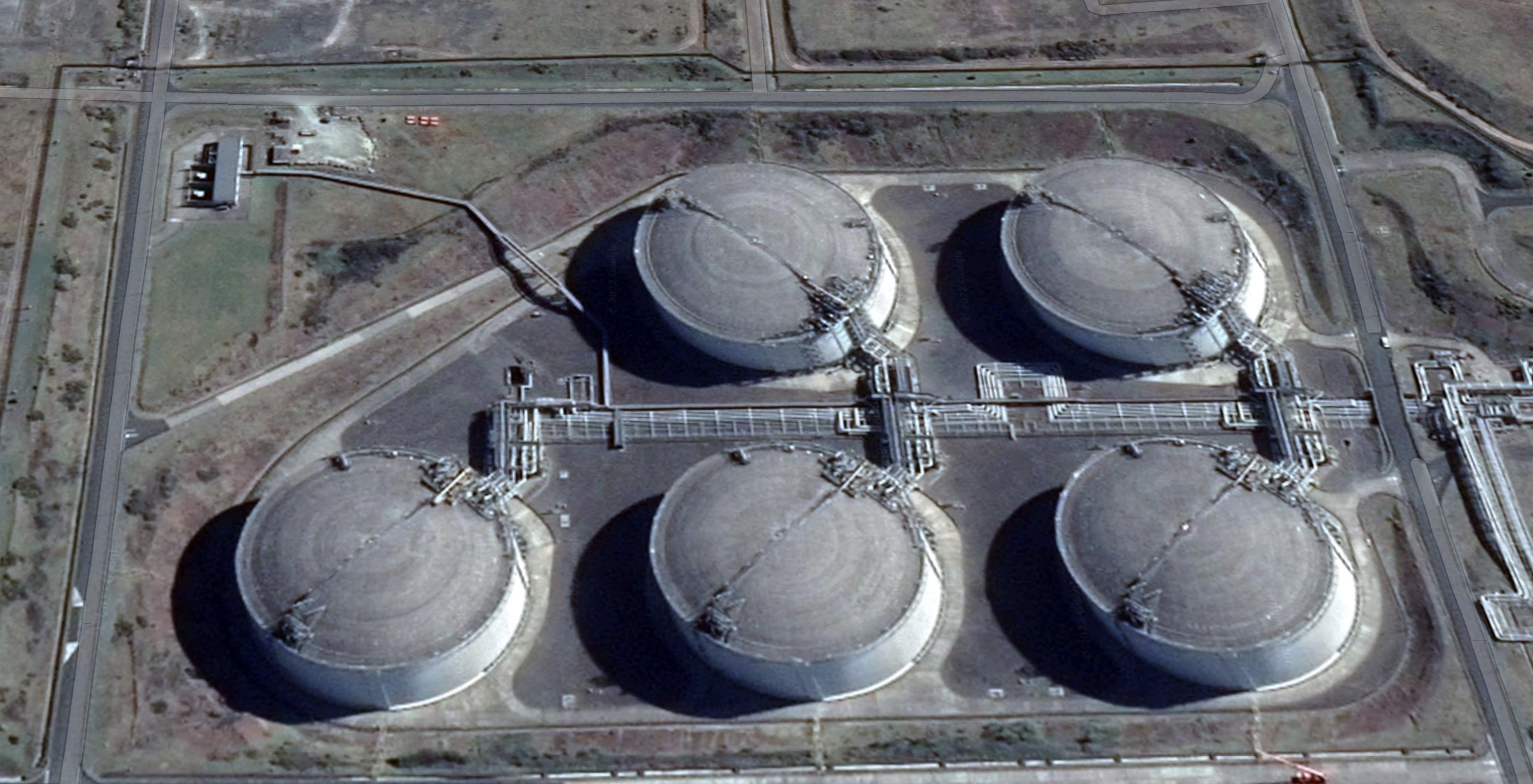
Note that images of these tanks under construction on the Internet, show that there is an underground portion of the tanks.
This page on the CIMC-ENRIC web site is entitled Successful Delivery Of 5,000M3 LNG Single Containment Tank Project. The page shows the design of the LNG tank.
As the density of liquid air is 870 kg/m3, a 5,000 cubic metre tank would contain 4,350 tonnes of liquid air at −194.35 °C and atmospheric pressure.
How much energy would be needed to create 4,350 tonnes of liquid air?
In this document, this is said about compressing natural gas with an electric drive.
It is the most-energy efficient technology with 230 kWh per ton of LNG.
As air and natural gas have molecules of similar weight, would 230 kWh per tonne be applicable to liquid air.
If it is, then around a GWh of electricity will be needed to create the liquid air.
This Wikipedia entry is entitled Cryogenic Energy Storage and describes Highview Power’s CRYOBattery.
This section describes the operation of the CRYOBattery.
When it is cheaper (usually at night), electricity is used to cool air from the atmosphere to -195 °C using the Claude Cycle to the point where it liquefies. The liquid air, which takes up one-thousandth of the volume of the gas, can be kept for a long time in a large vacuum flask at atmospheric pressure. At times of high demand for electricity, the liquid air is pumped at high pressure into a heat exchanger, which acts as a boiler. Air from the atmosphere at ambient temperature, or hot water from an industrial heat source, is used to heat the liquid and turn it back into a gas. The massive increase in volume and pressure from this is used to drive a turbine to generate electricity.
Note.
- The Claude cycle is described in this Wikipedia entry.
- The liquid air takes up one-thousandth of the volume of the gas.
- Wikipedia suggests that Highview claim the process has a round trip efficiency of 70 %.
Having done calculations in the past with chemical reactions in a series of large vessels, the dynamics can be strange and I wouldn’t be surprised that as Highview learn more about the process and add more and better ways of recycling heat and coolth, efficiencies will improve.
Certainly, in the process I mathematically-modelled in the 1970s, when I worked for ICI, I remember that one large reaction vessel performed better than four or five smaller ones with the same total volume.
Hence my thought that perhaps one large containment tank could be the most efficient design.
I also think, that the design of LNG tanks must have improved significantly over the last few years, as the transport of LNG has increased in importance.
Shell’s Jackdaw Gas Field Given Go-Ahead By Regulators
The title of this post, is the same as that of this article on the BBC.
These are the first two paragraphs.
Development of a major North Sea gas field has been approved by regulators.
The Jackdaw field, east of Aberdeen, has the potential to produce 6.5% of Britain’s gas output.
This is Greenpeace’s response
But environmental campaigners have condemned the move.
The activist group Greenpeace said it believed the approval could be unlawful and it was considering legal action.
“Approving Jackdaw is a desperate and destructive decision from Johnson’s government, and proves there is no long-term plan,” said Ami McCarthy, a political campaigner for Greenpeace.
I have my thoughts.
The Short Term Problem
We are all paying the high gas price, brought about by Vlad the Mad’s illegal invasion of Ukraine.
On the other hand, I am all for cutting carbon emissions, but stopping the development of the Jackdaw gas field will do nothing to cut total emissions in the short term.
In my view, the only way to cut carbon emissions is to replace the use of natural gas with hydrogen or electricity produced by renewable sources like solar, tidal, wave or wind power.
This change to every heating system and important industries like cement, chemicals, glass and steelmaking to hydrogen and renewable energy is not a short term or low-cost project. Especially whilst we’re still recovering from the pandemic and trying to handle Vlad the Mad.
We will need a supply of natural gas for a few years and if we don’t have enough gas will Greenpeace and their ilk, be happy to see everybody freezing and a large increase in unemployment?
The Government is between a rock and a hard place, where they can either bow to Greenpeace or buy Putin’s bloodstained gas, where there are two alternatives.
- Buy liquified natural gas (LNG) from countries like Australia, Canada, Qatar or the United States.
- Develop our own proven resources.
The advantages of taking the second route include.
- Some of the countries from where gas is available, have bizarre views on human rights and keeping their people safe.
- Gas is transported over long distances in a liquid form. Liquifying natural gas uses a lot of energy. Is that energy renewable?
- Countries from where gas is available are thousands of miles away. How much carbon dioxide will be emitted liquifying and transporting it?
- Gas from our own resources is delivered by pipeline.
- Development of gas fields like Jackdaw, will surely create employment in the UK.
At a first look, I feel that developing Jackdaw and other similar fields, may well be a sensible option to help us through these difficult times.
Exporting Gas To Europe
If you look at the geographical position, you would feel, that the gas will be landed at St. Fergus gas terminal, which is to the North of Aberdeen.
But no! The gas will be landed at Bacton in Norfolk through the SEAL pipeline, which is 475 km. long
Could this be because Shell want to make sure the South of England gets its gas?
Possibly, but much of the UK’s gas imports arrive at LNG terminals in the South.
But Bacton has other assets, in that it has two undersea gas pipelines to the Continent. One is to Belgium and the other is to the Netherlands.
Surely, if we export our gas to other countries, then it is their business what they do with the carbon dioxide.
Not our’s or Shell’s!
Perhaps, we should develop other proven gas fields, as they will create employment in the UK and valuable exports. It will also help our friends out in Europe, in their time of need!
Will Shell Play The Market?
I have just been informed, that recently, improvements have been made to the pipelines in the area and Jackdaw’s gas could now go to St. Fergus.
This surely would give the gas from Jackdaw three destinations.
- Scotland via St. Fergus.
- England via Bacton
- Europe via Bacton and the undersea pipelines.
So will Shell play the markets?
If in the future, we start to produce massive amounts of green hydrogen, I’m sure Europe, will be happy to buy that instead.
Powering Platforms With Renewable Energy
The BBC article says this.
And it plans also to re-power its offshore platforms with renewable electricity rather than burning gas.
Looking at the map, Jackdaw will not be far from the 2 GW wind farm, that Shell are developing.
Will they build a short interconnector from this wind farm to the gas platforms of Jackdaw and other nearby fields?
Will Shell Produce Hydrogen Offshore?
This article on Gas Processing And LNG is entitled Construction Of World’s Largest PEM Electrolyzer Completed.
This is the first two paragraphs.
Air Liquide has completed the construction of the world’s largest PEM (Proton Exchange Membrane) electrolyzer. Supplied with renewable energy, this unit is now producing up to 8.2 tons per day of low-carbon hydrogen in Bécancour, Québec. With this large-scale investment, the Group confirms its long-term commitment to the hydrogen energy markets and its ambition to be a major player in the supply of low-carbon hydrogen.
The new 20 MW PEM electrolyser, equipped with Cummins technology, is the largest operating unit of its kind in the world and will help meet the growing demand for low-carbon hydrogen in North America. Bécancour’s proximity to the main industrial markets in Canada and the United States will help ensure their supply of low-carbon hydrogen for industrial use and mobility. The commissioning of this electrolysis unit increases by 50% the capacity of Air Liquide’s Bécancour hydrogen production complex.
Note.
- This article is about a year old and electrolysers will get larger.
- 20 MW of electricity will produce 8.2 tons per day of low carbon or green hydrogen.
- It may surprise some, that the electrolyser has been built by Cummins, who are diesel engine manufacturers. They are a company, who appear to have seen the way the wind is blowing and are making sure they lead the revolution.
How much hydrogen could a 2 GW wind farm produce?
- Wind farms have a capacity factor, which is how much energy they actually produce compared to their rating.
- Shell’s 2 GW wind farm will be a floating wind farm and these typically have a capacity factor of at least 50 percent.
- I will assume the capacity factor of 50 percent.
This will give 8,200 tonnes per day of green hydrogen. This is nearly three million tons per year.
How Will The Hydrogen Be Brought Ashore?
The HyDeploy project is investigating blending of hydrogen into our natural gas grid.
- It appears that up to 25 % of hydrogen can be added without the need to change boilers and appliances.
- This blending of hydrogen into our natural gas supply, would cut our carbon emissions by a worthwhile amount.
So will we see gas piped to nearby gas platforms like Jackdaw for blending with fresh virgin natural gas?
This would have the following advantages for Shell.
- They wouldn’t need to install an electric cable to the shore with all its associated onshore and offshore substations.
- The hydrogen could be brought ashore at either Bacton or St. Fergus gas terminals.
- Shell could invite other local wind farms to share their electrolyser.
- Shell would need to new onshore installations.
If Shell get this right, they could cut the project cost.
Will Shell Produce Blue Hydrogen Offshore?
I wonder if Shell have a cunning plan.
- It is known, that Shell have developed a catalyst-based blue hydrogen process, which splits natural gas into hydrogen and carbon dioxide, with the addition of oxygen from the air.
- I suspect the process could need a lot of energy to work. But at least a GW from the nearby wind farm will probably be a good start.
- Could that carbon dioxide be captured and stored in a depleted gas field.
- The hydrogen could be piped to either Bacton or St. Fergus, as I previously described.
This hybrid method might be a more economic way to produce zero-carbon hydrogen.
Conclusion
I wouldn’t be surprised if Shell will produce hydrogen offshore.
UK Energy Exports To Europe At Record High
The title of this post, is the same as that of this article on The Times.
This is the first two paragraphs.
Britain has exported record amounts of gas to Europe so far this year as its liquefied natural gas terminals receive shipments destined for the Continent.
Electricity exports also have surged to unprecedented highs in recent weeks after an unexpected glut of gas pushed down short-term gas prices and resulted in gas-fired power plants generating more for export.
Who’d have thought it, that all those gas pipelines and electricity interconnectors between the UK and the Continent of Europe would be part of the replacementliqui for Russian gas.
According to Wikipedia, we have three liquified natural gas terminals; two at Milford Haven; South Hook and Dragon, and Grain on the Isle of Grain.
Note.
- South Hook is Europe’s largest liquified natural gas terminal and is owned by a partnership of the Qataris, ExxonMobil and Elf.
- South Hook and Dragon together can provide 25 % of the UK’s natural gas needs.
- Grain is owned by National Grid and according to Wikipedia, is in terms of storage capacity it is the largest LNG facility in Europe and the eighth largest in the world.
- Grain can supply 20 % of the UK’s natural gas needs.
- Grain has a reloading facility, so that gas can be exported.
- Grain seems to be continually expanding.
- Both Milford Haven and the Isle of Grain have large gas-fired power-stations.
Politicians say we don’t have enough gas storage, but we do seem to have world-class LNG terminals.
I have a couple of extra thoughts.
Blending Natural Gas With Hydrogen
HyDeploy is a project investigated blending hydrogen natural gas to cut carbon emissions. The project is described in this post called HyDeploy.
Surely, these terminals could be places, where hydrogen is blended with our natural gas supply.
- The terminals are connected to the UK gas network.
- Both Milford Haven and the Isle of Grain should have access to large amounts of offshore wind energy in the next few years, which could be used to generate green hydrogen.
- The terminals would need electrolysers to generate the hydrogen.
The Isle of Grain already has a blending capability.
NeuConnect
NeuConnect is an under-development interconnector between the Isle of Grain in Kent and Wilhelmshaven in Germany.
- It will have a capacity 1.4 GW.
- All the planning permissions seem to be in place.
- Prysmian have won a € 1.2 million contract to deliver the interconnector.
- Arup and German engineering firm Fichtner have formed a joint venture to provide project services for the interconnector.
- Construction could start this year.
It looks like the Germans will be replacing some of Putin’s bloodstained gas with clean zero-carbon energy from the UK.
Should We Develop More Gas Fields?
There are some gas fields in the seas around the UK, like Jackdaw, that could be developed.
Suppose, we extracted the gas and sent it to the reloading terminal on the Isle of Grain through the gas transmission network, where it could be exported by ship, to the Continent.
The UK would not be increasing its carbon emissions, as that would surely be the responsibility of the end-user.
Should We Develop More Gas Fired Power-Stations?
I believe it is possible to develop carbon-capture technology for gas-fired power stations.
The carbon dioxide would be either used in a beneficial way or stored in perhaps a worked-out gas field under the North Sea.
So long as no carbon dioxide is released into the atmosphere, I don’t see why more gas-fired power stations shouldn’t be developed.
What is happening at Keadby near Scunthorpe would appear to be one model for zero-carbon power generation.
Keadby Power Station
This is an existing
Conclusion
We will be exporting more energy to the Continent.
 The Anonymous Widower