Could Sheffield Station Become A Battery-Electric Train Hub?
Promised Improvements To Train Services At Sheffield
This news story from the Department of Transport is entitled Yorkshire And The Humber To Benefit From £19.8 billion Transport Investment.
Sheffield station gets several mentions of improvement to these routes.
Sheffield And Hull
This is said about train services between Sheffield and Hull.
The number of trains between Hull and Sheffield will be doubled, to 2 per hour, with capacity also doubled.
These points describe typical current services.
- The route is 59.4 miles long.
- Modern Class 170 trains take 78 minutes.
- There are stops at Meadowhall, Doncaster, Goole and Brough.
- The maximum speed of the line is mostly around 70 mph, with one short section of 100 mph.
- The average speed is 45.7 mph.
- The train continues to Scarborough after a six-minute stop at Hull.
I believe that if this route were to be electrified, that a time around an hour would be possible between Sheffield and Hull.
Sheffield and Scarborough takes two hours and 45 minutes. With electrification, this time could be less than two hours and 30 minutes.
But it would be around 113 miles of new double-track electrification.
I believe that Sheffield and Hull is a route that could be run by battery-electric trains, that would be charged at both ends of the route.
Sheffield And Leeds
This is said about train services between Sheffield and Leeds.
The line between Sheffield and Leeds will be electrified and upgraded, giving passengers a choice of 3 to 4 fast trains an hour, instead of 1, with journey times of 40 minutes. A new mainline station for Rotherham will also be added to the route, which could give the town its first direct service to London since the 1980s, boosting capacity by 300%.
These points describe typical current services.
- The route is 41.1 miles long.
- Modern Class 195 trains take 56 minutes.
- There is a few miles of electrification at the Leeds end.
- There are stops at Meadowhall, Barnsley and Wakefield Kirkgate.
- The maximum speed of the line is mostly around 60-70 mph.
- The average speed is 44 mph.
I believe that if this route were to be electrified, that a time around fifty minutes might be possible between Sheffield and Leeds.
That is not really good enough, but if they went through a new mainline station for Rotherham, the trains would be able to use 100 mph tracks all the way to Leeds. There would also be electrification between South Kirby junction and Leeds.
I suspect forty minutes should be possible with 100 mph running between Rotherham and Leeds.
I believe that Sheffield and Leeds is a route that could be run by battery-electric trains, that would be charged at both ends of the route.
Sheffield And Manchester
This is said about train services between Sheffield and Manchester.
The Hope Valley Line between Manchester and Sheffield will also be electrified and upgraded, with the aim of cutting journey times from 51 to 42 minutes and increasing the number of fast trains on the route from 2 to 3 per hour, doubling capacity.
In Electrification Of The Hope Valley Line, I talked about electrification of the line and how the services on the line could be run by battery-electric trains.
This was my conclusion in the linked post.
I believe that full electrification of the Hope Valley Line is not needed, if battery-electric trains are used.
I also believe that battery-electric trains and the current improvements being carried out on the Hope Valley Line will enable a forty minute time between Manchester Piccadilly and Sheffield.
I believe that the Hope Valley Line could be speeded up, by the use of intelligent engineering, rather than expensive and disruptive electrification.
Don Valley Line
This is said about the Don Valley Line.
Communities will be reconnected through the reopening of lines and stations closed under the Beeching reforms of the 1960s. This will include the restoration of the Don Valley Line between Stocksbridge and Sheffield Victoria, and new stations at Haxby Station, near York, Waverley, near Rotherham, and the Don Valley Line from Sheffield to Stocksbridge.
I’ve talked about the Don Valley Line before in Reopening The Don Valley Section Of The Former Woodhead Line Between Stocksbridge and Sheffield Victoria To Passenger Services.
The Don Valley Line has a comprehensive Wikipedia entry, which is well worth a read.
Could the Don Valley Line be worked by battery-electric trains?
It would appear that these promised improvements to and from Sheffield could be worked by battery-electric trains.
Now that battery-electric trains are being developed, it could also have services, using these trains.
Could Battery-Electric Trains Improve Other Services At Sheffield?
These are some possibilities.
Chesterfield And Sheffield Victoria
This news story from the Department of Transport is entitled East Midlands To Benefit From £9.6 billion Transport Investment.
This news story also talks about the Stocksbridge Line and Sheffield Victoria, where this is said.
Funding will also be provided for the Barrow Hill Line between Chesterfield and Sheffield Victoria, with a new station at Staveley in Derbyshire.
I wrote about the Barrow Hill Line in Reinstatement Of The Barrow Hill Line Between Sheffield And Chesterfield.
In the related post, this was my conclusion.
This looks to be a very sensible project.
- It could be run with either trains or tram-trams.
- It should be electrified, so it could be zero-carbon.
- Tram-trains could be used to make stations simpler.
- It could give an alternative route for electric trains to Sheffield station.
- The track is already there and regularly used.
But surely the biggest reason to built it, is that it appears to open up a lot of South and South-East Sheffield and North-East Chesterfield for development.
Now that battery-electric trains are being developed, Chesterfield and Sheffield could also have services, using these trains.
Sheffield And Adwick
Nothing is said in the news story about train services between Sheffield and Adwick.
Consider.
- Sheffield and Adwick is 22.7 miles.
- Journeys take fifty minutes.
- There are seven intermediate stations.
- This is an average speed of 27.2 mph.
- Adwick and Doncaster is 4.4 miles and electrified.
- There are generous turn-round times at both ends of the route.
- There are rather unusual reversing arrangements at Adwick.
I wonder if electric trains on this route, would knock a few minutes off the journey time because of the better acceleration and deceleration of electric trains.
Could this route be another route from Sheffield suitable for battery-electric trains?
- The train could fully charge between Adwick and Doncaster and at Adwick.
- It is only a short route with a round trip under sixty miles.
I believe this route could be very suitable for battery-electric trains.
Sheffield And Huddersfield
Nothing is said in the news story about train services in the Penistone Line between Sheffield and Huddersfield.
Consider.
- Sheffield and Huddersfield is 36.4 miles.
- Journeys take one hour and nineteen minutes.
- There are fifteen intermediate stations.
- This is an average speed of 27.6 mph.
- Huddersfield is being electrified as part of the TransPennine Upgrade.
I wonder if electric trains on this route, would knock a few minutes off the journey time because of the better acceleration and deceleration of electric trains.
Could this route be another route from Sheffield suitable for battery-electric trains?
Sheffield And Lincoln
Nothing is said in the news story about train services between Sheffield and Lincoln.
Consider.
- Sheffield and Lincoln is 48.5 miles.
- All Sheffield and Lincoln services start in Leeds.
- Journeys take one hour and twenty-five minutes.
- There are nine intermediate stations.
- This is an average speed of 34.2 mph.
- There is no electrification.
- Turn-round time at Lincoln is 26 minutes.
- All trains terminate in Platform 5 at Lincoln.
I wonder if electric trains on this route, would knock a few minutes off the journey time because of the better acceleration and deceleration of electric trains.
Could this route be another route from Sheffield suitable for battery-electric trains?
- Platform 5 could be electrified at Lincoln.
- There may need to be a battery top-up at Sheffield and Leeds.
I believe this route could be very suitable for battery-electric trains.
Electrification Between Sheffield And London
Consider.
- The Midland Main Line electrification is creeping up from London.
- It should soon be installed between St. Pancras and Market Harborough.
- Sheffield and Market Harborough is 81.9 miles.
- The Class 810 trains that will run the Sheffield and London route can’t be far off entering service.
There might be scope for running battery-electric trains on the route, until the electrification is complete.
A Battery-Electric Train Hub At Sheffield
I believe that a fair proportion of services to and from Sheffield could be run using battery-electric trains or bog-standard electric trains.
This OpenRailwayMap shows the platforms at Sheffield.

Note.
- The lilac tracks are those of the Sheffield Supertram.
- The darker lines are the tracks in the station.
- Tracks could be electrified as required.
Eventually, Sheffield will be a fully-electrified station, because of the Midland Main Line electrification.
But why not do it sooner rather than later, so that by running new or refurbished battery-electric trains to places like Huddersfield, Hull, Leeds, Lincoln, London and Manchester?
- Services would be speeded up by around a minute or two for each stop.
- Faster journeys may attract more passengers.
- Routes would be creating less carbon emission and pollution.
- In some cases, routes would be zero carbon.
Some routes would need electrification at the terminal to charge the trains, but Leeds, London St. Pancras and Manchester are already fully electrified.
Charging Long Distance Battery-Electric Trains When They Stop In Sheffield
These long distance services stop in Sheffield.
- CrossCountry – Plymouth and Edinburgh
- CrossCountry – Reading and Newcastle
- East Midland Railway – London and Leeds
- East Midland Railway – Liverpool Lime Street and Norwich
- Northern – Leeds and Lincoln
- Northern – Leeds and Nottingham
- Northern – Sheffield and Cleethorpes
- TransPennine Express – Liverpool Lime Street and Cleethorpes
battery-electric trains could be given a top-up, as they pass through.
I am assuming that CrossCountry, East Midland Railway, Northern and TransPennine Express will be running suitable battery-electric trains.
Battery-Electric Train Hubs
To be a battery-electric train hub, a station probably needs to have all or nearly all of its platforms electrified.
- It should be able to fully-charge any battery-electric trains terminating in the station, provided that the turn-round time is long enough.
- It should be able to give a through battery-electric train a boost if required, so that it gets to the final destination.
It would appear that there are already several battery-electric train hubs in the England, Scotland and Wales.
This map from OpenRailwayMap shows Liverpool Lime Street station, with electrified tracks shown in red.

It would appear that the station is fully electrified and is an excellent battery-electric train hub.
This map from OpenRailwayMap shows Manchester Piccadilly station, with electrified tracks shown in red.

It would appear that the station is fully electrified, except for the Northernmost platform, and is an excellent battery-electric train hub.
This map from OpenRailwayMap shows Leeds station, with electrified tracks shown in red.
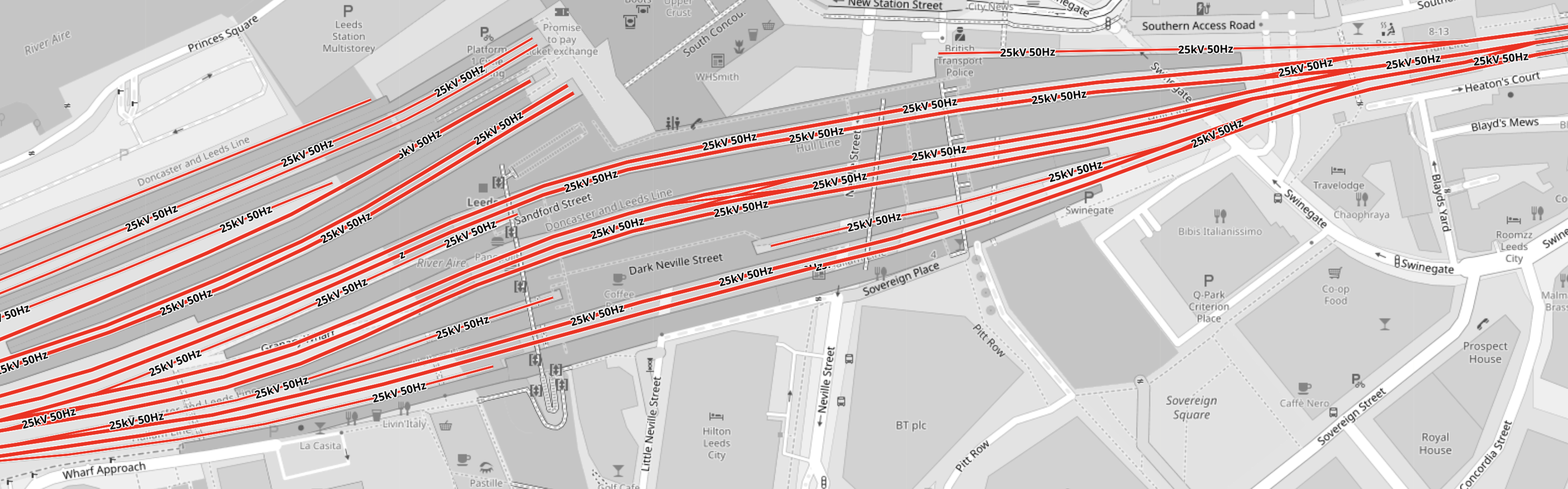
It would appear that the station is fully electrified and is an excellent battery-electric train hub, with twelve electrified bay platforms.
Conclusion
I can see a very comprehensive scheme being developed for Sheffield, based on a hub for battery-electric trains at Sheffield station.
The Diesel Power Of The Class 805 Trains
Avanti West Coast’s new Class 805 trains, will probably start running between London Euston and Chester, Shrewsbury and North Wales before the end of the year.
But will they have the 560 kW engines of the Class 800 trains or the the 700 kW engines of the Class 802 trains?
On this page of Eversholt Rail’s web site, there is a detailed specification for a Class 802 train.
It says these trains have a top speed of 110 mph on diesel.
But it also says this about the design of the trains.
They have been designed to meet the operational requirements of the West of England route and are used on services out of London Paddington to Plymouth and Penzance.
The class 802 is almost identical to the class 800, the differences are that class 802s have a higher rated engine output to tackle the gradients through Devon and Cornwall, and a superior diesel range to provide the IET experience to the wider Greater Western Network, they also have a larger brake resistor which reduces brake pad usage and requires less maintenance.
Wikipedia also says that these are the diesel engine sizes in the three main classes of these Hitachi AT 300 trains.
- Class 800 train – 560 kW – Three engines for five cars
- Class 801 train – 560 kW – One emergency engine for five cars
- Class 802 train – 700 kW – Three engines for five cars
- Class 810 train – 735 kW – Four engines for five cars
All these four trains have similar bodyshells and running gear, so I suspect that to run at similar cruising speeds, similar amounts of power will be needed.
If the Class 802 train has a speed of 110 mph on diesel, then a rough estimate of the cruising speed of a train with the 560 kW engines can be estimated by doing this simple calculation. Note that air resistance is proportional to the square of the speed.
Square root (110*110 *560/700) = 98.4 mph
I have looked on OpenRailwayMap at all the tracks to the West of Wolverhampton, where these trains will run and the highest maximum operating speed I can find is 90 mph.
As the Class 805 trains have a reprofiled nose, which could be more aerodynamic, they may be able to cruise at 90 mph.
I believe that a train with three 560 kW engines will suit Avanti West Coast purposes well.
What Is The Operating Speed Of The Class 810 trains?
I can use a similar calculation to estimate the maximum operating speed of the Class 810 trains, that will operate on the Midland Main Line.
Consider.
- The Class 802 train has a total power of 2100 kW
- The Class 810 train has a total power of 2940 kW
- The Class 810 train with only three working engines has a total power of 2205 kW
I can estimate the cruising speed by doing this simple calculation, which is similar to the one for the Class 805 train.
Square root (110*110 *2940/2100) = 130 mph
I can also do it for a train running on three engines.
Square root (110*110 *2205/2100) = 113 mph
I looks to me, that the following is possible.
- As Class 810 trains can achieve the maximum speed of 125 mph on both diesel and electric power, the timetable is independent of the progress of the electrification.
- If the 125 mph sections are ignored, the fastest sections of line have a maximum speed of 110 mph, which could be possible on three engines.
- North of the electrification, where the maximum speed is only 110 mph, engines could be selectively rested to avoid overheating.
Four engines give a lot of interesting options.
I can’t wait to take a ride.
Could The Class 810 Trains Be Fitted With Batteries?
When, the electrification reaches Market Harborough station, there will be no 125 mph sections on the Midland Main Line, which are not electrified.
This Hitachi infographic shows the Hitachi Intercity Tri-Mode Battery Train.

A Class 810 version of this train would have three diesel engines and one battery pack.
- It would have all the features of the infographic.
- My calculations give it a top speed of 113 mph on a route, where the maximum speed North of the electrification is 110 mph.
- I also suspect, it could bridge any small gaps in the electrification.
It would have the very positive effects of saving fuel and cutting pollution in stations.
Transformer Deliveries Mark Major Milestone For Braybrooke Substation Project And The Midland Main Line Upgrade
The title of this post, is the same as that of this press release from National Grid.
The press release says this.
Since early 2021 National Grid Electricity Transmission (NGET) has been building a new electricity substation near Braybrooke, on the outskirts of Market Harborough in Leicestershire.
The new substation, once complete, will form a vital part of electrical infrastructure to support Network Rail’s electrification of the Midland Main Line.
Following months of hard work, the project has reached a major milestone, as the engineering team have taken delivery of two new transformers.
The transformers arrived during November and were delivered via an access road off Kettering Road built to ensure construction traffic avoids the areas of Market Harborough and Braybrooke. Weighing an impressive 100 tonnes, they will now be installed at the substation over the coming months.
This Google Map shows the access road.

Note.
The main A6 road running across the top of the map.
Kettering road leads off it into Market Harborough.
The Midland Main Line running across the bottom of the map.
The access track runs between the two.
This enlargement of the South East corner of the map shows the 400 kV overhead transmission line.
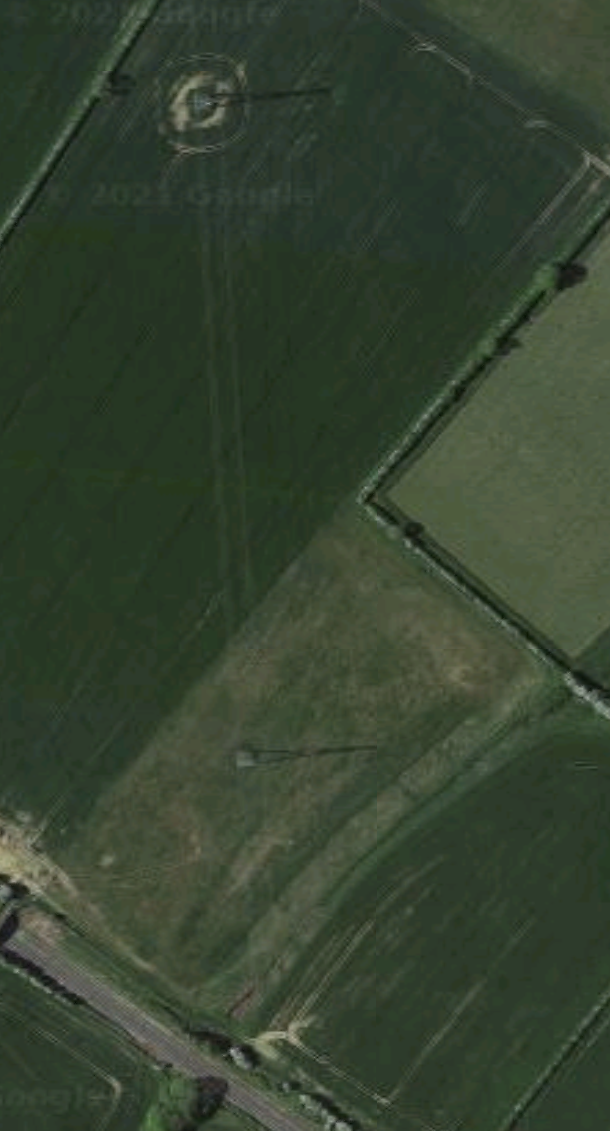
Note that the shadows give away two 400 kV pylons.
Will the sub-station be built in the smaller rectangular field?
How Many Sub-Stations Will Be Needed For The Midland Main Line Electrification?
I seem to remember that the Great Western Main Line to Cardiff was electrified with just three sub-stations, London, Cardiff and one in the middle and the London one is shared with Crossrail.
So I suspect that the feed of electricity may only need one further substation at the Northern end.
Conclusion
It does seem that National Grid have planned this well.
I suspect, bringing in the transformers didn’t cause too much disruption and the route gives good access to the overhead line.
Reopening Milton Keynes And Market Harborough Via Northampton
This post was originally part of Shapps Supports Beeching Axe Reversals.
That post takes its name from an article with a similar name in Rail Magazine.
But I now feel it would be better if it became a standalone post.
This route has not been proposed as a Beeching Reversal, but seems to have surfaced from the MP and the local rail group.
I was digging around the Internet looking for the words “Beeching Reversal, I found when this article on the Harborough Mail, which is entitled Harborough Rail Group Says Plan To Reopen Historic Line Is A ‘Excellent Idea’.
This is the introductory paragraph.
Moves to reopen the historic Market Harborough-Northampton railway line are being backed by a local rail passengers’ chief.
The Market Harborough-Northampton Line was only finally closed in 1981.
- It used to connect the two stations with a double-track railway.
- It is about fourteen miles long.
- It is now partly a heritage railway and a walking and cycling route called the Brampton Valley Way.
I have flown my virtual helicopter along the route and can make these observations.
- There is space for a bay platform at Market Harborough station.
- Once clear of Market Harborough, the route appears to be across open countryside.
- The connection to the Northampton Loop Line wouldn’t be too difficult.
The only problem, I can see is that the route into Market Harborough station appears to be tricky.
These are a few of my thoughts.
What Passenger Service Would Be Provided?
Consider.
- The route could certainly handle an hourly shuttle, as does the nearby Marston Vale Line.
- Northampton station currently has three trains per hour (tph) to and from London.
- Timings between Northampton and Market Harborough stations would probably be around twenty minutes.
- Fast services between Northampton and Euston take about an hour.
- Four tph between Northampton and London would probably be desirable.
So could a fourth service to and from London, be extended to Market Harborough station? Or perhaps even Leicester, which already has a platform, where the trains could be turned back?
- I estimate that with a ten minute turnround at Market Harborough, a three hour round trip would be possible and very convenient.
- A single track between Northampton and Market Harborough station would be enough.
- The fourteen miles between the two stations could be handled by a battery-electric train, as there will be electrification at both ends of the route.
- Porterbrook are developing a battery-electric Class 350 train.
At a first glance, this looks to be a very sensible proposition.
This map clipped from Wikipedia, shows the rail line between Milton Keynes Central and Northampton stations.
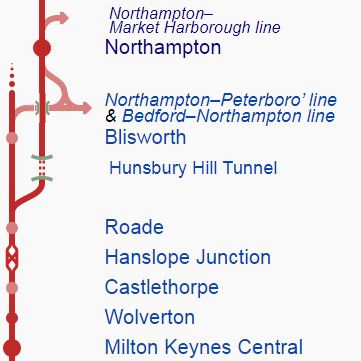
It is planned to introduce, a service between Marylebone and Milton Keynes Central using the tracks of the East West Rail Link.
- It could be run by East West Rail or Chiltern.
- It might be an easier service to operate as trains wouldn’t need to be turned back at Milton Keynes Central station.
- It might be a better financial option, if services were to be extended to Northampton and Market Harborough.
As the East West Rail Link is being built by a private company, do they have plans to create services between say Leicester and Oxford?
An Alternative Route To Leicester
A London Euston and Leicester service via Watford Junction, Milton Keynes, Northampton and Market Harborough could be run either as a regular service or when there are engineering works on the Midland Main Line.
Bringing Workers To Milton Keynes, Northampton and Leicester
When I moved back to Suffolk forty years ago, trains between Cambridge and Ipswich and Cambridge and Norwich were irregular hourly services using single or two-car trains. The good job prospects available in Cambridge, now mean that Greater Anglia now run four-car Class 755 trains on these routes to an hourly timetable.
Milton Keynes, Northampton and Leicester all need similar connections to stimulate employment.
Could Freight Trains Use The Northampton And Market Harborough Line?
Consider.
- A large rail freight interchange is being developed close to East Midlands Airport.
- The East West Rail Link will be a better route between Southampton Docks and the West Coast Main Line, than the current roundabout routes.
- Multimodal trains need to travel between the East Midlands and Sheffield and Southampton Docks.
- Stone trains need to travel between the North Midlands and West London.
If the Northampton and Market Harborough Line were to be reopened, it would provide a convenient freight route between the Midland Main Line and the West Coast Main Line.
Would the The Northampton And Market Harborough Line Be Electrified?
Consider.
- It joins the electrified Midland Main Line at Market Harborough station.
- It joins the electrified Northampton Loop Line at Northampton station.
- It is only fourteen miles long.
- Most trains should be able to bridge use the line on battery power.
- It will be a new well-surveyed railway, which is easier to electrify.
I suspect, whether the line is electrified will be more down to planning issues.
Would the The Northampton And Market Harborough Line Be Double Track?
The line was double-track when it closed and I think that only planning issues will stop it being reopened as a double track.
Is the Opening Of The Northampton And Market Harborough Line Being Driven By The East West Rail Link?
This is a paragraph from the Rail Magazine article.
Asked by Andrew Lewer (Con) at Transport Questions on October 24 whether he would elaborate on plans to open the proposed Market Harborough line as part of the Oxford to Cambridge expressway he said: “I understand that the reopening is at a formative stage, but I am very supportive of it. Indeed, I support the reopening of many of the smaller lines that were closed as a result of the Beeching cuts under a Labour Government, and I should like to see as many reopened as possible.”
Does that mean that The East West Rail Link is driving this project?
Conclusion
The reopening of Northampton and Market Harborough Line would appear to enable the following.
- Passenger trains between Marylebone and/or London Euston and Market Harborough and/or Leicester.
- Passenger trains between Oxford and Leicester via Milton Keynes, Northampton and Market Harborough.
- An increase to four tph between Northampton and Milton Keynes Central.
- A valuable freight route between Southampton Docks and the East Midlands and South Yorkshire.
It would also provide a connection between the West Coast Main Line and the Midland Main Line.
Reopening of the Northampton and Market Harborough Line could be a nice little earner for the East West Rail Link, if it hosted the following services.
- Freight trains between Southampton Docks and the East Midlands and South Yorkshire.
- Stone trains between the North Midlands and London.
- Passenger trains between Marylebone and/or London Euston and Market Harborough and/or Leicester.
- Passenger trains between Oxford and/or Reading and Market Harborough and/or Leicester.
These sections could also be electrified.
- Basingstoke and Reading
- Didcot Parkway and Oxford
- Oxford and Milton Keynes
- Northampton and Market Harborough
Much of the abandoned Electric Spine would have been created.
The only possible problem I see with this project is connecting the route to Market Harborough station.
Hopes Rekindled Of Full Midland Main Line Electrification
The title of this post, is the same as that of this article on Rail Magazine.
This is the key section of the article.
During a House of Commons debate on transport on September 17, HS2 Minister Andrew Stephenson said in response to a question from Alex Norris (Labour/Co-op, Nottingham North): “We are currently delivering the Midland Main Line upgrade, which includes electrification from London to Kettering, with additional electrification to Market Harborough being developed.
“Further electrification of the MML is currently at an early stage, but it is being examined by Network Rail.”
Stephenson said the DfT will continue to work closely with NR on the development of a proposal that would include approaches to advancing the delivery of electrification across the route.
The title of the article, probably sums it up well.
Electrification Of The Midland Main Line
Having read lots of stories about electrification of Midland Main Line, I think the following must be born in mind.
- Electrification on the line will reach as far North as Market Harborough station.
- The route between Sheffield station and Clay Cross North Junction will be shared with High Speed Two. It will obviously need to be electrified for High Speed Two.
- The section of the Midland Main Line between Derby and Clay Cross North Junction, runs through the World Heritage Site of the Derwent Valley Mills. The Heritage Taliban will love the electrification, with a vengeance.
- Electrification through Leicester station could be tricky, as the station building and the A6 road are over the tracks and there is limited clearance. Electrification could involve major disruption to the trains for some time.
These are some of the distances involved of sections of the route that are not electrified.
- Market Harborough and Derby are 54 miles apart.
- Market Harborough and Clay Cross North Junction are 67 miles apart.
- Market Harborough and Chesterfield are 70 miles apart.
- Market Harborough and Nottingham are 44 miles apart
- Market Harborough and Leicester are 16 miles apart.
- Derby and Clay Cross North Junction are 21 miles apart.
Since 2017, when electrification for the full route was originally abandoned, there have been big changes in rolling stock technology.
The biggest change has been the development of battery trains.
Hitachi’s Regional Battery Trains
This infographic from Hitachi gives the specification for their Regional Battery Train.

Note.
- The trains have a range of 56 miles on battery power.
- The trains can cruise at 100 mph on battery power.
- Hitachi have said that all of their AT-300 trains can be converted into Regional Battery Trains.
- Trains are converted by removing the diesel engines and replacing them with battery packs.
- I suspect these battery packs look like a diesel engine in terms of control inputs and performance to the driver and the train’s computer.
It is extremely likely, that the bi-mode Class 810 trains, which are a version of the AT-300 train, that have been ordered for the Midland Main Line can be converted into Regional Battery Trains.
These trains have four diesel engines, as opposed to the Class 800 and Class 802 trains, which only have three.
These are reasons, why the trains could need four engines.
- The trains need more power to work the Midland Main Line. I think this is unlikely.
- Four engine positions gives ,more flexibility when converting to Regional Battery Trains.
- Four battery packs could give a longer range of up to 120 kilometres or 75 miles.
It could just be, that Hitachi are just being conservative, as engines can easily be removed or replaced. The fifth-car might even be fitted with all the wiring and other gubbins, so that a fifth-engine or battery pack can be added.
I suspect the train’s computer works on a Plug-And-Play principle, so when the train is started, it looks round each car to see how many diesel engines and battery packs are available and it then controls the train according to what power is available.
London St. Pancras And Sheffield By Battery Electric Train
Any battery electric train going between London St. Pancras and Sheffield will need to be charged, at both ends of the route.
- At the London end, it will use the electrification currently being erected as far as Market Harborough station.
- At the Sheffield end, the easiest way to charge the trains, would be to bring forward the electrification and updating between Sheffield station and Clay Cross North Junction, that is needed for High Speed Two.
This will leave a 67 mile gap in the electrification between Market Harborough station and Clay Cross North junction.
It looks to me, the Class 810 trains should be able to run between London St. Pancras and Sheffield, after the following projects are undertaken.
- Class 810 trains are given four battery packs and a battery range of 75 miles.
- Electrification is installed between Sheffield station and Clay Cross North Junction.
Trains would need to leave Market Harborough station going North and Clay Cross Junction going South with full batteries.
Note.
- Trains currently take over an hour to go between Chesterfield to Sheffield and then back to Chesterfield, which would be more than enough to fully charge the batteries.
- Trains currently take around an hour to go between London St. Pancras and Market Harborough, which would be more than enough to fully charge the batteries.
- Chesterfield station is only three miles further, so if power changeover, needed to be in a station, it could be performed there.
- Leeds and Sheffield are under fifty miles apart and as both stations would be electrified, London St. Pancras and Sheffield services could be extended to start and finish at Leeds.
London St. Pancras and Sheffield can be run by battery electric trains.
London St. Pancras And Nottingham By Battery Electric Train
Could a battery electric train go from Market Harborough to Nottingham and back, after being fully-charged on the hour-long trip from London?
- The trip is 44 miles each way or 88 miles for a round trip.
- Services have either three or eight stops, of which two or three respectively are at stations without electrification.
- Trains seem to take over thirty minutes to turnback at Nottingham station.
Extra power North of Market Harborough will also be needed.
- To provide hotel power for the train, during turnback at Nottingham station.
- To compensate for power losses at station stops.
If 75 miles is the maximum battery range, I doubt that a round trip is possible.
I also believe, that Hitachi must be developing a practical solution to charging a train during turnback, at a station like Nottingham, where trains take nearly thirty minutes to turnback.
If the Class 810 trains have a battery range of 75 miles, they would be able to handle the London St. Pancras and Nottingham service, with charging at Nottingham.
Conclusion
It appears that both the Nottingham and Sheffield services can be run using battery electric Class 810 trains.
- All four diesel engines in the Class 810 trains would need to be replaced with batteries.
- The route between Clay Cross North Junction and Sheffield station, which will be shared with High Speed Two, will need to be electrified.
- Charging facilities for the battery electric trains will need to be provided at Nottingham.
On the other hand using battery electric trains mean the two tricky sections of the Derwent Valley Mills and Leicester station and possibly others, won’t need to be electrified to enable electric trains to run on the East Midlands Railway network.
Will it be the first main line service in the world, run by battery electric trains?
Highview Power And Railway Electrification
In Encore Joins Highview To Co-Develop Liquid Air Energy Storage System In Vermont, I gave brief notes about a proposed Highview Power CRYOBattery in Vermont.
- The system will supply 50 MW for eight hours.
- The total capacity will be 400 MWh.
Other articles have suggested, that the system could be built on the site of a demolished coal-fired power station, which still has a good connection to the electricity grid.
In other words, I believe that a CRYOBattery can be considered to be a small 50 MW power station.
- It could be charged by local excess renewable energy during the day.
- It could be charged by excess renewal energy from the electricity grid during the night, when there can be large amounts of wind energy, that needs a home.
- Intelligent control systems, would balance the output of the CRYOBattery to the needs of the electricity grid.
It would be used in very much the same way as gas-turbine power-stations are used in electricity grids all over the world.
The Braybrooke Feeder Station
The National Grid is providing a feeder station at Braybrooke to support the Midland Main Line electrification.
This page on the Harbough Rail Users site is entitled Electrification Substation Plan for Braybrooke.
It gives this description of the sub-station.
Electrification of part of the Midland Main Line has moved a tentative step closer with the plans being prepared by National Grid for a feeder substation at Braybrooke, just outside Market Harborough. The location is where a high-voltage National Grid power-line crosses over the railway and the plan is for a substation and associated equipment plus an access road from the A6. The substation is due to be completed by October 2020 and is intended to feed the power supply for the Corby line pending electrification of the main line through Market Harborough.
This Google Map shows the rough area, where it will be located.
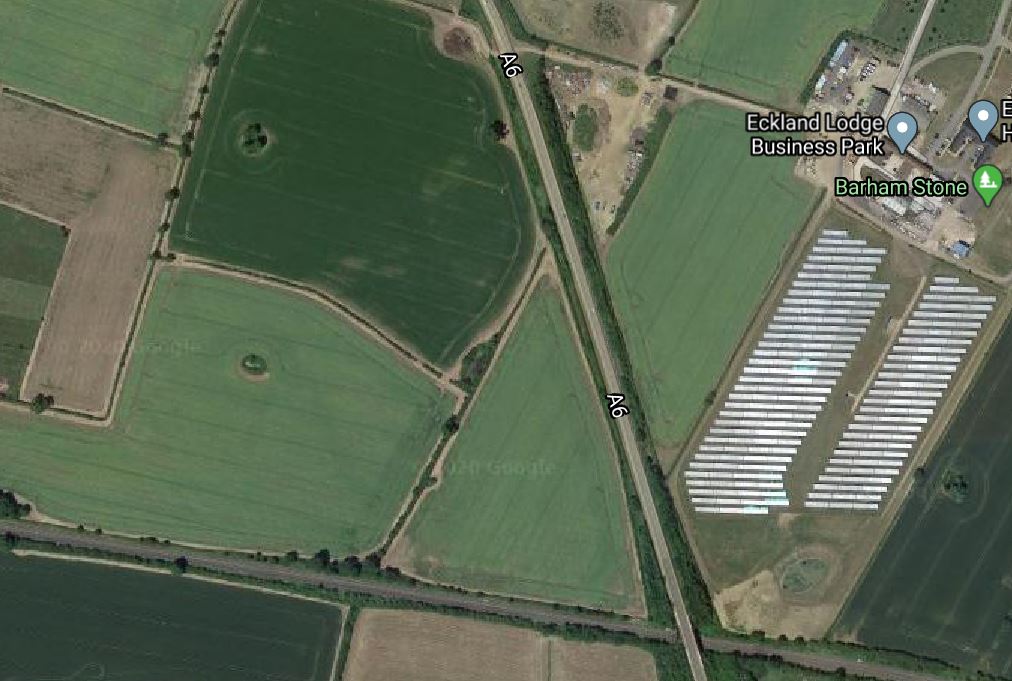
Note.
- The A6 crossing the Midland Main Line.
- The solar farm in the South-facing field, which has a 3MW capacity, according to the Eckland Lodge Business Park web site.
- Various planning documents say the transformers on the substation will be 400/25 kV units.
- This means that the power-line in the area must be a 400 kV.
Unfortunately, I can’t pick out the line of 400 kV pylons marching across the countryside. But they are rather large.
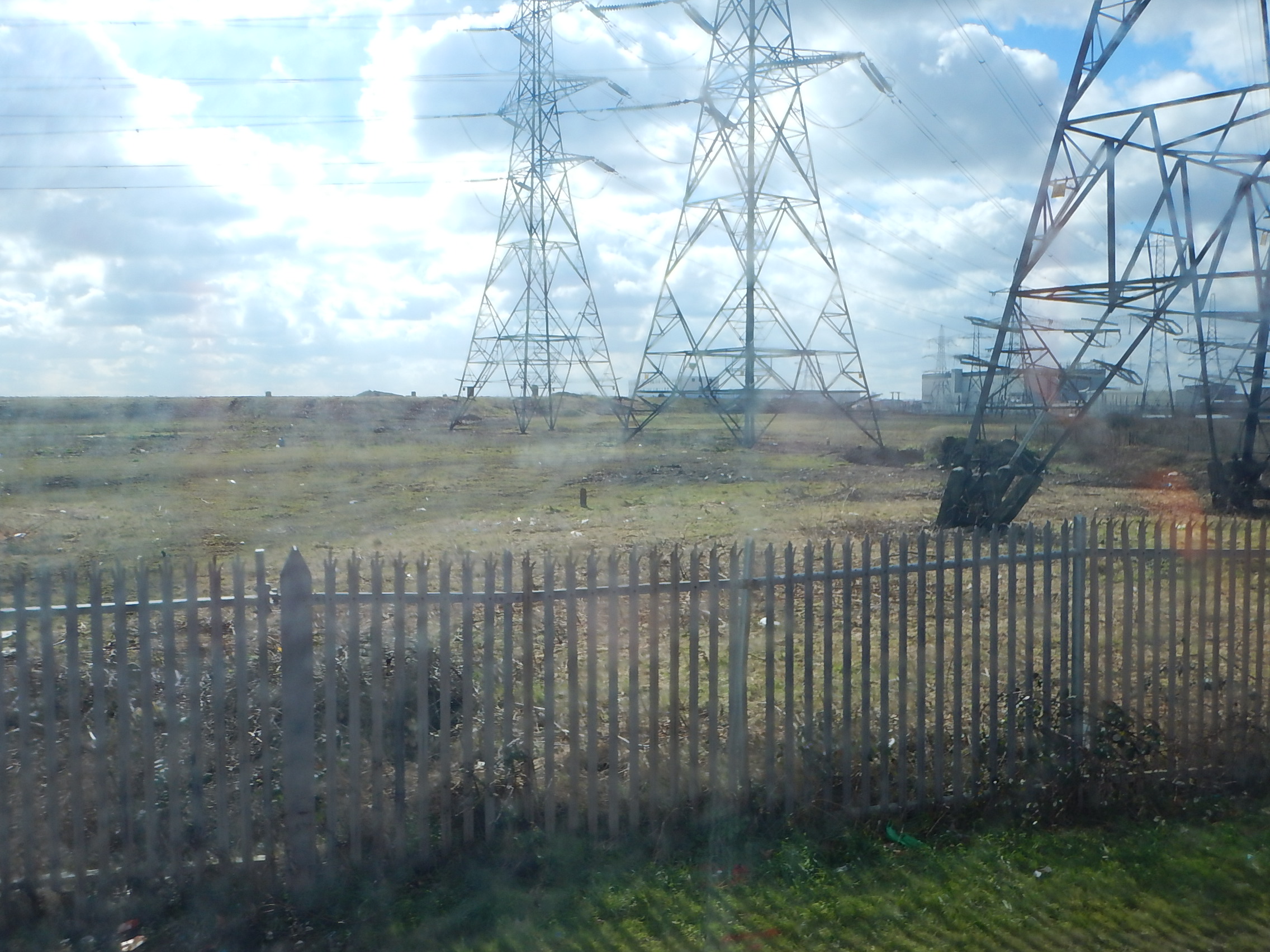
The pictures show a group of 400 kV pylons near Barking.
- The Midland Main Line at Braybrooke certainly seems to be getting a solid supply of electricity.
- It was originally planned, that the electrification would go all the way, but it was cut back to Kettering and Corby a couple of years ago.
- But to power, the electrification to Corby, it is being extended all the way to Braybrooke, so that the electrification can act as a giant extension lead for the Corby Branch Line.
The page on the Harborough Rail Users Site says this.
The Braybrooke substation is still planned, however, and the DfT has advised that the bi-mode trains will be able to switch power mode at speed. They would therefore be able to continue running electrically north from Kettering as far as Braybrooke before ‘pan down’
It would appear, that the end of the electrification will be at Braybrooke, but the sub-station seems to have enough power to extend the electrification further North if that is ever planned.
I also think, that is rather an efficient and affordable solution, with very little modification required to the existing electricity network.
But not all electricity feeds to railway electrification have a convenient 400 kV line at a handy site for installing all the needed transformers and other electrical gubbins.
How Much Power Will Needed To Be Supplied At Braybrooke?
This can probably be dismissed as the roughest or rough calculations, but the answer shows the order of magnitude of the power involved.
Consider.
- Braybrooke must be sized for full electrification of the Midland Main Line.
- Braybrooke will have to power trains North of Bedford.
- If there is full electrification of the Midland Main Line, it will probably have to power trains as far North as East Midlands Parkway station, where there is a massive power station.
- Trains between Bedford and Market Harborough take thirty minutes.
- Trains between Bedford and Corby take around thirty minutes.
- Four trains per hour (tph) run between Bedford and Market Harborough in both directions.
- The system must be sized to handle two tph between Bedford and Corby in both directions.
- The power output of each Class 360 train, that will be used on the Corby route is 1,550 kW, so a twelve-car set will need 4.65 MW.
- I can’t find the power output of a Class 810 train, but an InterCity 125 with similar performance has 3.4 MW.
- A Class 88 bi-mode locomotive has a power output of 4 MW when using the electrification.
I estimate that Braybrooke could have to support at least a dozen trains at busy times, each of which could need 4 MW.
Until someone gives me the correct figure, I reckon that Braybrooke has a capacity to supply 50 MW for trains on the Midland Main Line.
A Highview Power system as proposed for Vermont, would have enough power, but would need a lot more storage or perhaps local wind or solar farms, to give it a regular charging.
Riding Sunbeams
Riding Sunbeams are a company, who use solar power to provide the electricity for railway electrification.
I’ll let their video explain what they do.
It’s a company with an idea, that ticks a lot of boxes, but would it be able to provide enough power for a busy electrified main line? And what happens on a series of rainy or just plain dull days?
Highview Power
Could a Highview Power energy storage system be used?
- To store electricity from local or grid electrical sources.
- To power the local electrification.
If required, it could be topped up by affordable overnight electricity, that is generated by wind power.
The Highview Power system could also be sized to support the local electricity grid and local solar and wind farms.
Conclusion
I think that Riding Sunbeams and Highview Power should be talking to each other.
Shapps Supports Beeching Axe Reversals
The title of this post is the same as that of this article on Rail Magazine.
This is the introductory paragraph.
Secretary of State for Transport Grant Shapps says he supports the reopening of routes closed in the Beeching cuts of the 1960s.
In the article, which describes proceedings in the House of Commons, Grant Shapps, says he was very supportive of opening the Market Harborough Line.
I have now moved the rest of this article to a standalone article with a title of Reopening Milton Keynes And Market Harborough Via Northampton.
Market Harborough Station – 11th July 2019
Compare these pictures taken today, with those in Market Harborough Station – 10th May 2019.
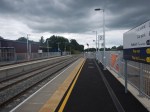
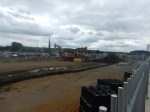
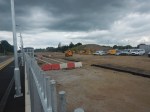
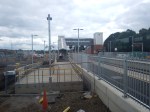
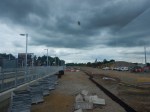
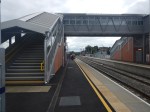
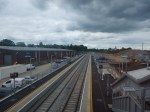
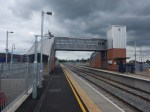
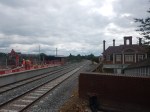
In the intervening two months, there have been major changes at Market Harborough station.
Two Shorter Curved Platforms Have Been Replaced
The two shorter curved platforms have been replaced by two long straight platforms.
- They can handle the longest trains likely to stop in the station.
- As they are straight, it is likely that there will be a smaller gap to mind, between platform and train.
- The platforms and the tracks have been moved to the West by several metres.
- The platforms are now furnished to a high standard, with shelters and information screens.
The new platforms and tracks are a great improvement for passengers, staff and train operators.
But they also mean.
- Trains that stop at the station, can perform faster stops, as the better train-platform interface speeds passengers entering or leaving the train.
- Passing trains can benefit from a higher speed limit through the station.
This should mean a faster journey time along the Midland Main Line.
The Land Released Will Be Used To Extend The Car Park
Several hundred new car parking spaces will be provided on the Eastern side of the line, in the land released by moving the platforms and tracks.
There Is A Fully Working Step-Free Bridge
The new step-free bridge is now fully working.
- The steps are wide enough for bi-directional traffic.
- There are lifts on both sides.
It is asymmetric, with the steps probably leading in the direction most passengers will be walking to and from.
- On the Eastern London-bound platform, passengers will be walking to and from the car park.
- On the Western Leicester-bound platform, passengers will be walking to and from the main station building with the exit to the town, the ticket office and the cafe.
The bridge will certainly handle commuters to London or Leicester, who drive to the station and have to cross the tracks before or after one journey.
It will also handle commuters, who walk or cycle from the town centre.
This bridge has been placed by someone, who knows what they’re doing!
There Are A Pair Of Crossovers To The North Of the Station
I don’t know whether these are new, but they certainly will give operational advantages, if for instance, a train should fail in Market Harbprough station.
As it is likely, that the Midland Main Line will be electrified as far North as Market Harborough station, could they be used for other purposes?
125 mph electric services could be run between London and Market Harborough.
- The two crossovers would easy turnback of the trains or the building of a stabling siding, North of the station.
- Trains would probably take under an hour.
- They could stop at intermediate stations like Luton Airport Parkway Luton, Bedford and Wellingborough.
- Market Harborough station has a lot of parking.
- It could be a second electric service into St. Pancras.
It could be a useful complimentary service or an alternative one whilst planned major regeneration work is ongoing at Leicester station.
Market Harborough Station Has A Bigger Capacity
Consider.
- The longer platforms will allow longer trains with more seats to call at the station.
- The shorter dwell times at the station of stopping trains will allow more trains to stop in the station every hour.
- The step-free bridge is additional capacity for crossing the tracks.
- There will be a massive increase in car parking.
It looks to me that the station has been upgraded to fulfil a need for more trains.
These figures show the population and passenger numbers at stations around Market Harborough.
- Corby – 70,800 – 300,000 – 4.24
- Kettering – 56,200 – 1,070,000 – 19
- Market Harborough – 22,900 – 900,000 – 39.3
- Wellingborough -49,100 – 1,015,000 – 20.7
The last figure was obtained by dividing the number of journeys by the population.
Does Market Harborough’s high figure mean that there is a high demand for travellers living around Market Hsrborough and the large amount of extra car parking will be well-used.
Note.
- I travelled to Market Harborough with a lady and her two young children, who wee actually going to Leicester and were being picked up by family at the earlier station due to all the traffic problems around Leicester station.
- There used to be four stations between Market Harborough and Leicester, but all closed in 1968.
- There used to be two stations between Market Harborough and Kettering, but all closed in the 1960s.
- Market Harborough is well-connected by roads.
So is Market Harborough station used by locals as a Leicester South station?
As an aside, I wouldn’t be surprised to see a new parkway station developed in conjunction with a large housing development, built between Kettering and Leicester, at some point in the future..
Future Electrification
There is a section entitle Electrification in the Wikipedia entry for the Midland Main Line.
This is the last paragraph.
On 26 February 2019 Andrew Jones, Parliamentary Under Secretary of State for Transport, announced that electrification would be extended northwards from Kettering to Market Harborough, enabling the connection of the railway to a new power supply point at Braybrooke.
I will assume that this means, that electric trains will be able to run to Market Harborough station.
As I said earlier, there are a pair of crossovers to the North of the station, which could be useful for turning trains or giving easy access to a couple of stabling sidings.
Hopefully, electrifying the station will not be difficult, as it has only recently been built and foundations for the electrification gantries have either been built or surveyed thoroughly.
Battery Trains Through Market Harborough Station
One thing that won’t be needed at Market Harborough station is a charging station for battery-electric trains, as this will be handled by the electrification.
Bi-mode and battery-electric trains would either raise or lower the pantograph at speed or at a stop in the station.
The operation of a battery-electric train going North could be interesting.
If it wasn’t scheduled to stop in the station, the train would go through Market Harborough station, with maximum charge in the onboard storage, after being charged by the overhead electrification, on the way up from London. The train would also run through the station, at the highest possible speed, as allowed by the track, so that the train had the highest possible kinetic energy.
Electrification to Market Harborough will act like a catapult to send trains North at their maximum kinetic energy and they could probably glide all the way to Leicester station using little of their energy stored in the onboard battery.
The electrification would probably go a short way North of Market Harborough station, so that sropping trains could be accelerated to full speed using the electrification.
There Is Still Work To Be Done
Work to be done appears to include.
- Refurbishing the original subway to give access between the London-bound platform and the station building.
- Finishing the shelters and other platform furnishings.
- Landscape the car-park and create ramped access to the London-bound platform.
A notice said the subway would reopen in December 2019.
Conclusion
Market Harborough now has a much higher capacity modern station.
Welcome For Extension Of Midland Electrification
The title of this post is the same as that of this article on Rail News.
This is the first paragraph.
Electrification of the Midland Main Line is set to be extended from Kettering North Junction to Market Harborough station.
The project was announced in the House of Commons and has already been called great news by the local MP.
In MML Wires Could Reach Market Harborough, I laid out my thoughts after an article in the June 2018 Edition of Modern Railways, with the same title.
This was my major conclusion.
I think that electrification between Glendon Junction and Market Harborough station will happen.
I actually feel that with the announcement of innovative new rolling stock and electrification methods in the last few months, that electrification of this section could now be easier and that electrification to Leicester might even happen.
A Reconnaissance To Market Harborough
This morning, I took trains between St. Pancras and Market Harborough stations, and then came back with a pit-stop at Wellingborough station.
These were my observations.
Electrification Between Bedford And Kettering/Corby
The electrification seems to be progressing, as these pictures show.







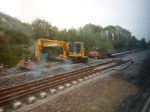

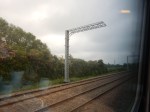
Note.
- Quite a few orange-capped piles have been installed.
- The gantries are going up.
- Extra tracks are being added.
One difference between this electrification project and others I have seen lately in the UK, is the aura of tidiness.
Electrifying From Glendon Junction To Market Harborough Station
One of the objectives of my reconnaissance was to see how much work needed to be done to the bridges between Glendon Junction and Market Harborough station, so that the overhead lines could be installed.
I counted nine bridges over the tracks and all seemed to offer sufficient clearance for freight trains and overhead wires.
It appeared that some bridges had been rebuilt and I suspect that Network Rail have completed their gauge clearance on this section of the Midland Main Line.
Line Speed From St. Pancras To Market Harborough
I chose to ride North in an InterCity 125, as having ridden in the cab of one of these iconic trains, I know a bit more about their capabilities.
What surprised me was how much of the journey was spent running at a speed in excess of 120 mph. There was one section where we were limited to about 90 mph, but I got the impression that Network Rail and their predecessors have created a high quality high speed line.
I would think it would be highly unlikely that by the time new bi-mode trains come into service in a few years time, that much of the route will be able to handle 125 mph running.
The train was almost at this speed between Glendon Junction and Market Harborough, so when the track through the station is straightened, it looks to me that journey times will be reduced.
Market Harborough Station
The station is a typical smaller main line station.
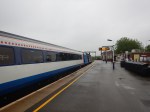

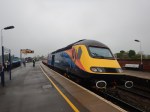
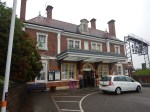


Note.
- Access to the London-bound platform is not step-free.
- Shelters are rather basic.
- The lines through the station will be straightened soon, to increase line speed.
Overall, it is a station with a good building, that should be improved.
Surely, if the tracks are being remodelled, then the foundations for electrification gantries should be installed.
Wellingborough Station
On the way back, I stopped off at Wellingborough station.
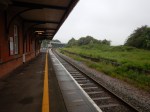
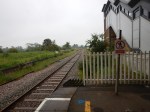
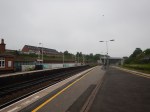
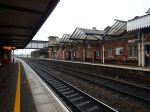

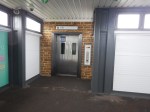

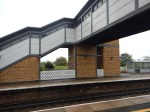
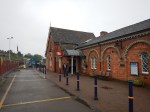
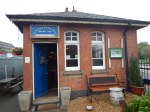
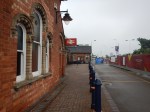
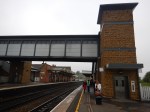
Note.
- Wellingborough station is being improved.
- All trains seem to stop at the two main platform 1 and 2.
- The bay platform 3 seems to have been rebuilt as a through platform to serve the new track being created through the station.
- There is rather a nice real ale and cider bar on the entrance side of the station.
- The station has a footbridge with lifts, which is better designed than many.
All of the improvements are to support the new housing being built around the station.
This Google Map shows the area around the station.
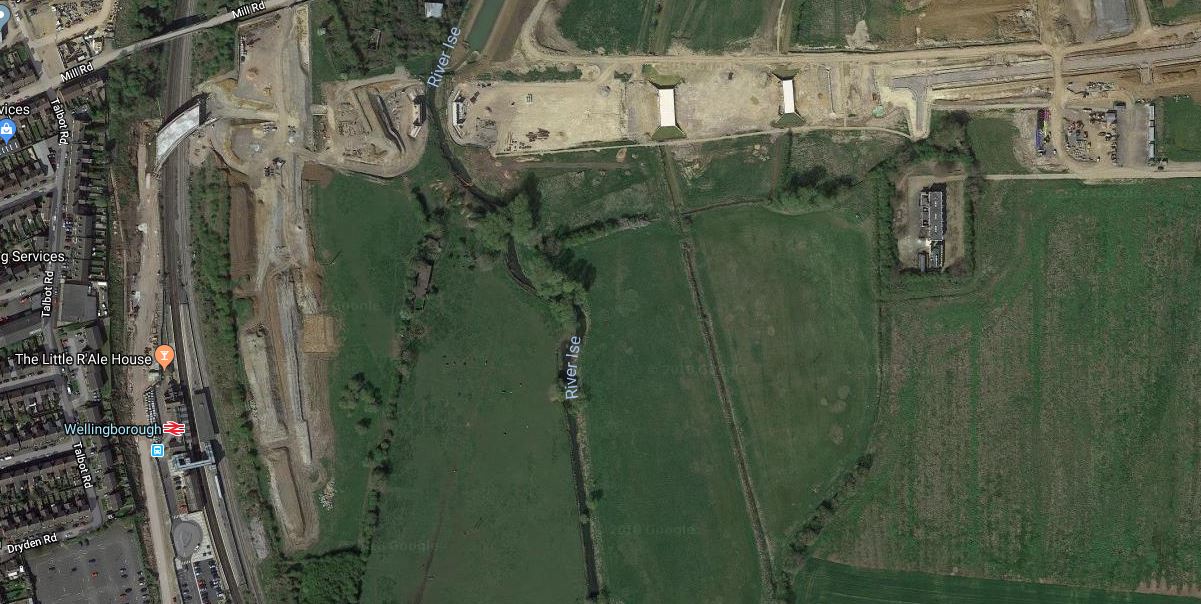
Note the new road crossing the railway to the North of the station.
It certainly looks like the upgraded station will be needed.
Views Of Drivers
I travelled back to London, with a group of drivers.
Two specific points emerged.
Electrification at Leicester could be difficult, as there are sewers under the track, which might mean the whole station and bridges would need to be substantially rebuilt.
South of Bedford, the Thameslink’s new Class 700 trains get in the way as they are too slow at 100 mph.
It is interesting to note the following.
- Class 387 trains working the East Coast Main Line and Great Western Main Line are 110 mph trains.
- Class 350 trains working the West Coast Main Line are 110 mph trains.
Are the Class 700 trains reducing the capcity of the Midland Main Line?
 The Anonymous Widower