My 78-Year-Old Legs Are More Reliable Than The New Chinese Buses On London’s 141 Bus Route
So we all know what we’re talking about, here’s a few pictures.
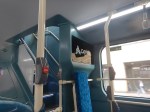
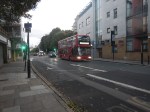
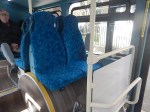
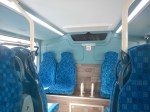

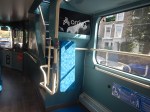


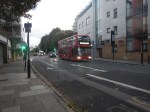
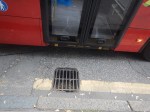
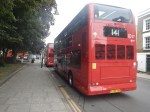





Note.
- The buses seem to have no serious faults from a passenger point of view.
- One middle-aged lady on the plump side, said she didn’t like the buses.
- The aisle between the front seats doesn’t seem to be built for large people.
- The seats are reasonably comfortable.
- One morning, I stood on a long journey and I felt the road-holding wasn’t as good as a New Routemaster.
- On several buses, the interior route display has not been working.
- As I don’t wear a watch, I find a non-working display annoying.
- I haven’t been upstairs yet.
- As picture numbers three and four show, the bus looks a bit pokey at the back downstairs.
But I am very suspicious about the buses’s reliability or ability to handle the route, which is fairly long.
Take this morning, when I was coming home from London Bridge station.
- There was only a 43 bus at the shared stop with the 141 bus.
- As the routes are identical until Old Street station, I took the 43 bus to Moorgate station.
- At Moorgate station, I took a 76 bus, which gets me within walking distance of where I live.
- Someone said, that a 141 bus would mean a wait of ten minutes.
- In the end my 78-year-old legs delivered be home.
I didn’t see a 141 bus going my way on my journey.
I have seen behaviour like this several times, since some Chinese electric buses were introduced on to the route.
As a graduate Electrical and Control Engineer, it looks to me, that there is one of two problems with these buses.
- The batteries aren’t large enough for the route.
- Not enough time is allowed for charging the batteries at the end of the route.
This page on the Wrightbus website is entitled Wrightbus Electroliner ‘Most Efficient Double-Deck Battery-Electric Bus’, and it contains this paragraph, which probably explains their philosophy and ambition.
We have already gained a strong reputation for our hydrogen double deck but we want to lead the world in zero-emissions full stop. Wrightbus has the best brains in the business when it comes to technology and our StreetDeck Electroliner puts us squarely at the front of the pack. We haven’t weighed the bus down with a high battery volume just so we can say it’s got the most power or range; instead, we’ve made it the most efficient vehicle on the road by combining optimum power with a class-leading rapid charge, meaning our electric bus spends more time on the road than any other.
It also probably sets a very high bar, which the Chinese can only achieve by adding battery volume and making their buses pokey.
To be fair to the buses, the 141 route is probably nearly 20 miles long.
In Sutton Station To Gatwick Airport By Hydrogen-Powered Bus, I wrote about what it says in the title.
In that post, I said this about hydrogen buses running on the 141 route.
Wrightbus Hydrogen Buses For My Local Bus Route 141
Consider.
- The 141 bus route is my local bus, which gets me to Moorgate, Bank, London Bridge and Manor House.
- The length of the full route is twenty miles and it takes about an hour to go from London Bridge station to Palmers Green.
- The route is currently run by older Wrightbus hybrid diesel-electric buses.
- I suspect that modern hydrogen buses could last almost all day on one fill of hydrogen, with perhaps a top-up at lunchtime.
They would have no difficulty handling the route and would greatly increase the customers current rock-bottom satisfaction.
I am sure, they would improve the horrendous reliability of the route.
I also wonder, if Wrightbus have another solution.
In UK Among Tri-Axle Zero-Emission Wrightbus StreetDeck Prospects, I talk about Wrightbus’s new Tri-Axle Zero-Emission Wrightbus StreetDeck bus and how it would be ideal for the 141 bus route.
- The 141 bus route is the old 641 trolleybus route, so all clearances are generous.
- The tri-axle design can probably carry a better-optimised battery.
- There used to be two bus routes on the route and now there is only one, so more capacity is needed.
- The 141 bus route bridges the gap between the Northern section of the Piccadilly Line and the Elizabeth Line, Bank and London Bridge.
- The new air-conditioned Piccadilly Line trains, will increase the passengers on the line.
- There will be a lot more housing built in Enfield, at the Northern end of the Piccadilly Line and more bus capacity will be needed between Manor House and the City of London.
Some of TfL’s rerouting of buses in North London, was a crime against mathematics.
America’s Looming Electricity Crisis Is Trump’s Achilles’ Heel
The title of this post, is the same as that of this article in the Telegraph.
This is the sub-heading.
Culture war banter and point-scoring have left Maga facing a self-inflicted energy shortage
These are the first three paragraphs.
The US is in danger of losing the global AI race for the most banal and careless of reasons: it is critically short of electricity.
The country is sitting on a neglected pre-modern grid that cannot meet surging power demand for data centres, cryptocurrencies, the reshoring of semiconductor plants and the proclaimed revival of the American industrial base.
Nor can it meet the needs for air conditioning through hotter and more humid summers. While we all talk about AI, the chief cause of rising electricity use last year was for cooling. Bitcoin mining took another 2pc of US power, for no productive purpose.
It looks like we can add simple arithmetic to the skills the Trump Administration lacks.
The Telegraph article and myself have some other thoughts.
The Planned Increase In Electricity Is A Fifth Of What’s Needed
This is a paragraph from the Telegraph.
The US Energy Department said in its Resource Adequacy Report in July that the planned increase in firm electricity supply is a fifth of what is needed by 2030.
In Renewable Power By 2030 In The UK, I stated that by 2030, the UK would add nearly 59 GW of offshore wind.
Surely, using the population size difference of four times, 240 GW of offshore wind, would do the USA nicely?
But, Trump doesn’t like wind turbines.
Texas Has A Shortage Of Electricity
These are two paragraphs from the Telegraph.
The Texas grid operator Ercot expects peak power demand in its region to soar from 87 gigawatts (GW) this year to 138 GW by 2030. This is physically impossible.
Texas passed a law in June giving the state emergency authority to cut off power to data centres. Ercot is already having to deploy “mobile generation plants” at exorbitant cost to avert blackouts even today.
It sounds pretty desperate.
Texas needs another 51 GW by 2030, which is less than we intend to delivery from just offshore wind.
If Little Great Britain can do it, then surely Texas can? After all, Texas is three almost times larger than the UK.
I get the idea, that someone isn’t doing any planning.
The United States Needs A Lot Of Transformers
These are three paragraphs from the Telegraph.
The National Infrastructure Advisory Council (Niac) says the average age of America’s 60 million large power transformers is 38 years. Many are beyond their design life.
The US supply chain is not capable of delivering the 12 million new transformers needed each year to keep the show on the road. The backlog has risen to four years. The cost of transformers has jumped 80pc since the pandemic.
There is an acute shortage of electrical steel needed to make them. This comes mostly from China, Japan, Korea or Germany. In his infinite wisdom, Trump has imposed 50pc tariffs on steel, aluminium and copper. That cost shock has yet to feed through.
The Niac says it is a similar tale for “other critical grid components such as conduit, smart meters, switchgear and high-voltage circuit breakers”.
It looks like, there’s another fine mess, you’ve got us in, Donny!
Maga Wants More Coal
These are three paragraphs from the Telegraph.
The quickest way to generate more power is to roll out wind and solar. Trump is actively intervening to obstruct this. Maga wants coal instead.
This week the administration announced $625m of taxpayer subsidy to “expand and reinvigorate” the coal industry. It will open new federal lands, slash the royalty fees for extracting coal, and lift curbs on mercury pollution.
“In addition to drill, baby drill, we need to mine, baby, mine,” said Doug Burgum, the interior secretary.
When it should be spin, baby, spin.
Conclusion
Read the article in full.
We certainly, don’t want anybody, with an energy policy like Trump, influencing the UK’s energy policy.
If Trump carries on like this, he’ll end up in a terrible mess.
Did Plans For Crossrail Ever Include A Station At Holborn?
I have only one North-South bus route, where I live.
The 141 bus connects Palmers Green and London Bridge station.
- The 141 bus was the replacement for the 641 trolley bus, which was the main link between Wood Green, Turnpike Lane and Harringay, and the City of London, when I was a child.
- The vehicles are up to ten years old Wrightbus diesel hybrids.
- The route suffers badly from overcrowding as it connects, Bank and Moorgate stations in the City of London, with the outer reaches of the Piccadilly Line.
The overcrowding on the 141 bus route has got worse in the last couple of years because of the following.
- The rebuilding of London Bridge station brought more passengers to the 141 bus route.
- The opening of the new London Bridge bus station at London Bridge station has improved access to the buses at London Bridge station.
- The improvement of the connection of the buses to the Docklands Light Railway, Central Line and Northern Line at Bank station.
- The opening of the Battersea branch of the Northern Line, which brings more passengers to Bank station.
- The opening of the new Cannon Street entrance to Bank Underground station.
- The opening of the Elizabeth Line through Moorgate station.
- Recently, a new walking route between Moorgate and Liverpool Street was opened, which will bring more passengers to the buses on Moorgate.
- The rebuilding of Old Street station brought more passengers to the 141 bus route.
So what was the response of the Mayor and Transport for London, to all this increase of passenger numbers?
The 21 bus, which shadowed the 141 route, and doubled the number of buses through where I live, was moved to serve Holloway.
It was a big crime against mathematics and the wishes of our long-serving Labour MP; Meg Hillier.
So to handle many more passengers between London Bridge station and Newington Green through the City of London, the number of buses was halved.
I believe that the overcrowding will get worse because of the improvements, that Transport for London have planned.
- The Piccadilly Line will be getting new air-conditioned trains within a couple of years and these will inevitably attract more passengers to the line.
- On the other hand the air-conditioning may persuade passengers to use the Piccadilly Line more than they do now. Instead of changing to the 141 bus at Manor House station, passengers could change at Finsbury Park, King’s Cross St. Pancras or Holborn stations for other routes to the City of London.
- The third line to receive the new air-conditioned trains will probably be the Central Line, which would create another East-West air-conditioned line and bring more passengers to Bank station.
- The Central Line could give some relief for the buses through Bank, if an extra station was built on the Central Line to interchange with Shoreditch High Street station on the East London Line of the London Overground.
- The fourth line to receive the new air-conditioned trains will probably be the Waterloo and City Line, which would create another air-conditioned line and bring more passengers to Bank station.
- It is likely, that more services will be added to the Elizabeth Line, which will bring more passengers to Moorgate station.
- It is likely, that more services will be added to the Northern City Line, which will bring more passengers to Moorgate station.
- The Mayor is also planning to pedestrianise Oxford Street, which may fill up the Central Line with extra passengers.
It looks to me, that there will be a need for a large increase of bus capacity through the City of London on a North-South axis.
On the other hand, the City of London have stated that they will pedestrianise many of their streets.
So what can be done to avoid gridlock in the City of London?
Develop The Northern City Line At Moorgate
I use this route regularly to and from Moorgate station.
- It already has new Class 717 air-conditioned trains.
- The route is already digitally signalled in conjunction with the East Coast Digital Programme.
- It has two platforms at Moorgate station.
- Highbury & Islington station has interchanges with the Victoria Line and the North and East London Lines of the London Overground.
- Finsbury Park station has interchanges with the Victoria Line and National Rail services.
- Bowes Park station has an out of station interchange with Bounds Green station on the Piccadilly Line.
- Step-free access needs improving.
- The Victorians had plans to extend the line to Lothbury near Bank station.
If the Northern City Line could handle more passengers, would passengers get to all parts of the City of London by changing at Finsbury Park and walking from Moorgate or Old Street stations?
I regularly go between my house and Moorgate, by taking a bus to Essex Road station and using the Northern City Line.
I believe that with improvements on the Northern City Line, the line could be turned into a very valuable part of London’s rail infrastructure.
Connect The Central Line And The East London Line At Shoreditch High Street Station
I wrote about this proposal in Will Shoreditch High Street Be Connected To The Central Line?
The Elizabeth Line needed to be completed before this could be started.
Build The Western Extension Of The Docklands Light Railway
I wrote about this proposal in The Bank Station Upgrade And The Western Extension Of The DLR.
Rebuild Holborn Station
The interchange between Piccadilly and Central Line at Holborn station is difficult to say the least.
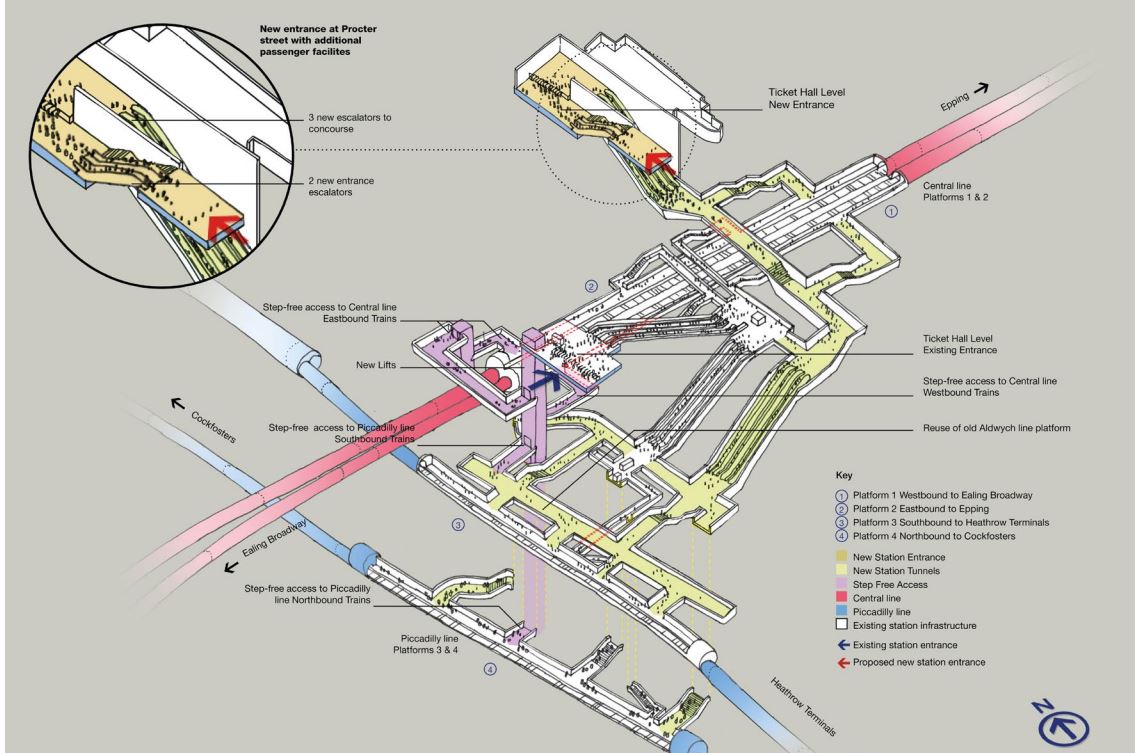
Holborn station is being extended with a new entrance. As with Euston, I suspect it has been designed with a feasible place for DLR platforms to be added.
This document on the TfL web site, gives more details of what is proposed at Holborn station.
I extracted this visualisation of the proposed station.
This map from carto.metro.free.fr shows the lines in the through and around the station.
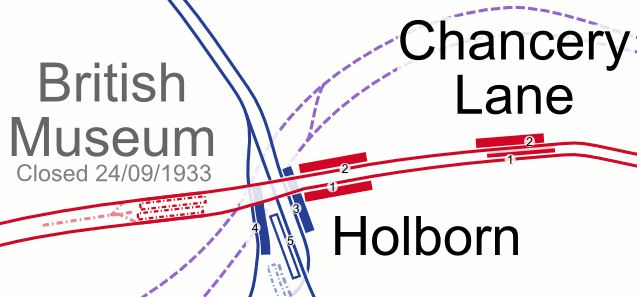
.Note, the Elizabeth Line, which is shown by dotted lines passes to the North of the station.
Conclusion
Not all these improvements need to be done, but each would improve transport in the City of London.
The Borough Of Islington Has Increased Residents Parking By 43 %
boroughSocial Media alive with the message, that the Borough of Islington has put up Residents Parking from £ 175 this year to £ 250 in 2025.
That is an increase of 43 %. Although the good mathematicians of Islington say it’s 70 %.
The politicians obviously know the residents can’t do maths, so they can get away with fleecing them.
SSE Renewables Partners With Fluence And OCU Energy To Deliver Its Battery Storage Project At Fiddler’s Ferry
The title of this post, is the same as that of this press release from SSE Renewables.
This is the sub-heading.
*The 150MW / 300MWh battery energy storage system will be built on the site of the former SSE-owned coal fired power station*
These four paragraphs give full details of the project.
SSE Renewables has announced its principal contractor and battery supplier for its 150MW battery storage project at Fiddler’s Ferry, Warrington.
OCU Energy – who are Stockport-based and are currently working with SSE Renewables on its Ferrybridge battery storage project – will be the principal contractor at Fiddler’s Ferry.
Fluence, a global leader in energy storage technology, digital solutions and services, has been selected as the supplier of the battery-based energy storage system.
Construction is set to begin at the site in the coming weeks after SSE Renewables took a final investment decision back in December 2023.
Note.
- This will be a two-hour battery.
- Good to see a press release with both battery output and battery capacity shown in the appropriate units.
It’s also good to see, SSE adding to the fleet of the UK’s battery storage.
This page on the SSE Renewables web site is entitled About Solar And Battery.
This is the sub-heading.
SSE Renewables is progressing a 1.2GW secured pipeline of utility-scale solar and battery projects across the UK and Ireland and a further 1.3GW of other prospective sites under development. These assets complement SSE’s existing portfolio of other low carbon infrastructure such as wind and hydro.
This is the first paragraph.
Our solar projects will be capable of harnessing the abundant power of the sun to bring renewable power onto the grid, while our battery projects will be able to store renewable power when the sun doesn’t shine or the wind doesn’t blow. The delivery of these projects is part of our commitment to a net zero transition.
What follows is a job advert.
As an electrical and control engineer, who has enjoyed over fifty years exploring the mathematics of big engineering projects, I don’t regret the choice of career I made.
Silvertown Tunnel: Cracks In Mayoral Policies
The title of this post is the same as that of this article on the BBC.
This is the sub-heading.
It is an infrastructure project that is well-underway with the boring almost completed — but it has a very low profile.
These are the first three paragraphs.
Every step of the Crossrail tunnelling, the media were invited along. Not so with this project.
This is Silvertown Tunnel. It is more than 1km long and will be London’s first road tunnel in over 30 years.
Perhaps one of the reasons it isn’t being pushed publicity-wise, is it is very controversial.
Tom Edwards gives a detailed outline of why the tunnel is controversial.
Under a heading of HGVs Using Bus Lanes, this is said.
Instead of using the Dartford Crossing, larger HGVs will be able to use the tunnel — and its bus lane.
Campaigners said that will mean more HGVs going through Newham and Greenwich.
I’ve also never heard this before.
Sheila Keeble, of the Greenwich Society, said the tunnel “will be magnet for bigger traffic than we’ve got at the moment”.
“One of the issues we have is all the developers are now looking at building distribution centres,” she said.
“At the moment the Blackwall Tunnel protects us from bigger traffic… Silvertown won’t.”
That is all very logical and I suspect we’ll see larger trucks in Hackney and Waltham Forest too!
There was also this bit of nonsense from Transport for London.
TfL says the tunnel will lead to an overall improvement in air quality.
How will all those trucks through the two tunnels reduce pollution?
In 2024, London must vote for a Mayor, who understands hydrogen, mathematics and science!
Elizabeth Line’s £29million Fares Bonanza As Passenger Numbers Hit New High
The title of this post, is the same as that of this news item on msn.
These four paragraphs outline the story.
The Elizabeth line has enjoyed a £29m fares income bonanza due to record passenger numbers, it was revealed on Wednesday.
But the positive state of its finances – alongside a prediction that it will break even this year – came as line managers belonging to the TSSA union announced they would strike on May 24 in an unresolved pay battle.
This threatens to close the central section of the £20bn line, between Paddington and Abbey Wood, and embarrass Mayor Sadiq Khan and Transport for London as the walkout falls on the first anniversary of its opening.
Latest figures from TfL show the Elizabeth line is carrying 3.5m passengers a week – and at times almost four million.
After the experience of continuously rising passenger numbers after the opening of the London Overground, it looks like the so-called mathematicians of Transport for London have got their numbers wrong again.
I have some thoughts.
When There’s A Sniff Of Money, The Unions Strike
This seems to be the case.
Perhaps Now Is The Time To Expand The Elizabeth Line?
I would add extra services between Oxford and Southend Victoria.
The extra fare revenue could be spent on trains.
How Sideshore Technology Can Optimise The Layout Of Your Offshore Wind Farm By Applying State-Of-The-Art Algorithms
The title of this post, is the same as that of this article on offshoreWIND.biz.
This is the sub-heading.
Smarter offshore wind farm layouts will accelerate the energy transition
These paragraphs outline the problem.
Wind farm layout optimisation is the art of defining the optimal locations of wind turbines, infield cables and substation structures. It presents a golden opportunity to increase project value.
The academic community has done extensive research into numerical wind farm layout optimization, however, in real projects, it is hardly ever applied. Wind farm layout optimisation is complex because it is multidisciplinary. A wind farm development is typically split into work packages (turbine, foundations, cables, substation). The location of each turbine influences the project cost across the various work packages. While wake effects are important, other aspects need to be considered as well. For example, water depth affects the foundation size. Turbulence levels need to be restricted. And cables, seabed preparation, and soil conditions are often neglected, while they too can have a substantial impact on costs. Fully optimising the turbine positions requires not only insight into wake interactions and the cost drivers across all work packages but also a way of linking everything together.
My project management software writing experience would take a system like this further and use the output pf their system to create the project network for a project management system.
The possibilities then are endless.
Wind Power For 1.2m Homes Is Wasted Because Of Lack Of Storage
The title of this post, is the same as that of this article on the Daily Telegraph.
These two paragraphs outline what happened.
Enough wind power to supply 1.2m homes a day was wasted over winter because there is no capacity to store extra energy generated on gusty days, according to new research.
National Grid’s electricity system operator asked wind turbines which were expected to generate about 1.35 terawatt-hours of electricity between October and January to switch off instead because they were not needed to meet demand at the time, according to the consultancy Stonehaven.
The problem has been flagged up by Rupert Pearce of Highview Power, who in my view could have a solution with their CRYOBatteries.
Pearce is quoted as saying this.
Renewable energy storage is essential to powering a cleaner, cheaper, always-on Britain.
By capturing and storing excess renewable energy, which is now the UK’s cheapest, most secure and most abundant form of energy, we can power Britain’s homes and businesses with renewable green energy, taking millions of tonnes of carbon out of the atmosphere and ending a culture of reliance on expensive foreign imports.
He’s too bloody right! And my experience of mathematical modelling large vessels at ICI in the 1970s, says that Highview Power have one of the sensible solutions to large scale energy storage.
World’s First Offshore Wind Farm Using 16 MW Turbines Enters Construction In China
The title of this post, is the same as that of this article on the offshoreWIND.biz.
This is the sub-heading.
China Three Gorges Corporation (CTG) has started construction of the second phase of its offshore wind farm Zhangpu Liuao. The project will be both China’s and the world’s first wind farm to comprise 16 MW wind turbines.
I hope the Chinese have done all their calculations, research and testing. The dynamics of large wings are tricky and there are a lot of square law factors involved. I’d always be worried that at a particular wind speed a dangerous vibration will be setup.
How many Chinese engineers have seen videos of Galloping Gertie?
As the video says, no one was injured or killed, when the Tacoma Narrows Bridge fell into the river, but we nearly had a very similar disaster in the UK. I used to work at ICI in Runcorn and at the time, I lived in Liverpool, so every day, I went to work I crossed the Silver Jubilee Bridge twice.
One day, after a party in Cheshire, I even got so drunk, I had to stop the car on the bridge and was sick into the Mersey. It was before C and myself were married and she always claimed she nearly called the marriage off, after the incident.
But have you ever wondered, why that bridge is a through arch bridge rather than a suspension bridge as over the Forth, Hmber and Severn, which were all built around the same time?
Wikipedia has a section, which describes the Planning of the bridge.
The new bridge had to allow the passage of shipping along the Manchester Ship Canal. Many ideas were considered, including a new transporter bridge or a swing bridge. These were considered to be impractical and it was decided that the best solution was a high-level bridge upstream from the railway bridge. This would allow the least obstruction to shipping and would also be at the narrowest crossing point. The first plan for a high-level bridge was a truss bridge with three or five spans, giving an 8 yards (7 m) dual carriageway with a cycle track and footpaths. This was abandoned because it was too expensive, and because one of the piers would be too close to the wall of the ship canal. The next idea was for a suspension bridge with a span of 343 yards (314 m) between the main towers with an 8 yards (7 m) single carriageway and a 2-yard (2 m) footpath. However aerodynamic tests on models of the bridge showed that, while the bridge itself would be stable, the presence of the adjacent railway bridge would cause severe oscillation.
The finally accepted design was for a steel through arch bridge with a 10-yard (9 m) single carriageway. The design of the bridge is similar to that of Sydney Harbour Bridge but differs from it in that the side spans are continuous with the main span rather than being separate from them. This design feature was necessary to avoid the problem of oscillation due to the railway bridge. The main span measures 361 yards (330 m) and each side span is 83 yards (76 m).
But that misses out part of the story that I learned about at ICI.
I developed a very simple piece of electronics for ICI Runcorn’s noise and vibration expert. The equipment allowed the signals from two noise meters to be subtracted. This meant that if they were pointed in different directions, the noise generated by an object or piece of equipment could be determined.
The noise and vibration expert had tremendous respect from his fellow engineers, but his involvement in the design of the Runcorn bridge had elevated him to a legend.
The designers of the suspension bridge, that is detailed in the Wikipedia extract, presented their design to the ICI (Merseyside) Scientific Society.
The noise and vibration expert was at the meeting and questioned the design and said it would collapse due to oscillations caused by the presence of the railway bridge. He advised aerodynamic tests should be done on the bridge.
His back of the fag packet calculations were shown by tests to be correct and the bridge was built as a through arch bridge.
These pictures show the bridge.
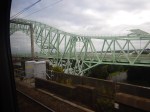
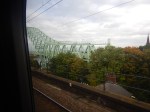

They were taken from a train on the railway bridge.
 The Anonymous Widower