UK Energy Exports To Europe At Record High
The title of this post, is the same as that of this article on The Times.
This is the first two paragraphs.
Britain has exported record amounts of gas to Europe so far this year as its liquefied natural gas terminals receive shipments destined for the Continent.
Electricity exports also have surged to unprecedented highs in recent weeks after an unexpected glut of gas pushed down short-term gas prices and resulted in gas-fired power plants generating more for export.
Who’d have thought it, that all those gas pipelines and electricity interconnectors between the UK and the Continent of Europe would be part of the replacementliqui for Russian gas.
According to Wikipedia, we have three liquified natural gas terminals; two at Milford Haven; South Hook and Dragon, and Grain on the Isle of Grain.
Note.
- South Hook is Europe’s largest liquified natural gas terminal and is owned by a partnership of the Qataris, ExxonMobil and Elf.
- South Hook and Dragon together can provide 25 % of the UK’s natural gas needs.
- Grain is owned by National Grid and according to Wikipedia, is in terms of storage capacity it is the largest LNG facility in Europe and the eighth largest in the world.
- Grain can supply 20 % of the UK’s natural gas needs.
- Grain has a reloading facility, so that gas can be exported.
- Grain seems to be continually expanding.
- Both Milford Haven and the Isle of Grain have large gas-fired power-stations.
Politicians say we don’t have enough gas storage, but we do seem to have world-class LNG terminals.
I have a couple of extra thoughts.
Blending Natural Gas With Hydrogen
HyDeploy is a project investigated blending hydrogen natural gas to cut carbon emissions. The project is described in this post called HyDeploy.
Surely, these terminals could be places, where hydrogen is blended with our natural gas supply.
- The terminals are connected to the UK gas network.
- Both Milford Haven and the Isle of Grain should have access to large amounts of offshore wind energy in the next few years, which could be used to generate green hydrogen.
- The terminals would need electrolysers to generate the hydrogen.
The Isle of Grain already has a blending capability.
NeuConnect
NeuConnect is an under-development interconnector between the Isle of Grain in Kent and Wilhelmshaven in Germany.
- It will have a capacity 1.4 GW.
- All the planning permissions seem to be in place.
- Prysmian have won a € 1.2 million contract to deliver the interconnector.
- Arup and German engineering firm Fichtner have formed a joint venture to provide project services for the interconnector.
- Construction could start this year.
It looks like the Germans will be replacing some of Putin’s bloodstained gas with clean zero-carbon energy from the UK.
Should We Develop More Gas Fields?
There are some gas fields in the seas around the UK, like Jackdaw, that could be developed.
Suppose, we extracted the gas and sent it to the reloading terminal on the Isle of Grain through the gas transmission network, where it could be exported by ship, to the Continent.
The UK would not be increasing its carbon emissions, as that would surely be the responsibility of the end-user.
Should We Develop More Gas Fired Power-Stations?
I believe it is possible to develop carbon-capture technology for gas-fired power stations.
The carbon dioxide would be either used in a beneficial way or stored in perhaps a worked-out gas field under the North Sea.
So long as no carbon dioxide is released into the atmosphere, I don’t see why more gas-fired power stations shouldn’t be developed.
What is happening at Keadby near Scunthorpe would appear to be one model for zero-carbon power generation.
Keadby Power Station
This is an existing
Conclusion
We will be exporting more energy to the Continent.
Ofgem Enables National Grid To Make Early Payment Of Interconnector Revenues, Helping To Reduce Household Bills
The title of this post, is the same as that of this press release from National Grid.
These are the first three paragraphs.
National Grid has offered to pay £200m of interconnector revenues ahead of schedule rather than at the end of the standard five-year review period to play its part in reducing household energy bills.
Interconnectors, which are subsea electricity cables connecting the UK and Europe, enable the import of cheaper, cleaner energy from European neighbours, supporting security of supply and reducing carbon emissions.
It’s estimated that National Grid’s interconnector portfolio will help the UK avoid around 100 million tonnes of carbon emissions by 2030.
Ofgem has approved National Grid’s request to make early payments.
These are my thoughts.
What’s In It For Consumers?
National Grid is making a payment early, so they are not getting anything, they won’t eventually get.
But they are getting it early!
What’s In It For National Grid?
As National Grid is making a payment early, they are forgoing interest on the £200 million.
In New Electricity ‘Superhighways’ Needed To Cope With Surge In Wind Power, I talked about National Grid’s plan to build new North-South interconnectors, that would handle all the extra wind-power.
National Grid currently owns all or part of these operating or planned interconnectors.
- BritNed
- HVDC Cross-Channel
- IceLink
- IFA-2
- Isle of Man to England Interconnector
- NemoLink
- North Sea Link
- Viking Link
- Western HVDC Link
National Grid would appear to have a substantial interest in the UK’s interconnectors and is the £200 million payment to ensure they get the contract to build and operate any new UK interconnectors? I’m not saying it’s a bribe, but it’s just operating the interconnectors in a manner that is an advantage to the UK and its electricity customers.
Surely, if the ultimate customers are happy, there will be less calls for the break-up of National Grid.
What Is A Cap And Floor Regime?
The press release explains a cap and floor regime like this.
Ofgem’s cap and floor regime sets a yearly maximum (cap) and minimum (floor) level for the revenues that the interconnector licensees can earn over a 25-year period. Usually, revenues generated by the interconnector are compared against the cap and floor levels over five-year periods. Top-up payments are made to the interconnector licensee if revenues are lower than the floor; and similarly, the licensee pays revenues in excess of the cap to consumers.
Ofgem’s approval enables National Grid to make payments of above cap revenues significantly earlier than originally planned, which will contribute to reducing consumer energy costs over the next two years. National Grid is now working with Ofgem to explore how to ensure the early payments can have the most impact for consumers.
I wonder if Ofgem and National Grid feel that a cap and floor regime is not only good for them, but for electricity consumers as well.
Cap And Floor Regimes And Energy Storage
There has been talk that cap and floor regimes should be used for energy storage.
This article on Current News is entitled Cap And Floor Mechanism The ‘Standout Solution’ For Long Duration Storage, KPMG Finds.
These are the first two paragraphs.
A cap and floor regime would be the most beneficial solution for supporting long duration energy storage, a KPMG report has found.
Commissioned by Drax, the report detailed how there is currently no appropriate investment mechanism for long duration storage. Examining four investment mechanisms – the Contracts for Difference (CfD) scheme, Regulated Asset Value (RAV) model, cap and floor regime and a reformed Capacity Market – it identified cap and floor as the best solution.
I also suspect that if the operator does a National Grid with the revenues, a cap and floor regime, must be even better.
I would not be surprised to see schemes like Coire Glas pumped hydro operating under a cap and floor regime.
Effect On Other Energy Companies
Wind farms seem to be operated under the Contracts for Difference scheme in many cases, but will we see cap and floor regimes being used in this market?
I can certainly see a new regime emerging, that is better for investors, wind farm builders, consumers and the Treasury.
In some ways keeping a happy relationship between the investors, Government and consumers is most important. So as National Grid, the Government and consumers don’t seem to be jumping up and down about their cap-and-floor regime, it must be working reasonably well!
Conclusion
Get the right regime and quality investors could be flocking to the UK’s energy generation and supply industry.
National Grid by their actions in paying up early, have thoroughly endorsed the system.
A Resilient Net Zero Electricity System Achievable By 2035 But Increased Investment Required, Regen Report Finds
The title of this post, is the same as that of this article on Current News.
This is the first two paragraphs.
The technical solutions needed to operate a net zero electricity system by 2035 are available or attainable, Regen has found, though a step-change in the level of investment is still needed.
The trade body has produced a new report for National Grid ESO into a ‘day in the life’ of a fully decarbonized electricity system by 2035, which the ESO is aiming for.
The article gives a lot of figures about our electricity supply in 2035.
Consumption of electricity will be between 450 and 500TWh per year, with the following sources.
- 55-65GW of offshore wind
- 25-35GW onshore wind
- 40-50GW of solar
- 6-10GW of other renewables
- 10-15GW of low carbon dispatch
- 8-10GW of nuclear
- 8-12GW of carbon capture and storage (CCS)
- 15-25GW of fossil fuel backup.
Note.
- 450-500 TWh is 51-57 GW per hour averaged out over the year.
- They emphasise the importance of energy storage.
- No mention is made of the massive Coire Glas pumped hydro storage.
- No mention is made of hydrogen.
- As is normal, with reports like this the authors don’t keep their GW and GWh separate.
- They also don’t explain the hierarchy of MW, GW and TW, which is 1000 x steps up the scale.
The full report is at this page on the Internet.
National Grid ESO And Reactive Technologies Launch Flagship Inertia System To Measure Grid Stability
The title of this post is the same as that of this article on Current News.
The first three paragraphs explain the project.
National Grid ESO and Reactive Technologies’ flagship grid stability measurement service has launched today, following the construction of the world’s largest continuously operating grid-scale ultracapacitor.
Using Reactive’s GridMetrix technology, the new services will provide instantaneous data to the grid operator, allowing for more efficient management than relying on estimates.
The ultracapacitor – constructed by Spanish technology group Ingeteam – sends pulses through the grid, which act like underwater sound waves used in sonar. These pulses will enable the ESO to measure power system stability.
As a Control and Electrical Engineer, I can just about get my brain around what is happening, but I do feel the explanation could be better.
- There is no mention of the size of the capacitor.
- Capacitors are often used to calm voltages in electrical circuits.
- How does the capacitor send pulses through the grid? It must be some other piece of kit linked to the capacitor.
In the end though, I don’t care, if it works.
New Electricity ‘Superhighways’ Needed To Cope With Surge In Wind Power
The title of this post, is the same as that of this article on the Telegraph.
This is the first two paragraphs.
Energy companies are pushing for the rapid approval of new electricity “superhighways” between Scotland and England amid fears that a lack of capacity will set back the country’s wind power revolution.
Businesses including SSE and Scottish Power are calling on the industry regulator Ofgem to approve a series of major new north-south power cables in a bid to ease congestion on the existing electricity network.
These points are mentioned in the article.
- Current capacity is 6 GW, which even now is not enough.
- Another 17 GW of capacity will be needed by 2033.
- Wind farms in Scotland have been switched off and replaced by gas-fired power stations because of a lack of grid capacity.
- Another 25 GW of wind farms could be built after leases were awarded last month.
Two North-South interconnectors are being planned.
Peterhead And Drax
This is being proposed by SSE and National Grid.
- It will be an undersea cable.
- It will be two cables, each with a capacity of 2 GW.
- Peterhead and Drax power station are four hundred miles apart by road and 279 miles as the seagull flies, as a lot of the route would be over the sea. So an undersea connection would appear to be sensible.
- Peterhead is on the coast, so connecting an undersea interconnector shouldn’t be too challenging or disruptive to the locals.
- Drax power station is a 4 GW power station and the largest in the UK, so it must have good grid connections.
This Google Map shows the location of Drax power station in relation to Hull, Scunthorpe and the rivers in the area.
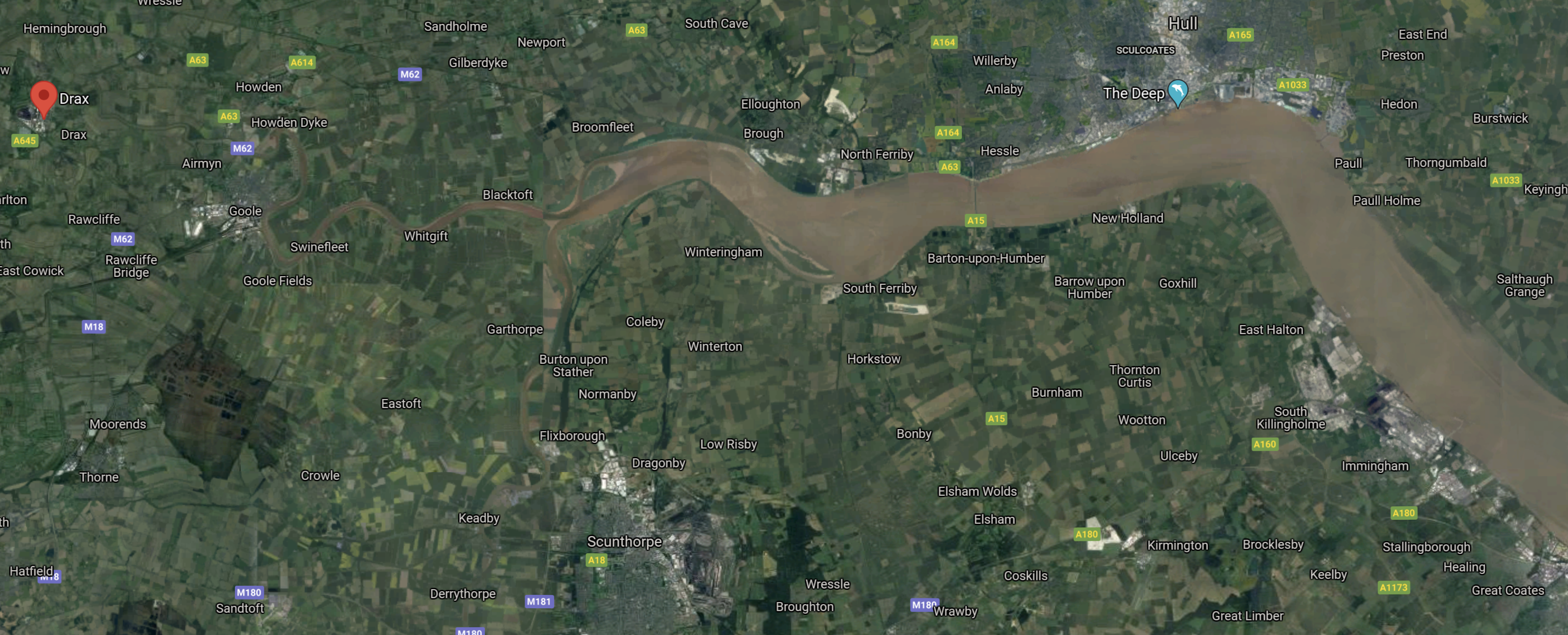
Note.
- Drax is marked by the red arrow in the West of the map.
- The large body of water in the East is the Humber Estuary.
- Hull is on the North Bank of the Humber.
- Scunthorpe, which is famous for its steel industry is South of the Humber in the middle of the map.
- To the West of Scunthorpe the Humber splits into the Trent and the Ouse.
- The Ouse leads all the way to Drax power station.
I suspect an undersea cable could go up the Humber and Ouse to Drax power station.
Is it a coincidence that both Drax power station and the proposed link to Peterhead are both around 4 GW?
Consider.
- Drax is a biomass power station, so it is not a zero carbon power station.
- Drax produces around six percent of the UK’s electricity.
- Most of the biomass comes by ship from North America.
- Protest groups regularly have protests at Drax because of its carbon emissions.
- Drax Group are experimenting with carbon capture.
- Drax is a big site and a large energy storage system could be built there.
- Wind is often criticised by opponents, saying wind is useless when the wind doesn’t blow.
- The Scots would be unlikely to send power to England, if they were short.
This is also said about Drax in Wikipedia.
Despite this intent for baseload operation, it was designed with a reasonable ability for load-following, being able to ramp up or down by 5% of full power per minute within the range of 50–100% of full power.
I take this it means it can be used to top up electricity generation to meet demand. Add in energy storage and it could be a superb load-follower.
So could the similar size of the interconnector and Drax power station be deliberate to guarantee England a 4 GW feed at all states of the wind?
I don’t think it is a coincidence.
Torness And Hawthorn Pit And Torness and South Humberside
These two cables are being proposed by Scottish Power.
- Each will be two GW.
- Torness is the site of the 1.36 GW Torness nuclear power station, which is likely to be decommissioned before 2030.
- Torness will have good grid connections and it is close to the sea.
- Hawthorn Pit is a large closed coal mine to the North of Newcastle, with a large substation close to the site. I suspect it will be an ideal place to feed power into the grid for Newcastle and it is close to the sea.
- Just South of Hawthorn Pit are the 1.32 GW Hartlepool nuclear power station, which will be decommissioned in 2024 and the landfall of the cables to the massive Dogger Bank wind farm.
- As I showed earlier with Drax, the Humber would be an ideal estuary to bring underwater power cables into the surrounding area. So perhaps the cable will go to Scunthorpe for the steelworks.
- As at Drax, there is backup in South Humberside, but here it is from the two Keadby gas-fired power stations.
The article in the Telegraph only gives the briefest of details of Scottish Power’s plans, but I suspect, that given the locations of the ends of the interconnectors, I suspect the cables will be underwater.
Conclusion
It strikes me that all three interconnectors have been well thought thought and they serve a variety of objectives.
- Bring Scottish wind power, South to England.
- Connect wind farms to the two nuclear power station sites at Hartlepool and Torness, that will close at the end of the decade.
- Allow the big 4 GW biomass-fired station at Drax to back up wind farms and step in when needed.
- Cut carbon emissions at Drax.
- Use underwater cables as much as possible to transfer the power, to avoid the disruption of digging in underground cables.
It looks to be a good plan.
National Grid Bets On Surge Pricing And Electric Cars To Avoid Another Energy Crisis
The title of this post is the same as that of this article on the Telegraph.
These are the first few paragraphs.
With wind supplies forecast to be low and other energy sources offline, a power crunch was looming by teatime the next day.
A call for help went out on a Tuesday afternoon and at 4.30pm on the Wednesday, electric car drivers plugged in special chargers to export power from their car batteries back to the grid, as part of a trial run by Ovo Energy.
Their efforts in November 2020 may have amounted to only a tiny portion of the power needed on that day, but it was a taste of things to come.
Cars and other devices will be both a source of electricity demand and a helpful tool to keep the lights on as the UK tries to build a much greener energy system at the least expense.
It is as the article says the shape of things to come.
I also believe that long-term car parking at places like airports will become storage batteries in the future. You will tell your car, when you will be returning and it will be fully charged to drive home, when you arrive. If you are running late, you would probably use an app to tell your car the new arrival time.
These developments will all be part of the Internet of Power.
Is There A Need For A Norfolk-Suffolk Interconnector?
The coast of East Anglia from the Wash to the Haven Ports of Felixstowe, Harwich and Ipswich is becoming the Energy Coast of England.
Starting at the Wash and going East and then South, the following energy-related sites or large energy users are passed.
Bicker Fen Substation
Bicker may only be a small hamlet in Lincolnshire, but it is becoming increasingly important in supplying energy to the UK.
Nearby is Bicker Fen substation, which connects or will connect the following to the National Grid.
- The 26 MW Bicker Fen onshore windfarm.
- The 1,400 MW interconnector from Denmark called Viking Link.
- The proposed 857 MW offshore wind farm Triton Knoll.
This Google Map shows the location of Bicker Fen with respect to The Wash.
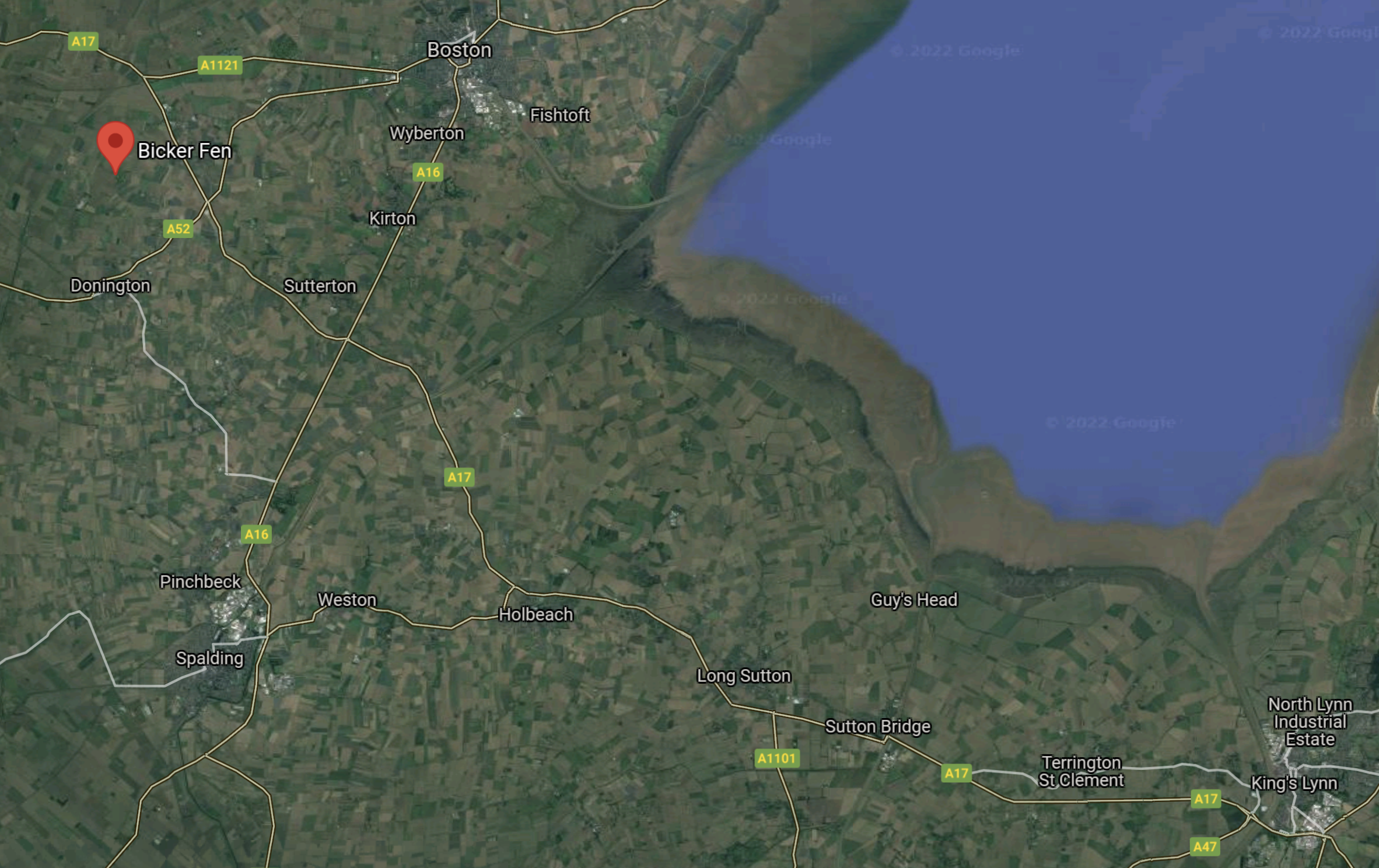
Bicker Fen is marked by the red arrow.
The Google Map shows the substation.
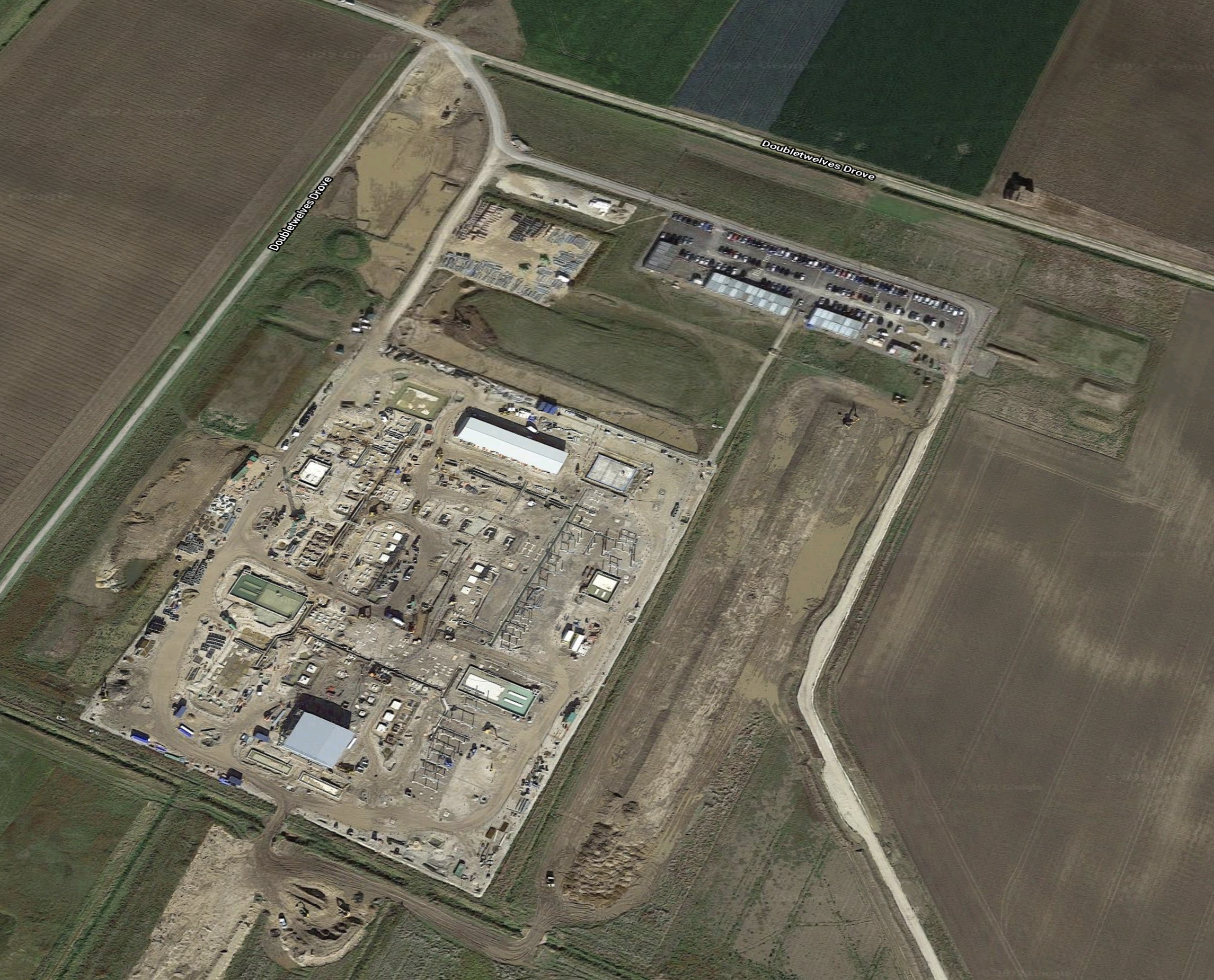
It must be sized to handle over 2 GW, but is it large enough?
Dudgeon Offshore Wind Farm
The Dudgeon offshore wind farm is a 402 MW wind farm, which is twenty miles off the North Norfolk coast.
- It has 67 turbines and an offshore substation.
- It is connected to the shore at Weybourne on the coast from where an underground cable is connected to the National Grid at Necton.
- It became operational in Oct 2017.
- Equinor and Statkraft are part owners of the windfarm and this is the home page of the wind farm’s web site.
- Equinor is the operator of the wind farm.
This Google Map shows the location of Weybourne on the coast.
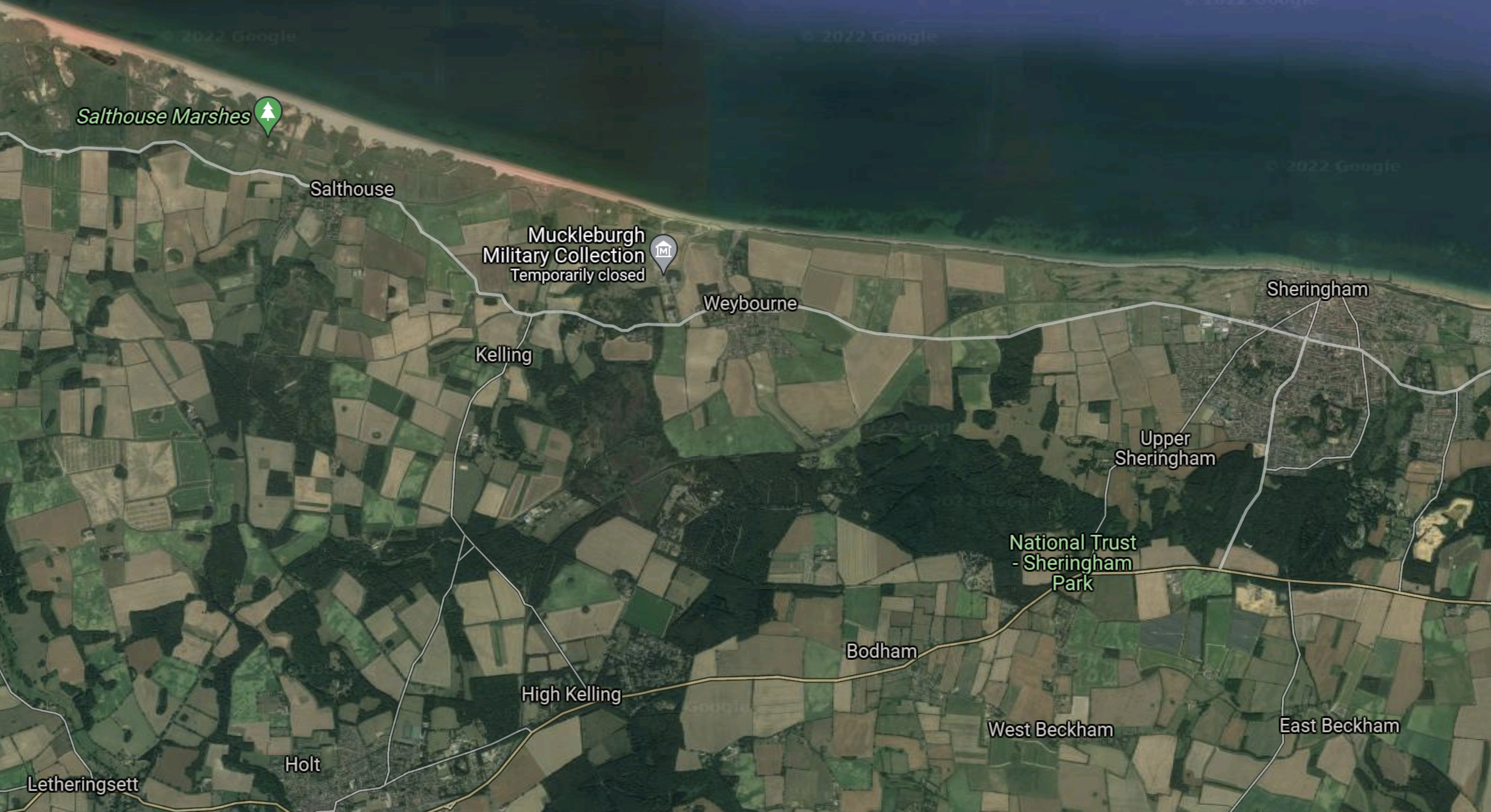
Note.
- Weybourne is in the middle on the coast.
- Sheringham is on the coast in the East.
- Holt is on the Southern edge of the map almost South of Weybourne.
This second map shows the location of the onshore substation at Necton, with respect to the coast.
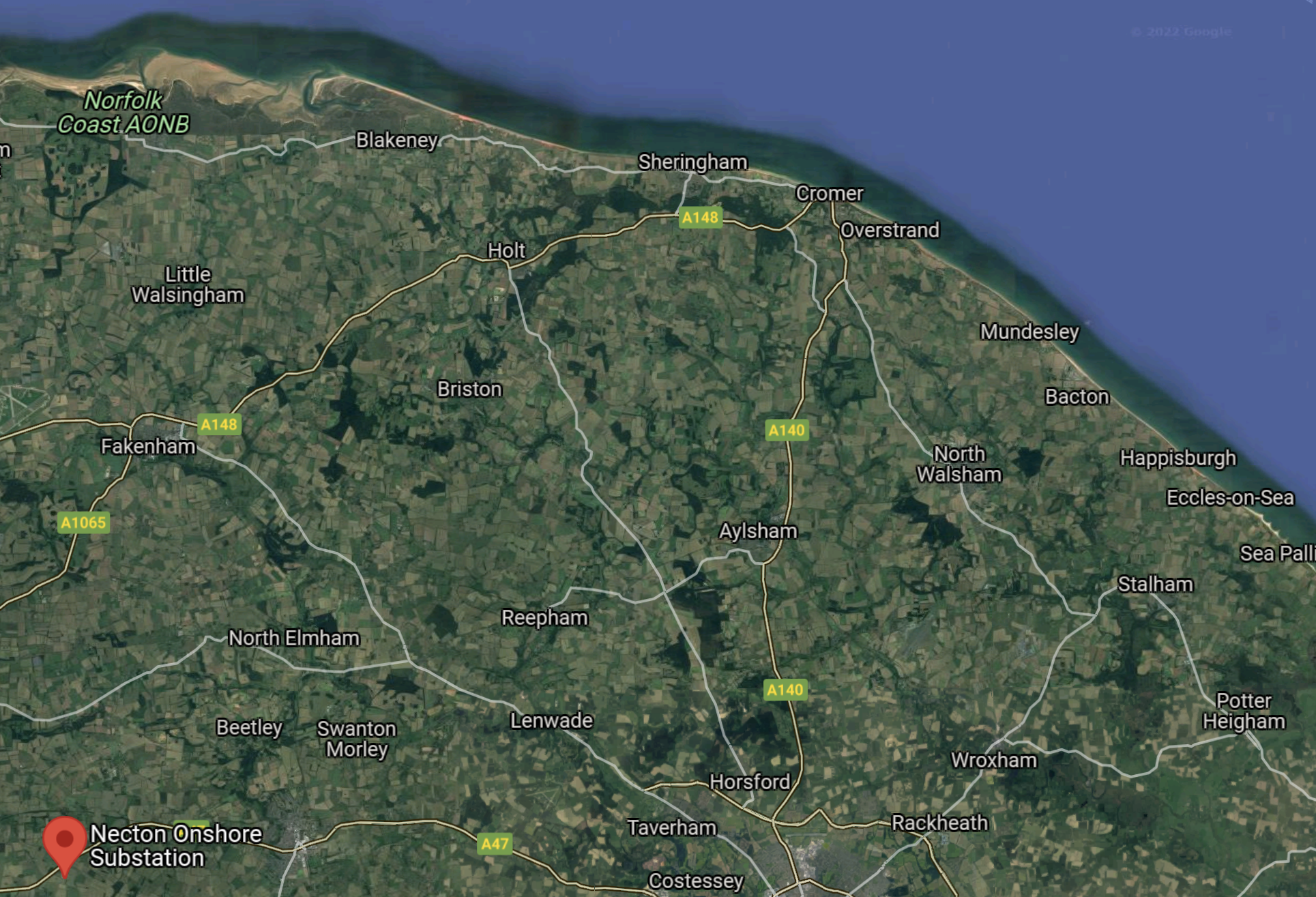
Note.
- The Necton substation is marked by a red arrow.
- Holt and Sheringham can be picked out by the coast in the middle.
- Weybourne is to the West of Sheringham.
- Necton and Weybourne are 35 miles apart.
Digging in the underground cable between Necton and Weybourne might have caused some disruption.
Looking at Weybourne in detail, I can’t find anything that looks like a substation. So is the Necton substation connected directly to Dudgeon’s offshore substation?
Sheringham Shoal Offshore Wind Farm
The Sheringham Shoal offshore wind farm is a 316.8 MW wind farm, which is eleven miles off the North Norfolk coast.
- It has 88 turbines and two offshore substations.
- As with Dudgeon, it is connected to the shore at Weybourne on the coast.
- But the underground cable is connected to an onshore substation at Salle and that is connected to the National Grid at Norwich.
- It became operational in Sept 2012.
- Equinor and Statkraft are part owners of the windfarm and this is the home page of the wind farm’s web site.
- Equinor is the operator of the wind farm.
This second map shows the location of the onshore substation at Salle, with respect to the coast.

Note.
- The Salle substation is marked by a red arrow.
- Holt, Weybourne and Sheringham can be picked out by the coast in the middle.
- Weybourne is to the West of Sheringham.
- Salle and Weybourne are 13.5 miles apart.
Could the following two statements be true?
- As the Sheringham Shoal wind farm was built first, that wind farm was able to use the shorter route.
- It wasn’t built large enough to be able to handle the Dudgeon wind farm.
The statements would certainly explain, why Dudgeon used a second cable.
Extending The Dudgeon And Sheringham Shoal Wind Farms
Both the Dudgeon And Sheringham Shoal web sites have details of the proposed join extension of both wind farms.
This is the main statement on the Overview page.
Equinor has been awarded an Agreement for Lease by the Crown Estate, the intention being to seek consents to increase the generating capacity of both the Sheringham Shoal Offshore Wind Farm and the Dudgeon Offshore Wind Farm.
They then make three points about the development.
- Equinor is proposing a joint development of the two projects with a common transmission infrastructure.
- As part of the common DCO application, the Extension Projects have a shared point of connection at the National Grid Norwich Main substation.
- These extension projects will have a combined generating capacity of 719MW which will make an important contribution to the UK’s target of 30GW of electricity generated by offshore wind by 2030.
This statement on the Offshore Location page, describes the layout of the wind farms.
The Sheringham Shoal Offshore Wind Farm extension is to the north and the east of the existing wind farm, while its Dudgeon counterpart is to the north and south east of the existing Dudgeon Offshore Wind Farm site. The proposed extension areas share the boundaries with its existing wind farm site.
They then make these two important points about the development.
- Equinor is seeking to develop the extension project with a joint transmission infrastructure. A common offshore substation infrastructure is planned to be located in the Sheringham Shoal wind farm site.
- The seabed export cable which will transmit the power generated by both wind farm extensions will make landfall at Weybourne.
There is also this map.

Note.
- The purple line appears to be the UK’s ten mile limit.
- The Sheringham Shoal Extension is outlined in red.
- The Dudgeon Extension is outlined in blue.
- The black lines appear to be the power cables.
I suspect the dotted blue lines are shipping routes sneaking their way through the turbines.
This statement on the Onshore Location page, describes the layout of the offshore and onshore cables.
A new seabed export cable will bring the electricity generated by both the Sheringham Shoal and Dudgeon Offshore Wind Farm extensions to shore at Weybourne, on the coast of Norfolk.
They then make these two important points about the development.
- From there a new underground cable will be installed to transmit that power to a new purpose built onshore substation, which will be located within a 3km radius of the existing Norwich main substation, south of Norwich. This will be the National Grid network connection point for the electricity from both wind farm extensions.
- The power will be transmitted from landfall to the substation using an HVAC system which eliminates the need for any relay stations along the onshore cable route.
There is also this map.
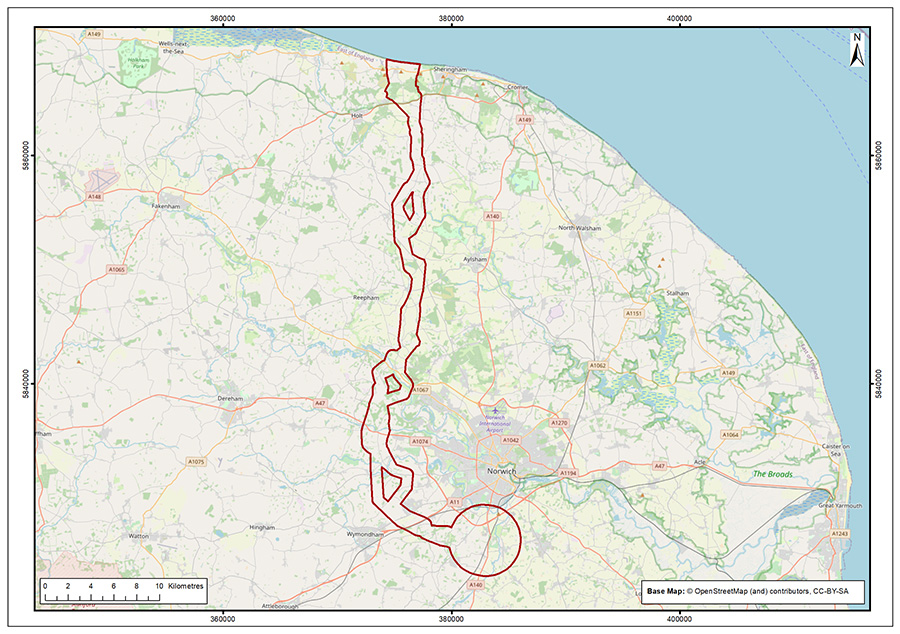
It will be a substantial undertaking to build the underground cable between Weybourne and South of Norwich.
Bacton Gas Terminal
The Bacton gas terminal is a complex of six gas terminals about ten miles East of Cromer.
- It lands and processes gas from a number of fields in the North Sea.
- It hosts the UK end of the BBL pipeline to The Netherlands.
- It hosts the UK end of the Interconnector to Zeebrugge in Belgium.
- The Baird and Deborah fields, which have been developed as gas storage, are connected to the gas terminal. They are both mothballed.
This Google Map shows the location of the terminal.
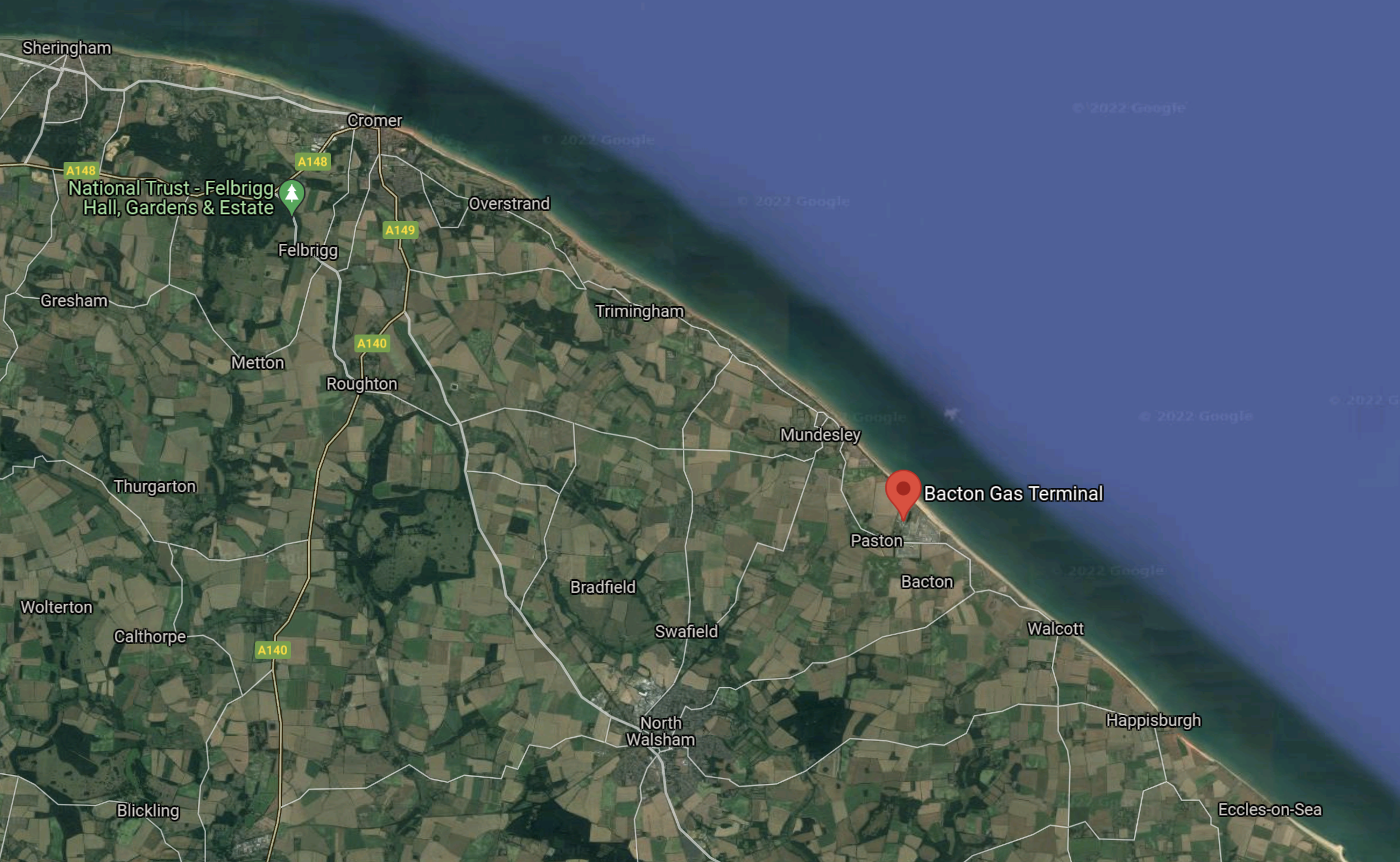
Note.
- The Bacton gas terminal is marked by a red arrow.
- Sheringham is in the North West corner of the map.
- Cromer, Overstrand, Trimingham and Mundesley are resort towns and villages along the coast North of Bacton.
This second map shows the Bacton gas terminal in more detail.
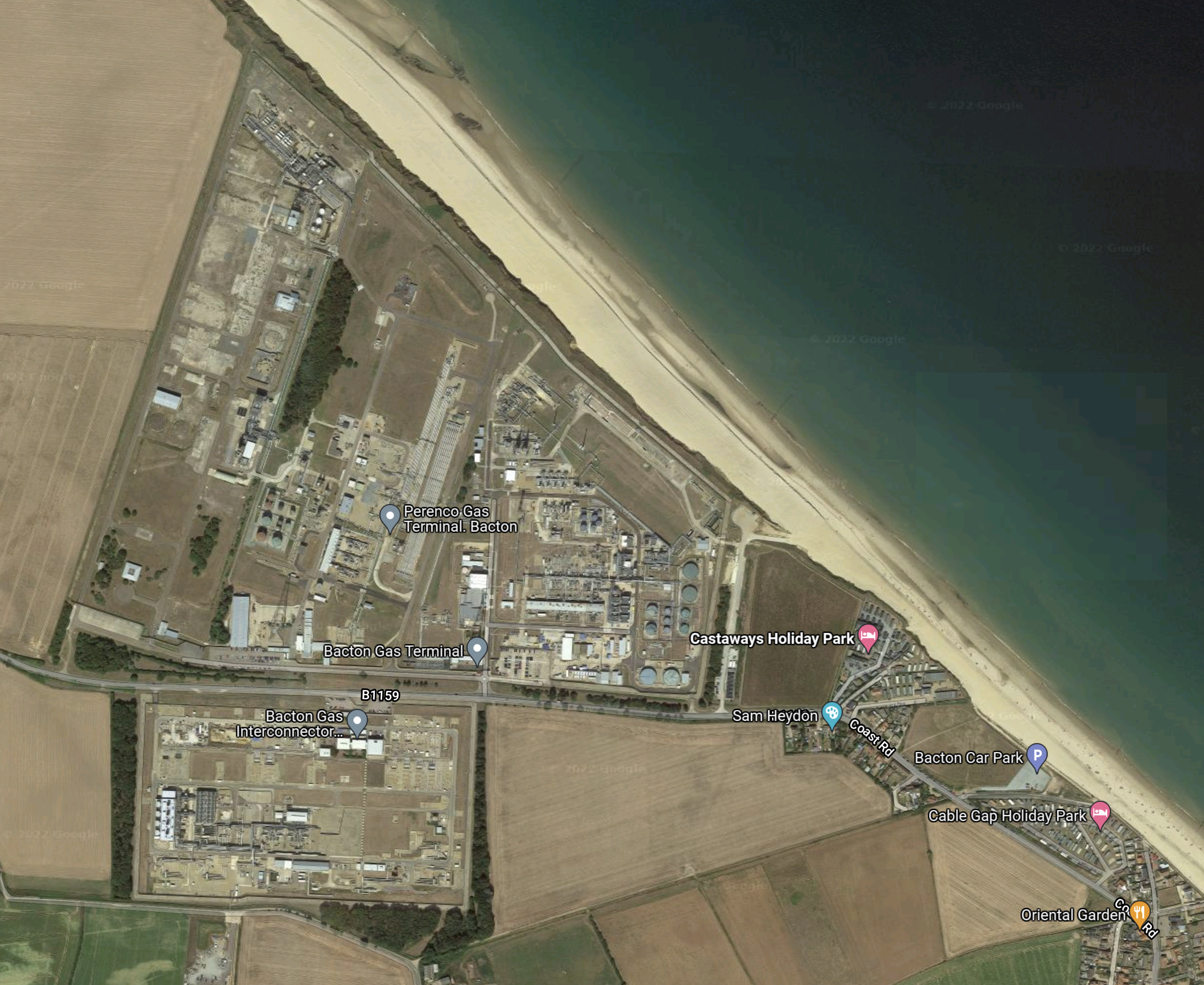
Would you want to have a seaside holiday, by a gas terminal?
Norfolk Boreas And Norfolk Vanguard
Norfolk Boreas and Norfolk Vanguard are two wind farms under development by Vattenfall.
- Norfolk Boreas is a proposed 1.8 GW wind farm, that will be 45 miles offshore.
- Norfolk Vanguard is a proposed 1.8 GW wind farm, that will be 29 miles offshore.
This map shows the two fields in relation to the coast.
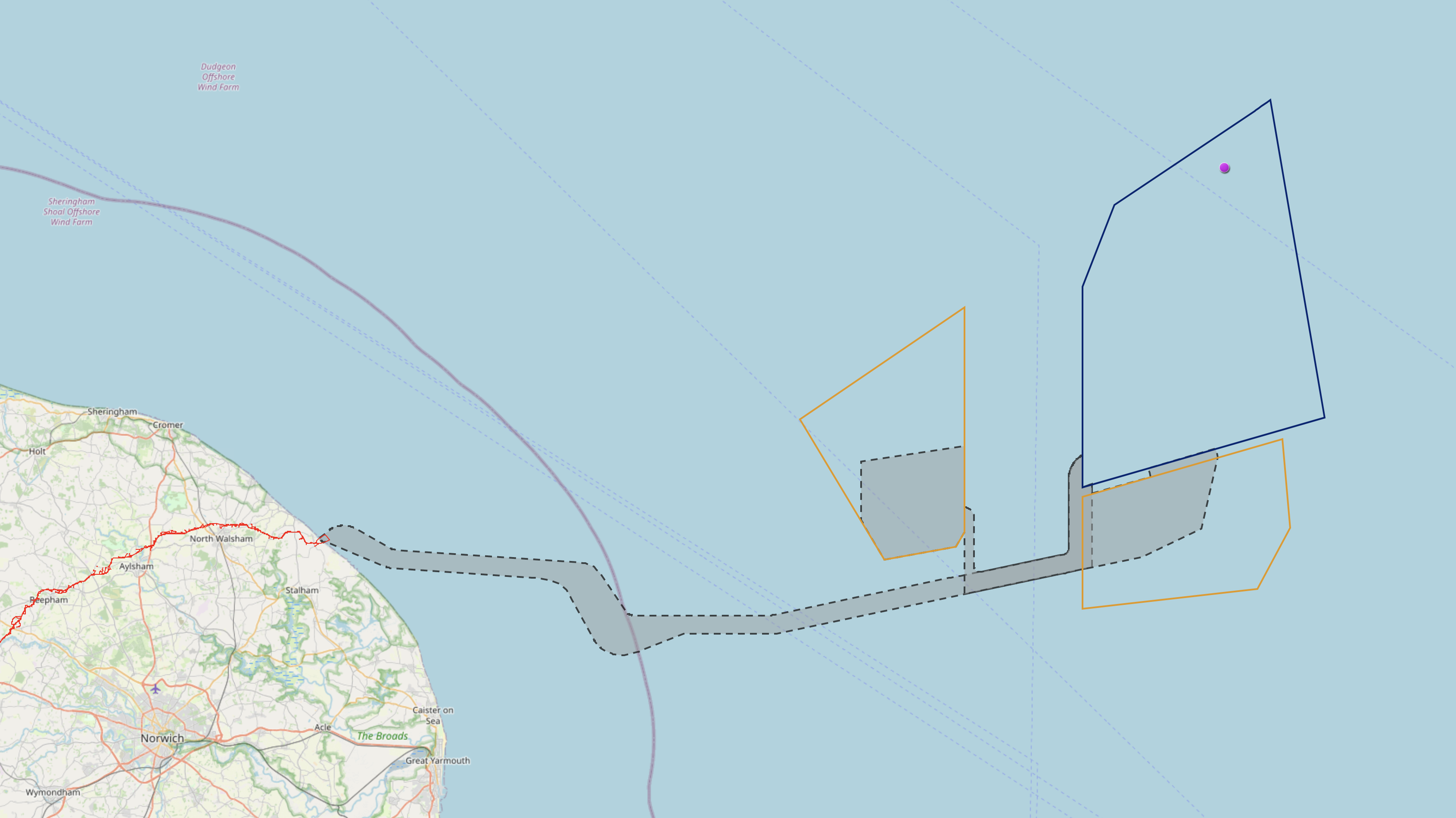
Note.
- The purple line appears to be the UK’s ten mile limit.
- Norfolk Boreas is outlined in blue.
- Norfolk Vsnguard is outlined in orange.
- Cables will be run in the grey areas.
This second map shows the onshore cable.
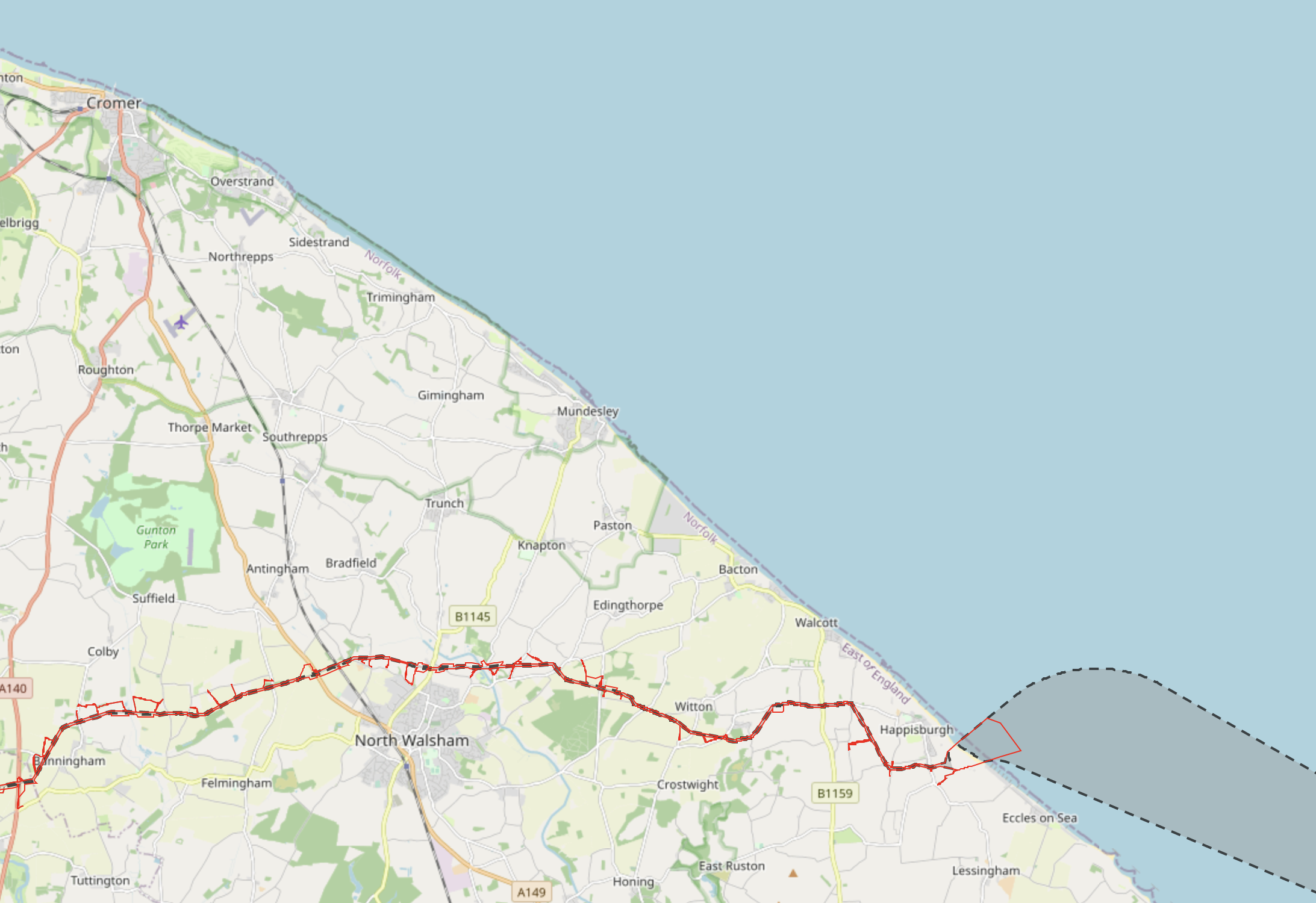
Note.
- The cables are planned to come ashore between Happisburgh and Eccles-on-Sea.
- Bacton gas terminal is only a short distance up the coast.
- The onshore cable is planned to go from here across Norfolk to the Necton substation.
But all of this has been overturned by a legal ruling.
This article on the BBC is entitled Norfolk Vanguard: Ministers Wrong Over Wind Farm Go-Ahead, Says Judge.
These are the first four paragraphs.
A High Court judge has quashed permission for one of the world’s largest offshore wind farms to be built off the east coast of England.
The Norfolk Vanguard Offshore Wind Farm was granted development consent in July by the Secretary of State for Business, Energy and Industrial Strategy (BEIS).
But Mr Justice Holgate overturned the decision following legal action from a man living near a planned cable route.
A Department for BEIS spokeswoman said it was “disappointed by the outcome”.
I bet the spokeswoman was disappointed.
Vattenfall and the BEIS will go back to the drawing board.
But seriously, is it a good idea to dig an underground cable all the way across Norfolk or in these times build a massive overhead cable either?
Perhaps the solution is to connect the Norfolk Boreas And Norfolk Vanguard wind farms to a giant electrolyser at Bacton, which creates hydrogen.
- The underground electricity cable across Norfolk would not be needed.
- Bacton gas terminal is only a few miles up the coast from the cable’s landfall.
- The UK gets another supply of gas.
- The hydrogen is blended with natural gas for consumption in the UK or Europe.
- A pure hydrogen feed can be used to supply hydrogen buses, trucks and other vehicles, either by tanker or pipeline.
- Excess hydrogen could be stored in depleted gas fields.
The main benefit though, would be that it would transform Bacton gas terminal from a declining asset into Norfolk’s Hydrogen Powerhouse.
Great Yarmouth And Lowestoft
Great Yarmouth Outer Harbour and the Port of Lowestoft have not been the most successful of ports in recent years, but with the building of large numbers of wind farms, they are both likely to receive collateral benefits.
I wouldn’t be surprised to see the support ships for the wind farms switching to zero-carbon power, which would require good electrical connections to the ports to either charge batteries or power electrolysers to generate hydrogen.
Sizewell
Sizewell has only one nuclear power station at present; Sizewell B, but it could be joined by Sizewell C or a fleet of Small Modular Reactors (SMR).
The Sizewell Overhead Transmission Line
Sizewell also has a very high capacity overhead power line to Ipswich and the West.





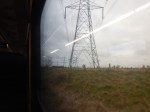
I doubt, it would be possible to build an overhead transmission line like this today.
Sizewell And Hydrogen
EdF, who own the site are involved with Freeport East and may choose to build a large electrolyser in the area to create hydrogen for the Freeport.
East Anglia Array
The East Anglia Array will be an enormous wind farm., comprising up to six separate projects.
It will be thirty miles offshore.
It could generate up to 7.2 GW.
The first project East Anglia One is in operation and delivers 714 MW to a substation in the Deben Estuary, which connects to the Sizewell high-capacity overhead power line.
Most projects will be in operation by 2026.
Freeport East
As the Freeport develops, it will surely be a massive user of both electricity and hydrogen.
Problems With The Current Electricity Network
I don’t believe that the current electricity network, that serves the wind farms and the large energy users has been designed with the number of wind farms we are seeing in the North Sea in mind.
Every new windfarm seems to need a new connection across Norfolk or Suffolk and in Norfolk, where no high-capacity cables exist, this is stirring up the locals.
There is also no energy storage in the current electricity network, so at times, the network must be less than efficient and wind turbines have to be shut down.
Objections To The Current Policies
It is not difficult to find stories on the Internet about objections to the current policies of building large numbers of wind farms and the Sizewell C nuclear power station.
This article on the East Anglia Daily Times, which is entitled Campaigners Unite In Calling For A Pause Before ‘Onslaught’ Of Energy Projects ‘Devastates’ Region is typical.
This is the first paragraph.
Campaigners and politicians have called on the Government to pause the expansion of the energy industry in Suffolk, which they fear will turn the countryside into an “industrial wasteland” and hit tourism.
The group also appear to be against the construction of Sizewell C.
I feel they have a point about too much development onshore, but I feel that if the UK is to thrive in the future we need an independent zero carbon energy source.
I also believe that thousands of wind farms in the seas around the UK and Ireland are the best way to obtain that energy.
Blending Hydrogen With Natural Gas
Blending green hydrogen produced in an electrolyser with natural gas is an interesting possibility.
- HyDeploy is a project to investigate blending up to 20 % of green hydrogen in the natural gas supply to industrial and domestic users.
- Partners include Cadent, ITM Power, Keele University and the Health and Safety Executive.
- Natural gas naturally contains a small amount of hydrogen anyway.
- The hydrogen gas would be distributed to users in the existing gas delivery network.
I wrote about HyDeploy in a post called HyDeploy.
Thje only loser, if hydrogen were to be blended with natural gas would be Vlad the Poisoner, as he’d sell less of his tainted gas.
An Interconnector Between Bicker Fen And Freeport East
I believe that an electricity interconnector between at least Bicker Fen and Freeport East could solve some of the problems.
My objectives would be.
- Avoid as much disruption on the land as possible.
- Create the capacity to deliver all the energy generated to customers, either as electricity or hydrogen.
- Create an expandable framework, that would support all the wind farms that could be built in the future.
The interconnector would be a few miles offshore and run along the sea-bed.
- This method of construction is well proven.
- It was used for the Western HVDC Link between Hunterston in Scotland and Connah’s Quay in Wales.
- Most wind farms seem to have existing substations and these would be upgraded to host the interconnector.
Connections en route would include.
Dudgeon Offshore Wind Farm
The interconnector would connect to the existing offshore substation.
Sheringham Shoal Wind Farm
The interconnector would connect to the existing offshore substation.
Dudgeon and Sheringham Shoal Extension Offshore Wind Farms
These two wind farms could be connected directly to the interconnector, if as planned, they shared an offshore substation in the Sheringham Shoal Extension offshore wind farm.
Bacton Gas Terminal
I would connect to the Bacton Gas Terminal, so that a large electrolyser could be installed at the terminal.
The hydrogen produced could be.
- Stored in depleted gas fields connected to the terminal.
- Blended with natural gas.
- Exported to Europe through an interconnector.
- Supplied to local users by truck or pipeline.
After all, the terminal has been handling gas for over fifty years, so they have a lot of experience of safe gas handling.
Norfolk Boreas And Norfolk Vanguard
These two wind farms could be connected directly to the interconnector, if they shared an offshore substation.
It would also help to appease and silence the objectors, if there was no need to dig up half of Norfolk.
Great Yarmouth And Lowestoft
It might be better, if these ports were supplied from the interconnector.
- Either port could have its own electrolyser to generate hydrogen, which could be.
- Used to power ships, trucks and port equipment.
- Liquefied and exported in tankers.
- Used to supply local gas users.
- Hydrogen could be supplied to a converted Great Yarmouth power station.
Both Great Yarmouth and Lowestoft could become hydrogen hub towns.
Sizewell
This site has a high-capacity connection to the National Grid. This connection is a big eyesore, but it needs to run at full capacity to take electricity from the Energy Coast to the interior of England.
That electricity can come from Sizewell B and/or Sizewell C nuclear power stations or the offshore wind farms.
East Anglia Array
There would probably need to be a joint offshore substation to control the massive amounts of electricity generated by the array.
Currently, the only wind farm in operation of this group is East Anglia One, which uses an underground cable connection to the Sizewell high-capacity connection to the Bullen Lane substation at Bramford.
Freeport East, Ipswich And Bullen Lane Substation
This Google Map shows the area between Ipswich and the coast.
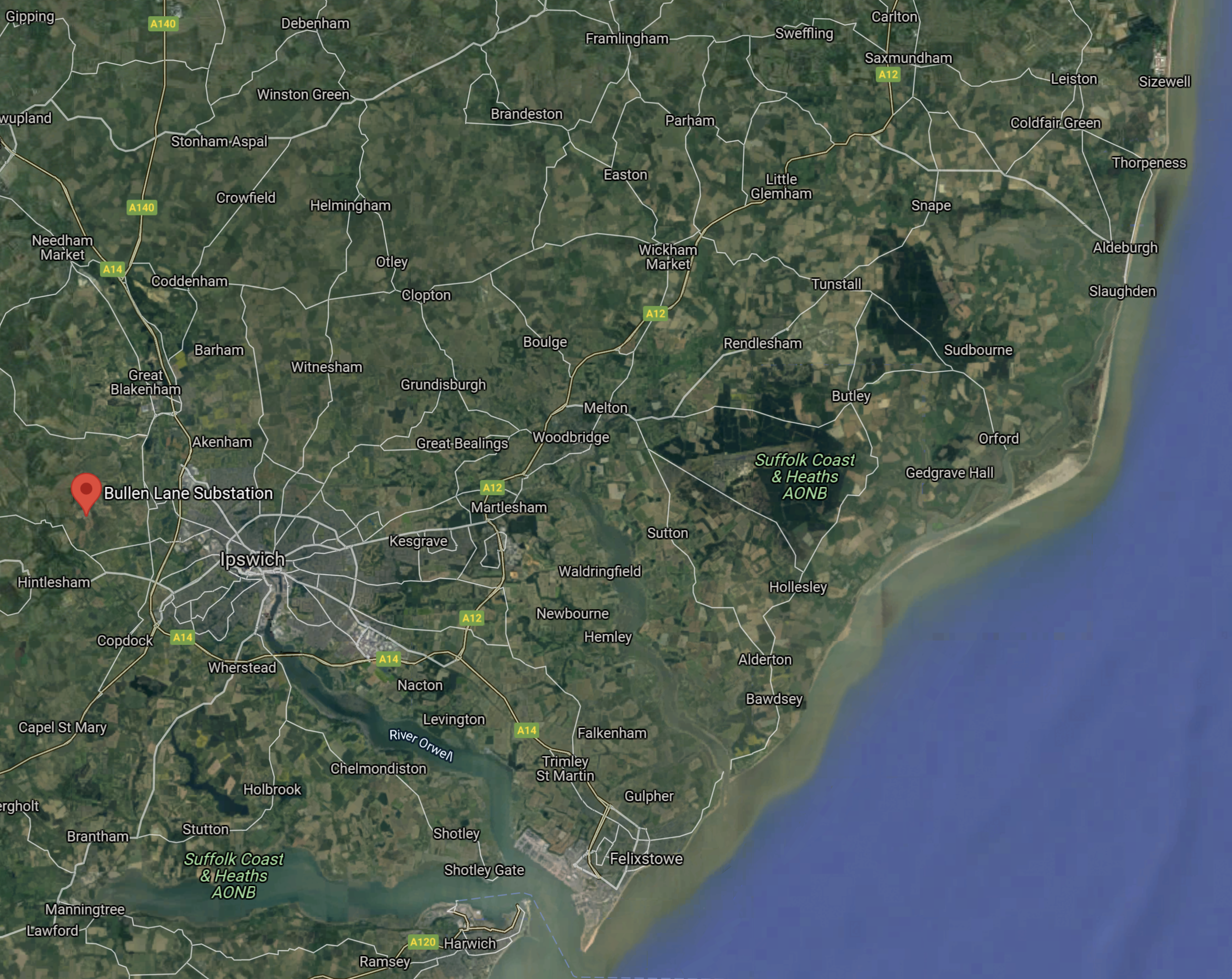
Note.
- Sizewell is in the North-East corner of the map.
- Felixstowe, Harwich and Freeport East are at the mouth of the rivers Orwell and Stour.
- The Bullen Lane substation is to the West of Ipswich and shown by the red arrow.
I would certainly investigate the possibility of running an underwater cable up the River Orwell to connect the Southern end of the interconnector Between Bicker Fen And Freeport East.
This Google Map shows the Bullen Lane Substation.
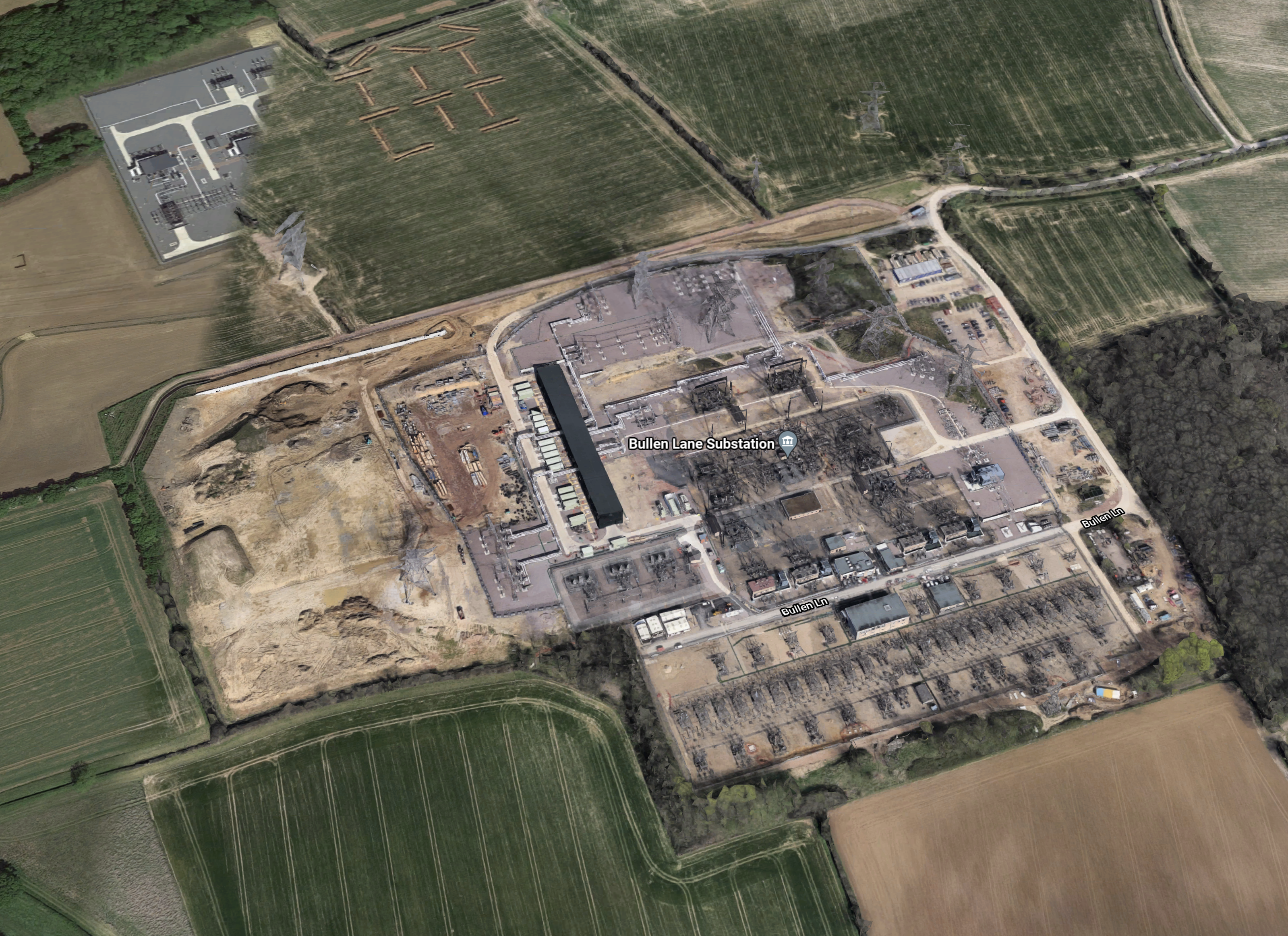
It looks impressive, but is it big enough to handle all the electricity coming ashore from the offshore wind farms to the East of Suffolk and the electricity from the power stations at Sizewell?
Conclusion
I believe there are a lot of possibilities, that would meet the threeobjectives, I stated earlier.
- Avoid as much disruption on the land as possible.
- Create the capacity to deliver all the energy generated to customers, either as electricity or hydrogen.
- Create an expandable framework, that would support all the wind farms that could be built in the future.
In addition, simple mathematics says to me, that either there will need to be extra capacity at both Bicker Fen and Bullen Lane substations and onward to the rest of the country, or a large electrolyser to convert several gigawatts of electricity into hydrogen for distribution, through the gas network.
Transformer Deliveries Mark Major Milestone For Braybrooke Substation Project And The Midland Main Line Upgrade
The title of this post, is the same as that of this press release from National Grid.
The press release says this.
Since early 2021 National Grid Electricity Transmission (NGET) has been building a new electricity substation near Braybrooke, on the outskirts of Market Harborough in Leicestershire.
The new substation, once complete, will form a vital part of electrical infrastructure to support Network Rail’s electrification of the Midland Main Line.
Following months of hard work, the project has reached a major milestone, as the engineering team have taken delivery of two new transformers.
The transformers arrived during November and were delivered via an access road off Kettering Road built to ensure construction traffic avoids the areas of Market Harborough and Braybrooke. Weighing an impressive 100 tonnes, they will now be installed at the substation over the coming months.
This Google Map shows the access road.

Note.
The main A6 road running across the top of the map.
Kettering road leads off it into Market Harborough.
The Midland Main Line running across the bottom of the map.
The access track runs between the two.
This enlargement of the South East corner of the map shows the 400 kV overhead transmission line.
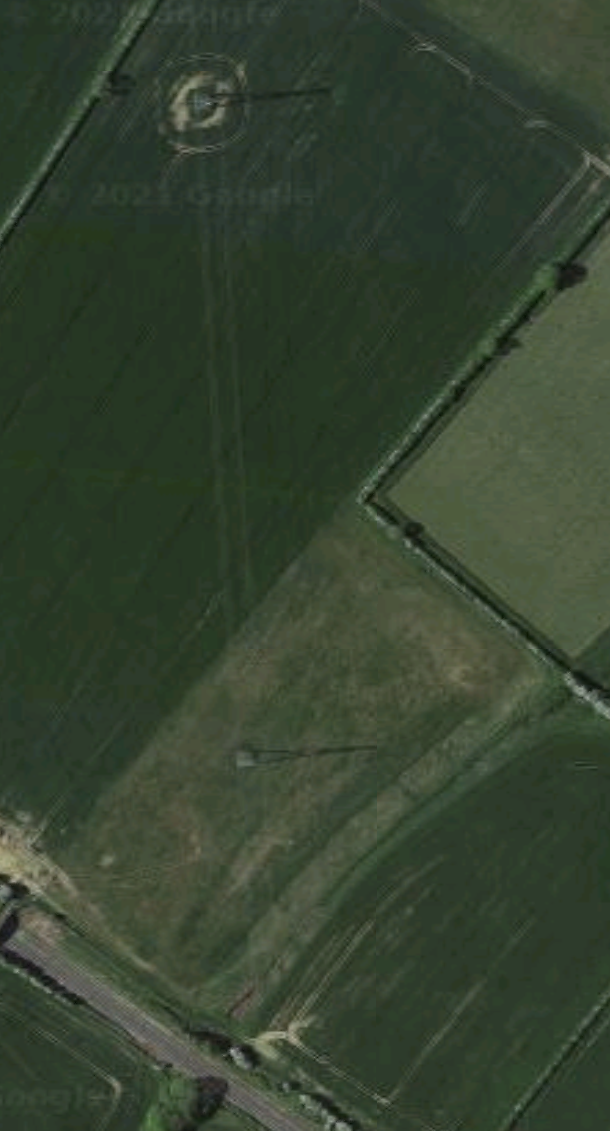
Note that the shadows give away two 400 kV pylons.
Will the sub-station be built in the smaller rectangular field?
How Many Sub-Stations Will Be Needed For The Midland Main Line Electrification?
I seem to remember that the Great Western Main Line to Cardiff was electrified with just three sub-stations, London, Cardiff and one in the middle and the London one is shared with Crossrail.
So I suspect that the feed of electricity may only need one further substation at the Northern end.
Conclusion
It does seem that National Grid have planned this well.
I suspect, bringing in the transformers didn’t cause too much disruption and the route gives good access to the overhead line.
UK National Grid In Talks To Build An Energy Island In The North Sea
The title of this post, is the same as that of this article on the New Scientist.
This is the first paragraph.
UK company National Grid has revealed it is in talks with two other parties about building an “energy island” in the North Sea that would use wind farms to supply clean electricity to millions of homes in north-west Europe.
These are my thoughts.
An Artificial Island on the Dogger Bank
The idea of the North Sea Wind Power Hub in the area of the Dogger Bank has been around for a few years and has a comprehensive Wikipedia entry.
Wikipedia says that it would be an artificial island on the Dutch section of the Dogger Bank and the surrounding sea could eventually host up to 110 GW of wind turbines.
North Sea Wind Power Hub Programme
The Dutch and the Danes seems to have moved on and there is now a web site for the North Sea Wind Power Hub Programme.
The home page is split into two, with the upper half entitled Beyond The Waves and saying.
The incredible story of how the Netherlands went beyond technical engineering as it had ever been seen before. Beyond water management. To secure the lives of millions of inhabitants.
I have met Dutch engineers, who designed and built the Delta Works after the North Sea Floods of 1953 and I have seen the works all over the country and it is an impressive legacy.
And the lower half of the home page is entitled North Sea Wind Power Hub and saying.
Today, climate policy is largely national, decoupled and incremental. We need a new approach to effectively realise the potential of the North Sea and reach the goals of the Paris Agreement. We take a different perspective: harnessing the power of the North Sea requires a transnational and cross-sector approach to take the step-change we need.
Behind each half are two videos, which explain the concept of the programme.
It is a strange web site in a way.
- It is written totally in English with English not American spelling.
- The project is backed by Energinet, Gasunie and TenneT, who are Danish and Dutch companies, that are responsible for gas and electricity distribution networks in Denmark, Ger,many and The Netherlands.
- There are four sections to the web site; Netherlands, Germany, Denmark and North Sea.
It is almost as if the web site has been designed for a British company to join the party.
Hubs And Spokes In North Sea Wind Power Hub Programme
If you watch the videos on the site, they will explain their concept of hubs and spokes, where not one but several energy islands or hubs will be connected by spokes or electricity cables and/or hydrogen pipelines to each other and the shore.
Many electrical networks on land are designed in a similar way, including in the UK, where we have clusters of power stations connected by the electricity grid.
The Dogger Bank
The Dogger Bank is a large sandbank in a shallow area of the North Sea about 100 kilometres off the east coast of England.
Wikipedia says this about the geography of the Dogger Bank.
The bank extends over about 17,600 square kilometres (6,800 sq mi), and is about 260 by 100 kilometres (160 by 60 mi) in extent. The water depth ranges from 15 to 36 metres (50 to 120 ft), about 20 metres (65 ft) shallower than the surrounding sea.
As there are Gunfleet Sands Wind Farm and Scroby Sands Wind Farm and others, on sandbanks in the North Sea, it would appear that the engineering of building wind farms on sandbanks in the North Sea is well understood.
The Dogger Bank Wind Farm
We are already developing the four section Dogger Bank Wind Farm in our portion of the Dogger Bank and these could generate up to 4.8 GW by 2025.
The Dogger Bank Wind Farm has its own web site, which greets you with this statement.
Building the World’s Largest Offshore Wind Farm
At 4.8 GW, it will be 45 % larger than Hinckley Point C nuclear power station, which is only 3.3 GW. So it is not small.
The three wind farms; Dogger Bank A, B and C will occupy 1670 square kilometres and generate a total of 3.6 GW or 0.0021 GW per square kilometre.
If this density of wind turbines could be erected all over the Dogger Bank, we could be looking at nearly 40 GW of capacity in the middle of the North Sea.
Interconnectors Across The North Sea
This Google Map shows the onshore route of the cable from the Dogger Bank Wind Farm.
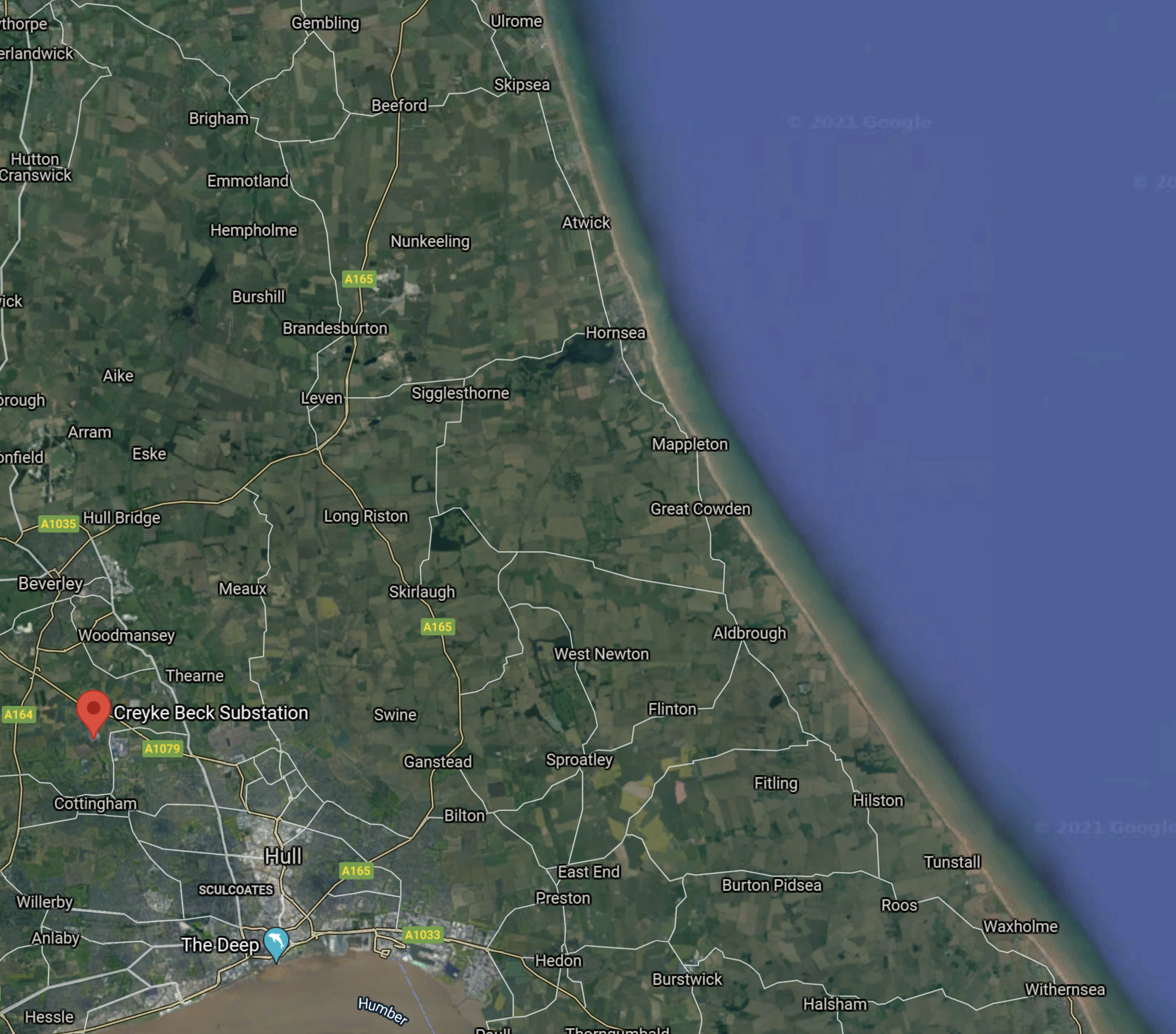
Note.
- Hull and the River Humber at the bottom of the map.
- The red arrow which marks Creyke Beck sub station, where the cable from the Dogger Bank Wind Farm connects to the UK electricity grid.
- At the top of the map on the coast is the village of Ulrome, where the cable comes ashore.
The sub station is also close to the Hull and Scarborough Line, so would be ideal to feed any electrification erected.
I would assume that cables from the Dogger Bank Wind Farm could also link the Wind Farm to the proposed Dutch/Danish North Sea Wind Power Hub.
Given that the cables between the wind farms and Creyke Beck could in future handle at least 4.8 GW and the cables from the North Sea Wind Power Hub to mainland Europe would probably be larger, it looks like there could be a very high capacity interconnector between Yorkshire and Denmark, Germany and The Netherlands.
It almost makes the recently-opened North Sea Link to Norway, which is rated at 1.4 GW seem a bit small.
The North Sea Link
The North Sea Link is a joint project between Statnett and National Grid, which cost €2 billion and appears to have been delivered as planned, when it started operating in October 2021.
So it would appear that National Grid have shown themselves capable of delivering their end of a complex interconnector project.
Project Orion And The Shetlands
In Do BP And The Germans Have A Cunning Plan For European Energy Domination?, I introduced Project Orion, which is an electrification and hydrogen hub and clean energy project in the Shetland Islands.
The project’s scope is described in this graphic.
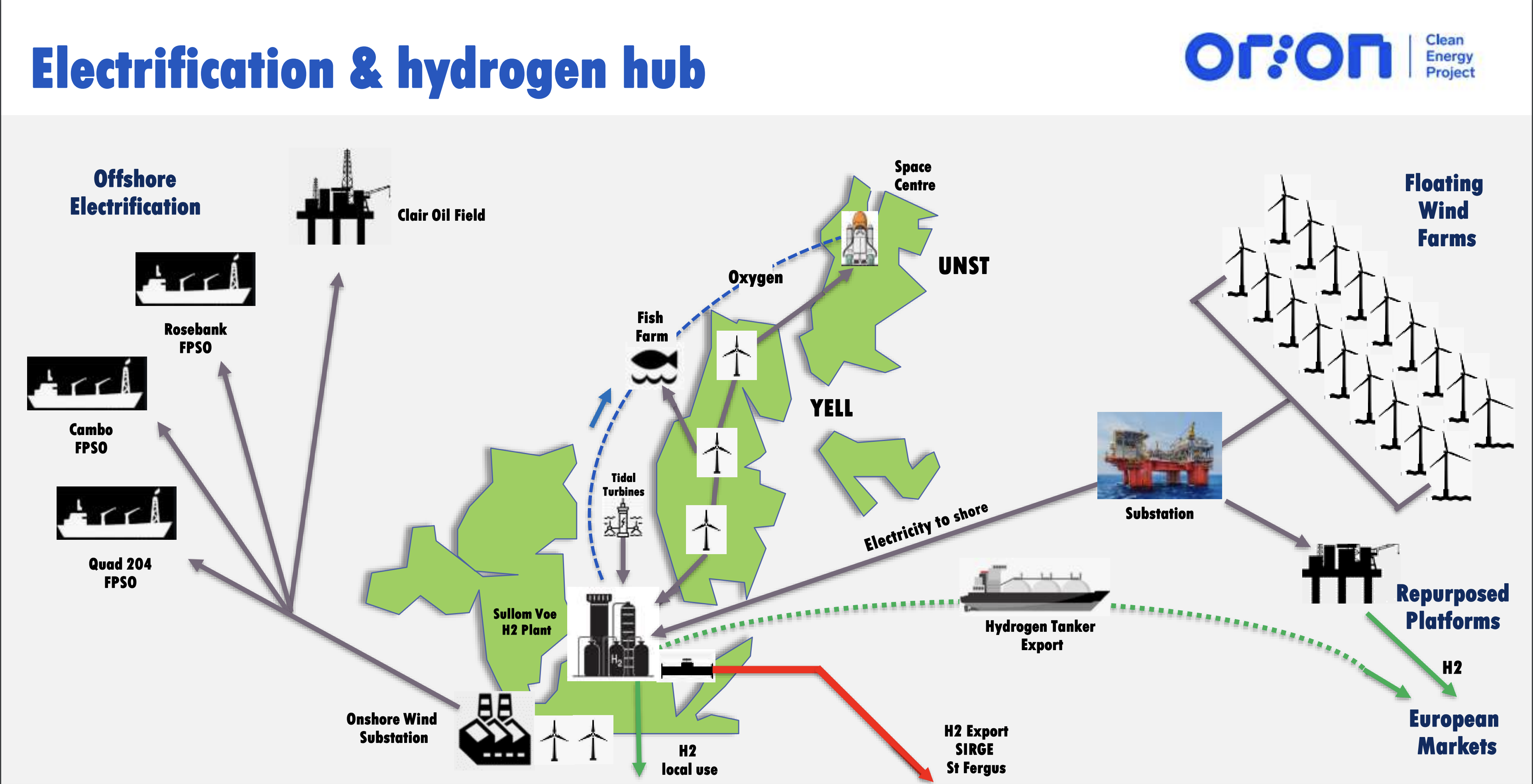
Note that Project Orion now has its own web site.
- Could the Shetlands become an onshore hub for the North Sea Power Hub Programme?
- Could Icelink, which is an interconnector to Iceland be incorporated?
With all this renewable energy and hydrogen, I believe that the Shetlands could become one of the most prosperous areas in Europe.
Funding The Wind Farms And Other Infrastructure In The North Sea
In World’s Largest Wind Farm Attracts Huge Backing From Insurance Giant, I described how Aviva were funding the Hornsea wind farm.
I very much believe that City of London financial institutions will be able to finance a lot of the developments in the North Sea.
After all National Grid managed to find a billion euros in a sock drawer to fund their half of the North Sea Link.
Electrifying The North Sea: A Gamechanger For Wind Power Production?
The title of this section, is the same as that of this article on Engineering and Technology Magazine.
This article in the magazine of the IET is a serious read and puts forward some useful facts and interesting ideas.
- The EU is targeting offshore wind at 60 GW by 2030 and 300 GW by 2050.
- The UK is targeting offshore wind at 40 GW by 2030.
- The article explains why HVDC electricity links should be used.
- The major players in European offshore wind are the UK, Belgium, the Netherlands, Germany, and Denmark.
- The foundations for a North Sea grid, which could also support the wider ambitions for a European super-grid, are already forming.
- A North Sea grid needs co-operation between governments and technology vendors. as well as technological innovation.
- National Grid are thinking hard about HVDC electrical networks.
- By combining HVDC links it can be possible to save a lot of development capital.
- The Danes are already building artificial islands eighty kilometres offshore.
- Electrical sub-stations could be built on the sea-bed.
I can see that by 2050, the North Sea, South of a line between Hull and Esbjerg in Denmark will be full of wind turbines, which could generate around 300 GW.
Further Reading
There are various articles and web pages that cover the possibility of a grid in the North Sea.
- National Grid – Interconnectors
- The Guardian – National Grid In Talks Over Plan For Energy Island In North Sea
- The Times – National Grid Planning ‘Energy Island’ In North Sea
I shall add to these as required.
Conclusion
I am coming to the conclusion that National Grid will be joining the North Sea Wind Power Hub Programme.
- They certainly have the expertise and access to funding to build long cable links.
- The Dogger Bank wind farm would even be one of the hubs in the planned hub and spoke network covering the North Sea.
- Only a short connection would be needed to connect the Dogger Bank wind farm, to where the Dutch and Danes originally planned to build the first energy island.
- There may be other possibilities for wind farm hubs in the UK section of the North Sea. Hornsea Wind Farm, which could be well upwards of 5 GW is surely a possibility.
- Would it also give access to the massive amounts of energy storage in the Norwegian mountains, through the North Sea Link or Nord.Link between Norway and Germany.
Without doubt, I know as a Control Engineer, that the more hubs and spokes in a network, the more stable it will be.
So is National Grid’s main reason to join is to stabilise the UK electricity grid? And in turn, this will stabilise the Danish and Dutch grids.
UK To Norway Sub-Sea Green Power Cable Operational
The title of this post is the same as that of this article on the BBC.
This is the first two paragraphs.
The world’s longest under-sea electricity cable, transferring green power between Norway and the UK, has begun operation.
The 450-mile (725km) cable connects Blyth in Northumberland with the Norwegian village of Kvilldal.
The BBC article is based on this press release from National Grid.
The link has been called the North Sea Link (NSL).
These are some thoughts.
What Is The Capacity Of The North Sea Link?
The National Grid press release says this.
[The link] will start with a maximum capacity of 700 megawatts (MW) and gradually increase to the link’s full capacity of 1400MW over a three-month period.
It also says this.
Once at full capacity, NSL will provide enough clean electricity to power 1.4 million homes.
It is more or less equivalent to two or three gas-fired power stations.
What Is The Operating Philosophy Of The North Sea Link?
The National Grid press release says this.
The Norwegian power generation is sourced from hydropower plants connected to large reservoirs, which can respond faster to fluctuations in demand compared to other major generation technologies. However, as the water level in reservoirs is subject to weather conditions, production varies throughout seasons and years.
When wind generation is high and electricity demand low in Britain, NSL will enable renewable power to be exported from the UK, conserving water in Norway’s reservoirs. When demand is high in Britain and there is low wind generation, hydro power can be imported from Norway, helping to ensure secure, affordable and sustainable electricity supplies for UK consumers.
It almost seems to me, that the North Sea Link is part of a massive pumped-storage system, where we can bank some of our wind-generated electricity in Norway and draw it out when we need it.
I would suspect that the rate and direction of electricity transfer is driven by a very sophisticated algorithm, that uses detailed demand and weather forecasting.
As an example, if we are generating a lot of wind power at night, any excess that the Norwegians can accept will be used to fill their reservoirs.
The Blyth Connection
This page on the North Sea Link web site, describes the location of the UK end of the North Sea Link.
These three paragraphs describe the connection.
The convertor station will be located just off Brock Lane in East Sleekburn. The site forms part of the wider Blyth Estuary Renewable Energy Zone and falls within the Cambois Zone of Economic Opportunity.
The converter station will involve construction of a series of buildings within a securely fenced compound. The buildings will be constructed with a steel frame and clad with grey insulated metal panels. Some additional outdoor electrical equipment may also be required, but most of the equipment will be indoors.
Onshore underground cables will be required to connect the subsea cables to the converter station. Underground electricity cables will then connect the converter station to a new 400kV substation at Blyth (located next to the existing substation) which will be owned and operated by National Grid Electricity Transmission PLC.
This Google Map shows the area.

Note.
- The light grey buildings in the North-West corner of the map are labelled as the NSL Converter Station.
- Underground cables appear to have been dug between the converter station and the River Blyth.
- Is the long silver building to the West of the triangular jetty, the 400 KV substation, where connection is made to the grid?
The cables appear to enter the river from the Southern point of the triangular jetty. Is the next stop Norway?
Britishvolt And The North Sea Link
Britishvolt are are building a factory at Blyth and this Google Map shows are to the North and East of the NSL Converter Station.
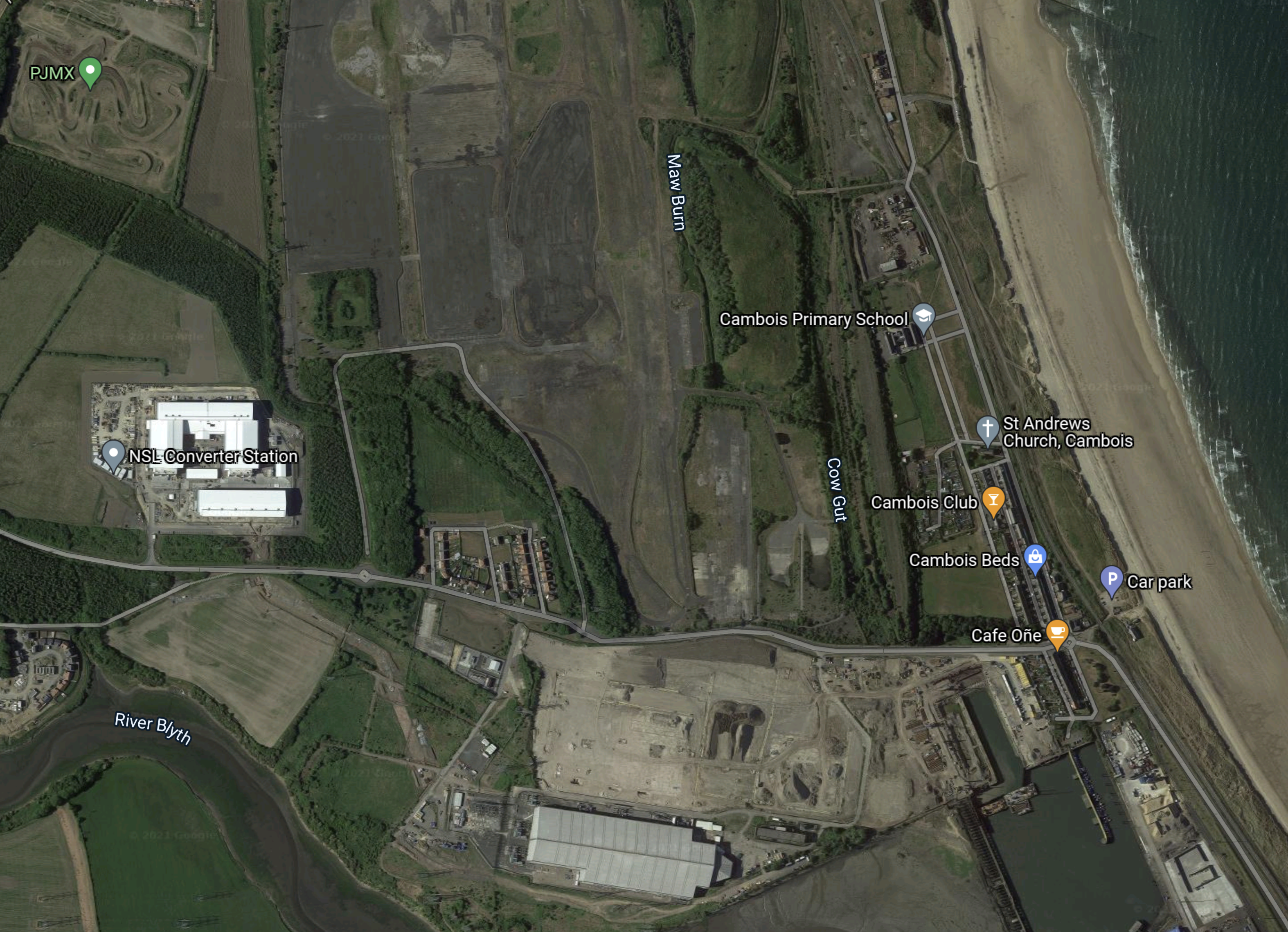
Note the light-coloured buildings of the NSL Converter Station.
I suspect there’s plenty of space to put Britishvolt’s gigafactory between the converter station and the coast.
As the gigafactory will need a lot of electricity and preferably green, I would assume this location gives Britishvolt all they need.
Where Is Kvilldal?
This Google Map shows the area of Norway between Bergen and Oslo.
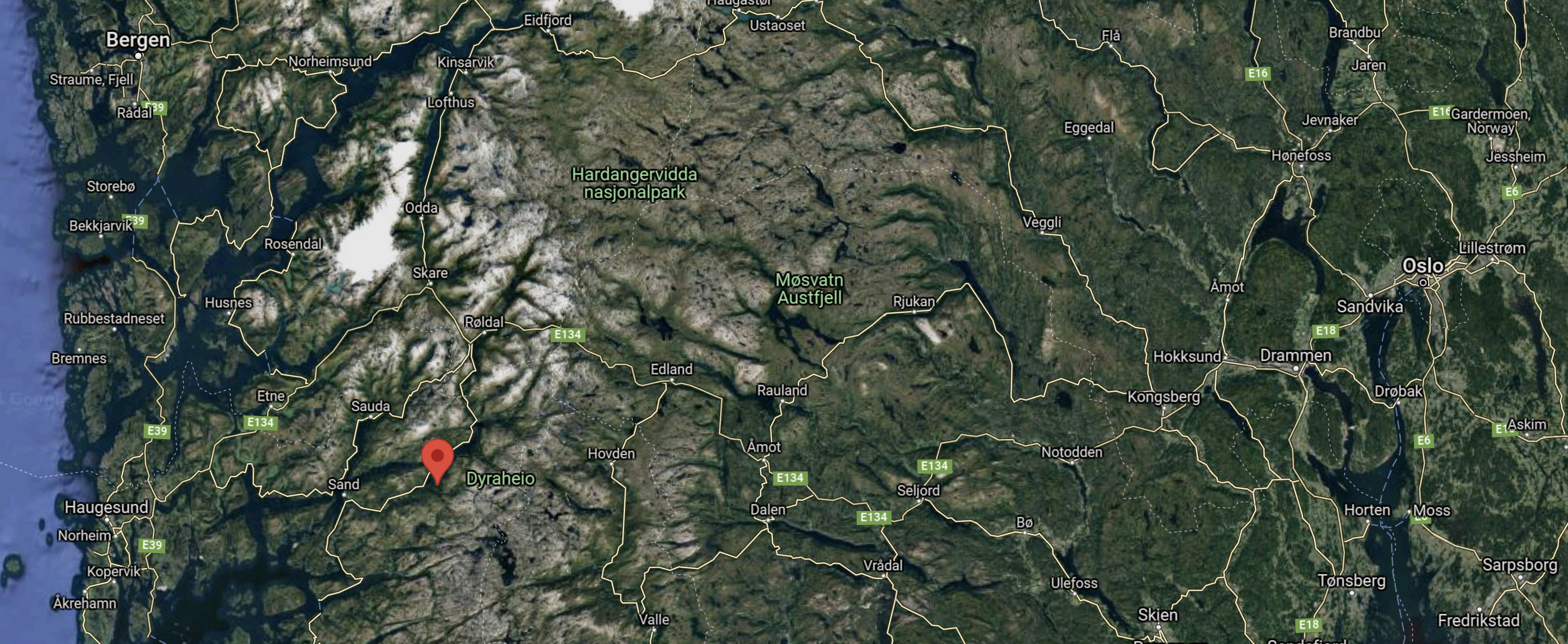
Note.
- Bergen is in the North-West corner of the map.
- Oslo is at the Eastern edge of the map about a third of the way down.
- Kvilldal is marked by the red arrow.
This second Google Map shows the lake to the North of Kvilldal.
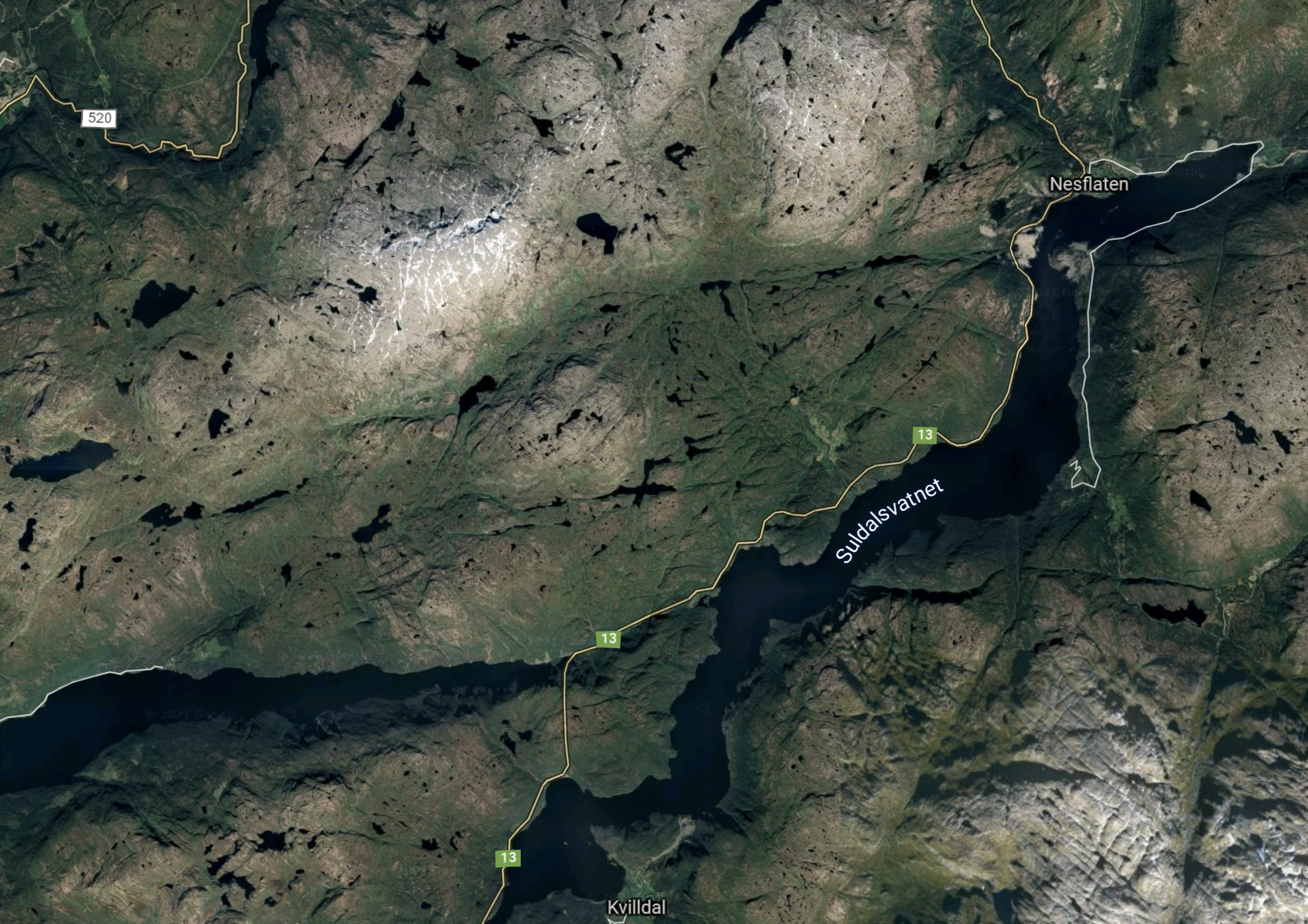
Note.
- Suldalsvatnet is the sixth deepest lake in Norway and has a volume of 4.49 cubic kilometres.
- Kvilldal is at the South of the map in the middle.
This third Google Map shows Kvilldal.
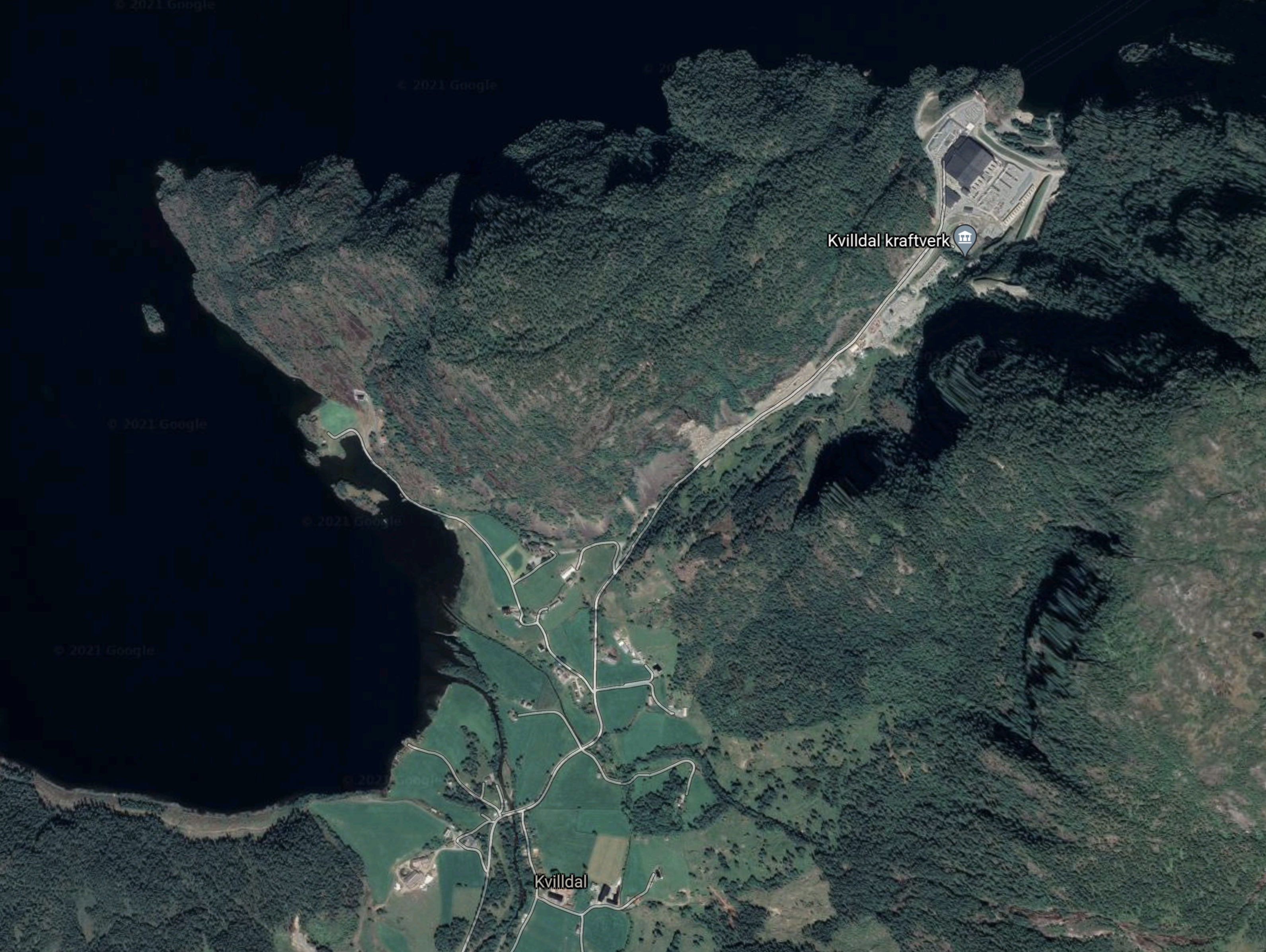
Note.
- Suldalsvatnet is the dark area across the top of the map.
- The Kvilldal hydro-electric power station on the shore of the lake.
- Kvilldal is to the South-West of the power station.
Kvilldal doesn’t seem to be the biggest and most populous of villages. But they shouldn’t have electricity supply problems.
Kvilldal Power Station And The North Sea Link
The Wikipedia entry for Kvilldal power station gives this information.
The Kvilldal Power Station is a located in the municipality of Suldal. The facility operates at an installed capacity of 1,240 megawatts (1,660,000 hp), making it the largest power station in Norway in terms of capacity. Statnett plans to upgrade the western grid from 300 kV to 420 kV at a cost of 8 billion kr, partly to accommodate the NSN Link cable] from Kvilldal to England.
This power station is almost large enough to power the North Sea Link on its own.
The Kvilldal power station is part of the Ulla-Førre complex of power stations and lakes, which include the artificial Lake Blåsjø.
Lake Blåsjø
Lake Blåsjø would appear to be a lake designed to be the upper reservoir for a pumped-storage scheme.
- The lake can contain 3,105,000,000 cubic metres of water at its fullest.
- The surface is between 930 and 1055 metres above sea level.
- It has a shoreline of about 200 kilometres.
This Google Map shows the Lake.
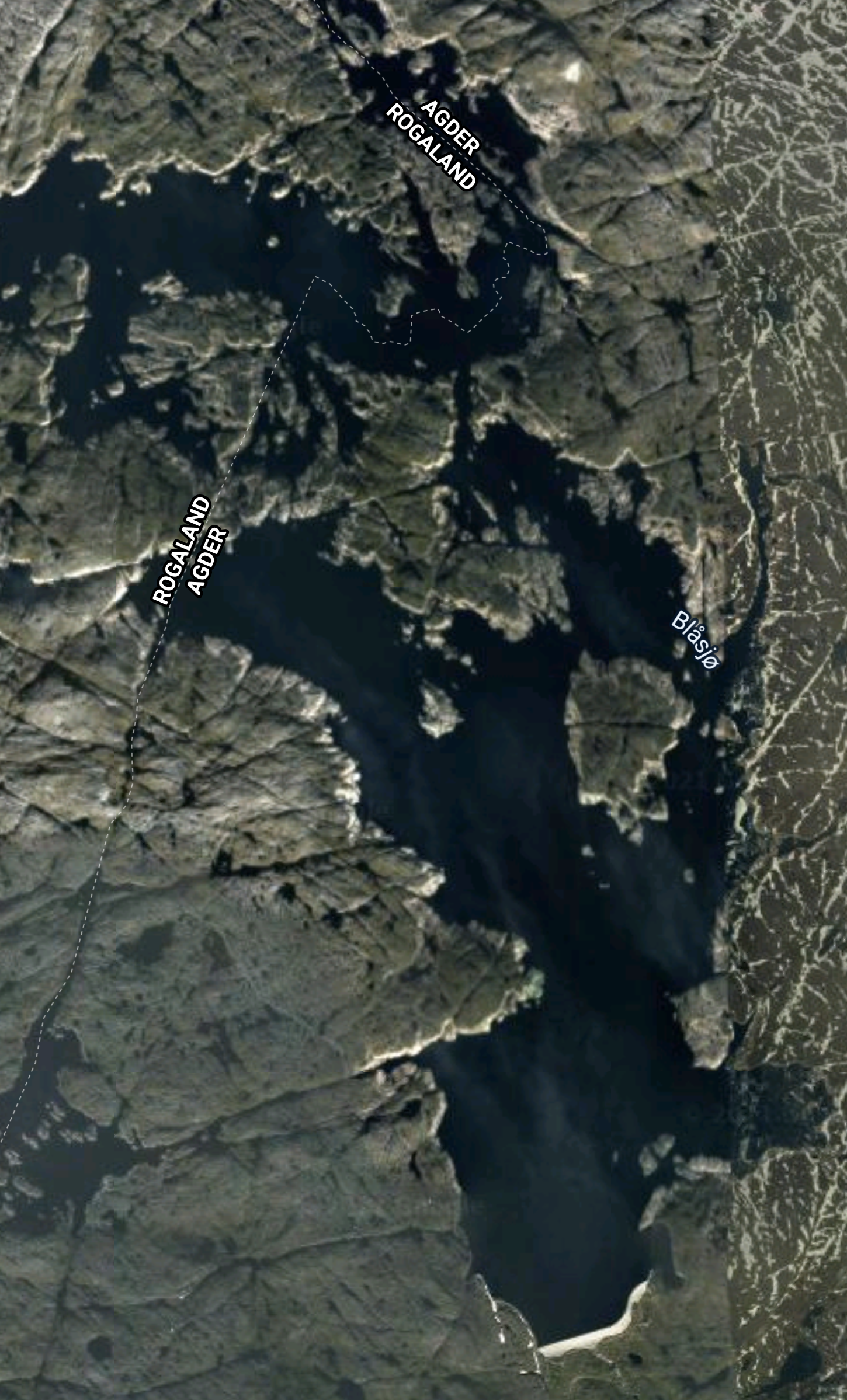
Note the dam at the South end of the lake.
Using Omni’s Potential Energy Calculator, it appears that the lake can hold around 8 TWh of electricity.
A rough calculation indicates that this could supply the UK with 1400 MW for over eight months.
The Wikipedia entry for Saurdal power station gives this information.
The Saurdal Power Station is a hydroelectric and pumped-storage power station located in the municipality of Suldal. The facility operates at an installed capacity of 674 megawatts (904,000 hp) (in 2015). The average energy absorbed by pumps per year is 1,189 GWh (4,280 TJ) (in 2009 to 2012). The average annual production is 1,335 GWh (4,810 TJ) (up to 2012)
This Google Map shows the area between Kvilldal and Lake Blåsjø.
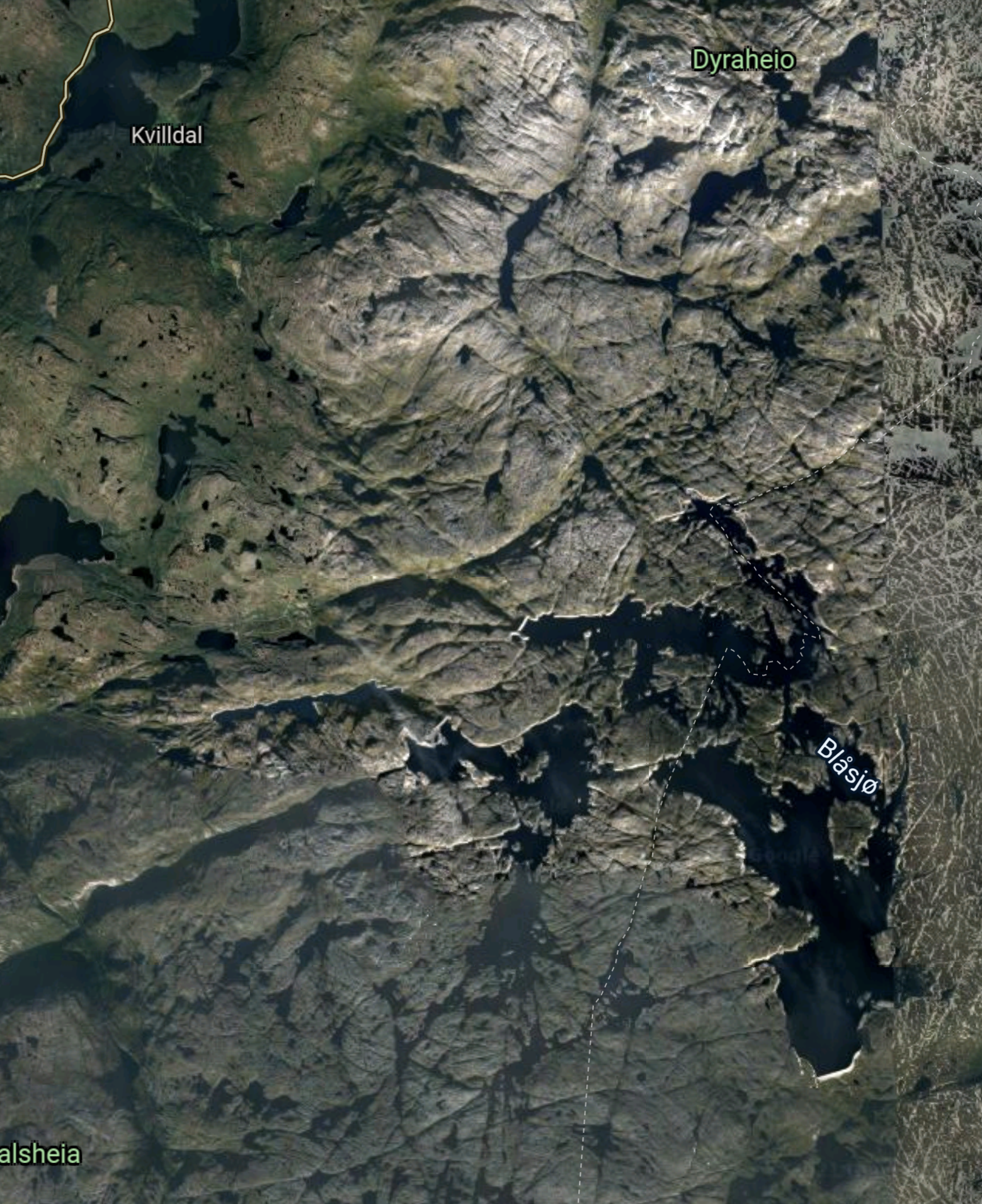
Note
- Kvilldal is in the North West of the map.
- Lake Blåsjø is in South East of the map.
This second Google Map shows the area to the South-East of Kvilldal.
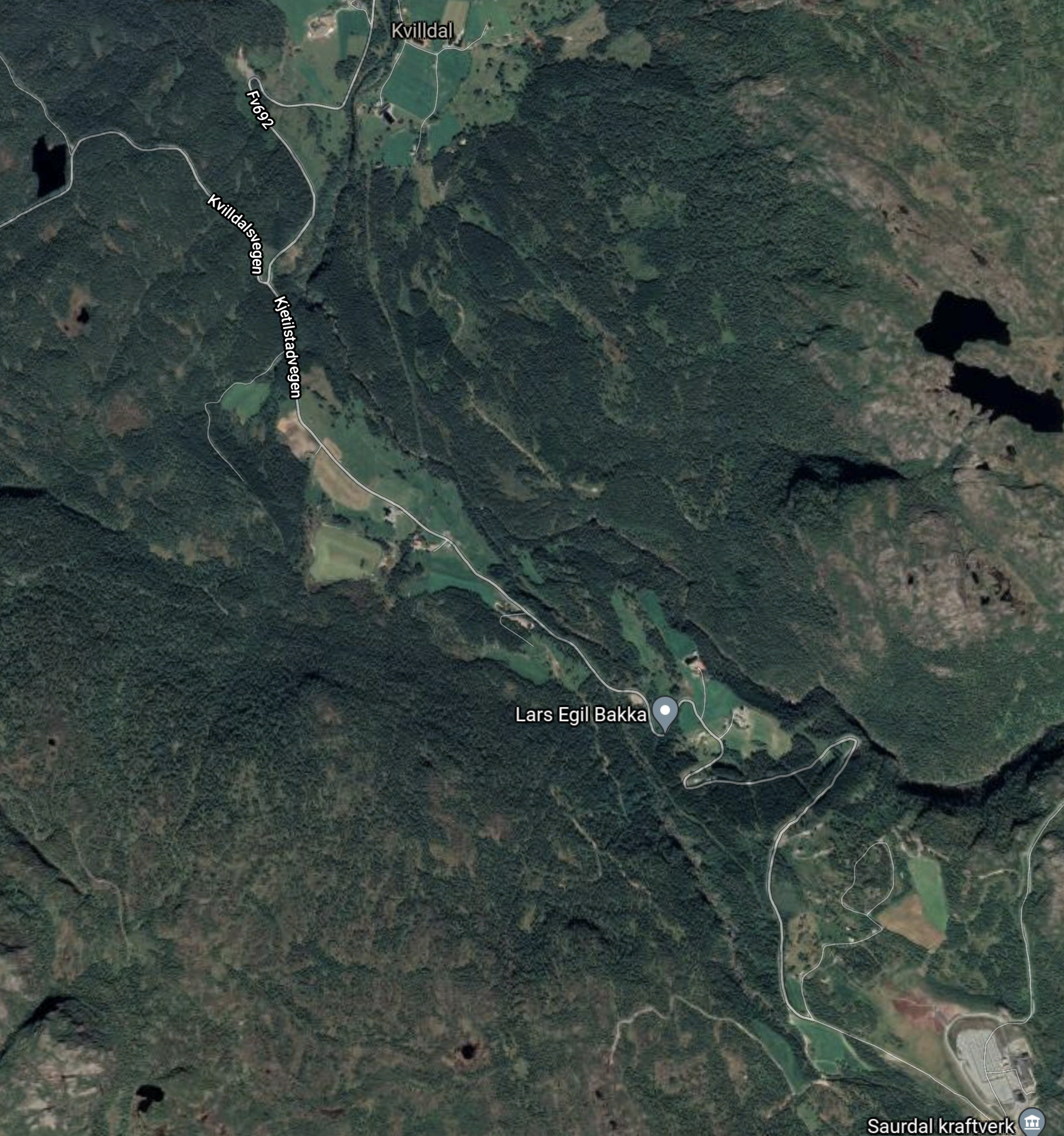
Note.
- Kvilldal is in the North-West of the map.
- The Saurdal power station is tight in the South-East corner of the map.
This third Google Map shows a close-up of Saurdal power station.

Saurdal power station is no ordinary power station.
This page on the Statkraft web site, gives a brief description of the station.
The power plant was commissioned during 1985-1986 and uses water resources and the height of fall from Lake Blåsjø, Norway’s largest reservoir.
The power plant has four generating units, two of which can be reversed to pump water back up into the reservoir instead of producing electricity.
The reversible generating units can thus be used to store surplus energy in Lake Blåsjø.
Is Lake Blåsjø and all the power stations just a giant battery?
Economic Effect
The economic effect of the North Sea Link to both the UK and Norway is laid out in a section called Economic Effect in the Wikipedia entry for the North Sea Link.
Some points from the section.
- According to analysis by the United Kingdom market regulator Ofgem, in the base case scenario the cable would contribute around £490 million to the welfare of the United Kingdom and around £330 million to the welfare of Norway.
- This could reduce the average domestic consumer bill in the United Kingdom by around £2 per year.
- A 2016 study expects the two cables to increase price in South Norway by 2 øre/kWh, less than other factors.
This Economic Effect section also talks of a similar cable between Norway and Germany called NorGer.
It should be noted, that whereas the UK has opportunities for wind farms in areas to the North, South, East and West of the islands, Germany doesn’t have the space in the South to build enough wind power for the area.
There is also talk elsewhere of an interconnector between Scotland and Norway called NorthConnect.
It certainly looks like Norway is positioning itself as Northern Europe’s battery, that will be charged from the country’s extensive hydropower and surplus wind energy from the UK and Germany.
Could The Engineering Be Repeated?
I mentioned NorthConnect earlier.
- The cable will run between Peterhead in Scotland and Samnanger in Norway.
- The HVDC cable will be approximately 665 km long.
- The cable will be the same capacity as the North Sea Link at 1400 MW.
- According to Wikipedia construction started in 2019.
- The cable is planned to be operational in 2022.
- The budget is €1.7 billion.
Note.
- Samnager is close to Bergen.
- NorthConnect is a Scandinavian company.
- The project is supported by the European Union, despite Scotland and Norway not being members.
- National Grid is not involved in the project, although, they will be providing the connection in Scotland.
The project appears to be paused at the moment, awaiting how North Sea Link and NordLink between Norway and Germany are received.
There is an English web site, where this is the mission statement on the home page.
NorthConnect will provide an electrical link between Scotland and Norway, allowing the two nations to exchange power and increase the use of renewable energy.
This sounds very much like North Sea Link 2.
And then there is Icelink.
- This would be a 1000-1200 km link between Iceland and the UK.
- It would have a capacity of 1200 MW.
- National Grid are a shareholder in the venture.
- It would be the longest interconnector in the world.
The project appears to have stalled.
Conclusion
I can see these three interconnectors coming together to help the UK’s electricity generation become carbon-free by 2035.
 The Anonymous Widower