RWE Orders 2.76 GW Of Offshore Wind Turbines At Vestas
The title of this post, is the same as that of this article on offshoreWIND.biz.
This is the sub-heading.
RWE has placed a firm wind turbine order with Vestas for its 1,380 MW Vanguard East offshore wind project in the UK, shortly after confirming a firm order for Vanguard West, which will have the same installed capacity.
These three paragraphs add more details.
For Vanguard East, Vestas will supply, deliver, and commission 92 of its V236-15.0 MW wind turbines, and will also be in charge of servicing them under a five-year service agreement, followed by a long-term operational support agreement.
RWE expects to make a final investment decision (FID) for both Vanguard East and Vanguard West in the summer of 2026, with wind turbine deliveries for Vanguard East to begin in the fourth quarter of 2028.
The commissioning of Vanguard West is expected in 2029, with Vanguard East following suit in 2030.
Note.
- On the 23rd of February, 2026, RWE placed a similar order for Vanguard West with Vestas.
- In Global Investor Joining RWE On Two Norfolk Vanguard Offshore Wind Projects, FID Expected in Summer, I describe how KKR are taking a stake in the two of the Norfolk Vanguard Offshore Wind Projects.
Things are looking good for RWE, Norfolk and wind power.
Great Yarmouth Terminal Set For Redevelopment Under Port Of East Anglia Name
The title of this post, is the same as that of this article on offshoreWIND.biz.
This is the sub-heading.
The UK’s Peel Ports Group has decided to invest a further GBP 10 million (approximately EUR 11.3 million) into its Great Yarmouth site, which is being rebranded as the Port of East Anglia.
These four paragraphs add details to the story.
The newly announced GBP 10 million brings this year’s total investment to GBP 70 million across the site and will be used to redevelop the port’s Northern Terminal, helping to accommodate the next generation of offshore wind projects across the region, according to Peel Ports.
Earlier this year, a substantial investment into its Southern Terminal was announced by the port, which has earmarked GBP 60 million to transform capacity and improve efficiencies.
This involves ensuring the port can support multiple hydrogen, carbon capture, offshore wind, and nuclear projects for decades to come.
Its existing terminals service a variety of construction customers, including infrastructure projects such as Sizewell C and offshore energy projects based in the southern North Sea.
Note.
- In Yarmouth Harbour To Be ‘Completed’ In £60m Project, I talk about the work to be done on the Southern Terminal.
- The work on the Southern Terminal includes a roll-on roll-off (RORO) lift ramp and a large storage area.
- Start on the work on the Southern Terminal will start in 2026.
With all the construction work mentioned in the last two paragraphs, I suspect that the Port of Great Yarmouth will be busy?
These are some further thoughts.
Why Is The Port Of Great Yarmouth Being Renamed?
The article says this.
The new name, which will come into effect in early 2026, also aligns with the creation of a new combined authority for Suffolk and Norfolk, according to Peel Ports.
Peel Ports name change is fairly sensible, but as I was conceived in Suffolk and I’m an Ipswich Town supporter, I don’t feel that the two counties should be merged.
Does The Mention Of Hydrogen Mean That The Port Of Great Yarmouth Will Be Hosting A Hydrogen Electrolyser, To Fuel Trucks And Ships?
I asked Google AI, “If A Hydrogen Electrolyser is To Be Built In The Port Of Great Yarmouth?”, and received this answer.
While there are no current public plans for an immediate construction of a large-scale hydrogen electrolyser within the Port of Great Yarmouth, significant port expansion and infrastructure upgrades are underway to ensure it can support future hydrogen projects and related clean energy initiatives.
Note.
- If technology to handle hydrogen, is copied from North Sea gas, there is certainly a lot of proven technology that can be used again.
- There may even be depleted gas fields, where captured carbon dioxide, hydrogen or North Sea gas can be stored.
I find the most exciting thing, would be to send hydrogen to Germany.
Why Would Anybody Export Hydrogen To Germany?
I asked Google AI, the question in the title of this section and received this answer.
Countries would export hydrogen to Germany because Germany has a large, growing demand for hydrogen to power its heavily industrialised economy and achieve its decarbonisation goals, but lacks sufficient domestic renewable energy capacity to produce the required amounts.
Germany also, uses a lot of bloodstained Russian gas and indigenous polluting coal.
How Could Anybody Export Hydrogen To Germany?
- Wilhelmshaven is one of the main import ports for hydrogen in North West Germany.
- Great Yarmouth is probably the closest larger port to Germany.
- Great Yarmouth and Wilhelmshaven are probably about 300 miles apart, by the shortest route.
- Great Yarmouth would need to build infrastructure to export hydrogen.
The easiest way to transport the hydrogen from Great Yarmouth to Wilhelmshaven, is probably to use a gas tanker built especially for the route.
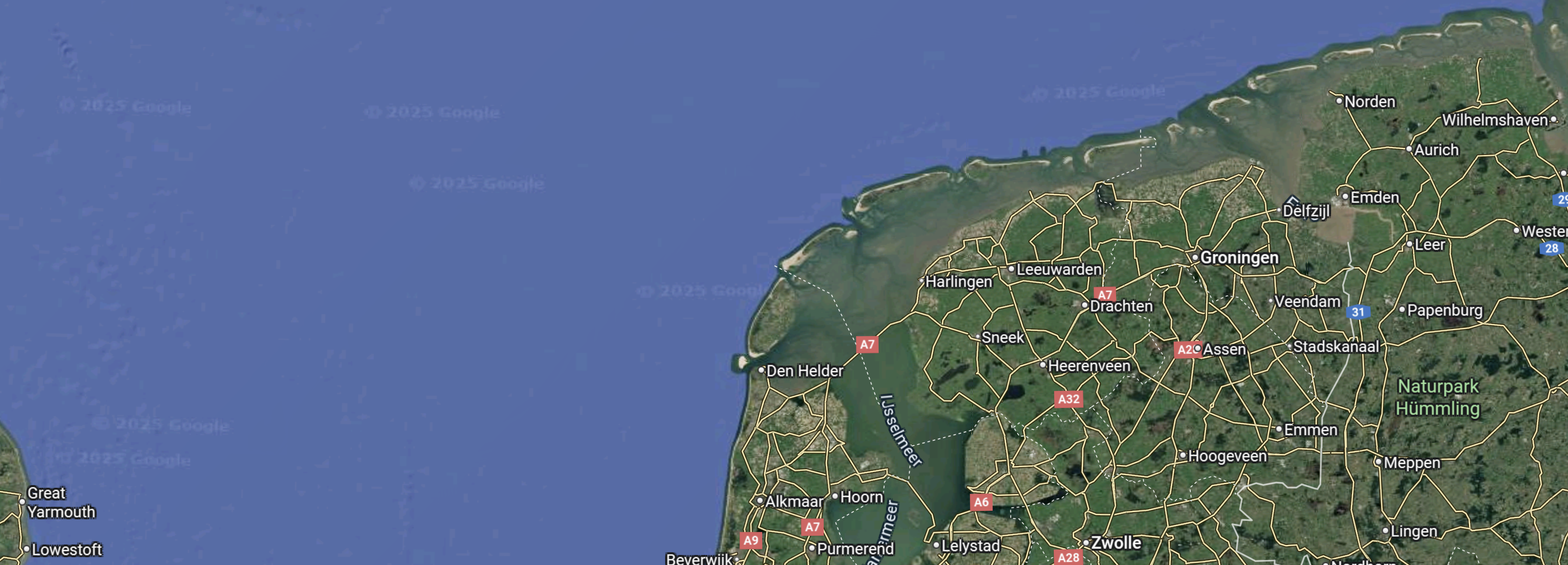
This Google Map shows the route between Great Yarmouth and Wilhelmshaven.
Note.
- The North-East corner of East Anglia with Great Yarmouth to the North of Lowestoft, is in the bottom-left corner of the map.
- Wilhelmshaven is a few miles inland in the top-right corner of the map.
- Could a coastal tanker go along the Dutch and German coasts to Wilhelmshaven?
I have no skills in boats, but would Great Yarmouth to Wilhelmshaven to take hydrogen to Germany?
RWE Are Developing Three Wind Farms To The North-East of Great Yarmouth
RWE are a large German Electricity company and the UK’s largest generator of electricity.
The company is developing three wind farms to the North-East of Great Yarmouth.
- Norfolk Boreas – 1.2 GW – 45 miles offshore
- Norfolk Vanguard West – 1.2 GW – 29 miles offshore
- Norfolk Vanguard East – 1.2 GW – 28 miles offshore
Note.
- The electricity for all three wind farms is to be brought ashore at Happisburgh South, which is about 22 miles North of Great Yarmouth.
- The original plan was to take the electricity halfway across Norfolk to the Necton substation to connect to the grid.
- The natives will not be happy about a 4.2 GW overhead line between Happisburgh and Necton.
- RWE have built offshore electrolysers before in German waters.
- Could an electrical cable or a hydrogen pipe be laid in the sea between Happisburgh South and the Port of Great Yarmouth?
- The electrolyser could either be offshore at Happisburgh or onshore in the Port of Great Yarmouth.
As I don’t suspect these three wind farms will be the last connected to the Port of Great Yarmouth, I would expect that RWE will put the electrolyser offshore at Happisburgh and connect it by a hydrogen pipeline to the Port of Great Yarmouth.
Could There Be A Connection To The Bacton Gas Terminal?
Consider.
The Bacton Gas Terminal, which feeds gas into the UK Gas Network, is only 4.2 miles up the coast from Happisburgh South.
Some climate scientists advocate blending hydrogen into the gas supply to reduce carbon emissions.
In Better Than A Kick In The Teeth – As C Would Say!, I disclosed that I now have a new hydrogen-ready boiler, so I’m not bothered, if I get changed to a hydrogen blend.
So could hydrogen from the Norfolk wind farms be fed into the grid to reduce carbon emissions?
Could The Port Of Great Yarmouth Become A Hydrogen Distribution Centre?
Thinking about it, the port could also become a distribution centre for green hydrogen.
Consider.
- Hydrogen-powered ships, tugs and workboats could be refuelled.
- Hydrogen-powered trucks could also be refuelled.
- Tanker-trucks could distribute hydrogen, to truck and bus operators, farms and factories, that need it for their transport and operations.
- I believe, that construction equipment will be increasingly hydrogen-powered.
In my life, I have lived at times in two country houses, that were heated by propane and there are about 200,000 off-grid houses in the UK, that are heated this way.
The two houses, where I lived would have been a nightmare to convert to heat pumps, but it would have been very easy to convert them to a hydrogen boiler and power it from a tank in the garden.
It should be noted, that the new boiler in my house in London is hydrogen-ready.
So the Port of Great Yarmouth could be the major centre for hydrogen distribution in Norfolk.
In the 1960s, I used to work in ICI’s hydrogen plant at Runcorn. If you ride in a hydrogen bus in England, it is likely that the hydrogen came from the same plant. Handled correctly, hydrogen is no less safe and reliable than natural gas or propane.
Norway’s Sovereign Wealth Fund Acquires Stake In 573 MW Race Bank Offshore Wind Farm
The title of this post, is the same as that of this article on offshoreWIND.biz.
This is the sub-heading.
A consortium made up of investment funds belonging to Australia-headquartered Macquarie Asset Management and Spring Infrastructure Capital has reached an agreement to divest a 37.5 per cent stake in the 573 MW Race Bank offshore wind farm in the UK to Norges Bank Investment Management.
These four paragraphs give more details of the deal.
The stake was sold to the Norwegian sovereign wealth fund for approximately GBP 330 million (about EUR 390.6 million).
According to Norges Bank Investment Management, the fund acquired Macquarie European Infrastructure Fund 5’s 25 per cent stake and Spring Infrastructure 1 Investment Limited Partnership’s 12.5 per cent interest in the Race Bank offshore wind farm.
A Macquarie Capital and Macquarie European Infrastructure Fund 5 consortium acquired a 50 per cent stake in Race Bank during the construction phase in 2016. Macquarie Capital divested its 25 per cent stake in the wind farm in 2017.
With the deal, Arjun Infrastructure Partners will remain co-investor for 12.5 per cent of the wind farm and Ørsted will remain a 50 per cent owner and operator of Race Bank.
These are my thoughts.
The Location of Race Bank Wind Farm
This map from the Outer Dowsing Web Site, shows Race Bank and all the other wind farms off the South Yorkshire, Lincolnshire and Norfolk coasts.
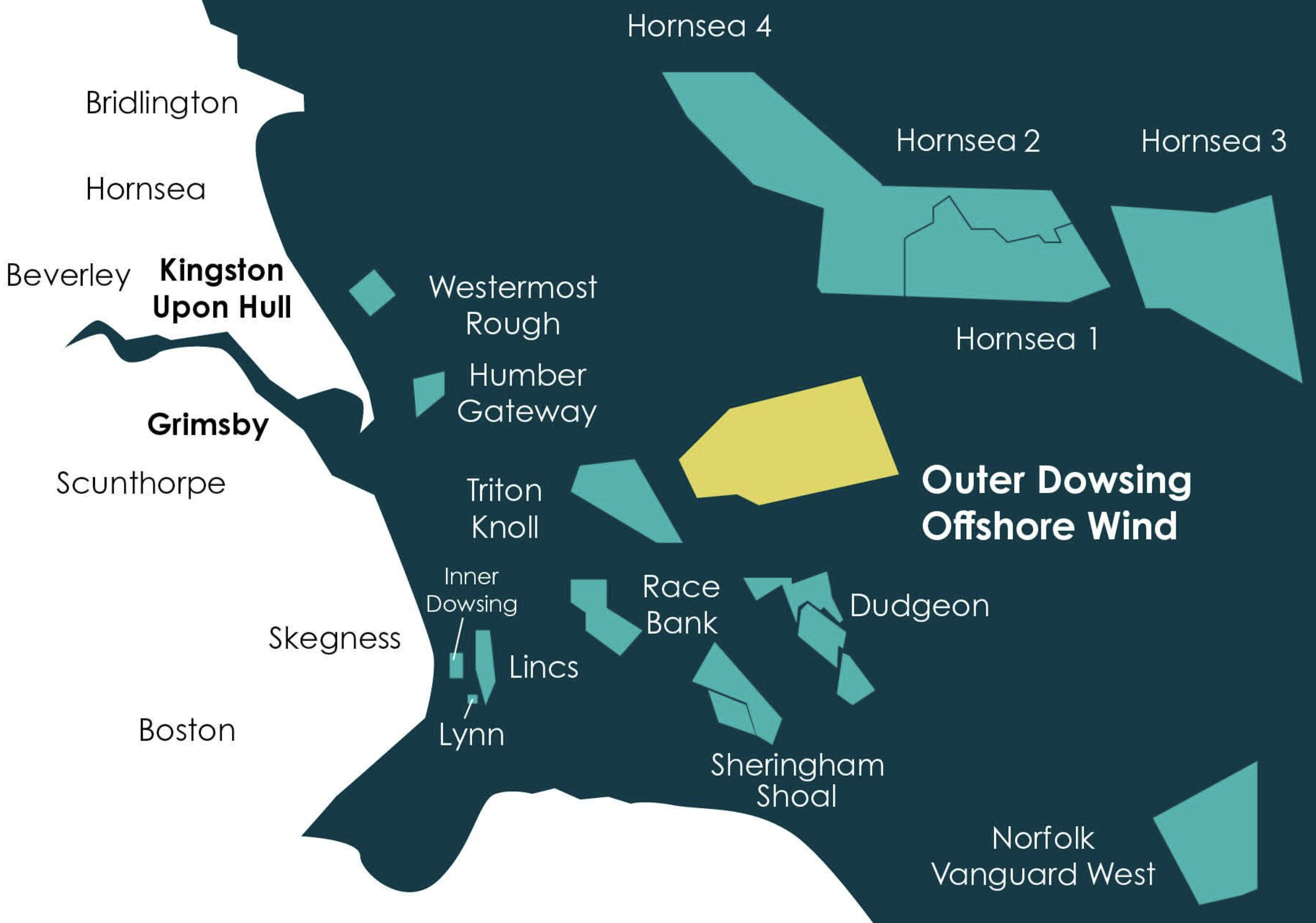
From North to South, wind farm sizes and owners are as follows.
- Hornsea 1 – 1218 MW – Ørsted, Global Infrastructure Partners
- Hornsea 2 – 1386 MW – Ørsted,Global Infrastructure Partners
- Hornsea 3 – 2852 MW – Ørsted
- Hornsea 4 – 2600 MW – Ørsted
- Westernmost Rough – 210 MW – Ørsted and Partners
- Humber Gateway – 219 MW – E.ON
- Triton Knoll – 857 MW – RWE
- Outer Dowsing – 1500 MW – Corio Generation, TotalEnergies
- Race Bank – 573 MW – Ørsted,
- Dudgeon – 402 MW – Equinor, Statkraft
- Lincs – 270 MW – Centrica, Siemens, Ørsted
- Lynn and Inner Dowsing – 194 MW – Centrica, TCW
- Sheringham Shoal – 317 MW – Equinor, Statkraft
- Norfolk Vanguard West – 1380 MW – RWE
Note.
- There is certainly a large amount of wind power on the map.
- Hornsea 1, 2 and 3 supply Humberside.
- Hornsea 4 will supply Norwich and North Norfolk.
- Norfolk Vanguard West would probably act with the other two wind farms in RWE’ Norfolk cluster.
- Ignoring Hornsea and Norfolk Vanguard West gives a total around 4.5 GW.
- There are also two 2 GW interconnectors to Scotland (Eastern Green Link 3 and Eastern Green Link 4) and the 1.4 GW Viking Link to Denmark.
I wouldn’t be surprised to see a large offshore electrolyser being built in the East Lincolnshire/West Norfolk area.
The primary purpose would be to mop up any spare wind electricity to avoid curtailing the wind turbines.
The hydrogen would have these uses.
- Provide hydrogen for small, backup and peaker power stations.
- Provide hydrogen for local industry, transport and agriculture,
- Provide hydrogen for off-gas-grid heating.
- Provide methanol for coastal shipping.
Any spare hydrogen would be exported by coastal tanker to Germany to feed H2ercules.
Do We Need Wind-Driven Hydrogen Electrolysers About Every Fifty Miles Or so Along The Coast?
I can certainly see a string along the East Coast between Humberside and Kent.
- Humberside – Being planned by SSE
- East Lincolnshire/West Norfolk – See above
- North-East Norfolk – See RWE Goes For An Additional 10 GW Of Offshore Wind In UK Waters In 2030.
- Dogger Bank – See RWE Goes For An Additional 10 GW Of Offshore Wind In UK Waters In 2030.
- Sizewell – See Sizewell C And Hydrogen.
- Herne Bay – Under construction
I can see others at possibly Freeport East and London Gateway.
Grid Powers Up With One Of Europe’s Biggest Battery Storage Sites
The title of this post, is the same as that of this article in The Times.
This is the sub-heading.
Orsted’s huge facility in Norfolk will store energy generated by its offshore wind farm
These three paragraphs give more details of the project.
The world’s largest developer of offshore wind farms is planning to build a vast battery storage facility near Norwich.
Orsted will install the energy storage system, which will be one of the largest in Europe, on the same site as the onshore converter station for its Hornsea 3 wind farm in Swardeston, Norfolk.
The project will store energy generated by Hornsea 3 when weather conditions are windy and when electricity supply exceeds demand so that it can be discharged later to help to balance the nation’s electricity grid.
Note.
- There is also a visualisation and a map.
- Tesla batteries will be used.
- The The battery will have an output of 300 MW, with a capacity of 600 MWh. So it is another two-hour BESS.
- It should be operational in 2026.
- The battery is on a 35-acre site.
- Cost is given as £8.5 billion, but that would appear to include the 2852 MW Hornsea 3 wind farm.
The BBC is reporting that local residents are worried about fire safety.
I have some thoughts of my own.
The Location Of The Swardeston Substation
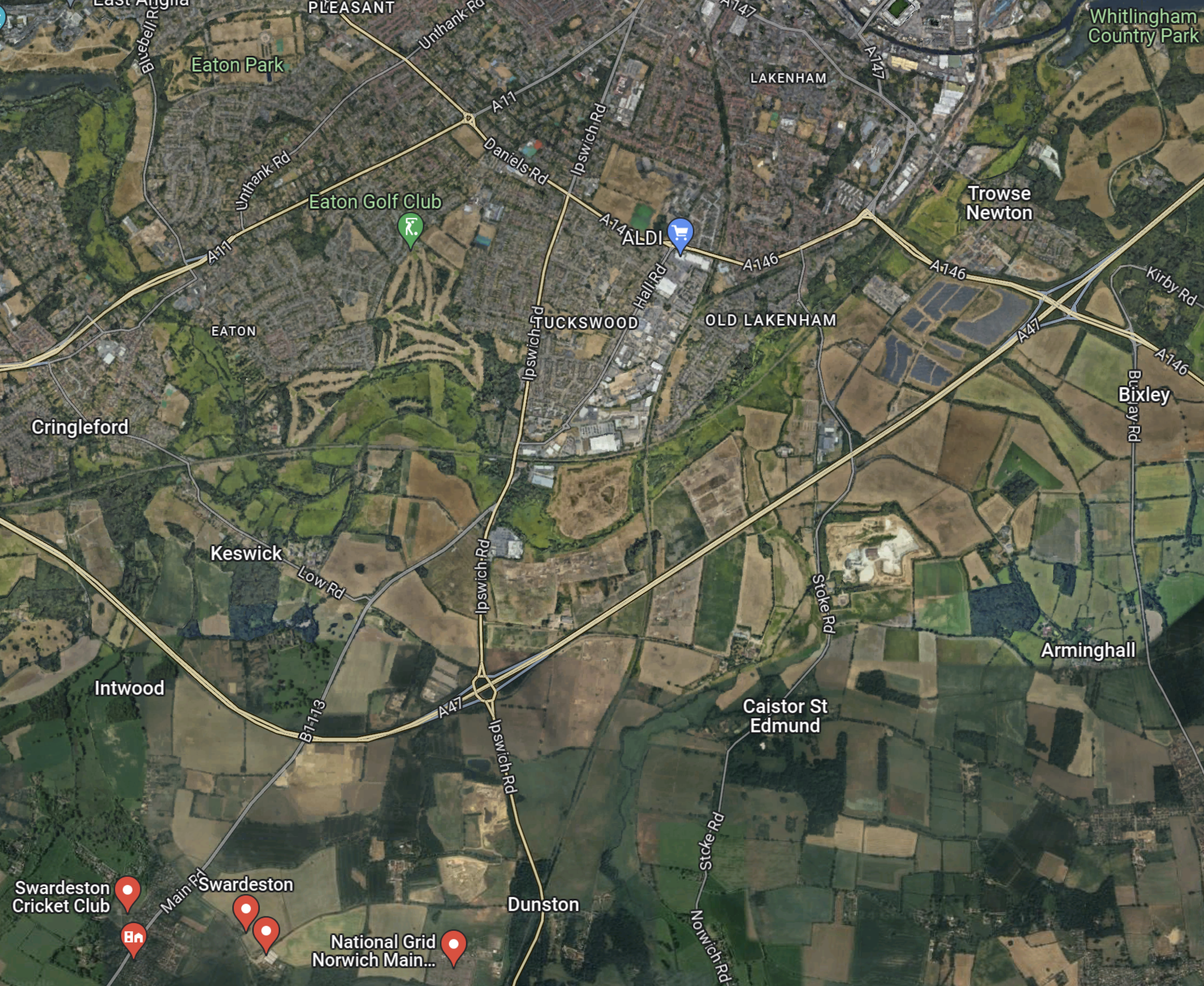
This Google Map shows the location of the Swardeston substation, which will also host the Swardeston BESS.
Note.
- The East-West road is the A 47 Norwich by-pass.
- Norwich is to the North of the by-pass.
- Just to the left-centre of the map, the main A 140 road runs between Norwich and Ipswich, which has a junction with the A 47.
- The A 140 passes through the village of Dunston, which is to the East of the National Grid sibstation, which will host the connection to the Hornsea Three wind farm.
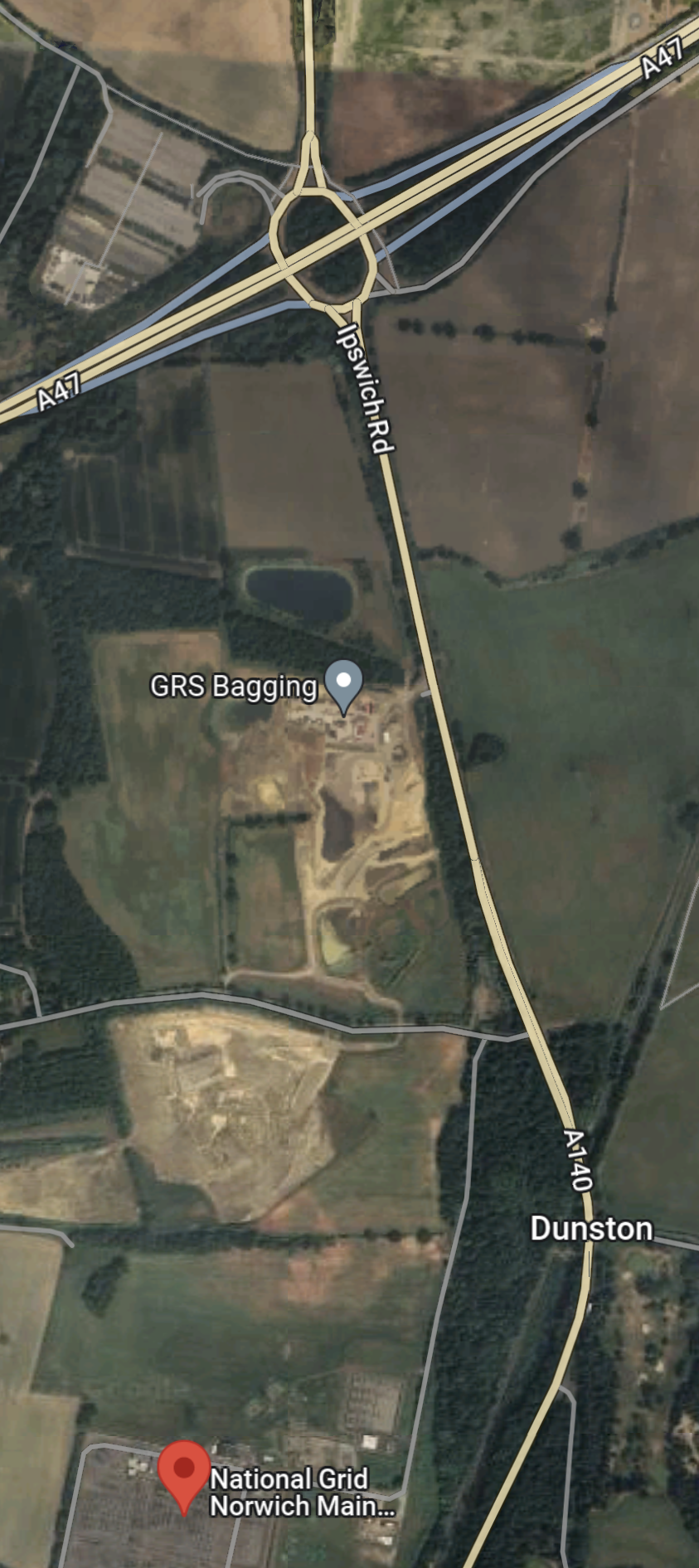
This second Google Map shows the A 140 in detail from the junction to the A 47 to the Swardeston substation.
Note.
- The Swardeston substation is on a substantial site.
- The Norwich to Tilbury transmission line will have its Northern end at Swardeston substation.
- Once the infrastructure is complete at Swardeston substation, Hornsea Three wind farm will be connected to the electricity infrastructure around London.
There would appear to be plenty of space at the site for all National Grid’s plans.
Capital Cost Compared To Big Nuclear
Hornsea Three is a 2852 MW wind farm, that will cost with the battery and a few extras £8.5 billion or around around £ 3 billion per gigawatt.
Hinckley Point C on the other hand will cost between £ 31-35 billion or £ 9.5-10.7 billion per gigawatt.
Conclusion
National Grid would appear to be using a BESS at Swardeston substation to improve the reliability and integrity of the Hornsea Three wind farm.
How many other big batteries will be placed, where large wind farms connect to the National Grid?
As an Electrical and Control Engineer, I certainly, believe that energy storage at major substations, is a proven way to improve the grid.
Do RWE Have A Comprehensive Hydrogen Plan For Germany?
What is interesting me, is what Germany company; RWE is up to. They are one of the largest UK electricity producers.
In December 2023, they probably paid a low price, for the rights for 3 x 1.4 GW wind farms about 50 km off North-East Norfolk from in-trouble Swedish company; Vattenfall and have signed contracts to build them fairly fast.
In March 2024, wrote about the purchase in RWE And Vattenfall Complete Multi-Gigawatt Offshore Wind Transaction In UK.
Over the last couple of years, I have written several posts about these three wind farms.
March 2023 – Vattenfall Selects Norfolk Offshore Wind Zone O&M Base
November 2023 – Aker Solutions Gets Vattenfall Nod To Start Norfolk Vanguard West Offshore Platform
December 2023 – SeAH To Deliver Monopiles For Vattenfall’s 2.8 GW Norfolk Vanguard Offshore Wind Project
Then in July 2023, I wrote Vattenfall Stops Developing Major Wind Farm Offshore UK, Will Review Entire 4.2 GW Zone
Note.
- There does appear to be a bit of a mix-up at Vattenfall, judging by the dates of the reports.Only, one wind farm has a Contract for Difference.
- It is expected that the other two will be awarded contracts in Round 6, which should be by Summer 2024.
In December 2023, I then wrote RWE Acquires 4.2-Gigawatt UK Offshore Wind Development Portfolio From Vattenfall.
It appears that RWE paid £963 million for the three wind farms.
I suspect too, they paid for all the work Vattenfall had done.
This transaction will give RWE 4.2 GW of electricity in an area with very bad connections to the National Grid and the Norfolk Nimbies will fight the building of more pylons.
So have the Germans bought a pup?
I don’t think so!
Where Is Wilhemshaven?
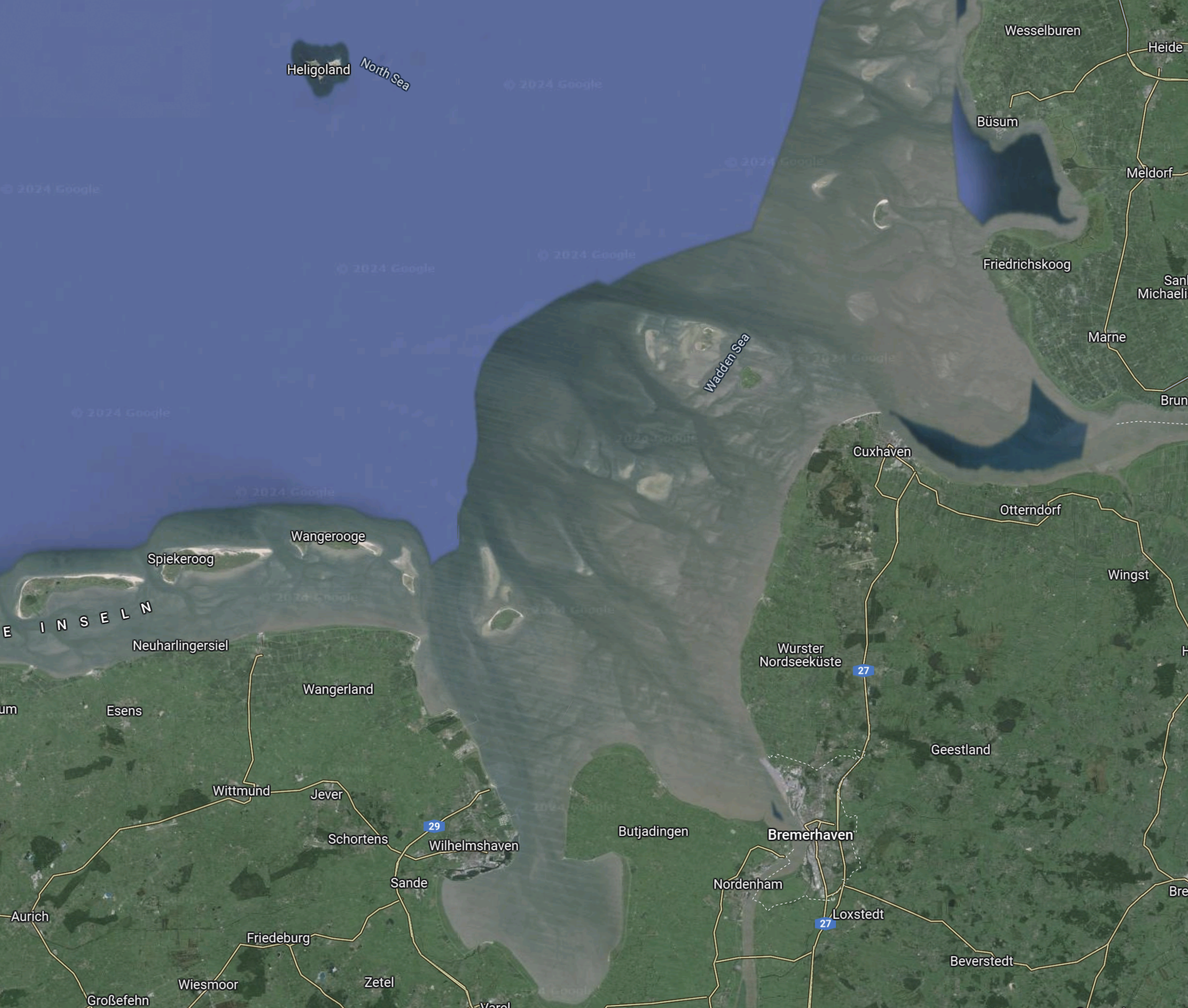
This Google Map shows the location of Wilhemshaven.
Note.
- Heligoland is the island at the top of the map.
- The Germans call this area the Wdden Sea.
- The estuaries lead to Wilhelmshaven and Bremerhaven.
- Cuxhaven is the port for Heligoland, which is connected to Hamburg by hydrogen trains.
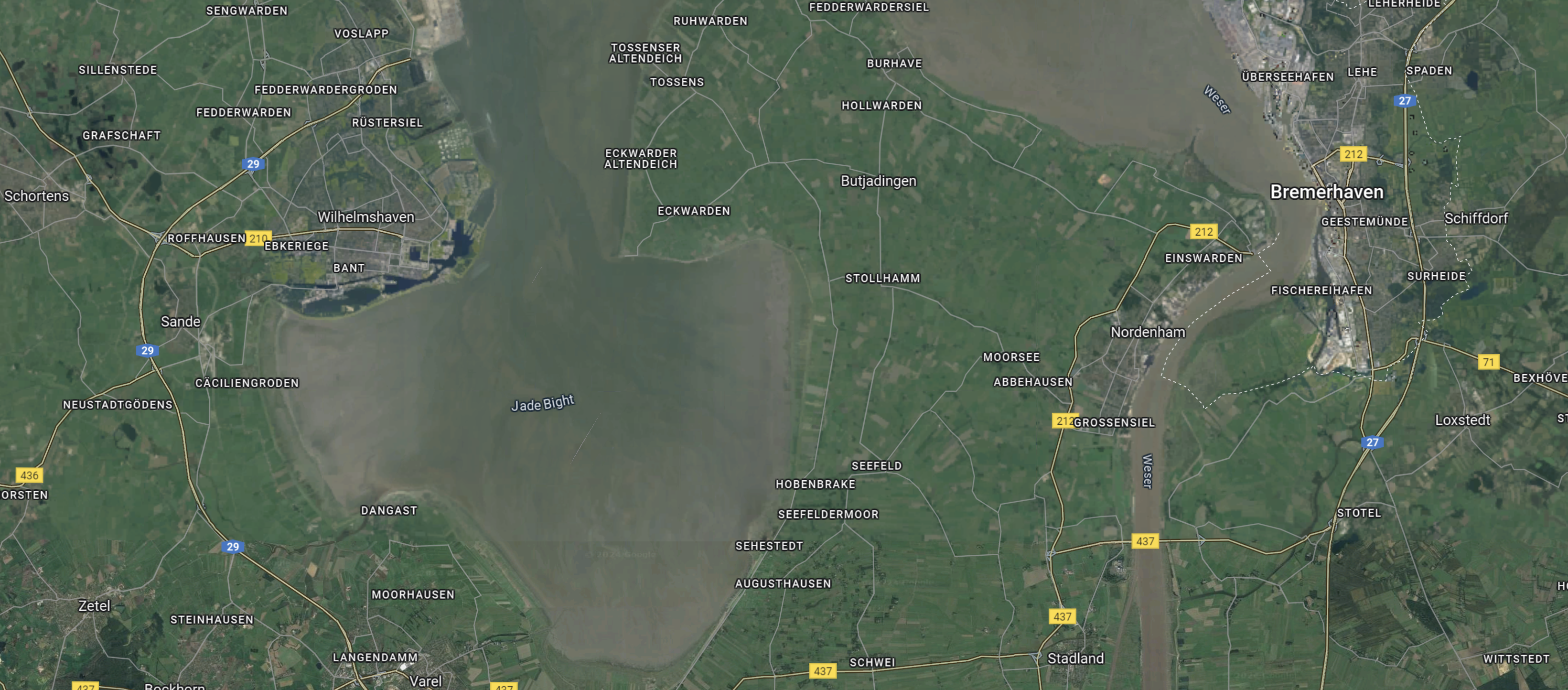
This second map shows between Bremerhaven and Wilhelmshaven.
Note.
- Wilhelmshaven is to the West.
- Bremerhaven is in the East.
- The River Weser runs North-South past Bremerhaven.
I’ve explored the area by both car and train and it is certainly worth a visit.
The Wilhemshaven Hydrogen Import Terminal
German energy company; Uniper is building a hydrogen import terminal at Wilhemshaven to feed German industry with hydrogen from places like Australia, Namibia and the Middle East. I wrote about this hydrogen import terminal in Uniper To Make Wilhelmshaven German Hub For Green Hydrogen; Green Ammonia Import Terminal.
I suspect RWE could build a giant offshore electrolyser close to the Norfolk wind farms and the hydrogen will be exported by tanker or pipeline to Germany or to anybody else who pays the right price.
All this infrastructure will be installed and serviced from Great Yarmouth, so we’re not out of the deal.
Dogger Bank South Wind Farm
To make matters better, RWE have also signed to develop the 3 GW Dogger Bank South wind farm.
This could have another giant electrolyser to feed German companies. The wind farm will not need an electricity connection to the shore.
The Germans appear to be taking the hydrogen route to bringing electricity ashore.
Energy Security
Surely, a short trip across the North Sea, rather than a long trip from Australia will be much more secure and on my many trips between the Haven Ports and The Netherlands, I haven’t yet seen any armed Houthi pirates.
RWE And Hydrogen
On this page on their web site, RWE has a lot on hydrogen.
Very Interesting!
H2ercules
This web site describes H2ercules.
The goal of the H2ercules initiative is to create the heart of a super-sized hydrogen infrastructure for Germany by 2030. To make this happen, RWE, OGE and, prospectively, other partners are working across various steps of the value chain to enable a swift supply of hydrogen from the north of Germany to consumers in the southern and western areas of the country. In addition to producing hydrogen at a gigawatt scale, the plan is also to open up import routes for green hydrogen. The transport process will involve a pipeline network of about 1,500 km, most of which will consist of converted gas pipelines.
Where’s the UK’s H2ercules?
Conclusion
The Germans have got there first and will be buying up all of our hydrogen to feed H2ercules.
RWE And the Norfolk Wind Farms
In March 2024, I wrote RWE And Vattenfall Complete Multi-Gigawatt Offshore Wind Transaction In UK, which described how Vattenfall had sold 4.2 GW of offshore wind farms, situated off North-East Norfolk to RWE.
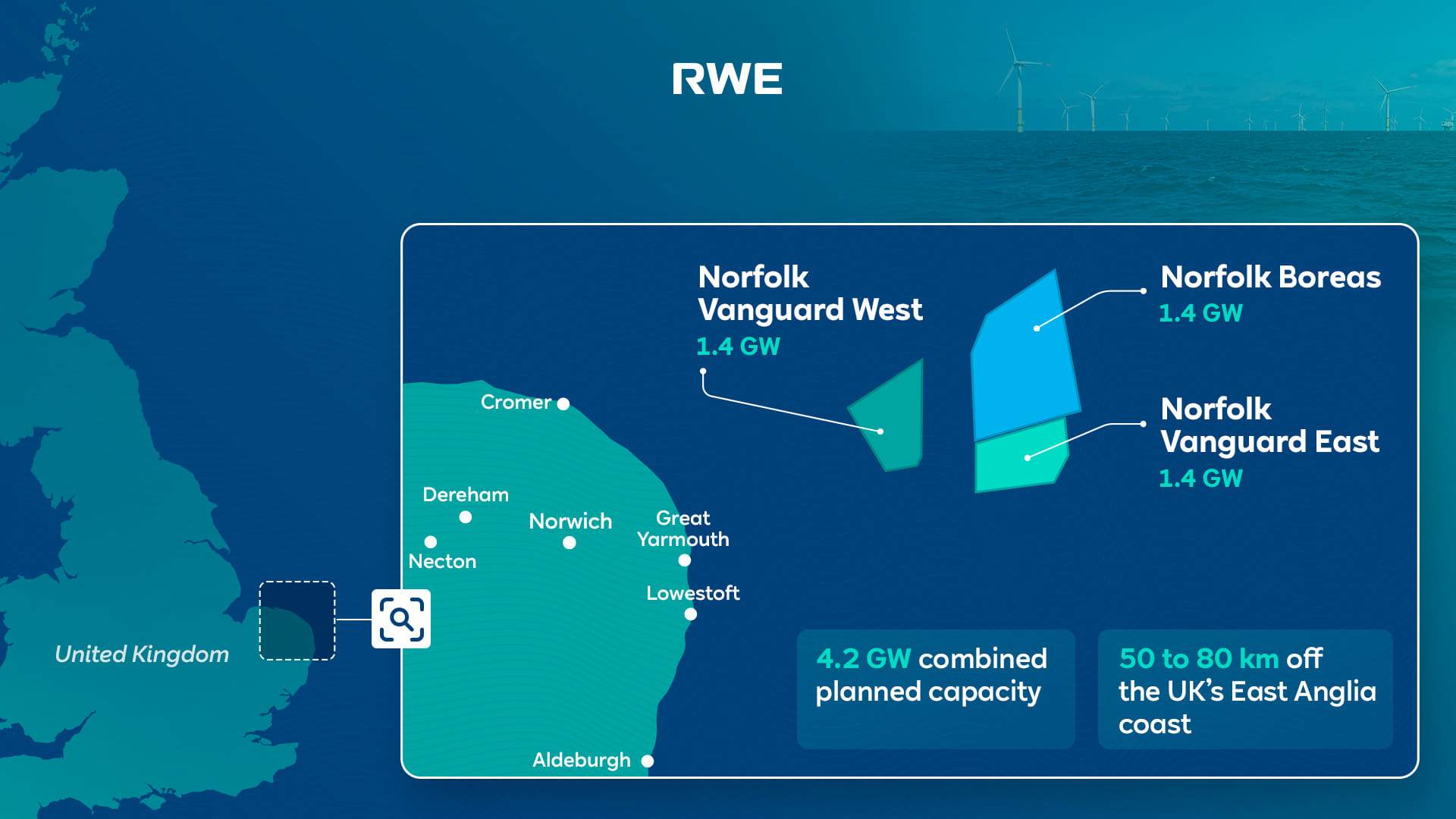
This map from RWE shows the wind farms.
Note.
- The Norfolk Zone consists of three wind farms; Norfolk Vanguard West, Norfolk Boreas and Norfolk Vanguard East.
- The three wind farms are 1.4 GW fixed-foundation wind farms.
- In Vattenfall Selects Norfolk Offshore Wind Zone O&M Base, I describe how the Port of Great Yarmouth had been selected as the O & M base.
- Great Yarmouth and nearby Lowestoft are both ports, with a long history of supporting shipbuilding and offshore engineering.
The wind farms and the operational port are all close together, which probably makes things convenient.
So why did Vattenfall sell the development rights of the three wind farms to RWE?
Too Much Wind?
East Anglia is fringed with wind farms all the way between the Wash and the Thames Estuary.
- Lincs – 270 MW
- Lynn and Inner Dowsing – 194 MW
- Race Bank – 580 MW
- Triton Knoll – 857 MW
- Sheringham Shoal – 317 MW
- Dudgeon – 402 MW
- Hornsea 3 – 2852 MW *
- Scroby Sands – 60 MW
- East Anglia One North – 800 MW *
- East Anglia Two – 900 MW *
- East Anglia Three – 1372 MW *
- Greater Gabbard – 504 MW
- Galloper – 353 MW
- Five Estuaries – 353 MW *
- North Falls – 504 MW *
- Gunfleet Sands – 172 MW
- London Array – 630 MW
Note.
- Wind farms marked with an * are under development or under construction.
- There is 4339 MW of operational wind farms between the Wash and the Thames Estuary.
- An extra 6781 MW is also under development.
If all goes well, East Anglia will have over 11 GW of operational wind farms or over 15 GW, if the three Norfolk wind farms are built.
East Anglia is noted more for its agriculture and not for its heavy industries consuming large amounts of electricity, so did Vattenfall decide, that there would be difficulties selling the electricity?
East Anglia’s Nimbies
East Anglia’s Nimbies seem to have started a campaign against new overground cables and all these new wind farms will need a large capacity increase between the main substations of the National Grid and the coast.
So did the extra costs of burying the cable make Vattenfall think twice about developing these wind farms?
East Anglia and Kent’s Interconnectors
East Anglia and Kent already has several interconnectors to Europe
- Viking Link – Bicker Fen and Jutland – 1.4 GW
- LionLink – Suffolk and the Netherlands – 1.8 GW – In Planning
- Nautilus – Suffolk or Isle of Grain and Belgium – 1.4 GW – In Planning
- BritNed – Isle of Grain and Maasvlakte – 1.0 GW
- NeuConnect – Isle of Grain and Wilhelmshaven – 1.4 GW – Under Construction
- GridLink Interconnector – Kingsnorth and Warande – 1.4 GW – Proposed
- HVDC Cross-Channel – Sellinge and Bonningues-lès-Calais – 2.0 GW
- ElecLink – Folkestone and Peuplingues – 1.0 GW
- Nemo Link – Richborough and Zeebrugge – 1.0 GW
Note.
- Five interconnectors with a capacity of 6.4 GW.
- A further four interconnectors with a capacity of 6 GW are on their way.
At 12.4 GW, the future capacity of the interconnectors between South-East England and Europe, is nor far short of South-East English wind power.
There are also two gas pipelines from the Bacton gas terminal between Cromer and Great Yarmouth to Europe.
The Wikipedia entry for the Bacton gas terminal gives these descriptions of the two gas pipelines.
Interconnector UK – This can import gas from, or export gas to, Zeebrugge, Belgium via a 235 km pipeline operating at up to 147 bar. There is a 30-inch direct access line from the SEAL pipeline. The Interconnector was commissioned in 1998.
BBL (Bacton–Balgzand line) – This receives gas from the compressor station in Anna Paulowna in the Netherlands. The BBL Pipeline is 235 km long and was commissioned in December 2006.
It would appear that East Anglia and Kent are well connected to the Benelux countries, with both electricity and gas links, but with the exception of the Viking Link, there is no connection to the Scandinavian countries.
Did this lack of connection to Sweden make convincing the Swedish government, reluctant to support Vattenfall in their plans?
Bringing The Energy From The Norfolk Wind Farms To Market
It looks to me, that distributing up to 4.2 GW from the Norfolk wind farms will not be a simple exercise.
- Other wind farms like the 2852 MW Hornsea 3 wind farm, may need a grid connection on the North Norfolk coast.
- The Nimbies will not like a South-Western route to the National Grid at the West of Norwich.
- An interconnector to Denmark or Germany from North Norfolk would probably help.
But at least there are two gas pipelines to Belgium and the Netherlands.
RWE, who now own the rights to the Norfolk wind farms, have a large amount of interests in the UK.
- RWE are the largest power producer in the UK.
- They supply 15 % of UK electricity.
- They have interest in twelve offshore wind farms in the UK. When fully-developed, they will have a capacity of almost 12 GW.
- RWE are developing the Pembroke Net Zero Centre, which includes a hydrogen electrolyser.
RWE expects to invest up to £15 billion in the UK by 2030 in new and existing green technologies and infrastructure as part of this.
Could this be RWE’s plan?
As the Norfolk wind farms are badly placed to provide electricity to the UK grid could RWE have decided to use the three Norfolk wind farms to produce hydrogen instead.
- The electrolyser could be placed onshore or offshore.
- If placed onshore, it could be placed near to the Bacton gas terminal.
- There are even depleted gas fields, where hydrogen could be stored.
How will the hydrogen be distributed and/or used?
It could be delivered by tanker ship or tanker truck to anyone who needs it.
In Developing A Rural Hydrogen Network, I describe how a rural hydrogen network could be developed, that decarbonises the countryside.
There are three major gas pipelines leading away from the Bacton gas terminal.
- The connection to the UK gas network.
- Interconnector UK to Belgium.
- BBL to The Netherlands.
These pipelines could be used to distribute hydrogen as a hydrogen blend with natural gas.
In UK – Hydrogen To Be Added To Britain’s Gas Supply By 2025, I describe the effects of adding hydrogen to the UK’s natural gas network.
National Grid Shares Proposals For Green Electricity Projects In Lincolnshire And West Norfolk, Needed To Boost Home-Grown Energy Supplies And Progress Towards Net Zero
The title of this post, is the same as that of this press release from National Grid.
These four bullet points, act as sub-headings.
- National Grid is inviting communities in East Lindsey, Boston and South Holland in Lincolnshire, and King’s Lynn and West Norfolk, to view proposals for two new primarily offshore electricity infrastructure projects.
- National Grid will consult communities from 23 April – 17 June to introduce the proposed project and ask for local peoples’ opinions.
- Eastern Green Link 3 (EGL 3) and Eastern Green Link 4 (EGL 4) will be able to transport enough clean energy generated in Scotland to power up to four million homes in the Midlands and South of England.
- The projects form part of The Great Grid Upgrade, the largest overhaul of the grid in generations, with new infrastructure across England and Wales helping the UK to meet its net zero ambitions, reduce its reliance on fossil fuels and contribute to lower energy bills over the long-term.
These five paragraphs outline the two projects.
National Grid is inviting communities to comment on early proposals for two green electricity infrastructure projects which will help deliver the UK’s energy security strategy and net zero targets.
The eight-week initial consultation, which begins on 23 April, shares proposals for Eastern Green Link 3 (EGL 3) and Eastern Green Link 4 (EGL 4) projects – two new, primarily subsea high voltage direct current (HVDC) electricity links, with associated infrastructure, between Scotland and England.
National Grid Electricity Transmission (NGET) is jointly developing EGL 3 with SSEN Transmission (SSEN) and EGL 4 with SP Energy Networks (SPEN).
EGL 3 would run from Peterhead, Aberdeenshire, under the North Sea via marine cables to a potential landfall location on the Lincolnshire coastline, either at Theddlethorpe or Anderby Creek. EGL 4 would run from Westfield, Fife, also via marine cables under the North Sea to the same landfall location as EGL 3.
After making landfall, both projects’ cables will run underground for approximately 100km to two proposed converter stations in the Walpole, King’s Lynn and West Norfolk, area. Underground cables would then connect the converter stations to the transmission network via a new proposed substation, also within the Walpole area.
Note.
- These would appear to be early proposals.
- National Grid appear to be planning and consulting on two interconnectors at once.
- There would appear to be a lot of underground cable on land. But then the cables will be dug into good Fenland soil.
- All the electrical gubbins seem to be in the Walpole area.
These paragraphs invite people to comment.
Throughout our initial consultation, we are holding a series of face-to-face events to consult on the electrical infrastructure required in England.
Our consultation events are being held across the project area. Information about our proposals will be on display and copies of maps and technical documents will be available to view. Members of the project team will be available to talk through our proposals and answer any questions.
National Grid have also announced dates of when public information events are being held.
- Tuesday 30 April 2024 – 2pm-7pm – Dunes Complex, Central Promenade, Mablethorpe, LN12 1RG
- Wednesday 1 May 2024 – 2pm-7pm – Anderby Village Hall, Sea Road, Anderby, Skegness, PE24 5YD
- Thursday 9 May 2024 – 12:30pm – 6pm – Alford Corn Exchange, 9 Market Place, Alford, LN13 9EB
- Monday 13 May 2024 – 2pm-7pm – Leverington Village Hall, Gorefield Rd, Leverington, Wisbech, PE13 5AT
- Wednesday 15 May 2024 – 2pm-7pm – Eastville, Midville and New Leake Village Hall, Station Rd, Eastville, PE22 8LS
- Thursday 16 May 2024 – 2pm-7pm – Poachers Country Hotel, Swineshead Road, Kirton Holme, PE20 1SQ
- Monday 20 May 2024 – 2pm-7pm – Walpole Community Centre, Summer Close, Walpole St Andrew, PE14 7JW
- Wednesday 29 May 2024 – 2pm-7pm – The Holbeach Hub, Boston Rd South, Holbeach, PE12 7LR
- Wednesday 5 June 2024 – 2pm-7pm – Burgh le Marsh Village Hall, Jacksons Lane, Burgh le Marsh, Skegness, PE24 5LA
I would have hoped, that some of the venues would have been easier to get to by public transport.
I have some thoughts and observations.
What Will Be The Capacity Of Green Link 3 And Green Link 4?
I can find references to the capacity of Eastern Green Links 1-4 and it appears that all four have a capacity of 2 GW.
A Map Of Green Link 3 And Green Link 4
I have found this map of Green Link 3 and Green Link 4.

National Grid are going to be busy, as they’re also building Green Link 1 and Green Link 2.
Will Green Link 3 And Green Link 4 Share A Route Between The Coast And Walpole?
There is only one green HVDC onshore cable on the map. But surely laying two 2 GW cables in the same trench will cost less, than digging two cable routes.
Looking at the three converter stations would appear to confirm that Green Link 3 and Green Link 4 share a route.
Will Landfall Be At Theddlethorpe Or Anderby Creek?
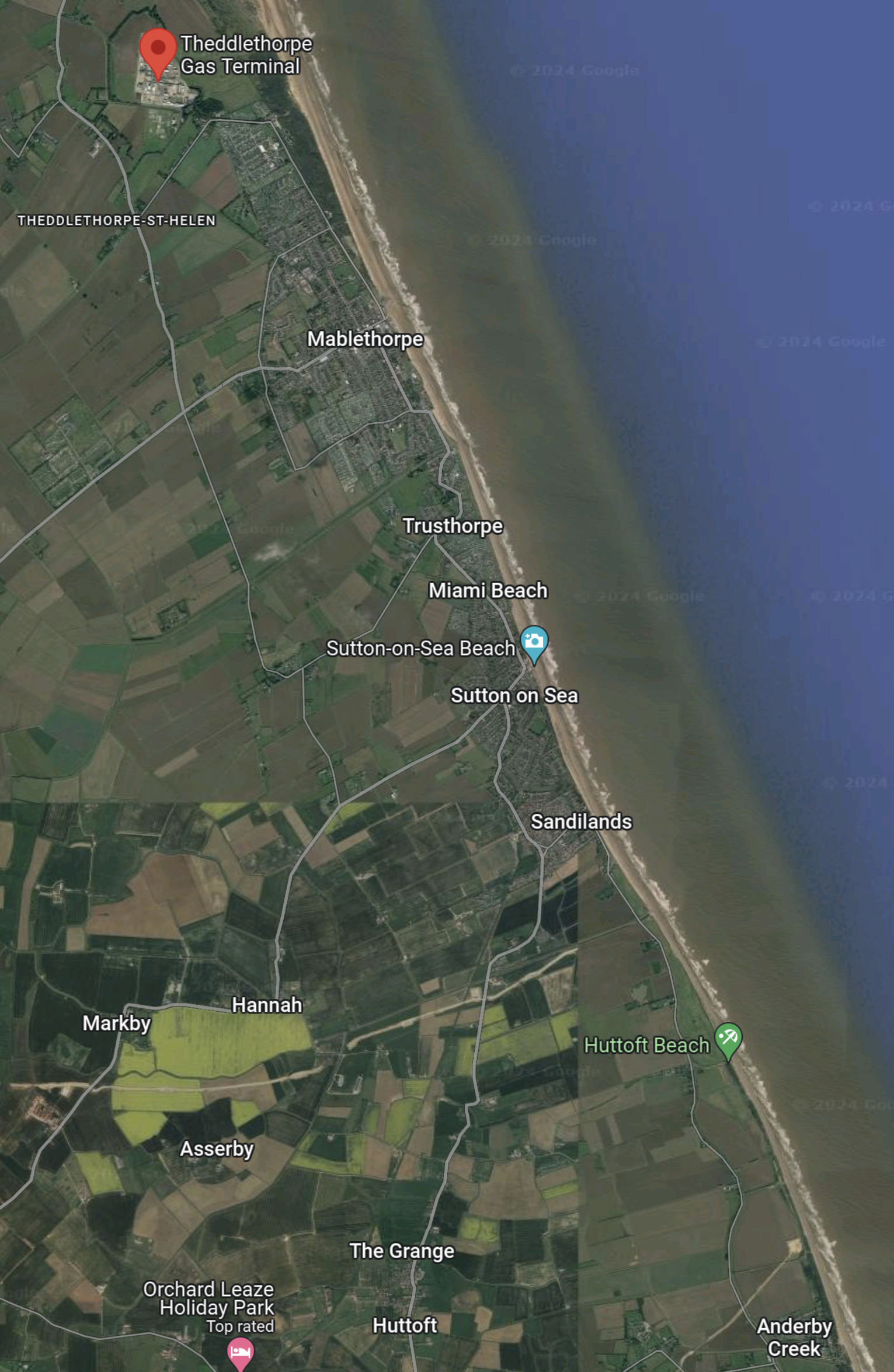
This Google Map shows the coast between Theddlethorpe and Anderby Creek.
Note.
- The decommissioned Theddlethorpe gas terminal is indicated by the red arrow.
- The seaside resort of Mablethorpe lies between the two possible landing sites.
- Anderby Creek is in the South-East corner of the map.
This second Google Map shows the Theddlethorpe Gas Terminal and the North of Mablethorpe.
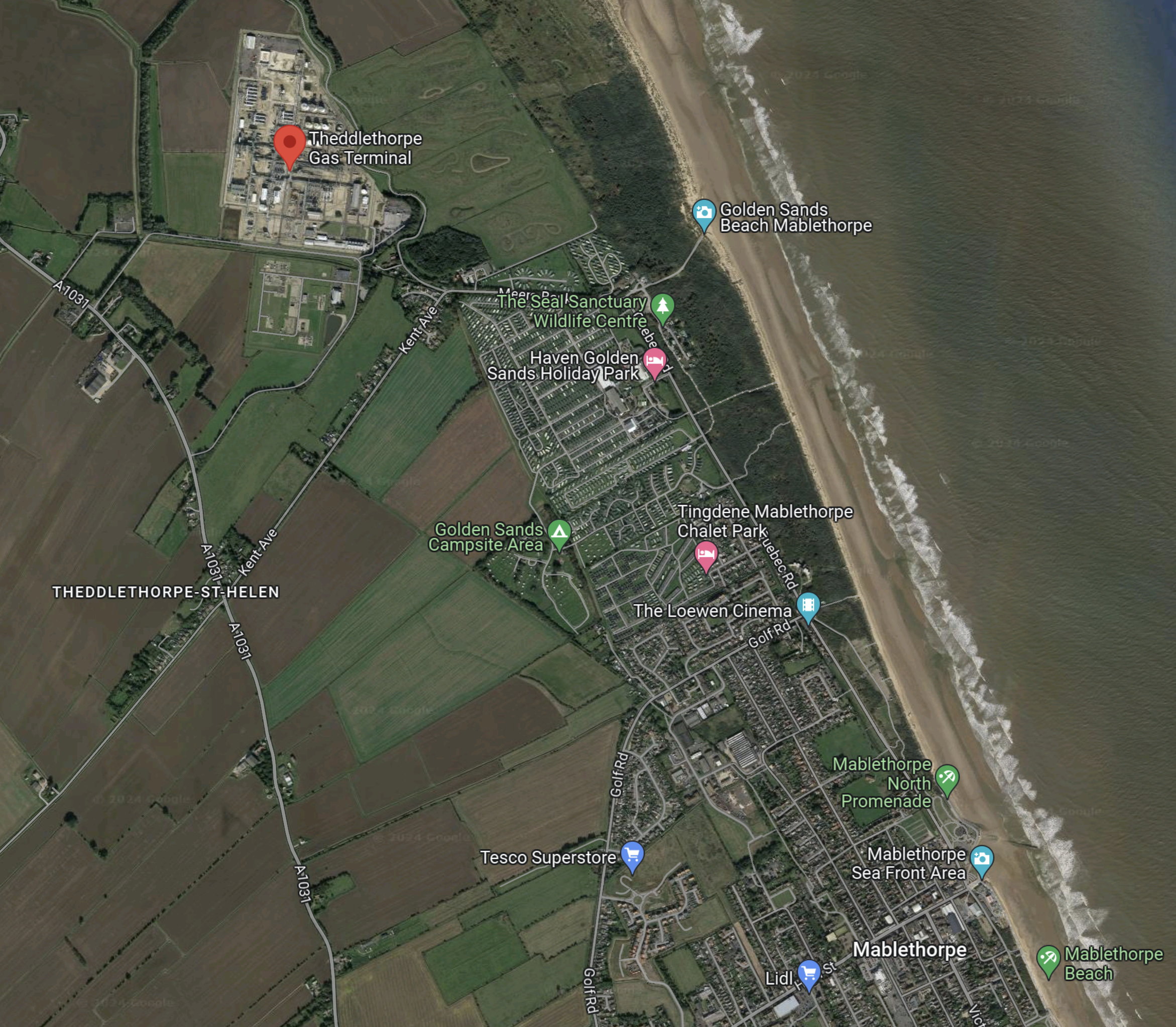
Note.
- The decommissioned Theddlethorpe gas terminal is indicated by the red arrow.
- Mablethorpe beach appears to be on a high quality.
Both sites would appear to be strong possibilities.
Both sites have plenty of space, but the Theddlethorpe gas terminal is a large brownfield site.
The Anderby Creek site would probably be a shorter underground cable across Lincolnshire.
The Triton Knoll Wind Farm
The Wikipedia entry for the Triton Knoll wind farm starts with these two paragraphs.
Triton Knoll Wind Farm is an 857 MW round 2 offshore wind farm 33 kilometres (21 mi) off the coast of Lincolnshire, in the North Sea, England.
RWE Npower Renewables were awarded the lease to the development area in 2003. The offshore elements of the wind farm of up to 1200MW power gained planning consent in 2013; RWE reduced the scope of the wind farm to 900MW or under in 2014, to reduce cost per MW.
Note.
- The wind farm was commissioned in January 2022.
- The wind farm cables make landfall at Anderby Creek.
- They then travel underground to Bicker Fen substation.
This Google Map shows Bicker Fen and Anderby Creek.
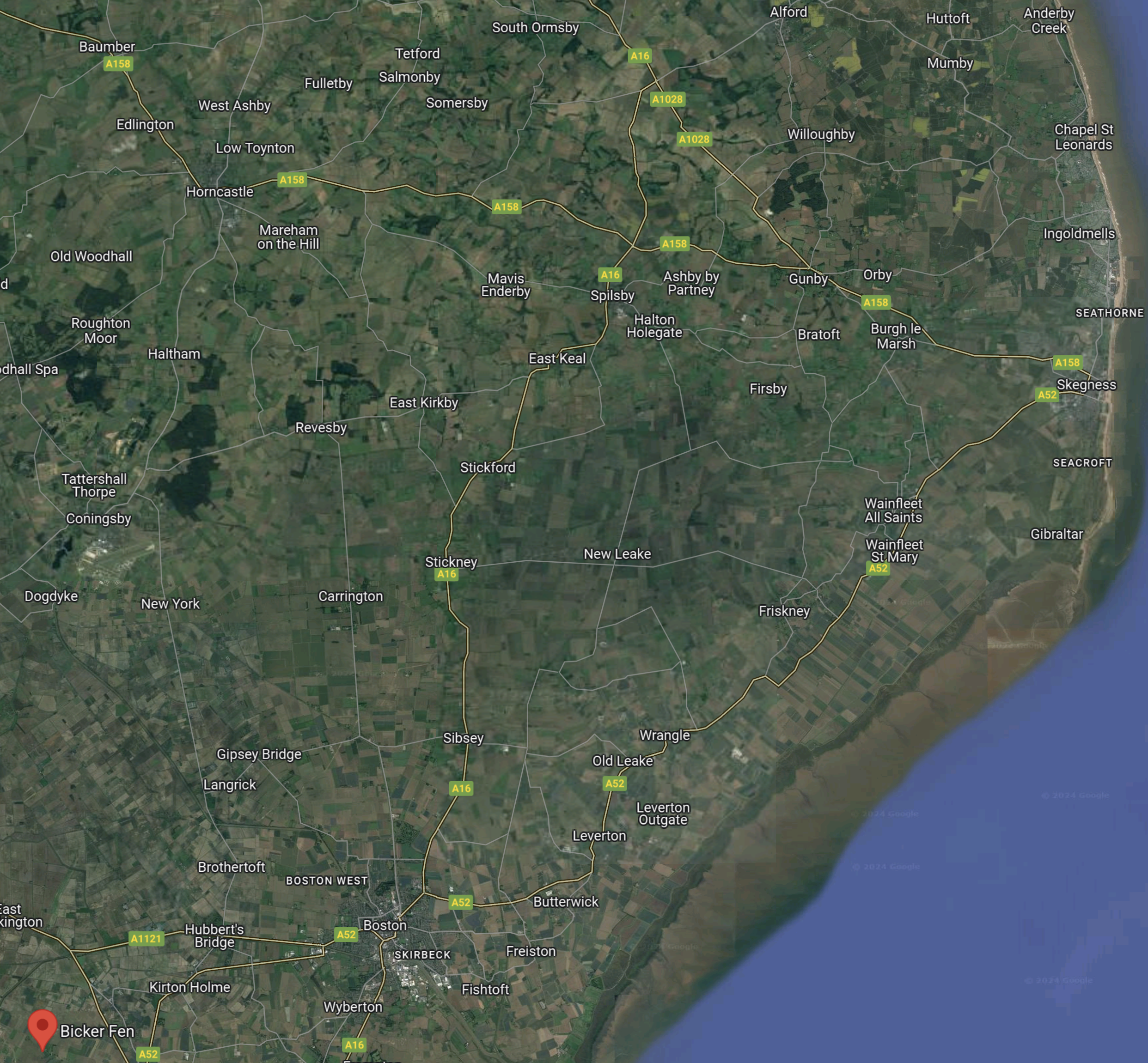
Note.
- Bicker Fen substation is in the South-West corner of the map and is indicated by a red arrow.
- Anderby Creek is in the North-East corner of the map.
- The cable is underground.
- This page on the Murphy Group website, describes the work the company did to install the cables.
- It appears from the Murphy document, that there are six cables between Anderby Creek and Bicker Fen.
This Google Map shows Anderby Creek.
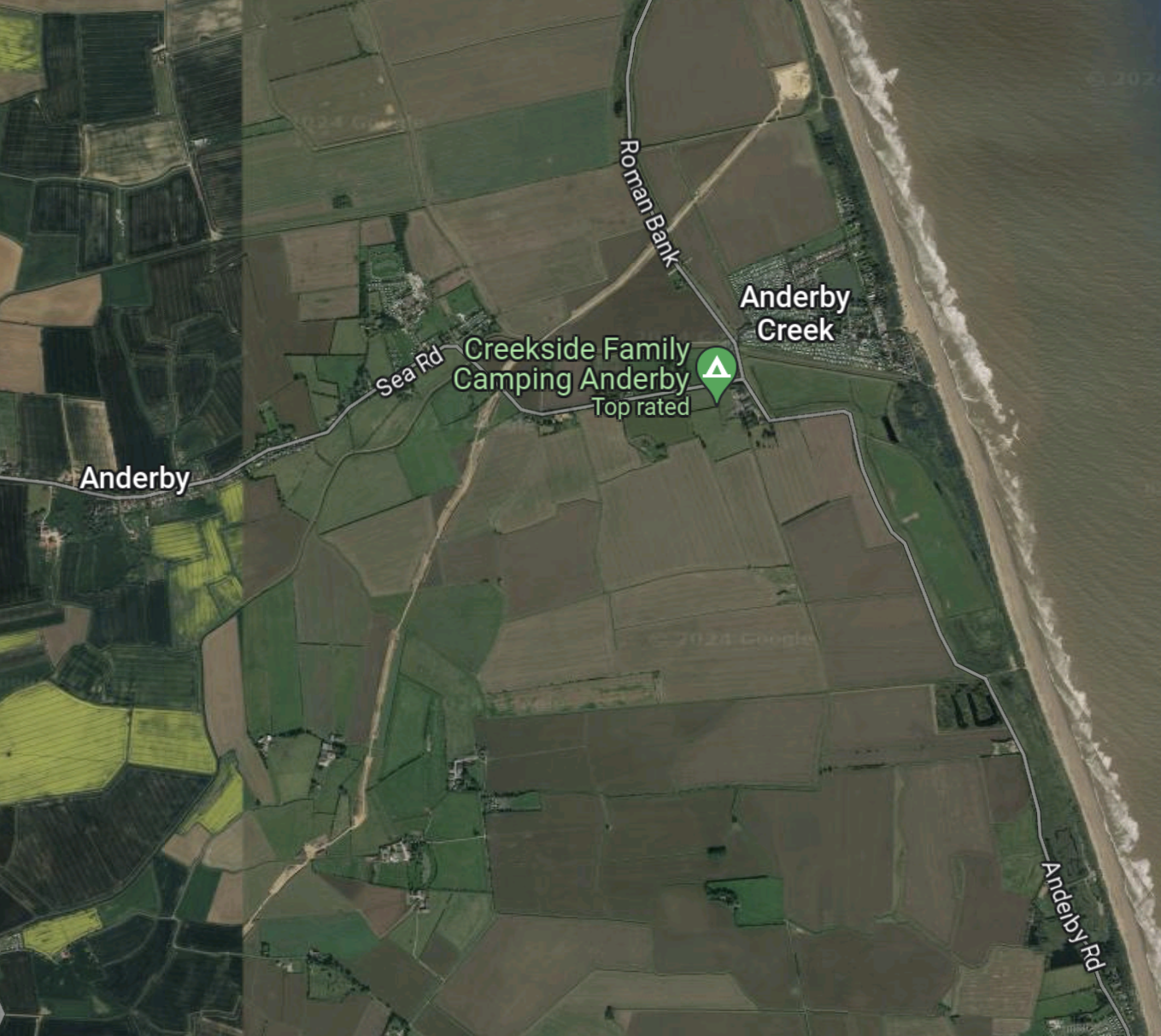
Could the scar across the land to the West of Anderby Creek, be the connection to the offshore Triton Knoll wind farm?
I think it is! And I also think that it can carry more than just the 857 MW Triton Knoll wind farm!
I am suspicious, that one of Baldrick’s ancestors has been at work and the Triton Knoll export cable system could be used to connect Green Link 3 and Green Link 4 to Bicker Fen and Walpole substations.
This would surely allow Scottish wind power to be sold to Denmark and then sold onward to Germany.
The VikingCCS Project
The VikingCCS project is a carbon capture and storage project, that is proposed to be based at the decommissioned Theddlethorpe gas terminal.
The VikingCCS project has a web site.
Would the use of the Theddlethorpe gas terminal mean that it is more likely that Green Link 3 and Green Link 4 will make a Southern landfall at Anderby Creek?
Will There Be A Connection To Viking Link?
The Viking Link is a 1400 MW at 525 KV electricity interconnector between Bicker Fen in Lincolnshire and Revsing in Jutland, Denmark.
This Google Map, shows the location of Bicker Fen, about halfway between Boston and Sleaford.

This second map shows the position of the current Walpole substation with respect to the Wash.
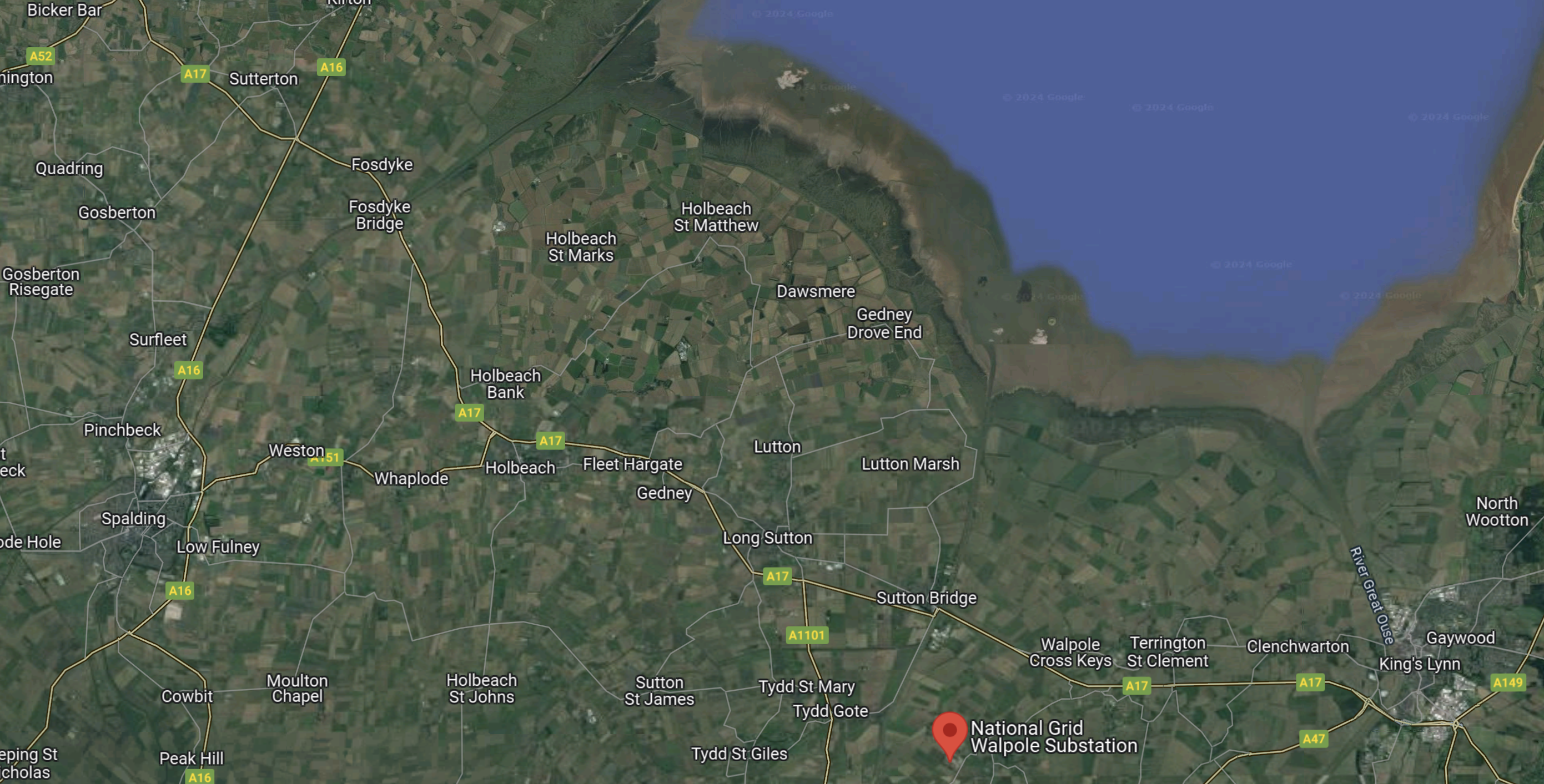
Note.
- Bicker Fen is in the North-West corner of the map.
- The current Walpole substation is marked by the red arrow.
- King’s Lynn is in the South-East corner of the map.
I suspect, if National Grid wanted to connect Green Link 3 and Green Link 4 to the Viking Link, then this would be possible.
If the Viking Link were to be connected to Green Link 3 and Green Link 4, this would allow surplus Scottish renewable energy to be sent to Denmark and on to Germany.
Green Link 3, Green Link 4 And Viking Link Appear To Be Underground In Lincolnshire
I can’t find any trace of overhead cables for the Viking Line in Lincolnshire and the press release says this about Green Link 3 and Green Link 4.
After making landfall, both projects’ cables will run underground for approximately 100km to two proposed converter stations in the Walpole, King’s Lynn and West Norfolk, area.
The connection to the Triton Knoll wuind farm is also underground.
It does appear that National Grid, are going for a Nimby-friendly approach for cables between Walpole and the coast.
Hopefully putting the cables underground will save money in legal arguments and fees.
RWE Acquires 4.2-Gigawatt UK Offshore Wind Development Portfolio From Vattenfall
The title of this post, is the same as that of this press release from RWE.
These three bullet points, act as sub-headings.
- Highly attractive portfolio of three projects at a late stage of development, with grid connections and permits secured, as well as advanced procurement of key components
- Delivery of the three Norfolk Offshore Wind Zone projects off the UK’s East Anglia coast will be part of RWE’s Growing Green investment and growth plans
- Agreed purchase price corresponds to an enterprise value of £963 million
These two paragraphs outline the deal.
RWE, one of the world’s leading offshore wind companies, will acquire the UK Norfolk Offshore Wind Zone portfolio from Vattenfall. The portfolio comprises three offshore wind development projects off the east coast of England – Norfolk Vanguard West, Norfolk Vanguard East and Norfolk Boreas.
The three projects, each with a planned capacity of 1.4 gigawatts (GW), are located 50 to 80 kilometres off the coast of Norfolk in East Anglia. This area is one of the world’s largest and most attractive areas for offshore wind. After 13 years of development, the three development projects have already secured seabed rights, grid connections, Development Consent Orders and all other key permits. The Norfolk Vanguard West and Norfolk Vanguard East projects are most advanced, having secured the procurement of most key components. The next milestone in the development of these two projects is to secure a Contract for Difference (CfD) in one of the upcoming auction rounds. RWE will resume the development of the Norfolk Boreas project, which was previously halted. All three Norfolk projects are expected to be commissioned in this decade.
There is also this handy map, which shows the location of the wind farms.
Note that there are a series of assets along the East Anglian coast, that will be useful to RWE’s Norfolk Zone development.
- In Vattenfall Selects Norfolk Offshore Wind Zone O&M Base, I talked about how the Port of Great Yarmouth will be the operational base for the Norfolk Zone wind farms.
- Bacton gas terminal has gas interconnectors to Belgium and the Netherlands lies between Cromer and Great Yarmouth.
- The cable to the Norfolk Zone wind farms is planned to make landfall between Bacton and Great Yarmouth.
- Sizewell is South of Lowestoft and has the 1.25 GW Sizewell B nuclear power station, with the 3.2 GW Sizewell C on its way, for more than adequate backup.
- Dotted around the Norfolk and Suffolk coast are 3.3 GW of earlier generations of wind farms, of which 1.2 GW have connections to RWE.
- The LionLink multipurpose 1.8 GW interconnector will make landfall to the North of Southwold
- There is also the East Anglian Array, which currently looks to be about 3.6 GW, that connects to the shore at Bawdsey to the South of Aldeburgh.
- For recreation, there’s Southwold.
- I can also see more wind farms squeezed in along the coast. For example, according to Wikipedia, the East Anglian Array could be increased in size to 7.2 GW.
It appears that a 15.5 GW hybrid wind/nuclear power station is being created on the North-Eastern coast of East Anglia.
The big problem is that East Anglia doesn’t really have any large use for electricity.
But the other large asset in the area is the sea.
- Undersea interconnectors can be built to other locations, like London or Europe, where there is a much greater need for electricity.
- In addition, the UK Government has backed a consortium, who have the idea of storing energy by using pressurised sea-water in 3D-printed concrete hemispheres under the sea. I wrote about this development in UK Cleantech Consortium Awarded Funding For Energy Storage Technology Integrated With Floating Wind.
A proportion of Russian gas in Europe, will have been replaced by Norfolk wind power and hydrogen, which will be given a high level of reliability from Suffolk nuclear power.
I have some other thoughts.
Would Hydrogen Be Easier To Distribute From Norfolk?
A GW-range electrolyser would be feasible but expensive and it would be a substantial piece of infrastructure.
I also feel, that placed next to Bacton or even offshore, there would not be too many objections from the Norfolk Nimbys.
Hydrogen could be distributed from the site in one of these ways.
- By road transport, as ICI did, when I worked in their hydrogen plant at Runcorn.
- I suspect, a rail link could be arranged, if there was a will.
- By tanker from the Port of Great Yarmouth.
- By existing gas interconnectors to Belgium and the Netherlands.
As a last resort it could be blended into the natural gas pipeline at Bacton.
In Major Boost For Hydrogen As UK Unlocks New Investment And Jobs, I talked about using the gas grid as an offtaker of last resort. Any spare hydrogen would be fed into the gas network, provided safety criteria weren’t breached.
I remember a tale from ICI, who from their refinery got a substantial amount of petrol, which was sold to independent petrol retailers around the North of England.
But sometimes they had a problem, in that the refinery produced a lot more 5-star petrol than 2-star. So sometimes if you bought 2-star, you were getting 5-star.
On occasions, it was rumoured that other legal hydrocarbons were disposed of in the petrol. I was once told that it was discussed that used diluent oil from polypropylene plants could be disposed of in this way. But in the end it wasn’t!
If hydrogen were to be used to distribute all or some of the energy, there would be less need for pylons to march across Norfolk.
Could A Rail Connection Be Built To The Bacton Gas Terminal
This Google Map shows the area between North Walsham and the coast.
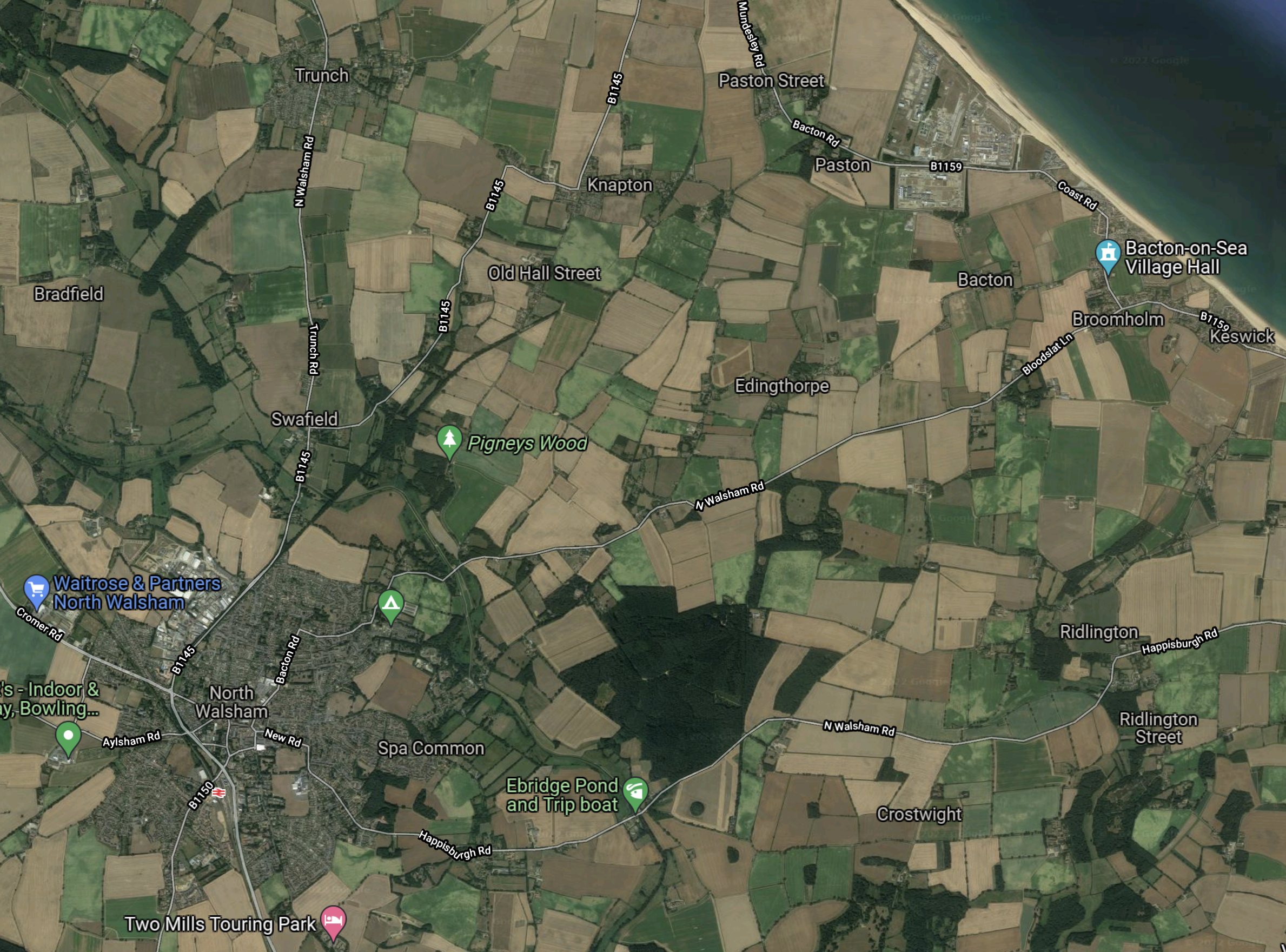
Note.
- North Walsham is in the South-Western corner of the map.
- North Walsham station on the Bittern Line is indicated by the red icon.
- The Bacton gas terminal is the trapezoidal-shaped area on the coast, at the top of the map.
ThisOpenRailwayMap shows the current and former rail lines in the same area as the previous Google Map.

Note.
- North Walsham station is in the South-West corner of the map.
- The yellow track going through North Walsham station is the Bittern Line to Cromer and Sheringham.
- The Bacton gas terminal is on the coast in the North-East corner of the map.
I believe it would be possible to build a small rail terminal in the area with a short pipeline connection to Bacton, so that hydrogen could be distributed by train.
There used to be a branch line from North Walsham station to Cromer Beach station, that closed in 1953.
Until 1964 it was possible to get trains to Mundesley-on-Sea station.
So would it be possible to build a rail spur to the Bacton gas terminal along the old branch line?
In the Wikipedia entry for the Bittern Line this is said.
The line is also used by freight trains which are operated by GB Railfreight. Some trains carry gas condensate from a terminal at North Walsham to Harwich International Port.
The rail spur could have four main uses.
- Taking passengers to and from Mundesley-on-Sea and Bacton.
- Collecting gas condensate from the Bacton gas terminal.
- Collecting hydrogen from the Bacton gas terminal.
- Bringing in heavy equipment for the Bacton gas terminal.
It looks like another case of one of Dr. Beeching’s closures coming back to take a large chunk out of rail efficiency.
Claire Coutinho And Robert Habeck’s Tete-a-Tete
I wrote about their meeting in Downing Street in UK And Germany Boost Offshore Renewables Ties.
- Did Habeck run the RWE/Vattenfall deal past Coutinho to see it was acceptable to the UK Government?
- Did Coutinho lobby for SeAH to get the contract for the monopile foundations for the Norfolk Zone wind farms?
- Did Coutinho have a word for other British suppliers like iTMPower.
Note.
- I think we’d have heard and/or the deal wouldn’t have happened, if there had been any objections to it from the UK Government.
- In SeAH To Deliver Monopiles For Vattenfall’s 2.8 GW Norfolk Vanguard Offshore Wind Project, I detailed how SeAH have got the important first contract they needed.
So it appears so far so good.
Rackheath Station And Eco-Town
According to the Wikipedia entry for the Bittern Line, there are also plans for a new station at Rackheath to serve a new eco-town.
This is said.
A new station is proposed as part of the Rackheath eco-town. The building of the town may also mean a short freight spur being built to transport fuel to fire an on-site power station. The plans for the settlement received approval from the government in 2009.
The eco-town has a Wikipedia entry, which has a large map and a lot of useful information.
But the development does seem to have been ensnared in the planning process by the Norfolk Nimbys.
The Wikipedia entry for the Rackheath eco-town says this about the rail arrangements for the new development.
The current rail service does not allow room for an extra station to be added to the line, due to the length of single track along the line and the current signalling network. The current service at Salhouse is only hourly during peak hours and two-hourly during off-peak hours, as not all trains are able to stop due to these problems. Fitting additional trains to this very tight network would not be possible without disrupting the entire network, as the length of the service would increase, missing the connections to the mainline services. This would mean that a new 15-minute shuttle service between Norwich and Rackheath would have to be created; however, this would interrupt the main service and cause additional platforming problems. Finding extra trains to run this service and finding extra space on the platforms at Norwich railway station to house these extra trains poses additional problems, as during peak hours all platforms are currently used.
In addition, the plans to the site show that both the existing and the new rail station, which is being built 300m away from the existing station, will remain open.
. As the trains cannot stop at both stations, changing between the two services would be difficult and confusing, as this would involve changing stations.
I feel that this eco-town is unlikely to go ahead.
Did RWE Buy Vattenfall’s Norfolk Zone To Create Green Hydrogen For Europe?
Consider.
- Vattenfall’s Norfolk Zone is a 4.2 GW group of wind farms, which have all the requisite permissions and are shovel ready.
- Bacton Gas terminal has gas pipelines to Europe.
- Sizewell’s nuclear power stations will add security of supply.
- Extra wind farms could be added to the Norfolk Zone.
- Europe and especially Germany has a massive need for zero-carbon energy.
The only extra infrastructure needing to be built is the giant electrolyser.
I wouldn’t be surprised if RWE built a large electrolyser to supply Europe with hydrogen.
Is Sizewell C Needed?
I am generally pro-nuclear, but I am not sure if building a large nuke at Sizewell is the right action.
Consider.
- East Anglia has 3114 MW of offshore wind in operation.
- East Anglia has 6772 MW of offshore wind under construction, with Contracts for Difference or proposed.
- Vattenfall are considering abandoning development of their large wind farms off the Norfolk coast, which are proposed to have a capacity of 3196 MW.
- If the two Vattenfall wind farms don’t get built, it is likely that East Anglia will have around 6700 MW of offshore wind capacity.
- Sizewell C has a proposed nameplate capacity of 3260 MW. Some might argue, that to back up East Anglia’s offshore wind power, it needs to be larger!
- Norfolk and Suffolk no large electricity users, so are Vattenfall finding they have a product no one wants to buy.
- National Grid is developing four interconnectors to bring power from Scotland to the Eastern side of England, which will back up wind power in the East with the massive Scottish pumped storage, that is being developed.
- National Grid and their Dutch equivalent; TenneT are developing LionLink to connect the UK and the Netherlands to clusters of wind farms between our countries in the North Sea.
- Kent and East Anglia have several gas and electric interconnectors to Europe.
- Sizewell is well-connected to England’s grid.
These are my thoughts.
Energy Storage At Sizewell
Consider.
- Sizewell is well connected to the grid.
- It has the sea on one side.
- It could easily be connected to the large offshore wind farms, thirty miles out to sea.
If large energy storage could be built on the Sizewell site or perhaps under the sea, then this energy could be recovered and used in times of low wind.
Perhaps the technology of the STORE Consortium, which I discussed in UK Cleantech Consortium Awarded Funding For Energy Storage Technology Integrated With Floating Wind, could be used.
In this system, energy is stored in 3D-printed concrete hemispheres under the sea.
A Small Nuclear Reactor Cluster At Sizewell
Rolls-Royce are proposing that their small modular reactors will have a capacity of 470 MW.
Perhaps a cluster of seven small modular reactors at Sizewell, with a building schedule matched to the need to back up wind farms would be better and easier to finance.
I also feel a cluster of SMRs would have less risk and would be less likely to be delayed.
Where Is Generating Capacity Needed In The UK?
These areas already have large amounts of offshore wind in operation or proposed to be built before 2030.
- Celtic Sea
- North Wales
- Liverpool Bay
- Cumbria
- Scotland
- Scotland’s Offshore Islands
- North East England
- Humberside
- Lincolnshire
- East Anglia
- Thames Estuary
- Kent
- Sussex
Amongst the back up for these wind farms, there are only two modern nuclear stations; Sizewell B and the still-to-open Hinckley Point C.
If you look at a map of England and its power generation, there is a tremendous gap of capacity South of a line between Hinckley Point and Brighton, with little or no offshore wind and no nuclear.
There is probably a need for a large nuke near Weymouth.
Alternatively, perhaps several SMRs could be built underneath places like Salisbury Plain, Dartmoor and Exmoor!
Conclusion
We probably need the nuclear electricity from another Hinckley Point C-sized nuclear power station, so that we have adequate back-up for offshore wind.
But I am not sure that Sizewell is the right place to build it.
3GW Green Hydrogen Project To Power Heavy Industry With Surplus Scottish Wind Energy
The title of this post, is the same as that of this article on the Institute of Mechanical Engineers web site.
I have covered the Kintore Electrolyser before, but this is a professional description of the project from a respected institution, who should know what they are talking about.
I can see several other giant electrolysers being built, in places like Humberside, Merseyside, Teesside, where there are large amounts of wind power and heavy energy users in the cement, chemicals and steel industries.
There could also be one in Norfolk or Suffolk to use the masses of offshore wind power being developed.
 The Anonymous Widower