Haventus, Sarens PSG Unveil ‘On-Land to Launch’ Floating Wind Solution
The title of this post, is the same as that of this article on offshoreWIND.biz.
This is the sub-heading.
UK companies Haventus and Sarens PSG have developed a low-cost solution for the integration and launch of floating offshore wind turbines.
These two introductory paragraphs add more details.
Haventus said that it is working to enable offshore wind project developers to acquire fully assembled floating bases and turbines at Ardersier, Scotland, as well as providing dry storage which does not require complex licensing.
A heavy-lift solution will enable safe on-land integration and launch to the harbour of fully integrated floating offshore wind turbines.
Note.
- Haventus introduce themselves on their web site, as an energy transition facilities provider, offering pivotal infrastructure for the offshore wind industry. The first facility, they are developing is the Port of Ardesier in the North of Scotland, to the North-East of Inverness.
- Sarens PSG introduce themselves on their web site, as specialists in turnkey heavy lifting and transportation solutions for offshore wind component load-in, marshalling, assembly, deployment, and integration.
It looks to me that the two companies are ideal partners to put together flotillas of large floating wind turbines.
These two paragraphs seem to describe the objectives of the partnership.
This should shorten supply chains through single-site sourcing of key components and remove the operational, safety, logistical, and engineering complexity that comes with storage and integration activities in the marine environment.
The companies also said that the solution can also drive down the costs and accelerate floating offshore wind deployment by simplifying transport and installation requirements and remove the obstacles of weather and design life variables that must be considered with ‘wet’ storage and integration.
I was always told as a young engineer to define your objectives first, as you might find this helps with the design and costs of the project.
I do wonder sometimes, if the objectives of High Speed Two smelt too much of a project designed by lots of parties, who all had different objectives.
The Location Of The Port Of Ardesier
This Google Map shows the location of the Port of Ardesier in relation to Inverness, the Orkneys and Shetlands, and Norway.
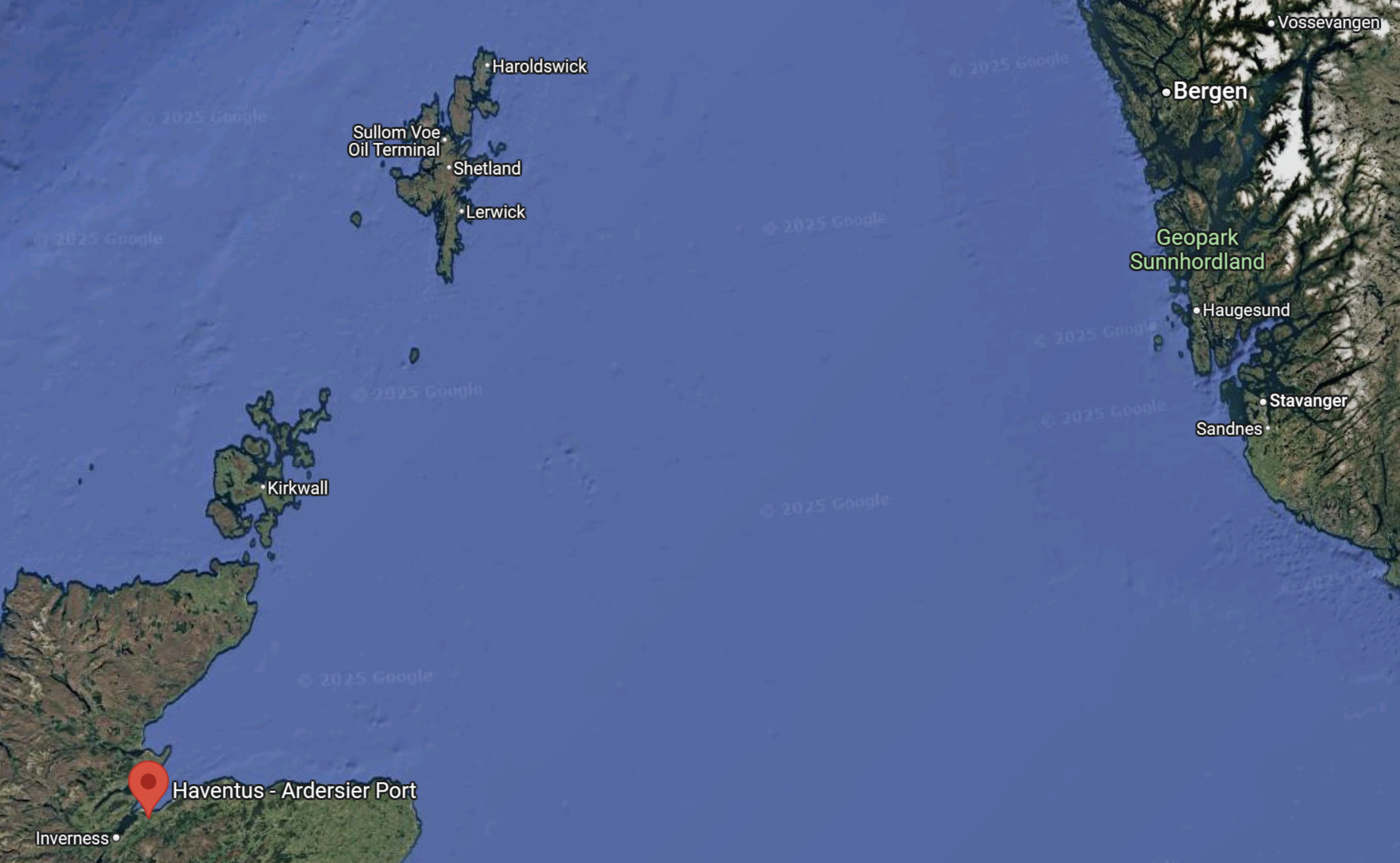
The Port of Ardesier would appear to be ideally placed to bring in business for the partnership.
Highland Council Greenlights West Of Orkney Windfarm Onshore Plans
The title of this post, is the same as that of this article on offshoreWIND.biz.
This is the sub-heading.
The Highland Council has approved the onshore plans of the 2 GW West of Orkney Windfarm project, being developed by TotalEnergies, Corio Generation, and Renewable Infrastructure Development Group (RIDG) in Scotland.
These are the first three paragraphs.
The onshore application for planning permission in principle was approved on 4 June and outlines the underground cables and electrical infrastructure required to connect the offshore wind farm to the national transmission network.
Last year, the project became the first ScotWind proposal to submit both its offshore consent application to Scottish Ministers and its onshore planning application to The Highland Council.
The onshore application provides information on proposed cable landfalls on the north Caithness coast, the project’s substation at Spittal in Caithness, and the underground cables which will extend around 25 kilometres and connect to the substation.
According to the project page of the West of Orkney wind farm web site, the target for commissioning of the wind farm is 2029.
This wind farm appears to be making a play to be the first of the ScotWind Leasing developments to be commissioned.
I have some thoughts.
Converting The Flotta Oil Terminal To The Flotta Hydrogen Hub
This first paragraph of the Wikipedia entry for the Flotta Oil Terminal, describes it like this.
The Flotta oil terminal is a major crude oil reception, processing, storage and export facility on the island of Flotta, in the south of Scapa Flow in the Orkney Islands. It receives and processes crude oil delivered by a subsea pipeline from the Piper, Claymore, Tartan and Golden Eagle platforms and associated fields. The terminal includes facilities for exporting stabilised crude oil (and formerly liquefied petroleum gases) by tanker.
It is now proposed to add the Flotta Hydrogen Hub to the Flotta Oil Terminal.
This document on the Repsol web site, describes the Flotta Oil Terminal.
- This page is the Flotta Hydrogen Hub web site.
- This page discusses, what will be done with the green hydrogen produced by electrolysis.
- The green hydrogen page, has an excellent map of the hydrogen and electricity flows to and from the Flotta Hydrogen Hub.
The Flotta Oil Terminal will be developed into a major hydrogen production and distribution facility.
Thoughts On The Future Of Orkney
This article on the BBC is entitled Orkney Votes To Explore ‘Alternative Governance‘
This is the sub-heading.
Orkney councillors have voted to investigate alternative methods of governance amid deep frustrations over funding and opportunities.
These paragraphs outline the story.
Council leader James Stockan said the islands had been “held down” and accused the Scottish and UK governments of discrimination.
His motion led to media speculation that Orkney could leave the UK or become a self-governing territory of Norway.
It was supported by 15 votes to six.
It means council officers have been asked to publish a report to Orkney’s chief executive on options of governance.
This includes looking at the “Nordic connections” of the archipelago and crown dependencies such as Jersey and Guernsey.
A further change which would see the revival of a consultative group on constitutional reform for the islands was accepted without the need for a vote.
My Thoughts On The Economic Future Of The Islands
The economic future of Orkney looks good.
Tourism and the traditional industries are on the up, but the islands could play a large part in renewable energy.
The West of Orkney offshore wind farm, which will be a 2 GW wind farm with fixed foundations, is being developed and a large hydrogen production hub at Flotta is being proposed, along with the development of a large quay in Scapa Flow for the assembly of floating wind farms.
The West of Orkney wind farm could be the first of several.
If the future wind farms are further from shore, they will most likely be based on floating technology, with the turbines and their floats assembled in Scapa Flow, from components shipped in from mainland UK and Europe.
Political Future
With a good financial future assured, I believe that Orkney will be able to choose where its political future lies. It could be a Crown Dependency or join Norway.
Whichever way it goes, it could be an island that effectively prints money, by turning electricity into hydrogen and shipping it to countries like Germany, The Netherlands, Poland and Sweden!
From a UK point of view, a Crown Dependency could be a favourable move.
Would Shetland follow the same route?
Offshore Hydrogen Production And Storage
Orkney is not a large archipelago and is just under a thousand square kilometres in area.
It strikes me, that rather than using up scarce land to host the large electrolysers and hydrogen storage, perhaps it would be better, if hydrogen production and storage was performed offshore.
Aker Northern Horizons
In Is This The World’s Most Ambitious Green Energy Solution?, I talk about Northern Horizons, which is an ambitious project for a 10 GW floating wind farm, which would be built a hundred kilometres to the North-East of Shetland, that would be used to produce hydrogen on Shetland.
Other companies will propose similar projects to the West and East of the Northern islands.
This map shows the sea, that could be carpeted with armadas of floating wind farms.

Consider.
- There are thousands of square miles of sea available.
- As the crow flies, the distance between Bergen Airport and Sumburgh Airport in Shetland is 226 miles.
- A hundred mile square is 10,000 square miles or 2590 square kilometres.
- In ScotWind Offshore Wind Leasing Delivers Major Boost To Scotland’s Net Zero Aspirations, I calculated that the floating wind farms of the Scotwind leasing round had an energy density of 3.5 MW per km².
- It would appear that a hundred mile square could generate, as much as nine GW of green electricity.
How many hundred mile squares can be fitted in around the UK’s Northern islands?
Crown Estate Scotland Joins Scapa Flow Deepwater Port Plan
The title of this post is the same as that of this article on Riviera Maritime Media.
This is the sub-heading.
Orkney Islands Council (OIC) and Crown Estate Scotland have signed an agreement to work together in developing a deepwater quay at Scapa Flow
The picture and the words, indicate it is not a small facility.
The final comment of Crown Estate Scotland’s director of marine Colin Palmer, are a strong statement of intent about how Crown Estate Scotland will help Scotland towards net-zero.
Orkney Council To Look At Proposals To Become Territory Of Norway
The title of this post, is the same as that of this article on the BBC.
This is the sub-heading.
The Orkney Islands could change their status in the UK or even become a self-governing territory of Norway under new proposals.
These paragraphs outline their possible strategy.
A motion will go before the council next week to investigate “alternative forms of governance”.
Council leader James Stockan said Orkney does not get fair funding with its current relationship within the UK.
He wants to look at Crown Dependencies like the Channel Islands and overseas territories like the Falkland Islands.
He suggested another possible future could be like the Faroe Islands – which is a self-governing territory of Denmark.
Councillor Stockan told BBC Radio Scotland there were many areas where Orkney was being “failed dreadfully” by both the UK and Scottish governments.
These are my thoughts.
Has Orkney Been Failed Dreadfully By The UK And Scottish Governments?
I wouldn’t be surprised, if the legal and economic framework between the Orkney, Scotland and the UK, dates back hundreds of years and didn’t really expect to see a more independent Scotland.
This is a quote from Council leader James Stockan.
And the funding we get from the Scottish government is significantly less per head than Shetland and the Western Isles to run the same services – we can’t go on as we are.
I could argue, they should be similar.
Orkney’s Income From Oil, Gas And Wind
Orkney doesn’t have Shetland’s oil, gas and wind infrastructure, so perhaps Scotland and the UK, think Orkney is the other’s problem.
Wind Development In Orkney, Shetland And The Western Isles
This map from Cross Estate Scotland shows all the wind contracts for Orkney, Shetland and The Western Isles.

These wind farms could send wind power to Orkney.
- 7 – Ayre – 1008 MW
- 13 – West of Orkney – 2000 MW
That is a total of 3008 MW.
These wind farms could send wind power to Shetland.
- 18 – Ocean Winds – 500 MW
- 19 – Arven – 1800 MW
- 20 – ESB Asset Development – 500 MW
That is a total of 2800 MW.
These wind farms could send wind power to the Western Isles.
- 14 – Havbredey – 1400 MW
- 15 – N3 Project – 495 MW
- 16 – Spiorad na Mara – 840 MW
That is a total of 2735 MW.
On this quick look, it does appear that there is a fair balance of investment in wind power between Orkney, Shetland and The Western Isles.
The Flotta Hydrogen Hub
The Flotta Hydrogen Hub is being planned and it has its own web site.
It looks like it will be linked to the West of Orkney wind farm.
The Ferries
CouncilStockan says this about the ferries.
We are really struggling at the moment, we have to replace the whole ferry fleet which is older than the CalMac fleet.
And it is well-known, that the Scottish Nationalist Party got into a muddle with ferries.
Conclusion
If you read the Wikipedia entry for Orkney, the islands would appear to have a sound future, based on hydrogen, tourism and wind.
I would hope that a discussion around some good local food and the local whisky could sort out Otkney’s worries.
Green Light For Orkney Transmission Link
The title of this post, is the same as that of this news item from SSE.
These three paragraphs outline the project.
SSE’s Transmission business, SSEN Transmission, has welcomed today’s publication by Ofgem in which the energy regulator has provisionally approved long awaited and much needed plans to provide a subsea electricity transmission link to Orkney.
The Orkney Islands are home to some of the world’s greatest resources of renewable electricity, from established onshore wind, to emerging marine technologies, where Orkney is at the forefront of global developments in marine energy generation.
Following significant growth in small-scale renewable electricity generation in Orkney, the local electricity network has long been at full capacity and no new electricity generation can connect without significant reinforcements.
This paragraph describes the scope of the project.
SSEN Transmission’s proposed solution would enable the connection of up to 220MW of new renewable electricity and consists of a new substation at Finstown in Orkney, and around 57km of subsea cable, connecting to a new substation at Dounreay in Caithness.
200 MW seems a good return for a substation and forty miles of cable.
Rolls-Royce And easyJet Set New World First
The title of this post, is the same as that of this press release from Rolls-Royce.
These three paragraphs explain what the two companies have done and are planning to do.
Rolls-Royce and easyJet today confirmed they have set a new aviation milestone with the world’s first run of a modern aero engine on hydrogen.
The ground test was conducted on an early concept demonstrator using green hydrogen created by wind and tidal power. It marks a major step towards proving that hydrogen could be a zero carbon aviation fuel of the future and is a key proof point in the decarbonisation strategies of both Rolls-Royce and easyJet.
Both companies have set out to prove that hydrogen can safely and efficiently deliver power for civil aero engines and are already planning a second set of tests, with a longer-term ambition to carry out flight tests.
The test today was carried out at Boscombe Down and are shown in this picture from Rolls-Royce.
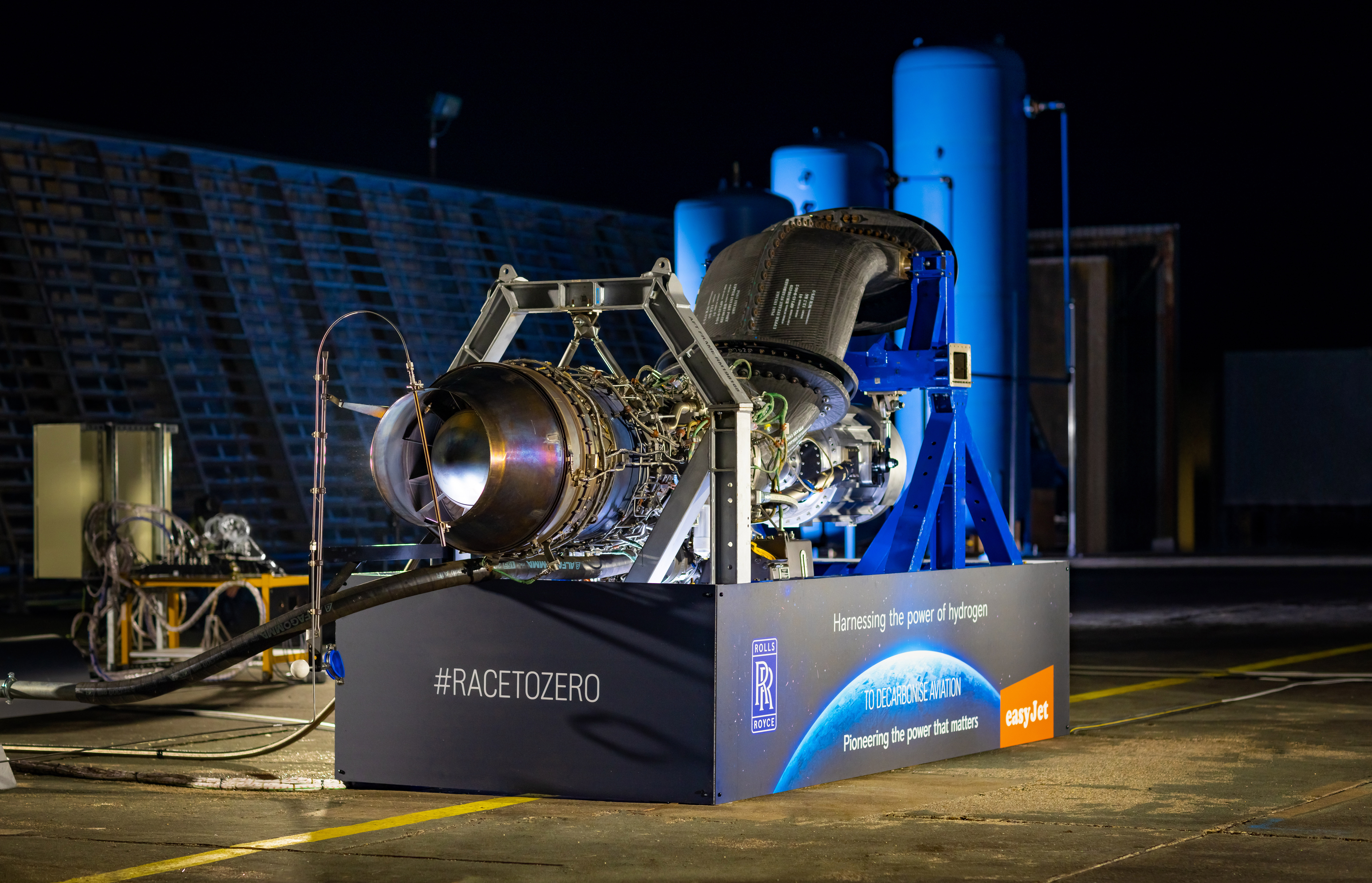
Rolls-Royce AE2100 Hydrogen Demonstrator engine preparing for test at RAF Boscombe Down
Note that the green hydrogen produced using Orcadian winds and tides.
We live in desperate times and I predict that a hydrogen-fuelled and Rolls-Royce-powered easyJet plane, will fly sooner than anybody thinks.
As with athletes, engineers love to be first!
Orbital Marine Power Awarded Two CfDs As Part Of UK Government Renewable Energy Auction
The title of this post, is the same as that of this news item on the Orbital Marine Power web site.
This is the heart of the news item.
Orbital, the renewable energy company focused on the development and global deployment of its pioneering floating tidal stream turbine technology, has been awarded two contracts for difference (CfDs) in the UK Allocation Round 4 (AR4) process.
This is a significant milestone in the company’s growth, with these CfDs underpinning the delivery of multi-turbine projects in Eday, Orkney.
Capable of delivering 7.2MW of predictable clean energy to the grid once completed, these Orbital tidal stream energy projects can power to up to 7,200 homes, supporting the UK’s security of supply, energy transition and broader climate change objectives.
This positive outcome also means Orbital can make a transformative investment in its UK supply chain, with around 150 jobs expected to be created through the manufacture and installation phase alone. On a jobs per MW installed basis, this would represent an unprecedented level of UK role creation for the construction phase of a renewable energy project.
It is good to see tidal power taken seriously.
The Strike Price For Tidal Stream Energy
Consider.
- Four contracts have been awarded for tidal stream energy.
- All have strike price of £178.54 per MWh of electricity.
- This may seem high, as all large wind farms have a strike price of only £37.35 per MWh of electricity.
On the other hand, there is a level playing field for all tidal stream energy developers. Just as there is for large wind farm developers, who have to live with £37.35 per MWh of electricity.
I think it will incentivise the developers and give them a reward for their technology.
All these strike prices are also mapped out for fifteen years, when trying to raise money for your tidal stream gubbins, you will know exactly where you stand.
I’ll give the Department of Business, Energy and Industrial Strategy, at least four out of five for their strike price regime!
The Concept Of Remote Island Wind
This document from the Department of Business, Industry and Industrial Strategy lists all the Contracts for Difference Allocation Round 4 results for the supply of zero-carbon electricity that were announced yesterday.
The contracts have also introduced a concept that is new to me, called Remote Island Wind. All have got the same strike price of £46.39 per MWh.
Two of the projects on Orkney are community projects of around 30 MW, run by local trusts. This is surely, a model that will work in many places.
There is more on Orkney’s Community Wind Farm Project on this page of the Orkney Islands Council web site.
It could even have an electrolyser to provide hydrogen for zero-carbon fuel, when there is more electricity than is needed. Companies like ITM Power and others already build filling stations with an electrolyser, that can be powered by wind-generated electricity.
The other Remote Island Wind projects are larger with two wind farms of over 200 MW.
It does look to me, that the Department of BEIS is nudging wind farm developers in remote places to a model, that all stakeholders will embrace.
The Viking Wind Farm
I wrote about this wind farm in Shetland’s Viking Wind Farm.
There are more details in this press release from SSE enewables, which is entitled CfD Contract Secured For Viking Energy Wind Farm.
These introductory paragraphs, give a good explanation of the finances of this farm.
SSE Renewables has been successful in the UK’s fourth Contract for Difference (CfD) Allocation Round, announced today, and has secured a low-carbon power contract for 220MW for its wholly-owned Viking Energy Wind Farm (Viking) project, currently being constructed in Shetland.
Viking’s success in securing a contract follows a competitive auction process in Allocation Round 4 (AR4) where it competed within Pot 2 of the allocation round set aside for ‘less established’ technologies including Remote Island Wind.
The 443MW Viking project, which SSE Renewables is currently building in the Shetland Islands, has secured a CfD for 220MW (50% of its total capacity) at a strike price of £46.39/MWh for the 2026/27 delivery year.
The successful project will receive its guaranteed strike price, set on 2012 prices but annually indexed for CPI inflation, for the contracted low carbon electricity it will generate for a 15-year period. Securing a CfD for Viking stabilises the revenue from the project whilst also delivering price security for bill payers.
It’s very professional and open to explain the capacity, the contract and the finances in detail.
The press release also has this paragraph, which details progress.
Viking is progressing through construction with over 50 per cent of turbine foundation bases poured. When complete in 2024, Viking Energy Wind Farm will be the UK’s most productive onshore wind farm in terms of annual electricity output, with the project also contributing to Shetland’s security of supply by underpinning the HVDC transmission link that will connect the islands to the mainland for the first time.
SSE also released this press release, which is entitled Major Milestone Reached As First Subsea Cable Installation Begins On Shetland HVDC Link, where this is the first paragraph.
The first phase of cable laying as part of the SSEN Transmission Shetland High-Voltage Direct Current (HVDC) Link began this week off the coast of Caithness, marking a major milestone in the £660M project.
SSE seem to be advancing on all fronts on the two projects!
The Stornoway Wind Farm
This press release from EDF Renewables is entitled EDF Renewables UK Welcomes Contract for Difference Success, where these are the first two paragraphs.
Two EDF Renewables UK projects bid into the Contract for Difference (CfD) auction round held by the UK Government’s BEIS department have been successful.
The projects are the Stornoway wind farm on the Isle of Lewis and Stranoch wind farm in Dumfries and Galloway. Together these onshore wind farms will provide 300 MW of low carbon electricity which is an important contribution to reaching net zero.
The press release also gives this information about the contract and completion of the Stornoway wind farm.
Stornoway Wind Farm on the Isle of Lewis is a joint venture with Wood. The project has won a CfD for 200 MW capacity, the strike price was £46.39, the target commissioning date is 31 March 2027.
This page on the Lewis Wind Power web site, gives these details of the Stornoway Wind Farm.
The Stornoway Wind Farm would be located to the west of the town of Stornoway in an area close to the three existing wind farm sites.
The project has planning consent for up to 36 turbines and is sited on land owned by the Stornoway Trust, a publicly elected body which manages the Stornoway Trust Estate on behalf of the local community.
The local community stands to benefit as follows:
- Community benefit payments currently estimated at £900,000 per annum, which would go to an independent trust to distribute to local projects and organisations
- Annual rental payments to local crofters and the Stornoway Trust – which we estimate could total more than £1.3m, depending on the CfD Strike Price secured and the wind farm’s energy output
- Stornoway Wind Farm is the largest of the three consented wind farm projects with a grid connection in place and is therefore key to the needs case for a new grid connection with the mainland. Indeed, the UK energy regulator Ofgem has stated that it will support the delivery of a new 450MW cable if the Stornoway and Uisenis projects are successful in this year’s Contract for Difference allocation round.
Note the last point, where only the Stornoway wind farm was successful.
The Uisenis Wind Farm
This press release from EDF Energy is entitled Lewis Wind Power Buys Uisenis Wind Farm, gives these details of the sale.
Lewis Wind Power (LWP), a joint venture between Amec Foster Wheeler and EDF Energy Renewables has bought the Uisenis Wind Farm project on the Isle of Lewis. The wind farm has planning consent for the development of 45 turbines with a maximum capacity of 162 MW. This would be enough to power 124,000 homes and would be the biggest renewable energy development on the Western Isles.
LWP owns the Stornoway Wind Farm project located around 20km to the north of Uisenis which has planning consent to develop 36 turbines to a maximum capacity of 180 MW – enough to power 135,000 homes.
This would bring Stornoway and Uisenis wind farms under the similar ownership structures.
This is a significant paragraph in the press release.
On behalf of Eishken Limited, the owner of the site where the Uisenis Wind Farm will be located, Nick Oppenheim said: “I am delighted that LWP are taking forward the wind farm. The resources available on the Eishken estate, and the Western Isles in general, means that it is an excellent location for renewable energy projects and, as such, the company is also developing a 300MW pumped storage hydro project immediately adjacent to the Uisenis wind farm. With such potential for renewables and the positive effect they will have on the local community, economy, and the UK as a whole I am are looking forward to positive news on both support for remote island projects and the interconnector.”
Note the mention of pumped storage.
This article on the BBC is entitled Pumped Storage Hydro Scheme Planned For Lewis, where this paragraph introduces the scheme.
A pumped storage hydro scheme using sea water rather than the usual method of drawing on freshwater from inland lochs has been proposed for Lewis.
The only other information is that it will provide 300 MW of power, but nothing is said about the storage capacity.
It looks like Lewis will have a world-class power system.
Mossy Hill And Beaw Field Wind Farms
Mossy Hill near Lerwick and Beaw Field in Yell are two Shetland wind farms being developed by Peel L & P.
This press release from Peel L & P is entitled Government Support For Two Shetland Wind Farms, where these are the first two paragraphs.
Plans for two onshore wind farms on the Shetland Islands which would help meet Scotland’s targets for renewable energy production are a step closer to being delivered after receiving long-term Government support.
Clean energy specialists Peel NRE has been successful in two bids in the Department for Business, Energy and Industrial Strategy’s (BEIS) Contracts for Difference (CfD) scheme; one for its Mossy Hill wind farm near Lerwick and the other for Beaw Field wind farm in Yell.
It looks like the two wind farms will power 130,000 houses and are planned to be operational in 2027.
Conclusion
I must admit that I like the concept. Especially, when like some of the schemes, it is linked to community involvement and improvement.
Only time will tell, if the concept of Remote Island Wind works well.
Could Fortescue Future Industries’ Green Hydrogen Help Europe Ditch Russian Energy?
The title of this post, is the same as that of this article on Motley Fool Australia.
This is the first paragraph.
Green hydrogen may help interrupt the Kremlin’s ability to conduct “war games”, says Fortescue chief Andrew Forrest.
I very much think that Andrew ‘Twiggy’ Forrest is right.
My last three hydrogen articles were.
- Poland May Become A Green Hydrogen Tycoon.
- Will The Orkney Become A Major Green Hydrogen Production Centre?
- Wind And Solar Boom Will Bring Energy Surplus.
If the projects in these articles don’t blow the bottom out of the market for Russia’s bloodstained gas, with a little bit of help from Twiggy’s hydrogen kanganaut, then I’ll be very surprised. Especially, as countries like Argentina, Australia, Brazil, Canada, Chile, Denmark, Iceland, Ireland, Jordan, Japan, Kenya, Namibia, Morocco, Norway, Papua New Guinea, Portugal, South Korea, Spain, Sweden and the United States are all planning to produce green hydrogen in large quantities.
 The Anonymous Widower