The Rolls-Royce SMR Web Site
Rolls-Royce now have a web site for their proposed small modular reactor (SMR) design.
This page is entitled Why Rolls-Royce SMR?, has this outline of the reactor program.
Rolls-Royce SMR offers a radically different approach to delivering nuclear power, we have drastically reduced the amount of construction activities and transformed the delivery environment, from a large complex infrastructure programme into a factory built commoditised product.
Our design has evolved in response to a definitive set of market driven outcomes, this is not technology for technology’s sake, but innovation, to create a transformational clean energy solution that will deliver clean affordable energy for all.
This would appear to be an approach driven by proven engineering principles and excellence, good low-risk design, backed up by the best project management.
These are all traditions inherent in the Rolls-Royce DNA.
But I also believe that Rolls-Royce have looked at the world market for nuclear reactors and designed a product to fit that market.
This paragraph is in a long section entitled Global & Scalable.
The compact footprint increases site flexibility and maximises potential plant locations, including replacement for existing coal or gas-fired plants.
Many things said on the Rolls-Royce SMR Web Site, appear to be very much market led.
In my view, this is the web site of a product designed to dominate the world market for nuclear energy.
The Channel Crossing Problem
My company provided the project management computer system; Artemis, that planned how both the tunnel and the rail link to London was built. So I heard numerous stories of inadequate infrastructure on both sides of the Channel.
I also for a time was a business partner of the man, who had been project manager on a previous attempt to build a Channel Tunnel, that was cancelled by Harold Wilson’s government in 1975, who had a lot of interesting input.
I have heard over the years of these inadequacies,
- The Dartford Crossing wouldn’t be able to handle the traffic generated at busy times.
- The Eurotunnel terminal in Folkestone wasn’t built large enough.
- The port of Dover is too small.
- The roads to the Port of Dover were inadequate.
- The rail terminal at St. Pancras doesn’t have the capacity to run services to the places that are better served by train.
The government only has one major improvement in place, which is a new Thames Crossing, but that will only make matters worse, as more traffic will be tempted to cross the Channel to get to Europe.
It is my belief, that we need more innovative services to provide more capacity.
- A German company called CargoBeamer, is developing a system, whereby unaccompanied freight trailers can be moved thousands of miles across Europe by rail. Their plans include services to Birmingham, Cardiff, Manchester and Scotland.
- I would also run a CargoBeamer service from Calais to Holyhead to create a direct freight service between Ireland and Europe.
- Ebbsfleet needs to be developed as a destination for the Elizabeth Line and an extra terminal for both daytime and sleeper trains to Europe.
- High speed freight trains, based on existing 160 mph EMUs could be used.
- Given the position of the new Thames Crossing on the Isle of Grain, perhaps a new ferry port could be built on the island to partially replace Dover.
- Could some Eurotunnel services start from Watford Gap?
We have to be bold.
Monte To Purchase 100 FC Aircraft Drives From ZeroAvia
The title of this post, is the same as that of this article on electrive.com.
This is the first paragraph.
ZeroAvia and Monte Aircraft Leasing will jointly market hydrogen-powered aircraft to regional operators. Under an agreement now signed between the companies, Monte will purchase up to 100 ZA600 hydrogen-electric powertrains from ZeroAvia to be installed on existing and new 5- to 20-seat aircraft.
Monte look to be an interesting company from their web site, which has this title.
Supporting The Transition Of The Regional Aviation Industry To Net Zero Carbon Emissions
The business model appears to be a well-proven and it is not that far removed from the one, colleagues and myself used to sell the project management system; Artemis.
In our case we took proven Hewlett-Packard computers and and other hardware, added our Artemis software and a custom-made desk and leased the systems to those who wanted to do project management, with as much support as our clients required. Customers just had to supply operators, printer paper and a thirteen amp socket.
Finance was obtained by various innovative methods, often through a bank manager, who was a bit of a rogue. But he was a rogue, who was on the side of the angels.
Later he became a firm friend of mine, before he sadly died within a few days of my wife.
Monte Aircraft Leasing’s model would appear to take a proven aircraft like a Cessna Caravan, Dornier 228 or Dash 8, replace the turboprop engines with a zero-carbon powerplant and then lease the aircraft. Often this will just be an additional lease to the existing operator.
The great advantage of this approach, is that the reengined aircraft does not need to be fully re-certified. It can fly under a Supplemental Type Certificate, which is described like this in Wikipedia.
A supplemental type certificate (STC) is a civil aviation authority-approved major modification or repair to an existing type certified aircraft, engine or propeller. As it adds to the existing type certificate, it is deemed “supplemental”. In the United States issuance of such certificates is under the purview of the Federal Aviation Administration (FAA).
Monte seem to have found a good way to make money from going net-zero.
Bank Station – 16th May 2022
The new Northern Line platforms at Bank station are now open and I went this morning to have a quick look.

























These are my thoughts.
The New Southbound Platform Is Wide
The new Southbound platform is wide and compares well with the wide platform at Angel station, that I wrote about in All Platforms Should Be Wide Like This.
This picture shows the Southbound platform at Angel., which dates from 1992.

And this the new Southbound platform at Bank.
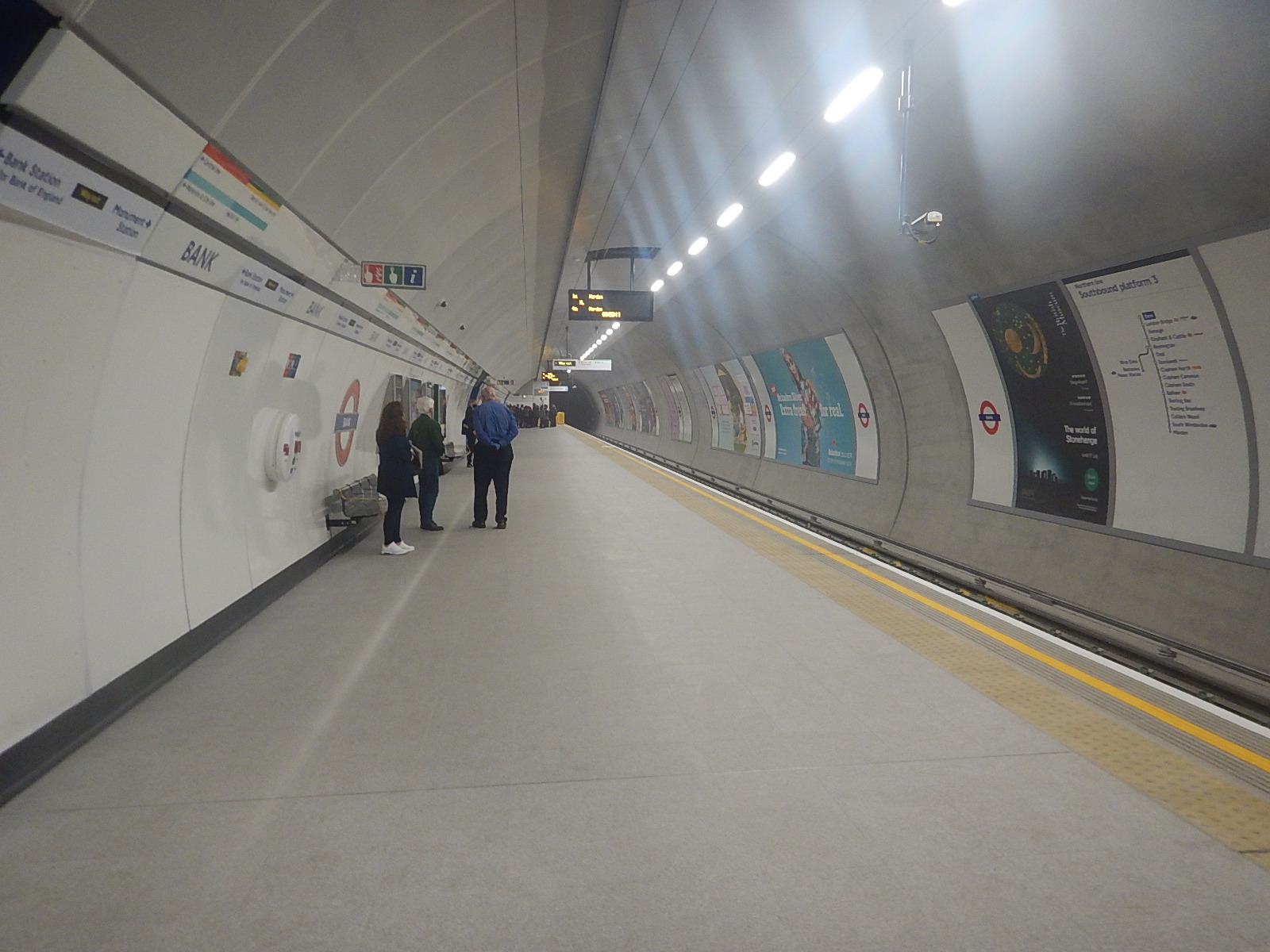
Two similar designs, but thirty years apart.
Simple Decor
The two pictures also illustrate the simple decor used in the rebuilt station.
The New Southbound Platform Is A Sprayed Concrete Tunnel
These pictures show the far wall of the new Southbound platform.






It looks from my untrained eye to be lined with sprayed concrete. I learned more about the use of sprayed concrete in tunnels, when I visited TUCA in Ilford, during Open House in 2012, which I wrote about in Open House – TUCA.
The Existing Northbound Platform Is Narrow
The Northbound platform is effectively as before, but with large and small holes in the wall to access a wide parallel pedestrian tunnel behind the wall.
There is a lot of circulation space.
The Parallel Pedestrian Tunnel
The old Southbound platform has been turned into a parallel pedestrian tunnel separated from the Northbound platform, by a wall that has four small and eight larger pedestrian-sized holes through it.
These pictures show a selections of the holes in the wall.







In addition.
- The tunnel has escalators at the Southern end connecting to Monument station.
- The tunnel has stairs at the Northern end to the Central Line.
- Further connections will be added.
- It also has seats along its length. These will be mainly for Northbound passengers, waiting for trains, who can see the trains through the large holes.
It is an unusual layout and I’ve never seen anything like it before anywhere in London, the UK, Europe or the world.
Wot No More Marble?
The Northbound Northern Line used to have a platform with marble facings.
Some of marble is still there as these pictures show.





Note that the old rat-run to the DLR is still there between the platforms.
The Wide Cross Tunnels
The wide cross tunnels link the two sides of the station together and to the escalators and moving walkways in the middle of the station.
This visualisation shows the station.
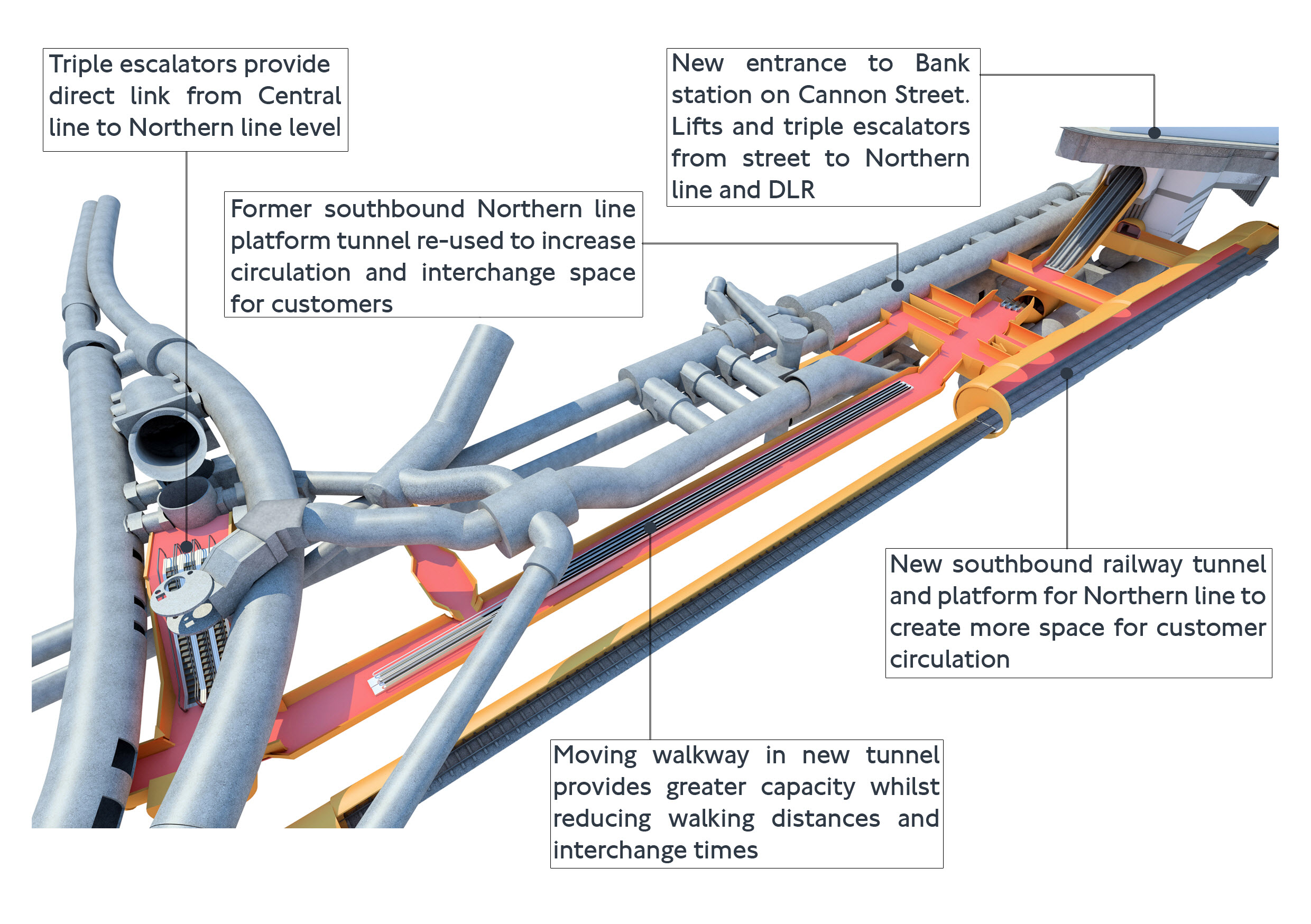
Note.
- The only more-or-less completed bits are the two Northern Line tunnels and platforms and parallel pedestrian tunnel.
- The four cross tunnels can be picked out towards the far end of the station.
- Three of the cross tunnels can now be used by passengers.
- The moving walkway can be accessed from the two cross tunnels nearest to the Central Line.
- The escalators from the yet-to-open Cannon Street entrance appear to lead directly into a cross tunnel and a parallel tunnel to the moving walkway.
This station has definitely been designed for rabbits.
Level Access To The Trains
This picture shows the level access on the new Southbound platform.

And this shows the step-up into the train on the old Northbound platform.

I wonder, if the platform can be raised to make the Northbound as good as the Southbound.
There Is Still A Lot To Do
At present the only sections of the project that are completed and visible to passengers are the following.
- The new wide Southbound platform.
- The refurbished Northbound platform, which is a similar width to before.
- The wide passenger tunnel behind the Northbound platform, that was converted from the old Southbound tunnel.
- The four new cross tunnels between the two platforms. Some still need finishing and there are spaces, where escalators will slot in.
It would appear that at least the following need to be done.
- Open up the new Cannon Street entrance
- Add the escalators and lifts.
- Put in the moving walkways between the Northern and Central Lines.
But it looks that everything left to do is small compared to the tunnel work that needed the closure from January.
This page on the TfL web site gives these dates.
- 16 May 2022: New southbound platform and concourse open
- Autumn 2022: DLR escalator and Central line link open
- Late 2022: Bank station capacity upgrade works due to be completed. New station with step-free access opens on Cannon Street.
It looks to me, that the project management has been done well and after hitting the first milestone, they appear to be on track.
Success For The Dartmoor Line
This article on Railnews is entitled Railway Braces For Weekend Changes.
The article flags up that rail timetables will change to the summer timetable and uses the Dartmoor Line where services will go hourly, as an example.
The article says this about the changes to the Dartmoor Line and the success of the restored service to Okehampton station.
One of the many changes includes the doubling of service frequencies on the recently-reopened Dartmoor Line between Exeter and Okehampton, where scheduled passenger trains were restored last November. From Sunday trains will be running every hour, and rail minister Wendy Morton visited Okehampton yesterday to celebrate the improvements.
The reopening is part of the government’s promise to ‘Restore your railways’, and the Okehampton line is the first practical example of this in action. The line was upgraded for £10 million less than the £40.5 million budgeted, and Network Rail said the route has proved ‘hugely popular’, because passenger numbers have been more than double than predicted, reaching an average of over 2,500 a week during the first 20 weeks. The number of passengers at nearby Crediton, where the Dartmoor Line joins services on the Tarka Line from Barnstaple, is also 39 per cent higher than it was before the pandemic.
I have some thoughts.
Reopening Of The Line
Network Rail can build projects on time and on budget, if they get the project management right.
Passenger Numbers Between Exeter And Okehampton
If 2,500 passengers per week can use the line in the winter, when there is only one train per two hours (tp2h), how many passengers will use the train, when there is an hourly service?
2,500 passengers per week, throughout the year would be 125,000 passengers per year and as surely the summer will be busier, I don’t think it will be an unreasonable figure.
Okehampton station car park appears to have around 300 spaces, so at 2,500 passengers per week, there might be a not too distant day, when it fills up.
Passenger Numbers At Crediton
I am not surprised that traffic at Crediton is up by 39 percent.
Consider.
- Pre-pandemic, Crediton station had one train per hour (tph) to and from Exeter.
- Post-pandemic, Crediton has three trains per two hours to and from Exeter.
It looks like the train frequency has been increased by 50 % and the number of passengers has increased by 39 %.
That surely is not surprising and passenger numbers might increase further when one tph are running between Exeter and both Barnstaple and Okehampton, if there are more possible passengers to attract.
Car parking at Crediton station may also be a problem, as there appears to be less than a hundred spaces.
Okehampton Parkway Station
Okehampton Parkway Station is likely to be built to the East of Okehampton. Wikipedia says this about the station.
Okehampton Parkway is a proposed railway station in Okehampton on the Dartmoor Line. The station would be part of the Devon Metro and has been described as a priority station. The station is to be sited at the A30 junction at Stockley Hamlet and would be sited at the Business Park at Okehampton as well as serving a further 900 homes close to the site.
Wikipedia, also says that Devon County Council has bought the site.
This must be one of the best sites to build a parkway station in the UK.
- It’s on the dual-carriageway A 30, between London and Cornwall.
- The good people of Devon seem to like to use trains given the passenger numbers at Okehampton and Crediton stations.
- Housing is being built nearby.
This Google Map shows Devon and Cornwall to the West of Okehampton and Barnstaple.
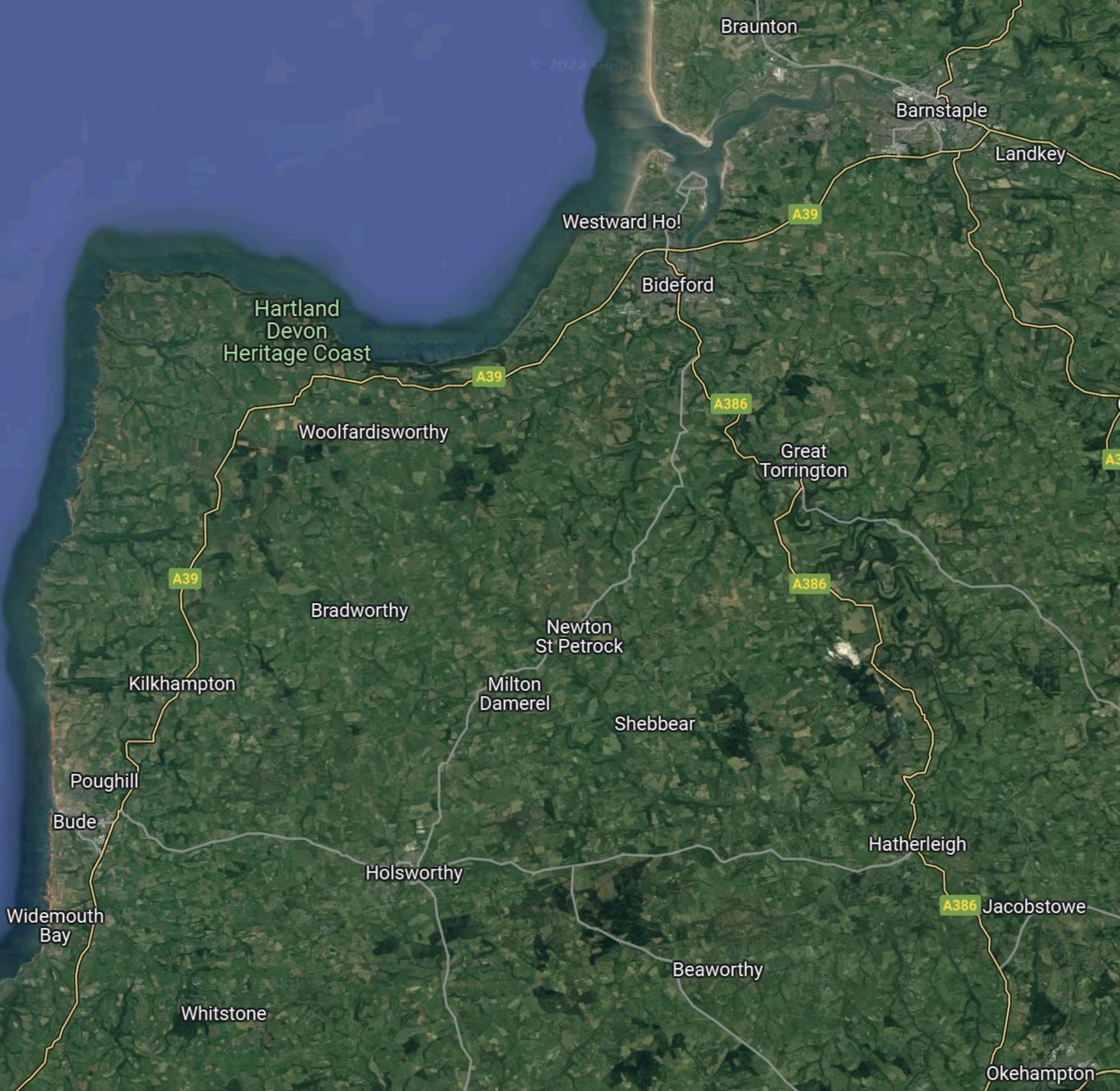
Note.
- Okehampton with two stations is in the South-East corner of the map.
- Barnstaple, which has a station, is in the North-East corner of the map.
- There are well-visited holiday resorts all along the cost including Ilfracombe, Westward Ho! and Bude.
It strikes me that if Devon put together a network of zero-carbon buses, it would be well-used and they could sell the area for zero-carbon holidays.
Rolling Stock
Currently, the Okehampton and Barnstaple services are operated by Class 150 trains.
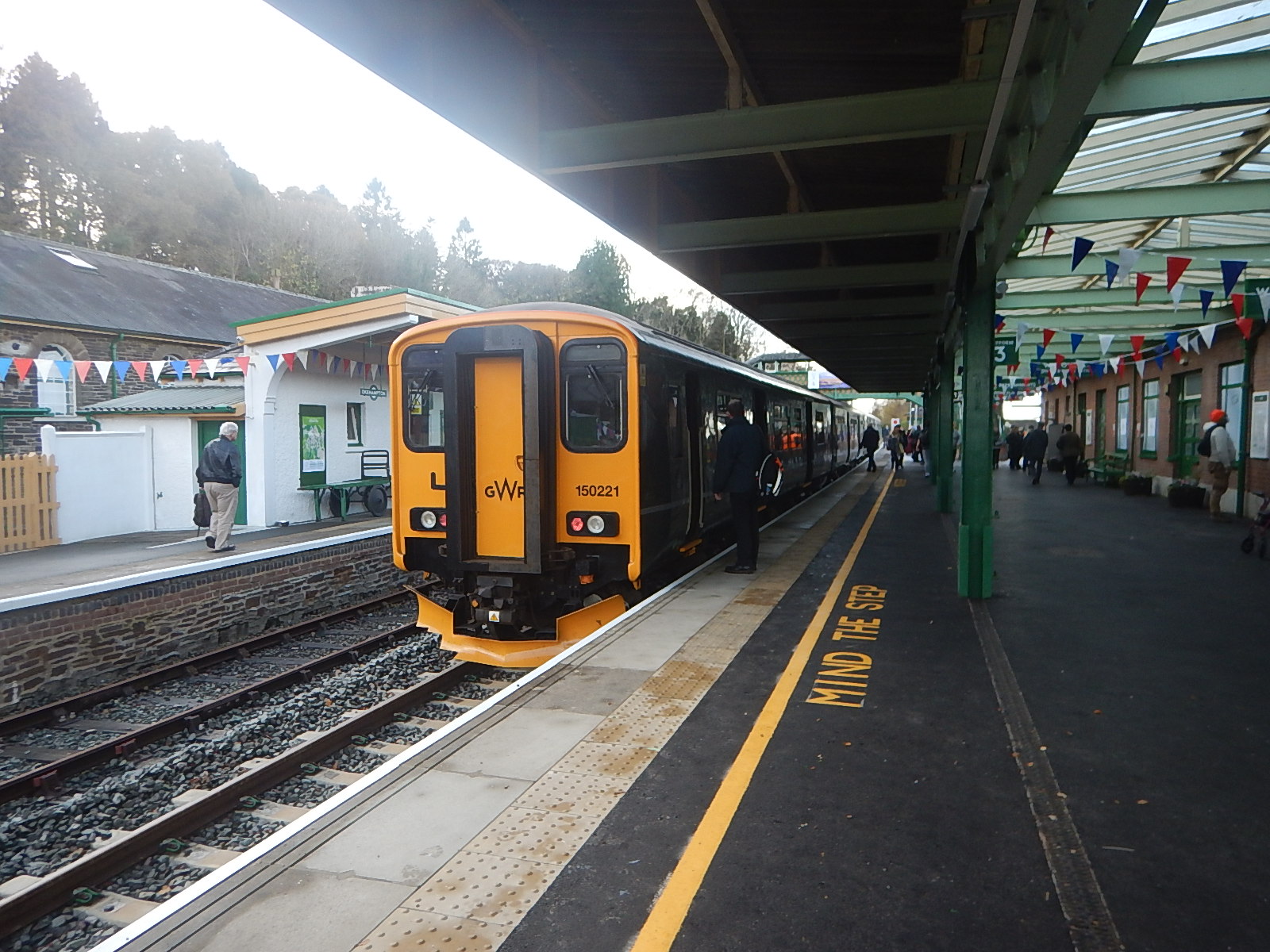
These are definitely not good enough, due to their age and diesel power.
The distances of the two services are as follows.
- Exeter and Barnstable – 39.5 miles
- Exeter and Okehampton – 25.5 miles
I feel that these routes could be handled by a battery-electric train like the Hitachi Regional Battery Train, which is shown in this Hitachi infographic.

Note.
- For these routes, the trains would probably be based on four-car Class 385 trains, with a top speed of 90 mph.
- Charging would be in Exeter.
- Charging may not be needed at Barnstaple and Okehampton as the routes are downhill.
If battery-electric trains can’t handle the routes, I’m sure hydrogen-powered trains could.
London Underground’s Northern Line Bank Branch To Reopen Next Monday
The title of this post, is the same as that of this article on Ian Visits.
These are the first two paragraphs.
The closed bank branch of the Northern line will reopen to passengers from Monday 16th May, TfL has confirmed.
The line has been closed since earlier this year to allow a new tunnel and platform at Bank tube station to be connected to the existing Northern line tunnels, work that could only be done by closing the tunnel to trains. When the line reopens, the new and much wider southbound Northern line platform and spacious new customer concourse at Bank station will open at the same time.
When, I found out, I was on a 21 bus to my home and I showed the other passengers Ian’s article.
All seemed pleased and I did get the impression, that one or two passengers were fed up with the closure.
I also think, that as Transport for London promised mid-May for the reopening, then they can’t get any closer than the 16th.
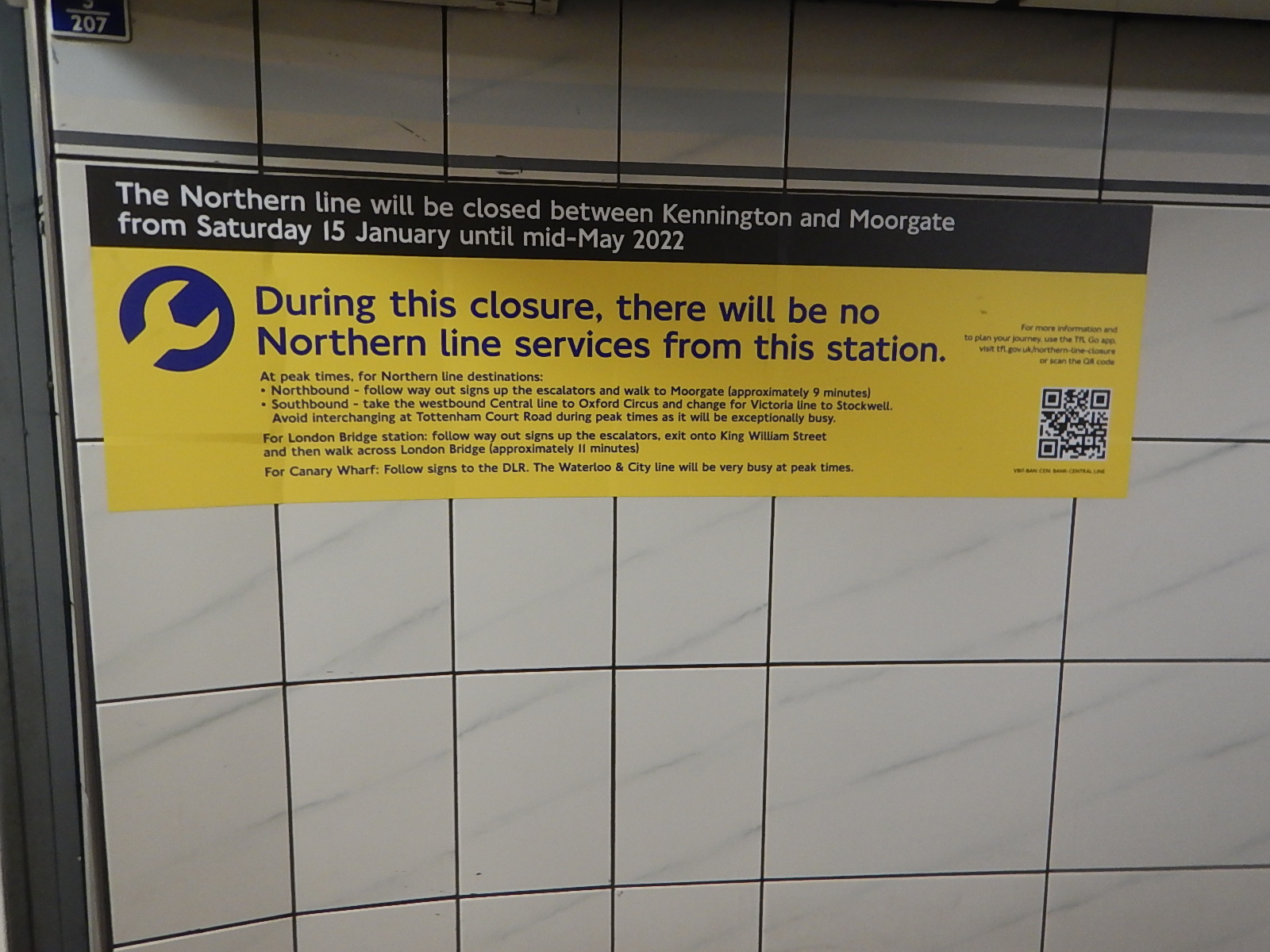
Note.
- The picture was taken just before closure on the 9th of January, which was a Sunday.
- TfL predict mid-May and then promise the 16th of May.
- I suspect that the public would even accept a few days late, as most reasonable people accept that odd things go wrong in complex projects.
- It’s also eight days before Crossrail opens, so hopefully, the Bank station Upgrade will be out of the way before Crossrail is opened.
Now that’s what I call good project management.
Boris Johnson Wants To Build ‘Colossal’ Irish Sea Wind Farm Within A Year
The title of this post, is the same as that of this article in The Telegraph.
This is the sub-title.
Prime Minister tells industry leaders he has ‘a dream’ that giant floating wind farm could provide ‘gigawatts of energy’
These are the first three paragraphs of the article.
Boris Johnson is pushing energy firms to build a “colossal” offshore wind farm in the Irish Sea within 12 months.
The Prime Minister told industry leaders he has “a dream” that a giant floating wind farm could provide “gigawatts of energy and do it within a year”, according to a government source.
He was addressing wind energy firms at a round table discussion in Downing Street as the Government finalised its energy security strategy.
It is said in the article, that industry leaders smiled at the suggestion.
My feelings though are different and I wonder if Boris has been briefed by an offshore wind expert, who knows what they’re doing.
Quietly and unobtrusively, a new technology has been developed, that allows Boris the luxury to dream.
The World’s Largest Floating Wind Farm
In the UK, we are getting used to superlatives being applied to our offshore wind farms.
- According to Wikipedia at the current time, nine of the fifteenth largest offshore wind farms in the world are in the United Kingdom.
- The Hornsea wind farm, comprises the 1.4 GW Hornsea Two wind farm, which is the largest offshore wind farm in the world.
- Previously, the 1.2 GW Hornsea One wind farm was the largest offshore wind farm in the world.
In this article on offshoreWIND.biz, which is entitled World’s Largest Floating Offshore Wind Farm Fully Operational, this is said.
Located 15 kilometres off the coast of Aberdeenshire, Scotland, in water depths ranging from 60 metres to 80 metres, Kincardine is the largest operating floating wind farm.
The project consists of five Vestas V164-9.5 MW and one V80-2 MW turbine, each installed on WindFloat® semi-submersible platforms designed by Principle Power.
This picture from Cobra Group shows one of the turbines being towed into position at Kincardine.
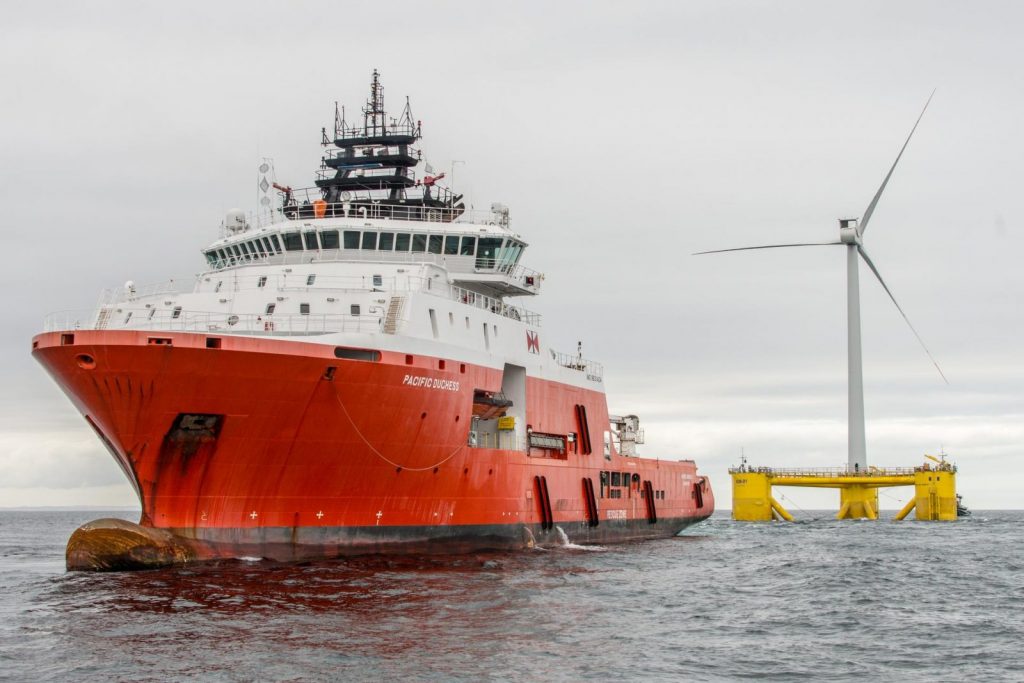
There are more pictures on this web page.
WindFloats would appear to be proven technology, as there are now two commercial wind farms using the technology and several others under development.
Erebus And Valorous
But Kincardine Wind Farm won’t be the world’s largest floating wind farm for long!
The next two wind farms, using the technology are Erebus and Valorous, who will provide a total of 400 MW from a company called Blue Gem Wind, which will use larger 14 MW turbines.
They will be installed to the South-West of the Pembrokeshire Coast.
Blue Gem Wind
Blue Gem Wind are based in Pembroke Dock and are a partnership of Simply Blue Energy, a pioneering Celtic Sea energy developer, and TotalEnergies.
Simply Blue Group are an Irish company, who are also working with Shell on the development of 1.35 GW of wind power to the West of Ireland.
50 GW Of Wind In The Celtic Sea
On the Projects page of the Blue Gem website, this is said about floating wind in the Celtic Sea.
Floating wind is set to become a key technology in the fight against climate change with over 80% of the worlds wind resource in water deeper than 60 metres. Independent studies have suggested there could be as much as 50GW of electricity capacity available in the Celtic Sea waters of the UK and Ireland. This renewable energy resource could play a key role in the UK meeting the 2050 Net-Zero target required to mitigate climate change. Floating wind will provide new low carbon supply chain opportunities, support coastal communities and create long-term benefits for the region.
Is this Boris’s project?
These are my thoughts.
How Many Turbines Would You Need For 50 GW?
If you need 7 x 14 MW turbines for each 100 MW, that would mean you need 3500 turbines and WindFloats for 50 GW.
How Would Each Turbine Be Installed?
It appears from pictures on the Cobra Group web site, that the turbine is mounted on the WindFloat using a large crane on a dock, whilst the WindFloat is alongside.
- The WindFloat and the turbine are then towed out into the desired position.
- It would then be anchored to the sea-bed.
- Finally, it would be connected to the power network.
I would doubt, that one team could probably install more than one turbine per day.
But I suspect more than one team could work in and out of one port at a time.
How Many Ports Could Be Used For Turbine Assembly?
As Blue Gem Wind is based in Pembroke Dock, I would assume that one of the ports would be on Milford Haven Waterway.
But there are other ports on the Welsh and Irish coasts, where the turbine lift could be accomplished.
How Much Capacity Could Be Installed In Twelve Months?
Suppose you had two ports doing assembly, with two teams working at each port, which would mean four turbines could be installed in a day.
- In a month, that would be 4 x 14 x 30 MW per month.
- This is nearly 1.7 GW per month or 20 GW per year.
It does appear to me, that floating wind farms with the right project management could be very much quicker to install than traditional fixed foundation wind turbines.
I believe that if we get the manufacturing and the project management right, that a colossal 20 GW of floating wind can be installed in twelve months.
Conclusion
Most people won’t believe Boris’s claim, but I feel that there is a degree of reality behind it, if we can produce four WindFloats and four turbines per day and enough cables and electrical gubbins to link them all together.
Is This The World’s Most Ambitious Green Energy Solution?
In the 1970s and 1980s, when I was developing Artemis, which was the first desk-sized project management system, we were heavily involved in North Sea Oil, with dozens of systems in Aberdeen. As Norway developed the oil business on the other side of the North Sea, the number of systems there grew to at least twenty.
Increasingly, I became aware of a Norwegian company called Kværner, which seemed to have large numbers of Artemis systems.
In 2002, Kværner merged with Aker Maritime and this eventually led to the formation of Aker Solutions in 2008, which is a company that is headquartered in Oslo and employs nearly 14,000.
According to Wikipedia, the Kværner name was dropped somewhere along the way, as non-Scandinavians have difficulty pronouncing Kværner.
Aker Solutions appears to be wholly Scandinavian-owned, with Aker ASA owning a third of the company.
They are a very respected company, when it comes to offshore engineering for oil and gas and wind projects.
Aker ASA also have a subsidiary called Aker Horizons, which has this web site, where they call themselves a planet-positive company.
This page on the Aker Horizons is entitled Northern Horizons: A Pathway for Scotland to Become a Clean Energy Exporter.
These first two paragraphs outline the project.
A vision to utilise Scottish offshore wind resources in the North Sea to make the country an exporter of clean energy has been unveiled at the COP 26 climate change conference in Glasgow.
The Northern Horizons Project has been unveiled by Aker Horizons’ portfolio companies Aker Offshore Wind and Aker Clean Hydrogen, who have the technical know-how and expertise to realise the project, and DNV, the independent energy expert and assurance provider.
Various targets and ambitions are listed.
- 10 GW of renewable energy in the North Sea.
- 5 GW of green hydrogen.
- Giant turbines nearly as tall as the London Shard on floating platforms more than 130km from Shetland.
- Enough liquid hydrogen will be produced to power 40 percent of the total mileage of local UK buses.
- Enough synthetic fuel to make 750 round trips from the UK to New York.
A completion date of 2030 for this project is mentioned.
This article on The Engineer is entitled Northern Horizons Plans Clean Energy Exports For Scotland.
The article is dated the 4th of November 2021 and starts with this sub-heading and an informative video.
Aker Horizons’ new initiative, Northern Horizons, aims to make Scotland a clean energy exporter by utilising offshore wind resources in the North Sea.
There is an explanatory graphic of the project which shows the following.
- Floating wind turbines.
- A floating DC substation.
- A floating hydrogen electrolyser.
- An onshore net-zero refinery to produce synthetic aviation fuel and diesel.
- A hydrogen pipeline to mainland Scotland.
- Zero-carbon energy for Shetland.
It is all very comprehensive.
These are some other thoughts.
Project Orion
Project Orion how has its own web site and the project that seems to have similar objectives to Northern Horizons.
The title on the home page is Building A World-Leading Clean Energy Island.
There is this statement on the home page.
Orion is a bold, ambitious project that aims to transform Shetland into the home of secure and affordable clean energy.
We will fuel a cleaner future and protect the environment by harnessing the islands’ renewables potential, using onshore and offshore wind, tidal and wave energy.
The graphic has similar features to that Northern Horizons in the article on The Engineer, with the addition of providing an oxygen feed to Skyrora for rocket fuel.
German Finance
I feel very much, that the Germans could be providing finance for developments around Shetland, as the area could be a major source of hydrogen to replace Vlad the Mad’s tainted gas.
In Do BP And The Germans Have A Cunning Plan For European Energy Domination?, I described how BP is working with German utilities and finance to give Germany the hydrogen it needs.
NorthConnect
The NorthConnect (also known as Scotland–Norway interconnector) is a proposed 650 km (400-mile) 1,400 MW HVDC interconnector over the floor of the North Sea.
- It will run between Peterhead in North-East Scotland and Norway.
This project appears to be stalled, but with the harvesting of more renewable energy on Shetland, I can see this link being progressed, so that surplus energy can be stored in Norway’s pumped storage hydro.
Icelink
Icelink is a proposed electricity interconnector between Iceland and Great Britain.
- It would be the longest undersea interconnector in the world, with a length of 620 to 750 miles.
- It would be a 800–1,200 MW high-voltage direct current (HVDC) link.
- National Grid is part of the consortium planning to build the link.
- Iceland has a surplus of renewable energy and the UK, is the only place close enough for a connection.
I believe that if Icelink were to be built in conjunction with energy developments on and around Shetland, a more powerful and efficient interconnector could emerge.
Conclusion
This ambitious project will transform the Shetlands and the energy industry in wider Scotland.
This project is to the North-East of Shetland, but the islands are surrounded by sea, so how many other Northern Horizons can be built in a ring around the islands?
Could Norfolk And Suffolk Be Powered By Offshore Wind?
This week this article on the BBC was published, which had a title of Government Pledges £100m For Sizewell Nuclear Site.
These are the first three paragraphs.
The government is putting up £100m to support the planned Sizewell C nuclear plant in Suffolk, Business and Energy Secretary Kwasi Kwarteng has announced.
The investment marks the latest stage in efforts to build the £20bn reactor on the east coast of England.
However, it does not commit the government to approving the project, which is still subject to negotiations.
My view of the proposed Sizewell C nuclear plant is that of an engineer, who used to live within thirty minutes of the Sizewell site.
- Hinckley Point C power station, which is currently being constructed, will have a nameplate capacity of 3.26 GW.
- Sizewell C would probably be to a similar design and capacity to Hinckley Point C.
- Sizewell C would likely be completed between 2033-2036.
- Sizewell B is a 1250 MW station, which has a current closing date of 2035, that could be extended to 2055.
- East Anglia and particularly the mega Freeport East, that will develop to the South at the Ports of Felixstowe and Harwich will need more electricity.
- One of the needs of Freeport East will be a large supply of electricity to create hydrogen for the trains, trucks, ships and cargo handling equipment.
- Sizewell is a large site, with an excellent connection to the National Grid, that marches as a giant pair of overhead cables across the Suffolk countryside to Ipswich.
But.
- We still haven’t developed a comprehensive strategy for the management of nuclear waste in the UK. Like paying for the care of the elderly and road pricing, it is one of those problems, that successive governments have kept kicking down the road, as it is a big vote loser.
- I was involved writing project management software for forty years and the building of large nuclear power plants is littered with time and cost overruns.
- There wasn’t a labour problem with the building of Sizewell B, as engineers and workers were readily available. But with the development of Freeport East, I would be very surprised if Suffolk could provide enough labour for two mega-projects after Brexit.
- Nuclear power plants use a lot of steel and concrete. The production of these currently create a lot of carbon dioxide.
- There is also a large number of those objecting to the building of Sizewell C. It saddened me twenty-five years ago, that most of the most strident objectors, that I met, were second home owners, with no other connection to Suffolk.
The older I get, the more my experience says, that large nuclear power plants aren’t always a good idea.
Small Modular Nuclear Reactors
In Is Sizewell The Ideal Site For A Fleet Of Small Modular Nuclear Reactors?, I looked at building a fleet of small modular nuclear reactors at Sizewell, instead of Sizewell C.
I believe eight units would be needed in the fleet to produce the proposed 3.26 GW and advantages would include.
- Less land use.
- Less cost.
- Less need for scarce labour.
- Easier to finance.
- Manufacturing modules in a factory should improve quality.
- Electricity from the time of completion of unit 1.
But it would still be nuclear.
Wind In The Pipeline
Currently, these offshore wind farms around the East Anglian Coast are under construction, proposed or are in an exploratory phase.
- East Anglia One – 714 MW – 2021 – Finishing Construction
- East Anglia One North 800 MW – 2026 – Exploratory
- East Anglia Two – 900 MW – 2026 – Exploratory
- East Anglia Three – 1400 MW – 2026 – Exploratory
- Norfolk Vanguard – 1800 MW – Exploratory
- Norfolk Boreas – 1800 MW – Exploratory
- Sheringham Shoal/Dudgeon Extension – 719 MW – Exploratory
Note.
- The date is the possible final commissioning date.
- I have no commissioning dates for the last three wind farms.
- The East Anglia wind farms are all part of the East Anglia Array.
These total up to 8.13 GW, which is in excess of the combined capacity of Sizewell B and the proposed Sizewell C, which is only 4.51 GW.
As it is likely, that by 2033, which is the earliest date, that Sizewell C will be completed, that the East Anglia Array will be substantially completed, I suspect that East Anglia will not run out of electricity.
But I do feel that to be sure, EdF should try hard to get the twenty year extension to Sizewell B.
The East Anglia Hub
ScottishPower Renewables are developing the East Anglia Array and this page on their web site, describes the East Anglia Hub.
This is the opening paragraph.
ScottishPower Renewables is proposing to construct its future offshore windfarms, East Anglia THREE, East Anglia TWO and East Anglia ONE North, as a new ‘East Anglia Hub’.
Note.
- These three wind farms will have a total capacity of 3.1 GW.
- East Anglia ONE is already in operation.
- Power is brought ashore at Bawdsey between Felixstowe and Sizewell.
I would assume that East Anglia Hub and East Anglia ONE will use the same connection.
Norfolk Boreas and Norfolk Vanguard
These two wind farms will be to the East of Great Yarmouth.
This map from Vattenfall web site, shows the position of the two wind farms.
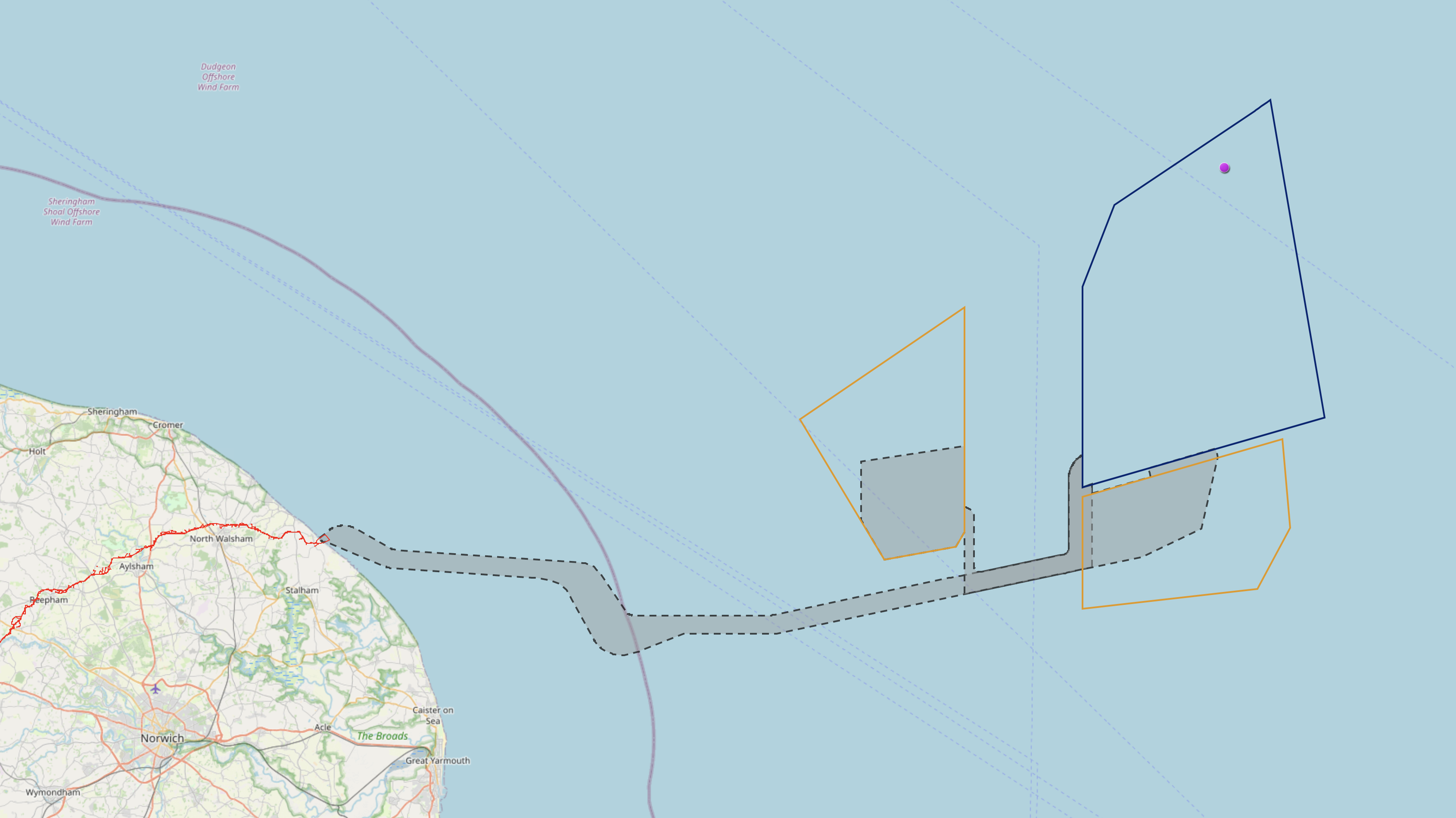
Note.
- Norfolk Boreas is outlined in blue.
- Norfolk Vanguard is outlined in orange.
- I assume the grey areas are where the cables will be laid.
- I estimate that the two farms are about fifty miles offshore.
This second map shows the landfall between Eccles-on-Sea and Happisburgh.
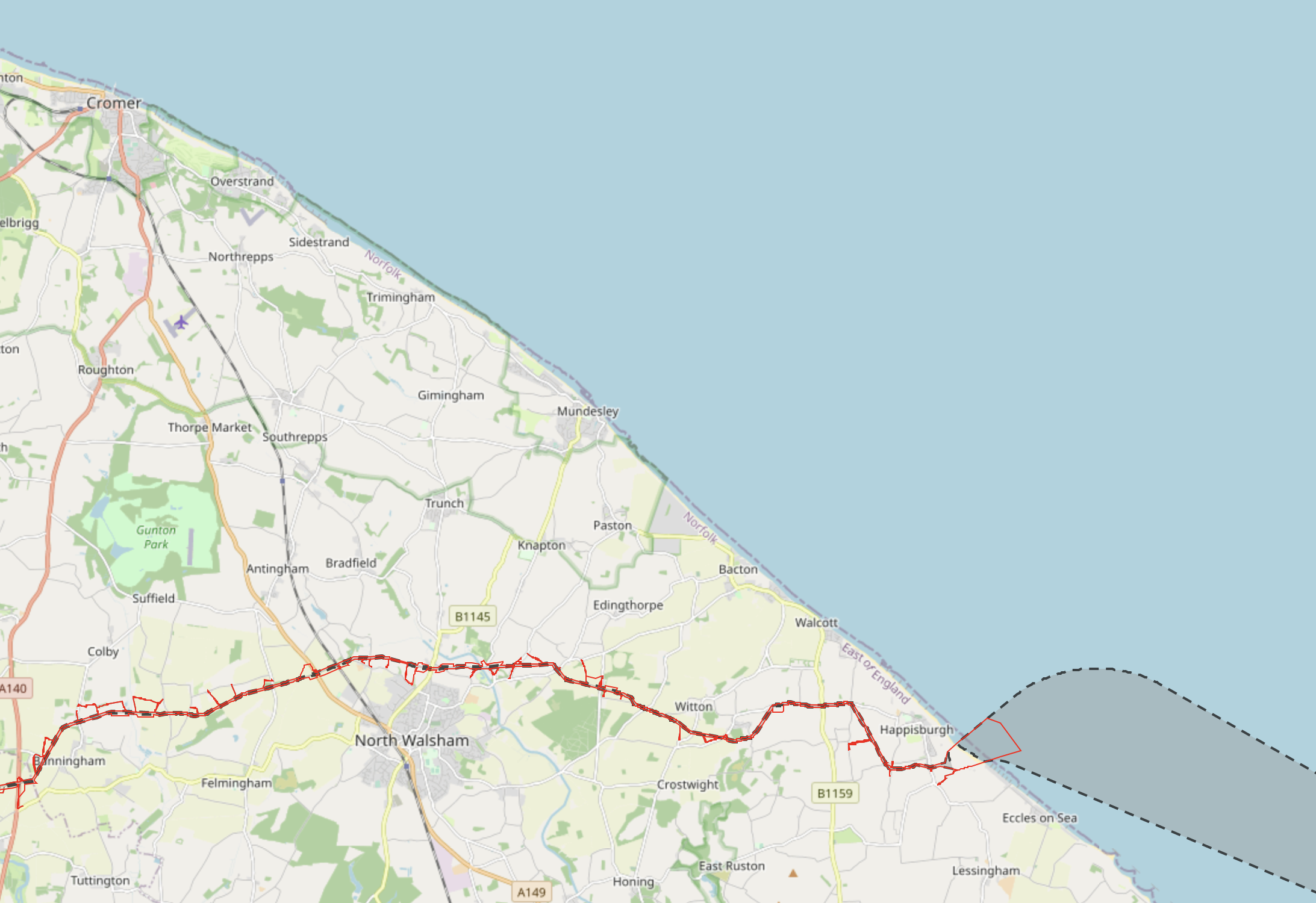
Note the underground cable goes half-way across Norfolk to Necton.
Electricity And Norfolk And Suffolk
This Google Map shows Norfolk and Suffolk.
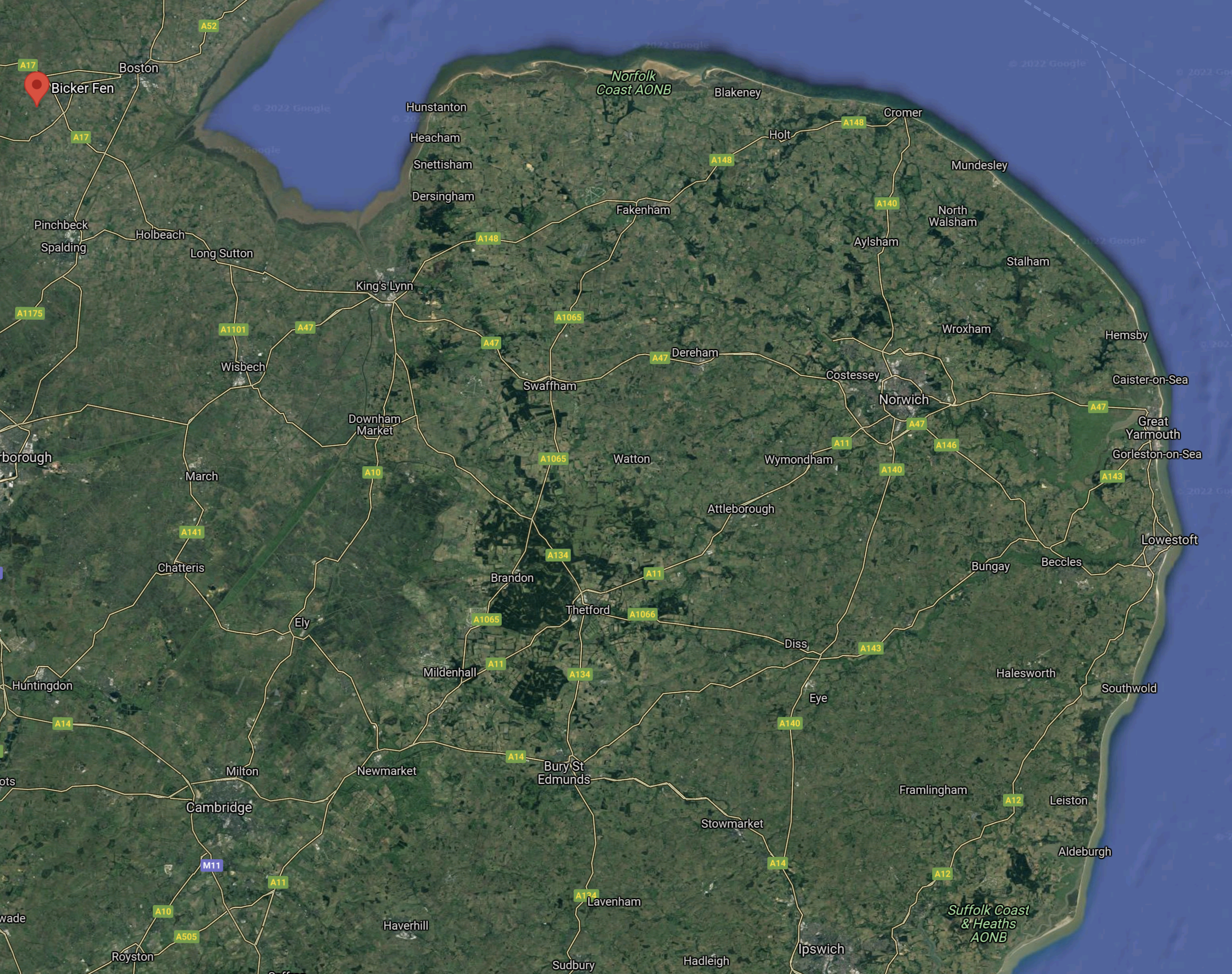
Note.
- The red arrow in the North-West corner marks the Bicker Fen substation that connects to the Viking Link to Denmark.
- The East Anglia Array connects to the grid at Bawdsey in the South-East corner of the map.
- Sizewell is South of Aldeburgh in the South-East corner of the map.
- The only ports are Lowestoft and Yarmouth in the East and Kings Lynn in the North-West.
There are few large towns or cities and little heavy industry.
- Electricity usage could be lower than the UK average.
- There are three small onshore wind farms in Norfolk and none in Suffolk.
- There is virtually no high ground suitable for pumped storage.
- There are lots of areas, where there are very few buildings to the square mile.
As I write this at around midday on a Saturday at the end of January, 49 % of electricity in Eastern England comes from wind, 20 % from nuclear and 8 % from solar. That last figure surprised me.
I believe that the wind developments I listed earlier could provide Norfolk and Suffolk with all the electricity they need.
The Use Of Batteries
Earlier, I talked of a maximum of over 7 GW of offshore wind around the cost of Norfolk and Suffolk, but there is still clear water in the sea to be filled between the existing and planned wind farms.
Batteries will become inevitable to smooth the gaps between the electricity produced and the electricity used.
Here are a few numbers.
- East Anglian Offshore Wind Capacity – 8 GW
- Off-Peak Hours – Midnight to 0700.
- Typical Capacity Factor Of A Windfarm – 20 % but improving.
- Overnight Electricity Produced at 20 % Capacity Factor – 11.2 GWh
- Sizewell B Output – 1.25 GW
- Proposed Sizewell C Output – 3.26 GW
- Largest Electrolyser – 24 MW
- World’s Largest Lithium-Ion Battery at Moss Landing – 3 GWh
- Storage at Electric Mountain – 9.1 GWh
- Storage at Cruachan Power Station – 7.1 GWh
Just putting these large numbers in a table tells me that some serious mathematical modelling will need to be performed to size the batteries that will probably be needed in East Anglia.
In the 1970s, I was involved in three calculations of a similar nature.
- In one, I sized the vessels for a proposed polypropylene plant for ICI.
- In another for ICI, I sized an effluent treatment system for a chemical plant, using an analogue computer.
- I also helped program an analysis of water resources in the South of England. So if you have a water shortage in your area caused by a wrong-sized reservoir, it could be my fault.
My rough estimate is that the East Anglian battery would need to be at least a few GWh and capable of supplying up to the output of Sizewell B.
It also doesn’t have to be a single battery. One solution would probably be to calculate what size battery is needed in the various towns and cities of East Anglia, to give everyone a stable and reliable power supply.
I could see a large battery built at Sizewell and smaller batteries all over Norfolk and Suffolk.
But why stop there? We probably need appropriately-sized batteries all over the UK, with very sophisticated control systems using artificial intelligent working out, where the electricity is best stored.
Note that in this post, by batteries, I’m using that in the loosest possible way. So the smaller ones could be lithium-ion and largest ones could be based on some of the more promising technologies that are under development.
- Highview Power have an order for a 50 MW/500 MWh battery for Chile, that I wrote about in The Power Of Solar With A Large Battery.
- East Anglia is an area, where digging deep holes is easy and some of Gravitricity’s ideas might suit.
- I also think that eventually someone will come up with a method of storing energy using sea cliffs.
All these developments don’t require large amounts of land.
East Anglia Needs More Heavy Consumers Of Electricity
I am certainly coming to this conclusion.
Probably, the biggest use of electricity in East Anglia is the Port of Felixstowe, which will be expanding as it becomes Freeport East in partnership with the Port of Harwich.
One other obvious use could be in large data centres.
But East Anglia has never been known for industries that use a lot of electricity, like aluminium smelting.
Conversion To Hydrogen
Although the largest current electrolyser is only 24 MW, the UK’s major electrolyser builder; ITM Power, is talking of a manufacturing capacity of 5 GW per year, so don’t rule out conversion of excess electricity into hydrogen.
Conclusion
Who needs Sizewell C?
Perhaps as a replacement for Sizewell B, but it would appear there is no pressing urgency.
Platform Construction Underway At Winslow On New East West Railway
The title of this post, is the same as that as this article on Rail Advent.
This picture from Network Rail shows the Winslow station construction site.
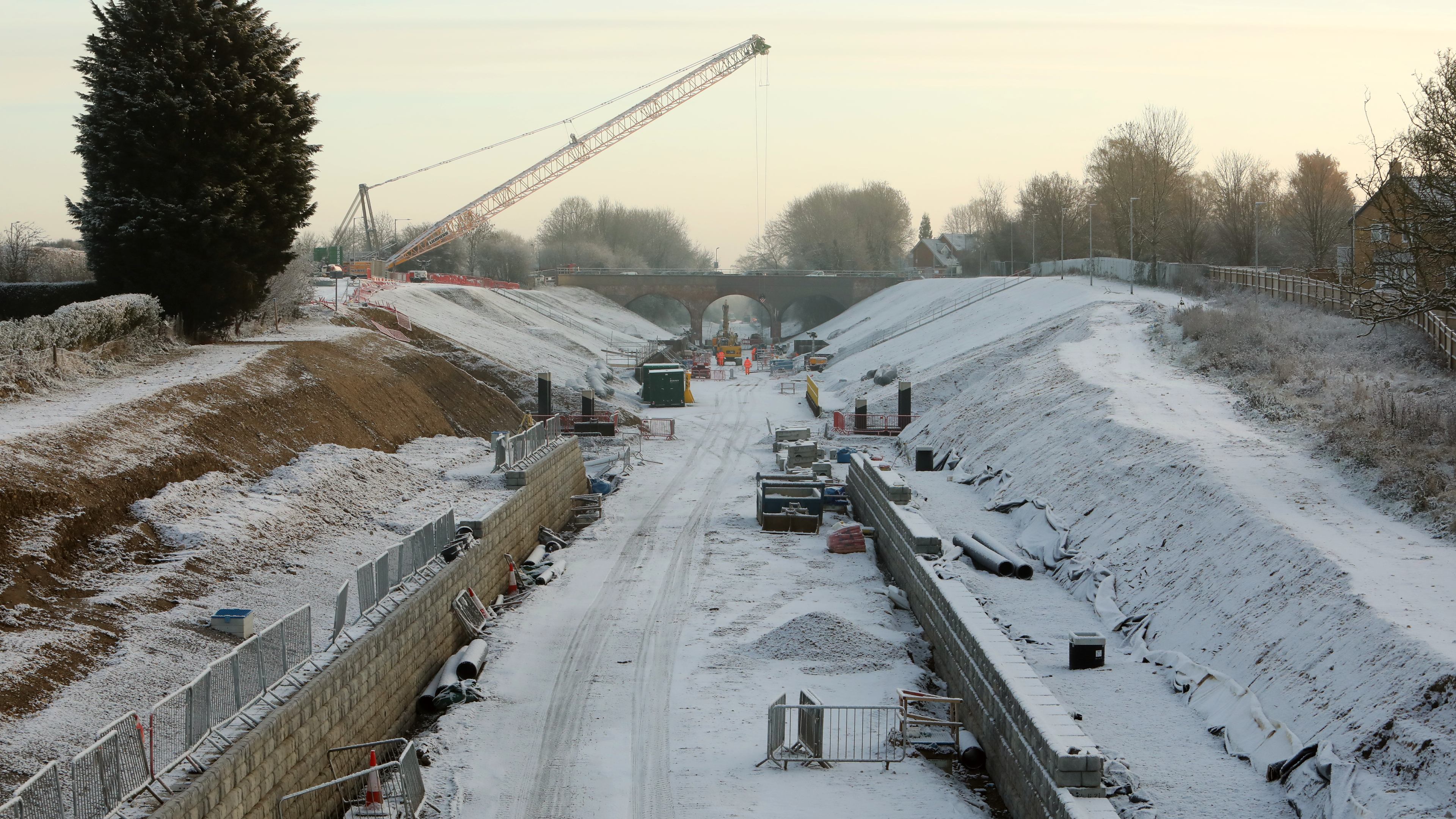
This paragraph from the Rail Advent article describes the operation.
A 250 tonne crawler crane is being used to lift over 500 pre-cast concrete platform units into position within new railway cutting. As there is limited space available on site, a smartphone app has been developed to allow the platform units to be called for delivery in the exact construction sequence. The crane’ ‘lattice boom’ is 62-metres long , which is taller than Nelson’s Column.
That all sounds like good project management to me.
 The Anonymous Widower