Rolls-Royce Supplies mtu On-Board Power Generators For Baleària’s Electric Ferries On The Route Between Europe And Africa
The title of this post, is the same as that of this press release from Rolls-Royce.
These are the three bullet points.
- Eight mtu emergency power generators ensure power supply on two fully electric, emission-free fast ferries operated by the shipping company Baleària
- Over 11,000 kW total output as backup for electric operation
- To be used on the route between Tarifa (Spain) and Tangier (Morocco) starting in 2027
These are the first two paragraphs.
Rolls-Royce’s Power Systems division is supplying a total of eight mtu emergency power generators for two fully electric fast ferries belonging to the Spanish shipping company Baleària. From 2027, the ships will cover the 18 nautical miles between Tarifa in Spain and Tangier in Morocco using electric power, thereby opening up the first “green corridor” between Europe and Africa.
The project is considered a milestone for CO2-neutral mobility at sea and is supported by an international network of partners consisting of shipping companies, shipyards, port authorities, energy suppliers, and other companies.
Note.
- The route is only 18 nautical miles.
- Each ferry can accommodate 804 passengers and 225 cars.
- The ferries have a cruise of 26 knots.
- The project is considered a milestone for CO2-neutral mobility at sea.
- Each ship will have an installed power of 11,000 kW on both electric and diesel.
- They should go into service in 2027.
I know little about ships, but these look to be the business and I can see them sneaking silently into ports everywhere.
But AI might, so I’ll ask a few questions.
How Will Baleraia’s New Fast Ferries Handle Rough Weather?
This was replied.
Baleària’s new fast ferries, such as the Eleanor Roosevelt and Margarita Salas, incorporate advanced stabilization and hull systems designed to improve comfort and reliability in adverse sea conditions. However, as with all maritime transport, sailings can still be cancelled or delayed due to severe weather for safety. reasons.
It certainly looks like the Spaniards are going for it.
Hydrogen In Aviation Offers Potential For Growth And Deeper Emissions Reductions, New Study Shows
The title of this post, is the same as that of this press release from Rolls-Royce.
These five paragraphs compose the press release.
Rolls-Royce, easyJet, Heathrow and University College London Air Transportation Systems Lab (UCL ATSLab) published a report highlighting how hydrogen-powered aircraft could enable European and UK aviation to cut carbon emissions while supporting future growth.
The study, Enabling Hydrogen in the European Aviation Market, found that hydrogen in aviation offers a unique opportunity to achieve both emissions reduction and market expansion. The analysis shows that introducing hydrogen alongside Sustainable Aviation Fuel (SAF) can accelerate progress towards net zero, particularly when policy incentives reward low-carbon fuels and if hydrogen were to be included within the EU’s SAF mandate.
The research also found that targeted hydrogen infrastructure at around 20 major European airports, including Heathrow, could deliver more than 80% of the emissions benefits of full hydrogen availability across the continent. Concentrating investment at key ‘hydrogen hubs’ would therefore provide a practical and cost-effective path to early adoption.
Further modelling indicates that the earlier novel technologies, such as hydrogen, can be introduced, the more opportunity they present for CO2 emission reductions, underscoring the value of early technological transition where it is financially and technically viable.
The study is underpinned by UCL ATSLab’s Airline Behaviour Model (ABM), which represents the complexity of airline decision-making through specific behavioural variables. Building on this, the research evaluates how fuel costs, incentives and new technologies shape airline responses. This provides a research-based, realistic picture of how hydrogen adoption could evolve, highlighting both opportunities and potential challenges for adoption.
Note, these two sentences recommending early adoption of hydrogen.
- Concentrating investment at key ‘hydrogen hubs’ would therefore provide a practical and cost-effective path to early adoption.
- Further modelling indicates that the earlier novel technologies, such as hydrogen, can be introduced, the more opportunity they present for CO2 emission reductions.
I also suspect, that introducing hydrogen early, feeds back to reduce Co2 emissions.
But what is Trump’s considered view on hydrogen aircraft?
Google AI gives this answer to my question.
Donald Trump’s view on hydrogen for transportation, including potential use in aircraft, is highly skeptical due to perceived safety risks and effectiveness concerns, which generally aligns with his broader opposition to green energy initiatives. He has specifically criticized hydrogen-powered vehicles as being dangerous and “prone to blowing up”.
Note.
- I used to work in a hydrogen factory and it’s still producing hydrogen.
- I doubt Trump gets on well with Jennifer Rumsey, who is CEO of Cummins, who are one of the world’s largest diesel-engine companies, who are following a zero-carbon route.
- Is Formula One Likely To Go To Hydrogen Fuel? This would set the Cat Among The Pigeons
I also feel that this University College London study will create a string of converts to hydrogen.
Rolls-Royce To Power Etihad Fleet Expansion
tThe title of this post, is the same as that of this press release from Rolls-Royce.
These two paragraphs form the heart of the announcement.
Rolls-Royce (LSE: RR., ADR: RYCEY) welcomes announcement by Etihad Airways that it will expand its widebody fleet with aircraft powered by Trent 7000 and Trent XWB-97 engines.
At this week’s Dubai Airshow, the Middle Eastern carrier announced its intention to select 15 Airbus A330 Neo powered by the Trent 7000; seven Airbus A350-1000 powered by the Trent XWB-97; and 10 Airbus A350F freighter variants also powered by the Trent XWB-97.
Note.
- 32 twin-engined aircraft will need more than 64 engines, if you include spares.
- A 2014 list price of $37.9 million per Trent 7000 engine is a reference point.
- The contract would probably include a number of years of ongoing maintenance.
That is certainly what you could call a multi-billion dollar contract.
Rolls-Royce Successfully Tests First Pure Methanol Marine Engine – Milestone For More Climate-Friendly Propulsion Solutions
The title of this post, is the same as that of this press release from Rolls-Royce.
These four bullet points act as sub-headings.
- World first: first high-speed 100 percent methanol engine for ships successfully tested
- Cooperation: Rolls-Royce, Woodward L’Orange and WTZ Roßlau are developing sustainable propulsion technology in the meOHmare research project
- Green methanol: CO2-neutral, clean and safe marine fuel
- Dual-fuel engines as a bridging technology on the road to climate neutrality
Rolls-Royce has successfully tested the world’s first high-speed marine engine powered exclusively by methanol on its test bench in Friedrichshafen. Together with their partners in the meOHmare research project, Rolls-Royce engineers have thus reached an important milestone on the road to climate-neutral and environmentally friendly propulsion solutions for shipping.
“This is a genuine world first,” said Dr. Jörg Stratmann, CEO of Rolls-Royce Power Systems AG. “To date, there is no other high-speed engine in this performance class that runs purely on methanol. We are investing specifically in future technologies in order to open up efficient ways for our customers to reduce CO2 emissions and further expand our leading role in sustainable propulsion systems.”
Rolls-Royce’s goal is to offer customers efficient ways to reduce their CO2 emissions, in-line with the ‘lower carbon’ strategic pillar of its multi-year transformation programme. The project also aligns with the strategic initiative in Power Systems to grow its marine business.
These are some questions.
Why Methanol?
Rolls-Royce answer this question in the press release.
Green methanol is considered one of the most promising alternative fuels for shipping. If it is produced using electricity from renewable energies in a power-to-X process, its operation is CO2-neutral. Compared to other sustainable fuels, methanol is easy to store, biodegradable, and causes significantly fewer pollutants.
“For us, methanol is the fuel of the future in shipping – clean, efficient, and climate-friendly. It burns with significantly lower emissions than fossil fuels and has a high energy density compared to other sustainable energy sources,” said Denise Kurtulus.
Note that Denise Kurtulus is Senior Vice President Global Marine at Rolls-Royce.
Could Methanol-Powered Engines Be Used In Railway Locomotives?
Given, there are hundreds of railway locomotives, that need to be decarbonised, could this be handled by a change of fuel to methanol?
I asked Google AI, the question in the title of this section and received the following answer.
Yes, methanol-powered engines can be used in railway locomotives, but they require a modification like high-pressure direct injection (HPDI) technology to be used in traditional compression ignition (CI) diesel engines. These modified engines typically use methanol as the primary fuel with a small amount of diesel injected to act as a pilot fuel for ignition, a process known as “pilot ignition”. Research and simulations have shown that this approach can achieve performance and thermal efficiencies close to those of standard diesel engines
From the bullet points of this article, it looks like Rolls-Royce have this pilot ignition route covered.
How Easy Is Methanol To Handle?
Google AI gave this answer to the question in the title of this section.
Methanol is not easy to handle safely because it is a highly flammable, toxic liquid that can be absorbed through the skin, inhaled, or ingested. It requires rigorous safety measures, proper personal protective equipment (PPE), and good ventilation to mitigate risks like fire, explosion, and severe health consequences, including blindness or death.
It sounds that it can be a bit tricky, but then I believe with the right training much more dangerous chemicals than methanol can be safety handled.
How Easy Is Green Methanol To Produce?
Google AI gave this answer to the question in the title of this section.
Producing green methanol is not easy; it is currently more expensive and capital-intensive than traditional methods due to high production costs, feedstock constraints, and the need for specialized infrastructure. However, new technologies are making it more feasible, with methods that combine renewable energy with captured carbon dioxide and renewable hydrogen to synthesize methanol.
Production methods certainly appear to be getting better and greener.
Which Companies Produce Methanol In The UK?
Google AI gave this answer to the question in the title of this section.
While there are no major, existing methanol production companies in the UK, Proman is planning to build a green methanol plant in the Scottish Highlands, and other companies like Wood PLC and HyOrc are involved in the engineering and construction of methanol production facilities in the UK. Several UK-based companies also act as distributors or suppliers for products, such as Brenntag, Sunoco (via the Anglo American Oil Company), and JennyChem.
It does appear, that we have the capability to build methanol plants and supply the fuel.
How Is Green Methanol Produced?
Google AI gave this answer to the question in the title of this section.
Green methanol is produced by combining carbon dioxide and hydrogen under heat and pressure, where the hydrogen is created using renewable electricity and the carbon dioxide is captured from sustainable sources like biomass or industrial emissions. Two main pathways exist e-methanol uses green hydrogen and captured carbon dioxide, while biomethanol is made from the gasification of biomass and other organic waste.
Note.
- We are extremely good at producing renewable electricity in the UK.
- In Rolls-Royce To Be A Partner In Zero-Carbon Gas-Fired Power Station In Rhodesia, I discuss how carbon dioxide is captured from a power station in Rhodesia, which is a suburb of Worksop.
In the Rhodesia application, we have a Rolls-Royce mtu engine running with carbon-capture in a zero-carbon manner, producing electricity and food-grade carbon-dioxide, some of which could be used to make methanol to power the Rolls-Royce mtu engines in a marine application.
I am absolutely sure, that if we need green methanol to power ships, railway locomotives and other machines currently powered by large diesel engines, we will find the methods to make it.
What Are The Green Alternatives To Methanol For Ships?
This press release from Centrica is entitled Investment in Grain LNG, and it gives hints as to their plans for the future.
This heading is labelled as one of the key highlights.
Opportunities for efficiencies to create additional near-term value, and future development options including a combined heat and power plant, bunkering, hydrogen and ammonia.
Bunkering is defined in the first three paragraphs of its Wikipedia entry like this.
Bunkering is the supplying of fuel for use by ships (such fuel is referred to as bunker), including the logistics of loading and distributing the fuel among available shipboard tanks. A person dealing in trade of bunker (fuel) is called a bunker trader.
The term bunkering originated in the days of steamships, when coal was stored in bunkers. Nowadays, the term bunker is generally applied to the petroleum products stored in tanks, and bunkering to the practice and business of refueling ships. Bunkering operations take place at seaports and include the storage and provision of the bunker (ship fuels) to vessels.
The Port of Singapore is currently the largest bunkering port in the world. In 2023, Singapore recorded bunker fuel sales volume totaling 51,824,000 tonnes, setting a new industry standard.
Note.
- After Rolls-Royce’s press release, I suspect that methanol should be added to hydrogen and ammonia.
- I don’t think Centrica will be bothered to supply another zero-carbon fuel.
- I can see the Isle of Grain providing a lot of fuel to ships as they pass into London and through the English Channel.
- Centrica have backed HiiROC technology, that makes hydrogen efficiently.
I can see the four fuels ammonia, hydrogen, LNG and methanol competing with each other.
What Are The Green Alternatives To Methanol For Railway Locomotives?
The same fuels will be competing in the market and also Hydrotreated Vegetable Oil (HVO) will be used.
Rolls-Royce To lead EU’s New Clean Aviation project UNIFIED To Transform And Decarbonise Aviation
The title of this post the same as that of this press release from Rolls-Royce.
These two opening paragraphs add a few details.
Rolls-Royce has been selected by the European Union’s Clean Aviation programme to lead one of 12 groundbreaking new projects aiming to decarbonise aviation. These initiatives, which include new aircraft concepts and innovative propulsion technologies, will receive funding of about €945 million.
The Clean Aviation Joint Undertaking (CAJU) is the European Union’s leading research and innovation programme for transforming aviation towards a sustainable and climate neutral future.
I asked Google AI about the European Union’s Clean Aviation programme and received this reply.
The European Union’s Clean Aviation programme, part of the Horizon Europe research initiative, is a public-private partnership aimed at developing disruptive, climate-neutral aviation technologies, including hydrogen-powered, hybrid-electric, and ultra-efficient aircraft, to achieve net-zero emissions by 2050. Launched in 2022, it has a budget of €4.1 billion (€1.7 billion from the EU, €2.4 billion from private partners) and focuses on technologies that will be integrated into a new generation of short- to medium-range aircraft with a target entry into service by 2035. Key goals include a 30% reduction in CO2 emissions and energy efficiency compared to 2020 standards for new aircraft by 2030, with a long-term objective of climate-neutral aviation by 2050.
Note.
- Only someone like Trump would think that the key goals in the last sentence were not worthwhile.
- €4.1 billion in the right place could be a very good start.
- There is a Clean Aviation web site.
The press release says this about the UNIFIED project.
UNIFIED – Ultra Novel and Innovative Fully Integrated Engine Demonstrations
The UNIFIED consortium is led by Rolls-Royce and contains key industrial, academic and research partners across France, Germany, the Netherlands, Norway, Spain and the United Kingdom. Subject to successful completion of grant preparation, the project will enable ground testing of an UltraFan® technology demonstrator at a short to medium range thrust class for future narrowbody aircraft and also enable the preparation of key activities towards future flight test of the UltraFan architecture.
I am not surprised Ultrafan is mentioned.
The Wikipedia entry for the Rolls-Royce Trent has a section about the UltraFan, which starts with these two paragraphs.
The UltraFan is a geared turbofan with a variable pitch fan system that promises at least 25% efficiency improvement. The UltraFan aims for a 15:1 bypass ratio and 70:1 overall pressure ratio.
The Ultrafan keeps the Advance core, but also contains a geared turbofan architecture with variable-pitch fan blades. The fan varies pitch to optimise for each flight phase, eliminating the need for a thrust reverser. Rolls-Royce planned to use carbon composite fan blades instead of its usual hollow titanium blades. The combination was expected to reduce weight by 340 kg (750 lb) per engine.
Note.
- 25 % is a very good efficiency improvement.
- No thrust reverser.
- A saving of 340 kg. in weight per engine.
It should also be noted that October 2028, will see the hundredth anniversary of Henry Royce sketching the R-type engine in the sand on the beach in Sussex.
The R-type was the engine that won the Schneider Trophy outright and enabled Rolls-Royce’s engineers to design the unrivalled Merlin engine that powered Hurricanes, Spitfires, Mosquitos, Mustangs and Lancasters in World War Two.
Raft Of US-UK Nuclear Deals Ahead Of Trump Visit
The title of this post, is the same as that of this article on World Nuclear News.The article is a good summary of all the deals done between the US and UK governments concerning next-generation nuclear power.
This is the introduction.
Several agreements have been signed between UK and US companies to advance the deployment of small modular reactors and advanced reactors in both countries. The deals were signed ahead of the state visit of President Donald Trump to the UK later this week.
The whole article is a must-read.
These are my posts, that are related to the main agreement.
- Centrica And X-energy Agree To Deploy UK’s First Advanced Modular Reactors
- Nuclear Plan For Decommissioned Coal Power Station
- Rolls-Royce Welcomes Action From UK And US Governments To Usher In New ‘Golden Age’ Of Nuclear Energy
I shall finish it later.
Rolls-Royce Welcomes Action From UK And US Governments To Usher In New ‘Golden Age’ Of Nuclear Energy
The title of this post, is the same as that of this press release from Rolls-Royce.
These three paragraphs introduce the press release.
The agreement between the UK and US Governments to deepen cooperation in advanced nuclear technologies and make it quicker for companies to build new nuclear power stations sets the stage for a significant step forward in the energy security and resilience of the two nations. The Atlantic Partnership for Advanced Nuclear Energy will help ensure the accelerated development and deployment of advanced nuclear reactor technologies in the US and UK. Building a bridge between the world’s first and world’s largest civil nuclear power markets.
The global market for advanced nuclear technologies is estimated to be worth many trillions up to 2050. Secure, scalable and reliable power across civil, defence, industrial and maritime sectors is needed to meet growing demands in digital and AI. In the US alone, demand for nuclear power is forecast to grow from 100GWe to 400GWe by 2050.
Rolls-Royce stands ready to seize the opportunity to further innovate and partner in the development of advanced nuclear technologies which will deliver thousands of skilled jobs, attract investment and support the economic growth of both the US and the UK.
Note.
- Rolls-Royce have several partners for the SMR, who include Siemens and a couple of American companies.
- Rolls-Royce are involved with US company; BWXT, in one of the consortia developing a micro-reactor for the US Department of Defense, which I wrote about in Rolls-Royce To Play Key Role In US Department Of Defense Nuclear Microreactor Program.
- Rolls-Royce also has a large design, development and manufacturing presence in the United States.
- The new engines for the B-52s are from Rolls-Royce.
Rolls-Royce has a very strong footprint in the United States.
Centrica And X-energy Agree To Deploy UK’s First Advanced Modular Reactors
The title of this post, is the same as that of this press release from Centrica.
This is the sub-heading.
Centrica and X-Energy, LLC, a wholly-owned subsidiary of X-Energy Reactor Company, LLC, today announced their entry into a Joint Development Agreement (JDA) to deploy X-energy’s Xe-100 Advanced Modular Reactors (“AMR”) in the United Kingdom.
These three paragraphs add more details.
The companies have identified EDF and Centrica’s Hartlepool site as the preferred first site for a planned U.K. fleet of up to 6 gigawatts.
The agreement represents the first stage in a new trans-Atlantic alliance which could ultimately mobilise at least £40 billion in economic value to bring clean, safe and affordable power to thousands of homes and industries across the country and substantive work for the domestic and global supply chain.
A 12-unit Xe-100 deployment at Hartlepool could add up to 960 megawatts (“MW”) of new capacity, enough clean power for 1.5 million homes and over £12 billion in lifetime economic value. It would be developed at a site adjacent to Hartlepool’s existing nuclear power station which is currently scheduled to cease generating electricity in 2028. Following its decommissioning, new reactors would accelerate opportunities for the site and its skilled workforce. The site is already designated for new nuclear under the Government’s National Policy Statement and a new plant would also play a critical role in generating high-temperature heat that could support Teesside’s heavy industries.
This is no toe-in-the-water project, but a bold deployment of a fleet of small modular reactors to provide the power for the North-East of England for the foreseeable future.
These are my thoughts.
The Reactor Design
The Wikipedia entry for X-energy has a section called Reactor Design, where this is said.
The Xe-100 is a proposed pebble bed high-temperature gas-cooled nuclear reactor design that is planned to be smaller, simpler and safer when compared to conventional nuclear designs. Pebble bed high temperature gas-cooled reactors were first proposed in 1944. Each reactor is planned to generate 200 MWt and approximately 76 MWe. The fuel for the Xe-100 is a spherical fuel element, or pebble, that utilizes the tristructural isotropic (TRISO) particle nuclear fuel design, with high-assay LEU (HALEU) uranium fuel enriched to 20%, to allow for longer periods between refueling. X-energy claims that TRISO fuel will make nuclear meltdowns virtually impossible.
Note.
- It is not a conventional design.
- Each reactor is only about 76 MW.
- This fits with “12-unit Xe-100 deployment at Hartlepool could add up to 960 megawatts (“MW”) of new capacity” in the Centrica press release.
- The 960 MW proposed for Hartlepool is roughly twice the size of the Rolls-Rpoyce SMR, which is 470 MW .
- Safety seems to be at the forefront of the design.
- I would assume, that the modular nature of the design, makes expansion easier.
I have no reason to believe that it is not a well-designed reactor.
Will Hartlepool Be The First Site?
No!
This page on the X-energy web site, describes their site in Texas, which appears will be a 320 MW power station providing power for Dow’s large site.
There appear to be similarities between the Texas and Hartlepool sites.
- Both are supporting industry clustered close to the power station.
- Both power stations appear to be supplying heat as well as electricity, which is common practice on large industrial sites.
- Both use a fleet of small modular reactors.
But Hartlepool will use twelve reactors, as opposed to the four in Texas.
How Will The New Power Station Compare With The Current Hartlepool Nuclear Power Station?
Consider.
- The current Hartlepool nuclear power station has two units with a total capacity of 1,185 MW.
- The proposed Hartlepool nuclear power station will have twelve units with a total capacity of 960 MW.
- My instinct as a Control Engineer gives me the feeling, that more units means higher reliability.
- I suspect that offshore wind will make up the difference between the power output of the current and proposed power stations.
As the current Hartlepool nuclear power station is effectively being replaced with a slightly smaller station new station, if they get the project management right, it could be a painless exercise.
Will This Be The First Of Several Projects?
The press release has this paragraph.
Centrica will provide initial project capital for development with the goal of initiating full-scale activities in 2026. Subject to regulatory approval, the first electricity generation would be expected in the mid-2030s. Centrica and X-energy are already in discussions with additional potential equity partners, as well as leading global engineering and construction companies, with the goal of establishing a UK-based development company to develop this first and subsequent projects.
This approach is very similar to the approach being taken by Rolls-Royce for their small modular reactors.
Will Centrica Use An X-energy Fleet Of Advanced Modular Reactors At The Grain LNG Terminal?
This press release from Centrica is entitled Investment In Grain LNG Terminal.
This is one of the key highlights of the press release.
Opportunities for efficiencies to create additional near-term value, and future development options including a combined heat and power plant, bunkering, hydrogen and ammonia.
Note.
- Bunkering would be provided for ships powered by LNG, hydrogen or ammonia.
- Heat would be needed from the combined heat and power plant to gasify the LNG.
- Power would be needed from the combined heat and power plant to generate the hydrogen and ammonia and compress and/or liquify gases.
Currently, the heat and power is provided by the 1,275 MW Grain CHP gas-fired power station, but a new nuclear power station would help to decarbonise the terminal.
Replacement Of Heysham 1 Nuclear Power Station
Heysham 1 nuclear power station is part-owned by Centrica and EdF, as is Hartlepool nuclear power station.
Heysham 1 nuclear power station is a 3,000 MW nuclear power station, which is due to be decommissioned in 2028.
I don’t see why this power station can’t be replaced in the same manner as Hartlepool nuclear power station.
Replacement Of Heysham 2 Nuclear Power Station
Heysham 2 nuclear power station is part-owned by Centrica and EdF, as is Hartlepool nuclear power station.
Heysham 2 nuclear power station is a 3,100 MW nuclear power station, which is due to be decommissioned in 2030.
I don’t see why this power station can’t be replaced in the same manner as Hartlepool nuclear power station.
Replacement Of Torness Nuclear Power Station
Torness nuclear power station is part-owned by Centrica and EdF, as is Hartlepool nuclear power station.
Torness nuclear power station is a 1,290 MW nuclear power station, which is due to be decommissioned in 2030.
I don’t see why this power station can’t be replaced in the same manner as Hartlepool nuclear power station.
But the Scottish Nationalist Party may have other ideas?
What Would Be The Size Of Centrica’s And X-energy’s Fleet Of Advanced Modular Reactors?
Suppose.
- Hartlepool, Grain CHP and Torness power stations were to be replaced by identical 960 MW ADRs.
- Heysham 1 and Heysham 2 power stations were to be replaced by identical 1,500 MW ADRs.
This would give a total fleet size of 5,880 MW.
A paragraph in Centrica’s press release says this.
The companies have identified EDF and Centrica’s Hartlepool site as the preferred first site for a planned U.K. fleet of up to 6 gigawatts.
This fleet is only 120 MW short.
Rolls-Royce SMR Advances To Final Stage In Swedish Nuclear Competition
The title of this post, is the same as that of this press release from Rolls-Royce.
This is the sub-heading.
Rolls-Royce SMR has been selected by Vattenfall as one of only two companies to reach the final stage in the process to identify Sweden’s nuclear technology partner.
These are the first two paragraphs, which add details.
After being shortlisted in 2024, Rolls-Royce SMR has progressed through a detailed assessment and will now work with Vattenfall through the final technology selection which could initially result in Rolls-Royce SMR delivering three SMRs.
This positive news is testament to Rolls-Royce SMR’s transformative approach to delivering proven nuclear technology in an innovative way through modularisation and builds on our successful selection in both the United Kingdom and Czech Republic.
Some other points from the press release.
- Sweden is initially looking to build three SMRs.
- Each SMR will supply 470MWe of clean low-carbon electricity.
- They are expected to have a lifetime of sixty years. Sizewell B was originally expected to have a lifetime of forty years, but appears to be being extended to sixty years, so I will accept Rolls-Royce’s expected lifetime.
- The first units will be at the Ringhals site on the Värö Peninsula, where there is an existing nuclear power station.
This Google Map shows the Ringhals site in relation to Gothenburg.
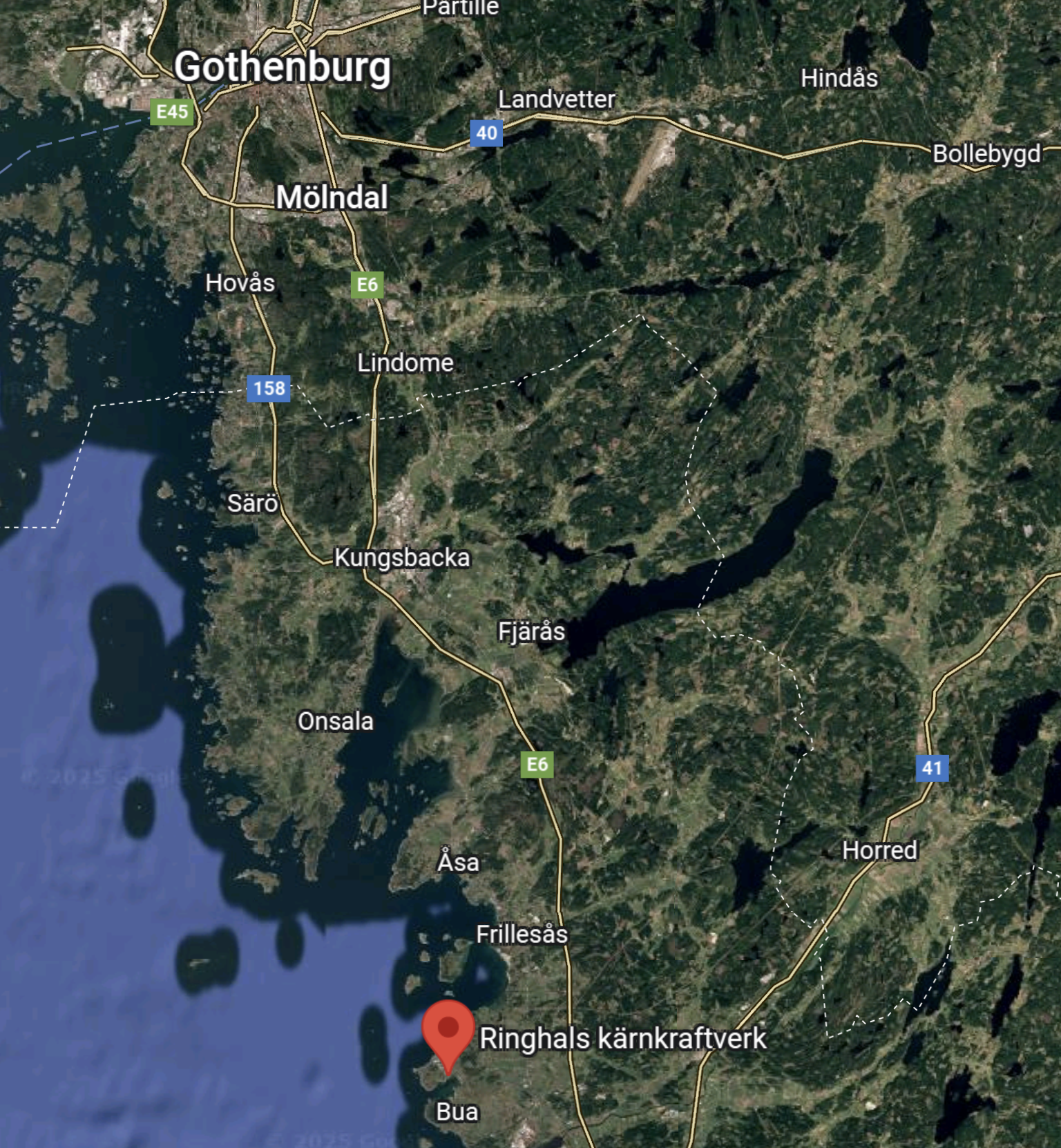
The site is marked by the red arrow.
On taking a closer look, it appears to be a site with expansion possibilities.
The British Media Don’t Seem Very Interested
It is now the 31st of August and the only paper to report the story has been the Financial Times.
SNP Ban On ‘Munitions’ Funds Puts Scottish Shipbuilding On The Line
The title of this post is the same as that of this article on The Times.
This is the sub-heading.
The president of Rolls-Royce submarines says plans for a world-class welding centre on the Clyde are at risk of being cancelled within days
These three paragraphs add more details to the story.
Ambitious plans to reverse a historic decline in Scottish shipbuilding are at risk after a £2.5 million taxpayer grant was axed due to an SNP ban on “munitions” funding.
A plan to build a specialist welding centre on the banks of the Clyde is now in grave doubt after Scottish Enterprise, the national economic development agency, was accused of reneging on a pledge to fund a building for the world-class facility.
Rolls-Royce, which is ready to support the project by providing £11 million worth of specialist equipment, expressed “dismay” at the news, saying the project had been classified as a “munitions” scheme solely on the basis that it would “support the construction of naval vessels”.
Given the experience of the Scottish Government in building ferries is documented in this Wikipedia entry, which is entitled Scottish Ferry Fiasco, the SNP must know something about how not to build ships.
The comments from readers of the Times Article are scathing, with many coming from those with Scottish names.
Welding And Nuclear Power
It doesn’t mention the other big use for welding in this article and that is in the manufacture of nuclear reactors. In fact one of the members of the Rolls-Royce consortium, that will build their small modular nuclear reactors is The Welding Institute – No prizes for guessing what they do!
Does that mean that Scotland won’t have anything to do with small modular nuclear reactors? Either in their manufacture or use.
This article in New Civil Engineer is entitled UK Plans New Nuclear Plant In Scotland Despite Scottish Government Opposition.
So if the Scottish Government wants nothing to do with making expensive, quality vessels for the nuclear industry, Rolls-Royce would surely be better building the welding centre in an area of the UK that would appreciate it.
Scots In High Positions Of Power
I like Scotland and the Scots and possibly, at one time, with all the North Sea Oil and Gas, I could have thought about relocating North of the Border. But I’m very glad I didn’t!
It does seem to me though, that when some Scots get to high positions of power, that they lose all sense of reason.
I would nominate.
- Fred the Shred
- The SNP
- That half-Scot, who was lucky enough to be elected US President twice.
There must be a few others.
 The Anonymous Widower